ORDER
Arun Khodpia, Accountant Member. – This appeal is preferred by the Revenue, directed against the order of the Commissioner of Income Tax Appeals, National Faceless Appeal Centre (NFAC), Delhi [in short, “the Ld. CIT(A)”], dated 07.08.2025 for the Assessment Year (AY) 2013-14,arises from the assessment order under section 143(3) of the Income Tax Act, 1961 [in short, “the Act”] dated 31.03.2016, passed by ACIT Circle-16(2), Hyderabad [in short, “the Ld.AO”]. The grounds of appeal raised by the Revenue are as under:
“1. Whether, on the facts and in the circumstances of the case and in law, the Ld. CIT(A) is justified in allowing the claim of cost of production of TV Serials and programmes as revenue expenditure as against the AO’s action in treating the same as capital expenditure?
2. Whether, on the facts and in the circumstances of the case and in law, the Ld. CIT(A) is justified in allowing the cost of production of TV Serials and programmes as revenue expenditure, when incurring of such expenditure resulted in creation of asset with enduring benefit because of its repeat telecast value?
3. Whether, on the facts and in the circumstances of the case and in law, the Ld. CIT(A) is justified in ignoring that Rules 9A and 9B are applicable only for production of feature films and not for production of TV Serials and programmes?
4. Whether, on the facts and in the circumstances of the case and in law, the Ld. CIT(A) is justified in not considering that the expenses in production of TV Serials and programmes created an Intangible asset which has to be depreciated over its lifetime?
5. Whether, on the facts and in the circumstances of the case and in law, the Ld. CIT(A) is justified in allowing depreciation @ 25% on ‘Film Software Library” holding the same as intangible asset?
6. Whether, on the facts and in the circumstances of the case and in law, the Ld. CIT(A) erred in allowing depreciation at 60% on computer peripherals, although such items are not included in the block of “computers including software” under the Income-tax Rules. Peripherals such as printers, scanners, modems, and routers are independent assets with standalone utility and are not classified as computers in the depreciation schedule.
7. Whether, on the facts and in the circumstances of the case and in law, the Ld. CIT(A) erred in treating the non-compete payment as an “intangible asset” eligible for depreciation under section 32(1)(ii), even though the covenant is purely personal, nonexclusive, non-assignable, and devoid of any enduring or independent commercial value.
8. The appellant craves to leave, to add, to amend or alter any of the ground of appeal, if need be.”
2. Brief facts of the case are that the assessee-company was formed as a result of demerger of M/s Ushodaya Enterprises Pvt Ltd., who was interalia in the business of purchasing and telecasting entertainment/news/information programmes under the trade name of ETV and has demerged its television business into three companies namely, i. M/s. Enadu Television Private Limited (ETPL) ii. M/s. Prism TV Private Limited (Prism TPL) and iii. M/s. Panorama Television Private Limited (PTPL). The aforesaid scheme of arrangement was approved by Hon’ble Court of Andhra Pradeshu/s 391 and 394 of Companies Act, 1956 vide order dated 15th December, 2010, effective from 1st April, 2010. The ITR for AY 2013-14 was filed by the assessee on 01.12.2013, declaring total income at Rs.33,98,58,450/- and book profit u/s 115JB at Rs.33,98,58,450/-. The return of assessee was processed u/s 143(1). Subsequently, the case was selected for scrutiny, accordingly notice u/s 143(2) was issued. In response to notices, Ld. Authorized Representatives of the assessee attended and furnished the information before the Ld. AO. After deliberation on the information and response furnished by the assessee, Ld. AO has recomputed taxable income of the assessee with following disallowances / additions:
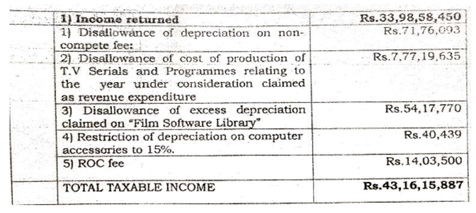
3. Being aggrieved with the aforesaid additions/disallowances made by the Ld. AO, the assessee preferred an appeal before the Ld. CIT(A), who had partly allowed the appeal of assessee, but all the substantive additions are directed to be deleted. Being dissatisfied with the decision of Ld. CIT(A), the Revenue is in appeal before us.
4. After hearing both the parties on the issues wherein the Ld. AR of the assessee supported the order of Ld. CIT(A) and also furnished written submission qua each of the additions made by the Ld. AO and deleted by the Ld. CIT(A).
5. On the other hand, Ld. Senior DR representing the Revenue vehemently supported the order of Ld. AO, requested to set aside the order of Ld. CIT(A) and restore the additions made by the Ld. AO.
6. To deal with each and every ground raised by the Revenue, the submissions of the parties, facts of the issue and the jurisprudences relied upon, our adjudication are described as under:
7. Ground No.1 – Regarding restricting the rate of depreciation on computer peripherals from 60% to 15%:
While dealing with the aforesaid issue, Ld. AO had observed that during the year under consideration, the assessee has made certain addition to the fix asset under the head computer for buying of computer accessories such as printers, scanners, modems, routers etc. The assessee has claimed depreciation at the rate of 60%, however in view of Ld. AO, such item purchase should be treated as plant and machinery and the depreciation rate shall be applicable at the rate of 15%. Accordingly, an addition of Rs. 40,439/- was made.
8. The issue has come up before the Ld. CIT(A), who on the issue had observed that this very issue is well settled as Hon’ble Delhi High Court in the case of CIT v. BirlasoftLtd. [ITA 1284/2011]has categorically held that computers include all essential input and output devices required for processing and dissemination of information, thus encompassing peripherals such as printers and scanners. He also referred to the decision of ITAT Mumbai in the case of Datacraft India Ltd. and other ITAT Benches stating that a similar conclusion was drawn by the Tribunals. Ld. CIT(A) concluded that from a spectacle and traditional perspective, it is established that a device is a necessary component of computer system and is acquired for integrated business use, there is no compelling justification for treating different from the computer itself for depreciation purposes. The Ld. AO’s opinion was on a literal classification and nomenclature, rather than the substance, AO’s opinion is misplaced in the case.
9. Ld. CIT(A) also noted that the department has accepted the higher rate of depreciation in assessee’s own case and group cases in earlier years, therefore following the ratio of judgment of Hon’ble Apex Court in the case of
Radhasoami Satsang v.
CIT [1992] 193 ITR 321 (SC), the principle of consistency and avoidance of unnecessary litigation must apply, barring any significant change in fact or law. Accordingly, the Ld. CIT(A) allowed the depreciation at higher rate of 60% and the ground of assessee was allowed.
10. We have considered the rival submissions and facts on record. Admittedly, the issue pertains to computer accessories and peripherals which are necessary for the use of computer and also provided by the assessee under the head “Computers including computer software”. This issue was decided in assessee’s favour by the Ld. CIT(A) for AY 2012-13, which was not contested by the department any further. Also, the issue has been deliberated upon in assessee’s own case by ITAT Hyderabad, while the assessee was M/s. Ushodaya Enterprises Pvt Ltd., which was demerged and the present assessee is one of the demerged entities. The issue was decided by ITAT Hyderabad in
Ushodaya Enterprises Ltd. v.
Dy. CIT [IT Appeal Nos. 1535 & 1552 (Hyd.) of 2010, dated 10-5-2013] for the AY 2007-08 by deciding it in favour of the assessee following the decision of Hon’ble Delhi High Court in the case of
Asstt. CIT v.
Amadeus India (P.) Ltd. [2001] 79 ITD 407 (Delhi). Further since there was no contrary decision or facts could be placed on record by the Revenue, we do not find any infirmity in the finding of Ld. CIT(A) in the present case. Accordingly, Ground of Appeal No.1 of the Revenue challenging the rate of depreciation of computer peripherals needs to be dismissed in absence of any plausible reason to allow the same.
11. Ground No.2-5 – Regarding allowing the claim of cost of production of TV Serials and Programmes as the revenue expenditure for Rs.7,77,19,635/-: It was the observation of Ld. AO that the expenditure incurred on production or TV Serials and Programmes, claimed as revenue expenditure needs to be capitalized and the assessee is entitled to claim depreciation on such expenditure. The Ld. AO has noted that the cost of production of TV serial and programme are not covered under Rule 9A or 9B of the Income Tax Rules, 1962, as the assessee is not a film distributor. Therefore, the expenditure is disallowed and added back to the total income of the assessee. Ld. CIT(A) allowed such expenditure stating that the key question for adjudication is whether the production cost of TV news and current affairs programming creates an asset with enduring benefit, justifying capital assets or whether it has a routine business to prove that it is fully deductibleas revenue expenditure in the year under consideration. Ld. CIT(A) also noted that the Ld. AO has not pointed to any significant evidence of commercial exploitation or repeated use of such content. The analogy of Rule 9B, while not strictly binding for TV programming is nonetheless persuasive legislative recognition that the production cost of content with fleeting value should be allowed as revenue expenditure. Ld. CIT(A) referred to decision in the case of CIT v. Sun TV Network Limited [2018] 403 ITR 890 (Madras) to support his observations which was followed in the case of assessee’s own group.
12. On this aspect, the Revenue is of the view that the decision of Ld. CIT(A) is not acceptable as the identical issue was raised by the Revenue for earlier years which was decided by the Tribunal in Panorama Television Private Ltd. v. Dy. CIT [IT Appeal Nos.6507 and 1483 (Mum) of 2016, dated 14-12-2018] for AY 2012-13 and Prism TV Private Limited v. DCIT [IT Appeal Nos. 466 and 1249 (Hyd.) of 2015, dated 24-3-2016] passed in the case of Prism TV Private Ltd. dated 24.03.2016, holding that the cost of production of TV serial and programmes as revenue expenditure, however, these decisions have not been accepted by the department and the department is in appeal before the Hon’ble High Court of Bombay. Ld. AR of the assessee, on the issue has submitted that the cost of production of TV news and programmes was incurred as an integral part of business functions of the assessee, who is in the business of production of TV serials as well as purchase of TV serials and programmes. Following the principle of accounting, these expenses are charged to profit and loss account based on the screening of serials and programme. Accordingly, the assessee has debited such amounts in profit and loss account and claimed the same as deductible u/s 37(1) of the Act. It is submitted by the Ld. AR that in AY 2012-13 the Ld. CIT(A) has decided the issue in favour of the assessee and the claim of assessee was further upheld by Hon’ble Mumbai Tribunal following the decision of Co-ordinate Bench in the case of ETPL (Eenadu Television Private Limited) v. ACIT in ITA No.760/Hyd/2016 for the AY 2011-12. It is further submitted that the decision of ETPL was rendered by Hon’ble Hyderabad Tribunal by following the case of Prism TV which was one of the resulting companies from demerger of UEPL. Accordingly, the Ld. AO was directed to treat the cost of production of TV programme as revenue expenditure.
13. On a thoughtful consideration of the aforesaid issue, since it is decided by the Tribunal in assessee’s own case in Panorama Television Private Ltd (supra) ITA No.6507/Mum/2016 for the AY 2012-13 vide order dated 14.12.2018 in favour of the assessee under identical facts and circumstances, without any deviating fact or decision brought on record by the Revenue, we find substance in the decision of Ld. CIT(A) in allowing the expenditure on production of TV news and programmes be treated as revenue in nature. Our decision is supported with the view taken by ITAT Hyderabad in ITA No.466/Hyd/2015in the case of Prism TV Private Ltd.(supra) vide order dated 24.03.2016 wherein the relevant observations of the Tribunal are as under:
“9. Having regard to the rival contentions and the material on record, we find that the ‘A’ Bench of this Tribunal at Chennai in the case of ACIT, Media Circle-II, Chennai v. M/s. Sun TV Network Ltd., Chennai in ITA.Nos. 1515 to 1520/Mds/2013 by its order dated 31.10.2013 has held as under:
“8. Now, we take up the common issue involved in all the appeals. The assessee is in the business of running satellite television channels. These channels telecast films, serials etc., through satellite channels. The rights over these films are purchased from the producers of the respective films for broadcasting through satellite television. These rights come with an embargo that the films shall not be broadcasted or aired for a specified period from the date of release in theatres depending upon the success at the box office and other factors. Till the time, such films are broadcasted, they are to be treated as stock in trade. Once the films are broadcasted, the purchase value of the films is written-off. The expenditure on purchase of films is claimed in the first year itself: The assessee has got only satellite telecasting rights and has no universal rights for airing the films or serials. Once the film or the serial is aired, its value is diminished in subsequent telecasts. The assesseeeams substantial revenue in the first telecast itself. In repeat telecast, the assessee is able to generate marginal revenue. Whatever income is earned from the subsequent telecasts is offered as income without claiming any expenditure.
The assessee also generates revenue from broadcasting serials through satellite channels. The assessee gets revenue from production and broadcasting serials on the lines of feature films, the rights of broadcasting such serials are also treated as stock in trade till the time they are aired and the expenses are debited to the Profit & Loss account. The assessee treats the films and the serials at par and applied the provisions of Rule 9A and 98 of the Income Tax Rules, as are applicable in case of films on serials as well.
On the other hand, the contention of the Revenue is that the film and serial broadcasting rights acquired by assessee are perpetual in nature. After first telecast, the assessee does not discard the films but carefully store the same in digital library for airing the same again. Therefore, the assessee gets enduring benefit from the rights acquired in films and serials and they do not expire on the date of first telecast as contemplated by the assessee. The rights are intangible assets within the meaning of Explanation (iii) to Section 32 and do not fall within the purview of Section 37(1). The assessee is entitled to claim depreciation on same.
9. The issue of amortization of cost of movie and serial rights, programme production expenses, consumable and media expenses by treating them as intangible assets u/s.32(1)(ii) has been dealt in detail by the CIT (Appeals) in his order dated 23-02-2013 relevant to the A Y. 2006-07 and 2007-08. We fully agree with the detailed findings and the reasoning given by the CIT(Appeals) in his order allowing this ground of appeal of the assessee. For the sake of brevity, we are not reproducing the findings of CIT (Appeals) in accordance with the judgment of theHon’ble Supreme Court of India in the case of CIT v. K. Y. Pillah & Sons reported as 63 ITR 411 subsequently followed by the Hon’ble Delhi High Court in the case of CIT v. Global Vantedge (P) Ltd. , reported as 354 ITR 21 (Del) . The Id. DR has not been able to controvert the well reasoned order of the CIT (Appeals) on the issue. Accordingly, the findings of the CIT (Appeals) on the issue are affirmed and this ground of appeal of the Revenue in respect of all the AYs is dismissed.”
9.1. In the case of Zee Media Corporation Ltd., (Formerly known Zee News Limited), Mumbai v. DCIT, Circle- 7(3), Mumbai, the ‘G’ Bench of Tribunal at Mumbai in ITA.No. 1590/Mum/2015 by order dated 12.08.2015 has held as under:
“25. We have heard both the parties and perused the orders of the Revenue Authorities as well as the cited precedents and paper book filed before us. The case of the assessee on the merits is that the assessee has a method of valuation of the news items/non fictional in nature, TV programs and the film rights. The details are given in the aforementioned ‘Note No 7 to the financial statements. According to the same, while the news items purchased are debited to the P and Laccount as they do not have the repeat telecast value, other items like the TV program and the film rights constitutes ‘current assets’, which are amortised over the years and the period of such amortization is given in the said Note. Per contra, the case of the revenue on these issues is that these items constitute ‘intangible depreciable capital assets’ and provisions of section 32 of the Act apply. Considering the same, we shall now undertake to discuss the item wise adjudication as follows.
a. On the debits relating to the purchases of the News items: Regarding the nature of the newsitems purchased by the assessee and debited to the Pand L account, we find it is in the common knowledge of every citizen that the news items do not have enduring benefit. Normally, the news items/non fictional items purchased by the assessee lose its value once they are telecast. Therefore, such items do not have repeat telecast value in terms of the revenue generation by way of advertisement from the sponsors. As such, it is a settled issue at the level of Hon’ble Delhi High Court in the case of Television Eighteen India Ltd (supra) that the claims of the assessee relating to news/non-fictional items are allowable. Even otherwise, even if some income generated, that is not criterion for describing the items as intangible assets’ for the purpose of invoking the provisions of section 32(ii) of the Act. We rely on the above referred Delhi High Court’s Judgment in the case of Television Eighteen India Ltd (supra). Further, we find that the assessee has a declared method of accounting relating to accounting of these transactions. He has been consistently following the same without any change. In fact, the Revenue has consistently allowed the claim in the past. This is for the first time, AO disturbed the claim of the assessee and invoked the provisions of section 32 (ii) of the Act, without any sustainable reasoning. Therefore, considering all the points mentioned above, we are of the firm opinion that the decision of the AO/CIT(A) is unsustainable legally. Hence, the assessee is entitled to claim the purchases of news items/non-fictional allowable expenditure. Accordingly, we direct the AO to delete the relevant addition. items as an
b. On the debits relating to the purchases of the TV Programs/Film rights: Assessee amortised the ‘inventories’ as per the method of accounting consistently followed by him over the years. In fact, the Revenue has consistently allowed the claim in the past. This is for the first time, AO disturbed the claim of the assessee and invoked the provisions of section 32 (ii) of the Act without any sustainable reasoning. We have perused he judgment of Honble High Courtof Delhi and the order of the Tribunal of Chennai Bench in the case of M/s Sun TV Networks Ltd (supra). We have also extracted the relevant paragraphs and already placed in this order above. We find similar issue of amortization of the TV Programs/Film rights came up before the Chennai Bench of the Tribunal wherein the issue was decided in favour of the assessee and rejected the AD’s proposal to invoke the provisions of section 32(i) of the Act in respect of the above programs/rights. As such, the Ld DR’s argument on the applicability of the AS-26 to the TV Programs and Film rights is not supported by any precedents and therefore, the arguments raised by the Revenue are not allowed. Thus, considering the covered nature of the issue as well as the consistent method of accounting followed by the assessee in this regard and also in the absence of any contrary material to support the arguments of the Revenue against the assessee’s claim, we are of the opinion that the decision taken by the CIT (A) in the impugned order is required to be reversed. Accordingly, Ground nos. 2 and 3 raised by the assessee are allowed.
9.2. In coming to this conclusion, the Tribunal has followed the judgment of the Hon’ble Delhi High Court in the case of CIT v. Television Eighteen India Limited reported in (2014) 364 ITR 597 (Del.). The relevant portion of the judgment of the Hon’ble Delhi High Court is reproduced as under:
“The revenue has preferred this appeal claiming to be aggrieved by an order of the Income Tax Appellant Tribunal (ITAT) dated 17.03.2006. The question of law framed in this case is:-
(i) Whether the Income Tax Appellate Tribunal was right in holding that the entire expenditure incurred by the assessee on production of programmes which became part of news archives should be allowed as a revenue expense under Section 37 of the Income Tax Act, 1961and should not be treated as incurred for creating a capital asset?
The assessee, at the relevant time, was in the business of television programme production. The assessee reflected Rs.88,83,128/- being 10% of the total expenditure incurred by it as value of “news archives” under the head of fixed assets. In the return filed by the assessee for the Assessment Year 1997, the said amount was claimed as revenue expenditure. According to the assessee this expenditure was allocated for the creation of “news achieves”, which comprised of its published or telecasted programmes. The AO capitalised this amount holding that the expenditure led to creation of an asset of enduring advantage. The CIT (Appeals) on appeal, however, reversed the findings of the AO. It was noticed that the news archives were not in the nature of plant or income generating apparatus but part of the product. It was also held that the unavailability of any objective basis, to quantify with any decree of accuracy future revenue that were likely to be generated and the proportionate cost of production that could be deferred, led to the conclusion that the 10% of the total expenditure earmarked for creation of “news archives” could not be treated as a capital expenditure.
On the revenue’s appeal, the ITAT held as follows:-
“12. It is admitted that no separate account was maintained wherein any expenditure was debited which could be earmarked towards creation of News Archives library. The assessee felt a part of footage of the news based on programmes produced has repeat value which could be used for the production of programme in future. The assessee, therefore, estimated 10% expenditure incurred as reasonable to be attributable to the News Archives library. The assessee has been engaged in the production of such programmes since assessment year 1994-95 and all along the cost of production of such expenditure has been treated as revenue expenditure and also allowed by the Department. Learned A.R. has referred to judgment of Hon’ble Supreme Court in the case of Alembic Chemical Works Ltd. v. CIT 177 ITR 377 which laid down that what is capitalexpenditure and what is revenue are not eternal verities but must needs to be flexible so as to respond to the changing economic realities of business. Viewed in that perspective, we are of the opinion that the estimated value assigned to the News Archives cannot be treated to be an expenditure incurred in the capital field. We, therefore, uphold the order of CIT (A) on this ground.
In this case, there is no dispute that the data base of the programmes which are utilised for the creation of “news archives” belonged to the assessee. The future likelihood of these resources being a possible source of revenue, cannot in the opinion of this Court justify its inclusion in the capital stream. Furthermore, this Court notices that the expenditure i.e. 10% Rs.88,83,128/- is a part of the entire total expenditure incurred by the assessee which is concededly treated as revenue, even otherwise.
In view of the above discussions, this Court is of the opinion that the question of law framed is answered in favour of the assessee and against the revenue.
The appeal is dismissed.”
9.3. Thus, it is seen that the issue is fairly covered in favour of the assessee by the above decision and the A.O. is directed to treat the expenditure incurred by the assessee on cost of production of TV programmes as revenue expenditure. This ground of appeal of the assessee is accordingly allowed.”
14. We, at this stage cannot accede to the plea of revenue on the basis of their persuasion before the Hon’ble High unless there is a decision or stay by the Hon’ble court. Thus, having justification in the opinion of Ld. CIT(A) based on existing decisions, we find force in the contentions raised by Ld. AR, therefore, uphold the decision of Ld. CIT(A) which, otherwise has no infirmity so as to interfered with. In result, Ground of Appeal Nos. 2-5 of the Revenue stands dismissed in terms of our aforesaid observations.
15. Ground of Appeal No.6 – The depreciation film on software library: This ground pertains to the restriction of depreciation on film software library at 15% instead of 25% claimed by the assessee. Regarding this activity, Ld. AO was of the view that the assessee is in the business of satellite television broadcasting and the film software library forms an important apparatus of its business which squarely falls within the definition of Plant and Machinery eligible for 15% of depreciation, therefore, the excess depreciation claimed by the assessee is disallowed and added back to the income of the assessee to the tune of Rs.54,17,770/-. The Ld. CIT(A) had discussed the issue at length and observed that the software library is an attribute, which has been recognized in several judicial pronouncements as “business or commercial rights of similar nature”. CIT(A) observed that the Hon’ble Hyderabad Tribunal and Ld. CIT(A) in assessee’s own group casesconsisting of the demerging company have consistently recognized such right as intangible asset, qualifying at for depreciation at 25%,thus following the principle of consistency in terms of decision of Hon’ble Supreme Court in the case of Radhasoami Satsang(supra), holds that the assessee is eligible for depreciation at the rate of 25% on its software library.
16. Ld. DR on this issue had submitted that the decision of Tribunal in ITA No.6507/Mum/2016 dated 14.12.2018 in assessee’s own case is challenged by the Department before Hon’ble Bombay High Court. Therefore, the decision of CIT(A) is not acceptable.
17. Per contra, the Ld. AR of the assessee placed his reliance on the decision of Hon’ble Bombay High Court in the case of Chimera Industrial & Development Pvt. Ltd v. ACIT [IT Appeal Nos. 2331 and 2332 (Mum) of 2023, dated 19-3-2024], wherein claim of depreciation was questioned by the Ld. AO in the second year of capitalization. Hon’ble Tribunal held that in absence of any change in facts, the claim of depreciation has to be allowed on subsequent years as well. Since in the facts in present case are identical and similar issue has been decided by the Hon’ble Bombay High Court in assessee’s own case for AY 2012-13 by upholding the claim of assessee, the Ld. AO was wrong in making the addition on account of restricting the rate of depreciation to 15% instead of 25%.
18. We have considered submissions of the parties and on perusal of the order of Tribunal in assessee’s own case for AY 2012-13 which is placed in assessee’s paper book, the identical issue was answered by the Tribunal at para 10 which is reproduced as under:
“10. Ground no.3 in Revenue’s appeal pertains to holding of film software library as an intangible asset and allowing depreciation @25% on it. The learned AR reiterated that this issue is also covered in favour of the assessee by the decision of the Coordinate Bench of this Tribunal vide its order dated 13.05.2016 in ITA No. 760/Hyd/2016 (supra), wherein it has held as under:
11. Having regard to the rival contentions, we find that this issue has been dealt with by this Tribunal (to which both of us are signatories) in ITA.No. 1265/Hyd/13 in the case of M/s. UEPL for the A.Y. 2007-08 and after considering the issue at length, we have held that the film software library is in the nature of an intangible asset and the depreciation thereon is allowable at the rate allowable on an intangible asset. However, as regards the valuation of the asset, this Tribunal has pointed out that certain circumstances leading to the valuation of the asset have not been considered by the authorities below and hence, has set aside the same for re-valuation. Respectfully following the same, we deem it fit and proper to remand this issue also to the file of the A.O. with similar directions and direct the A.O. to allow depreciation as is allowable on an intangible asset. This ground of appeal No.4 is treated as allowed for statistical purposes.
Facts and circumstances being identical and in the absence of any freshevidence to take a contrary view, respectfully following the said decision of the Tribunal, we dismiss the ground raised by the Revenue.”
19. We, in terms of aforesaid deliberations are of the considered view that the Ld. CIT(A) had rightly allowed the claim of assessee of 25% on film software library, therefore, we do not propose any change in the order of Ld. CIT(A) on this aspect. We thus, upheld the same. Accordingly, the Ground of Appeal No.6 of the Revenue stands dismissed.
20. Ground No.7 – Regarding depreciation on non-compete payment:
This issue was raised by the Assessing Officer, arises from the scheme of demerger. The assessee-company has received an asset in the form of noncompete fee. The genesis of such non-compete was that M/s. UEPL had acquired certain TV channels from M/s. Ramoji Rao HUF. At that point of time, the UEPL had paid a non-compete fee of Rs.670 crore to M/s. Ramoji Rao HUF in the AY 2008-09. M/s. UEPL had treated the same as intangible asset and claimed depreciation thereon. Further, when the UEPL was demerged into three companies, one of which the assessee-company had also allocated proportionate amount of non-compete fee. As a natural corollary, the assessee had also treated the asset as intangible asset and continued to claim depreciation on non-compete fee allocated to it.
21. The Ld. AO disallowed the claim of depreciation in the non-compete fee. Further, the matter reached ITAT Hyderabad in the case of UEPL for AY 200809 which is adjudicated vide order dated 22.10.2014 in Ushodaya Enterprises Pvt. Ltd. v. Asst. CIT Officer [IT Appeal Nos. 26 and 100 (Hyd) of 2011, dated 22-10-2014 ] and the matter was remanded back to the file of Ld. AO, with certain directions. In consequential proceedings, the Ld. AO referred the matter for valuation to DVO. Since the DVO had not furnished valuation report before the limitation date, the Ld. AO completed the assessment by disallowing the claim. M/s. UEPL filed appeal before the Ld. CIT(A) and when appellate proceedings were pending, DVO furnished the valuation report, he determined the Fair Market Value of non-compete feel at Rs.618.45/- crores. Accordingly, Ld. CIT(A) vide order dated 24.03.2023 directed the Ld. AO to allow depreciation on the value of Rs.618.45/- crores in the hands of UEPL in AY 2008-09. Copy of the order of Ld. CIT(A) is placed before us at page no. 390 and 392 of the assessee’s paper book. It is mentioned by the Ld. AR that the above order of Ld. CIT(A) was not contested by the Revenue, as no appeal is preferred before the ITAT, at the same time it can be understood that the UEPL has accepted the value determined by the DVO. Under such circumstances, the valuation of non-compete fee has attained finality in the hands of UEPL. The AO of UEPL has given effect to aforesaid order of Ld. CIT(A) and accordingly, depreciation was allowed on non-compete fee of Rs.618.45 crores.
22. The findings of Ld. AO are broughtto our notice wherein the Ld. AO has allowed the depreciation to the assessee (UEPL). The findings of Ld. AO in the consequential order dated 19.05.2023 u/s 143(3) r.w.s 254 are as under:
“4. Aggrieved with the order u/s 143(3) rws 254 of the I.T. Act dated 31.03.2017, the assessee preferred appeal before the CIT(A) on non consideration of the issue of disallowance of the depreciation claim of Rs. 83,75,00,000/- on the non-compete fee payment without appropriately considering the directions of the Hon’ble ITAT. In A.Y. 2008-09, the assessee paid an amount of Rs. 670,00,00,000/-towards non-compete fees to the promoters of UKT and UKM for not competing in the business for a period of five years. The said non-compete fee was paid pursuant to an agreement with a domestic investor for investment of upto 39% equity stake in Ushodaya. Consequently, the assessee claimed an amount of Rs. 83,75,00,000/- as depreciation on the noncompete fees in A.Y. 2008-09. The Assessing Officer held that depreciation cannot be allowed and disallowed the same. On appeal before the CIT(A), the actions of the Assessing Officer. On further appeal before the Hon’ble ITAT, the Hon’ble ITAT observed that while adjudicating on the disallowance of depreciation on non-compete fees, neither the AO nor the CIT(A) verified the aspect of the agreement with the domestic investor. Accordingly, the Hon’ble ITAT vide its order dated 22.10.2014, remitted the issue back to the file of the Assessing with a direction to verify the genuineness and necessity of incurring the said expenses. The Assessing Officer after verifying the submissions of the assessee, referred the valuation of the non-compete fee to the Valuation Officer. However, since the valuation officer did not provide the valuation report as on 31.03.2017, considering the order of the Hon’ble ITAT, the Assessing Officer passed the consequential order on 31.03.2017 sustaining the disallowance of non-compete fees stating the non-receipt of the valuation report as the reason for sustaining the disallowance.
5. The CIT(A) vide DIN & Order No. ITBA/NFAC/S/250/2022-23/1051261457(1) dated 24.03.2023 directed the Assessing Officer to allow the claim of non-compete fee as per the valuation determined by the Valuer appointed by the Assessing Officer, the value of which has been agreed by the assessee also during the course of appeal proceedings.
6. The Valuer vide letter dated 30.06.2018 had submitted the valuation of asset on “non-compete fee” and calculated the non-compete fee as under:
|
Rs. In lakh |
| Particulars |
|
2007-08 |
2008-09 |
2009-10 |
2010-11 |
2011-12 |
| Reduction in EBITDA |
|
22719.87 |
26835.52 |
31698.24 |
37443.99 |
44233.59 |
| Less Tax |
(33%) |
6617.88 |
8820.43 |
11473.77 |
14662.17 |
18485.27 |
| Less Incremental Receivables |
|
1812.99 |
1693.04 |
1999.09 |
2360.54 |
2787.44 |
| PAT Reduction (Net of tax) |
|
14289.01 |
16322.05 |
18225.38 |
20421.28 |
22960.87 |
| Discount factor |
(16.61 %) |
0.92 |
0.79 |
0.68 |
0.58 |
0.50 |
| NPV of Reduction |
|
13193.05 |
12923.80 |
12375.03 |
1189.27 |
11464.36 |
| Total value of Non-compete fee |
|
61845.31 |
|
|
|
|
7. In view of the above, the allowable depreciation @12.5% (Half of 25%) on the value of non-compete fee as determined by the Valuer works out to Rs.77,30,62,500/-, and the same is allowed.”
23. It is further submitted by Ld. AR that since assessee is one of the demerged entities from UEPL, once the issue on non-compete fee was decided and consequential effect is given by the Ld. AO in the case of UEPL, the consequential allocation effected in the case of present assessee would also eligible for depreciation. However, the Ld. AO, in the present case has repeated the same reasoning, which was adopted in the case of UEPL in 2008-09, stating that there was no necessity to make payment of non-compete fee and, accordingly, has disallowed the depreciation. It is argued that since the valuation of non-compete fee has attained finality at Rs.618.45/- crores as against Rs.670/-crores claimed by UEPL, the proportionate WDV allocated to the present assessee needs to be recognized accordingly and the depreciation should be allowed on the WDV so arrived. It is clarified that the Ld. CIT(A) had rightly observed that the department’s own acceptance of the revised WDV and depreciation in subsequent years for UEPL demonstrates a de facto acceptance of both the depreciable assetand its value. Accordingly, he directs the Ld. AO to allow the claim of depreciation after verification of arithmetic facts, but should not disturb the fundamental eligibility. It was, therefore, the prayer that the order of Ld. CIT(A) on this issue about the eligibility of depreciation on non-compete fee does not call for any further interference.
24. Ld. DR on the issue had submitted that the provisions of Clause (ii) of Sub-Clause (1) of Section 32 did not apply to the non-compete right acquired by the assessee-company, because it did not fall within the definition of “Asset”. The non-compete obligation acquired by the assessee do not represent an asset because it had no market value, it could not be sold or assigned, it was incapable of being transferred by the assessee to anybody else and the agreement did not make it a transfer of right, if the right acquired through non-compete agreement, there was no need to go into the question whether it was an intangible asset or whether it was similar to know-how, patents, copyrights, trademarks, licences, franchises, etc. The right as to know-how, patents, copyrights, trademarks, licences, franchises can be construed to be a right in them, which can be claimed against the word at large. Whereas, right in restrictive covenant is ‘right in personam’ which is available against the contracting parties only. As such, right in restrictive covenant is not allowable as per the provisions of section 32(1)(ii). Accordingly, Ld. AO has rightly made addition and the order of Ld. CIT(A) on this aspect is liable to be set aside.
25. We have considered the rival submissions, perused the material available on record and the decisions relied upon by the parties. Admittedly, in the present case the allocation of non-compete fee to the assessee was on account of its receipt during the demerger of UEPL and it is also a fact that for the AY 200809, the UEPL was allowed depreciation on the total non-compete fee paid by it to M/s. Ramoji Rao HUF. Now the question before us is whether depreciation on non-compete fee is allowable or not, primarily as the department itself has accepted that non-compete fee was genuinely paid and its valuation was also done by the DVO and further, the consequential effect was given by Ld. AO following the decision of ITAT Hyderabad in the case of UEPL for the AY 200809. Findings of the Tribunal in the case of UEPL are reproduced as under:
“25. We have heard the submissions of the parties and perused the orders of revenue authorities as well as other materials on record and also gone through the decisions cited. A perusal of the assessment order as well as the order passed by CIT(A) would leave no room for doubt that assessee’s claim of depreciation on non-compete fee has been rejected basically for the following two reasons:
1. Genuineness of the payment made and necessity of paying non-compete fee.
2. Non-compete fee not being in the nature of an intangible asset as defined in section 32(1)(ii), depreciation is not allowable26. Before examining whether non-compete lee can be considered to be an intangible asset so as to entitle the assessee to claim depreciation on it, it is necessary, at the outset, to address the issue of genuineness of payment of non-compete fee and necessity to make such payment. As can be seen from the assessment order, AO has treated the agreement entered into between assessee for payment of non-compete fee as a sham transaction as Shri Ramoji Rao is not only the owner of UKT and UKM being the karta of HUF to which these concerns belong but he also in his individual capacity is the Chairman of the assessee company. As such, assessee cannot be considered to be competing with himself. As it is an arrangement between related parties, there is no necessity for payment of non-compete fee. AO further observed that the assessee has entered into agreement for payment of noncompete fee to reduce its tax burden by allowing Shri Ramoji Rao HUF to adjust the non-compete fee against the huge brought forward losses suffered by it. AO also raised doubts with regard to the value of non-compete fee at Rs. 670 crores. However, the CIT(A) has rejected assessee’s claim by holding that as Shri Ramoji Rao, who is the kartha of HUF, which owns UKT and UKM and also in his individual capacity is the Chairman of the assessee company, therefore, there is no question of paying noncompete fee as a person cannot compete with himself. Of course the CIT()A) has also held that as non-compete fee does not provide any asset of enduring nature, deprecation cannot be allowed. In this. context, it is to be noted that assessee on 25/01/2008 has entered into subscription agreement and share purchase agreement with a domestic company, Viz.; Equator Trading Enterprises Pvt. Ltd. as per which the said domestic company agreed to make substantial investment in purchase of equity shares of the assessee company. However, as a precondition for making such investment, the said domestic company required the assessee company to enter into anon-compete agreement with UKT and UKM. Though copies of the share purchase agreement and subscription agreement are notavailable on record before us, however, on perusal of the closing agreement dated 30/01/08 between assessee and M/s Equator Trading Enterprises Pvt. Ltd. a copy of which is at page 220 of paper book, we find a reference to such precondition in clause 2(a). Further, as it appears from the fact on record and which remains uncontroverted in pursuance to the condition imposed by the domestic investor assessee has entered into the non compete agreement with UKT and UKM for a period of 5 years on payment of non-compete fee of Rs. 670 crores, which is also approved by the domestic investor. It is the contention of assessee that as a result of fulfillment of such condition of non-compete fee thereby excluding UKT and UKM competing with assessee company in future, the domestic company invested substantial amount by acquiring 39% of share in the assessee company.
27. From the aforesaid facts it cannot be denied that Equator Trading Enterprises Pvt. Ltd is a major stakeholder in assessee company. As can be seen from the assessment order as well as order passed by the CIT(A) before coming to their respective conclusion that the transaction entered into by parties for payment of non-compete fee is not genuine or there is no necessity for paying the non-compete fee as the same person is controlling both the assessee company and the two other companies acquired by the assessee, the role of M/s Equator Trading Enterprises Pvt. Ltd. in any decision taken by assessee company has not at all been considered. Neither the AO nor the CIT(A) has examined the effect of acquisition of 39% of equity shares by another entity and whether after such acquisition of shares, it can still be held that Shri Ramoji Rao is the controlling authority of assessee company and it is a transaction between related parties. Unfortunately, the assessment order and order of CIT(A) is totally silent on this aspect. Though in the remand report, AO-has examined the issue of investment made by the domestic investor and has alleged that it as a sham transaction and a collusive agreemententered into between the parties to reduce the tax burden by claiming depreciation on payment of non-compete fee. However, such Inference drawn by AO, in our view, is more on presumptions and surmises rather than on the basis of strong evidence. When two independent parties enter into an agreement on certain terms and conditions, it cannot be termed as sham or collusive without bringing sufficient evidence to prove such fact. AO cannot treat the transaction as a colourable device adopted by the parties merely on presumptions and surmises without proving the fact that either the promoters of both the companies are same or M/s Equator Trading Enterprises Pvt. Ltd. is a front company of either the assessee or the Ramoji Rao group. In these circumstances, the inference drawn on mere assumptions and presumptions that the agreement is a colourable device to reduce the tax burden cannot be accepted. Therefore, without examining the impact of investment made in equity shares to the extent of 39% by the domestic investor and condition imposed by it, the conclusion drawn by the CIT(A) that there is no necessity of payment of noncompete fee as the same person is controlling the assessee company as well as UKT and UKM, in our view, is without proper appreciation of facts and evidences brought on record, hence, cannot be sustained.
28. Even though the AO in the assessment order has also raised the issue of payment of non-compete fee for the purpose of setting off the loss sustained by the HUF and also has questioned the value of non-compete fee but the learned CIT(A) has not at all dealt with these issues. Be that as it may, it needs to be observed that so far as valuation of non-compete fee is concerned, in course of assessment proceeding, assessee has submitted a valuation report of a CA firm in support of the valuation made by it. Therefore, if the AO had any doubt with regard to the valuation made, he should have got through an independent valuer in stead of rejecting the valuation simply observing that the method adopted is not correct or scientific.It is also alleged by the AO that the payment of non-compete fee was made on the one hand to enable the assessee to reduce its profit and at the same time allowing Shri Ramoji Rao HUF to adjust it against its huge brought forward losses. In this context, it is to be observed that in course of hearing before us the learned AR has submitted certain documents as additional evidence. A perusal of the said documents reveal that Shri Ramoji Rao HUF for the assessment year 2008-09 has not only shown the non compete fee received by it as income but has also adjusted it against the brought forward losses of earlier years. AO i.e. JCIT, Range -16, while completing assessment in case of Shri Ramoji Rao HUF has accepted not only the income but also its adjustment against brought forward losses in an assessment order passed u/s 143(3) on 24/12/2010. Therefore, when the non-compete fee paid by assessee has been accepted at the hands of Shri Ramoji Rao HUF and allowed to be set off against the brought forward losses, it needs to be examined whether still the payment of non-compete fee made by the assessee to Shri Ramoji Rao HUF can be held to be either non-genuine or not necessary. Therefore, considering the totality of the facts and circumstances we are of the view that as the impact of acquisition of 39% of equity shares by M/s Equator Trading Enterprises Pvt. Ltd. has not at all been examined by AO at the time of assessment proceeding or by the learned CIT(A) while disposing of assessee’s appeal and further as the additional evidences produced before us were not examined either by the AO or by CIT(A), which certainly have a crucial bearing on the issue as to whether the payment of non-compete lee is genuine and necessary, we are inclined to remit the matter back to the file of AO for deciding afresh. Only after the issue relating to genuineness of non-compete fee paid and necessity to pay such fee is resolved, AO will decide the allowability of depreciation claimed on such non-compe lee by keeping in view the statutory provision as well as the ratio faid down in the decisions referred to hereinabove and any other decision brought to his notice. It is needless to mention that AO must afford afair opportunity of hearing to assessee in the matter before deciding the issue. This ground is considered to be allowed for statistical purposes.
29. Before parting, we need to mention that in ground no. 9. assessee has raised an alternative contention for allowing non-compete fee as deferred revenue expenditure. Though the learned AR at the time of hearing has also advanced arguments in respect of the aforesaid issue, however, considering the fact that we have remitted the issue relating to genuineness and necessity of payment of non-compete fee and assessee’s claim of depreciation on it, we are not inclined to go into the issue at this stage. However, it is open for the assessee to raise such issue before the AO at the time reassessment proceedings. If the assessee raises such an issue, AO must have to decide the same after considering the facts and materials brought on record and in accordance with law.”
26. Further, following the directions of Tribunal, the Ld. AO has passed the consequential order dated 19.05.2023 and allowed the depreciation on noncompete fee to UEPL therefore, in absence of any contrary decision or any deviation in facts of the present case, which is flowing from the facts of UEPL itself, we do not see any substance in the submissions of the Revenue to differ from their own stand by allowing depreciation to UEPL for AY 2008-09 but rejecting the claim of assessee, who is a demerged entity from UEPL and the share in same asset was allocated to the assessee. Under such facts and circumstances, we concur with the decision of Ld. CIT(A) in allowing the depreciation on non-compete fee, andso there is no reason to interfere with the same. We accordingly, dismiss Ground No.7 of the Revenue of the present appeal.
27. Ground No.8 is general in nature which does not need any adjudication.
28. In result, the appeal of Revenue stands dismissed in terms of our observations on the respective grounds of appeal as indicated above.



