ORDER
Arun Khodpia, Accountant Member. – The aforesaid cross-appeals are filed by the assessee and the revenue to assail the order of the Commissioner of Income Tax (Appeals) – XXXI [in short, “the Ld. CIT(A)”], dated 14.03.2002 for the Assessment Year (AY) 1999-2000, arises from the order under section 143(3) of the Income Tax Act, 1961 [in short, “the Act”] dated 15.02.2002, passed by Assistant Commissioner of Income Tax Circle 1(1), Mumbai [in short,”the Ld.AO”]. The grounds of appeal raised by the assessee and the Revenue are as under:
“Grounds raised by Revenue in ITA No.9162/Mum/2004
1. “On the facts and in the circumstances of the case and in law, the Ld. CIT(A) erred in directing to allow the sum of Rs. 9,48,70,897/- towards expenses incurred for Indian Branches u/s 37(1) of the Income Tax Act, 1961 holding it outside the scope of section 44 C of the IT Act.
2. “On the facts and in the circumstances of the case and in law, the Ld. CIT(A) erred in deleting the addition of Rs. 6,06,94,815/- on account of expenditure incurred in earning income claimed exempt u/s 10(15) & 10(23G) of the IT Act.
3. “On the facts and in the circumstances of the case and in law, the Ld. CIT(A) erred in directing the AO to compute deduction under section 36(1)(vila) of the IT Act 1961 before the deduction u/s 44 C of the Act.”
Grounds raised by Assessee in ITA No. 8681/Mum/2004
“1.1 The Commissioner of Income-tax (Appeals)-XXXI, Mumbai erred in disallowing the tax deducted at source of Rs. 54,231,957 on the gross interest payable to your Appellant’s overseas branches.
1.2 The Appellant is one entity and can file only one return of income under the Act. The Singapore branch of the Bank constitutes part of the Bank. Since the interest paid to the Bank’s Singapore branch is not liable to tax in india, the tax deducted at source from the interest payment should be refunded.”
2. Brief facts of the case are that the assessee is a foreign company with its headquarters in the USA. The Company is assessed to tax on its income attributable to the permanent establishment in India. The return of income has been filed on 04.11.1999 declaring total income of Rs.250,68,71,180/-. The case of assessee was selected for scrutiny assessment. Accordingly notices u/s 143(2) and 142(1) were issued. In response to aforesaid notices, the Assistant Vice-President, Authorized Representative (AR) of the assessee company had attended the hearings and filed necessary details before the Ld. AO. During the year under consideration, it is noted by the Ld. AO that the total receipt of the assessee bank has increased from Rs.752/- crores to Rs. 917/- crores but the net profit has declined from Rs.177/- crores to Rs. 144/- crores. It is noted that the decline is mainly due to increase in the interest paid by the company on inter-bank borrowings and others, as well as higher borrowing costs. The aforesaid fact led the Ld. AO to ask further questions to the assessee. Accordingly, he noted that the assessee-bank has claimed an expenditure amounting to Rs.9,48,70,897/- as a deduction in the computation of income, incurred for soliciting NRI deposits by NRI desk in overseas branches. The assessee was therefore asked to furnish details of expenses, auditor certificate and also to explain why these expenses should not be included in determining deduction available to it u/s 44C of the Act.
3. The assessee claimed vide letter dated 13.12.2001 that –
| (i) |
|
The expenses are incurred directly for the business of Indian Branch. |
| (ii) |
|
The expenses are not in the nature of general administrative expenses. |
For these reasons it was claimed that they should be allowed, the expenditure u/s 37(1) of the Act and the provisions of section 44C are not applicable. Such contention of the assessee was not accepted by the Ld. AO. He discussed various case laws and observed that the expenses are mainly on account of salary, travel, other employee related expenses and relocation expenses etc. Therefore, such expenses are without doubt general and administrative expenses, which are covered by the provisions of section 44C of the Act. After relying on the decisions, the Ld. AO rejected the contention of the assessee and held that the expenses relating to NRI deposits (NRI Desk) are general and administrative expenses within the meaning of section 44C of the Act. Ld. AO, raised the second issue regarding payment of interest, invoked the provisions of section 44C of the Act and after deliberations had disallowed an amount of Rs.43,94,246/- out of interest paid by the bank.
4. The third issue pertains to payments to clubs. Ld. AO observed that in the earlier year 1998-99, club payments were disallowed holding that there is no evidence that this resulted in any extra benefit to the assessee from the business angle. Therefore, under identical facts and circumstances, payments made to clubs amounting to Rs.11,57,565/- are added back to the income of the assessee.
5. Another issue was relating to TDS claimed on interest paid to overseas branches. On this aspect, the assessee’s claim for interest paid to overseas branches was denied by the Ld. AO, observing that the claim of assessee cannot be allowed at the outset, the interest paid is an income to the overseas branch considering the transaction at arm’s length in accordance with the Indo US treaty. In the event, it is accepted that the payment is to self, then the expenditure debited to the P & L account is also not allowable. The income is deemed to arise in India by virtue of section 9(v), therefore the income is taxable in India and accordingly TDS on the income of the non-resident is taxable in accordance with law. It is also observed by the Ld. AO that since the TDS is deducted on overseas branches, the same cannot be allowed against the tax payable by the PE in India as the income does not belong to the PE. Consequently, the PE has already been allowed the deduction of the interest paid. Further, credit of TDS on the same amount would result in deduction of an amount greater than expenditure incurred. With such observations, the Ld. AO rejected the claim of assessee and disallowed the expenditure of Rs.5,42,31,957/-.
6. The last issue pertains to loss on revaluation of the investment. The assessee has debited an amount of Rs.3,00,237/- representing loss of revaluation of permanent investment in its P & L account. The Ld. AO asked the assessee why the loss of permanent securities should not be disallowed. Since the permanent securities are treated as investments and should be carried forwarded at cost. The assessee submitted that the valuation on securities debited by it is in consonance with the method prescribed by the RBI. Ld. AO observed that the bank has categorized the security as investment and not as stock in trade. For the purposes of IT Act, investments have to be shown at cost. The RBI guidelines have also accepted this basic premise. Accordingly, the losses not incurred and gains not realized cannot be allowed. It is also noted that the Act permits indexation of the cost of acquisition to utilize the cost with inflation. This being the position, loss on revaluation of assets categorized as investments cannot be permitted under Income Tax Law. The revaluation loss on permanent securities of Rs.3,00,237/- is therefore disallowed. Finally, the Ld. AO recomputed the income of the assessee as under:
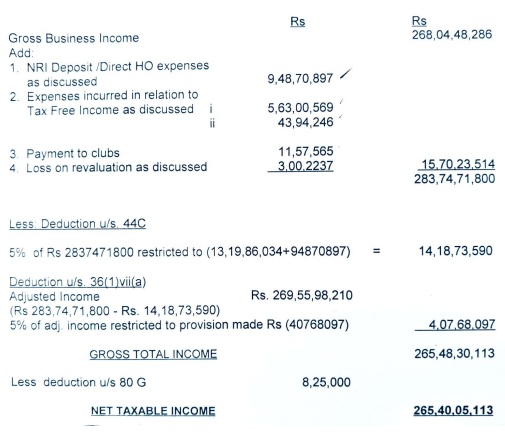
7. Being aggrieved with the aforesaid additions and disallowances, assessee preferred an appeal before the Ld. CIT(A) who had discussed all the issues at length and have decided the appeal of assessee as partly allowed. The Ld. CIT(A) had observed as under:
| (i) |
|
Regarding disallowance claim of expenses of Rs.9,48,70,897/- incurred by the assessee’s overseas branches for soliciting NRI deposits by NRI desks, by applying provisions of section 44C of the Act. Ld. CIT(A) followed the decision of CIT v. Abu Dhabi Commercial Bank [Income Tax Reference No. 17 of 1996, 30-4-2003] and in the case of American Express Bank v. DCIT [Income Tax Reference No. 3 of 2002]. In both the aforesaid cases, the Hon’ble Jurisdictional High Court of Bombay has held that such expenses are allowable u/s 37(1) and are outside the scope of section 44C of the Act, therefore the AO is directed to allow the same. On this aspect, the Revenue is in appeal before us. |
| (ii) |
|
Ld. CIT(A) has decided the second ground regarding disallowance of expenditure of Rs.11,57,565/- on Membership Fees and Subscription paid to clubs. This issue is also decided in favour of the assessee by directing the AO to allow the claim of assessee by observing that the Hon’ble Jurisdictional High Court in the case of Otis Elevator Co. (India) Ltd. v. CIT [1991] 96 CTR 14/[1992] 195 ITR 682 (Bombay)has held that the payments of club fees were made with a view to enable the assessee to improve its business relations and prospects and therefore must be allowed as business expenditure. |
| (iii) |
|
Ground No.3 of the assessee is also decided by the Ld. CIT(A) by directing the AO to allow the exemption of Rs.12,48,34,673/- claimed by the assessee u/s 10(15)(iv)(h) r.w.s 10(23G) of the Act. Ld. CIT(A) observed that the identical case has been decided in assessee’s own case for AY 2000-01in Deputy DIT (International Taxation)-l(l) v. Bank of America N.A [2026] (Mumbai – Trib.)/ITA 4090 & 4154/Mum/2004vide order dated 18.03.2026, accordingly no nexus has been proved to exist between tax free income and interest-bearing funds, on the other hand there are sufficient funds to finance the investment in shares/tax free securities. Therefore, the exemption u/s 10(15)(iv)(h) r.w.s 10(23G) of the Act cannot be denied. |
| (iv) |
|
The fourth ground before the Ld. CIT(A) was related to disallowance of assessee’s claim for credit of tax deducted at source of Rs.5,42,31,957/- on gross interest payable to its overseas branches. On this issue, Ld. CIT(A) was not convinced with the contentions raised by the assessee, therefore, he observed that the interest paid by the Indian Branch of the assessee was liable to tax in India. The AO should have brought the said income to tax and to allow the credit of TDS made on such interest. Nevertheless, the action of AO in not allowing the TDS without bringing the impugned interest income to tax has the same effect because the assessee has made deduction of TDS on the said interest at the rate of 10%,i.e., the rate provided under Article 11 of the Indo US treaty in which it would have been taxable. Thus, in a way deduction of tax at source at 10% on interest paid to overseas branch by the assessee extinguished its further taxability in India and the same result is achieved by not allowing further credit of impugned TDS as it would have beenby taxing such interest income and allowing credit for the TDS. Therefore, in these circumstances, the assessee does not deserve any further benefit of credit for the impugned TDS and the ground of appeal of the assessee was dismissed. On this issue, the assessee is in appeal before us. |
| (v) |
|
Two additional grounds were also raised before the Ld. CIT(A), which pertains to the calculation of deduction u/s 36(1)(viia) and 44C of the Act. On these issues, the Ld. CIT(A) directed the AO to compute deduction u/s 36(1)(viia) on gross total income and before calculating deduction u/s 44C of the Act, consequently deduction u/s 44C should be computed on gross total income after giving deduction u/s 36(1)(viia) of the Act.The ground of assessee was allowed. On this issue, the Revenue is in appeal before us. |
| (vi) |
|
One more additional ground is raised by the assessee before the Ld. CIT(A) regarding disallowing the loss on revaluation of securities at the end of year. This issue has been discussed by the Ld. CIT(A), following the decision of Jurisdictional High Court as well as Hon’ble Apex Court in various cases relied upon by the assessee, had directed the AO to allow the assessee’s claim for deduction of Rs.3,00,237/- on this account. |
8. In view of aforesaid observations, Ld. CIT(A) had partly allowed the appeal of assessee, there being various reliefs granted by the Ld. CIT(A) and also certain disallowances/additions made by the AO are confirmed. Therefore, being aggrieved with the aforesaid order of Ld. CIT(A), both Assessee as well as Revenue is in appeal before us in the present matters.
9. First, we shall be taking the issues raised by the Department in their appeal in ITA No.9162/Mum/2004 –
9.1 Ground No.1 of the Revenue’s appeal pertains to allowing the disallowance of expenditure amounting to Rs.9,48,70,897/- incurred by the assessee’s overseas branches for its independent operations, treating the same to fall within the scope of provisions of section 44C of the Act. We note that the aforesaid expenditure disallowed by the Ld. AO is bifurcated in two parts,
| i. |
|
expenditure incurred by NRI desks for Rs.2,28,06,032/- and |
| ii. |
|
ii. Data processing cost – Croydon for Rs.7,20,64,865/-. |
9.2 At the outset, Ld. Senior Counsel representing the assessee submitted that the issue pertains to NRI desk expenditure is covered against the assessee by assessee’s own case for AY 2000-01, wherein the identical issue has come up before the Hon’ble ITAT. The issue is decided in favour of the Revenue by reinstating the disallowance made by the Assessing Officer regarding the NRI desk expenditure incurred by the overseas branches of the assessee. It is stated that the NRI desk expenditure incurred by the assessee are decided against the assessee and, therefore, in terms of findings of Tribunal in assessee’s own case for AY 2000-01, the issue may be decided accordingly.
Regarding the data processing expenses, Ld. Counsel submitted that it cannot be clubbed with the general and administrative expenses. On this aspect, Ld. Counsel relied on the decision of ITAT Mumbai in the case of Assistant Director of Income-tax, Circle-1 (1) v. Antwerp Diamond Bank NV Engineering Centre /163 TTJ 175/[2015] 153 ITD 391/[2014] 65 SOT 23 (Mumbai) .
9.3 The amount was claimed by the assessee for the expenditure described as “Data processing cost-Croydon” for Rs.7,20,64,865/-, incurred by overseas branches of the assessee on behalf of PE in India, Ld. Sr. Counsel placed his reliance on the decision of Hon’ble Apex Court in the case of
Director of Income-tax (IT)-I, Mumbai v.
American Express Bank Ltd. [2025] (SC)/ Civil Appeal No.8291 of 2015, dated December 15, 2025, wherein Hon’ble Court, after analysis had summarized the legal position as under:
“70. The summary of the legal position emerging from the aforementioned analysis is as follows:
(a) First, Section 44C would apply only when the two primary conditions are met: the assessee is a non-resident and has incurred expenditure in the nature of head office expenditure.
(b) Secondly, the definition of ‘head office expenditure’ in the Explanation keeps in mind two factors: the nature of the expense (executive and general administration) and its geographic location (incurred outside India). It is entirely irrelevant whether such expenditure is common or exclusive.
(c) Thirdly, clause (c) mandates computation on an actual basis, and the phrase “attributable to” as present in clause
(c) is wide enough to encompass both the shared expenses allocated to India branches and exclusive expenses incurred for India branches.”
9.4 They further crystallized their observations by observing as under:
“75. In other words, for an expenditure to qualify as ‘head office expenditure’ within the meaning of the Explanation to Section 44C, the assessing officer has to be satisfied of the following three ingredients:
(a) First, the expenditure must be incurred outside India.
(b) Secondly, the expenditure must be in the nature of executive and general administration, i.e., a broad genus.
(c) Thirdly, the said executive and general administration expenditure must fall within the specific species enumerated in clauses (a), (b), and (c), or expressly prescribed under clause (d).”
9.5 Hon’ble Apex Court while according the final remarks, had concluded their decision in following terms:
“G. Conclusion
86. A conspectus of our legal discussion regarding Section 44C of the Act, 1961, is as under:
| (a) |
|
Section 44C is a special provision that exclusively governs the quantum of allowable deduction for any expenditure incurred by a non-resident assessee that qualifies as head office expenditure. |
| (b) |
|
For an expenditure to be brought within the ambit of Section 44C, two broad conditions must be satisfied: (i) The assessee claiming the deduction must be a nonresident; and (ii) The expenditure in question must strictly fall within the definition of head office expenditure’ as provided in the Explanation to the Section. |
| (c) |
|
The Explanation prescribes a tripartite test to determine if an expense qualifies as head office expenditure’ (i) The expenditure was incurred outside India; (ii) The expenditure is in the nature of ‘executive and general administration’ expenses; and (iii) The said executive and general administration expenditure is of the specific kind enumerated in clauses (a), (b), or (c) respectively of the Explanation, or is of the kind prescribed under clause (d). |
| (d) |
|
Once the conditions in (b) referred to above are met, the operative part of Section 44C gets triggered. Consequently, the allowable deduction is restricted to the least of the following two amounts: (i) an amount equal to 5% of the adjusted total income; or (ii) the amount of head office expenditure specifically attributable to the business or profession of the assessee in India. |
87. Based on the aforesaid discussion, it is manifest that the plain language of Section 44C, when viewed against the backdrop of the specific mischief it sought to curtail, is unambiguous. The statutory definition is broad and inclusive, containing no indication that ‘exclusive expenditure’ is to be excluded from its ambit. Furthermore, the term ‘attributable’ in Clause (c) does not create a statutory distinction between ‘common’ and ‘exclusive’ expenditure.
88. Thus, the question of law formulated by us is squarely answered in favour of the Revenue. We hold that Section 44C applies to ‘head office expenditure’ regardless of whether it is common expenditure or expenditure incurred exclusively for the Indian branches.
89. On the specific facts at hand in these appeals, a bare perusal of the records of the authority below reveals that the authorities have not satisfactorily dealt with the question whether the impugned expenditure actually constitutes head office expenditure’ as defined in the statute. It also appears that the authorities below conceived the meaning of head office expenditure’ in a broad and inclusive sense, which we have held is not a correct reading of the exhaustive definition provided in the Explanation. In other words, there is no factual finding on whether the expenses fulfil the three specific criteria we have elucidated in this judgment.
90. As an appellate court, we should not embark upon such a fact-finding exercise. Consequently, we remand the matters to the Income Tax Appellate Tribunal, Mumbai, for the limited purpose of verifying whether the disputed expenditures satisfy the tripartite test necessary to qualify as head office expenditure’ under the Explanation to Section 44C of the Act, 1961.”
9.6 We further note that the Co-ordinate Bench of ITAT Mumbai in a recent decision, in the case of DDIT(IT)-1(1) v. American Express Bank Ltd. (Mumbai – Trib.)/ITA No. 3487/Mum/2004 for AY 1999-2000, order dated 17.04.2026 had deliberated on the aforesaid issue taking into consideration the guiding principles laid down by Hon’ble Apex Court in the case of American Express Bank Ltd. (supra), and had restored the issue back to the file of Ld. AO for de novo adjudication keeping in view the ratio of law laid down by Hon’ble Apex Court. The observations of the Tribunal in the case of DDIT v. M/s. American Express Bank Ltd. (supra) are culled out hereunder for the sake of implementation of their observations in the facts of the present case:
“22. In case of Director of Income Tax (IT)-1, Mumbai v. M/s. American Express BankLtd. (supra), the Hon’ble Supreme Court having regard to the meaning of ‘head office expenditure’ as provided under clause (iv) of Explanation to section 44C of the Act has observed that apart from the general conditions that the expenditure must be incurred outside India and it must be in the nature of executive and general administration, the expenditure must fall within the specific species enumerated in clauses (a), (b), and (c) or expressly prescribed under clause (d). It appears from the observations of the A.O. that the direct head office expenses of Rs. 11,06,92,634/- is on account of salary, travel and other employee related expenses and relocation expenses, etc. Thus, from the aforesaid facts, it appears that if not all, but, some of the expenditures debited to the profit and loss account are covered under the definition of ‘head office expenditure’ as per clause (iv) of Explanation to section 44C of the Act. However, full facts relating to the nature of expenditure have either not been brought on record or have been properly dealt with by the departmental authorities. Therefore, keeping in view the ratio laid down by the Hon’ble Supreme Court in the decision referred to above, the nature and character of the expenditure has to be identified for determining whether they qualify as ‘head office expenditure’ in terms of clause (iv) of Explanation to section 44C of the Act. Since, such identification requires detailed factual analysis of the expenditure incurred by the assessee which has not been done either at the stage of assessment or by Id. First appellate authority, as Id. First appellate authority has disallowed major part of the expenditure for non-withholding of tax at source. In our view, the issue requires fresh examination at the end of the A.O., after analyzing in detail the nature of expenditure.
23. In view of the aforesaid, we are inclined to restore the issue to the A.O. for de novo adjudication, keeping in view the ratio laid down by the Hon’ble Supreme Court in the decision referred to above. Needless to mention, before deciding the issue, the assessee must be provided reasonable opportunity of being heard. This ground is allowed for statistical purpose.”
9.7 We thus, in terms of aforesaid findings of ITAT Mumbai in the case of American Express Bank Ltd. (supra), which follows the ratio of law and observations by the Hon’ble Apex Court in the case of American Express Bank Ltd (supra), thus, having parity of facts in the present case, the issue regarding expenditure incurred by assessee on “Data processing cost- Croydon” for Rs.7,02,64,865/- deserves to be restored to the file of Ld. AO to identify for determining whether they qualify as ‘head office expenditure’ in terms of clause (iv) of Explanation to section 44C of the Act., whereas the NRI desk expenses claimed by the assessee, which are disallowed by Ld. AO are sustained following the decision of ITAT in assessee own case for AY 2000-01 by setting aside the order of Ld. CIT(A). In result, Ground No.1 of Revenue’s appeal is allowed/partly allowed for statistical purposes.
10. Ground No.2 of Revenue’s appeal pertains to deleting addition of Rs.6,06,94,815/- on account of expenditure incurred in earning income claimed exempt u/s 10(15) and 10(23G) of the Act. On this issue, it is submitted by the Sr. Counsel representing the assessee that the issue is covered by the order of ITAT Mumbai in assessee’s own case for AY 2000-01, wherein the Tribunal has held that if the assessee’s own funds and other non-interest bearing funds were more than the investment in tax free securities, no disallowance u/s 14A /10(15) / 10(23G) of the Act can be made. It is also held that the disallowance u/s 14A of the Act would not be warranted where interest-free own fundsexceed the actual investment in tax free securities, in such cases the investment is presumed to be made out of assessee’s own funds. It is submitted that in present case the Ld. CIT(A) had decided the issue on the same lines having identical facts and circumstances, thus deserves to be upheld.
10.1 Per contra, Ld. DR vehemently supported the order of Ld. AO and requested to sustain the disallowance made u/s 14A / 10(15)(iv)(h).
10.2 We have considered the rival submissions, perused the material available on record and the decisions relied upon by the assessee. This issue has been dealt with by the Tribunal in assessee’s own case for AY 2000-01. It is also an undisputed fact that the assessee has sufficient funds to finance the shares/tax free securities, which is examined and recorded by the Ld. CIT(A) in his order, and has not been dislodged by the Revenue by any contrary submissions on this aspect. While deciding the aforesaid issue, the Tribunal in assessee’s own case (supra) had referred to the decision of Hon’ble Jurisdictional High Court as well as Hon’ble Supreme Court and had decided the issue against the Revenue with following findings:
“7. Having considered the submissions of both sides and perused the material available on record, in the present case, it is evident that there is no dispute that the interest expenditure was disallowed by the AO while granting exemption under section 10(15) and section 10(23G) of the Act. During the hearing, the learned Senior Counsel, appearing for the assessee, reiterated the contention that the assessee had sufficient interest-free funds for making investments for earning tax-free income. From the details of own funds available with the assessee as of 31st March for the period from 1998 to 2000 and the statement of lending to infrastructure projects and investment in tax-free bonds, as noted in the foregoing paragraphs, it is sufficiently evident that the assessee’s own funds were more than the investments for earning exemptincome. We find that the Hon’ble Jurisdictional High Court in
CIT v.
HDFC Bank Ltd. , reported in
[2014] 366 ITR 505 (Bom.) , held that where assessee’s own funds and other noninterest bearing funds were more than the investment in tax-free securities, no disallowance under section 14A of the Act can be made. We further find that the Hon’ble Supreme Court in
South Indian Bank Ltd. v.
CIT, reported in
[2021] 438 ITR 001 (SC) held that disallowance under section 14A of the Act would not be warranted where interest-free own funds exceed the investment in tax-free securities and in such a case the investment would be presumed to be made out of assessee’s own funds. Therefore, respectfully following the law laid down by the Hon’ble Supreme Court and the Hon’ble jurisdictional High Court in cases cited supra, we find no infirmity in the impugned order in deleting the disallowance of part interest while allowing exemption under section 10(15) and section 10(23G) of the Act. Accordingly, Ground No. 1, raised in Revenue’s appeal, is dismissed.”
10.3 We, thus in terms of aforesaid observations dismiss the ground no.2 of Revenue’s appeal by allowing the exemption claimed by the assessee u/s 10(15) and section 10(23G) of the Act. Resultantly, Ground No.2 of Revenue’s appeal stands dismissed.
11. Ground No.3 of Revenue’s appeal regarding directions by Ld. CIT(A) to conclude deduction u/s 36(1)(viia) before deduction u/s 44C of the Act. Ld. Senior Counsel representing the assessee submitted that this issue is also covered by the decision of ITAT Mumbai in assessee’s own case for AY 2000-01 (supra) wherein the Tribunal has dismissed the ground of appeal of Revenue by interpreting the provisions of section 44C of the Act. Accordingly, this ground of Revenue is also liable to be dismissed.
11.1 Per contra, Ld. DR placed his reliance on the order of Ld. AO.
11.2 Considered the submissions, perused the material available on record and the decision relied upon by the assessee. The relevant findings of Tribunal on this aspect in assessee’s own case for AY 2000-01 are extracted as under:
“26. We have considered the submissions of both sides and perused the material available on record. The AO, vide assessment order passed under section 143(3) of the Act, computed the deduction under section 36(1)(vila) of the Act after allowing deduction under section 44C of the Act. As per the assessee, the deduction under section 36(1)(viia) of the Act should be computed before computing the deduction under section 44C of the Act. The learned CIT(A), vide impugned order, agreed with the contention of the assessee and allowed the deduction under section 36(1)(viia) before computation of deduction under section 44C of the Act. Being aggrieved, the Revenue is in appeal before us.
27. From the plain reading of the provisions of section 44C of the Act, it is evident that while computing the income chargeable under the head “profits and gains of business or profession”, the deduction of Head Office Expenditure is restricted either to an amount equal to 5% of the adjusted total income or the amount of Head Office Expenditure incurred by the assessee as is attributable to the business or profession of the assessee in India, whichever is less. The term “adjusted total income” has been defined in the Explanation to section 44C as follows: –
“(i) “adjusted total income” means the total income computed in accordance with the provisions of this Act, without giving effect to the allowance referred to in this section or in sub-section (2) of section 32 or the deduction referred to in section 32A or section 33 or section 33A or the first proviso to clause (ix) of sub-section (1) of section 36 or any loss carried forward under sub-section (1) of section 72 or sub-section (2) of section 73 or sub-section (1) 55 [or subsection (3)] of section 74 or sub-section (3) of section 74A or the deductions under Chapter VI-A;”
28. From the plain reading of the above Explanation, it is evident that “adjusted total income” would mean total income without giving effect to the specified deductions as mentioned in the Explanation. We find that deduction under section 36(1) (viia) has not been expressly excluded for computation of “adjusted total income” as per the Explanation to section 44C of the Act. Thus, we are of the considered view that the effect of the deduction under section 36(1)(viia) has to be given prior to computation of deduction under section 44C of the Act. Accordingly, we do not find any infirmity in the findings of the learned CIT(A) on this issue, and the same are upheld. Accordingly, Ground No. 3 raised in Revenue’s appeal is dismissed.”
11.3 We thus, respectfully following the aforesaid decision of Tribunal find it appropriate to dismiss ground of appeal no.3 raised by the Revenue contradicting the decision of Ld. CIT(A) that the computation of deduction u/s 36(1)(viia) should not be deducted while computing the deduction u/s 44C of the Act. We thus, find substance in the finding of Ld. CIT(A) which is at parity with the decision of Tribunal in assessee’s own case for AY 2000-01. Further, while examining this aspect, the Ld. CIT(A) had allowed the claim of assessee, accordingly, we do not see any infirmity in the order of Ld. CIT(A) to interfere with. In result, Ground No.3 of the Revenue is also dismissed.
12. Resultantly, the appeal of Revenue in ITA No.9162/Mum/2004, stands dismissed in above terms of our aforesaid observations on each ground of Revenue’s appeal.
13. Now we shall be taking the appeal of assesseefor AY 1999-2000 in ITA 8681/Mum/2004, wherein the assessee has raised an issue against the order of Ld. CIT(A) that whether the credit of tax deducted at source on the gross interest payable to assessee’s overseas branch should be granted to the assessee or not. It is submitted by Ld. Sr. Counsel that the assessee and its overseas branches is one entity and can file only one return of income under the Act. Singapore branch of the bank constitutes a part of the bank. Since the interest paid to bank’s Singapore branch is not liable to tax in India, the tax deducted at source from interest payment should be refunded. On this aspect, Ld. AR placed his reliance on the decision of Hon’ble Special Bench of ITAT Mumbai in the case of Sumitomo Mitsui Banking Corpn. v. Deputy DIT (IT), Range-2(1), Mumbai 145 TTJ 649/136 ITD 66/16 ITR(T) 116 (Mumbai)/vide order dated 30th March, 2012, which is followed by ITAT Mumbai in assessee’s own case for AY 2013-14 in Bank of America National Association v. DCIT (IT) [IT Appeal No. 3343 (Mum.) of 2019, dated 26-8-2022] had observed that the Ld. CIT(A) was not right in invoking revisionary provisions of section 263, as the Ld. AO has followed the findings of his predecessors, wherein no income has been added in the hands of assessee for interest payment by domestic branches to the head office/overseas branches. Since the assessment records of the earlier years were available with the Assessing Officer, allowing the assessee’s claim that subjected interest was not taxable in the hands of PE in India. In view of judicial precedents, the assessment order passed by the Ld. AO cannot be treated as erroneous.
13.1 Per contra, Ld. DR submitted that for claiming of refund, there are separate proceedings available in the Act u/s 19(2)(b) of the Act and TDS deducted on payments cannot be claimed back by the assessee, who had deducted the TDS itself. In rebuttal, Ld. Senior Counsel submitted that it is not mandatory that income should be assessed or offered for refund of TDS where the deductor has erroneously deducted the TDS.
13.2 We have considered the rival submissions, perused the material available on record and the decisions relied upon by the parties. Admittedly, following the decision of Hon’ble Special bench in the case of M/s Sumitomo Mitsui Banking Corporation (supra), it is a settled position of law that the interest paid by Indian branch of the assessee bank to its head office and other branches outside India is not chargeable to tax in India, it follows that the provisions of section 195 would not be attracted and there being no failure to deduct TDS for the said payment of interest made by PE, the question of disallowance of said interest by invoking provisions of section 40(a)(ia) does not arises. Accordingly, the issue was decided in favour of assessee.
13.3 Referring to aforesaid observations by the Hon’ble Special Bench, it is clear that the assessee was not liable to deduct TDS u/s 195 of the Act on the payments made for interest paid to its head office or overseas branches, however, once TDS is deducted by the assessee, may be erroneously whether the same can be claimed back by the assessee (deductor) as refund from the Department, it is the cause of concern before us.
13.4 In backdrop of aforesaid facts and circumstances and discussions, we find that the assessee has deducted TDS on certain income pertains to its head office or overseas branches which are claimed as expenditure by the assessee in its P & L account, since such income in terms of findings of Hon’ble Special Bench in the case of M/s Sumitomo Mitsui Banking Corporation (supra) are not taxable income in India, therefore, no TDS was required. However, since assessee has made the TDS, which has been claimed that the credit for such TDS was also not availed by the entities (deductee) to whom such payments were made. In our considered opinion, once the deduction of tax was made and deposited with exchequer’s, it can only be claimed as deduction or by way of refund by the deductee and not by the deductor. We note that even if the Tax was deducted under misreading of law or under wrong interpretation/ opinion, only the deductee has the option to claim it back from the revenue. We, thus, in absence of any provision in the law to refund the TDS made and deposited by the deductor, are unable to subscribe and to allow the contentions raised by the assessee. In result the sole ground of the assessee stands dismissed.
14. Apart from the aforesaid ground of assessee, the assessee has also raised certain additional grounds of appeal which reads as under:
“Ground No. 1
1.1 Your Appellants submit that the deduction under section 36(1)(viia) should be computed before calculating the deduction under section 44C of the Act.
Ground No. 2
2.1 Your Appellants submit that the deduction u/s 44C of the Act should be computed on gross total income after giving deduction u/s 36(1)(viia) of the Act.
Ground No. 3
3.1 Your Appellants submit that The Assistant Commissioner of Income-tax-Circle 1(1), Mumbai hereinafter referred to as “the AO] erred in disallowing the loss of Rs.300,237 on revaluation of securities.
3.2 The AO erred in holding that securities held by your Appellants were investments in permanent securities and not stock in trade.”
14.1 The Additional Ground No.1, 2 and 3 are covered by the issues raised by the Revenue in the aforesaid appeal in ITA No.9162/Mum/2004, our decision therein shall apply mutatis mutandisto the aforesaid additional grounds of assessee. Accordingly, additional Ground Nos.1, 2 and 3 are allowed in favour of the assessee.
15. In result, the appeal of assessee in ITA No.8681/Mum/2004 is partly allowed, in above terms.
ITA No.2283/Mum/2005 (Revenue) and 2284/Mum/2005 (Assessee) for Assessment year 2001-02
16. The aforesaid two appeals are filed by the assessee and the Revenue raising identical grounds as have been dealt by us in the aforesaid appeals for AY 1999-2000 in ITA No.9162/Mum/2004 (revenue) and 8681/Mum/2004 (Assessee). Since the grounds of appeal in aforesaid appeals are identical under similar facts and circumstances, except certain ground which are deliberated separately hereunder, therefore our decision in aforesaid appeals for identical ground shall apply mutatis mutandis in these two appeals, also.
ITA No. 2284/MUM/2005 (assessee)
17. Ground No. 1.1 – The assessee has raised an issue emerging from the order of Ld. CIT(A) wherein the Ld. CIT(A) had upheld the disallowance of Rs.7,14,08,746/- towards expenditure incurred by the assessee’s overseas branches for its Indian operations by invoking section 40(a)(i) of the Act, having failed to appreciate that certain amount was not paid as ‘royalty’ and in any event there was no obligation to deduct TDS u/s 195 in respect of the same. On this aspect, on perusal of the order of Ld. CIT(A), it is found that the assessee’s overseas branches have incurred expenditure directly attributable to Indian operations on which no TDS was deducted. Therefore, the Ld. AO has applied the provisions of section 44C and also section 40(a)(i) of the Act, accordingly has disallowed such expenditure claimed by the assessee.
18. We find that this issue is squarely covered by our decision in ITA No.9162/Mum/2004, wherein the ground of Revenue’s appeal was allowed for statistical purposes, following the decision of Hon’ble Apex Court in the case of American Express Bank (supra) following the same analogy, the ratio of law which is discussed in detail in aforesaid issue in the appeal of Revenue for assessment year 1999-2000. Accordingly, we set aside the issue to the file of Ld. AO for fresh adjudication in terms of our observation therein. In result, Ground No.1.1 of the assessee stands partly allowed.
19. Ground No. 1.2 of the assessee’s appeal is also covered by our findings in the aforesaid order for assessment year 1999-2000. Accordingly, the issue is covered by the decision of Hon’ble Special Bench in the case of M/s Sumitomo Mitsui Banking Corporation (supra) and the disallowance of interest payable to Singapore Branch cannot sustain. The Ground of Appeal No.1.2 of assessee’s appeal is therefore allowed.
20. In result, ITA No.2284/Mum/2005 filed by the assessee for assessment year 2001-02 is partly allowed in above terms.
21. Accordingly, ITA No. 2284/Mum/2005 of the assessee and ITA No. 2283/Mum/2005 of the Revenue is disposed of in terms of our observations and decisions on the respective issues raised by either by the Revenue or by the assessee.
22. In combined result, ITA No.9162/Mum/2004 and 2283/Mum/2005 of the Revenue and ITA No.8681/Mum/2004



