


Road-Cutting Restoration Charges Paid To PWD For Laying Gas Pipelines Constitute Taxable Supplies Under Reverse Charge Mechanism
Issue
Whether road restoration charges paid by a gas distribution company to the Public Works Department (PWD) for obtaining road-cutting permission to lay pipelines constitute a taxable supply of service under reverse charge, and whether such payments are eligible for tax exemption or refund.
Facts
-
Project & Permission: The appellant, a gas distribution company, obtained permission from the PWD to cut public roads for laying gas pipelines and paid the requisite road restoration charges.
-
GST Discharge: The appellant initially discharged GST under the Reverse Charge Mechanism (RCM) via GSTR-3B.
-
Refund Claim: The appellant subsequently sought a refund of the RCM tax paid, contending that the restoration charges were compensatory in nature and fell outside the scope of “supply.”
-
Lower Authorities’ Stance: The Assessing Officer rejected the refund claim, and the appellate authority affirmed the rejection, treating the payments as consideration for services rendered by a Government department.
-
Appellate Proceedings: The matter reached the Tribunal, with the appellant additionally claiming sovereign function exclusion and tax exemption under Notifications 14/2017 and 12/2017 (including S. No. 6(d)).
Decision
-
Taxable Supply of Service: Held that road reinstatement charges represent a bilateral fee-for-service arrangement with transactional reciprocity, constituting a taxable supply of service for consideration rather than mere post-breach compensation.
-
Inapplicability of Sovereign Exemption: Held that sovereign function exclusions and exemptions do not apply to request-driven, custom repair works executed for a specific commercial layout, and S. No. 6(d) expressly excludes services supplied to business entities.
-
Mandatory RCM Liability: Held that services supplied by the Government or local authority to a registered business entity must be taxed under the mandatory scheme of Notification No. 13/2017-Central Tax (Rate).
-
Refund Dismissed: Held that since the tax payment under RCM was valid and no double taxation was proven, the refund claim failed. The appeal was dismissed in favor of the Revenue.
Key Takeaways
-
Commercial Road-Cutting Charges: Payments made to PWD or NHAI for road-cutting and restoration to execute commercial projects (like gas pipelines) are not compensatory damages; they are taxable considerations for services.
-
Exclusion for Business Entities: General tax exemptions or sovereign function exclusions granted to government bodies do not protect services rendered specifically to business entities.
-
Mandatory RCM on Government Services: Registered business entities receiving services from government authorities must discharge tax under the Reverse Charge Mechanism, and such payments cannot be claimed as refunds based on non-supply arguments.
GOODS AND SERVICE TAX APPELLATE TRIBUNAL , LUCKNOW BENCH
Torrent Gas Ltd.
v.
Commissioner, CGST & Central Excise Commissionerate
Santosh Kumar Srivastava, Judicial Member
and Arvind Kumar, Technical Member
and Arvind Kumar, Technical Member
APL/40/LCK/2026
OCTOBER 7, 2026
Vaibhav K. Jajoo, CA for the Appellant. Smt. Nidhi Sharma, SUPERINTENDENT
ORDER
1. Brief Facts of the Case.
The present Appeal No. LCK/40/2026 has been filed against Order-in-Appeal No. 438/GST/ADC/Alld/2025 dated 08.08.2025 (Reference No. ZD090925047269S dated 04.09.2025) passed by the Additional Commissioner, (Appeal), CGST & Central Excise, Allahabad, whereby claimed refund of amounting to Rs. 7,264/- rejected by the proper officer under Section 54 of the Central Goods and Services Tax Act, 2017 was upheld.
1.1 M/s TORRENT GAS LIMITED (hereinafter referred to as the ” appellant “) having it principal place of business at 3RD FLOOR, HIG 1B, SAI PLACE, CHANDRAVIHAR, LAKHANPUR, Kanpur Nagar, Uttar Pradesh, 208002. The Appellant is engaged in the business of supplying of natural gas through a gas pipeline network having GST registration number 09AAGCT7889P1Z1.
1.2 The Appellant received permission from the Public Works Department, Uttar Pradesh (PWD) to lay a gas pipeline network, which was subject to the payment of various charges for undertaking road restoration activities. The Appellant made a payment to the PWD during the month of October 2020.
1.3 The Appellant paid an amount equivalent to GST under the Reverse Charge Mechanism (RCM) as notified by Notification No. 13/2017-Ccntral Tax (Rate), amounting to 3:7,264/-(CGST – Rs. 3,632/- and SGST – 3:3,632/-) in Form GSTR-3B filed for the period of October 2020.
1.4 The Appellant subsequently filed an application for a refund of the amount paid, equivalent to GST amounting to Rs. 7,264/-, in Form GST RFD-01 under Section 54 of the CGST Act on February 26, 2024, under Rcfercnce/Acknowledgment No. AA0902241945821.
1.5 A Show Cause Notice (SCN) in Form GST RFD-08 under Reference No. ZF0904204226897 was issued to the Appellant on 12 April 2024, requesting certain documents and clarifications. The Appellant filed a point-wise reply against the SCN on April 30, 2024.
1.6 The Adjudicating Authority issued Order-in-Original No. ZJ0905240092909 on 06.05.2024, rejecting the refund claim of Rs. 7,264/-. The Adjudicating Authority held that road was already been constructed for the use of general public and by constructing the road, Municipal Authorities/panchayats have done the original work entrusted to them under Article 243G/Article 243W of the Constitution. On perusal of Eleventh and Twelfth schedule of the Constitution, it is evident that the work entrusted to Municipal Authorities/panchayats is for noble cause largely for the community. While doing so the Government Authorities do not charge any consideration to any business entity.
1.7 In the instant case, the Appellant has requested the Government Authorities to open/dug out/cut the already constructed road not for any noble cause but only for furtherance of their business with sole motive to earn profit. Road restoration is required each time whenever road is opened/dug out/cut by the business entities for furtherance of their business. Such type of restoration work would not result in performing of the sovereign function as stipulated in Article 243W or 243G of the Constitution. In the instant case, the sovereign function has already been done by constructing the road by PWD.
1.8 Aggrieved by the aforesaid OK), the Appellant filed an appeal in Form GST APL-01 under Section 107 of the Act on 05.08.2024, under Reference No AD090824009581Z. Accordingly, a personal hearing through virtual mode was attended by the authorized representative of the Appellant on 26.06.2025.
1.9 The Appellate Authority issued Order-in-Appeal No. 438/ GST / ADC / Alld / 2025 on 08.08.2025, upholding the rejection of the refund claim. The Appellate Authority sustained the rejection on the grounds that the road restoration work docs not qualify for exemption under Notification No. 12/2017-Central Tax (Rate) or Notification No. 14/2017-Central Tax (Rate). It ruled that the Appellant is the recipient of the service of road restoration provided by the Government Authorities and is therefore liable to pay tax under the reverse charge mechanism as envisaged under Notification No. 13/2017-Central Tax (Rate). A summary of the OIA was subsequently issued in Form GST APL-04 under Reference No. ZD090925047269S on 04.09.2025.
2. Grounds of appeal
2.1 The appellant has challenged the Order-in-Appeal dated 06.08.2025, contending that the order in appeal is against the law, without the weight of evidence and is totally unsustainable.
2.2 In his appeal, the appellant contests the refund rejected by OIA on various grounds which is as under;
2.3 ‘Road restoration charges’ being compensatory in nature, cannot be considered being towards any ‘supply’ under GST: In order to constitute a ‘supply’ under Section 7(1) of the CGST Act, there should be a supply of goods or services for consideration. The ‘road restoration charges’ recovered by PWD are not towards any ‘supply’ of goods or services but towards the compensation for the damage incurred on public property, i.e. roads. The payment of’road restoration charges’ is a condition and not a consideration for any service, as supported by the judgment of the Hon’blc Bombay High Court in Bai Mamubai Trust v. Suchitra (Bombay)/[2019] 31 GSTL 193 (Bombay)[, which held that wrongful unilateral acts resulting in the payment of damages do not encompass the doctrine of supply. Furthermore, Circular No. 178/10/2022-GST clarifies that GST shall not be levied on liquidated damages intended solely to compensate for injury, loss, or damage. In his claim, the appellant cited the case laws viz. Bai Mamubai Trust(supra), South Eastern Coalfields Ltd. v. Comm, of C.E. & S.T. [Service Tax Appeal no. 50567 of 2009] (Hon’ble CESTAT), Commissioner of Service Tax v. Repco Home Finance Ltd. [TS- 506-CESTAT-2020-ST] (Larger Bench of the CESTAT) & GET & D India Limited v. Deputy Commissioner of Central Excise, Chennai [2020-VIL-39-MAD-ST] (Hon’ble Madras High Court).
2.4 Payment of road restoration charges are in relation to the functions entrusted under Article 243W / Article 243G of the Constitution: Section 7(2) of the CGST Act notifications and Notification No. 14/2017-Central Tax (Rate) prescribe that services by way of any activity in relation to a function entrusted to a Panchayat under article 243 G of the Constitution or to a Municipality under article 243 W of the Constitution shall be treated neither as a supply of goods nor a supply of services. Similarly, entries 4 and 5 of Notification No. 12/2017-Central Tax (Rate) exempt services by a governmental authority in relation to these functions. Road maintenance, repair, and communication are covered under Entry 13 of the Eleventh Schedule and Entry 4 of the Twelfth Schedule of the Constitution. The expression ‘in relation to’ expands the scope to include ancillary functions such as road restoration. In his claim, the appellant cited the case laws viz. Doypack Systems (P.) Ltd. v. Union of India [1988 (36) ELT 201 (SC)] (Hon’ble Supreme Court),
2.5 Rebuttal on the contention that the exemption can only be claimed if the charges pertains to the laying of the original work undertaken for the construction of roads and not for restoration work: There is no explicit requirement under the law that an activity must relate only to the ‘original works’ listed under the Eleventh/Twelfth Schedule of the Constitution. The broad expression ‘in relation to’ encompasses all and any activity relating to the function of maintaining roads with the objective of keeping them in good condition for public welfare. In his claim, the appellant cited the case laws viz. Union of India v. Inter-Continental (India) 2008 226 ELT 16 (SC)] (Hon’ble Supreme Court), Saraswati Sugar Mills v. CCE, Delhi-Ill [2011] 270 ELT 465 (SC)] (Hon’ble Supreme Court), Phool Patti v. Ram Singh [(2009) 3 TMI 1068 -Supreme Court] (Hon’ble Supreme Court) & Sanjay Singh v. U.P. Public Service Commission [(2007) 1 TMI 596 -Supreme Court] (Hon’ble Supreme Court).
2.6 Rebuttal on the contention that the restoration charges are not for a ‘noble cause’: The statutory entries under the Constitution do not explicitly distinguish between works undertaken for a community cause versus permissions granted upon request. Discharging the maintenance of roads remains a sovereign function attributed to local authorities regardless of the nature of the request.
2.7 Rebuttal on the contention that the restoration charges are only for furtherance of the Appellant’s business and not for a sovereign function: The GST law does not differentiate the tax position based on whether a government department discharges a sovereign function suo-moto or upon a specific request made by a business entity. The character of road repair and maintenance remains a public welfare activity.
2.8 Identical facts – Issue conclusively settled by the authorities in other States I GST registrations: Favourable refund sanction orders have been received by the Appellant under identical facts for its registrations in other states, specifically Rajasthan and Punjab.
2.9 When the supplier had collected and deposited the taxes to the Government exchequer for a particular transaction then the service recipient should not be liable to pay taxes under RCM for the same transaction: The service recipient should not be saddled with a dual tax incidence under RCM for the same economic transaction if the statutory framework excludes it from the definition of a supply or exempts it at the primary instance. In his claim, the appellant cited the case laws viz. Eikos Pens Limited v. CST, Kolkata- 1 [2019 (24) G.S.T.L. 652 (Tri. – Kolkata)] (Hon’ble CESTAT), Navyug Alloys Pvt. Ltd. v. Commr. of C. Ex. & Cus., Vadodara-II [[2009] 13 STR 421 (Ahmedabad – CESTAT)] (Hon’ble CESTAT), Mandev Tubes v. Commissioner of Central Excise, Vapi [[2009] 16 STR 724 (Ahmedabad – CESTAT)] (Hon’ble CESTAT), Kakinada Seaports Ltd. v. C.C.E., S.T. & CUS., Visakhapatnam-II [2015 (40) S.T.R. 509 (Tri. – Bang.)] (Hon’ble CESTAT), Angiplast Pvt. Ltd. v. Commissioner of Service Tax, Ahmedabad [2013 (32) S.T.R. 628 (Tri. – Ahmd.)] (Hon’ble CESTAT), Commissioner of Service Tax, Mecrut-II v. Geeta Industries P. Ltd. [[2011] 22 STR 293 (New Delhi – CESTAT)] (Hon’ble CESTAT) & Sahakari Khand Udyog Mandal Ltd. v. Commissioner of Central Excise & Customs [[2005] 181 ELT 328 (SC)] (Hon’ble Supreme Court).
2.10 Impugned OIO followed by the impugned OIA has travelled beyond the scope of the impugned SCN. The impugned SCN based on which the impugned OIO followed by the impugned OIA is issued is vague. In his claim, the appellant cited the case laws viz. Saci Allied Products Ltd. v. CCE, Meerut 2005 183 ELT 225 (SC)] (Hon’ble Supreme Court), Reckitt & Colman of India Ltd. v. CCE [1996 (88) E.L.T. 641 (S.C.)] (Hon’ble Supreme Court), CCL Products (India) Ltd. v. CESTAT, Chennai [2015 (316) E.L.T. 625 (Mad.)] (Hon’ble Madras High Court), Kandarp Dilipbhai Dholakia v. UOI 46 GST 531/307 ELT 484/28 GSTR 633 (Gujarat)] (Hon’ble Gujarat High Court), C.C.E., C. & S.T., Bclgaum v. Swarnagiri Wire Insulations Pvt. Ltd. [2014 (301) E.L.T. 46 (Kar.)] (Hon’ble Karnataka High Court) & N.D. Metal Industries Ltd. v. CCE, Vapi [2013 (292) E.L.T. 520 (Tri. – Ahmd.)] (Hon’ble CESTAT), Royal Oil Field Private Limited v. UOI [2006 (194) E.L.T. 385 (Bom.)J (Hon’ble Bombay High Court), Indo Swiss Times Ltd. v. Collector of Customs 1993 68 ELT 82 (CEGAT- NEW DELHI)] (Hon’ble CESTAT), Mehta Pharmaceuticals v. CC & CE, Mumbai-III [2003 (157) E.L.T. 105 (Tri. – Mumbai)] (Hon’ble CESTAT), CCE, Bombay-Ill v. Bhikhlal Dwarkadas [1998 (99) E.I.T. 438 (Tribunal)] (Hon’ble CESTAT), Crompton Greaves Ltd. v. CCE, Mumbai-III [2015 (321) E.L.T. 278 (Tri. – Mumbai)] (Hon’ble CESTAT), Alleli & Co. P. Ltd. v. CCE, Mumbai-II 124 ELT 1122 (CEGAT- MUMBAI)] (Hon’ble CESTAT) & CCE, Bangalore v. Brindavan Beverages (P) Ltd. 2007 213 ELT 487 (SC)] (Hon’ble Supreme Court).
2.11 Impugned OIA erred in upholding the rejection of the refund claim based on the impugned SCN followed by the impugned OIO, which are illegal and invalid as they do not contain a DIN: The Show Cause Notice followed by the Order-in-Original was issued by the lower authority without quoting a Document Identification Number (DIN), rendering the administrative actions legally invalid. In his claim, the appellant cited the case laws viz Union of India v. Arviva Industries (I) Limited [[2008] 10 STR 534 (SC)] (Hon’ble Supreme Court), Keshavji Ravji and Co. 183 ITR 1 (SC)] (Hon’ble Supreme Court), K.P. Varghese 131 ITR 597 (SC)] (Hon’ble Supreme Court), Ellerman Lincs Ltd. [[1971] 82 ITR 913 (SC)] (Hon’ble Supreme Court), & Paper Products Ltd. v. Commissioner of Central Excise [1999 1999 112 ELT 765 (SC)] (Hon’ble Supreme Court).
2.12 The impugned OIA has been passed without providing any independent reasons or justification and without considering the detailed written submissions made by the Appellant.
2.13 The impugned OIA is void ab initio for complete non-application of mind and breach of principles of natural justice. In his claim, the appellant cited the case laws viz State of Punjab v. Bhag Singh [2006] 164 ELT 137 (SC)] (Hon’ble Supreme Court), Sahara India (Firm) v. Commissioner of Income Tax, Central- 1 [2008 (226) ELT 22 (SC)] (Hon’ble Supreme Court), Sant Lal Gupta v. Modern Co-operative Housing Society Ltd. [2010 (262) ELT 6 (SC)] (Hon’ble Supreme Court), Kranti Associates Pvt. Ltd. v. Masood Ahmed Khan [2011 (273) ELT 345 (SC)] (Hon’ble Supreme Court), Mohtesham Mohd. Ismail v. Spl. Director, Enforcement Directorate [2007 (220) ELT 3 (SC)] (Hon’ble Supreme Court), Orient Paper Mills Ltd. v. Union of India [1978 (2) ELT J345 (SC)] (Hon’ble Supreme Court), Tata Engineering & Locomotive Co. Ltd. v. CCE, Pune [2006 (203) E.L.T. 360 (S.C.)] (Hon’ble Supreme Court), Commissioner v. Ishan Technologies Pvt. Ltd. [2011 (269) E.L.T. 157 (Guj.)] (Hon’ble Gujarat High Court), Parnikka Harvest Floratech Ltd. v. CCE, Hyderabad [2010 (256) E.L.T. 417 (Tri. – Bang.)] (Hon’ble CESTAT), Dharampal Satyapal Ltd. v. Dy. CCE, Gauhati 51 GST 197/320 ELT 3/33 GSTR 1 (SC)] (Hon’ble Supreme Court), Globeop Financial Services (India) Pvt. Ltd. v. Deputy Commissioner of State Tax, Mumbai [(2025) 32 Centax 383 (Bom.)] (Hon’ble Bombay High Court) & Piramal Enterprises Ltd. v. State of Maharashtra [Writ Petition No. 2836 of 2021 ] (Hon’ble Bombay High Court),
3. Submission of Respondent
3.1 The Respondent (Revenue) opposes the appeal filed by the Appellant and submits the following contentions for the consideration of this Hon’ble Tribunal:
3.2. The ‘Road Restoration Charges’ are not liquidated damages or unilateral compensation as claimed by the Appellant. It is a calculated fee paid under a planned administrative arrangement where the PWD/NHAI performs a custom physical asset-repair service to restore the dug-up roads to their baseline state. Hence, it constitutes a taxable ‘Supply of Service’ under Section 7(1) read with Section 2(31) of the CGST Act, 2017.
3.3. While routine road upkeep for the general public is a sovereign function under Articles 243G and 243W of the Constitution, custom request-driven road cutting executed specifically to facilitate a private entity’s profit-driven business rollout loses all sovereign tax immunity.
3.4. The transaction is entirely hit by the restrictive proviso of SI. No. 6, Point (d) of Notification No. 12/2017-Central Tax (Rate), which categorically excludes any service provided by a Government or Local Authority to a ‘Business Entity’ from general tax exemptions. Proviso is as below;
| 6 | Chapter 99 |
Services by the Central Government, State Government, Union territory or local authority excluding the following services—
|
Nil | Nil |
3.5. Since the transaction is a taxable supply provided by the Government to a registered business entity, the statutory burden to discharge GST under the Reverse Charge Mechanism (RCM) rests strictly on the recipient company as per Notification No. 13/2017-Central Tax (Rate). Proviso is as below;
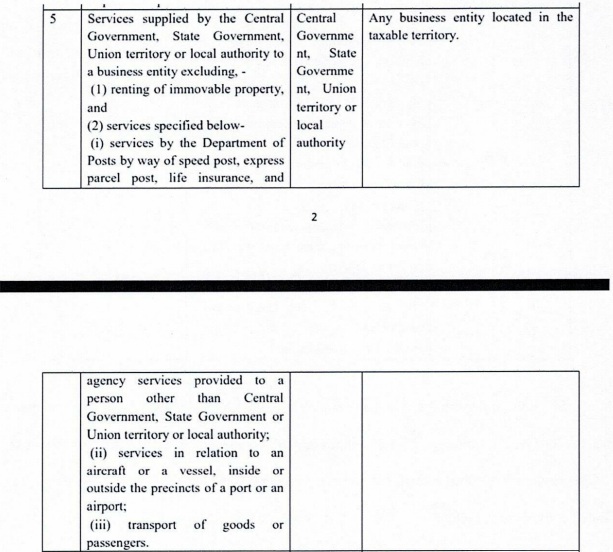
3.6. The entire refund workflow was executed through the authenticated, electronic GST portal where all notices (RFD-08), replies, and orders (OIO) are digitally logged. The complete participation of the Appellant leaves no room for any breach of natural justice.
3.7. In view of the above, the Respondent prays that the Order-in-Appeal No. 438/GST/ADC/Alld/2025 dated 08.08.2025 may kindly be upheld, and the present appeal may be dismissed.
4. Findings and Discussion
4.1. We have carefully examined the impugned Order-in-Appeal No. 438/GST/ADC/ALLD/2025 dated 08.08.2025, the grounds raised in the present appeal, the order dated 06.05.2024 passed by the Assistant Commissioner, CGST & Central Excise, Division-Ill, Kanpur, and the judicial precedents relied upon by the appellant and the material available on record.
4.2. Now we take up the matter for discussion and find that the Appellant argues that Section 9 of the CGST Act requires a “supply” for consideration. Appellant contend that road restoration fees paid to the Public Works Department (PWD) are purely compensatory damages to repair public roads, lacking the contractual reciprocity required to constitute a supply. Appellant rely on the Hon’ble Bombay High Court ruling in Bai Mamubai Trust(supra) and Circular No. 178/10/2022-GST dated 03.08.2022 to state that liquidated damages are not taxable. In this regard, we find this argument legally flawed. Section 2(31) of the CGST Act, 2017 defines “consideration” broadly, encompassing any payment made “in respect of, in response to, or for the inducement of, the supply of services.” Here, the transaction is completely distinct from a unilateral wrongful act or an award of post-injury civil damages as seen in Bai Mamubai Trust. The Appellant entered a planned administrative arrangement where they voluntarily applied to the PWD for permission to cut open constructed public roads. The PWD performs a distinct, physical asset repair service to return the dug-up roads to their public baseline state, explicitly calculating the fee based on the structural volume of the work required. This establishes an unassailable element of bilateral transactional reciprocity. The payment is not passive compensation for a contractual breach under Circular No. 178/10/2022-GST dated 03.08.2022; it is a direct fee for service.
4.3. The appellant’s reliance on various case laws as quoted in his grounds of appeal is completely misplaced and factually distinguishable. Those rulings only apply when there is a broken contract or a court order, and no real service is given. In the present matrix, there is no breach of contract. Rather, it is a voluntary and prior planned administrative arrangement. The taxpayer applies for a specialized utility permit to execute road cutting, and the PWD/Local Authority performs a positive, specific infrastructure restoration activity on a fee-for-service basis. The recovery of charges calculated on the basis of physical excavation volume establishes direct commercial reciprocity, falling squarely within the ambit of ‘Consideration’ under Section 2(31) and ‘Supply of Service’ under Section 7(1) of the CGST Act, 2017.
4.4. Further, we find that the Appellant contend that roads and bridges are subjects listed under the Eleventh Schedule (Entry 13) and Twelfth Schedule (Entry 4) of the Constitution. Therefore, they argue that under Section 7(2) (b) and Notification No. 14/2017-Central Tax (Rate) dated 28.06.2017, such activities performed by public authorities cannot be treated as a supply: They further claim exemption under Entry 4 and 5 of Notification No. 12/2017-Central Tax (Rate). We agree that the routine upkeep of public roads is an architectural function of local government. However, Notification No. 14/2017-Central Tax (Rate) excludes activities only when the government is engaged as a public authority performing sovereign duties for the collective populace. When the PWD fixes standard potholes out of public funds, it acts as a sovereign authority. In this matrix, the PWD executed custom, request-driven physical patch repairs directly connected to a private commercial entity’s business pipeline rollout. When a government department executes targeted physical tasks for a commercial corporation to facilitate its business layout, it steps out of its generic sovereign capacity. Therefore, the ‘statutory shield of a “non-supply” under Article 243G/243W or general public exemption entries cannot be legally claimed by the Appellant.
4.4.1. The appellant’s reliance on Doypack Systems (P.) Ltd. (supra) as well as other cited precedents, is entirely misplaced and untenable. The principle of expansive interpretation laid down in Doypack Systems (P.) Ltd. (supra) cannot be stretched to override the explicit statutory provisos of the GST exemption schedules. While the phrase ‘in relation to’ is broad, it is a settled principle of fiscal interpretation that an exemption notification must be construed strictly according to its text. The functions under Article 243G and 243 W are intended for public welfare activities provided to the common populace. In this case, the service is custom-delivered to a specific corporate entity to facilitate its commercial pipeline layout. An expansive interpretation cannot be used to introduce an immunity that the legislature explicitly restricted under the statutory framework.
4.5. The Appellant argues that the phrase “in relation to” used in Notification No. 12/2017 and 14/2017 has an expansive meaning, as held in Doypack Systems (P.) Ltd.(supra) Appellant argued the lower authorities erred by narrowing the exemption exclusively to the “original construction” of public roads. In this regard, we find that the core reason for taxability is not determined by whether the engineering work is “original” or “restored.” The taxability is governed by the specific nature of the recipient and the transactional context. As settled under fiscal interpretation norms, terms like “in relation to” cannot be stretched to defeat the explicit legislative proviso of a tax schedule. Although road restoration is generally part of road maintenance, this repair was specifically carried out for a business on a fec-for-service basis. Therefore, it falls under the tax net and does not qualify as a normal public utility exemption.
4.6. The Appellant contests the Adjudicating Authority’s use of the subjective term “noble cause” to deny the exemption, stating that constitutional entries governing public roads do not contain any qualifying administrative words such as “noble cause”. In this regard, we find that while the phrasing “noble cause” used by the lower authorities is an interpretive expression, its functional judicial meaning points directly to a “public interest utility” v. a “private commercial layout”. The statutory entries under the Eleventh and Twelfth Schedules are designed to protect pro bono public services provided by the state to the community without a target business consideration. Since the Appellant paid the charges to cut public property for private profit distribution, the underlying object is purely transactional and business-driven. Therefore, removing the subjective phrase “noble cause” does not change the taxable nature of the transaction.
4.7. The Appellant states that the GST framework contains no clauses that alter the tax position of a government activity simply because it was executed upon the individual proposal or application of a business entity. In this regard, we find that the GST law explicitly differentiates between services provided by the government to common citizens versus services provided to commercial entities. SI. No. 6, Point (d) of Notification No. 12/2017-Central Tax (Rate) explicitly establishes that any service provided by the Central Government, State Government, or a local authority to a business entity is completely excluded from general tax immunity.
4.8. The Appellant highlights that under completely identical facts, its parallel registrations under the state jurisdictions of Rajasthan and Punjab were granted full refunds by their proper officers, relying on Excel Industries Ltd.(supra) along with other case laws to argue against an inconsistent approach by the department; however, we find this reliance completely misplaced and unsustainable in the present cross-jurisdictional context. It is a well-settled principle of judicial review and a recognized judicial norm that a summary refund sanction order passed by an original ‘Proper Officer’ in one provincial state jurisdiction does not operate as a binding legal precedent or res judicata over an independent legal framework or a higher Appellate Authority of another state. If an administrative officer in a parallel state has allowed a refund by overlooking the restrictive statutory criteria and parameters of SI. No. 6 of Notification No. 12/2017-Central Tax (Rate), such an erroneous order possesses no binding value over this Bench, which remains strictly bound to enforce and apply the law as textually enacted by the legislature.
4.9. The Appellant submits that if a tax has been deposited once into the government treasury for a continuous transaction, forcing a service recipient to pay tax via RCM creates an unlawful dual tax incidence, relying on Eikos Pens Limited and Navyug Alloys Pvt. Ltd.; however, we find that this argument and their reliance on these judgments are factually and contextually misplaced. There is no clear, unequivocal proof on record to demonstrate that the Public Works Department (PWD) raised a standard or formal GST tax invoice under the Forward Charge Mechanism (FCM), or deposited a parallel tax entry into the exchequer specifically for this individual road cutting permit. Furthermore, under the strict textual mandate of Notification No. 13/2017-Central Tax (Rate), any taxable service supplied by the Government or a Local Authority to a registered business entity must strictly be discharged via the Reverse Charge Mechanism (RCM) by the recipient. Because the law explicitly mandates this specific mechanism, the statutory framework enacted by the legislature cannot be bypassed or diluted, and the Appellant cannot escape RCM compliance by raising abstract claims of revenue neutrality or double tax incidence.
4.10. The Appellant contends that the absence of a Document Identification Number (DIN) on the initial notice and the Order-in-Original (OIO) invalidates the proceedings, while also raising technical objections invoking Saci Allied Products Ltd. and Brindavan Beverages(supra) regarding the alleged vagueness of the Show Cause Notice (SCN) and breach of natural justice. In this regard, we find these contentions unsustainable. The record indicates that the SCN clearly detailed the factual and legal dynamics surrounding the non-applicability of Notification No. 14/2017 to request-driven commercial road cutting, and the Appellant fully understood the department’s inquiry, as evidenced by their exhaustive, point-wise legal response filed on 30.04.2024, leaving no room for a plea of surprise or prejudice. Furthermore, concerning the omission of a physical DIN on the lower authority’s notice and OIO, we find that the entire refund and dispute workflow was systematically processed, logged, transacted, and made available through the prescribed, authenticated, and official electronic GST portal. Since the application, issuance of notice, submission of replies, processing of the claim, and passing of the final order arc all part of an integrated electronic process, there remains no doubt regarding the identity, source, integrity, or authenticity of the documents issued by the proper officer. Because the taxpayer fully participated in these transparent digital portal proceedings, the mere technical absence of a physical DIN does not by itself invalidate the statutory adjudication, violate the principles of natural justice, or extinguish the underlying tax liability.
4.11. We find that the lower authority accurately applied Notification No. 13/2017-Central Tax (Rate) dated 28.06.2017. When a government department like PWD provides services or infrastructure permissions to a registered business entity for consideration, the statutory burden to pay GST is strictly placed on the recipient company under RCM. The Adjudicating authority correctly relied on the established legal parameters of identical disputes, such as the Assistant/Deputy Commissioner, CGST, Division-VII, Ahmedabad, North Commissionerate v. M/s Adani Total Gas Limited ruling, to hold that such request-driven commercial operations are taxable. Furthermore, the case laws cited by the appellant lack legal force as they are factually distinguishable from the situation in this case. Here, the appellant is a private/public limited company that caused damage to the public road for the furtherance of its business and paid consideration to the government authorities in lieu of the services provided by them. Consequently, these charges paid to the PWD and NHAI are not covered under the exemption Notification No. 12/2017-Central Tax (Rate) or Notification No. 14/2017-Central Tax (Rate) dated 28.06.2017 issued by the CBIC, New Delhi. Therefore, the GST amount of Rs. 7,264/- paid by the Appellant under RCM via Form GSTR-3B return for October 2020 was a valid statutory payment. The First Appellate Authority committed no error in confirming the rejection of the refund application under Section 54 of CGST Act 2017. In view of the above, we find that the OIA is fully sustainable, contains no loopholes, and requires no judicial interference from this Bench.
Order
In view of the foregoing discussion and findings, the Appeal No. LCK/40/2026 filed by the Appellant (M/s Torrent Gas Limited) is hereby dismissed. The Order-in-Appeal No. 438/GST/ADC/Alld/2025 dated 08.08.2025, is upheld.f