


Transporting Undocumented Garments With Unrelated Transit Documents Justifies Detention, Transporter Penalty, and Market-Based Valuation
Issue
-
Whether the interception of a vehicle carrying unmanifested readymade garments and completely unrelated transit documents justifies the detention of goods and conveyance, the imposition of penalty on the transporter under Section 129(1)(b) as a person other than the owner, and the adoption of market-based wholesale averages for valuation.
Facts
-
Vehicle bearing registration number HR38AA5752 was intercepted during transit checks at Lucknow, and the driver produced invoices and biltis pertaining entirely to unrelated goods bound for other destinations.
-
Physical verification revealed that the declared consignments were absent, and the truck was instead loaded with a large quantity of unmanifested readymade garments unaccompanied by any valid invoices, delivery challans, or e-way bills.
-
A Show Cause Notice was issued, and the Proper Officer detained the goods and conveyance, valued them based on quality parameters and wholesale averages from e-commerce portals, and imposed a penalty under Section 129(3) treating the appellant as a person other than the owner.
-
The first appellate authority dismissed the appeal and sustained the detention, valuation methodology, and penalty.
-
The appellant contended that post-detention email invoices and belated papers validated the transit, sought the application of Section 129(1)(a) by relying on judicial precedents (Khan Enterprises and Riya Traders), and challenged the valuation methodology.
Decision
-
Validity of Detention: Decided in favour of the Revenue. The total disconnect between the carried papers and the actual cargo, combined with zero e-way bills, established a clear statutory violation justifying detention, while post-detention documents were rejected as an afterthought.
-
Transporter Liability: Decided in favour of the Revenue. Reliance on Khan Enterprises and Riya Traders was misplaced since those rulings apply where valid contemporaneous documents identify a registered owner at interception, making action against the transporter under Section 129(1)(b) proper.
-
Sustainability of Valuation: Decided in favour of the Revenue. In the absence of contemporary commercial invoices or traceable buyers, market-based valuation anchored in product quality and prevailing wholesale averages was fair, rational, and legally sustainable.
Key Takeaways
-
Carrying documents belonging to entirely unrelated goods while transporting unmanifested cargo constitutes an open statutory breach under Section 68 and Rule 138, validating immediate interception and detention.
-
Subsequent generation of invoices, email confirmations, or papers issued after seizure cannot cure initial transit defects or retrospectively validate undocumented goods.
-
When intercepted goods lack authentic, pre-existing compliant documents identifying an owner who steps forward at the checkpoint, penalty action against the transporter under Section 129(1)(b) as a person other than the owner is fully justified.
-
When commercial invoices are missing or untraceable, tax authorities are legally justified in adopting market-based wholesale averages and quality parameters to compute valuation and penalty under Section 129.
GOODS AND SERVICE TAX APPELLATE TRIBUNAL , LUCKNOW BENCH
Bahadur Singh
v.
Himanshu*
Santosh Kumar Srivastava, Judicial Member
and Arvind Kumar, Technical Member
and Arvind Kumar, Technical Member
APL/294/LCK/2026
OCTOBER 28, 2026
Manish Tripathi, Adv. for the Appellant. Mahendra Pratap Singh, Assistant Commissioner for the Respondent.
ORDER
1. The present appeal has been preferred by M/s Badri Vishal Goods Carriers (hereinafter referred to as Appellant or transporter) under Section 112(1) of the CGST/UPGST Act, 2017, against Order-in-Appeal passed by the Appellate Authority/Additional Commissioner (Appeal), State Tax, Lucknow, whereby the First Appellate Authority dismissed the appeal filed by the Appellant and upheld the penalty order No. ZD090526102762E dated 12.05.2026, passed by the Assistant Commissioner, State Tax (Mobile Squad), Unit-4, Lucknow (hereinafter referred to as Respondent), imposing a penalty of Rs.39,74,712/- under Section 129(3) of the CGST/UPGST Act, 2017.
BRIEF FACTS OF THE CASE
1.1. The appellant, M/s Badri Vishal Goods Carriers, situated at 307/1/15A, Wesh Sarai Rohila, Shahzada Bagh, Delhi and is engaged in the commercial business of third-party logistics, freight forwarding, and interstate road transportation of diverse commercial goods.
1.3. The intercepting authority of the Mobile Squad, Unit-4, Lucknow, intercepted a commercial vehicle bearing registration number HR38AA5752 on 30.04.2026 at approximately 11:01 PM at Kisan Path, Deva Road, Lucknow, during routine road checking operations. The person-in-charge of the conveyance, the driver named Shri Bahadur Singh, produced a set of transport documents including tax invoices and bilties generated by the transporter, M/s Badri Vishal Goods Carriers. The documents produced initially showed transactions relating to miscellaneous retail goods loaded from Delhi, allegedly destined for Khalilabad and Gorakhpur.
1.3. The physical verification of the conveyance was subsequently conducted at the departmental office in Lucknow to compare the documentation against the physical cargo. Upon physical verification, the departmental officers observed a total mismatch between the physical cargo loaded in the vehicle and the invoices presented by the driver.
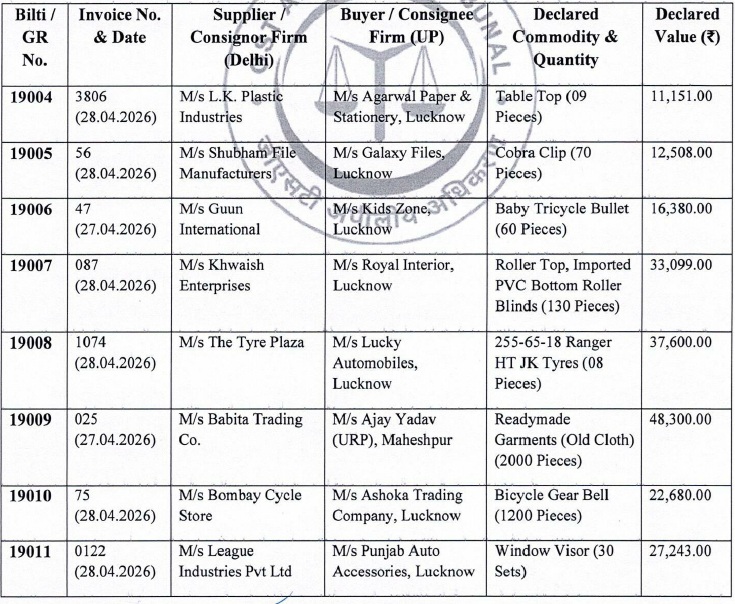
1.4. First, the physical verification revealed a complete absence of the declared cargo covered under 10 specific Biltis (Nos. 19004 to 19013) and their corresponding Tax Invoices. Upon inspection of the cargo space, not a single unit of these declared items was physically present inside the conveyance. Based on this total absence of declared goods, the department alleged that the respective buyers and sellers had entered into a collusive conspiracy to engage in fraudulent trade practices for the sole purpose of illicitly passing on fake Input Tax Credit (ITC) without any actual underlying physical supply of goods to evade tax. The itemized breakdown of this missing declared cargo is as follows:

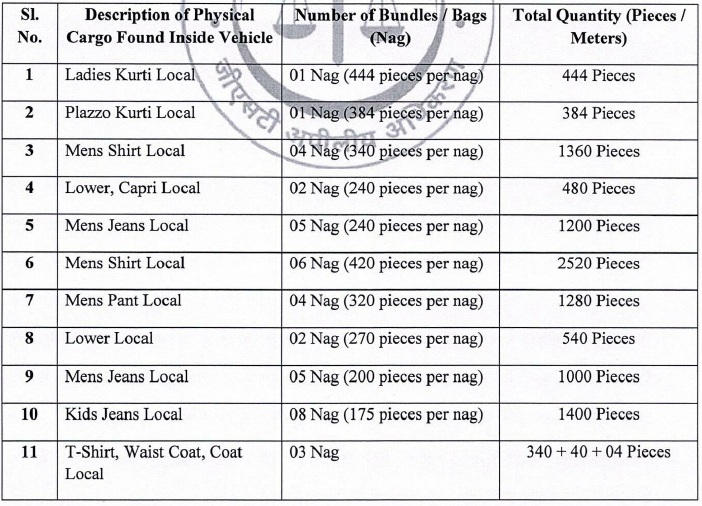
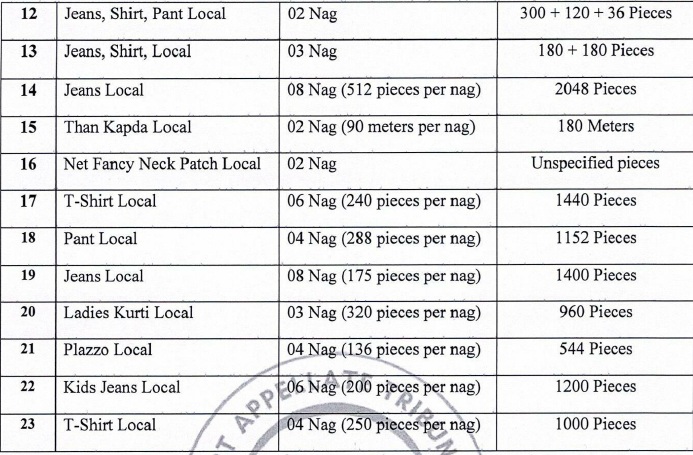
1.5. Second, in complete contrast to the missing cargo, the vehicle was found loaded with a massive volume of unmanifested, local commercial goods comprising 23 distinct categories of textile materials and readymade apparel. Since no valid tax invoices, delivery challans, or e-way bills covering this massive volume of garments were available at the time of transit, the department treated the entire cargo as unauthorized movement of goods in clear violation of Section 31 and Section 68 of the Goods and Services Tax Act, 2017, read along with Rules 46 and 138 of the statutory rules. The structural details of this physically recovered, undeclared cargo are indexed below:
1.6. Following the physical verification, a Show Cause Notice under Form GST MOV-07 / DRC-01 vide Notice No. ZD090526037413D dated 05.05.2026 was issued to the vehicle driver, giving him time until 10.05.2026 to submit a defense and scheduled a personal hearing for 11.05.2026. Because the actual consignors or consignees of the seized garments failed to come forward to claim legal ownership of the goods, the Proper Officer invoked the statutory provisions of Section 129(1) (b) of the Act, which prescribes the legal course of action when the owner of the goods does not step forward to face penalty proceedings. The valuation of the undocumented apparel was conducted by the department on the basis of quality parameters and prevalent wholesale market averages listed on e-commerce platforms like Indiamart. Consequently, on 12.05.2026, the Assistant Commissioner, Mobile Squad Unit-4, Lucknow, passed the Order-in-Original (OIO) vide Order No. ZD090526102762E, treating the Appellant transport operator as a person other than the owner and imposing a strict penalty totaling Rs. 39,74,712/- under Integrated Goods and Services Tax (IGST).
1.7. Aggrieved by the Order in Original, the Appellant preferred first appeal before the departmental appellate authority. The Appellant argued that there was no intention to evade tax. It was argued that the booking clerk had mistakenly handed the driver an incorrect bundle of transport documents meant for an entirely different transport vehicle. To prove its bona fides, the Appellant subsequently submitted a collection of 22 to 24 genuine Tax Invoices issued by three duly registered suppliers of Delhi, namely M/s Shree Maa Trading Co. (GSTIN-07BHQPA5874C1ZA), M/s R.P. Enterprises (GSTIN-07EDMPS6887N1Z7), and M/s Sahib Enterprises (GSTIN-07GTJPK1219P1Z7). The Appellant argued that these invoices matched the physical garments found inside the truck, that they were legally sold to various unregistered retail dealers across Uttar Pradesh, and that the applicable taxes had been fully charged by the suppliers. Invoking established judicial precedents, including the judgment of the Hon’ble Allahabad High Court in Falguni Steels v. State of U.P. (Allahabad)/[2024] 83 GSTL 12 (Allahabad)/[2024] 102 GST 662 (Allahabad), the Appellant claimed that the absence of mens rea (intent to evade tax) renders the heavy penalty unsustainable since inadvertent procedural errors should not be penalized so severely where no revenue loss is shown.
1.8. The First Appellate Authority (Additional Commissioner Grade-2 (Appeals)-5, State Tax, Lucknow) scrutinized the evidence under Appeal No. GST/355/26 and rejected the transport company’s defense. The Appellate Authority noted that the Appellant failed to produce any corroborative, independent evidence such as vehicle tracking logs or the specific identity of the second vehicle to validate the document-swap theory. The authority ruled that the law mandates statutory invoices and e-way bills to physically accompany the cargo during transit, meaning post-detention document submissions are a mere “after-thought” that cannot cure a fundamental legal breach. Furthermore, a deep examination of the belatedly submitted invoices revealed that they were issued entirely to unregistered entities, using only Aadhaar numbers without matching PAN details or physical identification proofs. Most crucially, it was confirmed that no E-Way bills were ever generated for these 22 transactions. Finding that the lack of mandatory documentation pointed to a deliberate intention to bypass the tax framework, the First Appellate Authority dismissed the appeal and upheld the original penalty of ?39,74,712/-. Aggrieved by the Order in Appeal, the Appellant has filed this present appeal before this Tribunal.
2. GROUNDS OF APPEAL
2.1. The Learned counsel for the Respondent submitted that the first Appellate Authority rejected the appeal without considering any submitted facts, legal documents, arguments, or the actual ownership of the cargo, making the disputed order entirely unjust and illegal. Although the registered dealers had provided all genuine invoices to the transporter, the vehicle driver accidentally presented the wrong documents during interception due to fear and hesitation.
2.2. The correct invoices, along with an explicit declaration of ownership by the registered dealers, were immediately submitted alongside the reply to the Show Cause Notice, but the respondent wrongly penalized the transaction solely based on the driver’s temporary error. By rejecting the dealers’ true ownership based entirely on groundless presumptions, the respondent violated the legal principles laid down by the Hon’ble Allahabad High Court in the case of Khan Enterprises v. Additional Commissioner (Allahabad)/[2023] 77 GSTL 162 (Allahabad)/[2023] 99 GST 760 (Allahabad). Furthermore, under the High Court ruling of Riya Traders v. State of U.P. [Writ Tax No. 28 of 2023, dated 17-1-2023] and another, it was held that when documents clearly identify a registered consignor, tax proceedings must be initiated against the actual owner instead of the driver, making the current penalty order under Section 129(3) illegal and unjust.
2.3. The physical goods perfectly matched the 22 invoices submitted with the response, and the respondent never contested the validity of these goods or denied that the suppliers are registered dealers who have actively come forward to claim ownership. The respondent’s claim that there was no proof showing the invoices were bona fide is groundless, as any tax invoice issued by registered, legitimate desders holds bona fide status, a fact further verified by their regular GST return filings on the official portal. Additionally, the respondent artificially increased the valuation of the intercepted goods without presenting any supporting material or evidence, which directly breaches Section 15 and Rules 27 to 35 of Chapter IV regarding tax valuation mechanics.
2.4. Finally, the respondent acted against official Instruction No. Sachal dal/2018-19/230/1819010/commercial tax issued by the Commissioner of Commercial Tax, UP, which explicitly mandates that a written declaration from a person claiming the goods must be accepted as sufficient proof of ownership.
3. SUBMISSION OF RESPONDENT;
3.1. The representative for the revenue has argued that the interception and subsequent physical verification revealed a massive case of structural non-compliance designed to circulate untaxed goods into open commercial streams. The revenue submits that the driver of vehicle HR38AA5752 initially produced an entirely separate, irrelevant set of tax documents relating to plastic goods and stationeries, which proves that the documentation was used merely as a cover to deceive checking authorities during transit. The department argues that if the mobile squad had not intercepted the truck, these readymade garments would have entered the local markets of Uttar Pradesh completely outside the official tax network, resulting in direct revenue leakage.
3.2. The department objects to the appellant’s defense of an accidental document mix-up, emphasizing that the appellant failed to provide any independent, corroborative evidence to support this claim. The revenue argued that the appellant produced absolutely no transport manifests, vehicle dispatch logs, or driver details regarding the alleged “second vehicle” with which the documents were supposedly swapped. In the absence of such verification, the story of an accidental document swap must be rejected as an afterthought designed to cover up clandestine transport.
3.3. The revenue further emphasizes that the 24 tax invoices produced by the transporter after the detention were issued exclusively to unregistered buyers whose identities could not be verified. The department notes that these post-detention invoices merely listed Aadhaar numbers without any accompanying PAN details or photocopies of physical identification cards to prove the transactions were genuine. Most importantly, the department stresses that no statutory e-way bills were generated or generated for these 24 invoices at the time of the transit. Under Section 68 read with Rule 138 of the GST Rules, moving goods without a valid, pre-generated e-way bill is an absolute statutory violation. The department concludes that the lack of proper documentation, the total mismatch of the cargo, and the failure to provide credible evidence of a document swap clearly prove an intent to evade tax, making the penalty under Section 129(l)(b) perfectly legal and justified. In this context, the order passed by the First Appellate Authority confirming the order under Section 129 is fully sustainable, and accordingly, it is requested to uphold the OIA order.
4. QUESTIONS OF LAW
• Whether the physical transport of taxable goods accompanied by completely mismatched tax documents, followed by the submission of post-detention invoices without any e-way bills, satisfies the statutory requirements under Section 68 of the CGST/UPGST Act, 2017 read with Rule 138 of the GST Rules?
5. DISCUSSIONS AND FINDINGS;
5.1. We have meticulously evaluated the submissions made by both sides, examined the lower court records, and thoroughly analyzed the statutory framework alongside the binding judicial precedents cited before this Bench.
5.2. The primary statutory mechanism under review is Section 129 of the CGST/UPGST Act, which handles the detention and seizure of goods and conveyances in transit. It is a well-settled principle of tax jurisprudence that transport operations must strictly align with the provisions of Section 68, which mandates that the person-in-charge of a conveyance must carry specified valid tax documents. In the present case, it is an undeniable fact that at the time of interception on 30.04.2026, the driver was not in possession of any document matching the readymade garments physically loaded in truck HR38AA5752. The documentation produced at the initial stage belonged to completely different suppliers and completely different commodities. This establishes a clear prima facie procedural violation, and the mobile squad authority was perfectly within its legal jurisdiction to stop and detain the vehicle for physical verification.
5.3. We find that the primary defense concerning the ‘accidental exchange of document bundles’ at the booking office is an unsubstantiated, self-serving oral statement backed by zero empirical evidence. The Appellant, a professional commercial logistics firm, failed to produce any corroborative trail such as a transport manifest, vehicle dispatch logs, RFID/Fastag data, or the registration details of the alleged ‘second vehicle’ to validate this document-swap theory. For a commercial carrier handling interstate cargo valued at lakhs of rupees to plead a blind clerical oversight fails the basic test of normal human behavior and commercial prudence. In the absence of a verifiable contemporary paper trail representing the alternate transaction, this Bench rejects the document-swap theory as a pure, post-detention afterthought designed to mask clandestine transport.
5.4. The subsequent submission of tax invoices via email after the physical seizure of the vehicle cannot cure the illegal nature of the transit. Section 68(1) of the Act categorically mandates that:
“The Government may require the person in charge of a conveyance carrying any consignment ofgoods of value exceeding such amount as may be specified to carry with him such documents and such devices as may be prescribed.”
Rule 138A (1) of the Central Goods and Services Tax Rules, 2017, reinforces this absolute rule by stating:
“The person in charge of a conveyance shall carry—(a) the invoice or bill of supply or delivery challan, as the case may be; and (b) a copy of the e-way bill or the e-way bill number.”
5.5. The law does not permit a system of “retrospective validation” where a transporter can move massive columns of undeclared commercial goods across states and then produce invoices post-interception once caught by the Mobile Squad. The presence of valid documentation during actual transit is a strict requirement under the law.
5.6. The complete failure to generate E-Way bills for commercial goods of this volume is a direct, open violation of Rule 138. The submission of un-mapped, non-E-Way bill invoices issued to unregistered buyers proves that the paperwork was artificially structured post-! I y J detention to shield an ongoing tax evasion operation.
5.8. We find that Appellant has relied upon the judicial precedents of the Hon ‘ble Allahabad High Court in Khan Enterprises(supra) and Riya Traders (supra). The Appellant has argued that the proper officer violated settled law by raising groundless presumptions against the subsequent ownership declarations made by the registered Delhi suppliers, and that the department was legally bound to proceed against the named owners rather than punishing the transporter under Section 129(1)(b) of the Act. While these rulings carry significant weight in their respective factual contexts, we find that the Appellant’s attempt to fit the current case into these precedents is based on a fundamentally flawed reading of both the facts and the statutory framework.
5.9. In Khan Enterprises (supra), the Hon’ble High Court held that the department cannot reject true ownership on groundless, arbitrary presumptions when all transit documents are in order and the dealer steps forward to claim the cargo. However, the protective shield of M/s Khan Enterprises cannot be extended to a case where the ownership claim itself is built upon a fictional paper trail designed post-interception. In the present case, the rejection of the dealers’ ownership by the Revenue is not based on “groundless presumptions” but on solid, verifiable facts:
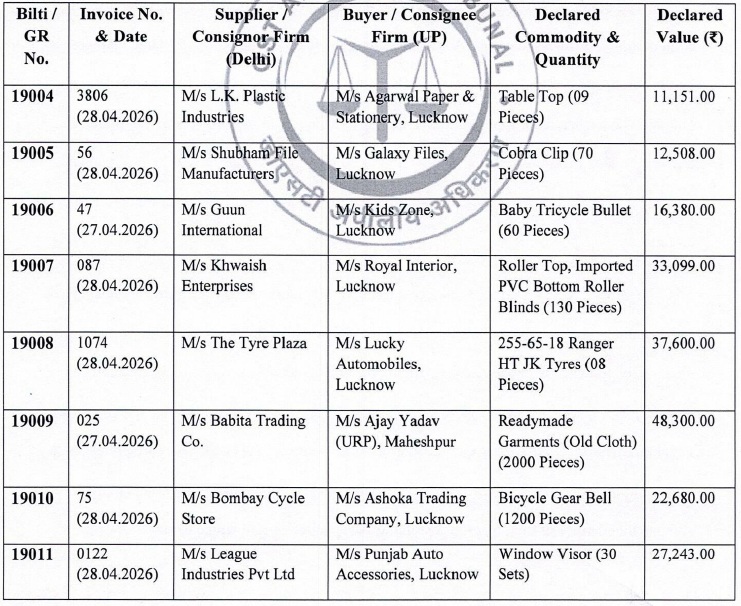
• The physical cargo inside the container was completely unmanifested at the time of interception. The driver carried documentation for a completely fictional layout of plastic goods, stationeries, and tyres that did not exist inside the vehicle, as itemised below:

• The invoices produced post-detention via email were issued exclusively to unregistered retail dealers, carrying no structural validation other than random Aadhaar numbers, without matching PAN data or physical verification records.
• Crucially, not a single E-Way bill was generated or recorded on the statutory network for any of the invoices, directly violating the strict mandate of Rule 138.
5.10. The claim of a registered dealer to be the “true owner” must be backed by authentic, contemporary business records. A registered dealer cannot simply issue blank invoices to unregistered, anonymous individuals’ post-seizure to cover up an active grey-market transport operation and then claim protection under M/s Khan Enterprises. When the underlying transaction lacks commercial reality and fails to comply with statutory E-Way bill mandates, the proper officer is fully justified in treating such ownership claims as a non-bona fide after-thought.
5.11. Similarly, the Appellant’s reliance on M/s Riya Traders (supra) is completely misplaced and dynamic contextually. In M/s Riya Traders, the Hon’ble High Court held that when valid transport documents physically accompanying the transit clearly identify a registered consignor or consignee, the tax proceedings must be initiated against such actual owner under Section 129(l)(a) instead of penalizing the transporter under Section 129(1)(b). The core prerequisite for invoking M/s Riya Traders is that the goods must be accompanied by documents that validate the identity of the owner in relation to the specific cargo being carried.
5.12. In the case before us, there was an absolute structural disconnect. The documents that were physically carried by the driver at the time of interception (Biltis 19004 to 19013) belonged to entirely different entities and described completely different commodities (table tops, cobra clips, tyres, etc.) which were nowhere to be found inside the vehicle. On the contrary, the massive volume of local garments actually stuffed inside the vehicle had no documentary coverage whatsoever. Therefore, at the critical moment of interception and detention, there was no owner identifiable on record for the following physically recovered, undeclared cargo:
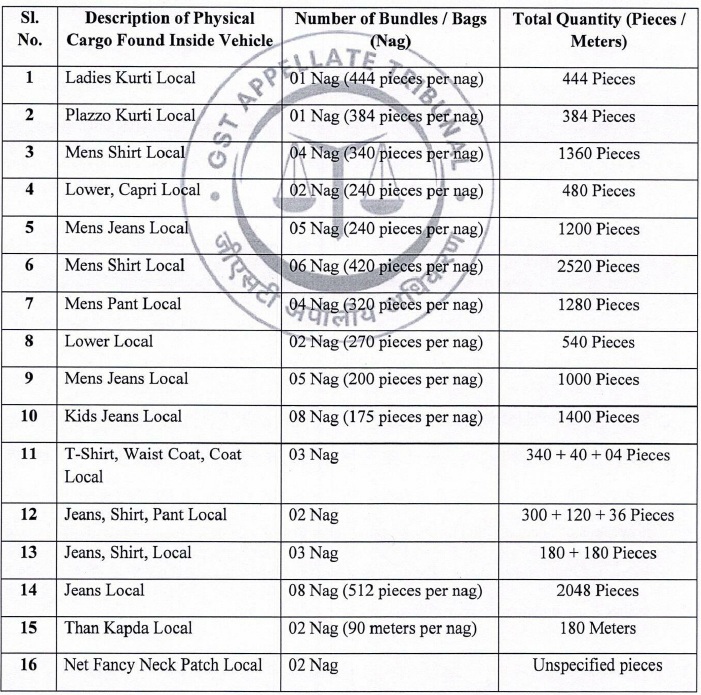
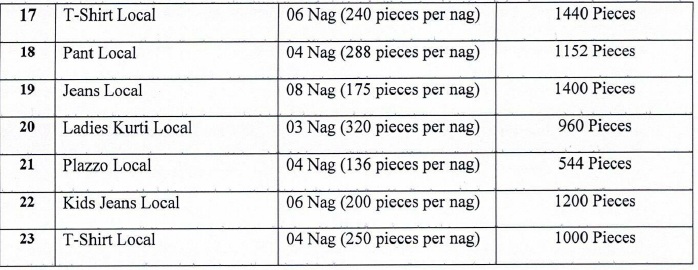
5.13. The subsequent submission of un-mapped, non-E-Way bill invoices via email does not retroactively change the fact that the cargo was moving in total secrecy. Section 129(1) (b) explicitly applies where the owner of the goods does not come forward. Legally speaking, “coming forward” means stepping forward with valid, pre-existing, and legally compliant documents at the threshold of interception. A transporter caught moving a massive layout of undocumented cargo cannot escape liability under Section 129(1) (b) by having cooperative dealers email unverified, non-E-Way bill invoices hours or days after the vehicle has been seized. If such a defense were allowed, the entire anti-evasion mechanism of Section 68 and Rule 138A would be rendered a dead letter, as every caught transporter could systematically arrange for post-detention invoices to shift liability away from the vehicle.
5.14. The proper officer has acted with complete legal propriety. In the absence of immediate, legally valid ownership documentation matching the physical cargo during transit, the proper officer committed no error in treating the Appellant transport operator under the strict provisions of Section 129(1)(b) as a person other than the owner. The principles laid down in M/s Khan Enterprises and M/s Riya Traders do not validate or protect transactions completely stripped of mandatory E-Way bills and clean transit tracking.
5.15. Regarding the valuation of the seized goods, we find no infraction of Section 15 or Rules 27-35. Since the cargo was completely undocumented and the actual buyers remained untraceable, the Proper Officer was legally bound to resort to take action under Section 129(l)(b) of the Act. The department conducted the valuation on objective parameters, factoring in product quality, fabric specifications, and prevalent wholesale market averages retrieved from established e-commerce business portals like IndiaMart. In the absence of any contemporary commercial invoices matching the transit, the market-based valuation adopted by the Proper Officer represents a fair, rational, and legally sound mechanism to safeguard public revenue.
5.16. The Proper Officer committed no error in treating the Appellant under Section 129(1)(b) since the actual owners did not come forward. The Learned First Appellate Authority acted with complete legal propriety in confirming the penalty. we find no reason or graunds to interfere with the well-reasoned findings of the authorities below.
ORDER
The appeal filed by the Appellant, M/S Badri Vishal Goods Carriers, is hereby Dismissed. The Order-in-Appeal sustaining the confirmation of seizure and the recovery of the IGST penalty of ^39,74,712/- under Section 129(3) is Upheld.