


Inadvertent TDS Oversight Due to Operational Personnel Changes Constitutes Reasonable Cause Mitigating Section 271C Penalty
Issue
Whether the levy of penalty under section 271C of the Income-tax Act, 1961 for failure to deduct tax at source (TDS) on payments made to foreign and domestic entities is sustainable when the failure was caused by inadvertent oversight due to frequent personnel changes during the initial period of operations.
Facts
-
The assessee, a hotel company, made payments toward commission to Hilton International LLC and professional fees to Hilton Jaipur during Assessment Year 2016-17.
-
The assessee failed to deduct tax at source (TDS) on these specific payments under a bona fide belief that no TDS was deductible.
-
TDS was regularly deducted on other distinct payments made to Hilton International LLC during the same period.
-
The Additional Commissioner of Income Tax (TDS) imposed a penalty equal to the TDS default under section 271C.
-
The assessee explained that frequent turnover of key accounting personnel during the initial operational phase led to an inadvertent oversight, establishing a reasonable cause under section 273B.
Decision
-
In favour of the assessee: The penalty imposed under section 271C for failure to deduct TDS is not legally sustainable.
-
Establishment of Reasonable Cause: The explanation provided by the assessee—attributing the non-deduction to bona fide oversight and operational disruption from key personnel changes—constitutes a “reasonable cause” within the meaning of section 273B.
-
Deletion of Penalty: Since reasonable cause under section 273B was established, no penalty under section 271C could be levied.
KeyTakeaways
-
Section 273B Immunity: Section 273B provides immunity from penalty under section 271C if the deductor proves reasonable cause for failing to deduct tax at source.
-
Bona Fide Operational Oversight: Inadvertent administrative errors arising from frequent staff changes during initial business operations can be treated as reasonable cause, provided there is no deliberate intent to evade tax compliance.
-
Consistent Compliance Record: Regular TDS compliance on other concurrent transactions strengthens the defense of bona fide mistake rather than deliberate default.
IN THE ITAT AGRA BENCH (DB)
Double Tree by Hilton Hotel
v.
Addl. CIT (TDS) Kanpur
Sunil Kumar Singh, Judicial Member
and Brajesh Kumar Singh, Accountant Member
and Brajesh Kumar Singh, Accountant Member
IT Appeal No. 470 (Agr) of 2026
[Assessment year 2016-17]
[Assessment year 2016-17]
OCTOBER 22, 2026
Mridul Pathak, CA for the Appellant. Anil Kumar, Sr. DR for the Respondent.
ORDER
Brajesh Kumar Singh, Accountant Member. – This appeal is directed against the impugned order dated 25.08.2025 passed in appeal No NFAC/2014-15/10296446 by the Commissioner of Income Tax(Appeals), NFAC, Delhi (hereinafter referred to as the “CIT(A)), u/s. 250 of the Income Tax Act, 1961 (hereinafter referred to as the “Act”) for the A.Y. 2016-17, wherein Id. CIT (A) has dismissed the assessee’s appeal.
2. The present appeal has been filed beyond the period of limitation, i.e., delayed by 207 days. The assessee has filed an application for condonation of this delay, which is reproduced as under :
” 1. That the Penalty order by Ld. Assessing Officer was passed under-section 271C of the Income Tax Act 1961 dated 25.09.2023 after Imposing penalty of Rs.80,753/-. The assesse had preferred an appeal against the impugned penalty order before the Id. CIT(A) which has also been decided against the assesse vide order dated 25.08.2025,
2. That the appeal against the order dated 25.08.2025 passed by the Ld. CIT(A) was to be filed on or before 31.10.2025.
3. That the Appellant preferred an appeal against the said order before the Hon’ble Income Tax Appellate Tribunal on 07.11.2025, along with an application for condonation of the marginal delay of 7 days incurred at that initial stage.
4. That due to technical limitations on portal, initially the appeal was filed before the Hon’ble Lucknow Bench. although the assessee had no role in such allocation.
5. That thereafter, the Hon’ble Lucknow Bench observed that the matter did not fall within its territorial jurisdiction and that the appeal was required to be dealt with by the Hon’ble Delhi Bench. Accordingly, the appeal was transferred and thereafter came to be processed before the Hon’ble ITAT, Delhi Bench.
6. That the appeal was ultimately registered before the Hon’ble ITAT, Delhi Bench as ITA No. 7233/Del/2025 and was taken up for consideration.
7. That vide order dated 30.04.2026, the Hon’ble ITAT, Delhi Bench held that it did not possess territorial jurisdiction to adjudicate the appeal as the situs of the Assessing Officer was at Agra and, therefore, the appeal was required to be filed before the Hon’ble Agra Bench. While dismissing the appeal on the ground of lack of territorial jurisdiction and held that “We accordingly conclude that Income Tax Appellate tribunal’s Delhi Benches do not have territorial jurisdiction to decide the assesse instant appeal, subject to a rider that it shall indeed be at liberty to institute a fresh appeal, if so advised, before the appropriate benches and delay caused therein as on date, shall stand condoned”.
8. That immediately upon receipt of the aforesaid order, the assessee took prompt steps for filing the present appeal before the Hon’ble Agra Bench having the requisite territorial jurisdiction and accordingly filed the appeal on 26.05.2026.
9. That the assessee acted bonafidely throughout and remained under the genuine belief that the appeal was being processed before the appropriate Bench of the Hon’ble Tribunal. The assessee had no role in the administrative processing of the matter before different Benches.
10. That the resultant delay in filing/refiling the present appeal before the Hon’ble jurisdictional Bench has occurred solely due to the above procedural and jurisdictional circumstances and not on account of any wilful negligence, deliberate default, or malafide intention on the part of the assessee.
In this regard reliance is also placed on the following judicial pronouncements –
1. Hon’ble Supreme Court in case of Land Acquisition Collector v. MST Katiji & Others 167 ITR 471 (SC) held that “it is on contention of delay that when substantial justice and technical considerations are pitted against each other, the case of substantial justice deserves to be preferred, for the other side cannot claim to have a vested right in injustice being done because of non-deliberate delay.” Keeping in view the discussion made in the preceding paras and following the ratio laid down by the Hon’ble Supreme Court in case of MST Katiji & Others (supra), we are of the considered view that there is “sufficient cause” to condone the delay of 928 days in filing the appeal, hence the same is hereby condoned. So this appeal is ordered to be registered and taken up for disposal on merits.
2. N. Balakrishnan v. M. Krishnamurthy 1998 (7) SCC 123:
The Supreme Court held that the expression “sufficient cause” must be considered with a pragmatic approach and that the cause shown for condonation of delay should be examined in the context of facts and circumstances of each case.
3. State of West Bengal V. Administrator, Howrah Municipality (1972 AIR 749)
The Supreme Court observed that the words “sufficient cause” should receive a liberal construction, and the courts should lean in favor of condoning the delay if substantial justice is met.
4. Ramlal, Motilal and Chotelal V. Rewa Coalfields Ltd 1962 AIR 361:
In this case, the Supreme Court held that the expression “sufficient cause” should be interpreted to advance substantial justice and should not be defeated by a rigid interpretation.
5. National Insurance Co. Ltd. V. Nicolletta Rohtagi & Ors Appeal Civil 4292 of 2002 order dated 17/09/2002:
The Hon’ble Supreme Court emphasized that the approach of the court should be dynamic and not static while deciding applications for condonation of delay, taking into consideration the overall interest of justice.
PRAYER
In view of the facts and circumstances stated above, It is, therefore, most humbly prayed to your honour to kindly condone the purported delay of 207 days in filing of the appeal, as the explanations provided are genuine and in line with the circumstances we have detailed.”
2.1 In view of the reasons assigned for condonation of delay, we are satisfied that there was sufficient cause for the said delay in filing this appeal. We accordingly condone the delay and take up the appeal for adjudication on merits.
3. Brief facts of the case: In this case, a TDS survey/verification u/s 133A(2A) of the Act was conducted on 03.03.2020. The DCIT(TDS), Kanpur passed an order u/s 201(1)/201(1A) of the Act and raised liability for non-deduction of tax u/s. 201(1) and interest u/s.201(1A) for F.Y. 2015-16 and calculated the amount of short deduction and interest as under:
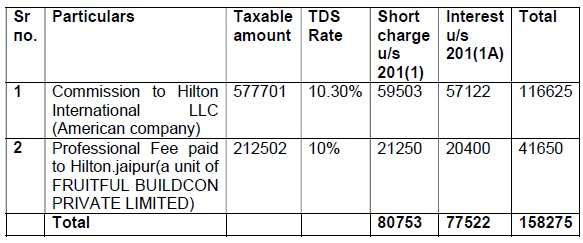
3.1 During the course of TDS verification proceedings, it was detected that deductor assessee had not deducted TDS paid on commission expenses (Rs. 5,77,701/-) paid to Hilton International LLC u/s 194 and professional fees (Rs. 2,12,502/-) paid to Hilton Jaipur for F.Y. 2015-16. The DCIT(TDS), Kanpur referred the case for considering penalty u/s 271C of the Act to the Addl. CIT(TDS)Kanpur. Accordingly, an opportunity of being heard was given to the deductor assessee vide show cause notice dated 20.04.2023. In compliance to show cause notice the deductor assessee submitted its reply on 08.05.2023. The Addl CIT(TDS)Kanpur, noted that the reply of assessee was not acceptable for the reason that deductor assessee had admitted its default on account of short deduction of tax and also paid tax of Rs. 1,58,275/- on 07.04.2023 as per the order u/s 201(1)/201(1A) of the Act, of the DCIT (TDS), Kanpur. In view of the above-mentioned facts, the Addl CIT(TDS)Kanpur held that the assessee is liable to penalty and it is a fit case for imposition of penalty u/s 271C of the Act for its failure to deduct the tax deducted at source and deposit it into the account of Govt. of India within the due dates as prescribed in the Act. Accordingly, the AO noted that since, the assessee had failed to deduct the tax deducted at source amounting to Rs.80,753/-, a penalty of Rs.80,753/-, was imposed u/s 271C of the Act, for F.Y. 2015-16 and the assessee was directed to pay the same.
4. Aggrieved with the said order, assessee filed an appeal before the learned CIT(A), who dismissed the appeal of the assesee. The relevant extract of the order of learned CIT(A) is reproduced as under :
“5.4 After considering the entire factual matrix and submission of the assessee and case laws relied upon by the appellant, I do not find any force in its submission because first of all, the appellant has itself accepted that it is availing various services from M/s Hilton International LLC like management agreement, license agreement, royalty, franchises etc. It has also been accepted by the appellant that the appellant is using the trademark name of Hilton for its hotel. It has also been accepted by the appellant that it is deducting tax against various payments to M/s Hilton International LLC except this payment of commission. Therefore, I am of the view that Hilton International LLC is having a P.E. in India and its Income which accrues and arise in India is liable to be taxed in India. The appellant cannot have two standard for the same company that some payments it is considering the P.E. of M/s Hilton International LLC and deducting tax on some of its payments and while leave other payments and take shelter of non – existent of P.E. Even otherwise, the use of trademark Hilton for its hotels itself proves that assessee / appellant is a P.E. of M/s Hilton International LLC. It is also not disputed that payment is made for commission of bookings in hotel owned by the appellant, therefore, this commission income of M/s Hilton International LLC certainly accrues and arise in India. In light of these facts, it is clear that such commission payments were liable to be taxed in India, thus, liable for TDS u/s 195 of the I.T. Act. As the appellant has failed to deduct that tax on these payments penalty u/s 271C is fully justified. Accordingly, the penalty on these payments is confirmed.
5.5 The second dispute is regarding the penalty u/s 271C of the I.T. Act for non deduction of TDS on professional services received from Hilton, Jaipur (a unit of Fruitful Buildcon Pvt. Ltd.). The appellant in its submission has mainly submitted that Hilton, Jaipur is a taxable entity in India and it has filed its return of income for that year and disclosed the receipts from appellant in its financial accounts, therefore, the appellant is of view that as taxes has been paid by recipients, the appellant cannot be considered assessee in default u/s 201 of the I.T. Act and accordingly the provisions of section 271C are not applicable. In its support, the appellant has relied on some judicial pronouncements. Without prejudice to this, the appellant has also stated that there were frequent changes in the key position in the accounts department of the appellant which has led two inadvertent oversight in TDS compliances without any intention thus, the appellant is of view that there was a reasonable cause for not deducting the tax on the said transaction and thus, prayed that penalty should be deleted.
5.6 From the submission of the appellant, it is apparent that the appellant has accepted there were payments to Hilton, Jaipur which were liable to be Tax Deduction at Source and the appellant has failed in its duty to deduct the due tax thereon. The decision placed by the appellant regarding the 201(1) are of no use as they are regarding only the recovery of the TDS, however, paying of tax by the receiver cannot absolve the appellant from its statutory duty of tax deduction. There are plethora of decision which states that wherever the recipients has disclosed the amount in its return of income and pay due taxes thereon, though, payer cannot be held as assessee in default for principle amount u/s 201(1) of the I.T. Act, however, payer is liable to pay the interest u/s 201(1A) and the penalty u/s 271C on the TDS defaulted. Therefore, the assessee in default for non deduction of TDS and thus, liable for penalty under section 271C of the I.T. Act. The case laws given by the appellant are of no use from the present facts of the case. Now coming to the reasonable cause given by the appellant. The appellant is running a five star hotel named as Hotel Double Tree by Hilton, Agra and is run professionally with the help from even the multinational companies like M/s Hilton International LLC for management etc. In such a big company, professionally managed the plea of leaving one or two personal cannot be sustained for non compliance of its statutory duties. Therefore, the plea of reasonable cause regarding leaving of few employees do not hold water and liable to be rejected. Therefore, the penalty u/s 271C on these payments to Hilton, Jaipur also deserves to be confirmed.
6. In the result, the appeal of the appellant dismissed.”
5. Aggrieved with the said order, the assessee is in appeal before us. The assessee filed the appeal on ground No. 1 to 8. Further during the course of appellate proceedings, the assessee filed a revised grounds of appeal which are reproduced as under :
“1. That the Ld. CIT(A)-5, NFAC has erred both on facts and in law in confirming the penalty under section 271C of the Income- tax Act, 1961 amounting to 80,753/- without appreciating that the alleged failure to deduct tax at source was based on a bona fide interpretation of law and was, therefore, covered by the exception of reasonable cause under section 273B of the Act.
2. That the Ld. CIT(A) has erred both on facts and in law in holding that Hilton International LLC had a Permanent Establishment (“PE”) in India merely because the appellant used the Hilton trademark and deducted tax at source on certain other payments, while ignoring that no PE was established in terms of Article 5 of the India-USA Double Taxation Avoidance Agreement. Consequently, the commission paid for overseas marketing services was not chargeable to tax in India and the provisions of section 195 were not attracted.
3. That the Ld. CIT(A) has erred in sustaining the penalty without appreciating that the payment made to Hilton Jaipur, being a domestic entity, had already been duly offered to tax by the recipient and assessed in India. As no loss of revenue was caused to the Revenue, the levy of penalty under section 271C is unsustainable in law.
4. That the Ld. CIT(A) has erred in law in treating the levy of penalty under section 271C as automatic, without appreciating that penalty cannot be imposed where the assessee has established a reasonable cause for the alleged default.
5. That the findings recorded by the Ld. CIT(A) are contrary to law and the facts on record in holding that the mere use of the Hilton trademark by the appellant establishes the existence of a Permanent Establishment of Hilton International LLC in India, without examining the conditions prescribed under the applicable Double Taxation Avoidance Agreement or the settled legal principles governing the determination of a Permanent Establishment.
6. That the Ld. CIT(A) failed to appreciate that the appellant’s acceptance of the order passed under sections 201(1) and 201(1A) was only with a view to avoid prolonged litigation and cannot, by itself, be construed as an admission of default so as to justify the levy of penalty under section 271C.
7. That, without prejudice to the foregoing grounds, the penalty levied is excessive, arbitrary and otherwise unsustainable, as the appellant had acted bona fide, under a genuine belief regarding the applicability of the provisions relating to deduction of tax at source, and there was no intention to evade tax.
8. That the appellant craves leave to add, alter, amend, modify or withdraw any of the above grounds of appeal at or before the time of hearing.”
5.1 The above revised grounds of appeal are admitted and the same are taken up for adjudication.
6. At the outset, the Id. AR submitted that in respect of payment of Rs.2,12,502/- on account of professional fees paid to Hilton, Jaipur, the assessee submitted that Hilton Jaipur had duly disclosed the entire receipts from the assessee company in the financial statements and it filed its Income Tax Return for A.Y. 2016-17 and had also paid due taxes. In this regard, the learned AR referring to the memorandum of Finance Act, 2012, whereby the first proviso to section 201(1) was introduced vide Finance Act, 2012, submitted that in view of the said provision, since Hilton Jaipur had included the receipts of Rs.2,12,502/- in its income and paid the taxes, the assessee will not be in default for non-deduction of TDS on the said payment and therefore will be not liable for penalty u/s 271C of the Act for its default on the non-deduction of TDS on the payment of Rs. 2,12,502/- to Hilton Jaipur. In this regard, the learned AR relied upon the decision of Hon’ble High Court in the case of CIT XVII, Delhi v. Cadbury India Ltd. (Delhi), to submit that in this case it was held that when there is no demand u/s. 201(1) of the Act, the provisions of section 271C were not applicable.
6.1 Regarding the commission payment of Rs. 5,77,701/- to Hilton International LLC, the learned CIT(A) confirmed the penalty on the ground that Hilton International LLC is having a Permanent Establishment (PE) in India and its income accrues and arises in India and therefore, liable to be taxed in India. The learned CIT(A) also noted that the assessee accepted deducting tax against various payments to Hilton International LLC except this payment of commission and the Id. CIT(A) noted that the assessee cannot have two standards for the same company.
6.2 In this regard, the learned AR submitted that it disputes the finding of the learned CIT(A) that M/s. Hilton International LLC had a PE in India. Further, the Id. AR submitted that the appellant had a bona fide belief that while deducting TDS in respect of other payments of Hilton International LLC, there was no requirement to deduct TDS in respect of the commission payment made to Hilton International LLC. In this regard, the assessee relied upon the decision of Hon’ble Apex Court in the case of CIT v. Eli Lilly & Co. (India) (P.) Ltd. [2009] 178 312 ITR 225 (SC), and submitted that in this case, the Hon’ble Apex Court held that no penalty shall be imposed on the person or the assessee for failure to deduct tax at source if the said person or the assessee proves that there was a reasonable cause for the said failure.
6.3 The Ld. AR also referred to the submission made by the assessee before the Ld. CIT(A) placed at para no. 4.2 on page no. 18 of the order that the assessee started its operation in December 2014 and in the initial period the employee turnover was high and the Finance Controller Head Mr. Ashwani Kadanga, resigned and left his office on 10/09/2015 and Main Accounts Executive Mr. Umesh Balchandani resigned on 26/10/2015. It was further submitted that the frequent changes in the key positions in the ‘Accounts Department’ led to disruption in the working which may have led to some inadvertent oversights in TDS compliances, without any intention of TDS default. In this regard, the relevant extract of the said submission is reproduced as under:
“4.2 It is reiterated that the assessee company had started its operations during December-2014. In initial periods, employee turnover was high. Finance Controller Head Mr ASHWANI KADANGA, resigned and left his office on 10/09/2015 and Main Accounts Executive Mr. UMESH BALCHANDANI resigned on 26/10/2015. Copy of resignation letter enclosed. Frequent changes in the key positions in the ‘Accounts Department’ led to disruption in the working which may have led to some inadvertent oversights in TDS compliances, without any intention of TDS default. The assessee has been tax compliant throughout and the above purported non- compliance or mis-interpretation of TDS provisions was due to change in the incumbent looking after the tax compliances of the assessee. Thus, the mistake in compliance if any was totally unintentional and there was a reasonable cause for non-deduction of tax at source on the above payments. Rather in the situation mentioned at Serial no. 1 the assessee company was of the bonafide belief that the tax was not required to be deducted at source on the said payments.”
7. On the other hand, the LD Sr. DR supported the orders of the authorities below.
8. We have heard both the parties and perused the material on record. In this case, the Ld. AR submitted that in respect of payment of Rs.2,12,502/- on account of professional fee paid to Hilton, Jaipur (a unit of Fruitful Buildcon Private Limited), Hilton Jaipur had duly disclosed the entire receipts from the assessee company in the financial statements and had filed its Income Tax Return for A.Y. 2016-17 and had also paid due taxes. Further, we notice that the conduct of the assessee in deducting tax in respect of other payments made by the assessee to Hilton International LLC, but not deducting TDS on commission payment of Rs.5,77,701/- under a bonafide belief that no such TDS was deductible on such payments, is found to be reasonable. But more importantly in this case we are satisfied by the explanation given by the assessee before the Ld. CIT(A) that due to various factors as mentioned therein led to disruption in the working which may have led to some inadvertent oversights in TDS compliances, without any intention of TDS default. In this regard, we do not agree with the view of the Ld. CIT(A) on this issue and we rely upon the order of the Hon’ble Apex Court in the case of CIT, New Delhi v. Eli Lilly & Co. (India) (P.) Ltd. (supra). The relevant observation of the Apex Court in para no. 35 is reproduced as under:
“(iv) On the Scope of section 271C read with section 273B:
35. Section 271C inter alia states that if any person fails to deduct the whole or any part of the tax as required by the provisions of Chapter XVII-B then such person shall be liable to pay, by way of penalty, a sum equal to the amount of tax which such person failed to deduct. In these cases we are concerned with section 271C(1)(a) Thus section 271C(1)(a) makes it clear that the penalty leviable shall be equal to the amount of tax which such person failed to deduct. We cannot hold this provision to be mandatory or compensatory or automatic because under section 273B Parliament has enacted that penalty shall not be imposed in cases falling thereunder. Section 271C falls in the category of such cases. Section 273B states that notwithstanding anything contained in section 271C, no penalty shall be imposed on the person or the assessee for failure to deduct tax at source if such person or the assessee proves that there was a reasonable cause for the said failure. Therefore, the liability to levy of penalty can be fastened only on the person who do not have good and sufficient reason for not deducting tax at source. Only those persons will be liable to penalty who do not have good and sufficient reason for not deducting the tax. The burden, of course, is on the person to prove such good and sufficient reason. In each of the 104 cases before us, we find that non-deduction of tax at source took place on account of controversial addition. The concept of aggregation or consolidation of the entire income chargeable under the head “Salaries” being exigible to deduction of tax at source under section 192 was a nascent issue. It has not be considered by this Court before. Further, in most of these cases, the tax-deductor- assessee has not claimed deduction under section 40(a)(iii) in computation of its business income. This is one more reason for not imposing penalty under section 271C because by not claiming deduction under section 40(a)(iii), in some cases, higher corporate tax has been paid to the extent of Rs. 906.52 lakhs (see Civil Appeal No. 1778/2006 entitled CIT V. Bank of Tokyo-Mitsubishi Ltd. In some of the cases, it is undisputed that each of the expatriate employees have paid directly the taxes due on the foreign salary by way of advance tax/self-assessment tax. The tax- deductor-assessee was under a genuine and bona fide belief that it was not under any obligation to deduct tax at source from the home salary paid by the foreign company/HO and, consequently, we are of the view that in none of the 104 cases penalty was leviable under section 271C as the respondent in each case has discharged its burden of showing reasonable cause for failure to deduct tax at source.”
(emphasis supplied by us)
8.1 Relying upon the ratio of the above- mentioned case, for the reasons as stated by the assessee, we are satisfied that the assessee had a reasonable cause for the said failure. Accordingly, we hold that the levy of penalty u/s 271C of the Act imposed in this case is not sustainable and we delete the penalty of Rs 80,753/- in this case. Ground no. 1 of the appeal is allowed. In view of ground no. 1 of the appeal being allowed, the other grounds of appeal become academic and are left open in this case.
9. In the result, the appeal of the assessee is allowed.