


Tax Addition Under Section 68 Unjustified for Demonetised Cash Repayments and Related Interest Income
Issue
Whether cash repayments of existing loans received in Specified Bank Notes (SBNs) by a micro-finance NBFC, and the corresponding interest income already credited to the Profit & Loss account, can be treated as unexplained cash credits under Section 68 of the Income-tax Act, 1961 (Section 102 of the Income-tax Act, 2025).
Facts
-
Nature of Business: The assessee is a Non-Banking Financial Company (NBFC) engaged in the business of micro-finance.
-
Demonetisation Receipts: Post-demonetisation (after 08-11-2016), the assessee accepted cash repayments of existing loan instalments from its borrowers in demonetised currency notes (SBNs).
-
Book Entries & Evidence: The cash collections were duly recorded in the regular books of account and supported by contemporaneous documentary evidence.
-
AO’s Stance on Cash Credits: The Assessing Officer (AO) treated the SBN receipts as unexplained cash credits under Section 68 solely because the assessee was not authorized to accept SBNs after 08-11-2016.
-
Unchallenged Fundamentals: The Revenue did not dispute or disprove the underlying loan transactions, nor did it reject the assessee’s books of account.
-
Double Addition of Interest: The AO made a separate addition of ~₹41.03 lakhs towards interest income, despite the fact that the assessee had already credited this interest to its Profit & Loss Account and offered it to tax under its regular accounting method.
Decision
-
Mode/Denomination Not Grounds for Section 68: The Tribunal/Court held that cash receipts representing genuine repayments of existing loans from established borrowers cannot be treated as unexplained cash credits under Section 68 merely due to the mode or denomination (SBNs) of the currency received.
-
Deletion of Cash Credit Addition: Since the underlying loan accounts were genuine and documented, the addition made under Section 68 was ordered to be deleted.
-
Deletion of Interest Income Addition: Once the cash collections were established as genuine loan repayments, the consequential separate addition for interest income could not independently survive.
-
Prevention of Double Taxation: Since the interest component was already recognized in the books and offered to tax, sustaining the separate addition would result in impermissible double taxation of the same income.
Key Takeaways
-
Section 68 Requires Unexplained Nature, Not Regulatory Breach: A violation of demonetisation guidelines or notifications restricting the acceptance of SBNs does not automatically convert genuine loan recoveries into “unexplained cash credits” under tax laws.
-
Authenticity of Books Holds Weight: When the Revenue accepts the regular books of account and does not dispute the underlying borrower accounts, additions under Section 68 cannot be made arbitrarily.
-
Prohibition Against Double Taxation: Income that has already been credited to the Profit & Loss account and offered to tax under regular accounting methods cannot be added again as unexplained income.
IN THE ITAT MUMBAI BENCH ‘A’
Agora Microfinance India Ltd.
v.
Income-tax Officer
Pawan Singh, Judicial Member
and Girish Agrawal, Accountant Member
and Girish Agrawal, Accountant Member
IT Appeal No. 7498 (Mum.) of 2025
[Assessment year 2017-18]
[Assessment year 2017-18]
AUGUST 7, 2026
Devendra Jain, Adv. for the Appellant. Surendra Kumar, Sr. DR for the Respondent.
ORDER
Girish Agrawal, Accountant Member.- This appeal filed by assessee is against the order of ld. CIT(A)/National Faceless Appeal Centre vide DIN: ITBA/NFAC/S/250/2025-26/1082645316(1), dated 14.11.2025 passed against the assessment order by the National Faceless Assessment Centre Delhi, u/s 147 r.w.s. 144B of the Income-tax Act (hereinafter referred to as the “Act”), dated 18.05.2023 for the Assessment Year 2014-15.
2. Assessee has raised the following grounds of appeal:
| 1. | On the facts and in the circumstances of the case and in law, the ld. CIT(A) erred in confirming the addition of Rs.1,53,91,500/-under section 68 of the Act made by the AO and not appreciating the contention of the appellant that cash accepted during the demonetization period was towards the instalment of outstanding loan on account of the borrower. |
| 2. | On the facts and in the circumstances of the case and in law, the ld. CIT(A) erred in confirming the addition of Rs. 1,53,91,500/- by invoking provisions of section 68 of the Act made by the AO without appreciating the following important facts: |
| a. | The amounts received are not credit; instead, they are the payments received towards the regular monthly instalments of the outstanding loan account. |
| b. | The said amounts are received towards the regular course of business and not specifically due to demonetization. |
| c. | The cash against loan was accepted after taking into consideration the KYC guidelines specified by the RBI. |
| 3. | The ld. CIT(A) has erred in confirming the addition of Rs. 41,02,594/-, made by the AO, disregarding the fact that the said amount has already been offered to tax by the Appellant company as Interest Income from Loans Provided for the concerned year, thereby resulting in double taxation of income. |
| 4. | On the facts and circumstances of the case and in law, the Ld.CIT(A) erred in confirming the disallowance u/s 36(1)(va) amounting to Rs. 71,894/- made by the Ld. AO in the assessment order. |
| 5. | The ld. CIT(A) erred in confirming and levying tax at 60% on cash deposited in bank Rs. 1,53,91,500/- without considering the fact that all alleged transactions are for the period from 08.11.2016 to 30.12.2016, hence the erstwhile rate of tax 30% is applicable and not as per the Taxation Laws (Second Amendment) Bill 2016 |
3. Assessee is a company engaged in the business of micro-finance. It is registered as a Non-Banking Financial Company (NBFC) and is engaged in extending micro-credit facilities to borrowers belonging to economically weaker sections of society. The loans are generally of small denominations and are granted after compliance with the Know Your Customer (KYC) norms prescribed by the Reserve Bank of India. The business of assessee primarily consists of advancing loans and recovering the same by way of periodic instalments from its borrowers. For the year under consideration, assessee filed its return of income declaring Nil income after setting off the brought forward losses. The return was selected for scrutiny through CASS primarily to examine the cash deposits made during the previous year, particularly those made during the period of demonetisation. During the course of assessment proceedings, notices under the Act were issued from time to time, in response to which assessee furnished the requisite details and explanations electronically. On examination of the books of account and the information received from the banks, ld. Assessing Officer observed that assessee had deposited cash aggregating to Rs.23.35 crores during the relevant previous year. Out of the aforesaid amount, cash deposits of Rs.3,88,90,827/- pertained to the demonetization period commencing from 09.11.2016.
3.1. Ld. Assessing Officer further noticed from the audited financial statements that assessee had disclosed receipt of Rs.1,38,84,000/- in Specified Bank Notes (SBNs) from its loan borrowers during the period from 09.11.2016 to 30.12.2016. He also obtained information from the bankers of assessee regarding deposits of Specified Bank Notes made during the demonetisation period. The details noticed by him are reproduced below:
| Bank | Amount (Rs.) |
| Kotak Mahindra Bank | 1,36,17,500 |
| HDFC Bank | 20,30,000 |
| Total | 1,56,47,500 |
3.2. Ld. Assessing Officer further observed that as per the cash book maintained by assessee, the closing cash balance as on 08.11.2016 comprised Specified Bank Notes amounting to Rs.2,56,000/- and other denomination notes of Rs.47,474/-. Since deposits of Specified Bank Notes aggregating to Rs.1,56,47,500/- had been made after 08.11.2016, ld. Assessing Officer called upon assessee to explain the source of the balance amount. Vide notice issued during the course of assessment proceedings, ld. Assessing Officer required assessee to explain why the Specified Bank Notes accepted after 08.11.2016 should not be treated as unexplained cash credits under section 68 of the Act, observing that Specified Bank Notes had ceased to be legal tender after the announcement of demonetisation and that assessee did not fall within the exempted categories notified by the Central Government. In response, assessee submitted that it is a registered NBFC engaged in the business of micro-finance and that the impugned receipts represented repayments made by existing borrowers towards their outstanding loan instalments. It was explained that the borrowers largely belonged to economically weaker sections of society and, immediately after the announcement of demonetisation, were unable to obtain valid currency because of severe cash shortages. In these circumstances, assessee accepted repayment of instalments in Specified Bank Notes in the ordinary course of its lending business so as to avoid further interest burden upon the borrowers.
3.3. Assessee further submitted that every loan had been sanctioned after complying with the KYC norms prescribed by the Reserve Bank of India and that the identity of the borrowers stood established at the time of grant of loan itself. It was emphasized that the impugned receipts did not represent fresh credits introduced into the books but merely constituted recovery of outstanding loan receivables arising in the ordinary course of business. It was therefore contended that the provisions of section 68 had no application.
3.4. Assessee also relied upon the discussions held by the Chamber of Tax Consultants regarding acceptance of Specified Bank Notes during the demonetization period and submitted that the acceptance of such currency towards discharge of existing liabilities did not render the receipts unexplained for the purposes of the Act. It was further stated that the position regarding holding and receipt of Specified Bank Notes had been duly reported to the Reserve Bank of India. To verify the explanation furnished by assessee, ld. Assessing Officer issued notices under section 133(6) of the Act to seventeen borrowers selected on a random basis. According to ld. Assessing Officer, some of the notices were returned unserved while in certain cases no direct reply was received from the concerned parties. Assessee was, therefore, required to produce the parties or furnish independent confirmations.
3.5. In compliance with the aforesaid direction, assessee furnished confirmations together with sworn declarations from fourteen borrowers. It was specifically explained that the receipts represented repayment of principal amounts already outstanding in the books of account and that only the interest component had been recognised as income. It was thus submitted that repayment of principal could not be regarded as an unexplained cash credit within the meaning of section 68 of the Act. The same is extracted below for ready reference:
“1. Your honour directed submission of confirmations from the 17 listed persons in your above referred letter on the ground that summons issued to them were unserved. The confirmation and oath statement made by the following persons numbering 14 are submitted herewith. It may kindly be noted that the oath declaration and confirmation was made by the depondentparty before two witnesses and I view of these confirmations, it is humbly requested not to treat the amount as unexplained cash credits as all the parties are in live and existing parties, bona-Fide existence is proved beyond doubt and confirmations have been filed.
Confirmation of 14 persons attached as Annexure-l
Out of 17 listed persons 1″ JAGANNATH PODIYAN VENILA has death and his entire family is shifted out of Mumbai, we have confirmed this through 2 witnesses which is attached along confirmation.
2nd EKBAL ABBAS KHAN is out of Mumbai we have confirmed this through 2 witnesses which is attached along with confirmation.
3rd SAYYED YASMIN entire family has shifted out of Mumbai and neighbors are afraid to sign as witnesses, as it is related to INCOME TAX matter.
Additional Photographic evidence of 5 persons from 17 listed 1)SARIKA ASHOK KAMBLE 2) PRIYA PRAKASH KADAM 3) VIDYA ASHISH JORI 4) LAXMI MAHIPAT CHILE and 5) SONI VISHAL VARMA attached as Annexure-II
Out of 26410, confirmations were submitted on our own, on sample basis, through our earlier letter dated 22/11/2019 in respect of 143 persons. In addition to the above, confirmations from 14 are enclosed herewith thus satisfying the department’s requisition in submission of confirmations from almost all the persons who paid their outstanding dues to the company. The discharge of liability by the client is in relation to payment of his outstanding dues which he took as loan earlier. The credit of cash has thus arisen only in relation to discharge of debt which the company accounted as receipt in its books if account in so far as it relates to interest components and while the receipt of principal amount is a capital receipt. On these facts of the case, the provisions of section 68 are not to be invoked and therefore unjustified. The company already offered the interest component as its income in its tax return.”
4. Ld. Assessing Officer, however, was not convinced with the explanation. According to him, assessee was not authorised to accept Specified Bank Notes after 08.11.2016 and the confirmations furnished did not satisfactorily establish the genuineness of the transactions. After giving credit for the opening balance of Specified Bank Notes amounting to Rs.2,56,000/-, ld. Assessing Officer treated the balance amount of Rs.1,53,91,500/- as unexplained cash credit under section 68 of the Act and subjected the same to tax under section 115BBE. Aggrieved, assessee went in appeal before the ld. CIT(A).
5. During the appellate proceedings, before the ld. CIT(A.), assessee reiterated that the impugned receipts represented repayment of loans advanced in the ordinary course of its micro-finance business. It explained its case per details already narrated above. Ld. CIT(A.), however, concurred with ld. Assessing Officer. According to him, assessee had failed to satisfactorily establish the genuineness of the impugned receipts and the acceptance of Specified Bank Notes by an entity not falling within the notified exempt categories rendered the explanation unacceptable. He, therefore, confirmed the addition made by the ld. Assessing Officer. Aggrieved, assessee is in appeal before the Tribunal.
6. We have heard the rival submissions, perused the orders of the authorities below and carefully examined the material placed before us, including the paper book containing the audited financial statements, cash book, details of cash deposits, confirmations furnished by the borrowers and the judicial precedents relied upon by the ld. Counsel for the assessee. At the outset, we observe that the nature of assessee’s business is not in dispute. Assessee is an NBFC engaged in the business of micro-finance, extending small-value loans to borrowers from economically weaker sections after complying with the KYC norms prescribed by the Reserve Bank of India. Revenue has neither disputed the genuineness of the business nor questioned the existence of the loan portfolio reflected in the books of account. The controversy is confined only to the character of the repayments received during the demonetisation period. Ld. Assessing Officer has proceeded on the premise that since Specified Bank Notes ceased to be legal tender from 09.11.2016 and assessee was not one of the notified entities authorised to receive such notes, the deposits made thereafter represented unexplained cash credits. In our considered opinion, the issue requires examination not merely from the standpoint of the demonetisation notifications but in the light of the conditions prescribed under section 68 of the Act. The enquiry under section 68 is whether assessee has satisfactorily explained the nature and source of the credit appearing in its books. The denomination in which the receipt is made, by itself, cannot determine its taxability.
6.1. Assessee has placed considerable contemporaneous evidence on record to substantiate its explanation. The most significant among these is the disclosure made in the audited financial statements forming part of the annual accounts for the year ended 31.03.2017. Under Note No. 32, assessee has disclosed the details of Specified Bank Notes held and transacted during the period from 09.11.2016 to 30.12.2016. The relevant disclosure reads as under:
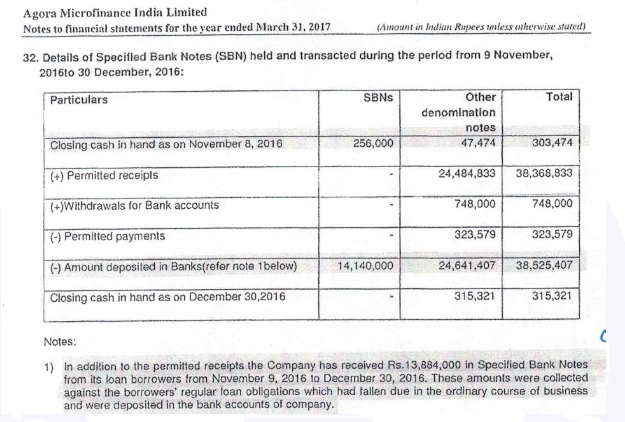
6.2. In our view, the above disclosure materially strengthens assessee’s explanation. The disclosure forms part of the audited financial statements prepared in accordance with the Companies Act and was made much before commencement of the assessment proceedings. It is, therefore, a contemporaneous record and not an explanation devised during assessment proceedings. The Revenue has neither questioned the authenticity of the audited accounts nor pointed out any discrepancy in the disclosure contained therein.
6.3. Assessee has also furnished a summary of monthly cash transactions maintained in the ordinary course of business. The same is reproduced below:
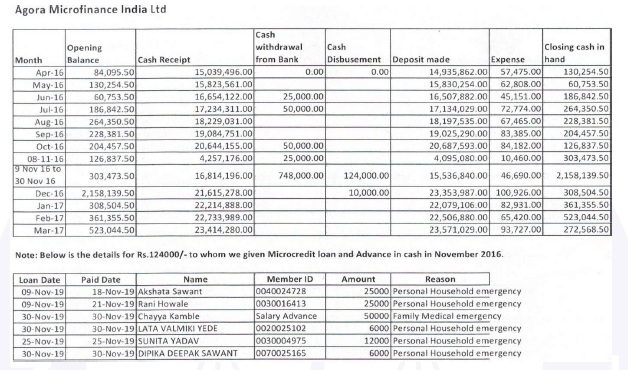
6.4. The above statement demonstrates a continuous flow of cash arising from regular business operations. The cash deposits are duly supported by corresponding receipts and are reflected in the regular cash book maintained by assessee. It is pertinent to note that ld. Assessing Officer has not rejected the books of account under section 145 nor has he pointed out any discrepancy in the maintenance of the cash book. Assessee has further furnished date-wise details of deposits made in Specified Bank Notes, which is extracted below:
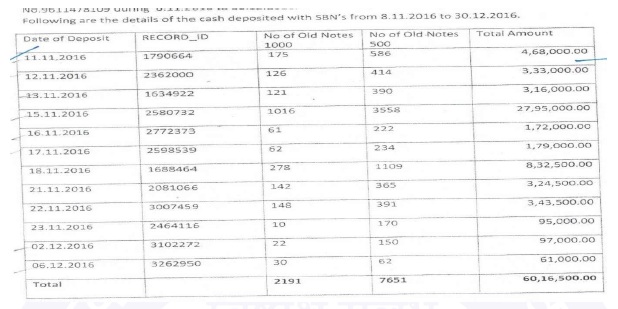
6.5. The record further reveals that, in response to the opportunity granted by ld. Assessing Officer, assessee furnished confirmations together with sworn declarations from fourteen borrowers selected by the Department itself. These confirmations affirmed that the payments represented repayment of existing loans obtained from assessee. Once such confirmations were produced, the onus shifted to the Revenue to dislodge the same by bringing contrary material on record. No such exercise has been undertaken. Merely because some notices issued under section 133(6) remained unserved or did not evoke a direct response cannot, by itself, justify rejection of the entire explanation, particularly when no effort was made to invoke the powers under section 131 for enforcing attendance or examining the deponents.
7. Having examined the evidentiary record, we now turn to the applicability of section 68. The provision empowers ld. Assessing Officer to treat a sum credited in the books as income where assessee either fails to offer an explanation regarding its nature and source or the explanation offered is found to be unsatisfactory. The expression “sum found credited” presupposes the introduction of a credit whose source remains unexplained. In the present case, the impugned receipts are not fresh loans, advances or deposits. They represent recovery of amounts already advanced by assessee and reflected as loan receivables in its books of account. Repayment of an existing loan merely results in reduction of the corresponding receivable; it does not create a new unexplained credit. Unless the Revenue first demonstrates that the underlying loan transactions are fictitious or non-genuine, recovery thereof cannot be brought within the mischief of section 68. No such finding has been recorded by either of the authorities below.
8. Ld. Assessing Officer’s reasoning essentially rests on three circumstances, namely, (i) that assessee was not authorised to receive Specified Bank Notes, (ii) that some notices issued under section 133(6) remained unserved, and (iii) that the deposits, therefore, represented unexplained money. We are unable to subscribe to this line of reasoning. Firstly, the issue whether acceptance of Specified Bank Notes was permissible under the demonetisation notifications is distinct from the enquiry under section 68. Even assuming there was any infraction of the regulatory framework governing acceptance of SBNs, such circumstance does not, by itself, establish that the receipts constituted assessee’s undisclosed income. Secondly, assessee has furnished confirmations from fourteen borrowers together with sworn declarations. The Revenue has not brought any material to show that these confirmations are false or fabricated. Thirdly, the books of account, cash book and audited financial statements have not been rejected. In the absence of any defect in the primary records, the explanation offered by assessee cannot be discarded merely on suspicion or conjecture.
9. Our view is fortified by the decision of the Chennai Bench of the Tribunal in TamilNadu State Marketing Corporation Ltd. v. Asstt. CIT (Chennai – Trib.)/ITA No.431/Chny/2023 dated 07.10.2024, wherein, after considering an identical controversy, the Bench held that the mere fact that deposits were made in Specified Bank Notes during the demonetisation period does not render them unexplained where the source of such deposits stands established from the regular books of account. In the said order, the Coordinate Bench observed that the enquiry under the Act is confined to the explanation regarding the source of the receipts and not to the legality of accepting Specified Bank Notes under the demonetisation scheme.
9.1. Similar is the view was taken by the Coordinate Bench of ITAT, Mumbai in the case of Goldman Tapes Pvt. Ltd. v. ACIT [ITA No.547/Mum/2024, Dated 17-6-2025], wherein it has been held that receipts from customers or debtors recorded in the regular books of account cannot be assessed as unexplained merely because they were received in demonetised currency. The Coordinate Bench emphasised that, unless the Revenue disproves the underlying business transactions or rejects the books of account, section 68 cannot be invoked solely on account of the mode or denomination of receipt.
9.2. The ratio of the aforesaid decisions squarely applies to the facts of the present case. Assessee has established, through contemporaneous documentary evidence, that the impugned receipts represented recovery of existing loan receivables arising in the ordinary course of its microfinance business. The audited financial statements, the cash book, the monthly cash-flow statement, the date-wise deposit details and the confirmations furnished by the borrowers together constitute a consistent evidentiary chain. The Revenue has failed to bring any material to break this chain or to demonstrate that the deposits represented assessee’s own unexplained money. Accordingly, we are of the considered view that the conditions necessary for invoking section 68 are absent in the present case. We, therefore, delete the addition of Rs.1,53,91,500/- made under section 68 of the Act. Ground nos.1 and 2 are accordingly allowed.
10. Ground no.3 relates to the addition of Rs.41,02,594/-, which, according to assessee, represents interest income already credited in the Profit & Loss Account and offered to tax. The grievance of assessee is that, once the receipts from borrowers have been treated as unexplained cash credits under section 68, the interest component embedded therein has again been brought to tax separately, resulting in double taxation of the same income.
11. We have already held while adjudicating ground nos.1 and 2 that the cash receipts during the demonetisation period represented repayments of existing loan receivables in the ordinary course of assessee’s micro-finance business and, therefore, could not be assessed as unexplained cash credits under section 68 of the Act. Once the very foundation for invoking section 68 ceases to exist, the consequential addition made on account of interest cannot independently survive. Assessee has consistently maintained that only the interest component of the loan instalments constituted its revenue income and the same stood credited in its books and offered for taxation in accordance with the regular method of accounting. Accordingly, we delete the addition so as to avoid double taxation of the same income. Ground no. 3 is accordingly allowed.
12. At the time of hearing, the ld. Counsel for the assessee submitted that ground no.4 challenging the disallowance of Rs.71,894/- under section 36(1)(va) is not pressed. Accordingly, ground no.4 is dismissed as not pressed.
13. Ground no.5 assails the action of the Revenue authorities in applying the enhanced rate of tax prescribed under section 115BBE in respect of the addition made under section 68. The case of assessee is that all the impugned deposits relate to the period from 09.11.2016 to 30.12.2016, whereas the Taxation Laws (Second Amendment) Act, 2016 enhancing the rate of tax under section 115BBE received Presidential assent only on 15.12.2016. It is, therefore, contended that the enhanced rate of sixty per cent could not be applied to the transactions in question.
14. We find that this ground has become largely academic in view of our decision deleting the addition made under section 68. Once the addition itself has been deleted, no tax survives under section 115BBE. Nevertheless, since elaborate arguments have been advanced by both sides and ld. CIT(A) has adjudicated the issue, we consider it appropriate to briefly deal with the same. Ld. CIT(A), while rejecting the contention of assessee, observed that the amendment to section 115BBE was made applicable with effect from 01.04.2017 and, therefore, governed Assessment Year 2017-18. On that reasoning, he upheld the application of the enhanced rate. Ld. Counsel for the assessee, on the other hand, relied upon various judicial precedents to contend that the enhanced rate created a substantive fiscal liability and could not be retrospectively applied to transactions that had already taken place prior to the amendment attaining finality.
15. Having regard to our decision deleting the addition under section 68, we do not consider it necessary to render any conclusive finding on the larger issue concerning the applicability of the amended rate under section 115BBE. The issue is rendered purely academic in the facts of the present case. Accordingly, Ground no.5 is allowed, being consequential to the deletion of the addition made under section 68.
16. In the result, appeal filed by assessee is allowed.