


Ad Hoc Transfer Pricing Adjustments Without Applying Prescribed Methods Are Illegal and Interest Under Section 234A Is Unwarranted for Portal Technical Glitches
Issue
-
Transfer Pricing: Whether the Transfer Pricing Officer (TPO) can make an ad-hoc transfer pricing adjustment by reallocating consideration between an assessee and its Associated Enterprises (AEs) without applying any of the mandatory prescribed methods under Section 92C.
-
Dividend Distribution Tax (DDT) & DTAA Rate: Whether the rate of Dividend Distribution Tax under Section 115-O can be restricted to the lower treaty rate (15%) provided under Article 10(2) of the India–Belgium DTAA.
-
Interest under Section 234A: Whether mandatory interest under Section 234A is leviable when a return of income is delayed by a few seconds due to technical glitches on the e-filing portal on the due date.
Facts
-
Slump Sale & IP Assignment: The assessee (a Indian pharmaceutical company and wholly-owned subsidiary of a Belgian entity) sold its identified business via slump sale to an unrelated third party for ₹434.65 crores (final ₹440.80 crores). Separately, the buyer paid ₹359.20 crores to the assessee’s foreign AEs for trademark/IP assignments out of a total negotiated deal of ₹800 crores (55.10% to assessee, 44.90% to AEs).
-
TPO’s Reallocation: The TPO disregarded the actual consideration and independent valuation, applied no benchmarking or valuation methodology, and arbitrarily reallocated 99% of the total ₹800 crore transaction value (₹792 crores) to the assessee based on Marketing Intangibles/AMP expenses. This resulted in an ad-hoc TP adjustment of ₹357.35 crores.
-
DDT Payment: The assessee paid dividend of ₹200 crores to its Belgian parent and deposited DDT of ₹40.71 crores at the statutory rate of 20.36% under Section 115-O, later claiming a refund of ₹10.71 crores by asserting the DTAA rate cap of 15% under Article 10(2).
-
Portal Delay for ITR Filing: The assessee attempted to submit its return of income on the statutory due date, but due to severe server congestion and technical glitches on the official e-filing portal, the upload completed a few seconds after midnight, stamping the acknowledgement with the next day’s date and triggering Section 234A interest.
Decision
-
Ad-Hoc Transfer Pricing Adjustment Set Aside [Section 92C]: Held in favour of the assessee. Transfer pricing determination without applying any of the six prescribed methods under Section 92C is outside the statutory scheme and legally unsustainable [Paras 7.1 to 7.9].
-
DDT DTAA Relief Remanded [Section 115-O / Article 10 DTAA]: Remanded to the Assessing Officer. Since the fundamental issue regarding the applicability of DTAA rates to Section 115-O DDT is pending before the Supreme Court, the matter was restored to the AO to decide in accordance with the ultimate outcome of the apex court proceedings [Para 9.2].
-
Section 234A Interest Deleted [Section 234A]: Held in favour of the assessee. Interest under Section 234A cannot be levied when the delay of a few seconds is attributable to technical glitches on the tax portal beyond the control of the assessee [Para 10.1].
Key Takeaways
-
Mandate of Section 92C Methods: The TPO cannot arbitrarily reallocate slump sale consideration or trademark values on an ad-hoc basis; applying one of the specific statutory methods under Section 92C supported by economic analysis is mandatory.
-
AMP Expenditures Cannot Replace Valuation: Marketing and promotional expenditures (AMP) alone cannot be used as an informal leverage tool to reassign 99% of deal consideration to an Indian entity while ignoring independent valuation reports.
-
No Penalty/Interest for System Failure: Technical glitches, server crashes, or e-filing portal delays beyond a taxpayer’s control cannot be penalized with Section 234A statutory interest.
IN THE ITAT MUMBAI BENCH ‘J’
UCB India (P.) Ltd.
v.
Deputy Commissioner of Income-tax Circle 8(3)(1)
Pawan Singh, Judicial Member
and Girish Agrawal, Accountant Member
and Girish Agrawal, Accountant Member
IT Appeal No. 905 (MUM) OF 2021
[Assessment year 2016-17]
[Assessment year 2016-17]
AUGUST 31, 2026
Rajan Vora, Pranay Gandhi, CAs Ms. Jayshree Thakur, Sr. DR for the Respondent.
ORDER
Girish Agrawal, Accountant Member. – This appeal filed by the assessee is against the final assessment order passed pursuant to the directions of ld. Dispute Resolution Panel-3, Mumbai (DRP) vide order No. ITBA/DRP/F/144C(5)/2020-21/1031623057(1) dated 19.03.2021, u/s. 144C(5) of the Income-tax Act (hereinafter referred to as the “Act”), for the Assessment Year 2016-17.
2. Assessee has raised the following grounds of appeal:
On the facts and in the circumstances of the case and in law, the learned AO/Joint Commissioner of Income-tax Transfer Pricing-4(2) (Learned TPO) Hon’ble Panel has:
GENERAL
1. Erred in assessing the total income at INR 11,31,56,51,392 as against the returned income of INR 3,86,56,51,850 disclosed in the return of income filed.
TRANSFER PRICING ISSUES
2 Erred in proposing an adjustment of INR 3,57,35,40,737 to the total income of the Appellant under Section 92CA(3) of the Act by treating the transaction of sale of identified business to a third-party ie Dr Reckty’s Laboratories Limited (‘DRL’) as a deemed international transaction covered under section 92B(2) of the Act.
Without prejudice to the above:
3 Erred in disregarding the valuation reports prepared for benchmarking the arm’s length price of the identified business of the Appellant including the intellectual property without understanding the assumptions used and basis therein.
4 Erred in upholding the arbitrary approach adopted by the learned TPO in determining the arm’s length price of the transaction of sale of identified business without applying any of the prescribed five methods.
5 Erred in concluding that the marketing intangibles are owned by the Appellant by alleging that significant advertisement, marketing and promotion (‘AMP’) expenses have been incurred by the Appellant by computing the alleged AMP expense incorrectly
6 Erred in disregarding that, key intangibles relevant in a pharmaceutical industry such as technical knowhow/manufacturing process/ trademark etc. have substantial value in the lifecycle of a pharmaceutical business and attributing the consideration of the sale of identified business only on account of “marketing intangibles”.
7 Erred in not considering the contribution valuation analysis conducted by the Appellant to arrive at an appropriate split of consideration between the Appellant and AEs based on the functions performed by the Appellant and AEs over the life cycle of the products of such business
8 Erred in not considering the documentary evidences filed to demonstrate the functions performed and risks assumed by the AEs about corporate strategy, research and development, technical knowhow/manufacturing process/regulatory filings, trademark/ brand name, marketing/ selling related activities etc. to substantiate the contribution of the AEs and to justify value of owned and developed by it.
OTHER DIRECT TAX ISSUES
9 Considering the assessed income at INR 1131,56,51,392 instead of INR 743,93,32,610
Earned in considering the total income of the appellant at INR 1131,56,51,392 as against INR 743,93,32,610, thereby, making double addition of capital gains amounting to INR 387,63,18,782
10. Considering the Income from Capital Gains at INR 1132,61,78,301 in the computation sheet Instead of INR 744,98,59,519 as per the assessment order
Erred in considering the Income from capital gains at INR 1132,61,78,301 in the computation sheet instead of INR 744,98,59,519 as per the assessment order.
11. Disallowance of interest on Tax Deducted at Source (‘TDS’)
Was not justified in making disallowance of interest on delayed payment of TDS of INR 140,023, from income from other source instead of income from business or profession
Refund of excess Dividend Distribution Tax (‘DDT’) paid to the Non-resident shareholder as per applicable Double Taxation Avoidance Agreement (‘DTAA’)
12. Learned DRP/ AO failed to adjudicate the additional ground filed during the proceeding before the DRP in respect of treaty rate to be applied to DDT paid on dividend paid to the non-resident shareholder
13. Should have appreciated that dividend paid/ distributed to non-resident shareholder namely UCB S.A, Belgium (a tax resident of Belgium), is liable to be taxed under Article 10 of the India -Belgium DTAA (i.e. at the rate of 15%) and not as per section 115-0 of the Act at 20.36%. Accordingly, the Hon’ble Tribunal may kindly direct the AO to apply treaty rate instead of DDT rate of 20.36%.
Deduction of education cess
14 Learned DRP/ AO failed to adjudicate the additional ground filed during the proceeding before the DRP in respect of deduction of education cess.
15 The appellant prays that ld. Assessing Officer be directed to allow deduction under section 37(1) of the Act in respect of education cess paid during the year on income-tax.
Charge of interest under section 234A of the Act
16. Erred in charging interest under section 234A of the Act.
Charge of interest under section 234B of the Act
17. Erred in charging interest of INR 1,02,61,28,519 under section 234B of the Act
Charge of interest under section 234C of the Act
18. Erred in charging interest of INR 36,86,283 under section 234C of the Act as against nil on the returned income.
Penalty proceedings
19. Initiating penalty proceedings u/s 274 r.w.s 271AA of the Act
20. Initiating penalty proceedings u/s 274 r ws 271(1)(c) of the Act
As Additional Ground
21. Erred in passing the final assessment order beyond the time limit prescribed under section 153 of the Act and hence the same is liable to be quashed.
2.1 . Ground no. 1 is general in nature and shall be subsumed in the other grounds. Ground no. 2 relates to the treatment of the transaction as a Deemed International Transaction. According to the ld. Counsel for the assessee, once ground nos. 3 to 8 challenging the merits of the transfer pricing adjustment are decided, ground no. 2 would be rendered academic and has to be dealt accordingly. Hence, ground nos. 3 to 8 are taken up first for adjudication together as they all challenge the merits of the TP adjustment made by the learned Transfer Pricing Officer (TPO).
3. Brief facts of the case are that assessee (hereinafter referred to as “UCB India”) is a wholly owned subsidiary of UCB SA, a company incorporated in Belgium. UCB India is engaged in the business of manufacture and distribution of original pharmaceutical research products of the UCB Group, which operates in more than 40 countries. The Group specializes in the fields of central nervous system disorders, allergy and respiratory diseases and immune and inflammatory disorders. UCB India filed its return of income on 01.12.2016, reporting total income at Rs. 386,56,51,850/- under normal provisions of the Act.
3.1. During the year, UCB India transferred a part of its identified business involving certain pharmaceutical products to Dr. Reddy’s Laboratories Limited (“DRL”), an unrelated third party, on a slump sale basis vide Business Transfer Agreement (“BTA”) dated 01.04.2015. UCB India received a consideration of Rs. 434,64,59,263/- (Rs. 434.65 crore) for this transfer, which was offered to tax as capital gains under section 50B of the Act. Separately, DRL also entered into a Trademark Assignment Agreement (“TAA”) dated 16.06.2015 with UCB Farchim SA (Switzerland) and UCB Biopharma SPRL (Belgium) (collectively referred to as “AEs” or “UCB Global”) for acquisition of the intellectual property rights (“IPs”) relating to the identified business sold. The pictorial representation of the transaction structure, as placed before us, is as under:
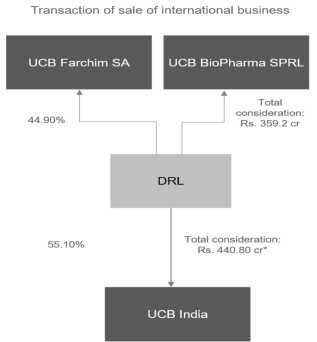
3.2. Financial summary of the entire transaction which took place and is the subject matter of present appeal is tabulated below:
| Party | Nature of Transaction | Consideration (Rs. Crore) | % Share |
| UCB India Private Limited | Transfer of identified business (slump sale) vide BTA dated 01.04.2015 | 440.80* | 55.10% |
| UCB Global (UCB Parchim SA + UCB Biopharma SPRL) | Transfer of intellectual property rights vide TAA dated 16.06.2015 | 359.20 | 44.90% |
| Total Consideration (as negotiated with DRL) | 800.00 | 100.00% |
*Actual amount reported in Form 3CEB: Rs. 434.65 crore. The difference represents adjustments in the final settlement.
3.3. Even though the transaction of UCB India was with an unrelated third party DRL, the assessee, out of abundant precaution, reported the transaction of sale of business to DRL as a “Deemed International Transaction” in Form 3CEB. Independent valuation reports were obtained from an independent valuer for determination of the value of the identified business of UCB India and the IP owned by UCB Global. The summary of the independent valuation versus the actual consideration received is as under:
| Particulars | As per Independent Valuation Report (Rs. Crore) | Actual Consideration (Rs. Crore) |
| Value of identified business of UCB India (excluding Global IP) | 116.89 | 440.80* |
| Value of IP owned by UCB Global (UCB Farchim SA + UCB Biopharma SPRL) | 543.22 | 359.20 |
| Total value of identified business + IP | 660.11 | 800.00 |
| Share retained by UCB India (%) | 17.71% | 55.10% |
| Share of IP in total value (%) | 82.29% | 44.90% |
* Actual receipt amount as reported in Form 3CEB is Rs. 434.65 crore.
3.4. Thus, UCB India received Rs. 440.80 crore, representing 55.10% of the total consideration of Rs. 800 crores which is significantly higher than the 17.71% of total value as indicated by the independent valuation report. UCB Global received Rs. 359.20 crore (44.90%), which is significantly lower than its 82.29% IP share per the valuation report. Since UCB India received a consideration exceeding its independent valuation-based entitlement, it was submitted that the transaction complied with the arm’s length principle (ALP), ensuring fair compensation to UCB India and no loss to the Indian tax authorities.
4. The case was selected for scrutiny assessment proceedings and simultaneously, transfer pricing proceedings were initiated by the learned Transfer Pricing Officer (“learned TPO”) under section 92CA(2) of the Act. The learned TPO passed the order u/s 92CA(3) of the Act dated 31.10.2019. During the course of TP assessment, the learned TPO disregarded both the actual consideration received by UCB India as well as the independent valuation report and held that the consideration received by UCB Global from DRL should also have been received by UCB India. The learned TPO did not perform any benchmarking analysis nor obtain any valuation report. Instead, in para 6.26 of its order, the learned TPO adopted the “Other Method” in an entirely ad hoc manner.
4.1. As discussed in para 6.26.5 of the TPO’s order, learned TPO rejected the method adopted by the assessee. In para 6.26.7, learned TPO described the basis for attribution of consideration by attributing 99% of the total combined consideration (Rs. 792 crore) to UCB India and only 1% (Rs. 8 crore) to UCB Global. This attribution was based primarily on the AMP expenses incurred by UCB India in India, treating these as evidence of economic ownership of marketing intangibles by UCB India. Ld. TPO accordingly proposed a TP adjustment of Rs. 357,35,40,737/- (Rs. 357.35 crore) over and above the consideration of Rs. 434.64 crore actually received by UCB India, thereby rewriting the terms of the Business Transfer Agreement entered into between UCB India and DRL which was an agreement between two unrelated parties.
4.2. The draft assessment order dated 21.12.2019 was passed by the learned AO u/s 144C(1) r.w.s 143(3) of the Act, proposing to tax the TP adjustment of Rs. 357.35 crore as business income and not as capital gains. Ld. AO also made a further addition on account of disallowance of net working capital while computing the net worth of the transferred undertaking of Rs. 23,52,21,796/-. Assessee filed objections before the ld. Dispute Resolution Panel-2 (the “DRP”), Mumbai. Ld. DRP, vide its directions dated 19.03.2021, disposed of the objections as under:
| Issue | DRP Direction |
| Transfer pricing adjustment on account of sale of identified business | Upheld, Rs. 357,35,40,737/- |
| Disallowance of net working capital while computing net worth | Directed to allow deduction of Rs. 23,52,21,796/- subject to verification |
| Characterisation of TP adjustment (business income v. capital gains) | Directed AO to tax the TP adjustment as capital gains, not as business income |
| Additional grounds on DDT refund and cess deduction | Not adjudicated |
4.3. Based on the DRP directions, ld. AO issued the final assessment order dated 22.04.2021 u/s 143(3) r.w.s 144C(13) of the Act with the following adjustments:
| Sr. No. | Particulars | Amount (Rs.) |
| 1 | Income from Capital Gains on sale of identified business | 7,44,98,59,519 |
| 2 | Interest on TDS | 1,40,023 |
4.4. Assessee observed errors in the final assessment order and filed a rectification application u/s 154 of the Act on 23.04.2021, in relation to (i) double addition of capital gains amounting to Rs. 387,63,18,782/-; (ii) wrong classification of TDS interest disallowance; and (iii) erroneous computation of interest u/s 234A, 234B and 234C. Ld. AO passed a rectification order dated 28.12.2023 u/s 154 r.w.s 143(3) of the Act, assessing the total income at Rs. 743,93,32,610/-. Aggrieved, assessee is in appeal before the Tribunal.
5. Ld. Counsel for the assessee Shri Rajan Vora made detailed submission, raising various contentions in respect of ground nos. 3 to 8 which challenges the merits of the TP adjustment of Rs. 357.35 crore made by the ld. TPO and confirmed by the ld. DRP. The multi-fold contentions so raised are discussed herein below and adjudicated thereupon.
5.1. The method adopted by the TPO is not within the realm of the “Other Method” and no prescribed method has been applied: Ld. TPO adopted an entirely ad hoc approach by attributing 99% of the total consideration of Rs. 800 crores to UCB India without applying any of the six prescribed methods under section 92C of the Act, viz. , CUP, RPM, CPM, TNMM, PSM or the “Other Method” in any recognised manner. The “Other Method” prescribed under Rule 10AB of the Income-tax Rules, 1962 (the Rules) requires the determination of ALP based on the price charged or paid in respect of any property transferred or services rendered to an unrelated entity in similar circumstances. No such analysis has been undertaken by the ld. TPO. The determination of ALP by the ld. TPO is arbitrary and not backed by any recognised transfer pricing methodology. Reliance was placed on the following decisions:
5.1.1. CIT v. Lever India Exports Ltd. (Bombay) – Ld. TPO’s jurisdiction is specific and limited viz. to determine the ALP of an international transaction in terms of Chapter X of the Act. The ad hoc determination of ALP dehors section 92C of the Act cannot be sustained. The relevant extract is reproduced below for ready reference:
“7. We note that the Tribunal has recorded the fact that the respondent assessee has launched new products which involved huge advertisement expenditure. The sharing of such expenditure by the respondent assessee is a strategy to develop its business. This results in improving the brand image of the products, resulting in higher profit to the respondent assessee due to higher sales. Further, it must be emphasized that the TPO’s jurisdiction was to only determine the ALP of an International Transaction. In the above view, the TPO has to examine whether or not the method adopted to determine the ALP is the most appropriate and also whether the comparables selected are appropriate or not. In fact, as found both by the CIT(A) as well as the Tribunal that neither the method selected as the most appropriate method to determine the ALP is challenged nor the comparables taken by the respondent assessee is challenged by the TPO. Therefore, the ad-hoc determination of ALP by the TPO dehors Section 92C of the Act cannot be sustained.”
5.1.2. Kodak India (P.) Ltd. v. Addl. CIT (Mumbai) affirmed by Hon’ble Bombay High Court in CIT v. Kodak India (P.) Ltd. [2017] 79 (Bombay) – The relevant extract from para 66 to 68 is reproduced below for ready reference:
“66. By the use of the word “shall”, for computing the ALP in one of the following methods, the Legislature has cast an embargo that no seventh method could be adopted by the TPO for computing the ALP.
67. We cannot accept the arguments of the DR that the word any has been used in section 92C(1), which could give leeway to the TPO to ascribe to a non-specific method. Word any, is founded on the suffix, “of the following methods being the most appropriate method”. Therefore, the ambit of the word any in section 92C(1) has been restricted within the precinct of the five specific methods.
68. Taking into account the clear and unambiguous wordings of the provisions of the Income-tax Act and Rules and respectfully following the decision of the Special Bench in the case of LG Electronics India (P.) Ltd. (supra), we hold that even on this legal issue, the assessee succeeds.”
5.1.3. Capgemini India (P.) Ltd. v. Deputy Commissioner of Income-tax (Mumbai – Trib.)/ ITA 1917/Mum/2023 dated 23.02.2023, affirmed by Hon’ble Bombay High Court in Pr. CIT v. Capgemini India (P.) Ltd. (Bombay) – The TPO is required to follow the prescribed methods and failure to do so renders the TPO’s order vulnerable. Hon’ble Court held:
“4. Further, the Tribunal, in this case, has relied upon the decisions in the case of Commissioner of Income Tax v. Kodak India (P) Ltd. (Bombay)and Barclays Bank PLC v. Additional Director of Income Tax (Mumbai), to hold that it is incumbent upon the TPO to follow the method prescribed under the Act and when such methods are not followed, the decision of the TPO is rendered vulnerable. Kodak India Ltd. (supra) also holds that the failure to follow any method prescribed by the law does not entitle the TPO to rectify the mistake in the second innings.”
5.2. AMP expenses are for sales promotion, not for brand building, no AMP adjustment in preceding years: Ld. TPO and ld. DR relied primarily on the AMP expenses incurred by UCB India to allege that UCB India had created economic ownership of marketing intangibles in India. However, AMP expenses are incurred for affecting sales and promoting products in the market, they are not incurred for building the brand. The brand is built and owned by UCB Global through its decades of research, development, regulatory filings and clinical trials. Further, it is a material fact that no TP adjustment was made in respect of AMP expenses in any of the preceding assessment years. The approach of the Revenue of attributing value based on AMP expenses alone is misplaced, particularly in the absence of any AMP adjustment in earlier years, and cannot be used to retrospectively recharacterize value attribution. Analogous examples from other industries confirm that branded products consistently command higher value than generic equivalents, reinforcing the importance of IP and brand equity developed by the IP owner.
5.3. Products do not lose significance on expiry of patent: Ld. TPO attributed virtually the entire IP value to 1% and implicitly concluded that IP “pales into insignificance” after 3-5 years. This approach ignores the long-term nature of pharmaceutical R&D and IP protection, which typically spans 10-20 years. Even after patent expiry, innovator products command a premium over generics due to brand equity, superior manufacturing quality and clinical trial validation. Ld. TPO’s determination of 1% contribution attributable to UCB Global is not based on any factual analysis, scientific methodology or recognized benchmarking and is therefore arbitrary.
5.4. TPO cannot rewrite independent agreements entered into by unrelated parties: UCB India entered into the BTA with DRL, an unrelated third party, on arm’s length terms. UCB Global entered into a separate TAA with DRL. Both are independent agreements at separately negotiated and agreed consideration. The Revenue authorities do not have the power to rewrite terms of an agreement unless there is demonstrated collusion between the parties or unless the transaction is shown to be a sham. In the present case, no finding of collusion or sham has been made.
5.4.1. Reliance in this regard was placed on D.S. Bist & Sons v. CIT 49 ITR 276 (Delhi) which held that the Act does not clothe the taxing authority with any power or jurisdiction to re-write the terms of an agreement, particularly when the parties are not at fault and there is no suggestion of collusion. The relevant extract is reproduced below for ready reference:
“The Act does not clothe the taxing authority with any power or jurisdiction to rewrite the terms of the agreement entered into, particularly in view of the finding of the Tribunal that there is nothing to suggest that the parties were not dealing with each other at arms’ length and there is no suggestion of any collusion between the partners of the assessed firm on the one hand and K on the other. Unless there is solid material on record before the income-tax authorities, it is not permissible to rewrite the terms of the commercial agreement entered into when the agreement is held as valid and genuine and not collusive and the two parties are held to be dealing at arms’ length while entering into the agreement.”
5.4.2. Reliance was also placed on CIT v. EKL Appliances Ltd. 345 ITR 241 (Delhi), wherein it has been held:
“18. Two exceptions have been allowed to the aforesaid principle and they are (i) where the economic substance of a transaction differs from its form and (ii) where the form and substance of the transaction are the same but arrangements made in relation to the transaction, viewed in their totality, differ from those which would have been adopted by independent enterprises behaving in a commercially rational manner. 19. There is no reason why the OECD guidelines should not be taken as a valid input in the instant case.”
5.5. Contribution analysis, a scientific basis adopted by the assessee: Assessee undertook a detailed contribution analysis to demonstrate the respective contributions of UCB India and UCB Global to the value of the identified business. The analysis was submitted before the ld. DRP vide submissions dated 04.02.2021. The product portfolio sold by UCB India to DRL was categorised into four baskets based on the nature of products and the relative contributions of UCB India and UCB Global which is tabulated below:
| Part | Particulars | Description | % of Portfolio |
| I | Original innovator products | Owned and developed by UCB Global; consists of original products | 69% |
| II | Product extensions/variations | Developed by UCB India, leveraged on UCB Global trademark/brands; owned by UCB Global | 18% |
| III | Generic products | Owned by UCB India | 6% |
| IV | Other arrangements | Arrangement with Indian third parties | 7% |
| Total | 100% |
5.5.1. The contribution analysis was computed by assigning weights to the functions and sub-functions performed by UCB India and UCB Global in each product category, reflecting their respective roles in creating value within the multinational group. Based on business valuation, 75% of total value was attributed to IP, owned by UCB Global and the remaining 25% to other assets on a conservative basis allocated entirely to UCB India. The 75% attributable to IP was then split between UCB India and UCB Global based on quantitative contributions across the four product baskets. The resulting split is summarised below:
| Particulars | UCB India’s Share | UCB Global’s Share | Total |
| PART I: Original innovator products | 12.54% | 39.16% | 51.69% |
| PART II: Product extensions/variations | 12.00% | 1.48% | 13.49% |
| PART III: Generic products | 4.81% | 0% | 4.81% |
| PART IV: Local arrangement | 0.75% | 4.26% | 5.01% |
| Share in IP contribution | 30.10% | 44.90% | 75.00% |
| Balance business valuation (allocated entirely to UCB India on conservative basis) | 25.00% | 0% | 25.00% |
| Total share in contribution | 55.10% | 44.90% | 100.00% |
5.5.2. The analysis quantitatively supports the actual split of consideration, that is 55.10% to UCB India and 44.90% to UCB Global, received in the BTA and TAA. The contribution analysis was placed before the ld. DRP but was not adequately considered.
5.6. No remand to TPO when prescribed methods have not been followed: Since the ld. TPO has on an ad hoc basis made the TP adjustment without applying any of the prescribed six methods, the Tribunal should not provide a second opportunity to the ld. TPO to re-determine the ALP. This principle has been established by the Hon’ble Bombay High Court and Mumbai ITAT in Kodak India Pvt. Ltd. (supra), Johnson & Johnson Ltd. v. Commissioner of Income-tax-LTU 150 ITD 377 (Mumbai)/ITA 83/Mum/2011, affirmed by Hon’ble Bombay High Court in CIT v. Johnson & Johnson Ltd. (Bombay) and Capgemini India (P.) Ltd. (supra). The principle is that when mandatory provision of the Act has been either superseded or ignored, it goes to the jurisdiction of the authority and another opportunity cannot be afforded to rectify the mistake.
6. Per contra, ld. DR supported the orders of the authorities below. The arguments advanced by the ld. DR were primarily on the basis of allocation of consideration as made by the ld. TPO, contending that:
| (a) | ld. TPO rightly relied on AMP expenses to establish economic ownership of marketing intangibles by UCB India; |
| (b) | absence of royalty payment by UCB India to UCB Global for use of IPs demonstrates that the IPs were of negligible value in the Indian market; and |
| (c) | the valuation approach adopted by the assessee does not correctly reflect the economic reality of the transaction. Ld. DR submitted that the TP adjustment confirmed by the ld. DRP be upheld. |
7. We have heard both the parties and perused the material on record. We have also given our thoughtful consideration to the submissions made as well as the judicial precedents referred before us. We have also gone through the paper books placed on record by the assessee.
7.1. Starting point for us is the analysis of the nature of impugned transaction. UCB India transferred its identified pharmaceutical business to DRL, an unrelated third party, on an arm’s length basis through a BTA, dated 01.04.2015. The BTA was negotiated independently between two unrelated parties. The consideration of Rs. 434.65 crore (Rs. 440.80 crore as per the final settlement) received by UCB India was the outcome of this independent and arm’s length negotiation. DRL separately approached UCB Global for the IP rights relating to the same identified business and entered into an independent TAA, dated 16.06.2015 under which UCB Global received Rs. 359.20 crore. There are thus, two separate and distinct agreements, one between UCB India and DRL, and the other between UCB Global and DRL, both entered into independently with the same unrelated third party.
7.2. Ld. TPO has without applying any of the six prescribed methods under section 92C of the Act, arbitrarily determined that 99% of the aggregate consideration received from DRL i.e. , Rs. 792 crores out of the total of Rs. 800 crores should have been received by UCB India alone, attributing only 1% i.e. , Rs. 8 crores to UCB Global. This determination was made on an ad hoc basis, primarily by reference to AMP expenses incurred by UCB India, without any independent valuation, benchmarking study or economic analysis. In para 6.26 of its order, ld. TPO purported to apply the “Other Method.” However, the “Other Method” as prescribed under Rule 10AB requires a determination of ALP based on price charged or paid in comparable uncontrolled transactions. No such comparable analysis has been carried out. The “Other Method” has been cited merely as a label; no recognisable methodology has been applied within its parameters. What has been done by the ld. TPO is therefore outside the provisions of section 92C of the Act.
7.3. We note that section 92C(1) mandates that the ALP shall be computed having regard to the most appropriate method from the prescribed methods. The use of the word “shall” creates a mandatory obligation. Ld. TPO cannot invent a methodology outside the prescribed methods. The decisions of the Hon’ble jurisdictional Bombay High Court in Lever India Exports Ltd. (supra), Kodak India Pvt. Ltd. (supra) and Capgemini India (P.) Ltd. (supra), all consistently held that the determination of ALP is required to be done only by one of the prescribed methods and an ad hoc determination dehors section 92C cannot be sustained. These decisions carry the force of binding nature, being jurisdictional High Court. Following these binding precedents, we hold that the approach adopted by the ld. TPO in making the TP adjustment of Rs. 357.35 crore on an ad hoc basis, without applying any of the prescribed methods, is contrary to the mandatory requirements of section 92C and cannot be sustained.
7.4. Ld. TPO’s reliance on AMP expenses to establish economic ownership of marketing intangibles by UCB India is fundamentally flawed. AMP expenses are incurred for promoting and selling products in the market, for affecting sales and not for building the brand or creating intellectual property. The brand, the trademark, the technical know-how and the manufacturing process have been developed, registered and protected by UCB Global over decades of research, regulatory filings and clinical trials. The legal ownership of IPs vested squarely with UCB Global. The economic ownership of an intangible cannot be presumed merely from the incurrence of marketing expenses by a distributor. Furthermore, there has been no TP adjustment to AMP expenses in any of the preceding years. The ld. TPO cannot now, for the first time, use AMP expenses retrospectively to recharacterize the value attribution between UCB India and UCB Global.
7.5. Ld. TPO’s implicit proposition that IPs lose significance with the passage of time and upon patent expiry does not withstand scrutiny in the pharmaceutical context. Innovator pharmaceutical products command a sustained premium over generic substitutes long after patent expiry, on account of brand equity, physician familiarity, manufacturing quality and clinical validation. The research and development lifecycle for pharmaceutical products spans 10-20 years. UCB Global’s contributions, through its research, technical know-how, regulatory filings, trademark registrations, maintenance and global marketing strategies, have built enduring value in the products sold by UCB India. To attribute 1% of this enduring value to UCB Global is not grounded in any factual or economic analysis and is arbitrary.
7.6. The BTA between UCB India and DRL and the TAA between UCB Global and DRL are separate, independent, commercially negotiated agreements between unrelated parties. Revenue has produced no finding of collusion between the contracting parties, no finding that the agreements are shams and no finding that the parties were not dealing at arm’s length with each other. In the absence of such findings, Revenue does not have the jurisdiction to rewrite the terms of these commercial arrangements. As held by Hon’ble High Court of Delhi in D.S. Bist & Sons (supra), the taxing authority has no power to substitute values placed in a valid, genuine and non-collusive commercial agreement. This principle is not merely a rule of procedure, it is a substantive limitation on the jurisdiction of the Revenue under the transfer pricing provisions.
7.7. Assessee submitted a detailed, scientifically grounded contribution analysis categorising the product portfolio into four baskets and assigning quantitative contributions based on the functions performed by UCB India and UCB Global, respectively, across the product lifecycle. This analysis was placed before the ld. DRP. The analysis arrived at UCB India’s share at 55.10% and UCB Global’s share at 44.90%, precisely matching the actual consideration received. Ld. TPO and the ld. DRP did not engage with this contribution analysis in any meaningful manner. The entire basis of their determination was ad hoc and not grounded in any of the accepted methodologies. We find the contribution analysis submitted by the assessee to be a more credible, scientific and reasoned basis for determination of the split of consideration than the ad hoc approach adopted by the ld. TPO.
7.8. Further, since the ld. TPO has failed to apply any of the prescribed methods under section 92C and has made the TP adjustment on an entirely ad hoc basis, we are in agreement with the contention of the ld. Counsel for the assessee that the matter should not be remanded to the ld. TPO to provide a second opportunity. For this, we find force from the principle enunciated by the Hon’ble jurisdictional High Court of Bombay in Kodak India Pvt. Ltd. and Capgemini India (P.) Ltd. (supra). Ld. DR’s request for a remand to the learned TPO is therefore cannot be accepted.
7.9. In view of the foregoing discussion on each of the contentions put forth by the ld. Counsel for the assessee, we hold that the TP adjustment of Rs. 357,35,40,737/- (Rs. 357.35 crores) proposed by the learned TPO u/s 92CA(3) of the Act and confirmed by the ld. DRP is not sustainable. The TP adjustment so made is accordingly deleted. Ground nos. 3, 4, 5, 6, 7 and 8 raised by the assessee are allowed.
8. In view of our finding on Ground nos. 3 to 8 above whereby the TP adjustment of Rs. 357.35 crore has been deleted in its entirety, ground no. 2, which challenges the characterisation of the transaction as a Deemed International Transaction under section 92B(2) is rendered academic. Accordingly, ground no. 2 is disposed of as academic without any further adjudication.
9. Ground nos. 12 and 13 relate to refund of excess Dividend Distribution Tax (“DDT”) paid by the assessee on dividend distributed to its non-resident shareholder UCB SA, Belgium. During the year, assessee paid a dividend of Rs. 200 crore to UCB SA, Belgium, on which DDT of Rs. 40,71,52,941/- was paid under section 115-O at the rate of 20.36%. Assessee contends that the applicable rate should be 15% under Article 10(2) of the India-Belgium DTAA, being more beneficial under section 90(2) and accordingly, claims a refund of excess DDT of Rs. 10,71,52,941/-, being 5.36% (i.e., 20.36% – 15%). This issue was raised as an additional ground before the ld. DRP which failed to adjudicate the same. Assessee has placed reliance on the decision of the Hon’ble Bombay High Court in Colorcon Asia (P.) Ltd. v. Jt. CIT [2025] 181 [2026] 486 ITR 476 (Bombay) in support of its claim.
9.1. We note the subsequent developments as described in the order of the Coordinate Bench where the undersigned Accountant Member is the author, in the case of Huhtamaki India Limited v. DCIT (Mumbai – Trib.)/ITA 7960/Mum/2025, order dated 08.05.2026. The relevant portion of the said order is extracted below for ready reference:
“Before us, ld. Counsel for the assessee placed reliance on the decision of Hon’ble jurisdictional High Court of Bombay in the case of Colorcon Asia (P) Ltd. v. JCIT (Bom) which according to him has settled the controversy in favor of the assessee. In this regard, it is important to take note of the recent development after the conclusion of hearing in the present case before us. Hon’ble High Court of Bombay has referred the issue in the case of Colorcon Asia (supra) which is similar to the one raised by the assessee through its additional ground, to the larger bench. The reference to larger bench is made by the Hon’ble Court to settle the issue of whether the Coordinate Bench decision in Colorcon Asia (supra) reads down the correct position in law or whether it is per incuriam, that is, the same being contrary to the provision of section 115-O, considering the decision of Hon’ble Supreme Court in the case of Godrej and Boyce Manufacturing Company Limited. Subsequent to this reference to the larger bench of the Hon’ble High Court, Hon’ble Supreme Court decided to hear the SLP filed by the Revenue in the case of Colorcon Asia (supra). While admitting the SLP of the Revenue, Hon’ble Supreme Court observed that it is an interesting case and thus, posted the matter for hearing on 13.05.2026. In view of the stated subsequent development after the conclusion of hearing before us, we find it appropriate to remit this particular issue raised by the assessee by way of additional grounds, to the file of ld. Assessing Officer so as to give effect to the issue based on the outcome of the above stated matter pending before the Hon’ble Supreme Court. Needless to say, assessee be given reasonable opportunity of being heard in this regard. Accordingly, additional grounds raised by the assessee are allowed for statistical purposes.”
9.2. We are confronted with the same factual and legal position in the present case. The controversy regarding the applicability of DTAA rate to DDT levied under section 115-O is pending before the Hon’ble Supreme Court in the matter arising from the Colorcon Asia (supra) case. The issue involved is purely a question of law and does not require verification of any additional facts. In these circumstances, we find it appropriate to follow the same approach adopted by the Coordinate Bench in Huhtamaki India Limited (supra) and remit this issue to the file of the ld. Assessing Officer to give effect to it based on the outcome of the proceedings pending before the Hon’ble Supreme Court. The ld. Assessing Officer shall afford the assessee a reasonable opportunity of being heard in this regard. Ground nos. 12 and 13 are accordingly, allowed for statistical purposes.
10. Ground no. 16 relates to levy of interest of Rs. 1,68,21,779/- under section 234A. Factual position is that the assessee intended to file its return of income on 30.11.2016 i.e. , the due date. However, due to a technical glitch on the e-filing portal and the rush hours associated with the deadline, the return got uploaded with a delay of a few seconds, causing the date of filing to appear as 01.12.2016 on the ITR acknowledgement. Ld. AO charged interest under section 234A treating the return as filed after the due date.
10.1. Assessee submitted that this delay was beyond its control and was solely on account of a technical glitch on the e-filing portal. Reliance has been placed on several decisions including Bombay Mercantile Co-op. Bank Ltd. v. Central Board of Direct Taxes 106/[2011] 332 ITR 87 (Bombay) and Cosme Matias Menezes (P.) Ltd. v. CIT 379 ITR 31 (Bombay). It is settled law that where the delay in filing is attributable to causes beyond the assessee’s control, interest under section 234A is not leviable. Ld. AO has not disputed the factual position that the return was ready and intended to be filed on 30.11.2016. Given the factual position and the judicial precedents cited, we hold that interest under section 234A of Rs. 1,68,21,779/- levied on the assessee is not warranted. Ground no. 16 is allowed.
11. Ground no. 21 by way of additional ground challenges the validity of final assessment order dated 22.04.2021 passed by the ld. AO on the ground that it was passed beyond the time limit prescribed under section 153. Since it goes to the root of the matter and all the relevant facts relating to the legal issues so raised are already on record. The same is admitted for adjudication.
11.1. Assessee contends that the time limit for passing the final assessment order for AY 2016-17 after accounting for the 12-month extension available on account of a reference made under section 92CA, was 31.12.2019. The final assessment order was passed on 22.04.2021, which the assessee contends is beyond the prescribed time limit. Assessee placed reliance on decisions of Hon’ble Madras High Court in Roca Bathroom Products Private Limited and the Hon’ble Bombay High Court in Shelf Drilling Ron Tappmeyer Ltd. v. Asstt. CIT, International Taxation 457 ITR 161 (Bombay) to contend that section 153 and section 144C are not mutually exclusive and the period of limitation under section 153 applies. Hon’ble Supreme Court in Asstt. CIT (International Taxation) v. Shelf Drilling Ron Tappmeyer Ltd. 262/[2026] 489 ITR 404 (SC) gave a split verdict on this issue, resulting in reference of the matter for the larger bench.
11.2. In this regard, it is noted that the Finance Act, 2026 has introduced the following sub-sections to section 144C and section 153 of the Act with retrospective effect from 01.04.2009 / 01.10.2009 which are relevant to the legal issue raised by the assessee:
| (i) | Sub-section (4A) to section 144C |
| (ii) | Sub-section (13A) and (13B) to section 144C |
| (iii) | Sub-section (10) to section 153 |
11.3. In view of the above amendments introduced by the Finance Act, 2026 with retrospective effectfrom 01.04.2009 / 01.10.2009 as noted above, we are of the view that the ground raised by the assessee challenging the limitation to pass the final assessment order is rendered infructuous. Ground no. 21 is accordingly, dismissed as infructuous.
12. Ground no. 20 is in respect of initiation of penalty proceedings under section 271(1)(c) of the Act. The said ground is premature at this stage, not requiring any separate adjudication.
13. Ground nos. 9, 10, 11, 14, 15, 17 and 18 have not been pressed by the assessee and are therefore, dismissed as not pressed.
14. In the result, appeal filed by the assessee is partly allowed.