ORDER
1. The appeal of the Assessee in ITA No.2058/Del/2010 for AY 2000-01, arises out of the order of the ld. Commissioner of Income Tax, Central-II, Delhi [hereinafter referred to as ‘ld. CIT(A)’, in short] dated 01.04.2010 against the order of assessment passed u/s 153A of the Income-tax Act, 1961 (hereinafter referred to as ‘the Act’) dated 01.06.2006 by the Assessing Officer, ACIT, Central Circle-2, New Delhi (hereinafter referred to as ‘ld. AO’).
2. The appeal of the Assessee in ITA No.2059/Del/2010 for AY 2001-02, arises out of the order of the ld. Commissioner of Income Tax, Central-II, Delhi [hereinafter referred to as ‘ld. CIT(A)’, in short] dated 01.04.2010 against the order of assessment passed u/s 153A of the Income-tax Act, 1961 (hereinafter referred to as ‘the Act’) dated 01.06.2006 by the Assessing Officer, ACIT, Central Circle-2, New Delhi (hereinafter referred to as ‘ld. AO’).
3. The appeal of the Assessee in ITA No.2060/Del/2010 for AY 2002-03, arises out of the order of the ld. Commissioner of Income Tax, Central-II, Delhi [hereinafter referred to as ‘ld. CIT(A)’, in short] dated 01.04.2010 against the order of assessment passed u/s 153A of the Income-tax Act, 1961 (hereinafter referred to as ‘the Act’) dated 01.06.2006 by the Assessing Officer, ACIT, Central Circle-2, New Delhi (hereinafter referred to as ‘ld. AO’).
4. The appeal of the Assessee in ITA No.2061/Del/2010 for AY 2003-04, arises out of the order of the ld. Commissioner of Income Tax, Central-II, Delhi [hereinafter referred to as ‘ld. CIT(A)’, in short] dated 01.04.2010 against the order of assessment passed u/s 153A of the Income-tax Act, 1961 (hereinafter referred to as ‘the Act’) dated 01.06.2006 by the Assessing Officer, ACIT, Central Circle-2, New Delhi (hereinafter referred to as ‘ld. AO’).
5. The appeal of the Assessee in ITA No.2062/Del/2010 for AY 2004-05, arises out of the order of the ld. Commissioner of Income Tax, Central-II, Delhi [hereinafter referred to as ‘ld. CIT(A)’, in short] dated 01.04.2010 against the order of assessment passed u/s 153A of the Income-tax Act, 1961 (hereinafter referred to as ‘the Act’) dated 01.06.2006 by the Assessing Officer, ACIT, Central Circle-2, New Delhi (hereinafter referred to as ‘ld. AO’).
6. The appeal of the Assessee in ITA No.2063/Del/2010 for AY 2005-06, arises out of the order of the ld. Commissioner of Income Tax, Central-II, Delhi [hereinafter referred to as ‘ld. CIT(A)’, in short] dated 01.04.2010 against the order of assessment passed u/s 153A of the Income-tax Act, 1961 (hereinafter referred to as ‘the Act’) dated 01.06.2006 by the Assessing Officer, ACIT, Central Circle-2, New Delhi (hereinafter referred to as ‘ld. AO’).
7. The appeal of the revenue in ITA No.4096/Del/2009 for AY 2002-03, arises out of the order of the ld. Commissioner of Income Tax (Appeals)-XX, New Delhi [hereinafter referred to as ‘ld. CIT(A)’, in short] dated 31.07.2009 against the order of assessment passed u/s 153A of the Income-tax Act, 1961 (hereinafter referred to as ‘the Act’) dated 01.06.2006 by the Assessing Officer, ACIT, Central Circle-2, New Delhi (hereinafter referred to as ‘ld. AO’).
8. The grounds of appeal of preferred by the assessee for AY 2000-01:-
“1. That on the facts and circumstances of the case and in law, the order passed by the Commissioner of Income-tax (CIT), under section 263 of the Income-tax Act, 1961 (‘the Act’) setting aside the assessment framed under section 143(3)/153A of the Act as erroneous and prejudicial to the interest of the Revenue is without jurisdiction, bad in law and void ab-initio.
2 That on the facts and circumstances of the case and in law, the order passed by the CIT without affording adequate opportunity of being heard, in complete violation of principles of natural justice, is void-ab-initio.
3. That on the facts and circumstances of the case and in law, the CIT erred in not allowing inspection of the records prayed by the appellant, preventing the appellant from making submissions on the validity of assumption of jurisdiction under section 263 of the Act.
3.1 That the CIT erred in facts and in law in observing that complete inspection of records had been allowed while the writ petition was pending before the Hon’ble High Court.
4. That on the facts and circumstances of the case and in law the proceedings under section 263 of the Act having been initiated at the dictates of superior authorities (CCIT/CBDT) were bad in law and void ab-initio.
4.1 That on the facts and circumstances of the case and in law, the CIT erred in holding that while setting aside the original order passed under section 263 of the Act, the Hon’ble High Court, vide order dated 11.12.2009, had dismissed the aforesaid ground raised by the appellant in the writ petition.
5. That on the facts and circumstances of the case and in law, the CIT erred in exercising jurisdiction under section 263 of the Act without appreciating that the original assessment order under section 143(3)/153A of the Act having been passed under the monitoring of the Commissioner/Chief Commissioner, such an assessment was not amenable to revision under section 263 of the Act.
6. That on the facts and circumstances of the case and in law, the CIT erred in exercising jurisdiction under section 263 of the Act and setting aside issues which had been discussed and scrutinized by the assessing officer in detail while framing the assessment under section 143(3)/153A of the Act.
7. That on the facts and circumstances of the case and in law, the CIT erred in exercising jurisdiction under section 263 of the Act in respect of various claims, which were duly supported by judicial precedents and, therefore, could at best be said to be debatable ousting jurisdiction under the said section.
8. That on the facts and circumstances of the case and in law, the CIT erred in exercising jurisdiction under section 263 in respect of issues which were beyond the jurisdiction of the assessing officer while framing the original assessment under section 143(3)/153A of the Act.
9. That on the facts and circumstances of the case and in law, the CIT erred in setting aside the various issues without recording any prima facie finding on the merits of the issues.
10. That on the facts and circumstances of the case and in law, the CIT exceeded his jurisdiction in setting aside the assessment order in respect of issues raised in the notice, dated 05.02.2010, issued under section 263 of the Act, in contravention of the Hon’ble High Court’s order dated 11.12.2009.
11. That on the facts and circumstances of the case and in law, the CIT erred in alleging that since the appellant had paid technical services fee to various non-residents without deduction of tax at source and the assessing officer having failed to examine the said issue, the order of the assessing officer in this regard was erroneous and prejudicial to the interest of the Revenue.
11.1 That in holding as aforesaid, the CIT failed to appreciate that the aforesaid issue, including the issue of deduction of tax at source, having been duly considered and scrutinized by the assessing officer in the original assessment, the assessment order could not be termed as erroneous and prejudicial to the interest of the Revenue.
11.2 Without prejudice, the CIT failed to appreciate that since under the alleged AMC contracts, the appellant had only received upgrades to software and had not received any technical service from the non-resident, the consideration paid was not subject to tax withholding under section 195 of the Act.
12. That on the facts and circumstances of the case and in law, the CIT erred in alleging that since import of ‘Net Varsity’ from NIIT USA was fictitious, the order of the assessing officer allowing depreciation on the value of Net Varsity, was erroneous and prejudicial to the interest of the Revenue.
12.1 That on the facts and circumstances of the case and in law, the CIT erred in holding that ‘Net Varsity’ was developed in India and, therefore, the question of importing the said software from NIIT USA did not arise.
12.2 That on the facts and circumstances of the case and in law, the CIT erred in alleging that the said software having not been put to use during the year under consideration, the order of the assessing officer allowing depreciation thereon, was erroneous and prejudicial to the interest of the Revenue.
12.3 That in holding as aforesaid, the CIT failed to appreciate that aforesaid software, viz., Netvarsity had already been put to use from financial year 1997-98 onwards and formed part of the block of assets thereafter.
12.4 That on the facts and circumstances of the case and in law, the CIT failed to appreciate that the aforesaid issue having already been examined and scrutinized in detail during the original assessment proceedings under section 143(3)/153A of the Act and, the CIT could not have exercised jurisdiction in respect thereto.
13. That on the facts and circumstances of the case and in law, the CIT erred in alleging that since the appellant had imported obsolete CBTs from NETg (UK) in order to remit payments in the nature of ‘royalty to NETg and the assessing having failed to examine the said issue, the assessment order in this regard was erroneous and prejudicial to the interest of the Revenue.
13.1 That on the facts and circumstances of the case and in law, CIT failed to appreciate that the aforesaid issue having duly examined in detail by the assessing officer in the original assessment, the same was, therefore, not amenable to revisionary jurisdiction under section 263 of the Act.
13.2 That on the facts and circumstances of the case and in law, the CIT erred in exercising jurisdiction under section 263 of the Act in respect of aforesaid issue without appreciating that the CIT (A) for assessment year 2002-03 had allowed the said issue in favour of the appellant.
14. That on the facts and circumstances of the case and in law, the CIT erred in alleging that the appellant had received payments in the nature of ‘royalty from overseas licensees/franchisees under the garb of export of courseware/TRM and the assessing officer having allowed exemption under section 10B of the Act in respect of the alleged ‘royalty’, the order of the assessing officer was erroneous and prejudicial to the interests of Revenue.
14.1 That on the facts and circumstances of the case and in law, CIT failed to appreciate that the aforesaid issue having duly examined in detail by the assessing officer in the original assessment, the same was, therefore, not amenable to revisionary jurisdiction under section 263 of the Act.
14.2 That on the facts and circumstances of the case and in law, the CIT erred in exercising jurisdiction under section 263 of the Act in respect of aforesaid issue without appreciating that the CIT (A) for assessment year 1999-00 had allowed the said issue in favour of the appellant.
15. That on the facts and circumstances of the case and in law, the CIT erred in alleging that since NIIT Antilles NV was a tax resident of India, the appellant was not entitled to exemption under section 10B of the Act in respect of income from export of software to NIIT Antilles NV and the assessing officer having allowed the claim of the appellant in this regard, without verification and enquiry, the order of the assessing officer was erroneous and prejudicial to the interests of Revenue.
15.1 That on the facts and circumstances of the case and in law, the CIT erred in holding that the control and management of NIIT Antilles NV was wholly situated in India.
15.2 That on the facts and circumstances of the case and in law, the CIT erred in alleging that the appellant had ‘obliquely and indirectly’ admitted that the control and management of NIIT Antilles NV was wholly situated in India.
15.3 That on the facts and circumstances of the case and in law, the CIT erred in alleging that the export of software to NIIT Antilles NV was not genuine and, therefore, the appellant was not entitled to exemption under section 10B of the Act in respect of income derived from such export.
15.4 That the CIT erred on facts and in law in holding, in the alternate, that exemption under section 10B of the Act was not available in respect of income in the nature of ‘royalty
15.5 That on the facts and circumstances of the case and in law, the CIT erred in exercising jurisdiction under section 263 of the Act in respect of the aforesaid issue without appreciating that the said issue was subject matter of appeal before the CIT (A) in assessment year 1999-00.
16. That on the facts and circumstances of the case and in law, the CIT erred in alleging that the appellant had invested in the equity of M/s Relativity Technologies under the garb of importing “Rescuware 5X Internet Software” and the assessing officer having allowed depreciation in respect of the said software, without verification and enquiry, the order of the assessing officer was erroneous and prejudicial to the interests of Revenue.
16.1 That on the facts and circumstances of the case and in law, the CIT failed to appreciate that the aforesaid issue having already been examined and scrutinized in detail during the original assessment proceedings under section 143(3)/153A, the CIT could not have exercised jurisdiction in respect thereto under section 263 of the Act.
17. That on the facts and circumstances of the case and in law, the CIT erred in alleging that the appellant had misallocated expenses between its EOU and Non-EOU units by selling and then repurchasing the same software from various vendors and the assessing officer having allowed exemption under section 10B in this regard, without verification and enquiry, the order of the assessing officer was erroneous and prejudicial to the interests of Revenue.
17.1 That on the facts and circumstance of the case and in law, the CIT erred in setting aside the aforesaid issue without appreciating that the aforesaid issue having already been examined and scrutinized in detail during the original assessment proceedings under section 143(3)/153A, the CIT could not have exercised jurisdiction in respect thereto under section 263 of the Act.
17.2 That on the facts and circumstances of the case and in law, the CIT erred in exercising jurisdiction under section 263 of the Act in respect of the aforesaid issue without appreciating that the said issue was subject matter of appeal before the CIT (A) in assessment year 2000-01 and assessment year 2001-02.
17.3 Without prejudice, the CIT erred on facts and in law in setting aside the aforesaid issue to the assessing officer without appreciating that all the vendors from whom the appellant had purchased software were regular income tax assessees and the PAN Nos. and addresses of all such parties were furnished before the assessing officer and the CIT as well.
18. That on the facts and circumstances of the case and in law, the CIT erred in alleging that since the assessing officer while allowing netting off of interest income against interest expense in the order passed under section 143(3)/153A of the Act failed to examine nexus between interest income and expense, the order of the assessing officer was erroneous and prejudicial to the interest of the Revenue.
18.1 That on the facts and circumstances of the case and in law, the CIT failed to appreciate that the aforesaid issue having already been examined and scrutinized in detail during the original assessment proceedings under section 143(3)/153A, the CIT could not have exercised jurisdiction in respect thereto, under section 263 of the Act.
19. That on the facts and circumstances of the case and in law, the CIT erred in setting aside the claim for exemption under section 10B as erroneous and prejudicial to the interest of the Revenue on the ground that the same was not examined by the assessing officer while passing the order under section 143(3)/153A of the Act.
19.1 That on the facts and circumstances of the case and in law, the CIT erred in holding that the individual units of the appellant, deduction in respect of which was claimed under section 10B of the Act, were not separate industrial undertakings but mere extension of already existing business of the appellant.
19.2 That on the facts and circumstances of the case and in law, the CIT erred in alleging that since the assessing officer failed to examine the basis of allocation of expenses between the EOU and non-EOU units, the order of the assessing officer was erroneous and prejudicial to the interest of the Revenue.
19.3 That on the facts and circumstances of the case and in law, the CIT erred in holding that since the appellant had not allocated foreign exchange fluctuation loss to the EOU units and the assessing officer having failed to examine the said issue, the order of the assessing officer in this regard was erroneous and prejudicial to the interest of the Revenue.
19.4 That on the facts and circumstances of the case and in law, the CIT erred in exercising jurisdiction under section 263 of the Act in respect of the aforesaid issue without appreciating that the said issue was subject matter of appeal before the CIT (A) in the assessment years 1999-00 and 2001-02.
20. That on the facts and circumstances of the case and in law, the CIT erred in holding that repair expenses of Rs.11.88 crores were claimed by the appellant and allowed by the assessing officer without any verification or enquiry.
20.1 That on the facts and circumstances of the case and in law, the CIT failed to point out any error in the order of the assessing officer in allowing the aforesaid claim of the appellant, which is sine qua non for initiation of proceedings under section 263 of the Act.
20.2 That the on the facts and circumstances of the case and in law, the CIT erred in setting aside the assessment order in this regard, without appreciating that the aforesaid expenses were in the nature of routine maintenance and repair expenses, deduction whereof was allowable under section 31/37 of the Act.
21. That on the facts and circumstances of the case and in law, the CIT erred in holding that the expenditure on course execution charges incurred by the appellant was accepted by the assessing officer without any verification and enquiry and, therefore, the order of the assessing officer in this regard was erroneous and prejudicial to the interest of the Revenue.
21.1 That on the facts and circumstances of the case and in law, the CTT failed to appreciate that the aforesaid issue was duly examined by the assessing officer during the original assessment proceedings and, therefore, was not amenable to revisionary jurisdiction under section 263 of the Act.
22. That on the facts and circumstances of the case and in law, the CIT erred in holding that the assessing officer failed to verify whether any expenses were incurred for earning exempt income which were required to be disallowed under section 14A of the Act and. therefore, the order of the assessing officer was erroneous and prejudicial to the interest of the Revenue.
22.1 That on the facts and circumstances of the case and in law, the CIT failed to appreciate that in terms of proviso to section 14A, the assessing officer being precluded from making any disallowance in this regard, the CIT could not have exercised jurisdiction under section 263 of the Act in respect of such issue.
23. That on the facts and circumstances of the case and in law, the CIT
erred in alleging that interest free advances/loans/investments having been made by the appellant for non-business purpose out of interest bearing funds and the assessing officer having failed to examine the aforesaid issue, the assessment order in this regard was erroneous and prejudicial to the interest of the Revenue.
23.1 That in holding as aforesaid, the CIT failed to appreciate that the appellant having mixed pool of funds, interest free advances/ loans/ investments had rightly been presumed by the assessing officer to have come out from interest free funds available with the appellant, while not making any disallowance of interest in the original assessment.
23.2 That the CIT failed to appreciate that since the appellant maintained common pool of funds and since the profits of the business exceeded the interest free advances /investments, the assessing officer had rightly not made any disallowance of interest in the original assessment.
23.3 That in holding as aforesaid, the CIT failed to appreciate that in the absence of one-to-one nexus between the funds borrowed for purpose of business and those diverted interest free, the assessing officer had rightly not made any disallowance of interest in the original assessment.
24. That on the facts and circumstances of the case and in law, the CIT erred in alleging that the assessing officer having allowed deduction under section 35D of the Act in respect of public issue expenses without verification and enquiry, the assessment order in this regard was erroneous and prejudicial to the interest of the Revenue.
25. That on the facts and circumstances of the case and in law, the CIT erred in setting aside the issue of loan transactions between the appellant and various banks and other parties alleging that the said issue was not examined by the assessing officer.
26. That on the facts and circumstances of the case and in law, the CIT erred in holding that credit for taxes paid/deducted abroad was claimed by the appellant and allowed by the assessing officer without verification and enquiry and, therefore, the order of the assessing officer in this regard was erroneous and prejudicial to the interest of the Revenue.
26.1 That on the facts and circumstances of the case and in law, the CIT failed to appreciate that all certificates in respect of foreign taxes paid/deducted were duly furnished before the assessing officer and the assessing officer after being satisfied allowed credit for such taxes while processing the return of income under section 143(1) of the Act.”
9. We have heard the rival submissions and perused the materials available on record. The Assessee Company is engaged in the business of providing learning and knowledge solutions and imparting computer education and training to clients. The Assessee Company derives income from domestic business and export , income from capital gains and income from other sources. The original return of income was filed by the Assessee Company for Assessment year 2000-01 on 30-11-2000. The assessment was completed under section 143(3) of the Act on 31-3-2003. A search and seizure operation under section 132 of the Act was conducted on the Assessee on 10-112004. Pursuant to the search, notice under section 153A of the Act stood issued to the Assessee on 6-9-2005. In response to the said notice, the Assessee filed return of income on 5-10-2005 declaring total income of Rs. 28,61,32,920. The Learned AO in the assessment order noted that all the points mentioned in the appraisal report and the seized materials have been duly examined by him in the course of assessment proceedings. The Learned AO also noted that in the appraisal report, it was pointed out that the Assessee Company had inflated its turnover by re-purchasing the same items through its business partners. The Assessee however did not agree to this allegation and gave detailed submissions before the Learned AO in the course of search assessment proceedings. The gist of the submissions are reproduced in Page 2 of the assessment order . The Learned AO also noted that in the course of assessment proceedings, the Assessee had filed confirmation of statement of accounts of four parties who did not appear before the DDIT Investigation. The said confirmations were also verified by the Learned AO in the assessment proceedings. The Learned AO however was not convinced with the explanation of the Assessee and the documentary evidences submitted by the Assessee and proceeded to make an addition of Rs 11,90,865 on account of excess cost of repurchased items from business partners of the Assessee and completed the assessment under section 153A of the Act for the Assessment Year 2000-01 on 1-6-2006 determining total income at Rs 28,73,23,785.
10. The Assessee Company filed an appeal before the Learned Commissioner of Income Tax Appeals (III), New Delhi and the same was allowed vide order dated 2709-2006. In the said order, the Learned CITA gave a categorical finding that the repurchases shown by the assessee from its business partners were genuine. The revenue’s appeal to this tribunal against this order of Learned CITA was dismissed by the tribunal on the ground of low tax effect. When the revenue’s appeal was pending before this tribunal for assessment year 2000-2001, the Learned Administrative Commissioner of Income Tax, Central -II, New Delhi (hereinafter referred to as CIT) sought to revise the search assessment framed under section 153A of the Act on 1-6-2006 by invoking his revision jurisdiction under section 263 of the Act on the ground that the assessment order is erroneous in as much as it is prejudicial to the interest of the revenue.
11. The assessee filed several factual paper books containing various details. We deem it fit to reproduce the contents of the paper book from its Index as under:-
INDEX OF PAPERS – ORDERS IN OWN CASE
| Sl. No. |
Particulars |
Page No. |
| 1 |
Copy of office notes to the assessment order for the assessment year 1999-2000 to assessment year 2005-06. |
1-42 |
| 2. |
Copy of the order dated 11.12.2009 passed by the Hon’ble Delhi High Court in the assessee’s own case setting aside the order dated 19.06.2008 passed by the Commissioner for assessment year 199900 with the direction to the Commissioner tofresh pass order for AYs 1999-00 and also orders for AYs 2000-01 to 2005-06 after considering the objections raised by the assessee. [WP (C) No. 4722/2008 and WP (C) Nos. 172 to 177/2009] |
43-61 |
| 3. |
Copy of the order dated 5.2.2010 passed by the Hon’ble Delhi High Court in CM No. 1415/2010 in W.P.(C) No. 4722/2008. |
62-64 |
| 4. |
Copy of the order dated 03.08.2012 passed by the Hon’ble Delhi High Court in the assessee’s own case holding that the assessee is entitled to challenge to assumption of jurisdiction under section 263 in the fresh orders passed by CIT and also upholding the direction given by the Tribunal vide order sheet entry dated 6.7.2010 for production of records. [W.P. (C) No.4684/2010] |
65-81 |
| 5. |
Copy of the order dated 27.03.15 passed by the Hon’ble Delhi Bench of the Tribunal in the assessee’s own case for the assessment year 1999-2000 (ITA No. 2057/Del/2010) |
82-351 |
| 6. |
Copy of the order dated 13.02.18 passed by the Hon’ble Delhi High Court in the assessee’s own case framing substantial question of law in the assessment year 1999-2000 (ITA No. 809/2015) |
352-354 |
| 7. |
Copy of the order dated 29.08.17 passed by the Hon’ble Delhi High Court in the assessee’s own case in the assessment year 1999-2000 (ITA No. 809/2015) |
355-356 |
| 8. |
Copy of the order dated 23.05.17 passed by the Hon’ble Delhi High Court in the assessee’s own case in the assessment year 1999-2000 (ITA No. 809/2015) |
357-360 |
INDEX OF PAPERS
VOLUME-1
| SNo. |
PARTICULARS |
PAGE No. |
Authority filed |
| 1. |
First Round Copy of show ’cause notice dated 19.11.2007 issued under section 263 of the IT Act, 1961 (‘Act7) by CIT (Central) – IT |
1-8 |
Matter of record |
| 2. |
Copy of show cause notice dated 18.12.2008 issued under section 263 of the Act by CIT (Central) – JI |
9-11 |
Matter of record |
| 3. |
Copy of reply dated 05.01.2009 furnished in response to notice datedl9.11.2007 and 18.12.2008. |
12-27 |
CIT |
| 4. |
Copy of Writ Petition, bearing WP (C) No. 177 of 2009, filed before the High Court of Delhi. |
28-66 |
Matter of record |
| 5. |
Copy of written submissions filed before the High Court of Delhi. |
67-110 |
Matter of record |
| 6. |
Copy of the order of High Court of Delhi dated 11. 12.2009 in WP (C) No. 177 of 2009. |
111-129 |
Matter of record |
| 7. |
Copy of Special Leave Petition, bearing SLP (C) No. 8488 of 2010, filed before the Supreme Court of India. |
130-145 |
Matter of record |
| 8. |
Copy of orders dated 12.03.2010, 22.03.2010 & 12.04.2010 passed by the Supreme Court against the Special Leave Petition, bearing SLP (C) No. 8488 of 2010 filed before the Supreme Court of India. |
146-149 |
Matter of record |
| 9. |
Second Round — Show cause notice dated 05.02.2010 issued by Commissioner of Income tax, Central-II (‘CIT’) under section 263 of the Act. |
150-160 |
Matter of record |
| 10. |
Copy of letter dated 10.03.2010 filed before the Commissioner of Income Tax, Central II during the course of proceedings under section 263 of the Act for assessment year 1999-2000 to 2005-06 containing all legal objections including inspection of records. |
161-178 |
CIT |
| 11. |
Copy of order dated I L03.2010 passed by the CIT in response to the letter dated 10.03.2010 filed by the assessee. |
179-184 |
Matter of record |
| 12. |
Copy of letter dated 15.03.2010 filed before the Commissioner of Income Tax, Central II during the course of proceedings under section 263 of the Act for assessment year in consideration giving details/information regarding:-
• inspection of records
• the annual maintenance charge,
• remittance to NIIT subsidiary- Netvarsity,
• payment of royalty to Neg
• suppression of technical know-how fee/royalty received from overseas franchisee/licensee.
• Arrangement of routing technical know-how fees/royalty through M/s NIIT Antilles NV
• Fictitious import of software from M/s Relativity Technologies Inc, USA. |
185-255 |
CIT |
| 13, |
Copy of letter dated 19,03.2010 filed before the Commissioner of Income tax, Central II during the course of proceedings under section 263 of the Act for. assessment year in consideration giving details/information regarding;-
• Bogus purchases of software |
256-262 |
I or |
| 14, |
Copy of letter dated 23,03,2010 filed before the Commissioner of Income tax, Central II during the course of proceedings under section 263 of the Act for assessment year in consideration giving details/information regarding:-
• the amortization of expenses under section 3 5D of the Act and
• relief under section 91 of the Act
• Claim of course expenditure |
263-270 |
err |
| 15. |
Copy of letter dated 29.03.2010 filed before the Commissioner of Income Tax, Central II during the course of proceedings under section 263 of the Act for assessment year in consideration giving details/information regarding:-
• the expenditure to earn exempt income to be disallowed,
• fresh loan transaction,
• repair expenses and
• interest paid on sum borrowed |
271-320 |
CIT |
| 16. |
Copy of letter dated 30.03.10 filed before the Commissioner of Income Tax, Central II during the course of proceedings under section 263 of the Act for assessment year in consideration giving details/information regarding
• fresh loan transactions. |
321 |
CIT |
| 17. |
Copy of letter dated 30.03.10 filed before the Commissioner of Income Tax, Central II during the course of proceedings under section 263 of the Act for assessment year 1999-00 and 2001-02 giving details/information regarding:-
• netting of interest income received on loans and
• grant of deduction under section 10 B of the Act. |
322-407 |
CIT |
Chronological Order of Documents received from Department of Income Tax on Inspection
VOLUME-I
| S. No. |
Date |
Particulars |
CIT Letter dt |
Running Page No. |
| Vol. -1 – Documents relating to monitoring of assessment proceedings |
| 1. |
30.12.2004 |
Informant to Director of Income Tax (Inv) |
19.07.2016 |
1 – 10 |
| 2. |
12.09.2005 |
CBDT, Dy. Secretary to CCIT (Central) |
08.06.2017 |
11 |
| 3. |
23.09.2005 |
CCIT to CIT (Central) – III |
08.06.2017 |
12 |
| 4. |
24.10.2005 |
CIT (Central) – III to Addl. CIT |
08.06.2017 |
13 |
| 5. |
14.10.2005 |
Informant to AC IT (CC – 2) |
08.06.2017 |
14-18 |
| 6. |
08.11.2005 |
AC1T (CC – 2) to CIT (Central) – III |
08.06.2017 |
19 |
| 7. |
14.11.2005 |
CIT (Central) – III to CCIT |
08.06.2017 |
20-21 |
| 8. |
29.11.2005 |
ACIT (CC – 2) to CIT (Central) – III |
11.08.2016 |
22 |
| 9. |
29.11.2005 |
ACIT (CC – 2) to CIT (Central) – III |
08.06.2017 |
23 |
| 10. |
30.11.2005 |
CIT (Central) – III to CCIT (Central) |
08.06.2017 |
24 |
| 11. |
05.12.2005 |
CCIT (Central) to Dy Secretary (Inv – I) CBDT |
11.08.2016 |
25 |
| 12. |
12.12.2005 |
ACIT (CC – 2) to Informant |
19.07.2016 |
26 |
| 13. |
15.12.2005 |
Informant to ACIT (CC – 2) |
19.07.2016 |
27 |
| 14. |
19.01.2006 |
ACIT (CC – 2) to Informant |
19.07.2016 |
28-29 |
| 15. |
24.01.2006 |
Informant to ACIT (CC – 2) |
19.07.2016 |
30-31 |
| 16. |
25.01.2006 |
ACIT (CC – 2) to CIT (Central) -III |
11.08.2016 |
32-38 |
| 17. |
31.01.2006 |
CIT (Central) -III to CCIT (Central) |
08.06.2017 |
39 |
| 18. |
02.02.2006 |
CCiT (Central) to Dy Secretary (Inv – I) CBDT |
11.08.2016 |
40 |
| 19. |
06.02.2006 |
Informant to ACIT (CC – 2) |
19.07.2016 |
41-66 |
| 20. |
28.02.2006 |
ACIT (CC-2) to Informant |
19.07.2016 |
67 |
| 21. |
04.03.2006 |
Informant to ACIT (CC – 2) |
19.07.2016 |
68-72 |
| 22. |
08.03.2006 |
Addl. CIT to TPO |
08.06.2017 |
73 |
| 23. |
13.03.2006 |
Under Secretary CBDT to CCIT (Central) |
08.06.2017 |
74 |
| 24. |
16.03.2006 |
CIT (Central) -III Addl. CIT (CR) -V |
08.06.2017 |
75 |
| 25. |
23.03.2006 |
CCIT (Central)To CIT (Central) – III |
08.06.2017 |
76 |
| 26. |
08/13.06.20 06, 25.03.2006 |
CBDT to CCIT (Central) – III Informant to Chairperson, CBDT |
08.06.2017 |
77-83 |
| 27. |
30.03.2006 |
CIT (Central) -III to CCIT (Central) |
08.06.2017 |
84 |
| 28. |
30.03.2006 |
ACIT (CC – 2) to CIT (Central) -III |
08.06.2017 |
85-89 |
| 29. |
30.03.2006 |
CCIT (Central) to CBDT |
11.08.2016 |
90 |
| 30. |
27.04.2006/ 05.05.2006 |
CBDT to CCIT (Central) – III Informant to Chairperson, CBDT |
11.08.2016 |
91 |
| 31. |
04.05.2006 |
Summon from ACIT (CC-2) to Informant |
19.07.2016 |
92 |
| 32. |
09.05.2006 |
Informant to ACIT (CC – 2) |
19.07.2016 |
93-94 |
| 33. |
15.05.2006 |
ACIT (CC-2) to CIT (Central) -III |
08.06.2017 |
95-162 |
| 34. |
15.05.2006 |
CCIT (Central) to CIT (Central) – III |
11.08.2016 |
163 |
| 35. |
16.05.2006 |
CIT (Central) – II to Addl. CIT (CR-V) |
11.08.2016 |
164-165 |
| 36. |
16.05.2006 |
Addl. CIT to CIT – III |
08.06.2017 |
166-167 |
| 37. |
18.05.2006, 15.05.2026 27.04.2006 / 05.05.2006 |
CIT (Central) – III to Adll CIT (CR – 5) |
08.06.2017 |
168-176 |
| 38. |
23.05.2006 |
ACIT (CC – 2) CIT (Central) – III |
08.06.2017 |
177-190 |
| 39. |
24.05.2006 |
Informant to CbDT |
03.08.2016 |
101-192 |
| 40. |
26.05.2006 |
Addl. CIT (CR -V) to CIT (Central) – III |
08.06.2017 |
193 |
| 41. |
26.05.2006 |
CIT (Central) – III to CCIT (Central) |
08.06.2017 |
194 |
| 42. |
26.05.2006 |
CCIT (Central) to CBDT |
08.06.2017 |
195-196 |
| 43. |
26.05.2006 |
CIT (Central) -III to CCIT (Central) |
11.08.2016 |
197 |
| 44. |
26.05.2006 |
Addl. CIT (CR -V) to CIT (Central) – III |
11.08.2016 |
198-210 |
Chronological Order of Documents received from Department of Income Tax on Inspection
VOLUME – II
| Vol. I |
– Documents relating to initiation of revision proceedings under section 263 |
| 45. |
14.06.2006 |
Dy Secretary CBDT to CCIT (Central) |
11.08.2016 |
211 |
| 46. |
15.06.2006 |
CCIT (Central) to CIT (Central) – III |
08.06.2017 |
212 |
| 47. |
15.06.2006 |
CCIT (Central) to CIT (Central) – III |
08.06.2017 |
213 |
| 48. |
15.06.2006 |
CIT (Central) – III to Addl. CIT (CR – V) |
08.06.2017 |
214 |
| 49. |
16.06.2006 |
Addl. CIT (CR -V) to CIT (Central) – III |
08.06.2017 |
215-216 |
| 50. |
19.06.2006 |
CCIT (Central) to CBDT |
08.06.2017 |
217-218 |
| 51. |
26.06.2006 |
CBDT to CCIT (Central) |
11.08.2016 |
219 |
| 52. |
27.06.2006 |
Director of Enforcement to ACIT (CC-2) |
08.06.2017 |
220 |
| 53. |
03.07.2006 |
CCIT (Central) to CBDT |
11.08.2016 |
221 |
| 54. |
17.05.2007/2 1.07.2007 |
Informant to Member (Investigation), CBDT |
08.06.2017 |
222-230 |
| 55. |
17.05.2007 |
Informant to Member (Investigation), CBDT |
08.06.2017 |
231-330 |
| 56. |
21.05.2007 |
CBDT to CCIT (Central) |
08.06.2017 |
331 |
| 57. |
21.05.2007/2 4.04.2007 |
Director, CBDT to CCIT (Central) |
08.06.2017 |
332-335 |
| 58. |
21.05.2007 |
CCIT (Central) to CIT (Central) -III |
08.06.2017 |
336 |
| 59. |
22.05.2007 |
CIT (Central) – III to Addl. CIT(CR) -V |
08.06.2017 |
337 |
| 60. |
22.05.2007 |
CIT (Central) – III to Addl. CIT(CR) -V |
08.06.2017 |
338 |
| 61. |
22.05.2007 |
CIT (Central) – III to Addl. CIT(CR) -V |
08.06.2017 |
339 |
| 62. |
24.05.2007 |
CIT (Central)- III to CCIT (Central) |
08.06.2017 |
340 |
| 63. |
24.05.2007 |
Informant to CBDT |
3.08.2017 |
341-366 |
| 64. |
28.05.2007 |
CBDT to CCIT (Central) |
08.06.2017 |
367 |
| 65. |
30.05.2007 |
CCIT (Central) to CIT (Central) – III |
08.06.2017 |
368 |
| 66. |
30.05.2007 |
CIT (Central) – III to Addl. CIT (CR – V) |
08.06.2017 |
369 |
| 67. |
01.06.2007 |
CBDT to COT (Central) |
08.06.2017 |
370 |
| 68. |
05.06.2007 |
Addl CIT (CR-V) to CIT (Central-II) |
3.08.2017 |
371-373 |
| 69. |
06.06.2007 |
CIT (Central) -III to CCIT (Central) |
08.06.2017 |
374 |
| 70. |
06.06.2007 |
CIT (Central) – III to CCIT (Central) |
08.06.2017 |
375-376 |
| 71. |
08.06.2007 |
CCIT (Central) to CIT (Central) – III |
08.06.2017 |
377 |
| 72. |
11.06.2007 |
CCIT (Central) to CIT (Central-Ill) |
3.08.2017 |
378 |
| 73. |
19.06.2007 |
Informant to CBDT |
08.06.2017 |
379-380 |
| 74. |
22.06.2007 |
Addl. CIT (CR -V) to CIT (Central)- III |
08.06.2017 |
381-383 |
| 75. |
22.06.2007 |
CIT (Central) – III to CCIT (Central) |
08.06.2017 |
384-385 |
| 76. |
22.06.2007 |
Addl. CIT (CR – V) to CIT (Central) – III |
08.06.2017 |
386-407 |
| 77. |
25.06.2007 |
Informant to Prime Minister |
08.06.2017 |
408-409 |
| 78. |
25.06.2007 |
CIT (Central) – III to CCIT (Central) |
08.06.2017 |
410-411 |
| 79. |
27.06.2007 |
Addl CIT (CR -V) to CIT (Central) – III |
08.06.2017 |
412-432 |
| 80. |
27.06.2007 |
CIT (Central) – III to CCIT (Central) |
08.06.2017 |
433 |
| 81. |
27.06.2007 |
Informant to CBDT |
08.06.2017 |
434-435 |
| 82. |
03.07.2007 |
CBDT to COT (Central) |
08.06.2017 |
436 |
| 83. |
03.07.2007 |
CIT (Central) – III to Addl. CIT(CR) -V |
08.06.2017 |
437 |
| 84. |
10.07.2007 |
CBDT to COT (Central) |
08.06.2017 |
438-443 |
| 85. |
16.07.2007 |
CCIT (Central)to CIT (Central) – III |
08.06.2017 |
444 |
| 86. |
16.07.2007 |
CIT (Central – III) to CCIT (Central) |
08.06.2017 |
445-454 |
| 87. |
16.07.2009 |
CIT (Central)-III review |
08.06.2017 |
455-464 |
| 88. |
Undated |
Undated Letter |
08.06.2017 |
464-465 |
| 89. |
17.07.2007 |
CIT (Central) – III to Addl. CIT -VI |
08.06.2017 |
466 |
| 90. |
20.07.2007 |
CCIT (Central) to CIT (Central) – III |
08.06.2017 |
467 |
| 91. |
20.07.2007/ 24.07.2007 |
CCIT (Central) to Member CbDt |
08.06.2017 |
468 |
| 92. |
23.07.2007 |
CIT (Central)-III to NUT (Show cause Notice) |
08.06.2017 |
469-471 |
| 93. |
23.07.2007 |
Addl CIT (CR-VI) to CIT (Central) – III |
08.06.2017 |
472-476 |
| 94. |
26.07.2007 |
CCIT (Central)to CIT (Central) – III |
08.06.2017 |
477-486 |
| 95. |
27.07.2007 |
CIT (Central) – III to CCIT (Central) |
08.06.2017 |
487-488 |
| 96. |
27.07.2007 /06.06.2007 |
CIT (Central) – III to CCIT (Central) |
08.06.2017 |
489-492 |
| 97. |
30.07.2007 |
Addl CIT (VI) to CIT (Central) – III |
08.06.2017 |
493-494 |
| 98. |
30.07.2007 |
Transfer Order |
08.06.2017 |
495 |
| 99. |
03.08.2007 |
CIT (Central) – III to CIT Central – II |
08.06.2017 |
496-497 |
| 100 |
03.08.2007 /06.08.2007 |
CBDT to CCIT (Central) |
08.06.2017 |
498 |
| 101 |
06.08.2007 |
Informant to Member (Investigation), CBDT |
08.06.2017 |
499-500 |
| 102 |
09.08.2007 |
Director (Investigation) CBDT to CCIT |
08.06.2017 |
501 |
| 103 |
14.08.2007 |
CBDT to CCIT (Central) |
08.06.2017 |
502-503 |
| 104 |
14.08.2007 |
Informant to Member (Audit & Judicial), CBDT |
08.06.2017 |
504-507 |
| 105 |
16.08.2007 |
CCIT (Central) to CIT (Central) – II |
08.06.2017 |
508 |
| 106 |
20.08.2007 |
CCIT (Central) to CIT (Central) – II |
08.06.2017 |
509 |
| 107 |
24.08.2007 |
CCIT (Central) to CIT (Central) – II |
08.06.2017 |
510 |
| 108 |
24.08.2007 |
CIT (Central – II) to ACIT (CC – 8) |
08.06.2017 |
511 |
| 109 |
25.08.2007 |
Informant to CCIT (Central) |
08.06.2017 |
512 |
| 110 |
29.08.2007 |
CIT (Central) – II to Addl. CIT(CR) – IV |
08.06.2017 |
513 |
| 111 |
29.08.2007 |
CBDT to CCIT (Central) |
08.06.2017 |
514 |
| 112 |
06.09.2007 |
Addl CIT (CR-IV) to CIT (Central) – II |
08.06.2017 |
515-516 |
| 113 |
06.09.2007 |
Annexure to Letter dt 06.09.2007 (S.N. 126) |
3.08.2017 |
517-522 |
| 114 |
06.09.2007 |
CIT (Central) – II to CCIT (Central) |
08.06.2017 |
523-524 |
| 115 |
18.09.2007 |
CCIT (Central) to CIT (Central) – II |
08.06.2017 |
525-526 |
| 116 |
28.09.2007 |
CCIT (Central) to CIT (Central) – II |
08.06.2017 |
527 |
| 117 |
25.11.2008 |
Informant to Finance Minister |
08.06.2017 |
528-531 |
| 118 |
24.12.2008 |
CBDT to CCIT (Central) |
08.06.2017 |
532 |
| 119 |
26.02.2009 |
Addl Dir of Income Tax (Vig) to CCIT (Central) |
3.08.2017 |
533 |
| 120 |
3.03.2009 |
ACIT (CC-8) to CIT (Central-II) |
3.08.2017 |
534-535 |
| 121 |
4.03.2009 |
CIT (Central) – II to CCIT (Central) |
3.08.2017 |
536 |
| 122 |
4.03.2009 |
Addl CIT (CR-IV) to CIT (Central-II) |
3.08.2017 |
537 |
| 123 |
12.03.2009, |
ACIT (CC-8) to CIT (Central) – II |
08.06.2017 |
538-540 |
| 124 |
13.03.2009 |
Addl. CIT (CR – IV) to CIT (Central) – II |
08.06.2017 |
541-542 |
| 125 |
16.03.2009 |
CIT (Central) – II to CCIT (Central) |
08.06.2017 |
543-544 |
| 126 |
Undated |
Undated Letter |
08.06.2017 |
545-546 |
| 127 |
Date Erased |
Informant to CIT (Central) – III |
11.08.2016 |
547-550 |
| 128 |
Date Erased |
Informant to ACIT (CC – 2) |
11.08.2016 |
551-555 |
| 129 |
Date Erased |
Informant to ACIT (CC – 2) |
11.08.2016 |
556-581 |
| 130 |
Date Erased |
Informant to ACIT (CC – 2) |
11.08.2016 |
582-586 |
INDEX OF PAPERS
VOLUME- III
| SNo, |
PARTICULARS |
PAG E No. |
Authority filed |
| 47. |
NIIT NY Copy of notice dated 2.11.2005 issued under Section 153 A of the Act issued by ACIT, Central Circle 2. |
767 772 |
Matter of record |
| 48. |
Copy of letter dated 14:11.2005 filed before ACIT, Central Circle 2 during the course of proceedings under Section 153 A of the Act. |
773 796 |
AO |
| 49. |
Copy of notice dated 29.12.2005 issued under Section 143 (3) of the Act issued by ACIT, Central Circle 2. |
797 798 |
Matter of record |
| 50. |
Copy of letter dated 09.01.2006 filed before ACIT, Central Circle 2 during the course of proceedings under Section 143 (2) of the Act giving detail/ information of NI1T NV including bank account details and addresses, board resolution regarding power of managing director and note on control and management where it exists. |
799 808 |
AO |
| 51 |
Copy of notice dated 10.01.2006 issued under Section 153 A of the Act issued by ACIT, Central Circle 2 |
809 809 |
Matter of record |
| 52 |
Copy of letter dated 17.01.2006 filed before ACIT, Central Circle 2 during the course of proceedings under Section 143 (2) of the Act giving detail information regarding working of NIIT NV with documentary evidence |
810 850 |
AO |
| 53. |
Copy of notice dated 10.02.2006 issued under Section 153 A of the Act issued by ACIT, Central Circle 2. |
851 855 |
Matter of record |
| 54. |
Copy of letter dated 27.02.2006 filed before ACIT, Central Circle 2 during the course of proceedings under Section 153 A of the Act giving details/information regarding tax on transaction routed thru NIIT-NV. |
856 863 |
AO |
| 55. |
Copy of notice dated 01.03.2006 issued under Section 153 A of the Act issued by ACIT, Central Circle 2. |
864 875 |
Matter of record |
| 56. |
Copy of letter dated 06.03.2006 filed before ACIT, Central Circle 2 during the course of proceedings under Section 153 A of the Act giving details/information regarding evasion of tax on transaction through Antilles w.e.f 01.10.1999-royalties and amounts against IPR from overseas Licensees deposited in Antilles and brought as tax free realizations in the export oriented unit (STP). |
876 877 |
AO |
| 57 |
Copy of letter dated 06.03.2006 filed before ACIT, Central Circle 2 during the course of proceedings under Section 153 A of the Act giving alt details made to NIIT NV along with FIRC nos. |
878 891 |
AO |
| 58. |
Input from M/s Relativity Inc. USA |
892 897 |
Matter of record |
| Copy of notice dated 2.11.2005 issued under Section 15 3 A of the Act issued by ACIT, Central Circle 2. |
| 59. – |
Copy of letter dated 14.11,2005 filed before ACIT, Central Circle 2 during the course of proceedings under Section 153 A of the Act giving details of equity invested in Relativity Inc. USA |
898 951 |
AO |
| 60. |
Copy of notice dated 29.12.2005 issued under Section 143(3) of the Act issued by ACIT, Central Circle 2. |
952 953 |
Matter of record |
| 61. |
Copy of letter dated 09.01.2006 filed before ACIT, Central Circle 2 during the course of proceedings under Section 143(2) of the Act giving detail/ information/note on the investments made in relativity alongwith the relevant documents in connection therewith and clarification regarding import of software from relativity. |
954 971 |
AO |
| 62. |
Copy of notice dated 10.01.2006 issued under Section 143(3) of the Act issued by ACIT, Central Circle 2. |
972 972 |
Matter of record |
| 63. |
Copy of letter dated 17.01.2006 filed before ACIT, Central Circle 2 during the course of proceedings under Section 153 |
973 973 |
AO |
|
A of the Act containing interalia invoice issued by Relativity USA Inc. |
|
|
| 64 |
Copy of notice dated 10.02.2006 issued under Section 143(3) of the Act issued by ACIT, Central Circle 2. |
977 981 |
Matter of record |
| 65 |
Copy of letter dated 27.02.2006 Filed before ACIT, Central Circle 2 during the course of proceedings under Section 153 A of the Act giving details/information regarding TDS on account of Relativity Inc., USA. |
982 994 |
AO |
| 66 |
Copy of notice dated 01.03.2006 issued under Section 153A of the Act issued by ACIT, Central Circle 2. |
995 1006 |
Matter of record |
| 67 |
Copy of letter dated 6.03.2006 filed before ACIT, Central Circle 2 during the course of proceedings under Section 143 (2) of the Act giving detail/ information regarding remittance made to M/s Relativity Inc. USA. |
1007 1020 |
AO |
| 68 |
Bogus Purchase of Software Copy of notice dated 2.11.2005 issued under Section 153 A of the Act issued by ACIT, Central Circle 2. |
1021 1026 |
Matter of record |
| 69 |
Copy of letter dated 21.11.2005 Filed before ACIT, Central Circle 2 during the course of proceedings under Section 153 A of the Act giving details of software purchased above Rs. 25 lacs from certain parties. |
1027 1035 |
AO |
| 70 |
Copy of letter dated 6.2.2006 filed before ACIT, Central Circle 2 during the course of proceedings under Section 153 A of the Act giving details/ information regarding increase in turnover through business partners. |
1036 1041 |
AO |
| 71. |
Copy of letter dated 11.05.2006 filed before ACIT, Central Circle 2 during the course of proceedings under Section 153 A of the Act giving details/ information regarding statements of items sold and repurchased through business partners and list of business partners with whom assessee during the year did not do any transaction relating to repurchase of products. |
1042 1044 |
AO |
| 72. |
Copy of the order of the Commissioner of Income tax (Appeals) in the matter of the appellant for the assessment year 2000-01. |
1045 1061 |
Matter of record |
INDEX OF PAPERS
VOLUME-IV
| SNo, |
PARTICULARS |
PAGE No. |
Authority Filed |
| 73. |
Grant of deduction under section 10B (EOU) without verification and enquiry Copy of notice dated 2.11.2005 issued under Section 153 A of the Act issued by ACIT, Central Circle 2. |
1062-1067 |
Matter of record |
| 74 |
Copy of letter dated 14.11.2005 filed before ACIT, Central Circle 2 during the course of proceedings under Section 153 A of the Act giving details of allocation of expenses-EOU and Non EOU. |
1068-1074 |
AO |
| 75 |
Copy of notice dated 29.12.2005 issued under Section 143(3) of the Act issued by ACIT, Central Circle 2. |
1075-1076 |
Matter of record |
| 76. |
Copy of letter dated 9.1.2006 filed before ACIT, Central Circle 2 during the course of proceedings under Section 153 A of the Act giving details/ information/note on export of software. |
1077-1102 |
AO |
| 77 |
Copy of notice dated 10.01.2006 issued under Section 153A of the Act issued by ACIT, Central Circle 2. |
1103-1103 |
Matter of record |
| 78 |
Copy of letter dated 17.1.2006 filed before ACIT, Central Circle 2 during the course of proceedings under Section 153 A of the Act giving details/ information/note on year wise export made alongwith reference of softex form issued by STP authorities. |
1104-1108 |
AO |
| 79 |
Copy of letter dated 6.2.2006 filed before ACIT, Central Circle 2 during the course of proceedings under Section 153 A of the Act giving details/ information regarding impact on allocation of expenses between EOU and Non EOU on account of turnover with business partners. |
1109-1153 |
AO |
| 80 |
Copy of notice dated 17.03.2006 issued under Section 153A of the Act issued by ACIT, Central Circle 2. |
1154 |
Matter of record |
| 81. |
Copy of letter dated 24.03.2006 filed before ACIT, Central Circle 2 during the course of proceedings imder Section 153A of the Act giving detail/ information/note on the exemption claimed under section 10B of the Act by the assessee including STPI approvals. |
1155-1197 |
AO |
| 82. |
Copy of the order of the Commissioner of Income tax (Appeals) in the matter of the appellant for the assessment year 1999- 2000. |
1198-1206 |
Matter record |
of |
| 83 |
Copy of the order of the Commissioner of Income tax (Appeals) in the matter of the appellant for the assessment year 2001 – 2002. |
1027-1223 |
Matter record |
of |
| 84. |
Claim of course execution charges. Copy of notice dated 2.11.2005 issued under Section 153 A of the Act issued by ACIT, Central Circle 2. |
1224-1229 |
Matter record |
of |
| 85. |
Copy of letter dated 14.11.2005 filed before ACIT, Central Circle 2 during the course of proceedings under Section 153 A of the Act. |
1230-1236 |
AO |
| 86. |
Copy of notice dated 29.12.2005 issued under Section 143 (3) of the Act issued by ACIT, Central Circle 2. |
1237-1238 |
Matter record |
of |
| 87 |
Copy of letter dated 09.01.2006 filed before ACIT, Central Circle 2 during the course of proceedings under Section 143 (2) of the Act giving detail/ information of expenses debited in respect of course execution expenses. |
1239-1242 |
AO |
| 88 |
Copy of letter dated 6.02.2006 filed before ACIT, Central Circle 2 during the course of proceedings under Section 153 A of the Act giving detail/ information regarding 5 heads of expenditures not debited in EOU account including course execution charges. |
1243-1255 |
AO |
| 89. |
Copy of notice dated 8.02.2006 issued under Section 153 A of the Act issued by ACIT, Central Circle 2. |
1256-1256 |
Matter record |
of |
| 90. |
Copy of letter dated 27.02.2006 filed before ACIT, Central Circle 2 during the course of proceedings under Section 153 A of the Act giving details/information and justification for increase in courseware and manual, bought out package, courseware execution , other equipment hiring and courseware announcement expenses |
1257-1259 |
AO |
| 91 |
Netting of interest Copy of notice dated 2.11.2005 issued under Section 153 A of the Act issued by ACIT, Central Circle 2. |
1260-1265 |
Matter record |
of |
| 92 |
Copy of letter dated 14.11.2005 filed before ACIT, Central Circle 2 during the course of proceedings under Section 153 A of the Act giving details of interest paid and received during the relevant assessment year. |
1266-1270 |
AO |
| 93 |
Copy of letter dated 6.02.2006 filed before ACIT, Central Circle 2 during the course of proceedings under Section 153 A of the Act containing interalia certificate issued by the auditor’s for deduction under Section 10 B of the Act. |
1271-1275 |
AO |
| 94 |
Copy of notice dated 17.03.2006 issued under Section 153 A of the Act issued by ACIT, Central Circle 2. |
1276-1276 |
Matter of record |
| 95 |
Copy of letter dated 24.03.2006 filed before ACIT, Central Circle 2 during the course of proceedings under Section 153 A of the Act giving detail/ information/note on the exemption claimed under section |
1277-1279 |
AO |
|
10B of the Act by the assessee and that the assessee has valued inventories at the year end at the lower of cost price or net realizable price |
|
|
| 96 |
Relief under section 91 of the Act |
1280-1294 |
AO |
| Copy of foreign TDS certificates for the purpose of claiming relief under section 91 of the Act. |
| 97 |
Fresh loan transaction. Copy of notice dated 2.11.2005 . issued under Section 153 A of the Act issued by ACIT, Central Circle 2. |
1295-1300 |
Matter of record |
| 98 |
Copy of letter jdated 14,11.2005 filed before ACIT, Central Circle 2 during the course of proceedings under Section 153 A of the Act giving details of loan given or taken during the relevant assessment year. |
1301- 1307A |
AO |
| 99. |
Miscellaneous Copy of return of income. |
1308-1323 |
AO |
| 100. |
Copy of computation of income. |
1324-1326 |
AO |
| 101. |
Copy of auditor’s report. |
1327-1327 |
AO |
| 102. |
Tax Audit Report-Form 3 CD |
1328-1382 |
AO |
| 103. |
Copy of letter dated 08,02.2006 filed before the ACIT, Central Circle 2 during the course of assessment proceedings under section 153A of the Act giving details/information regarding the contents of the material seized from office premises, residential premises of the Directors and also from AI/88 Janakpuri, New Delhi. |
1383-1395 |
AO |
| 104. |
Copy of the order of the assessing officer under section 143(3) of the Act for the captioned assessment year. |
1396-1398 |
Matter of record |
INDEX OF PAPERS – VOL- V
| S. No. |
Particulars |
Filed before |
Page No. |
| Re: AY 1998-99 – Assessment proceedings |
| 1. |
Copy of the assessment order, dated 16.11.2000, passed under section 143(3) of the Act in the case of appellant for the assessment year 1998-99 |
AO/ CIT(A) |
1399-1401 |
| 2. |
Copy of the relevant queries and replies furnished during the course of assessment proceedings under section 143(3) of the Act for the assessment year 1998-99, with respect to the following issues: Import of ‘Netvarsity’ software from NUT USA Computation of deduction under section 10B on 100% EOU Course execution charges |
AO/ CIT(A) |
1402 -1465 |
| Re: AM |
IC (Ground no. 11) |
| 3. |
Copy of e-mail from Sunanda Singh and Philip Dodds, qua the issue of AMC. |
AO/ CIT(A) |
1466-1467 |
| Re: Netvarsity (Ground no. 12) |
| 4. |
Copy of letter dated 29.11.2005 filed before ACIT, Central Circle 2 during the course of proceedings under Section 153A of the Act giving details/ information regarding purchase of Netvarsity. |
AO/ CIT(A) |
1468-1485 |
| 5. |
Copy of notice dated 10.02.2006 issued under Section 153 A of the Act issued by ACIT, Central Circle 2. |
AO/ CIT(A) |
1486-1489 |
| 6. |
Copy of letter dated 27.02.2006 filed before ACIT, Central Circle 2 during the course of proceedings under Section 143 (2) of the Act giving detail/ information regarding TDS on remittance of USD 7, 00,000 to NUT USA in June 1997. |
AO/ CIT(A) |
1490-1516 |
| Re: Payment of Royalty to NETs (Ground no. 13) |
| 7. |
Copy of relevant replies furnished in the course of assessment proceedings under section 153A of the Act for the assessment years 2002-03 and 2004-05 on the issue of NETg. |
AO/ CIT(A) |
1517-1587 |
12. A show cause notice was issued by the Learned CIT under section 263 of the Act by treating the order passed by the Learned AO as erroneous in as much as it is prejudicial to the interest of the revenue for lack of enquiry by the Learned AO on various issues. It would be relevant to address each of the issues, which in the opinion of the Learned CIT, were not subjected to any enquiry by the Learned AO. In this regard, the Learned AR filed a detailed submission before us furnishing the details of enquiries made on each of the issues by making corresponding reference to the relevant page numbers of the Paper Book. For the sake of convenience, the same is reproduced hereunder:-
Assessment Year : 2000-01
ITA No. : 2058/Del/2010 (Assessee’s appeal)
SNAP SHOT OF ENQUIRIES CONDUCTED
| Gro und No |
Issues raised by the CIT |
Pg No. of CIT order (1.4.2 010) |
Assessment Proceedings |
First Round of proceedings under section 263 /Second Round of proceedings under section 263 Vol.-I |
|
|
|
Notice/ queries raised by A.O. |
Pg No. of PB Merits |
Reply by assessee |
Pg. No. of PB |
PB – Pg No. of SCN issued in first round (19.11.2 007/ 18.12.20 08) |
PB-Pg. No. of SCN dated 5.2.201 0 u/s 263 (Secon d Round) |
Reply to SCN by assess ee |
Pg, No. of PB |
| 11. |
Annual Maintenance charges/ technical service fee paid outside India, without deduction of tax at source – Not examined by assessing officer |
13 to 16 |
Questionnaire dated:
– 2.11.2005
AO asked the assessee to explain why tax has not been deducted on the payments made towards software upgrades
– 10.2.2006
AO asked the assessee to explain why tax has not been deducted on payments made towards AMC on imported software |
Vol II
411-412 (Q. No. 33)
Vol II
428 (Q No. A) |
Replies dated:
– 14.11.2005
The assessee gave justification for not deducting tax at source on the payments made for purchase of upgrades alongwith copy of invoices and the bill of entry –
6.2.2006
The assessee submitted details of payments towards purchase of upgrades.
– 27.2.2006
The assessee gave justification for not deducting tax at source on the payments made as also clarification of the following emails.
Email dated 09.11.2000 from Mr. Sunanda Singh to Mr. T.S.Thomas
Email dated 21.09.2004 from Mr. Philip Dodds to Mr. Rajesh Mathu |
Vol.II
416-422
425-426
Vol II 432-433
Vol IV
1466
1467 |
1-2 |
150-151 |
15.3.20 10 |
231234 |
| 12. |
Remittance of USD 7,00,000 to NIT subsidiary (NIIT USA, Inc.) against import of computer software (Net Varsity) and depreciation claimed thereon, not examined by the assessing officer |
16-18 |
Questionnaire dated:
– 2.11.2005
AO sought explanation on the genuineness of the import of Netvarsity software
– 10.2.2006
AO asked the assessee to clarify whether development of website was in India and whether the same was not an Indian site and not put to use in India.
Query raised in A.Y 1998-1999 |
Vol. II
528(Q No. 28)
Vol V
1488-1489 (Q No. G) |
Replies dated:
– 14.11.2005
Assessee substantiated the import of software alongwith copies of purchase order, invoice and bill of entry. Copy of Fixed Assets Register was also submitted to substantiate capitalization of the imported software and the claim of depreciation thereon.
29.11.2005
27.2.2006
Assessee submitted detailed explanation regarding the import of software, including explanation on following emails
Email dated 08.02.2000, on the basis of which CIT held that “Net Varsity” was not an Indian site
Email dated 15.05.2000 substantiating that the site was used by Indian customers and was being put to use by the assessee for the purposes of its business.
10.11.2000
Assessee submitted details qua purchase of netvarsity software.
Assessment order under section 143(3) for the assessment year 1998-99 |
Vol.II
531,533
573-588@ 574
Vol V
1490- 1516 @ 1493
1504
1507- 1508
z 1402- 1425 (A.Y 1998- 99)
1399- 1401 |
3 |
151-152 |
15.3.20 12 |
234237 |
| 13. |
Import of obsolete CBT product from NETg in order to remit payments in the nature of royalty |
19-24 |
Questionnaire dated:
2.11.2005
AO asked to furnish details of income from the sale/use of CBTs purchased from NETg
29.12.2005
AO asked to explain the circumstances under which materials from Netg were imported after expiry of agreement with Netg.
– 10.2.2006
AO sought detailed explanation regarding the remittances to NETg
– 1.3.2006
AO sought explanation on certain emails exchanged between certain functionaries of the assessee and NETg relating to purchase in the assessment year 2002-03 (USD 2,07,785) to allege that said remittance was in the nature of payment for royalty. |
Vol.II
536 (Q. No.24)
542
569-570
580-585 |
Replies dated:
14.11.2005
Assessee submitted the reply giving details of imports as well as usage of products from NETg and revenue earned therefrom.
– 9.1.2006
Assessee submitted the copy of agreement with Netg highlighting the minimum purchase commitment of NIIT alongwith note on import of material from Netg
Copy of distributorshi p agreement dated 31.12.1994 between Netg and the assessee
Copy of account of M/s K.K Lubricants and
– 27.2.2006
Assessee explained in detail the nature of business arrangement with NETg and that CBTs are physically imported from outside India.
It was categorically denied that payments for import of CBTs was not in the nature of royalty.
– 6.3.2006
Assessee offered detailed explanation regarding remittance to Netg alongwith categorical rebuttal to the emails referred to.
– 11.5.2006
Assessee submitted invoices relating to import of Netg products. |
Vol.II
540
Vol V
1517-1551 (A.Y 200203)
Vol II
544-566
547
Vol V
1561- 1563 (A.Y 2004- 05)
Vol II 574-576
Vol V
1552- 1560@ 1555 (A.Y 2002- 03)
1569- 1584
Vol II
592-595
606-629 |
3-4 |
152-153 |
– 15.3. 2012 |
237-240 |
| 14. |
Suppression of Technical knowhow fee/royalty received from overseas franchisee/licensee |
25-27 |
Questionnaires dated:
– 2.11.2005
AO asked the assessee to explain as to why the proceeds against export of Technical Reference Material (‘TRM’) should not be treated as technical know-how fee
– 29.12.2005
AO asked the assessee to explain how software is physically exported
– 10.1.2006
AO sought details of year-wise export of software
– 10.2.2006
AO sought details regarding royalty received from overseas licensees.
– 1.3.2006
AO sought explanation as to whether the assessee had camouflaged receipt of royalty / technical know-how fee by including the same in value of TRM Software from 01.10.95 to 30.09.99 |
Vol II
688 (Q. No. 26)
697 (Q. No.9)
721 (Q. No.3)
730 (Q. No. I)
748 (Q. No. 6) |
Replies dated
-14.11.2005
Assessee provided details of export of TRM alongwith Software Export
Declaration Form (‘Softex forms’) no.
– 09.01.2006
Assessee explained that it is exporting software on outright sale basis and furnished sample Softex Forms issued by STP Authority.
17.1.2006
Details of year-wise export of software furnished @723-725
-27.2.2006
Assessee submitted details of royalties received from overseas licensees
-06.03.2006
Assessee submitted that it has made outright sale of Software which is exempt u/s 10B |
Vol II
694
699
723
736-740
758-759 |
4-5 |
153 |
15.03.2 010 |
241 244 |
| 15. |
Arrangement for routing technical knowhow fee/royalty through M/s NIIT Antilles NV (‘NIIT NV’) |
27-32 |
Questionnaires dated:
– 2.11.2005
AO asked the assessee to explain whether the control and management of NIIT NV was situated in India
– 29.12.2005
AO asked the assessee to furnish bank account, board resolution appointing MD of NIIT NV
– 10.1.2006
AO asked the assessee to furnish note on working of NIIT NV alongwith documentary evidence.
– 10.2.2006
AO asked the assessee to furnish details of who was handling international overseas business in overseas and submit whether any Director travelled to Netherlands.
– 1.3.2006
AO sought explanation as to the business model existing prior to 1.10.1999 and w.e.f. 1.10.1999 and whether the assessee had camouflaged receipt of royalty / technical know-how fee in garb of export proceeds from NV. |
Vol III
769 (Q. No. 27)
798 Q. No.10)
809 (Q. No.4)
855 (Q. No. H)
871-873 (Q. No. 7) |
Replies dated
-14.11.2005
It was submitted that NIIT Antilles is a company wholly controlled from outside India. Following documents were furnished:
• RBI approval for making investmen t @ 779
• Letter of intent for appointing attorneys signed by GEO heads on behalf of NIIT NV @ 781- 785
• Material Replicatio n Agreemen t dtd 3.10.1999 entered with Sona Overseas @ 786
-9.1.2006 Assessee furnished the following:
• Details of bank account and sample bank statement @801- 802
• Board resolution regarding delegation of powers to MD @803- 808
• Note regarding control and manageme nt of NIIT NV @ 800
-17.1.2006
Assessee filed note on working of NIIT NV alongwith following documents:
• Board resolution for entering into agreement with the assessee for buying software @ 816
• Board resolution for entering into agreement with NIIT Middle East for marketing its products @817
• Minutes of EGM of shareholde rs @818
• Resolution for granting powers to Mr. Gregory Elias, MD for conducting business @ 820
• Letter of intent for appointing attorneys signed by GEO heads on behalf of NIIT NV @826- 830
• Annual Performan ce Report @ 831- 841
• Bank Statement @842
• Tax Return filed in Netherland s Antilles @ 843, 847
-27.2.2006 Assessee submitted that there was no requirement of Directors to travel from India, since the MD in Netherlands was looking after day to day operations.
-06.03.2006
Assessee explained in detail the business model and how the exports made to NV were genuine and there was no consideration on account of royalty / technical know-how fee embedded in the export proceeds, supported by following evidences:
• export proceeds realized from NV were at arm’s length basis, supported with the transfer pricing study
• details of relevant softax form numbers, evidencing actual physical export of the software.
Even otherwise, it was submitted that the assessee would have been entitled to deduction under section 10B of the Act even if the assessee had
• exported coursewar e directly to the overseas franchises,
• charged separate fee on account of technical know-how / royalty. |
Vol III
775
799
811
860-863
883 |
5 |
153-155 |
15.03.2 010 |
244- 253 |
| 16. |
Fictitious import of software from M/s Relativity Technologies, USA |
33-34 |
Questionnaire dated: –
2.11.2005
AO asked the assessee to prove actual import of software from Relativity and furnish evidences of putting it to use for the purposes of assessee’s business
– 29.12.2005
AO asked the assessee to furnish details of investment in Relativity and substantiate whether there was any correlation between the payment for import of software and payment made for acquiring equity share in Relativity. |
Vol III
895 (Q. No. 31)
952 (Q. No. 1-3) |
Replies dated
-14.11.2005
The furnished contemporane ous evidences establishing actual import of software and putting up of same for use in the business of the assessee
-09.01.2006
The assessee furnished details of making investment in Relativity and submitted that transaction of import of software and investment in Relativity were independent transactions. |
Vol III
900
954-971 |
7 |
155 |
15.03.2 010 |
253- 255 |
| 17. |
Bogus purchase of software resulting in misallocation of expenses to non-eligible units and consequently higher exemption u/s 10B |
34-36 |
Questionnaire dated:
– 2.11.2005
AO asked to furnish details of all parties from whom alleged bogus purchase was made |
Vol III
1025 (Q No.36) |
Replies dated
-21.11.2005
Assessee furnished details of parties alongwith PAN, invoices etc.
-06.11.2006
Assesse submitted that the said parties had confirmed the transactions before the DDIT (Inv) u/s 131 of the Act.
Explained the business model behind aforesaid purchases and filed ledger accounts |
Vol III
1027-1035
1036- 1041 |
7-8 |
155-156 |
19.03.2 010 |
256-262 |
| 18. |
Netting of interest income received against interest paid on loans |
36-38 |
Questionnaire dated:
– 2.11.2005
AO asked to furnish details of interest paid and interest received during the year |
Vol.IV
1260-1265 |
Replies dated:
– 14.11.2005
Assessee submitted complete details and breakup of interest income and interest paid Profit and loss account relating to EOU unit
Profit and loss account
[Schedule 19 : Administration and Others] |
Vol.IV
1266
1270, @1268, 1270
1153
1342 |
10 |
156-157 |
30.3.20 10 |
327-329 |
| 19. |
Grant of Deduction u/s 10B (EOU): |
38-55 |
Questionnaire dated:
– 2.11.2005
AO after noticing expenses allocated by assessee in taxable and non- taxable units sought justification for nonallocation of certain expenses like course execution charges, bad debts, legal and professional charges, etc., exclusively to taxable units, and not to non-taxable / EOU units.
– 29.12.2005
AO asked the assessee to substantiate actual physical export of software and details of exports
– 10.01.2006
AO sought yearwise details of exports made along with the reference of softex forms issued by STP Authorities with sample copies thereof
– 17.03.06
AO asked the assessee to furnish necessary approvals and compliances, necessary for claiming deduction under section 10B of the Act. |
Vol.IV
1066 (Q. No. 37)
Vol.IV
1076 (Q. No. 9)
Vol.IV
1103 (Q. No. 3)
Vol.IV
1154 (Q. No. 3) |
Replies dated:
– 14.11.2005
Assessee gave justification for allocation of various expenses to taxable units as also explained the practice followed for allocating expenses to taxable and non-taxable units for the purpose of computing profits of the EOU units
06.02.2006
Assessee submitted reply regarding impact of allocation of expenses between EOU and Non EOU units , Detail of certain nonallocated expenses;
Accounts of EOU units along with certification of chartered accountant.
– 09.01.2006
Assessee provided details of exports made during the relevant year, along with proof of physical exports and the corresponding Softex Form Nos.
– 17.01.2006
Assessee provided details of yearwise export made along with the reference of softex forms.
– 24.03.2006
The assessee furnished all the approvals received from STPI authority of relevant state(s), where the EOU unit was established along with note on various business units including EOU units, the nature of operations carried out by them and the method of allocation of expenses amongst such various units. |
Vol. IV
1070- 1074
Vol. IV 1109 @ 1110, 1112, 1152
Vol.IV
1081- 1102
Vol.IV
1106- 1108
Vol. IV
1155 1156, 1196 |
9 |
157-158 |
– 30.3. 2010 |
329-346 |
| 20. |
Repair Expenses |
56-57 |
– Tax Audit Report [Clause 17(a)]
– Apparent disclosure in Schedule 19 of audited annual accounts : Administration and Others |
Vol. IV
1353
1342 |
Remarks
Similar claims allowed in the earlier years. |
|
10-11 |
158 |
– 29.3. 2010 |
280-283 |
| 21. |
Steep rise in course execution charges |
57-58 |
Questionnaire dated:
– 2.11.2005
AO requisitioned the details of course execution charges
– 29.12.2005
AO sought yearwise details of course execution charges
– 8.2.2006
AO specifically asked to explain the reasons behind increase in aforesaid expenditure vis-à-vis the last year. |
Vol. IV
1224 (Q. No. 37)
Vol. IV
1237
Vol. IV 1256 |
Replies dated:
– 14.11.2005
Assessee submitted details and explanation of course execution charges
– 9.1.2006
– 6.2.2006
Assessee submitted details and nature of said expenditure.
– 27.2.2006
Assessee submitted the justification for increase in course execution charges on the ground that same was on account of change in business model regarding payment to business partners.
10.11.2000
Reply dated 10.11.2000 submitted for the assessment year 1998-99 |
Vol. IV
1230-1323 @1232
Vol. IV
1244 1246-1255
Vol. IV
1257- 1259
Vol. V
1403, 1421 |
10 |
158-159 |
– 23.3. 2010 |
263-265 |
| 22. |
Expenditure to earn exempt income |
58-62 |
Apparent disclosure in:
– Return of Income (Schedule K)
– Computation of income |
1320
1321 |
Remarks
No expenditure in relation to exempt income- No error/prejudice |
|
11 |
159 |
– 29.3. 2010
– 30.3. 2010 |
271 -279
323-326 |
| 23. |
Interest paid on sum borrowed |
62-63 |
Questionnaire dated:
– 2.11.2005
AO asked the assessee to furnish the details of interest paid/received during the year |
Vol IV
1261 (Q No.10) |
Replies dated:
– 14.11.2005
Assessee submitted complete details of interest paid/receive d during the year.
Schedule 3 and 4 of the audited financial statements :
Secured Loans and Unsecured Loans Schedule 6 of the audited financial statements : Investments |
Vol III
1268- 1270
1333, 1334
1336 |
Not raised |
159 |
– 29.3. 2010 |
283-291 |
| 24. |
Amortization of expenses u/s 35D (share issue expenses) |
64-67 |
Apparent disclosure in :
– Schedule 14 of audited annual accounts :
Miscellaneous expenditure
– Schedule 19 of audited annual accounts : Administration and others
– Tax Audit Report : Clause 15 read with Annexure 3 |
Vol IV 1339 1342 1352, 1369 |
Remark Initial year of deduction under section 35D in the assessment year 1993-94
– Always accepted and allowed in earlier year(s) |
|
Not raised |
159-160 |
– 23.3. 2010 |
266268 |
| 25. |
Fresh Loan transactions |
67-68 |
Questionnaire dated:
– 2.11.2005
AO asked to submit details of all loans and advances given/taken during the year |
Vol III
1296 (Q No. 9) |
Replies dated:
– 14.11.2005
Assessee submitted details of all loans and advances given/taken during the year alongwith complete addresses of the respective parties
Tax Audit Report :
Clause 24(a) read with Annexure 8 |
Vol IV
1303-1307 (S. No. 7)
1376-1378 |
Not raised |
160 |
– 29.3. 2010
– 30.3. 2010 |
279- 280
321 |
| 26. |
Relief u/s 91, allowed without making any verification |
68-69 |
Apparent disclosure in :
– Return of income along with certificates
– Computation of income
– Order dated 31.03.2003 under section 143(3) for the relevant assessment year |
Vol. IV 1308,1316 13225,132 6 1396-1398 |
Remarks Similar claims allowed in the earlier years. |
|
Not raised |
160 |
23.3. 2010 |
268270 |
13. The enquiries made by the Learned AO in the search assessment proceedings are evident from the various questionnaires issued by the Learned AO on each of the aforesaid issues as evident from above and also from the Office Notes written by the Learned AO in the various correspondences sent to the higher authorities during the course of monitoring of the case at the time of search assessment proceedings. These Office Notes are enclosed for various assessment years as under:-
For Assessment Year 2000-01 – Enclosed in Pages 6 to 20 of Paper Book 1 and in Page 20 of Case Law Paper Book (last para)
For Assessment Year 2001-02 – Enclosed in Pages 21 to 26 of Paper Book
For Assessment Year 2002-03 – Enclosed in Pages 27 to 36 of Paper Book
For Assessment Year 2003-04 – Enclosed in Pages 37 to 40 of Paper Book
For Assessment Year 2004-05 – Enclosed in Page 41 of Paper Book 1
For Assessment Year 2005-06 – Enclosed in Page 42 of Paper Book 1
14. The Learned Special Counsel for the Revenue heavily relied on the order of this Tribunal for Assessment Year 1999-2000 on this aspect. But it is pertinent to note that Assessment Year 1999-2000 was completed under section 143(1) of the Act and hence the Learned AO was not having the benefit of examination of various issues in the assessment. Whereas , in the present set of proceedings before us, all the assessments were framed under section 143(3) of the Act after detailed examination of the issues raised in the section 263 notice. Hence the findings given by the Tribunal in Assessment Year 1999-2000 are factually distinguishable with the facts prevailing in the years under consideration.
15. The aforesaid charts would clearly establish the fact that adequate enquiries were indeed made by the Learned AO on each of the issues contemplated by the Learned CIT under section 263 of the Act. Hence it could be safely concluded that the issues raised by the Learned CIT in the revision order under section 263 of the Act cannot be subjected to revision at all as it is not the case of lack of enquiry. The law is very well settled that revision jurisdiction cannot be initiated unless the Learned CIT is able to establish that there was lack of enquiry on the part of the Learned AO in the assessment proceedings. Reliance in this regard is placed on the decision of the Hon’ble Jurisdictional
Delhi High Court in the case of
CIT v.
Sunbeam Auto Ltd. [2011] 332 ITR 167 (
Delhi)
;CIT v.
Anil Kumar Sharma [2011] 335 ITR 83 (
Delhi) , among others. In any event, adequate information was provided by the Assessee before the Learned AO and the Learned CIT which would enable the authority to form an opinion and take a plausible view on the matter. Hence no error could be attributed in the order of the Learned AO, even if it is found to be prejudicial to the interest of the revenue. Further we find that the Learned CIT was not able to bring on record with cogent evidence that the view taken by the Learned AO in accepting to the plea of the Assessee is unsustainable in the eyes of law. No finding in this regard has been given by the Learned CIT in this regard. Reliance in this regard is placed on the decision of Hon’ble Jurisdictional
Delhi High Court in the case of
ITO v.
D.G. Housing Projects Ltd (Mag.)/
[2012] 343 ITR 329 (
Delhi)
; DIT v.
Jyoti Foundation (Mag.)/357 ITR 388 (
Delhi), among others. The law is very well settled that twin conditions need to be satisfied by the Learned CIT to justify invocation of revision jurisdiction under section 263 of the Act viz. (
i) order of Learned AO must be erroneous and (
ii) it must be prejudicial to the interest of the revenue. Both these conditions are to be satisfied cumulatively. Even if one condition is absent, then the invocation of revisionary powers under section 263 of the Act would fail. Reliance in this regard is placed on the decision of the Hon’ble Supreme Court in the case of
Malabar Industrial Co. Ltd. v.
CIT 243 ITR 83 (SC) ;
CIT (Central) v.
Max India Ltd 295 ITR 282 (SC) and
CIT v.
Kwality Steel Suppliers Complex 395 ITR 1 (SC) .
(Emphasis supplied by us)
16. At the cost of repetition, we would like to state that the Learned AO had indeed made adequate enquiries in the search assessment proceedings itself on the issues sought to be revised by the Learned CIT. While this is so, then one may wonder why the Learned CIT had resorted to invoke revision jurisdiction u/s 263 of the Act on the very same issues. To address this aspect, it would be relevant to go into the fact as to whether the revision proceedings got triggered based on the dictates of the higher authorities such as CCIT/ CBDT. To address this issue, the following correspondences exchanged between the officers of the department ; correspondences between the informant to the officers of the department ; correspondences between the informant to the CBDT ; correspondences between the CBDT and the officers of the department etc, both at the time of assessment proceedings as well as post completion of assessment proceedings, which are as under:-
Assessment Year : 2000-01 to 2005-06
ITA No. : 2058, 2059, 2060, 2061, 2062, 2063/Del/2010
SEQUENCE OF EVENTS DURING ASSESSMENT UNDER SECTION 153A
| S. No. |
Date |
Particulars |
Contents |
Remarks |
Paper Book Page No. |
| 1. |
10.11.2004 |
Search under section 132 |
|
|
|
| 2. |
30.12.2004 |
Complaint filed by the Informant before DIT (Investigation) alleging tax evasion by the appellant company on various issues. |
|
|
1-10 (Vol-1) |
| 3. |
06.09.2005 |
Notice issued under section 153A |
|
|
|
| 4. |
12.9.2005 & 23.9.2005 |
Letter from CBDT to CCIT, and thereafter by CCIT to CIT(Central)-III |
CBDT directs the CCIT (and CCIT further directs CIT(Central) to indicate the conclusion of enquiry carried out by DGIT (Inv) on the assessment proceedings of the case |
|
11 & 12 (Vol-1) |
| 5. |
05.10.2005 |
Return filed by assessee in response to notice under section 153A |
|
|
|
| 6. |
14.10.2005 |
Another letter filed by Informant to the assessing officer. |
Providing information and making allegation of tax evasion by the appellant company on various issues |
|
14-18 (Vol-1) |
| 7. |
24.10.2005 |
Letter from CIT to Addl. CIT enclosing the above letter dated 14.10.2005 (mentioned at Sl No. 6 (supra) from the Informant, directing the Addl. CIT to examine the facts mentioned in the said letter and furnish the detailed report to the CIT. |
Direction from CIT to Addl. CIT to submit detailed report on specific issues raised by the Informant |
First letter from CIT to Addl. CIT, which substantiates that the CIT was monitoring the appellant’s assessment and was seeking report on specific issues being investigated during the course of assessment proceedings, as opposed to routine monitoring of the matter, as concluded by the ITAT. |
13 (Vol-1) |
| 8. |
08.11.2005 & 14.11.2005 |
Status report of assessment in the case of Appellant submitted by the assessing officer to CIT, which was further forwarded by CIT to CCIT |
|
Case monitored by the CIT/ CCIT |
19 & 20-21 (Vol-1) |
| 9. |
29.11.2005 |
Letter from the assessing officer to CIT(Central)-III |
Intimation regarding receipt of appraisal report from the Investigation Wing |
Case monitored by the CIT/ CCIT |
22-23 (Vol-1) |
| 10 |
30.11.2005 & 05.12.2005 |
Aforesaid status report of AO forwarded by CIT to CCIT and thereafter by CCIT to CBDT |
|
Case monitored by the CIT/ CCIT |
24-25 (Vol-1) |
| 11 |
12.12.2005 |
Letter from AO to Informant (as name has been restricted) |
Letter seeking documents or evidences in support of allegations for tax evasion made by the Informant |
|
26 (Vol-1) |
| 12 |
15.12.2005 |
Response Letter from Informant to AO |
Informant inviting attention of AO to various evidences/documents provided by the Informant earlier |
|
27 (Vol-1) |
| 13 |
19.01.2006 |
Summons issued by the AO u/s 131 to the Informant for providing certain specific details/documents |
|
|
28-29 (Vol-1) |
| 14 |
24.01.2006 |
Response Letter submitted by the Informant to AO |
|
|
30-31 (Vol-1) |
| 15 |
25.01.2006 |
Status Report furnished by the AO to CIT |
A comprehensive report on each allegation made by the Informant provided by the AO to CIT |
Another status report furnished by the AO to CIT, pointing out the status of enquires conducted on each allegation of tax evasion made by the Informant. Having regard to the issue wise status being provided by the AO, it is clear that CIT was specifically monitoring the nature of enquiries/investigation carried out by the assessing officer as opposed to a case of general/routine monitoring of assessment, as concluded by the ITAT. |
32-38 (Vol-1) |
| 16 |
31.01.2006 |
The above status report furnished by the AO, forwarded by CIT to Chief CIT with remark that contents of the report are “self-explanatory44 |
|
The status report of the AO was forwarded by the CIT to Chief CIT after a gap of almost 6 days and duly applying mind on the nature of enquiries, which is evident from the fact that the CIT reported the contents of report as “self- explanatory”.
The aforesaid letter also substantiates monitoring of issues raised in assessment by the CIT. |
39 (Vol-1) |
| 17 |
02.02.2006 |
Letter from Chief CIT to CBDT, enclosing certain information regarding assessment of the appellant company |
|
Enclosure not available |
40 (Vol-1) |
| 18 |
06.02.2006, 28.02.2006 & 04.03.2006 |
Further letters /correspondences between Informant and AO with c.c. to CIT, qua enquiries on various allegations made by the Informant on the appellant company. |
|
|
41-66, 67, 68-72 (Vol-1) |
| 19 |
08.03.2006 |
Letter from Addl. CIT to TPO to expedite transfer pricing proceedings. |
|
|
73 (Vol-1) |
| 20 |
13.03.2006 |
Letter from CBDT to CCIT with respect to the status report furnished by A.O. |
CBDT wanted specific report on details of investigations done with respect to certain specific allegations, bearing Nos. 2, 3, 4, 5 and 6 and whether information regarding allegation Nos. 13 and 14 have been sent to the respective assessing officer |
Clear instance of monitoring of assessment by CBDT |
74 (Vol-1) |
| 21 |
16.03.2006 |
Letter from CIT to Addl. CIT, while forwarding confidential complaint letter filed by the Informant and directing him to consider the same, while conducting assessment on the appellant company |
|
Another instance of monitoring of appellant’s assessment by the CIT. The CIT was clearly perusing all the contents of the complaints filed by the Informant and the status report furnished by the AO, which is evident from the contents of the said letter in as much as the CIT directed the Addl. CIT as under:
“As per para 4 of the above mentioned letter you may discuss the matter with AO regarding making ……. as witness in the proceedings, if he is able to furnish some evidence regarding the allegations contained in the letter as well earlier letters.”
The said document was not available while deciding appeal for AY 1999-2000, and has been made available recently pursunat to interim order dated 23.05.2017 passed by the Hon’ble High Court. |
75 (Vol-1) |
| 22 |
23.3.2006 |
Letter from Chief CIT to CIT to furnish status report, which was forwarded by CIT to AO |
|
Case monitored by the CIT/ CCIT/ CBDT |
76 (Vol-1) |
| 23 |
30.3.2006 |
Status report by AO to CIT, which was in turn forwarded by CIT to CCIT and then by CCIT to CBDT. |
|
Status report by the AO giving issue wise enquiries conducted and outcome thereof.— Another instance of issue wise monitoring of assessment by the CIT/ CCIT |
85-89, 84, 90 (Vol-1) |
| 24 |
27.4.2006 / 5.5.2006 |
Letter from CBDT to CCIT enclosing another complaint letter of the Informant |
|
|
91 (Vol-1) |
| 25 |
04.05.2006 & 09.05.2006 |
Notice issued by AO to Informant and subsequent reply from the Informant |
|
|
92, 93-94 (Vol-1) |
| 26 |
15.05.2006 |
A detailed status report submitted by the assessing officer to CIT dealing with by each allegation raised by the Informant upon the appellant and other group companies |
The report points out that each allegation raised by the Informant were confronted to the assessee during the course of assessment and the conclusions drawn on the basis of investigations and documents on record.
The report also pointed out that total addition of Rs.31.29 crores was being made in various companies of the same group. |
Case monitored by the CIT/ CCIT. Also shows that all the issues raised examined by the assessing officer. |
95-162 (Vol-1) |
| 27 |
16.5.2006 |
Correspondences betweeen CIT and Addl. CIT relating to status and monitoring of assessment. |
Regarding points to be kept in mind while conducting investigation.
The assessing officer is further advised by the CIT that in case of variance with the stand taken in the appraisal report, the assessing officer should properly record the same in the office note for future reference. |
Shows that assessment was being monitored / supervised by CIT. |
164-165, 166-167 (Vol-1) |
| 28 |
23.05.2006, 26.05.2006 |
Another letter from AO to CIT (through Addl. CIT) by CIT alongwith issue/allegation wise status report |
|
AO provided complete status of allegations made by the Informant, in response to the status update sought by the CIT. In this letter, the AO also gave his opinion on the illegaility of the following suggestion made by the Informant:
“In one of his communication, he has stated that “to ensure the assessment order/demands are correctly issued and nothing material are left out, you may show the draft of the assessment order/demand before these are issued.” Similarly, in his letter dated 25-03-2006 addressed to the Hon’ble Chairperson he has stated in Para 5, that the explanation filed by the assessee be shown to him for countering the defence of the assessee.”
The above letter goes to show the severe pressure created by the Informant at various authorities during the course of assessment and, thus, the assessment proceedings were under close monitoring by all the higher authorities within the Department.
Report dated 23.05.2006 was not available while deciding appeal for AY 1999-2000, and has been made available recently pursunat to interim order dated 23.05.2017 passed by the Hon’ble High Court. |
177-190, 193 (Vol-1) |
| 29 |
26.5.2006 |
Status report of assessing officer forwarded by CCIT to CBDT |
CCIT records that all the allegations levied by the Informant have been investigated in depth and wherever found correct, additions are being made.
Further, CCIT further informed CBDT that “the assessment orders are being given the finishing touches and are likely to be passed by the month end or latest by the first week of the next month.” |
Case monitored by the CIT/ CCIT/ CBDT. It would be pertinent to note that all such correspondences were with the subject as “Monitoring of NIIT Group of cases by the Board” |
195-196 (Vol-1) |
| 30 |
01.06.2006 |
Assessment order(s) under section 153A |
|
|
|
17. The above chart would clearly prove that the higher authorities including the CBDT were duly monitoring the case of the Assessee and the entire assessment proceedings based on the pressures applied by the Informant at all levels. This has been buttressed by the Learned Special Counsel for the Revenue that search case getting monitored by CBDT is quite normal and is done in every case. He vehemently argued that if the contention of the Learned AR is to be accepted, then no search assessment could be subjected to revision under section 263 of the Act which would render the said provision itself otiose. This argument of the Learned Special Counsel for the Revenue prima facie appears to be very fancy and correct, but it could be seen that no search assessment gets monitored by CBDT / CCIT to this minute level as was done in the instant cases before us, by getting into specific queries to be raised by the Learned AO and the replies given by the Assessee to the same on various issues. The constant reporting by the Learned AO to Learned Additional CIT ; Learned Additional CIT to Learned CIT ; Learned CIT to Learned CCIT and Learned CCIT to CBDT on each of the issues during the course of search assessment proceedings and post assessment proceedings are staring on us from the various correspondences placed on record. The aforesaid chart clearly depict a totally different picture duly buttressing the argument of the Learned Special Counsel for the Revenue. This is a classic case where all the authorities were involved at the time of search assessment proceedings itself so as to please the Informant for the various letters written by him to CBDT / CCIT / CIT / Additional CIT and the AO. Infact in the Office Notes recorded by the Learned AO for Assessment Year 2000-01 , it had been noted as under:-
“The assessment order has been passed after submitting a detailed report on the points of allegations by the CCIT (Central), New Delhi to the Member (Investigation), CBDT vide letter no. CCIT(Central)/2006-07/136 dated25.5.2006.”
17.1. The aforesaid noting at the end of the Office Note further substantiates that the higher authorities viz. CBDT / CCIT were not merely collecting progress reports from the Assessing Officer but were monitoring investigation of specific points of allegations raised by the CCIT, Member (Investigation), for which details were submitted by the Assessing Officer from time to time. Hence it could be safely concluded that the search assessment proceedings were indeed completed on the close monitoring and dictates of the higher authorities and all the higher authorities upto the level of CCIT (which obviously included the CIT also) were indeed satisfied with the level of enquiries carried out by the Learned AO on the various issues referred to in the compliant of the Informant. Now the moot question that arises is that when the search assessment proceedings were indeed completed pursuant to close monitoring of higher authorities upto the level of CCIT (including the Learned CIT also), then how the said search assessment could be construed as erroneous and prejudicial to the interest of the revenue and subjecting the same to revision under section 263 of the Act. The correspondences exchanged between the Learned CIT to Learned Additional CIT itself clearly proves that the Learned CIT was indeed involved in the search assessment proceedings itself. Then how can he sit in judgement of his own order effectively by turning the wheel and say that the order of the Learned AO is erroneous and prejudicial to the interest of the revenue. Reliance in this regard has been rightly placed by the Learned AR on the decision of the Hon’ble Madras High Court in the case of
R. Srinivasan v.
Asstt. CIT (Madras)/[2014] 360 ITR 471 (Madras) . We are unable to comprehend to this act of the Learned CIT (eventhough it is the new Learned CIT who had passed the revision order under section 263 of the Act) in the instant cases before us. This is not a case of routine monitoring of an assessment as pointed out by the Tribunal in Assessee’s own case in Assessment Year 1999-2000. Why this Tribunal is resorting to deviate from the view taken in Assessment Year 1999-2000 is being dealt with separately at later part of this order.
18. Post completion of assessment also, the Informant did not resort to close the complaints. He started making fresh complaints against the Learned AO, Learned Additional CIT and the Learned CIT making various personal allegations on them but raking up the very same issues to the higher authorities upto the level of CCIT and CBDT. Due to frequent receipt of complaints and correspondences from the Informant , the CBDT directed the competent authority to conduct a review of the assessment records, seized materials and the appraisal report, which ultimately resulted in initiation of revision proceedings under section 263 of the Act. The following chart containing the complete list of correspondences post completion of search assessment would clearly prove the fact in this regard:-
Assessment Year : 2000-01 to 2005-06
ITA No. : 2058, 2059, 2060, 2061, 2062, 2063/Del/2010 & 356/Del/2016
SEQUENCE OF EVENTS LEADING TO INITIATION OF PROCEEDINGS UNDER SECTION 263
| S. No. |
Date |
Particulars |
Contents |
Remarks |
Paper Book Page No. |
| 1. |
01.06.2006 |
Assessment order(s) passed under section 153A |
|
|
|
| 2. |
8/13.6.2006 |
Letter from CBDT to Chief CIT seeking status report on various allegations made by the Informant from time to time, while enclosing complaint letter dated 25.3.2006 from informant |
Directing CCIT to comment on the allegations contained in the letter Informant, vis-a-vis, findings given in the assessment order |
The first letter written by CBDT setting the boll rolling for review of the assessment order passed under section 153A of the Act, thereby establishing that the review proceedings were not based on independent satisfaction of the CIT, but dictates/pressure from higher authorties. The said directions of the CBDT were, in any case, extraneous to the powers of the Board under section 119 of the Act. |
77-83 (Vol-1) |
| 3. |
14.06.2006, 15.06.2006 |
Another letter from CBDT to Chief CIT (which was further forwarded by Chief CIT to CIT and then by CIT to Addl. CIT), enclosing complaint dated 24.05.2006 from the Informant (attached at pg no, 219-220 of Vol-1) and directing submission of such enquiry report by 21.06.2006 |
|
Another Instance of pressure from higher authorities to carry out review of the assessment order.
The said document was not available while deciding appeal for AY 1999-2000, and has been made available recently pursunat to interim order dated 23.05.2017 passed by the Hon’ble High Court. |
211-214 (Vol II) |
| 4. |
16.06.2006, 19.06.2006 |
Reply Letter from Addl. CIT to CIT, which was further forwarded by CIT to CCIT, submitting report on allegations made by the Informant. The contents of the said report were reiterated by CCIT, while submitting report to CBDT |
Addl. CIT invited attention to status report dated 23.5.2006 furnsihed to higher authorties during the course of assessment proceedings, whereby each allegation made by the Informant was dealt with before completing the assessment. On the strngth of the said status report, it was submitted as under: ”
……all the assessments have been completed on the lines intimated to the CBDT vide CCIT letter no. dated 26.5.06 (copy enclosed). As is apparent from this report the Department has made a judicious and watertight case against the assessee by making in depth investigation from all possible angles after referring the cases to TPOs as well as DVOs” |
Addl. CIT, CIT and CCIT categorically stated that in-depth investigation has been done in the matter from all possible angles, thereby providing their opinion against further review of the assessment order.
The said document was not available while deciding appeal for AY 1999-2000, and has been made available recently pursunat to interim order dated 23.05.2017 passed by the Hon’ble High Court. |
215-218 (Vol II) |
| 5. |
26.06.2006 |
Another letter from CBDT to CCIT again asking for submission of report on the review of allegations made by the Informant |
|
Instance of repeated pressure from CBDT, which was otherwise extraneous in terms of section 119 of the Act.
The said document was not available while deciding appeal for AY 1999-2000, and has been made available recently pursunat to interim order dated 23.05.2017 passed by the Hon’ble High Court. |
219 (Vol II) |
| 6. |
03.07.2006 |
Reply letter from CCIT to CBDT, inviting attention to the earlier letter dated 19.6.2006, whereby status for review was submitted. [Mentioned at Sl. No. 4 above] |
|
Repeated denial by CCIT for review of assessment order.
The said document was not available while deciding appeal for AY 1999-2000, and has been made available recently pursunat to interim order dated 23.05.2017 passed by the Hon’ble High Court. |
221 (Vol II) |
| 7. |
17.05.2007, 21.07.2007 |
Another elaborate complaint filed by the Informant to Member, Investigation (CBDT) and Vigilance |
|
Repeated complaints filed by the Informant before CBDT, creating pressure within the Department to review the assessment order. Reference can be made at pages 300 and 331 of the Complaint, where the Informant is instigating Department to consider initiation of revisionary proceedings under section 263 of the Act. |
228-230, 231-330 (Vol II) |
| 8. |
21.05.2007 |
Letter sent by CBDT to CCIT forwarding petition dated 24.4.2007 filed by the Informant, which was further forwarded by CCIT to CIT |
Seeking report of the review done by the jurisdictional Commissioner, in terms of clauses (i) to (viii) of para 2 of the said complaint letter of the Informant. |
These letters clearly show that CBDT started dictating the CCIT merely on the basis of pressure being created by the Informant. |
331-336 (Vol II) |
| 9. |
22.5.2007 |
Letter(s) from CIT to Addl. CIT (with copy to CCIT) |
CIT asking the Addl. CIT to call for all the files of the appellant group and conduct revuew thereof to see underassessment on any issue and remedial action, if any, to be taken under section 263 in these cases. CIT directs Addl. CIT as under:
“You are requested to undertake this job on urgent basis and inform the undersigned (CIT) as to whether there is any need to take any action under section 263 in these cases.” |
Pursuant to repeated complaints being filed by the Informant and pressure exerted by CBDT, the CIT directed Addl. CIT to conduct review of files. |
337-338 (Vol II) |
| 10. |
24.5.2007 |
Letter from CIT to CCIT |
Information that the CIT had telephonic conversation with Director (Inv.) CBDT seeking further time for submitting report. |
Indication of constant follow-up by CBDT |
340 (Vol II) |
| 11. |
28.5.2007 |
Another Letter written by CBDT to CCIT seeking factual report on review of allegations made by the Informant |
|
Indication of constant follow-up by CBDT
The said document was not available while deciding appeal for AY 1999-2000, and has been made available recently pursunat to interim order dated 23.05.2017 passed by the Hon’ble High Court. |
367 (Vol II) |
| 12. |
30.5.2007 |
Letter from CCIT to CIT, which was further forwarded by CIT to Addl. CIT, intimating about follow-up from CBDT to expeditre review of files. |
|
Indication of constant follow-up by CBDT |
368-369 (Vol II) |
| 13. |
01.06.2007 |
Another Letter from CBDT to CCIT |
Forwarding letter dated 24.5.2007 of the Informant and seeking review report at the earliest. |
Indication of constant follow-up by CBDT
The said document was not available while deciding appeal for AY 1999-2000, and has been made available recently pursunat to interim order dated 23.05.2017 passed by the Hon’ble High Court. |
370 (Vol II) |
| 14. |
05.06.2007, 06.06.2007 |
Review report from the Addl. CIT submitted before CIT, which was further forarded by CIT to CCIT |
While dealing with various issues raised by the Informant, Addl. CIT informed that such issues were examined by the AO and status report on such issues was also submitted at the time of assessment. However, given the complexity of the matter, keeping in mind the repeated complaints filed by the Informant, Addl. CIT sought further time to submit the report. |
|
371-374 (Vol II) |
| 15. |
8.6.2007 |
Letter from CCIT to CIT |
CCIT directs CIT to obtain complete factual report. |
Instance of direction by the CCIT to conduct the review of assessment order |
377 (Vol II) |
| 16. |
11.06.2007 |
Letter from CCIT to CIT, forwarding CBDT letter dated 01.06.2007, to expedite the submission of review report. |
|
Indication of constant follow-up by CBDT |
378 (Vol II) |
| 17. |
19.6.2007 |
Fresh complaint by the Informant to CBDT |
|
Referred in letter dated 3.7.2007 written by CBDT to CCIT, infra. The said document was not available while deciding appeal for AY 1999-2000, and has been made available recently pursunat to interim order dated 23.05.2017 passed by the Hon’ble High Court. |
379-380 (Vol II) |
| 18. |
22.6.2007 |
Review report submitted by Addl. CIT to CIT |
Pointwise reply to allegations made by the Informant in different complaints |
In most of the replies, the Addl. CIT disagreed with the allegations made by the Informant and justified the action taken in the assessment proceedings.
Against allegation no. 6, the Addl. CIT replied at Page 427 as under:
“It seems that the complainant is dictating the course of actions to be taken by the Department during the appellate proceedings. As all the relevant facts are mentioned in the assessment order, so there is no need to file rejoinder”
The said document was not available while deciding appeal for AY 1999-2000, and has been made available recently pursunat to interim order dated 23.05.2017 passed by the Hon’ble High Court. |
381-383 (Vol II) |
| 19. |
22.6.2007 |
Letter from CIT to CCIT submitting review report |
CIT categorically stated that – “I do not find any merit in the complaint of……….” |
CIT carrying out independent examination of record and agreeing with the stand taken in the assessment proceedings.
The said document was not available while deciding appeal for AY 1999-2000, and has been made available recently pursunat to interim order dated 23.05.2017 passed by the Hon’ble High Court. |
384-385 (Vol II) |
| 20. |
22.6.2007 |
Another review report by Addl. CIT to CIT dealing with each issue/allegation made by the Informant |
After dealing with each allegation, the Addl. CIT in the end submitted “Accordingly, in my view, no action is called for.” [@434] |
This is one of the most important documents.
The Additional CIT, who was not involved in the original assessment, independently came to a conclusion that no revisionary action under section 263 is warranted.
This clearly shows that subsequent action of revision was taken under pressure/dictates of higher authorities.
The said document was not available while deciding appeal for AY 1999-2000, and has been made available recently pursunat to interim order dated 23.05.2017 passed by the Hon’ble High Court. |
386-407 (Vol II) |
| 21. |
25.6.2007 |
Complaint by the Informant to Hon’ble Prime Minister of India |
|
Having regard to the negative reports submitted by the Addl CIT and CIT for revision of assessment, the Informant re-initiated the pressure tactics through writing a letter to PMO. |
408-409 (Vol II) |
| 22. |
25.6.2007 |
Review report by CIT to Chief CIT |
On the basis of report submitted by Addl. CIT and independent examination of record, CIT also expressed his opinion as under: “I have gone through this report with Annexure, Appraisal Report, assessment record, viz-a-viz petition of ..I find that there is no case for either escapement of income or any case for orders being prejudicial to the interests of revenue or erroneous. Therefore, in my opinion with regard to the issues raised in the complaint, no action is called for.” |
The said document was not available while deciding appeal for AY 1999-2000, and has been made available recently pursunat to interim order dated 23.05.2017 passed by the Hon’ble High Court. |
410-411 (Vol II) |
| 23. |
27.6.2007 |
Supplementary report from Addl. CIT to CIT |
|
On a holistic reading of the said report also, the Addl CIT was not able to find any material to render the assessment as erroneous. |
412-432 (Vol II) |
| 24. |
27.6.2007 |
Review report from CIT to CCIT, on the basis of report furnished by the Addl. CIT. |
|
|
433 (Vol II) |
| 25. |
27.6.2007 |
Another complaint letter by Informant to CBDT |
|
Instance of pressure being exercised by the Informant to CBDT, to take remedial action. |
434-435 (Vol II) |
| 26. |
03.07.2007 |
Letter from CBDT to CCIT |
|
In view of the complaint from Informant, CBDT directed the CCIT to again submit the review report. |
436 (Vol II) |
| 27. |
03.07.2007 |
Letter from CIT to Addl. CIT |
CIT asking the assessment record from Addl. CIT to independently conduct the review |
In the aforesaid letter, CIT categorically makes reference to earlier letters from CBDT/CCIT and points out that in view of said letters, it has been decided that CIT would himself conduct the review of record.
Another important letter, which clearly substantiates that CIT decided to conduct the review of appellant’s assessment records in view of repeated references from Board and CCIT. |
437 (Vol II) |
| 28. |
10.7.2007, 16.7.2007 |
Letter from CBDT to CCIT, which was further forwarded by CCIT to CIT |
Enclosing Informant’s complain letters dated 2.7.2007 and 3.7.2007, and directing the CCIT to submit the requisite report. |
In the enclosed letters of the Informant, he was levelling all sort of allegations with the sole vested interest of pressurizing the Department to somehow take action against the appellant, even though not called for in law. |
438-444 (Vol II) |
| 29. |
16.7.2007 |
Review letter by CIT with copy to CCIT and onward transmission to CBDT |
|
CIT framed an interim review order with direction to Addl. CIT to examine them further. The important aspect to be noted in the said review order is that, copy of the same was sent to CCIT and for further transmission to CBDT, which clearly vindicates that CIT was acting under the pressure/dictates of said higher authorities. |
445-449 (Vol II) |
| 30. |
Undated letter/report |
Author of the letter unknown |
Content of the letter is review of the interim review reports of Addl. CIT and CIT and, therefore, seems to be written by an higher authority.
In the last para, it is stated as under:
“The CIT’s report do not give any indication that any remedial action is required at this stage in this case. He has, however, been directed to ensure that if anything adverse is notices, appropriate action may be taken withouth further delay.” |
Another instance of direction from superior authorities to CIT.
The said document was not available while deciding appeal for AY 1999-2000, and has been made available recently pursunat to interim order dated 23.05.2017 passed by the Hon’ble High Court. |
464-465 (Vol II) |
| 31. |
17.7.2007 |
Letter from CIT to Addl. CIT |
Requiring report |
|
466 (Vol II) |
| 32. |
20.7.2007 |
Letter from CCIT to CIT |
Seeking report, as directed by CBDT |
CCIT was exerting pressure for quick submission of report, in view of further mandate from CBDT. |
467 (Vol II) |
| 33. |
20/24.7.2007 |
Letter from CCIT to CBDT |
Forwarding CIT’s review letter dated 16.7.2007 to CBDT |
|
468 (Vol II) |
| 34. |
23.7.2007 |
Show cause notice issued under section 263 for the assessment year 1999-2000 |
Copy sent to CCIT |
This show cause notice was sent to the CCIT, though, in law, it is not required.
It is also important to note that despite CIT being of the view that no action under section 263 of the Act, he was, by way of various communications, directed to issue the notice and initiate proceedings. |
469-471 (Vol II) |
| 35. |
23.7.2007 |
Review report from from Addl. CIT to CIT |
|
|
472-476 (Vol II) |
| 36. |
26.7.2007 |
Letter from CCIT to CIT |
CCIT directing CIT to make full and proper review. |
CCIT is clearly found to be directing the CIT to make full and proper review.
There are thus, repeated instances of CCIT and CBDT, through CCIT, directing the jurisdictional CIT to as to what is to be done, which is clearly without any authority of law. |
477-484 (Vol II) |
| 37. |
27.7.2007 |
Letter from CIT to CCIT |
CIT narrates the entire background behind the present case, i.e. repeated complaints by the Informant and monitoring by the Board. CIT indicated that he had earlier expressed transfer of files to some other CIT, to independently decide whether remedial action under section 262 is needed in this case. He states that “The proposal was made for fair and judicious application of mind”.
He also expressed his “dilemma” in not deciding whether to set-aside the whole assessment or set aside the assessment on limited issues.
The aforesaid contents of the letter clearly depicts the predicament/pressure in the mind of the CIT. In such circumstances, it was clear that proceedings under section 263 were initiated without independent satisfaction, but under pressure created on him under peculiar facts and circumstances of the case, narrated above. |
This is one of the most crucial documents since it indicates what was going in the mind of the jurisdictional CIT.
This letter clearly indicates that the CIT was forced to issue notice under section 263 of the Act, but since he was of the view that such action was not called for, he indicated his dilemma to the CCIT, who was apparently pressurizing him.
There is also clear indication that he was so pressurized that he even took the extreme step of requesting the jurisdiction of the appellant to be transferred. This painful request accepted on 30.07.2007, referred infra. |
487-488 (Vol II) |
| 38. |
30.7.2007 |
Letter from Addl. CIT to CIT |
Report on allegations made by the Informant in letters dated 19.6.07, 23.6.07, 2.7.07, 3.7.07 |
|
493-494 (Vol II) |
| 39. |
30.7.2007 |
Transfer of jurisdiction of the appellant by CCIT |
|
Transfer of jurisdiction clearly establishes that when the higher authorities found that it may be difficult to direct the jurisdictional CIT to follow the dictated lines, CIT’s request was accepted and the case was immediately transferred. |
495 (Vol II) |
| 40. |
3.8.2007 |
Letter from CIT(Central)-III (old CIT) to CIT(Central)-II (new CIT) transferrng the appellant’s record. |
|
|
496-497 (Vol II) |
| 41. |
3/6.8.2007 |
Letter from CBDT to CCIT, enclosing another complaint of even date from the Informant. |
|
It seems to be clear that CBDT was religiously forwarding the complaints received from Informant, which, in turn, were forwarded to the CIT to initiate revisionary proceedings.
Thus, pressure was created on the CIT to take action against the appellant.
The said document was not available while deciding appeal for AY 1999-2000, and has been made available recently pursunat to interim order dated 23.05.2017 passed by the Hon’ble High Court. |
498-500 (Vol II) |
| 42. |
9.8.2007 |
Letter from CBDT to CCIT |
Forwarding complaint dated 6.8.2007 |
|
501 (Vol II) |
| 43. |
14.8.2007 |
Letter from CBDT to CCIT |
Forwarding letters dated 25.6.07 and 21.7.07 from Informant |
502-507 (Vol II) |
| 44. |
16.8.2007 |
Letter from CCIT to CIT |
Forwarding CBDT letter dated 6.8.07 |
508 (Vol II) |
| 45. |
20.8.2007 |
Letter from CCIT to CIT |
Forwarding copy of letters dt 14.8.07 written by CBDT |
509 (Vol II) |
| 46. |
24.8.2007 |
Another Letter from CCIT to CIT |
|
|
510-512 (Vol II) |
| 47. |
29.8.2007 |
Letter from CIT to Addl. CIT |
Seeking report |
|
513 (Vol II) |
| 48. |
29.8.2007 |
Letter from CBDT to CCIT |
|
Another instance of follow-up by CBDT |
514 (Vol II) |
| 49. |
6.9.2007 |
Report form Addl. CIT to CIT |
Seeking time to submit report due to voluminous record |
In this letter, it would be pertinent to note that the new Addl. CIT pointed that “records reveal that as this was a CBDT monitoring case progress of investigations made in NIIT & Ors. Was sent to CBDT from time to time.”. |
515-522 (Vol II) |
| 50. |
6.9.2007 |
Letter from CIT (new CIT) to CCIT |
“All issues looked into in the course of assessment” |
This letter further establishes that even the new CIT came to the conclusion and formed the view that all the issues were examined in the course of assessment proceedings and therefore, revisionary jurisdiction under section 263 is not warranted.
This letter is, thus, also extremely critical for adjudication of grounds of appeal raised by the assessee. |
523-524 (Vol II) |
| 51. |
18.9.2007 |
Letter from CCIT to CIT |
Directs CIT that for the purposes of taking action under section 263, CIT is to look into whether decision of assessing officer is correct on all issues and not whether assessing officer has examined the issues during the course of assessment. |
The aforesaid letter clearly establishes repeated influence/ dictates by the CBDT/ CCIT to CIT.
In this letter, CCIT is directing the CIT the manner and the basis on which issues for 263 of the Act should be identified.
Even such direction is, infact, contrary to the settled legal position that where enquiries are conducted by the assessing officer on a particular issue, the assessment order cannot be regarded as erroneous.
Thus, the CCIT is found to be directing the CIT to proceed under section 263 contrary to the settled legal position. |
525-526 (Vol II) |
| 52. |
28.9.2007 |
Letter from CCIT to CIT |
Forwarding letter of CBDT to submit the review report |
Repeated instance of pressure from CBDT to expedite review process. |
527 (Vol II) |
| 53. |
15.10.2007 |
Second show cause notice under section 263 by the CIT |
|
|
|
19. From the above correspondences, it is crystal clear that the revision proceedings under section 263 of the Act indeed got triggered based on the dictates / pressure of the higher authorities including CBDT atleast for the years under consideration before us. Infact the change of the CIT , change of jurisdiction of the Assessee’s case from one range to another range itself is a standing testimony to the fact of subsequent CIT willing to enforce the dictates of higher authorities for invoking revision jurisdiction under section 263 of the Act in order to budge / honour the pressure applied by the informant on all the authorities.
20. Under these circumstances, the ratio laid down by the Hon’ble Punjab & Haryana High Court in the case of Hari Iron Trading Co. v. CIT 263 ITR 437 (Punjab & Haryana) would come to the rescue of the Assessee herein. The operative portion of the judgement of Hon’ble High Court is as under:-
8. Another fact which deserves mention in this case is that in response to the show-cause notice, the assessee had raised a legal issue pointing out that the assessment in its case had been made under effective monitoring of the Commissioner of Income-tax and had been finalised with his approval. As already observed, the Commissioner of Income-tax has not bothered to examine the specific objections raised by the assessee in its reply in the impugned order and the Tribunal has rejected the same summarily by observing that the objections were not supported by any material. Both the authorities have failed to take the trouble of even referring to the assessment record. There is a letter No. 180, dated 23-4-2001 by the Assessing Officer to the Commissioner of Income-tax, Rohtak, which reads as under :-
| “No. 810 |
Office of the Deputy Commissioner of Income-tax, Inv. Circle. |
|
Gurgaon, |
|
Dated 23-4-2001 |
To
The Commissioner of Income-tax,
Rohtak.
Sir,
Sub : Action under section 263 in the case of M/s. Hari Iron & Trading Co., Gurgaon for assessment year 1998-99 – Completion of assessment regarding – Request for return of survey file.
Kindly refer to your office letter F.No. CIT/RTK/2000-01/11392, 16-1-2001 on the subject.
The above case was selected for CIT’s monitoring as per CIT, Rohtak letter F.No. CIT/Tech/CIT’s/Monitor/DCIT/GGN/1999-2000/8266, dated 4/5-10-1999. The case was discussed with the then CIT, Rohtak from time to time. On 28-3-2000, the draft order in the above case along with the other cases was submitted vide this office letter No. DCIT/6/12451, dated 28-3-2000. The case was discussed with the then CIT and the file of survey under section 133A conducted on 27-111997, was retained by him for going through the same and the CIT said that the same shall be returned along with the approval draft orders, but the same has not been returned so far. Since the assessment for assessment year 1998-99 completed under section 143(3) on 31-3-2000 has been set aside by the CIT, Rohtak vide order dated 31-10-2000, which is pending, it is requested that the same may kindly be returned at the earliest.
Yours faithfully,
Sd/-
(Ranjit Singh)
Dy. Commissioner of Income-tax
Inv. Circle, Gurgaon.
Encls. : As above.”
Similarly, in para 2 of his letter No. DCIT/GGN/1583, dated 30-5-2001 to the Commissioner, the Assessing Officer has observed as under :—
“2. As already submittedfrom time to time, the above case was selected for CIT’s monitoring as per CIT, Rohtak’s letter F.No. CIT/Tech/CIT’s monitor/DCIT/GGN 1999-2000 8266, dated 4/5-10-1999. The case was discussed with the then CIT Rohtak from time to time and after his approval, the order was passed on 31-3-2000 under section 143(3). Thereafter assessment was cancelled under section 263 on 31-10-2000 by the CIT, Rohtak. The said assessment is pending.”
These letters fully support the contention of the petitioner that the case was being monitored by the Commissioner of Income-tax, Rohtak from time to time and the assessment order had been passed after a draft order along with the survey file had been forwarded to the Commissioner for his approval. Once the assessment order had been passed with the approval of the Commissioner of Income-tax, we are afraid that the successor Commissioner could not possibly say that the matter had been decided without application of mind by the Assessing Officer.
9. Consequently, the appeal is allowed, findings of the Tribunal are reversed and the order of the Commissioner dated 31-10-2000 set aside. However, in the circumstances of the case, there shall be no order as to costs.
20.1. Similar view was taken by the Hon’ble Calcutta High Court in the case of CIT v. Hastings Properties [2002] 253 ITR 124 (Calcutta) . The relevant operative portion of the said judgement is reproduced below:-
10. It cannot be said that the Assessing Officer has not made proper investigation for completing the assessments. It is true that all assessments are made on 27-9-1985, the return of income for the assessment year 1981-82 was filed on June 25 and assessment proceedings commenced on 6-8-1982. Several hearings took place in the years 1982-84 and 1985. The relevant order sheets were filed by the department before the Tribunal. The ITO has made enquiries at the instance and direction of the Commissioner (Investigation), Calcutta. In these cases even report was called for by the Commissioner (Investigation), Calcutta and the report was sent through the IAC, Special Range-VI, Calcutta on 14-6-1985. The Commissioner (Investigation) in his letter dated 16-8-1985 raised certain points, which were to be enquired into, and thereafter the case was to be discussed with him. For enquiry the matter was given to the Inspector and Inspector has furnished the report and the matter was again discussed verbally with the Commissioner on 16-9-1985 and 29-9-1985 and thereafter the assessments were completed. In view of these facts, it cannot be said that the assessments were made without proper enquiry.
12. For cost of construction, the assessee has incurred expenditure of Rs. 1,70,806 on the building in assessment year 1983-84 and in assessment year 1984-85 assessee has incurred expenditure of Rs. 5,78,768. That is, direct expenditure and indirect expenditure comes to Rs. 2,47,205 and in the assessment year 1985-86 the assessee has incurred expenditure on construction of Rs. 1,58,29,941. The Assessing Officer has examined this cost of construction, which is fully supported by the vouchers. When the expenditure was fully supported by the vouchers, what more investigation is required specially in this case when the assessment proceedings were monitored by the Commissioner (Vigilance), Calcutta.
…. …. …. ….
16. In view of the aforesaid facts, it cannot be said that the findings of the Tribunal are unreasonable or perverse when the assessment orders were made after due verification and under the supervision of the Commissioner (Vigilance) and all relevant material has been collected by the Assessing Officer. The assessment orders cannot be said to be erroneous and prejudicial to the interest of the revenue. Thus, we found no infirmity in the order of the ITO.
20.2. In the recent decision of Hon’ble Chattisgarh High Court in the case of
Dy. CIT v.
Surendra Kumar Jain [2024] (Chhattisgarh)/[2025] 472 ITR 346 (Chhattisgarh) , it has been held that-
71. Once having held that the reassessment started at the dictation of the higher authorities and thereafter, during reassessment process too continuous instructions were imparted and even the AO obtained instructions, therefore, the end result would be same as the bias would exist. Decision of reassessment, reassessment thereafter is at the dictation of higher authorities then the order itself would be outcome of bias and authority having original jurisdiction would not be able to come to save them under the shell. The entirety of facts cannot be fragmented in peace meal and entire state of affairs are to be considered as a whole.
21. The Learned Special Counsel for the Revenue vehemently placed reliance on the decision of the Co-ordinate Bench of this Tribunal in assessee’s own case in Assessment Year 1999-2000 in ITA No. 2057/Del/2010 dated 27-3-2015/
NIIT v.
CIT (Central-II) [2015] (
Delhi –
Trib.) by stating that the issues in dispute are squarely covered by the said Tribunal order and that the Tribunal had already taken due cognizance of the very same correspondences exchanged between the informant and the officers of the department and had categorically held that initiation of revision proceedings under section 263 of the Act were not triggered based on the dictates / pressures from the higher authorities. The Learned Special Counsel filed his detailed written submissions which are as under:-
INDEX
| S.No. |
A.Y. Category Particulars |
Page No. |
| 1. |
2000-01 |
Un-abated |
Written Submission on behalf of Revenue in ITA No. 2058/DEL/2010 |
1-31 |
| 2. |
2001-02 |
Unabated |
Written Submission on behalf of Revenue in ITA No. 2059/DEL/2010 |
32-36 |
| 3- |
2OO2-O3 |
Abated |
Written Submission on behalf of Revenue in ITA No. 2060/DEL/2010 |
37-43 |
| 4— |
2OO3-O4 |
Abated |
Written Submission on behalf of Revenue in ITA No. 2061/DEL/2010 |
44-47 |
| 5— |
2OO4-O5 |
Abated |
Written Submission on behalf of Revenue in ITA No. 2062/DEL/2010 |
48-55 |
| 6. |
2005-06 |
Abated |
Written Submission on behalf of Revenue in ITA No. 2063/DEL/2010 |
56-63 |
| 7— |
2000-01 |
Unabted |
Written Submission on behalf of Revenue in ITA NO. 4O96/Del/2OO9 (Revenue’s Appeal) |
64-69 |
WRITTEN SUBMISSIONS ON BEHALF OF THE REVENUE IN ITA NO. 2058/DEL/2010 [A.Y. 2000-01]
RE: Ground No. 1 to 10
| i. |
|
At the outset, it is respectfully submitted that subject matter contained in Ground Nos. 1 to 10 were argued in extenso before the Hon’ble Coordinate Bench hearing the appeal for A.Y. 1999-2000 ITA N0.2057/DEL/2010 Notwithstanding the Assessee’s attempt to re-argue these issues before this Hon’ble Bench, the Revenue submits that the matters [contained in Ground Nos. 1 tow] are squarely covered by the findings of A.Y. 1999-2000. |
| ii. |
|
The Revenue maintains that the findings contained in Paras 14 to 39 (at Page No. 114 to 202 of assesse paperbook – Orders in own case) apply with full force to the present proceedings for the following reasons: – |
| A. |
|
There is no change in facts; and |
| B. |
|
There is no change in law. |
| iii. |
|
Given the well-settled position of law that where a Coordinate Bench has already taken a view in the Assessee’s own case on identical facts, judicial propriety demands that the same be followed to maintain the finality of adjudication and avoid unwarranted divergence. Thus, the Revenue submits that there is absolutely no reason to depart from the finding of the Hon’ble coordinate bench for AY 19992000. |
REBUTTAL TO THE ASSESSEE’S ATTEMPT TO DISTINGUISH THE MATTER FOR A.Y. 2000-01 AND SEEKING FRESH ADJUDICATION.
| iv. |
|
The Assessee has sought to distinguish the present appeal from A.Y. 19992000 by raising arguments that are wholly untenable and legally fallacious. These are addressed as under: – |
A. Re: – Inspection of Records, Confidentiality claimed by Revenue and documents submitted by the Revenue in sealed cover in the earlier year, an act which violated the principles of natural justice- The
Assessee has alleged that all files relating to the assessment and revision proceedings were not made available to it during inspection, despite the specific directions issued by the Hon’ble ITAT in stay application No. 2430/001/2010 in ITA No. 2057-2063/061/2010, as reproduced (at Page No. 109 of assesse paperbook – Orders in own case).
B. In this regard, the Revenue submits as under: –
1. That, all the relevant records pertaining to the assessment proceedings and revisionary proceedings under section 263 were duly made available to the Assessee / its counsels at the time of inspection. However, files containing internal administrative correspondence and those related to vigilance matters was withheld as these were not part of “records” and further that these contained the identity of the informant.
2. The Revenue submits that its action was fully and strictly in compliance with the directions of the Hon’ble High Court in W. P. (C) No. 4684/2010 dated 03.08.2012/CIT v. Income Tax Appellate Tribunal (Delhi) (Mag.) (at Page No. 65 of assesse paperbook – Orders in own case), and the Hon’ble Coordinate Bench in stay application No. 24-30/Del/20W in ITA No. 2057- 2063/Del/20W, as reproduced (at Page No. 109 of assesse paperbook – Orders in own case) neither of which mandated the disclosure of internal administrative files. As observed by the Hon’ble Coordinate Bench in its order for A.Y. 1999-2000: –
“20.5. Therefore, ‘all records’ as interpreted by the assessee to include inter-departmental correspondence (including CBDT) in respect of assessment proceedings u/S 153A / 143(3); and the inter-departmental correspondence (including CBDT) in respect of proceedings u/s 263 of the Act does not come within the ambit of directions given by the Hon’ble High Court.
Hon’ble High Court has only referred to assessment records and the records relating to proceedings u/S 263 for the relevant assessment year. It is pertinent to note that neither Tribunal nor Hon’ble High Court referred to above correspondences and confidential records inspite of specific prayer to that effect by assessee.
20.6 . Thus “all records”, as mentioned in the Tribunal’s order dated 06.07.2010, have been clarified by Hon’ble High Court in its order dated 03.08.2012 by observing that Tribunal cannot be faulted in directing to produce the assessment record and the records relating to proceedings u/S 263.”
3. That, it has been the consistent case of the Revenue that the correspondence alleged to have not been provided, contained sensitive information, including the identity of informants, which was protected by the principle of confidentiality. It is well-settled that the Revenue is not obligated to disclose confidential information, particularly where such disclosure may compromise the source of information.
4. It needs to be further appreciated that acceding to the Assessee’s demand for the disclosure of internal vigilance and administrative records would have grave and far-reaching consequences for the efficacy of the Department’s search mechanism. Such a precedent would undermine the sanctity of confidential protocols that have been consistently and systematically followed, thereby compromising the integrity of the search and seizure framework. Notwithstanding the well-settled position of law that the Revenue is not obligated to disclose the privileged documents, that do not form part of the ‘statutory record’ for the purposes of Section 263 of the Act.
5. That, the Ld. Ld. Coordinate Bench, in the Assessee’s own case for A.Y. 1999-2000 in Para 20, 20.5, 20.6, 20.7, 21.2 and 21.3 at at Page No. 131135,138,143 of assesse paperbook – Orders in own case, has already adjudicated this issue, holding that: –
“20 ….. in the present case, we find that all the interdepartmental correspondences required by the assessee, primarily in the nature of administrative actions being taken by the department had been shown to assessee and department is claiming confidentiality on rest of the documents.
5.5. Therefore, ‘all records’ as interpreted by the assessee to include inter-departmental correspondence (including CBDT) in respect of assessment proceedings u/S 153A / 143(3); and the inter-departmental correspondence (including CBDT) in respect of proceedings u/s 263 of the Act does not come within the ambit of directions given by the Hon’ble High Court. Hon’ble High Court has only referred to assessment records and the records relating to proceedings u/S 263 for the relevant assessment year. It is pertinent to note that neither Tribunal nor Hon’ble High Court referred to above correspondences and confidential records inspite of specific prayer to that effect by assessee.
5.6. Thus “all records”, as mentioned in the Tribunal’s order dated 06.07.2010, have been clarified by Hon’ble High Court in its order dated 03.08.2012 by observing that Tribunal cannot be faulted in directing to produce the assessment record and the records relating to proceedings u/S 263.
5.7. The observations in the case of Dr. Pratap Singh (supra) and other decisions relied upon by the learned Special Counsel, noted above, conclusively lay down the law that the department is not obliged to produce
confidential records. We, therefore, are of the considered opinion that the department has fully complied with the directions of the Tribunal regarding the production of all records.
21.2. In this case, the issue was regarding the recording of satisfaction as per the statutory requirements in search proceedings and, therefore, the assessee had the right to ask for the same. However, this proposition cannot be extended to confidential administrative correspondences, which do not even form part of the “record” under Section 263. Such correspondence can be examined by the Court to arrive at a proper conclusion but need not be disclosed to the other party. We, therefore, hold that the decision relied upon by the learned Counsel is of little assistance in the present context.
21.3. The proceedings cannot be brought to a standstill on account of repeated pleas by the assessee regarding confidential records not being provided, which have not even been directed by the Hon’ble High Court to be shown to the assessee, and on which privilege is being claimed by the department, particularly when substantial details have already been made available to the assessee.”
6. Regarding the Assessee’s strenuous contentions concerning the documents submitted in a ‘sealed cover’ to the Hon’ble Coordinate Bench for A.Y. 1999-2000, it is submitted that these records formed part of a confidential internal set over which the Revenue has consistently maintained a claim of confidentialilty. These documents were submitted solely for the perusal of the Hon’ble Bench in strict compliance with its directions. Crucially, upon examination, the Hon’ble Bench concluded in Para 20.10 that the contents were irrelevant and purely in the nature of administrative correspondence. Since the earlier findings were rendered without placing any reliance on these documents, the Assessee’s allegation of a violation of natural justice is entirely misplaced. Consequently, this issue offers no ground for the Assessee to distinguish the present proceedings from the settled findings of the earlier year. The observations of the Hon’ble Bench in Para 20.10 are as under: –
“20.10. …We have examined the compilation filed by department in sealed cover, which is mainly from file nos. i,78,8,a,io,ii and 12. The entire correspondence relates to 2006 and 2007 i.e., prior to the passing of the first order of the Ld. CIT which was set aside by Hon’ble High Court and not thereafter. Therefore, in any case, this correspondence, which is purely administrative in nature, is not relevant for the present proceedings.”
7. It is pertinent to note that the Assessee, in its appeal before the Hon’ble High Court in ITA No. 819/2015 against the order for A.Y. 1999-2000, specifically sought a remand of the matter to the Hon’ble IT AT Page No. 355 of assesse paperbook – Orders in own case. Th is request was predicated on the contention that the Hon’ble Coordinate Bench did not have the benefit of certain documents subsequently produced pursuant to the High Court’s directions dated 23.05.2017 (in ITA No. 819/2015). However, the Hon’ble High Court conspicuously declined to accede to this request. Instead, vide its order dated 13.02.2018, the High Court proceeded to frame the Substantial Questions of Law at Page No. 352 and 353 of assesse paperbook – Orders in own case.
8. Significantly, the Hon’ble High Court did not frame any question of law regarding the alleged lack of evidence or documents before the Hon’ble Coordinate Bench. This omission confirms that the High Court found no merit in the Assessee’s plea for a remand on this ground, thereby rendering the findings of the Hon’ble Coordinate Bench conclusive and beyond challenge on this aspect.
9. Thus, the argument sought to be canvassed by the Assessee has become infructuous, stale and offers no valid ground for departure from the earlier finding of the Hon’ble Bench in Paras 14 to 39 (at Page No. 114 to 202 of assesse paperbook – Orders in own case).
10. The entire attempt to distinguish the facts of the present year with that of the earlier year is without any basis, there is not any iota of evidence in the compilation of so called ‘new documents’ to suggest any departure from the findings of the Coordinate Bench. While it may be open to raise any ground of appeal in succeeding years but merely because, the assesse choses to reargue the matters, it does not automatically distinguish it from the earlier findings.
C. Re; – The Assessee’s untenable attempt to distinguish the precedent of A.Y. 1999-2000 on the grounds that the original assessment was completed under Section 143(1) as opposed to Section 143(3)- The Assessee has sought to distinguish the findings of the Ld. Coordinate Bench for A.Y. 1999-2000 by relying on the nature of the original assessment proceedings. Specifically, the
Assessee contends that because the earlier year was processed under Section 143(1), whereas the assessment for A.Y. 2000-2001 was framed under the scrutiny provisions of Section 143(3), the prior judicial findings are inapplicable and cannot be relied upon in the present appeal.
1. In this regard, the Revenue submits that the argument of the Assessee is a distinction without a difference. The present appeal challenges the validity of a revisional order passed under Section 263. The jurisdictional power of the CIT to revise an order that is ‘erroneous and prejudicial to the interest of revenue’ remains identical, regardless of whether the original assessment was completed under Section 143(1) or 143(3). The nature of the summary proceeding versus a scrutiny assessment has no bearing on the legality of the subsequent revisionary jurisdiction.
2. Without prejudice to the foregoing, the Revenue invites the attention of this Hon’ble Bench to the original assessment order passed under Section 143(3) f°r the year under consideration (at Page No. 1396 of Merit PB Vol IV). While the Revenue does not dispute the statutory classification of the order, it is respectfully submitted that the order is entirely non-speaking and bears the semblance of a summary order under Section 143(1).
3. Accordingly, this argument made by the Appellant deserve to be rejected.
D. Re; – Continuation of old-proceedings- The Appellant has argued that the proceedings under Section 263 for A.Y. 2000-01 was only a continuation of the old-proceedings, being at show-cause stage, unlike A.Y. 1999-2000 where the order under Section 263 was already passed.
E. In this regard, the Revenue submits as under: –
1. At the outset, it is respectfully submitted that no ground in support of this contention has been raised by the Appellant in its Form 36 and is therefore, entirely estopped from agitating the issue.
2. Notwithstanding, it is an undisputed fact that the Hon’ble High Court, vide order dated 11.12.2009, quashed the erstwhile proceedings and directed a ‘de novo adjudication’ by a new incumbent CIT with an ‘independent mind’. In compliance therewith, the new CIT initiated fresh proceedings after a thorough examination of the records. In this regard, the findings of the Hon’ble High Court need to be adverted to, which are as under: –
“1… Wide this order, he has formed the opinion that the assessment order dated 01.06.2006 passed by the Assessing Officer (AO) under Section 143(3) 1153A °f A e Act in respect of assessment year 1999-2000 is erroneous and prejudicial to the interest of the Revenue because of the reason that certain issues, highlighted in the said order, were not considered at the time of framing of the issues. Consequently, the assessment order has been setaside with direction to the AO to frame the assessment afresh after affording the assessee an opportunity of being heard and after making proper enquiries and verifications. According to the petitioner, this order is illegal and mala fide.
2. As far as the other writ petitions are concerned, only show-cause notice under Section 263 of the Act in respect of different assessment years, i.e., from assessment years 2000-01 to 2003-06 have been issued, which are challenged, but admittedly no orders under Section 263 of the Act have been passed so far. In these circumstances, it is but proper to first deal with W.P.(C) No. 4722/2008 on merits as the consequences from the outcome of this writ petition will determine the fate of other petitions as well.”
3. That, the High Court subsequently, further clarified the requirement for an independent application of mind by the successor CIT and held that
‘2l. … At the same time, we make it clear that the present Commissioner/respondent No. 4, while exercising his powers under Section 263 of the Act, shall look into the matter with an independent mind, without being influenced by the observations made in the impugned order.
4. For the years under challenge where only show-cause notices were pending, the Hon’ble Court underscored: –
“24. Insofar as these writ petitions are concerned, no order under Section 263 of the Act has been passed so far, and only a show-cause notice has been issued. Needless to mention, in these cases as well, which relate to different assessment years, the Commissioner shall be governed by the same parameters delineated above, and these petitions stand disposed of in these terms.”
5. It is, therefore, submitted that both the original order for AY 19992000 and the show-cause notices for AY 2000-2001 onwards were effectively quashed by the common order dated 11.12.2009.
6. Pursuant to these directions, the new CIT [as a fresh incumbent] initiated entirely new proceedings. The Appellant’s contention that the CIT merely ‘washed his hands off the earlier proceedings is factually and legally misconceived. On the contrary, the issuance of fresh notices was an act of due compliance with judicial directions. As recorded at Page No. 3 of the CIT’s order for A.Y. 2000-2001
” Accordingly, fresh review proceedings were initiated by the undersigned. The records of M/s NUT Ltd. along with the Appraisal Report and seized material was called for and examined. As a result, a show cause notice as per the provisions of section 263 was issued to the assessee on 05/02/2010.”
7. That, the Hon’ble Coordinate Bench, while adjudicating the Assessee’s own case for A.Y. 1999-2000, categorically rejected, in Para 24, the argument that the old notices survived the quashing of the revisional order. It was held that-
(iv) In 263 proceedings, the show cause notice and the order passed by the Id. Commissioner both cannot survive once the order has been set aside. The show cause notice and the order passed by the Id. Commissioner are part and parcel of the same order and, therefore, when the order passed by Id. Commissioner has been set aside, then it cannot be said that though the order does not survive, but the show cause notice does survive. This will be contrary to the very nature of proceedings under section 263.”
8. Furthermore, the Hon’ble High Court, via its order dated 05.02.2010, clarified the position regarding limitation, by observing: –
“In the impugned order, we make it clear that in Para 24, where it is stated that the issue of limitation would not be raised by the petitioners, the same is in the context of passing of the orders under Section 263 of the Act as well.”
9. There is not an iota of evidence on record to suggest that the fresh showcause notices were a mere continuation of the quashed proceedings. It is a settled position that Section 263 proceedings can be re-initiated provided they fall within the statutory period of limitation. The Appellant’s contentions in this regard are legally untenable.
10. As there are no distinguishing features on facts or law between the present year and A.Y. 1999-2000, the findings of the Hon’ble Coordinate Bench assume a binding character. Judicial propriety demands that this Hon’ble Bench maintains consistency and declines to depart from the established precedent.
F. Re: – Change in law- It has been the Assessee’s forceful [yet legally flawed] contention that the order of the Hon’ble Coordinate Bench for
A.Y. 1999-2000 should be disregarded because it was rendered when the law was allegedly ‘unsettled’. The Assessee further suggests that, following the Hon’ble Supreme Court’s pronouncement in
Pr. CIT, Central-3 v.
Abhisar Buildwell (P.) Ltd. [2023] (SC) , the earlier order has rendered itself.
G. In this regard, the Revenue submits as follows: –
1. The Hon’ble Supreme Court in Abhisar Buildwell (supra) heldthatin cases of unabated/completed assessments, the AO assumes jurisdiction to assess ‘total income’ provided incriminating material is unearthed during the search.
2. A perusal of the ITAT’s order for A.Y. 1999-2000 [specifically Paras 34 & 34.1] reveals that the Ld. Coordinate Bench did not deviate from this principle. On the contrary, it correctly identified that the ‘trigger point’ for Section 153A is the search and that assessments cannot be arbitrary or made without a direct nexus to the seized material. It was held by the Hon’ble Bench as follows: –
34. We have considered the rival submissions and perused the record of the case. Section 153A lays down the procedure for assessment as a consequence of search. As per this section, where a search has been initiated u/s 132 or requisition is made u/s 132A of the Act, the AO shall assess or reassess the total income of six assessment years immediately preceding the assessment year relevant to the previous year in which such search was conducted or requisition was made. Ld. Spl. Counsel has rightly pointed out that in terms of section 132 of the Act, search can be conducted only on satisfaction of certain pre-requisite conditions prescribed under that section. He has pointed out that search can be conducted on a person only if the prescribed income-tax authority has reason to believe that –
| (i) |
|
Any person, to whom summons/ notice was issued under the provisions of the Act to produce books/ documents, has failed to produce the same; or |
| (ii) |
|
Any person to whom summons/ notice under the provisions of the Act had been or might be issued will not or would not produce books/ documents; or |
| (iii) |
|
Any person is in possession of money, bullion, jewellery or any valuable article or thing, which had not been or would not have been disclosed for the purpose of the Act, referred to as undisclosed income. |
34.1 . Thus, the trigger point of such assessment is search, which, in turn, can be conducted only where the incometax authority has reason to believe that the assessee is in possession of certain undisclosed assets or documents suggesting earning of undisclosed income by the assessee. The purpose of making assessment u/s 153 A of the Act is not to verify the return, as such, but to make assessment primarily on the basis of the material found during the course of search. There cannot be any quarrel with these submissions made by the Id. counsel for the assessee. In this regard we may refer to the decision of Hon’ble Jurisdictional High Court in the case of Chetan Das Laxman Das (supra), in which Hon’ble Jurisdictional High Court observed that though there is no condition in section 153A that addition should be strictly made on the basis of evidence found in the course of search or other post-search material or information available with the AO which can be related to the evidence found, but that does not mean that assessment u/s 153A can be arbitrary or made without any relevance or nexus with the seized material.”
3. Thus, it is extremely clear and evident that the Hon’ble Coordinate Bench rendered its findings precisely because seized incriminating material existed. Therefore, while the legal landscape has been further clarified by the Apex Court in Abhisar Buildwell (supra), the Hon’ble Bench’s application of the law to the specific facts of this case remains unimpeachable.
4. As stated above, the Hon’ble Coordinate Bench for A.Y. 1999-2000 rendered its findings after a granular examination of the incriminating material. Given that the identical material and factual matrix exist for the present assessment year, there is no legal justification for a departure from those findings.
ROLE OF INFORMANT
| i. |
|
The Assessee has labored extensively to suggest that the Department’s actions were not independent but were taken at the behest, or under the dictates, of the informant. It is, therefore, imperative to place the profile and role of the informant in its proper legal and factual perspective. |
| ii. |
|
As observed by the Ld. Coordinate Bench in Para 2.9 (v) at Page No. 85 of assesse paperbook – Orders in own case, the Informant occupied a key position within the Assessee’s organization. Being a quintessential insider, he was privy to the internal functioning, financial arrangements, and confidential affairs of the Assessee company. His information, therefore, carried significant evidentiary weight. |
| iii. |
|
It is submitted that the information provided by said informant formed the sole and primary basis for the initiation of search-and-seizure proceedings. Significantly, the Assessee has not challenged the validity of the information or the legality of the consequent search in any ground of appeal. Having accepted the search, the Assessee cannot now seek to discredit the source from which the incriminating material originated. |
| iv. |
|
The Informant’s role in assisting the Investigation Wing during inquiries was a logical extension of his disclosure. Such role will vary in the facts and circumstances of each case. Furthermore, his communications with various authorities, including the Ld. A.O. were an exercise of his rights as a complainant. The fact that the AO issued multiple summons to the informant demonstrates that the Department treated him as a witness to be examined, rather than a master to be followed. |
| v. |
|
The Assessee’s contention that the authorities acted at the Informant’s behest is legally untenable. An Informant is well within his rights to share his understanding of a taxpayer’s business affairs with the Revenue. The Department’s duty is to verify such information; the motive of the informant is irrelevant once the information leads to the discovery of undisclosed income or incriminating material. |
| vi. |
|
While it is a matter of record that a financial dispute led to arbitration between the Informant and the Appellant, ultimately settled in 2009 as recorded by the Hon’ble High Court in M/s NUT Limited v. Mr. A.L. Mehta, this collateral dispute has no bearing on the merits of the tax assessment. A personal grievance does not ipso facto vitiate the veracity of the evidence found during a search. |
SUBMISSIONS REGARDING JURISDICTIONAL ISSUES AND ALLEGED
DICTATES
| i. |
|
At the outset, it needs to be appreciated that it is a matter of record that the Hon’ble High Court did not adjudicate upon the jurisdictional challenges, namely, whether the revisionary proceedings were at the dictates or the assessment was monitored but instead expressly relegated these questions to be decided afresh by the new incumbent CIT. It was for the new incumbent CIT to state or the appellant to demonstrate with tangible material that CIT, while passing order u/s 263, was acting at the behest of the informant or at the dictates of higher authorities (CBDT). The bias is not a matter of speculation, It has to be established as a primary fact through documents or other evidences. The arguments by the counsels of either side without having any tangible evidence can not lead to existence or otherwise of bias on the part of statutory authorities. This direction meant that the new CIT was to apply an independent mind to these specific issues, unfettered by previous observations. |
| ii. |
|
In strict accordance with the High Court’s mandate, the Appellant raised these identical jurisdictional objections before the new CIT during the fresh proceedings. The Ld. CIT did not bypass these claims. In fact, he dealt with these claims extensively, as also the detailed submissions made by the Assessee, and recorded a definitive finding in the Impugned Order. |
| iii. |
|
Furthermore, when these same jurisdictional findings were tested before the Hon’ble Coordinate Bench for A.Y. 1999-2000, the Hon’ble Bench conducted a granular review of the material. After such exhaustive scrutiny, the Hon’ble Coordinate Bench found no merit in the allegations of ‘dictates’ or ‘monitoring’. |
| iv. |
|
It is, therefore, submitted that the jurisdictional questions have undergone the exact process of independent review mandated by the Hon’ble High Court. Given that the Hon’ble Coordinate Bench has already upheld the CIT’s findings on identical facts in A.Y. 1999-2000, and in the absence of any new material or distinguishing features, there is no legal or factual basis to deviate from that settled position. To do so would be to permit the Assessee to endlessly re-litigate a point that has already been independently adjudicated and judicially affirmed. |
| v. |
|
Re; – Allegation that the initiation of revisional proceedings under Section 263 were on the dictates of the higher authorities. |
| A. |
|
It is respectfully submitted that there is not a scintilla of evidence on record to suggest that the CBDT or any higher authority issued directions to the Ld. CIT to either: – (i) Carry out the review in a particular manner; or (ii) Pass an order under Section 263 in a pre-determined manner. |
| B. |
|
The Appellant’s contention is a mere figment of imagination and appears as a strategic ploy to evade a situation where it had received undue and legally inadmissible favors at the assessment stage [a fact fortified by framing of chargesheet against the A.O.]. |
| C. |
|
At the outset, the Revenue places strong reliance on the Presumption of Regularity as enshrined under Section 114(e) of the Indian Evidence Act, 1872 [now Section 119(e) of the Bharatiya Sakshya Adhiniyam, 2023]. It is a settled legal mandate that judicial and official acts, including the initiation of revisionary proceedings, are presumed to have been regularly and lawfully performed in good faith. Section 114(e) of the Indian Evidence Act, 1872 reads as under: – |
“114. Court may presume existence of certain facts. –
The Court may presume the existence of any fact which it thinks likeiy to have happened, regard being had to the common course of natural events, human conduct and public and private business, in their relation to the facts of the particular case.
The Court may presume-
(e) that judicial and official acts have been regularly performed;.”
| D. |
|
Thus, in the absence of any evidence to the contrary, the law presumes that Ld. CIT acted within the bounds of his jurisdiction and with an independent mind. The burden of displacing this presumption lies squarely upon the Assessee, who has failed to provide any material to substantiate their claims of bias or dictates. The inferences sought to be drawn by the Assessee by reading our various interdepartmental correspondences [where there is no direct evidence of dictate] must be outrightly rejected. |
| E. |
|
That, the question of whether revisionary proceedings were initiated at the dictates of higher authorities must be viewed in the larger context of the merits of the case. If the original order is ultimately found to be erroneous and prejudicial, the Appellant is legally barred from raising an untenable plea of bias to protect an illegal assessment. A plea of bias cannot be accepted on the basis of mere conjecture and must be established conclusively. |
| F. |
|
Imperatively and quite crucially, all arguments raised by the Assessee are identical to the grounds previously adjudicated by the Ld. Coordinate Bench for A.Y. 1999-2000. The Ld. Coordinate Bench adjudicated this issue in exhaustive detail at Para 24 of the order for A.Y. 1999-2000 and held as follows: – |
“24.
(1) From a combined reading of both the orders of the Hon’ble High Court, it is evident that the assessee is entitled to raise all pleas relating to jurisdictional issues on the grounds that the order under Section 263 is being passed at the dictates of higher authorities and, secondly, that the order under Sections 153/A /143(3) was passed under the monitoring of the learned Commissioner If we accept the contention of the learned counsel for the assessee that the show cause notice dated 23.07.2007 survives despite the set-aside order of the Hon’ble High Court dated 11.12.2009,ft would imply that the initiation of proceedings under Section 263 is valid and that all events occurring prior to the issuance of notice dated 23.07.2007 cannot be examined. This cannot be the true import of the directions of the Hon’ble High Court and would also result in an unintended consequence of the argument advanced by the learned counsel for the assessee, namely, that the impugned order passed under Section 263 dated 11.03.2010 still suffers from the same jurisdictional defect as was canvassed by the assessee in respect of the proceedings initiated through the show cause notice dated 23.07.2007.
24-1. In view of the above detailed discussion, ground Nos. 3 to 5 are dismissed.”
| G. |
|
That, significantly, when the Appellant challenged these findings, the Hon’ble High Court [in ITA No. 809/2015] admitted certain questions of law but conspicuously did not admit any question regarding whether the Section 263 order was passed at the dictates of higher authorities. This decision of the Hon’ble Higher court at the admission stage itself constitutes an implicit affirmation of the Coordinate Benches findings, on this aspect of the matter which have now attained finality. |
| H. |
|
The Revenue highlights a letter from the informant, Mr. Mehta, to the Hon’ble Finance Minister dated 25.11.2008 (Page 528 of inspection record PB vol II), wherein he stated: – |
“…C/T, Centra/-//, would be well advised. to file rejoinders to the appeals in the ITAT and not resort to revision of orders as per Section
| I. |
|
This correspondence demonstratively proves that the informant was not the ‘architect’ of the Section 263 proceedings. Rather, his primary intent was the settlement of personal financial dues. The fact that the informant ceased all correspondence following the settlement of his arbitration in 2009 further underscores that the Revenue acted independently of his influence |
| J. |
|
That, there has been absolutely no change in facts between the previous proceedings and the present appeal. The matter has already been set aside once by the Hon’ble High Court with specific directions, and the resulting findings have been tested and upheld. Under the well- settled principles of judicial discipline and finality of litigation, the Assessee cannot be permitted to re-litigate or re-agitate these identical issues. To allow the Appellant a ‘second bite at the apple’ on the same factual matrix would not only undermine the authority of the earlier Coordinate Bench but also violate the core tenets of the legal process. In the absence of any new material or distinguishing features, the earlier findings must be followed, and the Appellant’s arguments must be rejected. |
| vi. |
|
Re: – Allegation that the assessment under Section 153A was completed under monitoring of the higher authorities and CBDT. |
| K. |
|
It is respectfully submitted that the Appellant’s allegation of monitoring of assessment by the CIT or CBDT is factually baseless. A fundamental distinction must be maintained between the ‘monitoring’ of an assessment, which implies interference in the quasi-judicial decisionmaking on merits and the administrative act of seeking a report to investigate allegations of malpractice or any undue favour being shown by the authorities working under CBDT. |
| L. |
|
The correspondence dated 13.02.2006, 27.04.2006, and 16.05.2006, referred to before the Hon’ble High Court at Page N0.59 of assesse paperbook – Orders in own case pertains exclusively to the investigation into allegations raised by the informant, Mr. Mehta. Such administrative accountability does not, by any stretch of imagination, constitute ‘monitoring’ of the statutory assessment process. |
| M. |
|
In compliance with the Hon’ble High Court’s directions, the Ld. CIT specifically adjudicated this issue in the Impugned Order (Page 6), observing: – |
“The allegation is totally baseless. Routine correspondence and the submission of reports by the Assessing Officer (AO) to senior authorities do not imply that the assessment was completed under their direction. No approval was sought by the AO, nor were any directions issued by the CIT or CBDT regarding specific additions or disallowances.”
| N. |
|
The Appellant’s contention that superior authorities cannot seek progress reports is contrary to the established administrative framework. The Revenue draws attention to Circular/lnstruction No. F. No. 286/57/2002-IT (Inv. II) dated 03.07.2002 [already submitted to the Hon’ble Bench on the issue regarding deviation from appraisal report], which mandates at Clause xv: |
“The Range Addl./Joint CIT shall send a progress report in all search and seizure cases at intervals of every three months to the CIT.”
| O. |
|
The submission of these reports is otherwise rule based administrative obligation and does not vitiate the independence of the AO unless specific directions are issued to frame the assessment in a particular manner for which there is no evidence on record. |
| P. |
|
Furthermore, the Hon’ble Bench has already considered and adjudicated this issue in detail at Para 24 in the assessee’s own case in AY 1999-2000. The relevant extracts of the order are already reproduced above. |
VALIDITY OF REVISIONAL PROCEEDINGS UNDER SECTION 263 BY THE CIT
| i. |
|
The Assessee contends that the revisional proceedings initiated under Section 263 are legally unsustainable for the following reasons: – |
| A. |
|
The Assessee argued that the Ld. AO examined all aspects of the matter, issued multiple Show Cause Notices (SCNs), and considered exhaustive replies. Therefore, the CIT is merely attempting to substitute the AO’s possible view with his own, which is impermissible. |
| B. |
|
Relying on Sunbeam Auto Ltd., the Assessee maintained that once an inquiry was conducted, the CIT could not invoke Section 263 simply because he deems the inquiry inadequate. Jurisdiction is only available in cases of a total lack of inquiry. |
| C. |
|
Whether an AO applied his mind must be gathered from the entire assessment record, including office notes, and not merely from the final order. The Assessee pointed to elaborate reasons in the office notes as evidence of a discernible application of mind. |
| D. |
|
Citing Malabar Industrial Co. Ltd. (supra), the Assessee submitted that if the AO has taken one of two possible legal views, the order cannot be branded erroneous just because it resulted in a lower tax liability. |
| E. |
|
Jurisdiction under Section 263 could not be used to go into the assessment process repeatedly to find something when a reasonable inquiry has already culminated in a satisfaction. |
| ii. |
|
The Revenue submits that the Assessee’s arguments are legally flawed and ought to be rejected for the following reasons: – |
| A. |
|
At the outset, the Hon’ble Coordinate Bench in the Assessee’s own case for A.Y. 1999-2000 has already examined and rejected these identical arguments. In the absence of any change in facts, the findings of the earlier year bind these proceedings. The Assessee attempts to re-agitate these points without any change in law or facts is a violation of established judicial process. |
| B. |
|
The assessment order was passed in blatant violation of Circular/lnstruction dated 03.07.2002, bearing F. No. 286/57/2002-IT (Inv, II), which mandates that the AO must record minutes of meetings if there is a deviation from the Investigation Wing’s Appraisal Report. Under Section 119 of the Act, such instructions are binding. Thus, where such binding instructions are not followed by the concerned authority at the time of framing the assessment or passing the assessment order, the said order becomes erroneous and prejudicial to the interests of the Revenue. |
| C. |
|
The Circular itself, in its opening paragraph, clearly mandates that “the Board desires that the following actions should be strictly implemented.” Reliance in this regard is placed at serial no. 9 of revenue case law paperbook in case of BSCPL Aurang Tollway Ltd. v. Dy. CIT (Hyderabad – Trib.) , wherein it has been held that failure to follow the Boards circular is fatal and Section 263 is justified in such circumstances. |
| D. |
|
While it is true that Explanation 2, which has been inserted in Section 263, with effect from 01.06.2015 and which specifically provides for invocation of revisionary jurisdiction for failure to follow the binding instructions and circulars by deeming it erroneous in so far as it is prejudicial to the interest of Revenue, it is submitted that such a deeming fiction has been introduced only to clarify what the Legislature had always intended. |
| E. |
|
Even without explanation 2 being on the statute at the twice of framing the assessment, the order of the AO suffers from the grave error of not fulfilling the binding instruction of CBDT (statutorily binding on AO in terms of section 119(1) of the Act). There are several instances of the court and tribunals striking down of the order of assessment if it does not follow the binding circular of CBDT. However, in the present case, the CBDT circular is not giving to the jurisdictional issues but to the procedure to be followed before accepting a claim of the assesse, which stands in teeth’s of the findings of the investigation wing without a meeting in this regards and the minutes of that meeting being recorded. |
In these circumstances, the appropriate cause is to restore the matter back to the AO to enable him to follow the prescribed procedure. It is submitted that long before the amendment in section 263, this was an established procedure. Not following a prescribed procedure tenders the order as erroneous and prejudicial to the interest of revenue.
| F. |
|
In the present case, the Ld. A.O., while framing the assessment under Section 153A, has deviated from the appraisal report prepared by the Investigation Wing pursuant to the search conducted on 10.11.2004. Furthermore, no proper minutes or reasons have been recorded by the Assessing Officer for such deviation. This amounts to a clear violation of Clause xi of the aforesaid Circular/lnstruction. The relevant extract of the circular is reproduced hereunder |
xi. Wherever there is a major deviation between the income proposed to be assessed and the income estimated in the appraisal report, the matter should be discussed between the Assessment Wing and the Investigation Wing, and minutes of the same should be recorded.”
| G. |
|
Even otherwise, the Revenue submits that the preparation of minutes of discussion in the case of major deviation from Appraisal Report, constitutes established norm of the Department and failure to follow such established norm constitutes a valid basis to invoke revisionary jurisdiction. Reliance in this regard is placed on the decision of the High Court of Guwahati in the case of CIT v. Jawahar Bhattacharjee 342 ITR 74 (Gauhati) , wherein it was held that: – |
“8. It is clear from the above, that interference by the Commissioner of Income-tax was not merely on the ground that a different view could be taken but on the
ground that there was failure to follow the established norms and there being non-application of mind. The reasons given by the Commissioner including the one that there was unusual jump of prices from Rs. 6 per share to Rs. 200 per share within a span of 13 months which could not be held to be explained without examining the sellers and buyers and making further enquiries is not shown to be irrelevant. The Tribunal committed an error of law in ignoring this aspect. In the facts and circumstances of the case, the Tribunal was not justified in holding that the exercise of jurisdiction by the revisional authority was not permissible under section 263 of the Act.”
| H. |
|
In so far as the distinction between lack of inquiry and inadequate inquiry, on the touchstone of the present facts is concerned, the Revenue submits that the question has to be answered in light of each fact and each case. An inquiry is only valid if the AO reaches a level of verification where a rational person, under similar circumstances, would be satisfied. Merely raising “Yes/No” questions and accepting replies on face value without corroboration or independent verification constitutes a mere pretense of inquiry, which is equivalent to a complete lack of inquiry. As held in Gee Vee Enterprises v. Addl. CIT [1975] 99 ITR 375 (Delhi) , the AO is not just an adjudicator but an investigator. He cannot simply accept the Assessee’s statement in the return without conducting the inquiries that the circumstances of the case demand. |
| I. |
|
It is seen from the facts of the case that the assessment was completed in undue haste on 01.06.2006, nearly nine months before the limitation period expired. This speed, coupled with the Ld. A.O.’s failure to probe the incriminating material found during the search, speaks volumes of a manifest non-application of mind. The Ld. A.O. acted as a mere recorder of the Assessee’s claims rather than a statutory investigator. |
| J. |
|
This is not a case of the CIT substituting a possible view. Rather, it is a case where the Ld. A.O.’s view was not a possible view at all, as it was reached without the preliminary and essential inquiries mandated by the presence of search material. Consequently, the CIT’s action under Section 263 is fully justified to protect the interests of the Revenue. |
| K. |
|
On the Question lack of enquiry, the submission of the appellant have been categorically rejected by the Hon’ble coordinate bench in the following manner. |
GROUND-WISE SUBMISSIONS ON MERITS
| i. |
|
PRELIMINARY SUBMISSIONS: THE IMPACT OF PUT, CENTRAL -3 V. ABHISAR BUILDWELL (P.) LTD. (supra) |
| A. |
|
At the threshold, the Revenue deems it necessary to address the Assessee’s contention that the legal landscape has undergone a tectonic shift following the Hon’ble Supreme Court’s ruling in Abhisar Buildwell (P.) Ltd, (supra). The Assessee suggests that this judgment renders the earlier findings of the Ld. Coordinate Bench obsolete or non-est. This contention is fundamentally misconceived. |
| B. |
|
As stated above, the ratio in Abhisar Buildwell (supra) does not negate the earlier findings, rather, it reinforces them. The findings of the Ld. Coordinate Bench are in complete harmony with the principles laid down by the Apex Court. Specifically, the Hon’ble Bench correctly identified the existence of incriminating material and, upon discovering a manifest lack of inquiry by the Assessing Officer (AO) regarding such material, rightly upheld the invocation of Section 263. |
| C. |
|
For the sake of analytical clarity and judicial convenience, the Revenue has categorized Ground Nos. 11 to 26 into two distinct Categories: – |
1. Category 1 (Ground Nos. 11-17): – These grounds pertain to issues where direct incriminating material was seized during the search. While Grounds 1113 were covered in the previous year, Grounds 1417 are fresh grounds involving incriminating material of a similar nature, which the AO conspicuously failed to investigate, thereby satisfying the jurisdictional requirements of Section 263.
2. Category 2 (Ground Nos. 18-26): – These grounds involve issues where there is no email correspondence.
3. All these issues were decided against the Assessee in the previous year while confirming the action under Section 263 challenge.
| D. |
|
The Revenue’s primary contention is that once jurisdiction under Section 153A is triggered by the discovery of incriminating material for a particular assessment year, the scope of the assessment encompasses the ‘Total Income’, thereby empowering the GIT to revise the AO’s failure to enquire into ‘other material’ already available on record. |
| E. |
|
One of the most crucial, yet often under-emphasized, findings of the Hon’ble Supreme Court in Abhisar Buildwell (supra) is contained in points (i), (ii) and (iii) Paragraph 14 of the conclusion: |
14. In view of the above and for the reasons stated above, it is concluded as under:
| I) |
|
that in case of search under Section 132 or requisition under Section 132A, the AO assumes the jurisdiction for block assessment under section 153A; |
| II) |
|
all pending assessments/reassessments shall stand abated; |
| III) |
|
in case any incriminating material is found/unearthed, even in case of unabated/completed assessments, the AO would assume the jurisdiction to assess or reassess the ‘total income’ taking into consideration the incriminating material unearthed during the search and the other material available with the AO including the income declared in the returns.” |
| F. |
|
The Revenue submits that the existence of incriminating material serves as the jurisdictional trigger to reassess an unabated assessment under Section 153A. Once this threshold is crossed, the AO is mandated to compute the Total Income of the Assessee. Unlike the erstwhile Block Assessment regime, Section 153A does not permit the separate compartmentalization of undisclosed and regular income. |
| G. |
|
At Paragraph 15.1, the Apex Court further clarified this position: |
“…the AO would assume jurisdiction to assess or reassess the total income even in case of completed/unabated assessments. the AO has the power to reassess the return of the assessee not only for the undisclosed income. but also with regard to material that was available at the time of original assessment.”
| H. |
|
Consequently, once incriminating material is seized, the AO’s power is ‘activated’ to reassess the entire return. If the AO fails to conduct necessary inquiries into issues emanating from ‘other material’ (Ground Nos. 18-26) while seized material is present for that year, the resulting assessment order is patently erroneous and prejudicial to the interest of the Revenue, thus inviting revision under Section 263. |
| I. |
|
The scope of the Abhisar Buildwell (supra) was recently subjected to exhaustive scrutiny by a Third Member Bench of the ITAT, Ahmedabad, in Asstt. CIT v. Benefit Tradelink Ltd. (Ahmedabad – Trib.) . The Third Member was tasked with deciding whether ‘other material’ could be considered once the jurisdiction was triggered by incriminating material. The following question was referred to the Hon’ble Third Member: – |
“1. Whether in the facts and circumstances of the case, the assessment u/s 153A of the Act in the case of unabated I completed year(s) is to be completed only on the basis of incriminating material found during the search, or, once some incriminating materials are found during the course of search, the Assessing Officer is empowered to also take into account any “other material” which may be available with the Assessing Officer and/or information as available from the return of income as well; keeping in view the ratio of decision of Hon’ble Supreme Court in the case of Pr. CIT v. Abhisar Buildwell (P.) Ltd. (SC) ?”
| J. |
|
The Hon’ble Third Member agreeing with the Accountant member of the Divisional Bench thereafter made the following observations: – |
1. The assumption of jurisdiction under Section 153A is automatic and mandatory. While incriminating material is a sine qua non to disturb an unabated assessment, the object of the assessment is the determination of ‘Total Income’.
2. Following Section 2(45) and Section 5, “Total Income” includes income from ‘whatever source derived’. Restricting Section 153A only to ‘undisclosed income’ would negate the purpose of the statute and violate the rule of Harmonious Interpretation.
3. The Bench observed that Section 153A was introduced to do away with parallel assessments. If the Department is precluded from considering “other material” during a 153A proceeding (when incriminating material exists), it would force the Revenue to initiate parallel proceedings under Section 147, which is an anti-thesis to the legislative intent of a unified assessment.
4. The Third Member concluded that “the word ‘other material’ cannot be restricted only to the income declared in the return.” It encompasses all information or material available to the AO at the time of assessment.
| K. |
|
Applying the aforementioned judicial dictates to the present case, the Revenue submits that for Ground Nos. 18-26, the absence of specific seized material does not oust the CIT’s revisionary jurisdiction. Since incriminating material was found for the assessment year in question (triggering Category I), the AO was legally bound to scrutinize the Total Income, including the ‘other material’ relevant to Category II. |
| L. |
|
The AO’s failure to conduct such inquiries, despite having the statutory mandate and jurisdiction to do so, renders the assessment order erroneous. Therefore, the invocation of Section 263 by the Ld. CIT is not only valid but is a necessary exercise of jurisdiction to protect the interests of the Revenue in light of the settled law of the land. |
| ii. |
|
SUBMISSIONS ON MERITS |
A. Insofar as the submissions on merits, go the Revenue has already furnished a detailed chart on this aspect. The same is being re-annexed herewith for the sake of completeness.
| iii. |
|
It is thus submitted, that in light of the peculiar facts of the present case, and a binding order of the Hon’ble Coordinate Bench for the previous year in 1999-00, the appeal of the Assessee for the present year deserves to be disallowed. |
WRITTEN SUBMISSIONS ON BEHALF OF THE REVENUE IN ITA NO. 2059/DEL/2010 for AY 2001-02
1. On Issues Covered by the order of the Hon’ble Coordinate Bench for A.Y. 199900
| • |
|
RE: Ground 11 – Annual Maintenance Charges/ technical service fee paid outside India. |
| • |
|
RE: Ground 12 – Alleged fictitious import of ‘NetVarsity’ from NUT USA and claim of depreciation thereon. |
| • |
|
RE: Ground 13 – Payment of royalty to NETg(UK) for import of CBTs. |
| • |
|
RE: Ground 16 – Misallocation of expenses between EOU and non EOU units and grant of exemption u/s 10B. |
| • |
|
RE: Ground 17 – Netting off of interest income against interest expense. |
| • |
|
RE: Ground 18 – Grant of exemption u/s 10B. |
| • |
|
RE: Ground 19 – Repair expenses |
| • |
|
RE: Ground 20 – Expenditure on course execution charges. |
| • |
|
RE: Ground 21 – Disallowance u/s 14A – Expenditure incurred on earning exempt income. |
| • |
|
RE: Ground 22 – Interest free advances/loans/investments out of interest bearing funds. |
| • |
|
RE: Ground 23 – Deduction u/s 35D of the Act. |
A. The Revenue vehemently submits that the substantive issues raised in these grounds are no longer res Integra. These have been squarely and definitively adjudicated in the Revenue’s favor by the Hon’ble Coordinate Bench in the Assessee’s own case for AY 1999-2000 (ITA No. 2057/Del/2O1O, order dated 27.03.2015). Across these grounds, the Hon’ble Coordinate Bench has consistently upheld the Ld. CIT’s findings that the AO’s failure to conduct necessary inquiries resulted in an erroneous order prejudicial to the interest of the Revenue.
B. The Assessee’s attempt to re-agitate these settled issues is an impermissible exercise in absence of any distinguishing facts and the Ld. CIT’s invocation of Section 263 deserves be upheld.
ii. On Issues Covered by Submissions for AY 2000-01
| • |
|
RE: Ground 14 – Non-eligibility of exemption u/s 10B on income from export of software to NUT Antilles NV. |
| • |
|
RE: Ground 15 – Allowance of deprecation on fictious import of”Rescuware 5X internet software” from M/s Relativity Technologies. |
A. The Revenue relies entirely upon the detailed submissions already advanced in the assessee’s own case for Assessment Year 2000-2001, as the facts and legal positions are identical.
B. That, the fundamental premise of the CIT exercising his jurisdiction under Section 263 jurisdiction is based on the based factual condition that the AO riased a mere facade of raising queries and simply accepted the response of the Assessee without any further enquiry needed in the matter. This showed a complete lack of enquiry on the given issue. The CIT had dealt with this aspect in his order.
C. The Ld. A.O.’s complete failure to verify the actual downloading and utility of the Rescueware software, particularly amidst highly suspicious documentary timelines, renders the assessment manifestly erroneous. Furthermore, the ‘doctrine of merger’ and ‘possible view’ defenses are entirely inapplicable where the Ld. AO has blindly accepted assessee’s statement on its face value form over substance, ignoring glaring realities exposed by incriminating search evidence. The Ld. CIT’s intervention was absolutely necessary to protect the Revenue’s interest.
| iii. |
|
Re: Ground 24 – The Sham import of ENOM software from M/s Convergent Group USA. |
A. It is respectfully submitted that the Ld. A.O.’s findings on the issue regarding USD 2 million ENOM software import is a clear case of complete nonapplication of mind. The Ld. A.O. has functioned merely as a post office, accepting the Assessee’s superficial replies at face value without an iota of independent verification.
B. In fact, even the office notes themselves expose this glaring omission, inasmuch as these notes merely reproduce the Assessee’s stance without offering a single justification for blatantly disregarding vital search material and accepting the claim on its face.
C. Crucially and as pointed out by the Ld. CIT, the Ld. A.O. has inexplicably bypassed a seized letter dated 05/09/2000 from Shri Rajesh C. Mathur (Head, NUT GIS Ltd.), which strongly suggested manipulation of the purchase to circumvent TDS obligations. The Assessee’s desperate contention that this issue falls outside the scope of Section 153A is patently absurd in as much as these letters relied upon by the Ld. CIT constitute the incriminating materials unearthed during the search itself. These e-mails cast serious doubts on the claim of the import of software. The CIT has not drawn any conclusive view one way or the other, It is of the view that vital enquiries need to be conducted to gather the facts which may conclusively establish the claim of the assesse or the other way recorded. The total lack of inquiry, resulting in an order erroneous insofar as prejudicial to Revenue’s interest, fully justifies the Ld. CIT’s assumption of revisionary jurisdiction.
| iv. |
|
Re: Ground 25 – Taxation of Section 244A Interest (Rs. 75,65,824/-) |
A. It is respectfully submitted that the Ld. A.O. has completely abdicated his duty to examine the escapement of income of Rs. 75.65,824/- being in interest granted under Section 244A of the Act.
B. That, the Assessee’s post facto attempt to obfuscate the issue by claiming during the course of hearing before the Hon’ble ITAT, that this massive amount was buried within other income of Rs. 99,47,394/, which can not be accepted without verification.
C. It is an undeniable matter of record that no such break-up was ever provided to the Ld. A.O. during the assessment proceedings, nor during the revisionary proceedings before the Ld. CIT. It is only now, as a convenient afterthought before this Hon’ble Bench, that the Assessee is seeking reconcile these figures. Revenue ought to get an opportunity to verify the claim.
D. The Ld. A.O.’s failure to call for these rudimentary details constitutes a total lack of inquiry, making the CIT’s Section 263 order valid.
| v. |
|
Re: Ground 26 – Illegitimate Set-Off of Short-Term Capital Loss (Rs. 5.91 Crores) |
A. The Revenue contends that the Ld. A.O. committed a grave error in law by blindly allowing the set-off of Rs. 5,91,89,990/- as a short-term capital loss.
B. The Assessee’s claim, purportedly based on convenient legal advice, is entirely bereft of statutory backing. It needs to be appreciated that: –
1. The loss has accumulated overa period exceeding 12 months (across two financial years), inherently disqualifying it from being treated as a shortterm capital loss.
2. Imperatively, the Ld. A.O. has completely failed to evaluate the transaction through the lens of the Explanation to Section 73(4) of the Act. Under this statutory fiction, losses stemming from share transactions through the ESOP trust are unequivocally deemed speculative business losses, which can exclusively be adjusted against speculative gains.
3. The Ld. A.O.’s abject failure to apply these explicit provisions showcases a fatal lack of inquiry, fully justifying the Ld. CIT’s intervention.
| vi. |
|
Re: Ground 27 – Untaxed Foreign Exchange Gain (Rs. 5.80 Crores) |
A. It is submitted that the Ld. A.O. has abdicated his duty by unquestioningly permitting the assessee to exclude a massive foreign exchange gain of Rs. 5,80,89,740/- from its taxable income for the year under consideration. Under the mandatory mercantile system of accounting, this accrued gain ought to have been taxed in A.Y. 200102.
B. The Assessee’s argument that it offered this amount to tax in subsequent year (AY 2002-03) on a realization basis does not cure the in the lack of verification, enquiry and application of mind defect in the A.Y. 2001-02 assessment. The Ld. A.O. has conducted no verification regarding the restatement of these subsidiary loans. This blatant omission to verify the timing of income recognition constitutes a complete lack of inquiry, rendering the assessment both erroneous and prejudicial to the Revenue, thereby validating the Ld. CIT’s jurisdiction under Section 263.
WRITTEN SUBMISSIONS ON BEHALF OF THE REVENUE IN ITA NO. 2060/DEL/2010 for AY 2002-03
| i. |
|
On Issues Covered by the order of the Hon’ble Coordinate Bench for A.Y. 1999-oo |
| • |
|
RE: Ground 11 – Annual Maintenance Charges/ technical service fee paid outside India. |
| • |
|
RE: Ground 12 – Alleged fictitious import of ‘NetVarsity’ from NUT USA and claim of depreciation thereon. |
| • |
|
RE: Ground 16 – Netting off of interest income against interest expense. |
| • |
|
RE: Ground 17 – claim for Exemption under section 10B and basis of of allocation of expenses between the EOU and non EOU units. |
| • |
|
RE: Ground 18 – Repair expenses |
| • |
|
RE: Ground 19 – Expenditure on course execution charges. |
| • |
|
RE: Ground 20 – Disallowance u/s 14A – Expenditure incurred on earning exempt income. |
| • |
|
RE: Ground 21 – Interest free advances/loans/investments out of interest bearing funds. |
| • |
|
RE: Ground 22 – Deduction u/s 35D of the Act. |
| • |
|
RE: Ground 24 – Bad debts. |
A. The Revenue vehemently submits that the substantive issues raised in these grounds are no longer res Integra. These have been squarely and definitively adjudicated in the Revenue’s favor by the Hon’ble Coordinate Bench in the Assessee’s own case for AY 1999-2000 (ITA No. 2057/Del/20W, order dated 27.03.2015). Across these grounds, the Hon’ble Coordinate Bench has consistently upheld the Ld. CIT’s findings that the AO’s failure to conduct necessary inquiries resulted in an erroneous order prejudicial to the interest of the Revenue.
B. The Assessee’s attempt to re-agitate these settled issues is an impermissible exercise in absence of any distinguishing facts and the Ld. CIT’s invocation of Section 263 deserves be upheld.
| ii. |
|
On Issues Covered by Submissions for AY 2000-01 |
| • |
|
RE: Ground 13 – Non-eligibility of exemption u/s 10B on income from export of software to NUT Antilles NV. |
| • |
|
RE: Ground 14 – Allowance of deprecation on fictious import of “Rescuware 5X internet software” from M/s Relativity Technologies. |
A. The Revenue relies entirely upon the detailed submissions already advanced in the assessee’s own case for Assessment Year 20002001, as the facts and legal positions are perfectly identical.
B. That, the fundamental premise of the CIT exercising his jurisdiction under Section 263 jurisdiction is based on the based factual condition that the AO riased a mere facade of raising queries and simply accepted the response of the Assessee without any further enquiry needed in the matter. This showed a complete lack of enquiry on the given issue. The CIT had dealt with this aspect in his order.
C. The Ld. A.O.’s complete failure to verify the actual downloading and utility of the Rescueware software, particularly amidst highly suspicious documentary timelines, renders the assessment manifestly erroneous. Furthermore, the ‘doctrine of merger’ and ‘possible view’ defenses are entirely inapplicable where the Ld. AO has blindly accepted assessee’s statement on its face value form over substance, ignoring glaring realities exposed by incriminating search evidence. The Ld. CIT’s intervention was absolutely necessary to protect the Revenue’s interest.
| iii. |
|
On Issues Covered by Submissions for AY 2001-02 |
RE: Ground 23 – Sham import of ENOM software from M/s Convergent Group USA.
A. The Revenue relies entirely upon the detailed submissions already advanced in the assessee’s own case for Assessment Year 2001-2002, as the facts and legal
positions are perfectly identical.
B. That, the fundamental premise of the CIT’s order under Section 263 jurisdiction is that a mere facade of raising queries and simply accepting the response of the Assessee does not tantamount to an sufficient enquiry which is necessary for arriving to a rational decision based on complete factual background and not half backed facts which remain bald assertions.
C. The Ld. A.O.’s findings on the issue regarding USD 2 million ENOM software import is a clear case of complete non-application of mind and ignoring glaring realities exposed by incriminating search evidence. The Ld. CIT’s intervention was absolutely necessary to protect the Revenue’s interest.
| iv. |
|
Re: Ground 15 – Claiming of depreciation of bogus purchase of software. |
A. It is respectfully submitted on behalf of the Revenue that the assumption of revisionary jurisdiction under Section 263 of the Act by the Ld. CIT is entirely valid, legally sound, and necessary to protect the interests of the Revenue. The assessment order passed by the Ld. AO suffers from a complete nonapplication of mind and a fatal lack of inquiry.
B. The Ld. AO’s findings concerning the purchase of software capitalized at a massive Rs. 30,28,56,000 from various vendors, including BT Technet Ltd., demonstrate a clear case of complete non-application of mind. The Ld. AO completely failed to verify the genuineness of these high-value purchases. Merely issuing a query to the Assessee and passively accepting the Assessee’s response does not, under any interpretation of the law, tantamount to a legally sufficient or independent enquiry.
C. This abdication of investigative duty directly resulted in the misallocation of expenditure between the Assessee’s EOU units and Non-EOU units, wrongfully impacting the exemption claimed under Section 10B of the Act.
D. The Ld. CIT rightfully exercised jurisdiction based on glaring anomalies that were part of the record. Specifically, invoices found in the seized documents of “Party A-2” revealed that the purported vendors lacked fundamental commercial identifiers, such as sales tax registration numbers and phone numbers. Subsequent post-search investigations completely unraveled the Assessee’s claims, revealing that some of these vendors did not deal in software development at all. They lacked adequate technical manpower and expertise in the software trade, and neither originally developed nor added any value to the purported software.
E. Most astonishingly, when the DDIT issued summons under Section 131 of the Act to these parties during post-search investigations, none of the vendors appeared to substantiate the transactions [a fact completely ignored by the Ld. AO]
F. Furthermore, during the search and seizure operation on the Shri S.K. Gupta group of cases (conducted on 12.12.2006), Shri S.K. Gupta confirmed under oath that BT Technet was merely an entry provider and that no software development was done for the Assessee. The Assessee attempts to deflect from the lack of actual delivery by highlighting the corporate credentials of BT Technet Ltd., arguing that it was an ISO 9001 certified, stock exchange-listed, and STPI-registered entity with over 50 IT professionals and overseas offices. It is submitted that these general corporate attributes do not establish the genuineness of the specific transactions in question. A corporate facade cannot substitute for the actual physical or electronic proof of development, delivery, and installation of Rs. 30 Crores worth of software, which the vendors themselves refused to verify before the DDIT.
G. Similarly, the Assessee’s reliance on self-serving confirmations or the claim that BT Technet offered certain income in their Section 153A returns does not cure the primary defect: the Ld. AO’s failure to investigate the transaction when framing the assessment.
H. The Assessee vehemently relies on the alleged lack of crossexamination and the Hon’ble Supreme Court’s decision in Commissioner of Income Tax v. Reliance Industries Ltd. (SC)/[2019] 410 ITR 466 (SC) to argue that Shri S.K. Gupta’s ex-parte statement has no evidentiary value.
I. This reliance is fundamentally misplaced. The validity of an order under Section 263 must be adjudicated based on the record as it stood before the Ld. CIT at the time of the revision. Under Explanation 1(b) to Section 263, the ‘record’ includes all records relating to any proceeding available at the time of examination by the CIT.
J. Any future or subsequent relief granted in the S.K. Gupta or Reliance matters does not retroactively heal the Ld. AO’s original failure to inquire. The Reliance case involved a specific finding of fact by the Tribunal that there was sufficient independent evidence justifying the payment in that specific instance. In the present Assessee’s case, the independent evidence points to the contrary, particularly the fact that the Assessee’s vendors actively evaded statutory summons under Section 131.
K. A subsequent retraction by an accommodation entry provider cannot be used as a shield by the Assessee to legitimize an assessment order that was passed without any rudimentary verification.
L. The total lack of inquiry by the Ld. AO into a highly suspicious and massive capital addition rendered the assessment order both erroneous and strictly prejudicial to the interest of the Revenue. Therefore, the Ld. CIT’s assumption of revisionary jurisdiction was fully justified and strictly in accordance with the mandate of Section 263.
| v. |
|
R: Ground 25 – Claiming of exemption u/s 10B on software sold in india byrouting it through M/s Hitech software a Hong kong based company. |
A. CIT observed that the STP unit, developed CBT (Computer Based Training) courseware for its subsidiary, NUT Online Learning Ltd. (NOLL), and routed the transaction through a Hong Kong based entity, M/s Hitech Software Ltd., in order to avoid tax liability and claim deduction under section 10B of the Act. According to revenue, the CBTs were first exported outside India and subsequently imported by NOLL through Hitech Software Ltd., which has been alleged to be a dummy entity, there are evidences on record, to support the above allegation:-
| (i) |
|
M/s Hitech Software is not a registered company of Hong Kong. Also it does not have any infrastructure, office, technical expertise to develop the software which was imported by NOLL. |
| (ii) |
|
The agreement between Hitech Software and NOLL is 1 and % pages and not detailed one, which is highly impossible in international transaction. |
| (iii) |
|
The material alleged purchased from M/s Hitech by NOLL is similar/identical to what was exported by NUT Ltd. to outside co. |
| (iv) |
|
There are various e-mail exchanges between key functionary of NIIT/NOLL, which suggest that I PR of courseware were developed by NUT for NOLL for which payment of Rs. 2.38 crores was to be made by NOLL to KSB (Knowledge Solution Business of NUT) for perpetual license and resale rights. The e-mail also indicates that, though the IPR developed by NUT for NOLL but license agreement could not be executed. |
| (v) |
|
The intimation letter regarding down load of software was not filed with custom authorities as required vide circular No. 9 dated 20.8.2000. |
B. As pointed out by the Ld. CIT, From the perusal of the replies filed by assesse on 06/02/2006 it is very clear that the reply was vague. And as far as reply dated 08/03/2006 was concerned, these was no such reply on record. From the replies of the assessee, it is very clear that they have not addressed the issue and gave only vague and superficial replies. Assessing Officer has also not made any further enquiry on this issue. The reply of the assesse and the facts on record cried for a detailed enquiry but the AO showed his eagerness to accept the claim without necessary enquiries.
WRITTEN SUBMISSIONS ON BEHALF OF THE REVENUE IN ITA NO. 2061/DEL/2010 for AY 2003-04
i. On Issues Covered by the order of the Hon’ble Coordinate Bench for A.Y. 1999-00 (Grounds 11,12,16,17,18,19, 20, 22)
| • |
|
RE: Ground 11 – Annual Maintenance Charges/ technical service fee paid outside India. |
| • |
|
RE: Ground 12 – Alleged fictitious import of ‘NetVarsity’ from NUT USA and claim of depreciation thereon. |
| • |
|
RE: Ground 16 – Netting off of interest income against interest expense. |
| • |
|
RE: Ground 17 – claim for Exemption under section 10B and basis of of allocation of expenses between the EOU and non EOU units. |
| • |
|
RE: Ground 18 – Repair expenses |
| • |
|
RE: Ground 19 – Expenditure on course execution charges. |
| • |
|
RE: Ground 20 – Disallowance u/s 14A – Expenditure incurred on earning exempt income. |
| • |
|
RE: Ground 22 – Bad debts. |
A. The Revenue vehemently submits that the substantive issues raised in these grounds are no longer res Integra. These have been squarely and definitively adjudicated in the Revenue’s favor by the Hon’ble Coordinate Bench in the Assessee’s own case for AY 1999-2000 (ITA No. 2O57/Del/2OW, order dated 27.03.2015). Across these grounds, the Hon’ble Coordinate Bench has consistently upheld the Ld. CIT’s findings that the AO’s failure to conduct necessary inquiries resulted in an erroneous order prejudicial to the interest of the Revenue.
B. The Assessee’s attempt to re-agitate these settled issues is an impermissible exercise in absence of any distinguishing facts and the Ld. CIT’s invocation of Section 263 deserves be upheld.
| ii. |
|
On Issues Covered by Submissions for AY 2000-01 (Grounds 13,14) |
| • |
|
RE: Ground 13 – Non-eligibility of exemption u/s 10B on income from export of software to NUT Antilles NV. |
| • |
|
RE: Ground 14 – Allowance of deprecation on fictious import of “Rescuware 5X internet software” from M/s Relativity Technologies. |
A. The Revenue relies entirely upon the detailed submissions already advanced in the assessee’s own case for Assessment Year 2000-2001, as the facts and legal positions are perfectly identical.
B. That, the fundamental premise of the CIT exercising his jurisdiction under Section 263 jurisdiction is based on the based factual condition that the AO riased a mere facade of raising queries and simply accepted the response of the Assessee without any further enquiry needed in the matter. This showed a complete lack of enquiry on the given issue. The CIT had dealt with this aspect in his order.
C. The Ld. A.O.’s complete failure to verify the actual downloading and utility of the Rescueware software, particularly amidst highly suspicious documentary timelines, renders the assessment manifestly erroneous. Furthermore, the ‘doctrine of merger’ and ‘possible view’ defenses are entirely inapplicable where the Ld. AO has blindly accepted assessee’s statement on its face value form over substance, ignoring glaring realities exposed by incriminating search evidence. The Ld. CIT’s intervention was absolutely necessary to protect the Revenue’s interest.
| iii. |
|
On Issues Covered by Submssions for AY 2001-02 |
| • |
|
RE: Ground 21 – Sham import of ENOM software from M/s Convergent Group USA. |
A. The Revenue relies entirely upon the detailed submissions already advanced in the assessee’s own case for Assessment Year 2001-2002, as the facts and legal positions are perfectly identical.
B. That, the fundamental premise of the CIT’s order under Section 263 jurisdiction is that a mere facade of raising queries and simply accepting the response of the Assessee does not tantamount to an sufficient enquiry which is necessary for arriving to a rational decision based on complete factual background and not half backed facts which remain bald assertions.
C. The Ld. A.O.’s findings on the issue regarding USD 2 million ENOM software import is a clear case of complete non-application of mind and ignoring glaring realities exposed by incriminating search evidence. The Ld. CIT’s intervention was absolutely necessary to protect the Revenue’s interest.
| iv. |
|
On Issues Covered by Submissions for AY 2002-03 |
| • |
|
RE: Ground 13 – Claiming of depreciation of bogus purchase of software. |
D. The Revenue relies entirely upon the detailed submissions already advanced in the assessee’s own case for Assessment Year 2001-2002, as the facts and legal positions are perfectly identical.
E. That, the fundamental premise of the CIT’s order under Section 263 jurisdiction is that a mere facade of raising queries and simply accepting the response of the Assessee does not tantamount to an sufficient enquiry which is necessary for arriving to a rational decision based on complete factual background and not half backed facts which remain bald assertions.
F. The Ld. A.O.’s findings on the issue regarding purchase of bogus software of Rs. 30,28,56000 from different vendors including BT Technet Ltd. and claimed depreciation is a clear case of complete nonapplication of mind and ignoring glaring realities exposed by the statement of Shri S. K. Gupta (head of BT technet) and invoices of Purchase of software from BT technet during search procedure. The Ld. CIT’s intervention was absolutely necessary to protect the Revenue’s interest.
G. In their submission, the appellant has pointed out a few facts regarding Shri S. K. Gupta which were admitted not before the Ld. AO and he could not have taken any decision based on that. The erroneous nature of the order of assessment had to be judged on the basis of material which constitutes “record” and the submission which may have been before the CIT.
WRITTEN SUBMISSIONS ON BEHALF OF THE REVENUE IN ITA NO. 2062/DEL/2010 for AY 2004-OS
1. On Issues Covered by the order of the Hon’ble Coordinate Bench for A.Y. 1999-00
| • |
|
RE: Ground 11 – Annual Maintenance Charges/ technical service fee paid outside India. |
| • |
|
RE: Ground 12 – Alleged fictitious import of ‘NetVarsity’ from NUT USA and claim of depreciation thereon. |
| • |
|
RE: Ground 17 – Repair expenses |
| • |
|
RE: Ground 18 – Expenditure on course execution charges. |
| • |
|
RE: Ground 19 – Interest free advances/loans/investments out of interest bearing funds. |
| • |
|
RE: Ground 21 – Disallowance u/s 14A – Expenditure incurred on earning exempt income. |
A. The Revenue vehemently submits that the substantive issues raised in these grounds are no longer res Integra. These have been squarely and definitively adjudicated in Revenue’s favor by the Hon’ble Coordinate Bench in the Assessee’s own case for AY 1999-2000 (ITA No. 2057/Del/20W, order dated 27.03.2015). Across these grounds, the Hon’ble Coordinate Bench has consistently upheld the Ld. CIT’s findings that the AO’s failure to conduct necessary inquiries resulted in an erroneous order prejudicial to the interest of the Revenue.
B. The Assessee’s attempt to re-agitate these settled issues is an impermissible exercise in absence of any distinguishing facts and therefore Ld. CIT’s order Section 263 deserves be upheld.
C. Re: Ground 16 – Claim for Exemption under section 10B of the Act and basis of Allocation of expenses between the EOU and non-EOU units, apart from the issue having been raised and adjudicated in AY 19992000, there is an additional issue where CIT held that since there was demerger of the appellant-company, w.e.f. 1.4.2003, in terms of subsection (7A) of section 10B of the Act, the appellant-company, being transferor company, was not eligible for claiming deduction under the said section. It is further alleged that the assessing officer has granted deduction under section 10B of the Act without proper verification.
D. Ld. CIT required the details from the assesse for 1(e), for which the assessee was show caused under:
“It is seen that in respect of units at Delhi – Kalkaji, the deduction u/s 10B has been mentioned to be claimed for the second year. For this unit it is seen that deduction has earlier been claimed till A.Y. 2002-03. (A.Y. 200203 being the 9th year). Since, the deduction has already been claimed for the said unit, the same cannot be again claimed in respect of the same unit after giving the break of one year. The A.O. has failed to verify and examine the eligibility of this unit under the provisions of section 10B of the Act.”
E. The assessee in reply to this issue has submitted the following:
“In reply, it is submitted that the Unit set up in Kalkaji, your Honour is referring to, is another new unit called ‘ITES’ situated at Kalkaji. This unit is different and distinct from the other Kalkaji Unit and holds separate licence/approval, separate infrastructure, etc.”
F. Considering the reply of the assesse, Ld. CIT finds it as devoid of any merit, and mentioned that:
“As already mentioned above filing of letter of approval for setting up 100% EOU, wherein the authorities concerned had granted approval /permission subject to various conditions as stipulated therein, is of relevance, as it is not an issue in question. Moreover very fact of location in free trade zone or that it is declared as EOU or declared as Development Growth Centre in NER does not ipso facto lead to relief.”
G. The Ld. A.O.’s had failed to examine mandatory conditions for claiming the exemption / deduction u/s 10B, specially with reference to the fact that new unit is formed by splitting up, or the reconstruction, of a business already in existence and it is not formed by the transfer to a new business of machinery or plant previously used for any purpose.
H. Ld. CIT required the details from the assesse for 1(f), for which the assessee was show caused under:
“It is seen that in respect of units at Banglore, Kolkata and Gurgaon, which have been declared EOU and eligible for deduction u/s 10B in the preceding years, no deduction has been claimed during the year. No reason has been given in the return of income for not claiming the said deduction. If the deduction has not been claimed as these units were transferred under the scheme of de-merger, the deduction u/s 10B is not allowable for the year under consideration, as already mentioned above. However, if the deduction has not been claimed on account of loss in these units to be adjusted provisions of section wB the said loss cannot be allowed to be adjusted against the other taxable income. However, the A.O. has failed to examine the reasons for not claiming deduction in respect of these units.
I. The assessee in reply to this issue has submitted the following:
“It is respectfully submitted that demerger issue in respect of Bangalore and Kolkata Unit since the said units stood transferred to NTT Technologies Limited under the scheme of demerger, as regards Gurgaon Unit, the said unit was transferred to A-43, Mohan Co-op. Delhi for which deduction was duly claimed by the assessee under section 10B in the A.Y 2002. There is therefore, it is submitted no case has been made out by the aforesaid issue.”
J. Considering the reply of the assesse, Ld. CIT finds it as devoid of any merit, and mentioned that:
The assessee further shows that this issue has never been examined by the A.O. during the course of assessment proceedings. Neither the assessee has verified the applicability of the provisions of sub-section (7A) of section 10B, in the light of the fact that de-merger has taken place (refer query at Para No. i(a), as the assessee reply dated 30/03/2006 on this issue, talks about de merger of Global Solution Business to M/s NTT Technologies Ltd. during the year under consideration, and not about any particular undertaking. As clear from the provisions of the Act, no deduction shall be admissible under section 10B to the amalgamating or the demerged company for the previous year in which the amalgamation or the demerger takes place.
Thus it is clear that the A.O. has failed to verify the issue genuineness of the deduction claimed by the assessee.
Thus it is clear that during the course of assessment proceedings, the A.O. has neither examined the eligibility of EOU units, nor verified the genuineness of their profits, as declared by the assessee. As such failure on the part of the Assessing Officer to make necessary enquiries on the such an important aspect connected with assessment, stands established. Reliance in this regard is placed on the decision of hon’ble ITAT
Delhi Bench in the case of
Shyam Telelink Ltd. v.
ITO [2006] 99 ITD 576 (
Delhi) wherein it was held as under:
K. Ld. CIT raised an issue that the assessee had claimed deduction u/s 10B in respect of unit at Delhi-Kalkaji which was not allowable to be claimed after giving a break of one year, as aspect which the Ld. AO failed to examine. Also, the assessing officer failed to verify the applicability of sub-section (7A) of section 10B in light of the fact that demerger had taken place.
L. Where Senior counsel of the assesse submits that, with respect to the allegation of CIT in respect to units at Bangalore, Kolkata and Gurgaon stating that issue relating to claim of deduction u/s 10B in the case of amalgamation/demerger is not examined by assessing officer is factually incorrect and without any basis since the deduction was not claimed for units at Bangalore and Gurgaon as the same stood transferred to NUT Technologies by way of demerger.
M. The appellant is making statement about only Bangalore and Gurgaon units but it is silent about Delhi units and other units.
N. The Ld. A.O/s had neither verify the genuineness of the deduction claimed by the assesse, nor examined the eligibility of EOU units, nor verified the genuineness of their profits, as declared by the assessee. and also Ld. AO failed to verify the applicability of sub-section (7A) of section 10B renders the assessment manifestly erroneous. The Ld. CIT’s intervention was absolutely necessary to protect the Revenue’s interest.
| ii. |
|
On Issues Covered by Submissions for AY 2000-01 |
| • |
|
RE: Ground 13 – Non-eligibility of exemption u/s 10B on income from export of software to NUT Antilles NV. |
A. The Revenue relies entirely upon the detailed submissions already advanced in the assessee’s own case for Assessment Year 2000-2001, as the facts and legal position are identical.
B. That, the fundamental premise of the CIT’s order under Section 263 jurisdiction is that a mere facade of raising queries and simply accepting the response of the Assessee does not tantamount to an sufficient enquiry which is necessary for arriving to a rational decision based on complete factual background and not half backed facts which remain bald assertions.
C. The Ld. A.O.’s complete failure to verify the actual downloading and utility of the Rescueware software, particularly amidst highly suspicious documentary timelines, renders the assessment manifestly erroneous. Furthermore, the ‘doctrine of merger’ and ‘possible view’ defenses are entirely inapplicable where the Ld. AO has blindly accepted form over substance, ignoring glaring realities exposed by incriminating search evidence. The Ld. CIT’s intervention was absolutely necessary to protect the Revenue’s interest.
| iii. |
|
On Issues Covered by Submissions for AY 2001-02 |
| • |
|
RE: Ground 20 – Sham import of ENOM software from M/s Convergent Group USA. |
A. The Revenue relies entirely upon the detailed submissions already advanced in the assessee’s own case for Assessment Year 2001-2002, as the facts and legal positions are perfectly identical.
B. That, the fundamental premise of the CIT’s order under Section 263 jurisdiction is that a mere facade of raising queries and simply accepting the response of the Assessee does not tantamount to an sufficient enquiry which is necessary for arriving to a rational decision based on complete factual background and not half backed facts which remain bald assertions.
C. The Ld. A.O.’s findings on the issue regarding USD 2 million ENOM software import is a clear case of complete non-application of mind and ignoring glaring realities exposed by incriminating search evidence. The Ld. CIT’s intervention was absolutely necessary to protect the Revenue’s interest.
| iv. |
|
On Issues Covered by Submissions for AY 2002-03 |
| • |
|
RE: Ground 15 – Claiming of depreciation of bogus purchase of software. |
A. The Revenue relies entirely upon the detailed submissions already advanced in the assessee’s own case for Assessment Year 2001-2002, as the facts and legal positions are perfectly identical.
B. That, the fundamental premise of the CIT’s order under Section 263 jurisdiction is that a mere facade of raising queries and simply accepting the response of the Assessee does not tantamount to an sufficient enquiry which is necessary for arriving to a rational decision based on complete factual background and not half backed facts which remain bald assertions.
C. The Ld. A.O.’s findings on the issue regarding purchase of bogus software of Rs. 30,28,56000 from different vendors including BT Technet Ltd. and claimed depreciation is a clear case of complete nonapplication of mind and ignoring glaring realities exposed by the statement of Shri S. K. Gupta (head of BT technet) and invoices of Purchase of software from BT technet during search procedure. The Ld. CIT’s intervention was absolutely necessary to protect the Revenue’s interest.
D. In their submission, the appellant has pointed out a few facts regarding Shri S. K. Gupta which were admitted not before the Ld. AO and he could not have taken any decision based on that. The erroneous nature of the order of assessment had to be judged on the basis of material which constitutes “record” and the submission which may have been before the CIT.
WRITTEN SUBMISSIONS ON BEHALF OF THE REVENUE IN ITA NO. 2063/DEL/2010 for AY 2005-06
1. On Issues Covered by the order of the Hon’ble Coordinate Bench for A.Y. 199900
| • |
|
RE: Ground 10 – Annual Maintenance Charges/ technical service fee paid outside India. |
| • |
|
RE: Ground 11 – Alleged fictitious import of ‘NetVarsity’ from NUT USA and claim of depreciation thereon. |
| • |
|
Re: Ground 15 – Claim for Exemption under section 10B of the Act and basis of Allocation of expenses between the EOU and nonEOU units. |
| • |
|
RE: Ground 16 – Repair expenses |
| • |
|
RE: Ground 17 – Expenditure on course execution charges. |
| • |
|
RE: Ground 18- Interest free advances/loans/investments out of interest bearing funds. |
| • |
|
RE: G RE: Ground 20- Bad Debts. |
A. The Revenue vehemently submits that the substantive issues raised in these grounds are no longer res Integra. These have been squarely and definitively adjudicated in the Revenue’s favor by the Hon’ble Coordinate Bench in the Assessee’s own case for AY 1999-2000 (ITA No. 2057/Del/20W, order dated 27.03.2015). Across these grounds, the Hon’ble Coordinate Bench has consistently upheld the Ld. CIT’s findings that the AO’s failure to conduct necessary inquiries resulted in an erroneous order prejudicial to the interest of the Revenue.
B. The Assessee’s attempt to re-agitate these settled issues is an impermissible exercise in absence of any distinguishing facts and the Ld. CIT’s invocation of Section 263 deserves be upheld.
C. Re: Ground 23 – claimed deduction under section 10B of the Act by adopting book profits as the starting point for computing profits eligible for deduction, apart from the issue raised in AY 1999-2000, There is an additional issue where CIT has observed as under;
“that as per the Form 56G submitted for the purpose of claiming deduction u/s 10B of the Act, it is seen that instead of taking prof its as per the provisions of the Income Tax Act, the Chartered Accountant has taken the book profits of the company, it is seen that in the book profits you have made various adjustments in the computation of income. The said adjustment has made substantial difference in the business profits, which is evident from the fact that after adjustment, net business profits have been computed at Rs. 10,^2,22,167/- as against the book profit of Rs. 1,81,18,622/-.”
D. In this regards assesse submits that the Form No. 56G the book profit has been taken as the base/starting point and after making various additions/disallowances, the profits of the undertaking as per the provisions of the Act has been arrived at, which is clearly in consonance with the provisions of section 10B of the Act.
E. Ld. CIT found that In SI. No. 10 of Annexure A of Form 56G the Chartered
Accountant against the heading Total profit of the business has shown figure as Rs. 16,81,18,622/-. the profit is the book profit of the assessee company computed as per the provisions of the Company’s Act. It can be clearly seen that the assessee in computation of income, after making various adjustment has arrived at the Profits at Rs. 10,32,22,167/-. Thus it is evident that for the purpose of computing profits of EOU units, the Auditor in Annexure to Form 56G has taken the figures of book profit.
F. Besides the Auditor in Remark 3 contained in the said report has stated as under:
“That the amount of deduction in clause 17 above, (i.e. that is the amount of deduction to which the assessee is entitled u/s 10B) does not consider any adjustment on account of disallowance u/s 43B, 40(a). 4QA(7), and 4QA(g). etc, in relation to the liability of the undertaking.”
G. Any deduction or exemption under the Income Tax Act has to be computed on the profits computed as per the provisions of the Income Tax Act and not on the book profit of the undertaking.
H. The Ld. A.O.has accepted the deduction claimed on the basis of book profit without application of mind. The Ld. CIT’s intervention was absolutely necessary to protect the Revenue’s interest.
I. Re: Ground 24 – brought forward unabsorbed depreciation of earlier years was required to be adjusted first against the eligible profits before allowing deduction und section 10B of the Act, apart from the issue having been raised and adjudicated in AY 1999-2000, There is an additional issue where CIT observed that the assessee has wrongly claimed deduction/exemption of Rs. 108 Lakhs under section 10B of the Act before adjusting the brought forward unabsorbed depreciation. The unabsorbed depreciation is allowed to be set off against the current year’s income as per section 32(2).
J. As mentioned by the Ld. CIT that, the unabsorbed depreciation is totally different from carried forward business losses. Carried forward depreciation is allowable under section 32(2). As per section 32(2), the carried forward depreciation partakes the character of current year’s depreciation. Besides, as per section 29 of the Income-tax Act, profits and gains of the business are to be computed in accordance with the provisions contained in sections 30 to 43C. Since, carried forward depreciation is allowable under section 32(2), therefore, the same is to be taken into account while computing the profits and gains of the business
K. The Ld. A.O.’s failed to adjust brought forward unabsorbed depreciation before computing the deduction allowable u/s 10B of the Act. The Ld. CIT’s intervention was absolutely necessary to protect the Revenue’s interest.
| ii. |
|
On Issues Covered by Submissions for AY 2000-01 |
| • |
|
RE: Ground 12 – Non-eligibility of exemption u/s 10B on income from export of software to NUT Antilles NV. |
| • |
|
RE: Ground 13 – Allowance of deprecation on fictious import of”Rescuware 5X internet software” from M/s Relativity Technologies. |
A. The Revenue relies entirely upon the detailed submissions already advanced in the assessee’s own case for Assessment Year 2000-2001, as the facts and legal positions are perfectly identical.
B. That, the fundamental premise of the CIT’s order under Section 263 jurisdiction is that a mere facade of raising queries and simply accepting the response of the Assessee does not tantamount to an sufficient enquiry which is necessary for arriving to a rational decision based on complete factual background and not half backed facts which remain bald assertions.
C. The Ld. A.O.’s complete failure to verify the actual downloading and utility of the Rescueware software, particularly amidst highly suspicious documentary timelines, renders the assessment manifestly erroneous. Furthermore, the ‘doctrine of merger’ and ‘possible view’ defenses are entirely inapplicable where the Ld. AO has blindly accepted form over substance, ignoring glaring realities exposed by incriminating search evidence. The Ld. CIT’s intervention was absolutely necessary to protect the Revenue’s interest.
| iii. |
|
On Issues Covered by Submissions for AY 2001-02 |
| • |
|
RE: Ground 20 – Sham import of ENOM software from M/s Convergent Group USA. |
| • |
|
Re: Ground 21 – Taxation of Section 244A Interest |
A. The Revenue relies entirely upon the detailed submissions already advanced in the assessee’s own case for Assessment Year 2001-2002, as the facts and legal positions are perfectly identical.
B. That, the fundamental premise of the CIT’s order under Section 263 jurisdiction is that a mere facade of raising queries and simply accepting the response of the Assessee does not tantamount to an sufficient enquiry which is necessary for arriving to a rational decision based on complete factual background and not half backed facts which remain bald assertions.
C. The Ld. A.O.’s findings on the issue regarding USD 2 million ENOM software import is a clear case of complete non-application of mind and ignoring glaring realities exposed by incriminating search evidence. The Ld. CIT’s intervention was absolutely necessary to protect the Revenue’s interest.
D. It is respectfully submitted that the Ld. A.O. has completely abdicated his duty to examine the escapement of income of Rs. 19,82,302 and Rs. 5,17.724/- being in interest granted under Section 244A of the Act. The same ground is duly discussion at submission for AY 2001-02 at Ground No. 25.
| iv. |
|
On Issues Covered by Submissions for AY 2002-03 |
| • |
|
RE: Ground 14 – Bogus purchase of software. |
A. The Revenue relies entirely upon the detailed submissions already advanced in the assessee’s own case for Assessment Year 2001-2002, as the facts and legal positions are perfectly identical.
B. That, the fundamental premise of the CIT’s order under Section 263 jurisdiction is that a mere facade of raising queries and simply accepting the response of the Assessee does not tantamount to an sufficient enquiry which is necessary for arriving to a rational decision based on complete factual background and not half backed facts which remain bald assertions.
C. The findings of the Ld. A.O. regarding the alleged purchase of bogus software amounting to Rs, 1,94,40,000/- from ABI Overseas Ltd, and the depreciation claimed thereon clearly reflect complete non-application of mind and disregard of the relevant facts. The modus operandi adopted by the assessee in relation to the purchase of software is identical to that followed in AY 2002-03, wherein invoices of BT Technet were found during the course of search proceedings. The same was further corroborated by the statement of Shri S.K. Gupta, which was treated as incriminating material in respect of the bogus purchase of software on which depreciation had been claimed.
D. Also the above party had not appeared before the DDIT(lnv) in response of summon u/s 131 and assesse also could not prove the genuineness of the purchase of softwareTherefore, the intervention of the Ld. CIT was absolutely necessary for the protection of the interests of the Revenue.
E. Ld. CIT also mentioned that assesse vide reply dated 17/03/2006, the assessee has only submitted the copy of invoices raised by it, but nowhere from the said invoice it is clear that the software as contained therein has been developed by the assessee using the software provided by M/s ABI Overseas Ltd.
F. The total lack of inquiry by the Ld. AO into a highly suspicious and massive capital addition rendered the assessment order both erroneous and strictly prejudicial to the interest of the Revenue. Therefore, the Ld. CIT’s assumption of revisionary jurisdiction was fully justified and strictly in accordance with the mandate of Section 263.
| v. |
|
R: Ground 22 – Wrong Deduction claimed by the assesse on account of write off of inventories of the value of Rs.1,07,42,666/-. |
A. CIT observed that that In the computation of income the assessee has claimed inventory written off to the tune of Rs. 1,07,42,666/-. It has been stated in the return that the assessee has provided for certain non moving inventories amounting to Rs. 1,07,42,666/- during the previous year 2003-04 adjusting the same to General Reserve as per the Scheme of Arrangement approved by Hon’ble High Court of Delhi.
B. The assessee vide its reply dated 29/03/2010 has submitted that the complete break-up of each and every item included in the inventory which was written off by the assessee was filed before the assessing officer during the assessment procedure and that the assessing officer after being satisfied with the details furnished by the assessee rightly allowed the claim of the assessee in this regard.
C. Ld. CIT have observed as under:
“It is seen that nowhere the assessee has furnished any justification for allowance of the said claim. Demerger was as per the Scheme of Arrangement approved by Hon’ble High Court of Delhi. Any modification to the same should have also approved by Hon’ble High Court of Delhi but, the approval of the Hon’ble High Court of Delhi in this regard has neither been submitted by the Assessee nor has been asked by the Assessing Officer.”
D. Further, The CIT has not drawn any conclusive view one way or the other, It is of the view that the LD. A.O. has examined the said claim without verifying its genuineness and allowability. The total lack of inquiry, resulting in an order erroneous insofar as prejudicial to Revenue’s interest, fully justifies the Ld. CIT’s assumption of revisionary jurisdiction
WRITTEN SUBMISSIONS ON BEHALF OF THE REVENUE IN ITA NO. 40q6/Del/2009 [A.Y. 2000-01]
| i. |
|
The present appeal has been preferred by the Revenue against the appellate order of the Ld. CIT(A)-XX, New Delhi, dated 31.07.2009, which erroneously and without legal justification deleted substantial additions made by the Ld. A.O. and the Ld. TPO. |
| ii. |
|
The Revenue is fundamentally aggrieved by the Ld. CIT(A)’s deletion of two critical additions: |
A. An upward TP adjustment of Rs. 1,66,13,615 made by the Ld. TPO under Section 92CA(3) concerning the imputation of arm’s length interest on an interest-free loan of USD 8 million extended to a wholly-owned offshore subsidiary, NUT Antilles N.V.; and
B. A corporate tax disallowance of Rs. 97,36,496 concerning the purchase of obsolete CBT products from a foreign entity, NETG (UK), executed after the expiry of the governing distributorship agreement.
| iii. |
|
Re: Transfer Pricing Adjustment on interest-free loan. |
A. It is respectfully submitted that the Ld. CIT(A) grossly erred in law by deleting the TP addition based on the fallacious classification of the USD 8 million loan as quasi-equity and informal capital.
B. As is seen from the facts of the case and the findings of the Ld. A.O. and Ld. TPO, the Assessee willfully and consciously executed the transaction in the legal form of a debt instrument. The Assessee chose a loan structure specifically to retain the flexibility of repatriating the funds without the stringent regulatory hurdles associated with equity reduction. Having opted for the legal architecture of debt, the
Assessee cannot retroactively recharacterize the transaction as an equity infusion merely to escape the rigors of Chapter X of the Act.
C. That, the Indian transfer pricing jurisprudence firmly rejects such opportunistic, convenient and self-serving re-classification. In the landmark case of
Perot Systems TSI India Ltd. v.
DCIT [2010] 37 SOT
358 (
Delhi) the Hon’ble ITAT established that an interest-free loan to a subsidiary cannot be recharacterized as a capital contribution to avoid TP adjustments on notional interest. It was observed by the Hon’ble ITAT that: –
“10. We have carefully considered the submissions and perused the records. The primary contention before us, as submitted by the Id. Counsel of the assessee is that it was commercially expedient for assessee to advance interest free loans to the AEs and that since no interest has actually been charged, there is no real income exigible to tax. As observed by the Id. CIT(A) the agreements show that these are loan amounts given by the assessee to Associated Enterprises (AEs). This in fact is an admitted position. There is no case that any special feature in the contract make the transaction as capital in nature. It is also an admitted proposition that the assessee has extended the loan to its AE’s who are 100 per cent subsidiaries. The assessee’s case is that it has actually not earned any interest and it was commercially expedient to extend these interest free loans. Now it is noted that this is not a case of ordinary business transaction. The question relates to scrutiny of international transaction to determine whether or not the same it as arm’s length. The principle of transfer pricing aims at determining the pricing in the situations of cross border international transactions, where two enterprises which are subject to the same centre or direction or control (associated enterprise) maintain commercially or financially relation with other. In such a situation, the possibility exist that by way of intervention from the centre or otherwise, business conditions must be accepted by the acting units which differs from those which in the same circumstances would have agreed upon between unrelated parties. The aim is to examine whether there is anomaly in the transaction which arise out of special relationship between the creditor and the debtor. Hence the contention of having actually not earned any income cannot come to the rescue of the assessee in this scenario. The case laws from the Apex Court cited by the Id. Counsel of the assessee are in the context of the proposition that only the real income has to be taxed and interest free advances can be given by companies (domestic) to their subsidiaries on the ground of commercial expediency. But these decisions are not in the context of Chapter-X of the IT Act which relates to special provision relating to computation of income from international having regard to arm’s length price. Other case laws cited by the assessee are not germane to the facts of this case. Hence in our considered opinion they do not help the case of the assessee.”
D. It is submitted that the Ld. CIT(A) erroneously reasoned that because the subsidiary (NI IT NV) was financially distressed, [possessing a 2000:1 debt-to-equity ratio and continuous negative cash flows], no independent lender would have extended the loan, thereby justifying a 0% interest rate. The Revenue submits that this observation inherently validates the TPO’s adjustment. In an uncontrolled, arm’s length environment, a commercial lender facing a high-risk borrower with poor financials would demand a significantly higher risk premium, not waive interest entirely. Advancing unsecured capital at 0% to a highly distressed entity violently contradicts the foundational premise of arm’s length behavior.
E. That further, the Ld. CIT(A)’s reliance on the Supreme Court’s ruling in S.A. Builders v. CIT (Appeals) 288 ITR 1 (SC)/AIR 2007 SC 482 is entirely misplaced. The doctrine of commercial expediency governs the deductibility of interest under Section 36(i)(iii) for domestic taxation. Transfer pricing under Chapter X operates as an independent statutory code. The transfer pricing analysis does not evaluate whether a transaction was commercially expedient for the parent, rather it exclusively evaluates whether the pricing of the transaction mirrors the behavior of independent entities. An independent enterprise would not advance USD 8 million without adequate compensation.
F. Furthermore, the argument of ‘commercial expediency’ in the context of transfer pricing has been conclusively put to rest by the Special Bench of the ITAT in
Instrumentarium Corporation Ltd. v.
Asstt. DIT, International Taxation-I [2016] 160 ITD 1 (Kolkata –
Trib.). The Hon’ble Special Bench in Paras 37 and 39 unequivocally held that the commercial expediency of a loan to a subsidiary is wholly irrelevant in ascertaining the arm’s length interest on such a loan. The Hon’ble Special Bench noted that while there is no bar on advancing interest-free loans, when such transactions are covered as international transactions between AEs, Section 92C mandates that income must be computed based on the arm’s length price
C. That, the Ld. TPO’s application of the CUP method was methodologically correct. By utilizing the interest rates (7.5% to 9%) that the Assessee actively charged to its other functioning subsidiaries in the USA, UK, and Singapore, the Ld. TPO arrived at a highly conservative and reasonable arm’s length rate of LIBOR plus 3% (6.5%). The Revenue submits that the finding of the Ld. TPO is correct and by applying Internal CUP [which is the most preferred basis of analysing comparability], the same must be restored.
H. The Ld. TPO’s methodology of utilizing a LIBOR-based rate is firmly supported by the order of the Hon’ble ITAT in Dy. CIT v. Gujarat Glass Ltd. (Mumbai) . In this case, the Hon’ble ITAT, at Para 46 not only reaffirmed that the provision of an interest-free loan to an AE falls squarely within the purview of an international transaction under Section 92B, but also categorically held that where a loan is advanced to an AE in a foreign country, the arm’s length interest must be determined by applying the LIBOR rate. Consequently, the Ld. TPO’s calculation of LIBOR plus 3% is both methodologically and legally sound.
| iv. |
|
Re; – Disallowances of purchases from NETg. |
A. It is submitted that the Ld. CIT(A) has fundamentally erred in deleting the disallowance of Rs. 97,36,496 pertaining to the alleged purchases of CBT products from NETg.
B. That, the distributorship agreement governing the relationship between the Assessee and NETg unequivocally expired on 31.12.2000. The purchases in question were executed in the F.Y. 2001-02. The Ld. A.O., thus, correctly held that the ‘Minimum Order Commitment’ clause expired alongside the contract and thus, the Assessee possessed no binding legal or contractual obligation to incur these expenditures.
C. The Ld. CIT(A), however, blindly accepted the Assessee’s narrative that the purchases were executed to protect ‘business goodwill’ and maintain international relations. This conclusion deliberately ignores the devastating evidence unearthed during the search and seizure operations, which exposed these transactions as elaborate shams.
D. The Revenue submits that the Hon’ble Coordinate Bench in the Assessee’s own case for AY 1999-2000, which involved revisional proceedings under Section 263 arising from the exact same search operations, examined the seized internal e-mails regarding the NETg relationship. The Hon’ble ITAT recorded explicit findings regarding an e-mail from Mr. Andre Hogan (Director of Sales Operations, NETg UK) to Mr. Devanand (NUT Delhi), which instructed NUT to ‘revise your orders and include older titles, for instance word 97’ specifically to ‘release long outstanding monies to NETg’.
E. Accordingly, the Hon’ble ITAT conclusively held that the Assessee was raising fictitious purchase orders for obsolete, non-saleable CBT products solely as a colorable device to remit royalty payments to NETg. This elaborate disguise was constructed specifically to circumvent the rigorous withholding tax (TDS) obligations mandated under Section 195 of the Act. The ITAT in A.Y. 1999-00 affirmed that the Ld. A.O.’s failure to investigate this sham transaction constituted a fatal lack of inquiry.
F. It is submitted that if the failure to investigate these seized e-mails constituted a fatal error in A.Y. 1999-00, the Ld. CIT(A)’s complete disregard of this same evidence in the present AY 2002-03 renders the appellate order legally unsustainable. An expenditure incurred to execute a sham transaction designed to evade withholding tax cannot, under any interpretation of law, be deemed ‘wholly and exclusively for the purposes of the business’ under Section 37(1).
| v. |
|
In light of the detailed submissions and the binding judicial precedents cited above, the Revenue respectfully prays that the findings of the Ld. CIT(A) deserve to be quashed and set-aside. |
22. We find that the crux of the written submissions of the revenue is only addressing the fact of non-disclosure of identity of the informant. The assessee herein had never bothered to seek the identity of the informant as the same has been already disclosed by the revenue itself while furnishing the correspondences exchanged between the officers of the department. We find that nowhere the assessee had even sought the identity of the informant to be disclosed to it. Hence the confidentiality of information which is addressed by the Learned Special Counsel for the Revenue in his submissions has got absolutely no relevance for the adjudication of the disputes before us. The only short point is whether the entire correspondences exchanged between the officers of the department had been made available before this Tribunal in Assessment Year 1999-2000 or not is the issue. The revenue claims that all the correspondences had been placed on record. The assessee claims that incomplete correspondences were placed on record by the revenue before the Tribunal in Assessment Year 1999-2000. Be that as it may, pursuant to the directions of the Hon’ble High Court, the assessee had been given the benefit of complete correspondences exchanged between the officers of the department and CBDT and that now all such correspondences are brought on record by both the sides before us in the present proceedings for the years under consideration before us. Hence this Tribunal in the present set of appeals is benefitted with complete set of correspondences exchanged between the officers of the department in order to take a cohesive view on the issues in dispute before us.
23. It would be relevant to note that only certain correspondences exchanged between the officers of the department were placed before this Tribunal in Assessment Year 19992000 appellate proceedings. Subsequent to that, vide interim order of the Hon’ble Delhi High Court dated 23.5.2017 which is after the date of the Tribunal order for Assessment Year 1999-2000, the entire list of actual correspondences exchanged between the officers of the department qua the assessee group were directed to be furnished to the assessee and the same were duly furnished to the assessee by the department. Hence it could be safely concluded that the decision was rendered by the Tribunal in Assessment Year 1999-2000 based on incomplete correspondences placed on record by the revenue before the Bench. Further this fact has been established beyond reasonable doubt by the Hon’ble Delhi High Court which directed the revenue to bring on record all the correspondences exchanged to the knowledge of the assessee herein. These additional correspondences establish the clinching fact that revision proceedings under section 263 of the Act got indeed triggered based on the pressures / dictates of the higher authorities atleast for the years under consideration before us. The additional correspondences are as under:-
Assessment Year : 2000-01
ITA No. : 2058/Del/2010
Documents made available post ITAT order dated 27.03.2015 for AY 1999-00 and pursuant to interim order dated 23.05.2017 passed by the Hon’ble Delhi High Court
| S. No. |
Date |
Particulars |
Page Nos. |
| Documents demonstrating dictates for initiation of proceedings under section 263 |
|
| (refer Annexure A to Chart of issues – On Jurisdiction) |
|
| 1. |
14.06.2006, 15.06.2006 |
Letter from CBDT to Chief CIT (which was further forwarded by Chief CIT to CIT and then by CIT to Addl. CIT), enclosing complaint dated 24.05.2006 from the Informant (attached at pg no, 219-220 of Vol-1) and directing submission of such enquiry report by 21.06.2006
Another instance of pressure from higher authorities to carry out review of the assessment order |
Pg. 211 -214 (Vol II) |
| 2. |
16.06.2006, 19.06.2006 |
Reply Letter from Addl. CIT to CIT, & CIT to CCIT & CCIT to CBDT on allegations made by the Informant. -Addl. CIT invited attention to status report dated 23.5.2006 furnished to higher authorties during the course of assessment proceedings, whereby each allegation made by the Informant was dealt with before completing the assessment. On the strength of the said status report, it was submitted as under:
“all the assessments have been completed on the lines intimated to the CBDT vide CCIT letter no dated 26.5.06 (copy enclosed). As is apparent from thisreporttheDepartment has made a judicious and watertight case against the assessee by making in depth investigation from all possible angles after referring the cases to TPOs as well as DVOs”
-Addl. CIT, CIT and CCIT categorically stated that in-depth investigation has been done in the matter from all possible angles, thereby providing their opinion against further review of the assessment order. |
Pg. 215218 (Vol II) |
| 3. |
26.06.2006 |
Another letter from CBDT to CCIT again asking for submission of report on the review of allegations made by the Informant. Instance of repeated pressure from CBDT, which was otherwise extraneous in terms of section 119 of the Act. |
Pg. 219 (Vol. II) |
| 4. |
03.07.2006 |
Reply letter from CCIT to CBDT, inviting attention to the earlier letter dated 19.6.2006, whereby status for review was submitted. [Mentioned at Sl. No. 4 above] Repeated denial by CCIT for review of assessment order |
Pg. 221 (Vol. II) |
| 5. |
28.5.2007 |
Another Letter written by CBDT to CCIT seeking factual report on review of allegations made by the Informant Indication of constant follow-up by CBDT |
367 (Vol II) |
| 6. |
01.06.2007 |
Another Letter from CBDT to CCIT forwarding letter dated 24.5.2007 of the Informant and seeking review report at the earliest Indication of constant follow-up by CBDT |
Pg. 370 |
| 7. |
19.6.2007 |
Fresh complaint by the Informant to CBDT Referred in letter dated 3.7.2007 written by CBDT to CCIT, infra |
Pg. 379 380 (Vol II) |
| 8. |
22.6.2007 |
Review report by Addl. CIT to CIT – Pointwise reply to allegations made by the Informant in different complaints.
In most of the replies, the Addl. CIT disagreed with the allegations made by the Informant and justified the action taken in the assessment proceedings. Against allegation no. 6, the Addl. CIT replied at Page 427 as under:
“It seems that the complainant is dictating the course of actions to be taken by the Department during the appellate proceedings. As all the relevant facts are mentioned in the assessment order, so there is no need to file rejoinder” |
Pgs. 381-383 (Vol. II) |
| 9- |
22.6.2007 |
-Letter from CIT to CCIT submitting review report and categorically stating that – “I do not find any merit in the complaint of… … …”
-CIT carrying out independent examination of record and agreeing with the stand taken in the assessment proceedings |
Pg- 384 (Vol. II) |
| 10. |
22.6.2007 |
One of the most important documents. Another detailed review report by new Addl. CIT to CIT dealing with each issue/allegation made by the Informant.
After dealing with each allegation, the Addl. CIT in the end submitted “Accordingly, in my view, no action is called for.”
The Additional CIT, who was not involved in the original assessment, independently came to a conclusion that no revisionary action under section 263 is warranted.
This clearly shows that subsequent action of revision was taken under pressure/dictates of higher authorities. |
Pg. 386 407 @ 390 (Vol. II) |
| 11- |
25.6.2007 |
Review report by CIT to Chief CIT
On the basis of report submitted by Addl. CIT and independent examination of record, CIT also expressed his opinion as under:
“I have gone through this report with Annexure, Appraisal Report, assessment record, viz-a-viz petition of..I find that there is no case for either escapement of income or any case for orders being prejudicial to the interests of revenue or erroneous. Therefore, in my opinion with regard to the issues raised in the complaint, no action is called for.” |
Pg. 410411 (Vol II) |
| 12 |
Undated letter/report |
Direction to CIT by some higher authority –
In the last para, it is stated as under:
“The CIT’s report do not give any indication that any remedial action is required at this stage in this case. He has, however, been directed to ensure that if anything adverse is notices, appropriate action may be taken withouth further delay.
Another instance of direction from superior authorities to CIT |
Pg. 464- 465 (Vol II) |
| 13 |
3/6.8.2007 |
Letter from CBDT to CCIT, enclosing another complaint of even date from the Informant.
It seems to be clear that CBDT was religiously forwarding the complaints received from Informant, which, in turn, were forwarded to the CIT to initiate revisionary proceedings.
Thus, pressure was created on the CIT to take action against the appellant. |
Pg. 499- 500 (Vol. II) |
| 14. |
16.03.2006 |
Letter from CIT to Addl. CIT, forwarding confidential complaint filed by the Informant, directing him to consider the same while conducting assessment on the appellant company
Another instance of monitoring of appellant’s assessment by the CIT. The CIT was clearly perusing all the contents of the complaints filed by the Informant and the status report furnished by the AO, which is evident from the contents of the said letter in as much as the CIT directed the Addl. CIT as under:
“As per para 4 of the above mentioned letter you may discuss the matter with AO regarding making … … … as witness in the proceedings, if he is able to furnish some evidence regarding the allegations contained in the letter as well earlier letters.” |
Pg. 75 (Vol-1) |
| 15. |
23.05.2006, 26.05.2006 |
Letter from AO to CIT – issue/ allegation wise status report
AO provided complete status of allegations made by the Informant, in response to the status update sought by the CIT. In this letter, the AO also gave his opinion on the illegality of the following suggestion made by the Informant:
“In one of his communications, he has stated that “to ensure the assessment order/demands are correctly issued and nothing material are left out, you may show the draft of the assessment order/demand before these are issued.” Similarly, in his letter dated 25-03-2006 addressed to the Hon’ble Chairperson he has stated in Para 5, that the explanation filed by the assessee be shown to him for countering the defence of the assessee.”
The above letter goes to show the severe pressure created by the Informant at various authorities during the course of assessment and, thus, the assessment proceedings were under close monitoring by all the higher authorities within the Department. |
Pg. 177190, 193 @ 178 (Vol-1) |
24. In view of the aforesaid additional correspondences, we are constrained to deviate from the Tribunal Order for Assessment Year 1999-2000 in assessee’s own case in view of the fact that the documents that were placed on record before the Tribunal in Assessment Year 1999-2000 were totally incomplete. Whereas during the present proceedings, complete documents were placed on record by both the sides. This fact is evident from the correspondences exchanged between various officers of the department with the CBDT and by the informant with the various officers of the department including the CBDT. This fact has been established beyond doubt in the list of correspondences reproduced supra. The Tribunal in Assessment Year 1999-2000 in its order had listed out the various documents that were placed on record by the revenue before it. Those documents when compared with the list of documents that were placed on record for the years under consideration before us now , would clearly establish that the complete set of documents were not available before the Tribunal while rendering its decision in Assessment Year 1999-2000. Hence in view of the fresh set of documents that were placed on record pursuant to the directions of the Hon’ble Delhi High Court, we hold that the decision rendered by this Tribunal in Assessment Year 1999-2000 becomes factually distinguishable. At the same time, the additional documents listed above clearly prove that the Learned CIT had clearly acted to initiate section 263 proceedings on the assessee as per the dictates / pressures of the higher authorities for the years under consideration. Further we find from the letter dated 19.6.2006, the Learned CCIT had reported to CBDT that they had made a judicious and water tight case against the assessee by making an in depth investigation from all possible angles after referring the cases to Learned TPO and Learned DVO, in the assessment proceedings itself. This also establishes the fact that adequate enquiries and inquiries had been carried out by the Learned AO in the assessment proceedings and all the higher authorities had indeed participated in the assessment proceedings by seeking a status report on each of the queries raised by the Informant from time to time. This letter dated 19.6.2006 was not made available before this Tribunal during the course of appellate proceedings of Assessment Year 1999-2000. The said letter also mentioned that assessments have been completed on the lines intimated to the CBDT vide CCIT’s letter No. CCIT (Central)/2006-07/136 dated 26.05.06 . It is pertinent to note that search assessments were framed on 1.6.2006. This goes to prove that the CBDT /CCIT / CIT were all monitoring the case of the assessee till the fag end of the search assessment proceedings and dictating the manner in which assessments are to be framed for the years under consideration qua this assessee. While it is so, how can this be construed only as an order passed by the Assessing Officer Simplicitor ? It is effectively the assessment order signed by the Assessing Officer on the blessings of the CBDT / CCIT / CIT. Hence the said assessment order , in our considered opinion, cannot be subjected to revision proceedings under section 263 of the Act by the Learned CIT.
25. Further the Learned Special Counsel for the Revenue had stated in his written submissions that the search assessments framed were in complete deviation from the Investigation Wing’s Appraisal Report and that under section 119 of the Act, the CBDT Instruction bearing F.No. 286/57/2002-IT(Inv.II) dated 3-7-2002 is binding on the Income Tax Authorities. The main contention of the Learned Special Counsel for the Revenue in this regard was that no such minutes was drawn by the Learned AO for justifying the deviation of the Appraisal Report. Accordingly, it was canvassed that the search assessments framed by the Learned AO would be erroneous warranting revision under section 263 of the Act. On perusal of the said instruction, it only mandates that the AO must record minutes of meetings if there is a deviation from the Investigation Wing’s Appraisal Report. But very strangely, even after the passing of revision order under section 263 of the Act for the years under consideration and the consequential assessment orders thereon, no evidence was brought on record by the revenue as to whether such minutes of meeting of AO, Additional CIT, CIT and Director (Investigation) etc had ever happened in the case of the assessee herein and whether the AO had justified or not justified the deviation from the Appraisal Report. If the view of the Learned Special Counsel for the Revenue is to be appreciated that the figure determined in the Appraisal Report is to be considered sacrosanct, then there would be no requirement for the passing of an Assessment Order and it would also amount to re-writing the statute. It is well established that the Appraisal Report is only an initial report of the investigation wing of the department and it is only a suggestive document / guidance material to the field officers and it is the order passed by the Assessing Officer that is to be given due credence and is mandated in the provisions of the Act. That’s why the copy of Appraisal Report is not even entitled to be furnished to the assessee and it is purely an internal document. Either way, no evidence has been placed by the revenue before us that the consultative committee meeting and drawing of minutes for deviation from appraisal report had indeed happened or not in the instant case. Hence even as per the argument of the Learned Special Counsel for the Revenue, if the original search assessment suffers from legal infirmity in not following the aforesaid CBDT Instruction dated 3-7-2002 thereby making the said order erroneous and eligible for revision under section 263 of the Act , then the revision order under section 263 of the Act and the consequential assessment order passed by the revenue also would suffer from the same legal infirmity of not following the CBDT Instruction dated 3-7-2002, as apparently no minutes of meeting of consultative committee had been brought on record by the revenue before us. Infact a specific query in this regard was also posed by the Bench to the Learned Special Counsel for the Revenue to place the minutes of meeting of consultative committee. No evidence has been brought on record by the revenue in this regard to prove the preliminary fact of conduct of such consultative committee meeting and drawing of minutes thereon either before the completion of search assessment or thereafter. The argument of the Learned Special Counsel for the Revenue is like sword cutting both ways. Hence the arguments advanced by the Learned Special Counsel for the Revenue in this regard and further placing reliance on Explanation 2 to section 263 of the Act deserve to be dismissed as it does not advance the case of the revenue.
26. Further from the above tabular form correspondences, we find that even the review of the assessment folders were carried out by the competent authority at the behest of the dictates / pressures applied by CCIT / CBDT due to constant follow up of ceremonious letters written by Informant to CBDT and CCIT with copy marked to Chief Vigilance Commissioner etc etc. One such excruciating evidence that emanates out of the letter dated 25-6-2007 addressed by the Learned CIT to Learned CCIT wherein in para 4, it was categorically mentioned as under:-
“4. I have gone through this report with Annexure, Appraisal Report, assessment record viz-a-viz petition of . I find that there is no case for either escapement of income or any case for orders being prejudicial to the interests of revenue or erroneous. Therefore, in my opinion with regard to the issues raised in the complaint, no action is called for.
27. From the correspondences listed above, it clearly emanates that the Learned CIT had directed the Learned Additional CIT to conduct review of the assessment records by cross verifying with the seized materials and appraisal report in the light of the complaints given by the Informant and in the light of the directions given by CBDT to CCIT , CCIT to CIT etc. Both the Learned CIT and Learned Additional CIT had always stated that no action is called for as the assessments have been framed after taking into account all the materials on record and evidences on record after carrying out adequate enquiries and inquiries. It is pertinent to note that the Additional CIT who made this remark was not the person who was available at the time of framing of search assessments. Hence even the new Additional CIT who had joined duty in the respective range had also endorsed the fact that no action is called for and had not recommended for revision under section 263 of the Act to the Learned CIT. Yet another excruciating piece of evidence is the letter dated 27-07-2007 written by Learned CIT addressed to Learned CCIT (Central). Certain relevant extracts of the said letter are reproduced hereunder:-
2. As your honour is aware that in this case search was conducted on account of complaint by informant. During the course of assessment proceeding he was writing various complaints to AO / Addl.CIT/CIT/C.B.D.T. as mentioned above.
3. In view of his complaints, this case was monitored by Member (Inv.) CBDT from time to time. Thereafter the assessments were completed after making an addition of Rs 52 crores approximately in NIIT Group of cases.
4. Thereafter started writing complaints to Member (Inv.) CBDT. In these complaints, he started making false allegations against the then ACIT, the then Addl.CIT. CR-5 and CIT(C)-III.
5. In view of these facts and personal allegations, I has proposed to the then CCIT (C) to mark Addl.CIT’s report to some other Commissioner(C) to decide as to whether any 263 action is needed on the issues covered by complainant. This proposal was made for fair and judicious application of mind (letter dated 6-6-2007 enclosed).
…………………..
11. In view of these circumstances and discussion, I request you to kindly transfer NIITgroup of cases to some other CIT(C). List of cases are enclosed.
28. Pursuant to the aforesaid request, the jurisdiction of the case of assessee stood transferred from DCIT, Central Circle 2, New Delhi to DCIT, Central Circle 8, New Delhi vide order passed by the CCIT (Central) under section 127(2) of the Act dated 30-7-2007. Yet another clinching piece of evidence is the letter dated 6-9-2007 addressed by the new CIT to CCIT (Central) wherein he categorically admits that all the points raised in the complaint by the informant had already been examined by the Learned AO in the assessment proceedings itself. It was mentioned that the Learned AO had made additions wherever required and wherever additions are not required, the Learned AO had given detailed reasoning for the same in his Office Notes. It was also mentioned in Para 4 of the said letter that the investigation conducted by the Learned AO was also monitored by CCIT (Central) & Board and reports were sent from time to time.
(emphasis supplied by us)
29. Further the Learned Special Counsel for the Revenue had submitted that the issue of revision proceedings not getting triggered at the dictates / pressures from the higher authorities had attained finality pursuant to the Tribunal order for Assessment Year 19992000 in view of the fact that the Hon’ble Delhi High Court had not admitted the substantial question of law in the assessee’s appeal pending before the Hon’ble High Court for Assessment Year 1999-2000. We find that this was raised as Question No.4 before the Hon’ble High Court which according to revenue’s chart was not admitted by the Hon’ble High Court in Assessment Year 1999-2000. But we find from the same chart of the revenue that Question No. 3 raised before the Hon’ble High Court is on the aspect of Inspection of Records which is connected with the same issue of revision proceedings getting triggered at the dictates / pressures from the higher authorities, which was admitted by the Hon’ble High Court. Further we have already elaborately dealt with the fresh inter departmental correspondences that were brought on record in the present proceedings before us and we have already observed that the same were not made available before the Tribunal during the appellate proceedings for Assessment Year 19992000. Hence the Tribunal had rendered its decision based on documents that were placed on record in the form of inter -departmental correspondences. Since this Tribunal in the present set of proceedings is having the benefit of complete set of inter departmental correspondences, barring the confidential information and the pre-search investigation and Recce reports etc (which was not even sought for by the assessee) , the fresh inter departmental correspondences placed on record only during the present proceedings before us, clearly distinguish the Tribunal order for Assessment Year 1999-2000. Hence we hold that the Tribunal order for Assessment Year 1999-2000 is factually distinguishable qua this aspect of the issue.
30. In view of the aforesaid elaborate discussions and observations, we have no hesitation to conclude that the entire revision proceedings under section 263 of the Act had been triggered only based on the dictates / pressures from the higher authorities and not based on any independent application of mind by the Learned CIT in the manner known to law. This fact is clearly evident from the aforesaid correspondences brought on record by both the parties before us for the years under consideration and are listed in the index to the paper book in the table reflected in the initial part of this order. Hence the revision proceedings under section 263 of the Act richly deserve to get quashed and are hereby quashed for all the years under consideration. We had already given our detailed observations as to why this Tribunal is deviating from the order of Assessment Year 19992000 supra i.e. due to fresh correspondences brought on record only during the present proceedings which were not made available before the Tribunal in Assessment Year 19992000.
31. Since the relief is granted to the assessee for all the years under consideration by quashing the revision proceedings under section 263 of the Act, the adjudication of other grounds raised by the assessee on the non-availability of incriminating materials found during the course of search in respect of unabated assessments in the light of decision of Hon’ble Jurisdictional Delhi High Court in the case of CIT (Central)-III v. Kabul Chawla [2016] 380 ITR 573 (Delhi) and decision of Hon’ble Supreme Court in the case of Abhishar Buildwell(supra) [which were rendered after the decision of Tribunal order for Assessment Year 1999-2000 in the case of the assessee] , and grounds raised on merits, become academic in nature and they are left open.
32. In the result, the appeal of the assessee in ITA No. 2058/Del/2010 for Assessment Year 2000-01 is partly allowed.
33. The facts in assessee’s appeals for Assessment Years 2001-02 , 2002-03 , 2003-04, 2004-05 and 2005-06 are exactly identical with facts prevailing in Assessment Year 200001 and hence the decision rendered hereinabove for Assessment Year 2000-01 shall apply mutatis mutandis for other assessment years also, except with variance in dates and figures. Accordingly, the appeals of the assessee in ITA Nos. 2059 to 2063/Del/2010 for Assessment Years 2001-02 to 2005-06 are partly allowed.
ITA No. 4096/Del/2009 – Assessment Year 2002-03 – Revenue Appeal
34. The first issue to be decided in this appeal of the revenue is as to whether the Learned CITA was justified in deleting the addition made by the Learned TPO on account of interest on loan amounting to Rs 1,66,13,615 on account of transfer pricing adjustment in respect of interest-free loan given by the assessee company to its Associated Enterprise (AE).
35. We have heard the rival submissions and perused the materials available on record. The assessee is a public limited company engaged in the business of Information Technolog, Global Learning Business and export of software services. The assessee has operations in various countries across the globe including United States, Europe, Netherlands, Malaysia, etc. During the financial year 2000-2001, the assessee infused capital in the form of interest free loan amounting to USD 8 million in one of its wholly owned subsidiaries, namely, NIIT Antilies NV (“NIIT NV”) for setting up global learning business in the overseas market. The Learned Transfer Pricing Officer (“TPO”), however, determined the arm’s length rate of interest at LIBOR + 3% and consequently, made adjustment of Rs. 1,66,13,615 with respect to international transaction of interest on loan. The assessee filed appeal before the Learned CITA. The Learned CIT(A) deleted the addition made by the Learned TPO by observing as under:-
“9.5.1 In light of the above, I agree with the appellant that, NIIT India being the parent company of NIIT NV and having its own business interest in mind extended the loan with an intention to support the operations of its subsidiary. Accordingly, I am of the considered view that the USD 8 million loan’ advanced by the appellant to NIIT NV is actually in the nature of a funding support/ mechanism adopted by a parent company to support the operations of its subsidiary.
***
9.7 Based on the above discussion, I am of the opinion that the funds extended by the appellant to NIIT Antilles were actually in the nature of “quasi equity”/ “informal capital” and were structured in the form of a loan, which was only favorable to the appellant at the time of extension of such funds.
Accordingly, charging Nil rate of interest by the appellant on the USD 8 million loan is justifiable in the instant facts of the case. Accordingly, the adjustment carried out by the TPO/ AO is being deleted.”
35.1 . It was submitted that the assessee is a global IT solutions company with operations in 38 countries across the globe. The global operations of the assessee are divided into two broad segments, viz., Global Learning Business and Global Software Business. The Global Learning Business of the assessee primarily comprises of provision of IT education and training services, while the Global Software Business provides software solutions and services to various clients. Within the global learning business / education segment, the assessee imparts education and training to end-users through a wide network of franchisees. The franchisee is licensed the technical material (software), etc. and is also provided with the courseware to carry out the training. The Indian IT education business of the group is carried out by the assessee. The assessee did not, however, have the expertise and capability of marketing/selling and carrying out the education business in the overseas market. Accordingly, in August 1999, the assessee set up a wholly owned subsidiary, NIIT NV, with a view to carry out the overseas operations of the education business. As part of its business operations, NIIT NV undertakes several activities including, sales and marketing, franchise audits, replication of and supply of courseware to the franchises, technical and after sales support to franchisees for setting up, operating and maintaining the training centre, providing technical/system support etc. NIIT NV was granted the non-exclusive right to undertake the IT education business of the group (through overseas franchisees) in all countries across the globe, except India. In order to enable NIIT NV to undertake the aforesaid functions, the assessee infused capital in the form of interest free loan amounting to USD 8 million. The details and trends of Sales and Cashflow position of NIIT NV since its incorporation in 1999 and thereafter is presented in the table below:-
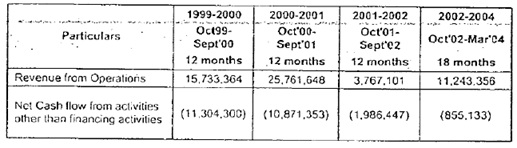
35.2 . From the above table, it could be seen that NIIT NV had negative cash flows from its operations. The cash outflow of NIIT NV was essentially on account of investment by that company in assets such as Software / Content procured from the assessee. It was submitted that such content was developed and legally owned by the assessee. It was submitted that majority (over 65%) of the purchases of such assets were made by NIIT NV from the assessee, resulting in enhanced cashflow and profitability for the assessee. In view of the aforesaid, it is submitted that it was in the business and commercial interest of the assessee to adequately capitalize NIIT NV so that benefits in the form of global penetration and higher sales as well as profitability could be enjoyed by the assessee. It was submitted that it is a settled position that commercial expediency is to be taken into consideration for determining the arm’s length price of a financial transaction. Reliance is placed in this regard on the decision of Hon’ble Jurisdictional Delhi High Court in the case of CIT -I v. Cotton Naturals (I) (P.) Ltd. (Delhi)/276 CTR 445 (Del) , wherein it was held as under:-
“27. Several aspects enunciated above, reflect the correct legal position. We, however, express our inability to accept that commercial expediency and related benefits have no connection or relationship with the rate of interest. In terms of Clause (c) and (d) to Rule 10B (2), contractual relations or terms, and other material facts should be recognized.”
35.3 . Further the Co-ordinate Bench of Chennai Tribunal in the case of Mascon Global Ltd. v. Dy. CIT (Chennai – Trib.) in ITA No. 2205/Mds/2010 held that no interest payment on advances extended to a subsidiary was required where the advances were made to undertake an acquisition and hence arose out of commercial expediency. Considering that NIIT NV was set up and funded by the assessee to promote and advance its own business interest, there was no justification for the assessee to charge interest from the AE and that the return on capital infused was enjoyed by the assessee in the form of higher revenue from sale of licenses / products to / through the subsidiary as well as global expansion of the business of the assessee.
35.4 . In any event, since, NIIT NV was specifically created by the assessee for setting up and expanding the Global Learning Business in the overseas territory, it was the obligation of the assessee, as a shareholder, to provide sufficient funding to enable the subsidiary to perform the stated activity. Accordingly, it was submitted that the capital was infused by the assessee in the form of loan in fulfilment of its obligation as a shareholder for which no compensation is warranted. Given the fact that NIIT NV was set up only in August 1999, it did not have any ‘reputation’ or ‘payment history’ that may have favourably impacted its credit worthiness in the open market. NIIT NV was essentially a start up at the time of capital infusion. At the time of grant of the said loan, NIIT NV did not have any tangible assets to pledge with any unrelated/ third party lender to avail the loan facility.
35.5 . In view of the aforesaid, it would be appreciated that the decision to set up NIIT NV , as a wholly owned subsidiary, was taken by the assessee to establish and expand its Global Learning Business in the overseas territory and accordingly, it was the obligation of the assessee to adequately capitalize the said subsidiary to undertake such business. In order to fulfil such obligation, the assessee infused capital in the form of interest free loan of USD 8 million. At the cost of repetition, it is submitted that since the loan was advanced for fulfilling the obligation as a shareholder, the said loan was essentially in the nature of equity for which no compensation in the form of interest was warranted. In the present case, the assessee did not advance funds to NIIT NV with the objective of earning interest income. Rather, the dominant purpose was to adequately capitalize the newly incorporated NIIT NV for expansion of business of the assessee in the overseas territory. Such capital infusion, therefore, was in the nature of shareholder activity for which no compensation was warranted. These facts were duly appreciated by the Learned CITA while granting relief to the assessee on which we do not find any infirmity. Hence the Ground Nos. 1.1. to 1.2. raised by the revenue are dismissed.
36. The next issue to be decided in the appeal of the revenue is as to whether the Learned CITA was justified in deleting the disallowance of purchase of CBT products in the sum of Rs 97,36,496 on the ground that the said purchases were made after the expiry of the agreement with the distributor.
37. We have heard the rival submissions and perused the materials available on record. National Education Training Group Inc. (“NETG”), a company having its principal office in the USA, was engaged in the business of producing, acquiring and marketing training resources/computer-based training programmes (“CBTs”) incorporated on various media, including CD-ROMs, interactive video instructions, linear video instructions, and related text, audio material and equipment. Pursuant to an agreement dated 31-12-1994, the assessee was appointed as the sole distributor of NETG products, namely CBTs/training programmes, in India. In terms of the said agreement, the assessee was obliged to procure products from NETG for the purpose of onward sale in India. During the relevant previous year, in discharge of the minimum purchase obligation stipulated under the aforesaid agreement, the assessee imported CBTs from NETG aggregating to Rs. 97,36,496 (US$ 2,07,785) as evident from the details enclosed in Page 235 of the Paper Book. The Learned AO proceeded to disallow the aforesaid purchases on the sole ground that the same were effected subsequent to the expiry of the agreement. Being aggrieved thereby, the assessee carried the matter in appeal before the Learned CITA. The Learned CIT(A), after duly appreciating the factual matrix and the contemporaneous documentary evidence on record, and placing reliance upon the judgment of the Hon’ble Supreme Court in S.A. Builders Ltd. v. CIT
288 ITR 1 (SC) , deleted the impugned disallowance by holding as under:
“11.3 I have gone through the documents so produced before me and from the perusal of the same it is found that the purchases are accompanied with the necessary import documents and have duly been consumed by the appellant. Further the purchases so made have been duly accounted for and the payment for the same have been made through banking channels therefore, it.is also not a case from the assessing officer that the purchases are not genuine.
From the facts it is clear that the purchases have been. made wholly and exclusively for the purpose of business and out of the commercial expediency, in view of the totally of the circumstances and taking a support from the decision of Supreme Court in the case of S.A Builders Ltd, v CIT , the addition made by the AO deserves to be deleted.”
37.1. It was submitted that, under the distributorship agreement entered into between the assessee and NETG, the assessee had been appointed as the sole and exclusive distributor of NETG products in India. In consideration thereof, and in terms of clause 4 of the agreement, the assessee was obligated to purchase CBTs from NETG for onward sale in India at prices determined by the assessee itself. The said clause further stipulated a “minimum order commitment” on a cumulative yearly basis during the currency of the agreement so as to secure adequate revenue generation for NETG and ensure placement of sufficient orders by the assessee from time to time. The aforesaid stipulation regarding “minimum order commitment” was incorporated to ensure procurement of products of a prescribed minimum value during the subsistence of the agreement. Accordingly, the assessee was under a binding obligation to place orders to the extent stipulated under clause 4. In the event of failure to comply with such commitment, NETG was vested with the right to terminate the agreement upon issuance of nine months’ notice in terms of clause 17 thereof. Further it was submitted that, under clause 3, the term of the agreement stood extended up to 31.12.2000, relevant to Assessment Year 2001-02. During the relevant previous year, although the agreement had formally expired, the assessee, with a view to making good the shortfall in the “minimum order commitment” pertaining to the contractual period, purchased CBTs amounting to Rs. 97,36,496/- (US$ 2,07,785) from NETG. The said purchases were thus effected in discharge of the obligations arising under the agreement executed with NETG. Consequently, the allegation of the Learned AO that the purchases were made merely after expiry of the agreement and were therefore not allowable, was wholly misconceived and untenable, particularly in light of the continuing and subsisting obligations arising from the contractual commitments undertaken by the assessee. The assessee is a concern enjoying substantial reputation and goodwill both in domestic as well as international markets. Likewise, NETG enjoys considerable standing and reputation in the international computer-based training industry, and its products are widely recognized and sought after by entities engaged in the field of computer education. Accordingly, viewed from the standpoint of a prudent businessman, it was commercially expedient and necessary for the assessee to honour its commitment towards an internationally reputed entity such as NETG, with a view to preserving its own credibility, goodwill and cordial business relations. The decision to effect the aforesaid purchases was therefore guided by sound commercial considerations and business expediency as well. Further, there is absolutely no material on record to cast any doubt upon the genuineness of the purchases made from National Education Training Group Inc. (“NETG”), particularly when:
| i. |
|
The training resources/CBT products indisputably came into India, as duly evidenced by the following contemporaneous documents: |
| (a) |
|
Purchase orders placed by the appellant upon NETG; |
| (b) |
|
Invoices raised by NETG; and |
| (c) |
|
Bills of Entry for home consumption issued by the Customs Authorities evidencing physical import of the products into India. |
| ii. |
|
Payment towards the impugned purchases has undisputedly been remitted to NETG through normal banking channels. |
| iii. |
|
It is not the case of the Revenue that the products were never received by the assessee or that the consideration paid ultimately reverted to the assessee in any form whatsoever, particularly when no incriminating material/document was found during the course of search proceedings under section 132 of the Act suggesting the aforesaid. |
| iv. |
|
NETG is an unrelated third party and bears no relationship with either the appellant or its Directors. |
| v. |
|
The very existence and identity of NETG has never been doubted by the Revenue. |
| vi. |
|
The assessee had also made purchases from the said party in preceding years, which were subsequently sold in the ordinary course of business. Such purchases made from the same party in earlier years stood accepted by the Department, including while framing assessments under section 153A of the Act. |
| vii. |
|
There is further no dispute regarding the utilization of the imported products for the purposes of the appellant’s business. The assessee required the CBT products procured from NETG for use/reference by students while imparting computer-based education and training as part of its regular business activities. The products were also required to be maintained in the assessee’s library for future academic reference. Apart therefrom, there existed commercial demand for such products and the assessee also intended to deal in/sell the same in the ordinary course of business. |
| viii. |
|
Further, the assessee had duly furnished a statement demonstrating utilization of the impugned products purchased from NETG. |
It was submitted that the purchases made during the relevant previous year were necessarily required either for internal/business use in the course of imparting computer-based learning or for onward sale. Significantly, such utilization has not been disputed by the Learned AO at any stage. The revenue arising from subsequent sale/use of such products has duly been offered to tax in later years, which aspect also remains undisputed by the Learned AO. The purchases made from NETG were, therefore, wholly and exclusively for the purposes of the assessee’s business.
| ix. |
|
Even the rate at which purchases were made from NETG has not been disputed by the Revenue. |
37.2. In view of the aforesaid cumulative reasons, there existed no basis to doubt the genuineness of purchases made from NETG during the relevant previous year. Accordingly, the action of the Learned AO in disallowing the entire purchases merely on the ground that such purchases were effected after the expiry of the agreement is wholly untenable. The said disallowance was, therefore, rightly deleted by the CIT(A), and no interference with the findings so recorded is called for. Accordingly, the Ground Nos. 1.3. and 1.4. raised by the revenue are dismissed.
38. The Ground Nos. 2 & 3 raised by the revenue are general in nature and does not require any specific adjudication.
39. In the result, the appeal of the revenue in ITA No. 4096/Del/2009 for Assessment Year 2002-03 is dismissed.
40. To Sum Up,
| ITA No. |
Assessment Year |
Assessee |
Appeal by |
Decision |
| 2058/Del/2010 |
2000-01 |
NIIT Ltd |
Assessee |
Partly Allowed |
| 2059/Del/2010 |
2001-02 |
NIIT Ltd |
Assessee |
Partly Allowed |
| 2060/Del/2010 |
2002-03 |
NIIT Ltd |
Assessee |
Partly Allowed |
| 2061/Del/2010 |
2003-04 |
NIIT Ltd |
Assessee |
Partly Allowed |
| 2062/Del/2010 |
2004-05 |
NIIT Ltd |
Assessee |
Partly Allowed |
| 2063/Del/2010 |
2005-06 |
NIIT Ltd |
Assessee |
Partly Allowed |
| 4096/Del/2009 |
2002-03 |
NIIT Ltd |
Revenue |
Dismissed |



