ORDER
M Balaganesh, Accountant Member – The appeals in ITA Nos. 6943 to 6945/Del/2025 for AYs 2019-20 to 2021-22, arise out of the order of the Id. Commissioner of Income Tax (Appeals)-3, Noida [hereinafter referred to as ‘Id. CIT(A)’, in short] dated 15.09.2025, against the order of assessment passed u/s 153C r.w.s. 143(3) of the Income-tax Act, 1961 (hereinafter referred to as ‘the Act’) dated 26.03.2024 for AYs 2019-20 and 2020-21 and 25.03.2023 for AY 2021-22 by the Assessing Officer, DCIT, Central Circle, Meerut (hereinafter referred to as ‘Id. AO’). Identical issues are involved in all these appeals and hence they are taken up together and disposed of by this common order for the sake of convenience. Both the parties before us mutually stated that the appeal of the assessee for the Asst Year 2020-21 may be taken as the lead case and the decision rendered thereon could be equally applied for other assessment years except with variance in figures, in view of identical issues.
2. The preliminary legal issue raised by the assessee is challenging the assumption of jurisdiction under section 153C of the Act and consequential framing of search assessment under section 153C of the Act on the assessee. This being a pure legal issue and going to the root of the matter, we deem it fit to address the same first and take up for adjudication.
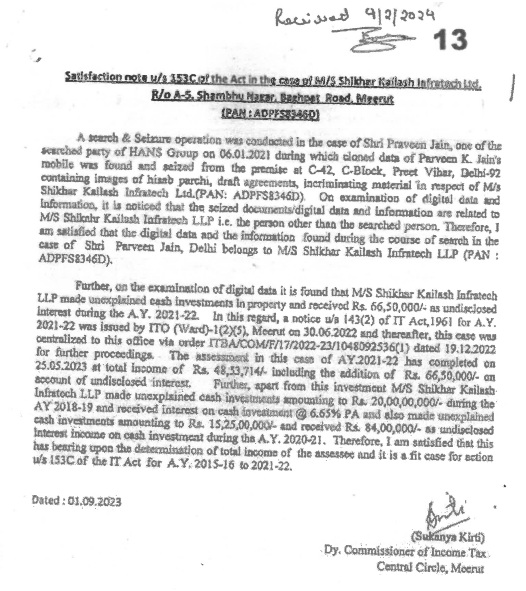
3. We have heard the rival submissions and perused the materials available on record. A search and seizure operation under section 132 of the Act was conducted on 6-1-2021 in the case of Shri Praveen Jain, who is one of the searched party of Hans Group. The learned AO of the searched person recorded satisfaction on 23-8-2022 relying upon certain WhatsApp chats between ‘Shri Praveen Jain’ and ‘Shri Dev Ka Aadmi CA Jain’ and between ‘Shri Praveen K Jain’ and ‘Shri Vaibhav Jain’ to conclude that certain seized documents relate to the Assessee. Accordingly, proceedings were sought to be initiated on the Assessee under section 153C of the Act. The learned AO of the searched person recorded satisfaction note dated 01-05-2023 for assessment years 2015-16 to 2021-22, stating that the seized documents in the form of WhatsApp chats mentioned above relate to the Assessee herein. The satisfaction note recorded by the learned AO of the searched person dated 23- 8-2022 is enclosed in pages 15-16 of the paper book. Basis this, the consolidated satisfaction note was recorded by the learned AO of the Assessee herein on 01-09-2023 for the assessment years 2015-16 to 2021-22. For the sake of convenience, the consolidated satisfaction note recorded qua the Assessee herein is reproduced below:-
4. Notice under section 153C of the Act stood issued to the Assessee on 26.12.2023. In response to the said notice, return of income was filed by the Assessee on 19.01.2024 for the Assessment Year 2020-21 declaring total income of Rs 41,41,190 which was the same income as was originally declared under section 139(1) of the Act on 09.10.2020. Notice under section 142(1) of the Act was issued on 16.01.2024. In response thereto, the Assessee filed its written submissions on 23.01.2024 along with computation of total income, audited financial statements, copy of Form 26AS / copy of bank accounts maintained by the Assessee, details in respect of unsecured loans received by the Assessee and their respective confirmations. Thereafter, notices under section 143(2) and 142(1) of the Act were issued to the Assessee on 23.02.2024, wherein the Assessee was specifically asked to explain the source of cash investment of Rs 20,00,00,000 and taxability of interest income earned thereon. The Assessee filed written submissions on 27.02.2024 wherein it categorically denied having made any investment in immovable property during the year under consideration and enclosed the balance sheet copy in support of its contentions. In the said reply, the Assessee also sought for documents in the possession of the department which suggest otherwise, in order to furnish proper explanations. The learned AO issued show cause notice to the Assessee dated 01.03.2024 enclosing the hisab parchis seized from the WhatsApp Chats of Shri Parveen Jain with some other party as to why the alleged investment in Dwarka Unity in the sum of Rs 20 crores together with alleged interest thereon @ 6.65% per annum be not brought to tax in the hands of the Assessee in Assessment Year 2019-20.
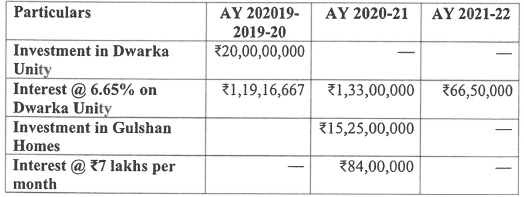
5. Further the learned AO in the said show cause notice also proposed an additions on account of unexplained investment in cash in M/s Gulshan Homes and Infrastructure Private Limited amounting to Rs 15,25,00,000 and interest income thereon at Rs 84,00,000 (7 lakhs per month * 12 months) for the Assessment Year 2020-21. The Learned AO also proposed an addition on account of interest income of Rs 1,33,00,000 and Rs 66,50,000 at the rate of 6.65% on Rs 20 crores alleged investment in Dwarka Unity for the Assessment Years 2020-21 and 2021-22 respectively.
6. The learned AO in the search assessments under section 153C of the Act made the following additions for various assessment years as under:
7. It is not in dispute that the learned AO of the searched person had recorded consolidated satisfaction note for initiating proceedings under section 153C of the Act qua the Assessee herein for the assessment Years 2015-16 to 2021-22 as evident from the satisfaction note reproduced supra. Whether recording of consolidated satisfaction note for various assessment years would prove fatal to the assumption of jurisdiction of the learned AO and consequential framing of assessments under section 153C of the Act was subject matter of consideration by the Hon’ble Karnataka High Court in the case of Dy. CIT v. Sunil Kumar Sharma 469 ITR 197 (Kar) dated 22-1-2024, wherein it was held as under:-
“53. Further, satisfaction note is required to be recorded under section 153C of the IT Act for each Assessment Year and in the impugned proceedings, a consolidated satisfaction note has been recorded for different Assessment Years, which also vitiates the entire assessment proceedings. In view of all these findings, it is said that the appeals do not have any substance for seeking intervention as sought for by the appellant/Revenue.”
7.1 . We find that the Special Leave Petition filed by the revenue before the Hon’ble Supreme Court against the aforesaid judgement was dismissed which is
CIT (Appeals) v.
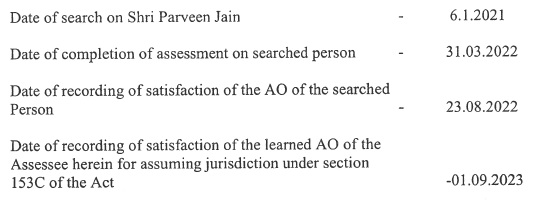
Sunil Kumar Sharma (SC). The relevant portion of the Head Notes and the order of Hon’ble Apex Court is reproduced hereunder:-
“Section 153C, read with sections 132, 153 and 153A, of the Income-tax Act, 1961 – Search and seizure – Assessment of any other persons (General principles) – Assessment years 2012-13 to 2018-19 – High Court held that satisfaction note is required to be recorded under section 153C for each assessment year and where a consolidated satisfaction note had been recorded for different assessment years, it would vitiate entire assessment proceedings – Whether SLP filed against impugned order of High Court was to be dismissed – Held, yes [Para 3] [In favour of assessee]
ORDER
1. Delay condoned.
2. Heard the learned Senior Counsel appearing for the appellants.
3. We are not inclined to interfere with the impugned judgment and order passed by the High Court of Karnataka at Bengaluru in Writ Appeal No. 831/2022 (T-IT) dated 22-01-2024/ Deputy Commissioner of Income-tax v. Sunil Kumar Sharma
(Karnataka).
4. The Special Leave Petition is dismissed.
5. Pending application(s), if any, shall stand disposed of.
8. We find that in this regard, the observations made by the Hon’ble Jurisdictional High Court in the case of
Saksham Commodities Ltd. v.
ITO 464 ITR 1 (
Delhi) are very much relevant in this regard as under:-
“39. The principle that the AO of the searched person is only required to be satisfied that the documents or materials pertain to the “other person” at the stage of transmission of material or documents to the jurisdictional AO of the non-searched entity was reiterated in RRJ Securities. We deem it apposite to extract the following passages from that decision:
“13. The first and foremost step for initiation of proceedings under Section 153C of the Act is for the AO of the searched person to be satisfied that the assets or documents seized belong to the Assessee (being a person other than the searched person). The AO of the Assessee, on receiving the documents and the assets seized, would have jurisdiction to commence proceedings under Section 153C of the Act. The AO of the searched person is not required to examine whether the assets or documents seized reflect undisclosed income. All that is required for him is to satisfy himself that the assets or documents do not belong to the searched person but to another person. Thereafter, the AO has to transfer the seized assets /documents to the AO having jurisdiction of the Assessee to whom such assets/documents belong. Section 153C(1) of the Act clearly postulates that once the AO of a person, other than the one searched, has received the assets or the documents, he is to issue a notice to assess/re-assess the income of such person – that is, the Assessee other than the person searched – in accordance with provisions of Section153A of the Act.
………
63. On an overall consideration of the structure of Sections 153A and 153C, we thus find that a reopening or abatement would be triggered only upon the discovery of material which is likely to “have a bearing on the determination of the total income” and would have to be examined bearing in mind the AYs’ which are likely to be impacted. It would thus be incorrect to either interpret or construe Section 153C as envisaging incriminating material pertaining to a particular AY having a cascading effect and which would warrant a mechanical and inevitable assessment or reassessment for the entire block of the “relevant assessment year”.
64. In our considered view, abatement of the six AYs’ or the “relevant assessment year” under Section 153C would follow the formation of opinion and satisfaction being reached that the material received is likely to impact the computation of income for a particular AY or AYs’ that may form part of the block of ten AYs’. Abatement would be triggered by the formation of that opinion rather than the other way around. This, in light of the discernibly distinguishable statutory regime underlying Sections 153A and 153C as explained above. While in the case of the former, a notice would inevitably be issued the moment a search is undertaken or documents requisitioned, whereas in the case of the latter, the proceedings would be liable to be commenced only upon the AO having formed the opinion that the material gathered is likely to inculpate the assessee. While in the case of a Section 153A assessment, the issue of whether additions are liable to be made based upon the material recovered is an aspect which would merit consideration in the course of the assessment proceedings, under Section 153C, the AO would have to be prima facie satisfied that the documents, data or asset recovered is likely to “have a bearing on the determination of the total income”. It is only once an opinion in that regard is formed that the AO would be legally justified in issuing a notice under that provision and which in turn would culminate in the abatement of pending assessments or reassessments as the case may be.
65. We would thus recognize the flow of events contemplated under Section 153C being firstly the receipt of books, accounts, documents or assets by the jurisdictional AO, an evaluation and examination of their contents and an assessment of the potential impact that they may have on the total income for the six AYs’ immediately preceding the AY pertaining to the year of search and the “relevant assessment year”. It is only once the AO of the non-searched entity is satisfied that the material coming into its possession is likely to “have a bearing on the determination of the total income” that a notice under Section 153C would be issued. Abatement would thus be a necessary corollary of that notice. However, both the issuance of notice as well as abatement would have to necessarily be preceded by the satisfaction spoken of above being reached by the jurisdictional AO of the non-searched entity.
66. Therefore, and in our opinion, abatement of the six AYs’ or the “relevant assessment year” would follow the formation of that opinion and satisfaction in that respect being reached.
67. On an overall consideration of the aforesaid, we come to the firm conclusion that the “incriminating material” which is spoken of would have to be identified with respect to the AY to which it relates or may be likely to impact before the initiation of proceedings under Section 153C of the Act. A material, document or asset recovered in the course of a search or on the basis of a requisition made would justify abatement of only those pending assessments or reopening of such concluded assessments to which alone it relates or is likely to have a bearing on the estimation of income. The mere existence of a power to assess or reassess the six AYs’ immediately preceding the AY corresponding to the year of search or the “relevant assessment year” would not justify a sweeping or indiscriminate invocation of Section 153C.
68. The jurisdictional AO would have to firstly be satisfied that the material received is likely to have a bearing on or impact the total income of years or years which may form part of the block of six or ten AYs’ and thereafter proceed to place the assessee on notice under Section 153C. The power to undertake such an assessment would stand confined to those years to which the material may relate or is likely to influence. Absent any material that may either cast a doubt on the estimation of total income for a particular year or years, the AO would not be justified in invoking its powers conferred by Section 153C. It would only be consequent to such satisfaction being reached that a notice would be liable to be issued and thus resulting in the abatement of pending proceedings and reopening of concluded assessments.”
(emphasis supplied by us)
8.1 . Further we find that the revenue had preferred Special Leave Petition (SLP) before the Hon’ble Supreme Court against the aforesaid decision of Hon’ble Jurisdictional High Court. The SLP was dismissed in the case of
ITO v.
Saksham Commodities Ltd. [2025] 170 (SC) The Head Notes and the full order are reproduced hereunder:-
“Section 153C, read with section 153A, of the Income-tax Act, 1961 – Search and seizure – Assessment of any other person – Assessment year 2015-16 – High Court by impugned order held that section 153C would apply only to such Assessment Years where jurisdictional Assessing Officer is satisfied and has incriminating material for those Assessment Years and which may be concerned with disclosed and undisclosed income – High Court also held that it is only once Assessing Officer of non-searched entity is satisfied that material coming into its possession is likely to “have a bearing on determination of total income” that a notice under section 153C would be issued and abatement would thus be a necessary corollary of that notice – High Court further held that since in instant case section 153C was invoked in respect of Assessment Years for which no incriminating material had been gathered or obtained and satisfaction notes also failed to record any reasons as to how material discovered and pertaining to a particular Assessment Year was likely to “have a bearing on determination of total income” for year which was sought to be abated or reopened in terms of impugned notices, in such circumstances, proceedings initiated under section 153C would not sustain and impugned notice was to be quashed – Whether SLP filed by revenue against impugned order of High Court was to be dismissed – Held, yes [Para 3] [In favour of assessee]
ORDER
1. Heard the learned counsel for the petitioners.
2. There is a delay of 124 and 127 days in filing the Special Leave Petitions respectively, which has not been satisfactorily explained. Even otherwise, we have gone through the Special Leave Petition and do not find any merit in the same.
3. The Special Leave Petitions are, therefore, dismissed on the ground of delay as well as on merits.
4. Pending application(s), if any, stand disposed of.
9. Since individual satisfaction note was not recorded for each assessment year by the learned AO of the Assessee herein, the assumption of jurisdiction under section 153C of the Act becomes fatal. Respectfully following the aforesaid decisions of the Hon’ble High Courts, we hold that the assumption of jurisdiction under section 153C of the Act qua the Assessee herein is totally flawed.
10. Yet another issue that requires consideration is the date of recording of consolidated satisfaction note for assumption of jurisdiction under section 153C of the Act i.e. whether the same was recorded within the reasonable time in accordance with the decision of the Hon’ble Supreme Court in the case of CIT v. Calcutta Knitwears (MAG)/362 ITR 673 (SC) and the CBDT Circular No. 24/2015 dated 31.12.2015. The Assessee has raised Additional Grounds specifically in this regard. These additional grounds go to the root of the matter. They are legal issues and facts relevant for adjudication are already on record. Hence the same are hereby admitted.
11. For the sake of adjudication of the said additional grounds, the following dates are relevant:-
11.1 . It could be seen that the satisfaction for initiation of proceedings under section 153C of the Act recorded qua the Assessee herein on 01.09.2023 was 17 months after the completion of assessment on searched person and 32 months after the search. The Hon’ble Supreme Court in the case of Calcutta Knitwears referred supra held that the satisfaction qua the third party (i.e. other than the person searched) could be recorded at any of the three stages:-
(a) at the time of or along with the initiation of proceedings against the searched person under section 158BC of the Act; or
(b) in the course of the assessment proceedings under section 158BC of the Act; or
(c) immediately after the assessment proceedings are completed under section 158BC of the Act of the searched person.
11.2. The provisions of section 158BC are pari materia with section 153A of the Act and provisions of section 158BD are pari materia with section 153D of the Act. Hence the aforesaid Circular No. 24/2015 read with the judgement of the Hon’ble Supreme Court in the case of Calcutta Knitwears(Supra) referred shall apply with equal force to proceedings under section 153C of the Act. Admittedly, the satisfaction under section 153C of the Act have been recorded in the instant case qua the Assessee herein on 01.09.2023 which is 17 months after the end of the month in which assessment proceedings were completed in the case of the searched person. This delay of 17 months cannot be construed as having recorded satisfaction immediately after the completion of assessment proceedings falling in category (c) of the aforesaid Circular. Hence the recording of satisfaction in terms of section 153C of the Act qua the Assessee herein on 01.09.2023 is not in consonance with the judgement of the Hon’ble Supreme Court in the case of Calcutta Knitwears (Supra) referred and the CBDT Circular No. 24/2015 dated 31.12.2015 and it has to be concluded that the satisfaction qua the Assessee has been recorded belatedly. Now the next question that arises for our consideration is as to whether such recording of belated satisfaction note would become fatal to the very assumption of jurisdiction under section 153C of the Act. This issue is no longer res integra in view of the judgement of Hon’ble Jurisdictional Delhi High Court in the case of CIT v. Bharat Bhushan Jain 370 ITR 695 (Delhi) wherein it was held that where an assessee was issued with notice under section 158BD in respect of assessment of other persons, in a year after completion of assessment, notice could not be held to be a valid notice as same was to be issued immediately. The relevant operative portion of the said judgement in this regard is reproduced below:-
“6. Having regard to the intent of the Supreme Court in paragraph 44 of theCalcutta Knitwears (supra), where it was indicated that the Revenue has to be vigilant in issuing notice to the third party under section 158BD, immediately after the completion of assessment of the searched person, this court is of the opinion that a delay ranging between 10 months of one-and-half years cannot be considered contemporaneous to assessment proceedings. We are of the opinion that notices were not issued in conformity with the requirements of section 158BD, and were unduly delayed. The appeals of the Revenue, accordingly, fail and are dismissed.”
11.3 . Similar views were expressed by the Hon’ble Gujarat High Court in the case of
Parag Rameshbhai Gathani v.
ITO, International Taxation (Guj) dated 18-11-2025 wherein the delay of 22 months from the time of completion of assessment proceedings of searched person was reprimanded by the Hon’ble High Court. Even the reasons for delay supposedly attributed due to Covid-19 pandemic and faceless assessment scheme were not accepted by the Hon’ble High Court. The SLP preferred by the revenue against this judgement was dismissed by the Hon’ble Supreme Court which is
Dy. CIT v.
Dharmesh Rameshchandra Gathani (SC) In yet another decision in the case of
Pr. CIT v.
Jitendra H. Modi HUF 403 ITR 110 (Guj), the Hon’ble Gujarat High Court observed that the recording of satisfaction qua third person after 9 months from the completion of assessment proceedings of searched person was reprimanded.
11.4 . Similar view was later expressed by the Hon’ble Bombay High Court in the case of
Clear Channel India (P.) Ltd. v.
Dy. CIT [
2026] (Bom) where in the delay of 15 months after the completion of search assessment proceedings of searched person was not accepted bythe Hon’ble High Court and proceedings under section 153C of the Act was quashed on third person as not initiated within the reasonable time limit provided in CBDT Circular No. 24/2015 dated 31.12.2015.
11.5 . Respectfully following the aforesaid judicial precedents on the aspect of delayed recording of satisfaction note for initiation of proceedings under section 153C of the Act, we hold that the assumption of jurisdiction under section 153C of the Act qua the Assessee herein itself is totally flawed and consequential assessment proceedings under section 153C of the Act deserve to be quashed.
12. The learned AR before us raised yet another legal argument in Additional Ground Nos. 19 & 20 for Assessment Year 2019-20 ; Additional Ground no. 18 for Assessment Year 2020-21 and 2021-22. These additional grounds for the respective years under consideration go to the root of the matter and facts relevant for its adjudication are already on record and being purely legal in nature, the same are hereby admitted and hence taken up for adjudication. The learned AR submitted that from 01-04-2021, proceedings arising from searched conducted on or after the said date are governed by sections 147 to 151 of the Act and section 153C(3) of the Act expressly excludes the applicability of section 153C of the Act in respect of such searches. The date of search qua the Assessee would have to be reckoned based on the date of recording of satisfaction note under section 153C of the Act qua the Assessee herein. The satisfaction note qua the Assessee herein was recorded by the learned AO on 01-09-2023. Hence the year of search qua the Assessee herein would be in financial year 2023-24 relevant to Assessment Year 2024-25, which falls after 01-04-2021. Now the short question that arises for our consideration is as to whether the learned AO was justified in framing an assessment under section 153C of the Act in respect of satisfaction recorded post 1-4-2021 in respect of search on third person prior to 1-4-2021. We find that this issue is no longer res integra in view of the judgement of the Hon’ble Madras High Court in the case of
Harigovind v.
Asstt. CIT Non-corporate 485 ITR 509 (Mad). The relevant operative portion of the said judgement of Hon’ble Madras High Court is reproduced hereunder:-
“3. The common issue involved in all these writ petitions is as to whether the issuance of impugned notice, under Section 153C of the Act, is sustainable and in accordance with the provision of said Section of the Act.
4. The learned counsel appearing for the petitioner would submit that in this case, initially, on 29.01.2019, the Income Tax Authorities had conducted a search at 3?? party premises. According to the Authorities, they have received/obtained incriminating materials, pertaining to the petitioner, at the said 3?? party premises. Pursuant to the same, the notice under Section 148A of the Act was issued by the Authorities on 15.03.2022 for the AY 2018-19. Subsequently, the notice under Section 148 of the Act was issued, on 31.03.2022, without granting sufficient opportunity to the petitioner to file objections to the aforesaid notice dated 15.03.2022. Therefore, the petitioner challenged the notice dated 31.03.2022 by way of filing a writ petition in Harigovind v. G.Ravindran [W.P. No. 9958 of 2022], wherein this Court, vide order dated 22.04.2022, set aside the notice and directed the concerned officer to issue a fresh hearing.
……………….
40. Thus, as far as the searched person is concerned, the date of initiation of search is the date, on which the search was conducted in his premises. The said date would be the date of initiation of search for searched person for all purposes. As far as the other person is concerned, the date of initiation of search would be the date, on which the materials, books of accounts, etc., are handed over to the JAO of the other person and this date would be considered as the date of initiation of search for other person for all purposes. Thus, there cannot be two different date of initiation of search, either for the searched person or for the other person.
41. The provisions of Sub-Section (3) of Section 153C states that
“153C(3). nothing contained in this Section shall apply in relation to a search initiated under Section 132 or books of account, other documents or any assets requisition under Section 132A on or after the 1st day of April, 2021”
which means, if the search is initiated subsequent to 01.04.2021, the provision of Section 153C will not apply and accordingly, no proceedings can be initiated against the other person.
42. According to the petitioner, the date of handing over of the seized materials, i.e., 25.11.2022, is the date of initiation of search. If the said contention of the petitioner is accepted, obviously, the issuance of impugned notices dated 07.02.2023 by the 2n? respondent is without any authority and contrary to Sub-Section (3) of Section 153C of the Act and thus, the same is liable to be quashed.
43. In terms of Sub-Section (1) of Section 153C of the Act, for the purpose of calculating the six years period, the date of handing over of the materials to the petitioner’s JAO has to be construed as the date of initiation of search for other person. Further, in terms of first proviso to Sub-Section (1) of Section 153C, for the purpose of abatement also, the date of handing over of the materials to the petitioner’s JAO has to be construed as the date of initiation of search for the other person. In such view of the matter, this Court is unable to comprehend the submissions made by the learned counsel for respondents that yet another date is available for the purpose of initiation of search in respect of the other person.
44. Certainly, there cannot be two different dates for initiation of search for the other person. Hence, for all practical purpose, the initiation of search would be the same date and it is apparent upon reading the provisions of Section 153C of the Act. In the provision of Section 153C(1) of the Act, the date of initiation of search is mentioned as the date of handing over of materials and as per the first proviso, the same date would apply for the purpose of abatement also. When such being the case, no other date will come into picture for the purpose of determination of initiation of search for other person. At this juncture, it would be apposite to refer the judgement rendered by the Hon’ble Apex Court in Jasjit Singh (supra), wherein, it was held on the aspect as to whether the first proviso to Section 153C would apply only for the purpose of abatement of pending proceedings or otherwise.
45. When a similar contention was raised before the Hon’ble Supreme Court in the aforesaid case of Jasjit Singh (supra), the same was recorded in the said judgement as
“… The revenue argued that the proviso to Section 153C(1), is confined in its application to the question of abatement”.
However, while deciding the said issue, the Hon’ble Apex Court had arrived at a conclusion and rendered its judgement by stating that
” the revenue’s argument is insubstantial and without merit” …
When such being the case, it is clear that the Hon’ble Apex Court had rejected the contention of the revenue that “the first proviso to Section 153C(1), is confined in its application to the question of abatement”, which means, as per the law laid down by the Hon’ble Apex Court, the said provision is not only for the purpose of abatement but also for all the other practical purposes.
46. For ready reference, the relevant portion of the judgement rendered in the case of Jasjit Singh (supra) is extracted hereunder:
“9. It is evident on a plain interpretation of Section 153C(1) that the Parliamentary intent to enact the proviso was to cater not merely to the question of abatement but also with regard to the date from which the six year period was to be reckoned, in respect of which the returns were to be filed by the third party (whose premises are not searched and in respect of whom the specific provision under Section 153-C was enacted. The revenue argued that the proviso [to Section 153(c)(1)] is confined in its application to the question of abatement.
10. This Court is of the opinion that the revenue’s argument is insubstantial and without merit. It is quite plausible that without the kind of interpretation which SSP Aviation adopted, the A.O. seized of the materials – of the search party, under Section 132 – would take his own time to forward the papers and materials belonging to the third party, to the concerned A.O. In that event if the date would virtually “relate back” as is sought to be contended by the revenue, (to the date of the seizure), the prejudice caused to the third party, who would be drawn into proceedings as it were unwittingly (and in many cases have no concern with it at all), is dis-proportionate. For instance, if the papers are in fact assigned under Section 153-C after a period of four years, the third party assessee’s prejudice is writ large as it would have to virtually preserve the records for at latest 10 years which is not the requirement in law. Such disastrous and harsh consequences cannot be attributed to Parliament. On the other hand, a plain reading of Section 153-C supports the interpretation which this Court adopts.
[**Emphasis supplied]
47. A reading of the above shows that the Hon’ble Apex Court had rejected the contention of the respondent and hence, it is clear that the first proviso to Sub- Section (1) of Section 153C is not only for the purpose of abatement but also for all other purposes, viz., initiation of search for other person in terms of Section 153C(3) of the Act. In such case, the date of initiation of search for the petitioner is the date, on which the documents were handed over to the JAO of the petitioner, i.e., 25.11.2022 is the date of initiation of search for the petitioner.
48. In terms of Sub-Section (3) of Section 153C, the provision of Section 153C will not apply for any search, which is initiated on or after 01.04.2021.
49. As stated above, in this case, the date of handing over of seized material to the petitioner’s JAO is on 25.11.2022 and the said date is the date of initiation of search for the petitioner. Thus, in the present case, it is crystal clear like cloudless sky that the initiation of search was subsequent to 01.04.2021, for which, the provisions of Section 153C will not apply. Therefore, the impugned notices dated 07.02.2023 is unsustainable and the same were issued without authority and against the provisions of Sub-Section (3) of Section 153C of the Act.
50. In such view of the matter, all the impugned notices are liable to be quashed and accordingly, all the impugned notices dated 07.02.2023 issued by the 2nd respondent are quashed.’
13. Respectfully following the aforesaid decision of Hon’ble Madras High Court, we quash the initiation of proceedings under section 153C of the Act in the hands of the assessee and consequentially the assessment framed for the assessment years under consideration under section 153C of the Act is held illegal and void abinitio and is hereby quashed.
14. In view of the aforesaid observations and respectfully following the various judicial precedents relied upon hereinabove, we hold that the Learned AO had invalidly assumed jurisdiction under section 153C of the Act for more than one reason as detailed supra and hence the entire search assessment is hereby declared as void ab initio for the years under consideration.
15. The Ground Nos. 1,2,3,8,9,16 & 17 together with Additional Grounds 20,21 & 22 raised by the assessee for the Assessment Year 2019-20 were stated to be not pressed by the learned AR at the time of hearing for which confirmation was given by the learned AR in writing. Accordingly, the said grounds are hereby dismissed as not pressed.
16. The Ground Nos. 1,2,3,8,9,17 & 18 together with Additional Grounds 21,22 & 23 raised by the assessee for the Assessment Year 2020-21 were stated to be not pressed by the learned AR at the time of hearing for which confirmation was given by the learned AR in writing. Accordingly, the said grounds are hereby dismissed as not pressed.
17. The Ground Nos. 1,2,3,8,9,14 & 15 together with Additional Grounds 21,22 & 23 raised by the assessee for the Assessment Year 2021-22 were stated to be not pressed by the learned AR at the time of hearing for which confirmation was given by the learned AR in writing. Accordingly, the said grounds are hereby dismissed as not pressed.
18. Since the entire assessment is quashed, the adjudication of remaining grounds raised by the assessee on merits of the additions become academic in nature and hence need not be gone into. No opinion is hereby rendered on the same and they are left open.
19. In the result, the appeals of the assessee are partly allowed.