ORDER
Manish Agarwal, Accountant Member.- The captioned cross appeals are filed by assessee and revenue against the separate orders of Ld. Commissioner of Income Tax (Appeals) 30, Delhi [“ld. CIT(A)”] passed u/s 250 of the Income Tax Act, 1961 [“the Act”] arising out of the separate assessment orders for AY 2020-21 and 2021-22. The same are tabulated as under:
| S. No. |
Appeal Nos. |
Asstt. Year |
CIT(A)’s Order dated |
Assessment Order dated |
Assessment Order passed u/s |
| 1 |
4602/Del/2026 (Assessee’s appeal) |
2020-21 |
27.03.2026 |
07.09.2024 |
143(3) r.w.s.147 |
| 2. |
6743/Del/2026 (Revenue’s appeal) |
– Do – |
– Do – |
– Do – |
– Do – |
| 3. |
3445/Del/2025 (Assessee’s appeal) |
2021-22 |
30.03.2025 |
28.01.2024 |
143(3) |
| 4. |
4514/Del/2025 (Revenue’s appeal) |
– Do – |
– Do – |
– Do – |
– Do – |
2. At the outset, it is observed that both the appeals filed by the revenue are with the delay of few days. The appeal for AY 2020-21 was delayed by 19 days and the appeal for AY 2021-22 was delayed by 21 days for which separate applications for condonation of delay were filed.
3. Before us, the ld. CIT DR submits that the AO was stuck up in time barring matters of block assessment proceedings and in various audit matters. He thus submits that considering the heavy workload due to high pendency of time barring assessment matters and other judicial and audit matters, the delay was occurred and, it is therefore humbly requested to condone the delay of 19 days in filling the Appeal before the Tribunal for AY 2020-21 and 21 days delay in AY 2021-22.
4. Per contra, ld. AR for the assessee has not objected to the request made by the revenue for condonation of delay in filing both the appeal.
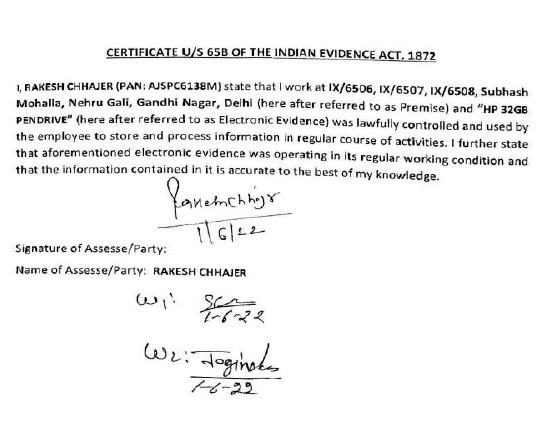
5. After hearing both the parties and considering the reasons stated by the AO in both the petitions, we find that the AO has reasonable cause for delay in filing the appeals for both the assessment years. Accordingly, the delay in filing the appeals is hereby condoned and both the appeals are admitted for hearing on merits.
6. Since all the appeals are having common issues which fact is fairly admitted by both the parties before us, therefore, all the appeal are taken together and decided by a common order.
7. We first take the cross appeals for AY 2020-21 in ITA No. 4602/Del/2026 as the lead case.
ITA No. 4602/Del/2026 (Assessee’s appeal) for AY 2020-21
8. Brief facts of the case are that the appellant is an individual and is proprietor of two proprietorship concerns viz. M/s J.M. Jain and M/s. JJ Trading. The return of income was originally filed on 28.02.2021 declaring total income of Rs.86,55,02,750/- which was revised at the income of Rs.86,41,70,200/-. The case was taken up for scrutiny and the assessment order was passed u/s 143(3) of the Act on 29.02.2022 at an income of Rs.86,41,93,280/-. A search and seizure operation u/s 132 was carried out at the business premises of the assessee situated at IX/6506, 6507 and 6508, Nehru Gali, Subhash Mohalla, Gandhi Nagar, East, Delhi 28.05.2022 and was concluded on 01.06.2022 as per various punchnama prepared and placed at Paper book (PB) pages 46 to 65. Simultaneously, searches were carried out at other premises situated at various places in Delhi and Kolkata on 28.05.2022 which were concluded on 29.05.2022, 30.05.2022 and 31.05.2022. Besides this another premises at IX/6504 was also searched on 31.05.2022. The relevant chart of the searches carried out at various places is as under:
| S. No. |
Place |
Date of commencement |
Date of conclusion |
Panchnama-pg of PB |
| (i) |
IX/6506, 6507 and 6508, Nehru Gali, Subhash Mohalla, Gandhi Nagar, East, Delhi |
28.5.2022 |
01.6.2022 |
43-65 |
| (ii) |
IX/6504, 3rd Floor, Nehru Gali, Subhash Mohalla, Gandhi Nagar, East, Delhi |
31.05.2022 |
01.06.2022 |
66-75 |
| (iii) |
66, Ram Vihar, East Delhi |
28.5.2022 |
30.5.2022 |
80-83 |
| (iv) |
67, Ram Vihar, East Delhi |
28.5.2022 |
30.5.2022 |
84-96 |
| (v) |
2285, Gali Hinga Bag, Tilak Bazar, Delhi |
28.5.2022 |
31.5.2022 |
96-99 |
| (vi) |
54, Hirabai Mrket Kankaria Road, Ahmedabad |
28.5.2022 |
31.5.2022 |
102-104 |
| (vii) |
145, M.G. Road, Kolkata |
28.5.2022 |
29.5.2022 |
105-119 |
| (viii) |
9A/23, WEA, Channa Market, Karol Bagh, Delhi |
28.5.2022 |
31.5.2022 |
120-127 |
| (ix) |
T-48/1, Panchpara Road, Bartalla, Railline, Matia Bridge, Kolkata |
28.5.2022 |
29.5.202 |
128-151 |
| (x) |
Locker No. 41, HDFC Bank, Chandni Chowk |
19.7.2022 |
19.7.2022 |
152-156 |
| (xi) |
Locker No. PH-15, PNB Bank, Surajmal Vihar, Delhi |
18.7.2022 |
18.7.2022 |
157-161 |
| (xii) |
Locker No. PH-83, PNB Bank, Surajmal Vihar, Delhi |
18.7.2022 |
18.7.2022 |
162-166 |
9. Thereafter, the jurisdiction over the case of assessee was transferred from Kolkata to Delhi in terms of the order passed u/s 127 of the Act dated 11.11.2022. The assessee received the notice u/s 148 followed by various notices issued from time to time which were duly replied by the assessee. At the fag-end of the proceedings i.e. on 14.03.2024, an order u/s 142(2A) of the Act was passed referring the matter for special audit and M/s O.P. Bagla & Co., Chartered Accountants were appointed to undertake special audit in the case of the assessee and their report was obtained and submitted on 10.07.2024. Thereafter, the final assessment order was passed on 07.09.2024 wherein various additions to the tune of Rs. 223,10,59,920/- were made by the AO.
10. Against the said order, assessee preferred an appeal before the Ld. CIT(A) who vide order dated 27.03.2026 has partly allowed the appeal of the assessee and deleted some of the disallowances made however, majority of the additions were confirmed.
11. Aggrieved by the said order, both the parties are in appeal before the Tribunal by taking the various grounds of appeal as per the appeal memo.
12. The ground of appeal No.1 is general in nature needs no separate adjudication.
13. Grounds of appeal No.2 to 2.3 are with respect to the additions made and the assessment framed based on the basis of digital data titled as ‘JSK Server’ stated to have been found recorded in one HP 32 GB Pen-drive from the possession of one of the employees of the assessee and further on the basis of the special audit report.
14. Before us, Shri Ashwani Kumar, Ld. AR filed a detailed written submission on all the grounds of appeal containing 175 pages which is placed on record. In support of the grounds of appeal No. 2 to 2.3, ld. AR submits that the Revenue has placed heavy reliance on ‘JSK Server’ stated to have been found recorded in the Pen-drive found from the possession of one of the employees namely Shri Sandeep Dugar whose statements were taken on the said Pen-drive on 31.05.2022. As per ld. AR the vary existence of the Pen-drive is totally doubtful. He drew our attention to the panchnama prepared at the premises at IX/6506, 6507 and 6508, Nehru Gali, Subhash Mohalla, Gandhi Nagar, East, Delhi where the search had commenced on 28.05.2022 at 1.05 PM when one Sh. Rakesh Chajjer was present to whom the search warrant was shown. As per the said punchnama, statements of various persons were recorded according to which, statements of Sh. Sandeep Dugar were firstly recorded u/s 131A of the Act on 28.05.2022. Thereafter as per the running punchnama-1 dated 31.05.2022 prepared for the new premises searched on 31.05.2022 i.e. IX/6504, 3rd Floor, Nehru Gali, Subhash Mohalla, Gandhi Nagar, East, Delhi for which Mr. Sandeep Dugar was taken to the said premises. As per the running Panchanama-2 placed at PB page 49, the authorized officer observed that during the course of search carried out at premises No. IX/6506, 6507, 6508 commenced on 28.03.2022, on 01.06.2022, various documents and digital data annexed as Annexure-A (containing annexures A1 to A 62) were found and seized. It is further submitted that in the Panchnama, it is stated that due to the sensitivity of the case, the same is being taken to the control room and as some proceedings related to digital data forensic are still running. Ld. AR drew our attention to Annexure-A dated 01.06.2022 prepared at premises No. IX/6506, 6507, 6508 where total 62 Annexure marked as Anx. A-1 to A-62 were found and seized by the Department. He specifically drew our attention to S. No. 60 which is “one external SSD” containing data of various digital devices and the first item is “HP23GB Pen-drive”.
15. The Ld. AR submits that as per Panchnama dt. 01.06.2022 and its Annexure containing 62 items, no reference was made of the seizure of any “HP 32 GB Pen-drive” separately by the Department and only its data was taken in the external SSD as per S. No. 60 of Annexure-A dated 01.06.2026. The Ld. AR submits that when the search was commenced on 28.05.2022 at premises No. IX/6506, 6507, 6508 where Mr. Rakesh Chajjer was present and Mr. Sanjeev Dugar was not available and a summon was issued on 28.05.2022 by the authorized officer directing him to appear for personal deposition at 3.00 P.M at the camp office at assessee’s premises during the search. The said notice is placed at page 167 of the PB. It is submitted by Ld. AR that search had commenced on 28.05.2022 at 1.05. P.M. and notice u/s 131(1A) of the Act was issued on very same date for personal presence of Sh. Sanjeev Dugar at 3.00 PM. In compliance Sh. Sanjeev Dugar appeared at the search premises and his statements were recorded u/s 131(A) and he was asked to remain present. Thereafter, he was shifted to the other premises at IX/ 6504 where search had commenced on 31.05.2022.
16. It was argued by Shri Ashwani Kumar that the said Pen-drive was stated to have been found from the possession of Mr. Sanjeev Dugar when the new premises No. IX/6504 was searched on 31.05.2022 and the same was not found at the other premises where search had commenced on 28.05.2022. It was the claim of the assessee that Pen-drive was brought from the outside to the searched premises. For this, the Ld. AR drew our attention to the statements of Sh. Sanjeev Dugar recorded on 30.05.2022, placed at PB pages 168 to 172, wherein only general question were put before him and no specific question was raised about the Pendrive. In the statements recorded 132(4) at the premises at IX/6506, Nehru Gali, Subhash Mohalla, Gandhi Nagar, East, Delhi on 30.05.2022, no pen drive was reported nor available/brought on record. Thereafter in the statements recorded at New premises No. IX-6504 searched on 31.05.2022, in reply to question No.9, Sh. Sanjeev Dugar has stated that this premises No. IX-6504 was related to the assessee Sh. Jeetmal Choraria. In the same statements in reply to question No.17, for the first time, a question was asked about the Pen-drive HP 32GB. In reply Mr. Sandeep Dugar has stated that the Pen-drive HP 32G was found from his office and contained the server in name of “JSK Server”. The respective question and answer No.17 and 18 are reproduced herein under:
Question No.17:- During the rummaging of your office, pen drive(HP 32GB) has been found please give the details of the usages and data in this pen drive.
Answer:- I acknowledge that the pend drive (HP 32GB) is found from my office. The pen drive is used in the server for accessing parallel books of account in the name JSK. I would also like to state that the pen drive is delivered to Accountants department (3rd or 4th floor of the building 6508 Gandhi Nagar) of JM Jain every day in morning and received back in the evening. The direction in this regard has been passed by JM Jain (owner of the JM Jain Group).
Question No.18:- Please state the content and owner of the pen drive.
Answer:-In this regard. I would like to state that the pen drive has data related to parallel books of account in the name JSK. The working and backup is done by accounts department in the pen drive on daily basis. This pen drive has the data of parallel books of accounts in the name of “JSK”. The pen drive (Which is sent to accounts) is inserted in the server of SAP and only after that we can access the parallel books and make debit and credit entries in the customer’s account. The owner of this pen drive is Jeetmal Jain (owner of JM Jain Group).
17. Ld. AR submits that as per the Panchanama prepared at business premises No. IX/6506, 6508 on 01.06.2022, data of the Pen-drive was copied in one SSD whereas no such Pen-drive was ever seized/ brought on record, however on 31st May, 2022 i.e. one day prior to the date of seizure, a question was put to Sh. Sandeep Dugar about the existence of such Pen-drive. He submits that once the Pen-drive was not found from the premises No. IX/6505,6506 & 6507 how it data could be shown as found and seized/copied at the said premises, thus, either the panchanama prepared at premises No.IX/ 6505, 6506 and 6508 is incorrect or the claim of the Revenue that the Pen-drive was found at premises No. IX/6504 is not true.
18. In the last with respect to the validity of the seizure of the Pen-drive, Sh. Ashwani Kumar submits that no evidence was brought on record about the seizure of the said Pen drive nor it was stated that at what time the Pen-drive was physically found, and as per the panchanama dated 01.05.2022 only its data was copied, therefore, the veracity of the Pen-drive cannot be relied upon and thus, requested to ignore the same without having any other corroborative material on record.
19. Ld. AR submits that the statements of the assessee were recorded for the first time on 18.07.2022 where no question was put to the assessee regarding the JSK Server allegedly found in the Pen-drive. Thereafter, on 26.07.2022 statement of the assessee were again recorded wherein he was asked about the JSK Server, however, he had denied the existence on any such duplicate books of account namely JSK Server. The assessee further in the statement recorded on 26.07.2022 has stated that no parallel books of accounts were maintained. Ld. AR submits that the Revenue has relied upon the statements of Sh. Sandeep Dugar recorded on 31.05.2022 however, copies of the said statements were provided only after conclusion of the assessment proceedings and no opportunities of cross examination him was allowed to the assessee. For this, reliance is placed on the various judgments which are as under:
– Kishinchand Chellaram v. CIT 125 ITR 713 (SC)
–
Saraswati Industrial Syndicate Ltd. v.
CIT (SC)
– CIT v. Odeon Builders (P.) Ltd. (SC)
– Andaman Timber Industries v. CCE (SC)
–
CIT v.
D.M. Joshi [1999] 239 ITR 315 (Gujarat)
–
SKM Animal Feeds and Foods (India) (P.) Ltd. v.
ACIT: 239 ITR 315 (Mad)
20. Ld. AR further drew our attention to statements recorded of various employees where almost all the question and answers are identical, thus, submits that such statements cannot be relied upon.
21. With respect to the validity of the digital evidences, Sh. Ashwani Kumar, Ld. AR drew our attention to section 65B of the Indian Evidence Act, 1872 and submits that as per section 65B of the Indian Evidence Act, 1872, certain pre condition are required to apply with for the electronic evidence to be admitted as a valid evidence. In this regard the ld. AR made a detailed written submission which is reproduced as under:
54. In terms of section 65B(1) of the Indian Evidence Act, 1872 (“Evidence Act”), any information contained in an electronic record, which is printed on paper, stored, recorded or copied in optical or magnetic media produced by a computer is deemed to be a document (under the said Evidence Act), only if the conditions mentioned in section 65B(2) are satisfied.
55. Relevant excerpts of the provisions in section 65B of the Evidence Act are reproduced below for ready reference:
“65B. Admissibility of electronic records. — (1) Notwithstanding anything contained in this Act, any information contained in an electronic record which is printed on a paper, stored, recorded or copied in optical or magnetic media produced by a computer (hereinafter referred to as the computer output) shall be deemed to be also a document, if the conditions mentioned in this section are satisfied in relation to the information and computer in question and shall be admissible in any proceedings, without further proof or production of the original, as evidence or any contents of the original or of any fact stated therein of which direct evidence would be admissible.
(2) The conditions referred to in sub-section (1) in respect of a computer output shall be the following, namely:—
(a) the computer output containing the information was produced by the computer during the period over which the computer was used regularly to store or process information for the purposes of any activities regularly carried on over that period by the person having lawful control over the use of the computer;
(b) during the saidperiod, information of the kind contained in the electronic record or of the kind from which the information so contained is derived was regularly fed into the computer in the ordinary course of the said activities;
(c) throughout the material part of the said period, the computer was operating properly or, if not, then in respect of any period in which it was not operating properly or was out of operation during that part of the period, was not such as to affect the electronic record or the accuracy of its contents; and
(d) the information contained in the electronic record reproduces or is derived from such information fed into the computer in the ordinary course of the said activities.
…………..
(4) In any proceedings where it is desired to give a statement in evidence by virtue of this section, a certificate doing any of the following things, that is to say, —
…………
(a) identifying the electronic record containing the statement and describing the manner in which it was produced;
(b) giving such particulars of any device involved in the production of that electronic record as may be appropriate for the purpose of showing that the electronic record was produced by a computer;
(c) dealing with any of the matters to which the conditions mentioned in subsection (2) relate,
and purporting to be signed by a person occupying a responsible official position in relation to the operation of the relevant device or the management of the relevant activities (whichever is appropriate) shall be evidence of any matter stated in the certificate; and for the purposes of this subsection it shall be sufficient for a matter to be stated to the best of the knowledge and belief of the person stating it.”
56. On a careful reading of the aforesaid provision, it will kindly be noticed that certain preconditions of section 65B of the Evidence Act would be required to be complied with in order for the electronic record(s) to be admitted and considered as evidence; one of the fundamental requirements is that there must be a certificate from the person having lawful control and occupying position in relation to operation of the device On a careful reading of the aforesaid provision, it will kindly be noticed that certain which confirms certain facts.
57. Section 65B(4) of the Evidence Act provides that if the electronic evidence is to be used in any judicial proceeding, a certificate shall have to be produced which identifies the electronic record and gives particulars of the device involved in the production of the electronic record. In absence of such certificate in compliance with the provisions, the digital material/ record cannot be relied upon at all.
58. The Hon’ble Supreme Court in Ravinder Singh v. State of Punjab: Criminal Appeal No.1307 of 2019 dated 04.05.2022 has observed that the electronic evidence should be in accordance with the statute and should have complied with the certification requirement, for it to be considered admissible. The Supreme Court further observed that oral evidence in the place of such certificate cannot possibly suffice as certificate under section 65B(4) of the Evidence Act is a mandatory requirement of the law.
59. To the similar effect are the following:
– Anwar PV v. B.K. Basheer [2014] 10 SCC 473
– Arjun Pandit Rao Khotkar v. Kailash Kushanrao Gorantyal [2020] 7 SCC 1.
60. As regards tax provisions, for digital evidence to be admissible, it must also comply with the procedural requirements outlined in the Digital Evidence Investigation Manual, 2014 issued by CBDT, in addition to the requirements of section 65B of the Evidence Act.
61. In the present case, the mandatory procedures for the seizure and handling of digital evidence were not followed, rendering the alleged evidence inadmissible and unreliable. There is mandatory requirement to maintain a chain of custody of digital material, for the digital material to be relied upon.
62. In this regard, kind attention is invited to the procedures laid down in the Digital Evidence Manual issued by the CBDT:
• As per Chapter 6 of Digital Evidence Investigation Manual issued by CBDT, if any digital material is to be used as evidence in the case of assessee, then at the time of seizure of such material, proper Seizure Memo and seizure procedure must be drawn/ followed and following things should be reflected in the Seizure Memo:
(i) One person from the technical side, one from the assessee side and two independent witnesses are part of the search and seizure proceedings.
(ii) Unique device number should be allotted and the same should be duly reflected in the Panchnama, Chain of Custody and Digital Evidence Collection Forms.
(iii) All potential digital devices that need to be seized should be photographed along with the respective reference, like cubicle number or name room surroundings etc.
(iv) If possible, a serial number should be pasted on the digital device so that it can be related to the exact case, date and the section under which it is searched.
(v) The panchas should have some knowledge about various digital devices. A writing should be included from panchas stating that they have been explained the various digital devices that have been identified and also the various procedures used in Forensic Collection.
(vi) Digital Evidence Collection form should be properly and duly filled before seizing the digital data. Original Digital Evidence should be collected and all the entries in Digital Evidence Collection Form should be filed up and signatures should be taken by the assessee and two witnesses.
(vii) The chain of custody form should be filed up, which is a key document that should be mandatorily filed up to ensure that integrity of the data cannot be questioned by any court of law.
(viii) In case Digital Evidence is a mobile phone, the Mobile Phone Evidence Collection Form should be filed up.
(ix) The Most Important, the ‘Hash Value’ should be recorded in the panchnama and the assessee can seek a copy of the image/ clone of the hard disk.
• Further, in Chapter 2.8 of the Digital Evidence Investigation Manual, it is stated that: “Accordingly, merely gathering electronic evidence is not sufficient. Efforts have to be made to corroborate the contents therein vis-avis other evidence such as material and oral. Preliminary and detailed statements of the persons in control of computers/ electronic devices are always very important.”
• With respect to section 65B of the Act, Digital Evidence Investigation Manual had directed that while handling any digital evidence, the procedure has to be in consonance with the provisions of section 65B of the Evidence Act. The relevant para 2.7.3 of above manual is reproduced here in below:
“2.7.3 .. Further, special provisions as to evidence relating to electronic record have been inserted in the Indian Evidence Act, 1872 in the form of section 65A & 65B, after section 65. These provisions are very important. They govern the integrity of the electronic record as evidence, as well as, the process for creating electronic record. Importantly, they impart faithful output of computer the same evidentiary value as original without further proof or production of original. Accordingly, while handling any digital evidence, the procedure has to be in consonance of these provisions. ” (emphasis supplied)
65B Certificate dtd. 1.06.2022 of HP 32B pen-drive- invalid [refer pg. 578-582]
63. The 65B certificates for various devices were provided to the assessee vide letter dated 25.04.2025 during the course of assessment for AY 2023-24 – letter issued by AO is attached as Annexure 2. Further, copies ofall certificates provided are placed at pg 575-706 of PB.
64. The 65B Certificate in relation to the so-called HP 32 GB pen-drive referred to as JSK Server is placed at pg 578 of PB. Along with the 65B certificate, is ‘Electronic Evidence & Examination details’ at pg. 579-582 of PB.
65. The aforesaid certificate is invalid in view of the following:
(a) Firstly, 65B certificate is issued by Mr. Rakesh Chhajer, whereas the so-called pen-drive was allegedly found from possession of Mr. Sandeep Dugar and not Mr. Chhajer;
(b) Secondly, there is no question or reference to any pen-drive in the statement of Mr.Rajesh Chhajer. Further, there is nothing brought on record to allege/ suggest that Mr. Rakesh Chhajer was in lawful control or possession or occupation of such pen- drive;
(c) Thirdly, Witnesses to 65B certificate are the one who signed Panchnama for premises No. 6506 to 6508, i.e., persons (drivers) based in Haryana;
(d) Fourthly, contents of 65B certificate are vague inasmuch as it vaguely states that “was lawfully controlled and used by employee to store and process information.” without specifying who is the employee, who as in lawful control, etc.;
Being so, the above 65B Certificate issued by Mr. Rakesh Chhajer cannot, in our respectful submission, be considered to be valid certificate in compliance with the mandatory statutory requirement of section 65B(2)/(4) of the Evidence Act. The certificate so issued is, therefore, no certificate in the eyes of law and hence, cannot be relied upon.
65B Certificate not provided for subsequent usage of seized pen-drive by Investigation Wing/ Assessing officer — JSK Server/ Pendrive and information contained therein is, therefore, not admissible as evidence
66. Pertinently, aforesaid 65B certificate is only in support of the alleged seizure and duplication of the contents of the pen-drive at the time of search.
67. The Forensic Team purportedly cloned the data and created two duplicate records, viz., (a)Master Copy; and (b) Working Copy and would have passed on the same to the Investigation Team and then, the same would have moved to the Assessing Officer, in the normal course. Apart from the fact that Chain of Custody of the digital material is not available on record (discussed infra), there is no 65B certificate for use of the digital material by the Investigation team and the Assessing officer.
68. Importantly, the purported information contained in the seized Pendrive or Master Copy or Working Copy would have subsequently been used by the:
(a) Investigation Wing for downloading the information contained therein, for postsearch investigation and preparation of search report; and
(b) Assessing Officer at the time of framing of assessment for using the information;
and therefore, before relying upon the information downloaded either from the Pendrive or the Master Copy or the Working Copy, ought to have issued a 65B certificate.
69. Most importantly, there are no 65B Certificate(s) in support of the aforesaid and hence, the information relied upon by the Investigation Team and the Assessing Officer have no evidentiary value in the eyes of law.
Judicial precedents on 65B
70. Emphatic reliance in this regard is placed on the decision in the case of Polisetty Somasundaram v. Dy. CIT 591 / 226 TTJ 1 (Vishakhapatnam Trib.), wherein pursuant to a search operation carried out at the premises of the assessee, a pen-drive was seized from the cashier of the assessee, contents of which were used to draw adverse inference against the appellant. On validity of the material, the assessee, before the Tribunal, raised concerns regarding the manner in which a pen-drive was seized from the cashier of the assessee. The assessee- (i) argued that the primary evidence from where the data was copied on the pen-drive was not identified; (ii) referenced the Digital Evidence Investigation Manual issued by the CBDT, which provided clear guidelines for obtaining a certificate under section 65B of the Evidence Act; (iii) emphasized that four conditions stipulated in section 65B(2), i.e., (a) to (d) along with section 65B(4) were not followed while obtaining the certificate under section 65B of Evidence Act; and (iv) contended that in the present case, no evidence was provided by the revenue to establish that the data copied onto the seized pen-drive originated from the specific system attributed to the cashier.
The Department argued that the Digital Evidence collection form was obtained from the assessee’s premises during the search operations and that the system had been identified by the search party. Countering the same, the assessee submitted that there was no evidence in support of the claim of the Department that the same system was used by the assessee’s cashier.
In the aforesaid factual background, after considering the law laid down by the apex Court, the Tribunal agreed with the contention of the assessee; it was held that reliance upon inadmissible seized material or evidence without satisfaction of conditions stipulated in section 65B(2) along with section 65B(4), i.e., certificate under section 65B of the Evidence Act, about the contents of the pen-drive and the person from whose custody it was seized, is not permissible; therefore, the information contained in the seized pen-drive could not be considered as admissible evidence and consequently the additions made based on the same are not valid in the eyes of law.
71. Reference in this regard may be made to the following judgments qua relevant of certificate under section 65B of the Act for digital evidence to be considered as admissible / reliable evidence:
– Panditrao Khotkar v. Kailash Kushanrao Gorantyal & Ors. : CA Nos. 2082520825 of 2017 (SC)
– Vetrival minerals v. ACIT, Madurai 437 ITR 178 (Mad.)
– Shri Anil Kumar Gupta v. ACIT: ITA No. 208/Del/2023 (Del Trib.)
– Smt. Abha Bansal v. Pr. CIT: ITA. No. 383/Del/2021
Judicial precedents applied to impugned Digital Material — No Evidence
72. It is thus emphatically reiterated that the so-called pen-drive was allegedly found from possession of Mr. Sandeep Dugar. It is further a matter of fact that there is no 65B Certificate issued by Mr. Sandeep Dugar. Therefore, there is no valid 65B certificate issued at all.
73. Moreover, there is no 65B Certificate for subsequent usage of the cloned data at the stage/ time of Investigation and Assessment.
74. In that view of the matter, in absence of any valid 65B Certificate, the so-called digital evidence / pen-drive has no evidentiary value in law and deserves to be ignored/ discarded. Once the same is discarded from consideration, there remains no material to draw any adverse inference against the appellant.
Apparent inconsistences in the Certificates
75. Apart from the aforesaid, it may be noteworthy to consider the following important facets to consider invalidity of the section 65B Certificate (for so called HP 32GB pen-drive):
75.1 Alongwith 65B Certificate for the so-called pen-drive, one document namely ‘Electronic Evidence & Examination details’ with respect to the so-called HP 32GB pen drive was provided- pg 580 of PB
It may be noted that the aforesaid document was signed on 01.06.2022, i.e., on the same day as the Panchnama of premises IX/ 6506, IX/ 6507, IX/ 6507 as well as Annexure ‘A’ referred above. Further, signature of Mr. Rakesh Chhajer (present at search premises) and witnesses (panchas) same as Panchnama are also present on the said 65B Certificate and the ‘Electronic Evidence & Examination details’.
Importantly, the same is signed by one Mr. Aditya Arora, who is stated to be Digital Forensic Examiner. There is no identification of how the said person (Mr. Aditya Arora) was present; as per the Panchnama, Mr. Aditya Arora is not the part of the team of the “Authorized Officer” or “Other officials who assisted the authorized officers” [list of persons at pg.43 of PB].
75.2 Pertinently, ‘Electronic Evidence & Examination details’ signed by Mr. Aditya Arora are not signed by any of the officers who were part of the search team, and there is no rubber stamp of the officers/ Department which is there in the Panchnama; therefore, there is no authenticity of such document. Further, Mr. Aditya Arora has never been examined by AO and nor has the appellant been given any opportunity of cross examination of the said person.
75.3 Moreover, in the aforesaid Electronic Evidence & Examination details’, no examination is mentioned except for backup of data. Even if it is assumed that any backup was taken (without admitting), there is no reference in the Panchnama of back-up being taken.
The Panchnama rather contradicts Mr. Aditya Arora’s ‘Electronic Evidence & Examination details’ dated 01.06.2022- as per Panchnama [pg. 49 of PB] the digital evidence was taken to the control room, whereas Mr. Aditya Arora [pg 580 of PB] stated that the backup of the data was taken during search at premises IX/6506, 6507, 6508.
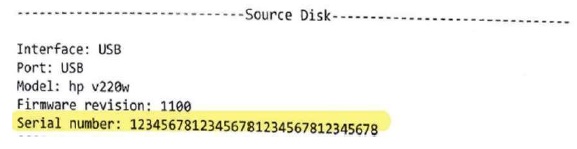
75.4 Shockingly, further in the attachment with the aforesaid form [pg 581 of PB], the Sr. No. of source is stated to be 12345678 12345678 12345678 12345678:
The aforesaid sequential source number appears to be doubtful particularly since all other similar documents with other certificates for various devices show random numbers.
76. For the aforesaid cumulative reasons, there is, in our respectful submission, no valid 65B Certificate and even the authenticity of 65B Certificate and the ‘Electronic Evidence & Examination Details’ issued in respect of so-called HP 32GB pen-drive is highly doubtful.
Non-compliance of CBDT Digital Evidence Manual – Non existence of Digital Evidence Collection Form, Chain of Custody Form and other mandatory requirements
77. Importantly, the procedure laid down in CBDT’s Digital Evidence Investigation Manual has not been followed by the Revenue.
78. In respect to the alleged Pendrive/ JSK server, inter alia, the following mandatory requirements have not been complied with:
(a) ‘Digital Evidence Collection Form’, if any, filled by the departmental officers was confronted to the assessee and assessee was not provided with Digital Evidence Collection form (as per Annexure 7 of the ‘Digital Evidence Investigation Manual, 2014’) which contains vital information regarding seizure of digital data;
(b) Chain of Custody Form (as per Annexure 8 of the ‘Digital Evidence Investigation Manual, 2014’) has not been provided, which is vital to ensure integrity of the seized digital data;
(c) Photographing of device: Even the basic procedural safeguard of photographing the device at the time of search was not followed;
(d) Seizure Memo: has not been made;
(e) Witness: Witness were not independent and merely signed on dotted lines; they were not competent to understand the process followed and hence, were incompetent to sign as witness – the entire process was thus compromised;
(f) 65B Certificates: have not been prepared.
79. It is respectfully submitted that violation of the Digital Evidence Investigation Manual while handling the so-called digital evidence, renders the digital evidence as not admissible as evidence and hence, cannot be relied upon at all.
80. The Madras High Court in case of Saravana Selvarathnam Retails (P.) Ltd. v. CIT(A): W.P. Nos. 9753, 9757, 9761 & 11176 of 2023 dated 23.02.2024 held that following of Digital Evidence Investigation Manual is mandatory for the tax Department without any exemption.
81. Emphatic reliance in this regard is placed on the recent judgment of the Delhi Bench of the Tribunal in the case of Arti Garg v. DCIT: ITA No. 3143/Del/2025 dt. 14.01.2026 wherein it was held that if while collecting and using digital evidence, the extensive provisions provided in CBDT Digital Evidence Investigation Manual are not followed then the evidence lack legal sanctity and sufficient veracity.
The Tribunal noted that the CBDT Manual aims to apprise tax authorities of the legal framework governing digital evidence under the Act, the Information Technology Act, and the Indian Evidence Act, with specific emphasis on sections 65A and 65B of the Evidence Act. The ITAT underscored the Manual’s stress on maintaining an unbroken chain of custody and prescribed procedures for seizure, backing up, analysis, and reporting of digital evidence. It observed that although a Digital Forensic Examiner’s certificate stated that data was backed up and master and working copies were prepared, there was no evidence-such as signatures of search officers-that these steps were carried out in their presence or that the data was properly handed over to the investigation team. Consequently, the Tribunal held that none of the extensive safeguards laid down in the CBDT Manual were followed. On these grounds, the digital evidence was held to be unreliable, and the assessee’s appeal was allowed deleting the additions made on such evidence.
82. The Delhi Bench of the Tribunal in the case of LSL Tools (P) Ltd v. ACIT: ITA No.5644/DEL/2024 dated 30.10.2025 made the following illuminating observations with respect to following of CBDT’s manual with respect to the digital evidences:
“29. We are of considered view that these instructions and directions of Board in the Manual do have strong persuasive value on the authorities to show that digital evidence is duly collected and relied in assessment order. Same is not the case here as nothing comes up from the assessment order in that regard. Hon’ble Supreme Court decision in Addl. Director General Adjudication v. Suresh Kumar and Co. Impex Pvt. Ltd. &Ors. In Civil Appeal Nos.11339-11342 of 2018 dated 20th August, 2025 very recently, has dealt with the case of relevancy and admissibility of electronic evidences in the proceedings under the Customs Act, 1962 wherein the provisions of section 138C of the Customs Act, 1962 regarding admissibility of electronic evidences has been accepted subject to availability of certificate to be obtained in accordance with the sub-section (4) of section 138C of this Act of 1962. The Hon’ble Supreme Court observed that section 65B(4) of Indian Evidence Act is parimateria to section 138C(4) of the Act of 1962 and, further relied the decision of the Hon’ble Supreme Court in Arjun Panditrao Khotkar v. Kailash Kushanrao Gorantyal and Others (2020) 7 SSC 1,and observed that in the said decision the Hon’ble Supreme Court, while explaining the mandatory nature of section 65B(4) of the Indian Evidence Act applied following two Latin maxims :- (i) impotentiaexcusatlegem; (ii) lex non cogitadimpossibilia, and thereafter held that these two maxims are the foundation with regard to admissibility of electronic evidences and though section 65B(4) of the Evidence Act is mandatory, yet, it would all depend on the facts of each case, how the same could be said to have been duly complied with. Accordingly, in the said case of Suresh Kumar (supra), the Hon’ble Supreme Court considered the ‘substantial compliance’ of section 138C(4) to be sufficient and, therefore, we can firmly conclude that if, in the case of the Income-tax Act, 1961, there are no specific provisions with regard to admissibility of electronic evidences, then, the Manual issued by the Board would substantially hold the ground and the tax authorities are supposed to ensure that there is at least substantial compliance of the Manual to make the electronic evidence relevant and admissible under the law and thus pass judicial scrutiny in appellate jurisdictions. Therefore, conclusion being based on mere whatsapp chats which do not have self contained information of transaction but need interpolation could not be basis for making such sort of additions of profit earned. We are inclined to allow ground no.5 raised by the assessee in AY 2021-22.”
83. Emphatic reliance is further placed on the recent judgment of the
Delhi Bench in the case of
DCIT v.
Balar Marketing (P.) Ltd.: [
2026] (
Delhi –
Trib.) wherein it was held that additions were based on software recovered from devices seized during search, constituted only secondary evidence without proper extraction reports, chain of custody, or 65B certificate establishing authenticity; thus, in absence of reliable and admissible evidence, additions were held to be unsustainable. The Hon’ble Tribunal considered the applicability of section 65B of the Evidence Act and the CBDT Manual, and made following illuminating observations:
“7.4 Thus the only evidence is images of ‘Sambhav software’, which is definitely a secondary piece of electronic evidence as the original software was not found in search and it seems AO had also not tried to get this software from Mr. Vimal Jain or the assesse by way of any notices.Then the other evidences are whatsapp chats of Mr. Vimal Kumar with some persons with he was exchanging ‘tokens’, which allegedly formed modus of payments of out of book purchases and sales. This too is electronic evidences. Thus we have to examine if these two electronic evidences were legally relevant, admissible and independently of any corroboration could have been basis of drawing conclusions and complete the assessment.
………
9. Here,at outset, we find it necessary to observe that this Manual is in the instructions though may not have been issued u/s 119 of the Act,but certainly form of atleast good practices, which Board has found fundamental and necessary to add credibility to electronic evidences. The Manual is self contained code where Board has consciously and very articulately examined various facet of collection, examining and reproducing the digital evidences in assessment orders, on the basis of judicial decisions and provisions of law as enshrined in Evidence Act or Information Technology Act, 2000, and then laid down instruction to be followed by the officers of the department.
………
16. We can further see that there are various provision under the Income Tax Act 1961 akin to provision under the Evidence Act like section 131 of the Act giving powers regarding discovery, production of evidence, section 132(4A) presumption as to books of account and documents, section 132A of the Act giving power to requisition books of account, section 136 of the Act specifically mentioning that proceedings before income-tax authorities to be judicial proceedings, provision of section 250(4) of the Act and Rule 46A of admitting additional evidences, Section 278E of the Act giving rise to presumption as to culpable mental state, section 292C of the Act giving rise to presumption as to assets, books of account definitely recognize some of the basic principles of Evidence Act by specific adoptions in the Income-tax Act, 1961. The presumption attached to statements recorded u/s 143(4) of the Act. Then, though affidavits are not included in the definition of ‘evidence’ in section 3 of the Evidence Act however, the same are frequently called for and relied in the assessment proceedings.
17. Thus we are of considered view that certain Rules of natural justice, prudence and common sense as enshrined in the Evidence Act certainly become applicable in all quasi judicial proceedings also even if there is no strict application of Evidence Act. Based on aforesaid discussion we can certainly hold that the strict principles and Rules of ‘mode of proof’ under the Evidence Act may not be applicable to assessment proceedings but the aforesaid discussion leaves us to a conclusion that even if the Evidence Act is not made strictly applicable to the tax proceedings by the Income Tax Act 1961, the fundamental principles of law of evidence defining what constitutes evidence, the relevancy of evidence for the issues under consideration, the principles of their admissibility in terms of valid mode of proof and probative value of the evidences, cannot be ignored even by quasi judicial authorities. Thus where the initial burden of proof is on the Revenue authorities to show that the receipts constitutes income, and only real income is liable to tax and more particularly in case of search assessments that addition is on the basis of incriminating material found during the search, the burden on the Revenue is of proving that the assessee has attempted to evade tax and this burden is to be discharged by establishing facts and circumstances from ‘relevant material’ driving conclusive inference that in fact assessee evade tax lawfully payable by it. Reliance can be placed on the decision of the Hon’ble Supreme Court in the case of CIT v. Sati Oil Udyog Ltd (SC)/[2015] 372 ITR 746 (SC). Hon’ble Supreme Court in Durga Prasad More (supra) has observed that “Now coming to the question of onus, the law does not prescribe any quantitative test to find out whether the onus in a particular case has been discharged or not. It all depends on the facts and circumstances of each case. In some cases, the onus may be heavy whereas in others, it may be nominal. There is nothing rigid about it.”
…….
19. The incorporation of provision about necessity of having certificate u/s 65B of the Evidence Act is thus one of the elementary jurisprudential aspects which call for admission of only the best evidence and to ensure the electronic or digital evidence hold veracity to draw conclusive conclusions and to fasten a liability. This is fortified by the Hon’ble Supreme Court decision in Addl. Director General Adjudication v. Suresh Kumar and Co. Impex Pvt. Ltd. [Civil Appeal Nos.11339-11342 of 2018, dated 20-8-2025] where recently, the Hon’ble Supreme Court has dealt with the case of relevancy and admissibility of electronic evidences in the proceedings under the Customs Act, 1962 wherein the provisions of section 138C of the Customs Act, 1962 regarding admissibility of electronic evidences has been accepted subject to availability of certificate to be obtained in accordance with the sub-section (4) of section 138C of this Act of 1962. The Hon’ble Supreme Court observed that section 65B(4) of Indian Evidence Act is parimateria to section 138C(4) of the Act of 1962 and, further relied the decision of the Hon’ble Supreme Court in Arjun Panditrao Khotkar v. Kailash Kushanrao Gorantyal (2020) 7 SSC 1,and observed that in the said decision the Hon’ble Supreme Court, while explaining the mandatory nature of section 65B(4) of the Indian Evidence Act applied following two Latin maxims 🙁i) impotentiaexcusatlegem; (ii) lex non cogitadimpossibilia, and thereafter held that these two maxims are the foundation with regard to admissibility of electronic evidences and though section 65B(4) of the Evidence Act is mandatory, yet, it would all depend on the facts of each case, how the same could be said to have been duly complied with.
…….
25. We thus come to a stage where it becomes relevant to again rely the provisions of the Manual issued by the Board to find out how the Board recognizes the due procedure to be adopted to ensure the admissibility of digital evidences and we find that by virtue of para 6.8 of the Manual while giving directions as to how the forensic imaging of cloning of the devices have to be done the Manual directs that hash value should be recorded in the Panchnama and the assessee can be given the option of seeking a copy of imaged/cloned hard disk by paying the copying charges. The Manual very categorically emphasis on the importance of hash value as evidence of genuineness and completeness of the collection and examination of the digital evidences.
26. However, when we examine the Panchnama, the copy of which was file at hearing, there is absolutely no whisper of the hash value of these digital devices and evidences in the Panchnama. There is no mention of IMEI numbers of the devices shown seized in the Panchnama.
…….
30. Now, what is material is that the Manual very categorically lays down the importance of chain of custody and the Manual lays down procedure to be followed by authorities for reporting and analysis of digital evidences and as to how the AO has to deal with the digital evidences and its analyse in the assessment order and what is the importance of chain of custody of digital evidences. The relevant para 9.1 and 9.6 of the Manual which:
…….
32. As with regard to circumstance, in the case before us, which indicate the importance of chain of custody document, we find on more careful examination of the aforesaid material provided at the time of hearing and the assessment order including the annexures in the form of statement recorded, that as mentioned above, admittedly, the date of search is 23rd March, 2021 but in the mobile device collection form has left the time of preparation of this form as blank. This mobile device collection form mentions details of imaging software/version used and also the hash value calculated. It is shown to be signed by the assessee mentioning the name Vimal, while assessee is Balar Marketing and authorized official Keshaw Kishore Anand, Dy. Director of Income-tax (Inv.), Unit-2(4), Delhi along with signature of the engineer/examiner. Two witnesses are also there, however, their signatures are dated 24th March, 2021. The list of inventory is shown to be dated 24.03.2021. The so-called certificate u/s 65B are also dated 24.03.2021. In continuity to the above, as the Panchnama document are examined they are shown to be witnessed on 25.03.2021.
33. At the same time, the statement of Shri Vimal Kumar Jain was recorded u/s 132(4) of the Act and the same is shown to be recorded on 23.03.2021 at 4 PM during the search. This statement is shown to be recorded by Shri Keshaw Kishore Anand. The statement shows that after putting 14 questions on 23.03.2021 at 8.30 PM, recording of statement was closed. This statement shows that Mr. Vimal Kumar Jain was not confronted with any of the digital devices seized or any evidence extracted at time of search. It can be observed that thereafter on 24.03.2021 the statement was continued further starting at 4.30 PM and was recorded by Shri Keshaw Kishore Anand. Therein the digital devices iPhone and Panasonic were confronted and he admitted about their ownership. It can be seen that certain questions were also put up about the whatsapp messages extracted running from pages 1 to 77 in the form of print outs and SMS messages running from page 1 to 165. As observed above the so-called certificate u/s 65B are also dated 24.03.2021, but only mention of the fact that using appropriate software working copy was prepared and nothing as such about the extracted evidences and as with regard to images of sambhav software nothing was extracted up to 24.03.21, so this e-Evidence certificate has no certification about the same. While the certificate should have been taken that the extracts taken out have been taken out in compliance of the Manual.
37 Then report which assessing officer has filed and we have reproduced in para 18.1 above admits that the procedure of seizure of electronic devices as well as imaging and cloning of digital devices is carried on in accordance with the Search and seizure manual (last updated in 2025) and Digital Evidence Investigation Manual 2014 and that chain of custody was not maintained subsequent to time of search. It is certainly thus not the case of department that assessing officer had any opportunity of examining the credibility of electronic evidences and then to record of same in the assessment order. Therefore, the chain of custody form as left incomplete demolishes the case of the Department that there is no reason to doubt the electronic evidences relied by the AO.
38 More importantly, as we examined the assessment order, we find that none of the directions of the Manual have been followed by the AO except for making the extracts of digital images of SambhavSoftwareor statements annexed to the assessment order. The aforesaid directions of Board in para 9.1 and 9.6 of the Manualhave been completely ignored by the AO. It appears that at time of initiation of search the process of collection of digital evidences was very much in accordance with the directions of Manual. The preparation of chain of custody document and taking E Certificate at time of making working copy, does show that authorities were conversant with the Manual or other instructions. They were aware that only evidence found in search is in the digital form so they with all caution initiated the process of collection of digital evidences form two phones in accordance with mandate of Manual and general principles of law, regulating collection of electronic evidence and to maintain its sanctity throughout, till it is ultimately relied in assessment and if needed at stage of judicial scrutiny. However, the attempt was either half hearted, if not to be presumed to be thwarted half way to prejudice of assessee. It is established that that tax authorities applied some provisions and instructions of the Manual, at time of search but, failed to maintain the records as per the instructions in Manual for Panchnama, mobile device collection form, certificate u/s 65B of the Evidence Act and most importantly the chain of custody form.
39. More particularly, and at the cost of repetition, with regard to the certificate u/s 65B, it can be observed that the same is merely a certificate of the expert about due process adopted while data was backed up from the impugned devices to the devices in which the data was cloned. However, subsequently, as to how the data was retrieved and relevant incriminating evidences were extracted from the devices by whom, have not been certified. In fact that required maintaining correct record of chain of custody, so as to show that when the data was retrieved or any extract taken during assessment proceedings the same were corroborated by hashvalues as recorded at time of making the working copy. The purpose of section 65B of Evidence Act is to provide a certificate to the computer output stating identity of the electronic record describing the manner in which the output electronic record was produced. The certificate should indicate particulars of the electronic device involved, like in the case in hand the two phones or the working copy involved for producing the output of images relied by assessing officer. The authenticity is added by the extraction reports which forms basis of issuing the certificate. There is no extraction report of these two mobiles or of working copies though of some other devices found insearch are placed in material before us. Then the certificate u/s 65B should have shown that the output to be relied as an evidence was produced from the working copy and that the same was in lawful control of the person signing the certificate and certainly the chain of custody document would have established same. However, the chain of custody document filed is completely silent about the same.
40. Then it is also pertinent to mention that the incriminating evidences relied by the AO is not the primary evidence existing in the laptop or computer wherein the alleged Sambhav software was installed, but, are merely images of Sambhav software which allegedly Mr. Vimal Jain was sharing with counterparts for acknowledging the transactions. Similarly, on going through the Whatsapp chats as part of the annexure to the assessment order, the same do not contain any message which will narrate any transaction on its own, but, only mention some figures which are allegedly to be codes. When original Sambhav software could not be retrieved from any of the electronic devices the images in the phones of Mr. Vimal Jain were, no doubt, secondary evidences only and that all the more required thatif they were to be relied the instructions given by the Board to ensure the authenticity of evidence become material directionsto be followed. The evidences extracted from the phone howsoever relevant would become admissible only once necessary compliances required as per due course of law are made. The due course here certainly is the instructions in Manual. Even if it is claimed by ld. DR to be not binding the aforesaid discussion has firmly established that the assessment though being a quasi judicial exercise had to be on the basis of evidences whose veracity can be tested in subsequent proceedings, like appeal or judicial review.This gives us an opportunity to hold that even if the case of revenue is accepted that strict principles or rules of Evidence Act are not applicable or there is no necessity of certificate u/s 65B, still in order to give and add credibility to the conclusions drawn on the digital evidences the AO should ensure that there is substantive compliances of the Manual and not just by way of eye wash.
41. Thus we have no hesitation to hold that assessment has been framed on the basis of material, allegedly retrieved from digital devices, but which are not admissible under law so as to be relied for drawing conclusions, of fact in dispute, being proved on scales of probability even. The corresponding grounds by which assesse challenges the assessment order being framed on inadmissible electronic evidences thus deserves to be sustained.”
84. The aforesaid judgments are squarely applicable to the facts of the case of the appellant.
Conclusion/ summary on digital material
85. In the absence of any valid 65B Certificate(s) and non-adherence to the binding Manual issued by CBDT, the so-called digital evidence/ pen-drive/ JSK Server has no evidentiary value and deserves to be ignored/ discarded. Once the same is discarded from consideration, there remains no material to draw any adverse inference against the appellant.
86. The purported certificate relating to the alleged cloning of the so-called JSK server, is inherently unreliable. The certificate records that the server cloning process was carried out between 3:20 PM and 4:30 PM in the presence of a witness who has signed the certificate. However, the very same witness has also signed the statement of Mr. Jai Chordia, which records a lunch break from 3:00 PM to 3:30 PM and thereafter shows the witness as being present during the continued recording of the statement. Consequently, from 3:20 PM onwards, the Department’s own records depict the witness as being simultaneously present at two different proceedings. This patent contradiction demolishes the credibility of the alleged server cloning process and renders the Section 65B certificate wholly unreliable.
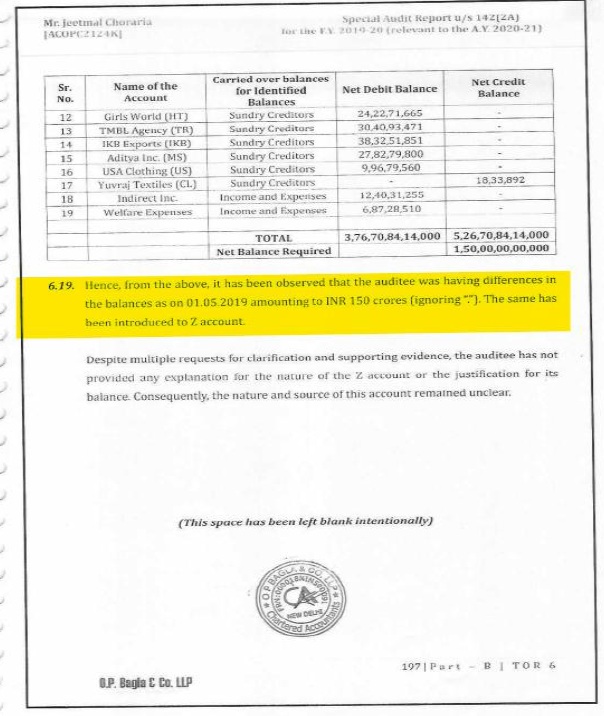
22. Thereafter, the Ld. AR submits that JSK Server does not belong to the assessee and in absence of any corroborative material, the same could not be made the sole basis for making any addition. The Ld. AR submits that no effort was made by the Assessing Officer to bring on record any fresh materials or evidence of any cash transactions or movement of cash to corroborate the entries alleged as found in the JSK Server. Sh. Ashwani Kumar, ld. AR further drew our attention to the fact that various customers were identified by the AO/Special Auditor from the JSK Sever, however, on enquiry, none of them have accepted any such transactions carried out with the assessee as found recorded in the JSK server and had denied them. As per the Ld. AR, in para 5 of the assessment order, the AO himself has observed that JSK Server is not based on accounting principles and the same does not represent true state of affairs, nature of many accounts cannot be identified, overstatement of figure is apparent, and correctness of accounts and income is highly doubtful. Therefore, JSK Server is not the credible evidence to be relied upon for making any addition in the hands of the assessee. However, the majority of additions were made on the basis of JSK Server. Further, the lower authorities have failed to locate and connect any entry with the assessee. He therefore, prayed that in absence of any corroboration of the entries found noted in the JSK Sever, no addition could be made in the hands of the assessee.
23. It is further stated by ld. AR that special auditor also in its report observed that JSK Server is not the reliable document. In the last, the Ld. AR submits that an admission was obtained from the assessee for additional income of Rs.100.00 crores based on the data recorded in the JSK server found in the so called Pendrive. The said admission was later explained by the assessee in terms of the letter written on 24.08.2022 wherein the assessee had categorically stated that true income will be worked out at the time of filing return of income thus, it cannot be said that the figures noted in the JSK Server are true and correct. The ld. AR has summerised the entire arguments as under:
Conclusions/ Summary:
For the aforesaid cumulative reasons, it is respectfully submitted as under:
| (a) |
|
The very existence of the so-called pen-drive (JSK server) and/or contents thereof is under serious doubt. |
| (b) |
|
The so-called pen-drive (JSK Server) was not found from the premises of the appellant |
| (c) |
|
It is not clear how and in what manner and on which date the pen-drive surfaced – the pen-drive was mysteriously brought into the search premises from outside. |
| (d) |
|
Digital Evidence in the form of pen-drive (JSK Server) was not handled in the manner required in law. |
| (e) |
|
Credibility of the JSK Server, which was not sealed, and appears to be fabricated, unauthenticated, tempered, is highly doubtful/ questionable. |
| (f) |
|
The so-called pen-drive/ JSK Server cannot be regarded as a valid/credible piece of material/ evidence. |
| (g) |
|
In the absence of valid 65B Certificate, JSK Server cannot, in any case, be relied upon. |
| (h) |
|
Ownership of JSK Server and/ or data therein cannot, in the absence of any matter, be attributed to the appellant. |
| (i) |
|
Reliance placed on ex-parte statements to somehow connect the pen-drive with the appellant is unsustainable in law, more so, in the absence of any cross-examination. |
| (j) |
|
In any case, the so-called data in JSK server has not been corroborated by any other material, and no addition could be based in respect of the same in the hands of the assessee. |
| (k) |
|
Even the contents of the so-called server are admittedly unreliable; the same is unreliable, improper, uncorroborated, and dumb. |
24. It is thus prayed that the additions based on the so-called JSK Server is liable to be deleted.
25. On the other hand, the Ld. CIT-DR for Revenue vehemently supported the orders of the lower authorities and submits that during the course of the search carried, one Pen-drive was found and seized from the possession of one of the employees of assessee who has also accepted this fact in his statement recorded during the course of search. The Ld. CIT-DR submits that such Pendrive contained digital data of JSK Sever and it was seized in accordance with the procedure laid down u/s 65B of the Evidence Act and the CBDT circular. The Ld. CIT-DR submits that lower authorities, in particular Ld. CIT(A) has discussed this issue at length while dealing with the grounds of appeal taken by the assessee in this regard and placed haeavy reliance on the observations made by the Ld. CIT(A). It is therefore, submitted that the entire additions have rightly been made and requested for the confirmation of the same.
26. We have carefully considered the rival submissions and perused the material available on records. The primary dispute in the present appeal, according to the assessee was that whether the data copied from the “HP 32GB Pen-drive” stated to have been found at the business premises of the Assessee in the course of search carried out, its authenticity and reliability as the assessee has vehemently disputed the existence of such Pen drive. It is pertinent to note that majority of the additions were made solely on the basis of the data available in the pen drive, which according to the AO was tally data referred to as JSK Server in the assessment order and therefore this issue is the core center of entire controversy/ dispute between the Assessee and the Revenue. Accordingly we first proceed to consider and decide this dispute, which would be relevant for the adjudication of other grounds of appeal specifically raised by the Assessee challenging various additions made on the basis of the subject pen-drive.
27. It was the primary argument of Sh. Ashwani Kumar, that the pen-drive/ JSK Server was not available at the Assessee’s premises when the search was commenced on 28.05.2022. The AR highlighted various documents and circumstances that the said pen-drive was later mysteriously found and was recorded as having been found and seized during the course of search and thus the contents of the pen-drive cannot be relied upon. Substantial arguments were raised with respect to the validity of the certificates issued u/s 65B of the Indian Evidence Act,1872 in relation seizure of pen drive, violation of Digital Evidence Investigation Manual, 2014 issued by the CBDT and other related aspects to contest the authenticity, reliability and the very credibility of the pen-drive. The other main argument of Ld. AR for the Assessee, on without prejudice basis, was that there was no corroborative material available or brought on record to support the alleged contents of pen-drive which have been heavily relied upon by the AO for making the impugned additions. Moreover, while separately dealing with various additions made on the basis of said pen-drive, it was further argued that there was no correlation, whatsoever of the alleged data found in the pen-drive with the Assessee and there was no reference of the name of the assessee anywhere in pen drive and thus the additions made by the assessing officer are even otherwise not sustainable on merit inasmuch as the assessing officer has cherry-picked the data contained in the pen-drive and ignored part of the data while making the additions and it was contended that once the data is not considered in the entirety, no addition could have been made.
28. On the other hand, claim of the revenue was that the authenticity and reliability of the pen-drive cannot be subject matter of question since the pendrive was found at the time of search and is duly recorded as such in the panchnama prepared at the business premises of the assessee and therefore it is not open to the assessee to now raise the doubts about the existence or the reliability of the pen-drive. It was further argued that the assessing officer has relied upon the DATA/information found recorded in the pen-drive to make the additions. As per ld. CIT DR, the AO has reached to the conclusion that two figures mentioned after the decimal have to be considered after ignoring the decimal. Our attention is further drawn to the fact that in the statements recorded during the search, assessee voluntarily offered a sum of Rs.100 crores and therefore, authenticity and reliability of the data seized in Pen drive cannot be questioned.
29. It is in this background, we first proceed to decide the issue of credibility and reliability of the pen-drive/ JSK server and data contained therein which, as stated above, which is the core controversy and very basis of the entire additions made by the AO.
30. On perusal of the records, it is observed that search in the case of the Assessee was commenced on 28.05.2022 at the business premises of Assessee bearing No. IX/6506, IX/6507 and IX/6508, Subhash Mohalla, Nehru Gali, Gandhi Nagar, Delhi (referred as ‘Premises-1’). At premises-1, one Mr. Rakesh Chajjer was present to whom the warrant of authorization was shown and search was commenced at about 1.05 P.M. This fact is further confirmed from the perusal of panchnama prepared and placed at page 43 onwards of the PB. The search team enquired about Mr. Sandeep Dugar who was apparently not available when the search had commenced on 28.05.2022 and therefore, a summon u/s 131(1A) of the Act was issued on 28.05.2022 to Mr. Sandeep Dugar requiring him to be present for personal deposition at the searched premises i.e. premises-1 at 3.00 PM of the same day, copy of summon is placed at page no. 167 of PB.
31. Though nowhere it was stated when Mr. Sandeep Dugar physically entered at the search premises however, his statements were recorded for the first time on 30.05.2022 at around 6.10 P.M. u/s 131(1A) of the Act at premises-1, copy is placed at pages Nos.168 onwards of PB. It is observed that no specific question was raised to Mr. Sandeep Dugar about any such pen-drive. Further from the perusal of Panchnama prepared at Premises-1, it contains Running Panchnamas where ‘Running Panchnama 1’ records that on 31.05.2022 a new premises bearing No. IX/6504, Subhash Mohalla, Nehru Gali, Gandhi Nagar, Delhi (referred as ‘Premises -2)’ was found and Mr. Sandeep Dugar was moved to the said Premises-2. Thus it is a fact on record that Mr. Dugar had firstly appeared at Premises-1 in response to the summon issued u/s131 and later was moved to Premises-2 on 31st May, 2022.
32. Thereafter, statements of Mr. Sandeep Dugar were again recorded on 31.05.2022 at Premises-2, wherein vide Q.No.17, he was specifically confronted about the alleged pen-drive HP 32GB stated to have been found from his office at premises 2 and this fact was also acknowledged by Mr. Sandeep Dugar. Here it is relevant to state and also very surprising, that as per Running Panchnama 2 (placed at page 49 of PB) being part of panchnama prepared for Premises-1, it is noticed that digital evidence, including the data of pen-drive is stated to have been recorded in SSD Drive marked as Ans. 60 found on 01.06.2022. Thus from the aforesaid facts, it is established that though Shri Sandeep Dugar was confronted on 31.05.2022 about the existence of pen-drive alleged as found from his office, i.e. at Premises-2, the same was actually found on the next day on 1.06.2022 and that too from the other premises i.e. at Premises No. 1. From the above discussions following facts emerged:
| 1. |
|
The alleged pen-drive was stated to have been found and its data was copied on 01.06.2022. |
| 2. |
|
That in the statement of Mr. Sandeep Dugar recorded on 31.05.2022 at Premises 2, reference of the said Pen drive had come to the surface, however, it was seized vide panchanam prepared for other Premises 1. i.e. at at_ IX/6506, IX/6507 and IX/6508 and not at premises No.2 i.e. No. IX/6504 that too on 31.06.2022. |
33. It is important to note here that as per the panchnama prepared at Premises-1 on 01.05.20222, the pen-drive is included in the list at Sr.No.60 where, it referred as a folder existing in one SS Drive, and not as a device itself thus it is not known whether such Pen drive was ever seized or not. Further as stated above, as per the running panchnama 2, the Pen drive was found on 01.06.2022 which is part of panchnama prepared at Premises-1 i.e. IX/6506, IX/6507 and IX/6508. It is further noticed that the critical digital evidence, including the pen-drive which was found on 01.06.2022, were taken out of the search premises to the control room. The relevant para of Running Panchnama 2 indicating such movement is reproduced as under:
” Running Panchnama 2
……… …………….
On date 01.06.2022, during the course of search proceedings, some digital and physical evidences annexed as Annexure A1 to A62 are found. Considering the sensitivity of the case the same is being taken to the control room as some proceedings relating to digital evidence are still running.
As the proceedings cannot be suspended hence the incident is taken on record”
33.1 However, whether the same digital devices were was returned back at the searched premises or not was neither stated nor brought on record.
34. As noticed earlier, the pen-drive as per the panchnama was found on 01.06.2022, the first question regarding the existence of pen-drive was put to Mr. Sandeep Dugar on 31.05.2022 i.e. one day prior to the physical recovery of pen-drive. Moreover, on 01.06.2022, when the pen-drive is stated to have actually been found by the search team, the statements of Mr. Sandeep Dugar were also recorded but from the perusal of the entire statements it is observed that no question was put to Mr. Sandeep Dugar about the pen-drive. Normally once an important material like the pen drive is found during the course of search, the said material is confronted from the person from whose possession it was found which, in the present case is clearly missing inasmuch as on 01.06.2022 or thereafter, the contents of the pen-drive were not questioned to Mr. Sandeep Dugar from whose possession the said pen-drive is stated to have been found. Moreover, the Pen-drive is recorded to be found from premises No. IX/ 6506, IX/6507 and IX/6508 on 01.06.2022 however, a question was raised to Mr. Sandeep Dugar about such Pen-drive in statement recorded at different premises at IX/6504 on 31.05.2022. In our considered opinion, all these sequence of events raise serious doubts with regard to the mode and manner in which the search took place, more so considering the apparent unreconcilable contradictions in the contents of the various panchnamas, all of which casts serious doubts about the manner of conducting of the search and the reliability, one can put to the pen-drive, which is claimed by the Revenue to have been found from the searched premises.
35. Now coming to the issue of the mandatory compliance of section 65B certificates in respect of the digital evidence as required under the provisions of the Indian Evidence Act,1872 and also in compliance of the Digital Evidence Investigation Manual, 2014 issued by the CBDT. From the perusal of all the 65B certificates supplied by the AO vide letter dated 25.04.2025, it is observed that in respect of the pen-drive, only one certificate was issued on 01.06.2022, copy placed at page 579 of PB. The same is reproduced as below:
36. Except the aforesaid 65B certificate, no other 65B certificate was prepared for the seizure of the pen-drive which too is full of discrepancies / defects. Firstly, the certificate is issued by Mr. Rakesh Chajjer, certifying the contents of the same though as per the search team, the pen-drive was found from the possession and control of Mr. Sandeep Dugar and not from Sh. Rakesh Chajjer. In fact, no query with respect to the pen-drive was ever put to Mr. Rakesh Chajjer, whose statements are placed at page 396 of PB. Secondly, the certificate vaguely states that the pen-drive was “lawfully controlled and used by the employee”, without even stating the name of the so-called employee who was in lawful control of the pen-drive and used the same for storing and processing the information. Thirdly, the two witnesses mentioned in the above certificate are the same witnesses whose names are in the panchnama in respect of Premises-1, wherein their complete name and addresses are recorded. As per the same, both panchas are resident of Karnal, Haryana and the search was conducted at the business premises of the Assessee situated at Gandhi Nagar, Delhi. Thus introducing the panchas without being reputed persons of the vicinity of search location is contrary to the statutory requirement of section 132 of the Act and Rule 112 of the IT Rules. Before us, it was the arguments of the assessee that based on its knowledge, these two panchas were actually drivers who brought the search team in their vehicles and simply signed the panchnamas and the above certificate on dotted lines without actually witnessing the search and understanding the contents. Since there is no material placed on record in support of such averment therefore, the same cannot be accepted however, the fact remains that they were not the “respectable persons” from the nearby locality of the search premises which is the statutory requirement of Section 132(13)/ (14) read with Rule 112 of the IT Rules. This aspect is very important because the panchas are the witnesses who authenticate and certify the proceedings and are mandated to be independent people from the nearby locality.
37. Before going further, the provisions of section 65B of the Indian Evidence Act, 1872, is reproduced hereunder for ready reference:
“65B. Admissibility of electronic records. — (1) Notwithstanding anything contained in this Act, any information contained in an electronic record which is printed on a paper, stored, recorded or copied in optical or magnetic media produced by a computer (hereinafter referred to as the computer output) shall be deemed to be also a document, if the conditions mentioned in this section are satisfied in relation to the information and computer in question and shall be admissible in any proceedings, without further proof or production of the original, as evidence or any contents of the original or of any fact stated therein of which direct evidence would be admissible.
(2) The conditions referred to in sub-section (1) in respect of a computer output shall be the following, namely:—
(a) the computer output containing the information was produced by the computer during the period over which the computer was used regularly to store or process information for the purposes of any activities regularly carried on over that period by the person having lawful control over the use of the computer;
(b) during the said period, information of the kind contained in the electronic record or of the kind from which the information so contained is derived was regularly fed into the computer in the ordinary course of the said activities;
(c) throughout the material part of the said period, the computer was operating properly or, if not, then in respect of any period in which it was not operating properly or was out of operation during that part of the period, was not such as to affect the electronic record or the accuracy of its contents; and
(d) the information contained in the electronic record reproduces or is derived from such information fed into the computer in the ordinary course of the said activities.
…………….
(4) In any proceedings where it is desired to give a statement in evidence by virtue of this section, a certificate doing any of the following things, that is to say, —
(a) identifying the electronic record containing the statement and describing the manner in which it was produced;
(b) giving such particulars of any device involved in the production of that electronic record as may be appropriate for the purpose of showing that the electronic record was produced by a computer;
(c) dealing with any of the matters to which the conditions mentioned in subsection (2) relate,
and purporting to be signed by a person occupying a responsible official position in relation to the operation of the relevant device or the management of the relevant activities (whichever is appropriate) shall be evidence of any matter stated in the certificate; and for the purposes of this subsection it shall be sufficient for a matter to be stated to the best of the knowledge and belief of the person stating it.”
38. It is evident that section 65B clearly mandates that for any electronic record to be admissible as evidence, the same must be supported by a certificate certifying that the computer output satisfies the conditions stated in sub-section (2) thereto. Sub-section (2) of Section 65B of the Evidence Act specifically requires four conditions to be fulfilled namely, (i) the computer output was produced by the computer during the period over which the computer was used regularly to store or process the information by the person having lawful control over the use of the computer, (ii) the information of the kind contained in record is derived was regularly fed into the computer in the ordinary course of activity, (iii) the computer was operating properly during the entire process and (iv) the information contained in a electronic record reproduces or derive from such information is fed into the computer in the ordinary course of the said activity. Sub-section (4) of Section 65B specifically requires the certificate certifying that the aforesaid four conditions of sub-section (2) are satisfied and that the said certificate is required to be signed by a person occupying a responsible position in relation to the operations of the relevant device/ evidence. The digital evidence before being relied upon must be supported by a certificate which satisfy all the requirements of section 65B of the Evidence Act and in case the certificate does not certify or meet the mandatory prescription of the said section, the digital evidence looses its evidentiary value. The Courts have rather repeatedly emphasized upon the importance of the 65B certificate for digital evidence to be relied upon to draw any adverse inference against the person intended.
39. The Hon’ble Supreme Court in Anwar PV v. B.K. Basheer [2014] 10 SCC 473 has dealt with the case of relevancy and admissibility of electronic evidences and mandatory compliance of section 65B(4) of Indian Evidence Act. The relevance of 65B certificate is also elaborated by the Apex Court in Arjun Pandit Rao Khotkar v. Kailash Kushanrao Gorantyal [2020] 7 SCC 1.
40. In Polisetty Somasundaram v. Dy. CIT (Visakhapatnam – Trib.), the Vishakhapatnam Bench of Tribunal held that where pursuant to a search operation, carried out at premises of assessee, a pen drive was seized from cashier of assessee, since investigation agency only obtained a certificate about details of pen drive and person from whose custody it was seized and except those details nothing was there in certificate and also said certificate was not completely filled up by revenue authorities, thus it could be said that four conditions stipulated in section 65B(2) i.e., (a) to (d) along with section 65B(4) of Indian Evidence Act, 1872 were not followed while obtaining certificate and therefore, said certificate was not a valid certificate in eyes of law and thus such digital material could not be relied in assessment.
41. Having regard to the importance attached to the requirements of the certificate under section 65B of the Indian Evidence Act and the role played by the digital evidence that may be found during the course of search, the CBDT has come out with detailed guidelines by way of Digital Evidence Investigation Manual, 2014, which are binding on the tax authorities. Some relevant and important contents of the aforesaid manual issued by the CBDT are reproduced as under:
“2.6-The Legal Background:
Further, special provisions as to evidence relating to electronic record have been inserted in the Indian Evidence Act, 1872 in the form of section 65A & 65B, after section 65. These provisions are very important. They govern the integrity of the electronic record as evidence, as well as, the process for creating electronic record. Importantly, they impart faithful output of computer the same evidentiary value as original without further proof or production of original. Accordingly, while handling any digital evidence, the procedure has to be in consonance of these provisions.
2.7 The sanctity and relevance of Digital Evidence
……
Accordingly, merely gathering electronic evidence is not sufficient. Efforts have to be made to corroborate the contents therein vis-a-vis other evidence such as material and oral. Preliminary and detailed statements of the persons in control of computers/ electronic devices are always very important.
…………
2.8 Importance of standard procedures to deal with Digital Evidences
From the above discussion on the nature and legality of digital evidence, it is clear that investigation in an automated environment require standard methods and procedures for the following main reasons:
i. Evidence has to be gathered in such a way that the same would be accepted by a court of law.
ii. Every care must be taken to avoid doing anything which might corrupt or add to the data, even accidentally or cause any other form of damage.
…………
“Chain of custody” is the roadmap that shows how evidence was collected, analyzed and preserved in order to be presented as evidence. Establishing a clear chain of custody is critical because electronic evidence can be easily altered. A clear chain of custody would demonstrate that electronic evidence is trustworthy. Preserving a chain of custody for electronic evidence, at a minimum, requires that;
i. No data has been added, changed, deleted from the seized information evidence.
ii. The seized /information evidence was duplicated exactly and completely.
iii. A reliable and validated duplication process was used.
iv. All media were secure and safe.
…………
2.9.3 For Authentication and Seizure of Evidence -Mathematical Hashing:
Mathematical hashing is equivalent to one-way encryption. Every digital evidence at the lowest level translates into a big numerical number. When the digital device or data is encrypted using a hashing algorithm, it results in a new number of a fixed length called the 22 dark message digest. The hashing algorithm has some unique characteristics, which are as follows:
…………
6.2- Seizure / Impounding of the Digital Evidences under Search/Survey
If the on-site technical help is not available, the officer in charge should plan for seizure of the digital evidence so that the same can be sent to the forensic laboratory for analysis in later on stage. Proper Seizure memo and Seizure Proceedings must be drawn and the following things should be reflected in the Seizure Memo:
• Make sure that one person from the technical side, one from the assessee side and two independent witnesses are , part of the search and seizure , proceedings
• Please refer the Pre-Investigation Assessment of Digital Devices as discussed in Chapter 5 for cross verifying and correctly documenting the technical information regarding equipment, networks and other communication equipment
• Time Zone/System Time should be carefully noted if the system is in switched on position
• Don’t switch on any devices
• Allot a unique device number and the same should be duly reflected in the Panchnama, Chain of Custody and Digital Evidence Collection Forms.
• Make sure all potential digital devices that needs to be seized are photographed along with the respective reference like cubicle number or name room surroundings etc. This is important since assessee may claim that the same was implanted without his knowledge.
• If the hard disk is removed, a photograph of the hard disk drive should be taken
• If Possible , paste a serial number on the digital device so that it can be related to the exact case , date and the section under which it is searched
• Make sure that panchas have some knowledge about various digital devices. It is advisable to include a writing from panchas that they have been explained the various digital devices that have been identified and also the various procedures used in Forensic Collection
• Document the chain of custody and Digital Evidence Collection forms which are explained in the next paragraph. Please fill all the details in the forms before seizing the same.
6.3- Digital Evidence Collection Form
Digital Evidence Collection Form ensures proper documentation of all the information about the evidence that is visible to the naked eye. It should contain the following details:
…….
6.4- Chain of Custody Form
Chain of custody refers to the documentation that shows the people who have been entrusted with the evidence. It should document the details of the people who seized the equipment, the details of people who transferred it from the premise to forensic labs, people who are analyzing the evidence, the details on when all it was opened and so on. This is very important since the assessee may level charges of tampering and fabrication of evidence and it would be difficult to prove the integrity of the evidence, if the chain of custody is not maintained. It is advisable to maintain a Chain of Custody form along with Digital Evidence Collection Form. A Model Chain of Custody form is enclosed below: …..”
42. On perusal of the above mentioned extracts of the manual, the first and foremost requirement is the importance of the seizure memo which should clearly and categorically and in no ambiguous terms records the exact details of digital evidence found during the course of search. The CBDT manual clearly states that the seizure memo must clearly reflect one person from the technical side, one from the assessee’s side and two independent witnesses who were part of the search and seizure proceedings, the unique device number should be mentioned, chain of custody and digital evidence collection forms must be prepared and preserved, the digital evidence must be photographed, the panchas in whose presence the seizure memo is recorded should be the person having some knowledge about the digital devices and it is advisable to include in writing from the panchas that they have been explained the various digital devices that have been identified and also various procedures used in forensic collections and the digital evidence collection form should be properly and duly filled-up before seeing the digital data.
43. The CBDT Manual also lays emphasis on the generation of hash value and maintenance of chain of custody from which must clearly reflect each and every movement of digital evidence and contents of the digital evidence must, before and after every movement, be authenticated by generation of hash value prior to and post the movement of the digital evidence. The CBDT Manual also clearly states that the entire procedure must be in conformity with the provisions of section 65B of the Evidence Act since the said provisions governs the integrity of the electronic record as evidence and therefore while handling any digital evidence, the procedure of section 65B and the CBDT Manual must be strictly adhered to.
44. In this regard, we rely on the following decisions wherein the Hon’ble Courts and various benches of the Tribunal have repeatedly held that in case the digital evidence is not supported by proper 65B certificate and there has not been adherence to the CBDT Manual, then the so-called digital evidence cannot be relied upon against the taxpayer to draw adverse inference and must be excluded from consideration.
45. The coordinate bench of Delhi Tribunal in the case of Dy. CIT v. Balar Marketing (P.) Ltd. (Delhi – Trib.) has dealt with the law relating to 65B certificates and CBDT Manual in great detail. The bench has expressly examined certain provisions of the Indian Evidence Act and Income Tax Act 1961, which indicate as to how, though not strictly applicable, the jurisprudential concepts of law of evidence, as enshrined under the Evidence Act, find their place, in proceedings under the Income Tax Act 1961 thereby establishing that in assessment proceedings also these jurisprudential concepts of law of evidence are relevant and needed to be followed. Regarding the examination of 65B Certificates and CBDT Manual, it is held that additions based on software recovered from devices seized during search, constituted only secondary evidence without proper extraction reports, chain of custody, or 65B certificate establishing authenticity. It was held that in absence of reliable and admissible evidence, additions were not unsustainable. The relevant observations of the Bench are extracted hereunder:
“13. To deal with the issue further as to how far the Evidence Act is applicable or not to the assessment proceedings under the Act, in more comprehensive manner, we take note of certain provisions of the Income Tax Act 1961, which indicate as to how, though not strictly applicable, the jurisprudential concepts of law of evidence, as enshrined under the Evidence Act, find their place, in proceedings under the Income Tax Act 1961.Thereby establishing that in assessment proceedings also these jurisprudential concepts of law of evidence are relevant and need to be followed.
13.1 In this regard, the foremost thing to consider is that section 3 of the Evidence Act describes ‘evidence’ with inclusive definition by bringing in scope all statements as oral evidences and all documents including electronic records as documentary evidences. The Income Tax Act 1961, however, independently does not define ‘evidence’, relevant and admissible for assessment proceedings. So the concept of evidence as provided and interpreted under law of evidence is relevant in assessment proceedings as well.
13.2 Further Section 17 of the Evidence Act, defines, ‘Admission’ as a “statement, oral or documentary or contained in electronic form which suggests any reference as to any fact in issue or relevant fact.” However, it to keep in mind that in the case of
Pullangode Rubber Produce Co. Ltd. v.
State of Kerala [1973] 91 ITR 18 (SC) and
CIT v.
S. Khader Khan Son 248 (SC)/[2013] 352 ITR 480 (SC)], the Hon’ble Supreme Court, in reference to proceeding under the Act itself has held that “an admission is an extremely important piece of evidence but it cannot be said that it is conclusive.
13.3 Then Section 3 of Evidence Act, further explains the concept of ‘proved’ wherein it is said that a fact is said to be proved when after considering ‘the matters before it’, the court either believes it to exist, or considers its existence so probable that a prudent man ought, under the circumstances of the particular case, to act upon the supposition that it exists. This definition of ‘proved’ uses the words, ‘after considering the matters before it’ and does not refer to merely evidences. Thus, it is not only the evidences, but, matter as a whole on record gives the court opportunity to draw an inference about the existence or nonexistence of fact.
13.4 The ld. tax authorities like any other quasi judicial authorities when entering into any inquiry to reach a conclusion on the basis of evidences, also rely the statements in the form of oral evidences or documents including electronic records called documentary evidences which form substantive material for believing a fact to exist or otherwise existing either by way of a conclusive opinion on the basis of a prudent man approach.
13.5 In this context, the provisions in section 143(2) and 143(3) of the Income Tax Act 1961 become relevant and which are reproduced below:-
….
13.7 It can be further seen that sub-section (3) to Section 143 of the Act, gives the scope of assessment wherein the AO has been given liberty to examine the evidences produced by the assessee and to even collect evidences by own efforts and, then, after taking into account ‘all relevant material’ which he has received from assessee or gathered in enquiry, make an assessment. Very apparently, like the use of the word ‘matter before it’ in section 3 of the Evidence Act, sub-section (3) of section 143 of the Act also uses the phrase ‘relevant material.’
13.8 Thus, to our mind, when it is said the provisions of Evidence Act are not applicable on the quasi judicial authority, what is meant is that the strict rules of proof of a fact in a particular manner only is not applicable. As for instance a Will, as per section 68 of the Evidence Act being a document required to be attested can be used in evidence only when one of the attesting witnesses at least has been examined for the purpose of proving its execution. However, in quasi judicial proceedings, like assessment, such strict mode of proof of Will is not necessary. That does not dispense with applicability of rules of fairness, prudence and natural justice which are foundation of evidence law.
13.9 As for our discussion with regard to this aspect we may mention here that under the Assessment proceedings the admission may be in the form of statements recorded at time of search and seizure under Section 132(4) of the Act and the statement have evidentiary value and can be used as evidence in any proceeding under the Act. Statement recorded during survey under Section 133A(3)(iii) unlike a statement under Section 132(4) of the Act, is not on oath and therefore has no evidentiary value, though it can still be used in proceedings being. Then during assessment proceedings u/s Section 131 of the Act, statement on oath are recorded by AO.However, statements recorded even on oath though binds the assessee cannot be independently used for making addition unless corroborated by evidences. Reliance can be placed on decision of Hon’ble Delhi High Court in Pr. CIT v. Pavitra Realcon (P.) Ltd. [2024] 340 CTR 225 (Delhi)/ 240 DTR 465 (Delhi)(HC).Thus relevant statements, including admissions or documents which are not inchoate and unimpeachable and whose veracities cannot be doubted at all should only be considered to be ‘relevant material’, permitted to be relied, u/s 143(3) of the Act for concluding the assessment.
………….
19 . The incorporation of provision about necessity of having certificate u/s 65B of the Evidence Act is thus one of the elementary jurisprudential aspects which call for admission of only the best evidence and to ensure the electronic or digital evidence hold veracity to draw conclusive conclusions and to fasten a liability. This is fortified by the Hon’ble Supreme Court decision in Addl. Director General Adjudication v. Suresh Kumar and Co. Impex Pvt. Ltd. [Civil Appeal Nos.11339-11342 of 2018, dated 20-8-2025] where recently, the Hon’ble Supreme Court has dealt with the case of relevancy and admissibility of electronic evidences in the proceedings under the Customs Act, 1962 wherein the provisions of section 138C of the Customs Act, 1962 regarding admissibility of electronic evidences has been accepted subject to availability of certificate to be obtained in accordance with the sub-section (4) of section 138C of this Act of 1962. The Hon’ble Supreme Court observed that section 65B(4) of Indian Evidence Act is parimateria to section 138C(4) of the Act of 1962 and, further relied the decision of the Hon’ble Supreme Court in Arjun Panditrao Khotkar v. Kailash Kushanrao Gorantyal (2020) 7 SSC 1,and observed that in the said decision the Hon’ble Supreme Court, while explaining the mandatory nature of section 65B(4) of the Indian Evidence Act applied following two Latin maxims 🙁i) impotentiaexcusatlegem; (ii) lex non cogitadimpossibilia, and thereafter held that these two maxims are the foundation with regard to admissibility of electronic evidences and though section 65B(4) of the Evidence Act is mandatory, yet, it would all depend on the facts of each case, how the same could be said to have been duly complied with.
20 . Accordingly, in the said case of Suresh Kumar (supra), the Hon’ble Supreme Court considered the ‘substantial compliance’ of section 138C(4) to be sufficient and, therefore, we can firmly conclude that if, in the case of the Income tax Act, 1961, there are no specific provisions with regard to admissibility of electronic evidences, then, the Manual issued by the Board would substantially hold the ground and the tax authorities are suppose to ensure that there is at least substantial compliance of the Manual to make the electronic evidence relevant and admissible under the law and thus pass judicial scrutiny in appellate jurisdictions.
……….
25 . We thus come to a stage where it becomes relevant to again rely the provisions of the Manual issued by the Board to find out how the Board recognizes the due procedure to be adopted to ensure the admissibility of digital evidences and we find that by virtue of para 6.8 of the Manual while giving directions as to how the forensic imaging of cloning of the devices have to be done the Manual directs that hash value should be recorded in the Panchnama and the assessee can be given the option of seeking a copy of imaged/cloned hard disk by paying the copying charges. The Manual very categorically emphasis on the importance of hash value as evidence of genuineness and completeness of the collection and examination of the digital evidences.
26 . However, when we examine the Panchnama, the copy of which was file at hearing, there is absolutely no whisper of the hash value of these digital devices and evidences in the Panchnama. There is no mention of IMEI numbers of the devices shown seized in the Panchnama.
………
38 More importantly, as we examined the assessment order, we find that none of the directions of the Manual have been followed by the AO except for making the extracts of digital images of Sambhav Software or statements annexed to the assessment order. The aforesaid directions of Board in para 9.1 and 9.6 of the Manualhave been completely ignored by the AO. It appears that at time of initiation of search the process of collection of digital evidences was very much in accordance with the directions of Manual. The preparation of chain of custody document and taking E Certificate at time of making working copy, does show that authorities were conversant with the Manual or other instructions. They were aware that only evidence found in search is in the digital form so they with all caution initiated the process of collection of digital evidences form two phones in accordance with mandate of Manual and general principles of law, regulating collection of electronic evidence and to maintain its sanctity throughout, till it is ultimately relied in assessment and if needed at stage of judicial scrutiny. However, the attempt was either half hearted, if not to be presumed to be thwarted half way to prejudice of assessee. It is established that that tax authorities applied some provisions and instructions of the Manual, at time of search but, failed to maintain the records as per the instructions in Manual for Panchnama, mobile device collection form, certificate u/s 65B of the Evidence Act and most importantly the chain of custody form.
39 . More particularly, and at the cost of repetition, with regard to the certificate u/s 65B, it can be observed that the same is merely a certificate of the expert about due process adopted while data was backed up from the impugned devices to the devices in which the data was cloned. However, subsequently, as to how the data was retrieved and relevant incriminating evidences were extracted from the devices by whom, have not been certified. In fact that required maintaining correct record of chain of custody, so as to show that when the data was retrieved or any extract taken during assessment proceedings the same were corroborated by hash values as recorded at time of making the working copy. The purpose of section 65B of Evidence Act is to provide a certificate to the computer output stating identity of the electronic record describing the manner in which the output electronic record was produced. The certificate should indicate particulars of the electronic device involved, like in the case in hand the two phones or the working copy involved for producing the output of images relied by assessing officer. The authenticity is added by the extraction reports which forms basis of issuing the certificate. There is no extraction report of these two mobiles or of working copies though of some other devices found in search are placed in material before us. Then the certificate u/s 65B should have shown that the output to be relied as an evidence was produced from the working copy and that the same was in lawful control of the person signing the certificate and certainly the chain of custody document would have established same. However, the chain of custody document filed is completely silent about the same.
40 . Then it is also pertinent to mention that the incriminating evidences relied by the AO is not the primary evidence existing in the laptop or computer wherein the alleged Sambhav software was installed, but, are merely images of Sambhav software which allegedly Mr. Vimal Jain was sharing with counterparts for acknowledging the transactions. Similarly, on going through the Whatsapp chats as part of the annexure to the assessment order, the same do not contain any message which will narrate any transaction on its own, but, only mention some figures which are allegedly to be codes. When original Sambhav software could not be retrieved from any of the electronic devices the images in the phones of Mr. Vimal Jain were, no doubt, secondary evidences only and that all the more required that if they were to be relied the instructions given by the Board to ensure the authenticity of evidence become material directions to be followed. The evidences extracted from the phone howsoever relevant would become admissible only once necessary compliances required as per due course of law are made. The due course here certainly is the instructions in Manual. Even if it is claimed by ld. DR to be not binding the aforesaid discussion has firmly established that the assessment though being a quasi judicial exercise had to be on the basis of evidences whose veracity can be tested in subsequent proceedings, like appeal or judicial review. This gives us an opportunity to hold that even if the case of revenue is accepted that strict principles or rules of Evidence Act are not applicable or there is no necessity of certificate u/s 65B, still in order to give and add credibility to the conclusions drawn on the digital evidences the AO should ensure that there is substantive compliances of the Manual and not just by way of eye wash.
41 . Thus we have no hesitation to hold that assessment has been framed on the basis of material, allegedly retrieved from digital devices, but which are not admissible under law so as to be relied for drawing conclusions, of fact in dispute, being proved on scales of probability even. The corresponding grounds by which assesse challenges the assessment order being framed on inadmissible electronic evidences thus deserves to be sustained.”
46. Further the coordinate benches of Delhi Tribunal in the cases of LSL Tools (P.) Ltd. v. ACIT (Delhi – Trib.)/ITA No.5644/DEL/2024 vide order dated 30.10.2025 and in the case of Arti Garg v. Dy. CIT (Delhi – Trib.)/ITA No. 3143/Del/2025 vide order dt. 14.01.2026 has held in favour of adherence to CBDT Manual and section 65B of Evidence Act and further held that the failure to comply renders the digital evidences inadmissible to make any addition.
47. Thus by respectfully following the settled legal position as stated above to the facts of the present case, in respect of the pen-drive, it is observed that only one 65B certificate is available on record which as discussed above is defective and failed to comply the mandatory prescription of section 65B of the Evidence Act. The certificate has been issued by a person who was not found to be the person in control of the pen-drive inasmuch the certificate has been issued by Mr. Rakesh Chajjer whereas the pen-drive was allegedly found in control and possession of Mr. Sandeep Dugar. The certificate ambiguously records that the evidence was in control of the employees who used to store the information without even giving names of any such employees. Compliance of fulfillment of all the four conditions of section 65(2) of the Evidence Act is nowhere certificated in the said certificate. The witnesses, as discussed earlier, are resident of Karnal, Haryana and are not from the vicinity of the place of search. Moreover, the certificate nowhere records, as required by the CBDT Manual that the panchas had knowledge about the digital evidence and were explained about the digital devices and the procedures followed by the search team for collection of forensic evidence in particular the pen-drive.
48. It is also surprising to note that there is no seizure memo and there is no chain of custody form in respect of the so-called pen-drive available on record. No hash value of the pen-drive is recorded in the panchnama. This assumes importance more particularly in light of the fact noticed by us earlier that Mr. Sandeep Dugar was not found at the search premises on 28.05.2022 and was subsequently appeared at the premises and his statement was recorded on 31.05.2022 at other premises when he was for the first time questioned about the pen-drive though the pen-drive was actually found on the next day i.e. on 01.06.2022 in terms of the running panchnama. Moreover on 01.06.2022, when the pen-drive was found, no question was asked from Mr. Dugar about the pendrive. Another important aspect was the running panchnamas specifically records that the digital evidence were moved from the search premises to the control room during the course of search proceedings. Despite this fact having been recorded, it is surprising that there are no seizure memos and chain of custody to record the movement of the digital evidence nor any evidence was brought on record that they were brought back to the search premises.
49. Another important aspect noticed by us, is that along-with 65B certificate, Electronic Evidence and Examination Details are available on record as placed in the paper book. We deem it appropriate to reproduce the content of the said form and extract of source disk details annexed as under:
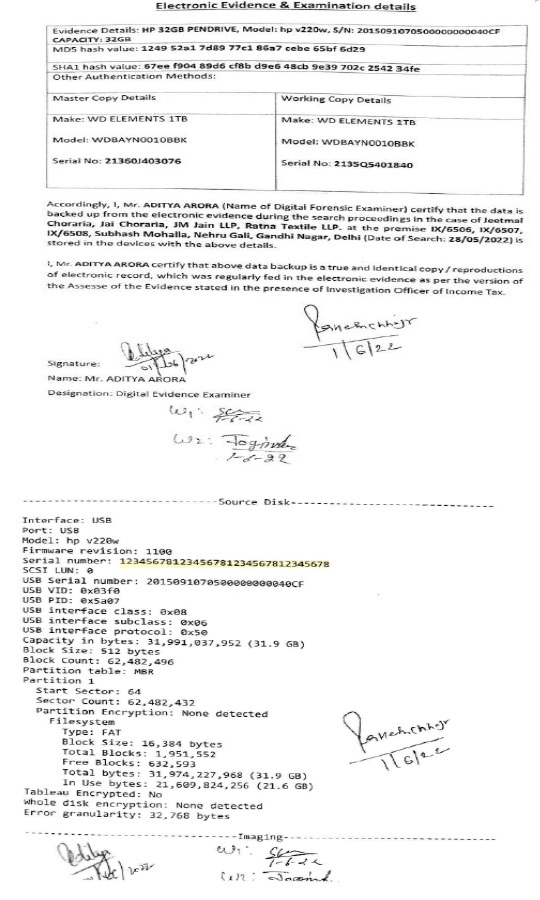
50. On perusal of the aforesaid, it is noticed that the said document has been signed by one Mr. Aditya Arora whose designation is mentioned as Digital Evidence Examiner and is also signed by Mr. Rakesh Chajjer and the same two witnesses who are residents of Karnal, Haryana. From the perusal of the panchnama it is observed that it nowhere records the presence of Mr. Aditya Arora as part of search team at any of the premises searched. Further, the most important fact is that the above details also has the reference of Sr. No. of the source disk, which in the present case is HP 32GB Pen-drive, and such details are basically mentioned for the purpose of identification of the digital evidence. It is rather surprising to note that the Sr. No. of the pen-drive is mentioned as “12345678123456781234567812345678” (fifth items from top of the title “Source Disk”), which is apparently and clearly a fictional number assigned to the pen-drive. This further cast serious doubts about the authenticity, credibility and reliability of the very source digital evidence i.e. HP 32GB Pen-drive. Clearly no digital evidence or pen-drive would have such kind of Sr. No. and there is no justification in respect of the same.
51. Coming back to the issue of requirement and role of panchas. From the panchanma prepared at Premises-1 (IX/6506, IX/6507 & IX/6508), as noted earlier the panchas witnessing the search are two people, viz., Mr. Shubham Goyal and Mr. Joginder, both residents of Karnal as duly recorded in the panchnamas. These two witnesses were not from the locality where the search premises are located and hails from Karnal which is far-away place of more than 150 kms from the searched premises and no reason was stated for taking them as panchas of far away place than the nearby place. It is also a matter of fact that two panchas who witnessed the search for the premises bearing no. IX/6506, IX/6507 & IX/6508 from where the pen-drive is found were residents of Karnal, however, at the other premises searched including premises no. IX/6504 were having panchas from local locality. There is also no recording in the panchnama about non-availability of local residents/ witness or any circumstances forcing search team to call for inhabitants of far off place to act as panchas.
52. In this context, Rule 112(6)/(7) of IT Rules prescribed as per section 132(14) of the Act requires the authorized officer and to conduct search to call upon two or more respectable inhabitants of the locality in which the building or place to be searched is situated and also mandates the search proceedings shall be conducted in the presence of the said witnesses and a list of all things seized during the course of such search and of the places in which they were respectively found shall be prepared by the authorised officer and signed by such witnesses. Similar safeguard is also laid down in section 100(4) of the Code of Criminal Procedure, 1973 which provides that the panchas shall be inhabitants of the locality in which the searched place is situated and the provisions of Code are incorporated in section 132 by virtue of sub-section (13) thereof. The Apex Court in the case of ITC Ltd. v. State of Karnataka [Civil Appeal No. 11798 of 2025 dated 12.09.2025] in respect of search and seizure under the Legal Metrology Act, 2009 made the following observations in respect of panchas being the driver of Assistant Controller:
“21. We have already held that Sections 100(4) and 100(5) Cr.P.C are applicable to the present case. Accordingly, the presence of two respectable independent witnesses from the locality was mandatory. It is significant to note that such witnesses may also be drawn from a different locality, provided they meet the requirements of independence and respectability. In the present case, however, the driver of the Assistant Controller — being a party to the inspection -acted as a witness, which is in violation of law. Although the respondents claimed that no one from the locality was forthcoming, there is nothing on record to indicate who was approached, when such request was made, whether a written request was given, and what further action was taken. The seizure mahazar also fails to support the respondents ‘ case, as it records none of the claims now relied upon in their defence. It is settled law that where the initial proceedings are vitiated, all subsequent proceedings are unsustainable. Any act in violation of law cannot be brushed aside on the ground that no prejudice was caused; every violation of law is deemed to cause some prejudice. “
53. Though in the instant case, we are not concerned with the validity of the search however, when the entire facts as stated above are considered in its entirety coupled with the irregularities, omissions and errors committed by the search team as discussed above, leads not only to raise doubts about the mode and manner of collection of digital evidence but also its subsequent handling and thus we are of the considered view that the data alleged as found in the said pen-drive stated to have been found and heavily relied upon for making the additions cannot be regarded as an admissible material/ evidence. The digital evidence collected, in particular the pen drive, cannot be made the vary basis for drawing adverse inference against the assessee as its credibility and authenticity is not proved by the revenue beyond doubt and lawful method of recovery and post recovery handling.
54. The entire discussion made herein above, and the conclusion drawn is summarized as under:
| 1. |
|
The search at Premises No.1 i.e. at IX/6506, IX/6507 and IX/6508 was not witnessed by proper panchas and is in violation of the statutory requirements as emphasized by the Supreme Court in ITC judgment (supra) |
| 2. |
|
There are unexplained/ unreconciled self-contradictions with regard to the date and premises from where and on which date the so-called pendrive was actually found, which has been made the sole basis of entire controversy. Digital evidence/ pen-drive is stated to have been found from the person Shri Sandeep Duggar who was not present at the search premises when search was commenced and appeared later on. He was confronted about the pen drive one day prior to the seizure of pen drive and post seizure of the pen drive he was not at all confronted though his statement was recorded. |
| 3. |
|
The digital evidence in the form of pen-drive was moved from the search premises and the 65B certificate placed before us is clearly not in compliance with the mandatory requirements of sub-sections (2) and (4) of section 65B of the Evidence Act. |
| 4. |
|
No memo is available on record with respect to the seizure of alleged Pen-drive in question and the chain of custody form is also missing. Only panchnama with respect to the storage of its data in SSD is available. |
| 5. |
|
As per the CBDT Manual, the search team has to photograph the digital evidence however the same was not complied with. |
| 6. |
|
No safeguards as contained in the CBDT Manual have been found to be followed. |
55. In the entirety of such circumstances, we are of the considered opinion that the pen-drive purportedly found from the search premises completely lost its evidentiary value and cannot be admitted or relied upon as the primary evidence/ material for the purpose of making any addition against the Assessee. Thus any addition made solely on the basis of the said pen-drive cannot be sustained and is hereby directed to be deleted.
56. It is further observed that the assessing officer has not referred to even a single transaction which may be claimed to be contained in the pen-drive/ JSK Server which may have any relation/ link with the Assessee. Rather the comparison/ link is tried to be established in the assessment order between the transaction in the pen drive and the bank account of a third party and not of the Assessee. There is neither any corroboration of any entry in the JSK Server with the regular books of accounts maintained by the Assessee and transactions in Assessee’s regular books are not found or corroborated with JSK Server. In the entire assessment order, we did not find reference to any material other than the alleged contents of the pen-drive found as a result a search or gathered in post search proceedings. Though substantial allegations were made on the basis of pen-drive that the assessee has undertaken various cash transactions of receipt and payment of money on commission basis, however, the AO failed to refer even a single paper/ document/ material, other than the pen-drive, in support of such allegation. On the contrary, we find that there is no material whatsoever that may corroborate the finding of the AO of any movement/ transactions in cash carried out by the Assessee. The AO further alleged that the assessee has received and paid cash but not even a single incidence or material in support of the same was brought on record. We thus fail to appreciate how and on what basis, such allegations of cash transactions have been made by the AO when not even a single transaction was found recorded in the alleged pen-drive was shown to have any correlation whatsoever with the regular books of account of the Assessee. The server titled as ‘JSK Server’ which is not shown to have any relation with the assessee. It is also surprising to note that there is no reference of any third-party enquiry conducted by the AO to somehow corroborate/ validate the contents of the pen-drive. Had the assessee entered into the transactions referred in the server/ pen drive then during the course of third party enquiry some evidence could have been gathered but as observed above, none is available on record. On the other hand, Sh. Ashwani Kumar, ld. AR for the assessee stated that various enquires were conducted by the AO u/s 133(6)/ 131 and apparently the said enquiries did not support the case of the Revenue, therefore, the same have not been brought on record.
57. The Revenue has relied upon the presumption of section 292C of the IT Act. We, however, are not convinced with regard to the applicability of the said presumption in the present case, more particularly having regard to the fact noticed hereinbefore regarding the mode and manner of recovery of the pendrive. It is not the case of the Revenue that the pen-drive was found from the possession and control of the Assessee. In such circumstances, the presumption u/s 292C cannot be applied against the Assessee, more particularly when serious doubts were raised about the authenticity, credibility and reliability of the pen-drive itself as discussed in detail herein above. Moreover, the presumption u/s 292C is rebuttable and therefore, simply on the basis of application of said rebuttable presumption, adverse inference cannot be drawn against the assessee. It is also a matter of fact that in para 5 of the assessment order, AO himself has raised serious doubts about the reliability of the contents of the very same pen-drive/ JSK Server. The AO observed that JSK Server was not based on sound and establish accounting principles, the data/ transactions contained therein does not represents the true states of affairs, the nature of accounts could not be identified, there are over statement of figures, the nature/ narration of the transactions were not specified in the ledgers, the nature of the accounts could not be determined etc. Similar observations were recorded in the report of the special auditor wherein, the special auditor has specifically commented upon various dummy/ adjustments entries being made in the JSK Server/ Pen-drive and also the non-reliability of the same.
58. In the entirety of the circumstances, it is thus clear that while on the one hand, the authenticity, credibility and reliability of the pen-drive is questionable, there is no independent material brought on record to corroborate the contents of the pen-drive with the Assessee. There is no reference to the name of the Assessee in the pen-drive and the additions have been made simply by relying upon the contents of the pen-drive without any independent material corroborative/ supportive the contents of the pen-drive. We thus hold that the contents of the pen drive/ JSK server are questionable and cannot be relied upon to draw any adverse inference against the assessee.
59. As regards the statement of Mr. Sandeep Dugar, Ld. AR for the Assessee referred to various circumstances to show that the statement was not recorded in fair and transparent manner. It was emphasized that statement recorded on evening of 30.05.2022 was recorded in Hindi; in the said statement, Mr. Dugar was expressly asked about the language in which he is comfortable to give statement to which Mr. Dugar answered that he would prefer Hindi language. Surprisingly, the other statements (morning of 31.05.2022) were recorded in English. It was stated that Mr. Sandeep Dugar is a person who is not at all well-versed in English language and was not the key employee and his statement was recorded behind the back of the Assessee and was not subjected to crossexamination by the Assessee. We are of the considered view that the law is fairly well settled that in case a third-party statement, including of an employee when the same is being relied upon, it is vital to subject the said statement to crossexamination and in absence thereof, such statement cannot be relied upon against the Assessee. Reliance is placed on the decision of Hon’ble Supreme Court in the case of Kishinchand Chellaram (supra) and in the case of Andaman Timber Industries(supra). That apart, the statement of Sh. Sandeep Dugar by itself cannot be made the sole basis to attribute/ connect the pen-drive with the Assessee, more so, when there is nothing on record to establish any link between the Assessee and the contents of the pen-drive. Furthermore, statements of various other person/ employee also bear copy paste answers as highlighted by the Ld. AR, which is unlikely where statements are taken in fair and transparent manner.
60. Now coming to the issue of admission of additional income of Rs.100 crores obtained from the Assessee. It is noted that the so-called offer was made by the Assessee vide letter dated 24.08.2022 filed before Investigation Wing and reference to the said offer was later made in his statement of the Assessee recorded on 19.10.2022. The said letter is placed at pages 235 & 236 of the PB. Few extracts of statement dated 19.10.2022 of the Assessee:
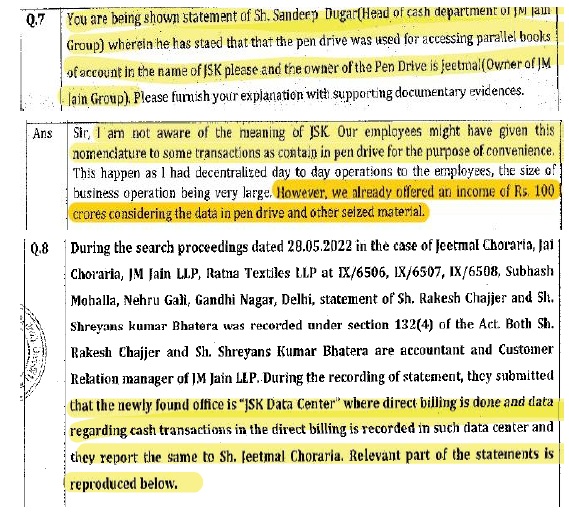
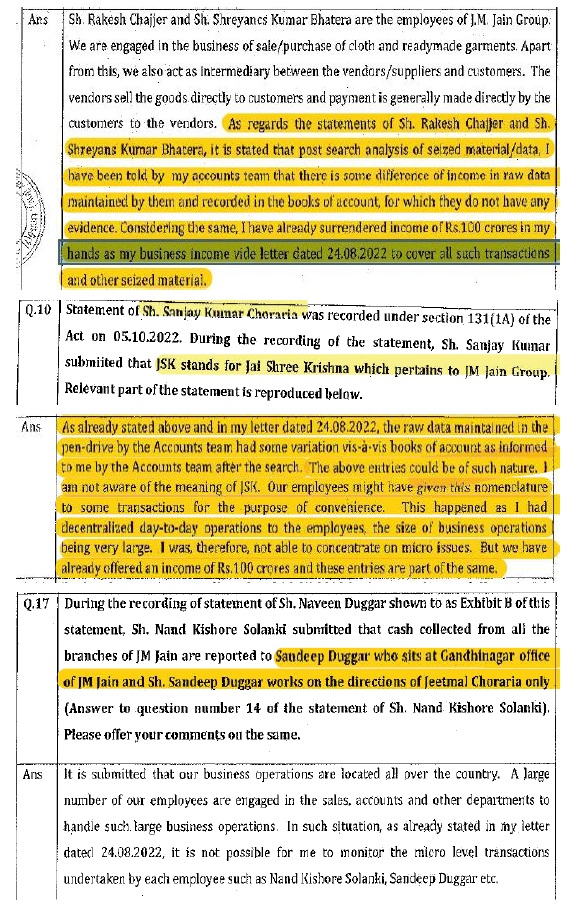
61. On perusal of the aforesaid, it is observed that there is reference of the additional income of Rs.100 crores for the first time in the letter dated 24.08.2022 which is after the conclusion of search on 18.07.2022 (as per last panchnama). Further in the said letter it is clearly stated by the assessee that he had no knowledge about the contents of the pen-drive and had written this letter in view of some differences of income appearing between some raw data and that recorded in the books of accounts as informed to him by his accounts team. The letter clearly shows that the offer made was tentative in nature and more for mental peace rather than on the basis of any specific material found during the course of search.
62. Even the statement of the Assessee recorded on 19.10.2022 i.e. after the aforesaid letter, clearly shows that the Assessee rather denied the contents of the pen-drive and merely made the offer to avoid litigation. However, the so-called offer was not honored in the income tax return filed subsequently by the Assessee and thus assessee has made retraction from the said offer. The Assessee has also referred to and relied upon the circumstances prevailing at the time of search including reference being made to certain health issues which the Assessee was undergoing at the time of search. The Ld. AR referred to cardiac arrest being suffered by the Assessee in order to submit that simply on the basis of offer made in peculiar circumstances, the additions cannot be made.
63. We are of the considered opinion that additions under the provisions of the Income Tax Act cannot be made by simply relying upon confession/ offer made at the time of search unless the said confession/ offer is corroborated with the independent material. In this regard reference to be made to the two CBDT instructions dated 10.03.2003 & 18.12.2014 wherein even the CBDT has emphasized on the need to focus on gathering evidences during search/ survey and to avoid obtaining the admission of undisclosed income without any cogent material and under undue influence. In this regard reliance is placed on the following judicial precedents wherein the Courts have repeatedly emphasis that additions cannot be made solely on the basis of an offer/ surrender unless the same is corroborated by any material brought on record.
64. The hon’ble Allahabad High Court in the case of CIT v. Radha Kishan Goel [2005] 278 ITR 454 (Allahabad) observed that it is a matter of common knowledge that the search is being conducted with the complete team of the officers consisting of several officers with the police force. The Court held that the assessee is put to a mental agony that he loses his normal mental state of mind and it cannot be expected from a person to pre-empt the statement required to be given in law as a part of his defence disconnected and all ingress and egress are blocked.
65. The coordinate bench of Delhi Tribunal in the case of ACIT v. Shyam Sunder Jindal [IT Appeal No. 5671 (Del) of 2016, dated 21-5-2025] held that mere admission in the statement recorded u/s 132(4) is not sufficient to make any addition in the hands of the assessee. The relevant extracts of the decision are extracted hereunder:
“14. It is a settled proposition of law that mere statement u/s 132(4) or u/s 131 is not sufficient to make an addition. A statement made must be relatable to incriminating material found during the search or the statement must be made relatable to some material by subsequent inquiry/investigations.
15. Hon’ble Supreme Court in the case of Pullangode Rubbers Produces CO Ltd (supra) has observed as under:
…. …. … …
16. The crux of the aforesaid decision is that a declaration or disclosure made by the person is binding unless it is rebutted by the person by furnishing valid evidences. In the present case, assessee admitted certain income in the statements recorded u/s 132(4) of the Act which was later retracted and reasons for such retraction was explained by making detailed submission with the help of explanation of seized material which does not indicate any incriminating material. Thus, the appellant retracted the statement recorded u/s 132(4) of the Act showing the admission made therein by him was incorrect by filing all the possible documentary evidences.
……….
20. Though the above principle is laid down in relation to assessment of block period u/s 158 BC of the Act, the same was also applied in respect of assessment u/s 153A, as has been held by hon’ble Delhi High Court in case of Best Infrastructure when it was held as under:
“38. Fifthly, statements recorded under Section 132 (4) of the Act of the Act do not by themselves constitute incriminating material as has been explained by this Court in Harjeev Aggarwal (supra).”
21. It is submitted that Hon’ble Rajasthan High Court in the case of PCIT v. Shri Sanjay Chhabra in Income Tax Appeal No. 22/2021 vide order dt. 06/04/2022 has held that addition based solely on statement later on retracted, without anything more, could not be justified in law and thus had not admitted the appeal filed by the department.
….. … … ….
26. At this stage we refer to the statements of the assessee recorded u/s 132(4) wherein after reply to Question No. 16, statements were discontinued for providing rest to the assessee at 8:45PM of 14.11.2011 and they were resumed on 9:00 PM of 14.11.2011 i.e. after allowing the assessee for rest of only 45 minutes. Thereafter, these statements were concluded on 15.11.2011 and it is not mentioned in the statements at what time they were concluded on next day. This clearly shows the mental pressure applied for obtaining the surrender from the assessee which is gross violation of the CBDT Instruction No. 286/2/2003- IT-Inv, dated 10.3.2003 wherein directions were given to the field officers to collect the evidences during search and seizure and to avoid the practice of obtaining the surrender. As observed above, in the present case, no such incriminating evidence was collected by the search team during the course of search nor thereafter, before completing the assessment u/s 143(3) of the Act and the addition was made solely on the basis of the alleged admission obtained from the assessee in the statements recorded u/s 132(4) of the Act.. ….”
66. In the instant case, the entire admission, as discussed earlier, was on tentative basis and not supported by any independent material/ evidence. It is relevant to state that such offer was withdrawn by the Assessee by not disclosing the same in the return of income. In such circumstances, the said offer cannot be made the basis of justifying any addition being made in the hands of the Assessee.
67. In view of above discussion and after considering the entirety of the facts of the case, we are of the considered view that heavy reliance placed by the AO on the pen-drive/ JSK Server for making additions is not at all sustainable in law. There is indeed serious doubt about the credibility, authenticity and reliability of the contents of the pen-drive more so, in the absence of proper 65B certificate, compliance of CBDT Digital Manual and apparent contradictions and grave procedural irregularities during the course of search. There is no independent material brought on record to show that Assessee had entered into any transaction outside the regular books of account as is being sought to be projected in the assessment order by relying upon the pen drive. The allegations that the assessee was dealing in cash and heavy cash was received and paid while acting as a broker/ agent is not at all supported by any reliable material/ evidence found as a result of search or brought on record by making independent enquires or investigation. If the Assessee was having transactions of such quantum of cash as alleged, then, during the course of search some material/ evidence must have been found but nothing was found in support of such allegation. Under these circumstances, the additions made on the basis of pen-drive are hereby deleted.
68. In Ground no.4 to 4.1, the Assessee has challenged the addition of Rs.41,25,00,000 made in the assessment order by the assessing officer by holding the same to be in the nature of undisclosed income in the form of commission and interest income on transactions undertaken by the Assessee outside the regular books of accounts as is found recorded in the Pen-drive/ JSK Server.
69. In support of the grounds of appeal taken the ld. AR for the assessee has made detailed written submission which is reproduced as under:
137. After attributing the ownership of the so-called JSK Server to the appellant and holding the same to contain unaccounted transaction, the assessing officer, vide paras 10 to 10.12 of the reassessment order, has made addition of Rs.41.25 crores on account of alleged unaccounted business income recorded in the so-called JSK server.
138. The quantification of aforesaid amount of Rs.41.25 crores was done by the assessing officer @ pages 21 to 22 of the reassessment order. The quantification of the aforesaid income/ addition is based on the report of the Special Auditor – internal pages 76-108 of the Special Audit Report (pg. 2584 to 2616 of PB).
139. The CIT(A) has upheld the addition made by the assessing officer by mere repeating the observation of the assessing officer.
140. The aforesaid addition made by the AO and sustained by the CIT(A) is not sustainable, inter alia, for the following reasons:
Submissions :
Re (a): Material relied upon is non-existent and does not belong to appellant
141. It is respectfully reiterated that the appellant has demonstrated that the existence of so called pen-drive/ JSK Server is under doubt; there are fundamental fallacies as far as the authenticity, reliability and veracity of the so-called pen-drive/ JSK Server is concerned; in any case, it cannot be alleged that the JSK Server/ pen drive belong to the appellant and hence there cannot be any presumption against the appellant in terms of section 292C of the Act. As a sequitur, addition made on the basis of any transactions/ data found in the said pen-drive/ JSK Server is per-se unsustainable. For the said reason alone, the addition made is bad in law and deserves to be deleted at the threshold.
142. Further, since the relevant data does not belong to the appellant, the appellant is not and cannot be expected to explain the contents thereof. It is one of the fundamental principles of law that law cannot compel a person to do the impossible i.e. lex non cogit ad impossibilia.
143. Without prejudice to the aforesaid, it is submitted as under:
Re (b): Addition in absence of corroborative evidences- invalid
144. On perusal of the assessment order and the special audit report, based on the data in the JSK server, primarily the following income allegedly earned in cash by the assessee as a commission agent is added as unaccounted income of the assessee:
? Commission charged from vendors/ customers on account of assistance in finding fabrics, garments and other products captured in following ledger accounts:
– ‘Margin A’ and ‘Margin’ Account [Commission set at default 3% commission with adjustment on account of various factors including sales return, etc.]
– Margin (Woolen LDH) Account [Margins for woolens]
? Interest charged from customers on the delayed payment:
– ‘OSIA FAB’ Account [Credit side represents additional charges (computed in form of interest) for delayed payment by customers to suppliers; debit side represents discounts offered for early payments to customers]
– ‘OSIA ENT’ Account [Mainly reversal of above interest].
145. It would be pertinent to note that while the appellant cannot be expected to explain the data, on mere perusal of the contents of the so-called JSK Server and the assessment order, it is reiterated that the transactions recorded in JSK Server are not corroborated by any evidence so as to be relied upon to draw adverse inference (detailed above), as is evident from the following facts:
– As submitted above, from the statements of certain employees, the Revenue/ assessing authority has interpreted that so-called JSK Server contains parallel book of accounts of the appellant; the assessee acts as agent for sale of goods from sellers to buyers; in respect of facilitation of transaction of purchase/ sales between vendor & sellers, invoices is raised by the seller directly in the name of the purchaser for the bank payments, and no invoice is raised for cash component- just Kachchi Parchi/ slip is issued for the cash part.
It may be noted that the so-called income recorded in the JSK Server is not at all corroborated by any tangible material, evidence, document etc. As explained above, there is nothing brought on record to corroborate the entry in the JSK Server with the regular book of accounts of the assessee. Rather, the entries in the so-called JSK Server are not at all recorded as per accepted accounting principles and even as per AO the same as incorrect.
Moreover, the transaction recorded in the JSK Server does not belong to the assessee and income cannot thus be taxed in his hands.
– Apart from journals, challans, and entries in the ledgers contained in JSK Server, there are no corroborative material/ evidence, to substantiate earning of any cash income by the appellant. Since the existence, credibility and veracity of the said source is doubtful, the futile attempt to attribute any taxable amount appears to be nothing but a failed attempt to somehow made additions of fictional amount.
– Pertinently, even as per Special Auditor and AO, there are numerous dummy accounts and the manner in which the accounts are maintained, it is not possible to arrive at any taxable income.
– One ‘cash in hand’ ledger in the so-called JSK Server is relied upon by the assessing authority and also the special auditor. In this regard, it submitted that – (i) the same is not credible as even the balance in the said account did not corroborate with cash in hand found during the search; (ii) there are multiple nature of entries in the said account and not merely cash which doubts the very nature of the said account; (iii) that apart, on perusal of the said account provided to the appellant, it appears that the term ‘cash’ has loosely been used even for banking or other book entries, and may not be related to cash/ currency exchange transaction. There is no corroboration, much less concrete, of cash income earned by the appellant.
– No evidence of cash receipt or payment such as any cash parchi/ receipt, rukka etc. was found during the course of search much less any document signed by the appellant or any employee or even bearing name of the appellant suggesting cash movement much less income of the appellant.
– It is also most important to note that name of the appellant is not even mentioned in the so-called JSK Server/ data and hence the same cannot be used to make addition in the hands of the appellant.
– Further, had the entries mentioned in JSK Server being in respect of actual transactions of the appellant, then during the search some tangible material would have been found to substantiate/corroborate the same. However, there is undisputedly nothing found and/ brought on record by AO to corroborate the entries.
– Pertinently, the tax department has undertaken search, the most lethal/ patent power, and had the transaction recorded in JSK Server been real and/ or related in any manner to the appellant, the Department would have discovered the same during search. Now the Revenue cannot, after undertaken search, been heard to say that there is no corroborative material and still addition is sustainable.
146. The aforesaid facts demonstrated above clearly prove that the data relied upon by the assessing officer is merely in the nature of uncorroborated dumb data qua the appellant, and hence the same cannot be relied on to draw adverse inference in the hands of the appellant.
147. It is trite law that in absence of any material/ evidence to corroborate the allegation that appellant had entered into unaccounted cash transactions, no adverse inference can be drawn against the assessee by the tax authorities. [refer legal position detailed supra].
148. In light of the above, it is submitted that the impugned addition, in absence of any corroborating evidence qua the appellant, is invalid in the eyes of law. Being so, the addition amounting to Rs.41.25 crores on the basis of alleged unaccounted income recorded in JSK server calls for being deleted.
149. Further strictly without prejudice that no addition is sustainable, it is submitted as under:
Re (c): Debits to various so-called revenue accounts ignored
150. At internal pages 32-37 of the Special Audit Report (pg 2540 to 2545 of PB), an attempt is made by the Special Auditor to corroborate certain data in JSK Server on sample basis and conclude that figures are suppressed by 100 times (2 decimals). In this regard, it is submitted that such an attempt to corroborate is futile, failed and unsustainable. In this regard, the appellant seals to highlight certain apparent inconsistencies hereunder:
■ Corroboration is sought to be made inter-se between documents found in the JSK Server, authenticity of which is highly doubtful;
■ There is no corroboration whatsoever of any transaction in the JSK Server with the books of the appellant- absence of such corroboration or any linkage with movement of cash, the authenticity and creditability transactions in JSK Server cannot be proved- the same is thus not more than a dumb data for all purposes;
■ Be that as it may, even the documents referred for inter-se corroboration is unreliable inasmuch as:
? At page 33 (pg 2541 of PB) of Special Audit Report, one voucher dated 13.03.2020 is given and on page 34, corresponding ledger extract is mentioned. It would be relevant to note that the name, description, quantity etc. in the two documents do not match.
? At page 36 (pg 2544 of PB) of Special Audit Report, some loose paper is extracted wherein amount is mentioned as Rs.1,66,557 in respect of party ‘Miahave er Gangapur ‘. As regards entry in JSK Server given at extract in page 37, party is mentioned as ‘Mahavir
The inconsistency highlights that corroboration sought to be made is not proper.
■ That apart, what the special auditor/ AO has done is that some inappropriate corroboration has been attempted with respect to data in JSK Server (although not a valid) and have extrapolated the inference to all the transactions recorded in the JSK Server. Such extrapolation is impermissible and not sustainable [refer CIT v. B. Nagendra Baliga: (Kar.), DCIT v. Indo Count Industries Ltd.: 3822/Mum/2024 (Mum Trib.), Gurdip Cycle Industries v. ACIT: (Vhd Trib.)].
151. Moreover, it is important and pertinent to note that while quantifying the so called undisclosed income, the special auditor and the assessing officer has, on whims and fancies, accepted the balances in the accounts partially — largely the credits have been accepted and assessed to tax while corresponding debits have been ignored while quantifying the income, for the reasons best known to them (detailed infra).
For illustration, the special auditor has computed revenues (commission and interest) at Rs.63.50 crores (pg 2601-2602 of PB) and expenses at Rs.22.76 crores (pg 2616 of PB). The same has been adopted without any independent application of mind by the AO to tax the alleged net income at Rs.41.25 crores (refer pg. 21-22 of assessment order). The said figures considered by the special auditor/ assessing officer are clearly disjointed with the balances reported by the special auditor himself stated to be available in the JSK Server.
152. In this regard, it is submitted that the special auditor at page 59 of his audit report (pg 2567 of PB) has reproduced a summary of entire trial balance for the year under consideration which was seized from JSK server which is extracted as under:
| Trial Balance Heads |
Debit (in Rs.) |
Credit (in Rs.) |
Closing Balance (in Rs.) |
| Asset |
4576,62,33,535 |
4320,91,59,411 |
255,70,74,124 |
| Liability |
1978,71,63,659 |
2237,96,00,103 |
-259,24,36,444 |
| Revenue |
171,75,03,383 |
166,13,81,578 |
5,61,21,805 |
| Expenditure |
32,72,46,865 |
34,80,06,350 |
-2,07,59,485 |
| Total |
6759,81,47,442 |
6759,81,47,442 |
|
At this juncture, it is most important to juxtapose the balances in the trial balance as per so-called JSK Server and the net income computed by the Special Auditor and AO:
Balances of Income and Expenditure, as per Trial Balance in JSK Server is extracted hereunder (refer pages 61-62 of Special Audit Report (pg 2569-2570 of PB):
? The computation/ quantification of income and expense as done by Special Auditor and adopted by the AO is snipped as under:
Income at page 93-94 of Special Audit Report (pg 2601-2602 of PB) snipped:
Expenditure at page 108 of Special Audit Report (pg 2616of PB) snipped:
On perusal of the aforesaid summary as well as detailed trail balance extracted by the spcial auditor as per JSK Server and the computation by the special auditor as adopted by the AO, it is clear as under:
• From perusal of the above analysed/ summary trail balance stated to be found in JSK Server, it is evident that the gross debits in the Revenue (Rs.171,75,03,383) are much more than the credits (Rs.166,13,81,578); thus, in fact, there appears to be a net loss of (Rs. 5,61,21,805). While computing the revenues, the special auditor has, however, computed revenues/ income by only considering the credit balance (and making some adjustments)- the debit balance has been ignored for the purposes of revenue.
• While on the other hand and in direct contradiction to the approach as per while revenues are computed, for most of the expenses, the net balance (debit less credit) has been considered.
• Furthermore, on clarification sought by the special auditor, the assessee basis his understanding somehow tried to analyze the entries in the aforesaid so-called income related ledger accounts and submitted that debits would relate to reversal on sale returns (refer pg 2585-2586 of the PB).
• The Special Auditor however conspicuously ignored the debits, without any finding for rejection/ disregard of such debits.
The aforesaid itself, without anything more, suggests that the entries in the so called parallel books of accounts are unreliable, non-corroborated and cannot be adopted or relied upon to compute income or make adverse inference against the assessee.
153. As explained in detail supra, the special auditor and the AO, while computing the taxable revenues arising from the JSK Server, have only considered the credits in the Revenue accounts but the debits to the said accounts have been ignored. From perusal of the above trail balance stated to be found in JSK Server, it is evident that the gross debits in the revenue (Rs.171,75,03,383) are much more than the credits (Rs.166,13,81,578); thus, in fact, there appears to be a net loss of (Rs. 5,61,21,805). In any case, there is no income that could have been brought to tax in the hands of the appellant. The said action of the assessing officer in ignoring the debits but considering the credits for revenues is clearly fallacious and nothing but an attempt to somehow tax amount in the hands of the appellant.
154. It is further respectfully submitted that once the income/ receipts (credits) as recorded in so-called JSK Server are assessed by the assessing officer in the hands of the appellant applying presumption under section 292C of the Act (although vehemently denied and refuted by the appellant), it is necessary corollary that it is not permissible to ignore the debits to the said accounts (presumed to be correct by the Department).
155. It is emphatically submitted that in case the search material is to be relied upon, the same has to be considered in entirety. It is not possible to pick up certain figures ignoring the other. Either the entire document is to be ignored but it is to be considered, it must be considered in entirety.
156. It is trite and settled law that the material found during the search should be considered in entirety and it cannot be the case that Revenue can cherry pick the items suitable to it to make a case adverse to the appellant; no part of seized material can be ignored; the debits/ expenditure recorded in the serized material must also be allowed in computing the alleged undisclosed income [refer CIT v. Piara Singh
[1980] 124 ITR 40 (SC)]
157. Reliance in this regard is also placed on the decision of the jurisdictional
Delhi High Court in CIT v. Indeo Airways (P) Ltd.:
349 ITR 85 (Del) wherein it has been held that where receipts recorded in searched documents are believed to be income, entries of expenditure recorded therein are also to be believed without asking for more evidence for such expenditure. The relevant observations of the Court are extracted hereunder:
“If the revenue was of the opinion that the expenses claimed towards “green boxes” was inadmissible or was excessive, or not genuine, in order to reject the entries in the books of account and other documents of the assessee, seized during the search, it ought to have relied on other materials. Having once drawn the presumption that the contents of the documents (of the assessee) taken into possession during the search were true, the revenue could not have, consistently with that presumption, proceeded to require the assessee to produce materials in support of the expenditure entries. Such an inconsistent approach in respect of the contents of the same book appears to have been founded only on suspicion that they were not genuine. However, suspicion cannot replace proof. Moreover, the full effect of the presumption should be given effect to, whenever the statute directs a particular non-existent state of affairs to be assumed. (Ref State of Bombay v. Pandurang Vinayak Chaphalkar AIR 1953 SC 244; Karnataka State Road Transport v B.A. Jayaram AIR 1984 SC 790). In these circumstances, the effect of the presumption (which bade the revenue, when it chose to invoke it, to presume that the “contents of such books of account and other documents are true. “. Therefore, in the absence of any materials, in the form of documents, the revenue could not have denied the benefit of any expenses which would otherwise have inured to the assessee, as an allowable deduction under Section 37 (1).
……….”
158. The Kerala High Court in the case of
CIT v.
P.D. Abrahm: [2012] 349 ITR 442 held that undisclosed income earned from clandestine business has to be assessed after allowing debits/ expenditure incurred therefor, whether or not accounted for in regular books.
159. To the similar effect is the decision of the Delhi Bench of the Tribunal in the case of G.D. Foods Manufacturing v. ACIT: ITA No. 1182/Del/2018, wherein it is held as under:
“21. The next question that arises whether the profitability found during those statements are required to be accepted or not. Further, if the addition is deservedly made in the hands of the 69tilized on account of Bogus purchases and scrap sale’s found in the excel sheets, then documents which are found from the same hard disk wherefrom addition on account of bogus purchases are made, cannot be ignored when same are interlinked, correlated and reconciled. We do not find any reason that when certain documents found from the hard disk are considered by the assessing officer for enhancing the income of the assessee, what could be the reason for ignoring other excels sheets found from the same hard disk. It is also not correct approach that income portion from the documents seized are taxed and closing the eyes towards the expenditure part of such expenses. Hon’ble Delhi High Court in 349 ITR 85 (del) in CIT versus Indeo Airways private limited on identical question about the allowability of the claim of the assessee of expenditure found during the course of search in seized documents but not recorded in the books of accounts where the income is also recorded which has been taxed by the revenue, has held as under
……
23. Therefore, in case of the documents found during the course of search in possession of the assessee the presumption lies for all the purposes in any proceedings under this act that contents of such books of accounts and documents are true. The law nowhere provides that such presumption is only available to the revenue. It also applies equally in favour of the assessee also. If any party either revenue or the assessee, would like to state otherwise, then they have to prove it with more credible and strong evidences to prove contrary. It is not an inviolable rule applicable to all situations and to all cases, that every seized document should be corroborated before any addition can be made based on it. If calculations and computations have been made in the seized document in such a manner that its probative value and genuineness cannot be doubted, nothing prevents the Assessing Officer from making additions on the basis of such document despite the absence of any corroboration. It must be remembered that in some cases it is difficult to obtain corroboration, particularly of the type contemplated by the revenue. It is not necessary that the seized documents should be in the form of pro-per books of account so that they can be relied upon for the purpose of making additions. They could be in any form, including loose papers on which notings or scribbling have been made. Such is the view taken by Honourable Delhi High court in case of 359 ITR 532 in CIT V Sonal Constructions. Provision of law applies on all such documents found during the course of search whether in favour of revenue or in favour of assessee. Therefore such excel sheets found during the course of search cannot be ignored even if in corroborated, incomplete etc.”
160. To the similar effect is the case of Delhi Bench of the Tribunal in ACIT v. Shri S.K. Gupta: ITA No. 2718/Del/2014.
161. It is respectfully submitted that the assessing officer cannot blow hot and cold at the same time, i.e., on one hand, when it comes to taxing of credits, but debits are ignored. The said conduct of the assessing officer is in gross violation to the settled doctrine of approbate and reprobate or the doctrine of election.
162. In R.N. Gosain v. Yashpal Dhir (1992) 4 SCC 683, the Supreme Court observed that law does not permit a person to both approbate and reprobate and that this principle is based on the doctrine of election which postulates that no party can accept and reject the same instrument and also that a person cannot say at one time that a transaction is valid and thereby obtain some advantage and then turn round and say it is void for the purpose of securing some other advantage.
163. In Joint Action Committee of Air Line Pilots’ Association of India (ALPAI) v. DG of Civil Aviation [2011] 5 SCC 435, the Honourable Supreme Court observed that the doctrine of estoppel by election is rooted in equity and that the parties should not blow hot and cold by taking inconsistent stands thereby prolonging the proceedings unnecessarily.
164. To the similar effect are the decision of apex Court in Union of India v. N. Murugesan [2022] 2 SCC 25 and Premalata @ Sunita v. Naseeb Bee: Civil Appeal Nos. 20552056 of 2022, dated on 23-3-2022.
165. It is emphatically reiterated that as per the summary of the JSK Server prepared by Special Auditor and relied upon by AO, the following position emerges:
(a) Revenue – (Rs. 5,61,21,805)- negative
(b) Expenses – (Rs.2,07,59,485)- negative
therefore, there is no taxable amount even as per JSK Server.
166.For the aforesaid reason, once the debits as found in the so-called JSK Server are considered, no additional income can be assessed in the hands of the appellant, and for this reason too the impugned addition is liable to be deleted in toto.
Re (d): In any case, incorrect quantification of income- excess addition made by the AO
167.Further without prejudice, from the perusal of data in JSK Server as shown to the appellant, it appear that even the quantification of income of alleged unaccounted business income of Rs.41.25 crores is, even otherwise, wrong.
168.The total revenue computed by AO is as under:
| S. No. |
Head of Revenue |
Amount(Rs. in crores) |
| As per AO |
| A. |
Margin A |
43.69 |
| B. |
Margin |
0.26 |
| C. |
Maring (Woolen LDH) |
2.66 |
| D. |
OSIA FAB |
17.64 |
| E. |
OSIA ENT |
-0.75 |
| F. |
DD Commission |
0.45 |
|
Total Revenue |
63.95 |
169. It is submitted that even as per mechanism adopted by the Special Auditor/ AO is concerned, the figure of ‘Total Revenue’ in JSK Server computed at Rs.63.95 crores is inflated by Rs.10.26 crores; the same shall be restricted to Rs. 53.69 crores -detailed explanation is given at internal pages 113-116 of CIT(A) submissions- pg 5788-5791 of PB. In that view of the matter, the amount of addition, in any case, needs to be reduced by Rs.10.26 crores which comes out to Rs.30.99 crores as against Rs.41.25 crores computed by the assessing officer.
170. Further without prejudice and be that as it may, the action of the assessing officer in considering the figures to be undervalued by 100 times (2 decimals) in JSK Server is based on conjectures and surmises and without any basis. Thus, even if one is to sustain the addition, the same but not be more than Rs.6,90,582 (as against Rs.6,90,58,929 made by the assessing officer).
70. On the other hand, ld. CIT DR vehemently supported the orders of lower authorities and submits that the addition is made on the basis of the JSK server found in the Pen drive and the observations made by the special auditor in its report and thus the same deserves to be upheld.
71. We have heard the rival submissions and perused the material available on record. While adjudicating the Grounds of appeal No. 2 & 3 herein above, we have held that the contents of the Pen-drive/ JSK server cannot be relied upon and any addition made only on the basis of the Pen-drive/ JSK Serve is not at all sustainable in law. For this reason, the addition made is hereby directed to be deleted.
72. That apart, we deem it appropriate to consider the relevant contents of the pen-drive relied upon by the AO to independently examine whether there is a valid or justifiable basis for making the addition. The assessee has challenged the addition of Rs.41,25,00,000 made by the AO as undisclosed income in the form of commission and interest income on transactions undertaken outside the regular books of accounts alleged as found noted in the Pen-drive/ JSK Server. It is observed that the findings of the AO are in fact based upon the findings given by the special auditor in the special audit report given pursuant to directions issued under section 142(2A) of the IT Act. On perusal of the special audit report, placed at 2518 to 2812, it is noted that the auditor has given its analysis about the contents of the pen-drive in Part-B titled as “Segregation of transactions in accounts of JSK Server as income, expenditure, asset, liability and dummy/ adjustment entries”. In the said part, the special auditor has initially concluded that the appellant to be acting as a commission agent and acted as an intermediary between the seller and buyer for which it was earning commission on the gross value of the transactions executed. Thereafter, the special auditor has taken note of the following summary of transaction:
| Trial Balance Heads |
Debit (In Rs.) |
Credit (In Rs.) |
Closing Balance (In Rs.) |
| Asset |
4576,62,33,535 |
4320,91,59,411 |
255,70,74,124 |
| Liability |
1978,71,63,659 |
2237,96,00,103 |
-259,24,36,444 |
| Revenue |
171,75,03,383 |
166,13,81,578 |
5,61,21,805 |
| Expenditure |
32,72,46,865 |
34,80,06,350 |
-2,07,59,485 |
| Total |
6759,81,47,442 |
6759,81,47,442 |
|
73. The special auditor has thereafter referred to the trial balance which also includes certain balances relating to the revenue and expenditure which is also reproduced hereunder:
74. On the basis of the aforesaid, special auditor concluded that the assessee has earned total revenue of Rs.63.95 crores, which comprised of Margin-A of Rs.57.96 crores and similar other amounts as mentioned in the trial balance. The special auditor further observed that the total expenditure as per the trial balance aggregated to Rs.22.76 crores and thus concluded that net income Rs.41.25 crores (Rs.63.95 crores less Rs.22.7 crores) was earned by the assessee. The said findings have been taken by the AO for making the addition of Rs.41.25 crores.
75. In our opinion this approach of the special auditor and the AO was not correct and perverse and flawed. The special auditor and AO have cherry-pick certain balances as appearing in the aforesaid summary and the trial balance and treated the same as revenue/ expenditure for arriving the taxable income. We noticed that as per the summary of trial balance as per JSK Server reproduced herein above, there was debit balance of Rs.171.75 crores and credit balance of Rs.166.13 crores in ‘Revenue’ resulting in a negative balance (i.e. loss) of Rs.5,61,21,805. Similarly, against the Expenditure in the summary, there was a debit balance of Rs.32.72 crores and credit balance of Rs.34.80 crores resulting in a positive balance (i.e., loss since expenditure on debit side is more than credit side, which is on account of receipts against expenditure as mentioned in the special audit report) of Rs.2.07 crores. The balances of the two are thus negative profit and the positive expenditure which rather cumulatively resulted into gross loss of more than Rs.3.54 crores and not the income. Similarly, in the trial balance which appears to be a detailed version of the summary of balances, similar result/ position is noticed. For example, Margin-A account, which as per the auditor and the AO is the income earned, it is noticed that the debit balance is mentioned as Rs.63.08 crores and the credit balance is mentioned as Rs.57.95 crores resulting in a net debit balance (i.e., loss) of Rs.5.12 crores. Similar is the position with regard to the expenditure. We are thus unable to fathom any reasonable ground why the assessing officer/ special auditor have chosen to ignore the debit balances as appearing in the trial balance/ summary accounts relied upon and picked up the credit balances solely for making addition.
76. It is settled law that the paper/ material should be considered in its entirety and not in a piecemeal manner. In the present case, it is observed that that the AO, while relying upon the findings/ observations of the special auditor, considered only credit balances, and ignored the debit balances in the very same account. We further noticed that the special auditor has given various instances of dummy accounts being maintained in the so-called called JSK Server. He has given his own analysis of first classifying certain accounts as dummy accounts and then observing that the dummy accounts need to be ignored. If the transactions in the Pen-drive/ JSK Server were reliable and authentic and in fact have to be relied upon for making any addition then there ought to be some explanation about the so-called dummy accounts and what exactly is meant by the dummy accounts and why such accounts have to be excluded. The very purpose of the special audit would have been to identify such aspects, whereas the auditor himself appears to be clueless. In regular/ authentic books of accounts, there is no reason for any dummy account to be maintained. We are therefore of the firm view that even considering the transactions/ trial balance as relied upon by the special auditor/ AO, there is no justifiable basis for the aforesaid addition of Rs.41.25 crores. This further supports the conclusion drawn earlier that the pen-drive and its contents are not at all reliable and cannot be considered for the purpose of making any addition. Considering these facts, the addition made is hereby deleted. The ground of appeal No. 4 raised by the assessee is allowed.
77. In Ground of appeal No.5, assessee has challenged the addition of Rs.6,90,58,929 made on account of an entry in one account called “Neel Ratan Sarkar” as found in JSK Server.
78. Before us, the ld. AR for the assessee made following submissions:
171. Vide paras 14 to 14.13 of the impugned reassessment order dated 07.09.2024, the assessing officer has made an addition of Rs.6,90,58,929/- on account of alleged unexplained credits in so-called “Neel Ratan Sarkar” ledger account found in JSK server. The assessing officer has alleged that – (i) entry dated 31.12.2019 with credit of Rs.6,90,589.29 represents cash introduction in the alleged parallel books; and (ii) the nature and source of such credit in the alleged parallel books of accounts is not explained; accordingly, addition has been made applying section 68 of the Act. The findings of the assessing officer are based on the observations of the special auditor at internal pages 282 to 290 of the Special Audit Report (pg 2790 to 2798 of PB).
172. The CIT(A) upheld the addition under section 68 of the Act inter alia observing that – (i) the aforesaid credit in ‘Neel Ratan sarkar’ account is accompanied by corresponding credit in cash account and hence the same is introduction of cash; (iii) JSK Server was found as premises of the appellant during search and contains parallel ‘books of accounts’ of the appellant; (iii) the appellant has not brought anything to explain the source; and (iv) conditions of section 68 of the Act stands satisfied.
173. The aforesaid addition made by the AO and sustained by the CIT(A) is not sustainable, inter alia, for the following reasons:
Submissions :Re (a): Material relied upon is non-existent and does not belong to appellant
174. It is respectfully reiterated that the appellant has demonstrated that the existence of so called pen-drive/ JSK Server is under doubt; there are fundamental fallacies as far as the authenticity, reliability and veracity of the so-called pen-drive/ JSK Server is concerned; in any case, it cannot be alleged that the JSK Server/ pen drive belong to the appellant and hence there cannot be any presumption against the appellant in terms of section 292C of the Act. As a sequitur, addition made on the basis of any transactions/ data found in the said pen-drive/ JSK Server is per-se unsustainable. For the said reason alone, the addition made is bad in law and deserves to be deleted at the threshold.
175. Further, since the relevant data does not belong to the appellant, the appellant is not and cannot be expected to explain the contents thereof. It is one of the fundamental principles of law that law cannot compel a person to do the impossible i.e. lex non cogit ad impossibilia.
176. Without prejudice to the aforesaid, it is submitted as under:
Re (b): Entries recorded in Neel Ratan Sarkar account only notional in nature and in any case uncorroborated- thus addition not sustainable
177. It is respectfully submitted that on perusal of the Neel Ratan Sarkar account forming part of the JSK Server, it appears that the entries recorded therein, including the entry on which addition is based, are some notional/ adjustment entries which does not represent any cash credit, to be deemed as unexplained credit in the hands of the appellant. The same is evident from the following facts apparent from record:
(i) Ledger account ‘Neel Ratan Sarkar’ relied by the assessing officer as extracted at page 42 is snipped as under:
Firstly, AO/ Special Auditor at Pg 3 of assessment order has held that ‘Neel Ratan Sarkar’ is a dummy account. Having so held, the appellant fails to appreciate how any reliance could be placed on the said dummy account to made any addition.
Secondly, from the said ledger account, it appears that the said account is largely used to carry forward the opening balances of the preceding year of various accounts, which fact is accepted by the special auditor and the assessing officer as no addition with respect of any other entry in the said account is proposed/ made. Thus, there cannot be any comprehensible basis to single out one entry in the said account to allege that the same represents unexplained cash credit, nature and source of which is not proved.
Further, even the assessing officer has, in the order dated 14.03.2024 (at page 15) directing Special Audit observed that “The incorporation of closing balance of last financial year results in overstatement of income and expense of the current year. In order to nullify the effect of duplication, these heads of income and expense are adjusted with dummy account ‘Neel Ratan Sarkar’ either directly or through ‘Cash in Hand’ Account.”
It is therefore reasonable to conclude that why one will put an entry for actual cash introduction/ credit/ receipt in a ledger with all adjustment/ notional entries, which per se has no impact on the income of the person.
Thus, the adverse inference drawn by the assessing officer is uncorroborated and not sustainable.
(ii) Be that as it may, the nature of the aforesaid impugned entry clearly appears to be a notional or adjustment entry as is evident from the fact that the amount in the impugned entry is the balancing figure (difference between credit and debit adjustment entries) which makes the balance of the account as Nil. Thus, the entry is clearly an adjustment or balancing entry in the so-called parallel books and cannot be given color of any explained cash credit as alleged by the assessing officer and the special auditor.
(iii) It is alleged that the corresponding debit of the aforesaid entry of Rs.6,90,589.29 is reflected in the ‘cash in hand’ account. In this regard, it is submitted that from the analysis of the cash in hand account in the JSK Server, the same appears to have multiple notional or adjustment entries and does not probably reflect cash receipts and payments; the cash in hand ledger is also a notional account with multiple adjustment entires. The said fact is glaringly evident from the fact that cash in hand shown as per the said account was not even close to what was found during the course of search; no allegation of any unaccounted cash arising from JSK Server or any addition in that regard has been made. Had the entries in the said account been real or belonged to the appellant, the corresponding cash should have been found during the course of search on the premises of the appellant. This further proves that entry in the Neel Ratan Sarkar accounts is notional or adjustment entries having no impact of income even as per JSK Server.
(iv) It is not alleged that the impugned entry is linked to any identifiable person such as any customer, vendor or lender etc. Thus, in absence of credit from identifiable person, the entry is clearly notional and cannot result in any income.
178. The aforesaid facts undoubtedly prove that the impugned entry in the Neel Ratan Sarkar Account is purely fictional, notional or is apparently in the nature of adjustment entry and is, in any case, not corroborated by any material or evidence of receipt of cash. Being so, such addition without any corroborative evidence is bad in law and liable to be deleted at the threshold. Legal position in this regard is detailed supra and is not repeated herein again for the sake of brevity [refer CBI v. V.C. Shukla & Ors.: (1998) 3 SCC 410].
179. In view of the aforesaid, the impugned addition could not have been made since provisions of section 68 cannot be applied without actual receipt of money and cannot be applied to a mere adjustment/ notional/ book entry in the books of accounts.
180. Furthermore, it is settled law that addition under section 68 can only be made if the credit is of “any sum of money” (legal position detailed infra in ground of appeal no.6)- in absence of any evidence of receipt of money corresponding to the aforesaid credit, section 68 of the Act is even otherwise not applicable.
Re (c): Since undisclosed income recorded in JSK Server is assessed to tax, no separate addition for cash credit out of said income can be made
181. Be that as it may, even if one is to assume (without admitting) that the impugned entry represents any cash introduction into the so-called parallel book (JSK Server), even then no addition could be made. This is for the reason that cash alleged to have been introduced/ credit could only be out of the unaccounted income/ profits earned from the business recorded in the so-called JSK Server. Once the entire income recorded in the JSK Server is assessed/ added to the income of the appellant by the assessing officer, separate addition of cash credit out of the said income cannot, in our respectful submissions, be made since the nature of source of the said cash credit is out of the cash profits/ income itself.
182. It is settled law that once the undisclosed income/ profits are brought to tax, no separate addition for cash credits/ unexplained cash can be made in the hands of the assessee [refer principle of telescoping, Anantharam Veerasinghaiah & Co. V. CIT:
123 ITR 457 (SC)].
183. Reference in this regard may be made to following judgments:
• CIT V. Tyaryamal Balchand: 165ITR 453 (Raj.):
“It is clear from the law discussed above, that the Income-tax Officer was within his right to tax the amount of Rs. 16,950 as income from undisclosed source, even though he had added the amount of Rs. 18,117 in addition to the profit shown by the respondent-firm in its account books. However, in the present case, the respondent was well within his rights to plead that this amount of Rs. 16,950 is covered by the intangible income assessed at Rs. 18,117 and added to the income of the firm and apart from this, since for the last preceding three years, substantial additions amounting to Rs. 32,797 have been made, the amount of Rs. 16,950 could be taken as having come out of such intangible additions. In the case reported in [1980] 123 ITR 457, their Lordships of the Supreme Court have held that the additions made to the book profits in earlier years are the real income and can be treated as available for use in subsequent years or even in the same year..” (emphasis supplied)
• CIT v. K. S. M. Guruswamy Nadar and Sons [1984]: 149 ITR 127 (Mad.) @ 130
“But in this case in addition to the bogus cash credit there is an addition towards suppression of profit. In such a case as this, when there are two additions, it is always open to the assessee to explain that the suppressed profits during the year has been brought in as cash credits and, therefore, one has to be telescoped into the other and there can be only one addition. ”
• CIT V. K. Sreedharan: 201 ITR 1010 @ 1019 (Ker)
“What the assessee is expected to prove is a negative fact, that he has not spent the amounts. The income being undisclosed and secret, from its very nature, positive evidence will not be available to prove its existence in 1980-81. On the other hand, the fact that the assessee offered a large amount for settlement with readiness to make payment of a large amount by way of tax any time the Settelment Commission passed its order, is itself indicative that the assessee did have sufficient amounts with him. The Tribunal has found as a fact that the assessee could in any event have an amount of Rs. 3,87,544 with him available for investment in January/March, 1980. The period of four years between 1976-77 and 1980-81 is not so long a period as to rebut the presumption regarding the continued availability of the amount. We are, therefore, of the view that, on the facts of the case, the assessee has discharged the burden that lay on him to prove the source of the amounts of the cash credit entries made in January/March, 1980.
• CIT V. Dr.S.Bharti: 254 ITR 261 (Del.)
“When the amount of Rs.21 lakhs was found in the locker in the Bank of Maharashtra and further sum of Rs.1.89 lakhs was found in Locker No. 362 in the Allahabad Bank, these amounts could be easily said to have come from professional receipts only. No other activities are being done by the assessee. Thus, the natural conclusion is that the cash amount found in these two lockers as well as the cash amount found during the course of search at the premises No. 18/49, East Patel Nagar, have come out of professional receipts only. As these amounts have already been considered and taken by the assessee while filing the return in response to notice under section 158BC of the Act, no separate addition on account of suppressed professional receipts was called for. ”
• Kantilal & Bros V. ACIT: 52 ITD 412 @ 419 (Pune)
“16. ..It is a cardinal principle of law that no one should be twice harassed for the same cause. This principle is canonized in a well known legal dictum:
“NEMO DEBET BIS VEXARI PRO EADEM CAUSA”
The general conspectus of the main plank of Shri Sathe ‘s argument was that the piece of paper impounded ~ from the premises of Kant Electronics, reflected only the borrowings of the assessee. These borrowings were 80tilized by the assessee for acquiring the assets found during the search. …It would be contrary to
the canons of law to tax twice the same amount, i.e., borrowings and cost of assets. Borrowings were 80tilized to acquire assets.
..Once the contention of assessee that the amount as reflected in the ‘seized paper ‘ represents borrowings of the assessee is accepted, it would be proper to presume that such amount was 80tilized for the acquisition of assets found at the time of search. ”
• Principle of telescoping has been also applied in the following cases:
– CIT v. Singhal Industrial Corporation: 303 ITR 225/ 199 CTR 690 (All.): The Court held that set off of unexplained deposits against addition on account of sales outside books was justified.
– Dhandia Jewellers V. CIT: 214 ITR 712, 715 (Raj.): Secret profits or
undisclosed income earned in earlier year constitutes a fund from which the assessee may withdraw subsequently.
– Rameshwar Lal Soni V. ACIT: 91 ITD 301, 354-357 (Jodhpur) TM: In this case, the assessee claimed the benefit of telescoping and also benefit ofpeak credit in respect of various addition made on the basis of documents found during the course of search. The benefit of telescoping and also benefit of peak credit was allowed by the Judicial Member but was denied by the Accountant Member on the ground that the assessee was unable to adduce proof to claim such benefit. The Third Member disagreed with the view of the Accountant Member and held that benefit of telescoping and also peak credit is to be allowed.
– Jagdamba Construction Co.: 82 TTJ 13 (Jd.)
– DCIT V. Sunil Umashankar Rungta: 94 TTJ 329 (Mum.): Principle of Telescoping applied to delete certain additions of undisclosed income in block assessment
– Eagle Seeds & Biotech Ltd V. ACIT: 100 ITD 301 (Ind.)
184. For the aforesaid reason too, the impugned addition calls for being deleted.
185. For the cumulative reasons explained above, the impugned addition of Rs.6,90,58,929/- is illegal, unwarranted and is liable to be deleted.
186. Be that as it may, the action of the assessing officer in considering the figures to be undervalued by 100 times (2 decimals) in JSK Server is based on conjectures and surmises and without any basis. Thus, even if one is to sustain the addition, the same but not be more than Rs.6,90,582 (as against Rs.6,90,58,929 made by the assessing officer).
79. On the other hand the ld. CIT DR vehemently supported the order of the lower authorities.
80. We have heard the rival submissions and perused the material available on record. This addition is also based on the contents of pen-drive/ JSK server and while adjudicating the grounds of appeal No. 2 and 3, we have already held that the contents of the Pen-drive/ JSK server cannot be relied upon for making any addition. Thus following the said observations, this addition has no legs to stand. That apart, However, in the larger interest, the ledger relied upon to make the addition is reproduced as under:
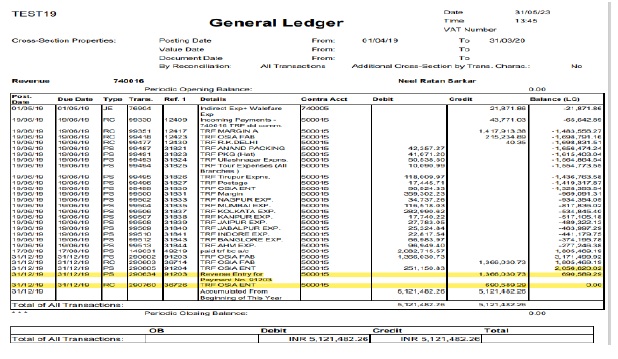
81. It is observed that the special auditor and AO has referred to the last transaction dated 31/12/2019 with the details “TRF OSIA ENT Accumulated From Beginning of This Year”. Based on the said entry, the impugned addition has been made for multiple reasons. Firstly, even as per the special auditor, the Neel Ratan Sarkar is a dummy account. If that be so, where is the question of any addition being made on the basis of the said ledger. Secondly, the ledger relied upon by the Revenue nowhere refers to the amount being received by the appellant as cash credit, as alleged by the AO. On the other hand, the narration mentioned against the amount refers “TRF OSIA ENT Accumulated From Beginning of This Year”, without any reference of cash/ receipt. Thirdly, there is no reason/ rationale given in the assessment order, why the other entries in the very same ledger have been completely ignored. Apparently, as commented by the special auditor, the Neel Ratan Sarkar ledger is a dummy account and therefore all other transactions have to be ignored. In such circumstances, there is no rationale/ justification to pick-up one entry, that too totally out of context and allege the same to be received of cash/ credit. Fourthly, as per the heading in one of the columns, the nature of the transaction is referred as “Contra Acct” which in accounting terminology is generally referred to as Contra entry. There is no analysis about the same. Fifthly, immediately before the entry relied upon, there is another entry with the titled “reverse entry”, which again has been completely ignored from consideration without any reason. Sixthly, the balance as per the ledger after the entry which is under consideration is stated to be NIL, which again is contrary to the fundamental principle i.e. if the amount received is in the nature of cash credit then where is the question of balance becoming NIL immediately after receipt of the amount as alleged. Had the amount been received, then, the amount received should have become credit balance and not NIL.
82. Considering the entirety of the facts and circumstances, no justification was given by the lower authorities as to why only one entry has been picked in the entire ledger and treated as unexplained cash credit. This is apart from the fact that as held by us in the earlier part of our order, the entries in the pen-drive are unreliable and cannot be with the basis of any addition. Accordingly, the addition made is hereby deleted. The ground raised by the assessee is allowed.
83. In Grounds of appeal No.6 to 6.2, the assessee has challenged addition of Rs.150 crores made on account of alleged unexplained cash credit in “Z” account.
84. Before us, the ld. AR for the assessee made following submissions:
187. Vide paras 15 to 15.20 of the reassessment order, the assessing officer has made addition of Rs.150,00,00,000 (Rs.150 crores) on account of unexplained credits in so-called “Z Account” found in JSK server, applying section 68 of the Act. While making the said addition, the assessing officer has observed as under:
• From the JSK Server, it is found that Z Account ‘ has been credited with Rs. 150 crores on 01.05.2019.
• The assessee has changed his stance on explanation regarding ‘Z Account’ inasmuch as it was first explained that the same relates to disclosure made by the family of the assessee under Income Disclosure Scheme, 2016 (IDS), while later the explanation was changed to that the ‘Z Account’ represents ‘liability’. Accordingly, the assessee is trying to mislead the Department about true nature of the account.
• Since Z Account is grouped under the set of accounts having account code starting with letter ‘CL’, the nature ofZ account is also loan account.
• Contention of the assessee that entries posted on 1st May represent only opening balances carried forward from prior year was incorrect as numerous regular entries are posted in JSK server on 1st May (snipped at page 49 of impugned order).
• Assessee has failed to identify the party to whom ‘Z Account’ represents; assessee has failed to explain why it is not a loan account; assessee has failed to establish the creditworthiness of party which represents ‘Z’ account in reference to credit of Rs. 150 crores; assessee has failed to specify the FY to which the opening balance of Rs.150 crores, if any, relates; assessee has failed to bring on record the relevant documents such as ledger of ‘Z’ account for FY 2018-19, balance sheet/ trial balance for FY 2018-19 or confirmation from third party to which ‘Z’ account relates to establish that credit entry represented opening balance.
• As the assessee failed to explain the nature and source of introduction of funds of Rs.150 crores found credited in Z Account in the parallel books of the assessee, an amount of Rs. 150 crores is added as unexplained credits under section 68 r.w.s 115BBE of the Act.
188. The aforesaid observations/ averments of the assessing officer are largely derived from the observation of the Special Auditor at internal pages 190 to 199 of the Special Audit Report (pg. 2698 to 2707 of PB).
189. The CIT(A) has upheld the aforesaid addition under section 68 of the Act largely repeating the observations made by the AO. The CIT(A) held that – (i) Z account is a format, unidentified, unnamed account with no corresponding activity; (ii) the amount of Rs.150 crores is disproportionate to normal business operations; (iii) onus under section 68 is not discharged by the assessee and (iv) explanations offered by the assessee are contradictory.
190. The aforesaid addition made by the AO and upheld by the CIT(A) is not sustainable and is liable to be deleted for the following reasons:
Submissions Re (a): Material relied upon is non-existent and does not belong to appellant
191. It is respectfully reiterated that the appellant has demonstrated that the existence of so called pen-drive/ JSK Server is under doubt; there are fundamental fallacies as far as the authenticity, reliability and veracity of the so-called pen-drive/ JSK Server is concerned; in any case, it cannot be alleged that the JSK Server/ pen drive belong to the appellant and hence there cannot be any presumption against the appellant in terms of section 292C of the Act. As a sequitur, addition made on the basis of any transactions/ data found in the said pen-drive/ JSK Server is per-se unsustainable. For the said reason alone, the addition made is bad in law and deserves to be deleted at the threshold.
192. Further, since the relevant data does not belong to the appellant, the appellant is not and cannot be expected to explain the contents thereof. It is one of the fundamental principles of law that law cannot compel a person to do the impossible i.e. lex non cogit ad impossibilia.
193. Without prejudice to the aforesaid, it is submitted as under:
Re (b): ‘Z Account’ appears to be dome dummy account with notional/ adjustment entry and is in any case uncorroborated- thus addition not sustainable
194. The ledger of ‘Z’ Account for the financial year 2019-20, as incorporated @ page 45 of the reassessment order, is snipped hereunder for ready reference:
195. On perusal of the aforesaid account, it is respectfully submitted that there appears a solitary entry in the so-called ‘Z Account’ on 01.05.2019 of Rs.15,000,000 (with ‘.’). Importantly, there is nothing in the said account which substantiates or even suggest of any actual flow of money/ amount/ cash corresponding to the said entry; in fact, there exist no corresponding entry on any date in the ‘cash in hand’ ledger in the so-called JSK Server corresponding to the aforesaid entry in the ‘Z Account’; there is no allegation or even indication in the assessment order of the special audit report as to how could the aforesaid entry in ‘Z Account’ be related to any amount/ sum received by the appellant.
196. Importantly, the entry is dated 01.05.2019 which the AO/ Special Auditor has noticed at internal pg 38-41 (pf 2546 — 2549 of PB) as per opening entries of the earlier year made in JSK Server. In fact, the ‘Details’ column clearly states “.Accumulated from Beginning of this year”, which clearly shows the entry to be merely opening entries relatable to earlier year.
197. Further, it appears that the solitary entry recorded therein is in any case some notional/ adjustment entry which does not represent any cash credit, to be deemed as unexplained income in the hands of the appellant. _The same is evident from the following facts apparent from record:
(i) The ‘Details’/ narration in the entry ‘Karni Fabrics (CL), Accumulated From Beginning of This Year’ shows that the same is adjustment relating to opening balance; further, Karni Fabric is undisputedly some notional/ adjustment account in the so-called JSK Server.
(ii) It is not alleged that the impugned entry is linked to any identifiable person such as any customer, vendor or lender etc. Thus, in absence of credit from identifiable person, the entry is clearly notional and cannot result in any income.
(iii) The ‘Type’ mention against the impugned entry in the ‘Z Account’ is mentioned as ‘JE’ which is stated to reflect Journal Entry, i.e., some adjustment/ notional/ balancing/ inter-se set-off entries; there is thus no corresponding credit of money.
(iv) No corroboration of any corresponding flow of cash/ money is substantiated by the Revenue. In fact, there is no corresponding entry in cash in hand account forming part of JSK Server.
(v) No corresponding cash is found during the course of search at the premises of the appellant.
(vi) Even as per Special Auditor, the Z Account reflects some difference between credit and debit balances of certain selected accounts as on 01.05.2019. The relevant extracts of the special audit reporare transcribed as under:
The aforesaid observation of the Special Auditor in any case, clearly indicates that Z Account is some adjustment of balances in such accounts and cannot thus be treated as unexplained credit to be taxed as income of the assessee.
198. Importantly, even the Special Auditor notes that balance of ‘Z’ account was carried over (para 6.17) and that the nature of Z accounts remains unjustified (para 6.18). It is also noticed that entry is a journal entry, and it is not even alleged that there is anything to indicate receipt of any money.
199. The aforesaid facts undoubtedly prove that the impugned entry in the Z Account is clearly fictional, notional or is in the nature of adjustment entry and is, in any case, not corroborated by any material or evidence of receipt of cash. The entire addition is based on assumptions, surmises and conjectures without even shoeing how the entry represents loan received and if yes, from whom and when. Being so, such addition without any material, much less corroborative evidence, is bad in law and liable to be deleted at the threshold. Legal position in this regard is detailed supra and is not repeated herein again for the sake of brevity [refer CBI v. V.C. Shukla & Ors.: (1998) 3 SCC 410].
200. For the aforesaid reason alone, the impugned addition calls for being dropped at the threshold.
Re (c): Section 68 applicable not applicable on mere book entries without actual receipt of ‘sum’- since no credit/ money actually received, section 68 is not applicable
201. It is submitted that Section 68 applies to receipt of money and not to any national entry. The provisions of section 68 of the Act, as applicable to assessment year 202021, are reproduced as under for ready reference:
“Cash credits.
68. Where any sum is found credited in the books of an assessee maintained for any previous year, and the assessee offers no explanation about the nature and source thereof or the explanation offered by him is not, in the opinion of the Assessing Officer, satisfactory, the sum so credited maybe charged to income-tax as the income of the assessee of that previous year :
Provided that where the assessee is a company (not being a company in which the public are substantially interested), and the sum so credited consists of share application money, share capital, share premium or any such amount by whatever name called, any explanation offered by such assessee-company shall be deemed to be not satisfactory, unless—
(a) the person, being a resident in whose name such credit is recorded in
the books of such company also offers an explanation about the nature and source of such sum so credited; and
(b) such explanation in the opinion of the Assessing Officer aforesaid has
been found to be satisfactory:
Provided further that nothing contained in the first proviso shall apply if the person, in whose name the sum referred to therein is recorded, is a venture capital fund or a venture capital company as referred to in clause (23FB) of section 10.”
(Emphasis supplied)
202. It is emphatically submitted that section 68 of the Act applies if and only if “any sum” is found credited in the books, “source” whereof is not satisfactorily explained by the assessee, and not to any “book entry” simplicitor.
203. It is respectfully submitted that actual receipt of sum/ cash/ money/ amount is sine qua non for invoking the provisions of section 68 of the Act and mere passing of book entries does not attract the said provision. It will kindly be appreciated that section 68 of the Act merely codifies and gives statutory recognition to the principle established by various judicial decisions under the 1922 Act to the effect that where certain sums of money were/ are claimed to have been borrowed/ received from certain persons, then, it was for the assessee to prove by cogent and proper evidence the nature and source of the money so received.
204. The Hon’ble Supreme Court in the case of
Commissioner of Income Tax v.
P. Mohankala: 291 ITR 278, while explaining the true nature and scope of section 68 of the Act, held there has to be credit of amount in the books maintained by an assessee. The pertinent observation of their Lordships is as follows:
“The question is what is the true nature and scope of section 68 of the Act? When and in what circumstances would section 68 of the Act come into play? A bare reading of section 68 suggests that there has to be credit of amounts in the books maintained by an assessee; such credit has to be of a sum during the previous year; and the assessees offer no explanation about the nature and source of such credit found in the books; or the explanation offered by the assessees in the opinion of the Assessing Officer is not satisfactory, it is only then the sum so credited may be charged to income-tax as the income of the assessees of that previous year.” (emphasis supplied)
205. It will kindly be appreciated that the expression “sum” is used in section 68 of the Act, in conjunction with the requirement of establishing the “source” of sum so found credited, which, in our respectful submission, necessarily refers to the origin of the sum of money and/or the amount so reflected in the books of account. One cannot possibly establish the source of something which was never received, much less source of a book entry simplicitor, not backed by any transaction. The said section is, therefore, it is submitted, not applicable to mere book entry(ies), but necessarily applies only where the transaction entails actual receipt of sum of money.
206. To put it simply, it is respectfully submitted that for provisions of section 68 of the Act to apply, the amount credited in the books of the assessee must be in respect of any amount or sum of money actually received, in respect of which the assessee is unable to satisfactorily explain the nature and source. The said section has no application, whatsoever, to a credit in the books of account on the basis of a book entry simplicitor.
207. Reliance in this regard is placed on the decision of the Madras High Court in the case of
CIT v.
Pandian Distributors: 259 ITR 428 wherein it was held that provisions of section 68 of the Act were not attracted as it was not a case of cash credit at all. In the said case, before commencement of business of the partnership firm, one of the partners had paid a sum of Rs.30,000 as license fee for warehouse and depots under the State Excise Rule to the State Government and had deposited another sum of Rs.30,000 as a wholesale security deposit with the State Government. The question arose whether the sum of Rs.60,000 credited to the account of the partner and treated as his capital contribution should be treated as undisclosed income of the firm. Holding in the negative, the High Court held as under:
“2. The brief facts necessary for the disposal of this tax case reference are as follows: the assessee is a firm of two partners, viz., one P. Thiagarajan and another K.L. Sri Hari. The firm was constituted by a partnership deed dated July 30, 1981, and its business was deemed to have commenced from July 16, 1981.
The firm was a registered firm. Even before the commencement of the firm, on May 16, 1981, one of the partners of the firm, viz., P. Thiagarajan, had paid a sum of Rs. 30,000 as licence fee for warehouse and depots under the State Excise Rules to the State Government and had deposited another sum of Rs. 30,000 as a wholesale security deposit with the State Government. The question arose whether the sum of Rs. 60,000 credited to the account of Thiagarajan and treated as his capital contribution should be treated as undisclosed income of the firm. The Tribunal found that even before the commencement of the business of the firm on July 16, 1981, Thiagarajan had paid Rs. 60,000 as security deposit and licence fees with the Government which was given credit in his capital account. The Tribunal further held that it was not a case of cash credit at all and the provisions of section 68 are not attracted. The Tribunal, therefore, held that the amount of Rs. 60,000 cannot be referred to as the undisclosed income of the firm as Thiagarajan had given a statement that the said amount was given by him even before the commencement of the business of the firm for the purpose of carrying on the business.
We find that the Appellate Tribunal has arrived at the conclusion that the sum of Rs. 60,000 was not the undisclosed income of the firm on the basis of the materials available on record and on the basis of the statement of Thiagarajan, which was believed and accepted by the Tribunal, we are therefore, of the view that the finding recorded by the Tribunal on the basis of the material is a pure finding of fact and does not call for any interference by this court.” (emphasis supplied)
208. Attention is also invited to the decision of the Delhi Bench of the Tribunal in the case of ACIT v. Suren Goel: ITA No. 1767/Del/2011. In that case, the balance sheet of the assessee as on 31.03.2007 revealed that his liabilities enhanced by Rs.20,00,000 towards Sh. Pritam Goel during the relevant year. To a query raised by the assessing officer, the assessee replied that to maintain credit limits enjoyed by the partnership firm (in which assessee was a partner) from the banks, a journal entry was p passed in the books of account of partnership firm M/s Lyra Industrials, whereby assessee’s capital account was credited, and his father, Shri Pritam Goel’s, capital account was debited by an equal amount. The fact of journal entry passed in the books of the firm was duly incorporated in the books of the assessee. The said credit by way of book entry was added by the assessing officer under section 68 of the Act. On further appeal, the CIT(A) deleted the aforesaid addition holding that provisions of section 68 of the Act shall not apply to mere book entries not backed by actual receipt of money, which was upheld by the Tribunal in the following words:
“3. On appeal, the ld. CIT(A) deleted the addition, holding as under: –
“4.4 I have considered the submissions of the ld. Counsel, the AO’s remand report and other facts on record. In this case there is no dispute that the loan of Rs. 20 lcas shown from Sh. Pritam Goel is only by way of book entry in the books of M/s Lyra Industrials. Neither the giver of loan nor the receiver of loan is claiming to have exchanged the sum of Rs. 20 lacs through banking channels or in cash. The amount was already available in the books of account of M/s Lyra Industrials but it has been transferred from the account of Sh. Pritam Goel to the account of Sh. Suren Goel with necessary entries in their capital accounts. As no money has been received from outside, there is no entry in the cash book of the firm. On these given facts there can be no case for treating the sum of Rs. 20 lacs as an unexplained cash credit in the books of the appellant. The AO’s view that the genuineness of a transaction cannot be certified till the mode of payment is established cannot be held to be a thumb rule. In the case of book entries/adjustments there is no question of mode of payment or actual receipt of money from one party to another. Book entry transfer means transfer only through the respective accounts in the books of the concerns. After the transfer the firm has shown reduced balance in the case of Pritam Goel and an increased balance in the case of Suren Goel even though these has been no physical withdrawal of Rs. 20 lacs from Sh. Pritam Goel’s account. The AO’s observation that the transaction is sham is thus, misconstrued. The liability of Rs. 20 lacs has been established to be genuine as the amount has been taken as a loan from Sh. Pritam Goel.
In view of the observations made above, it is held that the addition of Rs. 20 lacs made u/s 68 is totally unjustified. Accordingly the addition is deleted.”
4. The Revenue is now in appeal before us against the aforesaid findings of ld. CIT(A). The ld. DR supported the findings of AO while the ld. AR on behalf of the assessee relied upon the order of the ld. CIT(A).
5. We have heard both the parties and gone through the facts of the case. Indisputably, the loan of ’20 lacs shown from Sh. Pritam Goel father of the assessee was only a journal entry in the books of M/s Lyra Industrials. Since there was no physical transfer of money from the account of Sh. Pritam Goel and only a journal entry was passed, the findings of the AO that transaction was sham ,is baseless, the ld. CIT(A) concluded. In the light of these findings of ld. CIT(A) especially when the Revenue have not placed before us any material so as to enable us to take a different view in the matter, we are not inclined to interfere. Therefore, ground no. 1 in the appeal is dismissed.” (emphasis supplied)
209. Reference may also be made to Ahmedabad Bench of the Tribunal in the case of
Rich Paints Ltd. v.
ITO: (2021) 186 ITD 425 wherein it was held that held that section 68 does not apply to fictitious transaction recoded in the books of account; section 68 of the Act contains a legal fiction that is applicable to real transaction involving actual movement of cash/ money.
210. It has likewise been held in the following decisions that provisions of section 68 cannot be applied without actual receipt of money in the hands of the assessee during the accounting year relevant to the assessment year under consideration:
| • |
|
V.R. Global Energy (P.) Ltd. v. ITO: 407 ITR 145 (Mad.)- Revenues SLP dismissed (SC) |
| • |
|
Jatia Investment Co. v. CIT [1994] 206 ITR 718 (Cal.) |
| • |
|
ITO v. Zexus Air Services P. Ltd: (Del Trib.) |
| • |
|
ITO v. Anand Enterprises Ltd.: ITA No. 1614/Kol/2016 (Kol Trib.) |
| • |
|
ACIT v. Mahendra Kumar Agarwal: (Jaipur Trib.) |
| • |
|
Abhijeet Enterprises Ltd. v. ITO: IT Appeal No. 308 (Kol.) of 2017 |
211. As submitted supra, perusal of the solitary entry in the so-called ‘Z Account’ and in absence of any corroborative evidence brought on record by the assessing officer, there is nothing which substantiates or even suggest of any actual flow of money/ amount/ cash corresponding to the said entry; in fact, there it is not even supported by AO/ Special Auditor that there exist any corresponding entry on any date in the ‘cash in hand’ ledger in the so-called JSK Server corresponding to the aforesaid entry in the ‘Z Account’; there is no allegation or even indication in the assessment order or the special audit report as to how could the aforesaid entry in ‘Z Account’ be related to any amount/ sum received by the appellant. Thus, in absence of any amount/ sum/ money/ cash being received/ averred, there cannot be any addition qua the said amount in the hands of the appellant under section 68 of the Act.
212. Applying the aforesaid legal position to the present case, it is reiterated that provisions of section 68 of the Act are not applicable in respect of mere book entry, not backed by any amount/ sum of money.
Re (d): Addition u/s 68 cannot be made qua opening credits/ balances — applies only in the year in which money actually received/ credited
213. Strictly without prejudice, the aforesaid, it is submitted, may also be examined/ looked at from another angle. It is trite law that section 68 of the Act applies only in the year in which the sum of money is received and credited in the accounts of the assessee and not in any other year.
214. In the present case, it is evident from the records of JSK Server that entry does not belong to the year under consideration; the entry in the ‘Z Account’ is only with respect of transfer of closing balance of preceding year as opening balance of the year under consideration. Accordingly, on this ground also, no addition under section 68 of the Act is warranted in the year under consideration.
215. It is vehemently submitted that no sum was credited in ‘Z Account’ during the financial year 2019-20, relevant to assessment year under consideration. The said ‘Z Account’, had closing balance of Rs.150 crores (ignoring ‘.’ as per revenue) which is transferred as opening balance of the same account for the year under consideration. The said fact is easily discernible from the following:
• The “Details” column in the aforesaid Z Account ‘ mentions as under:
“Karni Fabrics (CL)
Accumulated From
Beginning of This Year “
The narration “Accumulated From Beginning of This Year” invariably means opening balance of ‘Z Account’ as at the beginning of the year and no other interpretation whatsoever of the said phrase is comprehensible.
• As per the findings of the special auditor, the accounting in JSK Server is not made as per normal accounting practice; the carried forward of balance is not done on standard date 01.04.2019 but as on 01.05.2019; closing balance are posted as opening balance of respective accounts as on 01.05.2019. The relevant extract of the Special Audit Report (refer page 40 of report) is snipped hereunder for ready reference:
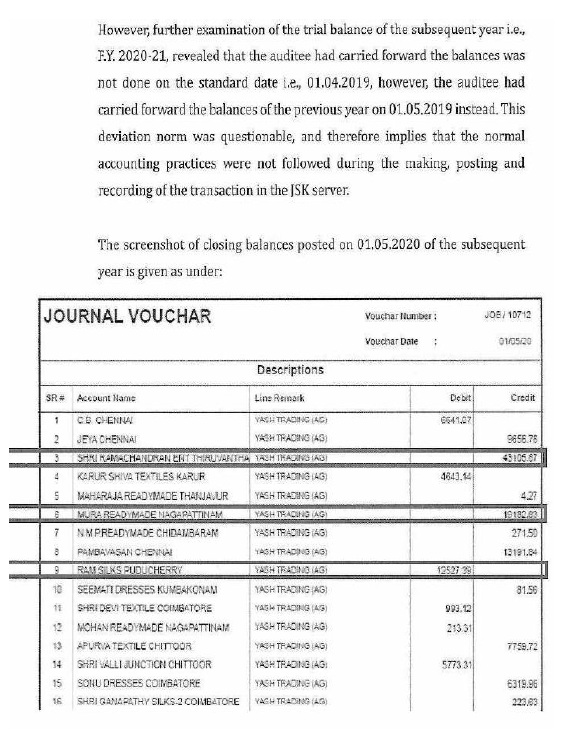
The aforesaid unusual practice in JSK Server is also recognized by the assessing officer. In the order dated 14.03.2024 passed under section 142(2A), the assessing officer observed that “The accounts in JSK server maintained in JSK server were not based on sound and established accounting principles.To arrive at the fair and correct figure of income, adjustment of opening balances and entries nullifying the impact of opening balances need reduction. Claim of revenue expenses, after adjustment of opening balances and nullifying entries, is to be allowed.” (refer page 16 of the order/ notice dated 14.03.2024).
Considering the aforesaid consistent practice, it is evident that closing balance as on 31.03.2019 is posted as opening balance of Z Account as on 01.05.2019; thus, the impugned entry does not reflect any fresh credit during the year under consideration but merely transfer of closing balance of earlier year to be posted as opening balance of relevant year.
It is relevant to note that while posting of opening balance entries as on 01.05.2019 is accepted for all other ledger accounts, in respect of Z Account, the special auditor and the assessing officer has alleged that the impugned entry is not carried forward of balance but is a regular entry, without any reason being assigned for the same. The said conduct in fact shows that the special auditor and the assessing officer are somehow desperate to make addition of the impugned entry in the books of account for the year under consideration. As regards reference made to certain regular entries made on 01.05.2019 in the JSK Server at page 41 of the impugned order, it is submitted that from the details made available it is noticed that the same is not comparable to the entry in the Z account as the said referred entries are of “RC” series while Z Account represent “JE” Series entry (which is same for all posting of opening balances).
• It is not even alleged that there was any corresponding entry is reflected as on 01.05.2019 in the cash in hand ledger account.
• It is admitted by the assessing officer in para 15.8 that “there is no movement of sale/ purchase in these accounts during the year.” The same reflects no fresh credit during the year.
216. On perusal of the aforesaid, it may be appreciated that even as per the details made available, during the financial year 2019-20, no fresh credits were made to the purported Z Account. The only entry, as appearing on 01.05.2019 ostensibly pertains to accumulated balance from the beginning of the year.
217. On a conspectus of the above, it may be appreciated that no amount was credited in Z Account during the previous year 2019-20 and alleged amount of Rs.150 crores represented opening balance of the purported account carried forward from earlier year(s). Accordingly, no addition in respect of the said credit can, in any case, be made during the year under consideration.
218. Attention in this regard is invited to the following decisions where the sums added by the assessing officer under section 68 of the Act were deleted on the ground that examination under that section can only be made in the year in which the amount was received/ credited to the account of the assessee (and not to opening balances):
• CIT v. Usha Stud Agricultural Farms Ltd.: 301 ITR 384 (Del.)- In the instant case, the assessing officer made addition under section 68 of the Act of Rs.15 lakhs shown as ‘advance received’ on the ground that the assessee failed to furnish the copy of confirmation from the creditor. On appeal, the CIT(A) allowed the appeal of the assessee on the ground that credit balance of Rs.15 lacs was being reflected in the books of accounts of the assessee over past four-five years and was not a fresh credit entry of the previous year under consideration. The Tribunal affirmed the order of the CIT(A). On further appeal by the Revenue, the High Court dismissing the appeal held as under:
“.Here, the CIT(A) has deleted the addition of Rs. 15 lacs mainly on the ground that this credit balance of Rs. 15 lacs is being reflected in the accounts of the Assessee over the past four to five years or so and hence this was not a fresh credit entry of the previous year under consideration and these credit entries were already made and accounted for in the assessment years 1995-96 and 1997-98 which were introduced in the form of advance against breeding stallions owned by the Assessee and thus these credit entries did not relate to the year under consideration for being considered under Section 68 of the Act.
Since it is a finding of fact recorded by the CIT(A) that this credit balance appearing in the accounts of the Assessee, does not pertain to the year under consideration, under these circumstances, the Assessing Officer was not justified in making the impugned addition under Section 68 of the Act and as such no fault can be found with the order of the Tribunal which has endorsed the decision of the CIT(A).
The above being the position, no fault can be found with the view taken by the Tribunal.
Thus, the order of the Tribunal does not give rise to a question of law, must less a substantial question of law, to fall within the limited purview of Section 260-A of the Act, which is confined to entertaining only such appeals against the order which involves a substantial question of law. Accordingly, the present appeal filed by the Revenue is, hereby, dismissed” (emphasis supplied)
• CIT v. Prameshwar Bohra: 301 ITR 404 (Raj.): The assessee credited an amount of investment/cash credit of Rs.1,55,316 on 01.04.1992 in his books of accounts. The assessing officer added this amount as unexplained investment in the assessment year 1993-94. The Tribunal held that this was not a case of cash credit entered in the books of account of the assessee during the year, but it was a case in which the assessee had invested the capital in the business and the amount was shown as closing capital on 31.03.1992 and as opening capital on 01.04.1992. Therefore, the Tribunal held that what was already credited in the books of account ending on 31.03.1992 for financial year 1991-92 could not be an explained cash credit or investment in the books of account maintained for the financial year 1992-93).
• In the case of DCIT v. Nipun Builders & Developers Ltd.: ITA No. 558/Del./2010, the Delhi Bench of the Tribunal held as under:
“….12…. We have heard the rival contentions in light of the material produced and precedent relied upon. We find that the Ld. Commissioner of Income Tax (Appeals) has given a categorical finding that the amount from the seven parties in this case have been received during the previous year relevant to assessment year 2004- 05, hence, no addition on account of any cash credit u/s 68 can be made for assessment year 2005-06. ” (emphasis supplied)
219. To the similar effect are the following decisions:
| • |
|
ACIT v. Ats Promoters & Builders (P.) Ltd.: (All) |
| • |
|
DCIT v. Amod Petrochem (P.) Ltd.: 217 CTR 401 (Guj) |
| • |
|
CIT v. Lakshman Swaroop Gupta & Brothers: 100 ITR 222 (Raj) |
| • |
|
CIT v. Orissa Steel Corporation (P.) Ltd.: 144 ITR 662 (Cal) |
| • |
|
PCIT v. Kulwinder Singh: 298 CTR 389 (P&H) |
| • |
|
Shri Vardhman Overseas Ltd. v. ACIT: 24 SOT 393 (Del ITAT) |
| • |
|
ITO v. Standard Leather (P.) Ltd.: 162 ITD 285 (Kol ITAT) |
| • |
|
DCIT v. GlobalMercantiles (P.) Ltd. : 157ITD 924 (KolITAT) |
| • |
|
DCIT v. Alidhara TexproEngineers (P.) Ltd. : 43 SOT 1 (Ahm ITAT) |
| • |
|
Shri Vijay Suresh Dave v. DCIT: ITA No. 2842/Mum/2023 (order dated 07.03.2024) |
| • |
|
Bharat Dana Bera v. ITO: 169 TTJ 721 (Mum ITAT) |
| • |
|
ITO v. Ramesh N. Vora: ITA No. 4962/Mum/2008 (Mum. Tri.) |
| • |
|
ITO v. Kishore Kumar G. Jain: ITA No. 492/Mum./2009 (Mum.ITAT) |
| • |
|
DCIT v. Satish Chandra Pandey: ITA No. 525/lkw./2010 (Luck. ITAT) |
| • |
|
Parsoli Corporation Ltd. v. DCIT: ITA No. 1431/Mum./2010 (Mum. ITAT) |
220. Applying the aforesaid well settled legal position to the undisputed facts, the only inevitable conclusion that can, in our submission, be drawn is that since no amount was credited in the purported Z Account in year under consideration, section 68 of the Act cannot be applied in the relevant year, i.e., AY 2020-21.
221. For the aforesaid reason, too, the addition of alleged sum of Rs.150 crores made in terms of section 68 of the Act, qua Z account, being without jurisdiction, is not warranted.
Re (e): Rebuttal to the allegations/ averments of the assessing officer
222. The observations/ allegations made by the assessing officer in the books of accounts are as briefly discussed and rebuttal hereunder:
| Allegations of the AO |
Remarks/ Rebuttal |
| The assessee has changed his stance on explanation regarding Z Account ‘ inasmuch as it was first explained that the same relates to disclosure made by the family of the assessee under Income Disclosure Scheme, 2016 (IDS), while later the explanation was changed to that Z account represents liability. Accordingly, the assessee is trying to mislead the Department about true nature of the account. |
In this regard, it is submitted that the said averment in fact supports the stand of the appellant that he is not aware about the true nature of Z Account since the JSK Server containing so called Z Account does not belong to the appellant.
That apart, the oscillating explanation before the assessing officer also in any case, reflects the said account probably captures some adjustment or notional entry, nature of which cannot be ascertained properly.
Furthermore, as explained above, at the time when the relevant submissions were filed before the investigation wing/ assessing officer, the appellant was suffering from severe health issues and had undergone heart surgery. The appellant thus merely relied on then consultants, who had made submissions before the authorities; even such consultants/ employees were probably not able to ascertain the nature of Z account.
Further, strictly without prejudice, even assuming arguendo (though denied) that the appellant has altered his stand for a different financial year, such allegation is wholly irrelevant to the year under consideration and cannot constitute a lawful basis for confirming the impugned addition. |
| Allegations of the AO |
Remarks/ Rebuttal |
|
It is a settled law that what is not taxable under the statute cannot be brought to tax on the basis of assumptions, admissions, conduct or equitable considerations. There is no estoppel against the statute. If a levy is not sanctioned by the Act, it cannot be sustained by invoking doctrines such as approbate and reprobate. Equity has no place in tax law – a levy must strictly flow from statutory authority. [Refer: CIT v. M.R.P. Firm: (1964) (10) TMI 13 (SC) Supreme Court, Nirmala L. Mehta v. A. Balasubramaniam, CIT And Others: (2004) (4) TMI 43 – Bombay High Court, SR. Koshti v. CIT: (2004) (12) TMI 62 – Gujarat High Court]
The above judicial pronouncements unequivocally hold that tax can be levied and collected only by authority of law, and there can be no estoppel against statute. If a particular receipt or entry is not exigible to tax under the Act, the same cannot be taxed merely on the basis of any alleged inconsistency in the stand or perceived concession.
Be that as it may, from the perusal of replies filed before lower authority, there appears to be no apparent inconsistency. Perceivably, income declared under IDS by the family members of the assessee could have been recorded in the so called Z Account ‘ in earlier year by some employee [clearly not on instructions of the appellant as the data does not belong to the appellant]; the same could thus be a kind of capital account in so-called JSK Server- since capital is reflected on liability side, the same was stated to be financial liability by the employee/ consultant, on analyzing data of cloned JSK Server provided. Thus, there is no inconsistency or flipping stands of the assessee as such.
For the aforesaid cumulative reasons, no adverse inference can be drawn against the appellant on account of change in stance before the assessing authority on Explanation qua Z Account.
|
| There is no movement of sale/ purchase in these accounts during the year. Since Z Account is grouped under the set of accounts having account code starting with letter CL ‘, the nature of Z account is also loan account; as per the |
The said conclusion drawn by the assessing officer is not based on any rationale or logic. Merely because the Z account has no sale/ purchase and the same is appearing in some head CL’ ‘ in JSK Server, it cannot be comprehended as to how the same can be considered as loan. The transaction of loan must have an identifiable lender, receipt of money, payment of interest, repayment of loan etc. None of the said factors are |
| Allegations of the AO |
Remarks/ Rebuttal |
| submission of the assessee that Z account is a liability. |
brought on record by the Revenue to allege the impugned amount as loan. The said observations of the assessing officer is purely a guess work and based on conjectures and surmises; the same in-fact shows desperation of the assessing officer to somehow tax the impugned entry in the hands of the appellant. |
| Contention of the assessee that entries posted on 1st May represent only opening balances carried forward from prior year was incorrect as numerous regular entries are posted in JSK server on 1st May (snipped at page 49 of impugned order) |
Considering the consistent practice shown and inferred by the Special Auditor and the assessing officer qua the JSK Server, it is evident that closing balance as on 31.03.2019 is posted as opening balance of Z Account as on 01.05.2019; thus, the impugned entry does not reflect any fresh credit during the year under consideration but merely transfer of closing balance of earlier year.
It is relevant to note that while posting of opening balance entries as on 01.05.2019 is alleged for all other ledger accounts, in respect of Z Account, the special auditor and the assessing officer has alleged that the impugned entry is not carried forward of balance but is a regular entry, without any reason being assigned for the same. The said conduct in fact shows that the special auditor and the assessing officer were somehow desperate to make addition of the impugned entry in the books of account for the year under consideration.
As regards reference made to certain regular entries made on 01.05.2019 in the JSK Server at page 41 of the impugned order, it is submitted that as explained above the same is not comparable to the entry in the Z account as the said referred entries are of “RC” series while Z Account represent “JE” Series entry (which is same for all posting of opening balances).
Thus, the failed attempt of the assessing officer to somehow not consider the impugned entry as posting of opening balance is, in our submissions, deserved to be thrashed. |
| Assessee has failed to identify the party to whom Z’ ‘ account represents; assessee has failed to explain why it is not a loan account; assessee has failed to establish the creditworthiness of party |
The appellant has, at the outset, denied the ownership and contents of JSK Server and thus there cannot be any failure on part of the assessee to explain the nature of Z Account.
Considering that impugned entry in Z Account is mere posting of closing balance of earlier year as opening balance for the relevant year, there is no fresh credit or |
| Allegations of the AO |
Remarks/ Rebuttal |
| which represents Z” account in reference to credit of Rs. 150 crores; assessee has failed to specify the FY to which the opening balance of Rs.150 crores, if any, relates; assessee has failed to bring on record the relevant documents such as ledger of ‘Z’ account for FY 201819, balance sheet/ trial balance for FY 2018-19 or confirmation from third party to which ‘Z’ account relates to establish that credit entry represented opening balance. |
receipt of sum money during the year under consideration.
Moreover, since Z Account appears to be some dummy/ adjustment/ notional account for adjustment entries/ purposes (detailed supra); the impugned entry therein does not reflect credit of sum from any person- thus, there is no person behind the said entry; accordingly, there cannot be identity or creditworthiness to be proved by the assessee.
It is further not alleged that the impugned entry is linked to any identifiable person such as any customer, vendor or lender etc. Thus, in absence of credit from identifiable person, the entry is clearly notional and cannot result in any income.
Moreover, the assessing officer has conveniently attempted to shift the onus on the appellant without even bringing on record any reasonable basis to impute income in the hands of the appellant qua the impugned entry in the Z Account. |
223. For the cumulative reasons explained above, the impugned addition of Rs.150 crores qua Z Account is beyond jurisdiction, illegal, unwarranted and is liable to be deleted.
224. Be that as it may, the action of the assessing officer in considering the figures to be undervalued by 100 times (2 decimals) in JSK Server is based on conjectures and surmises and without any basis. Thus, even if one is to sustain the addition, the same but not be more than Rs.1.50 crores (as against Rs.150 crores made by the assessing officer).
85. On the other hand the ld. CIT DR vehemently supported the order of the lower authorities and the entire addition is based on the entries found recorded in JSK server and further the assessee in the statements has admitted the omission of two zeros and therefore the AO has rightly made the addition of the ledger account in the name of ‘Z’ for which no explanation was tendered by the assessee. She prayed accordingly.
86. We have heard both the parties and carefully considered the material available on record. This addition is also based on the contents of pen-drive/ JSK server and while adjudicating grounds of appeal No. 2 &, we have already held that the contents of the Pen-drive/ JSK server cannot be relied upon for making any addition. That apart, we noticed that in the assessment order, the AO has reproduced a general ledger titled as “Z” account while making this addition, the same is reproduced as under:
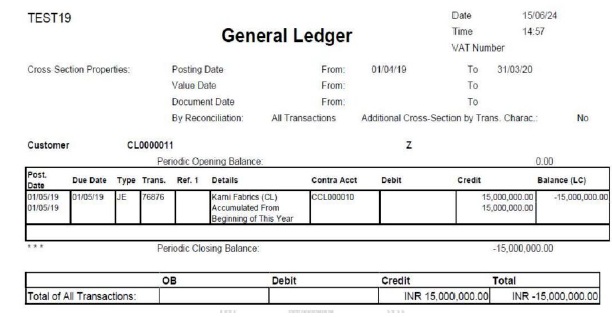
87. On the basis of the entry of “Rs. 15,000,000.00” in the above ledger, the AO treated the said amount as unexplained cash credit and made the addition of Rs.150 crores, by ignoring the decimal (“.”). As observed in the preceding paras, the entries in the Pen-drive/ JSK Server is completely unreliable and cannot be made the basis for making any addition/ drawing any adverse inference. Further, the date mentioned in the above ledger is “01/05/2019”, which means 01st May 2019. On the perusal of the records, it is noticed that the special auditor as well as the assessing officer have at various places stated that entry of 01.05.2019 in the JSK Server is actually the opening balance brought forwards from the preceding year. If that being so, the entry in the above “Z” account should have been considered as an opening balance and on that basis, there can be no justification for making any addition of the same in current year. Further as per the narration given in the general ledger itself the entry represents “accumulated from beginning of this year” which clearly depicts also that the amount has been accumulated in the earlier years and brought forward from earlier years and therefore, no addition could have been for the same in the year under appeal. There is no reference of any amount having been received in the current year in order to justify the same as cash credit. Lastly, the party to whom this ledger pertains has not been identified, more so, when the ledger account itself is titled as “Z” account i.e. not having any fictitious account name and no other corroborative material to support the allegation that the assessee received any such money from any party, was brought on record. Accordingly, we are of the considered opinion that the addition made by the assessing officer on the basis of the aforesaid “Z” account is clearly unsustainable and is hereby deleted. The ground of appeal raised by the appellant is allowed.
88. In Ground No.7, the assessee has challenged the addition of Rs.96,23,597/- made u/s 68 on the basis of certain ledger forming part of the JSK Server.
89. Before us, the ld. AR for the assessee has made detaied submission which is reproduced as under:
225. Vide paras 16 to 16.10 of the reassessment order, the assessing officer has made addition of Rs.96,23,597/- under section 68 of the Act on account of the following alleged unexplained credits found to be recorded in JSK server:
| S. No. |
Ledger No. |
Ledger Name |
Posting Date |
Journal Voucher |
Trans. No. |
Amount of credit (in Rs.) |
| 1. |
CL0000001 |
Usha Choraria |
01.05.2019 |
JE1150018 |
76876 |
4,46,537 |
| 2. |
CL0000002 |
Chiman Ji Buchcha |
01.05.2019 |
JE1150018 |
76876 |
44,15,013 |
| 3. |
CL0000004 |
Ganesh Devi Choraria |
01.05.2019 |
JE1150018 |
76876 |
21,21,828 |
| 4. |
CL0000008 |
Om Prakash Ji Varma Itanagar |
01.05.2019 |
JE1150018 |
76876 |
11,34,442 |
| 5. |
CL0000012 |
Hajarimal Mundra |
01.05.2019 |
JE1150018 |
76876 |
13,05,777 |
| 6. |
CL0000017 |
Advance Margin |
01.05.2019 |
JE1150018 |
76876 |
2,00,000 |
| TOTAL |
|
96,23,597 |
226. The CIT(A) upheld the aforesaid addition on the ground that the nature and source has not been explained; irrespective of mode of receipt, the credit is assessable under section 68 of the Act.
227. The aforesaid addition made by the AO and upheld by the CIT(A) is not sustainable for the reasons explained below:
Submissions
Re (a): Material relied upon is non-existent and does not belong to appellant
228. It is respectfully reiterated that the appellant has demonstrated that the existence of so called pen-drive/ JSK Server is under doubt; there are fundamental fallacies as far as the authenticity, reliability and veracity of the so-called pen-drive/ JSK Server is concerned; in any case, it cannot be alleged that the JSK Server/ pen drive belong to the appellant and hence there cannot be any presumption against the appellant in terms of section 292C of the Act. As a sequitur, addition made on the basis of any transactions/ data found in the said pen-drive/ JSK Server is per-se unsustainable. For the said reason alone, the addition made is bad in law and deserves to be deleted at the threshold.
229. Further, since the relevant data does not belong to the appellant, the appellant is not and cannot be expected to explain the contents thereof. It is one of the fundamental principles of law that law cannot compel a person to do the impossible i.e. lex non cogit ad impossibilia.
230. Without prejudice to the aforesaid, it is submitted as under:
Re (b): Entry dated 01.05.2019 recorded in each of the ledger accounts is only notional/ adjustment entry and is in any case uncorroborated- thus addition not sustainable
231. The extracts of the aforesaid ledger account of Usha Choraria, found from the so-called JSK server, are reproduced as under for ready reference: (pg 53 of AO Order)
232. Similar entries appear in the other ledger accounts as tabulated above [refer pg 53, 54 & 55 of the AO order respectively]
233. On perusal of the aforesaid ledger accounts forming part of the JSK Server, it appears that all the impugned entries dated 01.05.2019 are in the nature of notional/ adjustment entries which do not represent any cash credit, to be deemed as unexplained income in the hands of the appellant. The same is evident from the following facts apparent from record:
(i) The ‘Details’/ narration in the entry ‘Karni Fabrics (CL), Accumulated From Beginning of This Year’ shows that the same is adjustment relating to opening balance; further, Karni Fabric is undisputedly some notional/ adjustment account in the so-called JSK Server.
(ii) The ‘Type’ mention against each of the impugned entries in all the accounts is mentioned as ‘JE’ which is stated to reflect Journal Entry, i.e., some adjustment/ notional/ balancing/ inter-se set-off entries; there is thus no corresponding credit of money.
(iii) No corroboration of any corresponding flow of cash/ money is substantiated by the Revenue. In fact, there is no corresponding entry in cash in hand account forming part of JSK Server.
(iv) No corresponding cash is found during the course of search at the premises of the appellant.
234. The aforesaid facts undoubtedly prove that all the impugned entries are purely fictional, notional or in the nature of adjustment entries and are, in any case, not corroborated by any material or evidence of receipt of cash. Being so, such additions without any corroborative evidence are bad in law and liable to be deleted at the threshold. Legal position in this regard is detailed supra and is not repeated herein again for the sake of brevity [refer CBI v. V.C. Shukla & Ors.: (1998) 3 SCC 410].
235. In view of the aforesaid, the impugned addition could not have been made since provisions of section 68 cannot be applied without actual receipt of money and cannot be applied to a mere adjustment/ notional/ book entry in the books of accounts. For the aforesaid reason alone, the impugned addition calls for being dropped at the threshold.
Re (c): Section 68 applicable not applicable on mere book entries without actual receipt of ‘sum’- since no credit/ money actually received, section 68 is not applicable
236. As explained in detail above, it is reiterated that section 68 of the Act applies if and only if “any sum” is found credited in the books, “source” whereof is not satisfactorily explained by the assessee, and not to any “book entry” simplicitor [refer
Commissioner of Income Tax v.
P. Mohankala: 291 ITR 278].
237. In the present case, on perusal of extracts of the ledger accounts of various parties, (refer reproduction supra), it is respectfully submitted that all the entries dated 01.05.2019 in no manner whatsoever substantiate or even suggest of any actual flow of money/ amount/ cash corresponding to the said entries; in fact, there exist no corresponding entries in the ‘cash in hand’ ledger in the so-called JSK Server corresponding to the aforesaid entries in the respective accounts; there is no allegation or even indication in the assessment order of the special audit report as to how could the aforesaid entries be related to any amount/ sum received by the appellant. Thus, in absence of any amount/ sum/ money/ cash being received/ averred, there cannot be any addition qua the said amount in the hands of the appellant under section 68 of the Act.
238. Applying the aforesaid legal position to the present case, it is reiterated that provisions of section 68 of the Act are not applicable in respect of mere book entry, not backed by any amount/ sum of money.
239. Further, it is vehemently submitted that as amply evident from the trial balance allegedly retrieved from the JSK server itself, no cash loan transaction was identified during the relevant year under consideration. The copy of trial balance so extracted is enclosed @ pages 1735 to 1738 of the PB. Further, the extract of the same is also reproduced hereunder for ready reference:
240. The loan transaction(s) had only been undertaken through banking channels which have been duly recorded in the books of accounts, and details of the said unsecured loans, along with confirmation of accounts, bank statement and ITR acknowledgment of loan providers had been duly submitted before the Ld. AO vide reply dated 25.07.2024 to which no doubts have been raised.
241. Thus, in view of the above, it is respectfully submitted that the possibility of any cash loan being received from the above parties during the year under consideration is completely ruled out.
Re (d): Addition u/s 68 cannot be made qua opening credits/ balances — applies only in the year in which money actually received/ credited
242. Without prejudice, the aforesaid, it is submitted, may also be examined/ looked at from another angle. It is trite law that section 68 of the Act applies only in the year in which the sum of money is received and credited in the accounts of the assessee and not in any other year.
243. In the present case, even if one is to assume that the aforesaid amounts reflected in various ledger accounts relate to any credit of money, it is evident from the records of JSK Server that such credits do not belong to the year under consideration; the entries in the respective accounts is only with respect to transfer of closing balances of preceding year as opening balances of the year under consideration. Accordingly, no addition under section 68 of the Act is warranted in the year under consideration.
244. It is vehemently submitted that no sum was credited in any of the ledger accounts during the financial year 2019-20, relevant to assessment year under consideration. The said fact is easily discernible from the following:
• The “Details” column in each of the ledger account mentions as under in respect of the entry in question:
“Karni Fabrics (CL)
Accumulated From
Beginning of This Year “
The narration “Accumulated From Beginning of This Year” invariably means opening balance of respective ledger account as at the beginning of the year and no other interpretation whatsoever of the said phrase is comprehensible.
• As per the findings of the special auditor, the accounting in JSK Server is not made as per normal accounting practice; the carried forward of balance is not done on standard date 01.04.2019 but as on 01.05.2019; closing balance are posted as opening balance of respective accounts as on 01.05.2019 (explained supra).
• No corresponding entry is reflected as on 01.05.2019 in the cash in hand ledger account.
245. On perusal of the aforesaid, it may be appreciated that, during the financial year 2019-20, no fresh credits were made to any of the purported ledger accounts. The impugned entry in each of the ledger accounts, as appearing on 01.05.2019, ostensibly pertains to accumulated balance from the beginning of the year.
246. On a conspectus of the above, it may be appreciated that neither of the impugned entries represented any amount which was credited during the previous year 2019-20 and alleged cumulative amount of Rs.96,23,597 only represented opening balance(s) of the all the purported account(s) carried forward from earlier year(s). Accordingly, no addition in respect of the said credits can be made during the year under consideration. Legal position in this regard is detailed supra.
247. For the aforesaid reason, too, the addition of alleged cumulative sum of Rs.96,23,597/- made in terms of section 68 of the Act, qua various loan accounts, being without jurisdiction, is liable to be deleted.
248. Be that as it may, the action of the assessing officer in considering the figures to be undervalued by 100 times (2 decimals) in JSK Server is based on conjectures and surmises and without any basis. Thus, even if one is to sustain the addition, the same must not be more than Rs.96,236/- (as against Rs.96,23,597/- made by the assessing officer).
90. On the other hand the ld. CIT DR reiterated the same arguments and requested for the confirmation of the addition made.
91. We have carefully considered the rival submissions and perused the material available on record. It is observed that this addition is also based on the contents of pen-drive/ JSK server and while adjudicating the grounds of appeal No. 2 and 3, we have already held that the contents of the Pen-drive/ JSK server cannot be relied upon for making any addition. It is further noticed that posting date of the entry is mentioned as “01/05/2019” which is similar as are discussed while deciding the ground of appeal No.6 herein above. The narration and the date of the posting clearly shows that neither there was any material to support the allegation that the entry represents cash/ credit nor is there any material to show that the entry, if at all true, relates to year under consideration. For these reasons and further for the reasons given while adjudicating the ground of appeal No. 6 herein above in the context of entry of similar nature, we are of the considered view that the addition made is not sustainable and is hereby deleted. The ground of appeal No. 7 raised by the assessee is allowed.
92. In Ground No.8, the Assessee has challenged the addition of Rs.66,92,230/- made under section 69A of the Act on account of alleged cash receipt on the basis of certain WhatsApp chats.
249. Vide paras 17 to 17.10 of the impugned reassessment order, the assessing officer has made addition of Rs.66,92,230/- under section 69A of the Act on account of the following unaccounted cash receipts allegedly on the basis of Whatsapp chats not shown in JSK Server as under:
| Date |
Amount (in Rs.) |
| 14.08.2019 |
3,89,000 |
| 27.02.2020 |
1,03,230 |
| 20.06.2019 |
50,00,000 |
| 22.11.2019 |
12,00,000 |
| Total |
66,92,230 |
250. The excerpts of such Whatsapp chats have been reproduced by the special auditor @ pages 298 to 301 of his special audit report (pg 2806 to 2809 of PB).
251. The aforesaid addition has been upheld by the CIT(A) holding that the chats are not vague or intangible entries and no plausible explanation has been furnished by the assessee; the CIT(A) also held that section 65B of the Evidence Act does not apply to assessment proceedings.
252. The aforesaid addition made by the AO and upheld by the CIT(A) deserves to be deleted for the following reasons:
Submissions:
253. It is respectfully submitted that reference made by the Revenue on certain whatsapp chats cannot be construed as valid evidence. In this regard, it may be noted as under:
– It is firstly submitted that in absence of valid 65B Certificate for the device from which chat is extracted, the digital data does not have any evidentiary value and cannot thus be relied upon (legal position cited above).
– That apart, it is submitted that whatsapp chats forming part of personal chats are merely hearsay details and cannot be considered as evidence per se. Being so, any data/ chat/ contents retrieved from whatsapp cannot be used to make any inference against the assessee. Be that as it may, the same cannot be relied upon at all in absence of any corroborative evidence being brought on record.
Reliance in this regard is placed on the decision of the Chennai Bench of the Tribunal in the case of Mr. A. Johnkumar v. DCIT: ITA No. 3028/Chny/2019, wherein it was held that WhatsApp messages cannot be considered as a conclusive evidence to draw an adverse inference against the assessee. The relevant findings of the Tribunal are reproduced as under:
“……
9.4 We have heard both the parties, perused the materials available on record and gone through orders of the authorities below. The sole basis for the AO to make addition u/s.69C of the Act, was election held for Nellithope Constituency of Pondicherry Union Territory.. The AO had also taken support from a WhatsApp message sent from the assessee’s mobile phone to Mr.Somu and analyzed those SMS messages on his own understanding and inferred that the assessee had used some code words to distribute cash to voters. Except photo identity cards issued by M/s.Johnkumar Trust, found in the premises of the assessee and WhatsApp message sent from assessee’s mobile phone, no other evidence was with the AO to draw a conclusion that the assessee had distributed cash to voters amounting to rs. 17 Crs. First of all, WhatsApp messages cannot be considered as a conclusive evidence to draw an adverse inference against the assessee, unless those WhatsApp messages are supported by corroborative evidences to indicate that those messages and contents represents undisclosed income of the assessee. Further, what is written in WhatsApp message is not readable in terms of any income or expenditure. We have gone through those WhatsApp messages, which is available in the assessment order and we find that nothing could be made out from those messages. In some messages, it was written inward on various dates and some tonnes. In some messages, it was written in outward in tonnes. From those messages, the AO given his own meaning and inferred with tonne means lakhs, inward means cash received for distribution and outward means cash distributed. The AO had also in his own meaning for some other contents recorded in WhatsApp messages and inferred cash distribution timings, shift change timings, etc., and concluded that the assessee has received so much cash and distributed so much of cash to various persons in the process. The AO neither bring on record from which person, the assessee has received cash and to whom the assessee has distributed cash. The AO neither made out a case of source for cash and destiny of cash distributed by the assessee.. We find that neither the AO has found any physical cash distribution to voters nor examined any of the photo identity card holding to ascertain the fact that cash was distributed to them. Further, the AO had relied upon the WhatsApp messages sent from assessee’s mobile phone to Mr.Somu and had given his own meaning to those messages. In the process, the AO neither tested the admissibility of WhatsApp messages as evidence u/s.69B of Evidence Act, nor examined Mr.Somu the recipient of messages sent by the assessee. The AO without carrying out necessary enquiries and also examining those persons, simply concluded that those messages are meant for distribution of cash and the assessee has spent such a huge amount for election expenses. In our considered view, the findings recorded by the AO is purely on suspicion and surmises manner without any evidences to justify his findings..
..In our considered view, the AO is grossly erred in denying the explanation offered by the assessee, because whether or not any explanation offered by the assessee on the messages, but the fact remains that the AO could bring some positive evidence to link the WhatsApp messages to allege that the contents of WhatsApp messages depicts the undisclosed income or expenses of the assessee. In this case, on perusal of those WhatsApp messages what we could understand is that those messages are a dumb document without any corroborative evidence on record and therefore, no addition can be made on the basis of said documents. ” (emphasis supplied)
The Mumbai Bench of the Tribunal in the case of Mrs. Monica Kumarpal Banda v. ACIT: ITA No. 170/Mum/2023 dated 7.08.2023 held that WhatsApp chat recovered during the course of search and seizure operation without any corroborative evidence, has no evidentiary value and are simply dumb documents which cannot be relied on to make addition(s)/ draw adverse inferences.
To the similar effect are the following decisions:
? Designers Point (India) P. Ltd v. ACIT: ITA No.2517/Del/2022 (Del Trib.)
? LSL Tools (P.) Ltd. v. ACIT: (Delhi –Trib.)
? Atul Tantia v. DCIT: ITA No. 492/Kol/2021 (Kol Trib.)
? Dy. CIT v. Saarrthi Realty and Infra LLP [2025] 214 ITD (Mum.) 27
? DCIT v. Niru Dhiren Shah: 2025] (Mum – Trib.)
? Rucha Consultancy LLP v. DCIT: (Mum-Trib.)
? ACIT v. Shanker Nebhumal Uttamchandani: (Surat-Trib.)
? Balar Marketing (supra)
Specific reference is also made to the decision of the Supreme Court in the case of Common Cause (A registered Society) v. Union of India: 394 ITR 220 (SC) wherein various hard disks, pen drives etc. recovered running raids were held to be not admissible under the Evidence Act. The relevant extracts of the judgment are as under:
“22. In case of Sahara, in addition we have the adjudication by the Income Tax Settlement Commission. The order has been placed on record along with I.A.No.4. The Settlement Commission has observed that the scrutiny of entries on loose papers, computer prints, hard disk, pen drives etc. have revealed that the transactions noted on documents were not genuine and have no evidentiary value and that details in these loose papers, computer print outs, hard disk and pen drive etc. do not comply with the requirement of the Indian Evidence Act and are not admissible evidence. It further observed that the department has no evidence to prove that entries in these loose papers and electronic data were kept regularly during the course of business of the concerned business house and the fact that these entries were fabricated, non-genuine was proved. It held as well that the PCIT/DR have not been able to show and substantiate the nature and source of receipts as well as nature and reason of payments and have failed to prove evidentiary value of loose papers and electronic documents within the legal parameters. The Commission has also observed that Department has not been able to make out a clear case of taxing such income in the hands of the applicant firm on the basis of these documents.
23. It is apparent that the Commission has recorded a finding that transactions noted in the documents were not genuine and thus has not attached any evidentiary value to the pen drive, hard disk, computer loose papers, computer printouts.
……
27. Considering the aforesaid principles which have been laid down, we are of the opinion that the materials in question are not good enough to constitute offences to direct the registration of F.I.R. and investigation therein. The materials should qualify the test as per the aforesaid decision. The complaint should not be improbable and must show sufficient ground and commission of offence on the basis of which registration of a case can be ordered. The materials in question are not only irrelevant but are also legally inadmissible under Section 34 of the Evidence Act, more so with respect to third parties and considering the explanation which have been made by the Birla Group and Sahara Group, we are of the opinion that it would not be legally justified, safe, just and proper to direct investigation, keeping in view principles laid down in the cases of Bhajan Lal and V.C. Shukla (supra).”
Moreover, the screenshots of chats of employees are pages 2806 to 2809 of PB does not indicate muchless substantiate any cash transaction by the appellant. The contents of the chat are incomprehensible and does not anyhow substantiate any unaccounted cash received/ earned by the appellant.
– No corroboration of the aforesaid chat with any material has been established; the same is based solely on Whatsapp chats extracted from the mobile phones of some of the employees. In fact, the assessing officer has not even mentioned the nature of transaction in respect of which such alleged cash has been alleged to have been received.
254. In the view of above, the chats are inherently incapable of forming a basis for any substantive addition to the income of an appellant. These chats, without proper validation and context, cannot be deemed reliable or sufficient for making any determination regarding the assessee’s financial transactions or income. It is further imperative to note that it is well-settled law that a non-speaking or ‘dumb’ document, without any corroborative material or evidence, cannot be used as a basis for apprehending an escapement of income from assessment. Legal precedent underscores the importance of relying on clear, corroborated, and authenticated evidence when making any determinations regarding income assessments. Chats that do not provide a clear, verifiable link to the assessee’s financial activities are legally inadequate for substantiating claims of undisclosed income or financial discrepancies.
255. Therefore, in absence of any credible, reliable and verified documents, the impugned addition made, merely relying on the electronic evidence, without any corresponding statement of the persons recorded, is wholly untenable and unjustified.
256. That apart and without prejudice, it is submitted that once the assessing officer has added unaccounted income recorded in JSK, no separate addition of the cash under section 69A of the Act is warranted; the cash must be considered to be out of the same income and thus not addition in any case is liable to be made.
257. Therefore, the mere presence of chats cannot, in itself, warrant any adverse inference against the appellant, especially when such chats are unverified, uncorroborated, and unsupported by tangible evidence. Accordingly, in view of the above, the impugned addition may kindly be deleted.
93. Per contra, the ld. CIT DR vehemently supported the orders of the lower authorities on this issue and reiterated the same arguments.
94. We have carefully considered the rival submissions and perused the material available on record. From the perusal of assessment order and the observation in the special audit report, we find that apart from reliance being placed on certain WhatsApp chats, there was no material/ evidence to support the conclusion of cash having been received by the appellant. It is further observed that there is no 65B certificate in respect of the so-called WhatsApp chats or device from which the same is extracted. Therefore, in view of the detailed reason given by us herein above with regard to the significance of 65B certificate and CBDT manual, we are of the considered view that the WhatsApp chats solely cannot be the basis for making addition. Moreover, there is no supporting material to support the allegation that the cash was actually received. Under these circumstances, the addition made is hereby deleted. Ground of appeal No.8 is thus allowed.
95. In Ground nos.9 to 12, the assessee has challenged the validity of assessment order on various alternative grounds. Since we have already allowed the relief on merits, the grounds challenging the validity of the assessment order become academic and thus not adjudicated.
96. Ground no. 13, relates to levy of interest, which is consequential in nature and the AO is directed to charge the interest u/s 234B on the income finally determined after giving effect to the present order.
97. In Ground no.14, the appellant has challenged the initiation of penalty proceedings u/s 271DA and 271D of the Act which is premature at this stage and therefore dismissed.
98. Now we take up the appeal filed by the Revenue for AY 2020-21 in ITA No. 6743/Del/2026 for adjudication.
99. In Grounds nos. 1 to 6, the Revenue has challenged the action of ld. CIT(A) in deleting the disallowance made on account of bad debts and other expenses made by the AO by invoking the provisions of sections 36, 37 and 40A(3) of the Act. The AO had disallowed the expenditure totalling to Rs.22,70,12,191/- which comprise of two components – (1) bad debts of Rs. 3,41,21,191/- and (2) other expenses of Rs.19,05,00,000/-.
100. Heard the parties and perused the material available on records. The bad debts was disallowed by holding that the conditions of section 36(2) are not satisfied while the expenses were disallowed for lack of supporting vouchers and details. The AO further held that expenses to the extent of Rs.11,45,76,938/-are alternatively disallowable under section 40A(3) of the Act by alleging that such expenditure were in cash beyond the prescribed threshold limit. The CIT(A) has deleted the aforesaid additions and disallowances by holding that since the income recorded in the JSK server is brought to tax, expenditure recorded therein should be deductible since income and expenditure are two sides of the same coin.
101. It is a matter of fact that all the disallowances made by the AO out of various expenses were in relation to the income for which separate additions were made based on the contents of the pen-drive/ JSK Server. While adjudicating the appeal of the assessee, we have already deleted the additions made on the basis of the contents of the pen drive/ JSK Server, therefore based on the entries in same Pen Drive/JSK server, no further disallowance of expenditure could be made. Further before us, the observations made by ld. CIT(A) while deleting the disallowance were not controverted by the ld. CIT DR. Under these circumstances we uphold the order of ld.CIT(A) of deleting the disallowances made by the AO. Accordingly, the grounds of appeal Nos. 1 to 6 raised by the Revenue are dismissed.
102. Ground of appeal No. 7 relates to deletion of disallowance of Rs. 6,38,396/- being expenditure on granite slabs, shutter and allied works in the leased premises which was held as capital expenditure by the AO. The ld. CIT(A) has deleted the same by holding that no material was brought on record to demonstrate that any new capital asset has come into existence and the expenditure is of routine in nature.
103. We have heard the submissions of both the parties and perused the material available on records. As could be observed from the nature of expenditure which is related to the purchase of graphite slab and shutter and certain computer parts, the expenditure relates to routine expenditure and does not bring into existence any new asset. Furthermore, the said expenditure was not substantial considering the size and volume of the business of Assessee. Moreover, regular repair expenditure was incurred on the leased building (not owned by assessee) therefore the same was allowed following the decision of the
Delhi High Court in the case of
CIT v.
Hi Line Pens (P.) Ltd. [2008] 175 306 ITR 182 (
Delhi). Under these circumstances we find no error in the order of ld. CIT(A) deleting the disallowance which has not been controverted by the revenue before us. Thus, we upheld the order of Ld. CIT(A) on this issue. Accordingly, the ground of appeal No. 7 of revenue is dismissed.
104. The Ground of appeal No. 8, is regarding the disallowance of expenditure of Rs.7,51,712/- relating to SAP licence and customisation expenses made by the AO holding the same as capital in nature. The CIT(A) by holding the same as revenue in nature has deleted disallowance.
105. We have heard both the parties and perused the material available on record. The payment was made towards SAP license fee and customization fees for already installed accounting software and thus is routine payment for annual upgradation. Such expenditure should be allowed as revenue expenditure. The Delhi High Court in the case of CIT v. Amway India Enterprises 207 346 ITR 341 (Delhi) has allowed expenditure on purchase of software applications such as MS office software, antivirus software, lotus notes etc. as revenue expenditure. Since even outright purchase of software are allowed by the Courts to be revenue in nature, the annual license fee and customization charges of SAP should in our view be allowed as revenue expenditure. Therefore, we uphold the order of Ld. CIT(A) on this issue. Accordingly, ground of appeal No. 8 raised by the Revenue is dismissed.
106. Ground of appeal No. 9 relates to disallowance to prior period expenses amounting to Rs. 60,317/- .
107. We have heard both the parties and perused the material available on record. Since there is no averment that such expenditure was claimed by the assessee as deduction in any earlier year, the same cannot be disallowed for the sole reason that the invoice pertained to the preceding year and the expenditure was recorded and claimed in next year i.e. the year before us. Once the expenses has not been claimed twice and for the first time, it was claimed in the year under appeal, we find no reason for disallowing the same when the AO has not doubted the nature of expenses being incurred wholly and exclusively for the purpose of business. Accordingly, we uphold the order of ld. CIT(A) on this issue. The ground of appeal No.9 of the Revenue is thus dismissed.
108. Ground no. 10 of the Revenue relates to the disallowance of Rs.2,92,437 made by attributing proportionate cost of services based on number of days/ months in the relevant year noting that the services contracted covered multiple accounting periods. The said disallowance was deleted by the CIT(A) holding that there no concept of deferred revenue expenditure in the Income-tax Act.
109. We have heard both the parties and perused the material available on record. It is observed that the AO based on the observation of special auditor, partly allowed the expenditure of Rs. 4,48,000/- incurred towards installation of Microsoft 365 software and support services. The AO has allowed proportionate expenditure of Rs. 1,55,563/- for the period falling under year before us vis-avis total period for which such the software licence is valid. The balance expenditure was apportioned for the other year and the remaining proportionate amount of Rs. 2,92,437/- was disallowed. In our opinion the apportionment of expenditure done by the AO is in parity with the concept of accrual and the matching principle of accounting. Accordingly, the disallowance made by the AO is sustained. The Ground of appeal No. 10 raised by the Revenue is thus allowed.
110. Ground of appeal No. 11 relates to disallowance of Rs. 15,00,001/- made out of the expenditure incurred for painting and repair maintenance of the building taken on rent by the assessee from his wife by treating the same as capital expenditure. The ld. CIT(A) deleted the disallowance holding that painting and routine maintenance does not result into creation of any new asset.
111. We have heard the rival submissions and perused the material available before us. While rejecting the revenue’s ground of appeal No. 7 herein above, we have already held that the expenditure incurred on the repair and maintenance of rented premises is allowable expenditure. Further the AO has not disputed the usage of the subject property for the purpose of business and allowed the rent paid as business expenditure. Considering these facts, we are in agreement with the observations of ld. CIT(A) that the said expenditure were incurred wholly and exclusively for the purposes of business and under business expediency. Accordingly, the ground of appeal No. 11 of the Revenue is dismissed.
112. Ground of appeal No. 12 relates to the disallowance of Rs. 46,870/-made out of electricity expenses holding the same as personal expenditure. The ld. CIT(A) has deleted the same by holding that there is no prohibition on use of residential premises for business purposes. After hearing both the parties we concur with the findings of ld. CIT(A) that mere classification of premises as residential in the electricity bill is not conclusive for making disallowance of such expenditure particularly when it is not the case that the assessee is using the said premises situated at Ahmedabad for his residence. Moreover, the fact that assessee resides in Delhi has never been in dispute. Accordingly, ground of appeal No. 12 of the Revenue is dismissed.
113. The Ground of Appeal No. 13 relates to disallowance of Rs.5,92,489/-alleging certain electricity, printing and stationary expenses as incurred for nonbusiness purposes for the reason that that in the bills raised, address mentioned was other than the place of business operations declared by the assessee under GST registration. The necessary details of the location is reproduced at pages 75-80 of the assessment order.
114. We have heard the rival submission and perused the material available on record. It is observed that the assessee has filed complete details and justifications of use of premises at various locations before the AO. The same is extracted herein below for ready reference:
115. There is no allegation that the expense is fictitious or is personal in nature. It is also borne out from the records that the assessee has multiple offices across the country to control and manage business operations at various locations including the above cities. Thus, the expenditure incurred towards electricity and printing & stationary are wholly and exclusively incurred for the purpose of business and were incurred under business exigencies and therefore allowable u/s 37(1) of the Act. Accordingly, we find no error in the order of ld. CIT(A) deleting the disallowance. The ground of appeal No. 13 of the Revenue is thus dismissed.
116. The Ground no. 14 relates to disallowance of Rs.5,33,645/- made under section 40(a)(ia) of the Act being 30% of total payment of Rs.17,78,817/- on which no tax was deducted. The CIT(A) deleted the said disallowance by observing that with respect to lease line expenses of Rs. 9,25,867/-, TDS was not required to be made u/s 194J or 194C of the Act. As regards the other expenses it was held that the assessing officer had not brought on record any cogent material to established requirement of tax deduction at source.
117. We have heard both the parties and perused the material available on record. Regarding the payment of Rs.9,25,867/- towards lease line expenses, we the concur with the findings of ld. CIT(A) that no tax was required to be deducted on such payments in light of the
Delhi High Court judgment in the case of
CIT v.
Estel Communications (P.) Ltd. [2009] 318 ITR 185 (
Delhi). Accordingly, disallowance to the extent Rs. 2,77,760/- (30% of Rs. 9,25,867/-) has rightly been deleted by ld. CIT(A) and the said order is hereby confirmed. Regarding the remaining expenditure of Rs. 8,52,950/- from the table given in the assessment order, the nature of the expenditure appears to be mainly of maintenance charges. It is not seen from the records as to why tax was not deducted by the assessee on such payment particularly when the same is required to be deduction u/d 194C of the Act on maintenance charges. In absence of any plausible explanation for non deduction of tax on such payments, we restored the disallowance to the extent of Rs. 2,55,885/- (30% of Rs.8,52,950/-). Accordingly, the ground of appeal No. 14 of the revenue is partly allowed.
118. Grounds of appeal Nos. 15 to 20 raised by the revenue are having title as “Questions of law for consideration of the Hon’ble ITAT”. It appears that the revenue has misconstrued the Tribunal as the Hon’ble High Court whereas the Tribunal is the last fact-finding authority and considers both the factual and legal aspects. Further the issues raised have already been answered while deciding various grounds of appeal of the revenue and of the assessee’s also. Thus no separate adjudication is required for these grounds of appeal.
119. Ground No. 21 and 22 are general in nature and does not require any adjudication.
120. In the result appeal of the assessee is allowed and of the revenue is partly allowed.
IAT No. 3445/Del/2025 (Assessee’s Appeal & ITA No. 4514/Del/2025 (revenue’s Appeal) for AY 2021-22
121. Now we take the cross appeals for AY 2021-22 filed by both the parties. With respect to the appeal filed by the assessee before us, both the parties have fairly admitted that the facts of this year are identical to the facts of immediately preceding assessment year i.e. AY 2020-21 and requested to consider the submissions made therein and no separate detailed submissions were made. Further assessee has filed a chart containing the description of the issues raised through various grounds of appeal and the cross reference of grounds of appeal taken in AY 2020-21 and explained as to how they are identical and a brief note is given. Besides this, few new issues are also raised by the assessee which are separately discussed herein below. With respect to the appeal of the Revenue, it is observed that all the grounds of appeal taken by Revenue are having identical issues which were taken in AY 2020-21, thus we decide the appeal of the revenue by following the observations made and conclusion drawn while disposing the revenue’s appeal in ITA No. 6743/Del/2026 for AY 2020-21.
122. First we take assessee’s appeal in ITA No.3445/Del/2025.
123. Grounds of appeal No.1 is general in nature, requires no specific adjudication.
124. Grounds of appeal No.2 to 5 are with respect to the addition made on the basis of the Pen-drive/JSK Sever found /seized during the course of search. While deciding the appeal of the assessee for Asst. Year 2020-21 in ITA No. 4602/Del/2026 herein above, we have discussed this issue at length and held that data found/ seized from the Pen-drive/JSK Server cannot be relied upon and based on such data, additions made were directed to be deleted. The facts being identical in the year under appeal where the additions have been made by considering the ledger accounts contained in JSK Server/ Pen drive, therefore, by following the observations made hereinabove in assessee’s appeal for AY 2020-21 which are mutatis mutandis applied, the additions made in this year are deleted. The Grounds of appeal No.2 to 5 of the assessee are thus allowed.
125. Grounds of appeal No.6 is with respect to the reduction of deduction claimed u/s 80JJAA of the Act by Rs.23,061/-.
126. Heard both the parties and perused the material available on record. The assessee has claimed deduction u/s 80JJAA at Rs.13,32,523/- and necessary audit report in Form 10DA was also filed along with calculation of deduction claimed. The AO has raised the dispute about the quantification of the deduction claimed and reduced the amount of deduction. Before us, no new argument was made by the Ld. AR and has reiterated the same arguments as were made before the lower authorities. Considering the entirety of facts, we find no merits in the arguments of the ld. AR for the assessee and accordingly this ground of appeal is dismissed.
127. The ground No.7 relates to the disallowance of Rs.1,61,759/- being the amount paid in cash in excess of Rs.10,000/- as prescribed u/s 40A(3) of the Act.
128. Heard the both the parties at length and perused the material available on record. It was submissions of the assessee that though the payments were recorded on a single day in excess of Rs.10,000/-, however, each individual payments made in respect of majority of recipient were less than 10,000/-therefore, there was no violation of provisions of section 40A(3) of the Act and thus no disallowance should be made. From perusal of the table at page 2 of the written submissions, it is observed that a sum of Rs. 20,200/- was paid to Tarun Achala-TPR on 31.07.2020 and Rs.11,540/- on 31.07.2020 to Akash Dadhich-TPR as full and final payment of salary which are in excess of Rs.10,000/- on a single day to one payee and, therefore, the said payments are in violation of provisions of section 40A(3) of the Act. Remaining payments were made on account of repair and maintenance of office, vehicle running and maintenance expenses etc. where the assessee has been able to demonstrate that these payments were made to various parties and no single payment to each individual payee was in excess of Rs,10,000/-. Accordingly, we uphold the disallowance u/s 40A(3) to extent of the 30,740/- and remaining disallowances is hereby deleted. In the result, the Ground of appeal No. 7 is partly allowed.
129. Grounds of appeal No. 8 & 9 are with respect to disallowance of Rs.7,27,328/- made u/s 40(a)(ia) of the Act being 30% of Rs. 24,24,428/- made without making TDS on such payments.
130. Heard the parties and perused the material available on record. It is observed that AO has made disallowance of Rs.7,27,328/- out of which the disallowance to the extent of payment made for “Lease line charges” was deleted by Ld. CIT(A) and balance disallowance of Rs.2,63,381/- was confirmed, against which assessee is in appeal before the Tribunal. It was the claim of the assessee that TDS has been made on the payment of Rs.3,53,007/-though at a lower rate. Once the assessee has made the compliance by making TDS in respect of the payment made, whether it was at the correct rate or at the lower rate, it cannot be held it was in violation of provisions of section 40(a)(ia) of the Act, therefore, in our opinion, provisions of section 40(a)(ia) are not applicable on such payment. Reliance is placed on the judgement of hon’ble Calcutta high court in the case of CIT v. S. K. Tekriwal 361 ITR 432 (Calcutta). By following the said order, the Hon’ble Rajasthan High Court in the case of CIT v. M.C. Sharma Associates (P.) Ltd. [DBITA No. 20/2014 dt 20.07.2017] has expressed the same view which order stood confirm by the Hon’ble Supreme Court by rejecting the SLP filed by the Revenue. Thus, we hold that no disallowance to the extent of payment of Rs.3,53,007/- could be made u/s 40(a)(ia) of the Act. Regarding the remaining disallowance, in absence of any plausible explanation, we uphold the disallowance to this extent. The Grounds of appeal No.8 & 9 are thus partly allowed.
131. Ground No. 10 is not pressed and thus the same is dismissed.
132. Ground No.11, 12 & 13 the assessee has challenged the validity of the assessment order passed u/s 143(3), though the search was carried out after 01.04.2021 and, therefore, as per the assessee, the assessment should have been completed u/s 148 of the Act. The assessee further challenged the validity of assessment order as barred by limitations and passed without DIN.
133. Before us, Shri Ashwani Kumar, ld. AR for the assessee, submits that in the instant case since the search was carried out on 28.5.2022, the search year would be FY 2022-23 relevant to Asstt. Year 2023-24 and as per Explanation 2(i) of section 148, the assessment year under appeal falls well within the period of three preceding assessment years, therefore, the assessment ought to have been completed after initiating the proceedings u/s 148 and could not be concluded u/s 143(3) of the Act. Ld. AR therefore requested that the assessment order passed u/s 143 (3) is bad in law, without Jurisdiction and liable to be quashed. The ld. AR also placed reliance relied upon the following judicial pronouncements:
| • |
|
Montage Enterprises (P.) Ltd. v. DCIT/ACIT (Delhi – Trib.)/ITA No. 5458/Del/2025 (Delhi Tribunal) |
| • |
|
Malbros International (P.) Ltd. v. Dy. CIT (Chandigarh – Trib.) |
| • |
|
Miraj Products (P.) Ltd. v. ACIT (Jodhpur – Trib.)/ITA Nos. 461 & 421/Jodh/2025 (Jodhpur Tribunal) |
134. On the other hand, the Ld. CIT-DR vehemently supported the order of the lower authorities and submitted that a search was carried out on 28.05.2022 and the date for issue of statutory notice u/s 143(2) was not expired and, therefore, the AO has rightly completed the assessment proceedings u/s 143(3) of the Act and thus, requested for the confirmation of the order passed u/s 143(3) of the Act.
135. Heard the parties and perused the material available on record. As observed above, a search and seizure operation was carried out on the assessee u/s 132 of the Act on 28.05.2022. Prior to that, the return of income for the year under appeal was filed on 15.03.2022. It was the claim of the assessee that the assessment for the year under appeal was completed u/s 143(3) of the Act however, when a search action was taken u/s 132 of the Act in the case of the assessee, therefore, in terms of Explanation 2 clause (i) to Section 148, the assessment proceedings should have been initiated u/s 148 of the Act and the assessment must be framed u/s 147 of the Act. At this juncture, it is necessary to refer the provisions of Explantion-2 to section 148 of the Act, which reads as under:
Explanation 2- for the purpose of this section:
(i) A search is initiated under section 132 or books of accounts, other documents or any assets are requisitioned on or after 1st day of April 2021 in the case of the assessee or
(ii) a survey is conducted under section 133A, other than under sub-section (2A) [***] of that section, on or after the 1st day of April, 2021, in the case of the assessee; or
(iii) the Assessing Officer is satisfied, with the prior approval of the Principal Commissioner or Commissioner, that any money, bullion, jewellery or other valuable article or thing, seized or requisitioned under section 132 or section 132A in case of any other person on or after the 1st day of April, 2021, belongs to the assessee; or
(iv) the Assessing Officer is satisfied, with the prior approval of Principal Commissioner or Commissioner, that any books of account or documents, seized or requisitioned under section 132 or section 132A in case of any other person on or after the 1st day of April, 2021, pertains or pertain to, or any information contained therein, relate to, the assessee,
the Assessing Officer shall be deemed to have information which suggests that the income chargeable to tax has escaped assessment in the case of the assessee where the search is initiated or books of account, other documents or any assets are requisitioned or survey is conducted in the case of the assessee or money, bullion, jewellery or other valuable article or thing or books of account or documents are seized or requisitioned in case of any other person.
136. From the plain reading of the above explanation, it is conferred that the assessment ought to have been made under Section 148 of the Act where a search was conducted on or after 01.04.2021. Despite the search being conducted in the case of the assessee and the AO being fully aware of this fact, he had proceeded to conclude the assessment proceedings initiated by issued the notice u/s 143(2) on 28.06.2022. As per the Memorandum explaining the provisions of the Finance Bill, 2021, wherein it has been clarify that in cases where search is conducted on or after 01.04.2021, the assessment for the years immediately preceding the year of search are required to be undertaken under the provision of section 147, subject to the procedure prescribed u/s 147,148 and Section 148B.
137. Thus under these circumstances proper course of action would be to initiate the proceedings u/s 148 as outlined in Explanation 2(i) to section 148 of the Act as there was deemed escapement of income. Failure to comply the statutory procedure as provided under the Act constitutes a jurisdictional defect. The Hon’ble Apex Court in the case of Babu Varghessee v. Bar Council of Kerala (1999) 3 SCC 422, wherein at paragraph 31 and 32, it is held as follows:
“31. It is the basic principal of law long settled that if the manner of doing a particular act is prescribed under any statute, the act must be done in that manner or not at all. The origin of this rule is traceable to the decision in Taylor v. Taylor (1875) 1Ch.D 426 which was followed by Lord Roche in Nazir Ahmed v King Emperor who stated as under :-
‘”where a power is given to do certain thing in certain way, the thing must be done in that way or not at all. “
32. This rule has since been approved by this court in Rao Shiv Bahadur Singh & Anr v. State of Vindhya Pradesh and again in Deep chand v. state of Rajasthan 1962, (1) SCR = “AIR” 1961 SC 1527. These cases were considered by a three Judge Bench of this court in state of Uttar Pradesh v. Singhara Singh & Others and the rule laid down in nazir Ahmed’s case (supra) was again upheld. This rule has since been applied to the exercise of jurisdiction by courts and also been recognized as statutory principal of administrative Law.
138. Therefore, the AO should have acted strictly in terms of the amended provisions of section 148 of the Act for the searches carried out on or after 01.04.2021. The coordinate Delhi bench of the Tribunal in the case of Montage Enterprises Pvt. Ltd. (supra) by following the judgement of coordinate Chandigarh bench of Tribunal in the case of Homelife Buildcon (P.) Ltd. v. Dy. CIT (Chandigarh – Trib.) and in case of Jamna Das Nikkamal Jain Saraf (P.) Ltd. v. Dy. CIT [IT Appeal No. 403 (Chd.) of 2025, dated 4.11.2025] has held as under:
Heard both the parties. Case files perused.
2. We notice at the outset that there arises the first and foremost issue of validity of the impugned section 143(3) assessment itself framed by the learnedDCIT, Central Circle-II, Noida as per the assessee’s pleadings in its appeal ITA No.5458/Del/2025. A combined perusal of both these case files indicates that the assessee/appellant is engaged in the business of manufacturing and sale offlexible packaging material etc. It has filed its return for the impugned assessment year 2022-23 on 29.10.2022, declaring loss of Rs.64,53,88,702/-. And the same was taken for scrutiny. The learned departmental authorities thereafter carried out section 132 search action as well as section 133A survey in its case on 21.02.2023. There is further no dispute that the learned Assessing Officer then proceeded to frame the impugned assessment on 30th March, 2024 in its case inter alia making various disallowances/additions etc., involving varying sums, which stand partly upheld in the CIT(A)’s lower appellate discussion.
3. It is in this factual backdrop that the assessee seeks to raise it’s precise question challenging validity of the impugned assessment for the sole reason that the same ought to have been framed under section 148 with approval under section 148B of the Act in light of Homelife Buildcon (P.) Ltd. v. DCIT (Chandigarh – Trib.) as relied in Jamna Das Nikkamal Jain Saraf Pvt. Ltd. v. DCIT (ITA No. 403/Chd./2025) decided on 04.11.2025, adjudicating the very issue against the department as under:
“11.4 In conclusion, it was submitted that since the year under appeal formed part of the three assessment years immediately preceding the year in which search was conducted, the assessment ought to have been framed under section 148 with approval u/s 148B. The framing of the assessment u/s 143(3) and approval taken only for the purposes of section 143(3) was thus asserted to be fundamentally defective, non-compliant with statutory mandate, and consequently void ab initio. On these grounds, following the ratio in Homelife Buildcon Pvt. Ltd., it was prayed that the impugned assessment be quashed.
12. The Ld. CIT-DR Shri Manav Bansal opposed the contention, stating that the return for A.Y. 2022-23 was filed prior to the date of search, and validly selected for scrutiny under CASS. The AO was competent to complete the assessment u/s 143(3).
12.1 He contended that section 148B applies only to “re- assessment” and not to “regular assessments.” The AO’s approval from Addl. CIT, being in line with the CBDT Instruction No. 7/2022 dated 15.07.2022, fulfils the supervisory requirement. The DR also submitted that Homelife Buildcon is distinguishable, as the AO therein relied on third-party search data, whereas the present case is based on assessee’s own seized material.
13. We have carefully considered the rival submissions and perused the record. It is undisputed that search u/s 132 was conducted on 24.11.2022, relevant to A.Y. 2023-24. Thus, A.Y. 2022- 23 is one of the three preceding years under Explanation 2(iv) to section 148. The Explanation reads that if a search is initiated, “the Assessing Officer shall be deemed to have information suggesting escapement of income for the three assessment years immediately preceding the assessment year relevant to the previous year in which the search is initiated.”
13.1 Therefore, the only permissible statutory course was to issue notice u/s 148 and obtain prior approval u/s 148B before passing assessment order.
13.2 As the Assessing Officer completed the assessment under section 143(3) of the Act without issuing the notice under section 148 of the Act. Therefore, the question before us is whether the assessment proceedings initiated under section 143(3) of the Act can be validly continued and completed after a search under section 132 has been conducted in the case of the same assessee, without following the procedure prescribed under section 148 (Explanation 2) of the Act.
13.3 In our considered opinion, the answer lies in the scheme of the Act itself. Section 143 provides the general framework for regular assessment, whereas sections 147-148 (post-2021 regime) deal with reassessment based on information suggesting escapement of income, including that unearthed during a search.
13.4 A plain reading of section 143(2) shows that such notice can be issued only when a return of income is furnished under section 139 or in response to a notice under section 142(1). It empowers the Assessing Officer to scrutinize that return if he considers that income has been understated or tax underpaid. However, when a search under section 132 takes place and materials are found indicating possible escapement of income, the statute envisages a different route for carrying out assessment or reassessment under section 147 read with section 148, which is the special mechanism for bringing to tax the income discovered in consequence of a search.
13.5 Although section 148 (inserted w.e.f. 01.04.2021) does not begin with a non-obstante clause similar to the erstwhile section 153A, its context and Explanation 2 make it clear that where a search is initiated, the jurisdiction thereafter must flow through this special channel, subject to prior satisfaction and approval of the Principal Commissioner or Commissioner. The legislative intent is to ensure that when a search is carried out, the assessment is framed under the specific provisions meant for such cases and not under the general provision of section 143(3). Further we may mention that no notice under section 143(2) could have been issued after 3 months from the end of the financial year in which the return is furnished. In the present case the original return of income was filled on 4/11/2022 for the assessment year 202223 and 143 (2) was issued on 21/6/2023 , therefore also the assessment was framed under 143(3) of the Act is not sustainable. In other words the time required for issuing the notice under 143(2) had already expired, and the revenue can not be allowed to issue issue 143(2) on 21.6.2023 after the search was carried out and notice had been issued on 21.6.2023 and assessment was framed under 143(3) of the Act. The relevant portion of section 143(3) reads as under:-
143(2) Where a return has been furnished under section 139, or in response to a notice under sub-section (1) of section 142, the Assessing Officer or the prescribed income-tax authority, as the case may be, if considers it necessary or expedient to ensure that the assessee has not understated the income or has not computed excessive loss or has not under-paid the tax in any manner, shall serve on the assessee a notice requiring him, on a date to be specified therein, either to attend the office of the Assessing Officer or to produce any evidence on which the assessee may rely in support of the return:
Provided that no notice under this sub-section shall be issued after the expiry of three months from the end of the financial year in which the return is furnished.
13.6 This position finds substantial support from the ratio of various decisions of Hon’ble High Court and Hon’ble Supreme Court.
The Courts unanimously held that once a search has been conducted and proceedings are triggered under section 153A, the Assessing Officer cannot continue parallel proceedings under section 143(3) or section 147 for the same assessment year, because the entire assessment for that year stands merged in the search assessment. The Courts emphasized that the existence of a special procedure for assessment consequent to a search is a complete code in itself; therefore, ordinary assessments abate and cannot coexist with the search-based assessment.
13.7 Drawing this analogy to the current regime, it is evident that when a search takes place and information is unearthed suggesting escapement of income, the Assessing Officer must act under section 148 (which now performs the role formerly assigned to section 153A) rather than continuing with a pending section 143(3) proceeding. The legislative intent remains the same — to prevent multiplicity of proceedings and ensure that only one comprehensive order is passed, factoring in both the pre-search and post search materials.
13.8 The rationale is further reinforced by the well-settled principle of generalia specialibus non derogant — the special provision overrides the general. Section 148 (as a special provision triggered by search information) must prevail over section 143 (the general provision for regular scrutiny). Allowing the Assessing Officer to continue and conclude proceedings under section 143(3) after a search would defeat this legislative scheme and render the safeguards, such as prior approval of the Principal Commissioner, redundant.
13.9 Accordingly, we hold that once a search is initiated under section 132 and material is found relating to the assessee, the pending assessment under section 143(3) cannot validly continue, as the time for issuing the 143(2) in response to original return of income had already expired, therefore the Assessing Officer must necessarily proceed in accordance with the special provisions contained in section 148 of the Act.”
4. Learned CIT(DR) representing the Revenue vehemently supports the impugned assessment that the Assessing Officer had rightly finalized the same under the normal provision once the entire issue was pending before him as on the date of search.
5. We have given our thoughtful consideration to the assessee’s and the Revenue’s foregoing vehement submissions. We find merit in the assessee’s legal ground herein once the impugned search had taken place in its case, no normal assessment under section 143(3) of the Act could have been framed in light of the tribunal’s foregoing twin decisions going against the department. We thus adopt the above extracted reason mutatis mutandis to quash the impugned assessment framed by the learned Assessing Officer on 30th March, 2024 in very terms.
139. In view of above discussion, and by respectfully following the judgements of coordinate benches of Tribunal as referred herein above, we are of the considered view that the assessment for the impugned assessment year i.e. for AY 2021-22 ought to have been completed u/s 147 of the Act after following the procedure as provided in section 148 and 148B of the Act which has not been done in the instant case. Therefore, the assessment order so passed u/s 143(3) is invalid order and is hereby quashed. The ground of appeal No. 11 is this allowed. Since we have already allowed the legal ground of appeal taken by the assessee, the other legal grounds of appeal No. 12 & 13 become infructuous and thus not adjudicated.
140. Ground of appeal No. 14 is against the reference made for the Special Audit. This issue has already been considered and decided while adjudicating the assessee’s appeal in AY 2020-21 in ITA No.4602/Del/2026 which observations are while deciding the grounds of appeal No.10, which observations are applied mutatis mutandis.
141. Grounds of Appeal No.15 and 16 are identical to the Grounds of appeal No.11 taken in AY 2021-22 by the assessee wherein ITA No. 4602/Del/2026 made detailed discussion which are mutatis mutandis applied.
142. Grounds of appeal No.17 is with respect to levy of interest u/s 234A, 234B, and 234C which are consequential in nature and AO is directed to charge interest as per law after providing effect to the order of the Tribunal.
143. Grounds of appeal No.18 & 19 are with respect to initiation of penalty proceedings u/s 271DA,271E, 270A and 271AAC which are premature at this stage and thus, not adjudicated.
144. In the result, the appeal of the assessee is partly allowed.
(ITA No. 4541/Del/2025 for AY 2021-22 Revenue’s appeal)
145. In ITA No.4541/Del/2025 of the revenue, the grounds of appeal No. ‘A’ to ‘E’ are with respect to the deletion of disallowance of expenditure to the tune of Rs.15,87,93,578/- and Rs.9,67,21,757/-. Before us, both the parties have fairly admitted that issues involved in these grounds of appeal are identical with the issues in Revenue’s appeal for AY 2020-21 wherein while adjudicating the Revenue’s appeal in ITA No.6743/Del/2026 for AY 2020-21, we have already dismissed grounds of appeal Nos. 1 to 6 raised by the revenue. The observations made therein are mutatis mutandis applied and, therefore, all these grounds of appeal of the Revenue are dismissed.
146. The ground of appeal No. F is with respect to the deletion of disallowance of Rs.4,41,798/- made by holding the same as capital in nature.
147. Heard the parties at length and perused the material available on record. It is observed that this issue has been considered and decided by us in revenue’s appeal for AY 2020-21 wherein under identical circumstances we have dismissed the grounds of appeal No. 7 to 12 of the Revenue. Thus by respectfully following the observations made therein which are applicable mutatis mutandis, we confirm the order of Ld. CIT(A) deleting the disallowances. Accordingly, ground of appeal No. F of the Revenue is dismissed.
148. Grounds of appeal No. G of the Revenue with respect to disallowance of expense of Rs. 63,84,085/-.
149. Heard the parties and perused the materials available on record. It is observed that identical issue was decided by us against the revenue in AY 202021 while adjudicating the grounds of appeal No.13 of the Revenue in ITA No.6743/Del/2026, which observations are applicable mutatis mutandis and, accordingly, grounds of appeal No. G of the Revenue is dismissed.
150. In the result, the appeal of the Revenue is hereby dismissed.
151. In the final result, both the appeals of the assessee in ITA Nos. 4602/Del/2026 for AY 2020-21 and 3445/Del/2025 for AY 2021-22 are partly allowed and the appeal of the Revenue in ITA Nos. 6743/Del/2026 for AY 202021 is partly allowed and ITA NO. 4514/Del/2025 for AY 2021-22 is dismissed.
■