ORDER
Padmavathy S., Accountant Member. – This appeal by the assessee is against the order of the Commissioner of Income Tax (Exemptions) (in short “CIT(E)”) passed u/s. 263 of the Income Tax Act, 1961 (in short “the Act”) dated 24.02.2026 for Assessment Year (AY) 2022-23.
2. The assessee is a charitable trust and filed the return of income for AY 2022-23 on 12.02.2022 admitting nil income. The case was selected for scrutiny and the statutory notices were duly served on the assessee. The AO completed the assessment u/s. 143(3) of the Act accepting the income returned by the assessee. Subsequently, the CIT(E) noticed from the records that the assessee has repaid loans amounting to Rs.1,26,61,141/- and claimed the same as application of income. The CIT(E) was of the view that the AO failed to conduct proper verification and examination before allowing the deduction towards the said amount claimed as application. The CIT(E) therefore issued a show cause notice u/s. 263 of the Act. The assessee in response submitted that the A.O has already carried out verification of the loan amounts repaid claimed as application and that borrowal made originally were utilized to repay old once borrowed earlier and towards the objects of the trust. The assessee further submitted the prohibition to allow expenses incurred out of borrowals once again when they are repaid was inserted into Section 11 only in respect of borrowals made on or after 01.04.2021 and not to those prior to the said date. Accordingly, the assessee submitted that the AO has taken a plausible view after application of mind accepting income returned by the assessee. The CIT(E) however did not accept the submissions of the assessee and held that the order u/s. 143(3) of the Act passed by the A.O is erroneous and prejudicial to the interest of the Revenue. The relevant observations of the CIT(E) in this regard are extracted below:
“5. The assessee contended that the prohibition to allow expenses incurred, out of borrowed funds as application once and again when they are repaid, was inserted into section 11 of the Act, only in respect of borrowings made on or after 01.04.2021 and not to those prior to this date.
6. From the above reply, it is apparent that the expenses incurred out of borrowed funds were already claimed as application of income by the trust in the past and have again been claimed as application at the time of repayment in the current year, i.e., A.Y. 2022-23, thereby resulting in a dual claim of exemption.
7. Furthermore, the issue in the current year is not whether the application was made out of borrowed funds, but whether the repayment of such loans qualifies as application of income. The relevant provisions that provide clarity on this matter are outlined below:
Explanation 4.—For the purposes of determining the amount of application under clause (a) or clause (b),—
(ii) application for charitable or religious purposes, from any loan or borrowing, shall not be treated as application of income for charitable or religious purposes:
Provided that the amount not so treated as application, or part thereof, shall be treated as application for charitable or religious purposes in the previous year in which the loan or borrowing, or part thereof, is repaid from the income of that year and to the extent of such repayment:
Provided further that provisions of the first proviso shall apply only if there was no violation of the conditions specified—
| (a) |
|
in clause (c) of this sub-section; |
| (b) |
|
in Explanations 2, 3 and 5 of this sub-section; |
| (c) |
|
in the Explanation to this section; and |
| (d) |
|
in clause (c) of sub-section (1) of section 13, |
at the time the application was made from loan or borrowing:
Provided also that the amount repaid shall not be treated as application for charitable or religious purposes under the first proviso unless such repayment is made within a period of five years from the end of the previous year in which such application was made from loan or borrowing:
Provided also that nothing contained in the first proviso shall apply where application from any loan or borrowing is made on or before the 31st day of March, 2021; and
8. From the above, it can be seen that, as per clause (ii) of Explanation 4, application made out of borrowed funds is not allowed as application of income. This clause was inserted by the Finance Act, 2021, and the assessee has contended that since the loans were borrowed prior to the insertion of this provision, the same should not be applicable in its case.
9. However, at the same time, the assessee, relying on the latter part of the first proviso to clause (ii) of explanation 4, which was also inserted by the Finance Act, 2021, claimed repayment of loans as application of income. However, the said proviso starts with wordings: ” Provided that the amount not so treated as application, or part thereof, shall be treated as application”. This clearly implies that the repayment of the loan can be treated as application of income only if the original expenditure incurred out of borrowed funds was not claimed as application of income at the time it was incurred. In the present case, the assessee has failed to demonstrate that the amount spent out of borrowed funds was not claimed as application of income in the year the expenditure was incurred. Therefore, in the absence of such proof, the benefit of the proviso cannot be extended to the assessee.
10. The provisions must be read as a whole, and selectively applying only those clauses which are beneficial to the assessee while ignoring the rest is not permissible. The law should not be interpreted in a piecemeal manner to suit one’s convenience.
11. As per the provisions of explanation 4 the following can be understood.
| 1. |
|
Application from borrowed funds cannot be claimed as application. |
| 2. |
|
Application can be allowed at the time of repayment for the loans, subject to certain conditions. |
| 3. |
|
Expenses made out of such loans should not have been claimed as application in the past. |
12. In view of the above, another show cause notice was sent to the assessee on 11/07/2025 to offer its explanation. In response, the assessee submitted its reply on 05/08/2025. The same is reproduced below:
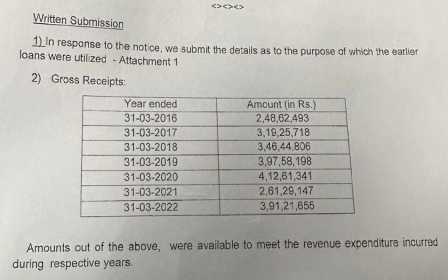
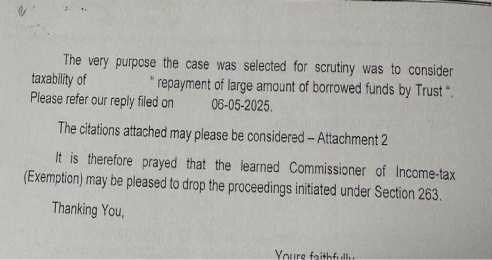
14. Even in response to the show cause notice, the assessee has failed to furnish documentary evidence to establish that the expenses incurred out of borrowed funds were utilised solely for the objects of the trust and that such expenses had not been claimed as application of income in earlier years. The assessee further contended that the case was selected for scrutiny specifically to examine the taxability of repayment of large amount of borrowed funds by the trust and, on this basis, challenged the jurisdiction of the present proceedings under section 263 of the Act. The assessee also cited certain case laws in support of its claim.
15. The assessee contended that the Assessing Officer, vide notice issued under section 142(1) of the Act, had called for details regarding repayment of borrowings and utilisation of funds, and after examining the same, accepted the returned income.
The assessee further contended that the assessment order, having been passed after due enquiry, cannot be made the subject matter of revision under section 263 of the Act. The reply of the assessee has been carefully perused and found not to be acceptable.
16. It is observed that the Assessing Officer has not conducted any enquiry to verify whether the expenses incurred out of borrowed funds had already been claimed as application of income in earlier years and the admissibility of the claim of application of income in respect of repayment of borrowed funds. Mere issuance of a questionnaire or calling for details does not amount to proper or adequate enquiry. In this regard, In this regard reliance is pleaced on the Hon’ble Supreme Court decision in the case of M/s. Daniel Merchants Pvt. Ltd. v. ITO (Appeal No. 2396/2017) dated 29.11.2017, wherein it was held that it was entirely permissible for the PCIT/CIT under section 263 to set aside the assessment and direct the AO to make necessary enquiries, where the proper enquiry had not been made while making the assessment.
17. The assessment order is squarely covered by the decision of the Hon’ble Delhi High Court in the case of CIT v. Toyota Motor Corporation (Del.) holding that order being cryptic is erroneous and prejudicial to interest of revenue. In the instant case as the order dated 09.03.2024 is a non-speaking one and sheds no light in respect of impugned issues. In view of the above, the order is definitely erroneous and prejudicial within the meaning of section 263.
18. Examination of the order sheet entries, case history notings, and other materials available on the assessment records does not reveal any discussion, verification, or finding regarding the acceptance of the assessee’s claim. As a revisionary authority, it is not possible to discern from the assessment records or folder the reasoning or basis that weighed with the Assessing Officer in allowing the claim of treating repayment of loan as application of income. In view of these facts, the assessment order suffers from a clear error of omission and lack of application of mind, thereby rendering it erroneous insofar as it is prejudicial to the interests of the Revenue within the meaning of section 263 of the Act.
19. The Hon’ble Supreme Court, in the case of Malabar Industrial Co. Ltd. v. CIT (
243 ITR 83), has held that the assumption of jurisdiction under section 263 is subject to the fulfilment of two essential conditions, namely:
| (i) |
|
the order of the Assessing Officer must be erroneous; and |
| (ii) |
|
such error must be prejudicial to the interests of the Revenue. |
20. The Hon’ble Court has further clarified that an order of the Assessing Officer can be regarded as erroneous in the following circumstances:
| i. |
|
where the order is passed on an incorrect assumption of facts or an incorrect application of law; |
| ii. |
|
where the order is passed in violation of the principles of natural justice; |
| iii. |
|
where the order is passed without proper application of mind; or |
| iv. |
|
where the Assessing Officer fails to conduct necessary inquiries or verification on issues that warranted examination in the facts and circumstances of the case. |
21. In the facts of the present case, the ratio laid down in the above decision is squarely applicable. The Assessing Officer, while completing the assessment under section 143(3) read with section 144B vide order dated 09.03.2024, failed to examine whether the borrowed funds were utilised solely for the objects of the trust and whether the expenses incurred out of such loans had already been claimed as application of income in earlier years. Thus, the assessment order has been passed without conducting proper enquiry and without due application of mind, rendering it erroneous insofar as it is prejudicial to the interests of the Revenue within the meaning of section 263 of the Act.
22. Accordingly, the assessment order passed by the Assessing Officer under section 143(3) read with section 144B of the Act, dated 09.03.2024, is hereby set aside. The Assessing Officer is directed to pass a fresh assessment order in accordance with the law within the time prescribed under the Act, after conducting necessary inquiries and verifications as discussed in the preceding paragraphs, and after affording the assessee a reasonable and adequate opportunity of being heard.
The assessee is in appeal before the Tribunal against the order of the CIT(A).
3. The primary contention of the Ld. AR is that the AO has already verified the details pertaining to the repayment of loan since the assessee’s case was selected for scrutiny in order to verify the large amount of repayments claimed as application by the assessee. The Ld. AR drew our attention to the notices issued u/s. 142(1) of the Act by the A.O calling for various details pertaining to the loans and the reply filed by the assessee. The Ld. AR further drew our attention to the details submitted with regard to the loans such as the date of borrowal, interest and repayment, utilization of the amount borrowed etc. The ld. AR argued that the A.O in the assessment order has extracted the details submitted by the assessee and after considering the said details has allowed the claim of the assessee. The ld AR further argued that the amendment to verify as to whether the assessee has claimed the utilisation of borrowed funds as application before allowing the repayment as application was introduced only from 01.04.2023 and therefore the AO’s order cannot be held to erroneous for the said reason. Accordingly, the ld. AR argued that the AO has applied his mind and has taken the conscious decision to allow the claim of the assessee and that the assessee cannot be faulted with merely for the reason that the AO has not given a detailed finding with regard to the view taken by him.
4. The Ld. Departmental Representative (DR), on the other hand, submitted that the CIT(E) has held the order to the erroneous for the reason that the AO has not verified the claim of the assessee in the light of Explanatio-4 to Section 11 of the Act. The Ld. DR further submitted that the AO has also not verified whether the assessee has claimed the expenditure incurred out of the borrowed funds as application before accepting the claim of the assessee that the repayment of loan as application. The ld. DR also submitted that mere submission details by the assessee cannot be held as the application of mind by the AO since from the perusal of the order of the AO nothing is coming out clearly as to whether the AO has examined the conditions precedent to the allowability of claim towards repayment of loan as application. Accordingly, the ld. DR submitted that the CIT(E) has correctly invoked provisions of Section 263 of the Act to hold that the order o the A.O is erroneous and prejudicial to the interest of revenue.
5. We have carefully considered the rival submissions and perused the material available on record. The revisional jurisdiction under section 263 of the Act has been invoked by the CIT(E) principally on two grounds, namely, (i) that the A.O had allowed the assessee’s claim of repayment of loan as application of income without examining whether the expenditure incurred out of such borrowing had already been treated as application in the earlier years and (ii) that the A.O had failed to verify whether the borrowed funds were utilised for charitable purposes. The question that arises for our consideration is whether these reasons render the assessment order both erroneous and prejudicial to the interests of the Revenue so as to justify the assumption of jurisdiction under section 263.
6. At the outset, it would be apposite to examine the statutory scheme as it existed for the assessment year under consideration. Explanation 4(ii) to section 11(1) of the Act, as applicable for the assessment year 2022-23, provided that application for charitable or religious purposes made out of any loan or borrowing shall not be treated as application of income and that the amount so not treated shall be regarded as application in the previous year in which such loan or borrowing is repaid out of the income of that year. Thus, under the statutory framework prevailing during the relevant assessment year, the Legislature expressly recognised the repayment of loan out of the income of the year as application of income. We notice that the provision, as it stood for the assessment year under consideration, did not prescribe any further condition requiring the A.O to examine whether the expenditure incurred out of such borrowing had already been treated as application in an earlier year before allowing the repayment as application. Likewise, Explanation 4(ii) to section 11(1) of the Act did not require the A.O, while considering the claim in the year of repayment, to once again verify the utilisation of the borrowed funds as a condition precedent for allowing such claim. The provision merely postponed the recognition of the application from the year of expenditure to the year of repayment. It did not introduce any additional statutory requirement to revisit the end use of the borrowing in the year of repayment. It is only by the Finance Act, 2023 that Parliament inserted the further provisos to Explanation 4(ii) to section 11(1) of the Act, inter alia, providing that the benefit of the first proviso would not apply where the application from loan or borrowing had been made on or before 31.03.2021 and also prescribing other qualifying conditions governing the allowability of repayment as application. These amendments were made effective from 01.04.2023. The Legislature having consciously introduced these additional restrictions prospectively, the same cannot be read into the provisions applicable to the assessment year 2022-23. A taxing statute has to be construed on the basis of the language employed by the Legislature and it is impermissible to supply words or conditions by implication. If Parliament intended that the A.O should, even for the assessment year 2022-23, examine whether the expenditure financed out of the borrowing had already been treated as application in an earlier year or impose any other qualifying condition while allowing the repayment as application, nothing prevented it from expressly providing so. The subsequent insertion of the provisos by the Finance Act, 2023 itself indicates that such conditions did not form part of the statutory scheme applicable to the assessment year under consideration.
7. In the above statutory backdrop, when we examine the assessee’s case we find that the principal reason assigned by the CIT(E) proceeds on applying to the assessment year 2022-23 a restriction which came to be introduced only with effect from 01.04.2023. In our considered opinion, the omission to conduct an enquiry which the statute itself did not mandate cannot render the assessment order erroneous and at best, the interpretation canvassed by the CIT(E) represents another possible view founded upon amendments brought into force subsequently. It is trite law that where two views are reasonably possible and the A.O has adopted one of the legally permissible views, the assessment order cannot be regarded as erroneous merely because the Commissioner prefers another view. The revisional jurisdiction under section 263 of the Act can be exercised only when the view adopted by the A.O is unsustainable in law. In the present case, the view adopted by the A.O. is not only in consonance with the statutory provisions as they stood for the assessment year under consideration but also constitutes a legally plausible view. Consequently, the assumption of jurisdiction under section 263 on the premise that the assessment order is erroneous in law is not tenable.
8. The second reason assigned by the CIT(E) is that the A.O had not verified whether the borrowed funds were utilised for charitable purposes. As already discussed, Explanation 4(
ii) to section 11(1) of the Act, as applicable for the assessment year under consideration, did not require the A.O. to undertake a fresh examination regarding the utilisation of the borrowed funds while considering the claim of repayment as application in the subsequent year. We notice that the case was selected for limited scrutiny specifically for examining the assessee’s claim of repayment of loan treated as application of income. During the course of assessment proceedings, the A.O had issued notices calling upon the assessee to furnish the relevant particulars and documentary evidences. In response thereto, the assessee furnished detailed submissions explaining the claim, the manner in which the borrowed funds had been utilised and the particulars relating to the repayment of the loan. The assessment order itself verbatim reproduces the submissions made by the assessee and thereafter records that the explanation furnished by the assessee was found acceptable and the claim was accordingly allowed. Thus, it is not a case where the A.O had accepted the claim mechanically or without conducting any enquiry. It is well settled that an A.O is not expected to mention the findings in respect of every issue examined during the course of assessment. In our view the assessment order is to be read along with the assessment records and if the records disclose that the A.O had called for the relevant details, the assessee had furnished the requisite explanation together with supporting evidences and the same had been accepted upon consideration, the mere absence of an elaborate discussion in the assessment order cannot lead to the conclusion that there was non-application of mind. Equally, the assessee cannot be prejudiced merely because the A.O has chosen not to record detailed reasons while accepting the explanation. The distinction between ‘lack of enquiry’ and ‘inadequate enquiry’ is too well settled to require elaborate discussion. While the former may justify the assumption of jurisdiction under section 263 of the Act, the latter does not. If an enquiry has in fact been conducted and the A.O has adopted a view on the basis of the material available before him, the Commissioner cannot invoke section 263 of the Act merely because he is of the opinion that some further enquiry ought to have been undertaken or because the assessment order does not contain an elaborate discussion. The principles laid down by the Hon’ble Bombay High Court in
CIT v.
Gabriel India Ltd. 203 ITR 108 (Bom) and by the Hon’ble Delhi High Court in
CIT v.
Sunbeam Auto Ltd [2011] 332 ITR 167 (Delhi) fully support this proposition.
9. In the facts of the present case, the A.O had examined the very issue for which the case was selected for scrutiny, called for the relevant particulars, considered the detailed explanation furnished by the assessee and thereafter accepted the claim. Therefore, even on facts, it cannot be said that the assessment order suffers from lack of enquiry so as to warrant invocation of revisionary jurisdiction under section 263 of the Act. Having regard to the aforesaid discussion, we are of the considered view that neither of the two grounds on which the CIT(E) has assumed jurisdiction under section 263 of the Act can be sustained. The first ground proceeds on importing into the assessment year 2022-23 statutory restrictions which came to be enacted only by the Finance Act, 2023. The second ground is contrary to the factual position emerging from the assessment records, which clearly demonstrate that the A.O had conducted the necessary enquiries and accepted the assessee’s explanation after due consideration. The view adopted by the A.O is a legally plausible view based on the provisions applicable to the relevant assessment year and cannot be characterised as erroneous merely because the CIT(E) entertains a different opinion. Consequently, the twin conditions stipulated under section 263 of the Act, namely, that the assessment order should be both erroneous and prejudicial to the interests of the Revenue, are not satisfied. We, therefore, hold that the assumption of jurisdiction under section 263 of the Act is unsustainable in law. Accordingly, the impugned revisional order is quashed and the assessment order is restored.
10. In the result, the appeal of the assessee is allowed.