ORDER
Ms. Padmavathy. S, Accountant Member.- This appeal by the assessee is against the final order of the assessment passed by Dy. Commissioner of Income Tax, Corporate Circle-1(2), Chennai (in short “AO”) passed u/s. 143(3) r.w.s 144C(8) of the Income Tax Act, 1961 (in short “the Act”) dated 26.09.2018 for Assessment Year (AY) 2014-15. The assessee raised the following grounds of appeal:
“1(a) The Order passed by the Learned (‘Ld.’) Deputy Commissioner of Income Tax, Corporate Circle 1(2), (‘DCIT’ or ‘AO’) in pursuance of the directions issued by the Hon’ble Dispute Resolution Panel (‘Ld. Panel’) under section 143(3) r.w.s. 144C(13) r.w.s 92CA of the Income-tax Act, 1961 (‘the Act’), is bad in law and on facts.
1(b) The Ld. Transfer Pricing Officer (‘TPO’) has erred in not recording an opinion that any of the conditions in section 92C(3) of the Act were satisfied in the instant case. Accordingly, the Order passed by the Ld. TPO is without jurisdiction. The Ld. Panel erred in upholding the actions of the Ld. TPO.
1(c) The Ld. TPO/AO/panel erred in law and on facts in failing to establish that the Appellant shifted profits outside India.
2. The Ld. Panel grossly erred in law and on facts by not considering the objections raised by the Appellant and in passing directions on the basis of factually incorrect statements.
The Ld AO on the facts and circumstances of the case and in law erred in initiating penalty proceedings under Section 271(1)(c) of the Act on the premise that the appellant has concealed/ furnished inaccurate particulars of income.
Transfer Pricing Grounds with regard to the IT Segment The Ld. TPO and Ld.AO, under the directions issued by the Ld. Panel
3(a) Erred in law and on facts by erroneously combining the AE and non-AE segment by arbitrarily concluding that segmental profit and loss account of the appellant is unreliable.
3(b) Erred in law and on facts by making a TP adjustment on the non-AE (third party) transactions, and in not restricting such adjustment to aggregate value of International Transactions.
3(c) Erred in law and on facts by adopting an adhoc and inconsistent approach in rejecting the segmentation of the IT segment between the AE and non-AE segments, while adopting a segmental approach for the ITeS segment. Erred in following inconsistent approach in current year vis-a-vis previous years.
3(d) The Ld. Panel erred in law and on facts by not adjudicating on the certified segmentation brought on record during the DRP proceedings. The Ld. Panel further erred in law and on facts in making factually incorrect statements that the segmentation was submitted during the proceedings with the TPO, whereas such segmentation was provided contemporaneously in the TP Study itself.
3(e) Erred on facts and in law in rejecting the following filters and search process adopted by the Appellant in the TP Study, without any basis:
(i) Upper Turnover Filter of INR 500 Crores
(ii) Export Filter of 25%
3(f) Erred in law and on facts in not allowing appropriate adjustments under Rule 10B to account for, inter alia, differences in the Functions, Assets and Risks (‘FAR’) between the Appellant and the comparables.
Erred in law and on facts by wrongly comparing the Appellant’s activities with companies operating as full-fledged entrepreneurs without considering the differences in functions performed, assets employed and risks assumed by the Appellant vis-a-vis comparable companies.
3(g) Erred in law and on facts in applying the following arbitrary filters as criterion for rejection of companies identified by the Appellant in the TP Study:
Different Financial Year-end Filter (i)
(ii) Export Filter of 75%
3(h) Erred in law and on facts in computation of margins of comparable companies by considering provision for doubtful debts as non- operating.
3(i) Erred in law and on facts in selecting the following functionally different companies, including very large companies as comparables:
(i) Infosys Limited (ii) Larsen & Toubro Infotech Ltd (iii) Mindtree Limited (iv) Persistent Systems Limited (v) Cigniti Technologies Ltd and (vi) Thirdware Solution Limited (viii) R System International Limited.
3(j) Erred in law and on facts in rejecting the following functionally comparable companies selected by the Appellant
(i) Akshay Software Technologies Ltd (ii) Helios and Matheson Information Technology Ltd (iii) Sasken Communication Technologies Ltd (iv) Evoke Technologies Private Limited (v) E-Zest Solutions Ltd and (vi) Goldstone Technologies Limited and (vii) R System International Limited
3(k) Erred in law and on facts in cherry picking abnormally high margin companies without considering their functional and risk profile.
3(i) Erred in law and on facts in using data, which was not contemporaneous and unavailable in the public domain at the time of conducting the TP study by the Appellant.
3(m) Erred in law and on facts in disregarding the application of multipleyear data while computing the margins of the comparable companies.
Transfer Pricing Grounds with regard to the ITeS Segment
The Ld. TPO and Ld.AO, under the directions issued by the Ld. Panel
4(a) Erred in law and on facts in applying an internal Transactional Net Margin Method for ITES segment, without acknowledging that there were significant differences in FAR between AE and non-AE contracts.
4(b) Erred in law and on facts in disregarding the external comparables selected by the Appellant in the TP study without providing cogent reasons.
4(c) Erred in law and on facts in using single comparable and single year for determining the arm’s length margin of the Appellant.
Erred in law and on facts in not allowing appropriate adjustments under Rule 10B to account for, inter alia, differences in the FAR between the AE and non-AE segment.
4(d) Erred in the erroneous application of +/-3% variation in calculating the variation as per the proviso to Section 92C(2) of the Act.
Ground with regard to disallowance under Section 14A
5(a) The Ld. AO erred in law and on facts by concluding the assessment without providing an opportunity of being heard to the Appellant with regard to the disallowance under section 14A of the Act. The Ld. Panel erred in upholding the same.
5(b) The Ld. AO has failed to appreciate that the interest expenditure amounting to INR 28,978 has been incurred only towards interest arising on certain delayed payments and therefore, the same is not directly attributable towards earning exempt income. Accordingly, no disallowance is warranted under Rule 8D(2)(ii) of the Rules. The Ld. Panel erred in upholding the same.
5(c) The Ld. AO has erred in law by including investments made in debt-oriented mutual funds with growth/fixed maturity plan which are not capable of yielding exempt income for the purpose of computing disallowance as per Rule 8D(2)(iii) of the Rules. The Ld. Panel erred in upholding the same.”
2. The assessee is a company engaged in the business of providing IT enabled services (ITES) and international technology services (IT) to CSS Group Companies and to third parties. The assessee filed the return of income for AY 2014-15 on 30.11.2014 declaring total income of Rs. 32,92,77,950/-. The case was selected for scrutiny, and the statutory notices were duly served on the assessee. Since the assessee had international transactions, the A.O made a reference to the Transfer Pricing Officer (TPO) to compute the Arm’s Length Price (ALP) of the international transactions. The TPO proposed the TP adjustment of Rs. 21,19,09,330/-. The AO passed the draft assessment order incorporating the transfer pricing adjustment. The AO also made disallowance u/s. 14A of the Act amounting to Rs.7,00,249/- and also disallowed the MAT credit to the tune of Rs.3,19,10,605/-. Aggrieved, the assessee filed its objections before the DRP and the DRP gave partial relief to the assessee whereby the TP adjustment in the IT segment was reduced to Rs.12,28,15,062/- from Rs.13,50,44,051/-. The DRP sustained the disallowances made u/s. 14A of the Act by the AO. The assessee is in appeal before the Tribunal against the final order of assessment passed by the AO as per the directions of the DRP.
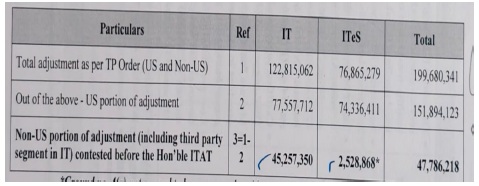
3. The assessee entered into mutual agreement procedure (MAP) under Article 25 of the India-US DTAA in respect of the transactions entered into with its US-AE and a resolution was reached by competent authorities of the respective countries. Accordingly, the appeal relating to TP adjustment covered in the MAP resolution under Rule 44G(8) was withdrawn vide letter dated 14.11.2024. The Ld. AR submitted the following table with regard to the balance TP adjustments contended in the present appeal:
4. During the course of hearing, the Ld. AR submitted that ground No. 4 pertaining to adjustment made to ITeS segment is not pressed due to smallness of the amount and that ground No.3(j) relating exclusion of certain comparables in IT segment is also not pressed. Hence these grounds are dismissed as not pressed. Ground No.1(ground-1(a) to 1(c)) are general in nature and not warranting any separate adjudication.
TP Adjustment with regard to IT segment – Ground No.3
5. For IT segment, the assessee has adopted TNMM as MAM and PLI was computed at OP/OC. The segmental margin for IT sector was computed by the assessee at 16.38% that was compared with the average margin of the comparables worked out at 13.29%, and according the assessee in the transfer pricing report concluded that the margins are within arm’s length. The TPO however rejected the TP study and held that the assessee for the purpose of comparison has segregated the IT segment between AE and non-AE subsegment which is not correct considering that the non -AE segment margin is at -14.43%. The TPO further held that the sub-segment margins computed by the assessee are based on profit and loss account which is unaudited and that the reason given by the assessee for loss in the non-AE segment is not substantiated. Therefore, rejected the segmentation between non-AE and AE and considered the overall IT segment margin of 11.40% for the purpose of making TP adjustment. The TPO also conducted an independent search to select 8 comparables whose average margin was arrived at 29.40%. Accordingly, the TPO arrived at an upward adjustment of Rs.13,50,44,051/-. The DRP gave marginal relief to the assessee whereby the TP adjustment was recomputed at Rs.12,28,15,062/-. The assessee is contending the TP adjustment on the following grounds:
Rejection of segmentation between AE & non-AE transactions
6. The Ld. AR submitted that the rejection of segmentation between AE and non-AE by the TPO is not correct since the non-AE IT segment operated as a risk bearing service provider executing losses in certain years and healthy margins in other years. The Ld. AR further submitted that the AE segment the risk is mitigated since the assessee is providing service to its own AE. The Ld. AR also submitted that segmental P & L maintained is part of the TP study submitted before the TPO which is certified by the qualified accountants and therefore, the rejection of the same on the ground that it is unaudited is not correct. The Ld. AR drew our attention to the fact that the assessee has made similar segmentation between AE and Non-AE transactions in the ITES segment also and that the TPO has accepted the said segmentation. The Ld. AR further drew our attention to the fact that the certified segmental P&L was furnished before the DRP which has not been properly appreciated. The Ld. AR submitted that the assessee’s own case for AY 2020-21 Movate Technologies (P.) Ltd. v. Dy. CIT [IT Appeal No. 2467 (Chny) of 2024, dated 16-2-2026] an identical issue has been considered by the Coordinate Bench where it is held that:
“7.5 We have heard the rival contentions and perused the material on record. Apropos we find that the segmentation was provided as part of TP Study report maintained by the Company [page 61 to 168 of paperbook]; further the Assessee had submitted the segmentation certified by another external CA along with its reply to SCN on 13.07.2023 [page 391-397 of paperbook], which is arbitrarily disregarded by the TPO by merely saying it is obtained after issuance of SCN though it was obtained and furnished before the completion of TP assessment. In fact, we are of the view that the IT Act/Rules does not mandate that audited segmental should be furnished. In support of the view, we gainfully rely on the following decisions:
7.6 The Chennai Tribunal decision in the case of M/s.3i Infotech Limited in ITA No.21/Mds/2013 has held as under:
“On the above facts, in view of the decision of the Delhi Bench of the Tribunal quoted above, we find that rate of profit achieved in other comparable cases are to be compared with the profit level declared by the Assessee in respect of its AE transactions after excluding domestic transactions.”
7.7 The Chennai Tribunal decision in the case of M/s. Honeywell Electrical Devices & Systems India Ltd. in ITA No. 2152/Mds/2011 has held as under:
“In the above facts and circumstances, we do not find any valid reason for not accepting the segmental reports in determining the ALP on the AE sales for this assessment year i.e. 2007-08 having accepted the segmentation approach for the earlier assessment years i.e. 2005-06 and 2006-07 and especially when there is no change in the facts and circumstances of the case in the current year.”
7.8 Respectfully following the above decisions we are of the view that since the Assessee has originally furnished segmental of AE as part of its TP report and also subsequently furnished audited segmental, therefore the lower authorities ought to have considered the segmental results of the AE for the purpose of benchmarking. Even the reasons given for not accepting the segmental seems to be based on conjectures and surmises. Therefore, as rightly submitted by the Assessee, we find that the margins of the AE segment is at 16% which is within the arms length range of comparable selected by the TPO i.e. 13.24% to 20.34% and therefore deleted this TP adjustment. Hence, the ground of appeal No.2 is allowed.”
7. The Ld. AR also submitted that the TPO has accepted the segmental approach which has been consistently followed by the assessee in the previous and subsequent years and therefore, applying the principle of consistently the TPO is not correct in rejecting the segmental approach for IT segment in the year under consideration.
Erroneous computation adjustment at entity level:
8. The Ld. AR submitted that the TPO for the purpose of adjustment has considered the entity level margin of the IT segment without appreciating the fact that the margin includes domestic non-AE transactions also. The Ld. AR further submitted that the TP adjustment should be restricted to the proportion of international transactions only and the adjustment cannot be computed at entity level. The ld. AR in this regard relied on the decision of the Bombay High Court in the case of CIT v. Hindustan Unilever Ltd. 325/[2017] 394 ITR 73 (Bombay) and further submitted that the SLP filed against said decision of the Hon’ble High Court is dismissed by the Hon’ble Supreme Court CIT v. Hindustan Unilever Ltd. (SC).
9. The Ld. Departmental Representative (DR), on the other hand, supported the orders of the lower authorities.
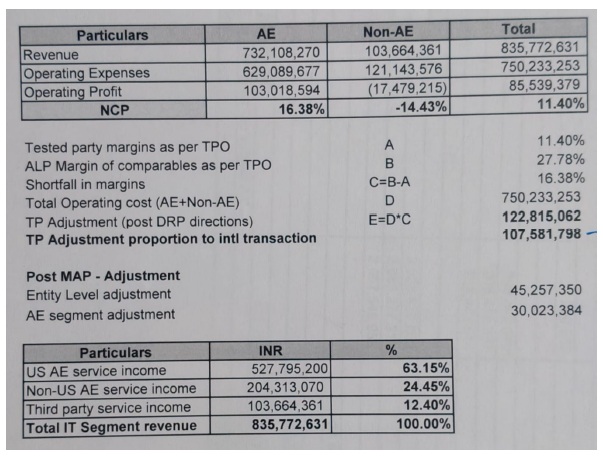
10. We heard the parties and perused the material on record. The issues for our consideration are, first, whether the TPO was justified in rejecting the segmentation of the IT segment into AE and non-AE transactions, and second, whether the TPO was justified in computing the adjustment at entity level. We notice that the TPO has rejected the segmentation on the ground that the segmental financials are unaudited and has taken the margin of 11.40% of the IT segment as a whole. This margin was compared with the margin of 27.78% of the comparables, and the shortfall of 16.38% was applied to the total operating cost of Rs.75,02,33,253, resulting in an adjustment of Rs.12,28,15,062 after the DRP directions. We further notice that the segmental profit and loss account formed part of the TP study submitted by the assessee before the TPO, and that the certified segmental financials were furnished before the DRP. We notice that an identical issue has been considered by the Coordinate Bench of this Tribunal in the assessee’s own case for AY 2020-21 [ITA No.2467/Chny/2024] where it is held that –
“7.5 We have heard the rival contentions and perused the material on record. Apropos we find that the segmentation was provided as part of TP Study report maintained by the Company [page 61 to 168 of paper book]; further the Assessee had submitted the segmentation certified by another external CA along with its reply to SCN on 13.07.2023 [page 391-397 of paper book], which is arbitrarily disregarded by the TPO by merely saying it is obtained after issuance of SCN though it was obtained and furnished before the completion of TP assessment. In fact, we are of the view that the IT Act/Rules does not mandate that audited segmental should be furnished. In support of the view, we gainfully rely on the following decisions:
7.6 The Chennai Tribunal decision in the case of M/s.3i Infotech Limited in ITA No.21/Mds/2013 has held as under:
“On the above facts, in view of the decision of the Delhi Bench of the Tribunal quoted above, we find that rate of profit achieved in other comparable cases are to be compared with the profit level declared by the Assessee in respect of its AE transactions after excluding domestic transactions.”
7.7 The Chennai Tribunal decision in the case of M/s. Honeywell Electrical Devices & Systems India Ltd. in ITA No. 2152/Mds/2011 has held as under:
“In the above facts and circumstances, we do not find any valid reason for not accepting the segmental reports in determining the ALP on the AE sales for this assessment year i.e. 2007-08 having accepted the segmentation approach for the earlier assessment years i.e. 2005-06 and 2006-07 and especially when there is no change in the facts and circumstances of the case in the current year.”
7.8 Respectfully following the above decisions we are of the view that since the Assessee has originally furnished segmental of AE as part of its TP report and also subsequently furnished audited segmental, therefore the lower authorities ought to have considered the segmental results of the AE for the purpose of benchmarking. Even the reasons given for not accepting the segmental seems to be based on conjectures and surmises. Therefore, as rightly submitted by the Assessee, we find that the margins of the AE segment is at 16% which is within the arms length range of comparable selected by the TPO i.e. 13.24% to 20.34% and therefore deleted this TP adjustment. Hence, the ground of appeal No.2 is allowed.”
11. From the perusal of the above findings it is notice that the Coordinate Bench considered that the segmentation was furnished as part of the TP study report and that the segmentation certified by an external chartered accountant was furnished before the completion of the TP assessment. The Coordinate Bench further held that the TPO had arbitrarily disregarded the certified segmentation merely because it was obtained after the issue of the show cause notice, and that the Act and the Rules do not mandate that audited segmental financials should be furnished. It is contended that for the year under consideration the certified segmental financials were furnished by the assessee before the DRP and that the DRP has not properly appreciated the same. In this regard it is also relevant to note that the segmental profit and loss account, which forms the basis of the segmentation, was part of the TP study report furnished before the TPO and the certification only authenticates the figures already forming part of the TP study. Further, in our considered view the absence of audit is not by itself a ground to reject the segmentation, as held by the Coordinate Bench, and the stage at which the certification was furnished cannot make the data unreliable.
12. We further notice that the assessee has made a similar segmentation between AE and non AE transactions in the ITeS segment in the same year, and that the TPO has accepted the said segmentation. We are of the view that when the TPO has accepted the approach for one segment, he cannot reject it for the IT segment without pointing out any difference in the manner in which the segmental data is maintained or certified. We also notice from the submissions of the Ld. AR that the AE and non-AE transactions in the IT segment have different risk profiles. The non-AE segment, in which the assessee renders services to third parties, operates as a risk bearing service provider, whereas in the AE segment the risk is mitigated since the services are provided to the AE of the assessee. This is borne out by the segmental results furnished before us. In the year under consideration, the AE segment has earned an operating profit of Rs.10,30,18,594 on an operating cost of Rs.62,90,89,677, resulting in a margin of 16.38%. The non-AE segment has incurred an operating loss of Rs.1,74,79,215 on an operating cost of Rs.12,11,43,576, resulting in a negative margin of 14.43%. The margin of 11.40% computed by the TPO is therefore only a blend of two segments with widely different results. Rule 10B(1)(e)(i) of the Rules provides that under the TNMM the net profit margin realised by the enterprise from the international transaction entered into with the AE is to be computed and compared with that of the comparables. Further, Rule 10B(2) requires the functions performed, assets employed and risks assumed to be considered for comparability. In such a scenario, we are of the view that the margin of 11.40% computed by the TPO, which combines the AE and non-AE transactions, would distort the margin of the international transaction, which is the transaction to be tested, and the margin of the AE segment is the appropriate margin to be compared with the comparables. It is also noticed that the assessee has followed the segmentation between AE and non AE transactions consistently in the earlier years and in the subsequent years, and the TPO has accepted the approach and has not made any adjustment in the subsequent years. We are conscious that each assessment year is a separate unit, but when the facts remain the same and no change in the functions or the manner of segmentation is pointed out, there is no reason to take a different view in the year under consideration.
13. We now take up the second issue, namely the computation of the adjustment at entity level. The Ld. AR relied on the decision of the Hon’ble Bombay High Court in Hindustan Unilever Ltd. (supra), and submitted that the SLP against the said decision was dismissed by the Hon’ble Supreme Court Hindustan Unilever Ltd. (supra). We notice that the Hon’ble High Court, has considered its own decisions in various other cases to lay down the ratio with regard to issue of justifiability of application of Arms Length Price (ALP) only to A.E. transactions and not to all transactions in that decision. The ld AR during the course of hearing submitted that the non-AE transactions also includes certain domestic transactions and therefore considering the margin at entity level may not be correct. Considering the overall facts and circumstances we are of the view that income arising from an international transaction is to be computed having regard to the arm’s length price, where the adjustment is required to be confined to the international transactions with AE and not to the margin at entity level which includes domestic and international transactions with non-AEs also. In such a scenario, we are of the view that the margin of 11.40% computed by the TPO, which includes the non-AE transactions, and the adjustment computed on that basis at entity level, is not correct. During the course of hearing the ld AR submitted the following table explaining the anomaly in the ALP computation done by the TPO and to explain the correct amount that ought to have been considered –
14. In view of the above discussion, we hold that the rejection of the segmentation of the IT segment into AE and non-AE transactions is not justified, and that the adjustment cannot be computed at entity level. We accordingly direct the TPO to accept the segmentation, to examine the above working, and to recompute the arm’s length price of the AE transactions on the basis of the margin of the AE segment. The adjustment, if any, shall be restricted to the AE transactions and shall take into account the effect of the MAP as reflected in the working, after giving the assessee a reasonable opportunity of being heard. The grounds raised by the assessee on these issues are accordingly allowed for statistical purposes.
Upper turnover filter to be applied at 200 Crores:
15. The Ld. AR submitted that the TPO has conducted fresh search of comparables and while doing so has not applied the filter of upper turnover. The Ld. AR further submitted that it is a settled position that the turnover filter of INR 200 Crores should be applied for the purpose of selecting the comparables since the turnover impacts the FAR analysis. The Ld. AR placed reliance on the decision of the Hon’ble Madras High Court in the case of CIT v. Visual Graphics Computing Services India (P.) Ltd. 481 (Madras) and the decision of the Bengaluru Bench of the Tribunal in the case of SAP Labs India (P.) Ltd. v. Jt. CIT (Bangalore – Trib.).
16. We have heard the parties, and perused the material available on record. We notice that the Coordinate Bench in the case of Kumaran Systems (P.) Ltd. v. Dy. CIT 191 ITD 514 (Chennai – Trib.) has considered an identical issue where it is held that:
“8. We have heard both the sides, perused materials available on record and gone through orders of the authorities below. It is a well settled principle of law by various decisions of Courts and Tribunal that upper turnover filter of Rs. 200 crores has to be adopted, while selecting the comparable set of companies, for the purpose of benchmarking under TNMM method. Further, Dun and Bradstreet’s analysis has classified software companies into 3 categories based on their turnover, as per which, small size firms are classified on the basis of turnover of Rs. 2,000 and upto Rs. 200 crores, medium size firms has been classified between Rs. 200 to Rs. 2000 crores and large size firms has been classified based on turnover of above Rs. 2000 crores. The Hon’ble Madras High Court in the case of Visual Graphics Computing Services India (P.) Ltd. (supra), held that the Appellate Tribunal has rightly rejected comparables based on turnover filter criteria. The Hon’ble High Court while dealing with the issue, has considered the decision of Hon’ble Bombay High Court in the case of CIT v. Pentair Water India (P.) Ltd 381 ITR 216, wherein it was stated that a giant company in the area of development of software cannot be compared with assessee, which is having a small turnover. Although, the Id. DRP has relied upon the decision of ITAT, Bangalore in the case of Genisys Integrating Systems (India) (P.) Ltd. v. Dy. CIT 53 SOT 159, but fact remains that in the latest decision, the ITAT, Bangalore Bench in the case of Autodesk (1)(P.) Ltd. (supra), has considered similar issue and after analyzing various judgments of different High Courts and Tribunals held that turnover filter is a good criteria to exclude comparables and hence, as per the settled principles, a high turnover company cannot be compared with a small turnover company. This being the case, the assessee which is having a small turnover and also catering to the needs of its AEs cannot be compared with giant companies like Mindtree Ltd., Persistent Systems Ltd., R S Software (India) Ltd., etc., which are having huge turnover. Further, the asset base including tangibles and intangibles, their brand value and area of operation would definitely have a bearing on the operating margin of the company because, they in general, provide services to various clients across the globe, whereas the assessee company limited its services to its AEs. In this case, admittedly, the assessee has a turnover of Rs. 33.24 crores, whereas the TPO has included 4 comparables whose turnover ranges from Rs. 207 crores to Rs. 3,032 crores, which is almost more than 6 times to 91 times of the turnover of the assessee and hence, we are of the considered view that the TPO as well as the Id.DRP has erred in not applying turnover filter for selection of comparables and hence, we direct the TPO to apply turnover filter of 0 to 200 crores for selection of comparables and recompute margin of the assessee. In case, the TPO finds that after application of turnover filter, operating margin of the assessee is within admissible range then, we direct the TPO to delete addition made towards TP adjustment.”
17. We further notice that a similar view has been held by the Coordinate Bench in the case of Symantec Software & Services India (P.) Ltd. v. Dy. CIT (Chennai – Trib.). From the perusal of the TPO’s order, we notice that the TPO has not applied the upper turnover filter and that the TPO has recorded a finding with regard to comparable with substantial turnover stating that the turnover will not have any impact from the margins. We are unable to agree with the said finding since the turnover has direct impact on the assets and the risk and therefore the contention that the turnover does not have an impact on the margin is not tenable. Therefore, respectfully following the above judicial precedence, we direct the TPO to apply the upper turnover filter of 200 crores while selecting the comparables and recompute the ALP accordingly.
Disallowance u/s. 14A – Ground No.5:
18. The AO noticed that the assessee is having investments to the tune of Rs. 20,84,19,357/- as per the financial statements as on 31.03.2025. The A.O held that the investments are capable of earning exempt income and therefore computed a disallowance u/s. 14A r.w Rule 8D to make a disallowance of Rs.7,00,249/-.
19. We have heard the parties, and perused the material available on record. With regard to disallowance made Rule 8D(2)(ii) of the Rules towards interest, it is submitted by the Ld. AR that the assessee is having sufficient own funds, we notice from the perusal of financial statements that the assessee for financial year ending 31.03.2014 is having shareholder funds of Rs.156,12,95,829/-, whereas the investments stood at Rs.20,84,19,357/-. Therefore, we see merit in the submission that the disallowance u/s. 14A of the Act r.w Rule 8D(2)(ii) of the Rules towards interest is not warranted. With regard to disallowance under Rule 8D(2)(iii) regarding indirect expenses, the Ld. AR submitted that the AO has considered the entire investments for the purpose of disallowance whereas only those investments earning exempt income only should be considered for the purpose of computing the disallowance. The Ld. AR submitted a working in support of the said contention:
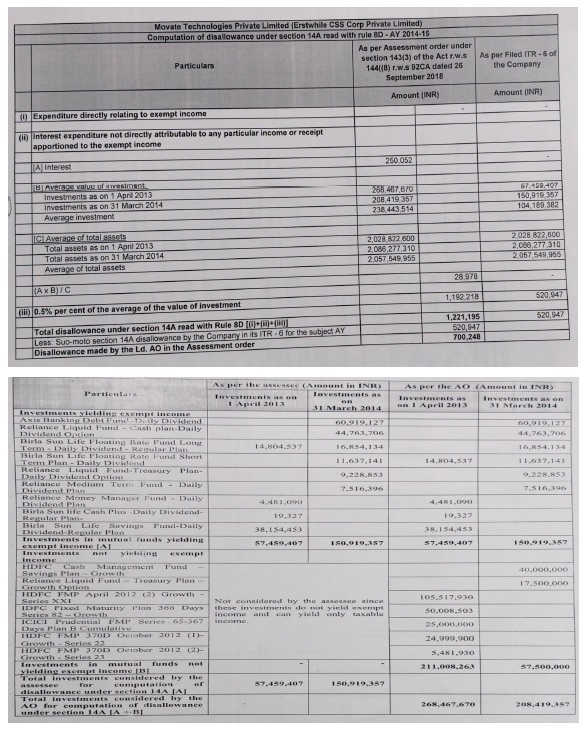
20. It is a settled position that for the purpose of computing disallowance under Rule 8D(2)(iii) only those investments earning exempt income are to be considered as has been held in the case of Asstt. CIT v. Vireet Investment (P.) Ltd 165 ITD 27 (Delhi – Trib.)(SB). Accordingly, we direct the A.O to consider only those investments which are earning exempt income as submitted by the assessee in the above workings after due verification of the same. It is ordered accordingly.
21. In the result, the appeal of the assessee is partly allowed.