ORDER
Om Prakash Kant, Accountant Member.- This appeal by the assessee is directed against the final assessment order dated 13th January 2026, passed by the Assessment Unit, Income-tax Department (hereinafter referred to as “the Assessing Officer” or “the AO”) under section 143(3) read with section 144C(13) of the Income-tax Act, 1961 (“the Act”), for the Assessment Year (“AY”) 2022-23, in pursuance of the directions dated 23rd December 2025 issued by the learned Dispute Resolution Panel (“DRP”). The assessee has raised the following grounds:
Final assessment order barred by limitation
On the facts and in circumstances of the case and in law, the learned AO erred in not passing the final assessment order within the time limit prescribed under section 153 of the Act which is the outer time limit for passing the final assessment order and hence, the final assessment order dated 13 January 2026 which is passed after 31 March 2025 (being the time limit as per the provisions of Section 153 of the Act) is time barred and liable to be quashed.
| i. |
|
Adjustment to the Arm’s Length Price (ALP) |
On the facts and circumstances of the case and in law, the learned AO/Transfer Pricing Officer (“TPO”) has erred in making an upward transfer pricing adjustment of INR 7,78,12,548 in respect of the international transaction of payment of interest on compulsory convertible debentures (“CCDs”), on the following grounds:
2.1. The learned AO/TPO and the Hon’ble DRP erred in re characterizing the nature of CCDs as an equity instrument without appreciating the actual terms of CCDs and the fact that CCDs are debt instruments until conversion into equity.
2.2. The learned AO/TPO and the Hon’ble DRP erred in rejecting the economic analysis of the Appellant undertaken in accordance with the provisions of the Act and erred in adopting the ‘Other Method’ as the most appropriate method to determine the arm’s length price of impugned transaction, without undertaking any comparability analysis.
2.3. The learned AO/TPO have erred in considering that the Appellant failed to treat CCDs as borrowing merely because the principal amount received at issuance of CCDs was reported as capital financing transaction under Clause 16 of Form no. 3CEB
| ii. |
|
Rejecting the Applicant’s claim for deduction of bad debts written off |
On the facts and circumstances of the case and in law, the learned AO and Hon’ble DRP erred in proposing to reject the Assessee’s claim to deduction for bad debts written off of INR 21,65,961 claimed under section 36(1) (vii) of the Act.
| iii. |
|
Initiation of penalty proceedings under section 270 A |
On the facts and circumstances of the case and in law, the learned AO erred in initiating penalty proceedings under section 270A of the Act for the additions/ disallowances made in the Final Assessment Order.
Each of the grounds of appeal referred to above is separate and may kindly be considered independent of each other.
The Appellant craves leave to add, alter, amend or withdraw all or any of the grounds of appeal herein above and to submit full statement, documents and papers as may be considered necessary either on or before the hearing of this appeal as per the law.
2. Briefly stated facts of the case are thatthe assessee, Andromeda Sales and Distribution Private Limited, is engaged in the business of retail loan distribution as a Direct Selling Agent (DSA) for various scheduled banks and Non-Banking Financial Companies (NBFCs). The assessee acts as an intermediary by sourcing prospective borrowers for a wide range of retail lending products, including housing loans, loans against property, loans against shares, automobile loans, unsecured business loans and personal loans. For such services, it earns commission and brokerage from the lending institutions upon sanction and disbursement of loans. It is not in dispute that no commission or brokerage is recovered from the retail borrowers, the entire revenue of the assessee being derived from banks and NBFCs.
2.1 The assessee filed its return of income for the year under consideration on 25th November 2022, declaring a total income of Rs.13,94,78,590/-. The return was selected for scrutiny through the Computer Assisted Scrutiny Selection (CASS) mechanism, and statutory notices issued under the Act were duly complied with.During the course of assessment proceedings, the Assessing Officer noticed that the assessee had entered into international transactions with its Associated Enterprises (“AEs”). Consequently, after obtaining the requisite approval from the competent authority, the matter was referred to the learned Transfer Pricing Officer (“TPO”) under section 92CA of the Act for determination of the arm’s length price of the international transactions.
2.2 The learned TPO, vide order dated 22nd January 2025, proposed an adjustment of Rs.7,78,12,548/- in respect of the international transaction relating to payment of interest on Compulsorily Convertible Debentures (CCDs). Taking into consideration the aforesaid transfer pricing adjustment, together with the proposed disallowance of Rs.21,65,961/- towards bad debts written off, the Assessing Officer passed a draft assessment order dated 19th March 2025 under section 144C(1) of the Act proposing variations to the returned income on the following issues:(i) disallowance of deduction in respect of bad debts written off amounting to Rs.21,65,961/-; and(ii) transfer pricing adjustment of Rs.7,78,12,548 relating to payment of interest on Compulsorily Convertible Debentures.
2.3 Aggrieved by the proposed variations, the assessee filed objections before the learned DRP. However, the objections did not find favour with the Panel. Pursuant to the directions issued by the learned DRP, the Assessing Officer passed the impugned final assessment order making the transfer pricing adjustment of Rs.7,78,12,548/- and disallowing the claim of bad debts written off amounting to Rs.21,65,961/-. Aggrieved by the said final assessment order, the assessee is in appeal before us on the grounds reproduced hereinabove.
3. At the time of hearing, the learned counsel for the assessee filed a paper book comprising pages 1 to 456.
Ground No. 2 – Transfer Pricing Adjustment
4. Ground No. 2 relates to the transfer pricing adjustment of Rs.7,78,12,548/- made in respect of the international transaction of payment of interest on Compulsorily Convertible Debentures (“CCDs”). The grievance of the assessee is three-fold, namely, (i) the re-characterisation of the CCDs as equity instruments instead of debt instruments; (ii) rejection of the transfer pricing analysis undertaken by the assessee, including the Comparable Uncontrolled Price (“CUP”) method adopted as the Most Appropriate Method (“MAM”), and the consequential adoption of the “Other Method” by the Transfer Pricing Officer (“TPO”); and (iii) the finding that the CCDs could not be regarded as borrowings merely because the principal amount received on their issuance was disclosed in Form No. 3CEB as a capital financing transaction.
4.1 Briefly stated, the relevant facts are that the assessee, Andromeda Sales and Distribution Private Limited, is a company incorporated on 28th April 2008 under the provisions of the Companies Act, 1956. It is engaged in the business of providing financial distribution services by facilitating access to retail lending products and promoting financial inclusion across metropolitan, urban and semi-urban markets. During the relevant previous year, the assessee entered into various international transactions with its Associated Enterprises (“AEs”), including the transaction relating to payment of interest on CCDs, which was reported in Form No. 3CEB as under:
| Sr. No. |
Description of transactions |
Amount in INR |
Method Adopted by Assessee |
| 1 |
Interest paid on Compulsory Convertible Debentures (‘CCDs’) issued |
7,78,12,548/- |
Comparable Uncontrolled Price (‘CUP’) method |
| 2 |
Buy back of compulsory convertible debentures |
40,00,00,000/- |
Other method |
4.2 The assessee did not furnish a fresh Transfer Pricing Study Report (“TPSR”) for the year under consideration on the ground that the impugned transaction had already been benchmarked in the TPSR prepared for Assessment Year 2020-21 and there was no material change either in the terms of the instrument or in the underlying contractual arrangement.The assessee submitted that during the Financial Year 2019-20, it had issued 4,64,38,560 Compulsorily Convertible Debentures of Rs.10 each to its Associated Enterprise, M/s Geosansar Mauritius Limited (“Geosansar”). The CCDs were compulsorily convertible into equity after ten years from the date of issuance at the agreed conversion price. For benchmarking the payment of interest on the CCDs, the assessee adopted the Comparable Uncontrolled Price (CUP) Methodas the Most Appropriate Method and relied upon external comparable transactions obtained from the publicly available database of the National Securities Depository Limited (NSDL).According to the assessee, the agreed coupon rate of 10.75% fell within the arm’s length range of 10% (35th percentile) to 15% (65th percentile) determined on the basis of eleven independent comparable CCD issuances, which were analysed at the time of the determination of the arms length rate of the interest on issue of the CCD during the AY year 2020-21. It was further contended that since neither the terms of the CCD agreement nor the underlying commercial arrangement had undergone any modification during the year under consideration, a fresh benchmarking exercise was unnecessary. Accordingly, the assessee maintained that the payment of interest at the rate of 10.75% during the relevant previous year satisfied the arm’s length standard prescribed under Chapter X of the Act.
4.3 The essence of the TPO’s reasoning may be succinctly summarised as under:
| (i) |
|
Hybrid Nature of CCDs: The CCDs were reported as a capital financing transaction in clause 16 of Form No. 3CEB and, according to the TPO, constituted hybrid instruments possessing both debt and equity characteristics, warranting examination of their true commercial substance. |
| (ii) |
|
Substance over Form: Since the funds raised through the CCDs were utilised for investment in the equity of a group concern, the TPO held that the transaction was, in substance, an equity infusion disguised as debt to claim interest deduction. |
| (iii) |
|
Alternative Mode of Equity Infusion: The TPO regarded CCDs as quasi-equity instruments commonly recognised by investors and credit rating agencies, particularly because they did not envisage repayment of principal but ultimately resulted in conversion into equity. |
| (iv) |
|
Control and Shareholding: The Associated Enterprise held 91.31% of the assessee’s equity share capital and exercised effective control over its management, which, according to the TPO, reinforced the equity character of the CCDs. |
| (v) |
|
Rights Attached to the Instrument: Referring to the Rule 18(3) of the Companies (Share Capital and Debentures) Rules, 2014, the TPO observed that the provision of appointing one nominee director by the Debenture trustee subject tocertain conditions , is also a right akin to equity shareholder thus having attribute of a equity transaction and thus such right flowing from the CCD arrangement, when read with the dominant shareholding of the Associated Enterprise, conferred attributes substantially akin to those of an equity shareholder. |
| (vi) |
|
Predominant Equity Features: The absence of security, contractual nature of interest, and the provision for conversion of the CCDs into equity led the TPO to conclude that the instruments possessed predominant equity characteristics rather than those of a conventional debt instrument. |
4.4 On the basis of the above analysis, the TPO concluded that the CCD holder enjoyed rights substantially similar to those of an equity shareholder and that the substance of the transaction prevailed over its legal form. Accordingly, he held that the CCDs were, in essence, equity instruments.Relevant observation of the TPO is reproduced as under:
” 4. From the above analysis, it can be observed that there are clauses which grant the CCDs holders rights similar to equity shareholders. Vide this Agreement, and by virtue of ultimate shareholding the CCDs holder i.e., AE can control the composition of the Board of Directors and thus, they can effectively manage and supervise the affairs of the company. These CCDs are normally subordinated to secured debts and such subordinated debt requires higher interest payments to compensate for higher risk taken by debenture holder. However, in present case, the interest rates are lower and the debenture holders are compensated for higher risks by giving them effective control over management of the company. At the same time, there is no liability to repay the principal amounts. There is existing coupon rate to be paid, based on fulfilment of certain conditions. All these conditions and features indicate that these CCDs have a clear character of Equity.
4.5 The ld TPO further observed that :
“5………………..
However, from the perusal of relevant clauses of the Agreement it can’t be said that these CCDs are purely debt instruments. Though there is no direct reference to voting rights, but the management of company is controlled by debenture holders by exercising full voting rights by virtue of being an holding company of assessee with 91.31% voting rights and in full control of the business. Though there is interest rate decided, but such interest payments are conditional. The assessee claims that only interest accrues to debenture holders before conversion, which is not correct; as the debenture holders get control over the Board of Directors too even before conversion. Also, CCDs will have preference over equity but it is not pari-passu to other secured borrowings. The assessee states that legally they are called ‘unsecured, unrated, unlisted and redeemable Optionally Convertible Debenture’; but in the present case, the principle of “substance over form” needs to be applied.”
4.6 In support of the above conclusion, the TPO also placed reliance upon the provisions of the Foreign Exchange Management (Non-Debt Instruments) Rules, 2019, particularly Rule 2(k), wherein convertible debentures are included within the expression “equity instruments”. Further he referred to Rule 2 (ai) defining “non-debt instruments means all investment in equity instrument in incorporated entities, public, private, listed and unlisted.
4.7 Further, the ld TPO relied upon the accounting treatment prescribed under Indian Accounting Standard (Ind AS) 32 and the Guidance Note issued by the Institute of Chartered Accountants of India (ICAI). According to the TPO, an instrument evidencing a residual interest in the assets of an entity after deducting all liabilities assumes the character of an equity instrument, and the CCDs issued by the assessee satisfied that description by reason of their compulsory conversion into equity. Accordingly, the Ld. TPO interpreted that all instruments including convertible preference shares and convertible debentures meet the definition of the equity as per Ind AS-32 in its entirety and when they do not have any component of the liability, should be considered as having the nature of the equity for the purpose of Ind AS Schedule III, such instruments shall be of termed as instruments entirely equity in nature. In view of the above interpretation, the Ld. TPO was of the view that the CCD are more of equity in nature as those instruments are compulsorily converted into equity shares of the company, which evidences the residual interest assets of the company.
4.8 The TPO further observed that the conversion feature embodied in the CCDs created an obligation to issue equity shares in accordance with the predetermined conversion formula and, therefore, the instrument possessed an overriding equity component. On this reasoning, he concluded that the CCDs were liable to be treated entirely as equity instruments for transfer pricing purposes. The relevant observation of Ld. TPO is reproduced as under;-
“……………….
In the instant case the conversion feature of the CCDs clearly a contractual obligation to pay cash that the issuer (the Company) cannot avoid, since the conversion into own equity shares is compulsory. The conversion ratio for the purpose of the conversion is also dependent on the share price of the Company at the time of conversion. The equity conversion feature can only be settled through the issue of equity shares and there is an obligation to issue a fixed number of shares based on the predetermined ratio and rates. Therefore, the conversion component in the instrument would not meet the criteria laid down in Ind AS 32 for the purpose of classifying as equity. Accordingly, the CCDs issued by assessee meet the criteria for being classified as equity instrument as there is a clear and full equity component. Therefore, the CCDs should be classified as Equity Instrument in entirety.”
4.9 Having thus held that the CCDs were essentially equity instruments, the TPO rejected the benchmarking analysis undertaken by the assessee under the CUP Method. According to him, the assessee failed to undertake reasonably accurate adjustments as contemplated under Rule 10B(3) of the Income-tax Rules, 1962, to account for the material differences between a conventional debt instrument and a hybrid instrument incorporating an embedded equity option.According to him, the nature and the characteristics of financial instrument is the most important factor, which determines its interest rate. Though credit rating also influences the interest rate, the nature of the financial instrument cannot be known while identification of the comparable of the benchmarking purposes. The Ld. TPO referred to Rule 10B(3) and stated that the contractual payments are one of the important factor in judging the comparability of the international transaction. The TPO noted that in the benchmarking study conducted by the assessee, the important clauses of the debenture agreement and its impact of the pricing of the funds had not been considered by the assessee. He submitted that the assessee neither considered the peculiar clauses of its Debenture Agreement nor considered the credit ratings of the comparable, while undertaking the benchmarking analysis
4.10 The TPO observed that the assessee had benchmarked the transaction merely by comparing coupon rates of other CCD issuances available in the NSDL database without assigning any value to the embedded option available to the Associated Enterprise to convert the instrument into equity. According to him, such an option conferred valuable commercial rights and could not be assumed to have a nil value. He further observed that recognised valuation methodologies, including the ‘Black-Scholes’, ‘Binomial Option Pricing’, and ‘Monte Carlo Simulation models’, were available for valuing such embedded options; however, the assessee had neither undertaken such valuation nor furnished any working to demonstrate that the value of the conversion option was insignificant.The TPO, therefore, held that the benchmarking exercise undertaken by the assessee did not satisfy the requirements of section 92C read with Rule 10B and rejected the transfer pricing analysis under section 92C(3) of the Act, observing as under:
“The assessee has benchmarked the effective interest rate on the CCDs based on NSDL data bases. However, it is to be pointed out that such determination of interest Rate is not reliable as it has not considered the debt and equity part of the instruments.
Valuation of “option” to subscribe to equity shares of company at a future date is not considered.
In the show cause notice issued to the assessee, it was specifically pointed out that by using other CCDs as comparables under CUP method for benchmarking interest on CCDs issued, the assessee has implied that the value of the “option to subscribe to equity” available with the AE is NIL. The value of such an option can’t be treated as NIL, as it has significant and unique benefits to the AE in the form of option to convert the same into capital on certain terms which are favorable vis-a-vis the terms available to independent enterprises.
The right to subscribe to equity shares of the company can’t be treated as Nil. The holder of such option enjoys the right to subscribe to the shares at a time convenient to the holder. The rights given is a pre-emptive right in which they get an option to subscribe to the capital in the company in order to protect their existing shareholding percentage There exists various valuation models such as Black-Scholes, binomial option pricing, and Monte-Carlo simulation for pricing the options. A premium is calculated based on these option pricing models. To say that the AE derives no benefit from the option would be incorrect, as the AE can effectively ensure its continued ownership of equity of the company even if the CCDs are converted. Therefore, the argument that “option to subscribe to equity” has NIL value is not acceptable.
Therefore, the benchmarking analysis for determining the ALP of the interest rate by the assessee in its TPSR as well as submissions during the course of Transfer Pricing Proceedings is rejected as no reasonably accurate adjustments are made to eliminate the material effects of differences between the features of CCDs by the assessee were made. Also, the assessee has failed to maintain and submit workings of the embedded value of option in the CCDS to this office and the calculation of the effective interest rate is not reliable. Thus, as per Section 92C(3) (a), Section 92C(3)(b) and Section 92C(3)(c) of the Income Tax Act, the prices charged in the international transaction of charging interest on CCDs have not been determined by the assessee in accordance with sub-sections (1) and (2) of Section 92C of the Income Tax Act, 1961.”
4.11 Thereafter, the ld. TPO proceeded to determine the arm’s length price by adopting the “Other Method” as the Most Appropriate Method, placing reliance upon the decision of the Chennai Bench of the Tribunal in Ascendas (India) (P. )Ltd. v. Dy. CIT, Company Circle-I(1) 143 ITD 208 (Chennai – Trib.). Proceeding on the premise that the CCDs were, in substance, equity instruments, the TPO treated the arm’s length price of the interest attributable to the equity component as Nil and consequently proposed an adjustment of Rs.7,78,12,548, being the entire amount of interest paid by the assessee on the CCDs during the relevant previous year.
4.12 The learned DRP, after considering the objections of the assessee, affirmed the approach adopted by the Transfer Pricing Officer and rejected all the objections raised in relation to the transfer pricing adjustment. The principal findings recorded by the DRP may be summarised thus.
4.13 The DRP held that the Compulsorily Convertible Debentures (“CCDs”), though described as debentures, were in substance equity instruments and not borrowings. According to the DRP, the CCDs were compulsorily convertible into equity after a stipulated period, carried; no obligation for repayment of principal; were unsecured and subordinated in nature; and conferred substantial economic and commercial benefits upon the Associated Enterprise (“AE”), which already held controlling interest in the assessee-company. Considering these features cumulatively, the ld. DRP concluded that the economic substance of the instrument was that of an equity contribution rather than a debt obligation.
4.14 The ld. DRP further observed that the benchmarking analysis undertaken by the assessee under the Comparable Uncontrolled Price (“CUP”) Method proceeded on the erroneous premise that the CCDs were pure debt instruments. According to the Panel, the assessee had failed to account for the significant differences between the CCDs issued by it and the comparable instruments relied upon, particularly in relation to repayment obligations, embedded conversion rights, subordination and other contractual attributes materially affecting pricing. Consequently, the benchmarking analysis was held to be unreliable and was rejected.
4.15 The ld. DRP concurred with the Transfer Pricing Officer that the “Other Method” prescribed under Rule 10AB was the most appropriate method in the facts of the case. Proceeding on the premise that an independent enterprise would not pay interest on an instrument which, in commercial substance, represented equity, the DRP upheld the determination of the arm’s length price of the impugned interest payment at Nil, thereby affirming the adjustment of Rs.7,78,12,548 proposed by the Transfer Pricing Officer.
4.16 While affirming the above adjustment, the DRP also observed that the assessee itself had reported the principal amount received on issuance of the CCDs as a capital financing transaction in Form No.3CEB, which, according to the Panel, was consistent with the true character of the instrument as an equity infusion rather than a borrowing.
4.17 In support of the aforesaid conclusions, the learned DRP placed reliance upon the decisions of the Hon’ble Supreme Court in Narendra Kumar Maheshwari v. Union of India (1990) Supp SCC 440 : AIR 1990 SC 1480, Sahara India Real Estate Corpn. Ltd. v. SEBI 115 SCL 478 (SC),IFCI Ltd. v. Sutanu Sinha [2024] 182 SCL 27 (SC),and Ferro Alloys Corporation Ltd. v. A.P. State Electricity Board [(1993) 4 SCC 136 : AIR 1993 SC 2005 ], to hold that Compulsorily Convertible Debentures (“CCDs”) are hybrid instruments possessing predominant attributes of equity and do not partake the character of conventional borrowings. The Panel also referred to the provisions of the Foreign Exchange Management (Non-Debt Instruments) Rules, 2019, the SEBI (Issue of Capital and Disclosure Requirements) Regulations, Indian Accounting Standard (Ind AS) 32, the OECD Transfer Pricing Guidelines, and the judgment of the Hon’ble Delhi High Court in CIT v. EKL Appliances Ltd. (Delhi), to conclude that the economic substance of the transaction justified treating the CCDs as equity for transfer pricing purposes.
4.18 The learned DRP further held that, quite apart from sustaining the transfer pricing adjustment, the payment described as interest on the CCDs was not allowable under the normal provisions of the Act. According to the Panel, the CCDs did not constitute “capital borrowed” within the meaning of section 36(1)(
iii) of the Act and, therefore, the claim of deduction was not admissible thereunder. In support of this proposition, reliance was also placed upon the decision of the Special Bench of the Tribunal in
Ashima Syntex Ltd. v.
Asstt. CIT [2006] 100 ITD 247/102 TTJ 177 (Ahmedabad – ITAT)(SB). The Panel further observed that the allowability of the expenditure was also liable to be examined under section 37(1) of the Act and, accordingly, directed the Assessing Officer to consider the claim under the regular provisions of the Act, while ensuring that no double disallowance was made in respect of the same amount.
4.19 Accordingly, the objections preferred by the assessee were rejected and the Assessing Officer was directed to complete the assessment in conformity with the directions issued by the DRP.
5. We have carefully considered the rival submissions, perused the orders of the authorities below and the material placed on record. We have also examined the judicial precedents relied upon by both sides.The controversy before us lies within a narrow compass. The principal question requiring adjudication is whether the Compulsorily Convertible Debentures (“CCDs”) issued by the assessee to its Associated Enterprise could be re-characterised as equity instruments for the purposes of determining the arm’s length price under Chapter X of the Act. Consequential to the said issue is the question whether the Transfer Pricing Officer was justified in rejecting the Comparable Uncontrolled Price (“CUP”) Method adopted by the assessee and in determining the arm’s length price of the interest payable on the CCDs at Nil by invoking the “Other Method” prescribed under Rule 10AB of the Income-tax Rules, 1962.
5.1 The learned counsel for the assessee submitted that the controversy is no longer res integra and stands squarely covered by the recent decisions of the Coordinate Benches of the Tribunal. Particular reliance was placed upon the decision of the Mumbai Bench in Indorama Ventures Oxides Ankleshwar (P.) Ltd. v. Assessment Unit, Income-tax Department / DCIT (Mumbai – Trib.)/ITA Nos. 4023 & 4024/Mum/2024, as also upon the subsequent decision of the Mumbai Bench in EBIXCASH World Money Ltd. v. Dy. CIT (Mumbai – Trib.), wherein, on substantially identical facts, it has been held that CCDs cannot be re-characterised as equity merely because they are compulsorily convertible at a future date and that the Transfer Pricing Officer has no jurisdiction to disregard the legal character of the instrument and determine the arm’s length price of interest at Nil. For ready reference finding in the case of EBIXCASH World Money Ltd (supra) is reproduced as under:
“8. We have considered the rival submissions of both the parties sand have gone through the orders of lowers authorities carefully. We have also deliberated on various case laws relied by Id AR of the assessee. We find that there is no dispute that during the relevant financial year under consideration, the assessee issued CCDs of Rs. 849.49 Crore to Ebix Asia Holding Inc, Mauritius at an interest @ 9% per annum. The assessee paid total interest of Rs. 76.45 Crore. To substantiate ALP of such interest payment the assessee furnished its TPSR in Form-3ECB. We find that TPO disregarded the benchmarking of the transaction and other objections of assessee for making reference for ALP by holding that that CCDs are equity-like and therefore, interest could not be allowed. It was also held that the substance of transaction is different from its form. The nomenclature of instrument is Compulsory Convertible Debenture, but a detailed analysis of contractual term reveals that the actual substance of the instrument is an equity instrument. The TPO vide its order dated 25th January 2025 determined ALP of interest at the Nil, resulting into transfer pricing adjustment of Rs. 76.45 crore. The DRP confirmed the action of TPO. We find that the grounds of appeal raised by assessee is in fact covered by a series of decisions of Tribunal and High Courts wherein it is consistently held that CCDs cannot be treated as equity and interest in respect of CCD cannot be disallowed by TPO. Similar view of taken by Mumbai Tribunal in Indorama Ventures Oxides Ankleshwar (P.) Ltd. (supra) where assessee issued CCDs to its AE to finance acquisition of business undertaking of an unrelated party and revenue made transfer pricing adjustment on account of alleged option premium arising on alleged sale of embedded call option to AE, it was held that in absence of any income (notional or otherwise) in nature of options premium, transfer pricing adjustment could not be made. We also find that Hon’ble Bombay high Court in HDFC Bank Ltd. (supra) also held that where assessee-bank had made a ‘rights issue’ of Fully Convertible Debentures (FCDs), expenditure incurred by assessee on issue of said FCDs was to be allowed as deduction. We further find that Hon’ble Bombay High Court followed the decision of Delhi High Court in Havells India(supra) Delhi wherein it was held that expenditure incurred on issue of debentures is to be allowed as revenue expenditure despite indications to effect that debentures are to be converted in near future into equity shares. Thus, respectfully following the decision of Tribunal High Courts, we find that the grounds of appeal raised by the assessee in fact covered in favour of the assessee. Hence, we direct the AO/TPO to delete the entire addition/ adjustment in the assessment order on account of interest expenses. In the result, grounds of appeal of assessee are allowed.”
5.2 We have carefully examined the aforesaid decisions. We find that in EBIXCASH World Money Ltd. (supra), after considering the entire scheme of Chapter X, the principles governing transfer pricing, the decision of the Hon’ble Delhi High Court in EKL Appliances Ltd. (supra), as well as the earlier decisions of the coordinate Benches, the Tribunal held that CCDs continue to retain the character of debt till the stage of conversion and that the Transfer Pricing Officer cannot disregard the legal form of the transaction merely on the basis of its perceived economic substance so as to determine the arm’s length price of interest at Nil.Likewise, in Indorama Ventures Oxides Ankleshwar Pvt. Ltd. (supra), the coordinate Bench, after considering the reliance placed by the Revenue upon the FEMA Regulations, RBI Circulars, Indian Accounting Standards (Ind AS), and the concept of thin capitalisation, categorically held that such regulatory provisions, enacted for purposes distinct from income-tax legislation, cannot be imported for re-characterising a valid borrowing transaction for transfer pricing purposes. The Tribunal further held that till the date of conversion, CCDs continue to represent debt instruments and the interest paid thereon is required to be examined in accordance with the provisions of the Act. The relevant finding of Tribunal (supra) is reproduced as under;-
“We considered the addition made under section 36(1) (iii) of the Act. The assessee submitted that the interest was paid to AE for CCDs till conversion to the equity share. But the Ld.TPO has changed the characteristics of the CCDs to an equity share. So, the re-characterization and transaction is beyond the jurisdiction of the Ld.TPO. Respectfully followed the order of the Hon’ble Delhi High Court in EKL Appliances Ltd(supra). The Ld. DRP got the concept of thin capital and relied on the circular No.74 dated 08/06/2007 issued by the RBI wherein the RBI stated that the instructions which are fully and mandatorily convertible into equity would be treated as part of equity under foreign direct investment policy. The circular is duly applied on that CCDs and treated as equity for Indian transfer pricing process. But the revenue has failed to appreciate the context of the circular which was to prevent the Indian companies for raising debt by means of issuing optional convertible debentures without complying with the conditions specified under the applicable ‘External Commercial Borrowing’ regulations. So, the said circular is not applicable for the assessee. In factual relation, the interest under section 36(1) (iii) related to CCDs which are a debt instrument until its conversion and the interest paid on CCDs should be considered as interest on borrowing for section 36(1) (iii) of the Act. Respectfully followed the order of Sahara India Real Estate Corpn. Ltd (supra). And finally, the CCDs are utilized for the purpose of business for payment of purchase consideration for acquisition of business undertaking from HIIPL as an ongoing concern on a slump sale basis and entire transaction is guided by the CCDs
subscription agreement. Further, it is placed that the RBI took on record related to issue AE under automatic approval route of RBI. The assessee Suo-motu disallowed an amount of Rs.1,55,02,844/ out of total interest paid of Rs.1,91,34,247/-in accordance with thin capitalization rule under section 94B of the Act during filing the return of income. We find that there is no wrong in the submission of the Ld.AR. We respectfully follow the order of the co-ordinate bench of ITAT, Bangalore in the case of CAE Flight Training India Pvt Ltd (supra), wherein the coordinate bench of ITAT has explicitly rejected reliance on that RBI policy / FEMA guidelines adopted by the revenue for recharacterizing CCDs as ‘equity’ for tax purposes. The Ld. DR has not rebutted the submission of the Id. AR by submitting any contrary judgment. The addition was made on account of the company following adjustments are duly set aside and liable to be quashed. In our considered view, the grounds of the assessee are succeeded.
26. In the result, the appeal of the assessee bearing ITA No. 4023/Mum/2023 is allowed.
5.3 We find that the controversy involved in the present appeal is materially identical to that considered by the coordinate Benches in the aforesaid decisions. The reasons assigned by the learned TPO as well as the learned DRP, namely, the compulsory conversion feature of the CCDs, absence of repayment obligation, reliance upon FEMA (Non-Debt Instruments) Rules, 2019, Ind AS-32, OECD Guidelines and the concept of “substance over form”, have all been specifically considered and rejected by the coordinate Benches.Significantly, no decision of the Hon’ble jurisdictional High Court or of the Hon’ble Supreme Court taking a contrary view has been brought to our notice by the Revenue. Judicial discipline demands that, in the absence of any distinguishing feature or contrary binding precedent, we follow the view consistently taken by the coordinate Benches.
5.4 We note that the learned DRP relied upon the decisions of the Hon’ble Supreme Court in Narendra Kumar Maheshwari (supra), Sahara India Real Estate Corporation Ltd. (supra), IFCI Ltd. (supra)and Ferro Alloys Corporation Ltd. (supra). In our considered opinion, the reliance placed upon the aforesaid decisions is misplaced. None of the said judgments was rendered in the context of determination of the arm’s length price under Chapter X of the Act, nor do they lay down any proposition that Compulsorily Convertible Debentures must invariably be regarded as equity for all purposes under every statute.
5.5 The issue before the Hon’ble Supreme Court in Narendra Kumar Maheshwari (supra) arose in the context of the Companies Act and the validity of issuance of compulsorily convertible debentures. Likewise, Sahara India (supra) was concerned with the regulatory jurisdiction of SEBI over optionally/fully convertible debentures under the securities law framework. In IFCI Ltd. (supra), the controversy arose under the Insolvency and Bankruptcy Code, 2016, where the Court examined the nature of CCDs for determining the status of a claimant in corporate insolvency proceedings. Similarly, Ferro Alloys Corporation Ltd. (supra) was rendered in an altogether different statutory setting concerning the legal incidents of debentures. These decisions, therefore, were rendered in the light of the object, scheme and purpose of the respective enactments governing those disputes.
5.6 Transfer pricing provisions contained in Chapter X of the Act constitute a self-contained code intended to determine the arm’s length price of international transactions between associated enterprises. The exercise contemplated therein is fundamentally one of benchmarking the pricing of an actual transaction and not of rewriting or disregarding a legally valid transaction except in the limited circumstances recognised by law. As explained by the Hon’ble Delhi High Court in EKL Appliances Ltd. (supra), the tax administration ordinarily has to respect the transaction actually undertaken by the parties and cannot substitute or re-characterise it merely because another commercial structure appears more appropriate. The recognised exceptions permitting re-characterisation are narrow and must be applied with circumspection.
5.7 In the present case, the Revenue has not demonstrated that the impugned transaction falls within any of the recognised exceptions warranting disregard of its legal character. On the contrary, the coordinate Benches in Indorama Ventures Oxides Ankleshwar Pvt. Ltd. (supra) and EBIXCASH World Money Ltd. (supra), after considering the aforesaid Supreme Court decisions, the FEMA Regulations, RBI Circulars, OECD Guidelines and Ind AS-32, have consistently held that the character of CCDs as debt instruments till conversion cannot be disregarded for determining the arm’s length price under Chapter X. Respectfully following the said decisions, we are unable to concur with the reasoning adopted by the learned TPO and affirmed by the learned DRP.
5.8 Respectfully following the decisions of the coordinate Benches in Indorama Ventures Oxides Ankleshwar Pvt. Ltd. (supra) and EBIXCASH World Money Ltd. (supra), we hold that the Transfer Pricing Officer was not justified in re-characterising the CCDs as equity instruments merely because they were compulsorily convertible into equity at a future date. Consequently, the foundation on which the arm’s length price of the interest payment was determined at Nil does not survive.
5.9 We accordingly hold that the CCDs issued by the assessee are required to be examined as debt instruments till their conversion, and the arm’s length price of interest thereon cannot be determined by first re-characterising the transaction as an equity infusion.
5.10 Having reached the aforesaid conclusion, the next question which arises is with regard to determination of the arm’s length price of the impugned international transaction.
5.11 We find that the learned TPO rejected the benchmarking undertaken by the assessee under the CUP Method solely because he proceeded on the premise that the CCDs were, in substance, equity instruments. Once the very basis of such re-characterisation is held to be unsustainable, the rejection of the CUP Method on that ground alone cannot be sustained.
5.12 At the same time, we notice that the Transfer Pricing Officer has not examined the comparability analysis furnished by the assessee on its own merits. The suitability of the comparable transactions, the adjustments, if any, required under Rule 10B, and the correctness of the benchmarking exercise undertaken by the assessee have not been independently examined, as the entire exercise stood eclipsed by the erroneous assumption that the transaction itself was in the nature of equity.
5.13 In these circumstances, we are of the considered opinion that the ends of justice would be adequately served by restoring the issue to the file of the learned Transfer Pricing Officer for examination limited to the determination of the arm’s length price of the impugned international transaction by treating the CCDs as debt instruments and by examining the benchmarking analysis furnished by the assessee under the CUP Method or such other legally permissible method as may be found appropriate in accordance with the provisions of section 92C of the Act read with Rule 10B of the Income-tax Rules, 1962.Needless to observe, the learned TPO shall afford adequate opportunity of hearing to the assessee, consider all evidences and judicial precedents relied upon by it, and thereafter determine the arm’s length price by passing a speaking order in accordance with law.Accordingly, Ground No. 2 is allowed for statistical purposes.
Ground No. 3 – Disallowance of Bad Debts Written Off
6. Ground No. 3 challenges the disallowance of Rs.21,65,961/-representing bad debts written off under section 36(1)(vii) of the Income-tax Act, 1961.
6.1 During the course of assessment proceedings, the Assessing Officer noticed that the assessee had debited a sum of Rs.21,65,961/- in the Profit and Loss Account towards bad debts written off. The explanation furnished by the assessee was that the amounts represented old outstanding receivables which, despite repeated follow-up, had become commercially irrecoverable and were accordingly written off pursuant to the decision of the management. The Assessing Officer, however, was not satisfied with the explanation. According to him, since the concerned parties continued to remain regular customers of the assessee and business transactions with them had continued during the relevant previous year, the debts could not be regarded as bad or irrecoverable. He, therefore, disallowed the claim.
6.2 The learned DRP affirmed the aforesaid disallowance substantially on the ground that the assessee had failed to establish the commercial ir-recoverability of the debts by producing documentary evidence such as correspondence with the debtors, recovery notices, reminder letters or other material evidencing efforts for recovery. According to the Panel, the continued business relationship with the concerned parties militated against the assessee’s claim that the debts had become bad. The DRP further held that the decisions of the Hon’ble Supreme Court in
T.R.F. Ltd. v.
CIT [2010] 230 CTR 14/323 ITR 397 391 (SC) and the Hon’ble Bombay High Court in
DIT (International Taxation) v.
Oman International Bank SAOG [2009] 223 CTR 382/313 ITR 128/184 (Bombay) were inapplicable to the facts of the case and instead placed reliance upon the decision of the Hon’ble Supreme Court in
Pr. CIT v.
Khyati Realtors (P.) Ltd. [2022] (SC) to sustain the disallowance. The relevant finding of ld DRP is reproduced as under:
” The Panel notes that Hon’ble Supreme Court in PCIT v. Khyati Realtors (P) Ltd. (2022) held that a write-off cannot be allowed as a bad debt where the assessee fails to establish that the advance or receivable arose in the ordinary course of its business, or that the write-off satisfies the statutory requirements of clause 36(1)(vii). The Court emphasised that the mere act of writing off the amount in the books does not make it allowable if the underlying transaction is not a trading debt or lacks commercial justification. It also held that where the assessee continues to engage with the same party, or fails to produce material demonstrating irrecoverability, the write-off cannot be treated as a deductible bad debt.
Applying this principle to Andromeda, the Panel notes that the Assessee has not demonstrated that the receivables written off for Rs. 21,65,961/- had become commercially irrecoverable. The debtors are admitted to be regular and continuing clients. Transactions continued during the year. No material evidencing disputes, defaults, cessation of business, inability to recover, or any commercial failure has been produced. As in Khyati Realtors, the Assessee has relied solely on the fact of Further, as in the Supreme Court case, there is no evidence that the write-off arose in write-off,” without establishing business circumstances that justify irrecoverability. the ordinary course of business exigencies that rendered the amounts genuinely bad. The absence of communications, reminders, legal notices, settlement attempts, or any recovery effort contradicts the Assessee’s claim. A unilateral entry without supporting facts does not satisfy clause 36(1) (vii). The reasoning adopted by the Supreme Court squarely applies: where the Assessee fails to demonstrate that the write-off meets the statutory conditions or occurred in the course of regular business, the claim must be rejected.
The Panel also notes that CBDT Circular 12/2016 clarifies the legislative intention to reduce litigation, but it does not remove the requirement of bona fide write-off. The Assessee must demonstrate that the write-off is not arbitrary or colourable. In the present case, the absence of recovery efforts, the absence of debtor communications, continuing business relationships, and the lack of any evidence of disputes or settlement failures indicate that the write-off lacks commercial basis.
The Panel therefore agrees with the AO that the amounts cannot be regarded as bad debts under clause 36(1)(vii), even after the amendment, as the foundational requirement of “irrecoverability” supported by business circumstances has not been met.
Based on the examination of the draft assessment order, written submissions of the Assessee, and material available on record, the Panel upholds the disallowance of Rs. 21,65,961/-. The AO has correctly concluded that the Assessee has failed to substantiate the claim of bad debts and that the write-off is not supported by commercial evidence. The Panel agrees that continuing business transactions negate the claim of irrecoverability and that deduction cannot be granted merely on a unilateral write-off without factual backing. Further, consistent with the binding principle in Khyati Realtors (supra) laid down by the Hon’ble Apex court, Andromeda’s claim of bad debt is not allowable. The Assessing Officer is correct in disallowing the claim.”
6.3 The learned counsel for the assessee submitted that the issue is no longer res integra. He invited our attention to CBDT Circular No. 12/2016 dated 30th May 2016, issued in the light of the judgment of the Hon’ble Supreme Court in TRF Ltd. (supra), clarifying that after the amendment made by the Direct Tax Laws (Amendment) Act, 1987, with effect from 1 April 1989, it is no longer necessary for an assessee to establish that the debt has in fact become irrecoverable and that the deduction under section 36(1)(vii) is allowable once the debt is written off as irrecoverable in the books of account and the conditions prescribed under section 36(2) stand satisfied.
6.4 We have given our thoughtful consideration to the rival submissions and have carefully perused the material available on record.The controversy, in our opinion, lies in a narrow compass. The question is whether, after the amendment of section 36(1)(vii) with effect from 1 April 1989, the assessee is still required to establish, by independent evidence, that the debt had become irrecoverable notwithstanding the fact that the debt has been written off in its books of account.
6.5 In our considered opinion, the answer to the aforesaid question stands concluded by the judgment of the Hon’ble Supreme Court in TRF Ltd. (supra), wherein the Hon’ble Apex Court has unequivocally held that, after the aforesaid amendment, it is no longer necessary for the assessee to establish that the debt has actually become irrecoverable and that it is sufficient if the bad debt is written off as irrecoverable in the books of account of the assessee. The aforesaid legal position has also been accepted by the Central Board of Direct Taxes in Circular No.12/2016 dated 30 May 2016, wherein the Board has specifically directed that the legislative intent behind the amendment was to eliminate litigation on the issue of irrecoverability and that deduction under section 36(1)(vii) shall be allowed where the debt is written off in the books of account and the conditions of section 36(2) are fulfilled.
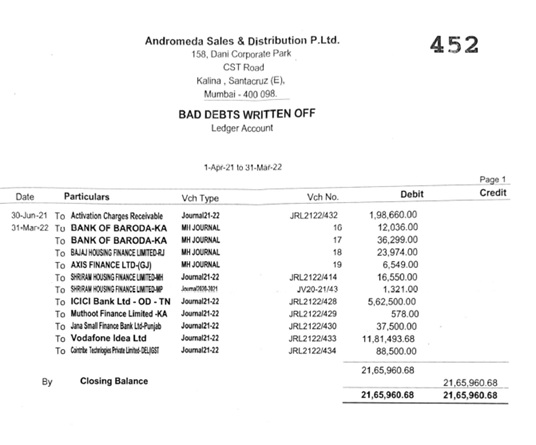
6.6 In the present case, the Revenue has not disputed that the amounts in question represented trade receivables arising in the ordinary course of the assessee’s business. It is equally undisputed that the impugned amounts have been debited to the Profit and Loss Account and the corresponding debtor accounts have been credited, thereby effecting an actual write-off in the books of account.
6.7 The learned counsel has invited our attention to page 452 of the paper book containing the ledger account evidencing the writeoff of the outstanding amount. For ready reference said ledger account is reproduced as under:
6.8 Further, from pages 407 to 451 of the paper book, we find that corresponding entries have been passed in the individual debtor accounts by crediting the amounts written off, thereby completely extinguishing the receivables from the books of account. Thus, the statutory requirement of actual write-off stands duly satisfied. For ready refrence, paper book page 452 which is a ledger of the bad debt written off in respect of Vodafone Idea Ltd. is reproduced as under:
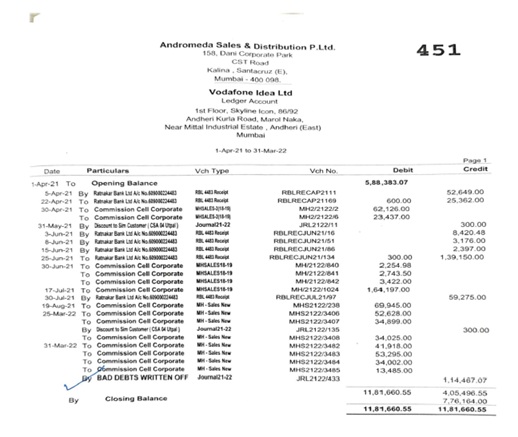
6.9 We are unable to subscribe to the reasoning adopted by the learned DRP that the continued business relationship with the concerned parties, or the absence of legal notices, correspondence or recovery proceedings, is sufficient to deny the deduction. Such a requirement would, in substance, reintroduce the very condition of proving irrecoverability which the Legislature consciously omitted by the amendment effective from 1 April 1989 and which has been authoritatively interpreted by the Hon’ble Supreme Court in TRF Ltd. (supra).
6.10 Commercial prudence may legitimately require an assessee to continue business with an existing customer while simultaneously writing off specific old receivables found to be commercially unrecoverable. The continuance of commercial dealings with a customer does not, by itself, establish that every outstanding invoice remains recoverable. The Income-tax Act does not mandate that an assessee must terminate its business relationship with a customer before claiming deduction under section 36(1)(vii).
6.11 We also find that the reliance placed by the learned DRP on the decision of the Hon’ble Supreme Court in Khyati Realtors (P.) Ltd. (supra) is misplaced. That decision turned upon its own peculiar facts where the amount claimed did not satisfy the statutory requirements of section 36(1)(vii) read with section 36(2), and the Hon’ble Supreme Court found that the assessee had failed to establish that the amount represented a trading debt arising in the ordinary course of business. The said decision does not dilute or overrule the ratio laid down in TRF Ltd. (supra) regarding the legal effect of a bona fide write-off after the amendment of section 36(1)(vii). The facts of the present case stand on an entirely different footing, as the impugned amounts admittedly represent trade receivables arising in the ordinary course of the assessee’s business and have been actually written off in the books of account.
6.12 In view of the foregoing discussion, we hold that the assessee has duly complied with the statutory requirements prescribed under section 36(1)(vii) read with section 36(2) of the Act. The disallowance sustained by the Assessing Officer and affirmed by the learned DRP is, therefore, unsustainable in law. We accordingly direct the Assessing Officer to delete the addition of Rs.21,65,961/-.Accordingly, Ground No. 3 is allowed.
7. Ground No. 4, relating to initiation of penalty proceedings under section 270A of the Act, is merely consequential. Since the issue pertains only to initiation of penalty proceedings, the same is premature for adjudication at this stage and is, accordingly, dismissed as infructuous.
8. Since the assessee has substantially succeeded on the issues arising in the present appeal, we do not consider it necessary to adjudicate Ground No. 1, challenging the validity of the assessment on the ground of limitation. The said ground is left open, with no opinion expressed thereon.
9. In the result, the appeal of the assessee is allowed partly for statistical purposes.