ORDER
Ravish Sood, Judicial Member. – The present appeal filed by the assessee society is directed against the order passed by the Commissioner of Income Tax (Appeals), National Faceless Appeal Centre, Delhi (for short, “CIT(A)”), dated 01/10/2025, which in turn arises from the order passed by the Assessing Officer (for short, “AO”) under section 147 r.w.s 144B of the Income Tax Act, 1961 (for short, “the Act”), dated 06/12/2023. The assessee society has assailed the impugned order of the CIT(A) on the following grounds of appeal:
| 1) |
|
The order of the learned Commissioner of Income Tax (Appeals) is contrary to the facts and also the law applicable to the facts of the case. |
| 2) |
|
The learned Commissioner of Income Tax (Appeals) is not justified in disallowing deduction under section 80P even though the return was filed in response to notice u/s 148 of the Act. |
| 3) |
|
The learned Commissioner of Income Tax (Appeals) is not justified in dismissing the appeal for alleged non-response from the appellant without adjudicating the matter on merits. |
| 4) |
|
The appellant craves leave to add to, alter, amend, modify, delete, all OR any of the above grounds of appeal. |
Also, the assessee society has raised the following additional grounds of appeal:
| 1. |
|
“On the facts and in the circumstances of the case, the order passed u/s 148A(d) and notice issued u/s 148 dated 07.04.2022 for AY 2018-19, having been issued beyond three (3) years without proper sanction as required u/s 151(ii), are bad in law, and consequently the reassessment proceedings initiated pursuant thereto are liable to be quashed.” |
| 2. |
|
“On the facts and in the circumstances of the case, the notice issued u/s 148A(b) dated 24.03.2022 did not provide the mandatory minimum period of 7 clear days for compliance and therefore the same is invalid in law and consequently the entire reassessment proceedings are liable to be quashed.” |
| 3. |
|
“On the facts and in the circumstances of the case, the notice u/s 148 dated 07.04.2022 by the Jurisdictional Assessing Officer (JAO) is not legally valid and liable to be quashed as the same ought to have been issued by the Faceless Assessing officer (FAO) in terms of section 151A of the Act.” |
2. As the assessee society/appellant has sought our indulgence for adjudicating the aforesaid issues, which are purely legal issues and would not require looking any further beyond the facts available on record, we have no hesitation in admitting the same. Our view is fortified by the judgment of the Hon’ble Supreme Court in National Thermal Power Corporation Company Limited v. CIT 229 ITR 383 (SC).
3. Succinctly stated, the AO based on information that the assessee society during the subject year had carried out substantial financial transactions, viz., (i) cash withdrawals (including through bearer’s cheque) from its current account with The Krishna District Cooperative Central Bank Limited: Rs.1,75,14,500/-; (ii) cash deposits (including through bearer’s cheque) in its current account held with The Krishna District Cooperative Central Bank Limited: Rs.2,96,500/-; (iii) time deposits with The Krishna District Cooperative Central Bank Limited: Rs.15,00,000/-; (iv) cash deposits in one or more accounts with The Krishna District Cooperative Central Bank Limited: Rs.1,90,41,342/-; and (v) receipt of commission or brokerage income: Rs.26,73,180/-, initiated proceedings under section 147 of the Act. Thereafter, the AO passed an order under section 148A(d) of the Act, dated 07/04/2022. Notice under section 148 of the Act, dated 07/04/2022, was issued to the assessee. In compliance, the assessee society filed its return of income on 05/05/2022, declaring NIL income (after claiming deduction under Chapter-VIA).
4. Thereafter, the AO vide his order passed under section 147 r.w.s. 144B of the Act, dated 06/12/2023, after declining the assessee’s claim for deduction under section 80P of the Act, determined its income at Rs. 33,51,754/-.
5. Aggrieved, the assessee society carried the matter in appeal before the CIT(A) but without success.
6. The assessee society, aggrieved with the order of the CIT(A), has carried the matter in appeal before us.
7. We have heard the Learned Authorized Representatives of both parties, perused the orders of the lower authorities and the material available on record.
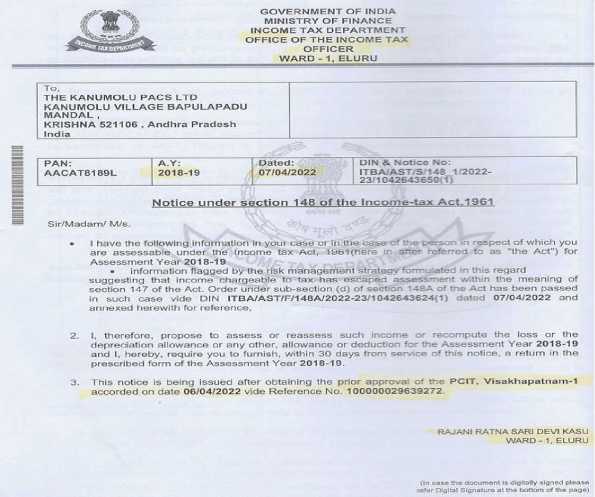
8. Shri R Siva Rama Krishna, Learned Authorized Representative (for short, “Ld. AR”) for the assessee society, at the threshold of hearing of the appeal, submitted that the AO had grossly erred in law and facts of the case in assuming jurisdiction and framing the impugned assessment vide his order passed under section 147 r.w.s 144B of the Act, dated 06/12/2023. Elaborating on his contention, the Ld. AR submitted that the AO had issued a notice under section 148 of the Act, dated 07/04/2022, without obtaining approval of the specified authority as contemplated under section 151(ii) of the Act. The Ld. AR, to buttress his contention, drew our attention to the notice issued by the AO, i.e., ITO, Ward-1, Eluru, under section 148A(b) of the Act, dated 24/03/2022, Page Nos. 0204 of APB. Further, attention was drawn to the order passed by the AO under section 148A(d) of the Act, dated 07/04/2022, Page Nos.05-07 of APB. Also, the Ld. AR had drawn our attention to the notice under section 148 of the Act, dated 07/04/2022, Page No.8 of APB, which revealed that the Income Tax Officer, Ward-1, Eluru had issued the said notice after obtaining the prior approval of the Principal Commissioner of Income Tax, Visakhapatnam-1, accorded on 24/03/2022, vide Reference No.100000029639272. Apart from that, the order passed under section 148A(d) of the Act also states that it was passed with the prior approval of the Principal Commissioner of Income Tax, Visakhapatnam. For the sake of clarity, we deem it fit to cull out the notice u/s 148 dated 07.04.2022, as under:-
9. At this stage, it would be relevant to point out that nothing has been placed on our record by the Ld. DR to rebut the aforesaid factual position as had been brought to our notice.
10. Apropos the challenge of the Ld. AR regarding the validity of the jurisdiction assumed by the A.O. for initiating proceedings u/s. 147 of the Act, i.e., without obtaining the approval of the specified authority u/s. 151(ii) of the Act, we find substance in the same. Admittedly, the reassessment proceedings u/s. 147 of the Act had been revamped vide the Finance Act, 2021 w.e.f. 01.04.2021. The substituted Sections 147 to 149 and Section 151 of the Act, applicable w.e.f. 01.04.2021 are culled out as under:
“Income escaping assessment-
147. If any income chargeable to tax, in the case of an assessee, has escaped assessment for any assessment year, the Assessing Officer may, subject to the provisions of sections 148 to 153, assess or reassess such income or recompute the loss or the depreciation allowance or any other allowance or deduction for such assessment year (hereafter in this section and in sections 148 to 153 referred to as the relevant assessment year).
Explanation.—For the purposes of assessment or reassessment or recomputation under this section, the Assessing Officer may assess or reassess the income in respect of any issue, which has escaped assessment, and such issue comes to his notice subsequently in the course of the proceedings under this section, irrespective of the fact that the provisions of section 148A have not been complied with.”. Issue of notice where income has escaped assessment
148. Before making the assessment, reassessment or recomputation under section 147, and subject to the provisions of section 148A, the Assessing Officer shall serve on the assessee a notice, along with a copy of the order passed, if required, under clause (d) of section 148A, requiring him to furnish within such period, as may be specified in such notice, a return of his income or the income of any other person in respect of which he is assessable under this Act during the previous year corresponding to the relevant assessment year, in the prescribed form and verified in the prescribed manner and setting forth such other particulars as may be prescribed; and the provisions of this Act shall, so far as may be, apply accordingly as if such return were a return required to be furnished under section 139:
Provided that no notice under this section shall be issued unless there is information with the Assessing Officer which suggests that the income chargeable to tax has escaped assessment in the case of the assessee for the relevant assessment year and the Assessing Officer has obtained prior approval of the specified authority to issue such notice.
Explanation 1.—For the purposes of this section and section 148A, the information with the Assessing Officer which suggests that the income chargeable to tax has escaped assessment means,—
(i) any information flagged in the case of the assessee for the relevant assessment year in accordance with the risk management strategy formulated by the Board from time to time;
(ii) any final objection raised by the Comptroller and Auditor General of India to the effect that the assessment in the case of the assessee for the relevant assessment year has not been made in accordance with the provisions of this Act.
Explanation 2.—For the purposes of this section, where,—
(i) a search is initiated under section 132 or books of account, other documents or any assets are requisitioned under section 132A, on or after the 1st day of April, 2021, in the case of the assessee; or
(ii) a survey is conducted under section 133A, other than under subsection (2A) or subsection (5) of that section, on or after the 1st day of April, 2021, in the case of the assessee; or
(iii) the Assessing Officer is satisfied, with the prior approval of the Principal Commissioner or Commissioner, that any money, bullion, jewellery or other valuable article or thing, seized or requisitioned under section 132 or under section 132A in case of any other person on or after the 1st day of April, 2021, belongs to the assessee; or
(iv) the Assessing Officer is satisfied, with the prior approval of Principal Commissioner or Commissioner, that any books of account or documents, seized or requisitioned under section 132 or section 132A in case of any other person on or after the 1st day of April, 2021, pertains or pertain to, or any information contained therein, relate to, the assessee, the Assessing Officer shall be deemed to have information which suggests that the income chargeable to tax has escaped assessment in the case of the assessee for the three assessment years immediately preceding the assessment year relevant to the previous year in which the search is initiated or books of account, other documents or any assets are requisitioned or survey is conducted in the case of the assessee or money, bullion, jewellery or other valuable article or thing or books of account or documents are seized or requisitioned in case of any other person. Explanation 3.—For the purposes of this section, specified authority means the specified authority referred to in section 151.”
Conducting inquiry, providing opportunity before issue of notice under section 148-
“148A. The Assessing Officer shall, before issuing any notice under section 148,— (a) conduct any enquiry, if required, with the prior approval of specified authority, with respect to the information which suggests that the income chargeable to tax has escaped assessment;
(b) provide an opportunity of being heard to the assessee, with the prior approval of specified authority, by serving upon him a notice to show cause within such time, as may be specified in the notice, being not less than seven days and but not exceeding thirty days from the date on which such notice is issued, or such time, as may be extended by him on the basis of an application in this behalf, as to why a notice under section 148 should not be issued on the basis of information which suggests that income chargeable to tax has escaped assessment in his case for the relevant assessment year and results of enquiry conducted, if any, as per clause (a); (c) consider the reply of assessee furnished, if any, in response to the showcause notice referred to in clause (b);
(d) decide, on the basis of material available on record including reply of the assessee, whether or not it is a fit case to issue a notice under section 148, by passing an order, with the prior approval of specified authority, within one month from the end of the month in which the reply referred to in clause (c) is received by him, or where no such reply is furnished, within one month from the end of the month in which time or extended time allowed to furnish a reply as per clause (b) expires:
Provided that the provisions of this section shall not apply in a case where,—
(a) a search is initiated under section 132 or books of account, other documents or any assets are requisitioned under section 132A in the case of the assessee on or after the 1st day of April, 2021; or
(b) the Assessing Officer is satisfied, with the prior approval of the Principal Commissioner or Commissioner that any money, bullion, jewellery or other valuable article or thing, seized in a search under section 132 or requisitioned under section 132A, in the case of any other person on or after the 1st day of April, 2021, belongs to the assessee; or
(c) the Assessing Officer is satisfied, with the prior approval of the Principal Commissioner or Commissioner that any books of account or documents, seized in a search under section 132 or requisitioned under section 132A, in case of any other person on or after the 1st day of April, 2021, pertains or pertain to, or any information contained therein, relate to, the assessee.
Explanation.—For the purposes of this section, specified authority means the specified authority referred to in section 151.”
Time limit for notice-
“149. (1) No notice under section 148 shall be issued for the relevant assessment year,—
(a) if three years have elapsed from the end of the relevant assessment year, unless the case falls under clause (b);
(b) if three years, but not more than ten years, have elapsed from the end of the relevant assessment year unless the Assessing Officer has in his possession books of account or other documents or evidence which reveal that the income chargeable to tax, represented in the form of asset, which has escaped assessment amounts to or is likely to amount to fifty lakh rupees or more for that year:
Provided that no notice under section 148 shall be issued at any time in a case for the relevant assessment year beginning on or before 1st day of April, 2021, if such notice could not have been issued at that time on account of being beyond the time limit specified under the provisions of clause (b) of subsection (1) of this section, as they stood immediately before the commencement of the Finance Act, 2021: Provided further that the provisions of this subsection shall not apply in a case, where a notice under section 153A, or section 153C read with section 153A, is required to be issued in relation to a search initiated under section 132 or books of account, other documents or any assets requisitioned under section 132A, on or before the 31st day of March, 2021:
Provided also that for the purposes of computing the period of limitation as per this section, the time or extended time allowed to the assessee, as per show cause notice issued under clause (b) of section 148A or the period during which the proceeding under section 148A is stayed by an order or injunction of any court, shall be excluded:
Provided also that where immediately after the exclusion of the period referred to in the immediately preceding proviso, the period of limitation available to the Assessing Officer for passing an order under clause (d) of section 148A is less than seven days, such remaining period shall be extended to seven days and the period of limitation under this subsection shall be deemed to be extended accordingly. Explanation.—For the purposes of clause (b) of this subsection, “asset” shall include immovable property, being land or building or both, shares and securities, loans and advances, deposits in bank account.
(2) The provisions of subsection (1) as to the issue of notice shall be subject to the provisions of section 151.’
Sanction for issue of notice-
“151. Specified authority for the purposes of section 148 and section 148A shall be—
(i) Principal Commissioner or Principal Director or Commissioner or Director, if three years or less than three years have elapsed from the end of the relevant assessment year;
(ii) Principal Chief Commissioner or Principal Director General or where there is no Principal Chief Commissioner or Principal Director General, Chief Commissioner or Director General, if more than three years have elapsed from the end of the relevant assessment year.”
11. The Hon’ble Apex Court in the case of Union of India v. Ashish Agarwal (SC)/ Civil Appeal No. 3005/2022, dated 04.05.2022, after deliberating at length on the aforesaid amended provisions had, inter alia, observed as under:
“5 . We have heard Shri N. Venkataraman, learned ASG appearing on behalf of the Revenue and Shri C.A. Sundaram and Shri S. Ganesh, learned Senior Advocates and other learned counsel appearing on behalf of the respective assessee.
6. It cannot be disputed that by substitution of sections 147 to 151 of the Income Tax Act (IT Act) by the Finance Act, 2021, radical and reformative changes are made governing the procedure for reassessment proceedings. Amended sections 147 to 149 and section 151 of the IT Act prescribe the procedure governing initiation of reassessment proceedings. However, for several reasons, the same gave rise to numerous litigations and the reopening were challenged inter alia, on the grounds such as (1) no valid “reason to believe” (2) no tangible/reliable material /information in possession of the assessing officer leading to formation of belief that income has escaped assessment, (3) no enquiry being conducted by the assessing officer prior to the issuance of notice; and reopening is based on change of opinion of the assessing officer and (4) lastly the mandatory procedure laid down by this Court in the case of GKN Driveshafts (India) Ltd. v. Income Tax Officer and ors; (2003) 1 SCC 72, has not been followed.
6.1 Further pre Finance Act, 2021, the reopening was permissible for a maximum period up to six years and in some cases beyond even six years leading to uncertainty for a considerable time. Therefore, Parliament thought it fit to amend the Income Tax Act to simplify the tax administration, ease compliances and reduce litigation. Therefore, with a view to achieve the said object, by the Finance Act, 2021, sections 147 to 149 and section 151 have been substituted.
6.2 Under the substituted provisions of the IT Act vide Finance Act, 2021, no notice under section 148 of the IT Act can be issued without following the procedure prescribed under section 148A of the IT Act. Along with the notice under section 148 of the IT Act, the assessing officer (AO) is required to serve the order passed under section 148A of the IT Act. section 148A of the IT Act is a new provision which is in the nature of a condition precedent. Introduction of section 148A of the IT Act can thus be said to be a game changer with an aim to achieve the ultimate object of simplifying the tax administration, ease compliance and reduce litigation.
6.3 But prior to pre-Finance Act, 2021, while reopening an assessment, the procedure of giving the reasons for reopening and an opportunity to the assessee and the decision of the objectives were required to be followed as per the judgment of this Court in the case of GKN Driveshafts (India) Ltd. (supra).
6.4 However, by way of section 148A, the procedure has now been streamlined and simplified. It provides that before issuing any notice under section 148, the assessing officer shall (i) conduct any enquiry, if required, with the approval of specified authority, with respect to the information which suggests that the income chargeable to tax has escaped assessment; (ii) provide an opportunity of being heard to the assessee, with the prior approval of specified authority; (iii) consider the reply of the assessee furnished, if any, in response to the showcause notice referred to in clause (b); and (iv) decide, on the basis of material available on record including reply of the assessee, as to whether or not it is a fit case to issue a notice under section 148 of the IT Act and (v) the AO is required to pass a specific order within the time stipulated.
6.5 Therefore, all safeguards are provided before notice under section 148 of the IT Act is issued. At every stage, the prior approval of the specified authority is required, even for conducting the enquiry as per section 148A(a). Only in a case where, the assessing officer is of the opinion that before any notice is issued under section 148A(b) and an opportunity is to be given to the assessee, there is a requirement of conducting any enquiry, the assessing officer may do so and conduct any enquiry. Thus if the assessing officer is of the opinion that any enquiry is required, the assessing officer can do so, however, with the prior approval of the specified authority, with respect to the information which suggests that the income chargeable to tax has escaped assessment.
6.6 Substituted section 149 is the provision governing the time limit for issuance of notice under section 148 of the IT Act. The substituted section 149 of the IT Act has reduced the permissible time limit for issuance of such a notice to three years and only in exceptional cases ten years. It also provides further additional safeguards which were absent under the earlier regime preFinance Act, 2021.
7. Thus, the new provisions substituted by the Finance Act, 2021 being remedial and benevolent in nature and substituted with a specific aim and object to protect the rights and interest of the assessee as well as and the same being in public interest, the respective High Courts have rightly held that the benefit of new provisions shall be made available even in respect of the proceedings relating to past assessment years, provided section 148 notice has been issued on or after 1st April, 2021. We are in complete agreement with the view taken by the various High Courts in holding so.
8. However, at the same time, the judgments of the several High Courts would result in no reassessment proceedings at all, even if the same are permissible under the Finance Act, 2021 and as per substituted sections 147 to 151 of the IT Act. The Revenue cannot be made remediless and the object and purpose of reassessment proceedings cannot be frustrated. It is true that due to a bonafide mistake and in view of subsequent extension of time vide various notifications, the Revenue issued the impugned notices under section 148 after the amendment was enforced w.e.f. 01.04.2021, under the unamended section 148. In our view the same ought not to have been issued under the unamended Act and ought to have been issued under the substituted provisions of sections 147 to 151 of the IT Act as per the Finance Act, 2021. There appears to be genuine nonapplication of the amendments as the officers of the Revenue may have been under a bonafide belief that the amendments may not yet have been enforced. Therefore, we are of the opinion that some leeway must be shown in that regard which the High Courts could have done so. Therefore, instead of quashing and setting aside the reassessment notices issued under the unamended provision of IT Act, the High Courts ought to have passed an order construing the notices issued under unamended Act/unamended provision of the IT Act as those deemed to have been issued under section 148A of the IT Act as per the new provision section 148A and the Revenue ought to have been permitted to proceed further with the reassessment proceedings as per the substituted provisions of sections 147 to 151 of the IT Act as per the Finance Act, 2021, subject to compliance of all the procedural requirements and the defences, which may be available to the assessee under the substituted provisions of sections 147 to 151 of the IT Act and which may be available under the Finance Act, 2021 and in law. Therefore, we propose to modify the judgments and orders passed by the respective High Courts as under:
(i) The respective impugned section 148 notices issued to the respective assessees shall be deemed to have been issued under section 148A of the IT Act as substituted by the Finance Act, 2021 and treated to be showcause notices in terms of section 148A(b). The respective assessing officers shall within thirty days from today provide to the assessees the information and material relied upon by the Revenue so that the assessees can reply to the notices within two weeks thereafter;
(ii) The requirement of conducting any enquiry with the prior approval of the specified authority under section 148A(a) be dispensed with as a onetime measure visavis those notices which have been issued under Section 148 of the unamended Act from 01.04.2021 till date, including those which have been quashed by the High Courts;
(iii) The assessing officers shall thereafter pass an order in terms of section 148A(d) after following the due procedure as required under section 148A(b) in respect of each of the concerned assessees;
(iv) All the defences which may be available to the assessee under section 149 and/or which may be available under the Finance Act, 2021 and in law and whatever rights are available to the Assessing Officer under the Finance Act, 2021 are kept open and/or shall continue to be available and;
(v) The present order shall substitute/modify respective judgments and orders passed by the respective High Courts quashing the similar notices issued under unamended section 148 of the IT Act irrespective of whether they have been assailed before this Court or not.
9. There is a broad consensus on the aforesaid aspects amongst the learned ASG appearing on behalf of the Revenue and the learned Senior Advocates/learned counsel appearing on behalf of the respective assessees.
We are also of the opinion that if the aforesaid order is passed, it will strike a balance between the rights of the Revenue as well as the respective assesses as because of a bonafide belief of the officers of the Revenue in issuing approximately 90000 such notices, the Revenue may not suffer as ultimately it is the public exchequer which would suffer.
Therefore, we have proposed to pass the present order with a view avoiding filing of further appeals before this Court and burden this Court with approximately 9000 appeals against the similar judgments and orders passed by the various High Courts, the particulars of some of which are referred to hereinabove. We have also proposed to pass the aforesaid order in exercise of our powers under Article 142 of the Constitution of India by holding that the present order shall govern, not only the impugned judgments and orders passed by the High Court of Judicature at Allahabad, but shall also be made applicable in respect of the similar judgments and orders passed by various High Courts across the country and therefore the present order shall be applicable to PAN INDIA.
10. In view of the above and for the reasons stated above, the present Appeals are ALLOWED IN PART. The impugned common judgments and orders passed by the High Court of Judicature at Allahabad in W.T. No. 524/2021 and other allied tax appeals/petitions, is/are hereby modified and substituted as under:
(i) The impugned section 148 notices issued to the respective assessees which were issued under unamended section 148 of the IT Act, which were the subject matter of writ petitions before the various respective High Courts shall be deemed to have been issued under section 148A of the IT Act as substituted by the Finance Act, 2021 and construed or treated to be show cause notices in terms of section 148A(b). The assessing officer shall, within thirty days from today provide to the respective assessees information and material relied upon by the Revenue, so that the assessees can reply to the show cause notices within two weeks thereafter;
(ii) The requirement of conducting any enquiry, if required, with the prior approval of specified authority under section 148A(a) is hereby dispensed with as a onetime measure vis-a-vis those notices which have been issued under section 148 of the unamended Act from 01.04.2021 till date, including those which have been quashed by the High Courts. Even otherwise as observed hereinabove holding any enquiry with the prior approval of specified authority is not mandatory but it is for the concerned Assessing Officers to hold any enquiry, if required;
(iii) The assessing officers shall thereafter pass orders in terms of section 148A(d) in respect of each of the concerned assessees; Thereafter after following the procedure as required under section 148A may issue notice under section 148 (as substituted);
(iv) All defences which may be available to the assesses including those available under section 149 of the IT Act and all rights and contentions which may be available to the concerned assessees and Revenue under the Finance Act, 2021 and in law shall continue to be available.
11. The present order shall be applicable PAN INDIA and all judgments and orders passed by different High Courts on the issue and under which similar notices which were issued after 01.04.2021 issued under section 148 of the Act are set aside and shall be governed by the present order and shall stand modified to the aforesaid extent. The present order is passed in exercise of powers under Article 142 of the Constitution of India so as to avoid any further appeals by the Revenue on the very issue by challenging similar judgments and orders, with a view not to burden this Court with approximately 9000 appeals. We also observe that present order shall also govern the pending writ petitions, pending before various High Courts in which similar notices under Section 148 of the Act issued after 01.04.2021 are under challenge.
12. The impugned common judgments and orders passed by the High Court of Allahabad and the similar judgments and orders passed by various High Courts, more particularly, the respective judgments and orders passed by the various High Courts particulars of which are mentioned hereinabove, shall stand modified/substituted to the aforesaid extent only.
All these appeals are accordingly partly allowed to the aforesaid extent. In the facts of the case, there shall be no order as to costs.
(emphasis supplied by us)
12. Apart from that, we find that the CBDT vide Instruction No.01/2022 while directing implementation of the judgment of the Hon’ble Supreme Court in the case of Union of India & Ors v. Ashish Agrawal, Civil Appeal No. 3005/2022, dated 04.05.2022, while laying down the procedure that is required to be followed by the jurisdictional Assessing Officers/Assessing Officer had, inter alia, held that if it is a fit case to issue notice u/s. 148 of the Act, the Assessing Officer shall serve on the assessee a notice u/s 148 after obtaining approval of the specified authority u/s. 151 of the new law.
13. Apropos, the Learned DR’s contention that for the purpose of computing the period of three years from the end of the relevant Assessment Year as provided in section 151 of the Act, the period allowed to the assessee, as per show cause notice issued under clause (b) of section 148A of the Act, shall be excluded, we are unable to concur with the same. We say so, for the reason that as the “proviso” to section 151 of the Act (as was then available on the statute) inter alia, contemplating the exclusion of the time period allowed to the assessee, as per show cause notice issued under clause (b) of section 148A, as mentioned in the “fifth proviso” to section 149 of the Act, had been made available on the statute vide Finance Act, 2023, w.e.f. 01/04/2023; therefore, the same cannot be applied to the subject year before us.
14. At this stage, we may herein observe that our aforesaid view that in a case where a period of more than three years have elapsed from the end of the relevant assessment year, then, approval for issuing the notice under section 148 of the Act has to be taken from the Principal Chief Commissioner or Principal Director General or Chief Commissioner or Director General for issuing the notice under section 148 of the Act is supported by the recent judgment of the Hon’ble High Court of Telangana in
Deloittee Consulting India (P.) Ltd. v.
Assessment Unit, Income-tax Department, National Faceless Assessment Center, New Delhi [2025] 481 ITR 175 (Telangana)/Civil Writ Petition No. 4061 of 2024, dated 25/09/2025. For the sake of clarity, we deem it apposite to cull out the observations of the Hon’ble jurisdictional High Court in the case of
Deloitte Consulting India Private Limited (supra), as under
:
“48. The proviso to Section 151 has been introduced by the Finance Act, 2023 with effect from 01.04.2023. The relevant Section 151 with its proviso is applicable to the case of the petitioner is quoted hereunder:
151. Sanction for issue of notice:- Specified authority for the purposes of Section 148 and Section 148A shall be,-
(i) Principal Commissioner or Principal Director or Commissioner or Director, if three years or less than three years have elapsed from the end of the relevant assessment year;
(ii) Principal Chief Commissioner or Principal Director General or Chief Commissioner or Director General, if more than three years have elapsed from the end of the relevant assessment year:
Provided that the period of three years for the purposes of clause (i) shall be computed after taking into account the period of limitation as excluded by the third or fourth or fifth provisos or extended by the sixth proviso to sub-section (1) of Section 149.
49. In the present case, the order under Section 148A(d) and notice under Section 148 have been issued on 07.04.2022 relatable to the relevant Assessment Year 2018- 19 i.e., after more than three years from the end of the relevant assessment year. The approval before passing the order under Section 148A(d) of the Act and before issuing of notice under Section 148 of the Act has been taken from the Principal Commissioner of Income Tax by the respondent No.1, which is permissible only if three years or less than three years have lapsed from the end of the relevant assessment year. In the present case, the relevant three years lapsed on 31.03.2022. Therefore, the prior approval of the Principal Chief Commissioner or Principal Director General or the Chief Commissioner or the Director General was required to be obtained before passing of the order under Section 148A(d) or before issuance of the notice under Section 148 of the Act.
50. Learned counsel for the respondent has relied upon the proviso to Section 151 of the Act inserted by the Finance Act, 2023 with effect from 01.04.2023 quoted above to contend that the period of seven days furnished to the assessee to submit reply to the notice under Section 148A(b) issued on 23.03.2022 has to be excluded for counting the period of three years. It is submitted that the proviso is clarificatory in nature and as such, it would operate from the date when the amended Section 151 was brought into force i.e., 01.04.2021. However, such a contention is fit to be rejected since the proviso to Section 151 has been inserted by the Finance Act, 2023 only with effect from 01.04.2023. It, therefore, cannot be applied retrospectively to exclude the period of seven days in furnishing the reply to the notice under Section 148A(b) of the Act by the assessee.
The Assessing Officer could not have assumed exclusion of such a period while passing the order under Section 148A(d) of the Act or issuing notice under Section 148 of the Act on 07.04.2022 that such a proviso excluding the period consumed in furnishing the reply is going to be brought into the statute book by amendment by the Finance Act, 2023 with effect from 01.04.2023. In taxing statutes, intendment cannot be assumed unless specifically expressed in the provision enacted by the legislature. Therefore, the reopening of assessment without sanction/approval of the specified authority in accordance with Section 151 of the Act was bad in law. Consequently, reassessment order dated 16.01.2024 also is bad in law.”
(emphasis supplied by us)
15. We find that the Hon’ble High Court in its aforesaid order had not only observed that in the case of the assessee before them ie., for AY 2018-19, the specified authority for granting approval under section 151 of the Act was the Principal Chief Commissioner or Principal Director General or Chief Commissioner or Director General as a period of more than three years had lapsed from the end of the relevant Assessment Year, but had also rejected the claim of the revenue that the “proviso” to section 151 of the Act as had been made available on the statute vide the Finance Act, 2023 w.e.f. 01/04/2023 was to be given a retrospective effect.
16. We, thus, in terms of our aforesaid observation, concur with the Ld. AR that in the present case before us for A.Y. 2018-19, wherein notice under Section 148 of the Act was issued on 07.04.2022, i.e., beyond a period of three years from the end of the assessment year, the A.O. was statutorily obligated to have obtained the approval from either of the authorities specified u/s. 151(ii) of the law as was then available on the statute, viz. Principal Chief Commissioner or Principal Director General or, where there is no Principal Chief Commissioner or Principal Director General, Chief Commissioner or Director General. However, as the A.O. had obtained the approval from the Pr. Commissioner of Income Tax, i.e., an authority who was not vested with any jurisdiction as per the mandate of Section 151 of the Act (as made available on the statute w.e.f 01.04.2021), therefore, the assessment so framed by him u/s.147 r.w.s. 144B of the Act, dated 06/12/2023, being devoid and bereft of any valid assumption of jurisdiction, is liable to be quashed. Accordingly, we quash the assessment framed by the A.O. under Section 147 r.w.s 144B of the Act, dated 06/12/2023, in terms of our aforesaid observations.
17. Before parting, we may herein observe that though the Finance Act, 2026 has made available on the statute section 292BC of the Act, which is deemed to have been inserted w.r.e.f 01/04/2021, though contemplates that notwithstanding anything contained in this Act or in any judgment, order or decree of any Court, for the removal of doubts, it is clarified that any approval given by an income-tax authority in relation to any assessment, reassessment or re-computation proceedings under this Act shall be deemed to be administrative and supervisory in nature and shall not be invalid or shall not be deemed to be invalid by reason of any insufficiency of the reasons recorded or by reason of any defect in the form or manner of its authentication or communication including whether digital signature have been appended to such approval or not, where such approval is granted electronically; but granting of an approval by an authority other than that specified under the Act does not fall within the scope and gamut of the said statutory provision. On the contrary, we find that in case once the approval for initiation of reassessment proceedings was granted by the Commissioner of Income Tax after expiry of three years from the end of the relevant assessment year, which ought to have been granted by the Principal Chief Commissioner of Income Tax, the Hon’ble Supreme Court in the case of Assistant Commissioner of Income-tax International Taxation v. LinkedIn Singapore Pte. Ltd. (SC) had upheld the order of the Hon’ble High Court, and quashed the impugned order passed by the AO under section 148A(d) as well as the notice issued under section 148 of the Act for want of valid assumption of jurisdiction.
18. As we have quashed the assessment framed by the A.O. under Section 147 r.w.s. 144B of the Act, dated 06/12/2023, for want of a valid assumption of jurisdiction for issuing notice u/s. 148 of the Act, we therefore refrain from adverting to and dealing with the other contentions raised before us, which are thus left open.
19. In the result, the appeal filed by the assessee is allowed in terms of our aforesaid observations.



