ORDER
R.K. Panda, Vice President.- This appeal filed by the Revenue is directed against the order dated 26.09.2025 of the Ld. CIT(A)-3, Bhopal relating to assessment year 2015-16.
2. Facts of the case, in brief, are that the assessee filed its return of income on 05.11.2015 declaring total income of Rs.9,44,260/-. Information was available with the department that the assessee M/s. Satkar Caterers Pvt Ltd.had availed bogus billing accommodation entry through shell company i.e. Silverlake Marketing Pvt. Ltd. to the tune of Rs.1,79,13,000/-. During the course of search and seizure operation carried out against Kolkata based group – Bathwal group and one entry operator Shri Ajit Kumar Jindal it was found that the entities of Bathwal group indulged in providing accommodation entry of bogus billing in connivance with seven other shell companies, one in the present case namely Silverlake Marketing Pvt. Ltd. In view of the above details, the Assessing Officer held that the transaction made by the assessee with the bogus shell company through bogus billing to the tune of Rs.1,79,13,000/- was the income chargeable to tax as the same had escaped assessment within the meaning of Explanation 2(b) of section 147 of the Income Tax Act, 1961 (hereinafter referred to as ‘the Act’). Accordingly, the jurisdictional Assessing Officer, after recording reasons, reopened the assessment and issued notice u/s 148 of the Act on 31.03.2021 and the same was served on the assessee electronically through ITBA portal.
3. The assessee in response to the same filed its return of income on 28.07.2021 declaring total income of Rs.9,44,260/-. The Assessing Officer issued notice u/s 143(2) which was duly served on the assessee and thereafter the Assessing Officer issued notice u/s 142(1) along with a questionnaire. The assessee in its reply categorically denied to have done any transaction with the said concern M/s. Silverlake Marketing Pvt. Ltd. However, the Assessing Officer was not satisfied with the arguments advanced and made addition of Rs.1,79,13,000/-in the hands of the assessee u/s 69A on the ground that the assessee is the owner of the fund of Rs.1,79,13,000/- which is not recorded in its books of account. The Assessing Officer further made addition of Rs.7,16,520/- u/s 69C being the commission expenses incurred by the assessee for availing of the accommodation entry. Accordingly, the Assessing Officer passed the order u/s 147 r.w.s. 144B on 29.03.2022 determining the total income of the assessee at Rs.1,95,73,780/-.
4. Before the Ld. CIT(A) the assessee filed certain additional evidences based on which the Ld. CIT(A) called for a remand report from the Assessing Officer. After considering the remand report of the Assessing Officer and rejoinder of the assessee to such remand report, the Ld. CIT(A) deleted the addition. While doing so, he held that the Assessing Officer is not having any evidence of bank account or entry in books of the assessee to indicate the alleged transaction of entry which is the basis of reopening. The Assessing Officer failed to provide the basis as to how the enquiry made by the Investigation Wing is linked to the assessee or provide any documentary evidence to link it to the assessee. He observed that the hypothesis of the Assessing Officer that one bank account No.214010200001700 with Axis Bank of the assessee mentioned in earlier years ITR might be having such entry holds no value and even that was proven to be not existing as that was closed before the relevant assessment year. He observed that the Assessing Officer has preferred to keep silence after the assessee proved with documents that the account was closed by 2009. This according to the Ld. CIT(A) clearly means that mention of this bank account in the order before jumping to conclusion by the Assessing Officer has become meaningless. Further, the Assessing Officer has admitted that the narration in bank account of M/s. Silverlake Marketing Pvt. Ltd. in DCB bank is of one – Satkar Caterers and not Satkar Caterers Pvt. Ltd. i.e. the assessee. Further, in spite of opportunity granted by him, the Assessing Officer has not been able to find any link or detail of alleged transaction with the assessee.
5. The Ld. CIT(A) further observed that assessment order lacks any basis, clarity of even the transaction of receipt or payment, transactional details, details of bank accounts etc. Further, the show cause notice indicates some section, addition is made in some other and computation mentions again some other section. This fact was also admitted by the Assessing Officer. He, therefore, held that the addition made by the Assessing Officer is baseless and without any documentary evidence. According to the Ld. CIT(A), the Assessing Officer cannot merely harp on information received from the Investigation Wing without verifying the same and getting necessary documentary evidences through enquiries. In view of the above, he deleted the addition made u/s 69A. Since the main addition was deleted, he deleted the addition made by the Assessing Officer u/s 69C on account of commission expenses.
6. Aggrieved with such order of the Ld. CIT(A) the Revenue is in appeal before the Tribunal by raising the following grounds:
1. Whether in law and on facts & circumstances of the case, the Ld. CIT(A) was justified in deleting the addition of Rs.1,79,13,000/- made by the AO u/s 69A of the I.T. Act 1961 on account of availing of bogus billing accommodation entry through shell companies, which is not recorded in books of accounts.
2. Whether in law and on facts & circumstances of the case, the Ld. CIT(A) was justified in deleting the addition of Rs.7,16,520/- made by the AO u/s 69C of the I. T. Act, 1961 on account of commission expenses.
3. Whether, on the facts and in the circumstances of the case, and in law, the Ld.CIT(A) was justified in accepting the contention of the assessee that the mere mention of “Satkar Caterers” in the records of DCB Bank does not necessarily pertain to “Satkar Caterers Pvt. Ltd.”, notwithstanding that the PAN-based information was received pursuant to a Search and Seizure operation conducted against the Kolkata-based Bathwal Group and the entry operator, Shri Ajit Kumar Jindal
4. The order of the CIT(A) is erroneous both in law and on facts.
5. Any other ground which may be adducted at the time of hearing.
7. The assessee made an application under Rule 27 of the Income Tax (Appellate Tribunal) Rules, 1963 for raising the legal issues which read as under:
“Gr. No.1
“On facts & circumstances of the case and in law, notice u/s148 dt. 31-3-21 for AY 15-16 (old regime) is invalid; for AY 15-16, period of 4 years from the end of the AY clearly fell between 20-3-20 and 31-3-21, the case is governed by the old regime as the new regime came into effect from 1-4-21; notice u/s 148 dt. 31-3-21 is not in accordance with the sec. 151, where the old sec 151(2) would be applicable, in which, the sanctioning authority is the Jt.CIT and not the PCIT; Notice u/s 148 is invalid & therefore, assessment made u/s 147 dt. 29-3-22 would be invalid & is liable to be quashed; Chetan Gopaldas Cholera (2025) (Bom HC); Prabhakar Nerulkar (2025) (Bom HC).”
Gr. No.2
“On facts and circumstances of the case and in law, basis for reopening u/s 148 for AY 15-16 is information emanating from search conducted u/s 132 on Bathwal Group (Kol-based) & Ajit Kumar Jindal i.e., third party, revealed that they are entry operators & assessee-Company got Rs.1,79,13,000 from Silverlake Marketing P.Ltd. i.e. alleged unaccounted money & having direct bearing on escaped income for AY 15-16; only permissible action is u/s 153C and not u/s 147; entire basis for reopening is the information/ statement collected during search u/s 132 conducted on third party premises; reopening u/s 148 is unsustainable & invalid & assessment made u/s 147 dt.29-3-22 is invalid & is liable to be quashed, Vikram Sujitkumar Bhatia (2023) (SC), Sejal Jewellery (2025) (Bom HC).”
Gr.No.3
“On facts & circumstances of the case and in law, notice u/s 148 dt.31-3-21 for AY 15-16 is invalid; it is merely based on unidentified/ unrelated transaction & without verifying the information of Rs.1,79,13,000 which having been allegedly received from Silverlake Marketing, when assessee had not made any transaction with the alleged party (Silverlake); there is no live link/ nexus between the ‘information & the “formation of reason to believe’ for alleged escaped income of Rs.1,79,13,000; notice u/s 148 is invalid & therefore, assessment made u/s 147 would also be invalid & is liable to be quashed; relied on Lakhmani Mewaldas (1976) (SC).”
8. It was argued that the above grounds raised in Rule 27 are legal in nature and raised for the first time before the Tribunal which goes to the root of the matter and the respondent-assessee is entitled to urge legal issue by way of application under Rule 27 on the basis of facts already available on record which though not arose before the Assessing Officer and the Ld. CIT(A).
9. Referring to the decision of the Hon’ble Bombay High Court in the case of
Peter Vaz v.
CIT, Central [2021] 436 ITR 616 (Bombay), he submitted that the Hon’ble High Court in the said decision has held that where the Tribunal in the impugned order has come to the conclusion that the issues raised in the cross objections are legal issues, the Tribunal should not have stopped the assessee from raising the issue in appeals instituted by the Revenue, even without the necessity of filing any cross objections.
10. Referring to the decision of the Hon’ble Gujarat High Court in the case of
Dahod Sahakari Kharid Vechan Sangh Ltd. v.
CIT [2006] 282 ITR 321 (Gujarat), he drew the attention of the Bench to paras 15, 16, 17 and 18 which read as under:
“15. Taking up the second issue first. The Tribunal has committed an error in law in holding that the assessee having not filed cross objection against findings adverse to the assessee in the order of Commissioner (Appeals), the said findings had become final and remained unchallenged. The Tribunal apparently lost sight of the fact that the assessee had succeeded before the Commissioner (Appeals). The appeal had been allowed and the penalty levied by the assessing officer deleted in entirety. In fact, there was no occasion for the assessee to feel aggrieved and hence, it was not necessary for the assessee to prefer an appeal. The position in law is well settled that a cross objection, for all intents and purposes, would amount to an appeal and the cross objector would have the same rights which an appellant has before before the Tribunal.
16. Section 253 of the Act provides for appeal to the Tribunal. Under Sub-section (1), an assessee is granted right to file an appeal; under Sub-section (2), the Commissioner is granted a right to file appeal by issuing necessary direction to the assessing officer; Sub-section (3) prescribes the period of limitation within which an appeal could be preferred. Section 253(4) of the Act lays down that either the assessing officer or the assessee, on receipt of notice that an appeal against the order of Commissioner (Appeals) has been preferred under Subsection (1) or Sub-section (2) by the other party, may, notwithstanding that no appeal had been. filed against such an order or any part thereof, within 30 days of the notice, file a memorandum of cross objections verified in the prescribed manner and such memorandum shall be disposed of by the Tribunal as if it were an appeal presented within the period of limitation prescribed under Sub-section (3). Therefore, on a plain reading of the provision, it transpires that a party has been granted an option or a discretion to file cross objection.
17. In case a party having succeeded before Commissioner (Appeals) opts not to file cross objection even when an appeal has been preferred by the other party, from that it is not possible to infer that the said party has accepted the order or the part thereof which was against the respondent. The Tribunal has, in the present case, unfortunately drawn such an inference which is not supported by the plain language employed by the provision.
18. If the inference drawn by the Tribunal is accepted as a correct proposition, it would render Rule 27 of the Tribunal Rules redundant and nugatory. It is not possible to interpret the provision in such manner. Any interpretation placed on a provision has to be in harmony with the other provisions under the Act or the connected Rules and an interpretation which makes other connected provisions otiose has to be to avoided. Rule 27 of the Tribunal Rules is clear and unambiguous. The right granted to the respondent by the said Rule cannot be taken away by the Tribunal by referring to provisions of Section 253(4) of the Act. The Tribunal was, therefore, in error in holding that the finding recorded by the Commissioner (Appeals) remained unchallenged since the assessee had not filed cross objections. “
11. Referring to the decision of the
Raipur Bench of the Tribunal in the case of
ITO v.
Bishambhar Dayal Agrawal [2024] (
Raipur –
Trib.), he drew the attention of the Bench to paras 15 and 16 of the order of the Tribunal which read as under:
“15. Coming to the issue as to whether the assessee respondent, in the absence of any cross-appeal or a cross-objection, could assail the validity of the jurisdiction that the A.O assumed for reopening the concluded assessment despite the fact that neither any such issue was raised before the CIT(Appeals) nor was adverted to by the latter while disposing off the appeal, we find that the said issue had been looked into at length by the Hon’ble High Court of Bombay in the case of Peter Vaz v. CIT, Central Circle, Bangalore (supra). Before adverting to the view taken by the Hon’ble High Court on the aforesaid issue, we shall briefly cull out the facts involved in the appeal before the Hon’ble High Court in the context of which the latter had looked into the scope of Rule 27.
| (i) |
|
The assessee before the Hon’ble High Court had, in the proceedings before the Tribunal, filed cross-objections, which involved a delay of 248 days. The cross objections filed by the assessee were dismissed by the Tribunal, which declined to condone the delay therein involved. On further appeal, it was the claim of the assessee that as it had assailed the validity of the jurisdiction that was assumed by the A.O u/s.153C of the Act, which was purely an issue of law, therefore, there was no justification on the part of the Tribunal in refusing to consider such significant issue. It was the claim of the assessee that as he was under Rule 27 of the Income Tax Appellate Tribunal Rules, 1963, only supporting the order passed by the CIT(Appeals) before the Tribunal, which was already in his favor, thus, there was no necessity for filing of a cross-objection. |
| (ii) |
|
After deliberating on the contentions of the assessee, the Hon’ble High Court found favor with the same. Adverting to the issue as to whether the assessee could have assailed the validity of the jurisdiction u/s.153C of the Act before the Tribunal without filing any cross-objection, the Hon’ble High Court observed that as the assessee wished to raise an issue that was at least prima facie going to the root of jurisdiction to initiate proceedings under Section 153C of the Act, therefore, having regard to the provisions of Rule 27, the Tribunal should have permitted the assesseerespondent to have supported the order of CIT (Appeals) on this ground, even without the necessity of filing any cross-objections. Relying on the judgment of the Hon’ble High Court of Gujarat in the case of Dahod Sahakari Kharid Vechan Sangh Ltd. v. CIT (2006) 200 CTR 265 (Guj), the Hon’ble High Court observed that the right that accrued to the assessee respondent under Rule 27 of the Income Tax Appellate Tribunal Rules, 1963 could not have been taken away by the Tribunal by referring to the provisions of Section 253(4) of the Act. The Hon’ble High Court had observed that though the issue as regards the validity of the jurisdiction assumed by the A.O u/s. 153C of the Act was not raised before the CIT(Appeals), but having regard to the provisions of Rule 27 of the Income Tax Appellate Tribunal Rules, 1963, as also the provisions of Section 260A(7) read with provisions of Order XLI Rule 22 of the CPC as interpreted by the Hon’ble Supreme Court in the case of S. Nazeer Ahmed v. State Bank of Mysore (2007) 11 SCL 75, the ITAT should not have precluded the assessee from assailing the issue as regards the validity of the jurisdiction assumed by the A.O u/s.153C of the Act in the course of hearing of the appeal instituted by the revenue, even without the necessity of filing any crossobjection. Based on its aforesaid observations, the Hon’ble High Court observed that in terms of Rule 27 of the Income Tax Appellate Tribunal Rules, 1963, the assessee was entitled to support the order of the CIT(Appeals) before the Tribunal even without the necessity of filing any cross-objection. For the sake of clarity, the observations of the Hon’ble High Court are culled out as under (relevant extract) : |
“38. In the present case, it is not as if the issue of non-fulfillment of jurisdictional parameters of Section 153C was raised but rejected by the CIT (Appeals). Such an issue was not raised before the CIT (Appeals). Having regard to the provisions of Rule 27 of the Appellate Tribunal Rules, 1963 as also the provisions of Section 260A(7) read with Order XLI Rule 22 of CPC as interpreted by the Hon’ble Supreme Court in S. Nazeer Ahmed (supra) we think that the ITAT should not have precluded the assessees from raising the issue in the appeals instituted by the Revenue, even without the necessity of filing any cross-objections. Accordingly, the additional substantial question of law is required to be answered in favor of the Appellants/assessees and against the Revenue.”
(emphasis supplied by us)
16. Considering the aforesaid judgment of the Hon’ble High Court of Bombay in the case of Peter Vaz v. CIT, Central Circle, Bangalore (supra), we are of the view that the assessee respondent before us, by triggering Rule 27 of the Income Tax Appellate Tribunal Rules, 1963, is well within his right to assai the validity of the jurisdiction assumed by the A.O for reopening of his concluded assessment u/s.147 of the Act.
12. He accordingly submitted that the legal grounds raised by the assessee through the application under Rule 27 be accepted.
13. The Ld. DR on the other hand strongly objected to the admission of the legal grounds raised by the assessee in the application under Rule 27.
14. After hearing both the sides and considering that the facts for adjudication of these grounds are already available on record which though not arose before the Assessing Officer or the Ld. CIT(A), we, respectfully following the decision of the Hon’ble Bombay High Court in the case of Peter Vaz (supra) and the decision of the Hon’ble Gujarat High Court in the case of Dahod Sahakari Kharid Vechan Sangh Ltd. (supra), admit the legal grounds raised by the assessee through the application under Rule 27.
15. The Ld. Counsel for the assessee at the outset submitted that the assessee filed the return of income on 05.11.2015 declaring total income of Rs.9,44,260/-. The Assessing Officer reopened the assessment after recording reasons and issued notice u/s 148 of the Act on 31.03.2021. While reopening the assessment the Assessing Officer obtained the approval u/s 151(1) from the PCIT,
Raipur on 30.03.2021. He submitted that for assessment year 2015-16 the period of 4 years time would be ended on 31.03.2020. Due to Covid-19 pandemic the Legislature enacted TOLA, 2020. By virtue of the TOLA all actions that were supposed to be completed on 20.03.2020 were extended to 31.03.2021. Therefore, by virtue of this enactment the period of 4 years did not expire before 31.03.2021 and thus the specified authority u/s 151(2) has time till 31.03.2021 to grant approval for assessment year 2015-16. Since the approval u/s 151(1) dated 30.03.2021 was obtained from the PCIT,
Raipur instead of JCIT, therefore, such approval being not in accordance with law, the re-assessment proceedings are liable to be quashed. For the above proposition, he relied on the decision of the Hon’ble Bombay High Court in the case of
Swami Shanti Prakash Ashram Trust Ulhasnagar, Thane v.
Asstt. CIT, Exemption (Bombay), the decision of the Hon’ble Bombay High Court in the case of
Global Earth Properties & Developers (P). Ltd. v.
UOI (Bombay) and the decision of the Hon’ble Bombay High Court in the case of
Prabhakar Nerulkar v.
Pr. CIT [
2026] 487 ITR 451 (Bombay).
16. So far as the ground No.2 in the application under Rule 27 is concerned, the Ld. Counsel for the assessee submitted that the basis for reopening of the assessment u/s 148 for assessment year 2015-16 is information emanating from search conducted u/s 132 on Bathwal group and Ajit Kumar Jindal i.e. third party revealed that they are entry operators and the assessee company got Rs.1,79,13,000/- from Silverlake Marketing Pvt. Ltd. i.e. alleged unaccounted money and having direct bearing on escaped income for assessment year 2015-16, therefore, only permissible action is u/s 153C and not u/s 147 since the entire basis is the information / statement collected during search u/s 132 conducted on third party premises, therefore, such reopening u/s 148 is unsustainable and invalid and the assessment made u/s 147 dated 29.03.2022 is invalid and liable to be quashed. For the above proposition, he relied on the decision of the Hon’ble Supreme Court in the case of ITO v. Vikram Sujitkumar Bhatia 453 ITR 417 (SC) and the decision of the Hon’ble Bombay High Court in the case of Sejal Jewellary v. UOI (Bombay). He also relied on the following decisions and various other decisions:
| (i) |
|
Vijaykumar Mangilalji Chordiya v. NFAC, Delhi [IT Appeal No. 1075 (PUN) OF 2024, Dated 19-09-2024] for assessment year 2013-14 |
| (ii) |
|
Pr. CIT v. VSL Mining Company (P.) Ltd. [2025] 479 ITR 433 (Karnataka) |
17. So far as ground No.3 raised in the application under Rule 27 is concerned, the Ld. Counsel for the assessee submitted that the reopening of the assessment was based on unidentified / unrelated transactions without verifying the information of Rs.1,79,13,000/- which have been allegedly received from Silverlake Marketing Pvt. Ltd. He submitted that since the assessee had not made any transaction with the alleged party and since there is no live link / nexus between the information & the formation of reason to believe for the alleged escaped income, such notice is invalid and therefore, the assessment completed would also be invalid and is liable to be quashed.
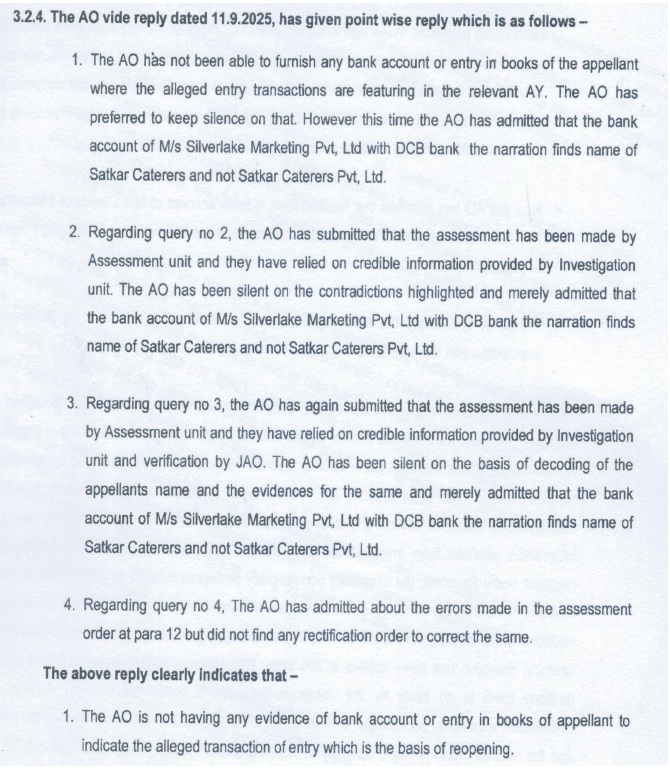
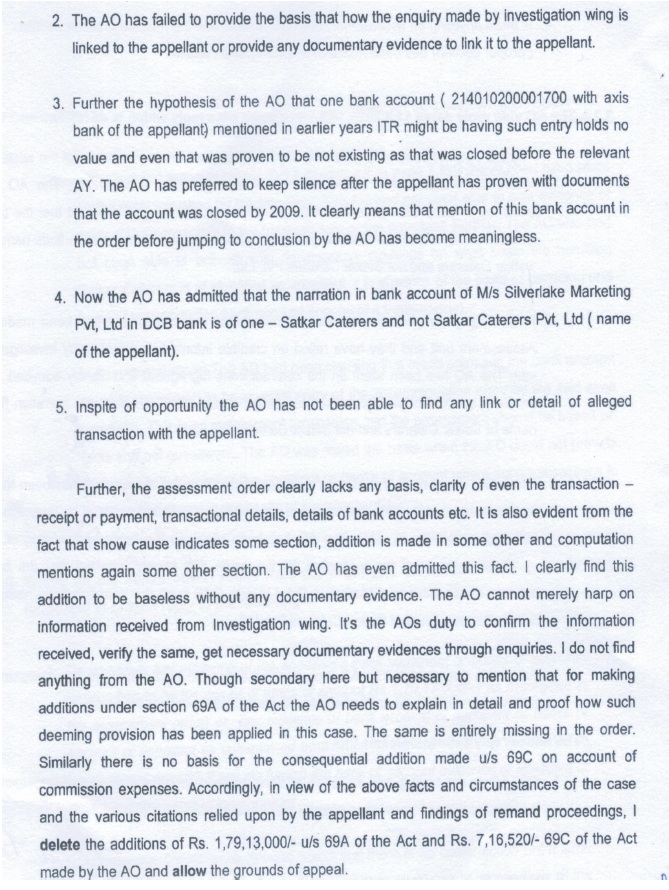
18. So far as the merit of the case is concerned, the Ld. Counsel for the assessee referring to page 38 of the paper book drew the attention of the Bench to the remand report submitted by the Assessing Officer. Referring to the findings given by the Ld. CIT(A), he drew the attention of the Bench to para 3.2.4 of the order of the Ld. CIT(A) which read as under:
19. He accordingly submitted that the order of the Ld. CIT(A) being in accordance with law should be upheld and the grounds raised by the Revenue on merit also are liable to be dismissed.
20. The Ld. DR on the other hand submitted that the order of the Ld. CIT(A) while deleting the addition on merit is not justified since the assessee has received accommodation entries from the shell company M/s. Silverlake Marketing Pvt. Ltd. which was established during the course of search and seizure operation carried out against Kolkata based group – Bathwal group and one entry operator Shri Ajit Kumar Jindal.
21. So far as the legal grounds raised by the assessee in the application under Rule 27 is concerned, he submitted that since these grounds were never raised before the Ld. CIT(A), therefore, he has no objection if the matter is restored to the file of the Ld. CIT(A) to adjudicate these grounds.
22. We have heard the rival arguments made by both the sides, perused the orders of the Assessing Officer and the Ld. CIT(A) and the paper book filed on behalf of the assessee. We have also considered the various decisions cited before us. Before deciding the grounds raised by the Revenue on merit, we would like to address the first legal ground raised by the assessee under Rule 27. A perusal of the assessment order as well as the details furnished in the paper book shows that the notice u/s 148 in the instant case was issued on 31.03.2021 for assessment year 2015-16. The approval was granted u/s 151(1) by the PCIT, Raipur which is evident from pages 2 to 4 of the paper book. So far as the approval u/s 151 is concerned, we find the PCIT, Raipur-1 has given the approval u/s 151 on 30.03.2021 which reads as under:
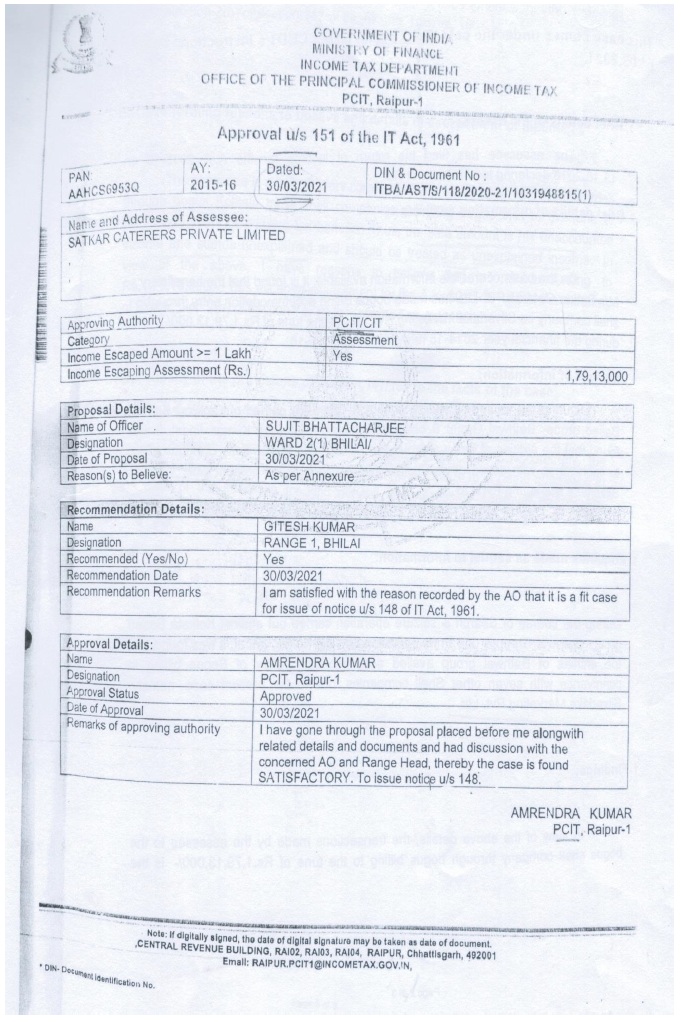
23. A perusal of the provisions of section 148 would show that for assessment year 2015-16, 4 years time would be ended on 31.03.2020. However, due to Covid-19 pandemic the Legislature enacted the TOLA, 2020 and by virtue of the TOLA all actions that were supposed to be completed on 20.03.2020 were extended to 31.03.2021. By virtue of this enactment, the period of 4 years did not expire before 31.03.2021 and therefore, the specified authority u/s 151(2) has time till 31.03.2021 to grant approval for assessment year 2015-16.
24. We find an identical issue had come up before the Hon’ble Bombay High Court in the case of Swami Shanti Prakash Ashram Trust Ulhasnagar (supra) where the Hon’ble High Court quashed the notice u/s 148 for obtaining the approval from the CIT(Exemption) as against the approval from the JCIT. The relevant observations of the Hon’ble High Court read as under:
“10. We have heard the learned Senior Advocate appearing on behalf of the Petitioner as well as the learned Counsel appearing on behalf of the Revenue.
11. At the outset, we are unable to agree with Mr. Saxena that in the facts of the present case, the notice issued under Section 148 of the Act was beyond the period of four years from the end of the Assessment Year 2015-16. As mentioned earlier, the impugned notice is dated 28th March, 2021. In normal circumstances, the period of four years would have expired on 31s March, 2020. However, due to the intervention of the Covid-19 pandemic, the legislature stepped in and enacted the Taxation and Other Laws (“Relaxation and Amendment of Certain Provisions”) Act, 2020 (for short “TOLA”). By virtue of the provisions of TOLA, all actions that were supposed to be completed on 20th March, 2020 were extended to 31s March, 2021. It is by virtue of this enactment that the period of four years did not expire before 31st March, 2021. This is also clear from what is set out by the Hon’ble Supreme Court in Rajeev Bansal (supra). Paragraph 77 in the case of Rajeev Bansal (supra) reads thus:-
“77:- Parliament enacted Taxation and other Laws (Relaxation and Amendment of Certain Provisions) Act, 2020 to ensure that the Interests of the Revenue are not defeated because the Assessing Officer could not comply with the preconditions due to the difficulties that arose during the covid-19 pandemic. Section 3(1) of the Taxation and other Laws (Relaxation and Amendment of Certain Provisions) Act, 2020 relaxes the time limit for compliance with actions that fall for completion from March 20, 2020 to March 31, 2021. The Taxation and other Laws (Relaxation and Amendment of Certain Provisions) Act, 2020 will accordingly extend the time limit for the grant of sanction by the authority specified under section 151. The test to determine whether Taxation and other Laws (Relaxation and Amendment of Certain Provisions) Act, 2020 will apply to section 151 of the new regime is this if the time limit of three years from the end of an assessment year falls between March 20, 2020 and March 31, 2021, then the specified authority under section 151(i) has an extended time till June 30, 2021 to grant approval. In the case of section 151 of the old regime, the test is if the time limit of four years from the end of an assessment year falls between March 20, 2020 and March 31, 2021, then the specified authority under section 151(2) has time till March 31, 2021 to grant approval. The time limit for section 151 of the old regime expires on March 31, 2021 because the new regime comes into effect on April 1, 2021.”
(emphasis supplied)
12. As can be seen from the above reproduction, Section 3 (1) of TOLA relaxes the time limit for completion from 20th March, 2020 to 31st March, 2021. TOLA will accordingly extend the time limit for the grant of sanction by the authority specified under Section 151 of the Act. In the aforesaid paragraph, the Hon’ble Supreme Court has categorically stated that in the case of Section 151 of the old regime (i.e. prior to 1st April, 2021), the test is if the time limit of four years from the end of the Assessment Year falls between 20th March, 2020 and 31st March, 2021. If it does, then, the specified authority under Section 151 (2) has time till 31st March, 2021 to grant approval. In other words, if the time limit of four years from the end of Assessment Year 2015-16 falls between 20th March, 2020 and 31st March, 2021, the Joint Commissioner would be the authority that would have to give sanction for issuance of notice under Section 148 of the Act.
13. In the facts of the present case, the Assessment Year in question is A. Y. 2015-16. The notice under Section 148 of the Act has been issued on 28th March, 2021. Once these are the facts, the same would squarely fall within the ratio laid down by the Hon’ble Supreme Court in Rajeev Bansal (supra) and more particularly paragraph 77 thereof. In other words, the notice issued under Section 148 of the Act in the present case should have the sanction of the Joint Commissioner. Instead, the sanction obtained is that of the CIT (Exemption), Pune, who is admittedly not the authority who could have granted the sanction in the present case. On this ground alone, the above notice issued under Section 148 of the Act has to be quashed.
14. Before parting, it would be only be fair to deal with the argument of Mr. Saxena that in the facts of the present case, there is a satisfaction of the Joint Commissioner for issuance of the impugned notice, and the notice therefore is valid. We find this argument to be completely without merit. The impugned notice can be found at page 35 of the paper book. This notice categorically states that the impugned notice is being issued after obtaining the necessary satisfaction of the CIT (Exemption), Pune. Therefore, having expressly stated that the “necessary satisfaction” has been obtained from the CIT (Exemption), Pune, the Revenue now cannot resile from this position and argue to the contrary that the “necessary satisfaction” of the Joint Commissioner has been taken. Once the Act contemplates the satisfaction of a particular authority, it is that authority alone that would have to give its sanction, and not any other authority. This is squarely covered by the decision of this Court in the case of Ghanshyam K. Khabrani v/s. Assistant Commissioner of Income Tax and Others reported in (2012) 346ITR 443 (Bom.) “
25. We find the Hon’ble Bombay High Court in the case of Global Earth Properties & Developers (P. ) Ltd. (supra) has observed as under:
“18. We have heard both parties at length and also perused the documents, proceedings and affidavits filed by the parties in the present petition.
19. We are in agreement with the primary contention of the Petitioner that the impugned notice issued under section 148 of the Act on March 31, 2021, for Assessment Year 2015-16, falls within the period of March 20, 2020 and March 31, 2021. Therefore, the relaxation on account of the provisions of TOLA stand applicable in respect of sanction under section 151 of the Act. Consequently, the impugned notice must be construed to have been issued within a period of four years from the end of the relevant Assessment Year 2015-16. In our view, the Apex Court in its decision in the case of Union of India v. Rajeev Bansal (supra) has settled the issue and held that TOLA extends the period of limitation with respect to sanction under section 151 of the Act. The Apex Court has been categoric in expressing its views in paragraphs 73, 74 and 77 of the said judgment, where the Court held as under:
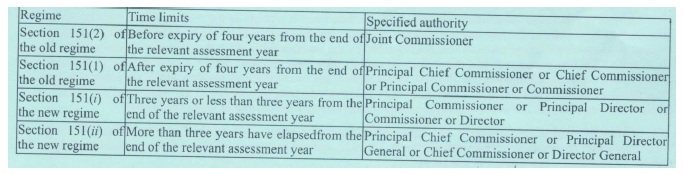
74. The above table indicates that the specified authority is directly corelated to the time when the notice is issued. This plays out as follows under the old regime:
| (i) |
|
If income escaping assessment was less than Rupees one lakh: (a) a reassessment notice could be issued under section 148 within four years after obtaining the approval of the Joint Commissioner; and (b) no notice could be issued after the expiry of four years; and |
| (ii) |
|
If income escaping was more than Rupees one lakh: (a) a reassessment notice could be issued within four years after obtaining the approval of the Joint Commissioner; and (b) after four years but within six years after obtaining the approval of the Principal Chief Commissioner or Chief Commissioner or Principal Commissioner or Commissioner. |
… … … ….
77. Parliament enacted TOLA to ensure that the interests of the Revenue are not defeated because the assessing officer could not comply with the pre conditions due to the difficulties that arose during the COVID-19 pandemic. Section 3(1) of TOLA relaxes the time limit for compliance with actions that fall for completion from 20 March 2020 to 31 March 2021. TOLA will accordingly extend the time limit for the grant of sanction by the authority specified under section 151. The test to determine whether TOLA will apply to Section 151 of the new regime is this: if the time limit of three years from the end of an assessment year falls between 20 March 2020 and 31 March 2021, then the specified authority under section 151(i) has an extended time till 30 June 2021 to grant approval. In the case of Section 151 of the old regime, the test is: if the time limit offour years from the end of an assessment year falls between 20 March 2020 and 31 March 2021, then the specified authority under section 151(2) has time till 31 March 2021 to grant approval. The time limit for Section 151 of the old regime expires on 31 March 2021 because the new regime comes into effect on 1 April 2021″
(emphasis supplied).
20. The coordinate bench of this Court in the case of Prabhakar Nerulkar v. PCIT (supra) has also followed the decision in Union of India v. Rajeev Bansal (supra). The facts in Prabhakar Nerulkar (supra) are almost identical to the facts of the Petitioner’s case. Accordingly, we are unable to accept the argument of the of the Respondents that the impugned notice issued under section 148 of the Act falls beyond the period of four years from the end of the relevant Assessment Year 2015-16. Firstly, such an argument is contrary to the decision of the Apex Court in case of Union of India v. Rajeev Bansal (supra). Secondly, the argument of the learned counsel of the Respondents cannot be accepted because it is contrary to the averment made by Respondent No. 3 in the affidavit-in-reply to the present Petition, because Respondent No. 3 has made a categorical averment that the contention of the Petitioner that the impugned notice being beyond a period offour years from end of relevant Assessment Year is incorrect.
21. Hence, the case of the Petitioner is governed by Section 151(2), where it is the Joint Commissioner, who should be satisfied with the reasons recorded by the Assessing Officer that it is a fit case for issuance of notice under section 148 of the Act. However, the notice under section 148 of the Act has been issued after obtaining the sanction of Respondent No. 5 i.e. the Principal Commissioner of Income-tax, Mumbai – 4, who is not the competent Authority to grant sanction under section 151 of the Act to the impugned notice dated 31st March 2021 issued under section 148 of the Act. Where the Income-tax Act has conferred the power of sanction to a specified and distinct Authority, then the mandate of the statute must be strictly followed, and when the statute mandates the satisfaction of a particular functionary for exercise of the power, the satisfaction must be of that Authority alone and not of any other authority. This view is also supported by the decision of the coordinate bench of this Court in case of Ghanshyam K. Khabrani v. ACIT (supra) . Hence, the Petition is liable to succeed on this ground alone. “
26. We find the Hon’ble Bombay High Court in the case of Prabhakar Nerulkar (supra) has observed as under:
“29. The test to determine whether the provisions of TOLA apply to Section 151 of the new regime was set out by stating as below:
“If the time limit of four years from the end of an assessment year falls between 20.03.2020 and 31.03.2021, then the specified Authority under Section 151(i) has an extended time till 30.06.2021 to grant approval. In case of Section 151 of the old regime, the test is, “if the time limit of four years from the end of the assessment year falls between 20.03.2020 and 31.03.2021, then the specified Authority under Section 151(2) has the time till 31.03.2021 to grant approval. The time limit for Section 151 of the old regime expires on 31.03.2021 because the new regime comes into effect on 01.04.2021. ”
30. The case before us clearly falls within the aforesaid time line as the AY 201516 and the period of four years from the end of the assessment year clearly fell between 20.03.2020 and 31.03.2021 and therefore, the case is governed by the old regime as the new regime came into effect from 01.04.2021.
Hence, the case of the Petitioner is governed by clause (2), where it is the Joint Commissioner, who should be satisfied with the reasons recorded by the Assessing Officer that it is a . fit case . for issuance of notice, and it is not a case governed by clause (1) of Section 151. However, the notice under Section 148 records that it is being issued after obtaining the satisfaction of the PCIT, Panaji, who is not the competent Authority.
31. The observations in the case of Ghanshyam K. Khabrani (supra) clearly come into play where it was observed thus:
“There is merit in the contention raised on behalf of the assessee that the requirement of section 151(2) could have only been fulfilled by the satisfaction of the Joint Commissioner that this is a fit case for the issuance of a notice under section 148. Section 151(2) mandates that the satisfaction has to be of the Joint Commissioner. That expression has a distinct meaning by virtue of the definition in section 2(28C). The Commissioner of Income-tax is not a Joint Commissioner within the meaning of section 2(28C). In the present case, the Additional Commissioner of Income-tax forwarded the proposal submitted by the Assessing Officer to the Commissioner of Income-tax. The approval which has 21st July 2025 WP 443 OF 2024.ODT been granted is not by the Additional Commissioner of Income-tax but by the Commissioner of Income-tax. There is no statutory provision here under which a power to be exercised by an officer can be exercised by a superior officer. When the statute mandates the satisfaction of a particular functionary for the exercise of a power, the satisfaction must be of that authority. Where a statute requires something to be done in a particular manner, it has to be done in that manner. In a similar situation the Delhi High Court in CIT v. SPL’s Siddhartha Ltd. (ITA No. 836 of 2011 decided on September 14, 2011)–since reported in (2012) 345 ITR 223 (Delhi) held that powers which are conferred upon a particular authority have to be exercised by that authority and the satisfaction which the statute mandates of a distinct authority cannot be substituted by the satisfaction of another. We are in respectful agreement with the judgment of the Delhi High Court.”
32. In the wake of the above, since we are of the view that the Authority at whose satisfaction must have issued the notice under Section 148 was not the PCIT, Panaji, but the Joint Commissioner as contemplated under sub-section (2) of Section 151, the notice issued under Section 148 on 31.03.2021 at Annexure D-1, is liable to be quashed and set aside as a consequence, the assessment order passed under Section 147 dated 21.03.2022 as well as the order dated 14.11.2023 under Section 264 of the Income Tax also cannot be sustained and are liable to be quashed and set aside. “
27. Since in the instant case the approval has been obtained from the PCIT instead of JCIT, therefore, in view of the decisions cited (supra), we are of the considered opinion that such approval being not obtained from the competent authority the notice issued u/s 148 is liable to be quashed. Once it is held that the notice issued u/s 148 is invalid, the consequent assessment proceedings on such invalid notice become null and void and are liable to be quashed. We, therefore, quash the re-assessment proceedings. Ground No.1 raised in the application under Rule 27 is accordingly allowed.
28. Since the assessee succeeds on this first legal ground, the other legal grounds become academic in nature and are not being adjudicated. Since the re-assessment proceedings have been quashed, therefore, the appeal filed by the Revenue becomes infructuous and the same is dismissed.
29. In the result, the appeal filed by the Revenue is dismissed.