ORDER
1. This is the appeal filed by the revenue against the order of the ld. CIT(A)-3, Patna dated 31/10/2018 for the A.Y. 2007-08 wherein the revenue has raised following grounds of appeal:
“1. That on the facts and circumstances of the case and in law, the Ld. CIT(A) has erred in deleting penalty u/s 271(1)(c) in respect of Transfer Pricing (TP) adjustment on export of goods of Rs. 38,95,03,560/- as determined by TPO.
2. That on the facts and circumstances of the case and in law, the Ld CIT(A) has erred in deleting penalty u/s 271(1)(c) in respect of Transfer Pricing adjustment towards interest on loan to Associated Enterprise (AE) in Thailand amounting to Rs. 49,51,777/- as determined by TPO.
3. That on the facts and circumstances of the case and in law, the Ld CIT(A) has erred in deleting penalty u/s 271(1)(c) on disallowance of assessee’s claim of deduction of provision for leave encashment amounting to Rs. 23,64,785/-.
4. That on the facts and circumstances of the case and in law, the Ld CIT(A) has erred in deleting penalty u/s 271(1)(c) on disallowance of deduction of legal claim fees amounting to Rs. 76,36,600/- u/s 48(i) from income computed under the head ‘long term capital gains.
5. That on the facts and circumstances of the case and in law, the Ld CIT(A) has erred in deleting penalty u/s 271(1)(c) by disregarding the facts that:
| (a) |
|
In quantum appeals, the aforesaid additions/ disallowances had already been confirmed by the Ld.CIT(A) as well as Hon’ble ITAT, after considering the relevant facts, evidences and explanation of the assessee and |
| (b) |
|
The assessee had failed to discharge the onus cast upon it under Explanation 1 to section 271(c) in so far as it offered an explanation on aforesaid additions/disallowances which it was not able to substantiate and failed to prove that such explanation was bona fide and all the facts relating to the same and material to the computation of its total income had been disclosed. |
6. Any other ground that may be raised at the time of hearing.”
2. Brief facts of the case are that the appellant is a widely held domestic company, engaged in the business of inter alia, manufacture and sale of steel wire ropes, wire rods, billets, wires etc. During the course of assessment proceedings, it was seen that the assessee had shown international transaction with associate enterprise for the year under consideration. A reference was made to the Transfer Pricing Officer, Kolkata who passed the order under section 92CA (3) of the Income Tax Act, 1961 (in short, the Act) by making a total adjustment of Rs.40,38,24,345/- Accordingly, the Assessing Officer added a sum of Rs.40,38,24,345/- to the total income of the assessee on account of Transfer Pricing adjustments. Penalty proceeding under section 271 (1) (c) of the Act was also initiated as per explanation 7 of this section during the assessment proceedings on the ground that the assessee had furnished inaccurate particulars of income within the meaning of section 271(1) (c) of the Act. The Assessing Officer, after giving due consideration of the submissions made by the assessee during the penalty proceedings, finally, imposed a penalty of Rs.14,84,89,440/- (being 100% of the tax sought to be evaded) u/s 271(1) (c) of the Act for furnishing inaccurate particulars of income to the extent of Rs.44,11,45,094/-
3. Now coming to the specific grounds of appeal raised by the Revenue, the first ground of appeal is in respect of transfer pricing adjustment amounting to Rs. 38,95,03,560/- The Assessing Officer has imposed penalty under Section 271(1)(c) of the Act for furnishing inaccurate particulars of income as under:
“8. The submission of the assessee has been perused. But the contention of the assessee is not acceptable for the reasons given as under.
1. The assessee’s contention that arms length price in respect of export of goods to AE was determined by following a robust benchmarking approach and selecting comparables which are functionally similar to the activities of the assessee is not acceptable as the sector in which assessee performed the search was Non electrical machinery and base metal and HCL also belong to the same category of industry. The assessee itself selected base metal as a search criteria. Copper and steel both are base metal category and companies engaged in manufacturing of either product could be considered as comparable. Hence the assessee submission on this ground is not tenable.
2. The assessee’s contention that the TPO has notionally computed guarantee fee in respect of aforesaid transaction and made transfer pricing adjustment whereas guarantee fee is not required to be recovered in case such guarantee is in nature of shareholders activity is not accepted. The assessee contention in this issue is not accepted as the assessee has neither provided funds to the AE in the form of equity nor has treated it as shareholder activity.
3. The assessee’s contention that the company has applied a CUP method for benchmarking the interest receivable from its group company whereas TPO applied an interest rate of 15.5% as against 7.5% considered by the company is not accepted. The assessee contention in this issue is not accepted as the there are huge difference in the terms and condition of the two-transaction considering the additional risk for the reason of economic turmoil in the region which affected the AE capacity to borrow.
4. The assessees contention that there was neither any concealment nor furnishing of any inaccurate particulars of income for which the provisions of section 271 (1) (c) can be attracted is not accepted. It may be mentioned here if the return been accepted on the basis of the computation of income, such inadmissible claim leading to under assessment would have escaped the due treatment under the law. In view of this matter action of the A.O. in initiating penalty holding that the assessee furnished inaccurate particulars by way of furnishing inaccurate particulars of income leading to understatement of taxable income is justified calling for levy of penalty u/s 271 (1) (c) of the I. T. Act.
Hence, there is no force in the assessee’s arguments and the same is rejected.
9. The legislature has not used the words ‘concealed his income. From this it would be apparent that penal provision would operate when there is a failure to disclose fully or truly all the particulars. The words particulars of income refer to the facts which lead to the correct computation of income in accordance with the provisions of the Act. So when any fact material to the determination of an item as income or material to the correct computation is not filed or that then the assessee would be liable to which is filed is not accurate Apparently in the Profit & penalty u/s 271 (1) (c) of the I. T. Act. Loss account the assessee made incorrect claim not supported by any provision of law. Rather the relevant provision did not provide for the expenses either on facts or the eye of the law.
10. It is well established that whenever there is difference between the returned and assessed income, there is inference of concealment.
11. It is not the law that any and every explanation has to be accepted. Since the assessee failed to substantiate their explanation in respect of amount in relation to addition/disallowance made on account of expenses/deduction claimed in the return, the onus laid down upon the assessee in terms of explanation 1(B) to section 271 (1) (c) of the Act remains undischarged and also the Ld. CIT (A) after examining of facts of the case only partly allowed assessee appeal.
12. The claim for expenses/deduction/adjustment on account of business expenses/deduction/adjustment under different heads was not admissible and the action of the assessee in claiming the expenses/deductions was deliberate and with willful intention to evade Tax. As already stated there is no specific mention in the account statement as to which of the provision was applicable expenses/deduction. In other words, the computation of income under the head “Business was incorrect on facts as well as in the eye of law”. Nothing was made apparent on the records as to the bona fide basis for making the claim as expenses/deduction or for not adding back the expenses/deduction/adjustment in to profit and loss account while preparing the statement of total income. The assessee has failed to satisfactorily explain as to the basis and bonafide on which he made above claim. The failure to adjust expenses/deduction/adjustment in the computation of income cannot be claimed to be either of ignorance of law or on any sound factual or legal basis.
This definitely amounts to furnishing of inaccurate particulars of income within the meaning of Explanation to section 271(1) (c) of the Act. Hence, on the facts and circumstances of the case, it is held that the contention of the assessee is not tenable in law and hence it is held to be a fit case for the imposition of penalty under section 271 (1) (c) of the Act, which is imposed as under.
13. In the light of above discussion, I am of the opinion that the assessee had furnished inaccurate particulars of income as mentioned above and it is a fit case for imposition of penalty u/s. 271 (1) (c) of the I.T. Act.”
4. When the assessee went into the appeal against the order of the Assessing Officer passed u/s 271 (1) (c), the ld. CIT(A) deleted the said penalty on all counts. On the issue of transfer pricing adjustments in respect of export of goods amounting to Rs. 38,95,03,560/- the ld. CIT(A) deleted the penalty by holding that though, it is a fact that the Ld. TPO has selected a different comparable and made an adjustment to the arm’s length price of international transaction by adopting an approach that contradicts TPO’s own approach in subsequent years and therefore, it cannot be said that the appellant has furnished inaccurate particulars of income so as to levy penalty under Section 271(1)(c) of the Act. The ld. CIT(A) while holding this, agreed with the submission of the assessee that the arm’s length price in respect of export of goods to AE was determined by the company by following a robust benchmarking approach and selecting comparables which are functionally similar/manufacturing similar products as that manufactured by the appellant. The appellant further submitted that it has filed an accountant’s report in Form 3CEB wherein all the transactions along with the method used for benchmarking the transactions are disclosed. Further, the scientific basis of selection of comparables was also disclosed in the Transfer Pricing study report. However, the Ld. TPO did not accept the TP analysis conducted by the appellant and carried out a separate analysis by selecting comparables which are operating under different industry/market and manufacturing dissimilar products altogether. It was further stated that the Ld. TPO selected Hindustan Copper Limited (HCL), which is primarily engaged into production of copper and copper products and used it for benchmarking transaction of export of steel wire rods and wire ropes. The assessee referring to Article 9 of Model Tax Convention stated that the Ld. TPO failed to appreciate that copper (dealt in by HCL) and steel (dealt in by the assessee) are completely different products as copper is a non-ferrous metal whereas steel being a ferrous metal. Also, the price realization of copper is around Rs. 3.5 lac per MT vis-à-vis steel having a realization of Rs. 40,000 per MT. In addition, the appellant also submitted that HCL is a government company enjoying certain specific rights and benefits which other companies fail to enjoy being in the same industry, therefore HCL should be rejected from the final comparable companies. Assessee also pointed out that in subsequent assessment year(s), i.e., AY 2008-09 to AY 2013-14, the TPO himself has not selected HCL as a comparable for the purpose of benchmarking this transaction. Accordingly, the assessee relying on the following decisions has urged that even though the Ld. TPO has arbitrarily selected a different comparable and made an adjustment to the arm’s length price of international transaction by adopting an approach that contradicts TPO’s own approach in subsequent years, it cannot be said that the appellant has furnished inaccurate particulars of income so as to levy penalty u/s 271(1)(c) of the Act. This view was followed in following cases:
Ranbaxy Laboratories Ltd. v.
ACIT (Delhi –
Trib.)/(TS-173-ITAT-2016(DEL)]
Mastek Ltd. v. Addl. CIT (Ahmedabad – Trib.)/(ITA No.3120/Ahd/2010) [TS-127-ITAT-2012(Ahd))
Dy. CIT v.
Development Consultants Ltd. (Kolkata –
Trib.)/(TS-117-ITAT-2017(Kol)-TP]
5. On the ground of interest on loan to AE in Thailand amounting to ₹ 49,51,777/-, the ld. CIT(A) deleted the penalty imposed by the Assessing Officer on the ground as under:
“I have carefully considered the submission of the appellant. The appellant submitted all relevant document/information before the Ld. TPO during the course of transfer pricing proceedings and the computation of arm’s length price by the appellant has been supported based on the principles of law, OECD guidelines, UN TP manual and judicial precedents and hence there cannot be an instance of furnishing of inaccurate particulars of income. Further, where a transaction has been adequately documented in Chartered Accountant’s Report/transfer pricing study report then mere difference in determination of arm’s length price and consequent addition would not warrant initiation of penalty proceedings. Further, Penalty not to be levied for transfer pricing adjustments where Company has used method prescribed in section 92C for determining arms’ length price as contemplated in Explanation 7 to section 271(1). Hence respectfully following the above quoted decisions and also relying on the decisions in the case of TNS India Pvt. Ltd. v. ACIT (TS-21-ITAT-2014(HYD)); in the case of DCIT va. Vertex Customer Service India Pvt. Ltd.
34 SOT 532; in the case of Mitsui Prime Advanced Composites India (P) Ltd. Vs DCIT reported in 178 TTJ 490, [TS-193-ITAT-2016(DEL)] etc. the AO is directed to delete the penalty levied on the adjustment made on account of Interest on loan to AE in Thailand amounting to Rs 4,951,777.”
6. On the issue of provision for leave encashment, the Assessing Officer imposed penalty on the ground that the expenses claimed were not ascertainable and the assessee failed to furnish any credible and satisfactory explanation in this regard. Therefore, the Assessing Officer found that the assessee has furnished inaccurate particulars of income within the meaning of Section 271(1)(c) of the Act. The ld. CIT(A) deleted the addition on the ground that the assessee had claimed this provision for leave encashment on the basis of the decision of the Hon’ble Kolkata High Court in the case of Exide Industries Ltd. v. Union of India 292 ITR 470 (Calcutta) wherein the Hon’ble High court has held that clause (f) of Section 43B of the Act is ultra vires the constitution and therefore, such provision is an admissible expenditure. Though, the revenue has filed an SLP against the said order of the Hon’ble Kolkata High Court, the matter is pending adjudication before the Hon’ble Supreme Court. Further, the Hon’ble Supreme Court while granting stay on the judgment of the Hon’ble Kolkata High Court has held that the assessee can claim the provision for leave encashment in the return of income after paying taxes. Accordingly, the appellant submitted that the claim of deduction for leave encashment on provision basis is backed by the direction of the Hon’ble Apex Court’s stay order in the case of Exide Industries Ltd. (supra), hence, the same will not result in furnishing of inaccurate particulars of income.
7. On the imposition of penalty under Section 271(1)(c) of the Act on the disallowance in respect of expenditure claimed towards legal fees of Rs.76,36,600 in the computation of capital gains. The ld. CIT(A) deleted the penalty on the ground as under:
“The appellant during the year under appeal has sold one of its land in Bangalore at a total consideration of Rs. 13,26,36,600/-. After adjusting indexed cost of acquisition and expenses on transfer, the appellant offered Rs 89,064,963/-as capital gains. While computing the said gain, the appellant had claimed deduction towards expenses incurred in connection with the sale of land amounting to Rs 16,157,735. The said expenditure in connection with transfer of asset included an amount of Rs 7,636,600 being actual amount towards legal fees for various litigations. However, the AO has treated the amount of expenditure towards legal fees as contingent and increased the amount of capital gain by Rs. 7,636,600. As the appellant had filed all relevant documents in connection with computation of capital gain as well as details of expenditure in connection with transfer of assets before the AO there can’t be any furnishing of inaccurate particulars of income so as to attract penalty u/s.271(1)(c). Accordingly, the AO is directed to delete penalty levied on the addition made on account of LTCG of Rs 7,636,600.”
8. The assessee on the other hand, in its written submission has submitted as under:
9. We have considered the impugned order and the rival submissions. We find that the ld. CIT(A) has rightly deleted the penalty by holding that simply because the Ld. TPO has selected a different comparable and made an adjustment to the arm’s length price of international transaction, it cannot be said that the appellant has furnished inaccurate particulars of income so as to levy penalty under Section 271(1)(c) of the Act. We also find that on the issue of transfer pricing adjustment amounting to Rs. 38,95,03,560/-, this Bench has already held while deciding the quantum appeal in assessee’s own case for the A.Y. 2007-08 to exclude Hindustan copper Limited while computing the ALP in the case of the assessee. Thus, we hold that the assessee has not furnished inaccurate particulars of income as provided under section 271(1)(c) of the Act and accordingly, the penalty imposed on this ground is deleted.
10. On the issue of interest on loan paid to Associated Enterprises in Thailand amounting to Rs. 49,51,777/-, the ld. CIT(A) deleted the penalty imposed by the Assessing Officer on the ground as under:
“I have carefully considered the submission of the appellant. The appellant submitted all relevant document/information before the Ld. TPO during the course of transfer pricing proceedings and the computation of arm’s length price by the appellant has been supported based on the principles of law, OECD guidelines, UN TP manual and judicial precedents and hence there cannot be an instance of furnishing of inaccurate particulars of income. Further, where a transaction has been adequately documented in Chartered Accountant’s Report/transfer pricing study report then mere difference in determination of arm’s length price and consequent addition would not warrant initiation of penalty proceedings. Further, Penalty not to be levied for transfer pricing adjustments where Company has used method prescribed in section 92C for determining arms’ length price as contemplated in Explanation 7 to section 271(1). Hence respectfully following the above quoted decisions and also relying on the decisions in the case of TNS India Pvt. Ltd. v. ACIT (TS-21-ITAT-2014(HYD)); in the case of DCIT va. Vertex Customer Service India Pvt. Ltd.
34 SOT 532; in the case of Mitsui Prime Advanced Composites India (P) Ltd. Vs DCIT reported in 178 TTJ 490, [TS-193-ITAT-2016(DEL)] etc. the AO is directed to delete the penalty levied on the adjustment made on account of Interest on loan to AE in Thailand amounting to Rs 4,951,777.”
The assessee, on the other hand, has submitted as under: –
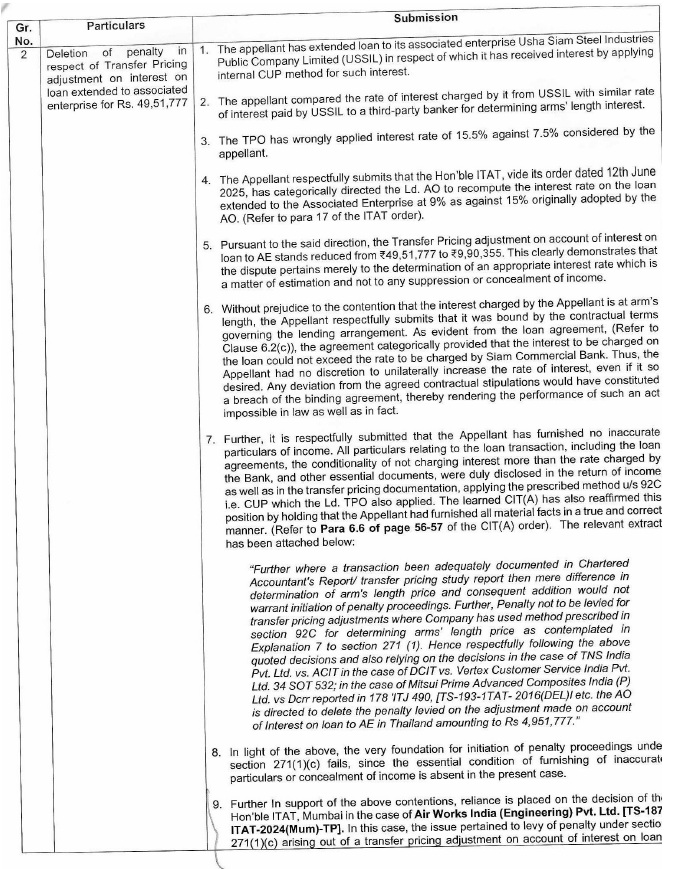
“The appellant has extended loan to its associated enterprise Usha Siam Steel Industries Public Company Limited (USSLI) in respect of which it has received interest by applying internal CUP method for such interest.
2. The appellant compared the rate of interest charged by it from USSLI with similar rate of interest paid by USSLI to a third-party banker for determining arms’ length interest.
3. The TPO has wrongly applied interest rate of 15.5% against 7.5% considered by the appellant.
4. The Appellant respectfully submits that the Hon’ble ITAT, vide its order dated 12th June 2025, has categorically directed the Ld. AO to recompute the interest rate on the loan extended to the Associated Enterprise at 9% as against 15% originally adopted by the AO. (Refer to para 17 of the ITAT order).
5. Pursuant to the said direction, the Transfer Pricing adjustment on account of interest on loan to AE stands reduced from Rs. 49,51,777 to Rs. 9,90,355. This clearly demonstrates that the dispute pertains merely to the determination of an appropriate interest rate which is a matter of estimation and not to any suppression or concealment of income.
6. Without prejudice to the contention that the interest charged by the Appellant is at arm’s length, the Appellant respectfully submits that it was bound by and complied with the governing the lending arrangement. As evident from the loan agreement, (Refer to Clause 6.2(c)), the agreement categorically provided that the interest to be charged on the loan could not exceed the rate to be charged by Siam Commercial Bank. Thus, the Appellant had no discretion to unilaterally increase the rate of interest, even if so desired. Any deviation from the agreed contractual stipulations would have constituted a breach of the binding agreement, thereby rendering the performance of such an act impossible in law as well as in fact.
7. Further, it is respectfully submitted that the Appellant has furnished no inaccurate particulars of income. All particulars relating to the loan transaction, including the loan agreements, the conditionality of not charging interest more than the rate charged by the Bank, and other essential documents, were duly disclosed in the return of income as well as in the transfer pricing documentation, applying the prescribed method u/s 92C i.e. CUP which the Ld. TPO also applied. The learned CIT(A) has also affirmed this position by holding that the Appellant had furnished all material facts in a true and correct manner. (Refer to Para 6.6 of page 56-57 of the CIT(A) order). The relevant extract has been attached below:
“Further where a transaction been adequately documented in the Chartered Accountants Report/ transfer pricing study report then mere difference in determination of arm’s length price and consequent addition would not warrant initiation of penalty proceedings. Further, Penalty not leviable on transfer pricing adjustments where Company has made adequate section 92C for determining arm’s length price as prescribed under Explanation 7 to section 271 (1). Hence respectfully following the quoted decisions and also relying on the decisions in the case of DCTV v. Vertex Customer Services Pvt. Ltd. v. ACIT in the case of DCTV v. Vertex Customer Services Pvt. Ltd. and Sod 532; in the case of Mitsui Prime Advanced Composites India Pvt. Ltd. Dsr reported in ITA 171/490, ITA-193-ITAT- Delhi, the penalty is directed to delete the penalty levied on the adjustment of interest on loan to AE in Thailand amounting to Rs 4,95,177.”
8. In light of the above, the very foundation for initiation of penalty proceedings under section 271(1)(c) fails, since the essential condition of furnishing inaccurate particulars or concealment of income is absent in the present case.
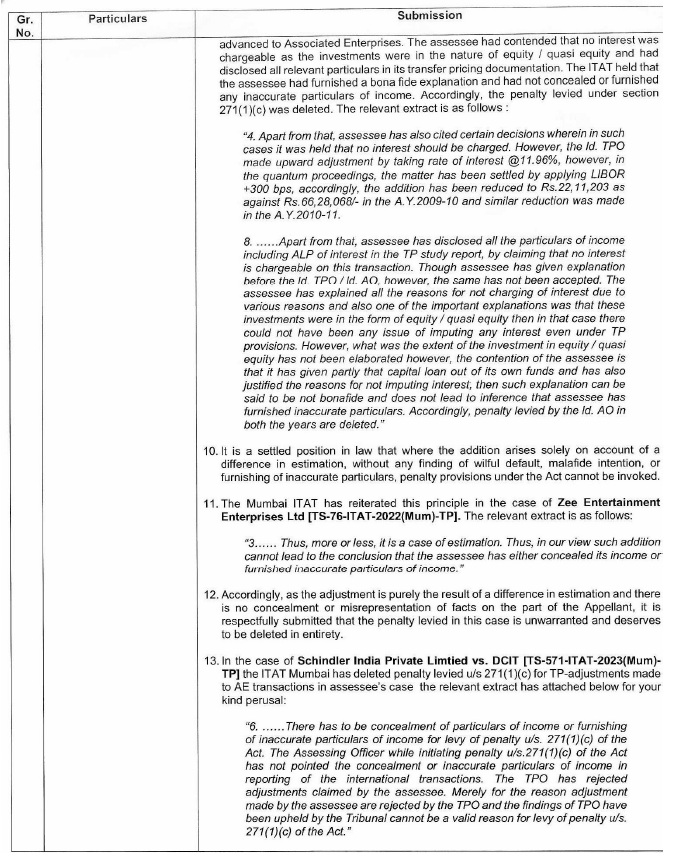
9. Further in support of the above contentions, reliance is placed on the decision of Hon’ble ITAT, Mumbai in the case of Air Works India (Engineering) Pvt. Ltd. ITA 2024/Mum/TP), in this issue pertaining to levy of penalty u/s 271(1)(c) arising out of a transfer pricing adjustment on account of interest advanced to Associated Enterprises. The assessee had contended that no interest was chargeable as the investments were in the nature of equity / quasi equity and had disclosed all relevant particulars in its transfer pricing documentation. The ITAT held that the assessee had furnished a bona fide explanation and had not concealed or furnished any inaccurate particulars of income. Accordingly, the penalty levied under section 271(1)(c) was deleted. The relevant extract is as follows:
“4. Apart from that, assessee has also cited certain decisions wherein in such cases it was held that no interest should be charged. However, the ld. TPO made upward adjustment by taking rate of interest @11.96%, however, in the quantum proceedings, the matter has been settled by applying LIBOR +300 bps, accordingly, the addition has been reduced to Rs.22,11,203 as against Rs.66,26,086/- in the A.Y.2009-10 and similar reduction was made in the A.Y.2010-11.
8…….Apart from that, assessee has disclosed all the particulars of income including ALP of interest in the TP study report, by claiming that no interest is chargeable on this transaction. Though assessee has been accepted before the ld. TPO / ld. AO, however, the same has not been accepted. The assessee has explained all the reasons for not charging interest due to various reasons and also one of the important contention that these investments were in the form of equity / quasi equity then in that case there could not have been any issue of imputing any interest even under TP provisions. However, what was the extent of the investment in equity / quasi equity has not been elaborated however, the contention of the assessee is that it has given partly that capital loan out of its own funds and has also justified the reasons for not imputing interest, then such explanation can be said to be not bonafide and does not lead to inference that assessee has furnished inaccurate particulars. Accordingly, penalty levied by the ld. AO in both the years are deleted.”
10. It is a settled position in law that where the addition arises solely on account of a difference in estimation, without any finding of wilful default, malafide intention, or furnishing of inaccurate particulars, penalty provisions under the Act cannot be invoked.
11. The Mumbai ITAT has reiterated this principle in the case of Zee Entertainment Enterprises Ltd [TS-76-ITAT-2022(Mum)-TP]. The relevant extract is as follows:
“3…….Thus, more or less, it is a case of estimation. Thus, in our view such addition cannot lead to the conclusion that the assessee has either concealed or furnished inaccurate particulars of income.”
12. Accordingly, as the adjustment is purely the result of a difference in estimation, there is no concealment or misrepresentation of facts on the part of the assessee. It is respectfully submitted that the penalty levied in this case is unwarranted and deserves to be deleted in entirety.
13. In the case of Schindler India Private Limited v. DCIT [TS-571-ITAT-2023(Mum)-TP] the ITAT Mumbai has deleted penalty levied u/s 271(1)(c) for TP adjustment to AE transactions in assessee’s case the relevant extract has been reproduced for kind perusal:
“6…….There has to be concealment of particulars of income or furnishing of inaccurate particulars of income for levy of penalty u/s. 271(1)(c) of the Act. The Assessing Officer while initiating penalty u/s. 271(1)(c) of the Act has not pointed the concealment or inaccurate particulars of income while reporting of the international transactions. The TP adjustments claimed by the assessee. Merely for the reason that the method by the assessee is rejected by the TPO and the findings of the TPO are upheld by the Tribunal cannot be a valid reason for levy of penalty u/s. 271(1)(c) of the Act.”
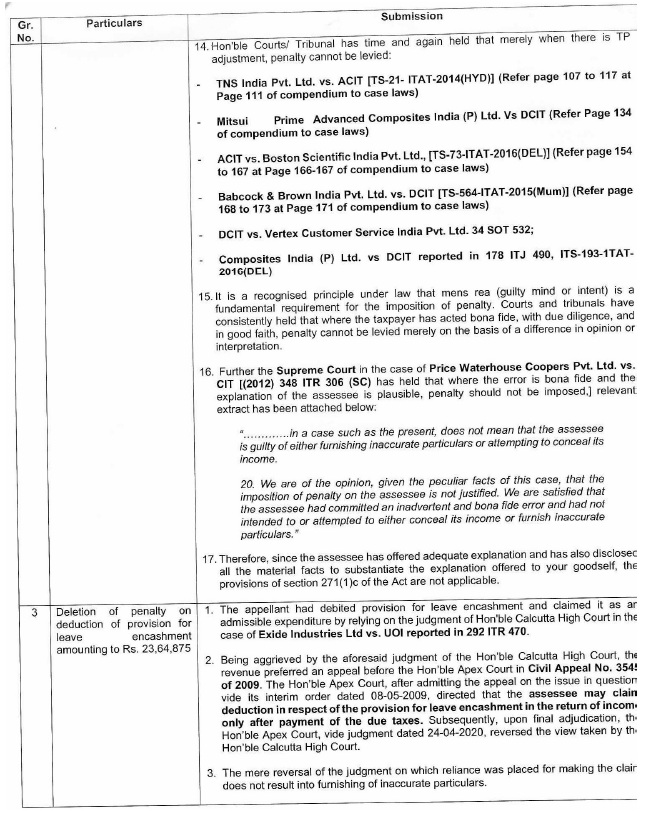
14. Hon’ble Courts/ Tribunal has time and again held that merely when there is TP adjustment, penalty cannot be levied:
– TNS India Pvt. Ltd. v. ACIT [TS-21- ITAT-2014(HYD)] (Refer page 107 to 117 at Page 111 of compendium to case laws)
– Mitsui Prime Advanced Composites India (P) Ltd. Vs DCIT (Refer Page 134 of compendium to case laws)
– ACIT v. Boston Scientific India Pvt. Ltd., [TS-73-ITAT-2016(DEL)] (Refer page 154 to 167 at Page 166-167 of compendium to case laws)
– Babcock & Brown India Pvt. Ltd. v. DCIT [TS-564-ITAT-2015(Mum)] (Refer page 168 to 173 at Page 171 of compendium to case laws)
– DCIT v. Vertex Customer Service India Pvt. Ltd. 34 SOT 532;
– Composites India (P) Ltd. vs DCIT reported in 178 ITJ 490, ITs-193-ITAT-2016(DEL)
15. It is a recognised principle under law that mens rea (guilty mind or intent) is a fundamental requirement for the imposition of penalty. Courts and tribunals have consistently held that where the taxpayer has acted bona fide, with due diligence, and in good faith, penalty cannot be levied merely on the basis of a difference in opinion or interpretation.
16. Further the Supreme Court in the case of Price Waterhouse Coopers Pvt. Ltd. v. CIT
(2012) 348 ITR 306 (SC) has held that where the error is bona fide and the explanation of the assessee is plausible, penalty should not be imposed. Relevant extract has been attached below:
“…………..in a case such as the present, does not mean that the assessee is guilty of either furnishing inaccurate particulars or attempting to conceal its income.
20. We are of the opinion, given the peculiar facts of this case, that the imposition of penalty on the assessee is not justified. We are satisfied that the assessee had committed an inadvertent and bona fide error and had not intended to or attempted to either conceal its income or furnish inaccurate particulars.”
17. Therefore, since the assessee has offered adequate explanation and has also disclosed all the material facts to substantiate the explanation offered by it, the provisions of section 271(1)(c) of the Act are not applicable.
11. We have considered the submissions made by the assessee and the impugned order. We find that this Bench while deciding the quantum appeal for the same A.Y 2007-08 has already held as under: –
“We have considered the rival submissions. Here, we are live to the fact that the bank in Thailand has granted the funs in the form of loan only subject to the assessee providing equal amount as loan in the setting up of the factory in Thailand. We are also live to the fact that no corporate guarantee has been provided by the assessee on the said loan. Further, it must be accepted that there is a risk involved and the risk is to be considered as a factor. It is mentioned by Ld. AR that the loan is subordinated loan. Considering the fact that there is risk involved in the said loan, admittedly 7.5% was charged by the bank and which has been accepted by the assessee is comparatively on the lower side, this is because the loans in India itself normally hold the interest 9%, as against 15% adopted by the AO and 7.5% as adopted by the assessee. Consequently, the AO is directed to recompute the interest portion at 9% as against 15% adopted by the AO. Consequently, Ground No. 2.3 of the assessee stands allowed.”
Thus, considering the above decision, we do not find any reason to interfere with the order of the ld. CIT(A), who has rightly deleted the penalty. We uphold the order of the ld. CIT(A) on this ground.
12. On the issue of Provision for leave encashment, the Assessing Officer imposed penalty under the head provision for leave encashment on the ground that the expenses claimed were not ascertainable and the assessee failed to furnish any credible and satisfactory explanation in this regard. Therefore, the Assessing Officer found that the assessee has furnished inaccurate particulars of income within the meaning of Section 271(1)(
c) of the Act. The ld. CIT(A) deleted the addition on the ground that the assessee had claimed this provision for leave encashment on the basis of the decision of the Hon’ble Kolkata High Court in the case of Exide Industries Ltd. Vs UOI reported in
292 ITR 470 wherein the Hon’ble High court has held that clause (
f) of Section43B of the Act is ultra vires the constitution and therefore, such provision is an admissible expenditure. Though, the revenue has filed an SLP against the said order of the Hon’ble Kolkata High Court, the matter is pending adjudication before the Hon’ble Supreme Court. Further, the Hon’ble Supreme Court while granting stay on the judgment of the Hon’ble Kolkata High Court has held that the assessee can claim the provision for leave encashment in the return of income after paying taxes. Accordingly, the appellant submitted that the claim of deduction for leave encashment on provision basis is packed by the direction of the Hon’ble Apex Court’s stay order in the case of Exide Industries ltd. (supra), hence, the same will not result in furnishing of inaccurate particulars of income. We have considered this ground and we find no infirmity in the order of the ld. CIT(A) as he has deleted the penalty on account of provision for leave encashment by following the Hon’ble Apex Court stay order in the case of
Exide Industries Ltd. (supra), therefore, the order of the ld. CIT(A) is upheld on this ground.
13. The Assessing Officer imposed penalty on the ground that the payment made by the assessee on account of legal claim fees amounting to Rs. 76,36,600/- on the ground that this expense was not ascertainable and therefore, disallowed by the Assessing Officer during the proceedings under Section 143(3) of the Act. Since the assessee failed to furnish any credible and satisfactory explanation to explain the said expense, the assessee is guilty of furnishing inaccurate particulars of income within the meaning of Section 271(1)(c) of the Act. The ld. CIT(A), however, vide the impugned order, deleted the penalty on the ground as under:
“The appellant during the year under appeal has sold one of its land in Bangalore at a total consideration of Rs. 13,26,36,600/-. After adjusting indexed cost of acquisition and expenses on transfer, the appellant offered Rs 89,064,963/-as capital gains. While computing the said gain, the appellant had claimed deduction towards expenses incurred in connection with the sale of land amounting to Rs 16,157,735. The said expenditure in connection with transfer of asset included an amount of Rs 7,636,600 being actual amount towards legal fees for various litigations. However, the AO has treated the amount of expenditure towards legal fees as contingent and increased the amount of capital gain by Rs. 7,636,600. As the appellant had filed all relevant documents in connection with computation of capital gain as well as details of expenditure in connection with transfer of assets before the AO there can’t be any furnishing of inaccurate particulars of income so as to attract penalty u/s.271(1)(c). Accordingly, the AO is directed to delete penalty levied on the addition made on account of LTCG of Rs 7,636,600.”
14. The assessee on the other hand, has submitted as under:
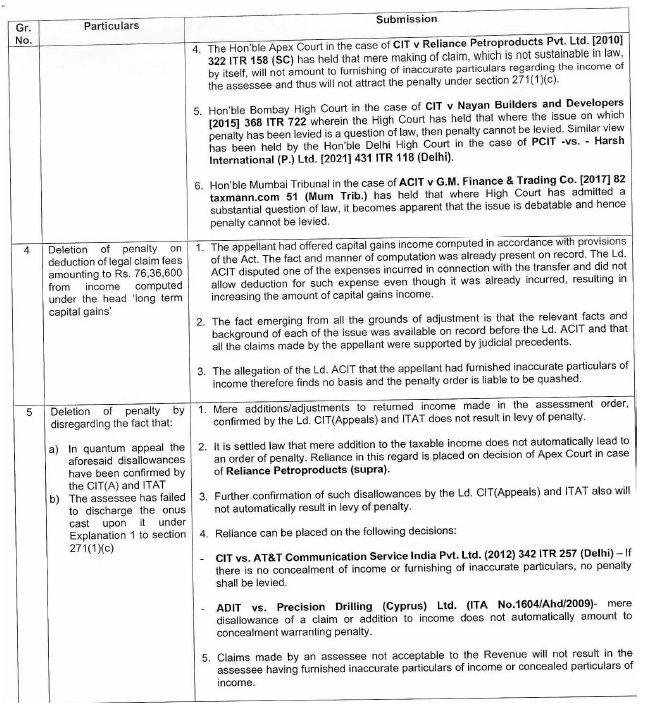
| 1. |
|
The appellant had offered capital gains income computed in accordance with provisions of the Act. The fact and manner of computation was already present on record. The Ld. ACIT disputed one of the expenses incurred in connection with the transfer and did not allow deduction for such expense even though it was already incurred, resulting in increasing the amount of capital gains income. |
| 2. |
|
The fact emerging from all the grounds of adjustment is that the relevant facts and background of each of the issues was available on record before the Ld. ACIT and all the claims made by the appellant were supported by judicial precedents. |
| 3. |
|
The allegation of the Ld. ACIT that the appellant had furnished inaccurate particulars of income therefore finds no basis and the penalty order is liable to be quashed. |
15. We have considered the rival submissions and also the impugned order and we find that the ld. CIT(A) was right in holding that the assessee has filed all the relevant documents in connection with computation of capital gain as well as details of expenditure in connection with transfer of assets before the Assessing Officer. It is found that this expense was allowed by this Bench while deciding the issue in assessee’s own case for the A.Y. 2008-09 in Usha Martin Ltd. v. Asstt. CIT (Ranchi – Trib.)/ITA No. 272/Ran/2017 order dated 29/07/2026. Since the quantum addition has already been deleted by this Bench, the ground of imposition of penalty does not arise and hence the same is deleted.
16. Now for invoking Explanation (7) of Section 271(1)(c) of the Act, the Assessing Officer has held that the assessee’s contention that there was neither any concealment nor furnishing of any inaccurate particulars of income for which the provisions of section 271 (1) (c) can be attracted, is not accepted. It was stated by him that if the return been accepted on the basis of the computation of income, such inadmissible claim leading to under assessment would have escaped the due treatment under the law and therefore, he has rightly imposed penalty u/s 271 (1) (c) of the I. T. Act for furnishing inaccurate particulars of income. He has further stated that the legislature has not used the words ‘concealed his income. From this it would be apparent that penal provision would operate when there is a failure to disclose fully or truly all the particulars. The words particulars of income refer to the facts which lead to the correct computation of income in accordance with the provisions of the Act. So, when any fact material to the determination of an item as income or material to the correct computation is not filed or that then the assessee would be liable for penalty u/s 271 (1) (c) of the I. T. Act. It is well established that whenever there is difference between the returned and assessed income, there is inference of concealment. It is not the law that any and every explanation has to be accepted. Since the assessee failed to substantiate their explanation in respect of amount in relation to addition/disallowance made on account of expenses/deduction claimed in the return, the onus laid down upon the assessee in terms of explanation 1(B) to section 271(1)(c) of the Act remains undischarged. The claim for expenses/deduction/ adjustment on account of business expenses/deduction/adjustment under different heads was not admissible and the action of the assessee in claiming the expenses/deductions was deliberate and with willful intention to evade Tax. As already stated, there is no specific mention in the account statement as to which of the provision was applicable expenses/deduction. In other words, the computation of income under the head “Business was incorrect on facts as well as in the eye of law”. Nothing was made apparent on the records as to the bona fide basis for making the claim as expenses/deduction or for not adding back the expenses/deduction/adjustment in to profit and loss account while preparing the statement of total income. The assessee has failed to satisfactorily explain as to the basis and bona fide on which he made above claim. The failure to adjust expenses/deduction/adjustment in the computation of income cannot be claimed to be either of ignorance of law or on any sound factual or legal basis. He finally, held that this definitely amounts to furnishing of inaccurate particulars of income within the meaning of Explanation 7 to section 271(1) (c) of the Act.
17. On the other hand, the ld. AR for the assessee submitted that mere addition/ adjustments to return income made in the assessment order and confirmed/deleted/partly allowed by the ld. CIT(A) does not result in automatic levy of penalty under Section 271(1)(c) of the Act for furnishing inaccurate particulars of income. It is a settled law that mere addition to the taxable income does not automatically lead to the imposition of penalty. Reliance was also placed on following decisions:
| 1. |
|
The Hon’ble Apex Court in the case of CIT v. Reliance Petroproducts (P.) Ltd. [2010] 322 ITR 158 (SC) has held that mere making of claim, which is not sustainable in law, by itself, will not amount to furnishing of inaccurate particulars regarding the income of the assessee and thus will not attract the penalty under section 271(1)(c). |
| 2. |
|
Hon’ble Bombay High Court in the case of CIT v. Nayan Builders & Developers [2014] 368 ITR 722 (Bombay) wherein the High Court has held that where the issue on which penalty has been levied is a question of law, then penalty cannot be levied. Similar view has been held by the Hon’ble Delhi High Court in the case of Pr. CIT (Central) v. Harsh International (P.) Ltd. 88/431 ITR 118 (Delhi). |
| 3. |
|
Hon’ble Mumbai Tribunal in the case of ACIT v. G.M. Finance & Trading Co. (Mumbai) has held that where High Court has admitted a substantial question of law, it becomes apparent that the issue is debatable and hence penalty cannot be levied. |
18. We have considered the rival submissions and also the judicial decisions on which the ld. AR for the assessee has placed reliance. We have also considered Explanation-7 of Section 271(1)(c) of the Act wherein it is mentioned that if the assessee failed to establish to the satisfaction of the Assessing Officer or the ld. CIT(A) that the price charged or paid in the international transaction computed in accordance with the provisions contained in Section 92C in the manner prescribed under that Section in good faith and with due diligence, the Assessing Officer has no option but to impose penalty under Section 271(1)(c) either for concealing the particulars of income or for furnishing inaccurate particulars of income. Here in the present case, we find that the assessee has fully established to the satisfaction of both the Assessing Officer and the ld. CIT(A) and even before us that all necessary documents required for the purpose of computing international transaction in the manner as provided under Section 92C of the Act and has discharged fully with due diligence and that is why while deciding the quantum appeals for the same assessment year and also for the subsequent assessment year, we have either fully allowed or partly allowed the appeal of the assessee. Merely because some deductions or expenses were not allowed, it cannot be inferred that the assessee has furnished inaccurate particulars of income. We, therefore, hold that this is not a fit case where penalty can be imposed under Section 271(1)(c) of the Act for furnishing inaccurate particulars of income.
19. In the result, this appeal of the revenue stands dismissed.