ORDER
1. This is an appeal filed by the assessee against the order of the ld CIT(A), Ranchi dated 4.8.2017 in Appeal No.468/Ran/Oth/11-12 for the assessment year 2008-09
2. Shri H.Robindro Singh, Ld CIT DR appeared for the revenue and Shri Vishal Jain, ld AR appeared for the assessee.
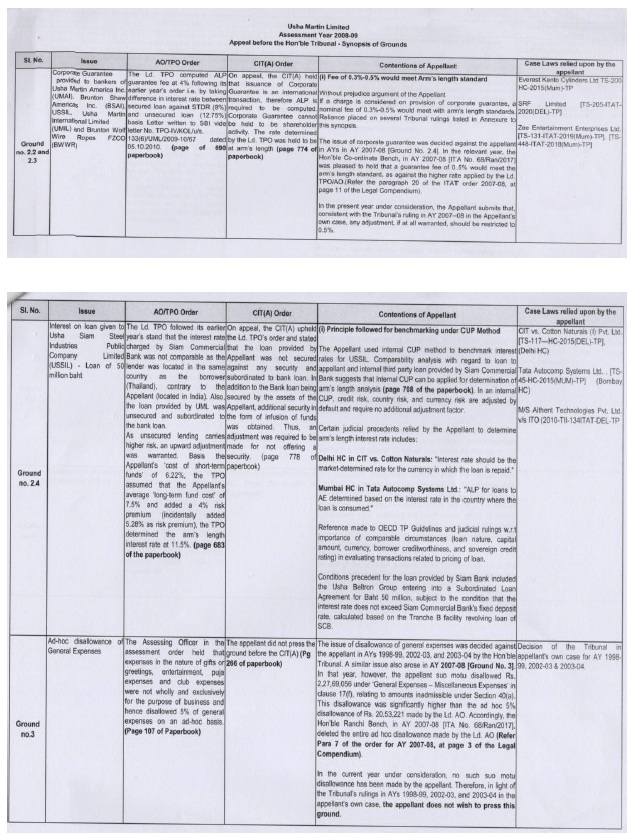
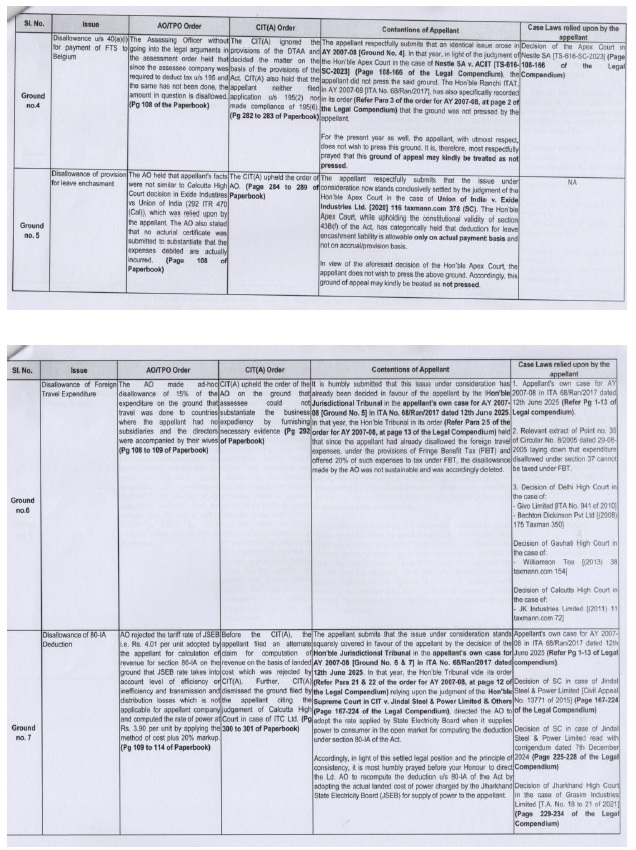
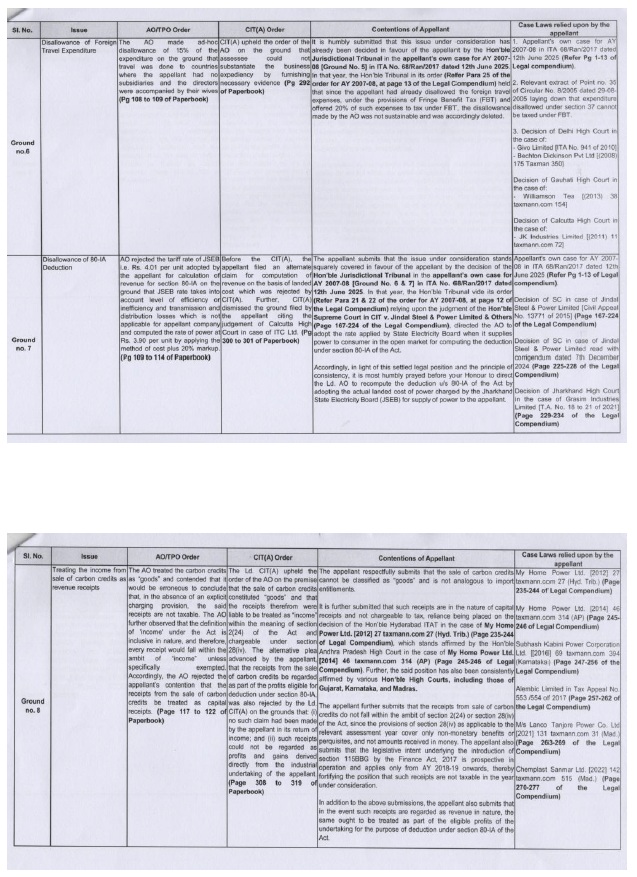
3. At the time of hearing, ld AR of the assessee has filed a synopsis in regard to grounds, which reads as follows:
4. At the time of hearing, ld AR has submitted that he does not wish to press Ground No.3, 4.1,4.2,4.3,5.1 and 5.2. Ld AR has endorsed in the grounds of appeal to this effect. Hence, Ground Nos.3 to 5.2 stand dismissed as not pressed.
5. It was submitted by ld AR that Ground No.1 is general in nature.
6. In Ground No.2 to 2.4, ld AR submitted that this issue was in regard to international transaction done by the assessee. It was the submission that the TPO had computed the Arm’s length Price (ALP) of Corporate Guarantee at 4% following its earlier orders. It was the submission that the ld CIT(A) had upheld the addition as made by the Assessing Officer. It was fairly agreed by both the sides that the issue is now squarely covered by the decision of the Coordinate Bench of this Tribunal in assessee’s own case for the assessment year 2007-08 in Usha Martin Limited v. Asstt. CIT [ITA No.68(Ran) OF 2017, dated 12-6-2025], wherein, in paras 19 to 20, the Coordinate Bench has held as follows:
“19. In reply ld CIT DR submitted that as per the citations submitted by the assessee itself the Hon’ble Bombay High Court decision in the cased of . Everest Kanto Cylinder Ltd. v. DCIT, clearly shows corporate guarantee is at 0.5%. It was the submission that the corporate guarantee may be fixed at 0.5%.
20. We have considered the rival submissions. A perusal of the various case laws submitted by AR clearly shows that Hon’ble Bombay High Court in the case of M/s. Everest Kanto Cylinder Ltd. v. DCIT. reported at TS 200 HC 2015 as also the decision of Bombay High Court reported in TS 960 HC 2018 has fixed the corporate guarantee at 0.5%. Consequently, respectfully following the decisions of Hon’ble Bombay High Court and as no other decision on the issue has been placed before us, the AO is directed to adopt the corporate guarantee at 0.5%.”
7. It was the submission that the Co-ordinate Bench has restricted the adjustment to 0.5% in respect of Corporate Guarantee.
8. We have considered the rival submissions. As it is noticed that the issue of Corporate Guarantee is squarely covered by the decision of the Co-ordinate Bench in assessee’s own case for the assessment year 2007-08 (supra), the Assessing Officer is directed to restrict the adjustment to 0.5% on account of Corporate Guarantee. Consequently, this ground is partly allowed.
9. Ground No.2.4 was in regard to interest rate charged by Siam Commercial Bank. It was the submission that the TPO had assumed that the assessee’s average long term fund cost at 7.5% and had added 4% risk premium and determined the ARM interest rate at 7.5%. It was fairly agreed by both the sides that this issue is squarely covered by the decision of Coordinate Bench in assessee’s own case for the assessment year 2007-08, wherein, in para 17, the Tribunal has held as follows:
“17. We have considered the rival submissions. Here, we are live to the fact that the bank in Thailand has granted the funds in the form of loan only subject to the assessee providing equal amount as loan in the setting up of the factory in Thailand. We are also live to the fact that no corporate guarantee has been provided by the assessee on the said loan. Further, it must be accepted that there is a risk involved and the risk is to be considered as a factor. It is mentioned by ld AR that the loan is subordinated loan. Considering the fact that there is risk involved in the said loan, admittedly 7.5% was charged by the bank and which has been accepted by the assessee is comparatively on the lower side, this is because the loans in India itself normally hold the interest 9%, as against 15% adopted by the AO and 7.5% as adopted by the assessee. Consequently, the AO is directed to recompute the interest portion at 9% as against 15% adopted by the AO. Consequently, Ground No.2.3 of the assessee stands partly allowed.”
10. In reply, ld CIT DR vehemently supported the order of the AO and ld CIT(A).
11. We have considered the rival submissions. A perusal of the facts in the present case clearly shows that for the assessment year 2007-08, the Co-ordinate Bench has held that the interest rate is to be tagged at 9%. This being so, respectfully following the decision of the Co-ordinate Bench in assessee’s own case for the assessment year 2007-08 (supra), the Assessing Officer is directed to restrict the addition by taking the interest rate at 9% for the impugned assessment year. This ground stands partly allowed.
12. In regard to Ground No.6, it was submitted by ld AR that this issue was in regard to adhoc disallowance out of general expenses in respect of foreign travel expenses. It was the submission that the Coordinate Bench of this Tribunal in assessee’s case for the assessment year 2007-08 has considered the fact that the assessee itself has made disallowance and had made the addition under fringe benefit tax. It was the submission that consequently, the Coordinate Bench has deleted the addition in respect of adhoc disallowance out of foreign travel expenses. It was the prayer that the disallowance as made by the AO and confirmed by the ld CIT(A) be deleted.
13. In reply, ld CIT DR vehemently supported the order of the AO and ld CIT(A).
14. We have considered the rival submissions. A perusal of paras 23 to 25 of the order of the Tribunal in assessee’s case for the assessment year 2007-08 (supra) shows that the Co-ordinate Bench in respect of issue od adhoc disallowance under the head “foreign travel expenses” has held as under:
“23. In Ground No.5, the assesssee has challenged the disallowance under foreign travel expenses. It was the submission that the assessee has incurred the total travelling expenses of Rs.5 crores and the foreign travel expenses of Rs.2 crores, the AO has disallowed 15% of Rs.2 crores. It was the submission that the assessee itself has disallowed Rs.2.74 crores under FBT. It was the submission that the wife of the Director has accompanied the Director on the foreign during the year. It was the submission that as Rs.2.74 crores have already been disallowed in FBT, under FBT, no disallowance is called for in the hands of the assessee.
24. Ld CIT DR supported the order of the AO and ld CIT(A).
25. As it is noticed that the assessee has already made disallowance under FTP of Rs.2.74 crores, which is far in excess of 15% of Rs.2.74 crores made by the AO, the disallowance stands deleted. Ground No.5 stands allowed.”
15. As it has been admitted by ld AR that the assessee itself has made disallowance at 20% and has offered the same under fringe benefit tax for the impugned assessment year, respectfully following the decision of the Co-ordinate Bench in assessee’s case for the assessment year 2007-08, the addition as made by the AO and confirmed by ld CIT(A) stands deleted. Consequently, this ground stands allowed.
16. In regard to Ground No.7.1 to 7.5 of assessee’s appeal, it was submitted by ld AR that the issue was in regard to tariff rate. It was the submission that the assessee had applied tariff rate of Jharkhand State Electricity Board whereas the Assessing Officer had applied the rate cost plus 2% marked up. It was the submission that consequently, the deduction claimed u/s.80IA by the assessee had been reworked out. It was the submission that this issue is squarely covered by the decision of the Co-ordinate Bench in assessee’s case for the assessment year 2007-08, wherein, in paras 21 to 22, it has been held as follows:
“21 In Ground No. 6.& 7, it was submitted by ld AR these are taxation issue. It was the submission that the issue was in regard to claim of 80IA in respect of applicability of the electricity tariff. It was the submission that the issue is squarely covered by the decision of the Hon’ble Supreme Court in the case of Jindal Steel and Power Ltd., reported in No.13771 o 460 ITR 162 (SC) (Del), wherein, in para 30 and 31, the Honble Supreme Court has held as follows:
“30. Thus on a careful consideration, we are of the view that the market value of the power supplied by the State Electricity Board to the industrial consumers should be construed to be the market value of electricity. It should not be compared with the rate of power sold to or supplied to the State Electricity Board since the rate of power to a supplier cannot be the market rate of power sold to a consumer in the open market. The State Electricity Board’s rate when it supplies power to the consumers have to be taken as the market value for computing the deduction under Section 80-IA of the Act.
31. That being the position, we hold that the Tribunal had rightly computed the market value of electricity supplied by the captive power plants of the assessee to its industrial units after comparing it with the rate of power available in the open market i.e., the price charged by the State Electricity Board while supplying electricity to the industrial consumers. Therefore, the High Court was fully justified in deciding the appeal against the revenue.”
22. Respectfully following the principles laid down by the Hon’ble Supreme Court in the case of Jindal Steel and Power Ltd (supra), the AO is directed to adopt the rate at State Electricity Board rates applied when it supplies power to consumer in the open market for computing deduction u/s.80IA of the Act. Ground No.6 & 7 stands allowed.”
17. It was the submission that the Co-ordinate Bench following the principles laid down by the Hon’ble Supreme Court in the case of CIT v. Jindal Steel and Power Ltd 460 ITR 162 (SC) has directed the Assessing Officer to adopt the rate charged by the State Electricity Board when it supplies power to the consumers in the open market for the purpose of computing the deduction u/s.80IA of the Act.
18. In reply, ld CIT DR vehemently supported the order of the AO and ld CIT(A).
19. We have considered the rival submissions. As it is noticed that the issue is now squarely covered by the decision of the Coordinate Bench of this Tribunal in assessee’s own case for the assessment year 2007-08, wherein, the Co-ordinate Bench has followed the principles laid down by the Hon’ble Supreme Court in the case of Jindal Steel and Power Ltd (supra). Following the same, the Assessing Officer is directed to adopt the tariff rate as applied by the State Electricity Board when it supplies power to the consumer for computing the deduction u/s.80IA of the Act. Consequently, Ground Nos.7.1 to 7.5 stands allowed.
20. Ground No.8.1 to 8.2 was in regard to the disallowance made whether the sale of carbon credits should be treated as capital receipts or whether the same should be treated as revenue receipts. It was the submission that this issue is covered by the decision of the various decisions of the Co-ordinate Bench as also various Hon’ble High Courts. It was the submission that Hon’ble Madras High Court in the case of
Pr. CIT v.
Chemplast Sanmar Ltd [2022] (SC), and Hon’ble Karnataka High Court in the case of
CIT v.
Subhash Kabini Power Corporation Ltd 385 ITR 592 (Karnataka) has categorically held that the receipts on sale of carbon credit is to be treated as capital receipts as carbon credits cannot be qualified as goods. It was the submission that admittedly, the provisions of section 115BBG have been introduced by the Finance Act, 2017 w.e.f. assessment year 2018-19 and same is prospective in nature, wherein, the receipts from carbon credits have been treated as revenue receipts. It was the submission that the impugned assessment year is 2008-09 and said amendment would not come into play in this assessment year.
21. In reply, ld CIT DR submitted that the carbon credits is a revenue receipts insofar as it is generated from the business activity of the assessee and, therefore, same should be treated as revenue receipts.
22. We have considered the rival submissions. A perusal of the facts in the present case clearly shows that Hon’ble Madras High Court as also Hon’ble Karnataka High Court has categorically held that the carbon credits cannot be treated as goods. It has also been held that the receipts on the sale of carbon credits are to be treated as capital receipts. No contrary decisions of any Hon’ble High Court have been brought out on record by the revenue to controvert the above findings. Respectfully following the judgments of Hon’ble Madras High Court in the case of Chemplast Sanmar Ltd (supra) and Hon’ble Karnataka High Court in the case of Subhash Kabini Power Corporation Ltd (supra), the Assessing Officer is directed to treat the receipts of the assessee from the sale of carbon credits as capital receipts. Consequently, this ground stands allowed.
23. In the result, appeal of the assessee stands partly allowed.