


Full cost of property acquisition corroborated by loan records must be allowed for computing capital gains.
Issue
-
Capital Gains Computation (Cost of Acquisition): Whether construction and land acquisition costs supported by an agreement to sell and corroborated by housing loan disbursement documents can be included in the “cost of acquisition” under Section 48, even if the registered sale deed reflects a lower consideration.
-
Validity of Reassessment Jurisdiction: Whether reassessment proceedings initiated under Section 147 after following the statutory procedure under Section 148A are valid when based on information regarding an un-filed return and a high-value property sale.
Facts
-
The assessee, an individual, sold a residential flat for ₹82 lakhs during Assessment Year 2020-21 and computed a long-term capital gain of approximately ₹3.74 lakhs.
-
The Assessing Officer (AO) observed that the registered sale deed listed the property acquisition consideration as ₹15.50 lakhs. Treating only this amount as the cost of acquisition, the AO restricted the indexed cost to ₹26.82 lakhs and determined long-term capital gains at ₹55.18 lakhs.
-
The CIT(A) upheld the AO’s restricted computation.
-
Reassessment proceedings were originally initiated because the assessee had not filed a return of income for AY 2020-21 despite carrying out a high-value property sale transaction of ₹82 lakhs.
-
The AO followed the prescribed statutory procedure under Section 148A—issuing a show-cause notice under Section 148A(b), passing an order under Section 148A(d), and issuing a notice under Section 148.
-
To substantiate the higher cost, the assessee produced:
-
An agreement to sell indicating a total acquisition cost of ₹43.50 lakhs for the flat and undivided land share.
-
LIC Housing Finance documentation showing loan sanction, direct disbursements to the builder/seller, regular EMI payments, and loan closure.
-
Decision
-
Cost of Acquisition Allowed: In favor of Assessee. The cost supported by the agreement to sell and corroborated by housing loan disbursement records must be considered as part of the total cost of acquisition. Denying this would tax capital gains on an inflated basis without granting credit for actual expenses incurred. The AO was directed to recompute the long-term capital gain after allowing the verified construction component along with applicable indexation benefits.
-
Jurisdiction Under Section 148 Upheld: In favor of Revenue. Reopening of assessment was valid since the AO possessed specific transaction information and strictly complied with the statutory procedure laid down under Section 148A.
Key Takeaways
-
Corroborative Evidence for Property Cost: Registered sale deeds are not the sole determinant of acquisition costs; genuine agreements to sell backed by direct bank/financial institution loan disbursement records are valid proof of actual acquisition and construction costs under Section 48.
-
Proportional Capital Gains Tax: Capital gains must be calculated on real economic gains; ignoring verified construction/acquisition costs leads to an unjust tax burden.
-
Procedural Compliance Validates Reassessment: Reassessment jurisdiction under Section 148/148A stands legally valid if initiated on tangible information (e.g., non-filing of returns for high-value sales) following due procedural compliance.
IN THE ITAT CHENNAI BENCH ‘B’
Siva Prabhu Madan
v.
Income-tax Officer
Manu Kumar Giri, Judicial Member
and S. R. RAGHUNATHA, Accountant Member
and S. R. RAGHUNATHA, Accountant Member
IT Appeal No. 1794 (Chny) of 2026
[Assessment year 2020-21]
[Assessment year 2020-21]
SEPTEMBER 15, 2026
D.Anand and Hitesh, Advs. for the Appellant. A.T. Krishnamoorthy, Addl. CIT for the Respondent.
ORDER
S.R. Raghunatha, Accountant Member.- The present appeal is filed by the assessee against the order dated 27.01.2026 passed by the learned Commissioner of Income Tax (Appeals) Chennai-16 (hereinafter referred to as “ld.CIT(A)”), dismissing the appeal filed by the assessee against the assessment order dated 03.02.2025 passed u/s.147 r.w.s. 143(3) of the Income Tax Act, 1961 (hereinafter referred to as the “Act”), pertaining to Assessment Year (A.Y.) 2020-21.
2. The brief facts of the case emanating from the records are that the assessee is an individual had not filed his return of income for the AY 2020-21.As per the information received in the insight portal under Risk Management System, the AO found that the assessee had sold an immovable property for Rs.82 lakhs along with certain payments made to non-residents (Sec.195 of the Act). Accordingly, statutory notices were issued to the assessee and latter by passing an order u/s.148A(d) of the Act was passed on 18.03.2024 and the case was reopened by issuing notice u/s.148 of the Act dated 29.03.2024. In response, the assessee filed his ITR on 01.04.2024 by declaring an income of Rs.3,81,310/-. Later, the AO issued notices by calling for information and other related documents in support of the return of income filed. In response to the show cause notice, the assessee submitted that during the impugned assessment year, he had sold a property for Rs.82 lakhs and computed the capital gain of Rs.3,74,184/- as detailed below:-
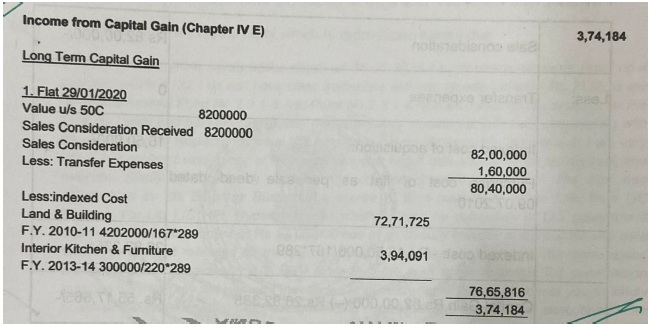
3. However, the AO found that the cost of acquisition was only Rs.15.50 lakhs as evident from the registered sale deed and hence restricted the indexed cost of deduction to arrive at the capital gain of Rs.15.55 lakhs with the indexation of Rs.26,82,335/- and computed the long term capital gain as Rs.55,17,665/- by passing an order u/s.147 of the Act dated 03.02.2025.
4. Aggrieved by the order of the AO, the assessee preferred an appeal before the ld.CIT(A). The assessee filed the detailed submission stating that he bought the property for Rs.15.50 lakhs on 09.07.2010 from M/s.Empress Builders by availing loan from LIC Housing Finance Limited, Hyderabad (“LIC” for short) of Rs.41.90 lakhs, along with the building value of Rs.37,10,000/-. However, the AO has not appreciated the details furnished and made an addition of Rs.55,17,665/- without considering the cost incurred towards building. On perusal of the submissions made by the assessee, the ld.CIT(A) rejected the contention of the assessee and dismissed the appeal of the assessee by passing an order dated 27.01.2026 by holding as under:-
“5. Appellate order and of decision:-
5.1 that the appellant had sold an The case was reopened on the basis immovable property for Rs.82,00,000/- during the year and made a payment of Rs.7,122/- to non-residents but had not filed a return of income for AY 2020-21. Thus, notice was issued u/s 148A to the District Registrar Office to verify the transactions and it was ascertained that the appellant had sold an immovable property being apartment Maphar Calyx, Flat No.407 to Shri Ryali Satya Sirisha for Rs.82,00,000/- on 12-03-2020, which was also reflected in Form 26AS. Thus, show cause notice was issued u/s 148A(b) to the appellant on 21-02-2024 communicating the information available with the Department. In response, the appellant filed submissions stating that the cost of acquisition of the said property was Rs.48,66,125/- as against the amount of Rs.15,50,000/- indicated in the purchase deed dated 09-07-2010. Thus, the AO was of the view that the indexed cost of acquisition adopted by the appellant was erroneous and thus, order u/s 148A(d) was passed on 18-03-2024 and notice u/s 148 was issued on 29-032024. Before the AO, the appellant stated that the flat purchased as per sale deed dated 09-07-2010 was a semi furnished flat and he had incurred a total amount of Rs.43,50,000/- for its purchase. The appellant sought to explain that the balance payment of Rs.37,40,000/- was paid directly by LIC Housing Finance Ltd directly to the builder from time to time. The appellant furnished copy of agreement of sale dated 21-04-2010 which shows purchaser was paid advance sale consideration of Rs.6.00.000/- through the appellant’s that the sale consideration of the flat was Rs.43.50,000/-, As per the agreement of sale, the AXIS Bank account and the balance sale consideration of Rs.37.50.000/- was to be paid in 15 equal instalments. As per the sale deed 09-07-2010, it is indicated that the total sale consideration is Rs.15.50,000/- out of which an amount of Rs.4.40.000/- was paid by the appellant and a sum of Rs.11,10,000/- was paid by LIC Housing Finance Ltd from the appellant’s housing loan. The appellant further stated that he had incurred Rs.3 lakhs towards interior design and further sums towards transfer expenses, stamp duty and registration charges and that these ought to be considered while working out the cost of acquisition.
5.2 A perusal of the assessment order shows that the appellant furnished a work order on plain paper dated 10-06-2010 for Rs.25,00,000/- during the assessment proceedings in order to substantiate the cost of construction of building. As per the work order, the appellant had given an advance of Rs.5,00,000/- to the contractor Shri Mohamed Anwar in cash on 10-06- 2010 and the contractor had agreed to complete the balance work for an amount of Rs.25,00,000/- within one month from the date of the work order. The AO disregarded this work order as it was not a registered document but was typed on plain paper and had no legal value or authentication. The AO further observed that the payment of Rs.15.50 lakhs as per the sale deed was towards the cost of both UDS and the flat (semi finished), and in the absence of any construction agreement, the argument of the appellant that further sums were paid towards the construction was not acceptable. I have considered the material on record. It is not understood how construction works worth Rs.25,00,000/- can be completed in a short period of one month as agreed upon by the parties in the aforesaid work order. Later, when the AO asked for details of deduction and payment of TDS from the contract amounts paid to Mr. Mohamed Anwar, the appellant retracted the submission regarding the work order before the AO and submitted that the construction payments were done by the LIC directly to the builder. The AO concluded that the appellant sought to misguide him regarding the transactions with Shri Mohamed Anwar and LIC Home Finance Limited. The AO dismissed the appellant’s justification that submission of work order with Shri Mohamed Anwar was an oversight because the appellant had furnished the submission with detailed accurate working of the expenses on construction.
5.3 I have perused at length the material available on record. The appellant has not filed a return in response to notice u/s 148 nor u/s 139(1) despite having taxable capital gains. During the assessment proceedings, he relied on the purchase cost indicated in the agreement of sale dated 21-04-2010 and requested to ignore the purchase price as per the registered sale deed dated 0907-2010. He was unable to produce any construction agreement to justify the additional cost of acquisition but produced an unverifiable and unauthentic work order with Shri Mohamed Anwar in support of his contentions. Later, he sought to explain that the additional costs were incurred out of housing loan sanctioned by LIC and retracted his earlier version that construction was carried out by Shri Mohamed Anwar. Even in the agreement of sale dated 21-10-2010, the parties involved are M/s.Empress Builders and the appellant and Shri Mohammad Anwar was no where in the picture nor his involvement indicated in the agreement of sale. The agreement of sale is unregistered. It is trite that the registered sale deed takes precedence over unregistered documents. Besides, it is apparent from the conduct of the appellant that he had been changing his stance several times in assessment and appeal proceedings in an opportunistic manner. When the appellant has not filed the return of income and has not been forthright in his submissions before the AO and the appellate authorities, the explanation furnished by him ought to be disregarded as having no evidentiary value. Further, the additional cost of construction, transfer expenses and cost of interior works are not supported by any proof. No confirmation has been submitted from the builder admitting receipt of sums over and above the amount of Rs 15.50 lakhs indicated in the registered sale deed. Also, even for a moment if the sale agreement is taken cognizance of, there is a mismatch between the payments made by the appellant as per the sale deed and as claimed in the agreement for sale, for which the appellant has not furnished any reconciliation. The contentions of the appellant remain unproved and unsubstantiated. Hence, it is held that the AO has rightly assessed the capital gains of Rs.55,17,665/- on the basis of material available with him. Thus, Ground Nos.7 to 15 and 17 are dismissed.
5.4 Ground No.16:
Ground No.16 is regarding the addition made u/s 69C for unexplained payments made to non residents. The appellant has not been able to explain the transactions in the assessment or appellate proceedings and hence, the addition is confirmed and Ground No. 16 is dismissed.
5.5 Ground Nos.1 to 6:
These grounds are against the validity of the reopening. It was argued that the transactions flagged by the AO did not come within the purview of ‘information’ as there was no transaction to begin with. It was also submitted that the reasons recorded for reopening were improper and that the appellant has necessary documents to prove that income has not escaped assessment which were produced before the AO. I have considered the submissions of the appellant. The appellant had entered into sale transaction of his property but did not file a return indicating the capital gains. The assessment was reopened following the due procedure in Sec. 148A on the basis of information available with the AO. The AO had information in possession that the appellant had sold an immovable property during the year but had not filed a return of income. This constitutes information as per Explanation 1 to Sec. 148. The appellant was provided several opportunities during the proceedings u/s 148A to explain his case and on the basis of submissions of the appellant, the AO was of the opinion that the sale of property has resulted in capital gains which escaped assessment. Thus, a speaking order u/s 148A(d) was passed on 18-03-2024 in which it was noted that the information in possession suggested escapement of income for AY 2020-21. Further, the assessment order passed is elaborate and has considered all the submissions furnished by the appellant. Thus, the appellant’s objections on the legality of the reopening and subsequent assessment are rejected and Ground Nos. 1 to 6 are dismissed.”
5. Aggrieved by the order of ld.CIT(A), the assessee is in appeal before us. The ld.AR for the assessee, assailing the action of the ld.CIT(A), submitted that the ld.CIT(A) has erred in confirming the order of the AO without appreciating the relevant details and documents furnished by the assessee. In support of the grounds of appeal, the ld.AR submitted a paper book of 60 pages consisting of agreement to sell and registered sale deed in relation to the property acquired in the AY 2011-12 and also the sale agreement entered by the assessee with the prospective buyer, email correspondence between the assessee and the LIC in respect of loan availed, certificate issued by LIC for the FY 2015-16 and FY 2019-20 in respect of instalments received, loan disbursement details to the seller, loan account closure statement along with the acknowledgement of receipts and documents filed before the ld.CIT(A). The ld.AR submitted that the assessee had acquired the property by entering into an ‘agreement to sell’ executed on 21.04.2010 at Hyderabad for purchase of flat No.407 at 4th Floor, admeasuring 11,534 sq.ft. along with the UDS of 45.55 sq.yds. for an agreed purchase consideration of Rs.43.50 lakhs (page Nos.1 to 7 of the paper book). Further, the ld.AR stated that the sale deed has been registered on 09.07.2010 in respect of UDS alone for Rs.15.50 lakhs along with the registration expenses, which did not include the construction cost (page Nos. 8 to 39 of the PB). The ld.AR took us through the agreement to sale entered by the assessee on 29.01.2020 with the buyer for Rs.82 lakhs, which clearly indicates that the assessee has sold the flat No.407 along with the UDS (page Nos.40 to 43 of the PB). In support of the payments for construction made by the assessee along with the purchase of UDS, the ld.AR shown us the email correspondence (page Nos.44 to 46 of PB) for having taken the loan from LIC Housing Finance ltd (LIC HFL) to the tune of Rs.37 lakhs. The same was confirmed by the LIC HFL (page Nos.47 to 49 of the PB) for repayment of housing loan during the FY 2015-16 and also FY 2019-20. The ld.AR also shown that the assessee had been regularly paying the EMIs towards housing loan obtained from LIC HFL, even during the impugned assessment year till 13.03.2020. Further, the ld.AR submitted that the entire details and documents along with the written submissions have been submitted before the ld.CIT(A) also. However, the authorities have failed to appreciate the documents and denied the cost of acquisition as a deduction towards flat construction portion. Therefore, in view of the above submissions, the ld.AR prayed for deleting the additions made by the AO, which has been confirmed by the ld.CIT(A).
6. Per contra, the ld.DR for the Revenue supported the orders of the authorities and contended that the registered sale deed for acquiring the asset has recorded the sale consideration of Rs.15.50 lakhs only, further the agreement to sell entered is an unregistered document. Therefore, the denial of deduction in excess of the same is correct and needs to be confirmed the order of the ld.CIT(A).
7. We have heard the rival submissions perused the material available on record and gone through the orders of the authorities including the paper book filed by the assessee. We have also carefully considered the documents relating to acquisition of the property, the registered sale deed, agreement to sell, housing loan documents, loan disbursement particulars, repayment details and the subsequent sale of the property.
8. The short issue for our consideration is whether, while computing the long-term capital gain arising on sale of Flat No.407, the assessee is entitled to claim the cost incurred towards acquisition/construction of the flat over and above the sum of Rs.15.50 lakhs mentioned in the registered sale deed dated 09.07.2010. The undisputed facts are that the assessee acquired Flat No.407 situated on the fourth floor of the building and subsequently sold the very same flat along with the corresponding undivided share of land for a consideration of Rs.82.00 lakhs on 12.03.2020. The AO, however, proceeded to adopt Rs.15.50 lakhs as the entire cost of acquisition solely on the basis of the amount stated in the registered sale deed and, after allowing indexation, determined the longterm capital gain at Rs.55,17,665/-. The ld.CIT(A.) has affirmed the said finding.
9. In our considered view, the approach adopted by the lower authorities fails to appreciate the nature of the asset itself. The property transferred by the assessee in the year 2020 was admittedly Flat No.407 situated on the fourth floor of the building. A flat situated on the fourth floor cannot, by its very nature, be acquired as a mere undivided share of land. The construction component is an integral and inseparable part of the flat which was ultimately sold by the assessee. The registered sale deed dated 09.07.2010 records consideration of Rs.15.50 lakhs. However, the assessee has consistently placed reliance upon the agreement to sell dated 21.04.2010, under which Flat No.407, together with the undivided share in land, was agreed to be acquired for a total consideration of Rs.43.50 lakhs. The assessee has specifically explained that the amount mentioned in the registered sale deed represented the amount attributable to the UDS/transaction covered by the registered conveyance and did not represent the complete cost incurred for the flat including its construction component.
10. More importantly, the assessee has produced independent and contemporaneous evidence in the form of documents relating to the housing loan obtained from LIC Housing Finance Ltd. The paper book contains correspondence with LIC Housing Finance, confirmation/certificates relating to the housing loan, details of disbursement of the loan to the seller/builder, repayment particulars and loan closure documents. The assessee has also demonstrated that the housing loan liability continued to be discharged through EMIs up to 13.03.2020, i.e., immediately preceding the sale of the property.
11. In our considered opinion, these documents provide substantial 0corroboration to the assessee’s explanation that expenditure over and above Rs.15.50 lakhs was in fact incurred in relation to acquisition/construction of the flat. The housing loan documents cannot be brushed aside as a self-serving piece of evidence. They constitute independent third-party evidence emanating from a financial institution and demonstrate the existence of a substantial financial liability incurred by the assessee in connection with the property. The fact that the housing loan was sanctioned and disbursed by LIC Housing Finance Ltd. is particularly significant. A financial institution would not ordinarily disburse a housing loan of the nature claimed by the assessee without reference to the underlying property transaction and construction. The loan disbursement particulars, repayment certificates and closure documents therefore materially corroborate the assessee’s claim regarding the expenditure incurred in acquiring the property.
12. We further find that the subsequent agreement entered into by the assessee with the purchaser also describes the property as Flat No.407 along with the corresponding undivided share of land, for a sale consideration of Rs.82.00 lakhs. Thus, the asset sold by the assessee was a constructed residential flat and not merely the undivided share of land. Therefore, in our considered view, it would be wholly artificial to hold that the assessee acquired only an undivided share of land for Rs.15.50 lakhs and subsequently sold a fourth-floor constructed flat for Rs.82.00 lakhs, while completely ignoring the construction component which necessarily forms part of the very asset transferred. The Revenue has heavily relied upon the registered sale deed and contended that the amount stated therein alone should constitute the cost of acquisition. We are unable to accept such a proposition in the peculiar facts of the present case. The registered sale deed has to be read along with the contemporaneous agreement to sell and the independent evidence regarding the housing finance and its utilisation. The mere fact that the registered conveyance records a particular consideration cannot result in disregarding genuine expenditure incurred towards acquisition/construction of the very asset subsequently transferred.
13. We also note that the assessee has produced documentary evidence from LIC Housing Finance Ltd. showing the housing loan and its repayment. The ld.CIT(A) has principally rejected the assessee’s claim by observing that the assessee had relied upon an unregistered agreement and had initially produced a work order with Shri Mohamed Anwar which was subsequently explained differently. In our considered opinion, the issue cannot be decided merely by isolating the work order from the remaining evidence. Even assuming that the work order is not taken into consideration, the agreement to sell and, more importantly, the independent housing-loan records provide corroborative evidence regarding the cost incurred by the assessee. The existence of the housing loan and the actual disbursement and repayment thereof are material circumstances which cannot be discarded merely because the assessee had furnished an inconsistent explanation regarding one particular document.
14. It is also relevant that the assessee had availed housing finance and continued to repay the loan even during the year of sale. The existence of such loan liability, coupled with the documentary evidence of its disbursement in connection with the property, lends considerable credibility to the assessee’s explanation. The Revenue has not brought any material on record to establish that the said housing loan was unrelated to Flat No.407 or that the amounts disbursed by LIC Housing Finance were utilised for any purpose other than acquisition/construction of the property. In these circumstances, we find that the assessee has discharged the evidentiary burden by producing contemporaneous documentary evidence from the builder and the housing finance institution. Once the existence of the construction component and the financing thereof is supported by independent documentary evidence, the Revenue cannot restrict the cost of acquisition merely to the amount stated in the registered sale deed without disproving the other evidence placed on record.
15. The reasoning of the ld.CIT(A.) that the registered sale deed necessarily takes precedence over the unregistered agreement is, in our considered view, misplaced in the context of the issue before us. We are not determining title to the property or the enforceability of the agreement. We are determining the actual cost attributable to the capital asset for the purpose of computation of capital gains. For that purpose, all relevant and credible evidence having a bearing on the actual cost has to be considered. Further, the Revenue has not brought any contrary evidence to demonstrate that the housing loan obtained from LIC Housing Finance was utilised for some other property or for any purpose unconnected with Flat No.407. On the contrary, the assessee has placed before us the loan correspondence, disbursement details, certificates and repayment particulars which directly support his explanation.
16. We therefore find considerable force in the contention of the ld.AR that the amount of Rs.15.50 lakhs mentioned in the registered sale deed cannot be regarded as the complete cost of acquisition of the fourth-floor flat. The construction component is an essential and inseparable part of the asset which was ultimately sold by the assessee. The evidence placed before us establishes that the assessee had incurred substantial expenditure towards acquisition/construction of the flat and had financed the same through LIC Housing Finance Ltd. Once the construction cost is accepted as having been incurred in respect of the very property sold by the assessee, the same necessarily forms part of the cost of acquisition/cost of the asset for the purpose of computing capital gains, subject to the provisions of section 48 of the Act. Denying the same would result in taxing the assessee on a capital gain computed without allowing the actual cost attributable to the asset transferred.
17. We accordingly hold that the AO was not justified in restricting the cost of acquisition to Rs.15.50 lakhs merely on the basis of the registered sale deed and in ignoring the contemporaneous and corroborative evidence placed by the assessee. The ld.CIT(A.) also erred in confirming the said action. In view of the foregoing discussion, we accept the assessee’s explanation regarding the cost incurred towards acquisition/construction of Flat No.407. The cost supported by the agreement to sell and corroborated by the LIC Housing Finance loan documents and disbursement particulars is liable to be considered while computing the capital gains arising on sale of the property.
18. Consequently, the addition of Rs.55,17,665/- made by the AO towards long-term capital gain, as confirmed by the ld.CIT(A.), is deleted. The AO is directed to recompute the long-term capital gain by allowing the eligible cost of acquisition, including the substantiated construction component, together with applicable indexation in accordance with law. Accordingly, the grounds raised by the assessee on the issue of cost of acquisition are allowed.
19. As regards the grounds challenging the reopening of assessment, we find that the proceedings were initiated on the basis of information available with the AO regarding the sale of immovable property for Rs.82.00 lakhs and the nonfiling of return of income by the assessee. Notice u/s.148A(b) was issued, the assessee was afforded an opportunity, an order u/s.148A(d) was thereafter passed and notice u/s.148 of the Act was issued. The ld.CIT(A) has recorded these facts and upheld the reopening. In the light of the material available on record, we do not find sufficient basis to interfere with the finding of the ld.CIT(A.) on the validity of assumption of jurisdiction u/s.148 of the Act. The grounds challenging reopening are accordingly dismissed.
20. Insofar as the addition u/s.69C of the Act towards payment to nonresidents is concerned, the material presently available before us, as recorded in the appellate order, only indicates that the assessee had not satisfactorily explained the relevant transaction before the lower authorities. Since the exact nature and evidentiary details of the payment are not elaborated in the material placed before us, no contrary finding can safely be recorded merely on the basis of the limited facts available. Accordingly, the issue may be adjudicated in accordance with the evidence available on record and applicable provisions of law.
21. In the result, the appeal of the assessee is partly allowed for statistical purposes.