


Commercial Property Disqualification and Urban Location Do Not Bar Exemptions Under Sections 54F and 54B
Issue
-
Eligibility under Section 54F: Whether the ownership of a commercial property (SCO-7, Dhakoli, Zirakpur) disqualifies an assessee from claiming capital gains exemption under Section 54F on the ground of owning more than one residential house on the date of transfer of the original asset.
-
Eligibility under Section 54B: Whether the mere urban location of land, confirmed to be agricultural in character by documentary evidence and factual verification, disentitles the assessee from claiming exemption under Section 54B for investments made in agricultural land.
Facts
-
Ancestral Land Sale: The assessee, an individual, sold ancestral agricultural land during Assessment Year 2018-19 and claimed capital gains exemptions under both Section 54F and Section 54B.
-
Section 54F Disallowance:
-
The CIT(A) denied the Section 54F claim for investment in a residential house, alleging that the assessee owned more than one residential house on the date of transfer of the original asset.
-
This denial was based on treating the assessee’s property at SCO-7, Dhakoli, Zirakpur as a residential property.
-
Fact-finding ordered by the Tribunal established that SCO-7, Dhakoli, Zirakpur was purely commercial in nature.
-
-
Section 54B Disallowance:
-
The Assessing Officer (AO) originally disallowed the Section 54B claim entirely due to lack of supporting evidence.
-
The CIT(A) granted partial relief of ₹2.20 crores upon verifying agricultural land purchases within the statutory timeline, but sustained the remaining disallowance.
-
The Revenue questioned the agricultural character of two newly purchased properties on the ground that they were located in an urban area.
-
A factual verification report submitted pursuant to the Tribunal’s directions confirmed that the lands were agricultural in nature despite their urban location.
-
Decision
-
Section 54F Deduction: In favour of Assessee. Commercial properties cannot be classified as residential houses to trigger the restriction under Section 54F. Once SCO-7, Dhakoli, Zirakpur was proven to be commercial, the assessee was not disqualified and was entitled to Section 54F deduction, subject to meeting other statutory conditions. [Para 24]
-
Section 54B Deduction: In favour of Assessee. The mere location of a land in an urban area is not a sufficient basis to deny Section 54B exemption if its actual agricultural character is established by documentary evidence and factual verification reports. The claim under Section 54B was allowed to the extent of the eligible investment. [Para 20]
Key Takeaways
-
Commercial Character Excludes Section 54F Bar: The proviso to Section 54F restricting exemption to assessees who own not more than one residential house applies strictly to residential properties; commercial units (such as SCOs) cannot be counted toward this limit.
-
Urban Location Does Not Alter Agricultural Status: For Section 54B benefits, the key criterion is the true agricultural character and usage of the land; being located within urban limits does not automatically reclassify agricultural land into non-agricultural property.
-
Primary Reliance on Factual Verification: Reports and evidence establishing actual physical character and usage of property override administrative assumptions made by tax authorities regarding nature and location.
IN THE ITAT CHANDIGARH BENCH ‘B’
Sushil Tiwari
v.
Income-tax Officer
Laliet Kumar, Judicial Member
and Vijay Varma, Accountant Member
and Vijay Varma, Accountant Member
IT Appeal No. 21 (CHD) of 2025
[Assessment year 2018-19]
[Assessment year 2018-19]
SEPTEMBER 1, 2026
Parikshit Aggarwal, Hrithik Singla, CAs Smt. Kusum Bansal, Pr. CIT DR for the Respondent.
ORDER
Laliet Kumar, Judicial Member.- This appeal filed by the assessee is directed against the order passed by the learned Commissioner of Income-tax (Appeals) [hereinafter referred to as “the learned CIT(A)”] and arises out of the assessment order passed by the Assessing Officer under section 143(3) read with section 144B of the Income-tax Act, 1961 (“the Act”) for the Assessment Year 2018-19.
2. At the outset, the ld. AR submitted that the appeal filed by the assessee is barred by limitation by 3 days for which affidavit explaining the delay has been placed on record. It was submitted that the delay was neither intentional nor deliberate and occurred due to unavoidable circumstances. The ld. DR did not seriously object to the condonation of delay. Considering the contents of the affidavit and the totality of facts and circumstances, we are satisfied that the assessee was prevented by sufficient cause from filing the appeal within the prescribed limitation period. Accordingly, the delay of 3 days in filing the appeal is condoned and the appeal is admitted for adjudication on merits.
3. The facts of the case are that the assessee is an individual deriving income under the heads “Income from House Property”, “Business or Profession”, “Capital Gains” and “Other Sources”. During the year under consideration, the assessee sold ancestral agricultural land for a consideration of Rs. 8,00,00,000 vide sale deed dated 18.09.2017. Against the resultant capital gains, the assessee claimed deduction/exemption under sections 54F and 54B of the Act.
3.1 The assessee computed the capital gain at Rs. 7,72,80,000 after reducing the indexed cost of acquisition and claimed deduction under section 54F of Rs. 2,63,71,500 on account of investment in a residential property and deduction under section 54B in respect of investment made in agricultural land. The assessment proceedings were taken up under the Limited Scrutiny scheme on the issue of capital gain deduction claimed by the assessee.
4. During the assessment proceedings, the Assessing Officer required the assessee to furnish details and supporting evidence in respect of the deductions claimed under sections 54F and 54B. The assessment order records that although the assessee furnished certain documents, the Assessing Officer considered that sufficient supporting evidence in respect of the claims had not been furnished. Consequently, the claims under sections 54F and 54B were disallowed and an aggregate addition of Rs. 6,36,28,000 was made to the returned income. The assessment was accordingly completed determining the assessed income at Rs.6,69,79,260, after making disallowance of Rs. 2,63,71,500 under section 54F and Rs. 3,72,56,500 under section 54B.
5. Aggrieved by the assessment order, the assessee preferred an appeal before the learned CIT(A). The assessee contended that the relevant documents had been furnished and that the disallowance was made without properly considering the documentary evidence.
6. In the appellate proceedings, the assessee furnished, inter alia, the sale deed of the agricultural land sold, purchase deeds of the agricultural properties acquired for claiming deduction under section 54B, documents relating to the residential property purchased for claiming deduction under section 54F and the relevant bank statement relating to the Capital Gains Accounts Scheme.
7. The learned CIT(A) partly accepted the claim under section 54B. In respect of investment of Rs.2,20,00,000, the learned CIT(A) found that the investment in agricultural land had been made within the prescribed time and allowed the claim to that extent. The remaining claim of Rs. 1,72,56,500 was not accepted for want of supporting documentary evidence.
8. As regards the amount of Rs. 1,36,52,000 deposited in the Capital Gains Accounts Scheme, the learned CIT(A) accepted the deposit as eligible for exemption for the year under consideration, subject to verification of subsequent utilisation in accordance with section 54B/54EC. With regard to the claim under section 54F, the learned CIT(A) noted that the assessee had shown income from more than one property under the head “Income from House Property”, including the property situated at SCO-7, Dhakoli, Zirakpur. Proceeding on the basis that the assessee owned more than one residential house on the date of transfer of the original asset, the learned CIT(A) held that the assessee failed to satisfy the condition prescribed under the proviso to section 54F and accordingly upheld the disallowance of Rs.2,63,71,500.
9. The assessee has challenged the order of the learned CIT(A), inter alia, on the following grounds:
| 1. | That the order of the Assessing Officer is defective both in law and on facts. |
| 2. | That the addition/disallowance made under section 54B is unjustified. |
| 3. | That the addition/disallowance made under section 54F is unjustified. |
| 4. | That the charging of interest under sections 234A, 234B and 234C is not justified. |
| 5. | That the initiation of penalty proceedings under section 270A is not justified. |
| 6. | The assessee has also raised a general ground seeking permission to raise additional grounds, if any. |
10. Since the controversy before us essentially concerns the eligibility of the assessee’s claims under sections 54B and 54F, we proceed to adjudicate these issues. The matter was elaborately argued by both sides, namely, the learned AR for the assessee and the learned DR for the Revenue.
11. On the issue of deduction under section 54B, the learned AR submitted that the assessee had furnished copies of the purchase deeds in respect of three agricultural lands purchased against the agricultural land sold. It was submitted that, despite the relevant documents having been furnished, the benefit of deduction was not allowed in respect of two purchase deeds, namely:
| • | purchase deed dated 02.07.2018 for Rs. 80,00,000; and |
| • | purchase deed dated 01.08.2018 for Rs. 45,00,000. |
12. The learned AR submitted that the aforesaid documents established the purchase of agricultural land within the prescribed period and, therefore, the corresponding investment was eligible for deduction under section 54B.
13. As regards section 54F, the learned AR submitted that the learned CIT(A) had denied the benefit on the premise that the assessee owned more than one residential house, principally because SCO No. 7, Dhakoli, Zirakpur had been treated as a residential property. It was submitted that the said property was a Shop-cum-Office and was commercial in nature. The learned AR therefore submitted that the said property could not be treated as a residential house for applying the restriction contained in section 54F. The assessee also relied upon the documentary material furnished in support of both claims. The record shows that before the appellate authority the assessee had specifically furnished purchase deeds and other documents in support of the deductions claimed.
14. Upon considering the rival submissions, this Tribunal, vide order dated 13.08.2026, found that the issues under sections 54B and 54F required verification of the relevant documents and factual position. Accordingly, in the interest of justice, the Tribunal directed the Assessing Officer to examine the relevant documents and submit a comprehensive report on both issues after providing due opportunity to the assessee. The assessee was granted liberty to place before the Assessing Officer copies of the relevant sale/purchase deeds concerning the two agricultural lands in respect of which deduction under section 54B had not been allowed, as well as the sale deed/documents relating to SCO No. 7, Dhakoli, Zirakpur, for determining the nature and status of the said property for purposes of section 54F. The matter was accordingly adjourned to 01.09.2026, with the hearing continuing as Part Heard.
15. The ld. DR had placed on record copy of the Remand Report filed by the AO which is to the following effect :
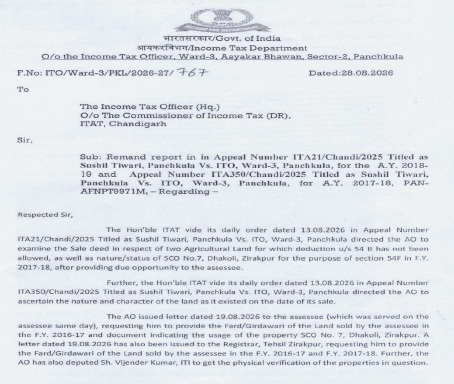
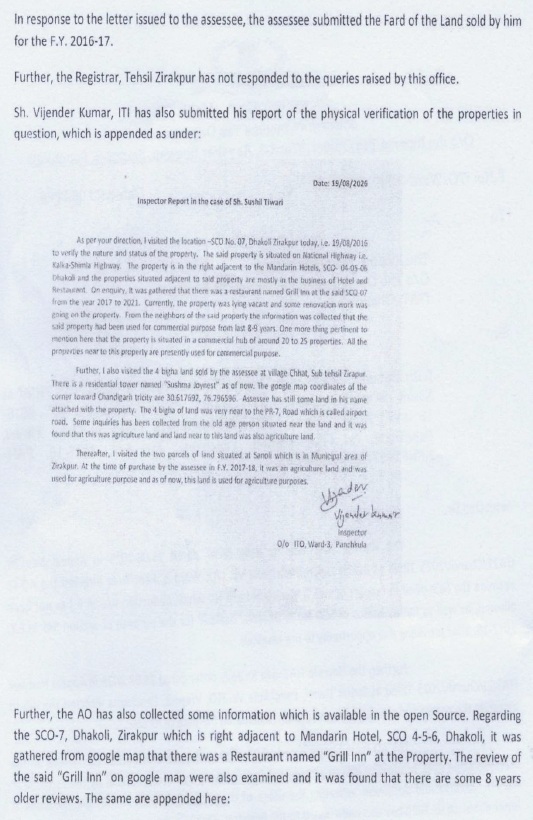
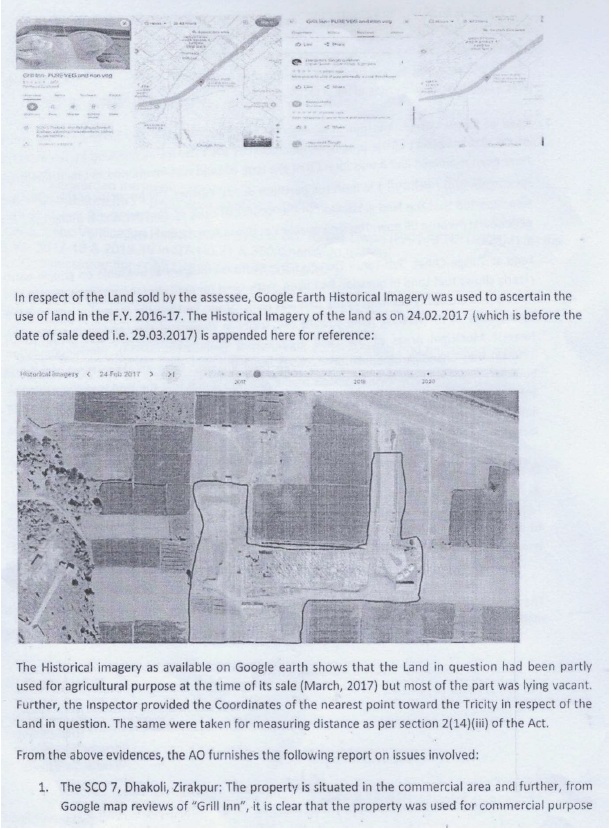
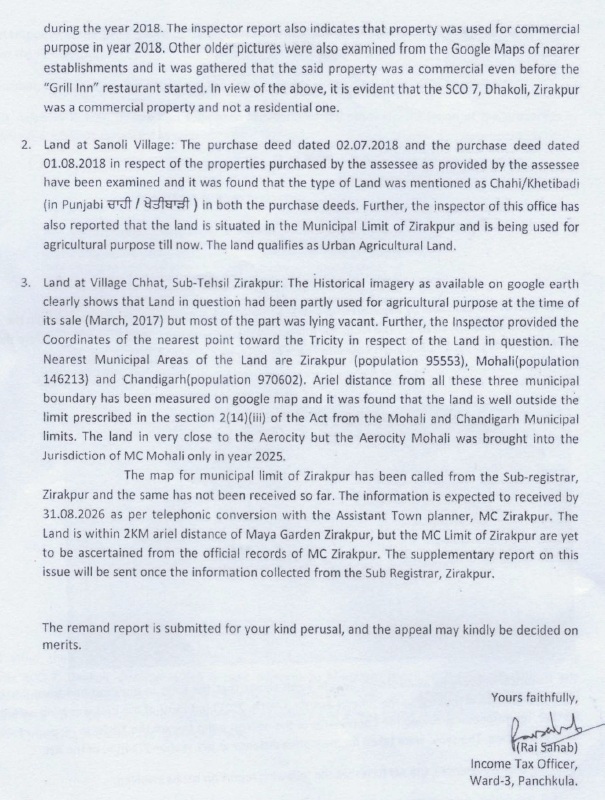
16. Pursuant to the aforesaid direction, the Assessing Officer, along with the learned CIT-DR, appeared before us and confirmed the factual position concerning the properties. In respect of SCO No. 7, Dhakoli, Zirakpur, it was confirmed that the property was commercial in nature. In respect of the other two properties, it was confirmed that the properties were urban agricultural properties purchased by the assessee. The Revenue, however, submitted that two of the agricultural properties were situated in an urban area and, therefore, the relevant statutory requirements required examination. The learned DR accordingly relied upon the factual report and the orders of the authorities below, while leaving the matter to be decided on the basis of the material and verification carried out pursuant to the Tribunal’s direction.
17. We have carefully considered the rival submissions, the orders of the authorities below, the material available on record and the factual report furnished pursuant to our order dated 13.08.2026. The assessee had invested Rs.2,63,71,500 in the purchase of a new residential property and claimed exemption under section 54F. The purchase deed and other supporting material were placed on record. The learned CIT(A), however, denied the claim on the ground that the assessee owned more than one residential house on the date of transfer of the original asset. The aforesaid finding of the learned CIT(A) was materially based upon the treatment of SCO-7, Dhakoli, Zirakpur, as a residential property. However, pursuant to the specific direction issued by this Tribunal on 13.08.2026, the factual position has been examined and the Assessing Officer has confirmed that the said property is commercial in nature. Once the said property is found to be commercial in nature, it cannot be taken into account as a residential house for the purpose of determining whether the assessee owned more than one residential house on the date of transfer of the original asset. The very factual foundation on which the learned CIT(A) denied the benefit under section 54F, therefore, does not survive.
18. We accordingly hold that the assessee cannot be denied the benefit of section 54F merely by treating SCO-7 as a residential property when the factual verification undertaken pursuant to the direction of this Tribunal establishes that the said property is commercial in nature. Accordingly, the disallowance of Rs.2,63,71,500 under section 54F is deleted and the assessee’s claim is allowed, subject to satisfaction of the remaining statutory conditions, if any.
19. The assessee claimed deduction under section 54B on account of investment in agricultural land purchased after the sale of the original agricultural land. The learned CIT(A) had allowed the claim only to the extent of Rs. 2,20,00,000 and denied the balance claim for want of supporting documentary evidence.
20. Before us, the learned AR specifically relied upon the purchase deeds dated 02.07.2018 for Rs. 80,00,000 and 01.08.2018 for Rs. 45,00,000, which, according to the assessee, had not been given due consideration by the lower authorities. Pursuant to our order dated 13.08.2026, the relevant documents and factual position were examined. It has been confirmed before us that the properties in question were agricultural properties and were purchased by the assessee. The Revenue has pointed out that two of the properties are situated in an urban area. However, the report furnished pursuant to the direction of the Bench confirms their agricultural character. Mere location of an agricultural property in an urban area, in the absence of material establishing that the property was not agricultural in character, cannot by itself be a sufficient basis for denying the benefit claimed under section 54B.
21. The documentary evidence regarding the purchase of agricultural land having been examined and the agricultural nature and purchase by the assessee having been confirmed, we find that the assessee has established the factual basis of the claim. Accordingly, the claim under section 54B is allowable to the extent of the eligible investment established by the purchase deeds and other material placed on record, including the investments covered by the purchase deeds dated 02.07.2018 and 01.08.2018. The disallowance sustained by the learned CIT(A) under section 54B is, therefore, deleted to the extent of the eligible investment duly established on record.
22. The grounds relating to levy of interest under sections 234A, 234B and 234C are consequential in nature and shall stand modified in accordance with the final computation of income pursuant to this order.
23. As regards initiation of penalty proceedings under section 270A, the same is premature at this stage and does not require independent adjudication.
24. In view of the foregoing discussion, and particularly having regard to the factual verification undertaken pursuant to the Tribunal’s order dated 13.08.2026, we hold as under:
| 1. | SCO No. 7, Dhakoli, Zirakpur, has been confirmed to be commercial in nature and, therefore, cannot be treated as a residential house for determining the assessee’s eligibility under section 54F. |
| 2. | The assessee is, accordingly, entitled to deduction under section 54F in respect of the investment of Rs.2,63,71,500, subject to the other statutory conditions being satisfied. |
| 3. | The properties relied upon for the purposes of section 54B have been confirmed to be agricultural properties purchased by the assessee. |
| 4. | The assessee is entitled to deduction under section 54B to the extent of the eligible investment established by the documentary evidence, including the purchase deeds dated 02.07.2018 for Rs.80,00,000 and 01.08.2018 for Rs.45,00,000. |
| 5. | The consequential ground relating to interest is allowed for statistical purposes, and the issue of penalty is left open in accordance with law. |
25. Accordingly, the grounds relating to sections 54B and 54F are allowed and the corresponding disallowances sustained by the learned CIT(A) are deleted to the extent indicated above.
26. In the result, the appeal of the assessee is allowed.