ORDER
R.K. Panda, Vice President. – The above 3 appeals filed by the respective assessees are directed against the separate orders of the Ld. CIT(A) / NFAC, Delhi as mentioned above. Since identical grounds have been raised by the respective assessees, therefore, for the sake of convenience, these were heard together and are being disposed of by this common order.
2. There is a delay of 432 days in filing of the appeal in ITA No.1797/pUN/2024, delay of 477 days in filing of the appeal in ITA No.1798/pUN/2024 and the delay of 411 days in filing of the appeal in ITA No.1799/pUN/2024 before the Tribunal for which the respective assessees have filed separate condonation applications along with affidavits explaining the reasons for such delay. In all the affidavits it has been mentioned that they have not received the order of the Ld. CIT(A) / NFAC but came to know of passing of such order only after the Assessing Officer initiated recovery proceedings. Thereafter, immediately after coming to know of passing of such order by the Ld. CIT(A) / NFAC the respective assessees have taken immediate steps and filed the appeals which caused the delay. However, if the period from the date of receipt of recovery notice till the date of filing of the appeals is considered, there is no delay in filing of the appeals before the Tribunal. Relying on various decisions the Ld. Counsel for the assessee submitted that the delay in filing of the appeals before the Tribunal should be condoned.
3. The Ld. DR on the other hand strongly opposed the condonation applications filed by the assessee.
4. We have heard the rival arguments made by both the sides on the issue of delay in filing of the appeals and considered the contents of the condonation applications filed along with the affidavits of the assessee. There is no dispute to the fact that there is delay in filing of the appeals by the respective assessees as mentioned above. A perusal of the condonation applications filed along with the affidavits show that there was bonafide reasons in not filing of the appeals in time.
5. We find the Hon’ble Supreme Court in the case of Collector, Land Acquisition v. Mst. Katiji (SC)/167 ITR 471 (SC) has held that when substantial justice and technical considerations are pitted against each other, cause of substantial justice deserves to be preferred for the other side cannot claim to have vested right in injustice being done because of a non-deliberate delay. Refusing to condone delay can result in a meritorious matter being thrown out at the very threshold and cause of justice being defeated. As against this when delay is condoned the highest that can happen is that a cause would be decided on merits after hearing the parties.
6. We find recently the Hon’ble Supreme Court in the case of Inder Singh v. State of Madhya Pradesh [SLP (Civil) No. 6145 of 2024, dated 21-3-2025]/2025 LiveLaw (SC) 339 has held as under:
“14. There can be no quarrel on the settled principle of law that delay cannot be condoned without sufficient cause, but a major aspect which has to be kept in mind is that, if in a particular case, the merits have to be examined, it should not be scuttled merely on the basis of limitation. “
7. Considering the totality of the facts of the case and in the light of the decisions of Hon’ble Supreme Court cited (supra), the delay in filing of all the appeals is condoned and the appeals are admitted for adjudication.
8. First we take up appeal in the case of Pandurang Gopal Thakur vide ITA No.1797/pUN/2024 for assessment year 2013-14 as the lead case.
9. Facts of the case, in brief, are that the assessee is an individual and is a salaried employee. During the year under consideration the assessee was working with Jilha Parishad School and has earned salary income of Rs.1,91,540/-. In addition to this, the assessee has declared interest income earned during the year. He filed his return of income on 24.07.2013 declaring total income of Rs.2,45,410/- after claiming refund of Rs.10,80,300/-. While doing so, the assessee disclosed a sum of Rs.95,60,208/- being enhanced compensation received on compulsory acquisition of agricultural land by the Special Land Acquisition Officer (SLAO) and claimed the same as exempt from tax. The return was processed u/s 143(1) of the Income Tax Act, 1961 (hereinafter referred to as ‘the Act’) accepting the returned income. Subsequently the Assessing Officer received specific information that during the financial year 2012-13 relevant to assessment year 2013-14 the assessee has received interest on enhanced compensation from SLAO which is subject to tax to the extent of Rs.33,13,299/- apart from others. The Assessing Officer accordingly reopened the assessment as per the provisions of section 147 of the Act and notice u/s 148 of the Act dated 10.06.2016 was issued and served on the assessee requiring him to furnish the return of income within 30 days. The assessee vide letter dated 18.07.2016 stated that the return filed on 24.04.2013 u/s 139(1) of the Act may be treated as return in response to the notice and compliance thereof. He also asked the Assessing Officer to supply the reasons recorded for issuing notice u/s 148 of the Act. The Assessing Officer supplied the reasons and also disposed off the objections raised by the assessee challenging the reopening of the assessment. Subsequently notice u/s 143(2) of the Act was issued. Thereafter, notice u/s 142(1) of the Act along with a questionnaire was issued.
10. During the course of assessment proceedings the Assessing Officer noted that the agricultural land of the assessee at Survey No.22 Issa No.7H having area 27-0 – H R P situated in Village Dhutum, Tal: Uran, Dist: Raigad was compulsorily acquired by the Special Land Acquisition Officer (Metro Centre-2), Uran in the year 1997. Compensation inclusive of interest was awarded to the assessee of Rs.37,091/ against compulsory acquisition of his above agricultural land. Being aggrieved, the assessee filed appeal against the Award before the Civil Court, Alibag. The Civil Court, Alibag, vide Order dated 14-09-2011 awarded enhanced compensation and interest thereon as under, which was received by the assessee during the previous year relevant to A Y 2013-14.
| Enhanced compensation |
2295000 |
| 30% Solatium |
688500 |
| Interest @ 12% u/s. 23(1A) of Land Acquisition Act, 1873 for the period 22-05-1997 to 09-12-1997 |
150705 |
| Less: Amount as per section 11 Award dated 14-01-1998 |
49890 |
|
3084315 |
| Interest @ 9% u/s. 28(f) of Land Acquisition Act, 1873 for the period 13-01-1998 to 12-01-1999 |
277588 |
| Interest @ 15% u/s. 28(f) of Land Acquisition Act, 1873 for the period 13-01-1999 to 06-02-2013 |
6198305 |
| Total |
9560208 |
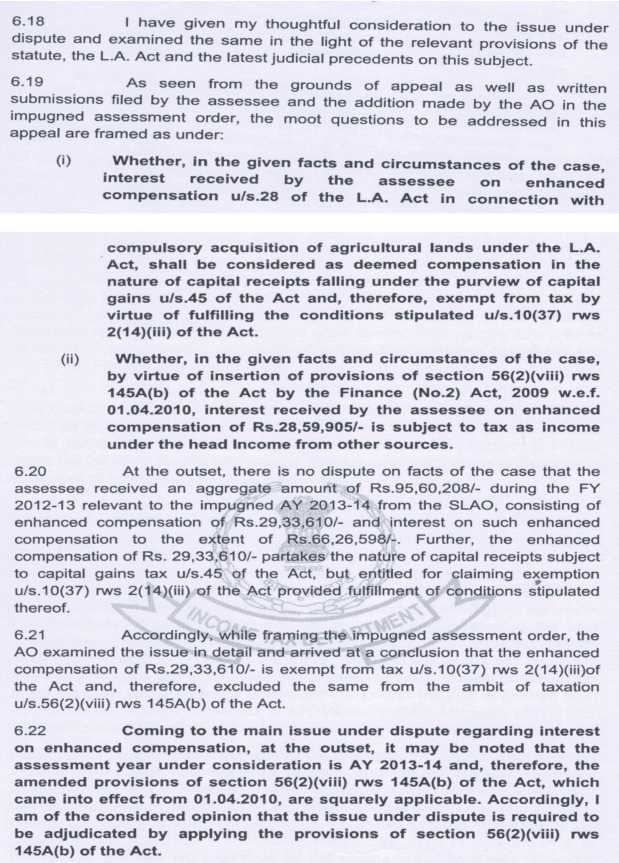
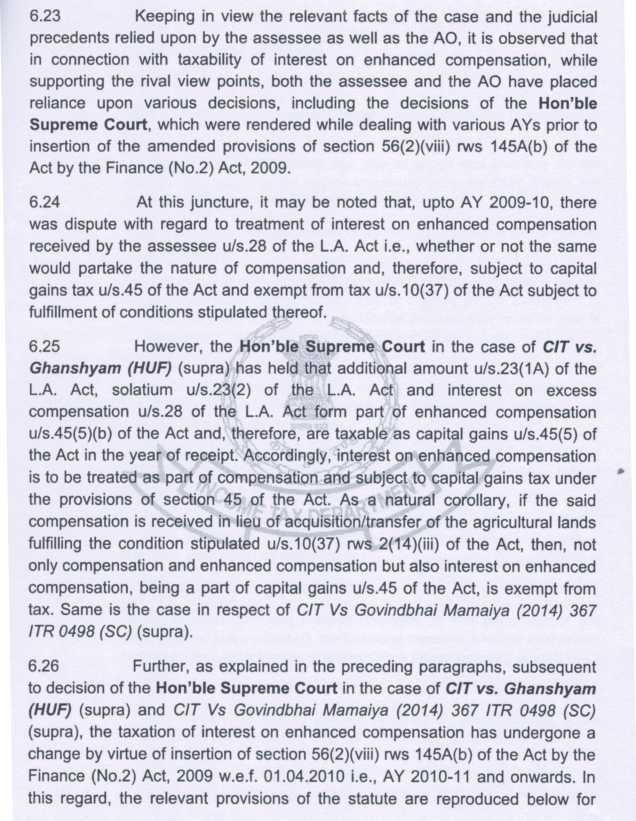
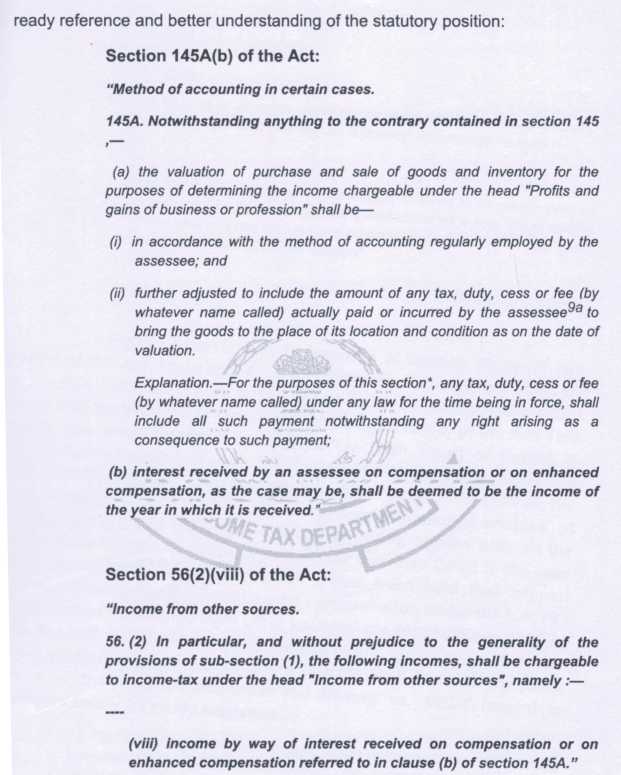
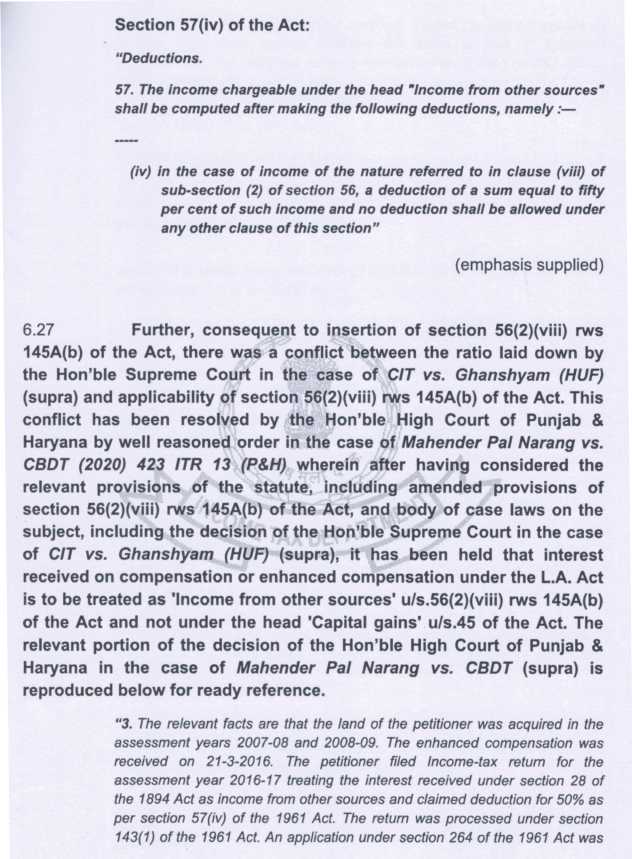
11. Out of total enhanced compensation and interest of Rs.95,60,208/-, the Special Land Acquisition Officer deducted tax at source of Rs.10,80,303/-. Along with the computation of total income, the assessee has claimed enhanced compensation and interest as exempt relying on the decision of Hon’ble Supreme Court in the case of CIT v. Ghanshyam (HUF) 315 ITR 1 (SC). The assessee endorsed a note along with the return of income for claiming exemption of the income of enhanced compensation and interest received during the relevant year under consideration. According to the Assessing Officer since the agricultural land was compulsorily acquired under the State law for which he has received enhanced compensation and interest during the year, therefore, the conditions laid down in section 10(37) and 2(14)(iii) are fulfilled. Therefore, the enhanced compensation of Rs.22,95,000/- received by the assessee during the impugned assessment year against compulsory acquisition of his agricultural land is eligible for claim of exemption u/s 10(37) of the Act. However, the interest received by the assessee against the compulsory acquisition of his agricultural land is taxable as ‘Income from other sources as per the provisions of section 56(2)(viii) subject to deduction u/s 57(iv) of the Act. Since the assessee has claimed interest received as exempt, he confronted the same to the assessee. Rejecting the various explanations given by the assessee, the Assessing Officer made addition of Rs.33,13,299/- as ‘Income from other sources’ by observing as under:
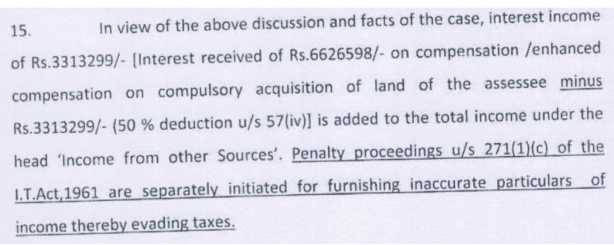
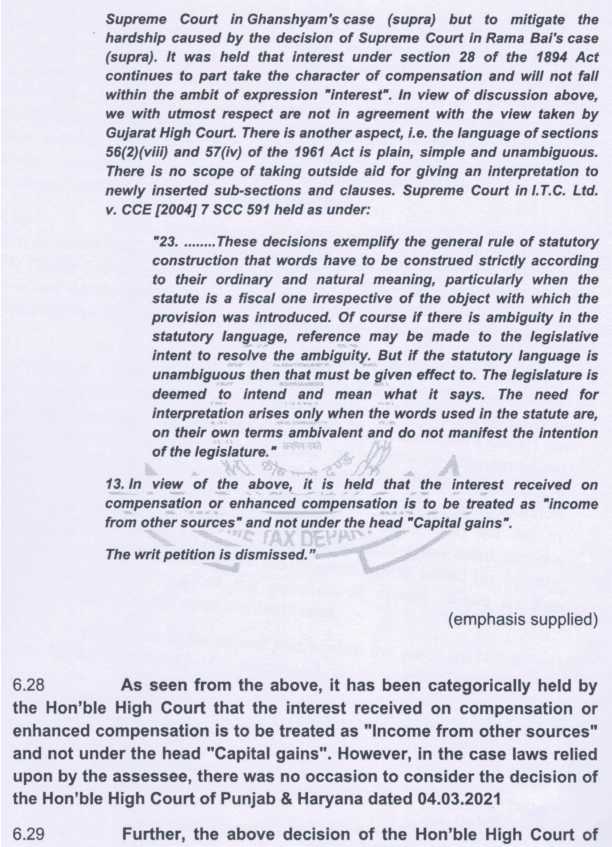
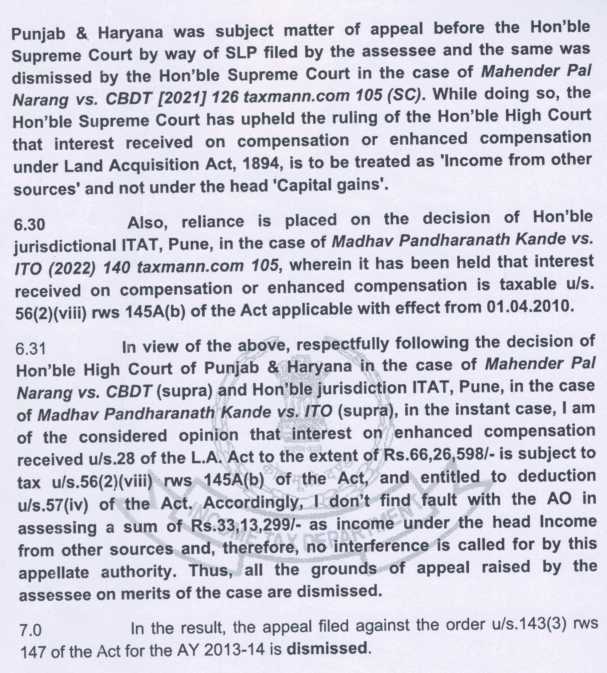
12. In appeal the Ld. CIT(A) / NFAC upheld the action of the Assessing Officer by observing as under:
13. Aggrieved with such order of the Ld. CIT(A) / NFAC the assessee is in appeal by raising the following grounds:
The following grounds are taken without prejudice to each other
On facts and in law,
| 1. |
|
The Appellant-Assessee requests to condone the delay in view of the affidavit and admit an appeal with further request to note that order of CIT(A)-NFAC dated 24/04/2023 was not communicated and assessee came to know about appeal dismissed by the CIT(A)-NFAC where notice of recovery dated 16/08/2024 was received. |
| 2. |
|
The Learned CIT(A)-NFAC failed to adjudicate the validity of notice issued u/s 148 and inter-alia re-assessment proceedings and merely reproduced the part of assessment order, disposing off the objections raised by the Assessee against issue of notice u/s 148 of the Act. |
| 3. |
|
The learned CIT(A)-NFAC failed to appreciate while confirming the action of the AO that the nature of the Gross Interest at Rs.66,26,598/- (50% assessed at Rs.33,13,299/-) awarded u/s 28 of the Land Acquisition Act, 1894 was Capital receipt and not taxable u/s 56(2)(viii) r.w.s. 145A(b) and sec 57(iv) of the Income Tax Act, 1961; as per principle/precedent laid down by the Hon’ble Supreme Court in the case of CIT v/s Ghanshyam HUF [2009] 315 ITR 1. |
| 4. |
|
The learned CIT(A)-NFAC failed to appreciate while confirming the action of the AO that the Gross Interest at Rs.66,26,598/- (50% assessed at Rs.33,13,299/-) awarded u/s 28 of the Land Acquisition Act, 1894 was Capital Receipt but not chargeable as capital gain u/s 45(5) as the compulsorily acquired agricultural land was Rural Agricultural Land and therefore was not capital asset u/s 2(14) which fact is not disputed by the learned AO and the learned CIT(A)-NFAC. |
| 5. |
|
The learned CIT(A)-NFAC awarded u/s 28 of the Land Acquisition Act, 1894 without appreciating that. |
| (a) |
|
The decision of Hon’ble Apex Court in the case of CIT v/s Ghanshyam HUF [2009] 315 ITR 1 still prevails and therefore the interest u/s 28 of the Land Acquisition Act, 1894 is not coming in the ambit of taxation. |
| (b) |
|
The SLP dismissed by Hon’ble Supreme Court in the case of Mahendra Pal Narang v/s CBDT, Ministry of Finance reported at (SC) filed against the order of Hon’ble Punjab and Haryana High Court in the case of Mahendra Pal Narang v/s CBDT [2020] does not prescribe a law or new position with respect to the claim of the assessee that interest awarded u/s 28 of the Land Acquisition Act, 1894 is capital receipt not subject to tax. |
| 6. |
|
The learned CIT(A)-NFAC while confirming the order of the AO failed to note that: |
| (a) |
|
No binding precedence is created and don’t constitute a law declared by Hon’ble Supreme Court and does not result in res-judicata where Special Leave Petition (the SLP) is dismissed by the Hon’ble Apex Court by non-speaking order as in the case of Mahendra Pal Narang v/s CBDT reported at (SC) and |
| (b) |
|
The learned CIT(A)-NFAC failed to consider for this purpose decisions of Hon’ble Apex Court in the following cases- |
| i. |
|
Khoday Distilleries Ltd. (supra): State Manipur v/s Thingujan Brojen Meeteil [1996] 95 SCC 29 and |
| ii. |
|
Om Prakash Gargi v/s State of Punjab [1996] 11 SCC 395 and |
| iii. |
|
Sun Export Corp v/s Collector of Customs AIR 1997 SC 2658 and |
| iv. |
|
V M Salgaocar and Bros. (P) Ltd. v/s CIT (SC) |
| (c) |
|
SLP dismissed by the Hon’ble Supreme Court [relied by the CIT(A)] is not dismissed after assigning reasons. |
| (d) |
|
In light of the above precedents, the decision of Hon’ble Supreme Court in the case of CIT v. Ghanshyam (HUF) still prevails and holds the ground. |
| 7. |
|
The learned CIT(A)-NFAC failed to appreciate that majority of decisions cited and relied upon by the assessee which were rendered by the Hon’ble ITAT Pune in favour of the assessee carry judicial precedence especially where there is no direct decision of jurisdictional High Court, even if the decision of Non-Jurisdictional High Court is against. |
14. The Ld. Counsel for the assessee referring to page 62 of the paper book drew the attention of the Bench to the details of interest received u/s 28 of the Land Acquisition Act which are as under:
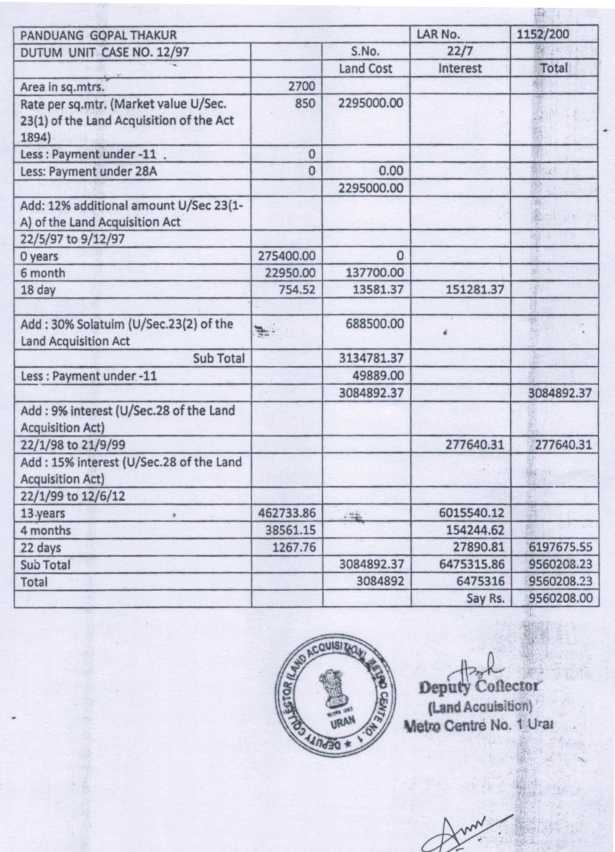
15. He submitted that the compensation / enhanced compensation received by the assessee has been accepted to be exempt from tax by the Assessing Officer and no addition has been made. However, he has brought to tax the interest of Rs.33,13,299/- on the compensation / enhanced compensation on compulsory acquisition of agricultural land which has been upheld by the Ld. CIT(A) / NFAC. He submitted that the Ld. CIT(A) / NFAC while deciding the issue against the assessee has referred to the decision of the Hon’ble Punjab & Haryana High Court in the case of Mahender Pal Narang v. CBDT, New Delhi 423 ITR 13 (Punjab & Haryana) and the decision of the Pune Bench of the Tribunal in the case of Madhav Pandharinath Kande v. ITO 195 ITD 579 (Pune – Trib.)/ITA No. 2584/pN/2016. He submitted that the Tribunal first considered this issue in the case of Basweshwar Mallikarjun Bidwe v. ITO [IT Appeal No. 1012 (PN) of 2017, dated 5-10-2020]. While deciding the issue, the Tribunal relied upon the decision of the Hon’ble Bombay High Court, Aurangabad Bench in the case of Shivajirao v. State of Maharashtra [ WP No. 5402 of 2013, dated 27-8-2013]. The Tribunal held that the Hon’ble Bombay High Court in the said case has held that interest u/s 28 of the Land Acquisition Act is chargeable to tax. Considering the said decision the Tribunal held that interest received by the assessee was rightly taxed by the Assessing Officer u/s 56(2)(viii) of the Act. He submitted that the Tribunal in the case of Madhav Pandharinath Kande (supra) has again held that the interest received u/s 28 of the Land Acquisition Act was chargeable to tax.
16. Referring to the decision of the Hon’ble Bombay High Court Bombay Bench in the case of Rupesh Rashmikant Shah v. Union of India 417 ITR 169 (Bombay) he submitted that the Hon’ble Bombay High Court while dealing with the issue of interest awarded under the Motor Accident claim case held that the interest received from the date of claim petition till passing of the award or judgment would not be income chargeable to tax. While deciding the issue the Hon’ble High Court relied upon the decision of the Hon’ble Supreme Court in the case of Ghanshyam (HUF)(supra) wherein the Hon’ble Supreme Court held that the interest received u/s 28 of the Land Acquisition Act was part of the compensation received. The Hon’ble Bombay High Court considering the said decision held that the interest received by the assessee would be part of the compensation awarded.
17. He submitted that subsequent to the decision of the Pune Bench of the Tribunal in the case of Madhav P. Kande (supra), the Co-ordinate Bench of the Tribunal in the case of Sanjay Bhimrao Patil v. ITO 200 ITD 575 (Pune – Trib.)/ITA No.532/pN/2017, after considering the decisions in the case of Shivajiro decided by the Hon’ble Bombay High Court Aurangabad Bench and in the case of Rupesh Rashmikant Shah decided by the Hon’ble Bombay High Court Bombay Bench as well as the Pune Bench of the Tribunal in the case of Basweshwar M. Bidwe held that the interest received u/s 28 of the Land Acquisition Act would be part of the enhanced compensation and therefore would not fall within the ambit of section 56(2)(viii) r.w.s. 145A(b).
18. He submitted that the Co-ordinate Bench of the Tribunal in the case of Raghunath B. Patil v. ITO [IT Appeal No.235 (Pune) of 2023, dated 27-4-2023] had an occasion to decide similar issue. In that case, the Tribunal referred to the decisions in the case of Shivajirao and Others as well as Rupesh Rashmikant Shah and held that since the land forming subject matter of compulsory acquisition as well as the Assessing Officer was within the territorial jurisdiction of the Hon’ble Bombay High Court, Bombay Bench, therefore, the decision of Rupesh R. Shah would be followed. Similar view has been taken by the Co-ordinate Bench in the case of Kusum Jayram Thakur Dhutum v. ITO 207 ITD 237 (Pune – Trib.)/ITA No.1332/pUN/2023. He submitted that in the case of Azizuddin Latiphoddin Kazi v. ITO 203 ITD 152 (Pune – Trib.)/ITA No.835/pUN/2023 the jurisdiction of the Assessing Officer was at Latur which fell under the Hon’ble Bombay High Court, Aurangabad Bench and hence, the claim of the assessee was rejected. He submitted that recently Pune Bench of the Tribunal in the case of Sushila M. Mhatre v. ITO [IT Appeal Nos.2786 and 2787 (Pune) of 2025, dated 19-2-2026] has allowed the claim of the assessee holding that the interest received u/s 28 of the Land Acquisition Act is exempt from tax.
19. He submitted that in the present case the land which has been acquired was located at village Dhutum, Tal Uran, Dist. Raigad. The Assessing Officer who has framed the assessment is ITO, Ward 4, Panvel. Accordingly, the land as well as the Assessing Office who has framed the assessment fall within the territorial jurisdiction of the Hon’ble Bombay High Court, Bombay Bench. Therefore, the addition made u/s 56(2)(viii) should be deleted. He accordingly submitted that the order of the Ld. CIT(A) / NFAC be set aside and the grounds raised by the assessee be allowed.
20. The Ld. DR on the other hand strongly relied on the order of the Ld. CIT(A)/NFAC and relied on the following decisions:
| (a) |
|
Dr. Shamlal Narula v. CIT [1964] 53 ITR 151 (SC) |
| (b) |
|
T.N.K. Govindaraju Chetty v. CIT [1967] 66 ITR 465 (SC) |
| (c) |
|
Rama Bai v. CIT [1990] 181 ITR 400 (SC) |
| (d) |
|
Bikram Singh v. Land Acquisition Collector [1997] 224 ITR 551 (SC) |
| (e) |
|
CIT v. Ghanshyam (HUF)(supra) |
| (g) |
|
Manjet Singh (HUF) Karta Manjeet Singh v. Union of India [SLP Appeal (C) No. 34642 of 2014, dated 18-12-2014 |
| (h) |
|
Rupesh Rashmikant Shah (supra) |
| (i) |
|
Mahender Pal Narang (supra) |
| (j) |
|
Basweshwar Mallikarjun Bidwe (supra) |
| (k) |
|
Mahender Pal Narang v. CBDT, Ministry of Finance [2024] 462 ITR 498 (SC) |
| (l) |
|
Madhav Pandharinath Kande (supra) |
| (m) |
|
Shri Ram Laxmanrao v. ITO [IT Appeal No.574 (Pune) of 2020, dated 23.11.2022] for assessment year 2013-14 |
| (n) |
|
Sanjay Bhimrao Patil (supra) |
| (o) |
|
Raghunath Budhaji Patil (supra) |
| (p) |
|
Azizuddin Latiphoddin Kazi (supra) |
| (q) |
|
Kusum Jayram Thakur Dhutum (supra) |
| (r) |
|
Anvar Ali Poolakkodan v. ITO (Kerala) |
21. We have heard the rival arguments made by both the sides, perused the orders of the Assessing Officer and the Ld. CIT(A) / NFAC and the paper book filed on behalf of the assessee. We have also considered the various decisions cited before us. We find the Assessing Officer in the instant case made addition of Rs.33,13,299/- being 50% of the interest received of Rs.66,26,598/- on compensation / enhanced compensation received by the assessee on compulsory acquisition of land by invoking the provisions of section 56(2)(viii) of the Act. We find the Ld. CIT(A) / NFAC confirmed the addition made by the Assessing Officer, the reasons of which have already been reproduced in the preceding paragraphs. It is the submission of the Ld. Counsel for the assessee that since the land in the instant case which was compulsorily acquired was located in a village called Dhutum, Tal Uran, Dist. Raigad and the Assessing Officer who has framed the assessment is ITO, Ward 4, Panvel, therefore, the decision of the Hon’ble Bombay High Court, Bombay Bench, which has been subsequently followed by the Co-ordinate Bench of the Tribunal in various other cases should be followed and it should be held that the interest received u/s 28 of the Land Acquisition Act is exempt from tax.
22. We find some force in the above arguments of the Ld. Counsel for the assessee. We find the Co-ordinate Bench of the Tribunal in the case of KusumJayram Thakur Dhutum (supra) has held that interest received u/s 28 of Land Acquisition Act, 1894 on enhanced compensation granted by reference court on acquisition of land is not taxable u/s 56(2)(viii) of the Act. The relevant observations of the Tribunal read as under:
“3. Suffice to say, the assessee’s sole substantive grievance raised herein seeks to reverse both the learned lower authorities action assessing it’s interest received u/sec.28 of the Land Acquisition Act, 1894 granted by the learned Reference Court, u/sec.56(2)(viii) r.w.s.145A of the Act qua the amount in question of Rs.2,65,38,689/- in the Assessing Officer’s assessment herein dated 27.12.2018. Both the learned Assessing Officer as well as the NFAC herein are of the opinion that in light of the foregoing statutory amendment in the Act, such an interest income of enhanced land acquisition compensation is no more exempt from taxation.
4. Both the learned representatives reiterated their respective stands during the course of hearing. It transpires during the course of hearing that the Assessing Officer before us is learned ITO, Ward-3, Panvel. This being the clinching fact, it is noticed that the tribunal’s recent coordinate bench(es) order in Raghunath Budhaji Patil, Uran v. ITO ITA.No.235/pUN./2023 decided on 27.04.2023 has already settled the issue in assessee’s favour and against the department going by jurisdictional bench of hon’ble high court as under :
“3. We have given our thoughtful consideration to vehement rival stands against and in support of the lower authorities findings holding the assessee’s interest income received under section 28 of the Land Acquisition Act, 1894 as taxable under the head income from “Other” sources under section 56(2)(viii) of the Act. The assessee’s case before us is that such an interest income is part of the land acquisition compensation itself and not taxable, therefore, in light of Ghanshyam(HUF) v. CIT [2009] 315 ITR 1 (SC). Learned counsel thereafter quoted [2016] 138 DTR 229 (Guj) Moraliya B Balashai v. ITO and [2019] 471 ITR 169 (Bom), Ruesh R.Shah v. Union of India and vehemently contended that the learned lower authorities action under challenge is hardly sustainable in law.
4. Mr.Jasnani on the other hand has quoted this tribunal’s co-ordinate bench’s order in Basweshwar Mallikarjun Bidwe v. ITO in ITA No.1012/pUN/2017 dated on 05.10.2020 in department’s favour as under :
“3. Succinctly, the facts of the case are that the assessee filed his return declaring total income of Rs.42,370/-. He received enhanced compensation at Rs.38,19,709/- and interest u/s.28 of the LAA amounting to Rs.68,32,020/- on compulsory acquisition from The Special Land Acquisition Officer (MIW), Latur against the land situated at Village Khadgaon, Tq. Latur. In the column of exempt income in the return, the assessee showed figures of total interest at Rs.68,32,020/- and agriculture income at Rs.2,37,900/-. On being called upon to explain as to why the interest was not shown separately as income u/s.56(2)(viii) of the Income-tax Act, 1961 (hereinafter also called ‘the Act’) Act, the assessee made certain submissions which did not find favour with the Assessing Officer (AO). Treating 50% of the interest income as deductible in terms of section 57(iv), the AO added net interest income of Rs.34,16,010/-u/s. 56(2)(viii) of the Act. The ld. CIT(A), relying on certain decisions, which we will advert to in the later part of the order, jettisoned the claim of the assessee thereby approving the view of the AO in bringing to tax the interest income u/s.56(2)(viii) of the Act. Aggrieved thereby, the assessee has approached the Tribunal.
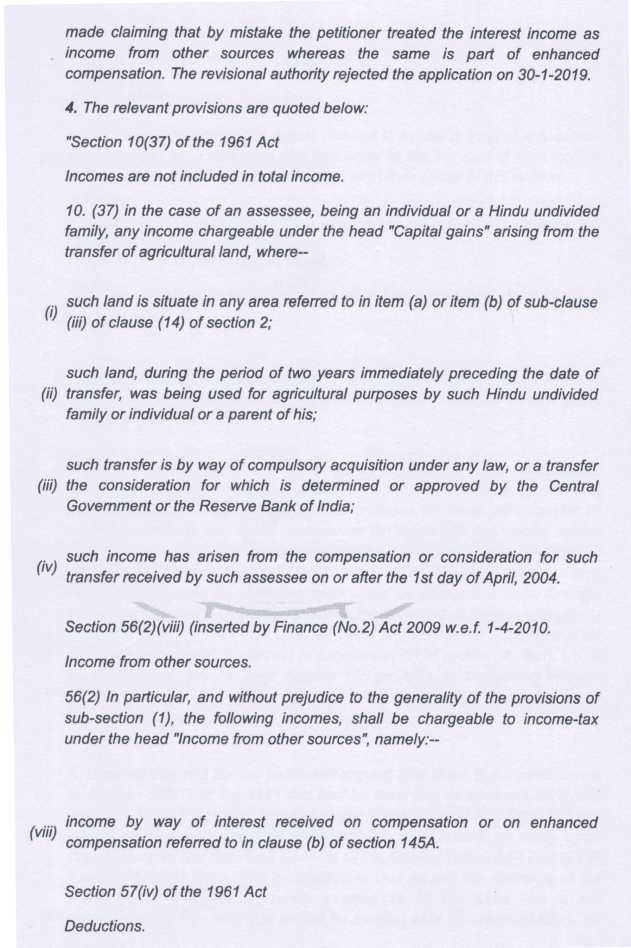
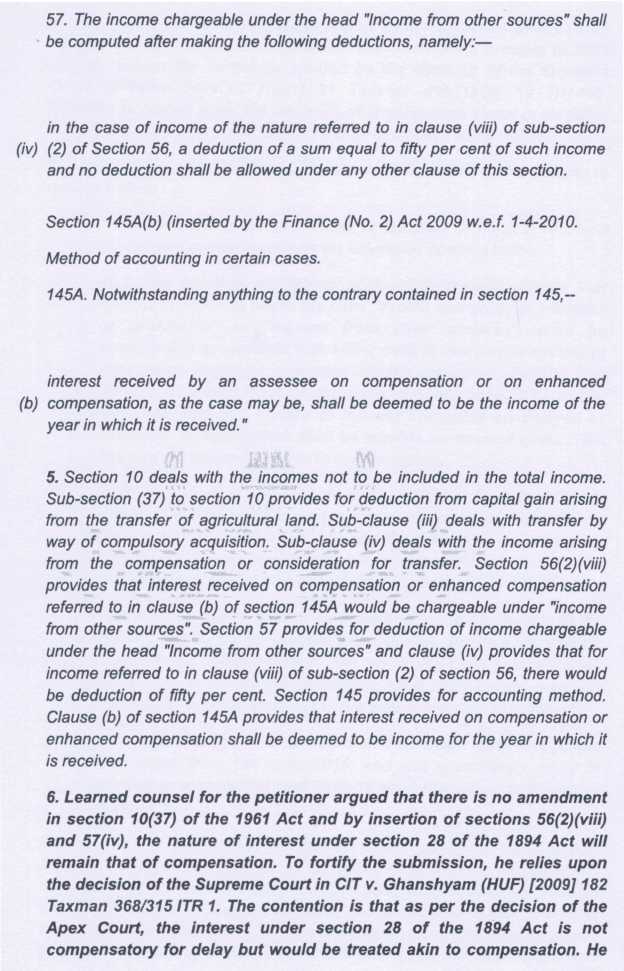
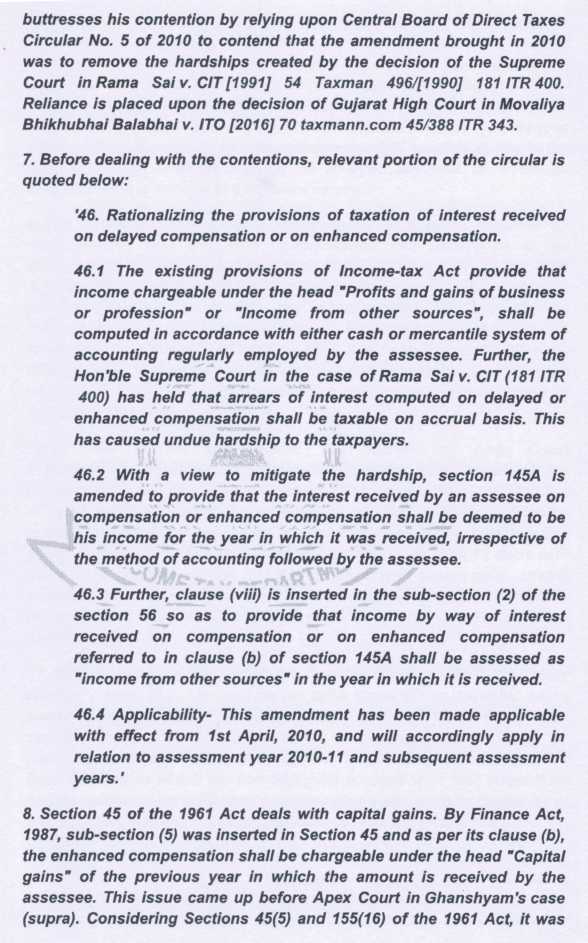
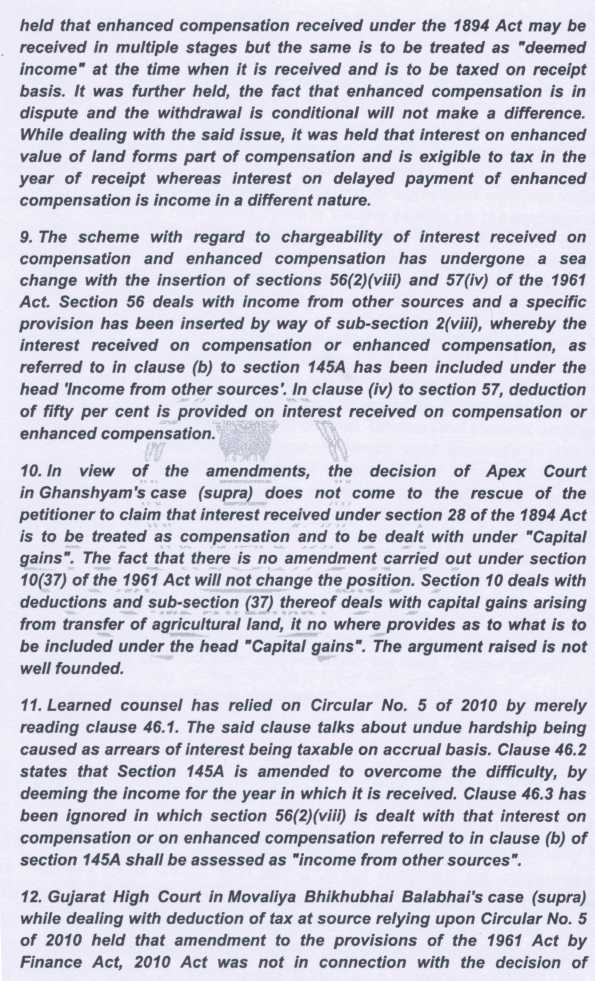
4. We have heard both the sides through virtual court and cogitated over the relevant material on record. Indisputably, the amount of net interest income computed by the AO u/s.56(2)(viii) of the Act pertains to section 28 of the LAA. The assessee treated such amount as part of the enhanced compensation of land and claimed the same as exempt from tax on the ground that the land itself was agricultural. To buttress the contention that interest u/s 28 of the LAA is a part of compensation and hence not chargeable to tax, the ld. AR chiefly relied on the judgment of the Hon’ble Supreme Court in CIT v. Ghanshyam (HUF) (2009) 315 ITR 1 (SC) before the Tribunal in which it has been held that interest u/s.28 under The Land Acquisition Act, is to be taxed as part of consideration on receipt basis. This judgment was delivered on 16-07-2009. The Finance (No.2) Act, 2009 w.e.f. 01-04-2010 inserted clause (viii) to section 56(2) providing that: “income by way of interest received on compensation or on enhanced compensation referred to in subsection (1) of section 145B” shall be chargeable to income-tax under the head “Income from other sources”. Section 145B(1) provides that: “Notwithstanding anything to the contrary contained in section 145, the interest received by an assessee on any compensation or on enhanced compensation, as the case may be, shall be deemed to be the income of the previous year in which it is received”. Thus it is palpable that post the decision in Ghanshyam (supra), a statutory amendment has been carried out providing that income by way of interest received on compensation or on enhanced compensation shall be chargeable to income-tax under the head “Income from other sources”.
5. The question of taxability of interest received u/s 28 of the LAA came up for consideration before Hon’ble Punjab & Haryana High Court in the case of Manjet Singh (HUF) Karta Manjeet Singh v. Union of India (P&H). It noted another judgment of three Judges of the Hon’ble Apex Court in Bikram Singh v. Land Acquisition Collector, (1997) 224 ITR 551(SC) following Dr. Shamlal Narula v. CIT (1964) 53 ITR 151 (SC) holding that interest under Section 28 of the 1894 Act was a revenue receipt and is taxable. After considering all the available relevant material including the judgment in Ghanshyam (HUF) (supra) and also the statutory amendments carried out w.e.f. A.Y. 2010-11, the Hon’ble High Court, vide its judgment dated 14.01.2014, decided this issue in favour of the Revenue by holding that interest u/s.28 of LAA was chargeable to tax u/s. 56(2)(viii) of the Act. The SLP filed against the judgment in the case of Manjet Singh v. Union of India has since been dismissed by the Hon’ble Supreme Court on 18-12-2014 (SLP No. 34642 of 2014) holding that “Heard ld. Counsel for the petitioners and perused the relevant material. We do not find any legal and valid ground for interference. The special leave petitions are dismissed.”
6. Question of deduction of tax at source on interest u/s 28 of the LAA once again came up for consideration before the Hon’ble jurisdictional High Court in a batch of 13 petitions with the lead case of Shivajirao S/o Dnyanoba Ghanwat & Ors. v. The State of Maharashatra & Ors. (WP No. 5402 of 2013). The petitioners contended that the tax was deducted at source on the entire amount of compensation awarded in Land Acquisition proceedings, including the interest u/s 28 of the Land Acquisition Act, which was not deductible in the light of the judgment of the Hon’ble Supreme Court in Ghanshyam (HUF) (supra). Per contra, the Respondent made out a case that tax at source was rightly deductible as there was no difference between the interest granted u/s 28 and 34 of the LAA. This view was bolstered on the basis of an earlier judgment of the Hon’ble Supreme Court in Bikram Singh (supra) 224 ITR 551 (SC). The Hon’ble Bombay High Court, vide its judgment dated 27.08.2013 (copy at pages 69 onwards of the assessee’s paper book), recorded the petitioner’s contention in para 8 and that of the respondent in paras 3 read with 4. In para 5 of the judgment, their Lordships found that: ‘Section 34 casts obligation upon Collector to pay interest after compensation is worked out. Section 28 puts similar obligation upon the Court when the Court finds that the compensation awarded under section 11 was inadequate. Therefore, there is no change in nature of interest either u/s.28 or section 34. Even if court hikes compensation for land and interest is awarded under Section 28 of the Act, upon such increased compensation, in the light of larger Bench judgment, the Department and Disbursing Authorities are bound to effect deduction of TDS’. On the interplay between the Hon’ble Apex Court judgments in Ghanshyam (supra) & Bikram Singh (supra), the Hon’ble Bombay High Court in para 4 found the: ‘issue to be squarely covered by the larger Bench judgment of the Apex court’ in Bikram Singh (supra). Then it noted in para 9 of the judgment that: “We have perused para 24 and 25 of the judgment of the Apex Court in Commissioner of Income Tax v. Ghanshyam (supra). We find that the Hon’ble Apex Court there, was not called upon to look into the Larger Bench judgment delivered earlier in case of Bikram Singh (supra). In para 7, the Hon’ble Larger Bench has found that the interest paid u/s.28 is not by way of any charge on compensation determined u/s.23(1). We, therefore, with respect, follow the larger Bench judgment of the Hon’ble Apex Court”. Thus it is plentifully lucid that the Hon’ble jurisdictional High Court has categorically held that interest u/s 28 of the Land Acquisition Act is chargeable to tax.
7. The ld. AR submitted that the Hon’ble jurisdictional High Curt has not correctly appreciated the legal position inasmuch as the decision in the case of Ghanshyam (supra) was binding and ought to have been followed. He unsuccessfully tried to convince the Tribunal that the decision rendered by the Hon’ble Bombay High Court should not be preferred over certain other decisions in favour of the assessee. We find that in certain decisions, the issue has been decided in assessee’s favour. Notwithstanding any contrary view expressed by a nonjurisdictional Hon’ble High Court, the Tribunal, being an authority inferior in hierarchy to its jurisdictional High Court, is bound by the verdict of its superior Hon’ble High Court and cannot read, consider or understand the judgments of the Hon’ble Supreme Court in a way different from the one understood by the Hon’ble jurisdictional High Court unless such a view has been subsequently reversed/modified by the Hon’ble Supreme Court.
8. The ld. AR then submitted that the Hon’ble Supreme Court in Union of India and others v. Hari Singh and others (2018) 302 CTR 0458 (SC) has considered a similar issue and decided the same in favour of the assessee. It was then contended that since the judgment of the Hon’ble jurisdictional High Court was rendered prior to that of Hon’ble Supreme Court in Hari Singh and others (supra), the latter should be followed in preference to the former.
9. We are unable to find any relevance of the judgment of Hon’ble Supreme Court in Hari Singh and others (supra), insofar as the issue under consideration is concerned. In that case, the Land Acquisition Collector deducted tax at source from compensation on account of compulsory acquisition of land and deposited the same with the exchequer. A writ petition was filed in the High court urging that no deduction of tax at source was permissible in view of the provisions of section 194LA of the I.T. Act, since the land which was acquired was agricultural land and this provision categorically mentions that in respect of agricultural land, tax at source was not to be deducted. The Hon’ble High Court directed the Income-tax Department to refund the amount to the collector and held: “that the Collector will determine whether the compensation paid is for property other than the agricultural land or otherwise and whether deduction of tax at source was permissible under other provisions of law…….”.
00A0ggrieved thereby, the Revenue approached the H0on’ble Supreme Court pleading that the matter should have been remitted to the AO for deciding the nature of land acquired and not the Collector as it was the AO who was to come to the conclusion whether land was agricultural or not. Accepting the contention on behalf of the Revenue, the Hon’ble Supreme Court held that the claimant should approach the concerned AO and raise the issue that no tax was payable on compensation/enhanced compensation which was received by them as their land was agricultural land. It was further observed that, while determining as to whether the compensation paid was for agricultural land or not, the AO will keep in mind the provisions of Section 28 of the Land Acquisition Act and the law laid down by this Court in CIT, Faridabad v. Ghanshyam (HUF) in order to ascertain whether the interest given under the said provision amounts to compensation or not. It is abundantly clear that the judgment in the case of Hari Singh and others (supra) is based an altogether different factual matrix in which the question was as to whether it was the Collector or the AO who will decide as to whether any tax was payable on compensation/enhanced compensation. This issue came to be decided by Hon’ble Supreme Court by holding that the AO was the competent authority. There is no adjudication on the point as to whether interest u/s.28 of the Land Acquisition Act is chargeable to tax separately or part of enhanced compensation. There is a simple direction to the AO to consider this aspect of the matter.
10. In view of the foregoing discussion, it is manifest that the judgment of the Hon’ble jurisdictional High Court holding that interest u/s.28 under the LAA is chargeable to tax, is intact and has not been disturbed in any manner by the Hon’ble Supreme Court in the case of Hari Singh and others (supra). On a specific query, the ld. AR could not point out as to whether the judgment of the Hon’ble jurisdictional High Court in Shivajirao (supra) has been reversed or modified in any manner by the Hon’ble Supreme Court. Respectfully following the judgment of the Hon’ble jurisdictional High Court in Shivajirao (supra) and the judgment of Hon’ble Punjab & Haryana High Court in Manjeet Singh (supra) along with the statutory amendment carried out to section 56(2) inserting clause (viii) w.e.f. 0104-2010, it is overt that the ld. CIT(A) has taken an unexceptionable view in the matter pertaining to the A.Y. 2013-14. We, therefore, uphold the same. This ground is not allowed.”
5. We have heard the foregoing vehement rival contentions. It transpires that the instant issue of taxability of the assessee’s interest income received under section 28 of the Act is covered in assessee’s favour as per the hon’ble high court’s Bombay bench holding that the same is not taxable under section 56(2)(viii) of the Act as against the Revenue’s contentions that the Aurangabad bench of the very hon’ble jurisdictional high court has taken a divergent view against the taxpayer in Shivajirao and Others v. State Writ Petition No.5042/2013 dated 27.08.2013 (supra).
6. Faced with the situation, we are of the opinion that it is the Bombay and not Aurangabad bench of the hon’ble jurisdictional high court whose decision would prevail in the given facts and circumstances as the assessee, his land/capital asset forming subject matter of compulsory acquisition as well as “situs” of the Assessing Officer who has framed assessment before us dated 28.11.2017, are covered within its territorial jurisdiction notified from time to time. We thus quote PCIT v. ABC Paper Limited [2022] 447 ITR 1 (SC) and decide the instant sole substantive ground as well as the main appeal is assessee’s favour. Ordered accordingly.
5. We adopt the detailed discussion mutatis mutandis “for Panvel” to accept the assessee’s instant sole substantive grievance on merits.”
23. We find the Co-ordinate Bench of the Tribunal in the case of Sanjay Bhimrao Patil(supra) has held that interest received by assessee under section 28 of Land Acquisition Act, 1894 on enhanced compensation received for compulsory acquisition of its agricultural land for the period from the date of acquisition of land till the date of payment of compensation to assessee was part of compensation and, thus, same was not taxable and amendment by way of substitution of section 145A and insertion of clause (iii) in section 56(2) would not be applicable on same.
24. We find the Hon’ble Gujarat High Court in the case of Movaliya Bhikhubhai Balabhai v. ITO 388 ITR 343 (Gujarat) has held that the interest received on compensation/enhanced compensation under section 28 of Land Acquisition Act forms part of compensation and not interest as contemplated under section 145A; same is not taxable under head ‘income from other sources’ and department was not justified in deducting tax at source under section 194A.
25. We find recently the Co-ordinate Bench of the Tribunal in the case of Sushila Maruti Mhatre(Supra) for assessment year 2016-17 while deciding an identical issue has held that interest on enhanced compensation on acquisition of agricultural land situated in village Bokadvira, Taluka Uran, District Raigad is exempt from tax. The relevant observations of the Tribunal read as under:
“4. We have heard both the parties and perused the records. In this case, Agricultural Land of Assessee’s Father situated in BOKADVIRA Village, Taluka Uran, District Raigad was compulsorily acquired under Land acquisition Act on 25.11.1986 as noted from the judgment or Civil Court, Alibagh(page no.4 to 20 of the paper book).
5. Assessing Officer issued notice u/s.148 for A.Y.2016-17 on 31.03.2021 based on the information received on Portal of Income Tax Department. Then, Assessing Officer issued notice u/s.142 on various dates. Assessee filed Return of Income in response to notice u/s.148 on 08.03.2022 declaring total income at Rs.13,500/-. In the Return of Income, Assessee has claimed interest received on enhanced compensation under section 28 of Land Acquisition Act, of Rs.87,64,016/- as exempt income.
6. The Assessing Officer in the assessment order held that interest income of Rs.87,64,016/- received under section 28 of Land Acquisition Act, on enhanced compensation is taxable under section 56(2)(viii) of the Income Tax Act. Assessing Officer allowed deduction u/s.57(iv) of the Income Tax Act and taxed Rs.43,82,008/-. Aggrieved by the assessment order, Assessee filed appeal before ld.CIT(A).
7. Assessee relied on the decision of Hon’ble Supreme Court in the case of
CIT v.
Ghanshyam (HUF) 315 ITR 1 and other decisions before ld.CIT(A). The ld.CIT(A) upheld the assessment order. Aggrieved by the order of the ld.CIT(A), Assessee has filed appeal before this Tribunal.
7.1 Thus, the only issue before us is that whether interest received u/s.28 of the Land Acquisition Act on enhanced compensation is taxable under section 56(2)(viii) of the Income Tax Act or not!
8. It is an admitted fact that Assessee’s Father’s Agricultural Land was compulsorily acquired by the Government of Maharashtra in 1986 under the Land Acquisition Act.
9. Assessee’s father has expired. Senior Division Civil Judge, District Raigad vide his order dated 13.05.2013 has enhanced the compensation paid by the State Government of Maharashtra.
9.1 Admittedly, Assessee has received interest income of Rs.87,64,016/- under section 28 of the Land Acquisition Act, on enhanced compensation.
10. The Hon’ble Supreme Court in the case of
CIT v.
Ghanshyam(HUF) [2009] 315 ITR 1 vide order dated 16.07.2009 has observed as under, while explaining taxability under compulsory land acquisition :
“14. The following conditions need to be satisfied for taxing a transaction as capital gains, viz., the subject-matter must be a capital asset, the transaction must fall in the definition of “transfer”, there must be profit or loss called “Capital Gains” and that the taxpayer has claimed exemption in whole or in part by complying withlegal provisions (Like section 54F).
…… ……. …
33. …….. …… …….Interest under section 28 unlike interest undersection 34 is an accretion to the value, hence it is a part of enhanced compensation or consideration which isnot the case with interest under section 34 of the 1894 Act.”
10 .1 Thus, Hon’ble Supreme Court held that interest income under section 28 of Land Acquisition Act is part of enhanced compensation.
11. Hon’ble Gujarat High Court in the case of
Movaliya Bhikhubhai Balabhai v.
Income-tax Officer-TDS- 1-Surat in Special Civil Application No.17944 of 2015 vide order dated 31.03.2016;
388 ITR 343 (Gujarat) has held as under :
“13. The upshot of the above discussion is that since interest under section 28 of the Act of 1894, partakes thecharacter of compensation, it does not fall within the ambit of the expression “interest” as contemplated insection 145A of the I.T. Act.
12. Before the Hon’ble Gujarat High Court(supra), Revenue had taken the plea that Income Tax Act was amended w.e.f. 01.04.2010 and hence, decision of Hon’ble Supreme Court in the case of CIT v. Ghanshaym(HUF) was not applicable after the amendment. However, Hon’ble Gujarat High Court in para 11 held as under :
“11…. …… …. ….
Thus, the substitution of section 145A by Finance (No. 2) Act, 2009 was not in connection with the decision of the Supreme Court in Ghanshyam (HUF)’s case (supra) but was brought in to mitigate the hardship caused to the assessee on account of the decision of the Supreme Court in Rama Bai v. CIT [1990] 181 ITR400 whereby it was held that arrears of interest computed on delayed or enhanced compensation shall be taxable on accrual basis. Therefore, when one reads the words “interest received on compensation or enhanced compensation” in section 145A of the I.T. Act, the same have to be construed in the manner interpreted by the Supreme Court in Ghanshyam (HUF)’s case (supra).”
12.1 Thus, Hon’ble Gujarat High Court held that Hon’ble Supreme Court’s decision in the case of CIT v. Ghanshyam(HUF) is applicable even after the amendment introduced from 01.04.2010.
13. No contrary decision of Hon’ble Jurisdictional High Court has been brought to our notice.
14. ITAT
Pune Bench in the case of
Sanjay Bhimrao Patil v.
ITO [2023] 200 ITD 575 vide order dated 08.02.2023 has held as under :
“Therefore, respectfully following the decision of Hon’ble Jurisdictional High Court of Bombay in the case of Rupesh Rashmikant Shah (supra), we hold the interest received u/s. 28 of the Land Acquisition Act would not fall within the ambit of the expression interest as envisaged u/s. 145A(b) of the Act, further, hold that the amendment by way of substitution of section 145A by Finance (No. 2) Act, 2009 w.e.f. 1-042010 and amendment by way of insertion of clause (iii) in section 56(2) by Finance Act, 2009 would have no applicability to the facts of the present case and in view of the same the order of CIT(A) in confirming the order of AO is not justified.
14.1 Thus, the proposition of law laid down by Hon’ble Supreme Court, Hon’ble Gujarat High and ITAT Pune Bench is that the interest income under section 28 of Land Acquisition Act, is not taxable under section 56(2)(viii) of the Income Tax Act, 1961.
15. Respectfully following the decision of Hon’ble Supreme Court, Hon’ble Gujarat High Court and ITAT Pune Bench, the Ground No.1 raised by the Assessee is allowed.”
26. Since the land in the instant case is located at village Dhutum, Tal Uran, Dist. Raigad and the Assessing Officer who has framed the assessment is ITO, Ward-4, Panvel, therefore, the Assessing Officer who has framed the assessment falls within the territorial jurisdiction of the Hon’ble Bombay High Court, Bombay Bench. Therefore, in view of various decisions cited (supra), we hold that the interest received on enhanced compensation on compulsorily acquisition of land is not taxable u/s 56(2)(viii) of the Act. Accordingly, the order of the Ld. CIT(A) / NFAC is set aside and the grounds raised by the assessee are allowed.
27. Grounds by the assessee in ITA No.1798/pUN/2024 read as under:
The following grounds are taken without prejudice to each other-
On facts and in law,
| 1. |
|
The Appellant – Assessee requests to condone the delay in view of the affidavit and admit an appeal with further request to note that order of CIT(A)-NFAC dated 10/03/2023 was not communicated and assessee came to know about appeal dismissed by the CIT(A)-NFAC when notice of recovery dated 20/08/2024 was received. |
| 2. |
|
The learned CIT(A)-NFAC failed to appreciate while confirming the action of the AO that the nature of the Gross Interest at Rs.1,84,90,236/- (50% assessed at Rs.92,45,118/-) awarded u/s 28 of the Land Acquisition Act, 1894 was Capital receipt and not taxable u/s 56(2)(viii) r.w.s. 145A(b) and sec 57(iv) of the Income Tax Act, 1961; as per principle/precedent laid down by the Hon’ble Supreme Court in the case of CIT v/s Ghanshyam HUF [2009] 315 ITR 1. |
| 3. |
|
The learned CIT(A)-NFAC failed to appreciate while confirming the action of the AO that the Gross Interest at Rs.1,84,90,236/- (50% assessed at Rs.92,45,118/-) awarded u/s 28 of the Land Acquisition Act, 1894 was Capital Receipt but not chargeable as capital gain u/s 45(5) as the compulsorily acquired agricultural land was Rural Agricultural Land and therefore was not capital asset u/s 2(14) which fact is not disputed by the learned AO and the learned CIT(A)-NFAC. |
| 4. |
|
The learned CIT(A)-NFAC confirmed the addition of interest awarded u/s 28 of the Land Acquisition Act, 1894 without appreciating that: |
| (a) |
|
The decision of Hon’ble Apex Court in the case of CIT v/s Ghanshyam HUF [2009] 315 ITR 1 still prevails and therefore the interest. u/s 28 of the Land Acquisition Act, 1894 is not coming in the ambit of taxation. |
| (b) |
|
The decision of the Non-Jurisdictional High Court cannot be applied when direct decision of Hon’ble Supreme Court is existing and without distinguishing the facts of the case as against the facts of the decision relied upon by the Assessee. |
| (c) |
|
Majority of decisions cited and relied upon by the assessee which were rendered by the Hon’ble ITAT Pune in favour of the assessee carry judicial precedence especially where there is no direct decision of jurisdictional High Court, even if the decision of Non-Jurisdictional High Court is against. |
| 5. |
|
The learned CIT(A)-NFAC failed to appreciate that majority of decisions cited and relied upon by the assessee which were rendered by the Hon’ble ITAT Pune in favour of the assessee carry judicial precedence especially where there is no direct decision of jurisdictional High Court, even if the decision of Non-Jurisdictional High Court is against. |
| 6. |
|
The Assessee craves leave to add, alter, amend or delete any of the grounds of appeal. |
28. Grounds by the assessee in ITA No.1799/pUN/2024 read as under:
The following grounds are taken without prejudice to each other
On facts and in law.
| 1. |
|
The Appellant-Assessee requests to condone the delay in view of the affidavit and admit an appeal with further request to note that order of CIT(A)-NFAC dated 15/05/2023 was not communicated and assessee came to know about appeal dismissed by the CIT(A)-NFAC where notice of recovery dated 16/08/2024 was received. |
| 2. |
|
The Learned CIT(A)-NFAC failed to adjudicate the validity of notice issued u/s 148 and inter-alia re-assessment proceedings. |
| 3. |
|
The learned CIT(A)-NFAC failed to appreciate while confirming the action of the AO that the nature of the Gross Interest at Rs.10762305/- (50% assessed at Rs.53,81,153/-) awarded u/s 28 of the Land Acquisition Act, 1894 was Capital receipt and not taxable u/s 56(2)(viii) r.w.s. 145A(b) and sec 57(iv) of the Income Tax Act, 1961; as per principle/precedent laid down by the Hon’ble Supreme Court in the case of CIT v/s Ghanshyam HUF [2009] 315 ITR 1. |
| 4. |
|
The learned CIT(A)-NFAC failed to appreciate while confirming the action of the AO that the Gross Interest at Rs.10762305/ (50% assessed at Rs.53,81,153/-) awarded u/s 28 of the Land Acquisition Act, 1894 was Capital Receipt but not chargeable as capital gain u/s 45(5) as the compulsorily acquired agricultural land was Rural Agricultural Land and therefore was not capital asset u/s 2(14) which fact is not disputed by the learned AO and the learned CIT(A)-NFAC. |
| 5. |
|
The learned CIT(A)-NFAC erred in confirming the addition of interest awarded u/s 28 of the Land Acquisition Act, 1894 without appreciating that: |
| (a) |
|
The decision of Hon’ble Apex Court in the case of CIT v/s Ghanshyam HUF [2009] 315 ITR 1 still prevails and therefore the interest u/s 28 of the Land Acquisition Act, 1894 is not coming in the ambit of taxation. |
| 6. |
|
The learned CIT(A)-NFAC failed to appreciate that majority of decisions cited and relied upon by the assessee, during the assessment proceedings, which were rendered by the Hon’ble ITAT Pune in favour of the assessee carry judicial precedence especially where there is no direct decision of jurisdictional High Court, even if the decision of Non-Jurisdictional High Court is against. |
| 7. |
|
The Assessee craves leave to add, alter, amend and delete any of the grounds of appeal. |
29. After hearing both the sides, we find the grounds raised by the respective assessees in the above 2 appeals are identical to the grounds raised in ITA No.1797/pUN/2024. We have already decided the issue in ITA No.1797/pUN/2024 and allowed the grounds raised by the assessee by holding that the interest received on enhanced compensation on compulsory acquisition of land is not taxable u/s 56(2)(viii) of the I.T. Act, 1961. Following similar reasonings, we allow the grounds raised by the respective assessees.
30. In the result, all the 3 appeals filed by the respective assessees are allowed.