ORDER
R.K. Panda, Vice President.- The above two appeals filed by the assessee are directed against the separate orders dated 26.07.2024 and 22.10.2024 of the Assessing Officer passed u/s 143(3) r.w.s. 144C(13) of the Income Tax Act, 1961 (hereinafter referred to as ‘the Act’) relating to assessment years 2020-21 and 2021-22 respectively. Since identical grounds have been raised in both the appeals, therefore, for the sake of convenience both the appeals were heard together and are being disposed of by this common order.
ITA No.1768/pUN/2024 (A.Y. 2020-21)
2. Facts of the case, in brief, are that the assessee is a company engaged in the business of manufacturing, trading and selling of engines and allied activities. It filed its return of income on 12.02.2021 declaring total income of Rs.559,57,00,030/-. The case was selected through scrutiny under CASS and accordingly, statutory notices u/s 143(2) and 142(1) of the Income Tax Act, 1961 (hereinafter referred to as ‘the Act’) were issued and served on the assessee in response to which the assessee filed the requisite details from time to time.
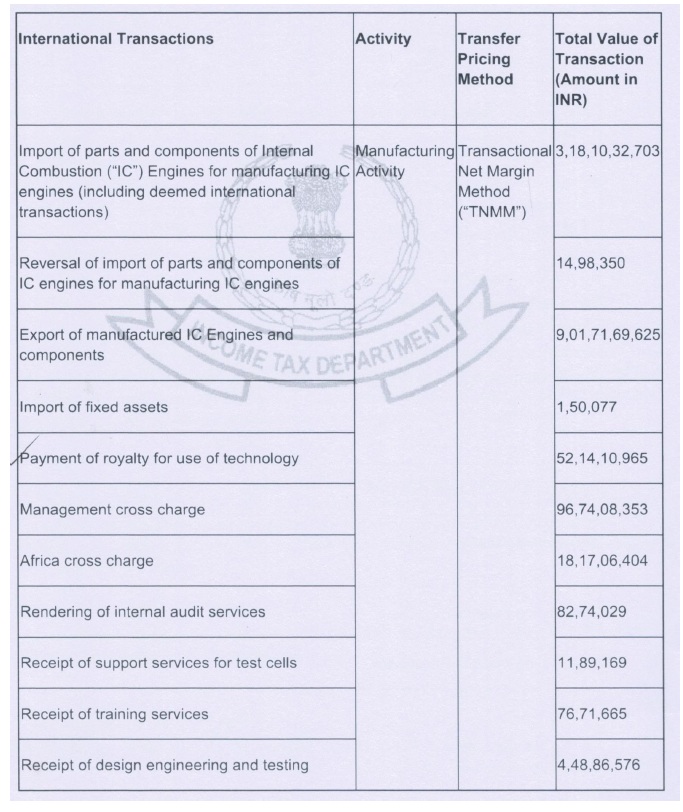
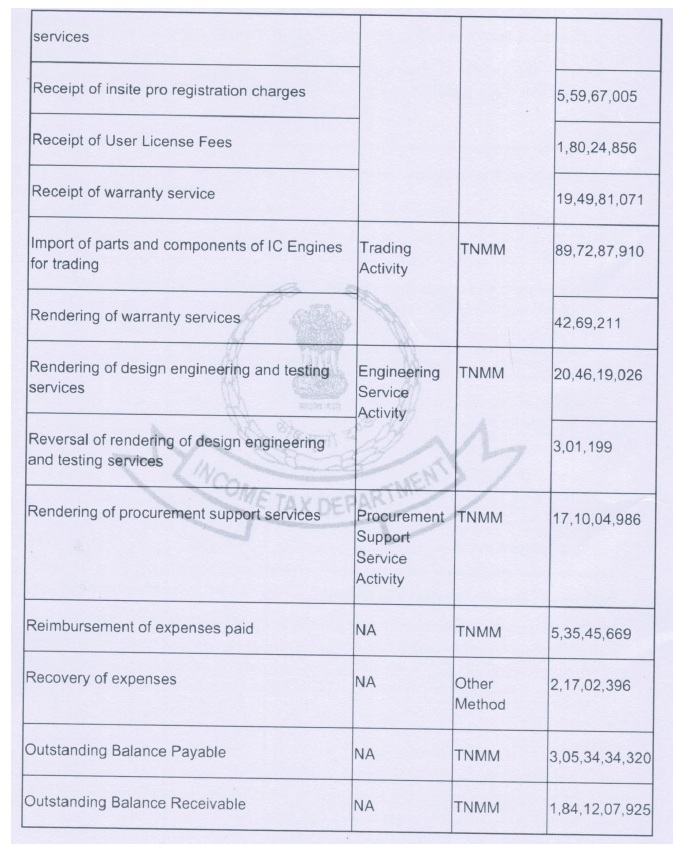
3. Since the assessee during the impugned assessment year had entered into certain international transactions, therefore, the Assessing Officer referred the matter to the Transfer Pricing Officer (TPO) for determining the arm’s length price in relation to the International Transactions. During the course of TP assessment proceedings the TPO on the basis of various details submitted by the assessee noted that the international transactions entered into by the assessee and their aggregation, if any, during the assessment year 2020-21 are as under:
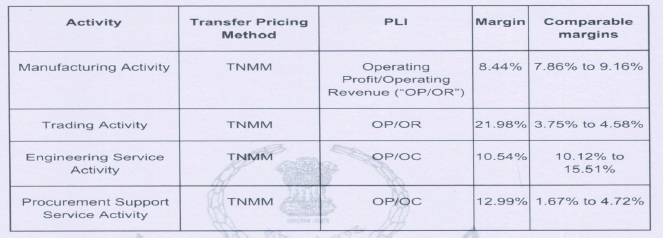
4. He further noted that the calculation of PLI of various segments for the year under consideration as submitted by the assessee are as under:
5. After considering the various submissions made by the assessee from time to time the TPO proposed an upward adjustment of Rs.12,96,00,000/- on account of royalty on export sales and Rs.92,20,072/- on account of design engineering service segment. The Assessing Officer in the draft assessment order, on the basis of the report of the TPO, made the above 2 adjustments.
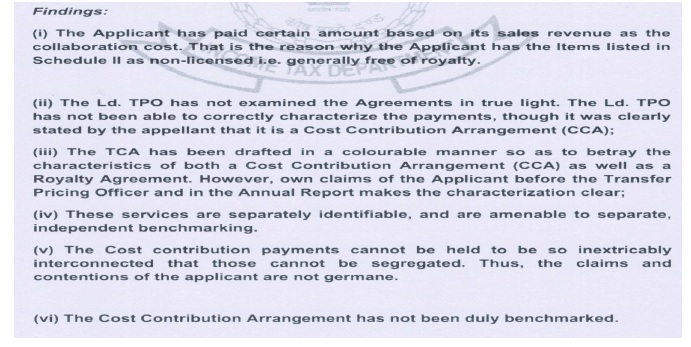
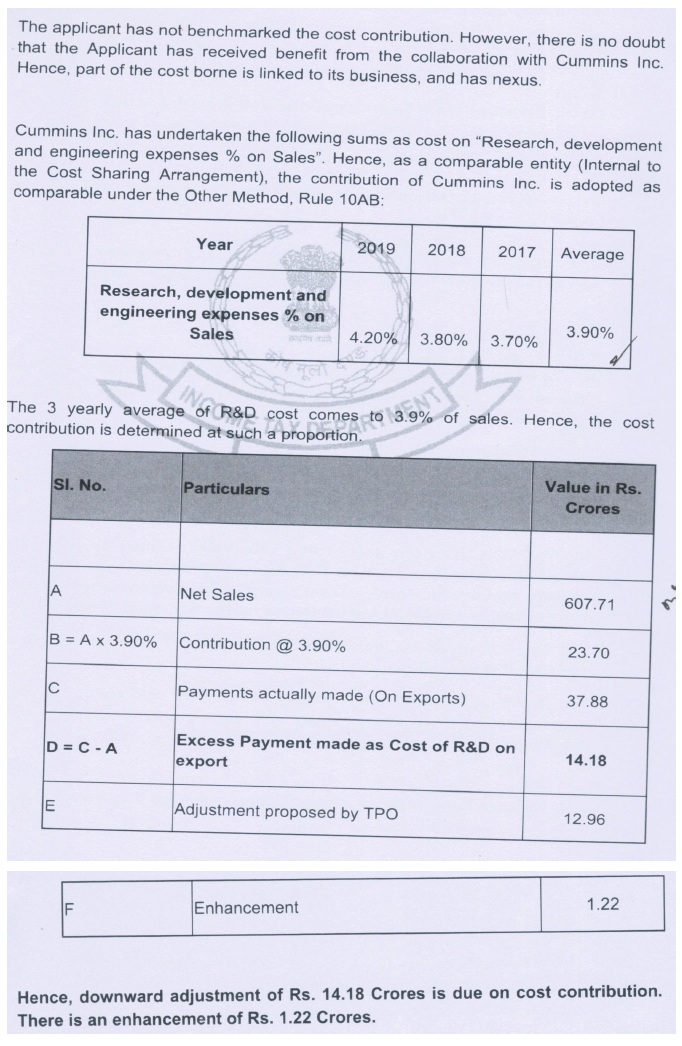
6. The assessee approached the Dispute Resolution Panel (DRP). So far as the TP adjustment on account of royalty on export sales is concerned, the DRP instead of giving any relief proposed an enhancement of Rs.1.22 crores by observing as under:
7. Accordingly, the DRP issued a notice to the assessee and finally enhanced the disallowance to Rs.1.22 crores by invoking the powers vested under subsection (8) of section 144C of the Act.
8. So far as the upward adjustment of Rs.92,20,072/- proposed by the TPO under the design engineering service segment is concerned, the DRP upheld the action of the TPO. The Assessing Officer in the final assessment order accordingly made the above additions. Further, the Assessing Officer in the final assessment order also made certain other additions such as disallowance u/s 14A read with Rule 8D of the IT Rules, 1962 at Rs.64,27,880/- and addition of Rs.3,93,41,610/- on account of variation with regard to disallowance of deduction claimed of health and education cess. He accordingly determined the total income of the assessee at Rs.579,24,89,592/-.
9. Aggrieved with such order of the Assessing Officer / TPO / DRP, the assessee is in appeal before the Tribunal by raising the following grounds:
Grounds on Transfer Pricing issue:
| 1. |
|
General ground: Transfer pricing addition of INR 15,10,20,072/ |
| 1.1 |
|
The Ld. AO pursuant to the directions of the Hon’ble DRP erred in law and on the facts and in circumstances of the case in making an upward adjustment of INR 14,18,00,000/- vis-a-vis the international transaction of payment of royalty (for non-exclusive right and license to use engine technology and technical support to enable the Appellant to manufacture and sell IC engines by the Appellant and INR 92,20,072/- vis-a-vis the international transaction of rendering of engineering and design services. |
| 1.2 |
|
. The Ld. AO pursuant to the directions of the Hon’ble DRP erred in law and on the facts and in circumstances of the case in rejecting the benchmarking of the international transaction of payment of royalty and in making an upward adjustment of INR 14,18,00,000/-. |
| 1.3 |
|
The Ld. AO pursuant to the directions of the Hon’ble DR erred in law and or the facts and in circumstances of the case in rejecting the benchmarking of the international transaction of rendering of engineering and design services and in making an upward adjustment of INR 92,20,072/-. |
| 2. |
|
International transaction of payment of royalty by the Appellant |
| 2.1. |
|
Erroneous re-classification of the international transaction of payment of royalty by the Appellant as a Cost Contribution Arrangement between the Appellant and its AE. |
| 2.1.1. |
|
The Ld. AO pursuant to the directions of the Hon’ble DRP erred in law and on the facts and in circumstances of the case in re-classifying the international transaction of payment of royalty as a Cost Contribution Arrangement (“CCA”) between the Appellant and its AE, artificially. |
| 2.1.2. |
|
The Ld. AO pursuant to the directions of the Hon’ble DRP erred in law and on the facts and in circumstances of the case in not appreciating the cogent reading of the entire inter-company agreements dated 14 October 2005, 16 September 2010 and subsequent deed of extensions “the Agreement” which clearly outlines that Cummins Inc. has merely granted a no exclusive right and license to use engine technology and provides technical support to enable the Appellant to manufacture and sell IC engines, for which the Appellant is required to compensate the AE via payment of royalty. |
| 2.1.3. |
|
The Ld. AO pursuant to the directions of the Hon’ble DRP erred in law and on the facts and in circumstances of the case in concluding that there is joint collaboration between appellant and its AE by misinterpreting the terms of the intercompany agreement between the Appellant and the AE and the disclosure made in the Annual Report of the Appellant. |
| 2.1.4. |
|
The Ld. AO pursuant to the directions of the Hon”ble DRR erred in law and on the facts and in circumstances of the case in concluding that the products mentioned in Schedule II of the inter-company Agreement are provided by Cummins Inc. to the Appellant as a “grant” / “Free grant”. |
| 2.1.5. |
|
The Ld AO pursuant to the directions of the Hon’ble DRP erred in law and on the facts and in circumstances of the case in concluding that as per the Agreement the payment of royalty is for “Technology Support” and not for base technology, and that the Appellant has made payments only in respect of “Technical Support” and not for base technology. |
| 2.1.6. |
|
The Ld. AO pursuant to the directions of the Hon’ble DRP erred in law and on the facts and in circumstances of the case in arriving at unwarranted and erroneous conclusion unsupported by any relevant material and holding the international transaction of payment of royalty as ‘CCA’ and thereby rewriting the agreement/transaction between the Appellant and its AE. Further, the Ld. AO/Hon’ble DRP have also failed to consider the contrary material and evidence adduced by the Appellant. |
| 2.2. |
|
Erroneous ignorance of principle of consistency |
| 2.2.1 |
|
. The Ld. AO pursuant to the directions of the Hon’ble DRP erred in law and on the facts and in circumstances of the case in not applying principle of consistency. The Appellant would like to highlight the fact that the Appellant has received technology and has paid royalty for the same which has been accepted by the Hon’ble High Court of Bombay, Hon’ble ITAT, Hon ‘ble DRP, the Ld. AO and the Ld. TPO in the earlier years. There is no change in the facts of the case in the current year vis-a-vis earlier years and hence, adopting a different approach and re-classifying the impugned transaction as a Cost Contribution Arrangement is against the principle of consistency. |
| 2.2.2 |
|
The Ld. AO pursuant to the directions of the Hon’ble DRP erred in law and on the facts and in circumstances of the case in adopting a different approach in the current assessment year despite of acknowledging that the previous assessment year’s facts are identical and relevant for the current assessment year. |
| 2.3. |
|
Rejection of “Aggregation approach for benchmarking the international transaction of payment of royalty for use of technology with the manufacturing activity |
| 2.3.1. |
|
The Ld. AO pursuant to the directions of the Hon’ble DRP has erred in law and on the facts and in circumstances of the case in upholding the application of Other Method (“OM”) as the most appropriate method to determine the arm’s length nature of payment of royalty for use of technology by disregarding the application of Transactional Net Margin Method (“TNMM”) as documented by the Appellant, in the Transfer Pricing documentation, wherein the pay rent of royalty was aggregated with the manufacturing activity for determining the arm’s length price. |
| 2.3.2. |
|
The Ld. AO pursuant to the directions of the Hon’ble DRP erred in law and or the facts and in circumstances of the case in not following the principle of consistency and reacting the aggregation approach (which has been accepted in the earlier years by the learned AO, Transfer Pricing Officer, Hon’ble DRP, Hon’ble ITAT and jurisdictional High Court) for benchmarking the impugned transaction of payment of royalty. |
| 2.4. |
|
Erroneous dissection of payment of royalty for benchmarking: |
| 2.4.1. |
|
Without prejudice to the other grounds raised by the Appellant, the Ld. AO pursuant to the directions of the Hon’ble DRP erred in law and on the facts and in circumstances of the case, by questioning the commercial wisdom of the Appellant and dissecting the international transaction of payment of royalty for use of technology, into royalty paid on domestic sales and royalty pad or export sales, while benchmarking the impugned transaction. |
| 2.4.2. |
|
The Ld. AO pursuant to the directions of the Hon’ble DRP erred in law and on the facts and in circumstances of the case in re-classifying only the royalty paid on export sales as Cost Contribution Arrangement between the Appellant and its AE. The nature of royalty paid on domestic sales has been accepted by the Hon’ble DRP, despite the fact that both payments are emanating from the same agreement and are on the same products. The only difference is in the jurisdiction of the customers. |
| 2.5. |
|
Not establishing the criteria under Section 92C(3) of the Act to disturb the arm’s length price determined by the Assessee. |
| 2.5.1. |
|
On the facts and in circumstances of the case and in law, the Ld. AO pursuant to the directions of Hon’ble DRP, has erred by not establishing any of the four criteria mentioned under section 92C(3) of the Act and has proceeded to benchmark the impugned transaction on ho own and has made adjustments to the arm’s length price determined by the Appellant. |
| 3. |
|
International transaction of rendering of engineering and design services |
| 3.1. |
|
Without prejudice to the subsequent grounds, erroneous calculation of margins of comparable companies as selected by the Ld. TPO in the engineering and design service segment. |
| 3.1.1. |
|
Without prejudice to the other grounds raised by the Appellant, the Ld. AO pursuant to the directions of the Hon’ble DRP erred in upholding the erroneous working capital adjusted margins of the comparable companies selected in the TP Order for the engineering and design service segment. |
| 3.2. |
|
Erroneous modification of benchmarking analysis conducted by the Appellant for design engineering service segment |
| 3.21. |
|
The Ld. AO pursuant to the directions of the Hon’ble DRP has erred in law and on the facts and in circumstances of the case in modifying the benchmarking analysis conducted by the Appellant to benchmark its international transactions pertaining to Design Engineering Service Segment which has been consistently followed by the Appellant. |
| 3.3. |
|
Erroneous application of additional filters by the Learned TPO |
| 3.3.1. |
|
The Ld AO pursuant to the directions of the Hon’ble DRP has erred in law and on the facts and in circumstances of the case in applying the below additional filters for selection of comparable companies in the TP order: |
| i. |
|
Diminishing revenue filter |
| ii. |
|
Revenue to 4-month Receivable filter |
| 3.4. |
|
Erroneous selection of functionally not comparable company viz XS Cad India Private Limited as a comparable company |
| 3.4.1 |
|
The Ld. AO pursuant to the directions of the Hon’ble DRP has erred in law and on the facts and in circumstances of the case in selecting functionally not comparable company viz. X S Cad India Private Limited as a Comparable company. |
| 3.5. |
|
Erroneous rejection of additional comparable companies selected by the Appellant during the course of transfer pricing proceedings. |
| 3.5.1. |
|
The Ld. AO pursuant to the directions of the Hon’ble DRP has erred in law and on the facts and in circumstances of the case in rejecting the below additional comparable companies selected by the Appellant during the course of transfer pricing proceedings. |
| i. |
|
VMS Engineering and Design Services Pvt. Ltd |
| ii. |
|
Semac Consultants Pvt. Ltd. |
| iii. |
|
Balaji Rail Road Systems Limited |
| iv. |
|
Intercontinental Consultants and Technocrats Pvt Ltd. |
Grounds on Corporate Tax issues:
| 4. |
|
Disallowance of expenses under section 14A read with Rule 8D |
| 4.1. |
|
The Ld. AO pursuant to the directions of the Hon’ble DRP has erred in law and on the facts and in circumstances of the case in disallowing expenses of INR 66,36,000/- as attributable to earning of exempt income under section 14A by applying rule 8D. |
| 4.2. |
|
The Appellant submits that considering the facts and circumstances of its case and the law prevailing on the subject no further disallowance u/s. 14A of the Act is called for in addition to the amount of INR 2,08,120/- suo-moto disallowed by the Appellant and the stand taken by the Ld. AO/Hon’ble DRP in this regard is misconceived and incorrect. |
| 4.3. |
|
Without prejudice to the foregoing, the disallowance, if any, ought to be restricted to Rs.25,24,470 (i.e. 1% of average investments of Rs.25,24,47,063/-) in accordance with section 14A of the Act r.w. Rule 8D. |
| 5. |
|
Erroneous computation of tax liability on the assessed income: |
| 5 |
|
.1. The Ld AO has erred in computing the tax on assessed income as Rs. 145,76,38,582/- instead of Rs.1,45,76,31,019/- by adopting incorrect tax rate. |
| 5 |
|
2 The Appellant submits that the AO be directed to re-compute the tax on total income in accordance with the law and re-compute the Appellant’s tax liability accordingly |
| 6. |
|
Not granting credit for Dividend Distribution Tax (“DDT”) paid. |
| 6.1. |
|
The Ld. AO has erred in not granting credit for DDT of Rs.96,85,47,590/-while computing DDT liability of the Appellant, thereby computing a net tax payable of Rs.1,17,96,18,515/- including interest u/s 115P of the Income-tax Act, 1961) |
| 6.2. |
|
The Appellant submits that considering the facts and circumstances of its case and the law prevailing on the subject the tax computed by the Ld. AO for the amount of DDT payable is incorrect, erroneous, misconceived and not in accordance with law. |
| 6.3. |
|
The Appellant submits that the Ld. AO be directed to delete the addition made in the tax liability of the Appellant for the DDT paid and the interest u/s. 115P of the come-tax Act, 1961 of Rs.1,17,96,18,516/- and to recompute its tax liability accordingly. |
| 7. |
|
Short granting of credit for tax deducted at source amounting to Rs.57,27,314/- and tax collected at source amounting to Rs.1,533/-. |
| 7.1. |
|
The Ld. AO has erred in granting the Appellant credit for tax deducted at source short by Rs.67,27,314/- and tax collected at source by Rs.1,533/-. |
| 7.2. |
|
The Appellant submits that considering the facts and circumstances of its case and the law prevailing on the subject it is entitled to full credit for tax deducted at source mounting to Rs.43,87,20,739/- and tax collected at source amounting to Rs.25,404/-. |
| 7.3. |
|
The Appellant submits that the Ld. AO be directed to grant full credit for tax deducted at source and tax collected at source and to re-compute its tax liability accordingly. |
| 8. |
|
Initiation of Penalty Proceedings |
| 8.1 |
|
The Ld. AO pursuant to the directions of the Hon’ble DRP erred on the facts and in law in initiating penalty proceedings under section 270A of the Act. |
The Appellant prays leave to add, alter, vary, omit, amend, substitute or delete grounds of appeal at any time before or at the time of appeal, so as to enable the Hon’ble Income Tax Appellate Tribunal to decide this appeal in accordance with the law.
10. The Ld. Counsel for the assessee at the outset did not press ground No.1 being general in nature for which the Ld. DR has no objection. Accordingly, the same is dismissed as ‘not pressed’.
11. So far as ground No.2 is concerned, the same relates to the TP addition of Rs.14,18,00,000/- on account of payment of royalty.
12. The Ld. Counsel for the assessee at the outset submitted that this ground stands covered in favour of the assessee by the decision of Hon’ble Bombay High Court in assessee’s own case for assessment years 2015-16 to 2017-18, copies of which are placed in the paper book. He submitted that the Hon’ble High Court has dismissed the SLP filed by the tax department. He further submitted that following the decision of the Hon’ble Bombay High Court in assessee’s own case the Tribunal in assesse’s own case for assessment year 2018-19 has decided the issue in favour of the assessee. He further submitted that while the royalty paid on account of domestic sales has been accepted by the TPO / AO, however, the adjustment was basically made on account of export sales.
13. The Ld. DR on the other hand heavily relied on the orders of AO / TPO / DRP.
14. We have heard the rival arguments made by both the sides, perused the orders of the AO / TPO / DRP and the paper book filed on behalf of the assessee. We have also considered the various decisions cited before us. We find an identical issue had come up before the Tribunal in assessee’s own case for assessment year 2018-19. We find the Tribunal vide Cummins India Ltd. v. ACIT (Pune – Trib.)/ITA Nos.632/pUN/2023 and ITA No.1256/pUN/2023 order dated 04.12.2025 has decided the issue in favour of the assessee and accepted the royalty calculated by the assessee based on TNMM method by observing as under:
“11. We have heard rival contentions and perused the records placed before us. Ld.AO in the final assessment order has made upward adjustments of Rs. 12,70,86,646/- on account of international transaction involving payment of royalty by the assessee to its Associated Enterprises (AEs) for use of technology for manufacturing of goods. We find that similar type of adjustments have been made in the hands of the assessee in the past for A.Ys. 2015-16 to 2017-18 and the matter has travelled upto Jurisdictional High Court vide Income Tax Appeal No. 126 of 2023, dated 28/07/2023. Hon’ble Court on due adjudication of the said issue, has answered the questions in favour of the assessee. For the sake of convenience, three questions of law dealt with by the Hon’ble Court and brief facts, observed by the Hon’ble Court reads as under:-
“1 These appeals are filed by Assessee under Section 260A of the Income Tax Act 1961 (the Act) against the order dated 28th September 2022 passed by the Income Tax Appellate Tribunal (ITAT) for A.Y.2015-2016, 20162017 and 2017- 2018. The issue is in respect of transfer pricing adjustments. The appeals were admitted on 11th April 2023 and in the three appeals, the following three questions of law were framed:-
“(1) Whether the Appellate Tribunal has erred in law in passing the order dated 28th September 2022 directly contrary to the view taken by the Appellate Tribunal in Appellant’s own case for earlier assessment years on identical facts and law without referring the issue to a Special (Full) Bench in the event that it wished to differ from the view taken by a co-ordinate Bench of the Tribunal ?
(ii) Whether the order dated 28th September 2022 passed by the Appellate Tribunal is bad in law as the same is passed ignoring the fact that on the very same transaction the department has accepted the methodology applied by the Appellate for benchmarking the transactions for transfer pricing purposes in seven (7) earlier years in view of inter alia binding order of the Tribunal?
(iii) Whether in the facts and in the circumstances of the case and in law the Tribunal erred in passing the impugned order dated 28th September 2022 purporting to rely on decision of Delhi High Court in the case of Magneti Marelli Power Train India P. Ltd. v. Deputy Commissioner of Income-tax which ex-facie did not support and was in fact contrary to the view set out in the impugned order?”
2. Assessee is engaged in the business of manufacture and sale of Internal Combustion Engines, Spares, Components (including Bought-Outs) thereof & Generating Sets, service of Engines & Gensets / Generating Sets & Allied Equipment, etc. Assessee also has a 100% Export Oriented Unit at Pirangut which is engaged in manufacture and exports of internal combustion engines and its accessories and generating sets and accessories. The returns filed by Assessee was selected for scrutiny assessment by issuing statutory notices under section 143(2) and section 142(1) of the Act. During the years under consideration, Assessee had entered into various international transactions with its Associated Enterprise(s) in the course of its business. Assessee had paid royalty amounting to Rs.54,30,69,318/-for A.Y.2015-2016, Rs.46,99,15,361/- for A.Y.2016-2017 and Rs.51,26,51,778/- for A.Y. 2017-2018 to its Associated Enterprise, i.e., Cummins Inc. for providing technical know how and technical knowledge for manufacturing of engines to be sold to the customers.
For A.Y.-2015-16 Assessee filed its return of income on 30th November 2015 declaring total income of Rs.3,83,80,77,530/- For A.Y. 2016-2017 Assessee filed its return of income on 30th November 2016 declaring total income of Rs.4,10,59,82,510/-, and for A.Y. 2017-2018 Assessee filed its return of income on 30th November 2017 declaring total income of Rs.4,98,57,18,870/-. The returns filed by Assessee were processed and accepted under the provisions of Section 143(1) of the Act.
12. We further find that Hon’ble Jurisdictional High Court has decided the above referred questions of law holding as under:-
“10 In our view, the Tribunal has entirely misread the law as laid down in Magneti Marelli (supra). It is correct that in that case also Assessee had paid royalty to its associate Enterprise for use of technical support for manufacturing its product and the court held that royalty and technical assistance fee did not form part of a composite transaction and have to be treated as two separate transactions for the purpose of benchmarking and computing the ALP because Assessee had paid the royalty and separately technical assistance fees. During the transfer pricing proceedings, Assessee was unable to substantiate the need for payment of technical assistance fees to its foreign associate Enterprise and the TPO had observed that Assessee did not undertake any cost benefit analysis or any benchmarking exercise at the time of entering into the agreement. The court observed that the initial burden is upon Assessee to prove that the international transaction was at ALP but Assessee was unable to explain why he had paid technical assistance fee which did not form part of composite transaction. But in the case at hand, the assessing officer has accepted that Assessee had received technology from Cummins Inc. Associate Enterprise and the rate of royalty payment was made on exports. The TPO has also accepted that Assessee has used the TNMM method as the most appropriate method to benchmark its international transactions under the manufacturing activity including royalty that it had paid on the export sales as well. The TPO has accepted the TNMM method as the most appropriate method to benchmark Assessee’s international transactions under the manufacturing activity but decided to separately benchmark the royalty. This is what has been held not permissible (and we respectfully agree with this view) in Magneti Marelli (supra), where paragraph 16 reads as under:
“16. As far as the second question is concerned, the TPO accepted TNMM applied by the assessee, as the most appropriate method in respect of all the international transactions including payment of royalty. The TPO, however, disputed application of TNMM as the most appropriate method for the payment of technical assistance fee of 38,58,80,000 only for which Comparable Uncontrolled Price (“GUP”) method was sought to be applied. Here, this court concurs with the assessee that having accepted the TNMM as the most appropriate, it was not open to the TPO to subject only one element, i.e payment of technical assistance fee, to an entirely different (CUP) method. The adoption of a method as the most appropriate one assures the applicability of one standard or criteria to judge an international transaction by each method is a package in itself, as it were, containing the necessary elements that are to be used as filters to judge the soundness of the international transaction in an ALP fixing exercise, If this were to be disturbed, the end result would be distorted and within one ALP determination for a year, two or even five methods can be adopted. This would spell chaos and be detrimental to the interests of both the assessee and the revenue. The second question is, therefore, answered in favour of the assessee; the TNMM had to be applied by the TPO/AO in respect of the technical fee payment too. (emphasis supplied).
11. Therefore, the TPO having accepted that TNMM method applied by Assessee was the most appropriate method in respect of all the international transactions including payment of royalty cannot dispute application of TNMM method as the most appropriate method for the payment of royalty only for which CUP method was sought to be applied. We would concur with Mr. Mistri that having accepted the TNMM method as the most appropriate, it was not open to the TPO to subject only one element, i.e. payment of royalty, to an entirely different CUP method. The adoption of a method as the most appropriate one assures the applicability of one standard or criteria to judge an international transaction. Each method is a package in itself, as it were, containing the necessary elements that are to be used as filters to judge the soundness of the international transaction in an ALP fixing exercise. If this were to be disturbed, the end result would be distorted and within one ALP determination for a year, two or even five methods can be adopted. This would spell chaos and be detrimental to the interests of both Assessee and the revenue.
12. Further the Tribunal was totally incorrect in saying that accepting aggregation of royalty payment with other international transactions under the manufacturing segment for the Assessment Year 2006-2007 was in the context of an earlier agreement under which the royalty was paid. But Assessee having entered into a new agreement on 16th September 2010 with Cummins Inc. under which the technical support was received for which payment of royalty was made by Assessee for the year under consideration and hence they need not follow the earlier approach of the Tribunal. This is because the new agreement on which reliance has been placed by the Tribunal was dated 16th September 2010, and even after the said agreement was entered into, for the Assessment Year 2011-2012 to Assessment Year 2014-2015 the TPO himself had accepted the benchmark of the international transaction of payment of royalty under the aggregation approach along with transactions of the manufacturing segment. The Tribunal failed to recognize that the royalty agreement for the years under consideration was the same agreement. We have to notice that neither the TPO nor the DRP had even whispered or mentioned in their orders about any facts being different from the earlier orders. In such situation, the Tribunal was not justified in taking a different view for these three assessment orders. The Apex Court in Radhasoami Satsang v. CIT has held that in the absence of change in material facts, the department is bound by the previous decision.
13. Once the Tribunal in its earlier orders has held that the transaction of payment of royalty for use of technology is inextricably linked with manufacturing activity and should be aggregated with other international transactions in the manufacturing segment for the purposes of benchmarking the same, and the TPO having accepted the aggregating of international transaction of payment of royalty with other international transactions in the manufacturing segment and not drawn any adverse inferences in respect of such aggregation of royalty payment under identical agreement, the Tribunal should have followed the order of the coordinate bench rendered under identical facts. More so, when in a majority of the years from the Assessment Year 2006-07 up to the Assessment Year 2014-15 it was under the very same agreement and the orders were passed after thoroughly scrutinising the international transactions entered into by assessee, the transfer pricing report obtained and the transfer pricing documentation maintained.”
13. On going through the judgment of Hon’ble Jurisdictional High Court and applying the ratio laid down therein on the facts of the present case, we find that the same are squarely applicable and, therefore, we hold that ld. DRP’s directions confirming the action of TPO making the upward adjustment on the transaction of payment of royalty proposing separate benchmarking and on the other hand accepting the method adopted by the assessee i.e. Transactional Net Margin Method (TNMM) for the other international transactions is uncalled for. Therefore, the ALP of the international transactions of payment of royalty calculated by the assessee based on TNMM deserves to be accepted. Grounds of appeal Nos. 2, 3, 4 & 5 raised by the assessee are allowed.”
15. Since the facts of the instant case are identical to the facts of the case decided by the Tribunal which in turn has followed the decision of Hon’ble Bombay High Court in assessee’s own case and the SLP filed by the department has been dismissed, therefore, in absence of any contrary material brought on record by the Revenue, we direct the Assessing Officer to delete the upward adjustment made by the TPO which has been enhanced by the DRP. Ground No.2 raised by the assessee is accordingly allowed.
16. In ground No.3 the assessee has challenged the TP adjustment of Rs.92,20,072/- on account of rendering of Engineering and Design Services (EDS).
17. The Ld. Counsel for the assessee while explaining the case submitted that the assessee is the world’s largest independent diesel engine designer and manufacturer above 200HP. The assessee, a power leader, is a group of complementary business units that design, manufacture, distribute and service engines and related technologies including fuel systems, air handling, filtration, emission solutions and electrical power generation systems. He submitted that under the EDS segment the assessee provides engineering design, testing and drafting services to its AE depending on the requirement of the AE. The services are in the nature of design and development, specifications, data, systems and other technical knowledge relating to manufacture. He submitted that the assessee has applied TNMM method which is not disputed by the TPO. Further, the Profit Level Indicator (PLI) i.e. OP / OC is also not disputed by the TPO. The margin of the assessee as per TPO for EDS at 10.54% is also not disputed by the TPO. However, the Assessing Officer in the final assessment order rejected certain comparables and adopted certain new comparables thereby making the addition of Rs.92,20,072/-. He submitted that the grievance of the assessee will be addressed if the erroneous calculation of margins of comparable companies as selected by the TPO in the EDS segment are rectified. He submitted that despite detailed arguments made before the TPO / DRP on this issue they have not adopted correct adjusted margins of the comparable companies. Further, the Assessing Officer in the final assessment order has added X S Cad India Pvt Ltd. on the basis of the report of the TPO where the weighted average margin has been taken as 4.40%. He submitted that this company is not at all comparable since the said company is functionally dissimilar to that of the assessee as it is a design support firm that serves the retail, homebuilding, architecture, engineering and construction sectors with high quality engineering and architectural design services and BIM / CAD solutions and is involved in multiple service business such as building engineering, home building, retail and architecture with no segmentals available in the financials.
18. Referring to the decision of the Hyderabad Bench of the Tribunal in the case of DGS TechnicalServices (P.) Ltd. v. Dy. CIT (Hyderabad – Trib.)/ITA No. 1095/Hyd/2024 order dated 31.10.2025 for assessment year 2021-22, he drew the attention of the Bench to para 28 of the order and submitted that XS CAD India Pvt. Ltd. was directed to be excluded from the list of final set of comparables on the ground that XS CAD India Pvt. Ltd. provides engineering design services on its own drawings. Further, there was an extraordinary event of acquisition of a subsidiary which has significantly impacted the operating margin of the above company. It also derives income from training and coaching services and has incurred significant agency commission for which it was directed to be excluded from the final set of comparables.
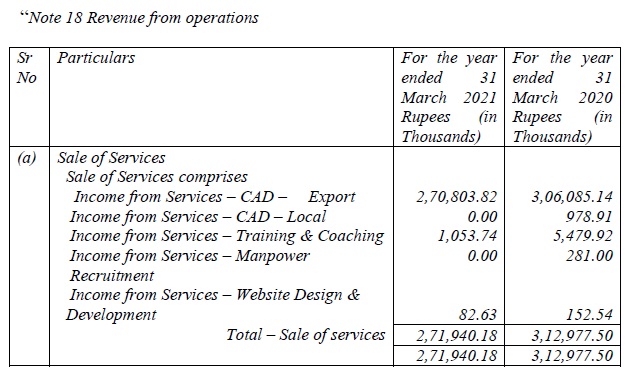
19. Referring to Note No.22 – Other expenses of the financial statements i.e. Notes forming part of the financial statements, he drew the attention of the Bench to the Agency commission of Rs.1,34,84,934.40 received by the assessee for the year ending 31.03.2020. Similarly, referring to Note No.18 – Revenue from operations, he drew the attention of the Bench to the same according to which the said company has received huge income from training and coaching, manpower recruitment and website design & development. Further, no segmental details are also available in the case of the said company.
20. Referring to the Mumbai Bench of the Tribunal in the case of
EmersonElectric Company (India) (P.) Ltd. v.
Addl. CIT [2023] 155 (Mumbai –
Trib.)/555/MUM/2022 order dated 14.08.2023 for assessment year 2017-18, he submitted that the Tribunal in the said decision has directed to exclude XS CAD India Pvt. Ltd. from the final set of comparables on account of functional dissimilarity. The Tribunal further excluded the same on the ground that the said comparable company derives income from multiple streams and no reliable segmental information was available, thereby rendering it unsuitable for comparability analysis.
21. Referring to the Delhi Bench of the Tribunal in the case of ION Trading India (P.) Ltd. v. ACIT (Delhi – Trib.)/ITA No. 2055/Del/2022 order dated 25.04.2025 for assessment year 2018-19, he submitted that the Tribunal in the said decision has directed to exclude XS CAD India Pvt. Ltd. on the ground of functional dissimilarity and non-availability of segmental data. He accordingly submitted that once the above company is excluded from the final list of comparables, the corrected average margin earned by the comparable companies would be worked out to be at 10.00%. Since the margin of the assessee is 10.54% is above the mean of the comparable companies, consequently, there would be no TP adjustment worked out.
22. The Ld. DR on the other hand heavily relied on the orders of the AO / TPO / DRP.
23. We have heard the rival arguments made by both the sides, perused the orders of the AO / TPO / DRP and the paper book filed on behalf of the assessee. We have also considered the various decisions cited before us. We find the assessee in the instant case in its TP study report considered the following 7 comparables, the details of which are as under:
| Sr. No. |
Name of Company |
Three Years Weighted Avg. Margin (OP/OC) |
| 1 |
Accuspeed Engineering Services India Ltd. |
2.60% |
| 2 |
MAY Softech Pvt Ltd |
20.51% |
| 3 |
Sphinx Worldbiz Ltd |
10.69% |
| 4 |
Axiscades Engineering Technologies Ltd |
1.55% |
| 5 |
Development Consultants Ltd. |
8.52% |
| 6 |
Satyam Venture Engineering Services Pvt. Ltd. |
18.95% |
| 7 |
Tata Consulting Engineers Ltd. |
17.07% |
| 35 th percentile |
8.96% |
| Median |
10.42% |
| 65th percentile |
12.08% |
24. We find the TPO in its order selected the following companies wherein he retained 3 comparables selected by the assessee, rejected 4 comparables of the assessee and added 2 more comparables, the details of which are as under:
| Sr. No. |
Name of the company |
Appellant / TPO comparable |
Three Years WCA Weighted Avg. Margin (OP/OC) |
| 1 |
Accuspeed Engineering Services India Ltd. |
Appellant |
4.68% |
| 2 |
Aabsys Information Technology Pvt. Ltd. |
TPO |
11.14% |
| 3 |
Sphinx Worldbiz Ltd. |
Appellant |
12.73% |
| 4 |
May Softech Pvt. Ltd. |
Appellant |
23.64% |
| 5 |
X S Cad India Pvt. Ltd. |
TPO |
25.40% |
| Average |
|
15.52% |
25. We find the Assessing Officer in the final assessment order retained the above companies and made transfer pricing adjustment of Rs.92,20,072/- to the Design Engineering Segment of the assessee. It is the submission of the Ld. Counsel for the assessee that XS CAD India Pvt. Ltd. cannot be considered as comparable with that of the assessee company on account of non-availability of segmental details, functional dissimilarity, income from multiple streams and occurrence of extraordinary event.
26. We find some force in the above arguments of the Ld. Counsel for the assessee. A perusal of the financials of XS CAD India Pvt. Ltd., copy of which is placed in the paper book shows that in Note No.18 the said company has shown the revenue from operations, the details of which are as under:
27. Similarly, in Note No.22 i.e. Other Expenses, the said company has incurred Agency commission expenses of Rs.13,484.93. A perusal of the segment report shows that no reliable segmental data has been given by the said company in its audited accounts.
28. We find the Hyderabad Bench of the Tribunal in the case of DGS Technical Services Pvt. Ltd. (supra) at para 28 of the order has observed as under:
“28. Insofar as XS CAD India Pvt Ltd. is concerned, upon perusal of the relevant annual reports of the assessee company and the above company, we find that, although the assessee company is engaged in engineering design services, but going by the nature of services rendered by the assessee company to it’s A.E, the assessee provides simple back-end support services to it’s A.E. on DGS Technical Services Private Limited the basis of drawings and designs provided by the A.E. or its customers, whereas XS CAD India Private Limited provided Engineering design services on its own drawings. Therefore, on functional profile itself, the above company cannot be compared with the assessee company. Further, there was an extraordinary event of acquisition of a subsidiary, which has significantly impacted the operating margin of the above company. Further, XS CAD India Private Limited derives income from training and coaching services. It has also incurred significant agency commission and from the above, it is undisputedly clear that, the business model of the above company is different from that of the assessee company. Since the assessee company is a simple ITeS provider on the basis of designs and drawings supplied by the A.E. or its customers, the assessee company cannot be compared with the above company, which is engaged in providing high-end KPO services, i.e., engineering design services. Therefore, we direct the Ld. TPO to exclude XS CAD India Private Limited from the list of final set of comparable. “
29. We find the Mumbai Bench of the Tribunal in the case of Emerson Electric Company (India) (P.) Ltd. (supra) has observed as under:
“17. We have considered the submissions of both sides and perused the material available on record. From the perusal of the annual report of XS Cad India Private Limited for the financial year 2016-17, forming part of the paper book from pages 892-910, we find that this company earned income from the export and import of computer-aided design, training & coaching, manpower recruitment, web design, and development, during the year under consideration. From the segmental reporting in Note 23(v) to the financial statement of this company, we find that the segmental reporting of the company is based on the geographical location of the customer and accordingly country-wise, namely for USA, Canada, Australia, UK, Germany, and India reporting has been made by this company. Further, the company treats its complete operations as a single segment, i.e. “Information Technology Services”. As noted above, the assessee has made relevant segment reporting in the notes to its financial statements. Since this company is earning revenue from various streams, therefore, in the absence of relevant segmental information, this company cannot be said to be functionally comparable to the assessee. Accordingly, we direct the TPO/AO to exclude XS Cad India Private Limited while benchmarking the international transaction pertaining to “Provision of IT support and related services”.”
30. We find the Delhi Bench of the Tribunal in the case of ION Trading India (P.) Ltd. (supra) while directing the TPO to exclude XS CAD India Pvt. Ltd. from the list of comparables has observed as under:
“11. We have heard both the parties and perused the material available on record. The Ld. TPO held that XS CAD India Private Limited is functionally comparable to the Assessee and retained as a comparable company on the ground that the services provided by the Company are predominantly software development services, which are similar to the services provided by the Assessee. Further observed that, the said company cannot be rejected because it performs only some functions that are commonly attributable to software development services. It can be seen . from the snap shot of web site extracted by the TPO in its order, that the said company provides design support pre-construction planning building information modeling, 3D modeling and walk through services for building engineering consultants/ contractors and fabricators etc. The services rendered by the said company is entirely different . from the software development services provided by the ACT v. ION Trading India Private Limited Assessee. Further XS CAD India Private Limited earns 94.94% revenue from the CAD Services, which can be corroborated from the . financials produced at page no. 315 of the Paper book II. The Companies revenue are from operation are CAD, training and coaching, manpower recruitment and web-site design and development and the said company is engaged in providing ITes Services and products linked to CAD sector within the construction and building services. It is also notable fact that the complete operations of the said company have been treated as a single segment Information Technology Services. While company performs diversified functions, it has also provided segmental information based on geographical location and no segment has been drawn for software development services, which can be corroborated form Page No. 341 of the Paper Book-2 for segmental.
12. The Co-ordinate bench of the Mumbai Tribunal in the case of Emersion Electric Company (India) (P) Ltd. (supra), held that XS CAD India Private Limited company cannot be good comparable in following manners:
“17. We have considered the submissions of both sides and perused the material available on record. From the perusal of the annual report of XS Cad India Private Limited for the financial year 2016-17, forming part of the paper book from pages 892-910, we find that this company earned income from the export and import of computer-aided design, training & coaching, manpower recruitment, web design, and ACT v. ION Trading India Private Limited development, during the year under consideration. From the segmental reporting in Note 23(v) to the financial statement of this company, we find that the segmental reporting of the company is based on the geographical location of the customer and accordingly country-wise, namely for USA, Canada, Australia, UK, Germany, and India reporting has been made by this company. Further, the company treats its complete operations as a single segment, i.e. “Information Technology Services”. As noted above, the assessee has made relevant segment reporting in the notes to its financial statements. Since this company is earning revenue from various streams, therefore, in the absence of relevant segmental information, this company cannot be said to be functionally comparable to the assessee. Accordingly, we direct the TPO/AO to exclude XS Cad India Private Limited while benchmarking the international transaction pertaining to “Provision of IT support and related services “.
13. Considering the above facts and circumstances and the reasons stated supra, XS CAD India Private Limited cannot be said to be functionally comparable to the Appellant, accordingly, we direct the TPO/A.O. to exclude excess XS CAD India Private Limited while benchmarking the international transaction pertaining to provisions of IT support and related services.
14. Since, the Ld. Assessee’s Representative submitted that by excluding the XS CAD India Private Limited from comparables, the Assessee will be at Arm’s Length, accordingly, not canvassed any argument on the other comparable companies, thus, the Ground No.4 is partly allowed.”
31. In view of the decisions cited (supra), we hold that XS CAD India Pvt. Ltd. cannot be compared with that of the assessee company on account of involvement of multiple service business, absence of segmental data, occurrence of extraordinary event of acquisition of subsidiary and deriving income from multiple sources such as training and coaching services, manpower recruitment etc. We, therefore, direct the AO / TPO to exclude XS CAD India Pvt. Ltd. from the list of comparables and work out the correct average margin earned by the comparable companies and in case the margin of the assessee is above the mean of the comparables, then to delete the TP adjustment.
32. Ground No.4 relates to the disallowance of Rs.66,36,000/- u/s 14A of the Act read with Rule 8D of the IT Rules, 1962.
33. After hearing both the sides, we find the assessee in its ITR has claimed exempt income of Rs.75,01,50,941/- which was derived from dividend income on investments in assets and joint ventures. On being enquired by the Assessing Officer, the assessee submitted that the assessee company has suo motu disallowed an amount of Rs.2,08,120/- u/s 14A read with Rule 8D as expenses incurred in relation to exempt income. It was further submitted that the said amount has been certified by an independent auditor. However, the Assessing Officer did not accept the contention of the assessee. Invoking the provisions of section 14A read with Rule 8D, he made disallowance of Rs.66,36,000/-. While doing so, he further held that in earlier assessment year 2018-19 also addition was made on this issue which was upheld by the DRP.
34. We find the Tribunal in assessee’s own case for assessment year 2018-19 has decided the issue and dismissed the ground raised by the assessee by observing as under:
“25. We have heard rival contentions and perused the records placed before us. We observe that during the year under consideration, assessee has earned total exempt income of Rs. 96,04,18,088/-. The assessee has suo-motu disallowed Rs. 48,48,551/- in the computation of income. However, Ld.AO has calculated disallowance @1% of the total exempt income which comes to Rs. 96,04,180/- and after reducing the disallowance, suo-motu offered by the assessee has made the alleged disallowance of Rs. 47,55,629/-. We observe that the year under consideration, the amended Rule 8D w.e.f. 02/06/2016 reads as under:-
8D. (1) Where the Assessing Officer, having regard to the accounts of the assessee of a previous year, is not satisfied with—
(a) the correctness of the claim of expenditure made by the assessee; or (b) the claim made by the assessee that no expenditure has been incurred, in relation to income which does not form part of the total income under the Act for such previous year, he shall determine the amount of expenditure in relation to such income in accordance with the provisions of sub-rule (2).
[(2) The expenditure in relation to income which does not form part of the total income shall be the aggregate of following amounts, namely:—
(i) the amount of expenditure directly relating to income which does not form part of total income; and
(ii) an amount equal to one per cent of the annual average of the monthly averages of the opening and closing balances of the value of investment, income from which does not or shall not form part of total income:
Provided that the amount referred to in clause (i) and clause (ii) shall not exceed the total expenditure claimed by the assessee.]
26. From perusal of the above Rule 8D(1) of the Rules, 1962 provides that calculating the disallowance as per the method provided in Rule 8D(2), Ld.AO has to first satisfy about the correctness of the claim about the expenditure incurred or not incurred by the assessee in relation to income which does not form part of the total income. We find that Ld.AO has duly examined this aspect and after being satisfied that the expenses incurred on account of time given by BoD to MD, CFO, VC and treasury team directly involved in making the investments have not been considered by the assessee in suo-motu disallowance, has enhanced the disallowance from Rs.48,48,551/- offered by the assessee to Rs. 96,04,180/-calculating it @1 % of the exempt income.
27. We observe that as per the method provided in rule 8D(2), disallowance u/s. 14A would have been aggregate of two amounts; firstly, the amount of expenditure directly relating to income which does not form part of total income; and secondly, an amount equal to one per cent of the annual average of the monthly averages of the opening and closing balances of the value of investment, income from which does not or shall not form part of total income. Had Ld.AO applied the formula of Rule 8D(2), the disallowance u/s. 14A of the Act would have been much higher amount. However, Ld.AO in the final assessment order has only made the disallowance u/s. 14A @1% of exempt income which clearly indicates that after properly getting satisfied with the details of calculation of disallowance u/s. 14A filed by the assessee along with the information available in the financial statements had taken a plausible view. Further, we find that reliance placed by the learned counsel for the assessee on the decision of this Tribunal in assessee’s own case pertains to the assessment years prior to the amendment brought in by the Income Tax (14 amendment) Rules 2016 effective from 02/06/2016 and, therefore, the same will not be applicable on the facts of the present case. We, therefore, find no infirmity in the disallowance made by the Ld.AO u/s. 14A of the Act at Rs.47,55,629/-. Ground No.9 raised by the assessee is dismissed.”
35. Since the Assessing Officer while deciding the issue has followed the order for earlier assessment year i.e. assessment year 2018-19 and since in assessment year 2018-19 the issue has already been decided against the assessee, therefore, respectfully following the order of the Tribunal in assessee’s own case for assessment year 2018-19, the disallowance made by the Assessing Officer of Rs.66,36,000/- by invoking the provisions of section 14A read with Rule 8D is upheld and the ground raised by the assessee on this issue is dismissed.
36. Ground No.5 relates to erroneous computation of tax liability on the assessed income.
37. The Ld. Counsel for the assessee submitted that a rectification application dated 07.08.2024 has been filed before the Assessing Officer pointing out certain errors in the computation of the tax liability. However, the same is still pending. He accordingly submitted that the issue may be restored to the file of the Assessing Officer for computing the correct tax liability on the assessed income.
38. After hearing both the sides, we deem it proper to restore the issue to the file of the Assessing Officer with a direction to compute the tax liability on the assessed income. Needless to say the Assessing Officer shall decide the issue after giving due opportunity of being heard to the assessee.
39. Ground No.6 relates to the non-granting of credit on dividend distribution tax paid.
40. The Ld. Counsel for the assessee submitted that the assessee has filed a rectification application on 07.08.2024 before the Assessing Officer pointing out certain apparent errors on record which is still pending. He accordingly submitted that a direction may be given to the Assessing Officer to verify and grant credit of Dividend Distribution Tax paid.
41. After hearing both the sides, we deem it proper to restore the issue to the file of the Assessing Officer with a direction to verify and grant the credit of dividend distribution tax paid by the assessee. Needless to say the Assessing Officer shall give due opportunity of being heard to the assessee while doing verification.
42. Ground No.7 relates to the short credit of TDS amounting to Rs.67,27,314/-.
43. The Ld. Counsel for the assessee submitted that the rectification application filed before the Assessing Officer on this issue is still pending. It is his submission that a direction may be given to the Assessing Officer to verify and grant the short credit of TDS.
44. After hearing both the sides, we deem it proper to restore the issue to the file of the Assessing Officer with a direction to verify and grant correct credit of TDS after giving due opportunity of being heard to the assessee.
45. Ground No.8 relates to the initiation of penalty proceedings u/s 270A of the Act which is premature at this stage and therefore, the same is dismissed.
46. In the result, the appeal filed by the assessee is partly allowed for statistical purposes.
ITA No.2628/pUN/2024 (A.Y. 2021-22)
47. Grounds raised by the assessee are as under:
Grounds on Transfer Pricing Issue:
| I. |
|
General ground: Transfer pricing addition of INR 1,57,91,400/ |
| 1.1 |
|
The Ld. AO pursuant to the directions of the Hon’ble DRP erred in law and on the facts and in circumstances of the case in making an upward adjustment of INR 56,76,000/- vis-a-vis the international transaction of payment of royalty (for non-exclusive right and license to use engine technology and technical support to enable the Appellant to manufacture and sell IC engines) by the Appellant and INR 1,11,15,400/- vis-a-vis the international transaction of rendering of engineering and design services. |
| 1.2 |
|
The Ld. AO pursuant to the directions of the Hon’ble DRP erred in law and on the facts and in circumstances of the case in rejecting the benchmarking of the international transaction of payment of royalty and in making an upward adjustment ofINR 56,76,000/-. |
| 1.3 |
|
The Ld. AO pursuant to the directions of the Hon’ble DRP erred in law and on the facts and in circumstances of the case in rejecting the benchmarking of the international transaction of rendering of engineering and design services and in making an upward adjustment ofINR 1,11,15,400/-. |
| 2. |
|
International transaction of payment of royalty by the Appellant |
| 2.1. |
|
Erroneous re-classification of the international transaction of payment of royalty by the Appellant as a Cost Contribution Arrangement between the Appellant and its AE. |
| 2.1.1. |
|
The Ld. AO pursuant to the directions of the Hon’ble DRP erred in law and on the facts and in circumstances of the case in re-classifying the international transaction of payment of royalty as a Cost Contribution Arrangement (“CCA”) between the Appellant and its AE, artificially. |
| 2.1.2. |
|
The Ld. AO pursuant to the directions of the Hon’ble DRP erred in law and on the facts and in circumstances of the case in not appreciating the cogent reading of the entire inter-company agreements dated 14 October 2005, 16 September 2010 and subsequent deed of extensions (“the Agreement”), which clearly outlines that Cummins Inc. has merely granted a nonexclusive right and license to use engine technology and provides technical support to enable the Appellant to manufacture and sell IC engines, for which the Appellant is required to compensate the AE via payment of royalty. |
| 2.1.3. |
|
The Ld. AD pursuant to the directions of the Hon’ble DRP erred in law and on the facts and in circumstances of the case in concluding that there is joint collaboration between Appellant and its AE by misinterpreting the terms of the intercompany agreement between the Appellant and the AE and the disclosure made in the Annual Report of the Appellant. |
| 2.1.4. |
|
The Ld. AO pursuant to the directions of the Hon’ble DRP erred in law and on the facts and in circumstances of the case in concluding that the products mentioned in Schedule II of the inter company Agreement are provided by Cummins Inc. to the Appellant as a “grant”/”Free grant”. |
| 2.1.5. |
|
The Ld. AO pursuant to the directions of the Hon’ble DRP erred in law and on the facts and in circumstances of the case in concluding that as per the Agreement, the payment of royalty is for “Technology Support and not for base technology, and that the Appellant has made payments only in respect of “Technical Support” and not for base technology. |
| 2.1.6. |
|
The Ld. AO pursuant to the directions of the Hon’ble DRP erred in law and on the facts and in circumstances of the case in arriving at unwarranted and erroneous conclusion unsupported by any relevant material and holding the international transaction of ‘payment of royalty as ‘CCA’ and thereby rewriting the agreement/transaction between the Appellant and its AE. Further, the Ld. AO/Hon’ble DRP have also failed to consider the contrary material and evidence adduced by the Appellant. |
| 2.2. |
|
Erroneous ignorance of principle of consistency |
| 2.2.1. |
|
The Ld. AO pursuant to the directions of the Hon’ble DRP erred in law and on the facts and in circumstances of the case in not applying principle of consistency. The Appellant would like to highlight the fact that the Appellant has received technology and has paid royalty for the same which has been accepted by the Hon’ble High Court of Bombay, Hon’ble ITAT, Hon’ble DRP, the Ld. AO and the Ld TPO in the earlier years. There is no change in the facts of the case in the current year vis-a-vis earlier years and hence, adopting a different approach and re-classifying the impugned transaction as a Cost Contribution Arrangement is against the principle of consistency. |
| 2.2.2. |
|
The Ld. AO pursuant to the directions of the Hon’ble DRP erred in law and on the facts and in circumstances of the case in adopting a different approach in the current assessment year despite of acknowledging that the previous assessment year’s facts are identical and relevant for the current assessment year. |
| 2.3. |
|
Rejection of “Aggregation approach” for benchmarking the international transaction of payment of royalty for use of technology with the manufacturing activity. |
| 2.3.1. |
|
The Ld. AO pursuant to the directions of the Hon’ble DRP has erred in law and on the facts and in circumstances of the case in upholding the application of Other Method (“OM”) as the most appropriate method to determine the arm’s length nature of payment of royalty for use of technology by disregarding the application of Transactional Net Margin Method (“INMM”) as documented by the Appellant, in the Transfer Pricing documentation, wherein the payment of royalty was aggregated with the manufacturing activity for determining the arm’s length price. |
| 2.3.2. |
|
The Ld. AO pursuant to the directions of the Hon’ble DRP erred in law and on the facts and in circumstances of the case in not following the principle of consistency and rejecting the aggregation approach (which has been accepted in the earlier years by the learned AO/ Transfer Pricing Officer, Hon’ble DRR, Hon’ble ITAT and jurisdictional High Court for benchmarking the impugned transaction of payment of royalty. |
| 2.4. |
|
Erroneous dessection ofpayment of royalty for benchmarking: |
| 2.4.1. |
|
Without prejudice to the other grounds raised by the Appellant, the Ld. AO pursuant to the directions of the Hon’ble DRP erred in law and on the facts and in circumstances of the case, by questioning the commercial wisdom of the Appellant and dissecting the international transaction of payment of royalty for use of technology, into royalty paid on domestic sales and royalty paid on export sales’, while benchmarking the impugned transaction. |
| 2.4.2. |
|
The Ld. AO pursuant to the directions of the Hon’ble DRP erred in law and on the facts and in circumstances of the case in re-classifying only the royalty paid on export sales as Cost Contribution Arrangement between the Appellant and its AE The nature of royalty paid on domestic sales has been accepted by the Hon’ble DRP, despite the fact that both payments are emanating from the same agreement and are on the same products The only difference is in the jurisdiction of the customers |
| 2.5 |
|
Not establishing the criteria under Section 92C(3) of the Act to disturb the arm’s length price determined by the Assessee |
| 2.5.1 |
|
On the facts and in circumstances of the case and in law, the Ld AO pursuant to the directions of Hon’ble DRP, has armed by not establishing any of the four criteria mentioned under section 92C(3) of the Act and has proceeded to benchmark the impugned transaction on his own and has made adjustments to the arm’s length price determined by the Appellant |
| 3. |
|
International transaction of rendering of engineering and design services |
| 3.1 |
|
Without prejudice to the subsequent grounds, erroneous calculation of margins of comparable companies as selected by the Ld TPO in the engineering and design service segment |
| 3.1.1 |
|
Without prejudice to the other grounds raised by the Appellant, the Ld AO pursuant to the directions of the Hon’ble DRP erred in upholding the erroneous working capital adjusted margins of the comparable companies selected in the TP Order for the engineering and design service segment |
| 3.2 |
|
Erroneous modification of benchmarking analysis conducted by the Appellant for design engineering service segment |
| 3.2.1 |
|
The Ld AO pursuant to the directions of the Hon’ble DRP has erred in law and on the facts and in circumstances of the case in modifying the benchmarking analysis conducted by the Appellant to benchmark its international transactions pertaining to Design Engineering Service Segment which has been consistently followed by the Appellant |
| 3.3 |
|
Erroneous application of additional filters by the Learned TPO |
| 3.3.1 |
|
The Ld AO pursuant to the directions of the Hon’ble ORP has erred in law and on the facts and in circumstances of the case in applying the below additional filters for selection of comparable companies in the TP order: |
| i. |
|
Diminishing revenue filter |
| ii. |
|
Revenue to 4-month Receivable filter |
| iv. |
|
Service income filter |
| 3.4 |
|
Erroneous rejection of companies due to data not being available in public domain |
| 3.4.1. |
|
The Ld. AO pursuant to the directions of the Hon’ble DRP has erred in law and on the facts and in circumstances of the case in rejecting the below comparable companies selected by the Appellant in the transfer pricing report on the ground that data is not available in public domain, despite the fact that the annual report of these comparable companies was submitted to the Hon’ble DRP as well as the Ld. TPO |
| i. |
|
Tata Consulting Engineers Ltd. |
| ii. |
|
Balaji Rail Road Systems Ltd. |
| 3.5. |
|
Erroneous selection of functionally not comparable company viz. X S Cad India Private Limited as a comparable company |
| 3.5.1. |
|
The Ld. AO pursuant to the directions of the Hon’ble DRP has erred in law and on the facts and in circumstances of the case in selecting functionally not comparable company viz. XS Cad India Private Limited as a Comparable company. |
| 3.6. |
|
Erroneous rejection of additional comparable companies selected by the Appellant during the course of transfer pricing proceedings |
| 3.6.1 |
|
The Ld. AO pursuant to the directions of the Hon’ble DRP has erred in law and on the facts and in circumstances of the case in rejecting the below additional comparable companies selected by the Appellant during the course of transfer pricing proceedings |
| i. |
|
VMS Engineering and Design Services Pvt. Ltd. |
| ii. |
|
Intercontinental Consultants and Technocrats Pvt Ltd. |
Grounds on Corporate Tax issues:
| 4. |
|
Deviating from returned income during scrutiny assessment under section 143(3) without giving any Justification: |
| 4.1. |
|
The Ld. AO pursuant to the directions of the Hon’ble DRP has erred in law and on the facts and in circumstances of the case in deviating from returned income by INR 42,78,65,197/- during scrutiny assessment under section 143(3) of the Act. |
| 4.2. |
|
The Ld. AO pursuant to the directions of the Hon’ble DRP has erred in law and on the facts by considering the income as per intimation under section 143(1) without discussing the additions made in the said intimation. |
| 4.3. |
|
The Appellant submits that the Ld. AO be directed to consider the income returned as the starting point while arriving at the assessed income. |
without prejudice to the foregoing,
| 5. |
|
Re: Not considering the relief of Rs.20,72,47,394/- granted by the Commissioner of Income-tax (Appeals) in appeal against intimation dated 20 October 2022 issued u/s 143(1) of the Income-tax Act, 1961. |
| 5.1 |
|
The Ld. AO has erred in not considering the relief of Rs.20,72,47,394/-granted by the Commissioner of Income-tax (Appeals) in appeal against intimation dated 20 October 2022 issued u/s 143(1) of the Income-tax Act, 1961 while assessing the total income of the Appellant for the year under consideration. |
| 5.2 |
|
The Appellant submits that considering the facts and circumstances of its case and the law prevailing on the subject, the addition made by the Ld. AO in this regard is incorrect, erroneous and not in accordance with the law. |
| 5.3 |
|
The Appellant submits that the Ld.AO be directed to consider the relief granted by the Commissioner of Income-tax (Appeal) and delete the additions so made and to re-compute its total income accordingly. |
Without prejudice to the foregoing
| 6. |
|
Re.: Erroneously considering the amount of Rs.20,72,47,394/- as income of the Appellant without considering its nature: |
| 6.1 |
|
The Ld. AO has erred in considering the amount of Rs.20,72,47,394/- as income of the Appellant under the head ‘Any other item of addition u/s 28 to 44DA’ without considering the nature of said amount and merely because it was reported in the Tax Audit Report. |
| 6.2 |
|
The Appellant submits that considering the facts and circumstances of its case and the law prevailing on the subject, the addition made by the Ld. AO in this regard is incorrect, erroneous and not in accordance with the law. |
| 6.3 |
|
The Appellant submits that the Ld. AO be directed to delete the addition so made and to re-compute its total income accordingly. |
| 7. |
|
Re: Erroneously considering the amount of Rs.22,06,17,804/- as deemed income under section 41 of the Income-tax Act, 1961: |
| 7.1 |
|
The Ld. AO has erred in considering the amount of Rs.22,06,17,804/-as deemed income under section 41 of the income-tax Act, 1961 without appreciating the fact that the said amount as reflected in clause 25 of the Tax Audit Report has already been offered to tax by the Appellant during the year under consideration. |
| 7.2 |
|
The Appellant submits that considering the facts and circumstances of its case and the law prevailing on the subject, the addition made by the Ld. AO in this regard is incorrect, erroneous and not in accordance with the law. |
| 7.3 |
|
The Appellant submits that the Ld. AO be directed to delete the addition so made and to re-compute its total income accordingly. |
| 8. |
|
Credit for tax deducted at source amounting to Rs.23,15,671/- granted short. |
| 8.1. |
|
The Ld. AO erred in granting credit for tar deducted at source short by Rs.23,15,671/- while computing the Appellant’s tax liability for the year under consideration. |
| 8.2. |
|
The Appellant submits that considering the facts and circumstances of its case and the law prevailing on the subject it is entitled to full credit for tax deducted at source from its income as claimed by it and the stand taken by the Assessing Officer in this regard is misconceived, incorrect, erroneous and illegal. |
| 8.3. |
|
The Appellant submits that the Ld. AO be directed to grant full credit for tax deducted at source of Rs.43,42,97,282/- and to re-compute its tax liability accordingly. |
| 9. |
|
Re: Erroneous levy of interest u/s. 234A of the Income-tax Act, 1961; |
| 9.1. |
|
The Ld. AO has erred in levying interest u/s. 234A of the Income-tax Act, 1961 on the Appellant. |
| 9.2. |
|
The Appellant submits that considering the facts and circumstances of the case and the law prevailing on the subject, the stand taken by the Assessing Officer in this regard is misconceived, incorrect, erroneous and illegal. |
| 9.3. |
|
The Appellant submits that the Ld. AO be directed to delete the interest so levied on it and to re-compute its tax liability accordingly. |
| 10. |
|
Initiation of Penalty Proceedings: |
| 10.1. |
|
The Ld. AO pursuant to the directions of the Hon’ble DRP erred on the facts and in law in initiating penalty proceedings under section 270A of the Act. |
The Appellant prays leave to add, alter, vary, omit, amend, substitute or delete grounds of appeal at any time before or at the time of appeal, so as to enable the Hon’ble income Tax Appellate Tribunal to decide this appeal in accordance with the law.
48. Ground No.1 being general in nature, is dismissed.
49. Ground No.2 relates to the disallowance on account of payment of royalty.
50. After hearing both the sides, we find this ground is identical to the ground No.2 raised in ITA No.1786/pUN/2024. We have already decided the issue and allowed the said ground. Following similar reasonings, we allow ground No.2 raised by the assessee.
51. Ground No.3 relates to the TP adjustment on account of Engineering Design Services.
52. After hearing both the sides, we find this ground is identical to the ground No.3 raised in ITA No.1786/PUN/2024. We have already decided the issue and allowed the said ground. Following similar reasonings, we allow ground No.3 raised by the assessee.
53. Grounds No.4, 5, 6 and 7 raised by the assessee are not pressed by the Ld. Counsel for the assessee for which the Ld. DR has no objection. Accordingly, these grounds are dismissed as ‘not pressed’.
54. Ground No.8 relates to short credit of TDS of Rs.23,15,671/-.
55. After hearing both the sides, we find the Assessing Officer while computing the assessee’s tax liability for the year under consideration granted short credit of TDS of Rs.23,15,671/-. It is the submission of the Ld. Counsel for the assessee that this matter may be set aside to the file of the Assessing Officer with a direction to verify the record and grant correct TDS credit to the assessee. We, therefore, restore this issue to the file of the Assessing Officer with a direction to verify the record and give correct TDS credit.
56. Ground No.9 relates to the erroneous levy of interest u/s 234A of the Act.
57. After hearing both the sides, we restore the issue to the file of the Assessing Officer with a direction to compute the correct interest u/s 234A of the Act.
58. Ground No.10 relates to the initiation of penalty proceedings by the Assessing Officer which is premature and accordingly the same is dismissed.
59. In the result, both the appeals filed by the assessee are partly allowed for statistical purposes.