


Microsoft CEO Satya Nadella warns AI could leave entire industries struggling if value stays with few companies
Microsoft CEO Satya Nadella warns AI could leave entire industries struggling if value stays with few companies
Satya Nadella has warned that businesses should not let a few AI model providers capture the value of entire industries. His remarks sharpen the debate over whether AI will spread capability widely or concentrate power and economic returns.
AI is rapidly becoming the foundation of how businesses operate, but Microsoft CEO Satya Nadella believes the industry must be careful not to repeat mistakes seen during earlier economic transformations. In a lengthy post on X, Nadella warned that if the benefits of AI end up being controlled by only a handful of companies, entire industries could find themselves losing value, expertise and long-term competitiveness.
His comments arrive at a time when the debate around AI’s impact on jobs and businesses is becoming increasingly intense. While many technology companies continue to promote AI as a productivity booster, concerns around workforce disruption and economic concentration have also been growing.
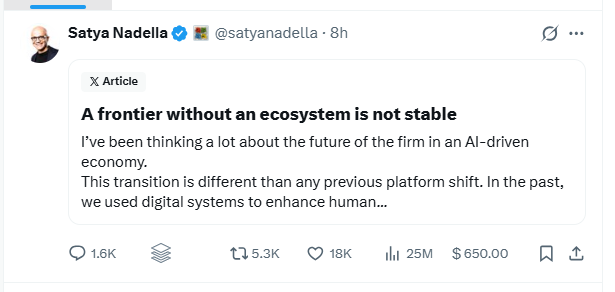
Nadella says companies must build AI around human expertise
Nadella argued that the AI era differs from previous technology transitions because it is not just about using digital tools to improve productivity. Instead, he said businesses are entering a phase where people and AI systems can continuously learn from one another, creating what he described as a “cognitive loop” between human workers and digital systems.
According to Nadella, companies of the future will need to build two forms of capital. The first is human capital, which includes employees’ knowledge, judgment, relationships and creativity. The second is what he called “token capital”, the AI capabilities that an organisation develops and owns.
Rather than seeing AI as a replacement for people, Nadella argued that human expertise becomes even more important as AI systems become more capable. “Human agency will be the driver of token capital growth,” he wrote, adding that people will continue to play a central role in setting goals, connecting ideas across different fields and recognising meaningful patterns.
A major concern for Nadella is the possibility that companies may become overly dependent on a small number of powerful AI models. He said businesses should focus on creating their own learning systems that preserve institutional knowledge and intellectual property, rather than simply relying on external AI providers.
“The last thing any of us want is a world where every company across every sector is ceding value to a few models that eat everything they see,” Nadella said.
He drew parallels with the early years of globalisation, when manufacturing and industrial jobs moved across borders. While economic growth continued on paper, many communities experienced lasting disruption. Nadella warned that a similar situation could emerge if AI systems absorb industry knowledge while most of the economic rewards flow to only a few companies.
“Let us not bring that dynamic into the AI era, with a small number of AI systems capturing all the economic returns, while entire industries find their knowledge commoditized right out from underneath them,” he wrote.
Debate grows as AI leaders disagree on future impact
Instead, Nadella called for the development of what he described as a “frontier ecosystem” rather than a “frontier model.” In his view, AI should help businesses across industries and countries build their own capabilities, allowing value to spread more broadly throughout the economy.
His comments come just days after Dario Amodei offered a much darker assessment of AI’s impact on employment. In a recent policy essay, the Anthropic chief executive warned that long-term job displacement may not simply be a temporary side effect of AI adoption but could be a fundamental characteristic of the technology itself.
Amodei said there is a “decent possibility” that AI could lead to “significant enduring job loss” as systems increasingly replicate human cognitive work. He argued that if AI dramatically reduces demand for human labour, governments may eventually need measures such as wage insurance, workforce retraining programmes and even long-term income support funded through taxes on companies benefiting from AI.
While Amodei focused on the risk of permanent workforce disruption, Nadella’s concern centres more on how economic value is distributed. His argument is that AI should strengthen organisations and workers rather than concentrating power in a small group of model providers.
The debate has also drawn responses from other technology leaders. Just a few weeks back, Jensen Huang criticised attempts to directly link AI to recent layoffs. Huang argued that many companies were reducing headcount long before generative AI became widely useful, suggesting that blaming the technology alone oversimplifies a much more complex issue.
 Microsoft CEO Satya Nadella
The Core Warning
- Loss of Industry Control: AI models are continuously absorbing corporate knowledge, workflows, and expertise. Nadella cautions that if businesses completely cede this data to a few external AI providers, they will lose ownership of their competitive edge. [2]
- The “Eat Everything” Risk: He explicitly stated, “The last thing any of us want is a world where every company across every sector is ceding value to a few models that eat everything they see.” [2]
- No Societal Permission: Nadella added that there is no public or societal backing for a tech transition that leaves traditional business sectors completely stripped of their value. [2]
Parallel to Globalization [4]
- Surface Metrics vs. Reality: During early globalization, overall GDP numbers looked healthy, but localized industrial economies were entirely hollowed out. [2]
- Long-Term Consequences: The resulting displacement caused deep, lasting societal and economic disruptions that are still felt today. He strongly urged the tech sector not to repeat this pattern with AI. [2, 7]
The Proposed Solution: “Frontier Ecosystems”
- Internal Learning Loops: Businesses must build their own learning systems on top of existing foundational models. True competitive advantage will come from combining human capital with an organization’s unique internal data and past lessons. [3, 6]
- Task-to-Model Matching: He advised companies against using massive, expensive “frontier models” for basic, everyday tasks. He suggested utilizing automation and tailored tools to optimize computing costs and preserve efficiency. [8, 9]
- Diverse Partnerships: Mirroring this philosophy, Microsoft itself has expanded past its exclusive infrastructure reliance on OpenAI, shifting to distribute workloads across other prominent models like Anthropic and xAI to foster a healthier tech ecosystem. [10]
Read more
216. Google Chat external interoperability with Microsoft Teams via NextPlane OpenHub is now available
236. Microsoft Build event in 25 minutes
308. Microsoft AI CEO unveils 7 new AI models | Mustafa Suleyman at Microsoft Build 2026
311. Microsoft Who evaluates the evaluators? The data science behind agent evals
216. Google Chat external interoperability with Microsoft Teams via NextPlane OpenHub is now available
for more refer Gemini website click here
for more refer Artificial Intelligence website click here