JUDGMENT
P. Velmurugan, J.- Both these appeals arise out of the common judgment dated 04.09.2019 made in T.O.S.No.56 of 2013 and C.S.No.1090 of 2008.
2. The appellant herein is the plaintiff in C.S.No.1090 of 2008 and the defendant in T.O.S.No.56 of 2013. The respondent in O.S.A.No.84 of 2020 is the plaintiff in T.O.S.No.56 of 2013 and the respondents in O.S.A.No.85 of 2020 are the defendants in C.S.No.1090 of 2008.
3. The brief facts of the suit in C.S.No.1090 of 2008 are as follows:
| (i) |
|
It is the case of the plaintiff that her father, late K.K.Dominic, was working as Assistant Director (Technical), All India Handloom Board, Weavers Service Centre, Chennai, for a considerable period of time. He married the plaintiff’s mother, Treasa, in the year 1935, and out of the said wedlock, the plaintiff and the third defendant were born. During the subsistence of the marriage, the plaintiff’s father K.K.Dominic allegedly developed an illicit relationship with one Theyamma, leading to marital discord and separation of Treasa, who thereafter resided in Kerala. |
| (ii) |
|
The maternal grandfather of the plaintiff, K.D.Kuruvilla, supported Treasa and her two daughters after the separation. It is also the case of the plaintiff that one Mary Pothen, the Principal of S.I.E.T. College for Women, Teynampet, Chennai – 18, assisted in providing education to the plaintiff and the third defendant. A case for maintenance was also filed by Treasa, which resulted in a direction to Late K.K.Dominic to pay a sum of Rs.500/- per month as maintenance. |
| (iii) |
|
According to the plaintiff, during the year 1963, her father K.K.Dominic, purchased the suit property from and out of his own resources. However, the Sale Deed, was registered in the name of one T.P.Davessy, the brother-in-law of Theyamma, who was only a school teacher with no independent financial capacity to acquire the property. It is further claimed that K.K.Dominic resided in the suit property with Theyamma until his death in 1995 and that the house was named after his pet dog. |
| (iv) |
|
The plaintiff further alleges that, with an intention to wrongfully appropriate the property, Theyamma procured a Deed of Settlement dated 27.02.1970, vide Doc.No.169/1970, from T.P.Davessy in her favour. Upon coming to know about the said transaction, the mother of the plaintiff, Treasa, sent a communication to the Income Tax Authorities in 1970 and 1971 asserting that the property had in fact been purchased by K.K.Dominic in the name of T.P.Davessy. It is also claimed that T.P.Davessy himself had executed an affidavit dated 23.12.1963, wherein he purportedly admitted that he was not the real owner of the property and that it had been purchased in his name using funds provided by Theyamma, allegedly gifted by her mother. The plaintiff, however, contends that this explanation is false, relying on a letter from Theyamma’s mother, Mrs.Annam, stating that she had no financial means to provide such funds. |
| (v) |
|
After the death of the plaintiff’s mother in the year 1993, K.K.Dominic married Theyamma in 1994. Therefore, according to the plaintiff K.K.Dominic was survived by his second wife Theyamma, and he died in the year 1995 leaving behind the said Theyamma, the plaintiff and the third defendant as his legal heirs and each of them have 1/3rd share of the suit property. After the death of K.K.Dominic, Theyamma remained in possession of the property as a co-sharer, while the plaintiff and the third defendant continued to visit the property occasionally. The said Theyamma died on 19.10.2008 leaving behind the second defendant as her legal representative to inherit her 1/3rd share in the suit property. Thus, according to the plaintiff, the plaintiff, the second defendant and the third defendant each have 1/3rd share of the suit property. The plaintiff would further claim that the second defendant informed her of a Will dated 31.07.2006 allegedly executed by Theyamma, claiming absolute ownership of the entire property and directing the second defendant to sell the property and distribute the sale proceeds to various persons and institutions. |
| (vi) |
|
According to the plaintiff, even assuming the Will to be genuine, Theyamma could have bequeathed only her 1/3rd share and not the entire property. The plaintiff also disputes the genuineness of the Will, alleging that Theyamma, owing to advanced age, poor health, and severe eyesight problems since 2002, was incapable of validly executing it. According to the plaintiff, the first defendant fabricated the Will to deprive the plaintiff and the third defendant of their lawful 1/3rd shares. On these allegations, the plaintiff sought partition and separate possession of her 1/3rd share in the suit property, along with consequential reliefs. |
| (vii) |
|
The first defendant resisted the suit, contending that the allegations in the plaint are wholly false and that the suit was instituted solely to harass him and prevent the implementation of the Will executed by Theyamma. According to the first defendant, he was a close family friend of Theyamma, who had been living alone after the death of her husband, K.K.Dominic. It is his case that Theyamma intended to sell the suit property and distribute the sale proceeds among various charitable institutions, a portion of consideration was also directed to be paid to the plaintiff herein. |
| (viii) |
|
The first defendant specifically denied the plaintiff’s claim that K.K.Dominic, had purchased the suit property in the name of T.P.Davessy, out of his own resources. According to him, the property was purchased by T.P.Davessy on 03.05.1963, and thereafter, by a Settlement Deed dated 27.02.1970, the said T.P.Davessy settled the property in favour of Theyamma, who consequently became its absolute owner. It is further contended that K.K.Dominic, despite being alive until 1995, never asserted any right, title or interest over the suit property, thereby disproving the plaintiff’s claim. |
| (xi) |
|
The first defendant further relied upon a Will dated 28.05.1986 allegedly executed by K.K.Dominic, wherein, he had stated that his relationship between him and his daughters, namely, the plaintiff and the third defendant was highly strained. The first defendant would also further claim that, after coming into the force of the Benami Transactions (Prohibition) Act 1988, now known as the Prohibition of Benami Property Transactions Act, 1988 [hereinafter referred to as ‘the Act, 1988’], the plaintiff cannot be allowed to plead that the purchase by T.P.Davessy in the year 1963 was a benami transaction, in view of Section 4 of the Act, 1988. It was also claimed that, in view of 2002 amendment to the Indian Succession Act, probate of the Will executed by Theyamma was not mandatory. |
| (x) |
|
The other defendants in the suit remained ex-parte. Upon consideration of the pleading in the suit, this Court framed the following issues for trial : |
| 1. |
|
Whether the plaintiff has any right of succession in the suit property? |
| 2. |
|
Whether the alleged claim of right through late father K.K.Dominic is sustainable under the law? |
| 3. |
|
Whether the property referred in the suit was the absolute property of Smt.Theyamma or not? |
| 4. |
|
Whether the said Theyamma validly testamented the property for her succession or not? |
| 5. |
|
Whether the plaintiff has right of any apportion in the suit schedule property under what capacity? |
| 6. |
|
What is the relationship of the plaintiff D1 and D2 with the late Smt.Theyamma? |
| 7. |
|
Whether the plaintiff is entitled to the relief of partition as claimed in the plaint? |
| 8. |
|
Whether the plaintiff is entitled to have the division of the property through the appointment of Commissioner? |
| 9. |
|
Whether the plaintiff valued the property correctly for filing the suit? |
| 10. |
|
Whether testamentary right over any other right in respect of the suit property or not? |
| 11. |
|
Whether the third defendant is amenable to the suit and what is the compensation to be awarded to the third defendant for the harassment exerted on him? |
| 12. |
|
What is the Court to be awarded against the plaintiff? |
| 13. |
|
To what other reliefs, the plaintiff is entitled to? |
| (xi) |
|
Upon hearing the counsels, the issues were recast as follows : |
| 1. |
|
Whether the plaintiff is not barred under the provisions of the Prohibition of Benami Property Transactions Act 1988, from setting up a plea of Benami after the cut off date i.e. 19.05.1988? |
| 2. |
|
Whether the plaintiff has any right to succeed the suit property? |
| 3. |
|
Whether the claim of the plaintiff through her late father K.K.Dominic is sustainable under law? |
| 4. |
|
Whether the suit property is the absolute property of Theyamma? |
| 5. |
|
Whether the Theyamma had testamentary capacity to execute the Will dated 31.07.2006? |
4. The facts of the Testamentary Original Suit in T.O.S.No.56 of 2013, are as follows:
| (i) |
|
It is the case of the plaintiff in T.O.S.No.56 of 2013 that the first defendant in C.S.No.1090 of 2008 had initially filed O.P.No.411 of 2011 seeking probate of the Will dated 31.07.2006 executed by Theyamma. Upon the fourth respondent in the Original Petition (who is the plaintiff in C.S.No.1090 of 2008), entering a caveat, the probate proceedings were converted into a Testamentary Original Suit and numbered as T.O.S.No.56 of 2013. |
| (ii) |
|
According to the plaintiff, the property subject matter of the Will was purchased by T.P.Davessy under a Sale Deed dated 03.06.1963 and was subsequently settled in favour of Theyamma by a Settlement Deed dated 27.02.1970, therefore, Theyamma was the absolute owner of the property. On 31.07.2006, the said Theyamma executed a registered Will in the presence of two attesting witnesses, appointing the plaintiff as the executor and directing him to sell the property and distribute the sale proceeds among various beneficiaries, including several charitable institutions. On the death of the testatrix namely, Theyamma, the plaintiff sought probate of the said Will. |
| (iii) |
|
The plaintiff in C.S.No.1090 of 2008 filed a caveat disputing the execution and validity of the Will and claimed 1/3rd share in the suit property as a legal heir of K.K.Dominic. The written statement filed in T.O.S.No.56 of 2013 substantially reiterated the same contentions raised in the plaint in C.S.No.1090 of 2008. |
| (iv) |
|
On the pleadings in the Testamentary Original Suit, the following issues were framed for trial. |
| 1. |
|
Whether the Will dated 31.07.2006 executed by Theyamma is true and valid? |
| 2. |
|
Whether the Will dated 31.07.2006 has been executed by testatrix with sound and disposing state of mind without any coercion or undue influence? |
| 3. |
|
To what other reliefs, the plaintiff is entitled to? |
5. Both the Testamentary Original Suit in T.O.S.No.56 of 2013 and Suit in C.S.No.1090 of 2008 were taken up for trial together. The plaintiff in C.S. No.1090 of 2008 was examined as P.W.1, she has also examined one Amita Joseph as P.W.2. Exs.P1 to P9 were marked on the side of the plaintiff. The plaintiff in T.O.S.No.56 of 2013/first defendant in C.S.No.1090 of 2008 was examined as D.W.1 and he has produced Exs.D1 to D5. Ex.P10 was marked in cross-examination of D.W.1. Mr.V.M.Joseph, who figures as an attesting witness in the Will has been examined as D.W.2.
6. Upon a full-fledged trial and after hearing the learned counsel on either side, the learned Single Judge, by a common judgment dated 04.09.2019 dismissed C.S.No.1090 of 2008 and decreed T.O.S.No.56 of 2013 granting probate of the Will dated 31.07.2006 in favour of the plaintiff. Aggrieved by the common judgment and decree, the present appeals have been preferred.
7. Mr.Sharath Chandran, learned counsel for the appellant submitted that the suit property was purchased by the appellant’s father K.K.Dominic, out of his own funds in the name of one T.P.Davessy, who was only a benamidar and name-lender. The Sale Deed dated 03.05.1963 was therefore a benami transaction, and consequently, the Settlement Deed dated 27.02.1970 executed by T.P.Davessy in favour of Theyamma did not confer any valid title upon her. Admittedly, the said T.P.Davessy, had no independent financial capacity to purchase the property, which is evidenced by Ex.P6, wherein he admitted that he was not the real owner. He further submitted that in Ex.P5, the affidavit dated 23.12.1963, T.P.Davessy has stated that the property had been purchased with funds provided by Theyamma (partially from a gift given by Theyyamma’s mother) and that he was not the owner of the said property. On the other hand, Ex.P4, the letter of Mrs.Annam, mother of Theyamma, disclosed that she was living in penury and had no means to provide funds to Theyamma. Since Theyyamma was admittedly uneducated, unemployed and had no independent source of income, the only reasonable inference is that the consideration for the purchase flowed from K.K.Dominic. Accordingly, the appellant, being one of his legal heirs, is entitled to 1/3rd share in the suit property.
8. The learned counsel further submitted that the learned Single Judge erred in rejecting the appellant’s plea under Section 4(3) (b) of the Act, 1988, solely on the ground that there was no specific pleadings regarding the existence of a fiduciary capacity. It was contended that the suit property was purchased by K.K.Dominic in the name of T.P.Devessy, who held the property only in a fiduciary capacity and as a benamidar. Therefore, the transaction falls within the exception carved out under Section 4(3) (b) of the Act, 1988. The learned counsel further submitted that the learned Single Judge failed to appreciate that the relationship between K.K.Dominic, Theyyamma and T.P.Devessy clearly disclosed an arrangement founded on trust and confidence, bringing the transaction within the ambit of the fiduciary exception. Therefore, the appellant’s suit for partition could not have been held to be barred under Section 4 of the Act, 1988.
9. The learned counsel also assailed the decree granting probate by contending that the Will had not been proved in the manner known to law. The propounder (D.W.1) was admittedly not related to the testatrix and had no personal knowledge regarding the preparation or execution of the Will. No independent evidence was adduced to establish that Theyyamma possessed sufficient means to acquire the suit property.
10. It was further argued that the evidence disclosed several suspicious circumstances surrounding the execution of the Will. Though Theyyamma had ordinarily signed the documents, the Will bore only her thumb impression without any explanation. The evidence indicated that she was nearly blind, bedridden for several years preceding her death, and suffering from poor vision. The medical records allegedly relied upon for securing the visit of the SubRegistrar to her residence was withheld. An earlier Will of Theyamma, admittedly in the possession of D.W.1 was also not produced.
11. The learned counsel further submitted that the testimony of D.W.2, the attesting witness, did not satisfy the mandatory requirement for proving a Will under the Indian Succession Act, 1925 and the Indian Evidence Act, 1872. D.W.2 admitted that he was unaware of the contents of his proof affidavit, which had been prepared in English, and that he had no personal knowledge regarding the circumstances in which the testatrix affixed her thumb impression. There was also no satisfactory evidence that the attesting witnesses had signed the Will in the manner contemplated under law. It was further submitted that D.W.2, in his cross-examination, also admitted that the contents in affidavit had not been explained to him and that he signed it at the request of an Advocate. His evidence, therefore, fails to satisfy the mandatory requirements for proving the due execution and attestation of the Will. The mere fact that the Will is registered does not dispense with the statutory requirement of proving its due execution and attestation in accordance with law.
12. The learned counsel for the appellant mainly contended that the Will was surrounded by grave suspicious circumstances. The testatrix was about 90 years of age, bedridden, and the principal beneficiary as well as the executor was a complete stranger who was occupying a portion of the suit property. No convincing explanation was offered for excluding the natural heirs. These suspicious circumstances, according to the appellant, remained unexplained. Hence, the decree granted probate is liable to be set aside and, once the Will is rejected, the appellant and the other legal heirs would become entitled to partition and separate possession of their respective shares in the suit property.
13. In support of his contention, the learned counsel for the appellant relied upon the following decision of the Hon’ble Supreme Court :
| (i) |
|
Jaswant Kaur v. Amrit Kaur (1977) 1 SCC 369 |
| (ii) |
|
Kavita Kanwar v. Pamela Mehta (2021) 11 SCC 209 |
| (iii) |
|
Kannamaml v. Chinnaponnammal (1997) 1 CTC 222 |
| (iv) |
|
Veena Singh v. District Collector and Another (2022) 7 SCC 1 |
| (v) |
|
Dharam Singh v. ASO 1990 Supp SCC 684 |
| (vi) |
|
Marcel Martins v. M. Printer (SC)/(2012 5 SCC 342 ) |
| (vii) |
|
Lac Minerals v. International Corona Resources Limited 1989 SCC Online Can 85 |
14. Mr.AR.L.Sundaresan, learned Senior Counsel appearing for the respondent submitted that the subject matter of the Will was purchased by T.P.Davessy in the year 1963, who in turn, settled the property in favour of Theyamma in the year 1970, therefore, Theyamma was the absolute owner of the suit property. The said Theyamma, had no issues and, after the demise of her husband K.K.Dominic, was living alone. Intending that her estate be sold and the sale proceeds utilised, inter alia, for charitable purposes, she executed a registered Will dated 31.06.2006 and appointed the first respondent as the executor/propounder of the said Will. It was further submitted that the appellant herself is one of the beneficiaries under the said Will.
15. The learned Senior Counsel contended that the Will was duly executed and proved in accordance with law. One of the attesting witnesses was examined and deposed to the execution of the Will and the affixture of the testatrix’s thumb impression. The propounder also deposed that the testatrix had personally handed over the original Will to him and, after her demise, he instituted the proceedings seeking probate. It was therefore submitted that the statutory requirements relating to the execution and proof of the Will stood fully satisfied. It was further submitted that the testatrix had become the absolute owner of the suit property under the Settlement Deed dated 27.02.1970 and was fully competent to execute the Will. The learned Single Judge, having rightly appreciated the oral and documentary evidence, correctly granted probate and dismissed the suit for partition. Hence, no interference with the impugned common judgment is warranted.
16. The learned Senior Counsel further submitted that the suit property was already sold and the sale proceeds disbursed to some of the beneficiaries as per the Will. It was further submitted that the remaining amounts are yet to be disbursed, as the parties are presently not in a position to identify the beneficiaries.
17. Heard the learned counsel on either side and perused the materials available on record.
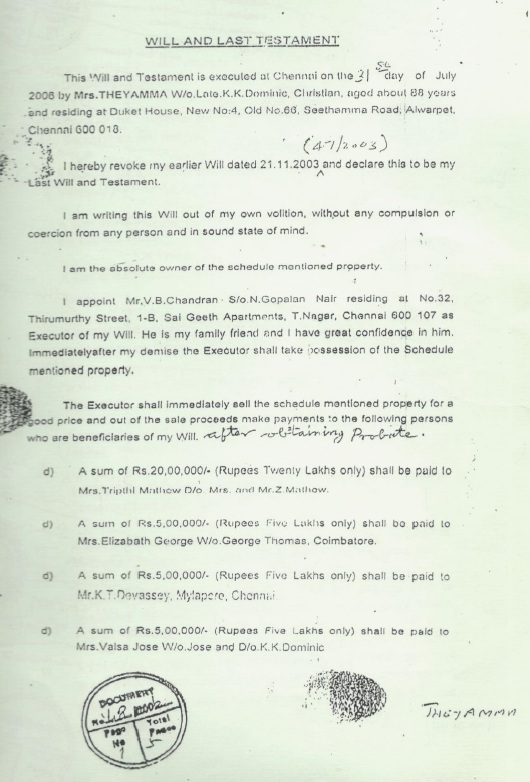
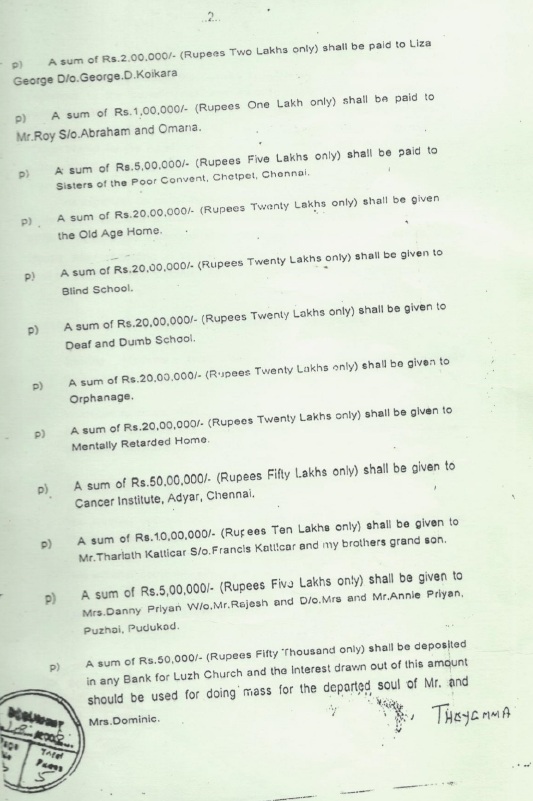
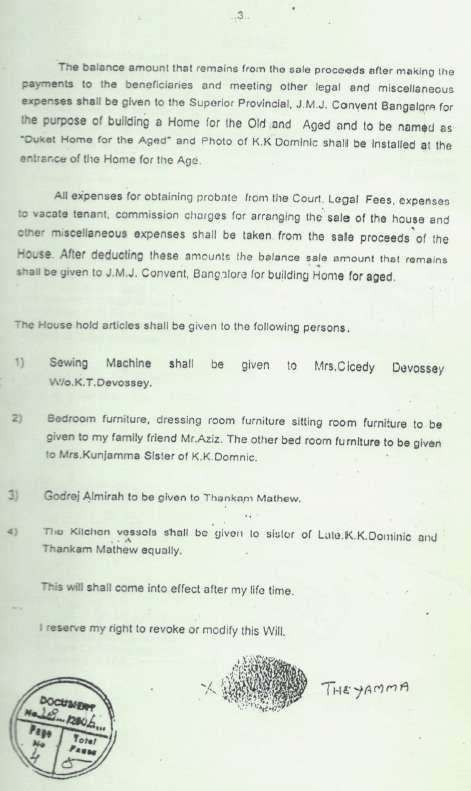
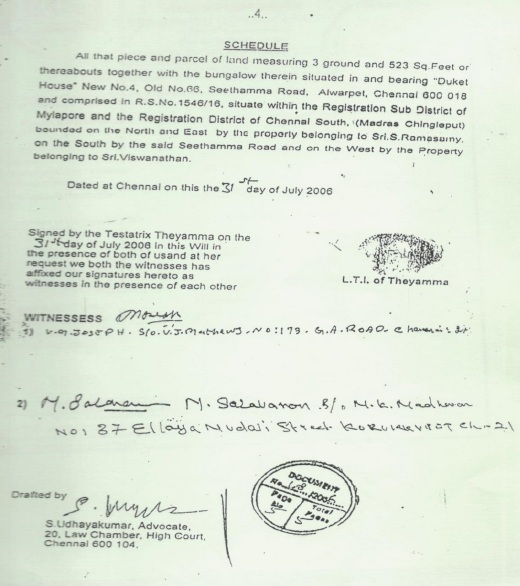
18. Admittedly, the testatrix derived title to the suit property under the Settlement Deed dated 27.02.1970. Having no Class I legal heirs, she executed a registered Will dated 31.07.2006, whereunder, she bequeathed her estate. A scanned reproduction of Will is extracted hereunder:
19. It is also undisputed that the testatrix derived title to the suit property under the Settlement Deed dated 27.02.1970. Though the appellant pleaded that the original purchase in the name of T.P.Davessy was a benami transaction, neither the Settlement Deed nor the title derived thereunder was ever challenged from the year 1970 till the institution of the suit. Even in the suit for partition, no relief was sought to set aside the Settlement Deed. In the absence of any challenge to the Settlement Deed, the learned Single Judge rightly held that the testatrix was the absolute owner of the suit property and was fully competent to execute a Will in respect thereof.
20. Insofar as the Will dated 31.07.2006 is concerned, the propounder examined himself as D.W.1 and one of the attesting witnesses as D.W.2, the other attesting witness having passed away. Upon a careful consideration of the oral and documentary evidence, the learned Single Judge found that the Will, being a registered instrument, stood duly proved through the cogent and convincing testimony of D.W.2 regarding its execution and attestation. Having independently re-appreciated the evidence on record, we find no infirmity in the said findings warranting interference in appeals. We are satisfied that the due execution and attestation of the Will stand proved in conformity with the requirements of Section 63 of the Indian Succession Act, 1925 and Section 68 of the Indian Evidence Act, 1872.
21. The suspicious circumstances alleged by the appellant, namely, the advanced age and physical condition of the testatrix, the registration of the Will at her residence, and the role of the executor, have not been substantiated by acceptable evidence. The appellant neither examined the registering authority nor produced any evidence to substantiate the allegation that the registration of the Will was vitiated by suspicious circumstances. Mere registration of the Will at the residence of the testatrix, who was unable to attend the Sub-Registrar’s Office, does not, by itself, render the Will suspicious. The evidence on record establishes that the testatrix, being the absolute owner of the property and having no issues, consciously bequeathed her estate in favour of the beneficiaries and charitable institutions named in the Will. The appellant herself having been named as one of the beneficiaries under the Will, her contention that the testamentary disposition is unnatural or fabricated cannot be accepted. Consequently, the appellant cannot claim any right to seek partition of the suit property dehors the Will, and the dismissal of the suit for partition calls for no interference.
22. During the pendency of these appeals, the executor sold the suit property in exercise of the powers conferred under the Will. It has been submitted that the sale proceeds have been distributed to the beneficiaries. The executor is, therefore, directed to file an affidavit on or before 07.07.2026, indicating the manner in which the sale proceeds have been disbursed in terms of the Will, including the amounts, if any, remaining to be paid to the beneficiaries.
23. For the foregoing reasons, both the appeals fail and are accordingly dismissed. Consequently, connected miscellaneous petition is closed. There shall be no order as to costs.
List the matter on 08.07.2026 “For Filing Affidavit”.