


Reassessment completed by a different Officer without issuing Section 148 notice or Section 127 order is invalid.
Issue
Whether a reassessment completed by an Assessing Officer under Section 143(3) read with Section 147 is legally valid when the Section 148 notice was issued by a different officer, no fresh notice was issued by the assessing officer who completed the assessment, and no transfer order was passed under Section 127.
Facts
-
Issuance of Notice: For Assessment Year 2011-12, the notice for reopening assessment under Section 148 was issued by ITO-1(4), Raipur.
-
Completion of Assessment: The final reassessment order under Section 143(3) read with Section 147 was passed by ITO-1(2), Raipur.
-
Non-Issuance of Fresh Notice: ITO-1(2), Raipur, completed the assessment without issuing any fresh notice under Section 148 to the assessee.
-
Absence of Transfer Order: No formal order transferring jurisdiction under Section 127 was passed by the competent authority to shift the case from ITO-1(4), Raipur to ITO-1(2), Raipur.
Decision
-
Inconsistent Statutory Exercise is Void: Any exercise of power by statutory authorities inconsistent with the statutory prescription is invalid, as there can be no waiver of statutory requirements that go to the root of jurisdiction.
-
Reassessment Invalid Without Notice: Because ITO-1(2), Raipur, framed the assessment without issuing a notice under Section 148, the reassessment order was inherently invalid.
-
Absence of Section 127 Order Vitiates Assessment: When jurisdiction shifts between officers, the absence of a valid transfer order under Section 127 vitiates the entire reassessment proceeding.
-
Outcome: The reassessment order was held invalid and quashed, deciding the issue in favor of the assessee.
Key Takeaways
-
Jurisdictional Requirement of Section 148: The Assessing Officer framing the reassessment must independently issue a notice under Section 148 unless jurisdiction has been lawfully transferred.
-
Mandatory Section 127 Transfer Order: A change of jurisdiction from one Assessing Officer to another requires a formal transfer order passed under Section 127 by a competent authority.
-
No Waiver on Jurisdictional Requirements: Procedural mandates that touch upon the fundamental jurisdiction of an assessing authority cannot be waived by the assessee or ignored by the Revenue.
[Assessment year 2011-12]
| (i) | Vidya Shankar Jaiswal v. ITO (SC)/Civil Appeal Nos./2025 [Special Leave Petition (Civil) Nos. 26310-26311/2024], dated 31.01.2025 passed by the Hon’ble Supreme Court. |
| (ii) | Jagdish Prasad Singhania v. Addl. CIT (TDS) [TAX Case No.17 OF 2025, dated 24-02-2025], passed by Hon’ble High Court of Chhattisgarh. (iii) Inder Singh v. State of Madhya Pradesh [SLP (Civil) No.6145 of 2024, dated 21-3- 2025]. (iv) Collector, Land Acquisition v. Mst. Katiji [1987] 167 ITR 471 (SC) passed by the Hon’ble Supreme Court, accordingly, the said delay of 18 days is condoned. |
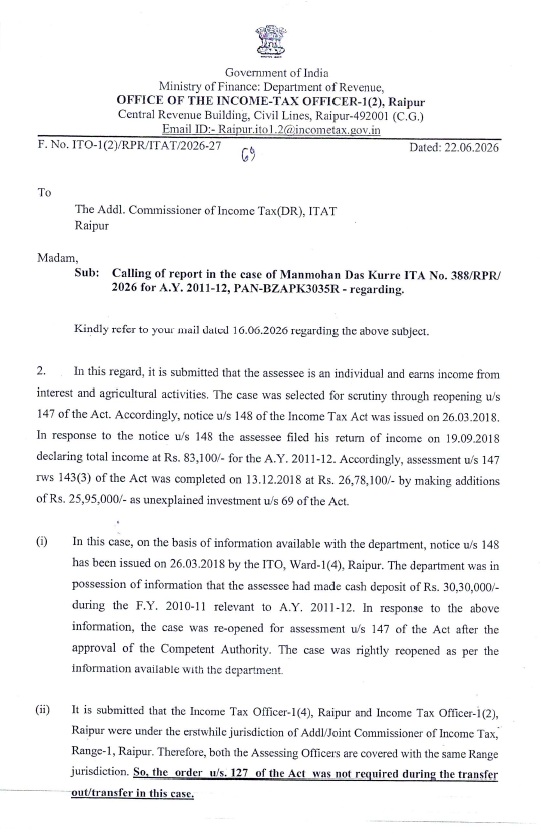
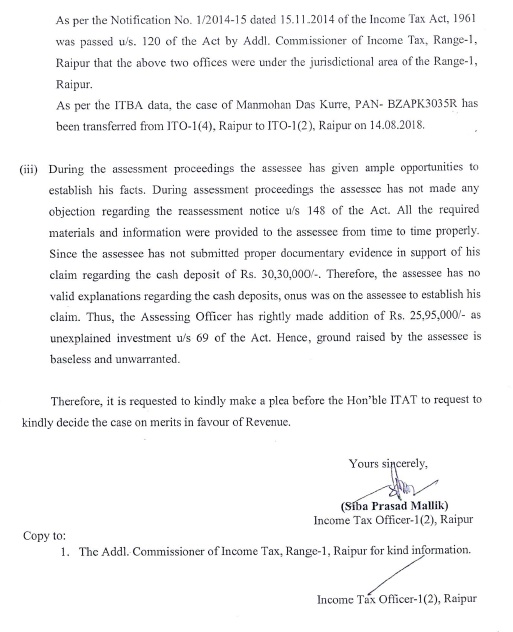
“Kindly refer to your letter F.No.Addl. CIT/RPR/Report/2025-26, dated 17.02.2026 on the subject captioned above.
In this regard, the pointwise replies are submitted as under:-
1.1. On perusal of case record, it has not been traced any order ups 127 of the I.T. Act 1961 except a letter of the then ITO-4(4), Raipur regarding transfer of time barring scrutiny cases (copy attached). Regarding jurisdiction over the transfer of case, it is submitted that vide notification dated 15.11.2014, territorial reallocation of wards a Raipur was undertaken and consequent upon this restructuring, the jurisdiction over the area Pachpedi Naka, Raipur automatically transferred to the then ITO Ward-3(2), Raipur. Thereafter, the ITO, Ward-3(2), Raipur on 14.08.2018, pursuant to the notice issued earlier. Continued the jurisdiction after reallocation and passed the order of assessment under section 147 r.w.s. 143(3) of the I.T. Act, 1961 on 19.11.2018 in this case. Further, the assessee has failed to raise objection under section 124(3) o the I.T. Act within one month of service of notice or within one month from the date of issuance of notice or completion of assessment in this case.
2. 2. Further on perusal of case record, it is respectfully submitted that though the assessee had filed return of income under section 139(1), no return was filed it response to notice issued under section 148 of the Act. The assessee also did no communicate that the original return filed under section 139(1) may be treated as return filed in compliance with notice under section 148. In absence of such compliance, there was no return available on record in the reassessment proceedings. Since issuance of notice under section 143(2) presupposes furnishing of a return in response to statutory notice, the same was not mandatory in the present case. Accordingly, the assessment has been validly completed under section 143(3 read with section 147 of the Income-tax Act, 1961.”
“2. In this case, the assessee has filed both legal ground as well as grounds on merits. The Ld. Counsel for the assessee submitted that he would assail the legal ground first and if the said legal ground is answered affirmative, then the grounds on merits becomes academic. The Ld. Counsel for the assessee submitted that first notice u/s. 143(2) of the Act for A.Y.2016-17 for initiating limited scrutiny had been issued by the ITO, Ward-4(5), Raipur, dated 18.09.2017. Thereafter, another notice u/s. 142(1) of the Act for the same A.Y. dated 09.06.2018 was issued by the ITO, Ward-3(1), Raipur. That further, the Ld. Counsel has annexed the return of income and acknowledgement given by the department for the assessment year under consideration where the designation of the A.O (Ward-Circle) is appearing as Ward-3(1), Raipur. In this background, the Ld. Counsel submitted that firstly, if the original jurisdiction of the assessee is with ITO, Ward-4(5), Raipur who had initiated the proceedings for limited scrutiny and later on, transferred to the ITO, Ward-3(1), then as per the mandatory requirement of the Act, order of transfer u/s. 127 of the Act is required. However, no such order has been placed by the department and nothing is there on record that such order of transfer u/s. 127 of the Act was acquired; secondly, if it is accepted that the actual jurisdiction of the officer regarding the assessee was the ITO, Ward-3(1), Raipur which is likely so since the e-filed return is admittedly taken by the designation of the A.O as per the address of the assessee to be ITO, Ward-3(1) appearing in the acknowledgment of the ITR filed on 22.02.2017 in the said assessment year, Page 8-9 of APB. Now if that be so, then the initiation of the proceedings of limited scrutiny i.e. with regard to the first notice u/s.143(2) of the Act issued by the ITO, Ward-4(5), Raipur suffers from valid jurisdiction, resultantly then subsequent assessment framed by the ITO, Ward-3(1), Raipur becomes invalid and non-est in the eyes of law.
3. Per contra, the Ld. Sr. Departmental Representative (for short ‘DR’) vehemently submitted that as per Section 124(3)(a) of the Act, if the assessee had any objection regarding the jurisdiction of the Assessing Officer, then the same could have been raised within one month from the date on which he was served with the notice u/s. 142(1) and 143(2) of the Act. However, in the present case, the assessee had failed to do so. The Ld. Sr. DR relied on the judgment of the Hon’ble Supreme Court in the case of DCIT (Exemption) & Ors. v. Kalinga Institute of Industrial Technology (SC), wherein the Hon’ble Apex Court has ruled that where the assessee had participated pursuant to the notice issued under Section 142(1) and had not questioned the jurisdiction of the assessing officer, then Section 124(3)(a) of the Income Tax Act precludes the assessee from questioning the jurisdiction of the assessing officer, if he does not do so within 30 days of receipt of notice under Section 142(1).
4. I have carefully considered the submissions of both the parties, considered the material available on record and facts and circumstances involved in the present case. In so far the legal issue is concerned, it is apparent from record as annexed in the paper book that the first notice u/s.143(2) of the Act, dated 18.09.2017 has been issued by the ITO, Ward-4(5), Raipur. Thereafter, second notice u/s.142(1) of the Act, dated 09.06.2018 was issued by the ITO, Ward-3(1), Raipur. However, there is no iota of evidence whether there is any order of the Pr. CIT u/s. 127 of the Act for transferring of the jurisdiction from one Assessing Officer to another in the present case of the assessee. It is also noted from the e-filed return and the acknowledgement of the department that the designation of the jurisdictional Assessing Officer is mentioned as ITO, Ward-3(1), Raipur. If that is so, then also, the first notice i.e. notice issued u/s. 143(2) of the Act, dated 18.09.2017 by the ITO, Ward-4(5), Raipur is without jurisdiction, invalid and bad in law.
5. In so far the reliance placed by the Ld. Sr. DR on the judgment of the Hon’ble Apex Court in the case of DCIT (Exemption) & Ors. v. Kalinga Institute of Industrial Technology (supra), wherein, the conduct of the assessee was determined while accepting or non-accepting the jurisdiction by way of participation in the proceedings, the word “participating” in this present context should not be construed in any manner given the text of the said decision to prevent the right of the assessee for challenging any legal issue including the issue of jurisdiction before any appellate forum as had been held by the Hon’ble Supreme Court in the case of National Thermal Power Company Ltd. Ltd. v. CIT (1998) 229 ITR 383 (SC). Rightfully so mentioned in the said judgment, the Hon’ble Apex Court held that when certain legal issues have been arisen and the assessee has failed to raise such legal issues before the sub-ordinate authorities, then he should not be prevented from raising the same before any other appellate authority. Therefore, taking guidance from the aforesaid judicial pronouncement of the Hon’ble Apex Court, the contention regarding the issue of jurisdiction is held to be valid as had been raised by the assessee first time before the Tribunal. The decision of the Hon’ble Supreme Court in the case of DCIT (Exemption) & Ors. v. Kalinga Institute of Industrial Technology (supra) as has been relied on by the Ld. Sr. DR is clearly focused on the parameter of compliance. However, in the present case as demonstrated in the record, it is not that of compliance and rather, it is ambiguity in issuance of notice and denying an opportunity to the assessee as to whether he should respond to the ITO, Ward-4(5), Raipur or ITO, Ward-3(1), Raipur. There are plethora of judicial pronouncements wherein it had been held that the tax payer should be provided opportunity to prepare for his defence in timely and appropriate manner and if there is any ambiguity/confusion arising in the said hearing notice which prevents the assessee to defend himself, then such hearing notices and subsequent proceedings have to be struck down holding them to be arbitrary, bad in law. If this kind of ambiguity in issuance of notice by the appropriate authority is allowed then it would highly effect smooth running of business activities or for that matter generating income to the assessee tax payer. If the assessee tax payer is not able to earn income, then there is no question of paying any taxes. Therefore, the assessee should be allowed to prepare his defence as regards the proper jurisdiction before whom he shall make necessary compliances.
6. Derived from the Latin word “notitia”, which means being known, notice is the starting of any hearing. Unless a person knows the issues of the case in which he is involved, he cannot defend himself. For a notice to be adequate it must contain- (a) Time, place and nature of hearing; (b) Legal authority under which hearing has to be held; and (c) The specific charges, grounds and proposed actions the accused has to meet. This is the very edifice of the principle of natural justice. There is mandatory requirement of reasonable opportunity of being heard. This pre-requires issuance of a proper notice. The authority has to issue Show Cause to the party/assessee to explain and produce evidence before an adverse inference may be drawn against him. The notice should be specific and unambiguous so that proper compliance can be made by the assessee. The importance of a show cause notice has been reiterated by Supreme Court in the case of Umanath Pandey v. State of UP (2009) 12 SCC 40-43 wherein the Hon’ble Apex Court has held that “Notice is the first limb of this principle. It must be precise and unambiguous. It should appraise the party determinatively the case he has to meet. Time given for the purpose should be adequate so as to enable him to make his representation. In the absence of a notice of the kind and such reasonable opportunity, the order passed becomes wholly vitiated”. In the case of Biecco Lawrie Ltd v. State of West Bengal (2009) 10 SCC 32, the Supreme Court observed that “One of the essential ingredients of fair hearing is that a person should be served with a proper notice, i.e. a person has a right to notice. Notice should be clear and precise so as to meet and make an effective defence. Denial of notice and any ambiguity there denied the right of the assessee for fair and judicious proceedings. The adequacy of notice is a relative term and must be decided with reference to each case.”
7. Rebutting the facts of the present case, it is noted as per the documents on record that the first notice u/s. 143(2) of the Act, dated 18.09.2017 was issued by the ITO, Ward-4(5), Raipur and thereafter, another notice u/s. 142(1) of the Act, dated 09.06.2018 was issued by the ITO, Ward-3(1), Raipur who had framed the assessment without any order of transfer as required u/s.127 of the Act by the Ld. Pr. CIT. Similarly, if it is to be accepted that the actual jurisdiction is with the ITO, Ward-3(1), Raipur then first notice u/s. 143(2) of the Act, dated 18.09.2017 which had been issued for initiating the scrutiny proceedings by the ITO, Ward-4(5), Raipur is definitely without a valid jurisdiction over the assessee. When the issuance of notice and framing of assessment order suffers from lack of jurisdiction as enshrined in the statute then all subsequent proceedings becomes non-est in the eyes of law.
8. I find that the Hon’ble Supreme Court in its recent order passed in the case of Union of India v. Rajeev Bansal [2024] 469 ITR 46 (SC) had, inter alia, observed that the order passed without jurisdiction is nullity. It was further observed that if a statute expressly confers a power or imposes a duty on a particular authority, then such power or duty must be exercised or performed by that authority itself. Elaborating further, the Hon’ble Apex Court had observed that any exercise of power by statutory authorities inconsistent with the statutory prescription is invalid. Apart from that, it was observed that as there cannot be any waiver of a statutory requirement or provision that goes to the root of the jurisdiction of assessment, therefore, any consequential order passed or action taken will be invalid and without jurisdiction. For the sake of clarity, the observations of the Hon’ble Apex Court are culled out as under:
30. If a statute expressly confers a power or imposes a duty on a particular authority, then such power or duty must be exercised or performed by that authority itself. (Dr. Premachandran Keezhoth v. Chancellor, Kannur University). Further, when a statute vests certain power in an authority to be exercised in a particular manner, then that authority has to exercise its power following the prescribed manner (CIT v. Anjum M.H. Ghaswala; State of Uttar Pradesh v. Singhara Singh). Any exercise of power by statutory authorities inconsistent with the statutory prescription is invalid..
32. A statutory authority may lack jurisdiction if it does not fulfil the preliminary conditions laid down under the statute, which are necessary to the exercise of its jurisdiction. (Chhotobhai Jethabhai Patel and Co. V. Industrial Court, Maharashtra Nagpur Bench). There cannot be any waiver of a statutory requirement or provision that goes to the root of the jurisdiction of assessment. (Superintendent of Taxes v. Onkarmal Nathmal Trust). An order passed without jurisdiction is a nullity. Any consequential order passed or action taken will also be invalid and without jurisdiction. (Dwarka Prasad Agrawal V. B.D. Agrawal). Thus, the power of assessing officers to reassess is limited and based on the fulfilment of certain preconditions. (CIT v. Kelvinator of India Ltd.)”
9. With these observations, the assessment framed by the ITO-3(1) Raipur vide his order passed u/s.143(3) of the Act, dated 26.10.2018 in absence of an order of transfer u/s.127 of the Act having been passed by the Ld. Pr.CIT and without any issuance of notice by him u/s. 143(2) of the Act to the assessee, is held to be without jurisdiction, invalid and bad in law and thus, the same is quashed.
10. Needless to say, once the assessment has been quashed for want of valid assumption of jurisdiction then all the other proceedings subsequent thereto becomes non-est in the eyes of law. As the legal issue has been answered in favour of the assessee then the grounds on merits becomes academic.
11. As per the aforesaid terms the grounds of appeal raised by the assessee stands allowed.
12. In the result, appeal of the assessee is allowed.”
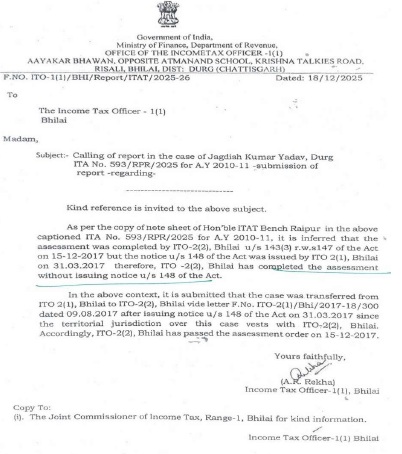
“3. The legal ground assailed by the Ld. Counsel for the assessee is that in this case, notice u/s.148 of the Income Tax Act, 1961 (for short ‘the Act’) has been issued by the ITO-2(1), Bhilai on 31.03.2017 but the assessment was completed by the ITO-2(2), Bhilai u/s. 143(3) r.w.s. 147 of the Act, dated 15.12.2017 without any valid order of transfer u/s. 127 of the Act. That further, it was submitted by the Ld. Counsel that the assessment was completed by the ITO-2(2), Bhilai without issuance of any notice u/s.148 of the Act, therefore, in these set of facts, firstly, there is no mandatory valid order of transfer u/s. 127 of the Act for transferring the case of the assessee from ITO-2(1), Bhilai to ITO-2(2), Bhilai and secondly, the ITO-2(2), Bhilai before completing the assessment has not issued any notice u/s.148 of the Act.
4. The Ld. Sr. DR relied on the orders of the sub-ordinate authorities a/w. judgment of the Hon’ble High Court of Chhattisgarh in the case of Harish Kumar Chhabada v. Pr. Commissioner of Income Tax, TAXC No. 138 of 2023, dated 08.10.2025. Also, the Ld. Sr. DR submitted a report dated 18.12.2025 which reads as follows:
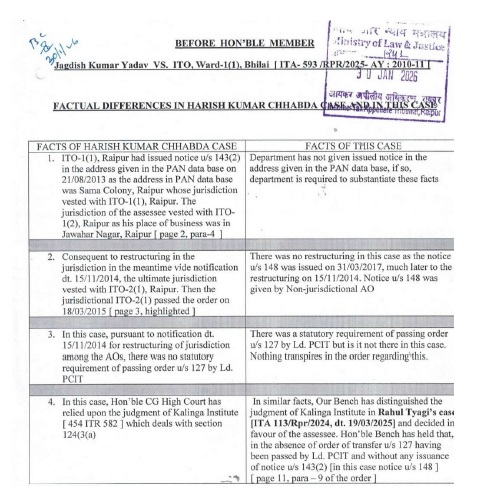
5. Per contra, the Ld. Counsel for the assessee had filed written submissions submitting that the facts regarding the case of the assessee are substantially distinguishable from the facts of the case referred to by the Ld. Sr. DR. The relevant submission of the Ld. Counsel is extracted as follows:
6. In this regard, I refer to the order of the ITAT, SMC Bench, Raipur in the case of Virendra Gir Goswami v. Income Tax Officer, ITA No. 411/RPR/2025, dated 22.07.2025 wherein similar issue has been dealt with by the Tribunal. For the sake of completeness, the relevant observations of the Tribunal are extracted as follows:
“8. Reverting to the facts of the present case, it is noted that notice u/s. 148 of the Act has been issued by the ITO-1(3), Bhilai and thereafter, assessment was completed by the ITO-2(2), Bhilai without any order of transfer as mandated u/s.127 of the Act by the competent authority. Therefore, such framing of assessment by the ITO-2(2), Bhilai in absence of valid order of transfer u/s.127 of the Act is held to be without inherent valid jurisdiction. For the sake of completeness, the relevant paras in the case of Rahul Tyagi v. Income Tax Officer (supra) are extracted as follows:
“2. In this case, the assessee has filed both legal ground as well as grounds on merits. The Ld. Counsel for the assessee submitted that he would assail the legal ground first and if the said legal ground is answered affirmative, then the grounds on merits becomes academic. The Ld. Counsel for the assessee submitted that first notice u/s. 143(2) of the Act for A.Y.2016-17 for initiating limited scrutiny had been issued by the ITO, Ward-4(5), Raipur, dated 18.09.2017. Thereafter, another notice u/s. 142(1) of the Act for the same A.Y. dated 09.06.2018 was issued by the ITO, Ward-3(1), Raipur. That further, the Ld. Counsel has annexed the return of income and acknowledgement given by the department for the assessment year under consideration where the designation of the A.O (Ward-Circle) is appearing as Ward-3(1), Raipur. In this background, the Ld. Counsel submitted that firstly, if the original jurisdiction of the assessee is with ITO, Ward-4(5), Raipur who had initiated the proceedings for limited scrutiny and later on, transferred to the ITO, Ward-3(1), then as per the mandatory requirement of the Act, order of transfer u/s. 127 of the Act is required. However, no such order has been placed by the department and nothing is there on record that such order of transfer u/s. 127 of the Act was acquired; secondly, if it is accepted that the actual jurisdiction of the officer regarding the assessee was the ITO, Ward-3(1), Raipur which is likely so since the e-filed return is admittedly taken by the designation of the A.O as per the address of the assessee to be ITO, Ward-3(1) appearing in the acknowledgment of the ITR filed on 22.02.2017 in the said assessment year, Page 8-9 of APB. Now if that be so, then the initiation of the proceedings of limited scrutiny i.e. with regard to the first notice u/s.143(2) of the Act issued by the ITO, Ward-4(5), Raipur suffers from valid jurisdiction, resultantly then subsequent assessment framed by the ITO, Ward-3(1), Raipur becomes invalid and non-est in the eyes of law.
3. Per contra, the Ld. Sr. Departmental Representative (for short ‘DR’) vehemently submitted that as per Section 124(3)(a) of the Act, if the assessee had any objection regarding the jurisdiction of the Assessing Officer, then the same could have been raised within one month from the date on which he was served with the notice u/s. 142(1) and 143(2) of the Act. However, in the present case, the assessee had failed to do so. The Ld. Sr. DR relied on the judgment of the Hon’ble Supreme Court in the case of DCIT (Exemption) & Ors. v. Kalinga Institute of Industrial Technology (SC), wherein the Hon’ble Apex Court has ruled that where the assessee had participated pursuant to the notice issued under Section 142(1) and had not questioned the jurisdiction of the assessing officer, then Section 124(3)(a) of the Income Tax Act precludes the assessee from questioning the jurisdiction of the assessing officer, if he does not do so within 30 days of receipt of notice under Section 142(1).
4. I have carefully considered the submissions of both the parties, considered the material available on record and facts and circumstances involved in the present case. In so far the legal issue is concerned, it is apparent from record as annexed in the paper book that the first notice u/s.143(2) of the Act, dated 18.09.2017 has been issued by the ITO, Ward-4(5), Raipur. Thereafter, second notice u/s.142(1) of the Act, dated 09.06.2018 was issued by the ITO, Ward-3(1), Raipur. However, there is no iota of evidence whether there is any order of the Pr. CIT u/s. 127 of the Act for transferring of the jurisdiction from one Assessing Officer to another in the present case of the assessee. It is also noted from the e-filed return and the acknowledgement of the department that the designation of the jurisdictional Assessing Officer is mentioned as ITO, Ward-3(1), Raipur. If that is so, then also, the first notice i.e. notice issued u/s. 143(2) of the Act, dated 18.09.2017 by the ITO, Ward-4(5), Raipur is without jurisdiction, invalid and bad in law.
5. In so far the reliance placed by the Ld. Sr. DR on the judgment of the Hon’ble Apex Court in the case of DCIT (Exemption) & Ors. v. Kalinga Institute of Industrial Technology (supra), wherein, the conduct of the assessee was determined while accepting or non-accepting the jurisdiction by way of participation in the proceedings, the word “participating” in this present context should not be construed in any manner given the text of the said decision to prevent the right of the assessee for challenging any legal issue including the issue of jurisdiction before any appellate forum as had been held by the Hon’ble Supreme Court in the case of National Thermal Power Company Ltd. Ltd. v. CIT (1998) 229 ITR 383 (SC). Rightfully so mentioned in the said judgment, the Hon’ble Apex Court held that when certain legal issues have been arisen and the assessee has failed to raise such legal issues before the sub-ordinate authorities, then he should not be prevented from raising the same before any other appellate authority. Therefore, taking guidance from the aforesaid judicial pronouncement of the Hon’ble Apex Court, the contention regarding the issue of jurisdiction is held to be valid as had been raised by the assessee first time before the Tribunal. The decision of the Hon’ble Supreme Court in the case of DCIT (Exemption) & Ors. v. Kalinga Institute of Industrial Technology (supra) as has been relied on by the Ld. Sr. DR is clearly focused on the parameter of compliance. However, in the present case as demonstrated in the record, it is not that of compliance and rather, it is ambiguity in issuance of notice and denying an opportunity to the assessee as to whether he should respond to the ITO, Ward-4(5), Raipur or ITO, Ward-3(1), Raipur. There are plethora of judicial pronouncements wherein it had been held that the tax payer should be provided opportunity to prepare for his defence in timely and appropriate manner and if there is any ambiguity/confusion arising in the said hearing notice which prevents the assessee to defend himself, then such hearing notices and subsequent proceedings have to be struck down holding them to be arbitrary, bad in law. If this kind of ambiguity in issuance of notice by the appropriate authority is allowed then it would highly effect smooth running of business activities or for that matter generating income to the assessee tax payer. If the assessee tax payer is not able to earn income, then there is no question of paying any taxes. Therefore, the assessee should be allowed to prepare his defence as regards the proper jurisdiction before whom he shall make necessary compliances.
6. Derived from the Latin word “notitia”, which means being known, notice is the starting of any hearing. Unless a person knows the issues of the case in which he is involved, he cannot defend himself. For a notice to be adequate it must contain- (a) Time, place and nature of hearing; (b) Legal authority under which hearing has to be held; and (c) The specific charges, grounds and proposed actions the accused has to meet. This is the very edifice of the principle of natural justice. There is mandatory requirement of reasonable opportunity of being heard. This pre-requires issuance of a proper notice. The authority has to issue Show Cause to the party/assessee to explain and produce evidence before an adverse inference may be drawn against him. The notice should be specific and unambiguous so that proper compliance can be made by the assessee. The importance of a show cause notice has been reiterated by Supreme Court in the case of Umanath Pandey v. State of UP (2009) 12 SCC 40-43 wherein the Hon’ble Apex Court has held that “Notice is the first limb of this principle. It must be precise and unambiguous. It should appraise the party determinatively the case he has to meet. Time given for the purpose should be adequate so as to enable him to make his representation. In the absence of a notice of the kind and such reasonable opportunity, the order passed becomes wholly vitiated”. In the case of Biecco Lawrie Ltd v. State of West Bengal (2009) 10 SCC 32, the Supreme Court observed that “One of the essential ingredients of fair hearing is that a person should be served with a proper notice, i.e. a person has a right to notice. Notice should be clear and precise so as to meet and make an effective defence. Denial of notice and any ambiguity there denied the right of the assessee for fair and judicious proceedings. The adequacy of notice is a relative term and must be decided with reference to each case.”
7. Rebutting the facts of the present case, it is noted as per the documents on record that the first notice u/s. 143(2) of the Act, dated 18.09.2017 was issued by the ITO, Ward-4(5), Raipur and thereafter, another notice u/s. 142(1) of the Act, dated 09.06.2018 was issued by the ITO, Ward-3(1), Raipur who had framed the assessment without any order of transfer as required u/s.127 of the Act by the Ld. Pr. CIT. Similarly, if it is to be accepted that the actual jurisdiction is with the ITO, Ward-3(1), Raipur then first notice u/s. 143(2) of the Act, dated 18.09.2017 which had been issued for initiating the scrutiny proceedings by the ITO, Ward-4(5), Raipur is definitely without a valid jurisdiction over the assessee. When the issuance of notice and framing of assessment order suffers from lack of jurisdiction as enshrined in the statute then all subsequent proceedings becomes non-est in the eyes of law.
8. I find that the Hon’ble Supreme Court in its recent order passed in the case of Union of India v. Rajeev Bansal [2024] 469 ITR 46 (SC) had, inter alia, observed that the order passed without jurisdiction is nullity. It was further observed that if a statute expressly confers a power or imposes a duty on a particular authority, then such power or duty must be exercised or performed by that authority itself. Elaborating further, the Hon’ble Apex Court had observed that any exercise of power by statutory authorities inconsistent with the statutory prescription is invalid. Apart from that, it was observed that as there cannot be any waiver of a statutory requirement or provision that goes to the root of the jurisdiction of assessment, therefore, any consequential order passed or action taken will be invalid and without jurisdiction. For the sake of clarity, the observations of the Hon’ble Apex Court are culled out as under:
30. If a statute expressly confers a power or imposes a duty on a particular authority, then such power or duty must be exercised or performed by that authority itself. (Dr. Premachandran Keezhoth v. Chancellor, Kannur University). Further, when a statute vests certain power in an authority to be exercised in a particular manner, then that authority has to exercise its power following the prescribed manner (CIT v. Anjum M.H. Ghaswala; State of Uttar Pradesh v. Singhara Singh). Any exercise of power by statutory authorities inconsistent with the statutory prescription is invalid..
32. A statutory authority may lack jurisdiction if it does not fulfil the preliminary conditions laid down under the statute, which are necessary to the exercise of its jurisdiction. (Chhotobhai Jethabhai Patel and Co. V. Industrial Court, Maharashtra Nagpur Bench). There cannot be any waiver of a statutory requirement or provision that goes to the root of the jurisdiction of assessment. (Superintendent of Taxes v. Onkarmal Nathmal Trust). An order passed without jurisdiction is a nullity. Any consequential order passed or action taken will also be invalid and without jurisdiction. (Dwarka Prasad Agrawal V. B.D. Agrawal). Thus, the power of assessing officers to reassess is limited and based on the fulfilment of certain preconditions. (CIT v. Kelvinator of India Ltd.)”
9. With these observations, the assessment framed by the ITO-3(1) Raipur vide his order passed u/s.143(3) of the Act, dated 26.10.2018 in absence of an order of transfer u/s.127 of the Act having been passed by the Ld. Pr.CIT and without any issuance of notice by him u/s. 143(2) of the Act to the assessee, is held to be without jurisdiction, invalid and bad in law and thus, the same is quashed.
10. Needless to say, once the assessment has been quashed for want of valid assumption of jurisdiction then all the other proceedings subsequent thereto becomes non-est in the eyes of law. As the legal issue has been answered in favour of the assessee then the grounds on merits becomes academic.
11. As per the aforesaid terms the grounds of appeal raised by the assessee stands allowed.
12. In the result, appeal of the assessee is allowed.”
9. Respectfully following the aforesaid decision on the same parity of reasoning, I hold that the assessment framed by ITO-2(2), Bhilai vide his order passed u/s.147 r.w.s.143(3) of the Act, dated 24.12.2018 in absence of an order of transfer u/s. 127 of the Act and without any issuance of notice by him u/s.148 of the Act to the assessee, is held to be without valid jurisdiction, bad in law hence quashed.
10. Since the assessment is quashed thereafter all the other proceedings becomes non-est in the eyes of law. As the legal issue has been answered in favour of the assessee therefore the grounds on merits becomes academic only.
11. As per the aforesaid terms the grounds of appeal raised by the assessee stands allowed.”
7. As per the aforesaid judicial pronouncement, on the same parity of reasoning and similar terms, I hold that assessment framed by the ITO-2(2), Bhilai vide order passed u/s. 143(3) r.w.s. 147, dated 15.12.2017 in absence of an order of transfer u/s.127 of the Act and without any issuance of notice by him u/s. 148 of the Act to the assessee is held to be without valid jurisdiction, bad in law, hence quashed.
8. That once the assessment is quashed, therefore, all the other subsequent proceedings becomes non-est as per law. Since this legal issue has been answered in favour of the assessee therefore the grounds on merits becomes academic only.
9. Before parting it is stated that in so far the reliance placed by the Ld. Sr. DR on the judgment of the Hon’ble High Court of Chhattisgarh in the case of Harish Kumar Chhabbda v. Pr. CIT (supra), the same is distinguishable on facts of the present case. Firstly, in the case of Harish Kumar Chhabbda v. Pr. CIT(supra), the place of residence of the assessee and the place of business was within the jurisdiction of two separate A.Os and the assessee has given PAN database to the department in relation to the residence of the assessee. The Hon’ble Jurisdictional High Court in the aforesaid case (supra) has held that since informations have been furnished by the assessee himself regarding PAN database, therefore, there is no need for any correction of jurisdiction. So far as the case of the present assessee is concerned, there is no such demarcation of PAN database regarding residence and business and the PAN database given to the department by the assessee pertains to ITO, Ward-2(2), Bhilai whereas, notice u/s.148 of the Act was issued by the ITO, Ward-2(1), Bhilai. Secondly, in the case of Harish Kumar Chhabbda v. Pr. CIT (supra), there was restructuring in the jurisdiction vide Notification dated 15.11.2014 and the ultimate jurisdiction vested with ITO, Ward-2(1), Raipur and hence, in the case of the Harish Kumar Chhabbda v. Pr. CIT (supra), the jurisdictional A.O i.e. ITO, Ward- 2(1), Raipur had passed the assessment order. However, in the case of the assessee, there is no restructuring. Thirdly, since there is no restructuring, the order u/s.127 of the Act is mandatory for transferring the case of the assessee from ITO, Ward-2(1), Bhilai to ITO, Ward-2(2), Bhilai. Since the judgment of the Hon’ble Jurisdictional High Court in the case of the Harish Kumar Chhabbda v. Pr. CIT (supra) is distinguishable on facts, therefore, the decision relied upon by the Ld. Sr. DR will not be of assistance to the Revenue.
10. In the result, appeal of the assessee is allowed.”