


Recharacterization of Capital Gains as Dividend With Reduced Tax Liability Does Not Warrant Penalty Under Section 270A
Issue
Whether initiation of penalty proceedings under Section 270A for under-reporting or misreporting of income is legally sustainable when the recharacterization of capital gains into dividend income by the Assessing Officer results in no increase in total assessed income and actually leads to a lower effective tax liability for the assessee.
Facts
-
Assessee Status: The assessee is a Netherlands-resident company holding a Tax Residency Certificate (TRC) and claiming benefits under the India–Netherlands DTAA, having no business operations in India.
-
Return of Income: For AY 2017-18, the assessee filed its return declaring a total income of approximately ₹352.91 crores, which included long-term capital gains of about ₹275.20 crores arising from a reduction of share capital in an Indian company.
-
Assessment & Recharacterization: During assessment under Section 143(3) read with Section 144C, the AO applied Section 2(22)(d) and reclassified approximately ₹138.47 crores from capital gains to “deemed dividend” taxable under Income from Other Sources at the applicable DTAA rate.
-
Same Assessed Income: The DRP upheld the AO’s view in principle, and the final assessment order determined the total income at ₹352.91 crores—the exact amount originally returned—resulting merely in a change in the composition of income.
-
Tax Impact & Penalty Initiation: The reclassification resulted in a lower overall tax liability than what the assessee had voluntarily offered in its return. Nevertheless, the AO initiated penalty proceedings under Section 270A.
Decision
-
No Under-Reporting or Concealment: Merely changing the classification of income from ‘capital gains’ to ‘dividend income’ without any addition to the total returned income does not amount to under-reporting or concealment.
-
Absence of Loss to Revenue: Since the effective tax computed under the reclassified head was lower than the tax voluntarily declared and paid by the assessee (a fact uncontroverted by the Revenue), there was no suppression of income.
-
Ruling: Penalty under Section 270A cannot be levied in the absence of under-reported income or tax avoidance, and the issue was decided in favor of the assessee.
Key Takeaways
-
Section 270A Requires Under-Reported Income: Penalty for under-reporting or misreporting under Section 270A cannot be invoked where the assessed income remains identical to the returned income.
-
Recharacterization Without Tax Shortfall Is Not Default: A bona fide change in the head or characterization of income made by the Revenue does not automatically trigger penalty provisions, especially when it results in no revenue loss.
-
Tax Yield Comparison: Where the assessee voluntarily pays higher tax under its declared classification compared to the tax liability under the AO’s reclassified head, penalty under Section 270A is legally unmaintainable.
IN THE ITAT MUMBAI BENCH ‘I’
Legrand Netherlands B.V.
v.
Smt. Beena Pillai, Judicial Member
and ARUN KHODPIA, Accountant Member
and ARUN KHODPIA, Accountant Member
IT Appeal No.1882 (Mum) of 2026
[Assessment year 2017-18]
[Assessment year 2017-18]
JULY 16, 2026
Siddhesh Chougule for the Appellant. Satya Pal Kumar, CIT. (DR) for the Respondent.
ORDER
Arun Khodpia, Accountant Member.- This appeal of the assessee is directed against the order of the Commissioner of Income Tax Appeals – 57, Mumbai [in short, “the Ld. CIT(A)”], dated 10.12.2025 for the Assessment Year (AY) 2017-18, arises from the order under section 270A of the Income Tax Act, 1961 [in short, “the Act”] dated 25.07.2024, passed by Assessing Officer [in short, “the Ld.AO”]. The grounds of appeal raised by the assessee are as under:
“1. Ground No. 1-Imposition of penalty under section 270A of the Act
1.1. On facts and circumstances of the case and in law, the learned Commissioner of Income-tax (Appeals) (‘Ld. CIT(A)’) erred in confirming penalty of INR 6,97,89,850 imposed by Assistant Commissioner of Income-tax-International Tax Circle 3(1)(2) (Ld. AO’) under section 270A of the Act of the Act for under reporting of income, disregarding the fact that there is no change in the income declared in the Return of Income filed by the Appellant and the income assessed by the Ld. AO in the final assessment order issued under section 143(3) r.w.s. 144C(13) of the Act.
1.2. On facts and circumstances of the case and in law, the Ld. CIT(A) erred in confirming the action of Ld AO of imposing penalty under section 270A of the Act merely on account of reclassification of a portion of income as dividend income as against capital gains disclosed in the Return of Income and holding such reclassification of income as under reporting of income.
1.3. Without prejudice to the above, on facts and circumstances of the case and in law, the Ld. CIT(A) erred in confirming the action of the AO in imposing the penalty under section 270A of the Act, without appreciating the fact that the tax paid by the Appellant was in fact higher than that calculated by the Ld. AO on reclassification of portion of income and there was no loss to the revenue.”
2. Brief facts of the case culled out from the order of Ld. CIT(A) are as under:
“5. Brief facts of the case
5.1 As submitted by the appellant, Legrand Nederland B.V.is a company incorporated in, and tax resident of, the Netherlands. It is engaged in the manufacturing of cablemanagement systems and in providing associated engineering and installation services. It does not carry on any business operations in India. It holds a valid Tax Residency Certificate and claims benefit under the India-Netherlands Double Taxation Avoidance Agreement (“DTAA”).
5.2 For A.Y. 2017-18, the assessee filed its return of income on 30.11.2017 declaring total income of Rs.3,52,91,25,531/-, The return, inter alia, included long-term capital gains of Rs.2,75,20,00,000/- arising on account of reduction of share capital of an Indian company, Novateur Electrical and Digital systems Private Limited (‘Novateur’).
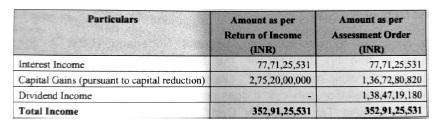
5.3 During assessment proceedings u/s 143(3) r.w.s. 144C, the AO examined the capital reduction transaction, the financials of the Indian company and its accumulated profits. Applying the provisions of section 2(22)(d) of the Act, the AO held that a portion of the consideration for capital reduction, to the extent of accumulated profits, was in the nature of “deemed dividend”. Accordingly, out of the amount treated by the assessee as capital gains, a sum of Rs. 138,47,19,180/- was re-characterised as “dividend income chargeable under the head “Income from Other Sources, with consequential application of the DTAA rate.
5.4 The Dispute Resolution Panel (“DRP”) upheld. in principle, the AO’s conclusion that the impugned amount represented dividend within the meaning of section 2(22)(d) of the Act. The final assessment order uis 143(3) rw.s. 144C(13) dated 29.07.2022 determined total income at Rs 352,91,25,531/-. Thus, while the aggregate total income remained the same as in the return, the composition of such income changed a part of the capital gains originally offered by the assessee was assessed as dividend income. The AO also initiated penalty proceedings u/s 270A of the Act for under-reporting of Income, by way of issuing notice dated 29.07.2022 issued u/s 274 r.w.s.270 A of the Act.
5.5 A table summarizing the breakup of total income as per return of income and that as per the final assessment order is given below:
5.6 The assessee’s contention in assessment/DRP proceedings that the capital gains itself were not taxable in India, or that the entire receipt ought to be regarded as a capital receipt not chargeable to tax, was rejected. In appeal, the Hon’ble ITAT, Mumbai, vide its Order dated 13.10.2023 passed in ITA No. 2487/Mum/2022 confirmed. in substance, the re-characterisation of the impugned amount as dividend, but directed that tax on such dividend be restricted to 10% in terms of the India-Netherlands DTAA (inclusive of surcharge and cess).
5.7 After receipt of the ITAT’s Order, the AO issued notice under section 274 r.w.s. 270A of the Act, on 29.02.2024, asking the appellant to show cause as to why an order imposing penalty under section 270A of the Act should not be passed in its case. After considering the assessee’s replies, the AO concluded that, by not offering the impugned sum under the correct head as dividend income, the assessee had under-reported its income within the meaning of section 270A(2), and levied penalty of Rs.6,97,89,850/-being 50% of the tax computed on such under-reported income. Aggrieved, the assessee is in appeal”
3. While disposing of the appeal of the assessee, Ld. CIT(A) observed that as per legislative intent behind section 270A to deter the under-reporting of income and its mischaracterization, it is held that the Ld. AO was correct in his decision to levy penalty. Accordingly, the levy of penalty has been upheld and the ground of appeal of assessee is dismissed, however regarding computation of tax on under-reported income at an effective rate of 10.08% instead of 10% contrary to the specific directions of the Tribunal that tax on the impugned dividend be restricted to 10%, Ld. CIT(A) directed the Ld. AO to recomputed the quantum of penalty by applying the correct rate of tax at 10%.
4. Ld. AR representing the assessee has submitted a written synopsis before us making arguments that the penalty u/s 270A is not attracted on merits of the case. The arguments so submitted are extracted as under:
“Penalty under section 270A is not attracted on merits of the case
2.1. Relevant extracts of Section 270A isreproduced for ready reference:
“(2) A person shall be considered to have under-reported his income, if-
| (a) | the income assessed is greater than the income determined in the return processed under clause (a) of sub-section (1) of section 143; |
| (b) | the income assessed is greater than the maximum amount not chargeable to tax, where no return of income has been furnished or where return has been furnished for the first time under section 148: |
| (c) | the income reassessed is greater than the income assessed or reassessed immediately before such reassessment; |
| (d) | the amount of deemed total income assessed or reassessed as per the provisions of section 115JB or section 115JC, as the case may be, is greater than the deemed total income determined in the return processed under clause (a) of sub-section (1) of section 143: |
| (e) | the amount of deemed total income assessed as per the provisions of section 115JB or section 115JC is greater than the maximum amount not chargeable to tax, where no return of income has been furnished or where return has been furnished for the first time under section 148; |
| (f) | the amount of deemed total income reassessed as per the provisions of section 115JBor section 1153C, as the case may be, is greater than the deemed total income assessed or reassessed immediately before such reassessment: |
| (g) | the income assessed or reassessed has the effect of reducing the loss or converting such loss into income.” |
2.2. The Appellant humbly submits that its case is not covered under any of the criteria mentioned under sub-section (2) of section 270A and hence a question of underreporting does not arise at all.
2.3. A table summarizing the breakup of total income as per return of income and that as per the final assessment order is given below:
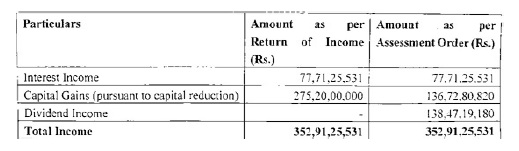
2.4. On perusal of the above, it is evident that there is no difference in the total income declared by the Appellant vis-a-vis the income assessed by the Ld. AO in the final assessment order. The Ld. AO had merely reclassified a portion of total income amounting to Rs. 138,47,19,180 as ‘dividend taxable under the head Income from Other Sources as against the same being reported as ‘capital gains’ by the Appellant.
2.5. Thus, your Honours will appreciate that since there is no increase in the income of the Appellant, the present case does not fall within the purview of sub-section (2) to section 270A of the Act, and by no stretch of imagination, it can be said that there is under-reporting of income.
2.6. Reliance in this regard is placed on the decision of the Hon’ble jurisdictional Mumbai Tribunal in the case of D.C. Polyester Ltd. v. DCIT wherein it was held that addition made to total income on account of change in the head of income would not give rise to underreporting of income under section 270A of the Act. The relevant extracts is reproduced below:
“The addition came to be made to the total income returned by the assessee, due to change in the head of income, te, the addition has arisen on account of computational methodology prescribed in the Act. In our view, this kind of addition will not give rise to under-reporting of income. Accordingly, we are of the view that the AO should haveexercised his discretion not to initiate penalty proceedings w/s 2704 of the Act in the facts and circumstances of the case
2.7. Reliance is further placed on the undernoted decisions wherein it was held that where the income assessed and income returned were identical, there was no underreporting/misreporting of income within the meaning of section 270A:
| • | PCITPrafulbhaiVallabhdasFuletra (R/Tax Appeal no. 650 of2023) (Gu) HC) |
| • | Sudarsan De v. DCIT Circle- 2(1)(1), Ghaziabad ITA No. 5177/DEL/2024 (Delhi Trib.) |
| • | Penninti Vivekananda Rao v. ADIT (International Taxation)- 2 (Hyd ITAT) |
2.8. Based on the above judicial precedents, it can be observed that no penalty under section 270A can be levied in absence of any difference in income assessed versus income offered in return of income.
2.9. Without prejudice to the above submission, the Appellant would also like to highlight that the reclassification of capital gain income to dividend income does not lead to any loss of revenue since it is taxable at the higher rate of 10.812% under the Act, as compared to dividend income which is taxable at the rate of 10% under the Tax Treaty. Detailed working with respect to tax on capital gains as well as dividend income is tabulated below for your Honours’ ready reference:
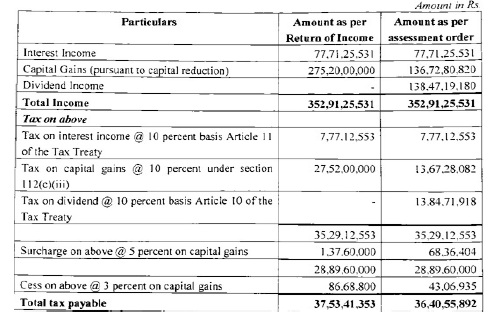
2.10. On perusal of the above, your Honour will appreciate that there is no increase in the tax liability of the Appellant upon reclassification of the income. In fact, the Appellant has paid higher taxes on capital gains under the provisions of the Act, and shall be entitled to receive refund if the income is assessed as ‘dividend income taxable under the head ‘Income from other sources’. Thus, in absence of any loss of revenue, no penalty should be levied on the Appellant.
2.11. It is accordingly submitted that the levy of penalty by the Ld. AO, as upheld by the Hon’ble CIT(A), is without appreciating the facts of the case and the legal positions and is therefore bad in law. Accordingly, the Appellant prays before your Honours to direct the Ld. AO to delete the penalty levied under section 270A of the Act.”
5. Per contra, Ld. DR representing the Revenue submitted that the Ld. CIT(A) has categorically explained each and every aspect for levy of penalty u/s 270A according to which the penalties to be imposed are not akin to the erstwhile penalty proceedings u/s 271(1)(c) of the Act and therefore, even in the case of recharacterization of income, the same shall constitute a mis-reporting / underreporting of the income therefore, the levy of penalty triggers in such cases also. It is submitted that the Ld. CIT(A) has rightly and judiciously decided the issue against the assessee, however has allowed to benefit of tax rate by directing the Ld. AO to recomputed the quantum of penalty. In view of such observations, it was the prayer that the order of Ld. CIT(A) deserves to be upheld.
6. We have considered the rival submissions, perused the material available on record and the decisions relied upon by the assessee. Apparently, in the present case the returned income of assessee and the assessed income of assessee remain to be same and this is an undisputed aspect of the case. The assessee has also worked out the rate of tax paid by the assessee and the tax on the assessed income computed by the Ld. AO, according to which the tax payable as per returned income was Rs.37.53 crores as against the tax computed by Ld. AO at 36.40 crores, therefore, the tax liability of the assessee upon reclassification of income was lower than the tax offered by the assessee. In such case, whether only on the basis of reclassification of income the penalty u/s 270A is leviable or not is the issue before us. On this aspect, Ld. AR placed his reliance on the decision of ITAT Mumbai “D” Benchin the case of D.C. Polyester Ltd. v. DCIT (Mumbai – Trib.) wherein the Tribunal has observed as under:
“10. We heard rival contentions and perused the record. We notice that section 270A of the Act uses the expression “the Assessing Officer ‘may direct”. Hence there is merit in the contention of the assessee that levying of penalty is not automatic and discretion is given to the Assessing Officer not to initiate penalty proceedings under section 270A of the Act. From the facts discussed earlier, it can be noticed that the addition came to be made on account of change in the head of income for assessing the rental income. We noticed that the assessee had offered rental income under the head “Income from House Property”, but the assessing officer has assessed the same under the head “Income from business.” The standard deduction @ 30% allowable u/s 24(a) while computing income under the head Income from house property will not be available when it is assessed under the Income from business. Thus, it is not a case that the assessee has suppressed or under reported any income. The addition came to be made to the total income returned by the assessee, due to change in the head of income, i.e., the addition has arisen on account of computational methodology prescribed in the Act. In our view, this kind of addition will not give rise to under reporting of income. Accordingly, we are of the view that the AO should have exercised his discretion not to initiate penalty proceedings u/s 270A of the Act in the facts and circumstances of the case.
11. As submitted by Ld A.R that sub. Sec. (2) of sec. 270A lists out the instances which are considered to be “under reporting” of income and clause (g) of it covers the case, when loss is converted into income. However, subsection (6) of section 270A lists out exceptions to sub. Sec (2), ie., the instances which will not be considered as cases of ‘under reporting’ of income. Clause (a) of sub. Sec. (6) specifically states that the amount of income in respect of which the assessee offers an explanation and the Assessing Officer is satisfied that the explanation is bonafide and the assessee has disclosed all material facts to substantiate explanation so offered will not be considered as under reporting of income. In the instant case, as noticed earlier, the assessee has not under reported any income. The addition has arisen on account of change in head of income. We notice that the assessee has offered an explanation as to why it reported the rental income under the head Income from House property and the said explanation is not found to be false. Accordingly, we are of the view that the case of the assessee is covered by clause (a) of sub.sec. (6) of sec. 270A of the Act. We noticethat the Chennai bench of Tribunal has held in the case of S Saroja (supra) that bonafide mistake committed while computing total income, the penalty u/s 270A of the Act should not be levied.
12. Accordingly, we are of the view that the impugned penalty levied u/s 270A of the Act is liable to be deleted.”
7. Coming to the facts of the present case, wherein the income of assessee has been reclassified from ‘capital gains’ to ‘dividend income’, however, the effective tax on such income has been reduced as per working provided by the assessee referred to (supra), which is not controverted by the Revenue. The case of assessee is even better than the facts of case referred by the assessee in D.C. Polyester Ltd. v. DCIT (supra),wherein the tax on reclassification of income was increased, still the Tribunal has observed that it is not a case that the assessee has suppressed or under-reported any income, the addition came to be made to total income returned by the assessee due to change in head of income. It had just arisen on account of computational methodology prescribed in the Act, therefore the same will not give rise to under-reporting of income. Accordingly, the Ld. AO should have exercised the discretion not to initiate penalty proceedings u/s 270A of the Act, in the facts and circumstances of the case.
8. Considering the aforesaid findings, interpreting the ratio emerging from such findings, applying it in the facts of the present case, we are of the considered view that there was no suppression of income or concealment of income by the assessee, so as to invoke provisions of section 270A of the Act for imposing penalty on the assessee. We thus set aside the order of Ld. CIT(A) and direct the Ld. AO to delete the impugned penalty.
9. In result, the appeal of assessee is allowed in above terms.