


Assessment Orders Passed Ex Parte Against a Deceased Assessee Warrant Remand to AO for Fresh Adjudication
Issue
Whether ex parte assessment and appellate orders passed due to non-representation by a deceased assessee should be set aside and remanded to the Assessing Officer for fresh adjudication to uphold the principles of natural justice.
Facts
-
Ex Parte Assessment: The Assessing Officer passed assessment orders ex parte due to non-appearance/non-representation on behalf of the deceased assessee.
-
Ex Parte Appellate Order: The CIT(A) also dismissed the subsequent appeals and passed ex parte appellate orders without adjudicating on merits with proper representation.
-
Additions Made: Substantive additions were made to the total income of the deceased assessee in the ex parte proceedings.
-
Absence of Prejudice: Remanding the matter to the Assessing Officer for de novo consideration would not cause any prejudice to the Revenue.
Decision
-
The Tribunal held that in the interest of natural justice and given the nature of the additions, the ex parte orders could not be sustained.
-
The matters were restored to the file of the Assessing Officer for adjudication afresh on merits.
-
The remand was granted at the risk and responsibility of the legal representative/assessee to ensure proper compliance during the restored proceedings.
Key Takeaways
-
Adherence to Natural Justice: Ex parte assessment orders passed against a deceased individual without adequate representation violate fundamental principles of natural justice and are liable to be set aside.
-
Remand for De Novo Adjudication: Where no prejudice is caused to the Revenue, appellate authorities prefer restoring the matter to the Assessing Officer to ensure fair play and a decision on merits.
-
Onus on Legal Representative: Restoring ex parte matters comes with the responsibility on the legal heir or representative to actively participate and comply with notice requirements before the Assessing Officer.
IN THE ITAT SURAT BENCH
Kamlesh Ranchhodbhai Patel
v.
Income-tax Officer
Ms. Suchitra Kamble, Judicial Member
and B.M. Biyani, Accountant Member
and B.M. Biyani, Accountant Member
IT Appeal Nos. 1159 and 1160 (Srt) of 2025
[Assessment years 2011-12 and 2012-13]
[Assessment years 2011-12 and 2012-13]
JUNE 29, 2026
Akshay M. Modi, CA for the Appellant. Ashish Kumar, Sr. D.R for the Respondent.
ORDER
B.M. Biyani, Accountant Member. – The captioned two (2) appeals have been filed by assessee challenging two (2) separate orders of first-appeal, both dated 22.08.2023 and passed by learned Commissioner of Income-Tax (Appeals)-NFAC, Delhi [“Ld. CIT(A)”], which in turn arise out of respective assessment-orders dated 04.12.2018 and 11.12.2019 passed by learned ITO, Ward-2(2)(4), Surat [“Ld. AO”] u/s
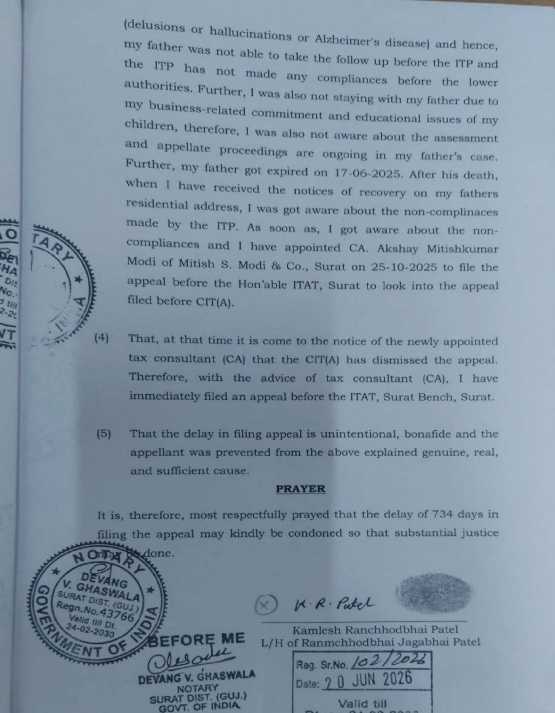
2. Ld. AR thereafter submitted that considering the averments made in above application, the filing-delay may be condoned. Further, the orders passed by both of the lower authorities are ex-parte for non-representation by deceased assessee. That, in the first AY 2011-12, the Ld. AO has made Collector, Land Acquisition v. Mst. Katiji (SC)/1987 AIR 1353/1987 2 SCC 387 andInder Singh v. State of Madhya Pradesh [2025 LiveLaw (SC) 339] holding that whenever “substantial justice” and “technical considerations” are opposed to each other, the cause of “substantial justice” must be preferred by adopting a justice-oriented approach, we are inclined to condone the filing delays in present appeals.
3. Further, having regard to nature of additions made by Ld. AO, the principle of natural justice and also bearing in mind that no prejudice would be caused to revenue if the present matters are restored at the level of Ld. AO, we restore these matters to the file of Ld. AO for adjudication afresh, at the risk and responsibility of assessee. The Ld. AO shall give necessary opportunity of hearing to assessee and pass appropriate orders uninfluenced by his earlier orders. The assessee is also directed to remain vigilant and ensure participation in the hearings as may be fixed by Ld. AO without seeking unnecessary adjournments failing which the Ld. AO shall be at liberty to proceed in accordance with law. Ordered accordingly.
4. Resultantly, these appeals are allowed for statistical purposes.