


Reinsurance Cession Disallowance Deleted and 60% Depreciation Allowed on Independent Business Computer Software
Issue
Whether an Assessing Officer can disallow reinsurance premiums exceeding regulatory limits when IRDAI raises no objection, and whether standalone business software qualifies for depreciation under the higher rate for “Computers including Computer Software”.
Facts
-
Reinsurance Premium Disallowance: The assessee, a general insurance company, ceded more than 10 percent of its aggregate foreign reinsurance premium to a single non-resident reinsurer.
-
AO’s Stand on Reinsurance: The Assessing Officer (AO) disallowed the excess cession beyond the 10 percent limit, holding that IRDAI’s “no objection” did not amount to formal prior approval under Regulation 9 of IRDA (General Insurance—Reinsurance) Regulations, 2000.
-
IRDAI Clarification: IRDAI expressly clarified that it had no objection to the reinsurance arrangement and did not consider the programme to be in violation of applicable regulations.
-
Software Depreciation Claim: The assessee capitalized expenditure incurred on acquiring computer software used in its business and claimed depreciation at the higher rate prescribed for “Computers including Computer Software” under Appendix-I to the Income-tax Rules, 1962.
-
AO’s Stand on Software: The AO treated the software as intangible assets falling under the expression “licences” in Explanation 3(b) to Section 32(1)(ii), restricting the depreciation allowance.
Decision
-
Reinsurance Cession Upheld: The AO cannot substitute his own interpretation of sectoral rules when IRDAI—the regulatory authority—has accepted the explanation and raised no objection; the disallowance of excess reinsurance cession was deleted.
-
Computer Software Depreciation Allowed: Computer software acquired independently for business operations squarely answers the description of “computer software” in Appendix-I and is entitled to depreciation at the rate prescribed for “Computers including Computer Software”.
-
Exclusion from Intangibles: Standalone software used in business does not automatically fall under general “licences” under Explanation 3(b) to Section 32(1)(ii).
Key Takeaways
-
Tax Authorities Cannot Override Sector Regulators: Assessing Officers must defer to domain regulators (such as IRDAI) regarding regulatory compliance and cannot make tax disallowances based on their own re-interpretation of sectoral rules.
-
Higher Depreciation for Standalone Software: Computer software used for business functions is eligible for the specific rate applicable to computer systems rather than lower rates designated for general intangible assets or licenses.
IN THE ITAT MUMBAI BENCH ‘G’
ACIT
v.
SBI General Insurance Company Ltd.
Pawan Singh, Judicial Member
and Om Prakash Kant, Accountant Member
and Om Prakash Kant, Accountant Member
IT Appeal Nos. 7083 to 7085 (MUM) of 2025
C.O. Nos. 377 to 379 (MUM) of 2025
[Assessment years 2012-13 to 2014-15]
C.O. Nos. 377 to 379 (MUM) of 2025
[Assessment years 2012-13 to 2014-15]
JULY 10, 2026
Niraj Seth for the Appellant. Basavaraj Hiremath, CIT DR for the Respondent.
ORDER
1. These appeals preferred by the Revenue and the Cross Objections filed by the assessee arise out of a common order dated 11.08.2025 passed by the learned Commissioner of Income-tax (Appeals)-54, Mumbai [hereinafter referred to as “the ld. CIT(A)”] for Assessment Years 2012-13, 2013-14 and 2014-15. Since identical issues arise in all the appeals and the cross objections involving common facts and substantially similar questions of law, they were heard together and are being disposed of by this consolidated order. For the sake of convenience, Assessment Year 2012-13 has been treated as the lead year and the decision rendered therein shall apply mutatis mutandis to the remaining assessment years. The Relevant grounds raised by the Revenue in AY 2012-13 are reproduced as under:-
| i. | Whether on the facts and circumstances of the case and in law, the Ld. CIT(A) erred in deleting the disallowance of Rs. 14,32,97,149/- made by the Assessing Officer, without appreciating that as per Regulation 9 of the Insurance Regulatory and Development Authority (General Insurance -Reinsurance) Regulations, 2000, an insurer may place reinsurance outside India only up to 10% of the total reinsurance premium ceded outside India to any one nonresident reinsurer, unless specific prior approval of the IRDA is obtained for exceeding the said limit.” |
| ii. | Whether on the facts and circumstances of the case and in law, the Ld. CIT(A) failed to appreciate that the assessee did not produce any formal or written approval from the IRDA, as required under Regulation 3(9) of the IRDA (General Insurance -Reinsurance) Regulations, 2000, for ceding reinsurance premium in excess of the prescribed limit.” |
| iii. | Whether on the facts and circumstances of the case and in law, the Ld. CIT(A) erred in ignoring that the assessee does not acquire ownership of such software but merely obtains a license to use the same for a limited period under contractual restrictions, while the ownership of the copyright continues to vest with the vendor. Such license rights clearly fall within the ambit of “licenses, franchises or any other business or commercial rights of similar nature” as defined in Explanation 3(b) to Section 32(1)(ii) of the Act.” |
| iv. | Whether on the facts and circumstances of the case and in law, the Ld. CIT(A) failed to consider that “computer software mentioned in the depreciation schedule refers only to system software forming part of the computer system, and not to independent application or business software where the Assessing Officer had correctly allowed higher depreciation only on system software while restricting depreciation on application software to 25% applicable to intangible assets. |
| v. | The Appellant crave, leave to add, alter, amend or modify any or all grounds of appeal on or before the date of hearing.” |
2. Briefly stated facts of the case are that the assessee is engaged in the business of general insurance. It filed its return of income for the year under consideration declaring a loss of Rs.59,30,56,606/-. The return was selected for scrutiny and assessment under section 143(3) of the Income-tax Act, 1961 (“the Act”) was completed on 23.03.2016 accepting the returned loss. Subsequently, the assessment was reopened under section 147 by issuance of notice under section 148 dated 29.03.2019 on the premise that income chargeable to tax had escaped assessment. The reasons recorded referred to three issues, namely: (i) inward fire premium of Rs.9,97,89,000/-; (ii) reinsurance premium ceded amounting to Rs.14,32,97,149/-; and (iii) excess depreciation on computer software amounting to Rs.5,49,25,318/-.
2.1 During the reassessment proceedings, the assessee furnished detailed submissions explaining each of the issues. The Assessing Officer, however, made additions only on two counts, namely: (a) disallowance of reinsurance premium of Rs.14,32,97,149/-; and (b) restriction of depreciation on computer software resulting in disallowance of Rs.5,49,25,318/-.
3. The learned CIT(A), after examining the entire material on record, deleted both the additions on merits. However, having allowed the appeals on merits, he did not adjudicate the legal ground challenging the validity of reassessment. Aggrieved by the relief granted, the Revenue is in appeal before us, whereas the assessee has filed Cross Objections challenging the non-adjudication of the jurisdictional grounds.
Ground Nos. 1 & 2 – Disallowance of Reinsurance Premium
4. The first issue relates to deletion of disallowance of Rs.14,32,97,149/- representing reinsurance premium ceded to a foreign reinsurer. The Assessing Officer observed that during the relevant previous year the assessee had ceded reinsurance premium aggregating to Rs.128.62 crores outside India. Out of the said amount, a sum of Rs.27.19 crores had been placed with Insurance Australia Group (IAG), a single non-resident reinsurer. According to the Assessing Officer, Regulation 9 of the Insurance Regulatory and Development Authority (General Insurance— Reinsurance) Regulations, 2000 permitted placement of reinsurance with any one foreign reinsurer only up to ten per cent of the total premium ceded outside India unless prior approval of the Insurance Regulatory and Development Authority of India (IRDAI) had been obtained. Since the amount placed with IAG exceeded the prescribed threshold, the Assessing Officer required the assessee to produce the approval of the IRDAI permitting such excess cession. The assessee explained that the reinsurance programme had been duly placed before the IRDAI and the Authority had never objected to the arrangement. Since the Assessing Officer entertained doubts regarding the regulatory approval, he invoked section 133(6) of the Act and sought information directly from the IRDAI.
4.1 In response, the IRDAI informed the Assessing Officer that the assessee had sought approval for ceding reinsurance beyond the prescribed limit and that the Authority had no objection to such arrangement. According to the Assessing Officer, however, absence of objection could not be equated with formal approval contemplated under the Regulations. Proceeding on this interpretation, he disallowed the excess reinsurance premium amounting to Rs.14,32,97,149/-.
4.2 In appeal, the learned CIT(A) examined not only the correspondence initially relied upon by the Assessing Officer but also the subsequent clarification furnished by the Executive Director of the IRDAI in response to the notice issued under section 133(6). The appellate authority found that the regulatory authority had categorically clarified that it had no objection to the assessee entering into reinsurance arrangements exceeding the prescribed limit and further explained that the concept of “deemed approval” did not arise because the Authority had accepted the explanation furnished by the insurer. Upon appreciation of the entire correspondence exchanged between the IRDAI and the assessee as well as the clarification furnished directly to the Assessing Officer, the learned CIT(A) concluded that the regulatory requirement stood substantially complied with and consequently deleted the disallowance.
4.3 The Revenue is aggrieved by the aforesaid finding.
4.4 We have carefully considered the rival submissions and examined the material placed before us. The controversy does not involve any dispute regarding the fact that the assessee ceded reinsurance premium exceeding ten per cent of the aggregate foreign reinsurance premium to one non-resident reinsurer. The limited question requiring adjudication is whether, in the facts of the present case, such excess cession violated the applicable IRDAI Regulations so as to warrant disallowance under the provisions governing computation of income from insurance business.
4.5 Section 44 of the Act provides a special mechanism for computation of profits and gains of insurance business. It constitutes a complete code in itself and mandates that taxable profits of an insurance company are to be computed in accordance with the First Schedule to the Act. Consequently, while computing taxable income of an insurer, the Assessing Officer cannot travel beyond the statutory framework governing insurance business unless a specific violation having tax consequences is established. Rule 5 of the First Schedule requires the accounts of a general insurance company to be prepared in accordance with the Insurance Act, the IRDA Act and the Regulations framed thereunder. Therefore, if there is a clear and established violation of the applicable regulatory framework, appropriate consequences may undoubtedly follow. Equally, however, where the sectoral regulator itself has accepted the conduct of the insurer and has not found any regulatory infraction, it would be impermissible for the Assessing Officer to infer a breach on the basis of his own interpretation divorced from the stand of the statutory regulator.
4.6 The foundation of the disallowance rests upon the Assessing Officer’s understanding that the assessee had failed to obtain prior approval of the IRDAI. This premise, however, does not survive in view of the communication furnished by the IRDAI itself.
Pursuant to the statutory notice issued under section 133(6), the Executive Director of the IRDAI specifically informed the Assessing Officer that the Authority had no objection to the assessee entering into reinsurance arrangements in excess of ten per cent with one or more reinsurers. The communication further clarified that the issue of deemed approval did not arise and that where satisfactory explanation was furnished, the Authority could accept such explanation and permit the reinsurance programme. The relevant finding of the Ld. CIT(A) is reproduced as under;-
” 5.3.1. The AO’s contention that “taking the insurer’s submission on records” is not same as giving approval for the insurer’s submission, cannot be ignored because as per AO once submission is taken on records the decision of the regulator should be communicated to the insurer in black and white. At the same time, no adverse view can be drawn for the observation, of “taking on records” as not giving approval, unless objection is communicated to the insurer. In order to remove the imbroglio/ambiguity on the interpretation of “taking on records” it is required to see the whole letter of IRDA. This letter is annexed by the appellant in page 230 of the paper book which was written by Joint Director of IRDA to the appellant-insurance company mentioning that “the authority takes on record your submission under IRDA (General Insurance Reinsurance) Regulations, 2000 that from FY 2013-14, actual reinsurance placement will be done by your company and it will be evidenced by Board papers and Minutes together with your company’s Reinsurance management strategy. You are hereby advised to ensure compliance of IRDA (General Insurance Reinsurance) Regulations, 2000 and circulars issued by the Authority from time to time.”. The second line in this letter advising the insurance company to ensure compliance of IRDA (General Insurance Reinsurance) Regulations, 2000 and circulars issued by the Authority from time to time, gives rise to another interpretation that the submission was taken on record but all was not well with that submission and therefore advisory was given to the insurance company to comply with IRDA regulations on reinsurance. Thus, no fault can be found with the AO on making disallowance of premium paid on ceded re-insurance outside of India to a single reinsurer in excess of 10% of total premium paid on re-insurance ceded.
5.3.2. However, the appellant submitted a letter dated 23.12.2019 issued by IRDA addressed to the ACIT in compliance with notice u/s.133(6) wherein it was clearly mentioned that there was not objection by IRDA for SBI General to enter into reinsurance arrangement in excess of 10% with one or more re-insurers. Whereas, no cognizance was given to this letter in assessment proceedings. On further enquiry into the dates, it was found that the assessment order was passed on 23.12.2019 and IRDA’s letter dated as 23.12.2019 but modified as 24.12.2019 must have been received by the AO after passing of the assessment order. The date 23.12.2019 in this letter was apparently modified with a handwritten marking as 24.12.2019. In any case this letter under the signature of Executive Director of IRDA must have reached the office of AO subsequent to passing of the assessment order. This letter is posted below:
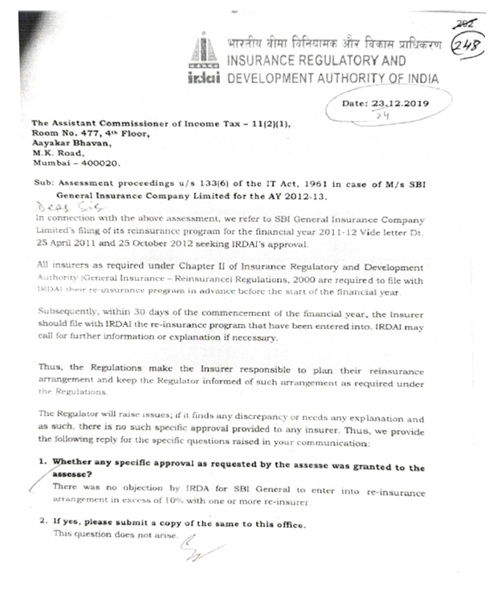
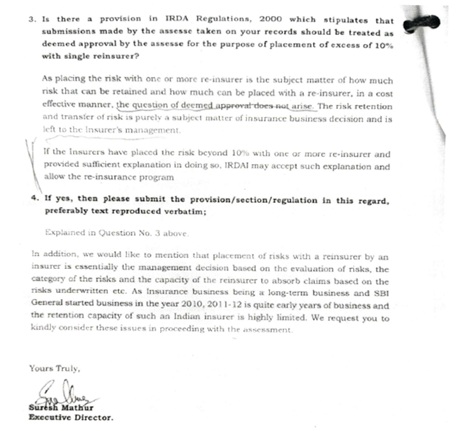
From the above letter addressed by none other than the ED of IRDA it is clarified in Q.No.1 that there was no objection by IRDA for SBI General to enter into reinsurance arrangement in excess of 10% with one or more re-insurers. In Q.No.3 it was clarified that the question of deemed approval does not arise in this case and also clarified that if the insurer could provide sufficient explanation in exceeding 10% with one or more re-insurers the IRDA may accept such explanation and allow the reinsurance programme. When answer to question no.3 is read with answer to question no.1 it becomes obvious that the IRDA accepted the explanation of the assessee insurer and thereby clarified that IRDA had no objection in this matter. 5.3.3. In view of the foregoing, disallowance of excess premium paid of Rs.14,32,97,149 for ceded re-insurance is deleted.
4.7 In our considered opinion, once the statutory regulator itself clarifies that it has no objection to the reinsurance arrangement adopted by the assessee, the Assessing Officer cannot disregard such clarification and substitute his own interpretation of the regulatory provisions. The Income-tax authorities are neither expected nor empowered to sit in appeal over the regulatory satisfaction recorded by the specialised authority entrusted with administration of the Insurance Regulatory framework. The expression “no objection”, occurring in the communication issued by the IRDAI, cannot be read in isolation. It has to be construed in the context of the entire correspondence exchanged between the Authority and the assessee. Reading the communications as a whole leaves little room for doubt that the Authority accepted the explanation furnished by the assessee and did not regard the reinsurance programme as being in violation of the applicable Regulations.
4.8 The approach adopted by the Assessing Officer proceeds on an excessively technical construction of the correspondence while overlooking its substance. Tax adjudication cannot be reduced to a mere semantic exercise. Where the competent statutory regulator has consciously examined the matter and has accepted the assessee’s explanation without raising any objection, the Revenue cannot proceed on the assumption that the regulatory approval stood declined merely because a formal order employing a particular expression was not issued. Significantly, the Revenue has not brought any material on record to demonstrate that the IRDAI had ever rejected the assessee’s request or had initiated any proceedings alleging violation of the Reinsurance Regulations. In the absence of any such material, the disallowance rests entirely upon inference rather than established fact.
4.9 The learned CIT(A), in our considered opinion, has appreciated the regulatory correspondence in its proper perspective and has rightly concluded that the assessee had substantially complied with the requirements of the applicable Regulations. We find ourselves in complete agreement with the reasoning adopted by the first appellate authority.
4.10 We, therefore, see no infirmity in the order of the learned CIT(A) deleting the disallowance of Rs.14,32,97,149/-. Ground Nos.1 and 2 raised by the Revenue are accordingly dismissed.
Ground Nos. 3 & 4 – Depreciation on Computer Software
5. Ground Nos. 3 and 4 of the Revenue’s appeal assail the deletion of disallowance of depreciation amounting to Rs.5,49,25,318/- made by the Assessing Officer by restricting depreciation on computer software to the rate applicable to intangible assets.
5.1 The material facts are largely undisputed. During the relevant previous year, the assessee acquired various enterprise software applications, namely Oracle Financials, Oracle Database, Oracle Identity Management, Oracle BPEL, Oracle Business Intelligence Enterprise Edition (OBIEE) and Siebel CRM, aggregating to Rs.15.69 crores. These software applications were capitalised as computer software, and depreciation was claimed at the rate applicable to “Computers including Computer Software” under Appendix-I to the Income-tax Rules.
5.2 The Assessing Officer was of the view that higher depreciation is admissible only where software forms an integral part of the computer hardware and is acquired along with the computer system. According to him, software acquired independently merely confers a licence to use the product, ownership of the copyright continuing to vest with the developer. Such licence, in his opinion, constituted an intangible asset falling within Explanation 3(b) to section 32(1)(ii), thereby qualifying only for depreciation at the rate applicable to intangible assets.
5.3 The learned CIT(A), after examining the statutory provisions as well as the nature of the software acquired by the assessee, rejected the aforesaid interpretation and held that the depreciation schedule specifically recognises “Computers including Computer Software” as a separate block of assets without drawing any distinction between software acquired independently and software supplied together with the hardware. He, therefore, directed the Assessing Officer to allow depreciation at the prescribed rate, subject to verification of the date on which the assets were first put to use. The relevant finding of ld. CIT(A) is reproduced as under:
” The submissions of the appellant are perused and considered vis-a-vis the contentions of the AO. As per the AO’s interpretation, softwares when purchased separately from the purchase of computers, would fall under the category of intangible assets because software itself is not a tangible asset and what is acquired by the buyer of a software is not any tangible asset but only an intangible asset in the form of a license. Hence, he concluded that when softwares are purchased independent of the purchase of computers which being tangible assets, such softwares would fall under the category of licenses classified as intangible assets in Part B of I-T Depreciation Schedule with applicable depreciation rate of 25%. On the other hand, the appellant submits that computer software was included alongwith computers with depreciation rate of 60%, w.e.f. 01.04.2023. Besides this, the appellant made a lot of pleas and gave reasonings in his submissions reproduced as above under para 6.2 of this order. I am in agreement with the submission of the appellant. In rules of construction and interpretation one should not deviate from the obvious wording of the provisions. In this case computer software is included in the category of computers by giving the nomenclature as “computers including computer software” qualifying for 60% depreciation rate (during the present FY). Whereas, the wording of computer software is absent within the meaning of license in Part B of I-T Depreciation Schedule. In the hierarchy of interpretations the obvious wording should be given first preference over other forms of interpretations. Secondly, a license is a form of intangible asset having independent existence for its utilization. While exploiting the license the user of such license exercises the right of such license and conducts his business without the aid of any other tangible asset meaning thereby a license gives the holder, the right to use it without any external aid or support of a tangible asset. Whereas, in the case of software without the aid of computer the software has no utility. Yes, it might be true that software is purchased through purchase of a license because the technological feasibility makes the owner of the software to make copies of the software and only sell license in the form of a code thereby giving access to the database or copy of the software embedded in external storage devise. However, it does not mean only license is purchased but not the software. Indeed, the longevity of computers is different from that of the softwares and thus the life of a software may not be same as the life of a computer. Therefore, it can be made out that computers are not required to be purchased every time softwares are purchased or vice versa. Furthermore, the phrase “computers including computer software” is not meant to give a direction to the assessees to buy computers every time when softwares are purchased. The interpretation of the AO that he would allow higher depreciation rate of 60% on softwares, only when purchased alongwith computers is not in good sprit of the provisions of the Act. In the light of the foregoing and after giving due consideration to the appellant’s submissions and the case laws relied on by it, the disallowance of depreciation is deleted and the depreciation claim made by the assessee at the rate of 60% is restored. Needless to say the date of putting to use would be considered by the AO while granting depreciation @60% on softwares.”
5.4 The Revenue is aggrieved and has carried the matter before us.
5.5 We have carefully considered the rival submissions and examined the statutory provisions governing the issue. The controversy essentially turns upon the true construction of the depreciation schedule contained in Appendix-I to the Income-tax Rules. The question is whether computer software acquired independently is entitled to depreciation under the block “Computers including Computer Software”, or whether such software necessarily falls within the expression “licences” occurring in Explanation 3(b) to section 32(1)(ii).
5.6 In our considered opinion, the answer must emerge from the language employed by the statute itself. The depreciation schedule classifies the relevant block of assets as “Computers including Computer Software.” The expression employed by the rule-making authority is explicit and unambiguous. The Schedule does not distinguish between operating software and application software, nor does it prescribe that the software should necessarily be embedded in the hardware or acquired simultaneously with the computer system. Had such a distinction been intended, the rulemaking authority could have expressly incorporated it. The Tribunal cannot read into the provision a limitation which the legislature itself has consciously omitted. The interpretation canvassed by the Revenue proceeds on the assumption that every software licence necessarily constitutes an intangible asset because the purchaser merely acquires a limited right to use the software. Attractive though the argument may appear at first blush, it overlooks the commercial and functional character of modern computer software. In contemporary business environments, software is ordinarily supplied through licence agreements. Such licensing mechanism is merely the legal mode adopted by the developer to regulate the use of intellectual property. It does not alter the intrinsic character of the asset acquired by the user. If the Revenue’s argument were to be accepted, virtually every software acquisition would cease to qualify as “computer software” and would automatically migrate to the block of intangible assets, thereby rendering the specific entry “Computers including Computer Software” substantially otiose. Such an interpretation cannot be accepted, for it is a settled principle of statutory construction that every expression employed by the legislature must be given meaningful effect and no provision should be interpreted in a manner that renders another redundant. Equally untenable is the Revenue’s contention that higher depreciation is available only where software is purchased simultaneously with computer hardware. The depreciation schedule nowhere incorporates such a requirement. A computer system is dynamic in nature. Hardware and software have different technological life cycles and are frequently upgraded independently. Enterprise software is often acquired years after installation of the underlying hardware. To insist that higher depreciation would be available only if both are purchased together would introduce a condition which finds no support either in the statutory language or in commercial reality. The software acquired by the assessee consists of enterprise-level applications such as Oracle Financials, Oracle Database, Oracle Identity Management, Oracle BPEL, Oracle Business Intelligence and Siebel CRM. These applications constitute integral components of the assessee’s information technology infrastructure and are deployed for managing financial operations, customer relationship management, database administration, business intelligence and core operational functions. They operate only in conjunction with computer systems and derive their utility exclusively from such deployment. They cannot be commercially exploited independent of the computer environment in which they function.
It is true that the assessee does not become the owner of the underlying copyright in the software. However, ownership of copyright is not the criterion prescribed by the depreciation schedule. What is relevant is the nature of the asset forming part of the block. The assessee has capitalised expenditure incurred for acquisition of computer software used in the course of its business. Such software squarely answers the description of “computer software” occurring in Appendix-I.The expression “licences” appearing in Explanation 3(b) to section 32(1)(ii) occurs in the company of know-how, patents, copyrights, trademarks, franchises and other commercial rights of similar nature. Applying the well-settled principle of ejusdem generis, the licences contemplated therein are licences constituting independent commercial or intellectual property rights capable of being exploited as business assets in their own right. A software licence obtained merely to enable the user to operate computer software cannot automatically be equated with such independent commercial rights.
5.7 This understanding also accords with the consistent judicial view that computer software constitutes a distinct class of depreciable asset entitled to depreciation under the specific entry relating to computers. The Special Bench of the Tribunal in Amway India Enterprises v. Dy. CIT [2008] 111 ITD 112 (Delhi – Trib.) (SB) held that computer software is eligible for depreciation at the rate prescribed for computers. Similar principles have been reiterated by the Hon’ble Bombay High Court in the case of Indian Energy Exchange Limited v. Asstt. CIT (Bombay) and decision in the case of Maharashtra State Power Generation Company Limited v. Dy. CIT (Bombay).
5.8 We are, therefore, unable to subscribe to the interpretation adopted by the Assessing Officer. The statute itself recognises “computer software” as a separate constituent of the computer block of assets. Once the asset answers that description, no further distinction can be artificially imported based upon the manner in which the software was licensed or the timing of its acquisition visa-vis the hardware.
5.9 The learned CIT(A), in our considered view, has correctly appreciated both the statutory framework and the functional character of the software acquired by the assessee. His conclusion that depreciation is allowable at the prescribed rate applicable to “Computers including Computer Software” is in consonance with the language of the Rules as well as the settled legal position.
5.10 We accordingly affirm the order of the learned CIT(A) on this issue. Ground Nos. 3 and 4 raised by the Revenue are dismissed.
6. We shall now advert to the Cross Objections preferred by the assessee. The Cross Objections challenge the validity of the reassessment proceedings initiated under sections 147/148 of the Act. The grievance of the assessee is that although specific grounds questioning the assumption of jurisdiction were raised before the learned CIT(A), the same were not adjudicated, the appeals having been allowed on merits.
6.1 We have given our thoughtful consideration to the issue. Having upheld the order of the learned CIT(A) deleting the impugned additions on merits, no tax liability survives against the assessee for the assessment years under consideration. Consequently, adjudication of the jurisdictional challenge to the reassessment would not alter the ultimate outcome of the present appeals. The exercise would thus remain purely academic. We accordingly refrain from expressing any opinion on the validity of the reassessment proceedings. The questions raised in the Cross Objections are left open to be urged in an appropriate case, if occasion so arises. The Cross Objections are, therefore, disposed of without adjudication.
Assessment Years 2013-14 and 2014-15
7. Learned representatives of both the parties fairly submitted that the issues involved in Assessment Years 2013-14 and 2014-15 are identical in facts as well as in law. No distinguishing feature in the factual matrix or the applicable statutory provisions has been brought to our notice. Since the controversy involved in those assessment years is identical, our conclusions recorded hereinabove for Assessment Year 2012-13 shall apply mutatis mutandis to Assessment Years 2013-14 and 2014-15 as well. Consequently, the corresponding grounds raised by the Revenue in those years also fail, and the Cross Objections filed by the assessee for those assessment years are similarly disposed of without adjudication.
8. In the result,
| (i) | the appeals filed by the Revenue for Assessment Years 2012-13, 2013-14 and 2014-15 are dismissed; and |
| (ii) | the Cross Objections filed by the assessee for the aforesaid assessment years are disposed of in the terms indicated above. |