ORDER
1. These appeals by the assessee are against the separate orders of the Commissioner of Income Tax (Appeals), Addl./JCIT-1, Chandigarh (in short “FAA”) passed u/s. 250 of the Income Tax Act, 1961 (in short “the Act”) for Assessment Years (AYs) 2017-18 to 2023-24. The common issue contended in all these appeals is with regard to treatment of the assessee as an assessee in default u/s. 201(1)/(1A) of the Act for alleged failure to deduct tax at source u/s. 194A of the Act on the interest paid/credited to its depositors. Since the issues contended are common across all these appeals they are disposed off to this common order for brevity.
2. The assessee is a State Public Sector undertaking registered as non banking financial company with the Reserve Bank of India. The assessee mobilises funds through public deposits and various government schemes and pace substantial amount of interest to its depositors including universities, temples, government companies, boards and other statutory entities. There was a survey u/s. 133A(2A) of the Act conducted on 30.10.2023 in the office of the assessee which concluded on 31.10.2023 in order to verify the compliance with TDS provisions. During the survey, it was noticed that the assessee has not deducted TDS on interest payments to certain depositors. The A.O after considering the submissions of the assessee held the assessee to be the assessee in default and passed an order u/s. 201(1) and 201(1A) of the Act for failure to deduct Tax at source u/s. 194A of the Act. On further appeal, the CIT(A) confirmed the order of the A.O. The assessee is in appeal before the Tribunal against the order of the CIT(A). For the purpose of adjudication, we will examine the impugned interest payment / credits made by the assessee to each type of the depositors as mentioned hereunder to decide on the applicability of liability to deduct tax u/s.194A of the Act –
(i) Interest payment/credit to Universities:
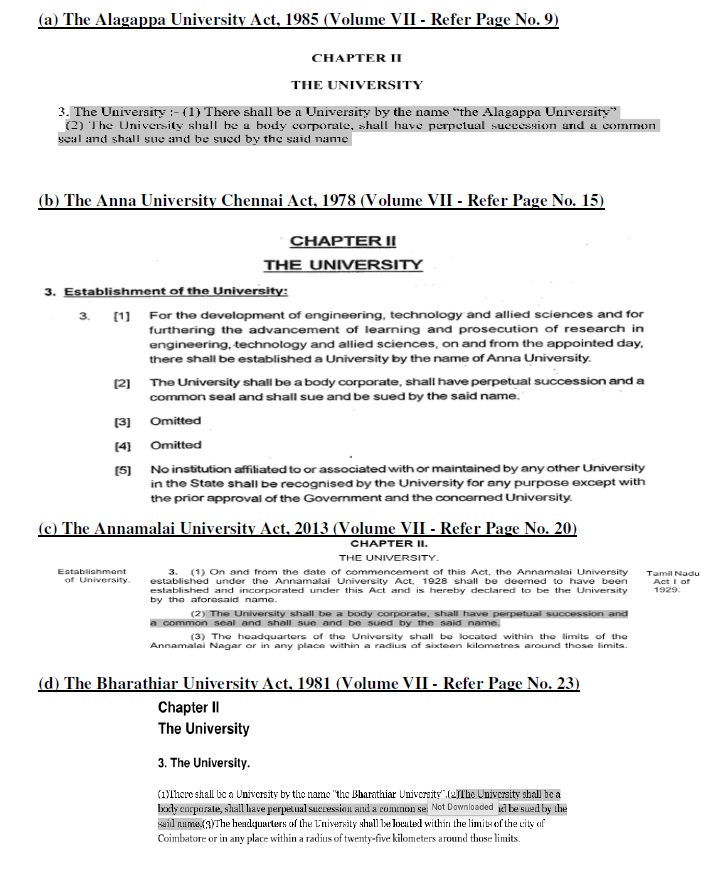
3. The assessee has made payments to various universities towards interest and tax has not been deducted at source against the said payments. The Ld. Authorized Representative (AR) of the assessee in this regard submitted that section 194A(3) of the Act carves out several categories payees to which the obligation to deduct TDS does not arise. The Ld. AR further submitted that as per Section 194A(3)(iii)(f) of the Act, the obligation to deduct tax at source is not applicable when interest is paid/credited to any corporation established by a Central, State or provincial act and to such other institutions associations or body as the Central Government may by notification specify. The Ld. AR also submitted that in excise of the said power the Central Govt. has issued the notification No.S.O.3489 dated 22.10.1970 under which the Universities would get covered.
4. The Ld. AR argued that the universities would fall within the category of corporation established by a State Act since in the present case each of the universities to which the assessee has made payments are established and owes its very existence to the State enactment. The Ld. AR further argued that each of the State Act under which the Universities have come into existence are expressly stating that the universities are constituted as a body corporate. The Ld. AR also argued that the expression ‘Corporation’ has mentioned in the above notification cannot be confined to entities incorporated under the Companies Act, 2013 or its predecessor but bears a wider meaning of anybody corporation. The Ld. AR in this regard placed reliance on the decision of the following decisions of the Hon’ble Supreme Court
| i. |
|
CIT (TDS) v. Canara Bank 406 ITR 161 (SC)(enclosed at Page No. 701 of Volume II Paper book); and |
| ii. |
|
Union Bank of India v. Addl. CIT (TDS) 442 ITR 194 (SC)(enclosed at Page No. 714 of Volume II Paper book) |
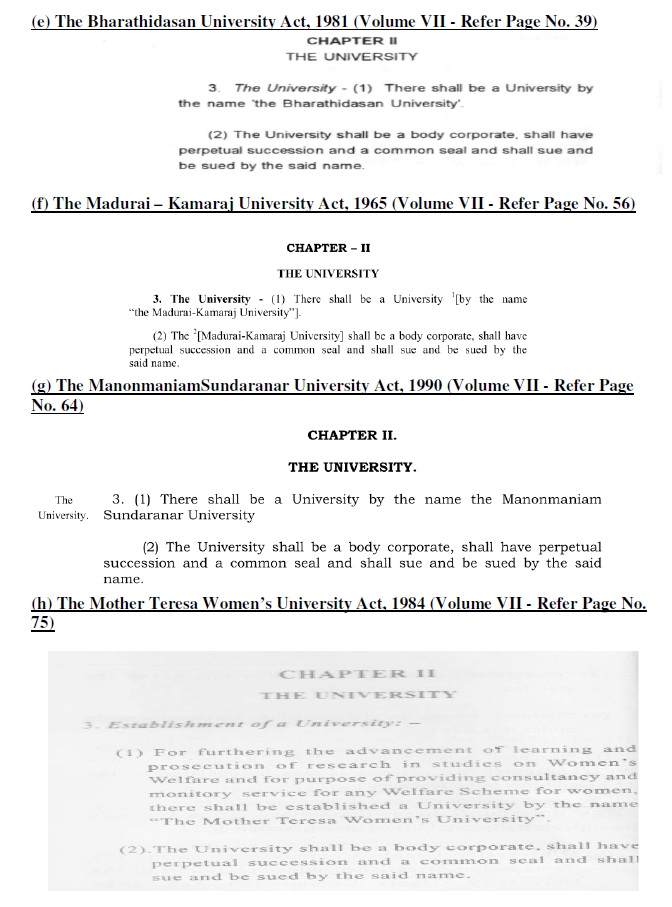
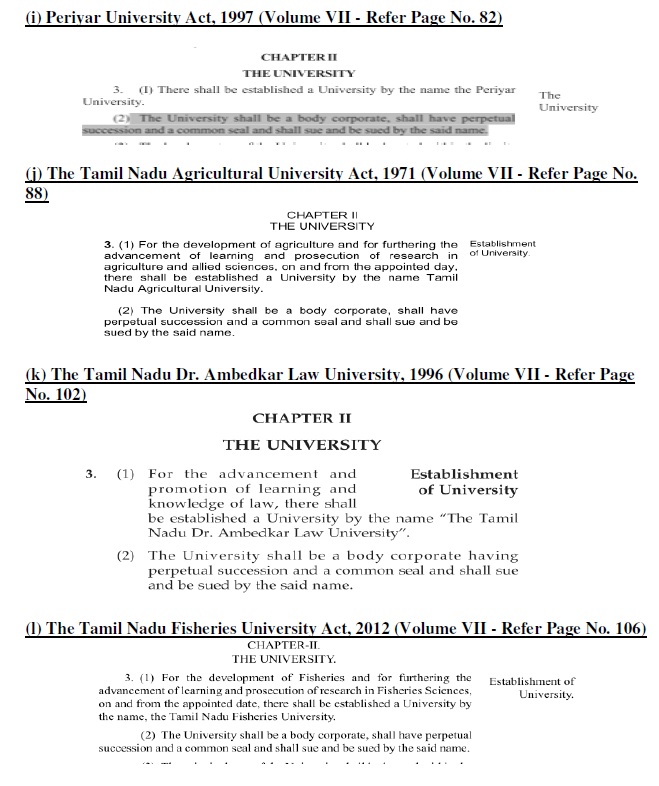
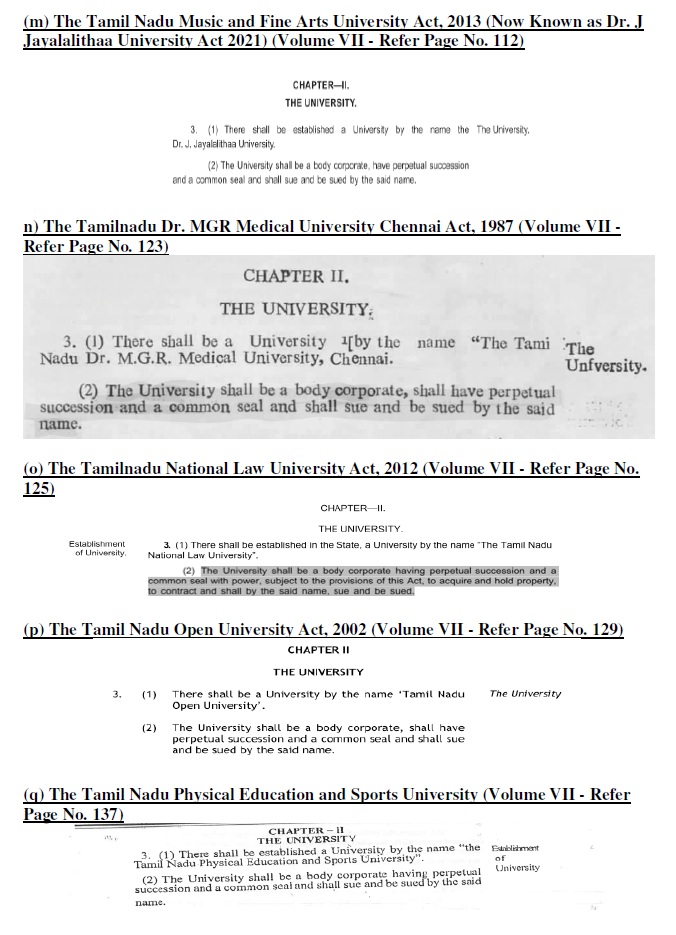
5. The ld AR, placing reliance on the above decisions, submitted that the settled legal position is that the expression “corporation established by a Central, State or Provincial Act” refers to a statutory corporation which owes its very existence to the parent enactment and that the decisive test is whether the statute itself provides for the constitution of the authority as a body corporate and prescribes its composition, powers and functions. The ld AR further submitted that where the authority is brought into existence by the statute itself, it is a corporation established by the Act, notwithstanding that its actual constitution is effected through a notification issued under the Act. It was, therefore, submitted that the universities constituted as body corporates under their respective enactments are covered by Notification No. S.O.3489 dated 22.10.1970 issued under section 194A(3)(iii)(f) and are consequently entitled to receive interest without deduction of tax at source. The Ld. AR placed on record written submission containing the relevant clauses under the various Acts under which the universities are established to submit that the Universities to which the assessee has made payments are corporations that are exempt as per the notification of the Central Government.
6. The Ld. Departmental Representative (DR), on the other hand, submitted that:
“A.3.1. Section 194A casts an absolute obligation on the payer to deduct tax at source on interest payments, and this liability is triggered regardless of whether the recipient is ultimately taxable or not. Even if these universities eventually claim tax exemption under Section 10(23C), the deductor is bound to comply with TDS laws unless a valid certificate under Section 197 or an explicit statutory carve-out is produced.
A.3.2. The Assessee’s reliance on the Supreme Court’s decision in Canara Bank v. CIT (TDS) AIR 2018 SC 3458 is contextually distinguishable. That case was decided entirely within the specific framework of the New Okhla Industrial Development Authority (NOIDA) under the U.P. Industrial Area Development Act, 1976, meaning the Court was evaluating a commercial infrastructure setup that shares no functional or legal commonality with academic universities. The Canara Bank judgment cannot be used as a blanket rule that any entity born out of a State Act automatically qualifies for exemption under Notification S.O. 3489. Each institution’s nature, purpose, and statutory structure must be evaluated on its own merits before extending such a benefit.
A.3.3. The Parliament has enacted a specific and comprehensive tax code for educational institutions and universities under Sections 10(23C)(iiiab) and 10(23C)(vi). Under the well-known legal principle of Generalia Specialibus Non Derogant where specific laws override general ones, universities must clear the exact hurdles set up for educational institutions rather than bypassing them by claiming a general notification meant for statutory corporate undertakings.
A.3.4. The Constitution Bench in Commissioner of Customs v. Dilip Kumar & Co. AIR 2018 SC 3606 settled the law by ruling that tax exemption notifications must be read strictly, and if any ambiguity arises, the interpretation must favor the Revenue, not the taxpayer.
A.3.5. Following this mandate, the term “corporation established by an Act” in Notification S.O. 3489 cannot be stretched or loosely interpreted to cover public educational universities. The Assessee remains bound by its statutory TDS obligations under Section 194A, which cannot be avoided by reading a general 1970 notification too broadly or by citing a precedent meant for a completely different statutory body.”
7. We heard the parties and perused the material on record. The assessee while making payments/credits towards interest to various Universities has not deducted tax at source. The contention of the assessee is that the Universities would fall within the purview of exemption u/s.194A(3)(iii)(f) r.w. notification dated 22.10.1970 which read as under –
Section 194A – Interest other than “Interest on securities”
(1) & (2)
(3) The provisions of sub-section (1) shall not apply—
(iii) to such income credited or paid to—
| (a) |
|
any banking company to which the Banking Regulation Act, 1949 (10 of 1949), applies, or any co-operative society engaged in carrying on the business of banking (including a co-operative land mortgage bank), or |
| (b) |
|
any financial corporation established by or under a Central, State or Provincial Act, or |
| (c) |
|
the Life Insurance Corporation of India established under the Life Insurance Corporation Act, 1956 (31 of 1956), or |
| (d) |
|
the Unit Trust of India established under the Unit Trust of India Act, 1963 (52 of 1963), or |
| (e) |
|
any company or co-operative society carrying on the business of insurance, or |
| (f) |
|
such other institution, association or body or class of institutions, associations or bodies which the Central Government may, for reasons to be recorded in writing, notify in this behalf in the Official Gazette: |
Provided that no notification under this sub-clause shall be issued on or after the 1st day of April, 2020;
SECTION 194A(3)(iii)(f) OF THE INCOME-TAX ACT, 1961 -DEDUCTION OF TAX AT SOURCE – INTEREST OTHER THAN “INTEREST ON SECURITIES” – NOTIFIED INSTITUTION
NOTIFICATION S.O. 3489 [NO. 170 (F.NO. 12/164/68-ITCC/ITJ).], DATED 22-10-1970
In pursuance of sub-clause (f) of clause (iii) of sub-section (3) of section 194A of the Income-tax Act, 1961 (43 of 1961), the Central Government hereby notify the following for the purposes of the said sub-clause:-
(i) any corporation established by a Central, State or Provincial Act;
(ii) any company in which all the shares are held (whether singly or taken together) by the Government or the Reserve Bank of India or a Corporation owned by that Bank; and
(iii) any undertaking or body, including a society registered under the Societies Registration Act, 1860 (21 of 1860), financed wholly by the Government.
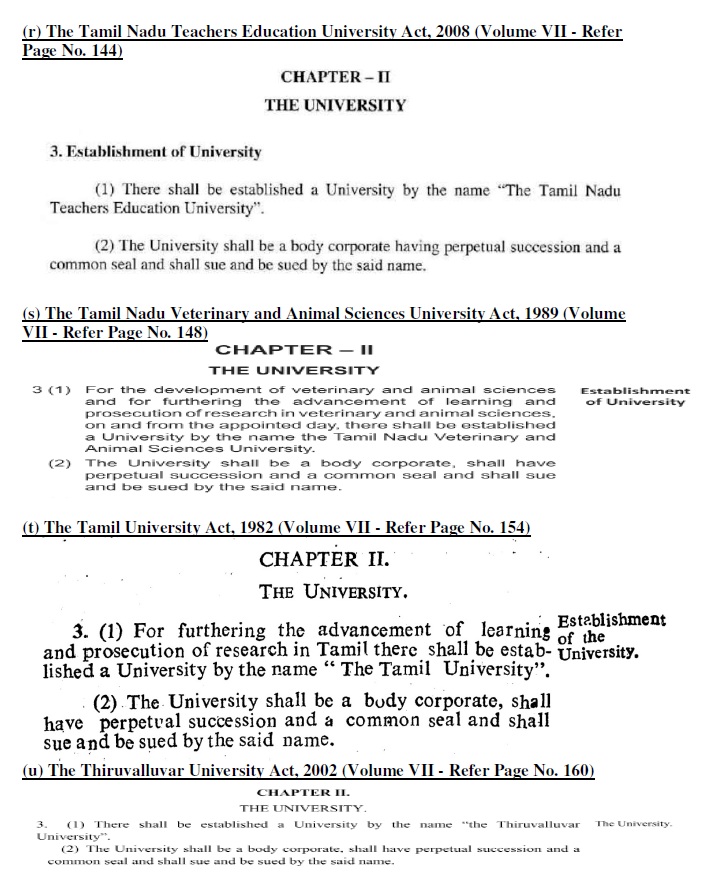
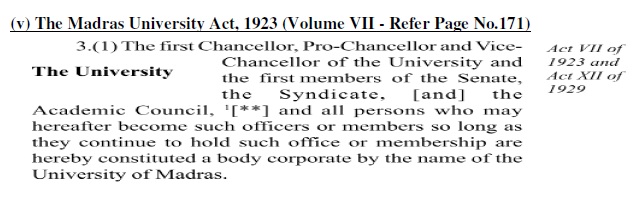
8. From the combined perusal of the section 194A(3)(iii)(f) r.w. clause (i) of the above notification it is clear that the requirement to deduct tax at source would not apply to payments made to corporation established by a Central, State or Provincial Act. The ld AR submitted that the Universities to whom the assessee has made payments are established under a State Act and the Univeristies are a body corporate as per the said Acts. In this regard the ld AR drew our attention to the various Acts and the relevant clauses extracted as under –
9. The expression “any corporation established by a Central, State or Provincial Act” refers to a statutory corporation brought into existence by the statute itself. The distinction between a corporation “established by” an Act and one merely “established under” an Act is explained by the Hon’ble Supreme Court in the case of Canara Bank (supra) where it is held that –
“16. A Constitution Bench of this Court in Sukhdev Singh and Others v. Bhagatram Sardar Singh Raghuvanshi [1975] 1 SCC 421 had occasion to consider the nature and character of Corporation including its early history. Justice Mathew, delivering his concurrent opinion noted that Corporations in 17th, 18th and 19th Centuries were far more like the bodies corporate we call “public authorities” today. In paragraph Nos. 83, 86 and 87 following has been laid down:
“83. The chartered corporations of the 17th, 18th and 19th centuries were expected, perhaps required, to perform stated duties to the community like running a ferry, founding a colony or establishing East Indian trade. Performance of these functions and securing whatever revenue the enterprise made to the Crown were the primary reasons why a charter was granted. Corporations in early English law were in fact, and in legal cognizance, a device by which the political State got something done. They were far more like the bodies corporate we call “public authorities” today. Few in the 17th or 18th century would have disputed that such a corporation was an agency of the State.”
86. The public corporation, therefore, became a third arm of the Government. In Great Britain, the conduct of basic industries through giant corporations is now a permanent feature of public life.
87. A public corporation is a legal entity established normally by Parliament and always under legal authority, usually in the form of a special statute, charged with the duty of carrying out specified no governmental functions in the national interehose functions being confined to a comparativel restricted field, and subjected to control by the Executive, while the corporation remains juristically independent entity not directly responsible to Parliament. A public corporation is not generally multipurpose authority but a functional organisation created for a specific purpose. It has generally thaltipur shareholders. Its responsibility generally is to Government. Its administration is in the hands of a Board appointed by the competent Minister. The employees of public corporation are not civil servants. It is, in fact, likely that in due course a special type of training for specialized form of public service will be developed and the status of the personnel of public corporation may more and more closely approximate to that of civil service without forming part of it. Insofar as public corporations fulfil public tasks on behalf of Government, they are public authorities and as such subject to control by Government.”
17. One more principle which was reiterated by this Court in above Constitution Bench judgment is that Corporations which are instrumentalities of the Government are subject to the limitation as contained in the Constitution. The Corporations which were under consideration in the above case, namely, Life Insurance Corporation of India, Oil and Natural Gas Commission, Industrial Finance Corporation were held to be constituted within the meaning of Article 12 of the Constitution. Two categories of Corporations have been noticed i.e. statutory corporations and non-statutory corporations, Whereas, the statutory corporations owe their existence from “by or under” statute, non-statutory bodies and corporations are not created by or under statute rather are governed by a statute.
“ESTABLISHED BY A CENTRAL, STATE OR PROVINCIAL ACT”
18. The appellant on the one hand submits that the Authority has not been established by 1976 Act rather it has been established under the 1976 Act, hence it is not covered by Notification dated 22.10.1970 whereas the respondent submits that Authority has been established by the 1976 Act hence, it fulfills the condition as enumerated under Notification dated 2.10.1970. Alternatively, it is submitted that words “by and under” have been interchangeably used in the IT Act, 1961 and there is no difference, even if, the Authority is established under the 1976 Act.
19. Section 194A(3)(iii) clauses (b), (c) and (d) refer to expression “established”. In sub clause (b) expression used is “established by or under a Central, State or Provincial Act”, in sub clause (c) the expression used is “established under the Life Insurance Corporation Act” and in sub clause (d) expression used is “established under the Unit Trust of India Act”. The Section thus uses both the expressions “by or under”. The expression established by or under an Act have come for consideration before this Court on several occasions. In this context, it shall be useful to refer to few judgments of this Court. In Sukhdev Singh case (supra), the Court had occasion to consider the status of company incorporated under the Companies Act. The Court held that Company incorporated is not a Company created by the Companies Act. In paragraph No. 25 following was held:
“25…..A company incorporated under the Companies Act is not created by the Companies Act but comes into existence in accordance with the provisions of the Act. It is not a statutory body because it is not created by the statute. It is a body created in accordance with the provisions of the statute.”
20. Mathew J., writing concurrent opinion while discussing the public corporation held that such corporations are created by State. In Executive Committee of Vaish Degree College, Shamli v. Lakshmi Narain [1976] 2 SCC 58, the question for consideration fell as to whether the Executive Committee of a degree college is a statutory body. Contention before the Court was that the Executive Committee was the statutory body since it was affiliated to the Agra University which was established by the statute. The Executive Committee was further covered by the statute framed by the Agra University. In the above context, this Court held that there is a clear distinction between a body which is created by the Statute and a body which having been come into existence is governed in accordance with the provisions of the statute. In paragraph No. 10 following was held:
“10 … It is, therefore, clear that there is a well marked distinction between a body which is created by the statute and a body which after having come into existence is governed in accordance with the provisions of the statute. In other words the position seems to be that the institution concerned must owe its very existence to a statute which would be the fountainhead of its powers. The question in such cases to be asked is, if there is no statute would the institution have any legal existence. If the answer is in the negative, then undoubtedly it is a statutory body, but if the institution has a separate existence of its own without any reference to the statute concerned but is merely governed by the statutory provisions it cannot be said to be a statutory body… ”
21. Again in S.S.Dhanoa case (supra), this Court had occasion to consider a Registered Society which was a body/corporate. The question was as to whether the State Body/corporate is a Corporation within the meaning of Clause Twelfth of Section 21 of the IPC (Indian Penal Code). This Court again held that expression Corporation means a Corporation created by the legislature. In paragraph No. 7 following was held:
“7……In our opinion, the expression ‘corporation’ must, in the context, mean a corporation created by the legislature and not a body or society brought into existence by an act of a group of individuals. A cooperative society is, therefore, not a corporation established by or under an Act of the Central or State Legislature.”
22. Further noticing the distinction between Corporation established by or under Act or body created by or under Act, following was held in paragraph No. 10:
“10. There is a distinction between a corporation established by or under an Act and a body incorporated under an Act. The distinction was brought out by this Court in Sukhdev Singh v. Bhagatram Sardar Singh Raghuvanshi. It was observed: [SCC p. 435: SCC (L&S) p. 115, para 25]
“A company incorporated under the Companies Act is not created by the Companies Act but comes into existence in accordance with the provisions of the Act.”
There is thus a well-marked distinction between a body created by a statute and a body which, after coming into existence, is governed in accordance with the provisions of a statute … ”
23. Another judgment which had occasion to consider the expression established by or under the Act is a judgment of this Court in Dalco Engg. (P.) Ltd. v. Satish Prabhakar Padhye [2010] 4 SCC 378. The Court had occasion to examine the provision of Section 2k, of the Persons with Disabilities (Equal Opportunities, Protection of Rights and Full Participation) Act, 1995, specifically expression “establishment” means a Corporation established by or under Central, Provincial or State Act. This Court held that the phrase established by or under the Act is a standard term used in several enactments to denote a statutory corporation established or brought into existence by or under the statute. On Company it was held that the company is not established under the Companies Act and an incorporated company does not “owe” its existence to the Companies Act. In paragraph No. 20 following has been laid down:
’20. A “company” is not “established” under the Companies Act. An incorporated company does not “owe” its existence to the Companies Act. An incorporated company is formed by the act of any seven or more persons (or two or more persons for a private company) associated for any lawful purpose subscribing their names to a memorandum of association and by complying with the requirements of the Companies Act in respect of registration. Therefore, a “company” is incorporated and registered under the Companies Act and not established under the Companies Act. Per contra, the Companies Act itself establishes the National Company Law Tribunal and the National Company Law Appellate Tribunal, and these two statutory authorities owe their existence to the Companies Act.’
24. This Court further elaborating the expression held that when the expression used is “established by or under the Act”, the emphasize should be on the word “established” in addition to the words “by or under”. It is useful to refer to what has been said in paragraph Nos. 21 and 22 of the judgment which is to the following effect:
’21. Where the definition of “establishment” uses the term “a corporation established by or under an Act”, the emphasis should be on the word “established” in addition to the words “by or under”. The word “established” refers to coming into existence by virtue of an enactment. It does not refer to a company, which, when it comes into existence, is governed in accordance with the provisions of the Companies Act. But then, what is the difference between “established by a Central Act” and “established under a Central Act”?
22. The difference is best explained by some illustrations. A corporation is established by an Act, where the Act itself establishes the corporation. For example, Section 3 of the State Bank of India Act, 1955 provides that a bank to be called State Bank of India shall be constituted to carry on the business of banking. Section 3 of the Life Insurance Corporation Act, 1956 provides that
3. Establishment and incorporation of Life Insurance Corporation of India.—(1) With effect from such date as the Central Government may, by notification in the Official Gazette, appoint, there shall be established a Corporation called the Life Insurance Corporation of India.
State Bank of India and Life Insurance Corporation of India are two examples of corporations established by “a Central Act”.’
25. This Court has also referred to provisions of The State Financial Corporations Act, 1951 which provides for establishment of various financial corporations under the Act. It is useful to refer to definition of financial corporation as contained in Section 2(b) which is to the following effect:
“2(b) Financial Corporation means a Financial Corporation established under Section 3 and includes a Joint Financial Corporation established under Section 3A;”
26. Section 3 deals with establishment of State Financial Corporation which provides as follows:
“3. Establishment of State Financial Corporations.: (1) The State Government may, by notification in the Official Gazette, establish a Financial Corporation for the State under such name as may be specified in the notification.
(2) The Financial Corporation shall be a body corporate by the name notified under sub-section (1), having perpetual succession and a common seal, with power, subject to the provisions of this Act, to
[acquire, hold and dispose of] property and shall by the said name sue and be sued. ”
27. This Court clearly in above case, Dalco Engg. (P.) Ltd. case (supra) has held that such Financial Corporations are established by an Act or under an Act. In paragraph No. 23 of the judgment following has been held:
’23. We may next refer to The State Financial Corporations Act, 1951 which provides for establishment of various financial corporations under that Act. Section 3 of that Act relates to establishment of State Financial Corporations and provides that “the State Government may, by notification in the Official Gazette, establish a financial corporation for the State under such name as may be specified in the notification” and such financial corporation shall be a body corporate by the name notified. Thus, a State Financial Corporation is established under a Central Act. Therefore, when the words “by and under an Act” are preceded by the words “established”, it is clear that the reference is to a corporation established, that it is brought into existence, by an Act or under an Act. In short, the term refers to a statutory corporation as contrasted from a non-statutory corporation incorporated or registered under the Companies Act.’
28. Now, we revert back to the provisions of 1976, Act. The very preamble of that Act reads “an Act to provide for the Constitution of an Authority for the development of certain areas in the State into industrial and urban township and for masses connected through with”.
29. Thus, the Act itself provides for constitution of an authority. Section 2(b) of the 1976 Act defines Authority as authority constituted under Section 3 of the Act. Section 3 which is very relevant for the present case is as follows:
“3. (1) The State Government may, by notification, constitute for the purposes of this Act, An authority to be called (Name of the area) Industrial Development Authority, for any industrial development area.
(2) The Authority shall be a body corporate.
(3) The Authority shall consist of the following:-
(a) The Secretary to the Government, Uttar Pradesh, Industries Department or his Nominee not below the rank of Joint Secretary-ex-official. — Member Chairman
(b) The Secretary to the Government, Uttar Pradesh, Public works Department or his nominee not below the rank of Joint Secretary exofficial. — Member
(c) The Secretary to the Government, Uttar Pradesh, Local SelfGovernment or his nominee not below the rank of joint Secretary-ex official. — Member
(d) The Secretary to the Government, Uttar Pradesh, Finance Member Department or his nominee not below the rank of Joint Secretary-ex official. — Member
(e) The Managing Director, U.P. State Industrial Development Corporation-ex official. — Member
(f) Five members to be nominated by the State Government by notification. — Member
(g) Chief Executive Officer. — Member Secretary
(4) The headquarters of the Authority shall be at such place as may be notified by the State Government.
(5) The procedure for the conduct of the meetings for the Authority shall be such as may be prescribed.
(6) No act or proceedings of the Authority shall be invalid by reason of the existence of any vacancy in or defect in the constitution of the Authority.”
30. When we compare the provisions of Section 3 of 1976 Act with those of The State Financial Corporations Act, 1951, it is clear that the establishment of Corporation in both the enactments is by a notification by State Government. In the present case, notification has been issued in exercise of power of Section 3, the Authority has been constituted. It is useful to extract paragraph No. 2 of the Notification dated 12.04.1976:
“2. The Governor is hereby further pleased, in exercise of the powers under Section 3 of the said Act, to constitute, in respect of the above-mentioned Industrial Development Area, for the purposes of the said Act, an Authority to be called the ‘New Okhla Industrial Development Authority’, consisting of the following, namely,
(i) Secretary to the Government, Uttar Pradesh, Industries Department, Ex officio — Member Chairman (Under Clause(a))
(ii) Secretary to the Government, Uttar Pradesh, Public Works Department, Ex Officio — Member (Under Clause(b))
(iii) Secretary to the Government, Uttar Pradesh, Local self-Government, Department Ex officio — Member (Under Clause (c))
(iv) Secretary to the Government, Uttar Pradesh, Finance Department, Ex officio — Member (Under Clause (d))
(v) Managing Director, UP State Industrial Development Corporation Ltd. Ex. Officio — Member (Under Clause (e))
(vi) Chairman, UP State Electricity Board, Ex-officio — Member (Nominated under Clause (f))
(vii) Chief Engineer, UP Jal Nigam Board, Ex-officio — Member (Nominated under Clause (f))
(viii) Chief Engineer, Irrigation Department UP Ex-officio — Member, (Nominated under(f))
(ix) Chief Town and Country Planner, UP, Ex-officio, — Member (Nominated under Clause(f))
(x) District Magistrate, Bulandshahr, Ex-officio — Member (Nominated under Clause(f))
(xi) Chief Executive Officer — Member Secretary (Under Clause (g))”
31. This Court having already laid down in Dalco Engg. (P.) Ltd. case (supra) that establishment of various financial corporations under State Financial Corporation Act, 1951 is establishment of a Corporation by an Act or under an Act. We are of the view that the above ratio fully covers the present case and we have no doubt that the Authority have been established by the 1976 Act and it is clearly covered by the Notification dated 22.10.1970. It is further relevant to note that composition of the Authority is statutorily provided by Section 3 of 1976 Act itself, hence, there is no denying that Authority has been constituted by Act itself.”
10. The Hon’ble Supreme Court in the above case held that the expression “corporation established by or under a Central, State or Provincial Act” applies only to statutory corporations which owe their very existence to the statute. It is further held that the true test is whether, in the absence of the statute, the entity would have any legal existence. Accordingly it is held that a body merely incorporated under the Companies Act or governed by statutory provisions is not covered, whereas a body constituted under the provisions of the statute, with its composition, powers and functions prescribed therein, is a statutory corporation established by or under the Act. Therefore when we apply the above test to the Universities under consideration here, we have to examine whether (i) The Universities are is created directly by a State Legislature (not merely registered under another law) and (ii) the Act under which the Universities are is established declares the University to be a body corporate with perpetual succession, common seal, power to sue and be sued etc.
11. We have herein above have extracted the relevant clauses from the Various Acts under which the Universities are established and from the perusal of the said clauses it is clear that the Universities are established as body Corporate having a perpetual sucession and common seal. The ld DR argued that every body corporate cannot be considered as a corporation and that the exception u/s.194A(3)(iii)(f) r.w. the notification applies only to corporations. We are in agreement with the said contention to the extent that the mere fact that an entity is a body corporate does not ipso facto bring it within the expression “corporation established by or under a Central, State or Provincial Act” since a body corporate is only a juristic entity having a separate legal personality. The relevant test is whether the entity owes its very existence to the statute itself. If it is merely incorporated under a general law such as the Companies Act, it remains a body corporate but is not a statutory corporation established by or under the Act. Conversely, where the statute itself contemplates and brings into existence the entity, it constitutes a statutory corporation falling within the said expression.
12. The learned DR contended that Notification No. S.O.3489 dated 22.10.1970, being in the nature of an exemption notification, deserves strict construction. We are unable to accept the said contention in the facts of the present case. The issue before us is not one of extending the scope of the Notification by implication but of determining whether the recipient entities satisfy the conditions expressly stipulated therein. Once the statutory status of the recipient or the ownership conditions prescribed under the Notification stand established from the material on record, the benefit cannot be denied by adopting an unduly restrictive interpretation. Accordingly in our considered view, the Universities which are declared as body corporate, that owe its very existence to the State Act is to be considered as a statutory corporation and therefore the Universities in our view are covered under the exception provided under section 194(3)(iii)(f) r.w. the notification dated 22.10.1970. We thus direct the AO to delete the levy under section 201(1)/(1A) towards payments/credits by the assessee towards interest to Universities.
(ii) Interest payment/credit to Government companies:
13. The Ld. AR submitted that the assessee has paid interest to Government companies which fall squarely within the second limb of the Notification dated 22.10.1970 as per which any company in which all shares are held (whether singly or taken together) by the Government or RBI or a Corporation owned by RBI is exempted. The Ld. AR drew our attention to details of the shareholding in the Government companies to which the assessee has made interest payments without deducting tax to substantiate the fact that these depositors fall within the exception as contained in Section 194A(3)(iii)(f) r/w Notification dated 22.10.1970.
14. The Ld. DR, on the other hand, submitted that:
“B.3.1. The Assessee has claimed exemption from deduction of tax at source on interest payments made to various Government Companies by placing reliance on Notification No. S.O. 3489 dated 22.10.1970. However, the notification applies only to specifically covered entities, and the burden of establishing satisfaction of the prescribed conditions rests entirely upon the Assessee. Being in the nature of an exemption from a statutory obligation to deduct tax at source, the notification must be construed strictly, and eligibility cannot be presumed merely on the basis of Government participation, administrative control, or shareholding.
B.3.2. A Government Company derives its legal existence from incorporation under the Companies Act and not from direct establishment by a Central or State enactment. Mere Government ownership or control cannot, by itself, convert a company incorporated under company law into a corporation established by statute for the purposes of Notification S.O. 3489.
B.3.3. Even under the second limb of the notification which contemplates entities whose shares are held wholly by the Central Government and/or one or more State Governments, the Assessee has failed to discharge the burden of demonstrating that the recipient entities satisfied the prescribed condition during the relevant period. The Assessing Officer’s verification revealed that the claim of exclusive Government ownership was not substantiated, and the materials placed on record did not establish that all shares of the recipient entities were held solely by the Government as required under the notification.
B.3.4. The recipient entities are separate legal and taxable persons having independent PANs and filing separate returns of income. Merely because the Government holds shares in such entities, the interest paid to them cannot be equated with payments made directly to the Government so as to attract immunity under Section 196 or any analogous exemption.
B.3.5. The provisions of Section 194A cast a statutory obligation upon the payer to deduct tax at source at the time of credit or payment. Such obligation can be dispensed with only where the case falls squarely within a statutory exemption and the requisite conditions are demonstrably satisfied. In the absence of clear evidence establishing eligibility under Notification S.O. 3489, the Assessee could not have assumed non-deductibility of tax merely on the basis of its own understanding of the status of the recipients.
B.3.6. Reliance is placed on the judgment of the Hon’ble Supreme Court in Transmission Corporation of A.P. Ltd. v. CIT [
(1999) 239 ITR 587 (SC)], wherein it was held that the provisions relating to deduction of tax at source are mandatory in nature and that the obligation to deduct tax cannot be diluted except in accordance with the express provisions of the Act. The decision underscores the principle that a deductor cannot unilaterally dispense with statutory withholding obligations unless the case clearly falls within a recognised exemption.
B.3.7. In these circumstances, the Assessing Officer was fully justified in holding that the Assessee had failed to substantiate its claim of exemption in respect of the impugned payments and, consequently, in invoking the provisions of Section 201(1) and levying consequential interest under Section 201(1A) of the Act.”
15. We have considered the rival submissions and perused the material on record. The next class of payments made by the assessee is payments made to Government Companies. The argument of the ld AR is that the interest paid/credited to Government companies would fall squarely within the second limb of the Notification dated 22.10.1970. The said grants exemption from deduction of tax at source in respect of interest paid to “any company in which all the shares are held (whether singly or taken together) by the Government, the Reserve Bank of India or a corporation owned by that Bank.” We notice from the perusal of clause (ii) of the Notification that the emphasis is therefore, not on the source of incorporation of the entity but on the ownership of its entire share capital. This would mean that, a company incorporated under the Companies Act, though not a statutory corporation established by a Central, State or Provincial Act, would nevertheless be entitled to the benefit of the notification if it satisfies the condition that its entire shareholding is vested in the Government, the Reserve Bank of India or a corporation owned by the Reserve Bank of India. The notification thus creates an independent and distinct category of exempt entities by specifically including wholly Government-owned companies. The legislative intent is therefore clear that Government companies are eligible for exemption not because they are corporations established by statute, but because they satisfy the ownership criterion prescribed under clause (ii). Therefore, once it is demonstrated that the entire share capital of the recipient company is held by the Government or the other specified entities, the exemption under clause (ii) follows, and the payer cannot be fastened with an obligation to deduct tax at source under section 194A. In the light of the said proposition lets now examine the assessee’s facts. The ld AR during the course of hearing drew our attention to the following factual position with respect to the shareholding of Government companies to whom the assessee has made payments/credits without deducting TDS based on screenshots from the portal of the Ministry of Corporate Affairs (MCA), the Forms MGT-7 (Annual Returns), and the audited Annual Reports placed on record –
| 1) |
|
Tamilnadu Civil Supplies Corporation (Volume III – Refer Page No. 980 – 982) |
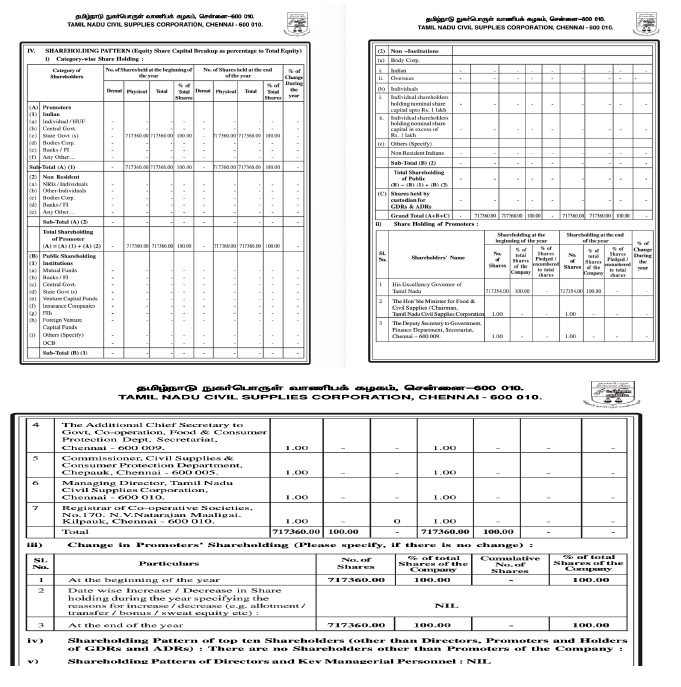
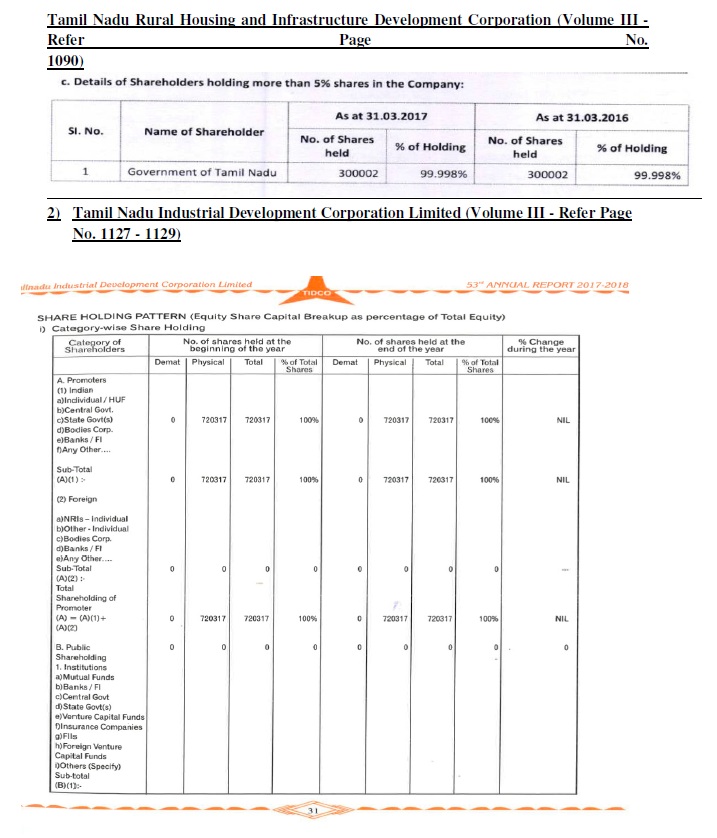
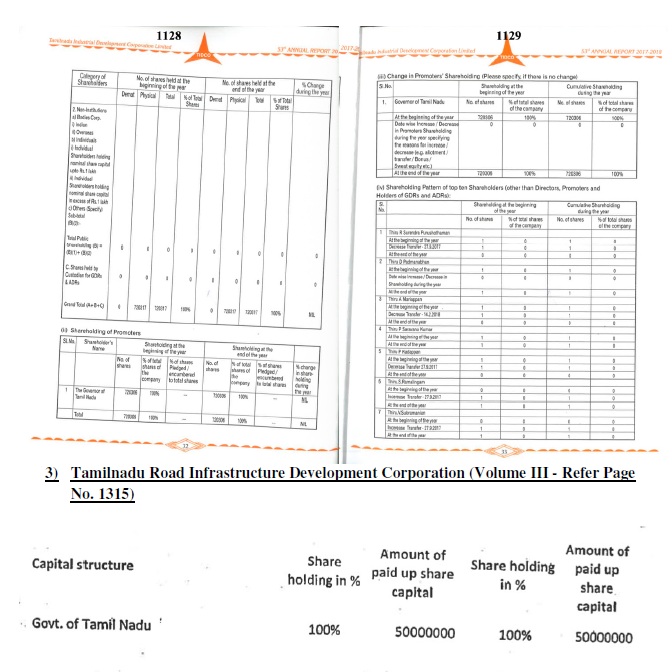
16. From the perusal of the above facts it is clear that the shares in the Government companies to whom the assessee has made payments/credits towards interest are wholly held by the Government and therefore there is merit in the submissions that the impugned payments/credits are covered by the exception provided u/s.194A(3)(iii)(f) r.w. clause (ii) of notification dated 22.10.1970. The reliance placed by the ld DR on the decision in Transmission Corpn. of A.P. Ltd. v. CIT 239 ITR 587 (SC) is not correct since in the said case the decision proceeds on the premise that the payment in question contains income chargeable to tax where as in the present case, we are deciding the foundational issue of whether the interest payments/credits to the impugned parties attract section 194A or would fall within the purview of any exceptions as contained therein. In view of these discussions we direct the AO to levy made under section 201(1) & 201(1A) of the Act.
| (iii) |
|
Payments/credits to Government Companies toward interest on Government Funds deposited |
17. The ld AR submitted that the amounts representing Government funds were held by the assessee only in a nodal and fiduciary capacity for implementation of various Government schemes and did not constitute its own funds. The ld AR drew our attention to the Government Orders (GO) constituting and governing the respective funds, declarations issued by the concerned departments, the MCA records, Forms MGT-7 and the Annual Reports, and contended that the assessee was merely an implementing agency entrusted with the custody and administration of the funds in accordance with the directions of the Government, without acquiring any beneficial ownership over the same. The ld AR therefore, submitted that the interest earned on such deposits retained the character of Government funds and could not be regarded as income of the assessee. With specific reference to the deposits relating to the Tamil Nadu Generation and Distribution Corporation Limited (TANGEDCO), the ld AR submitted that the correspondence exchanged between the parties, the order of the Hon’ble Madras High Court, the cheque evidencing payment of Rs.14,01,86,452/- and the contemporaneous records, clearly establish that the amount represented Government funds and that the assessee had acted only as a custodian thereof. Accordingly the ld AR contended that no liability to deduct tax at source under section 194A could be fastened upon the assessee since the interest earned is not in the nature of income.
18. The ld DR, on the other hand, submitted that the assessee has failed to establish that the deposits representing Government funds were held merely in a nodal or fiduciary capacity so as to take the interest income outside the ambit of section 194A. The ld DR further submitted that the recipient Government companies are independent legal entities having separate PANs, maintaining separate books of account and filing independent returns of income and that merely because the funds originated from the Government or were intended for implementation of Government schemes would not alter the legal character of the deposits or convert the interest payable thereon into income of the Government. The ld DR also submitted that the GO governing the schemes cannot override the statutory obligation cast under section 194A, and, in the absence of any specific exemption under the Act or a notification issued by the CBDT, the payer was bound to deduct tax at source. Accordingly, the Assessing Officer was justified in treating the assessee as an assessee in default under sections 201(1) and 201(1A).
19. We have heard the rival submissions and perused the material available on record. Section 194A(1) casts an obligation to deduct tax at source only in respect of “any income by way of interest” and that, the foundational requirement for invoking the provision is that the amount paid or credited should partake the character of income in the hands of the recipient. Unless the interest constitutes income accruing to the payee, the machinery provision relating to deduction of tax at source cannot be set in motion. Therefore, before examining the applicability of the exemptions contained in section 194A(3) or the Notification issued there under, it is necessary to determine whether the impugned interest represents income of the depositor Government companies at all. From the perusal of the GO constituting the respective funds (Page 1850 to 1871 of Vol-III paper book), and the other contemporaneous records placed before us, we find that the amounts deposited under the category “Government Funds” were entrusted to the respective Government companies only for implementation of specified Government schemes and that the recipient companies acted merely as nodal or implementing agencies and held the funds in a fiduciary capacity without acquiring any beneficial ownership over the corpus. We further notice that as per the GO the funds could neither be deployed nor appropriated by the companies for their own purposes except in accordance with the directions of the Government. Therefore we see merit in the submission that the interest earned on such deposits also retained the same character and accrued beneficially to the Government, the true owner of the funds, and not to the Government company in its independent capacity. It is the contention of the revenue that the recipient Government companies possess separate juristic personality, independent PANs and are separate assessees under the Act and accordingly the interest earned is the income in the hands of the Government companies. It is further contended that the Government Orders governing the schemes cannot override the provisions of section 194A. However in our considered view, these circumstances are not determinative and the existence of a separate legal personality does not, by itself, establish beneficial ownership over every receipt passing through such entity. Further when an assessee receives or holds monies merely as a trustee, custodian or nodal agency, the legal form of the recipient cannot override the real character of the transaction. It is relevant to mention here that that the assessee does not seek exemption on the strength of the GO and that they are relied upon to establish the true character of the funds and the fiduciary capacity in which the recipient companies held the deposits. Our decision is based on the statutory provisions of the Act read with the legal character of the transaction and not merely on the basis of executive instructions. As already stated the obligation under section 194A arises only where the interest constitutes income of the recipient and not where the recipient merely receives or holds the amount on behalf of the beneficial owner. In the present case, the evidences placed before us clearly establish that the Government companies were merely custodians of Government funds earmarked for implementation of specified public welfare schemes. The Revenue has not brought any material on record to demonstrate that either the corpus or the interest thereon became the unrestricted property or income of the recipient companies. In the absence of such material, we are unable to hold that the interest paid on these deposits constituted “income by way of interest” in the hands of the recipient Government companies so as to attract the provisions of section 194A(1). Once the charging requirement under section 194A itself is not satisfied, the question of treating the assessee as an assessee in default under sections 201(1) and 201(1A) does not arise. Having held so we leave open the contention of the ld AR that even otherwise, several of the recipient entities are wholly Government-owned companies falling within clause (ii) of Notification No. S.O.3489 dated 22.10.1970 issued under section 194A(3)(iii)(f). Accordingly, the orders passed under sections 201(1) and 201(1A) on this issue are directed to be deleted.
| (iv) |
|
Payments/credit of interest to Tamil Nadu Water Supply and Drainage Board (TWAD Board) |
20. The Id AR submitted that the TWAD Board is a statutory body corporate constituted under the Tamil Nadu Water Supply and Drainage Board Act, 1970 with effect from 14.04.1971 and, therefore, squarely falls within the expression “corporation established by a State Act” occurring in section 194A(3)(iii)(f) read with Notification No. S.O.3489 dated 22.10.1970. It was further submitted that the TWAD Board has also been notified under section 10(46) of the Act vide Exemption Notification No.5/2015 and its income stands exempt from tax. Without prejudice, the learned AR submitted that the TWAD Board has duly filed its return of income and a certificate issued by a Chartered Accountant certifies that the interest received from the assessee has been duly offered to tax in its return of income. Therefore, it was contended that the assessee cannot be treated as an assessee in default under section 201(1), either because no tax was deductible under section 194A in view of the statutory exemption available to the recipient or, in any event, because the recipient has already included the interest income in its return of income.
21. The ld DR on the other hand submitted that the assessee had failed to establish that the TWAD Board was entitled to the benefit of section 194A(3)(iii)(f) read with Notification No. S.O.3489 dated 22.10.1970. According to him, the burden to prove that the recipient falls within the notified category squarely rests upon the assessee, and the mere fact that the TWAD Board is a statutory body or is under Government control does not ipso facto entitle it to exemption from deduction of tax at source. It was further contended that the applicability of the Notification has to be examined strictly with reference to the statutory provisions governing the recipient and that the decisions rendered in the case of other statutory authorities cannot be applied mechanically. Accordingly, the learned DR submitted that the assessee having failed to establish the eligibility of the recipient under the Notification, the Assessing Officer was justified in treating the assessee as an assessee in default under sections 201(1) and 201(1A).
22. We have heard the rival submissions and perused the material available on record. We have already held, while dealing with the scope of section 194A(3)(iii)(f) read with Notification No. S.O.3489 dated 22.10.1970, that a body corporate which owes its very existence to a Central, State or Provincial Act is a corporation established by such Act. From the perusal of records, it is noticed that TWAD Board has been constituted as a body corporate under the provisions of the Tamil Nadu Water Supply and Drainage Board Act, 1970 and, the contention that TWAD, squarely falls within the expression “corporation established by a State Act” occurring in the Notification has merits. Accordingly in our view the assessee has satisfactorily discharged the burden of establishing the eligibility of the recipient under the Notification and the contention of the ld DR in this regard are not tenable. Accordingly, we hold that the interest paid to the TWAD Board is covered by clause (i) of Notification No. S.O.3489 dated 22.10.1970 issued under section 194A(3)(iii)(f), and consequently, the assessee was under no obligation to deduct tax at source under section 194A. Even otherwise we notice that the assessee has placed on record the return of income filed by the recipient and the Chartered Accountant’s certificate certifying that the interest received from the assessee has been duly included in its return of income. In view of these discussions we hold that the impugned demand raised under sections 201(1) and 201(1A) be deleted.
| (v) |
|
Interest payment/Credit to Temples: |
23. In this regard, the Ld. AR submitted that the obligation to deduct tax does not arise for the reason that the recipient temples have either offered the interest income to tax or furnished the prescribed declarations for non deduction of tax at source. The Ld. AR drew our attention to the paper book containing the breakup of temples having Form-26A certifying that the interest income paid by the assessee has been included in the return of income of the deposited temples including the details of return of income filed, condonation petitions filed u/s. 119(2)(b) of the Act, the exemptions sought and granted, the Form-15G furnished by the temples declaring that no tax be deducted at sources on such interest. The Ld. AR prayed that the details could not be submitted online due to the volume of submissions and accordingly prayed one more opportunity may be granted before the Jurisdictional Assessing Officer (JAO).
24. The Ld. Departmental Representative (DR), on the other hand, submitted that:
“C.3.1. Article 289 of the Constitution of India grants tax immunity strictly to the property and income of a State Government. The interest payments under consideration were made to individual, constituent temples maintaining deposits with the Assessee, and not to the State Government of Tamil Nadu.
C.3.2. A temple does not cease to be a distinct legal and taxable entity merely because it is administered or supervised by the HR&CE Department. Administrative control by a government department cannot convert the independent income of a temple into the income of the State Government.
C.3.3. The recipient of the interest income is the individual temple concerned, not the HR&CE Department. Consequently, any statutory exemption available to the HR&CE Department cannot be extended to its constituent temples as a matter of course.
C.3.4. The Assessee’s reliance on Section 196 is legally untenable. Section 196 exempts deduction only when a payment is made directly to the Government, the Reserve Bank of India, or other specifically notified entities; the Assessee has completely failed to demonstrate that the recipient temples fall within any of these statutory categories.
C.3.5. The Assessee’s own records defeat its argument, as the Kallazhagar Temple had previously obtained a non-deduction certificate under Section 197. The very necessity of obtaining a Section 197 certificate clearly demonstrates that interest paid to these temples is otherwise subject to Section 194A; had these payments been inherently outside the scope of TDS, no such certificate would have been required.
C.3.6. The Hon’ble Madras High Court in Sri Vaithiyanathaswamy Devasthanam and Sri Amirthakadeswarasamy Devasthanam v. PCIT [2021 (4) TMI 513 (Mad.)] recognized that temples administered under the HR&CE framework continue to be separate assessable entities. Statutory supervision by the HR&CE Department does not obliterate a temple’s distinct legal identity or automatically extend to it the exemptions available to the administrative authority.
C.3.7. The learned CIT(A) correctly observed that the exemption contemplated under Section 10(23BBA) is restricted solely to the administrative authority referred to therein and does not automatically apply to the independent income of every temple functioning under such an authority.
C.3.8. Without prejudice to the primary liability, while the benefit of the first proviso to Section 201(1) may be examined recipient-wise based on duly verified Forms No. 26A or other statutory evidence, such secondary verification cannot dilute or dispense with the Assessee’s primary statutory obligation to deduct tax under Section 194A.
25. We have heard the rival submissions and perused the material available on record. With regard to the impugned payments / credit of interest to temples, the assessee has placed reliance upon Forms No.26A, Forms No.15G, returns of income filed by the recipient temples, condonation petitions under section 119(2)(b), and other supporting documents to contend that the recipient temples have either duly offered the interest income to tax or furnished valid declarations. Accordingly it is contended that the assessee cannot be treated as an assessee in default under section 201(1). In our view, these documents require factual verification by the end of the AO and considering that the documents to be examined are voluminous, we deem it appropriate to restore this issue to the file of the Jurisdictional Assessing Officer (JAO) with a direction to examine the Forms No.26A, Forms No.15G, declarations and other evidences furnished by the assessee, including such additional evidences as may be produced and decide the issue afresh in accordance with law in the light of the first proviso to section 201(1). Needless to say that the assessee be given a reasonable opportunity of being heard. The grounds in this regard are allowed for statistical purposes.
26. In result the appeal of the assessee for AY 2017-18 to 2023-24 are allowed for statistical purposes.