ORDER
Amitabh Shukla, Accountant Member.- This appeal is filed by the Assessee is directed against the order of Ld. Commissioner of Income Tax (Appeals)/National Faceless Appeal Centre, New Delhi, dated 28.10.2025 arising out of assessment order dated 15.04.2021 passed under section 143(3) for the Assessment Year 2018-19. The word ‘Act’ herein this order would mean Income Tax Act, 1961.
2. The assessee has raised following grounds of appeal:-
| 1. |
|
That on the facts and in the circumstances of the case and in law, the National Faceless Appeal Centre (“Ld. CIT(A)/ NFAC”) has grossly erred in dismissing the appeal filed by the Appellant against the assessment order passed under section 143(3) of the Income-tax Act, 1961 (“Act”), as “infructuous”, without appreciating that the said assessment order resulted in determination of total income and tax liability and thus gave rise to a valid and subsisting cause of grievance to the Appellant. |
| 2. |
|
That the Ld. CIT(A) erred in dismissing the appeal by stating that no addition/disallowance has been made, whereas the total income has been assessed at Rs.12,80,92,944 as against the returned income of Rs.2,29,05,790 thereby confirming additions/adjustments amounting to Rs. 10,51,87,154 and the impugned order has thus been passed without any basis and without proper application of mind |
| 3. |
|
That the Ld. CIT (A) has erred in law in failing to appreciate that an assessment order passed under section 143(3) of the Act is independently appealable under section 246A of the Act and cannot be rendered non-maintainable merely because the variations to income had their origin at the stage of processing under section 143(1) of the Act. |
| 4. |
|
That the impugned order passed by the Ld. CIT (A) is bad in law and void ab initio for non-compliance with the mandatory provisions of section 250(6) of the Act, inasmuch as the Ld. CIT(A) has failed to adjudicate any of the grounds raised by the Appellant on merits and has passed a non-speaking and cryptic order without recording reasoned findings. |
| 5. |
|
That the Ld. CIT(A) has erred in law in holding that no grievance survives against the assessment order under section 143(3) of the Act merely on the ground that the Assessing Officer did not make fresh additions during scrutiny proceedings, ignoring the settled position of law that adoption, confirmation, or continuation of additions made under section 143(1) in the final assessment order itself constitutes an adverse determination against the Appellant. |
| 6. |
|
That the learned CIT(A) has erred in law in invoking the doctrine of merger to dismiss the appeal, without appreciating that the assessment order passed under section 143(3) of the Act is a final and operative order determining total income and tax liability, and is independently appealable under section 246A of the Act, irrespective of the stage at which the additions originated or whether the issues were earlier processed under section 143(1). |
| 7. |
|
That the learned CIT(A) failed to appreciate that in the present case, the Assessing Officer, while passing the assessment order under section 143(3), merely adopted the income assessed in the intimation under section 143(1) without any independent examination, enquiry, or adjudication of the issues involved, and therefore the assessment order cannot be treated as neutral or non-prejudicial to the Appellant. |
| 8. |
|
That the Ld. CIT(A) erred in law in dismissing the appeal without adjudicating the grounds raised on merits, thereby violating the statutory mandate under section 250(6) of the Act and the principles of natural justice and thereby the impugned order passed by the Ld. CIT(A) is bad in law, unsustainable on facts, contrary to the provisions of the Income-tax Act, 1961, and is liable to be set aside on this ground alone. |
3. The only issue arising from the above grounds of appeal is regarding the non-consideration and dismissal of assessee’s appeal by the Ld. CIT(A) on the premise that as the Ld. AO has not made any addition in the order u/s 143(3) dated 15.04.2021, there cannot be any case of any grievance.
4. At this stage, it is deemed necessary to first briefly the recapitulate the brief factual matrix of the case. Returned declaring income of Rs.2,29,05,790/-was filed by the assessee on 11.10.2018. The assessee was issued a communication u/s 143(1)(a) dated 16.02.2019 by the Central Processing Centre, Bangalore, (in short ‘CPC’) proposing certain additions. Order under section 143(1) was passed by CPC, dated 16.10.2019 making certain additions and determining total income of the assessee at Rs.12,80,92,944/-.The assessee apparently moved rectification applications u/s 154 which were not favourably answered by the revenue authorities. The return of the assessee was selected for scrutiny and accordingly order dated 15.04.2021 was passed by the ld. AO accepting the income determined u/s 143(1) of Rs.12,80,92,944/-. The assessee went in appeal before the Ld. First Appellate Authority, who dismissed while observing as under:-
“……4.1 I have considered the facts and circumstances of the case, the submission of the assessee and material available on record. It is found that the assessee has contested grounds of appeal at serial No. 1 to 13 and contested additions made by the assessing officer. However, after the perusal of the assessment order it was found that the assessing officer has not made any addition as mentioned by the assessing officer vide the assessment order passed under section 143(3) vide order dated 15.04.2021. As such, it may be appreciated that the issues contested by the assessee are not emanating from the assessment order subjected to appeal by the assessee.
4.2 Without prejudice to the above, it may be appreciated that the the assessee has filed its return of income for A.Y. 2018-19 declaring total income at Rs. 2,29,05,790/- on 16.10.2019. However, the in this case the order u/s 143(1) was passed vide order dated 16-10-2019 DIN CPC/1819/A6/1925650269 wherein the income was assessed at Rs.6,94,18,333/- after making certain disallowances. The assessee has contested these additions vide filing of appeal on 19/08/2020 vide Acknowledgement Number 476283421190820.
4.3 Therefore, it may be appreciated that the assessee has already availed the alternative remedy to adverse its grievance and filed the appeal against the order u/s 143(1) was passed vide order dated 16-10-2019 DIN CPC/1819/A6/1925650269. It may be appreciated that the assessing officer has not made any disallowance vide order under section 143(3) vide order dated 15.04.2021; therefore, there is no cause of any grievance to the assessee has no adverse pending is given by the assessing officer.
4.4 Therefore, considering the facts and circumstance of the case, the submission of the assessee and material available on record and specifically considering that the assessee has already availed the alternate remedy for redressal of his grievance as prescribed by the statutory provisions, the impugned appeal filed by the assessee is dismissed as infructuous.
5 In result, the appeal of the assessee is dismissed. “
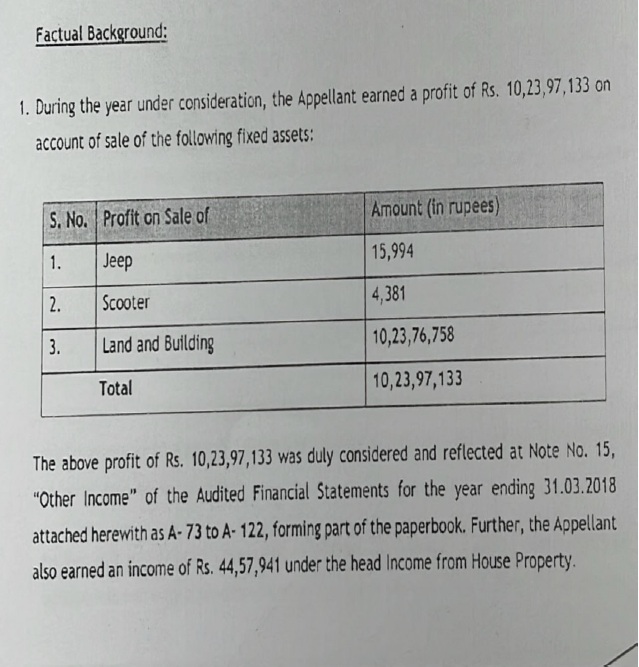
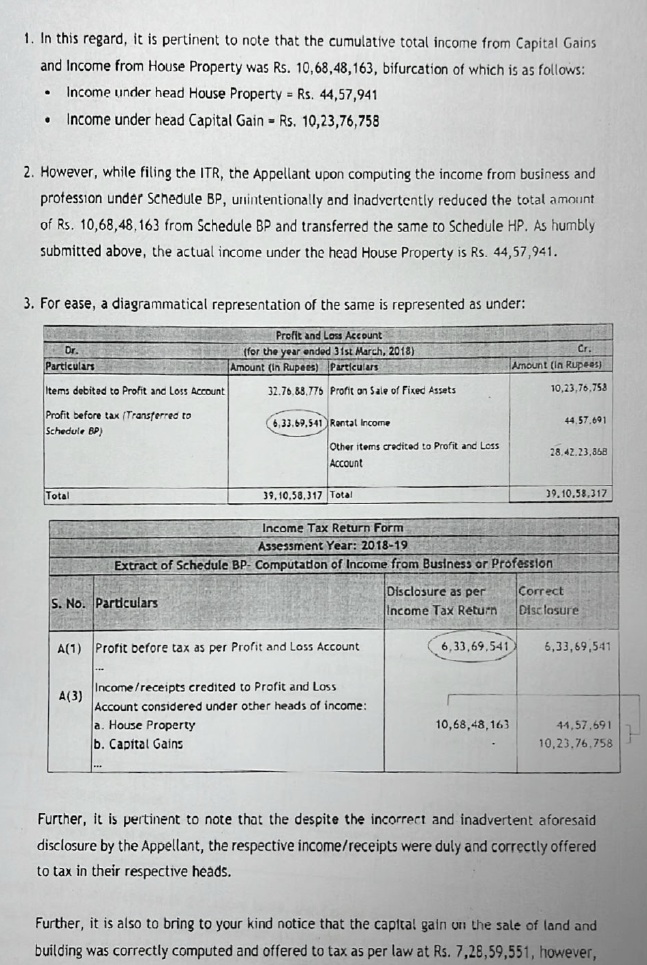
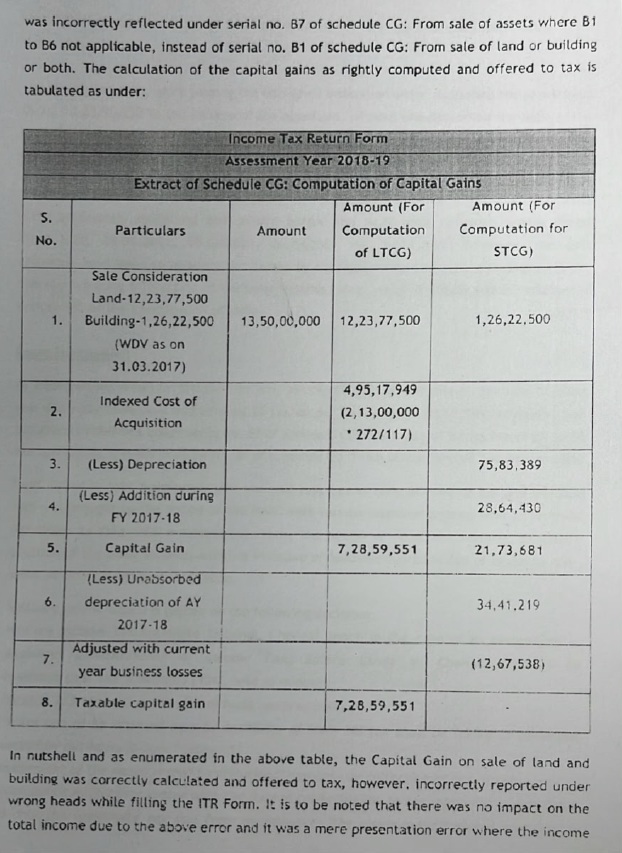
5. The ld. Counsel for the assessee vehemently argued assailing the order of the Ld. First Appellate Authority. It was contended that there was a bona fide unintentional and inadvertent mistake of assessee while filing its Return of Income in the schedules of business profits, etc. Thus, the ld. Counsel invited our attention to submissions on page-13 to 16 of its paper book.
6. The ld. Counsel accordingly prayed that the order of ld. CIT(A) is excessive and unwarranted. The ld. Counsel further argued that the order under section 143(1) got merged with order under section 143(3) which was subsequently passed and therefore the argument of the ld. Counsel for the assessee in dismissing his appeal are not correct. It was also contended that the assessee has already paid taxes on all the amounts which were added back under section 143(1) and therefore it’s a case of double taxation.
7. Shri Ajay Kumar Arora, ld. Sr. DR, pleaded that he would like to place reliance upon the order of lower authorities.
8. We have heard rival submissions in the light of material available on records. The solitary controversy raised in the present case is as to whether the appropriateness of the conclusion drawn by the ld. First Appellate Authority of dismissing the appeal of the assessee on the premise that as there was no cause for any grievance in the order under section 143(3) dated 15.04.2021, the assessee was not entitled for any relief qua disturbance made to its total income u/s 143(1). Before proceeding further, we would like to reproduce the statutory prescription contained in section 246 of the Act concerning filing of appeals before the First Appellate authority vis CIT(A)s or the JCIT(A)
246. (1) Any assessee aggrieved by any of the following orders of an Assessing Officer (below the rank of Joint Commissioner) may appeal to the Joint Commissioner (Appeals) against—
| (a) |
an order being an intimation under sub-section (1) of section 143, where the assessee objects to the making of adjustments, or any order of assessment under subsection (3) of section 143 or section 144, where the assessee objects to the amount of income assessed, or to the amount of tax determined, or to the amount of loss computed, or to the status under which he is assessed; |
| (b) |
an order of assessment, reassessment or recomputation under section 147; |
| (c) |
an order being an intimation under sub-section (1) of section 200A; |
| (d) |
an order under section 201; |
| (e) |
an order being an intimation under sub-section (6A) of section 206C; |
| (f) |
an order under sub-section (1) of section 206CB; |
| (g) |
an order imposing a penalty under Chapter XXI; and |
| (h) |
an order under section 154 or section 155 amending any of the orders mentioned in clauses (a) to (g): |
Provided that no appeal shall be filed before the Joint Commissioner (Appeals) if an order referred to in this sub-section is passed by or with the prior approval of, an income-tax authority above the rank of Deputy Commissioner.
(2) Where any appeal filed against an order referred to in sub-section (1) is pending before the Commissioner (Appeals), the Board or an income-tax authority so authorised by the Board in this regard, may transfer such appeal and any matter arising out of or connected with such appeal and which is so pending, to the Joint Commissioner (Appeals) who may proceed with such appeal or matter, from the stage at which it was before it was so transferred.
(3) Notwithstanding anything contained in sub-section (1) and subsection (2), the Board or an income-tax authority so authorised by the Board in this regard, may transfer any appeal which is pending before a Joint Commissioner (Appeals) and any matter arising out of or connected with such appeal and which is so pending, to the Commissioner (Appeals) who may proceed with such appeal or matter, from the stage at which it was before it was so transferred.
(4) Where an appeal is transferred under the provisions of sub-section (2) or sub-section (3), the appellant shall be given an opportunity of being reheard.
(5) For the purposes of disposal of appeal by the Joint Commissioner (Appeals), the Central Government may make a scheme, by notification in the Official Gazette, so as to dispose of appeals in an expedient manner with transparency and accountability, by eliminating the interface between the Joint Commissioner (Appeals) and the appellant, in the course of appellate proceedings to the extent technologically feasible and direct that any of the provisions of this Act relating to jurisdiction and procedure for disposal of appeals by the Joint Commissioner (Appeals), shall not apply or shall apply with such exceptions, modifications and adaptations as may be specified in the notification.
(6) For the purposes of sub-section (1), the Board may specify that the provisions of that sub-section shall not apply to any case or any class of cases.
Explanation.—For the purposes of this section, “status” means the category under which the assessee is assessed as “individual”, “Hindu undivided family” and so on.
9. Perusal of the above shows that it gives right to a tax payer, if aggrieved by an action of the qua orders passed under sub-clauses (a) to (h) of section 246(1). Thus, the right to file an appeal has two essential critical components. Firstly, a tax payer should have been aggrieved by an order passed by an Assessing Officer and secondly, such order should have been passed in any of the sub-clause (a) to (h) of section 246(1). It is pertinent to note that in sub-clause (a) of section 246(1) mentions orders u/s 143(1), or 143(3) or 144. This goes on to allude the clear prescription of law that all the three sections i.e. u/s 143(1), or 143(3) or 144 run independently. An assessee who is aggrieved under any of the said sub-section has to file a appeal under section 246. Therefore, the clear interpretation of the statute is that an assessee aggrieved by an order u/s 143(3) cannot resort for remedy by invoking provisions of section 143(1) and vice a versa. Thus, in simple terms, all the three sections in section 246(1)(a) are independent to each other and doctrine of merger would not apply.
10. The second component section 246(1)(a) is that the assessee has to be aggrieved meaning that there has to be an action of the Assessing Officer which has adversely impacted tax payers interest. Thus, if there is no cause of any grievance arising to a tax payer from an order passed u/s 143(1), or 143(3) or 144 of the Act, it cannot file an appeal under section 246(1) of the Act. In the above back ground, we have noted that the arguments of the assessee are not correct. Hypothetically assuming the assessee’s contentions of it being due for a genuine relief on account of its inadvertent mistakes in filing Return of Income are correct, the fact remains that it ought to have contested the same in respect of order passed u/s 143(1) and cannot test them qua an order passed u/s 143(3) of the Act. Hon’ble Apex Court in its decision in the case of Shri Dilip Kumar have laid down that where the provisions of statute is unambiguously clear, no different meanings can be assigned to it for giving or taking any benefit from a tax-payer.
11. On the issue of operation of Doctrine of merger between orders passed u/s 143(1) vis-a-vis orders passed u/s 143(3), we have noted that a hon’ble Coordinate Bench of the Chennai Tribunal in the case of the Kumbakonam Central Cooperative Bank v. DCIT [IT Appeal No.583 (Chny) of 2024, dated 21-2-2025] for Assessment Year 2013-14 had an occasion to examine the controversy. Considering nearly identical facts, it held as under:-
“5.0 We have heard rival submissions in the light of material available on records. We have noted that in realty the assessee was trying to contest before the Ld. CIT(A) the addition made by the Ld.AO on account of bad debts of Rs.9,66,65,844/- vide his order dated 22.03.2016. The issue i.e. seminal to the controversy is whether the law permits the assessee to do so now. The Ld. Counsel for the assessee submitted that by way of Doctrine of merger the order dated 22.03.2016 had merged with the order dated 12.03.2022 and hence it is entitled to contest the addition under bad debts made in the impugned order dated 22.03.2016. The Ld. DR on the other hand argued that the assessee had taken a conscious call of not contesting the addition made in order dated 22.03.2016 within the statutorily available time limits and therefore cannot agitate the same later. It was further submitted that there is no addition made in the order u/s 147 dated 12.03.2022 by the Ld. AO and hence the Ld. CIT(A) is correct in dismissing the appeal of the assessee in limine as non-maintainable. We find sufficient force in the arguments of the Ld. DR.
5.1 The controversy embedded in the present appeal of the appellant assessee has been examined w.r.t. the statutory provisions of the act as well as the facts and circumstances of the case. In principle the assessee has contested the order u/s 251 of the act passed by the Ld. First Appellate Authority. Before the Ld. CIT(A) the appellant assessee had assailed order u/s 147 r.w.s. 143(3) dated 12.03.2022 of Ld.AO. This bring us to the question as to the powers of Ld.AO u/s 147 of the act. Briefly put section 147 empowers an assessing officer to bring to tax any income which has escaped assessment for reasons specified in the statute. Thus, a notice u/s 148 is issued by the Ld. AO to examine the issue as to whether any income has escaped assessment. It is noteworthy that this is the stage of prima face belief of the Ld. AO and not a conclusive finding which only comes upon detailed enquiry and investigation into the case, confronting the tax payer, examining material, evidence on record etc.
5.2 Section 246 of the act entails that “any assessee aggrieved” by the order of the Ld. AO passed under different statutory provisions of the act including u/s 147, possess a right to contest the impugned order by which it is “aggrieved”. The word “aggrieved” order would mean an order which causes an injury or harm to the taxpayer and the same in the case of Direct Tax Jurisprudence would mean raising of additional tax demand and / or interest or penalty. Thus, an order u/s 251 is passed by the Ld. First Appellate Authority qua an order appealed against u/s 246. The most essential ingredient for appeal to be filed u/s 246 and for the Ld. First Appellate Authority to pass an order u/s 251 is the presence of element of assessee being “aggrieved”.
5.3 Coming to the grounds on which an order u/s 147 r.w 143(3) can be assailed is two fold. Firstly it can be challenged on the legal issue of jurisdictional insufficiency or else on the issues concerning merits of the addition. The grounds concerning jurisdictional challenge may, inter alia, include matters like issue of notice being time barred or change of opinion to reopen the case etc. As regards merits the order can be assailed on the premise of opportunities of heard not being granted, reliance upon weak or negligible evidences or inadequate / inappropriate interpretation of the statute.
5.4 We have noted that when, viewed in the above context, there is nothing to challenge the order u/s 147 r.w.s. 143(3) dated 12.03.2022. There is nothing on records that the issue of jurisdiction u/s 147 was raised by the assessee either before the Ld.AO during reassessment proceedings or assailed before the Ld. CIT(A). Nothing has been brought on records to allude towards jurisdictional insufficiency of the reassessment proceedings u/s 147. As far as merits of the case are concerned, there cannot be any case of grievance to the assessee because the Ld. AO did not make any additions. In fact in all fairness it is noted that the Ld. AO had initiated proceedings u/s 147 to examine an aspect of the percentage of rural branches which the assessee bank was having qua its claim of deduction u/s 36(1)(vii), however upon noting absence of any deficiency, the Ld. AO proceeded not to make any further disturbance. It is pertinent to point out that 147 action is always taken to add to or improve upon the quantum of income assessed in the original order, be it u/s 143(1) or u/s 143(3). It is thus seen that there was no case for the assessee getting aggrieved by the order of the Ld. AO, which would have warranted filing of an appeal u/s 246 before the Ld. First Appellate Authority. The views of the Ld. First Appellate Authority extracted in para 4.0 herein above, have therefore been found to be totally in order. The decision of the Ld.CIT(A) that as the assessee has not contested the order dated 22.03.2016 in which the addition of Rs.9,66,65,844/- was made by the Ld.AO on account of bad debts, the same cannot now be contested in a roundabout manner by invoking the hypothesis of doctrine of merger. Merely because the Ld. AO has reopened the assessment on connected matter and proceeded to conclude that no further addition is required to be made would not mean that the original addition stands obliterated. Both the assessment orders dated 22.03.2016 and dated 12.03.2022 are on different footings and cannot be treated as composite orders. We therefore find force in the argument of the Ld. CIT(A) as to when there is no addition no relief can be given to the assessee. Accordingly, we confirm the order of the Ld. CIT(A) and dismiss all the grounds of appeal raised by the assessee.
6.0 In the result, the appeal of the assessee for ITA No.583/Chny/2024 for AY-2013-14 is dismissed.”
12. Thus, the conclusion is that there is no doctrine of merger appearing unavailable between orders passed u/s 143(1) vis a vis those passed u/s 143(3). Accordingly, in view of the fact that there was no cause for grievance to the assessee qua order u/s 143(3) dated 15.04.2021, the ld. CIT(A) was right in dismissing the appeal of the assessee primarily on the ground of non-maintainability. We are therefore of the considered view that there is no case for any intervention in the order of the ld. CIT(A). We, therefore, confirm the same and dismiss the appeal of the assessee.
13. In the result, the appeal of the assessee is dismissed.