ORDER
B.M. Biyani, Accountant Member.- The captioned six cross-appeals, consisting of three appeals by assessee and three appeals by revenue, are preferred against three separate orders of first-appeals dated 10.03.2022 passed by learned Commissioner of Income-tax (Appeals)-4, Surat [“Ld. CIT(A)”], which in turn arise out of respective assessment-orders dated 28.03.2015/27.03.2015 passed by Ld. ACIT, Central Circle-4, Surat [“Ld. AO”] for Assessment Years [“AYs”] 201112 & 2012-13 u/s 153A r.w.s. 143(3) of the Income-tax Act, 1961 [“the Act”] and for AY 2013-14 u/s 143(3) of the Act.
2. Precisely stated, the background facts leading to present appeals are such that the assessee-individual is engaged in the business of dealing in real estate. The income-tax authorities carried out a search u/s 132 of the Act upon “Piyush Patel Group” including assessee on 27.12.2012, pursuant to which the AO framed special assessments u/s 153A r.w.s. 143(3) for AYs 2011-12 & 2012-13 and regular assessment u/s 143(3) for AY 2013-14 which are the subject-matters of present appeals. While framing those assessments, the Ld. AO made certain additions/disallowances. Aggrieved, the assessee carried matters in first-appeals before Ld. CIT(A) whereupon the Ld. CIT(A) granted certain reliefs. Now, the assessee and revenue, both are aggrieved by the orders passed by Ld. CIT(A) and have come in present appeals before ITAT.
3. Since these appeals involve identical/similar issues, they were heard together at the request of parties and are being disposed of by this consolidated order for the sake of convenience, brevity and clarity. We will first adjudicate assessee’s appeals and thereafter take up revenue’s appeals.
Assessee’s Appeals:
4. Initially, the assessee has raised grounds in the Form No. 36 (Appeal Memos) of respective years which are kept in case files. Subsequently, the assessee has also raised following “additional grounds” through separate applications:
Additional grounds in IT(SS)A 11/SRT/2022 – AY 2011-12:
“(1) On the facts and in the circumstances of the case as well in law, the learned CIT (Appeals) ought to have quashed the impugned assessment order passed by the JAO, on the ground that the JAO has failed to adhere to provisions of Section 153C while relying upon material seized during search/survey in case of third parties and hence, being patently in violation of the provisions of the law, arbitrary, baseless and without jurisdiction, is liable to be quashed.
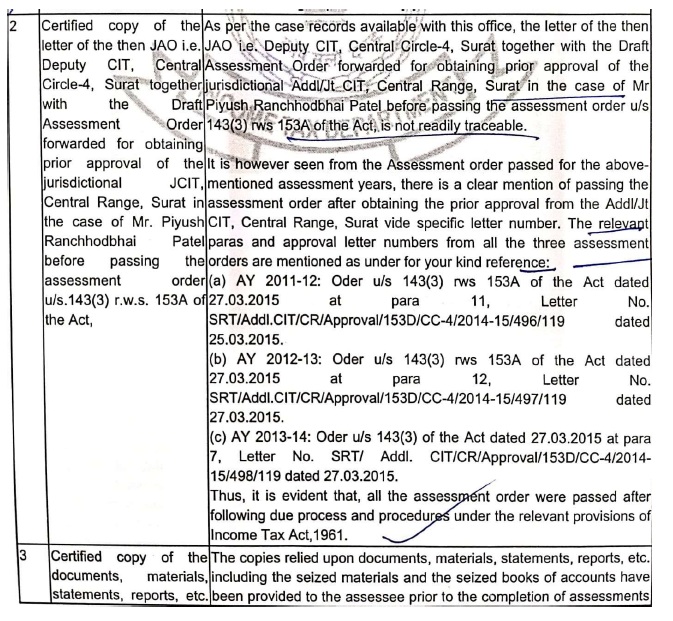
(2) On the facts and in the circumstances of the case as well in law, the learned CIT (Appeals) ought to have quashed the impugned assessment order passed by the JAO, on the ground that the JAO had not taken a valid approval u/s 153D in accordance with the law and therefore, the assessment order passed for the relevant assessment year in question based on mere non speaking, mechanical and half-hearted approval of the superior authority i.e. the JCIT, Central Range, Surat, resulted into pure violation of the CBDT’s Circular No. 3 of 2008 dtd. 12-03-2008 and hence, being patently in violation of the provisions of the law, arbitrary, baseless and without jurisdiction, is liable to be quashed.”
Additional grounds in IT(SS)A 12/SRT/2022 – AY 2012-13:
“(1) On the facts and in the circumstances of the case as well in law, the learned CIT (Appeals) ought to have quashed the impugned assessment order passed by the JAO, on the ground that the JAO has failed to adhere to provisions of Section 153C while relying upon material seized during search/survey in case of third parties and hence, being patently in violation of the provisions of the law, arbitrary, baseless and without jurisdiction, is liable to be quashed.
(2) On the facts and in the circumstances of the case as well in law, the learned CIT (Appeals) ought to have quashed the impugned assessment order passed by the JAO, on the ground that the JAO had not taken a valid approval u/s 153D in accordance with the law and therefore, the assessment order passed for the relevant assessment year in question based on mere non speaking, mechanical and half-hearted approval of the superior authority i.e. the JCIT, Central Range, Surat, resulted into pure violation of the CBDT’s Circular No. 3 of 2008 dtd. 12-03-2008 and hence, being patently in violation of the provisions of the law, arbitrary, baseless and without jurisdiction, is liable to be quashed.”
Additional grounds in ITA 130/SRT/2022 – AY 2013-14:
“1. On the facts and in the circumstances of the case as well in law, the learned CIT (Appeals) ought to have quashed the impugned assessment order passed by the JAO, on the ground that the JAO had not taken a valid approval u/s 153D in accordance with the law and therefore, the assessment order passed for the relevant assessment year in question based on mere non speaking, mechanical and halfhearted approval of the superior authority i.e. the JCIT, Central Range, Surat, resulted into pure violation of the CBDT’s Circular No. 3 of 2008 dtd. 12-03-2008 and hence, being patently in violation of the provisions of the law, arbitrary, baseless and without jurisdiction, is liable to be quashed.”
5. Ld. AR for assessee submitted that the additional grounds are legal in nature, go to the root of the matter, do not require consideration of any fresh evidence, and can be adjudicated on the basis of material already available on record. Placing reliance on the decision of Hon’ble Supreme Court in National Thermal Power Co. Ltd. v. CIT 229 ITR 383 (SC), Ld. AR submitted that the additional grounds are admissible. Ld. DR for Revenue opposed the admission of additional grounds but, however, could not controvert the submissions made by Ld. AR. After a careful consideration, we find merit in the submissions of Ld. AR for assessee. Since the additional grounds are legal in nature, go to the root of the matter, do not require consideration of any fresh evidence, and can be adjudicated on the basis of material already available on record, we admit the same and proceed to adjudicate in subsequent paras.
Additional Ground No. 2 in AY 2011-12 & 2012-13 and No. 1 in AY 2013-14:
6. By means of these grounds, the assessee is claiming that the assessment-orders passed by Ld. AO without taking a valid approval mandated u/s 153D are void-ab-initio, invalid and liable to be quashed.
7. Ld. AR for assessee submitted that in terms of provision of section 153D, the assessment-orders were required to be passed with the prior approvals of the Joint Commissioner/Addl. Commissioner, which the Ld. AO has not obtained in present matters. To support this claim of assessee, Ld. AR invited our attention to Point No. 2 / Page 2 of the letter bearing DIN: ITBA/COM/F/17/2025-26/1080482642(1) dated 09.09.2025 supplied by AO’s office to assessee; the same is scanned and re-produced below for an immediate reference:
8. Ld. AR submitted that in Point No. 2 of above information, the AO has clearly acknowledged that the letters of approvals are not traceable. However, the AO has simply relied upon the notings made by AO in assessment-orders giving the details of the approval-letters of Addl. CIT. Ld. AR submitted that when the AO is unable to produce the approval-letters issued by Joint Commissioner / Additional Commissioner u/s 153D, it has to be accepted that there was no approval taken by AO u/s 153D. Ld. AR submitted that the Hon’ble Jurisdictional High Court of Gujrat has accepted such a proposition in R/Tax Appeal No. 187 of 2019, Pr. CIT v. Munisuvrat Corporation (Gujarat), dated 23.07.2019, the relevant paras of decision are re-produced below:
“6. We take notice of the principal argument that was canvassed by the assessee before the ITAT. The principal argument has been noted by the ITAT in para 7, which reads as under:
“7. Feeling aggrieved and dissatisfied, the assessee has come up before this Tribunal by way of this appeal. The learned counsel for the assessee submitted that section, 153C of Income Tax Act, 1961, prescribed a mandatory requirement of recording of satisfaction by the AO of seized person about the belonginess of seized material by other person. The AO of the searched person is also required to hand over such searched material to the AO of the other person who then proceed for making the assessment of other person. In the instant case, the AO of the searched person has not recorded the satisfaction in the assessment of the assessee. The assessee has raised this issue before the learned CIT(A) but learned CIT(A) has taken adverse view by holding that the AO had jurisdiction over under section 153 C of the Act as the satakhat belonged the assessee. Hence, the AO was fully empowered to initiate proceedings under section 153C of the Act. The learned counsel for the assessee, referred the CBDT circular No. 24/2015 dated 31st December 2015 which is regarding recording of satisfaction note under section 158BD/153C of the Act wherein in para 4 it was mentioned as “The guidelines of the Hon’ble Supreme Court as referred in para 2 above, with regard to recording of satisfaction note may be brought to the notice of all for strict compliance. Iti s further clarified that even if the AO of the searched person and “other person” is one and the same, then also he is required to record his satisfaction as held by the courts.” The learned counsel for the assessee, submitted that the assessment proceedings carried under section 153 C of the Income Tax Act, 1961 were without recording of any satisfaction by the AO. The learned counsel contended that in the assessee’s case, no satisfaction was recorded by the AO of the person searched. The learned counsel for the assessee submitted that assessee has requested the AO vide letter dated 17th April 2018 to furnish copy of satisfaction note recorded under section 153C in the case of to represent the case before Tribunal. However, it was not supplied to the assessee. Therefore, the Bench of Tribunal has also requested the AO vide letter dated 17th April 2018 to furnish copy of satisfaction note recorded under section 153C in the case of to represent the case before Tribunal. However, it was not supplied to the assessee. Therefore, the Bench of Tribunal has also requested the learned Departmental Representative to supply copy of satisfaction note if any recorded by the AO. In compliance thereof, the AO vide letter dated 20.8.2018 submitted that looking to facts that not only satisfaction note but also order sheet are not traceable, it is very likely that the AO was maintaining confidential folder incorporating important papers somehow got misplaced hence, not ready available with the AO i.e. Income Tax officer, ward-1(3)(7) Surat also filed an affidavit dated 17.8.2018 to this effect that from transfer memo of records, no satisfaction note was received and same is not available on assessment record. The assessee is also agitating that even in its own case no satisfaction was recorded as regard to its belongingness to certain incriminating documents seized from the premises of Shir Kiritbhai M. Shah. The learned counsel for the assessee further relied in the case of Pepsi co India Holding Pvt. Ltd. V. ACTT (2015) 370 ITR 295 (Delhi) (Delhi) wherein it was observed as follows: “In the instant case, it is nobody’s case that Jaipuria Group had disclaimed those documents as belonging to them. Unless and until it is established that the documents as belonging to them. Unless and until it is established that the documents do not belong to the searched person, the provisions of section 153C do not get attracted because the very expression used in section 153C is that where the Assessing Officer is satisfied that any money, bullion, jewellery or other valuable article or thing or books of account or documents seized or requisitioned belongs or belong to a person other than the person referred to in section 153A.” In view of this phrase, it is necessary that before the provisions of section 153C can be invoked, the Assessing officer of the searched person must be satisfied that the seized material (which included documents) does not belong to the person referred to in section 153A, i.e., the searched person. In the satisfaction note, which is the subject matter of these writ petitions, there is nothing therein to indicate that the seized documents do not belong to the Jaipuria Group. This even apart from the fact that there is no disclaimer on the part of the Jaipuria Group insofar as these documents are concerned.(para 14)”
6. The Tribunal, ultimately recorded its findings as reflected in para 12 of the impugned order, which read thus:
“12. We have heard the rival submissions and have perused the materials available on record. We find that the assessing officer has issued notices under section 153C of the Act based on search under section 132(1) which was carried out in the case of Shri Kirit M. Shah. The Assessing Officer issued notices under section 153C and initiated the assessments proceeding for the years under consideration. The provisions of section 153C can be invoked only after recording a satisfaction in the case of persons searched qua the assets or books or documents seized during the course of search belong to some other person. In the instant case, the Assessing officer of other concerned assessee has not recorded any satisfaction qua the belongingness of the seized documents with the assessee. Similarly, as admitted by the AO vide letter dated 20.8.2018 that there was no satisfaction note is available in the case of the assessee, led to believe that there was no satisfaction note recorded in the case of the assessee as well as in the case searched person, therefore, the assessment proceeding initiated by way of issue of notice under section 153C read with section 153 A is bad in law. The Hon’ble Delhi High Court in the case of Pepsi Co. India Holding Pvt. Ltd. V. ACIT (2015) 370 ITE 295 (Delhi) (Delhi) “where the Assessing officer is satisfied that any money, bullion jewellery or other valuable article or thing or books of account or other than the person referred to in section 153A.” In view of this phrase, it is necessary that before the provisions of section 153C can be invoked, the Assessing officer of the searched person must be satisfied that the seized material (which includes documents) does not belong to the person referred to in section 153 A i.e., the searched person. In the satisfaction note, which is the subject matter of these writ petitions, there is nothing therein to indicate that the seized documents do not belong to the Jaipuria Group. This is even apart from the fact that there is no disclaimer on the part of the Jaipuria Group in so far as these documents are concerned. In the present case, there is not satisfaction that seized document belonged to the assessee. therefore, proceeding initiated under section 153 C are bad in law.” The similar issue had come up before the Hon’ble High Court of Madhya Pradesh in the case of CIT v. Mechmen (2015) (MP), wherein the Hon’ble High court discussing the various judgments has held that the AO is obliged to record satisfaction (in case of the searched person) that the assets or documents do not belong to the searched person and these in fact belong to some other person other than the searched person. This is sine quo non despite the fact that the AO of searched and non-searched person is same. Thereafter, he has to handover the material to the AO of non- searched person having jurisdiction over him (may be the same AO). After receipt of the material and due verification, the AO of non-searched person has to issue notice under section 153C of the Act and to proceed in the matter. Thus, we are of the view that the Assessing officer of the person searched has to necessarily form a satisfaction that the item referred to in section 153 C belongs or belong to a person other than the person searched. Apparently, in the present appeals, no such satisfaction has been recorded by the Assessment officer. The learned DR has not controverted the submission of the learned counsel for the assessee that in the case of the persons searched, no satisfaction as regard to the belongingness of any document to the present assessees was recorded. The learned counsel for the assessee relied on circular No. 24/2015 dated 31.12.2015, issued by the CBDT, in which, the Board following the decision of Hon’ble Supreme Court in case of M/s Calcutta Knitwear’s (civil Appeal No. 3958 of 2014 dated 12.3.2014), has directed that where the satisfaction by the Assessing officer of the person searched and other person is not found recorded, the Department should not press that mater in Appeal. Thus, keeping in view rival submissions in light of judicial pronouncements as discussed above and CBDT Circular (supra) the assessment in the assessee case for the assessment year under consideration is held as illegal and void-ab initio. Accordingly, the grounds raised by the assessees relating to applicability of section 153 C are allowed.”
7. Having heard the learned counsel appearing for the parties and having gone through the materials on record, we are of the view that no error, not to speak of any error of law, is said to have been committed by the Tribunal in the impugned order.
8. We would not like to disturb the finding of fact arrived at by the Tribunal.
9. In the result, this Appeal fails and is hereby dismissed.”
[emphasis supplied]
9. Ld. AR placed a strong reliance on the decision of Hon’ble Jurisdictional High Court of Gujarat in Pr. CIT v. Sunrise Finlease (P.) Ltd. (Gujarat), to contend that the prior approval contemplated u/s 153D is a mandatory statutory requirement and that an assessment order passed without such valid prior approval is unsustainable in law. The relevant observations of the Hon’ble High Court, relied upon by Ld. AR, are reproduced below:
“9. As regards proposed questions [B] and [C] viz., whether lack of approval under section 153D would invalidate the assessment order and was not a curable defect, it may be noted that section 153D of the Act mandates that no order of assessment or reassessment shall be passed by an Assessing Officer below the rank of Joint Commissioner in respect of each assessment year referred to in clause (b) of subsection (1) of section 153A or the assessment year referred to in clause (b) of subsection (1) of section 153B, except with the prior approval of the Joint Commissioner. In the present case, the assessment order has been passed by an Income Tax Officer, who admittedly is an officer below the rank of Joint Commissioner, therefore, the provisions of section 1530 of the Act would be applicable Section 153D starts with the words “No order of assessment or reassessment shall be passed.” In other words, the language employed in the provision is couched in the negative and therefore, there is a prohibition against passing of an assessment or reassessment order, except with the prior approval of the Joint Commissioner.
10. In Shin-Etsu Chemical Co. Ltd. v. Aksh Optifibre Lad [2005] 7 SCC 234, the Supreme Court has observed that if the requirements of a statute which prescribes the manner in which something is to be done are expressed in negative language, that is to say, if the statatte enacts that it shall be done in such a manner and in no other manner, it has been laid down that those requirements are in all cases, absolute, and that neglect to attend to them will invalidate the whole proceeding. In Vijay Narayan Thatte v. Stute of Maharashtra [2009] 9 SCC 92, the Supreme Court has helld that it is well settled that when a statute is couched in negative language it is ordinarily regarded as peremptory and mandatory in nature. The Supreme Court, in some decisions has held that merely because a provision of law is couched in a negative language implying mandatory character, the same is not without exceptions. However, the present case deals with the interpretation of a taxing statute. It is well settled that a toxing statute has to strictly construed, therefore, from the language employed in section 153D of the Act, the requirement of obtaining the prior approval of the Joint Commissioner has to be regarded as mandatory in nature.
11. In the facts of the present case, as the assessment order has been pasand by an Income Tax Officer, the requirement of obtaining the prior approval of the Joint Commissioner under section 153D of the Act was absolute. The Tribunal, however, has recorded a finding of fact that there is nothing on record to indicate that the prior approval of the Joint Commissioner was obtained. As a natural corollary therefore, in the absence of the requirement of prior approval of the Joint Commissumer being satisfied, the whole proceeding would stand invalidated. The Tribunal was, therefore, wholly justified in holding that the impugned order of assessment would stand vitiated in view of non-compliance of the provisions of section 153D of the Act. On this count also, therefore, the appeal, does not merit acceptance.”
10. Ld. AR further placed reliance on the following decisions to contend that the approval contemplated u/s 153D is not an empty formality and that the approving authority is required to apply its independent mind before granting such approval. It was submitted that where the approval is granted mechanically, without proper consideration of the draft assessment-order and the material available on record, such approval cannot be regarded as a valid approval for the purposes of section 153D:
| (i) |
|
Hon’ble Orissa High Court in ACIT v. Serajuddin & Co 454 ITR 312 (Orissa) – The SLP filed by revenue has already been dismissed by Hon’ble Supreme Court ACIT v. Serajuddin and Co. (SC). |
| (ii) |
|
Hon’ble Delhi High Court in Pr. CIT (Central) v. Anuj Bansal 466 ITR 251 (Delhi) – The SLP filed by revenue has already been dismissed by Hon’ble Supreme Court Pr. CIT v. Anuj Bansal 466 ITR 254 (SC). |
11. Ld. AR submitted that even if the Revenue were to contend that the approval was in fact granted by the Addl. CIT, the Tribunal would still be required to examine the approval-letter to ascertain whether the statutory authority had applied its mind before granting such approval. According to Ld. AR, when the alleged approval-letters themselves are not available on record and have admittedly not been produced before the Tribunal, neither the existence nor the validity of the alleged approvals can be examined by ITAT.
12. Ld. AR, therefore, submitted that the mere mention of the particulars of the alleged approval-letters in the assessment-orders cannot cure the defect arising from non-production of the approval-letters themselves. It was contended that the statutory requirement is of obtaining prior approval u/s 153D and not merely of making a recital in the assessment-order that such approval had been obtained. Ld. AR accordingly prayed that the assessment-orders are liable to be quashed.
13. In reply, the Ld. DR for revenue made a submission that in earlier hearings conducted by a different composition of ITAT, Surat bench, the AO appeared with case record. Therefore, perhaps, the bench was convinced qua the obtaining of approval. Ld. DR, therefore, opposed the plea taken by Ld. AR.
14. In re-joinder, Ld. AR submitted that the AO personally appeared before the bench and claimed/showed the movement of papers between AO’s office and higher authority but the approval-letters were not produced/shown. Ld. AR contended that the movement of the assessment records or papers between the AO and the higher authority cannot, by itself, establish that a valid prior approval u/s 153D was actually granted in the manner contemplated by law.
15. We have considered the rival submissions of both sides and perused the material available on record. The controversy before us is whether, on the facts and circumstances of the present case, the assessment-orders passed by Ld. AO can be sustained when the approval-letters allegedly granted u/s 153D have not been produced before us and the AO himself has stated that such approval-letters are not traceable.
16. Section 153D of the Act reads as under:
“No order of assessment or reassessment shall be passed by an Assessing Officer below the rank of Joint Commissioner in respect of each assessment year referred to in clause (b) of sub-section (1) of section 153A or the assessment year referred to in clause (b) of subsection (1) of section 153B, except with the prior approval of the Joint Commissioner.”
17. A plain reading of the aforesaid provision makes it clear that the approval contemplated u/s 153D is a condition precedent for passing an assessment-order by an AO below the prescribed rank. The expression “prior approval” assumes significance. Thus, what is required to be established is not merely that some papers were forwarded to the superior authority or that the assessment-order contains a recital regarding approval, but that the competent authority had, in fact, granted the requisite approval before the assessment-order was passed. In present case, the assessee has sought copies of the approval-letters allegedly granted u/s 153D from the office of AO. In response, the AO, vide letter dated 09.09.2025, stated that the approval-letters were not traceable. Thus, despite the specific challenge raised by the assessee regarding the validity of approval u/s 153D, the Revenue has not been able to place before us the approval-letters mandated u/s 153D. The Hon’ble Jurisdictional High Court has, in Munisuvrat Corporation (supra) quashed the proceeding done by assessing authority where the authority failed to produce the satisfaction note required by assessee. The decision of Hon’ble Jurisdictional High Court, though rendered in the context of satisfaction note u/s 153C, is relevant for the broader principle that a statutory requirement going to the assumption of jurisdiction cannot be presumed to have been complied in absence of the relevant statutory record.
18. We are conscious of the fact that the assessment-orders contain references to the particulars of the alleged approval-letters. However, in our considered view, such recital, by itself, cannot be treated as conclusive proof of the existence of a valid approval, particularly when the assessee has specifically disputed the same and the Revenue has failed to produce the approval-letters before the appellate authority. The Hon’ble Jurisdictional High Court in Sunrise Finlease (P.) Ltd. (supra) has recognised the mandatory nature of the prior approval contemplated u/s 153D. Further, the decisions in Serajuddin & Co. (supra) and Anuj Bansal (supra), relied upon by Ld. AR, emphasise that the approval u/s 153D is not an empty formality and that the approving authority is required to apply its mind before granting such approval. Thus, even assuming that the Revenue’s assertion regarding grant of approval is accepted, the absence of the approval-letters prevents us from examining whether the statutory requirement was complied with in the manner contemplated by section 153D.
19. In our considered view, when a statutory provision makes prior approval a condition precedent for passing an assessment-order, the burden lies upon the Revenue to demonstrate compliance with such mandatory requirement when the same is specifically challenged by the assessee. In present case, the Revenue has not produced the approval-letters despite the issue having been specifically raised. A mere reference to the alleged approval in the assessment-order, in these circumstances, cannot substitute the statutory approval contemplated u/s 153D. Therefore, in the light of the provision of section 153D and the legal precedents cited by Ld. AR and having regard to the peculiar facts of the present case, we hold that the Revenue has failed to establish compliance with the mandatory requirement of obtaining prior approval u/s 153D before passing the assessment-orders. Consequently, the impugned assessment-orders are not sustainable and are hereby quashed.
20. Since we have already quashed the assessment-orders, other grounds raised by assessee are not required to be adjudicated at this stage. Those grounds are left open, undecided.
Revenue’s appeals:
21. Since we have already decided assessee’s appeals and quashed the assessment-orders passed by AO, the revenue’s appeals are rendered infructuous and do not require any adjudication from us at this stage. Therefore, the Revenue’s appeals are dismissed.
22. Resultantly, the Assessee’s appeals are allowed and the Revenue’s appeals are dismissed.



