ORDER
Manish Agarwal, Accountant Member.- The captioned cross-appeals are filed by assessee and the Revenue against the order dated 02.04.2012 by Ld. Commissioner of Income Tax (A)-15, Mumbai [“Ld. CIT(A)”] in Appeal No. CIT(A)-15/Arr.259/11-12 passed u/s 250 of the Income Tax Act, 1961 [“the Act”] arising out of assessment order dated 08.02.2011 passed u/s 143(3) of the Act pertaining to Assessment Year 2007-08.
2. Before us, both the parties have stated that the facts involved in both captioned cross-appeals are common, therefore, they are taken together and decided by a common order.
3. First we take up the assessee’s appeal for Assessment Year 2007-08 in ITA No.4306/Mum/2012.
ITA No.4306/Mum/2012 [Assessment Year 2007-08]
[Assessee’s appeal]
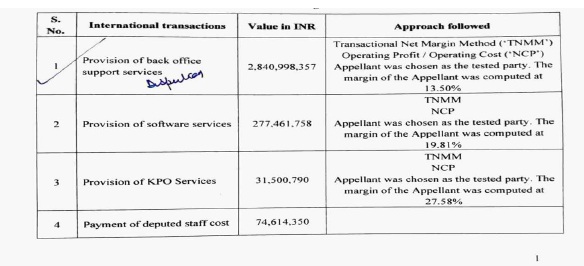
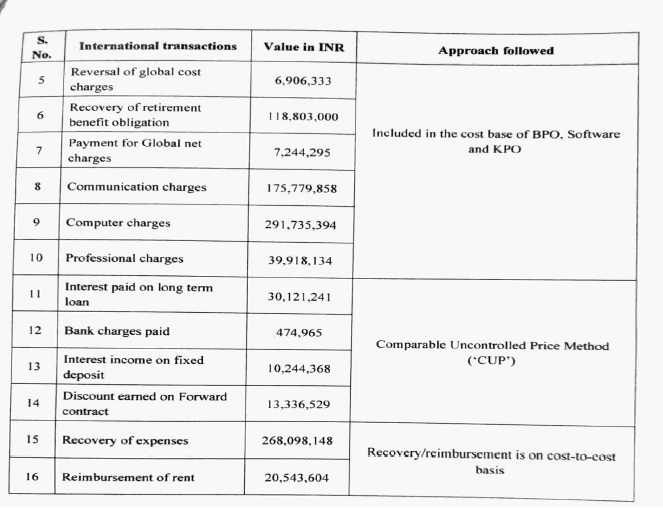
4. Brief facts of the case are that the assessee was earlier known as RBS Business Services Ltd. and is engaged in rendering back office support services, software services and knowledge process outsourcing services (“KPO”) to various entities within its Group (“NatWest Group”). During the year, the assessee has entered into following international transactions with its Associated Enterprises (“AEs”):-
5. The return of income was filed on 31.10.2007, declaring total income of INR 5,25,59,617/- under the normal provisions of the Act and book profit of INR 4,54,03,426/- was declared u/s 115JB of the Act. The case was selected for scrutiny and the matter was referred to Transfer Pricing Officer (“TPO”) for determination of the Arm’s Length Price (“ALP”) of international transactions carried out by the assessee with its AE’s. The TPO in terms of the order dated 29.10.2010 passed u/s 92CA(3) had made following adjustments under various services provided to its AE:-
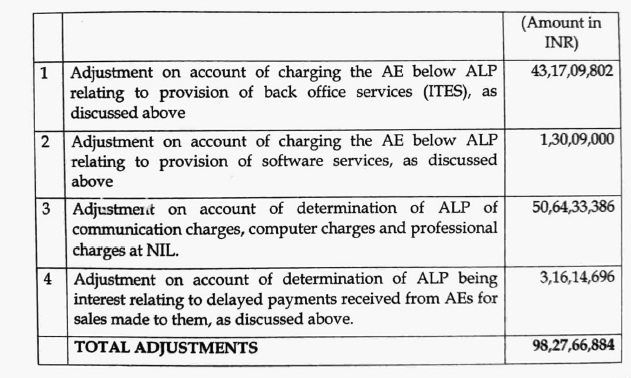
6. Accordingly, TPO proposed total adjustments of INR 98,27,66,884/-. The AO passed the draft assessment order on 03.12.2010. Since the assessee has not disputed the draft assessment order before the Dispute Resolution Panel (“DRP”) therefore the AO has passed the order u/s 143(3) dated 08.02.2011 wherein the AO has incorporated all the adjustments of INR 98,27,66,884/- made by the TPO for the international transactions carried out with its AE’s and further reduce the deduction u/s 10A of the Act to INR 74,57,93,220/- as against INR 81,97,75,474/- claimed by the assessee.
7. Against the said order, the assessee preferred an appeal before Ld. CIT(A) who vide impugned order dated 02.04.2012 has partly allowed the appeal of the assessee where in T.P. adjustment made on account of back office support service and interest on delayed payment of INR 3,16,14,696/- were sustained and the adjustment with respect to provision of software service of INR 1,30,09,000/- and adjustments towards the communication charges computer charges and professional charges of INR 50,64,33,386/- were deleted. Further, the reduction in the deduction claimed u/s 10A on account of unbilled revenue was sustained.
8. Aggrieved by the order of Ld. CIT(A), both the parties i.e. the assessee and the Revenue, are in appeal before the Tribunal by taking following Grounds of appeal mentioned in the appeal memo:-
ITA No.4306/Mum/2012 [Assessment Year : 2007-08]
[Assessee’s appeal]
Ground 1-Transfer Pricing Adjustment
| 1. |
|
Back-office support services |
| 1.1 |
|
“The learned Commissioner of Income-tax (Appeals) -15, Mumbai (‘CIT-A’) erred on facts and in law in upholding the addition in relation to international transaction of back-office support services made by the Assessing Officer i.e. Deputy Commissioner of Income-tax, Range 3(3), Mumbai (‘AO’) by relying on the order of the Additional Commissioner of Income-tax I(1) (‘TPO’) to the Appellant’s total income based on the provisions of Chapter X of the Income-tax Act, 1961 (‘the Act’). |
| 1.2 |
|
The learned CIT-A erred in confirming the erroneous action of the TPO who arbitrarily rejected/disregarded the detailed and methodical benchmarking analysis and comparable companies selected by the Appellant without appreciating the fact that such selection was based on the contemporaneous data and the transfer pricing study report prepared and maintained as per section 92D of the Act read with Rule 10D of the Income-tax Rules, 1962 (‘the Rules’). |
| 1.3 |
|
The learned CIT-A erred on facts and in law in upholding the action of the learned TPO of applying a standard search conducted by the tax office for Information Technology enabled Companies (‘ITES’) companies without taking into consideration the facts of the Appellant’s case and differences in the functions performed, assets employed and risks undertaken between the Appellant and the comparables appearing in the set of the TPO. Thus the Appellant prays that the fresh benchmarking analysis conducted by the learned TPO is liable to be quashed. |
| 1.4 |
|
The learned CIT-A erred on facts and in law in confirming the action of the learned TPO of obtaining data which was not available in public domain by using his special powers u/s 133(6) of the Act and selectively applying such data for benchmarking international transactions of the Appellant. |
| 1.5 |
|
The learned CIT-A erred on facts and in law in confirming the action of the learned TPO of not allowing adjustments in accordance with the provisions of Rule 10B(1)(e)(iii) of the Rules to account for differences in the functional and risk profiles of the international transactions and the alleged comparable uncontrolled transactions selected by the learned AO/ TPO. |
| 1.6 |
|
The learned CIT-A erred on facts and in law in arbitrarily rejecting the contention of the Appellant of computing the margin of alleged comparable companies based on multiple year financial data. |
| 1.7 |
|
The learned CIT-A erred in facts and in law in disregarding para 55.5 of Circular 14/2001 which clarifies that the basic intention underlying the new transfer pricing regulations is to prevent shifting out of profits by manipulating prices charged or paid in international transactions thereby eroding the country’s tax base. |
| 2. |
|
Notional Interest on outstanding invoice payments from Associated Enterprises |
| 2.1 |
|
The learned CIT-A erred on facts and in law in confirming the action of the learned AO/TPO in making an arbitrary and adhoc adjustment in relation to outstanding invoice payments from AEs for services rendered. |
| 2.2 |
|
The learned TPO/CIT-A erred on facts and in law, in adopting an arbitrary approach/methodology in imputing a notional interest on amount outstanding from AEs without considering the detailed submissions of the Appellant. |
The Appellant prays that the adjustment to the total income in relation to pricing provisions, made by the learned TPO and confirmed by the learned IT-A, be deleted.
Ground II-Adjustment on account of unbilled revenue
| 3.1. |
|
Based on the facts of the case and in law, the learned CIT-A erred in confirming the action of the AO in including the unbilled revenue of Rs. 7,25,14,158 to the total turnover of the Appellant for the purpose of calculating deduction under section 10A of the Act while excluding the same from the export turnover. |
| 3.2. |
|
Without prejudice to the above, based on the facts of the case and in law, the learned CIT-A erred in not maintaining parity and including the unbilled revenue in the export turnover also. |
Ground III-Levy of interest under Section 234B of the Act
| 4.1 |
|
. The Appellant submits that after giving relief on the grounds raised in this appeal, the interest levied in the impugned order would undergo a change. |
| 4.2 |
|
The Appellant, therefore, prays to grant relief in respect of consequently reduce the interest levied under Section 234B of the Act. |
Ground IV – Penalty Proceedings under section 271(1)(c) of the Act
| 5.1 |
|
On the facts and in the circumstances of the case, the learned AO has erred in initiating penalty proceedings under section 271(1)(c) of the Act. |
| 5.2 |
|
The Appellant prays that the penalty proceedings be dropped in the matter. |
The appellant submits that the above grounds are independent and without prejudice to one another.
The Appellant craves leave to add, alter, amend or withdraw all or any of the grounds of appeal herein above and to submit such statements, documents and papers as may be considered necessary either at or before the hearing of this appeal as per law.”
ITA No.4467/Mum/2012 [Assessment Year : 2007-08]
[Revenue’s appeal]
“Appeal under section 253(1)(d) of the Income Tax Act, 1961 (hereinafter referred to as the “Act”). against the order dated April 2, 2012 (received on May 7, 2012), passed by CIT(A)-15, Mumbai under section 250 of the Income-tax Act, 1961.
The following grounds are independent of and without any prejudice to one another.
Ground I -Transfer Pricing Adjustment
| 1. |
|
Back-office support services |
| 1.1 |
|
The learned Commissioner of Income-tax (Appeals) – 15, Mumbai (“CIT-A’) erred on facts and in law in upholding the addition in relation to international transaction of back-office support services made by the Assessing Officer i.e. Deputy Commissioner of Income-tax, Range 3(3), Mumbai (‘AO’) by relying on the order of the Additional Commissioner of Income-tax-1(1) (‘TPO’) to the Appellant’s total income based on the provisions of Chapter X of the Income-tax Act, 1961 (the Act’). |
| 1.2 |
|
The learned CIT-A erred in confirming the erroneous action of the TPO who arbitrarily rejected/disregarded the detailed and methodical benchmarking analysis and comparable companies selected by the Appellant without appreciating the fact that such selection was based on the contemporaneous data and the transfer pricing study report prepared and maintained as per section 92D of the Act read with Rule 10D of the Income-tax Rules, 1962 (‘the Rules’). |
| 1.3 |
|
The learned CIT-A erred on facts and in law in upholding the action of the learned TPO of applying a standard search conducted by the tax office for Information Technology enabled Companies (‘ITES’) companies without taking into consideration the facts of the Appellant’s case and differences in the functions performed, assets employed and risks undertaken between the Appellant and the comparables appearing in the set of the TPO. Thus the Appellant prays that the fresh benchmarking analysis conducted by the learned TPO is liable to be quashed. |
| 1.4 |
|
The learned CIT-A erred on facts and in law in confirming the action of the learned TPO of obtaining data which was not available in public domain by using his special powers u/s 133(6) of the Act and selectively applying such data for benchmarking international transactions of the Appellant. |
| 1.5 |
|
The learned CIT-A erred on facts and in law in confirming the action of the learned TPO of not allowing adjustments in accordance with the provisions of Rule 10B(1)(e)(iii) of the Rules to account for differences in the functional and risk profiles of the international transactions and the alleged comparable uncontrolled transactions declared by learned AO/TPO. |
| 1.6 |
|
The learned CIT-A erred on facts and in law in arbitrarily rejecting the contention of the Appellant of computing the margin of alleged comparable companies based on multiple year financial data. |
| 1.7 |
|
The learned CIT-A erred in facts and in law in disregarding para 5.5 of Circular 14/2001 which clarifies that the basic intention underlying the new transfer pricing regulations is to prevent shifting out of profits by manipulating prices charged or paid in international transactions thereby eroding the country’s tax base. |
| 2. |
|
Notional Interest on outstanding invoice payments from Associated Enterprises (‘AEs’) |
| 2.1 |
|
The learned CIT-A erred on facts and in law confirming the action of the learned AO/TPO in making an arbitrary and adhoc adjustment in relation to outstanding invoice payments from AEs for services rendered. |
| 2.2 |
|
The learned TPO/CIT-A erred on facts and in law; in adopting an arbitrary approach/ methodology in imputing a notional interest on amount outstanding from AEs without considering the detailed submissions of the Appellant. |
The Appellant prays that the adjustment to the total income in relation to transfer pricing provisions, made by the learned TPO and confirmed by the learned CIT-A, be deleted.
Ground II – Adjustment on account of unbilled revenue
| 3.1 |
|
Based on the facts of the case and in law, the learned CIT-A erred in confirming the action of the AO in including the unbilled revenue of Rs. 7,25,14,158 to the total turnover of the Appellant for the purpose of calculating deduction under section 10A of the Act while excluding the same from the export turnover. |
| 3.2 |
|
Without prejudice to the above, based on the facts of the case and in law, the learned CIT-A erred in not maintaining parity and including the unbilled revenue in the export turnover also. |
Ground III-Levy of interest under Section 234B of the Act
| 4.1 |
|
The Appellant submits that after giving relief on the grounds raised in this appeal, the interest levied in the impugned order would undergo a change. |
| 4.2 |
|
The Appellant, therefore, prays to grant relief in respect of the above grounds and consequently reduce the interest levied under Section 234B of the Act. |
Ground IV – Penalty Proceedings under section 271(1)(c) of the Act
| 5.1 |
|
On the facts and in the circumstances of the case, the learned AO has erred in initiating penalty proceedings under Section 271 (1) (c) of the Act. |
| 5.2 |
|
The Appellant prays that the penalty proceedings be dropped in the matter. |
The appellant submits that the above grounds are independent and without prejudice to one another.
The Appellant craves leave to alter, amend or withdraw all or any of the Grounds of Appeal herein above and to submit such statements, documents and papers as may be considered necessary either at or before the hearing of this appeal as per law.”
9. Before us, Ground of appeal No.1 raised by the assessee with respect to adjustment made in the transactions of back office support service. In support, ld.AR submits that the assessee has selected seven [07] comparables for benchmarking international transactions with respect to back office support services and worked out the margin @ 13.50% which is within [+/-] 5% of the arithmetic mean declared by the assessee. Therefore, no adjustment was made by the assessee and transactions were considered at ALP. The TPO though accepted the method applied by the assessee for determination of the ALP however, has modified/inserted new filters and further, the TPO has rejected two [02] comparables selected by the assessee and inserted twenty [20] new comparables and made the adjustment of INR 43,17,09,802/-. In first appeal, Ld. CIT(A) has directed to exclude seven [07] comparables inserted by the TPO and thereafter, based on the remaining eighteen [18] comparables out of twenty five [25] selected by TPO, the mean margin was computed at 32.60% and accordingly, the adjustment was come to INR 43,17,09,802/- towards the back office support services provided to its AE’s.
10. Before us, ld.AR requested for the exclusion of eleven [11] comparables taken by the TPO and the main argument of the assessee is that they are functional dissimilar, having extraordinary events and further failed in certain filters.
11. Besides this, ld.AR submits that TPO has denied the working capital adjustment as the assessee has not provided details of working capital adjustment. Ld.AR submits that assessee is a low risk captive services provider, providing support service and software services, KPO services therefore, working capital adjustment as per section 10A(b) should be provided. For this, reliance is placed on various judicial pronouncements which are as under:-
| (i) |
|
ITO v. CRM Services India (P.) Ltd. (Delhi)/ITA No.4796/Del/2010; |
| (ii) |
|
Mercer Consulting (India) (P.) Ltd. v. Dy. CIT 150 ITD 1 (Delhi – Trib.)/ITA No.966/Del/2014; |
| (iii) |
|
Asstt. CIT v. Akzo Nobel Car Refinishes India (P.) Ltd. (Delhi – Trib.)/ITA No.1925/Del/2011; |
| (iv) |
|
Verifone Sales India (P.) Ltd. v. ITO (Delhi–Trib.)/ITA Nos.5829/Del/2010 & 607/Del/2014; |
| (v) |
|
Westfalia Separator India (P.) Ltd. v. Asstt. CIT (Delhi – Trib.)/ITA No.4446/Del/2007; |
| (vi) |
|
Qualcomm India (P.) Ltd. v. ACIT [IT Appeal No. 5239 (Del) of 2010, dated 10-6-2013] ; and |
| (vii) |
|
Navisite India (P.) Ltd. v. ITO [IT Appeal No. 5329/Del/2012 dated 31-5-2013]. |
12. On the other hand, ld. CIT DR for the Revenue requested for the confirmation of the order of ld. CIT(A).
13. Heard the contentions of both the parties at length and perused the material on record. The argument of the assessee with respect to the exclusion of certain comparable is as discussed as under:-
[1]. Mold-Tek Technologies Ltd.-
14. This company is included by ld. TPO by holding that it is functionally in similar segment and therefore, is a valid comparable. The assessee submits that the company has two [02] divisions namely, (i) plastic division and (ii) I.T. division. Ld. CIT(A) says that I.T. division is comparable to the case of the assessee and the segmental results are given in the Annual Report. Whereas the claim of the assessee is that under I.T. division, the company provided structural engineering KPO services using tools like CAD/CAM, Stadd Pro and highly skilled engineers and therefore, it is working in the entirely different domain and providing specialized engineering services whereas assessee has provided BPO and KPO services where no specific specialized engineering services are required and therefore, the profit element in the comparable company of Mold-Tek Technologies Ltd. is very high. Further, during the year under appeal, there was an extraordinary event of amalgamation which was not considered and therefore, this company deserves to be excluded. For this, Ld.AR drew our attention to page 13 of the Annual Report of the company wherein there was a reference of merger of the company and further proposal was made for the demerger. He further drew our attention to the Annual Report wherein the company has started KPO division where engineering services were provided to high rise buildings for clients in US and Canada which has resulted into high profits. Ld.AR submits that this is not the case of the assessee and therefore, the company being functionally dissimilar and also having extraordinary event, the same should be excluded. He further submits that under similar circumstances, the said company was excluded by the Tribunal from the final set of comparables in the case ofHewitt Associates (India) (P.) Ltd. v. ACIT (Delhi – Trib.)/ITA No.5736/Del/2011, copy of the same is placed at page 92 to 142 of the Paper Book relevant pages 124 to 125.
15. On the other hand, Ld. CIT DR for the Revenue vehemently supported the inclusion of the said company as the valid comparable and submits that the assessee has failed to prove the amalgamation effect.
16. Heard the contentions of both the parties at length and perused the material on record. It is observed that the TPO has taken this company as it was under functionally similar segment. It is observed that the company is functionally dissimilar since it involves in providing highly specialized engineering services and KPO services whereas the assessee is providing business support services to its AE which is very general in nature of services. Under identical facts, the Co-ordinate Bench in the case of Hewit Associates Pvt. Ltd. has excluded this company from the valid comparable by making following observations:-
25.2 . “In support thereof, the assessee relied on the decision of the Special Bench of the Hon’ble Tribunal in the case of Maersk Global Centre (India) Private Limited (ITA No. 7466/MUM/2012) wherein it has been held as under :-
“81. In so far as the case of Mold-Tek Technologies Ltd. is concerned, it is observed from the annual report of the said company for the financial year 2007-08placed at page 139 to 151 of the paper book that the said company was pioneer in structural engineering KPO services and its entire business comprised of providing only structural engineering services to various clients. Further information of Mold-Tek Technologies Ltd. available on their Website is furnished in the form of printout at page 158 to 165 of the paper book and a perusal of the same shows that it is a leading provider of engineering and design services with specialization in civil, structural and mechanical engineering services. It is stated to have a strong team of skilled resources with world class resources and skill sets. It is also stated to have consistently helped the clients to cut down design and development costs of civil, structural, mechanical and plant design by 30-40% and delivered technologically superior outputs to match and exceed expectations. It is claimed to have inhouse software development team, quality control training and troubleshooting facilities. M/s. Mold-Tek is also rendering web design and development services with experience in turning them into an effective graphic design representation and creating dynamic and graphic rich web applications from IT specs, design prints etc. Keeping in view this information available in the annual report of Mold-Tek as well on its website, we are of the view that the said company is mainly involved in providing high-end services to its clients involving higher special knowledge and domain expertise in the field and the same cannot be taken as comparable to the assessee company which is mainly involved in providing low-end services.” [Emphasis supplied]
25.3 Upon consideration of the submissions made by the assessee, material available on record and the decision of the Special Bench of Tribunal in Maersk Global Centre (India) Private Limited (supra), we arrive at a conclusion that this company is not a suitable comparable to the assessee. Hence, we direct the Ld. TPO/AO to exclude this company from the final list of comparable companies.”
17. Thus, by respectfully following the aforesaid judgment of Coordinate Bench of the Tribunal (supra) and considering the fact that the assessee is not providing structural engineering services therefore, this company is not suitable comparable accordingly, we direct the AO/TPO to exclude the company from the final set of comparables.
[2 & 3]. Eclers Services Ltd. and Vishal Information Technology Pvt. Ltd.
18. The AO/TPO has included these two companies in the final set of comparables by observing that “Akin to ITES and inspite a different business model, heavy profits are being made thus comparable’. The ld. CIT(A) has confirmed the inclusion of these companies as valid comparable by observing as under:-
“In the annual accounts, under the Schedule 15 trading and operating expenses have been given which pertain to data entry charges and vendor payments. It nowhere shows that such work has been outsourced. It only shows that the data entry charges and the related costs may have been grouped separately and have not been shown as employee cost. Because what has been shown as employee cost is only ‘personnel cost’ which might relate to the personals employed for supervising and administrative set up. Accordingly the submission of the appellant that is sub contracts its business and the employee cost is less than 1% of the total cost may not be the fact of the case and it is also arrived at that even if so, the same does not vitiate the comparability.
Accordingly the contention of the appellant to exclude this company is not found to be acceptable.”
19. The contention of the assessee is that both the companies are functionally dissimilar as they are engaged in outsourcing activities where approximately 64% of the total expenses with respect to the outsourcing and further the employee cost to sales ratio is 2.30% whereas the assessee is purely dependent on the employees for providing its service and its employees cost to sales ratio is 42%. Further, considering these facts in the judgment of Hon’ble
Delhi High Court in the case of
Rampgreen Solutions (P.) Ltd. v.
CIT (
Delhi)/ITA No. 102/2015, both the companies were excluded from the list of valid comparables. After hearing both the parties and considering the material, we are of the view that both the companies are functionally dissimilar as they are carrying out the work through outsourcing and therefore, these are not valid comparables. This fact was considered by the Hon’ble Jurisdictional High Court in the case of
Rampgreen Solutions (P.) Ltd. (
supra) while excluding them fromt eh final set of valid comparables. Accordingly, we direct the AO/TPO to exclude these companies from the final set of comparables.
[4] Accentia Technologies Ltd.
20. This company was included by the TPO by making following observations:-
“The company is in healthcare receivable management (page 16, segment information AS 17 item No.19 of Annual Report. Even the assessee is in similar business, as detailed earlier in this order).
Majority of the income is generated from medical transcription billing and coding such this company is mainly into ITeS and accordingly comparable.
Further it is not coming out of the annual report that the company is into any kind of outsourcing. Accordingly, the appellant’s contention in respect of this company as not being comparable and should be excluded from the set of comparables for benchmarking is not found to be acceptable.”
21. The assessee claimed that the company has failed in IT enables services filter of 75% applied by the TPO as it has revenue form medical transcription of 57.70%; billing and coding of 9.50% and software devilment and implementation of 32.79%. Therefore, its revenue from ITeS services are 67.2% only which is less than 75%. Further its segmental data is not available in the public domain therefore, assessee requested for the exclusion of the same.
22. On careful consideration of the facts, we find force in the arguments of the assessee that this company has failed the IT enabled services filter of 75% applied by the TPO and further, its segmental data are not available in the public domain wherein company shows only single segment i.e. health care segment and no separate date for I. T. services was available. It is further observed that on the basis of the extraordinary event of acquisition and merger, the Co-ordinate Bench of the Tribunal in the case of Hewit Associates (India) (P.) Ltd. (supra) has excluded this company as a valid comparable by making following observations in para 27.2 of its order:-
27.2 “In support thereof, the Ld. AR relied on the decision of the Bangalore ITAT in AOL Online India Private Limited (IT(TP)A No.1036/Bang/2011) wherein the Hon’ble Tribunal for the same assessment year 2007-08 observed as under :-
“1. Extraordinary events during the year — Amalgamation of subsidiary resulting in growth of revenues by 75.33% Amalgamated the company Iridium Technologies which is a software product company. 2. Functionally not comparable – The activity of medical transcription (considered by TPO), billing and coding and software development and implementation is not comparable to the services provided by the Appellant. 3. Business promotion expenses constitutes 28.34% of the total operating revenue earned by the company”.
27.3 Keeping in view the fact that an extraordinary event in the form of acquisition took place in this company in the year under consideration, the other facts on record which clearly establishes the functionally dissimilarity between this company and the assessee and respectfully following the decision of the Hon’ble Bangalore Tribunal we hold this company to be not a suitable comparable company. Accordingly, we direct the Ld. TPO/ AO to exclude this company from the list of comparables.”
23. Considering the overall facts and following the order of Coordinate Bench in the case of Hewit Associates (India) P. Ltd. (supra), this company has extraordinary event of amalgamation in the year under appeal therefore, it is not a valid comparable and thus, we direct the AO/TPO to exclude this company from the final list of comparable.
[5]. HCL Comnet Systems & Services Ltd.
24. The TPO has added this comparable by making following observations:-
“In the business akin to assessee’s business being ITES. Abnormal profitability evens out in a large sample.”
25. Ld. CIT(A) has confirmed the action of TPO by observing as under:-
“The company is functionally comparable. Related party transaction upto 25% has been-considered to be acceptable for the comparability and benchmarking. Accordingly at the first place the transaction with even related party which is not associated enterprises within the meaning of section 92A cannot be regarded as having any influence on the transaction irrespective of the percentage of related party transaction. It is important to distinguish between a related party and associated enterprises. The related party could or could not be associated enterprises. It is only when there is transaction with the associated enterprises that such transaction cannot be considered as uncontrolled transaction and not otherwise. It is also the fact that there would hardly be any enterprises available which would not have related party transaction. The transactions with the associated enterprises are disclosed under the related party disclosure. Accordingly for the practical stand point of implementation of the transfer pricing regulations, it is important to consider such companies as comparable where the related party or the transactions with the associated enterprises would not have significant influence on the results. As per section 92A (2) (a) of the Act there is threshold given based on the 26%control requirement and below this threshold the law has considered that the same would not constitute to be an AE and therefore would not come under the purview of the T.P. regulations. Therefore it has been imperatively implied that if the holdings are less than this threshold the transactions are going to be free from influence and would be uncontrolled in nature. When holding below this threshold cannot be considered to be having any influence than only the transaction which may be sale/purchase or of any other nature below 25% would also have to be considered to not having significant influence on the results.”
26. The contention of the assessee is that this company has 02 segments namely, (i) Telecommunication services and (ii) IT enabled Services. In I.T. Enabled services, the company is engaged in the business of providing data center management services and user computing services, managed security services, networking services and tools and process consulting services. The company has also engaged in providing the remote data infrastructure management services, inferring high end KPO services. The assessee further claimed that company owns intangible assets of computer software services @ 17.76% of total assets and intangible total asset ratio @ 6.50% whereas the assessee operates normal BPO services and developing softwares product which accounted @ 6.50% of the total assets. The assessee further submits that company is functionally dissimilar and the Co-ordinate Bench in the case of Hewit Associates (India) (P.) Ltd. (supra) and in case of ICC India (P.) Ltd. v. Dy. CIT [IT Appeal No. 25 (Del.) of 2012, dated 30.03.2016] has excluded the same.
27. After considering the submissions of both the parties, it is observed that the company is functionally dissimilar and further under identical circumstances, this fact was also considered in the case of Hewit Associates (India) (P.) Ltd. (supra) & ICC India (P.) Ltd. (supra) thus, by respectfully following the aforesaid judgments, we hold that this company is functionally dissimilar and direct the AO/TPO to exclude this company from the final set of comparable.
[6]. Informed Technologies India Ltd.
28. TPO has included this company by observing that the business is akin to assessee’s business which fact was confirmed by ld. CIT(A). The contention of the assessee is that said company has higher business promotion expenses and abnormal margins. Further, the company is mainly engaged in the business of collecting and analyzing data on financial fundamentals, corporate governance, director/executive compensation and capital markets which is high-end services. Further, the turnover of both the companies is dissimilar where the company has turnover of INR 4.08 crores as against the company’s back office support services where the assessee has turnover of around INR 284 crores. Further, in the case of Hewit Associates (India) (P.) Ltd. (supra) and Dy. CIT v. Morgan Stanley Advantage Services (P.) Ltd. (Mumbai)/ITA No.4406 & 4479/Mum/2012 for AY 2007-08, this company was held as not a valid comparable due to abnormal margins and significant fluctuations in the margins of profits.
29. After considering all the facts, it is observed that this company is functionally dissimilar moreover, its turnover from back office business support services was very less as compared to turnover of the assessee thus, both the companies are dissimilar on turnover basis. Once the company is functionally dissimilar and having abnormal growth therefore, following the order of the Co-ordinate Bench in the case of Hewit Associates (India) (P.) Ltd. (supra), we direct the AO/TPO to exclude this company from the final set of comparables.
[7]. Iservices India Pvt. Ltd.
30. It is taken as valid comparable by observing that “entity is in similar business and in a large sample all things even out”. Ld. CIT(A) has included the same by making following observations:-
“The commission on sales is just Rs 4,99,238/- out of the total operating and other expenses at Rs. 35,750,831/-. This alone cannot make this company as functionally not 5 comparable. Further there is drastic dip in this head of expenses and sale of the company (have gone up. The appellant has mentioned that the whole transaction appear to be abnormal. Why and how abnormal has not been stated with any facts or figures.
In respect of the submission that this company was not thrown up in the search process undertaken by RBS BS is concerned it is mentioned that it is not the submission of the appellant that the company did not have its data in the public domain at the time its conduct of search. Further reliance is placed on the decision of Hon’ble ITAT in the case-of Quark system Pvt ltd.
38 SOT 307 (SB), where it has been held that the comparable L which are subsequently available can also be considered for benchmarking.”
31. The claim of the assessee is that this company is providing high end diversified services like web hosting, email services, spam filtering, domain names and DNS hosing services etc. Further, the same company was rejected as a valid comparable by the TPO in subsequent AY. Considering the overall facts and circumstances of the case, we find that said company is excluded by the TPO itself on account of functionally dissimilar in subsequent year. Thus there is no reason to take it as a valid comparable as it is contrary to the observations made in subsequent year. Accordingly, we direct AO to exclude the same from final set of comparable.
[8]. Asit C.Mehta Financial Services Ltd.
32. It is observed that the company is functionally dissimilar and TPO himself in subsequent AY has excluded this company from the final set of comparable on account of functionally dissimilar. Thus, by considering these facts, we direct TPO/AO to exclude this company as final set of comparables.
[9]. Genesys International Corporation Ltd.
33. TPO has included this company as the business akin to IT enable services and entity level all things even out in a large sample. Ld.CIT(A) confirmed the action of AO/TPO. The contention of the assessee is that company is not functionally comparable as it is engaged in providing GIS mapping services comprising of remote sensing, photogrammertry, cartography, data conversion and other related computer based services. Further, during the year under appeal, there was extraordinary event of demerger of engineering information division which is evident from the Annual Report of the company. Further, the company has intangible assets @ 39.73% of the assets. On the careful consideration of the facts, it is observed that there was an extraordinary event of demerger and out of total assets, it has intangible assets of 39.73% as against 6.55% of total assets held by the assessee thus, is not valid comparable accordingly, we direct AO/TPO to exclude the same from the final set of comparable.
[10]. Cosmic Global Ltd.
34. This company is included as its business is BPO, translation services and transcription services which are akin to ITES which facts is confirmed by ld. CIT(A). The asseseee’s contention is that its business totally different and its main revenue of 95% was from translation and consultancy services and 2.27% from medical transcription services whereas accounts BPO services is 2.90% of total revenue thus, it is functionally dissimilar.
35. After considering the fact that the company has more than 95% from translation and consultancy services and most of the services taken from outsource services therefore, we direct the AO to exclude this company from the final set of comparable.
[11]. Caliber Point Business Solutions Ltd.
36. The TPO has included the same in the final set of comparable by observing that the company is having business process management and inspite of different business model, the activity is the same and at entity level, events out in large sample. Ld.CIT(A) has confirmed the action of TPO by making following observations:-
“The appellant’s submission is factually incorrect as the expenses of 60,42,690 are not of software development expenses but they are ‘Software and Development Expenses’ which means these expenses are for software purchase and for certain related development expenses. The same does not mean that the company is involved in the software development expense. Had it been so the corresponding expenses would be in terms of employee salary etc. As far as data processing charges as mentioned by the appellant is concerned, the same in the annual report have been mentioned to be only as processing charges and not data processing charges. Accordingly the same makes this company as not comparable cannot be arrived at either from the submission of the appellant or form the annual report of the company. Accordingly the appellant’s contention in respect of this company as not being comparable and should be excluded from the set of comparables for benchmarking is not found to be acceptable.”
37. The contention of the assessee is that company is engaged in development of software products and outsourced works third party vendors. On careful consideration of the facts, we find that ld. CIT(A) has dealt with the objection of the assessee elaborately and after considering the same, held it has a valid comparable. We find that the reasoning given by ld. CIT(A) is reasoned one and therefore, we hold that AO/TPO has rightly included this company in the final set of comparable.
38. Now, coming to the argument of the assessee that working capital adjustment was not given. Considering the facts of the case, the AO/TPO is directed to allow working capital adjustment to the assessee. Assessee is also directed to file all the necessary working of working capital adjustment. This view is supported by various judgments relied upon by the assessee as stated (supra). Accordingly, Ground of appeal Nos. 1 to 1.7 raised by the assessee are partly allowed.
39. Coming to Ground of appeal No.2 raised by the assessee regarding adjustment of notional interest on delayed payments on the outstanding invoice from its AE’s. The TPO has considered the invoice payment and computed the notional interest at six [06] month LIBOR + 300 basis point which comes to 8.277 % after allowing credit period of 45 days and made the adjustment of INR 3,16,14,696/-. The claim of the assessee is that the average no. of days of allowing credit period to its AE was 85 days. The assessee further claimed that the working capital adjustment have already been undertaken by the assessee which subsumes the outstanding balances thus there was no requirement of making separate adjustments on account of outstanding receivables. For this, he placed reliance on the judgment of Hon’ble
Delhi High Court in the case of
Pr. CIT v.
Kusum Health Care (P.) Ltd. [2018] [2017] 398 ITR 66 (
Delhi)/ITA No.765/2016 order dated 25.04.2017.
40. On the other hand, Ld. CIT DR for the Revenue vehemently supported the orders of the lower authorities and submits that the adjustment has rightly been made by the AO/TPO in this regard.
41. Heard the contentions of both parties at length and perused the material available on record. It is observed that the assessee has already considered the working capital adjustment in outstanding receivable and such adjustment was in parity with the credit/recovery policy followed by the assessee. Once adjustment is made on this account, there is no requirement to analyze the impact of overdue receivables as the same is subsumed in the working capital adjustment. The Hon’ble Jurisdictional High Court in the case of Kusum Health Care (P.) Ltd. (supra), considered these facts and had made the following observations in para 10 & 11 as under:-
10. “The Court is unable to agree with the above submissions. The inclusion in the Explanation to Section 92B of the Act of the expression „receivables” does not mean that de hors the context every item of „receivables” appearing in the accounts of an entity, which may have dealings with foreign AEs would automatically be characterised as an international transaction. There may be a delay in collection of monies for supplies made, even beyond the agreed limit, due to a variety of factors which will have to be investigated on a case to case basis. Importantly, the impact this would have on the working capital of the Assessee will have to be studied. In other words, there has to be a proper inquiry by the TPO by analysing the statistics over a period of time to discern a pattern which would indicate that visa-vis the receivables for the supplies made to an AE, the arrangement reflects an international transaction intended to benefit the AE in some way. 11. The Court finds that the entire focus of the AO was on just one AY and the figure of receivables in relation to that AY can hardly reflect a pattern that would justify a TPO concluding that the figure of receivables beyond 180 days constitutes an international transaction by itself. With the Assessee having already factored in the impact of the receivables on the working capital and thereby on its pricing/profitability vis-a-vis that of its comparables, any further adjustment only on the basis of the outstanding receivables would have distorted the picture and re-characterised the transaction. This was clearly impermissible in law as explained by this Court in CIT v. EKL Appliances Ltd.
(2012) 345 ITR 241 (
Delhi).”
42. In the instant case, as observed above, the assessee has already considered the working capital adjustments while charging for the services rendered. Thus, by considering the overall facts and circumstances of the case and by respectfully following the judgment of Hon’ble High Court, we are of the considered view that no further adjustment on account of outstanding receivables is required and accordingly, the same is hereby, deleted.
43. Ground of appeal No.3 raised by the assessee is with respect to the adjustment on account of unbilled revenue for the purpose of reducing the export turnover for computing the deduction u/s 10A of the Act.
44. Heard the contentions of both parties at length and perused the material available on record. This issue was considered and decided in assessee’s own case for AY 2005-06 wherein this issue was sent to the file of TPO to consider alternate arguments of the assessee that if unbilled revenue is included in the total turnover, then the same should be included in the export turnover. The facts being identical therefore, we direct the AP/TPO to follow the order of Co-ordinate Bench in assessee’s own case for AY 2005-06 in Dy. CIT v. RBS Services India (P.) Ltd. (Delhi – Trib.)/ITA No.2554/Mum/2010 and recomputed the same. With these directions, Ground of appeal No.3 raised by the assessee is allowed for statistical purposes.
45. Ground of appeal No.4 raised by the assessee is consequential in nature, hence not adjudicated.
46. Ground of appeal No.5 is initiation of penalty which is premature hence, dismissed.
47. In the result, appeal of the assessee is partly allowed.
48. Now we take appeal of the Revenue in ITA No.4467/Mum/2012 for Assessment Year 2007-08.
ITA No.4467/Mum/2012 [Assessment Year 2007-08]
[Revenue’s appeal]
49. Ground of appeal No.1 raised by the Revenue is with respect to the action of ld. CIT(A) in holding the communication charges, computer charges and professional charges paid by the assessee to its AE as ALP.
50. Heard the contentions of both parties at length and perused the material available on record. It is observed that the assessee has treated payments made for communication charges of INR 17,57,79,858/-; computer charges of INR 29,17,35,394/- and professional charges of INR 3,99,18,134/- as allocation cost. The TPO has taken the ALP price of this transaction as NIL and made the adjustment of INR 50,64,33,386/-. The claim of the assessee was that during the course of TP assessment proceedings, the assessee has provided detailed description of the charges paid to AE and details of benefits received. The assessee further claimed that the assessee has already raised the bills with markup while charging for the services of back office support services and KPO services wherein cost incurred on this account have been duly accounted for. Further, the tax of the above expenses was paid to the Indian Tax Authority. The assessee further claimed that the TPO has disallowed the global cost and at the same time, has not provided all corresponding adjustment in computing the ALP for back office support services and software services provided to its AE thus, it has resulted into double taxation. Ld. CIT(A) after considering these facts, has deleted the addition by following observation in para 7.4 of the order:-
7.4 “I have considered the facts of the case, submission of the appellant as against the findings/observations of the AO/TPO in his assessment order u/s 143(3)/92CA(3) of the I.T. Act. The contentions and submissions of the appellant are being discussed and decided here in under:
| i. |
|
It is the fact of the case there are international transactions undertaken by the appellant in respect of the communication charges, computer charges and professional charges totalling to Rs. 506,433,386/- |
| ii. |
|
It is also the fact of the case that such transaction have been reflected in the audit report in the form 3CEB of the appellant. |
| iii. |
|
It has also been mentioned in the order of the TPO that he does not doubt the genuineness of transaction. |
| iv. |
|
It is also a fact of the case and has further been not disputed by the TPO that such cost allocations have been recharged to the AE with mark-up while raising invoice to the AEs towards delivery of services by the appellant. As such these charges are forming part of appellant’s cost base. |
| v. |
|
It is also the fact emanating from the submission of the appellant that such charges are allocation of costs by the AE and there is no mark-up charged on the same. |
| vi. |
|
It is the submission of the appellant that such cost allocated to it is based on the applicable allocation keys. |
| vii. |
|
The determination of ALP of this transaction at NIL by the TPO is not based on any analysis. It is not the case that services rendered by the AE and utilised by the appellant are found to be either factually not rendered by the AE or costs of such services were NIL as such. Both these propositions are not arrived at by the TPO. |
| viii. |
|
In view of the facts of the case and especially keeping in view that such cost allocated to the appellant is without mark-up and that the appellant has recharged back such cost allocated, to the AE with mark-up, it is arrived at that there cannot be any reason for allocation of costs without corresponding services/facilities rendered by the AE to the appellant. As such transaction is on cost and without mark-up, the ALP of the cost allocation would be the same as the value of international transaction. Accordingly the action of the TPO in arriving at the ALP of this transaction at NIL is not found to be sustainable and therefore this ground of appeal is allowed.” |
51. Before us, the Revenue has failed to controvert the findings given by ld. CIT(A) by deleting the additions made. Once the assessee has completely recovered these expenses with ALP mark-up therefore, there is no requirement of making further adjustments on this account thus we find no error in the order of ld. CIT(A) which is hereby sustained. Accordingly, Ground of appeal No.1 raised by the Revenue is dismissed.
52. Ground of appeal No.2 raised by the Revenue is with respect to the action of ld. CIT(A) in holding that the unbilled revenue should be excluded from the eligible profit for computation of deduction u/s 80(10A) of the Act.
53. This issue has been decided by us while deciding Ground of appeal No.3 of assessee’s appeal in ITA No.4306/Mum/2012 in above-mentioned paras wherein we have already sent this issue back to the file of AO to decide in accordance with law with the direction of Co-ordinate Bench in AY 2005-06 therefore, Ground of appeal No.2 raised by the Revenue is partly allowed.
54. In the result, appeal of the Revenue is partly allowed.
55. In the final result, the appeal of the assessee in ITA No.4306/Mum/2012 for Assessment Year 2007-08 is partly allowed and appeal of the Revenue in ITA No.4467/Mum/2012 for Assessment Year 2007-08 is also partly allowed.