


Survey Excess Cash and Stock Incorporated in Financial Books Are Business Income, Exempting Section 115BBE Taxation
Issue
-
Whether excess cash and excess stock of gold and silver jewellery found during a survey under Section 133A—which were duly incorporated into the trading and capital accounts before finalizing year-end books—can be treated as unexplained investments under Sections 69, 69A, or 69B and taxed under Section 115BBE, when no non-business income sources were found.
Facts
-
The assessee, a goldsmith and trader in gold jewellery and silver articles, was subjected to a survey under Section 133A during the relevant financial year (AY 2017-18).
-
During the survey, excess cash, excess stock of gold and silver jewellery, and an unaccounted investment in shop construction were discovered.
-
The survey was conducted during the ongoing financial year before the books of account were closed and finalized for the year ending 31 March 2017.
-
While finalizing the financial statements, the assessee entered the excess stock in the trading account and credited the excess cash to the capital account, offering them as additional income in the return.
-
The Revenue found no evidence indicating that the assessee possessed any source of income other than the declared trading business.
-
The Assessing Officer rejected the business classification, treated the excess cash and stock as unexplained under Sections 69A and 69B, and invoked the higher tax rate under Section 115BBE.
Decision
-
Business Income Characterization: Decided in favour of the assessee. The excess cash and stock discovered during the survey pertained directly to the assessee’s regular trading business; thus, Sections 69, 69A, and 69B were held inapplicable.
-
Deletion of Additions Under Section 115BBE: Decided in favour of the assessee. Since the assets were duly recorded in the trading and capital accounts prior to year-end closing and no undisclosed non-business sources existed, the additions under Sections 69/69A/69B and the application of Section 115BBE were deleted.
Key Takeaways
-
Survey Surpluses as Business Income: Surpluses of stock and cash detected during an intra-year survey—where no alternative income streams exist—constitute operational business income rather than unexplained investments.
-
Pre-Finalization Book Entries: Incorporating survey disclosures into trading or capital accounts before closing annual financial books prevents invocation of deeming provisions under Sections 69A and 69B.
-
Inapplicability of Higher Tax under Section 115BBE: The punitive tax rate under Section 115BBE cannot be applied when excess assets are demonstrably linked to the regular operational trade of the taxpayer.
IN THE ITAT BANGALORE BENCH ‘A’
Devalapur Raghavendra
v.
Deputy Commissioner of Income-tax
SANDEEP SINGH KARHAIL, Judicial Member
and BALAKRISHNAN S., Accountant Member
and BALAKRISHNAN S., Accountant Member
IT Appeal No. 1654 (BANG) of 2026
[Assessment year 2017-18]
[Assessment year 2017-18]
OCTOBER 5, 2026
Ramesh V Mudhol, AR for the Appellant. Shashidhara S Shet, JCIT for the Respondent.
ORDER
Sandeep Singh Karhail, Judicial Member.- The assessee has filed the present appeal against the impugned order dated 25/02/2026, passed under section 250 of the Income Tax Act, 1961 (“the Act”) by the learned Commissioner of Income Tax (Appeals)-2, Panaji, [“learned CIT(A)”], for the assessment year 2017-18.
2. In this appeal, the assessee has raised the following revised grounds of appeal: –
| 1. | The Ld CIT(A) erred in confirming the action of the Ld Assessing Officer of bringing to tax the additional income declared on account of excess cash and excess stock found during survey u/s 133A, as unexplained money u/s 69A and as unexplained investments u/s 69/69B. |
| 2. | The Ld CIT(A) erred in not appreciating the fact that the Ld AO erred in ignoring the fact that the appellant has credited the excess cash and excess stock found during survey to the trading and profit and loss account of the business, which clearly establishes that the said excess stock and cash declared, is related to the business and as such the provisions of S 69A and 69/69B are not attracted. |
3. The solitary issue that arises for our consideration pertains to the addition made under section 69/69A/69B of the Act in respect of excess cash and excess stock found during the survey under section 133A of the Act.
4. The brief facts of the case pertaining to this issue, as emanating from the record, are: The assessee is an individual. The assessee is a goldsmith and a trader in Gold Jewellery & Silver Articles. The assessee runs his business in the name and style of M/s Mouneshwara Jewellery Mart, at Kampli. On 16/09/2016, a survey under section 133A of the Act was conducted at the business premises of the assessee. During the survey, excess cash of Rs. 2,10,750 and excess stock of gold jewellery and Silver articles valued at Rs. 1,89,99,174 were found. In his statement recorded during the survey, the assessee offered these amounts as additional income for the year under consideration. Accordingly, while filing his return of income for the year under consideration on 13/03/2018, the assessee included the additional income in respect of excess cash and excess stock of gold jewellery and silver articles found during the survey and declared a total income of Rs. 2,17,86,050. The return filed by the assessee was selected for scrutiny, and statutory notices under section 143(2) and section 142(1) of the Act were issued and served on the assessee. During the assessment proceedings, it was noticed that the assessee had failed to declare the unaccounted investment in the construction of a shop in his return of income. Accordingly, it was found that the assessee, although in a statement recorded during the survey offered the unaccounted investment of Rs. 10,50,000 towards construction of a shop, did not pay the due taxes thereon while filing his return of income. When the assessee was asked to explain as to why the unexplained investment in construction of a shop amounting to Rs. 10,50,000, admitted during the survey, is not included in the return of income filed for the year under consideration, the assessee submitted that the Excel sheet showing the details of additional income to be declared in the return of income, which was handed over to the assessee, only contained the details of excess cash and excess stock of gold and silver ornaments, and there was no information about the income offered towards construction of building. Accordingly, the assessee submitted that if the recorded statements had been made available to him at the time of filing the return of income, he would have offered the entire addition of income, as per the sworn statement, to tax. The assessee further submitted that he has now paid taxes, along with interest, on the value of income offered towards construction of the building, and the challans for having paid the taxes are also filed. Thus, the assessee submitted that, since he was not provided with a copy of the statement recorded at the time of survey, he was unable to incorporate the income offered towards the construction of the building in the return of income filed by him.
5. The Assessing Officer (“AO”), vide order dated 24/12/2019 passed under section 143(3) of the Act, added the unexplained investment in construction of shop to the returned income of the assessee as unexplained investment under section 69/69B and charged the same to tax under section 115-BBE of the Act. The AO also treated the excess cash and excess stock of gold and silver jewellery found during the survey as unexplained money under section 69A and section 69B of the Act, despite the fact that the assessee had already included the same while filing his return of income, unlike the unexplained investment in construction of shop. Contrary to the assessee’s claim of taxability under the normal rates, the AO proposed to tax the excess cash and excess stock of gold and silver jewellery found during the survey at special rates under section 115-BBE of the Act. In his response, the assessee submitted that he has not maintained regular books of accounts and has maintained a purchase and sales register. The assessee submitted that the excess stock found at the time of survey is due to the fact that the assessee, though he has purchased gold and silver ornaments in the regular course, the officer who had conducted this survey has not considered the purchase bills while taking final stock of the goods, which resulted in excess stock. The assessee further submitted that once he has surrendered the income as additional income and offered the same to tax while filing his return of income, the same cannot be treated as deemed income under section 69A and section 69B of the Act. However, the AO disagreed with the submissions of the assessee and held that cash found during the survey could not be explained by the assessee as no cash book was maintained and excess stock of gold and silver jewellery was found over and above the book stock. Therefore, it was held that the same is assessable under section 69A/69B of the Act. It was further held that the assessee’s voluntary admission of additional income is merely an afterthought. Accordingly, the AO held that the assessee, despite being granted adequate opportunity, failed to explain the excess stock of gold in silver jewellery, and therefore, the same needs to be taxed as per the provisions of section 69/69B of the Act at special rates under section 115-BBE of the Act. Thus, the excess cash and excess stock of gold and silver ornaments were assessed under section 69A and section 69B of the Act and charged to tax at 60% as per the provisions of section 115-BBE of the Act.
6. The learned CIT(A), vide impugned order, dismissed the appeal filed by the assessee and upheld the additions made by the AO. Being aggrieved, the assessee is in appeal before us.
7. We have considered the submissions of both parties and perused the material on record. The undisputed facts of the case are that the assessee, an individual, is a goldsmith and trader in gold jewellery and silver articles. During the relevant financial year, a survey under section 133A of the Act was conducted at the assessee’s business premises on 16/09/2016. During the survey, excess cash and excess stock of gold and silver ornaments were found, apart from unaccounted investment in the construction of a shop. It is further undisputed that, in his statement recorded during the survey, the assessee offered these amounts as additional income for the year under consideration, i.e., assessment year 2017-18. Accordingly, while filing his return of income, the assessee included the additional income of Rs. 2,10,750 on account of excess cash and Rs. 1,89,99,174 on account of excess stock of gold and silver ornaments in his return of income filed for the year under consideration. However, the AO, treating the additional income offered by the assessee as unexplained, inter alia, made additions under section 69/69A/69B of the Act and levied tax under section 115-BBE of the Act.
8. It is pertinent to note that the excess stock was duly recorded by the assessee in his trading account and excess cash was duly credited to the capital account. The said fact is evident from the following details, which were placed on record during the hearing: –
(THIS SPACE IS INTENTIONALLY LEFT BLANK)
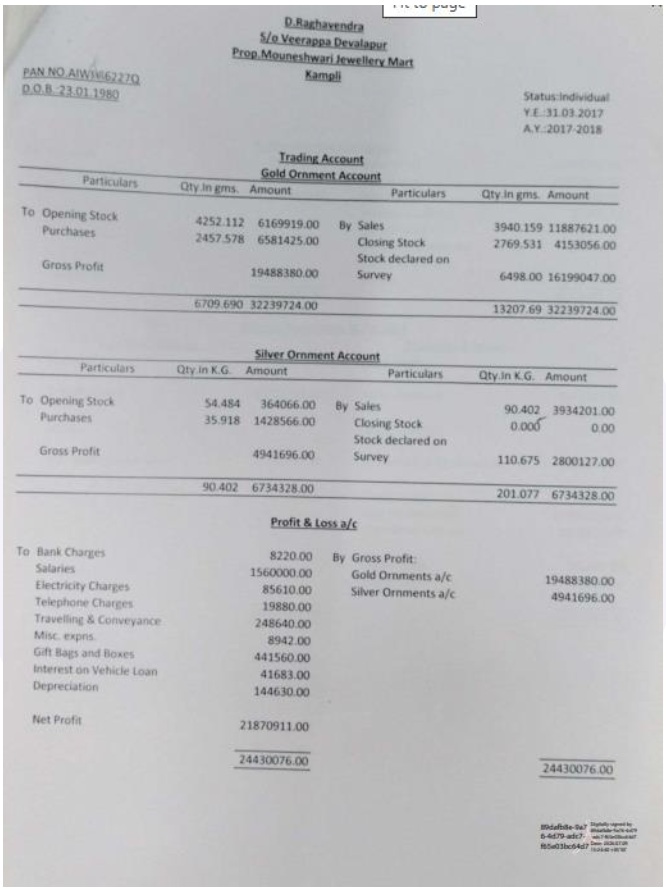
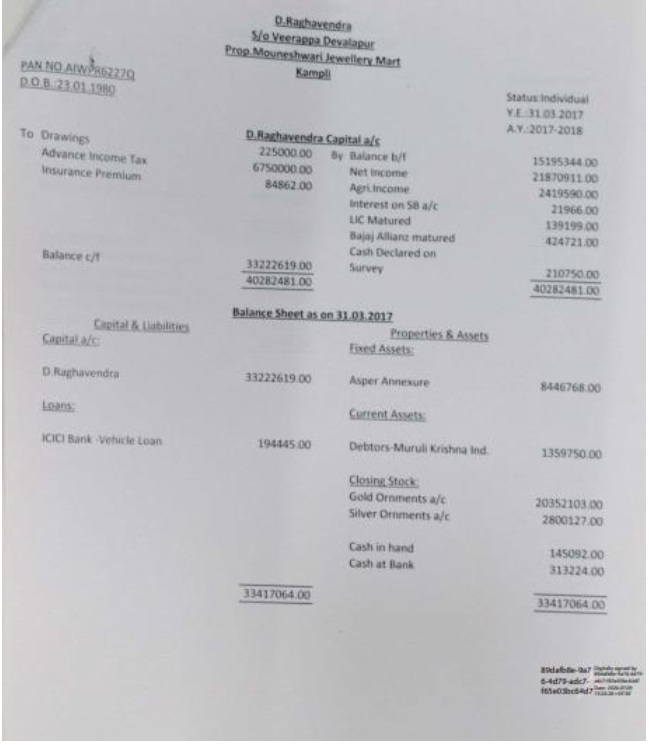
9. It is worth noting that the present case is distinguishable from cases where, during the survey, some undisclosed income was found for the preceding financial years and was not recorded by the taxpayer in his accounts for those financial years, and accordingly assessment proceedings were initiated on the basis of the survey findings and additions under section 69/69A/69B of the Act were made. The survey under section 133A of the Act in the instant case was conducted on 16/09/2016, i.e., during the relevant financial year and not after the end of the relevant financial year, i.e., 2016-17. Therefore, the accounts were not yet closed and finalised for the year on the date of survey. It is evident that while finalising his trading account, profit and loss account, capital account and balance sheet as on 31/03/2017, the assessee duly recorded the excess cash and excess stock of gold and silver ornaments found during the survey. From the record, it is further evident that during the survey, no evidence was found to show that the assessee had sources of income other than the declared business of trading in gold jewellery and silver articles. Thus, the excess cash and excess stock of gold and silver jewellery appear to have been generated from the business of trading in gold and silver jewellery, which the assessee not only admitted as additional income but also offered for taxation while filing the return of income. Therefore, we are of the considered view that the instant case is of undeclared business income and cannot be said to be undisclosed income of the assessee. Consequently, we are of the considered view that the excess cash and excess stock of gold and silver jewellery pertain to the business of the assessee, and therefore, the provisions of section 69/69A/69B of the Act have no applicability.
10. In view of the above, the addition made under section 69/69A/69B of the Act in respect of the excess cash and excess stock of gold and silver jewellery found during the survey is deleted. As a result, Grounds No. 2 and 3, raised in assessee’s appeal are allowed.
11. In view of our aforesaid findings, Ground No. 3 require no separate adjudication as the same is rendered academic and therefore is kept open.
12. In the result, the appeal by the assessee is allowed.