ORDER
Dr. Dipak P. Ripote, Accountant Member.- This is an appeal filed by the assessee against the order of the Learned Commissioner of Income Tax (Appeals), (NFAC)- Delhi [Ld.CIT(A)], passed u/s. 250 of the Income Tax Act, 1961 (‘the Act’) for AY 2020-21 on 24-09-2025, emanating from the Assessment Order u/s 147 of the Act, dated 29-03-2025.
2. Submission of Ld.AR:
The Ld.AR filed factual paper book, case law paper book and written submissions, which are reproduced as under:
Reassessment invalid due to absence of mandatory Prior Approval as required under clause (iv) of the explanation no. 2 of sec. 148 of the Act and clause (c) of 1st proviso to sec. 148A of the Act.
Reassessment invalid due to Erroneous Assumption of Search on M/s. Midas and Bhoomi Associates Forming the basis of Reopening.
Reassessment invalid since the approval granted u/s. 151 of the Act is Mechanical in nature and without application of mind.
Reassessment invalid due to non-supply of relied upon material and denial of opportunity to rebut – despite the same were requested ruing assessment proceedings – violation of principles of natural justice.
Reassessment invalid due to denial of cross-examination despite specific request.
3. Submission of Ld.DR:
The Ld.DR relied on the order of the AO and Ld.CIT(A).
4. Findings and analysis:
We have heard both the parties and perused the records. In this case, assessee is a retired salaried employee. Assessee had filed return of income for AY. 2020-21 on 25-10-2020, declaring total income at Rs. 4,98,980/-.
4.1. The AO had received certain information on Insight Portal of Income Tax Department. As per the information available on the Insight Portal of Income Tax Department, there was a search u/s. 132 of the Act in the case of Bhoomi Group. Assessee has purchased Flat No. C-1404 in Midas Bhoomi Harmony, Nehru Nagar, Kurla East, Mumbai along with her son and husband, from M/s. Midas and Bhoomi Associates. It has been alleged in the reasons recorded by the AO that as per the information available on Insight Portal of Income Tax Department, assessee has paid along with two co-owners Rs. 16,60,000/- on-money for purchase of the said flat. Therefore, AO issued notice u/s. 148 of the Act for AY. 2020-21 on 29-032024.
4.2. During the re-assessment proceedings, assessee denied payment of any on-money. Assessee also requested to provide copies of the statement recorded, opportunity of cross-examination, copies of the seized documents. Assessee filed bank statements, copy of purchase deed and other details. However, it has been submitted that opportunity of crossexamination was never provided to the assessee. Ld.AR also submitted that specific documents were never provided.
4.3. In this case, the most important fact, which emanates from the assessment order is that there has been addition in the case of Midas and Bhoomi Associates on account of cash receipt for AY. 2022-23. Midas and Bhoomi Associates is the concern from whom, the assessee had purchased a flat. The contradiction is that addition has been made in the case of the assessee of alleged cash money payment for AY. 2020-21, whereas same money has been added in the case of seller for AY. 2022-23. Thus, it apparently seems that the AO was not sure about the actual date of alleged cash payments.
4.4. It is important to mention here that there is a reference to Annexure-A4, page number 1-6 and page number 19-30 in the assessment order. However, these documents were never produced before us. It is also observed that apparently it seems that the AO also was not having the impugned Annexure-A4. AO has relied on the document which was uploaded on the Insight Portal of Income Tax Department. The AO has scanned the document at Pg. No. 14 of the assessment order. The same is scanned and reproduced here again:
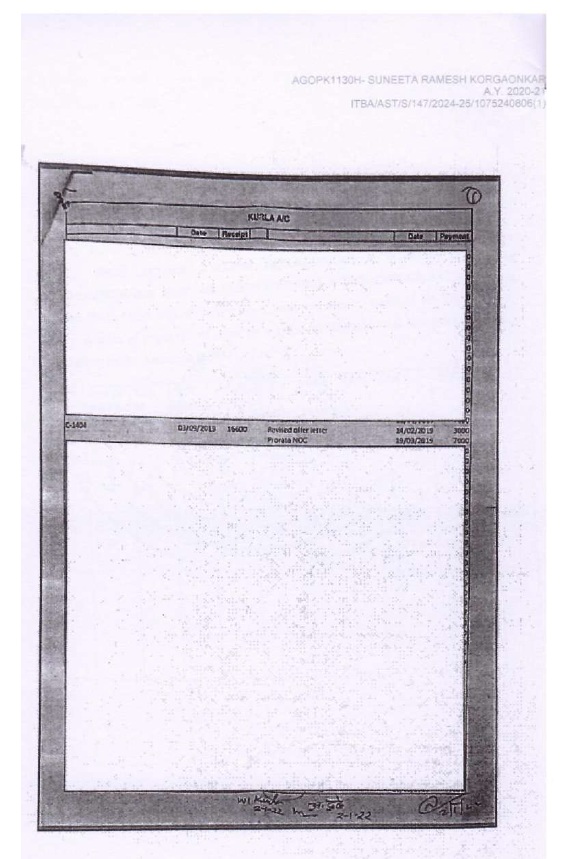
The first and foremost thing, the above referred page which appears in the assessment order is not the original evidence rather it is a tampered evidence, as some has removed all other entries which were appearing on that page. A tempered evidence cannot be relied. It is seen that name of the assessee does not appear in that document, which has been scanned and reproduced by the AO in the assessment order, which is apparently copy of some page of Annexure-A4. Also, it is not clear from the scanned document that assessee had made cash payment. Thus, the document on which AO is relying does not show cash payment made by the assessee. There is no word ‘cash’ in the impugned document. In the document, there is a Number, C-1404, we presume it to be flat number. There is no name of the building or name of the project mentioned in the impugned document. Therefore, it cannot be presumed that the document which has been scanned by the AO pertains to Midas Bhoomi Harmony, wherein assessee has purchased a flat. Thus, at least the scanned document is a dumb document. No other document has been produced before us. In the assessment order, there is a reference of a chart, but the said chart has been prepared either by the AO or by the DDIT, Inv. based on some documents. Thus, the chart which appears in the assessment order at Pg. No. 12 and also in the reasons recorded is not the original evidence, but it is prepared based on certain other documents by the officers of the Income Tax Department. Therefore, that chart cannot be evidenced.
4.5. We have already mentioned that the scanned document appearing in the assessment order is a dumb document. We again specify that no original documents were produced before us. We have gone through the part of the statement which appears in the assessment order of Mr. Neerav Mehta, nowhere Mr. Neerav Mehta has alleged cash payment by the assessee. Therefore, the statement is of no help.
4.6. In these facts and circumstances of the case, we are of the considered opinion that the addition made by the AO in the assessment order of Rs. 5,33,000/- u/s. 69 of the Act is baseless, without any evidence. Therefore, we direct the AO to delete the addition of Rs. 5,33,000/-. Accordingly Ground Nos. 6 & 7 raised by the assessee are allowed.
5. We have read the reasons recorded by the AO for issuing notice u/s. 148 of the Act, which are at Pg. No. 4-10 of the paper book submitted by the assessee. The reopening is based on information available on Insight Portal of Income Tax Department. The para No. 3.4, 4 & 5 of the reasons are reproduced here as under:
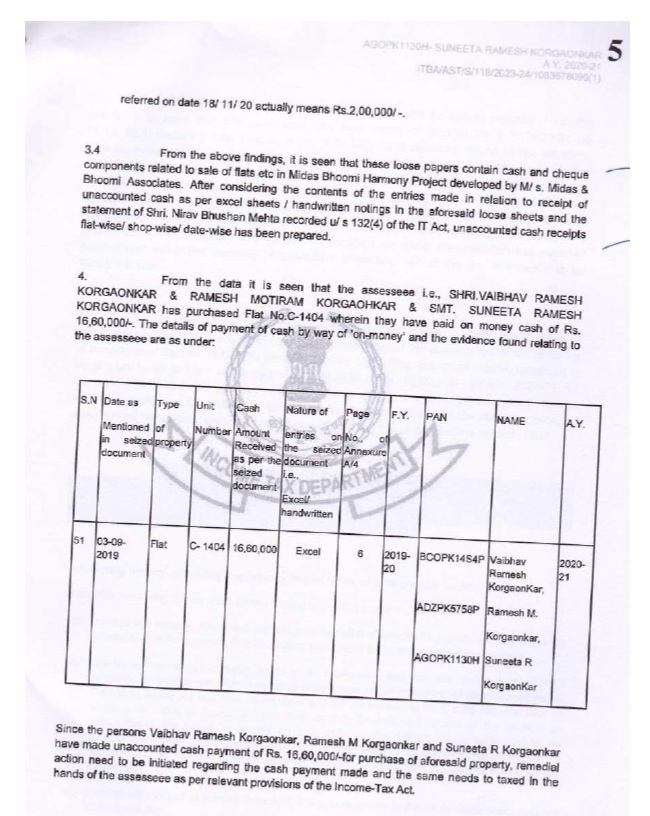
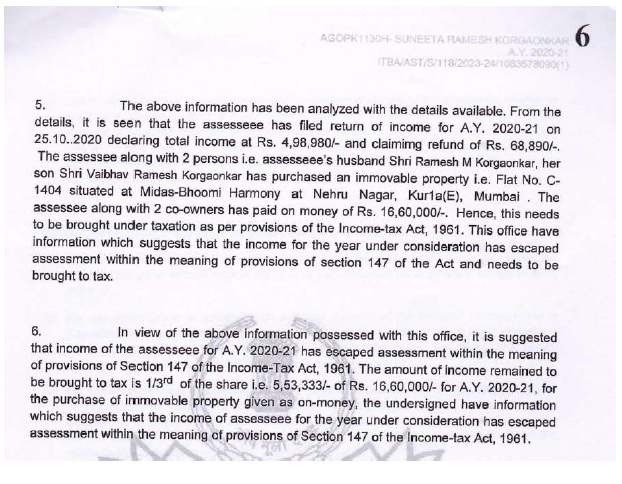
5.1. Thus, it can be observed that the reopening is based on a chart which has been prepared based on some documents found during the search. Thus, the chart is not the document which was found during the search. After carefully reading the reasons recorded by the AO, it is clear that AO was not having copies of the seized documents alleging cash payments. The entire reasons are based on the chart, which was supplied to the AO on Insight Portal of Income Tax Department. The AO has not bothered to obtain copies of the seized documents before recording the reasons. Therefore, the reasons recorded are baseless. The AO has relied on proviso to section 148A of the Act in the reasons recorded for reopening. However, AO has not referred any specific document which was seized during the search and which was available with the AO. Therefore, the reliance on section 148A proviso, is factually incorrect.
5.2. Hon’ble Bombay High Court in the case of Pr. CIT v. Shodiman Investments (P.) Ltd [2020] 422 ITR 337 (Bombay) has held as under :
Quote, “12. The re-opening of an Assessment is an exercise of extraordinary power on the part of the Assessing Officer, as it leads to unsettling the settled issue/assessments. Therefore, the reasons to believe have to be necessarily recorded in terms of Section 148 of the Act, before re-opening notice, is issued. These reasons, must indicate the material (whatever reasons) which form the basis of re-opening Assessment and its reasons which would evidence the linkage/nexus to the conclusion that income chargeable to tax has escaped Assessment. This is a settled position as observed by the Supreme Court in S. Narayanappa v. CIT [1967] 63ITR 219, that it is open to examine whether the reason to believe has rational connection with the formation of the belief. To the same effect, the Apex Court in ITO v. Lakhmani Merwal Das
[1976] 103 ITR 437 had laid down that the reasons to believe must have rational connection with or relevant bearing on the formation of belief i.e. there must be a live link between material coming the notice of the Assessing Officer and the formation of belief regarding escapement of income. If the aforesaid requirement are not met, the Assessee isentitled to challenge the very act of re-opening of Assessment and assuming jurisdiction on the part of the Assessing Officer.
13. In this case, the reasons as made available to the Respondent-Assessee as produced before the Tribunal merely indicates information received from the DIT (Investigation) about a particular entity, entering into suspicious transactions. However, that material is not further linked by any reason to come to the conclusion that the Respondent-Assessee has indulged in any activity which could give rise to reason to believe on the part of the Assessing Officer that income chargeable to tax has escaped Assessment. It is for this reason that the recorded reasons even does not indicate the amount which according to the Assessing Officer, has escaped Assessment. This is an evidence of a fishing enquiry and not a reasonable belief that income chargeable to tax has escaped assessment.
14. Further, the reasons clearly shows that the Assessing Officer has not applied his mind to the information received by him from the DDIT (Inv.). The Assessing Officer has merely issued a re-opening notice on the basis of intimation regarding re-opening notice from the DDIT (Inv.) This is clearly in breach of the settled position in law that re- opening notice has to be issued by the Assessing Office on his own satisfaction and not on borrowed satisfaction.
15. Therefore, in the above facts, the view taken by the impugned order of the Tribunal cannot be found fault with. This view of the Tribunal is in accordance with the settled position in law.
16. Therefore, the question as framed does not give rise to any substantial question of law. Thus, not entertained.
17. Accordingly, Appeal dismissed. ” Unquote.
5.3. Thus, in the case of the assessee also, the reasons recorded for reopening demonstrates that reasons were recorded based on some information which was available on Insight Portal of Income Tax Department in the form of chart which was prepared by officer of the Income Tax Department. Thus, the reopening is not based on any specific material. Therefore, respectfully following the decision of the Hon’ble Bombay High Court (supra), we hold that the notice issued u/s. 148 of the Act based on the reasons is bad in law. Accordingly, Ground No. 1 raised by the assessee is allowed.
6. All other grounds of appeal are dismissed as unadjudicated.
7. In the result, the appeal of the assessee is partly allowed.