


CIT(E) cannot reject Section 12AB registration by overstepping into assessment-stage matters or misclassifying charitable activities under the residual proviso.
Issue
Whether the CIT(E) exceeded his jurisdiction under Section 12AB of the Income-tax Act by examining activity-wise profitability, commercial receipts, and accounting presentation to reject registration renewal, rather than restricting the scope of inquiry strictly to the genuineness of the trust’s activities and the alignment of its objects.
Facts
-
Trust Profile: ISKCON, registered under the Maharashtra Public Trusts Act, 1950, held Section 12A registration since 1975 and Section 80G approval since 1971, operating over 270 centres across India with unchanged charitable objects.
-
Charitable Activities: Undertook direct public welfare work including free meal distribution, disaster relief, board-affiliated education, an AYUSH-YCB accredited yoga school, medical/de-addiction programs, and over 100 goshalas alongside eco-villages.
-
Renewal Application: Filed Form 10AB for renewal of registration under Section 12AB and approval under Section 80G(5)(ii), submitting 3 years of audited financial statements.
-
CIT(E) Findings:
-
Classified all activities under the residual limb of Section 2(15) (“advancement of any other object of general public utility”).
-
Extrapolated commercial receipts (44%–48% of total receipts) using web-scraped data from ISKCON Juhu to trigger the 20% limit under the proviso to Section 2(15).
-
Deemed the presentation of net surplus/deficit (instead of gross receipts) in certain accounting heads as “incorrect information” constituting a “specified violation” under Explanation (g) to Section 12AB(4).
-
-
Rejection: CIT(E) rejected both Section 12AB renewal and Section 80G approval based on these findings.
Decision
-
Jurisdictional Limit: Held that CIT(E) committed a jurisdictional error. At the Section 12AB stage, the scope of examination is strictly confined to the objects of the trust and the genuineness of its activities. Quantum of receipts, application of income, and activity-wise profitability are matters reserved exclusively for the Assessing Officer during Section 11 assessment proceedings.
-
Applicability of Proviso to Section 2(15): Held that the authority must first check if activities fall within specified named limbs (e.g., relief of poor, education, medical relief, environmental preservation). Since ISKCON’s activities fell under at least five specified limbs, the residual limb and its restrictive proviso were entirely inapplicable.
-
Scale & Accounting Practice: Held that large-scale operations or organised execution do not alter an institution’s intrinsic charitable character if funds are not diverted for private gain. Furthermore, presenting net figures per recognized accounting practices when underlying schedules are disclosed does not constitute deliberate concealment or a “specified violation.”
-
Relief: Set aside the CIT(E)’s order and directed the CIT(E) to grant registration renewal under Section 12AB and consequential approval under Section 80G(5)(ii).
Key Takeaways
-
Strict Scope of Section 12AB: CIT(E) cannot prematurely perform the role of an Assessing Officer by auditing financial receipts or activity-wise profitability during registration proceedings.
-
Priority of Named Charitable Limbs: The residual category under Section 2(15) and its commercial proviso can only be invoked if an institution’s activities fail to qualify under any of the primary specified charitable heads.
-
Scale Does Not Equal Commercialization: Systematic organization and high monetary receipts do not strip an entity of its charitable nature provided the core objects remain charitable and income is applied accordingly.
-
Accounting Presentation vs. Specified Violation: Standard accounting disclosures presenting net figures backed by complete audited schedules do not amount to “incorrect information” or a “specified violation” under Section 12AB(4).
IN THE ITAT MUMBAI BENCH ‘C’
International Society for Krishna Consciousness
v.
Commissioner of Income-tax (Exemptions)*
SAKTIJIT DEY, Vice President
and Girish Agrawal, Accountant Member
and Girish Agrawal, Accountant Member
IT Appeal Nos. 5500 and 5507 (MUM) of 2026
AUGUST 11, 2026
Vijay Mehta and Rakesh Joshi, CAs for the Appellant. Ajay Soneji, Sr. DR for the Respondent.
ORDER
Girish Agrawal, Accountant Member.- These two appeals filed by the assessee are against the orders of ld. Commissioner of Income-tax (Exemptions), Mumbai (hereinafter referred to as “ld. CIT(E)”) vide DIN & Notice No. ITBA/EXM/F/EXM45/2025-26/1088134721(1) and ITBA/EXM/F/EXM45/2025- 26/1088134872(1), both dated 30.03.2026 passed in Form No. 10AD, rejecting the application for renewal of registration filed by the assessee in Form 10AB u/s 80G and 12A(1)(ac)(ii) of the Income-tax Act, 1961 (hereinafter referred to as the “Act”), respectively.
2. Assessee has raised the following grounds of appeal:
In ITA No. 5507/Mum/2026:
1. The Commissioner Income-tax (Exemptions), Mumbai (hereinafter referred to as “CIT(E)”) has erred in passing the order u/s 12AB of the Income Tax Act 1961, which is illegal and bad in law.
2. The CIT(E) has erred in rejecting the application made by the appellant for renewal of registration u/s 12AB of the Act on the ground that various activities of the appellant are commercial in nature and are in violation of proviso to S. 2(15) of the Act.
3. The CIT(E) has erred in not appreciating that activities like conducting Yoga, meditation, spiritual course in ancient vedas, publication of devotional books, providing satvik food, maintaining gaushala, training and livelihood support for farmers, women and rural community, providing temporary accommodation to spiritual seekers etc. are neither commercial activities nor are hit by proviso to S. 2(15) of the Act.
4. The CIT(E) has erred in holding that the receipts from commercial activities are more than 20 percent of the total receipts in each of the three previous years. The CIT(E) has erred in holding that the appellant has underreported receipts from various activities and the same is specified violation as per explanation (g) to section 12AB(4) of the Act.
5. The CIT(E) has erred in passing the impugned order in violation of principles of natural justice.
In ITA No. 5500/Mum/2026:
1. The Commissioner Income-tax (Exemptions), Mumbai (hereinafter referred to as “CIT(E)) has erred in rejecting the application made by the appellant for renewal of registration u/s 80G of the Income Tax Act 1961.
2. The CIT(E) has erred in holding that non-grant of registration u/s 12A ipso facto renders the application for approval u/s 80G of the Act liable for rejection
3. The CIT(E) ought to have appreciated that S. 80G does not envisage automatic rejection solely on that ground and requires a separate satisfaction regarding the conditions under section 80G(5)(i) to (v) of the Act.
4. The CIT(E) has erred in passing the impugned order in violation of principles of natural justice.
2.1 . We first take up appeal in ITA no. 5507/Mum/2026 which relates to rejection of application made for seeking renewal of registration under section 12AB. The other appeal in ITA no. 5500/Mum/2026 relates to rejection of registration application under section 80G(5)(ii). This second appeal is consequential to the first one as ld. CIT(E) notes in para 3 of the order rejecting application for renewal under section 80G that “3. The provision of section 80G(5)(i) of the Act stipulates the condition that the provision of this section is only available for institution or fund for which section 11,12 or clause 23AA or clause 23C of section 10 of the Act applies. The applicant fails to fulfil any of the above criteria in view of the rejection of its application for registration u/s 12AB of the Act. Thus, its application for approval u/s 80G of the act becomes untenable.” Accordingly, our observations and findings in the first appeal shall have a direct bearing on the second one.
3. Brief facts of the case are that assessee hereinafter referred to as “ISKCON”, is a charitable organisation registered under the Maharashtra Public Trusts Act, 1950 on 29.03.1971. Assessee trust is registered under section 12A of the Act since 11.06.1975 vide registration no. INS./7300 and has enjoyed approval under Section 80G as well since 16.01.1971 vide registration no. BRC/Sec80(G)/Ch.161-T/70-71 with B.C. No. J-I/295 (2)/579/70-71, without any change in its objects or in the nature of its activities. It is also registered under FCRA (registration renewed by the Ministry of Home Affairs vide approval dated 15.05.2025 with registration no. 083780436 with nature ‘social’) and under the Companies Act, 2013 for CSR activities with registration no. CSR00005241, issued by Ministry of Corporate Affairs. It is also registered under The Societies Registration Act, 1860 vide Registration No. F-2179 (BOM). ISKCON has been engaged in charitable activities across India for more than five decades through its centres which are now more than 270 in number.
3.1. Assessee carries on extensive charitable activities rooted in the traditional Indian model of social welfare deeply embedded in Indian civilizational ethos, integrates free food distribution, education, healthcare, environmental sustainability and value-based social upliftment into a unified and holistic framework of public service. These centres also provide satvik vegetarian food through “Govinda’s,” which is its prasadam-distribution facility and offer Dharamshala / pilgrim accommodation at key, cultural and important destinations. Further, several major centres maintain utility facilities within the premises, providing access to devotional literature, deity worship materials, satvik food items and other essential articles required for spiritual practice and daily living by disciples and followers.
3.2. Assessee filed an application in Form 10AB u/s 12A(1)(ac)(ii) on 30.09.2025, seeking renewal of registration u/s 12AB of the Act. On verification of the application in Form 10AB filed by the assessee, ld. CIT(E) found the application to be incomplete, as all the documents required to be accompanying the application were not furnished. Accordingly, a notice dated 01.11.2025 was issued to the assessee requesting it to furnish the complete set of documents as mandated by Rule 17A(2) of the Income-tax Rules, 1962 (the Rules). In response, assessee submitted its reply vide letter dated 10.11.2025, complying with all the requirements. After perusal of this submission, ld. CIT(E) noted that the assessee is in receipt of income under three specific heads, viz.,
| (a) | “Sponsorships”, |
| (b) | “Broadcasting and Royalty” and |
| (c) | “Farm, agriculture and other Income” and all these receipts shown under the head “Income from Incidental Activities”. On the basis of this reading alone, ld. CIT(E) formed the view, at that preliminary stage itself, that these activities are prima facie commercial in nature and being carried on for a consideration, thereby attracting the proviso to section 2(15). It is significant that this conclusion was reached, and recorded, before the show cause notice was even issued. |
3.3. Based on the view so formed, a show cause notice dated 21.03.2026 was issued to the assessee requesting explanation as to why the aforesaid receipts should not be treated as receipts from activities of a commercial nature within the meaning of proviso to section 2(15). This notice called for details in respect of the period from FY 2021-22 to FY 2025-26. The proceedings were time-barred by 31.03.2026, leaving the assessee a period of ten days to respond to a notice calling for five years of details. In response, assessee filed its detailed submission dated 25.03.2026. Contents from the said show cause notice in this regard are extracted below:
1. Please explain why the receipts shown as “Sponsorships”, “Broadcasting and Royalty” and “Farm, agriculture and other Income” under the head Income from Charitable Activities and receipts shown under the head “Income from incidental activities” shall not be considered as receipts from activities of a commercial nature, within the meaning of Proviso to Section 2(15); thereby rendering such activities as non-charitable.
[emphasis supplied by us by bold]
3.4. In its submission dated 25.03.2026, assessee stated, inter alia, that all its activities are charitable and religious in nature, falling squarely within the statutory definition of “charitable purpose” as defined in section 2(15) and that none of its activities or projects fall within the ambit of “advancement of any other object of general public utility.” On the specific income streams identified by the ld. CIT(E), assessee submitted that:
| (a) | receipts under the head “Sponsorships” represent voluntary contributions from corporates and philanthropic entities towards large-scale charitable activities and are not made in consideration of any commercial service; |
| (b) | Broadcasting and Royalty income arises from dissemination of spiritual discourses and educational content, integral to the Society’s charitable objectives; and |
| (c) | Farm, Agriculture and Other Income arises from farm operations supplying produce primarily to the Annakshetra programme and from maintenance of goshalas. Assessee further submitted that its 270+ Govinda’s food outlets and accommodation at more than 35 centres are carried on at cost or at a loss, as evidenced by comprehensive nationwide financial data furnished during the course of impugned proceedings. |
3.5. Assessee submitted detailed data in respect of its 270+ Govinda’s food outlets, demonstrating that the most popular item, a thali, ranges from Rs. 50 to Rs. 350 per plate across the country (excluding one or two outlets in and around Mumbai where prices are approximately Rs. 650 per thali), and that the distribution of food through these outlets is at no profit-no loss or at a loss. Similarly, for accommodation maintained at more than 35 centres, assessee submitted a comprehensive nationwide comparison which the ld. CIT(E) did not take cognisance of, selectively relying instead on data for just one location, viz., ISKCON Juhu, Mumbai. Assessee also submitted that all these activities are integral to its charitable objects and are not commercial in nature.
4. Ld. CIT(E) examined the submission of the assessee dated 25.03.2026 in the light of the material available on record. The operative findings of the ld. CIT(E) and the reasons assigned for rejection of the application are summarised as under:
4.1. Ld. CIT(E) classified the activities of the assessee, viz., meditation camps, scriptural courses and spiritual dissemination, sale/distribution of devotional books and articles, satvik food distribution (including through organised outlets), broadcasting and royalty from digital dissemination and agricultural and farm-based activities, as falling under the residuary limb of section 2(15), i.e., “advancement of any other object of general public utility.” It was held that these activities do not fall within the specific limbs of “education”, “medical relief” or “relief of the poor” as envisaged under section 2(15) and that by necessary implication, the negative test in the proviso to section 2(15) applies.
4.2. On the issue of sponsorships, ld. CIT(E) held that the nomenclature “sponsorship” inherently indicates a quid pro quo arrangement typically involving visibility, branding or association benefits to the sponsors. He treated the structured and recurring nature of such receipts as indicating organised revenue-generating activity and held that assessee failed to furnish documentary evidence that such receipts are purely voluntary donations devoid of any commercial element.
4.3. On Broadcasting and Royalty income, ld. CIT(E) held that generation of income through digital platforms, licensing and royalty inherently involves systematic commercial exploitation of content and such activities are carried out in a structured and organised manner with revenue generation as an outcome. He further held that sale of goods, books, articles, food items, for consideration constitutes a trading activity irrespective of its religious or cultural context. Maintenance of separate books of account for these activities was treated as additional evidence of their revenue-generating commercial character. The claim of “cost recovery” was held to require documentary evidence demonstrating absence of profit motive despite all the details already placed on record.
4.4. On the question of farm and agricultural income, ld. CIT(E) held on similar grounds that sale of surplus produce and organised farm operations indicate systematic economic activity and that the scale and integration of such activities with revenue streams demonstrates that they form part of the income-generating structure of the assessee.
4.5. Ld. CIT(E) also referred to the accommodation provided to devotees and satvik vegetarian food in the form of prasad at Govinda’s, and cross-verified the assessee’s claim from publicly available data on the web portal of the assessee. He relied on data pertaining exclusively to ISKCON Juhu, Mumbai, centre viz., buffet prices at Govinda’s ranging from Rs. 650 to Rs. 750 per person and guest house rates at Rs. 3,500 to Rs. 6,750 per night and concluded that these activities are carried out in a structured and organised manner with revenue generation as an outcome and are purely commercial in nature within the meaning of the proviso to section 2(15). Ld. CIT(E) did not take cognisance of the assessee’s data for its 270+ Govinda’s outlets across the country or the comparative data for accommodation at its 35+ centres, submitted during the course of impugned proceedings.
4.6. Ld. CIT(E) further held that the magnitude of receipts and the organised manner of carrying on these activities indicate systematic business operations and that the decisive test is the nature and extent of activity, not the stated object. He computed the percentage of aggregate receipts from the aforesaid activities to total receipts for three financial years. Assessee has disputed the computation methodology of the ld. CIT(E) adopted in this regard. His computation details are extracted below from para 4.9 of the impugned order:
| Financial Year | Total Income (Rs.) | Aggregate of Receipts treated as Commercial (Rs.) | Percentage of Commercial Receipts to Total Receipts |
| 2022-23 | 77,02,409,250 | 33,74,426,733 | 43.81% |
| 2023-24 | 94,43,901,308 | 45,07,132,944 | 47.72% |
| 2024-25 | 1,12,60,122,899 | 52,48,711,351 | 46.61% |
4.7. On the question of accounting and reporting, ld. CIT(E) found that assessee had not disclosed the gross receipts from the heads “Income from Charitable Activities” and “Income from Incidental Activities” in its financial statements and had instead disclosed only the net surplus after reducing related expenditure. He held this to be misrepresentation and nontransparent disclosure of material financial particulars and charged the same as a “specified violation” under Explanation (g) to section 12AB(4). This formed the second independent ground for rejection of the application for registration filed by the assessee.
4.8. Ld. CIT(E) accordingly concluded that the application for renewal of registration u/s 12AB filed by the assessee is not allowable and thus rejected the same on two grounds:
| (a) | the actual activities of the Trust “over the years” are not towards “charitable purpose” as per the proviso to section 2(15); and |
| (b) | there is a specified violation as per Explanation (g) to section 12AB(4) of the Act. |
4.9. Aggrieved by the said order, assessee is in appeal before the Tribunal.
5. Ld. Counsel for the assessee CA Vijay Mehta along with CA Rakesh Joshi submitted that the impugned order is fundamentally erroneous both on law and on facts and must be set aside on multiple independent grounds, which are addressed in sequence hereunder.
6. The primary and threshold submission was that the ld. CIT(E) has committed a jurisdictional error by considering the impugned registration proceedings as assessment proceedings by examining application of income, quantum of receipts, activity wise profitability which are matters for the Assessing Officer at the stage of assessment when exemption under section 11 is claimed year-on-year basis. It is strongly contended that at the stage of grant of registration under section 12AB, the only matters for examination are:
| (a) | whether the objects of the trust are charitable, and |
| (b) | whether the activities are genuine. |
6.1. Reliance was placed on the decision of Hon’ble Supreme Court in the case of Ananda Social and Educational Trust v. CIT 426 ITR 340 (SC) who has authoritatively laid down the above stated proposition. The ratio of this judgment is that the registering authority does not sit in appeal over the quantum or nature of receipts; such enquiry is impermissible. In this regard, important factual position asserted is that in past several years, case of assessee has been examined under section 143(3) and 147 wherein claim made under section 11 towards exemption has not been rejected in any of such assessments made.
6.2. On the above aspect, reliance was placed on CBDT Circular No. 21/2016 dated 27.05.2016. Para 4 of the said Circular, which is the most significant for the present case, is reproduced below for ready reference:
“4. In view of the aforesaid position, it is clarified that it shall not be mandatory to cancel the registration already granted u/s 12AA to a charitable institution merely on the ground that the cut-off specified in the proviso to section 2(15) of the Act is exceeded in a particular year without there being any change in the nature of activities of the institution. If in any particular year, the specified cut-off is exceeded, the tax exemption would be denied to the institution in that year and cancellation of registration would not be mandatory unless such cancellation becomes necessary on the grounds) prescribed under the Act.”
6.3. In this regard, reliance was placed on the decisions of the Hon’ble jurisdictional High Court of Bombay in DIT (Exemptions) v. Khar Gymkhana (Bombay) who dealt with the aforesaid circular. From placitum 10, the relevant extract of the judgment is reproduced below for ready reference:
“We find that the Circular No. 21 of 2016 when read as a whole, specifically lists out in paragraphs 4 and 5 reproduced herein above that the registration granted under section 12AA could not be cancelled, only when the receipts on account of business exceeded the cut off, specified in the proviso to section 2(15) of the Act. The jurisdiction to cancel the registration only arises if there is change in the nature of activities of the institution or the activities of the institution, are not genuine. The aforesaid Circular by placing reliance upon section 13(8) of the Act inter alia provides that the registration granted to the trust would continue even when the receipts on account of business is in excess of Rs. 25 lakhs. In such case, the Assessing Officer while framing the assessment for the subject assessment year would be entitled to deny the benefit of exemption to such a trust for that year.”
6.4. On the above, even the judgment of Goa Industrial Development Corporation v. CIT 421 ITR 676 (Bombay) observed on similar lines in placitum 27 which is extracted below which in turn referred to its decision of Khar Gymkhana (supra):
“We also add that Circular No. 21 of 2016 also, supports the contentions of Mr. Vaidya, inasmuch as it reiterates that the process of cancellation of registration has to be initiated strictly in accordance with the provisions under section 12AA(3) and after carefully examining the application of the said provisions. The Circular, in the context of income limits under the proviso also explains that merely because in a particular year the limits may be exceeded is not a good ground to cancel the registration itself, though, all these aspects, can be taken into consideration at the stage of assessment. In fact in the case of Khar Gymkhana (supra), as also in Karnataka Industrial Area Development Board (supra), the Division Benches of our court have taken the view that such matters can be evaluated in the course of assessment but this shall not be a ground for cancellation of the registration itself.”
6.5. Ld. Counsel further submitted that objects of the assessee as set out in Note 1 (Summary of Significant Accounting Policies) in its Annual Financial Statements, have not been doubted, questioned or challenged by the ld. CIT(E) at any point in the impugned order. Section 12AB(1)(b) of the Act requires the authority to be satisfied about (i) the objects of the trust or institution; and (ii) the genuineness of its activities. Registration cannot be denied on the basis of a characterisation of income streams where the objects themselves have not been found to be non-charitable. The said Note 1 is reproduced below for ready reference:
“General Information: The International Society for Krishna Consciousness (ISKCON) is a Society founded by A.C. Bhaktivedanta Swami Prabhupeda, who propagated the science of Krishna Consciousness all over the world by teaching from the authorized scriptures, such as Bhagavad Gita and Srimad Bhagavatam (Bhagavat Purana). It was registered in India in 1971 under The Societies Registration Act, 1860. It is also registered as a charitable institution under section 12AA and also has 80G under the Income Tax Act, 1961. In addition, it is also registered under Maharashtra Public Trusts Act, 1950.
One of the main purposes of ISKCON is to teach a simpler and more natural way of life. The Society fosters peace and universal brotherhood by uniting people from all over the world by applying the principles deeply rooted in the ancient cultural wisdom and heritage of India.
For close to five decades the organisation has been working towards eradication of hunger by providing free food to the needy and poor across many cities and villages, providing education through schools, conducting yoga and anti-addiction/de-addiction seminars, counselling, successfully implemented projects on rural development, raising awareness against fatal diseases, organic farming, skill development and women empowerment, working towards animal welfare like protecting and serving cows and providing them safe living condition.”
7. It is also strongly submitted that ld. CIT(E) has committed a jurisdictional error by misclassifying ISKCON’s activities under the residuary limb of section 2(15), i.e., “advancement of any other object of general public utility.” Ld. Counsel submitted that ISKCON’s activities squarely and independently fall under at least five specific named limbs of section 2(15), viz.:
| (a) | relief of the poor, |
| (b) | education, |
| (c) | yoga, |
| (d) | medical relief, and |
| (e) | preservation of environment. |
7.1. The proviso to section 2(15) is, in its terms, applicable only to the residual limb. If any of the specific named limbs is attracted, the proviso simply has no application. Ld. CIT(E) never considered this primary aspect but proceeded directly to examine the nature of three income streams without first recording a finding as to which limb of section 2(15) governs ISKCON.
7.2. In support of the proposition that specific named limbs are independent of the proviso, ld. Counsel placed reliance on CBDT Circular No. 11/2008 dated 19.12.2008 which, in terms, clarifies that the restrictive proviso was intended to operate only in respect of institutions falling under the residual category of “advancement of any other object of general public utility” and not in respect of entities engaged in relief of the poor, education or medical relief. Circular explicitly states that entities engaged in relief of the poor, education or medical relief would continue to enjoy the benefit of exemption notwithstanding the fact that they incidentally generate receipts in the course of carrying out their charitable objects.
7.3. Strong reliance was placed on the decision of Hon’ble jurisdictional High Court of Bombay in the case of Goa Industrial Development Corporation (supra) wherein placitum 26, Hon’ble Court held as under:
“Upon perusal of the impugned orders we find that there are no categorical findings that the activities of GIDC are not genuine or are not in accordance with the objects of the trust or the institution. Merely because, by reference to the amended provisions in section 2(15), it may be possible to contend that the activities of GIDC are covered under the proviso, that, by itself, does not render the activities of GIDC as non-genuine activities so as to entitle the Commissioner of Income-tax to exercise powers under section 12AA(3) of the said Act. We however clarify that we have really not gone into the question as to whether the activities of GIDC are indeed covered under the proviso to section 2(15) of the said Act as amended. This is because we are satisfied that the substantial question of law at (b) is required to be answered in favour of the appellant and against the respondent-Revenue. Once this is done, there is really no necessity to go into the other issue as is reflected in the substantial question of law at (a).”
7.4. Reliance was also placed on the decision in the case of DIT (Exemptions) v. Maharashtra Housing & Area Development Authority 392 ITR 240 (Bombay). From placitum 6, the relevant extract is reproduced below for ready reference:
“All that has been referred to by the Director is the details of income in income and expenditure account and profit of Rs. 114.48 crores out of sale of housing and income by way of lease rent, tenancy deposits, etc. Based on that a show-cause notice was issued to the assessee and the assessee pointed out how its activities are in furtherance of the Maharashtra Housing and Area Development Act, 1976. It has no profit motive, far from indulging in any trade or commerce and as far as the activities alleged or the income generated, what has been pointed out is that MHADA gives houses to middle class families at affordable rents. The income is on account of sale of housing stock and which is erroneously termed, according to MHADA, as coming from a systematic commerce and business activities.”
8. On the specific activities falling under each named limb of section 2(15), ld. Counsel provided the following comprehensive factual matrix with supporting financial data, which is presented activity-wise hereunder:
| (a) | Relief of the poor: ISKCON distributes approximately 1.50 lakh free meals across India every single day without any discrimination of caste, creed or religion, through its 270+ centres. Total direct expenditure on free meals during FY 2023-24 alone was Rs. 124.61 crore, without including indirect and administrative expenditure. During festivals, the scale multiplies, 50 lakh free meals during Maha Kumbh 2025 and 8 lakh free meals during Rath Yatra 2025. During natural calamities, assessee proactively distributed free meals and emergency supplies, during the Covid-19 pandemic (more than five crore free meals and lacs of ration kits), Hurricanes Amphan (2020), Yaas (2021) and Dana (2024). India Book of Records recognised ISKCON for distributing food to 5,11,600 persons in 24 hours during the national lockdown. ISKCON also hosted the “All India Tribal Convention” at Mayapur, West Bengal, attended by approximately 2,500 tribal representatives from more than 10 States. |
| (b) | Education: ISKCON operates ‘Bhaktivedanta Swami Mission School’ at Mumbai (1,000+ students, ICSE board), ‘Bhaktivedanta National School’ at Agartala, Tripura (100 students, State board) and ‘Bhaktivedanta Gurukul & International School’ at Vrindavan (450 students, ICSE/ISC board). It is in the process of setting up its own university in Vrindavan on a 75-acre campus. More than 30 lakh students from 6,700+ schools have participated in ISKCON’s educational programmes. In 2023 alone, 30,000 youths from 1,036 colleges across 400 cities participated in the parivartan and youth empowerment programmes. Total expenditure towards education during FY 2023-24 was Rs. 22.29 crore. Distribution of books on Bhagavad Gita, Srimad Bhagavatam and other Indian vedic scriptures is carried out at no profit-no loss or at a loss: gross receipt from sale of books during FY 2023-24 was Rs. 98.26 crore against direct expenditure (without overhead and administrative cost) of Rs. 79.26 crore. |
| (c) | Yoga: ISKCON runs the ISKCON Govardhan School of Yoga, which is accredited by the Ministry of AYUSH, Government of India through the Yoga Certification Board (YCB) for training yoga teachers. More than 4,000 yoga teachers and 35,000 students have been trained. Physical and virtual yoga programmes are conducted through its various centres, including in schools, colleges and corporates. ISKCON was also recognised in the Guinness Book of World Records in August 2015 for participation from 108 countries in a mega Yoga session held at Netaji Indoor Stadium, Kolkata. The Ministry of AYUSH’s formal accreditation of ISKCON’s yoga school is a direct governmental recognition of ISKCON’s yoga activities as falling squarely within the statutory limb of “yoga” in section 2(15). It was pointed out that recently, on 21.06.2026, ISKCON actively participated in the International Day of Yoga event at Kolkata attended by the Hon’ble Prime Minister. |
| (d) | Medical relief: ISKCON undertakes medical relief through de-addiction programmes, medical camps, ayurvedic clinics, children’s health camps and counselling. It has entered into a MoU with the Department of Social Justice & Empowerment, Government of India under the Nasha Mukt Bharat Abhiyaan and a MoU with the Narcotics Control Bureau, Ministry of Home Affairs, dated 02.12.2024, “Mission Spandan”, for combating substance abuse through awareness, education and spiritual empowerment. ISKCON holds a Guinness World Record for gathering 8,813 youths to take antiaddiction pledges in 24 hours at the UDGAAR 2025 mega youth festival. |
| (e) | Preservation of environment: ISKCON operates more than 100 goshalas across the country for protection and rehabilitation of abandoned, aged and infirm cattle, incurring direct expenditure of Rs. 12.47 crore in FY 2023-24 on goshala maintenance alone. ISKCON Govardhan Eco Village (GEV) at Palghar, Maharashtra, spread across 85+ acres, is internationally recognised for environmental leadership and has received multiple national and international awards including from UNEP, UNECOSOC, UNCCD, and by the Union Ministry of Jal Shakti (Jal Prahari Samman, 2024). ISKCON has developed in-house Soil Biotechnology in collaboration with IIT Bombay, treating more than 2 lakh litres of waste-water daily without chemicals and converts approximately 600 kilograms of food waste daily into organic compost. ISKCON has entered into a MoU with the National Skill Development Corporation (NSDC), Ministry of Skill Development, Government of India (April 2024) for sustainable rural development and livelihood generation. Assessee was honoured as Host of the Food & LiFE (Lifestyle for Environment) Conference during the G20/C20 Summit 2023. |
9. Ld. Counsel also furnished details of various awards, recognition, accreditations, also details of various collaborations and MoUs, world records which are testimony to the scale of its charitable operations having humongous impact on the well-being of the common mass, reaching out at the grassroot level. These details are tabulated below for ready reference:
| (a) | Recognitions, Awards and International Accreditations |
| Sr. | Year | Organisation | Award / Recognition |
| 1 | 2013 | Ministry of New & Renewable Energy and TERI | 5 Star Platinum Grha ratings for green buildings |
| 2 | 2013 | Skoch Foundation | Rated amongst the highest scoring projects in India |
| 3 | 2013 | IAA India Chapter | Award for continued efforts towards environmental sustainability |
| 4 | 2013 | Dept, of Horticulture, Govt, of Maharashtra | Awards for 30 best nursery plants |
| 5 | 2014 | Asian Sustainability Leadership Awards | Best overall sustainable performance |
| 6 | 2015 | CMO Asia | Asia Best CSR practices award for sustainability |
| 7 | 2015 | Ministry of Power & Bureau of Energy Efficiency | National Award for excellence in renewable energy |
| 8 | 2015 | Golden Globe Tigers Awards | Best green water stewardship |
| 9 | 2015 | The Green Organization | Symbiotic recycling systems for sustainable habitats |
| 10 | 2016 | Limca Book of World Records | Innovation in converting 4-acre waste land into cultivable land |
| 11 | 2016 | Aqua Foundation Group | Quality and supply of freshwater resources |
| 12 | 2017 | UNWTO | Eco-tourism as a catalyst for rural development |
| 13 | 2017 | UNESCO, Ministry of Water Resources & ASSOCHAM | Best water NGO, water education |
| 14 | 2019 | Energy Globe Foundation | Integrated water conservation and protection |
| 15 | 2021 | Maharashtra Energy Development Agency (MEDA) | Ecological conservation |
| 16 | 2024 | Union Ministry of Jal Shakti, GoI | Jal Prahari Samman, water conservation |
| (b) | ISKCON also holds accreditations from UNEP, UNECOSOC and UNCCD, and has received the IGBC Green Village Platinum Rating (2017), GRIHA Performance Award 2020, UNWTO Award and WTM Responsible Tourism Award. At the 9th Dalmia Bharat CSRBOX CSR Impact Awards 2023, ISKCON was recognised for exceptional work in ecological conservation, organic farming, waste management and sustainable tribal development. |
| (c) | Collaborations and MoUs, Government Recognition of Charitable Character |
| MoU / Collaboration | Details and Purpose |
| MoU with DBSKKV (2021) | Dr. Balasaheb Sawant Kokan Krishi Vidhyapeeth, agricultural reforms and farming practices in Palghar district, Maharashtra |
| MoU with NSDC (April 2024) | National Skill Development Corporation, Ministry of Skill Development, GoI, sustainable rural development, skill development, livelihood generation and tribal empowerment |
| G20/C20 Summit 2023 | Host of Food & LiFE (Lifestyle for Environment) Conference during the G20/C20 Summit 2023 |
| MoU with Dept, of Social Justice & Empowerment, Gol | Nasha Mukt Bharat Abhiyaan (NMBA), de-addiction in schools, colleges and tribal areas |
| MoU with Narcotics Control Bureau (02.12.2024) | Ministry of Home Affairs, Mission Spandan, combating substance abuse through awareness, education and spiritual empowerment |
| (d) | World Records |
| Record | Details |
| Guinness Book of World Records (August 2015) | Participation from 108 countries in mega Yoga session, Netaji Indoor Stadium, Kolkata |
| Guinness World Record, UDGAAR 2025 | 8,813 youths taking anti-addiction pledges in 24 hours |
| World Book of Records (London) | 5,000 youths from 10 States at Govardhan, Mathura, Viplava Festival 2022 under Azadi Ka Amrit Mahotsav |
| World Book of Records, ISKCON (UP) World Book of Records | Maximum students at a youth event on Mental Awareness, 7 April 2023 Largest participation in Online Bhagavad Gita quiz, 3,99,000 students from 2,000+ schools across India and abroad |
10. On the 20% threshold computation, ld. Counsel submitted that ld. CIT(E)’s figures are premised on an incorrect classification of receipts as “commercial” and also on an erroneous computation methodology. As per the decision of the Hon’ble Supreme Court in Asstt. CIT (Exemptions) v. Ahmedabad Urban Development Authority (SC) (hereinafter referred to as “AUDA (supra)”), the test for determining whether an activity constitutes “trade, commerce or business” within the proviso to section 2(15) requires an examination of whether the activity is undertaken at cost or at a nominal surplus in furtherance of charitable objects. According to him, the financial data on record which is verifiable clearly demonstrates that ISKCON’s activities are carried on at cost or at a very nominal margin, rebutting the working made by ld. CIT(E) as noted in para 4.6 above. It was pointed out that figures are direct costs only. Common costs and administrative overheads are not allocated. Up on full cost allocation, Govinda’s, accommodation and books would show no surplus or a deficit. Working furnished by the assessee is as under for which references were made during the course of hearing before us to the relevant financial data reported in its audited financial statements placed on record:
| Activity | Gross Receipts (Rs. Cr.) FY 2023-24 | Direct Expenditure (Rs. Cr.) FY 2023-24 | Net Surplus on Direct Cost Basis | Remarks |
| Govinda’s Food Outlets | 197.15 | 178.88 | 18.27 | -10.2% on direct cost only; nil or negative after common cost allocation |
| Accommodation | 54.74 | 53.54 | 1.20 | ~2.2% on direct cost only |
| Books | 98.26 | 79.26 | 19.00 | Direct cost basis; nil after common cost allocation |
| Free Food (charitable, no receipts) | Nil | 124.61 | N/A | Pure charitable expenditure |
| Education (charitable, no receipts) | Nil | 22.29 | N/A | Pure charitable expenditure |
| Goshalas (charitable, no receipts) | Nil | 12.47 | N/A | Pure charitable expenditure |
11. On the charge of “specified violation” under Explanation (g) to section 12AB(4), ld. Counsel submitted that assessee had furnished its audited financial statements for the preceding three years at the time of filing the application on 30.09.2025 itself, as evidenced by the Acknowledgement Receipt of the Income Tax Form placed in the paper book at pages 63 to 64. There was no suppression or non-disclosure. The accounting presentation adopted by the assessee, where net surplus/deficit rather than gross receipts is presented for certain activities, is a recognised and accepted accounting practice, particularly for activities where separate books are maintained as a matter of policy. Reliance was placed in this regard on the decision of the Coordinate Bench of ITAT Delhi in Pista Devi Education Society v. Commissioner of Income-tax (Exemptions) (Delhi – Trib.)/ ITA No. 6250/Del/2025, order dated 20.04.2026 at paras 11 to 13 thereof whereby it was held that mere presentation of accounts in a particular format, without any element of wilful misrepresentation or deliberate concealment, does not rise to the level of a “specified violation” as defined under the Explanation to section 12AB(4).
12. On the question of natural justice, ld. Counsel submitted that the ld. CIT(E) had already concluded, in para 3 of the impugned order, after reading the assessee’s reply dated 10.11.2025 to the preliminary notice, that the proviso to section 2(15) is attracted and that the aggregate of receipts from the alleged commercial activities exceeds 20% of total receipts. The show cause notice dated 21.03.2026 was issued after this conclusion had already been drawn. An authority that has already reached its conclusion before affording a hearing cannot be said to have given a genuine opportunity of being heard. The ten-day window between the notice dated 21.03.2026 and limitation due by 31.03.2026, for a notice calling for five years’ details, demonstrates that the opportunity given was not a meaningful one.
13. On the principle of consistency, ld. Counsel submitted that the three income streams identified by the ld. CIT(E) as “commercial”, viz., Sponsorships, Broadcasting and Royalty, and Farm, Agriculture and Other Income, have been examined and accepted in past assessments completed u/s 143(3) and u/s 147 of the Act over several years, the details of which are tabulated in the index of Paper Book 2. The same is extracted below for ready reference.
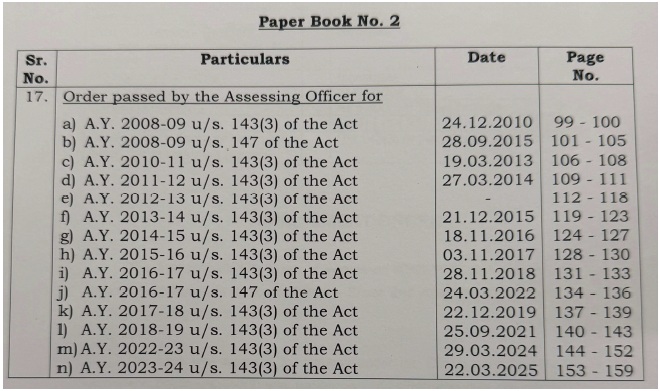
13.1. Reliance was placed on the decision of the Hon’ble Supreme Court in Radhasoami Satsang v. CIT [1991] 100 CTR 267/[1992] 193 ITR 321 (SC), which establishes that when the same question has been examined and accepted in past scrutiny assessments, the Revenue cannot take a contrary position without placing cogent material to justify the departure.
14. Per-contra, ld. DR supported the impugned order and made three submissions. First, that the ld. CIT(E) has rightly exercised jurisdiction u/s 12AB and 80G(5) by examining not merely the stated objects of the assessee but the actual nature, genuineness and manner in which its activities are carried on. Second, that the assessee is engaged in numerous systematic and organised revenue-generating activities. Third, that the assessee’s characterisation of these receipts as charitable or religious cannot be accepted merely on the basis of nomenclature. Ld. DR accordingly submitted that both the appeals be dismissed.
15. We have heard both the parties and perused the material on record. We have also given our thoughtful consideration to the submissions made as well as the judicial precedents referred before us. We have also gone through the paper books placed on record by the assessee. Before we delve on the issues raised in these appeals, we place on record our appreciation, both for the ld. Counsels for the assessee and the ld. DR for their effective representations in assisting the Bench to take up this set of appeals. Submissions made by both the parties are dealt by us while adjudicating the respective issues.
15.1. Important questions that arise for adjudication are:
| (a) | whether the activities of ISKCON fall under the specific named limbs of “charitable purpose” as defined in section 2(15) of the Act, which would take them outside the scope of the proviso altogether, more particularly when the impugned proceedings are for granting of renewal of registration and not making an assessment for considering claim of exemption under section 11; |
| (b) | alternatively, even if the proviso were to apply, whether the ld. CIT(E)’s computation of the 20% threshold is correct; |
| (c) | whether the accounting presentation adopted by the assessee constitutes a “specified violation” under Explanation (g) to section 12AB(4); and |
| (d) | whether the impugned order is vitiated by violation of the principles of natural justice. |
16. Before proceeding, we apprise ourselves of the relevant provisions of section 2(15) of the Act as applicable to the present case, which are reproduced below for ready reference:
2(15) ‘charitable purpose’ includes relief of the poor, education, yoga, medical relief, preservation of environment (including watersheds, forests and wildlife) and preservation of monuments or places or objects of artistic or historic interest, and the advancement of any other object of general public utility:
Provided that the advancement of any other object of general public utility shall not be a charitable purpose, if it involves the carrying on of any activity in the nature of trade, commerce or business, or any activity of rendering any service in relation to any trade, commerce or business, for a cess or fee or any other consideration, irrespective of the nature of use or application, or retention, of the income from such activity, unless,
| (i) | such activity is undertaken in the course of actual carrying out of such advancement of any other object of general public utility; and |
| (ii) | the aggregate receipts from such activity or activities during the previous year, do not exceed twenty per cent of the total receipts, of the trust or institution undertaking such activity or activities, of that previous year.” [emphasis supplied by us by bold] |
16.1. On a careful reading of the above provision, the following position emerges with unmistakable clarity. Section 2(15) classifies “charitable purpose” into seven categories. Six of them are specific named limbs, relief of the poor, education, yoga, medical relief, preservation of environment, and preservation of monuments. The seventh and last is the residual category, “advancement of any other object of general public utility.” The proviso, in its terms, applies only and exclusively to this last, residual category. The proviso begins with the words “the advancement of any other object of general public utility shall not be a charitable purpose, if it involves the carrying on of any activity in the nature of trade, commerce or business.” The proviso is inextricably linked to, and moves in tandem with, the residual limb. It cannot and does not travel to the first six specific named limbs. An institution whose dominant purpose falls under any one of the first six named limbs is, by the scheme of the statute itself, outside the scope of the proviso.
16.2. CBDT Circular No. 11/2008 dated 19.12.2008, issued in explanation of the proviso introduced by the Finance Act, 2008 clarifies that the restrictive proviso was intended to operate only in respect of institutions falling under the residual category of “advancement of any other object of general public utility.” This circular explicitly states that institutions engaged in relief of the poor, education or medical relief would continue to enjoy the benefit of exemption notwithstanding the fact that they incidentally generate receipts in the course of carrying out their charitable objects. This clarification from CBDT itself establishes that the appropriate enquiry must commence with identifying the limb of section 2(15) under which the institution falls, not with an examination of receipts.
16.3. As elucidated by the ld. Counsel in the above paragraphs on CBDT Circular No. 21/2016 dated 27.05.2016, it is noted that it provides guidance on the examination to be undertaken by the authority at the stage of considering applications for registration u/s 12AB which further reinforces this position. Para 4 of the said Circular, which is the most significant, is already reproduced above. We also take note that this position has been affirmed by the Hon’ble Bombay High Court in Goa Industrial Development Corporation (supra) for which also relevant extracts are reproduced above.
16.4. It is also important to take note of section 12AB(1) which deals with procedure for registration since present case before us is in this regard. Relevant portion is extracted below:
12AB. (1) The Principal Commissioner or Commissioner, on receipt of an application made under clause (ac) of sub-section (1) of section 12A, shall,—
| (a) | where the application is made under sub-clause (i) of the said clause, pass an order in writing registering the trust or institution for a period of five years; |
| (b) | where the application is made under sub-clause (ii) or sub-clause (iii) or subclause (iv) or sub-clause (v) or item (B) of sub-clause (vi) of the said clause,— |
| (i) | call for such documents or information from the trust or institution or make such inquiries as he thinks necessary in order to satisfy himself about— |
| (A) | the genuineness of activities of the trust or institution; and |
| (B) | the compliance of such requirements of any other law for the time being in force by the trust or institution as are material for the purpose of achieving its objects; |
| (ii) | after satisfying himself about the objects of the trust or institution and the genuineness of its activities under item (A) and compliance of the requirements under item (B), of sub-clause (i),— |
| (A) | pass an order in writing registering the trust or institution for a period of five years; or |
| (B) | if he is not so satisfied, pass an order in writing,- |
| (I) | in a case referred to in sub-clause (ii) or sub-clause (iii) or sub-clause (v) of clause (ac) of sub-section (1) of section 12A rejecting such application and also cancelling its registration; |
| (II) | in a case referred to in sub-clause (iv) or in item (B) of sub-clause (vi) of subsection (1) of section 12A, rejecting such application, after affording a reasonable opportunity of being heard; |
| (c) | where the application is made under item (A) of sub-clause (vi) of the said clause or the application is made under sub-clause (vi) of the said clause, as it stood immediately before its amendment vide the Finance Act, 2023, pass an order in writing provisionally registering the trust or institution for a period of three years from the assessment year from which the registration is sought, |
and send a copy of such order to the trust or institution:
[emphasis supplied by us by bold]
16.5. From the above provision, most relevant to be taken note of is that only two aspects have to be satisfied by the CIT(E) on the application made by the assessee seeking registration under section 12AB, viz. genuineness of activities of the trust and compliance of such requirements of any other law for the time being in force as are material for the purpose of achieving its objectives. Once the authority is satisfied on the two requirements, an order in writing is to be passed granting registration sought. In case of rejection, a reasonable opportunity of being heard is mandated.
17. We now proceed to address the primary and threshold question: ld. CIT(E) committing jurisdictional error by conducting the impugned registration proceedings as though they were assessment proceedings. We find considerable merit in this submission and we deal with it as the primary and threshold proposition before proceeding to examine the substantive questions relating to the nature of ISKCON’s activities.
17.1. As already noted above, the statutory scheme under section 12AB(1)(b) prescribes and limits, the enquiry at the stage of registration to two questions, viz., (a) whether the objects of the trust or institution are charitable, and (b) whether the activities of the trust or institution are genuine. Nothing beyond these two questions falls within the statutory remit of ld. CIT(E) at the registration stage. The enquiry at this stage is therefore confined to ascertaining, first, whether what the institution proposes to do is charitable in law, and second, whether it is actually doing what it says it is doing.
17.2. The questions that are not within the ld. CIT(E)’s domain at the registration stage are the very questions that the ld. Assessing Officer examines when making the assessment year by year: what is the quantum of receipts from particular activities? whether receipts from a particular activity exceed twenty per cent of total receipts? what is the activity-wise profitability? what prices are charged for a particular service? whether income has been applied for charitable purposes in a given year? whether income has been accumulated beyond the statutory limit? whether the accounts correctly reflect gross or net receipts? None of these are “objects” questions. None are “genuineness” questions. They are assessment questions, squarely within the domain of the ld. Assessing Officer, to be examined when the trust or institution claims exemption under section 11 on its income for each year.
17.3. The Act has a carefully calibrated two-stage statutory architecture for charitable institutions. At the first stage, viz., registration under section 12AB, ld. CIT(E) performs a threshold gatekeeping function. The question is whether this institution is, in principle, a charitable one and whether it is genuinely doing charitable work. These are binary questions directed at eligibility. At the second stage, viz., assessment under section 11, ld. Assessing Officer performs a year-on-year monitoring and compliance function. Has the income been applied for charitable purposes? Has any accumulation exceeded the permissible limit? Have the conditions for exemption been satisfied in that particular financial year? These are quantitative and compliance questions directed at annual entitlement.
17.4. The two stages operate at fundamentally different levels of this statutory scheme. Registration is about identity and eligibility, that is, whether this is a genuine charitable institution. Assessment is about conduct and compliance, that is, whether this genuine charitable institution has behaved in the manner required by the statute in a particular year. Confusing the two constitutes a jurisdictional error because it involves the ld. CIT(E) deciding questions that the statute has entrusted to the ld. Assessing Officer.
17.5. In the present case, ld. CIT(E) has examined the following matters, all of which are squarely assessment-stage questions, in the course of impugned registration proceeding:
| (i) | The aggregate quantum of receipts from Sponsorships, Broadcasting and Royalty and Farm, Agriculture and Other Income and Income from Incidental Activities across three financial years, viz., Rs. 337,44,26,733/- in FY 2022-23, Rs. 450,71,32,944/- in FY 2023-24 and Rs. 524,87,11,351/- in FY 2024-25 and whether such aggregate exceeds twenty per cent of total receipts in each year. This is a numerical threshold test which is to be applied by the ld. Assessing Officer when examining whether the proviso to section 2(15) is attracted, year by year. It is not a “genuineness” test for registration. |
| (ii) | The price of the buffet at Govinda’s restaurant at ISKCON Juhu, Mumbai. The ld. CIT(E) extracted data from the assessee’s web portal and concluded from a buffet price of Rs. 650 to Rs. 750 per person that the activity lacks charitable character. This is an activity-wise profitability analysis of precisely the kind conducted by the ld. Assessing Officer when examining the nature of a transaction for assessment purposes. It is not a question of whether ISKCON is genuinely engaged in providing satvik food to devotees and the public. |
| (iii) | The room rental rates at the ISKCON Dharamshal, Juhu, Mumbai. Again, from web portal data, ld. CIT(E) concluded that rates of Rs. 3,500 to Rs. 6,750 per night indicate commercial character. This is, once more, an activity-wise profitability determination, which falls within the domain of the ld. Assessing Officer. |
| (iv) | Whether the assessee has correctly disclosed gross receipts or only net receipts in its financial statements. The charge of “specified violation” under Explanation (g) to section 12AB(4) has been built entirely on the premise that gross receipts were not separately disclosed. Verification of accounting methodology and financial statement presentation is an exercise that falls squarely within the competence of the ld. Assessing Officer at the time of assessment, not the ld. CIT(E) at the time of registration. |
| (v) | Whether income has been applied towards charitable objects. The entire thrust of the analysis in the impugned order is directed at establishing that the receipts from the three income streams are retained as “commercial surplus” rather than applied for charitable purposes. Monitoring of application of income is the function of the ld. Assessing Officer under section 11 at the assessment stage. It has no place in a registration proceeding under section 12AB. |
17.6. The correct statutory test at the registration stage is: does ISKCON’s work consist of genuine charitable activities? The answer, on the undisputed facts that the ld. CIT(E) has either accepted or not disputed in the impugned order, is unambiguous. ISKCON has been registered as a charitable institution since the 1970s. It operates through 270+ centres across India. It distributes 1.50 lakh free meals daily without any discrimination of caste, creed or religion. It runs Ministry of AYUSH-accredited yoga training through the Yoga Certification Board. It maintains over 100 goshalas. It operates three ICSE/ISC/State board-affiliated schools. It implements environmental projects in formal collaboration with IIT Bombay, the NSDC and sovereign ministries of the Government of India. Not one of these activities has been found in the impugned order to be fictitious, bogus, fraudulent or not actually carried on. No finding has been recorded that ISKCON is not what it says it is.
17.7. What has been found by the ld. CIT(E) is something entirely different, viz., that certain receipts of a genuine charitable institution that is actually doing what it says it does, may be characterised as commercial because their aggregate exceeds twenty per cent of total receipts. This is a finding about income entitlement, not a finding about charitable status. It is a finding that belongs to the domain of section 11, to be made by the ld. Assessing Officer in the course of making the assessment for each year and not a finding that can found the rejection of a registration application under section 12AB.
17.8. The practical consequences of the ld. CIT(E)’s approach, if sustained, would produce an outcome that cannot be sanctioned by the statute. On this approach, a genuine and active charitable institution whose receipts from certain activities cross the twenty per cent threshold in any year, even temporarily and even as a result of large-scale philanthropic events like the MahaKumbhMela, would lose its registration. The Act does not operate in this manner. Loss of registration is a consequence of failing to satisfy the threshold conditions prescribed under section 12AB, conditions that relate only to objects and genuineness of activities. A charitable institution that genuinely carries on charitable activities does not lose its registration because of the quantum of its receipts in a particular year. What it may lose, year by year, is the exemption under section 11 on the specific portion of income that exceeds the prescribed threshold, if and when the ld. Assessing Officer so determines upon examination of the actual facts for that year. That determination is for the ld. Assessing Officer. It is not for the ld. CIT(E) at the registration stage.
17.9. It is further to be noted that the Act does not prescribe any affordability index, any ceiling on the charges levied by a charitable institution for its services, any cap on its receipts or any particular model of service delivery as a condition for registration under section 12AB. The decisive considerations at the registration stage are whether the institution is genuinely engaged in the relevant charitable activity, whether its activities are carried out in furtherance of its objects and whether its income and resources remain devoted to such charitable objects. Ld. CIT(E), while examining an application for renewal of registration, cannot step into the position of the ld. Assessing Officer and pronounce upon the conditions of exemption under section 11 in advance of the assessment.
17.10. There is a further and pointed indication of how far the ld. CIT(E) has strayed from the statutory boundary. The impugned order in para 8 describes ISKCON’s activities as not being towards “charitable purposes” when viewed “over the years.” A registration proceeding is not a proceeding “over the years.” The ld. Assessing Officer examines activities “for the year”; that is the ld. Assessing Officer’s jurisdiction. Ld. CIT(E) examines activities as they currently stand; that is the ld. CIT(E)’s jurisdiction at the registration stage. A sweeping temporal characterisation of activities spanning multiple years finds no basis in the statutory framework of section 12AB and does not reflect a balanced and bona fide approach to the impugned registration proceeding.
17.11. It is further to be noted that when the same activities have been examined by the ld. Assessing Officer across multiple years in scrutiny assessments completed under sections 143(3) and 147 of the Act and no adverse finding has been recorded in those assessments regarding the nature of those activities, a departure from that consistent position at the registration stage, without any new material to justify the departure, is also impermissible for the reasons set out in our discussion in paragraph below on the principle of consistency laid down by the Hon’ble Supreme Court in Radhasoami Satsang (supra).
17.12. In view of the foregoing, we hold that ld. CIT(E) committed a jurisdictional error in the impugned registration proceeding by examining application of income, quantum of receipts and activity-wise profitability, which are matters reserved for the ld. Assessing Officer at the stage of assessment under section 11. The proper scope of examination under section 12AB was limited to the objects of the assessee and the genuineness of its activities. On both counts, the position of ISKCON is clear and unimpeachable based on verifiable facts on record. The impugned order is therefore vitiated at its root, even before the examination of the specific issues on the nature of each income stream.
18. We now proceed to address the other threshold question: does ISKCON, on the basis of its stated objects and actual activities, fall under any of the six specific named limbs of section 2(15)? The objects of the Society, as set out in Note 1 of ISKCON’s Annual Financial Statements, are reproduced in para 5.4 above. These objects have not been challenged or disputed by the ld. CIT(E) at any point in the impugned order. On the contrary, the ld. CIT(E) has accepted the assessee’s description of its activities; the impugned order lists them and then proceeds to characterise them. The question before us is whether that characterisation is correct.
18.1. We examine ISKCON’s activities against each specific named limb. A comprehensive factual matrix with financial tabulation for each activity has been set out in paragraphs above, which also incorporates the full listing of recognitions and awards, collaborations and MoUs entered into with Government of India ministries, and world records achieved by ISKCON. Rather than repeating those details here, we in reference to the above paragraphs record the following findings on each limb summarily. It is imperative that before we take up each of the primary limb of activities, for the sake of convenience, the entire expenditure incurred by the assessee trust for last 3 years is taken note of, giving holistic view of the gamut of charitable activities undertaken by it and the funds deployed thereon which is summarized as under:
Rs. In Crores
| STATEMENT SHOWING HEADWISE EXPENDITURE AS A % OF TOTAL EXPENDITURE FOR FY 2022-23 TO FY 2024-25 | ||||||||
| Expenditure | FY 2022-23 | % | FY 2023-24 | % | FY 2024-25 | % | Total For 3 years | % |
| Direct Expenses on the Objects of the Trust | ||||||||
| Propagation of Yoga | 227.91 | 49.43 | 273.01 | 50.69 | 376.50 | 53.24 | 877.42 | 51.40 |
| Religious Objects | 24.02 | 5.21 | 24.11 | 4.48 | 33.08 | 4.68 | 81.21 | 4.76 |
| Educational Objects | 19.69 | 4.27 | 13.38 | 2.48 | 24.93 | 3.52 | 58.00 | 3.40 |
| Medical Relief | 0.21 | 0.05 | 0.06 | 0.01 | 0.12 | 0.02 | 0.39 | 0.02 |
| Poverty Relief | 98.79 | 21.43 | 124.61 | 23.13 | 137.84 | 19.49 | 361.23 | 21.16 |
| Preservation Of Environment | 12.36 | 2.68 | 13.35 | 2.48 | 14.29 | 2.02 | 40.00 | 2.34 |
| Other Expenses on the Objects of the Trust | ||||||||
| Insurance on Immovable Properties | 0.78 | 0.17 | 0.08 | 0.02 | 0.18 | 0.03 | 1.04 | 0.06 |
| Repairs and Maintenance on Buildings | 8.07 | 1.75 | 10.51 | 1.95 | 11.35 | 1.60 | 29.93 | 1.75 |
| Depreciation / Amortisation on Immovable Properties | 39.04 | 8.47 | 43.36 | 8.05 | 62.33 | 8.81 | 144.73 | 8.48 |
| Rates and Taxes on Immovable Property | 1.87 | 0.41 | 1.75 | 0.32 | 1.75 | 0.25 | 5.37 | 0.31 |
| Establishment Expenses | 1.06 | 0.23 | 1.73 | 0.32 | 1.82 | 0.26 | 4.61 | 0.27 |
| Legal and Professional Charges | 7.36 | 1.60 | 8.87 | 1.65 | 11.29 | 1.60 | 27.51 | 1.61 |
| Audit Fees | 0.26 | 0.06 | 0.34 | 0.06 | 0.42 | 0.06 | 1.02 | 0.06 |
| Depreciation other than Immovable Properties | 19.64 | 4.26 | 23.48 | 4.36 | 31.34 | 4.43 | 74.46 | 4.36 |
| Total Expenditure | 461.06 | 538.62 | 707.24 | 1,706.93 | ||||
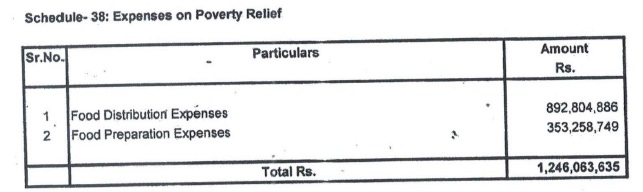
| (a) | Relief of the poor: The financial data placed on record confirms that free food is distributed to 1.50 lakh beneficiaries daily at a direct cost of Rs. 124.61 crore in FY 2023-24. Govinda’s food, which is satvik prasad for temple visitors, is distributed at the most at no-profit-no-loss or at a loss across 270+ outlets. ISKCON’s response to natural calamities and it’s All India Tribal Convention further demonstrate its charitable reach. These activities squarely fall under “relief of the poor.” Details of expenses reported by the assessee in its audited financial statement in this regard is extracted below: |
| (b) | Education: ISKCON operates three board-affiliated schools with combined enrolment of 1,550+ students and is establishing a university on 75 acres at Vrindavan. More than 30 lakh students from 6,700+ schools have participated in ISKCON’s educational programmes. Book distribution is at no-profit-no-loss. Total education expenditure in FY 2023-24 was Rs. 22.29 crore. These activities squarely fall under “education.” |
| (c) | Yoga: The ISKCON Govardhan School of Yoga is formally accredited by the Ministry of AYUSH through the Yoga Certification Board (YCB). More than 4,000 yoga teachers and 35,000 students have been trained. The ld. CIT(E) has not referred to this governmental accreditation anywhere in the impugned order. ISKCON’s yoga activities squarely fall under the specific named limb of “yoga.” |
| (d) | Medical relief: ISKCON’s formal MoUs with the Ministry of Home Affairs (Narcotics Control Bureau, Mission Spandan, 02.12.2024) and with the Department of Social Justice & Empowerment (NMBA) for de-addiction work are direct governmental partnerships for medical and social welfare. These activities fall under “medical relief.” |
| (e) | Preservation of environment: ISKCON’s 100+ goshalas directly implement the constitutional mandate of Articles 48 and 51A(g). ISKCON’s GEV at Palghar, with multiple national and international awards including from UNEP, UNECOSOC, UNCCD and the Union Ministry of Jal Shakti, is internationally recognised for environmental leadership. MoUs with NSDC and DBSKKV further demonstrate the environmental and rural development mission. These activities squarely fall under “preservation of environment.” |
18.2. Our foregoing analysis establishes, without any scope for doubt, that ISKCON’s activities fall under at least five of the six specific named limbs of section 2(15). The proviso to section 2(15) is, by its own express terms, inapplicable to any of these limbs. Ld. CIT(E) never considered primary aspect as to under which limb of section 2(15) does ISKCON fall. Instead, he proceeded directly to examine three income streams, characterised them as commercial, and invoked the proviso. This reversal of the statutory scheme is, in our considered view, a fundamental error going to the root of the impugned order.
18.3. It is settled that the scheme of section 2(15) requires the authority to first determine whether the institution falls within one of the specified named limbs. Only if the answer to that primary question is in the negative can the authority proceed to examine whether the institution falls within the residual category and only then can the proviso be invoked. An approach that skips this primary requirement and goes directly to examining receipts is contrary to the statutory scheme.
18.4. It is equally well settled that the source from which income is derived cannot, by itself, determine the true character of a charitable institution. The decisive test is the predominant object for which the institution exists and the manner in which income is ultimately applied. Every charitable institution, whether running hospitals, schools, temples or food distribution centres, requires financial resources to carry out its charitable programmes. The Act recognises this by granting exemption not to receipts as such but to income derived from property held under trust, subject to conditions under section 11. Merely because an institution generates receipts in the course of carrying out its charitable activities, even in a systematic and organised manner, does not lead to the inference that it has embarked upon a commercial venture.
18.5. We further note that neither the ld. Assessing Officer nor the ld. CIT(E) has recorded any finding that ISKCON has abandoned its charitable objects, diverted its funds for private gain, or undertaken any activity alien to the purposes for which it was constituted. The entire foundation of the impugned order rests upon the characterisation of three income streams, without any deliberation on ISKCON’s objects, which are admitted to be charitable, or the application of income, which is directed towards charitable purposes. The magnitude of receipts and the organised manner of the activity cannot alter the intrinsic character of an institution whose objects are charitable and whose income is applied towards charitable purposes. This is not a case of a charitable entity masking commercial activity behind a charitable facade; it is a case of a manifestly charitable entity generating resources through ancillary activities in the course of discharging its charitable mission.
18.6. There is also a fundamental distinction between an activity undertaken for earning profit and an activity undertaken for generating resources to fulfil charitable obligations. The latter does not assume the character of trade, commerce or business merely because it generates income in a systematic manner. The philosophy of selfless action, performing one’s duty for the welfare of society without attachment to personal gain, which ISKCON exists to propagate, is itself the organizing principle that distinguishes ISKCON’s income-generating activities from commercial enterprise. The resources generated sustain the free food distribution, the goshala maintenance, the schools, the yoga programmes, the de-addiction camps and the environmental projects. The income is not the end; it is the means to a manifestly charitable end.
18.7. Hon’ble Supreme Court in AUDA (supra), at para 160, drew a clear distinction between “a property or business held under trust”, to which section 11(1) applies and which is entitled to exemption, and “a business carried on by or on behalf of the trust”, to which section 11(4A) applies. Revenue has not demonstrated that ISKCON is carrying on a business “by or on behalf of the trust” rather than deriving income from “property held under trust.” In the absence of such a finding, the ratio of AUDA (supra), which was concerned with statutory and quasi-governmental authorities primarily falling under the residual limb, cannot be applied to ISKCON, whose dominant purposes fall under five specific named limbs.
18.8. It is worthwhile to refer to the judgment of Hon’ble High Court of Delhi in the case of India Trade Promotion Organization v. DIT (Exemptions) (Delhi) who had an occasion to deal with the challenge of constitutional validity of proviso to section 2(15) as amended by the Finance Act, 2008. While dealing with the issue, Hon’ble Court referred to the Memorandum regarding Delegated Legislation – Rationalisation and Simplification Measures to note that activities carried out on commercial lines are to intended to be brought under the radar. Relevant portion is extracted below:
“It has been noticed that a number of entities operating on commercial lines are claiming exemption on their income either under section 10(23C) or section 11 of the Act on the ground that they are charitable institutions. This is based on the argument that they are engaged in the “advancement of an object of general public utility” as is included in the fourth limb of the current definition of “charitable purpose”. Such a claim, when made in respect of an activity carried out on commercial lines, is contrary to the intention of the provision.”
18.8.1. It also referred to the Speech of the Hon’ble Minister of Finance, relevant extract are as under:
“180. ‘Charitable purpose’ includes relief of the poor, education, medical relief and any other object of general public utility. These activities are tax exempt, as they should be. However, some entities carrying on regular trade, commerce or business or providing services in relation to any trade commerce or business and earning income have sought to claim that their purpose would also fall under ‘charitable purpose’. Obviously, this way not the intention of Parliament and, hence, I propose to amend the law to exclude the aforesaid cases. Genuine charitable organizations will not in any way be affected.”
[emphasis supplied by us by bold]
18.8.2. Also, reference is made to the reply of Hon’ble Finance Minister to the Debate in the Lok Sabha on the Finance Bill, 2008, wherefrom relevant portion is extracted for our reference:
“The intention is to limit the benefit to entities which are engaged in activities such as relief of the poor, education, medical relief and any other genuine charitable purpose, and to deny it to purely commercial and business entities which wear the mask of a charity…. I once again assure the House that genuine charitable organisations will not in any way be affected.”
[emphasis supplied by us by bold and underline]
18.8.3. In para 53, Hon’ble Court made observation on the dominant activity vis-a-vis incidental or ancillary activity for the applicability of proviso to section 2(15). Relevant portion is extracted below:
“.it is apparent that merely because a fee or some other consideration is collected or received by an institution, it would not lose its character of having been established for a charitable purpose. It is also important to note that we must examine as to what is the dominant activity of the institution in question. If the dominant activity of the institution was not business, trade or commerce, then any such incidental or ancillary activity would also not fall within the categories of trade, commerce or business.”
[emphasis supplied by us by bold]
18.8.4. While concluding in para 58, Hon’ble Court gave its finding on the correct interpretation of proviso to section 2(15) by laying emphasis on ‘dominant and prime objective’. Relevant portion is reproduced as under:
“The correct interpretation of the proviso to Section 2(15) of the said Act would be that it carves out an exception from the charitable purpose of advancement of any other object of general public utility and that exception is limited to activities in the nature of trade, commerce or business or any activity of rendering any service in relation to any trade, commerce or business for a cess or fee or any other consideration. In both the activities, in the nature of trade, commerce or business or the activity of rendering any service in relation to any trade, commerce or business, the dominant and the prime objective has to be seen. If the dominant and prime objective of the institution, which claims to have been established for charitable purposes, is profit making, whether its activities are directly in the nature of trade, commerce or business or indirectly in the rendering of any service in relation to any trade, commerce or business, then it would not be entitled to claim its object to be a ‘charitable purpose’. On the flip side, where an institution is not driven primarily by a desire or motive to earn profits, but to do charity through the advancement of an object of general public utility, it cannot but be regarded as an institution established for charitable purposes.”
[emphasis supplied by us by bold]
18.8. Keeping the above detailed exposition on the issue in juxtaposition, we find that rejection of ISKCON’s application for renewal of registration u/s 12AB on the ground of violation of the proviso to section 2(15) is not sustainable.
19. Without prejudice to and in addition to the foregoing, and to address ld. CIT(E)’s specific observations on each of the three challenged income streams, details of receipts for the relevant years are tabulated below. For each of the three streams considered by the ld. CIT(E), we note the following:
| Particulars | 2022-23 | 2023-24 | 2024-25 |
| Total donations | 700,97,11,477 | 856,25,04,139 | 1030,64,00,285 |
| Total receipts | 11,47,51,33,035 | 14,32,19,67,964 | 16,88,31,27,444 |
| Sponsorship | 1,28,32,859 | 34,14,822 | 1,86,94,052 |
| Broadcasting & Royalty | 21,76,021 | 700,000 | 11,27,394 |
| Farm Agriculture and Other Income | 14,71,57,738 | 23,69,78,157 | 40,02,93,595 |
19.1. Sponsorships: It was submitted that the aggregate receipts under the head “Sponsorship” amount to Rs. 3,49,41,733/- over the last three years, which constitutes merely 0.08% of the total gross receipts, thereby clearly demonstrating their negligible proportion in the overall financial framework of the assessee. The nomenclature “sponsorship” does not, of itself, determine the nature of a receipt. What is relevant is whether the receipt is made in exchange for a commercial service or benefit. Assessee has demonstrated that receipts under this head from corporates and philanthropic entities are voluntary contributions towards large-scale charitable activities, free food distribution, humanitarian outreach and cultural programmes. Ld. CIT(E)’s approach of fastening on nomenclature alone, treating the word “sponsorship” as conclusively establishing a quid pro quo, is an error of the kind that ld. CIT(E) himself warns against in para 4.4 of the impugned order when it is recorded in the impugned order that characterisation on the basis of nomenclature alone is not acceptable. The same principle that the ld. CIT(E) applies to reject the assessee’s characterisation of these receipts as charitable applies with equal force to the Revenue’s characterisation of them as commercial on the basis of nomenclature. The MahaKumbhMela example is illustrative: ISKCON served over 50 lakh meals to nearly one lakh beneficiaries per day through a mega kitchen initiative, with corporate contributions that were purely philanthropic in nature and not made in consideration of any commercial service, advertisement or business benefit. These receipts are pure donations, earmarked for specific charitable purposes, as evidenced from the details set out below:
| Financial Year | NAME | Purpose for which amt is given | Amount |
| 2024-25 | Ambuja Cements Ltd | Free Food Distribution at Mahakumbh | 15,000,000 |
| 2024-25 | Finolex Industries Ltd | For Value Education | 1,500,000 |
| 2024-25 | Desai Foods Pvt Ltd | Free Food Distribution at Rathyatra Festival | 180,000 |
| 2023-24 | Finolex Industries Ltd | For Value Education | 1,260,000 |
| 2022-23 | Animesh Pathak | Free Food Distribution at Rathyatra Festival | 500,000 |
| 2022-23 | State Bank of India | Free Food Distribution at Rathyatra Festival | 300,000 |
| 2022-23 | Emami Ltd | Free Food Distribution at Rathyatra Festival | 500,000 |
| 2022-23 | J G Hosiery Pvt Ltd | Free Food Distribution at Rathyatra Festival | 300,000 |
19.2. Broadcasting and Royalty: As per the table above, total broadcasting and royalty receipts for the last three years amount to Rs. 40,03,415/-, which is negligible (approximately 0.009% of the total gross receipts). These receipts arise from limited permissions granted to television and DTH service providers to broadcast live feeds activities of our institution. Dissemination of teachings of Bhagavad Gita and Srimad Bhagavatam through audio-visual and digital media is not commercial exploitation of content. Bhagavad Gita, which expounds the universal philosophy of selfless action, renunciation of attachment, ethical duty and spiritual self-realisation through its eighteen chapters, is universally acknowledged as one of the greatest philosophical and ethical treatises available to mankind. Its teachings, including the principle “Karmanyevadhikaraste ma phaleshu kadachana” and the doctrine of Lokasangraha, selfless performance of one’s duties for the welfare of society, are universal ethical principles studied and relied upon by philosophers, jurists, management experts and leaders across the world, irrespective of their religious affiliation. Dissemination of such universal philosophical and ethical teachings through digital platforms is the twenty-first century instrument for preserving and transmitting India’s greatest cultural heritage. This is education and cultural preservation, not commercial media exploitation. Bhagavad Gita is not a text that propagates any exclusive ritual, ceremony or form of worship; its core teaching is ethical living, selfless action and self-realisation. Ld. CIT(E)’s characterisation of this activity as “systematic commercial exploitation of content” ignores the nature, purpose and context of what is being disseminated. Furthermore, the doctrine of Sannyasa as expounded in the Bhagavad Gita distinguishes creating wealth in service of a larger purpose, which is encouraged, from selfishly accumulating wealth for personal benefit, which is discouraged. ISKCON’s income from broadcasting and royalty is directed entirely to sustaining its charitable mission. This is the antithesis of commercial motivation.
19.3. Farm, Agriculture and Other Income / Goshalas: Total receipts under this head for the last three years amount to Rs. 78,44,29,491/-, which constitutes only approximately 1.84% of the total gross receipts of the assessee. Within this, agricultural income constitutes merely about 4.8% of farm, agricultural, and other income and 0.09% of the total gross receipts, with the balance comprising various small and incidental heads of income which are intrinsically connected with assessee’s core charitable activities. Given the insignificant proportion of these receipts in the overall financial framework, several minor heads have been grouped under “Other Income” for accounting convenience, without altering their underlying charitable character, as evident from the following table:
| Accounting head | Nature of income | 2024-25 | 2023-24 | 2022-23 |
| Sale of Vegetables / Fruits / Flowers/ Milk and milk product / other agricultural products | Farm & Agriculture Income | 19,217,356 | 13,645,118 | 5,305,772 |
| Scriptural course | Other Income | 456,292 | 22,611,000 | 277,932 |
| Spiritual Tour | Other Income | 114,023,006 | 24,447,578 | 17,578,961 |
| Museum and show | Other Income | 26,850,714 | 27,638,772 | 22,815,245 |
| Puja Bhoga Thali | Other Income | 12,000,884 | 7,204,392 | 2,987,084 |
| Sale of Shares & Securiries | Other Income | 10,542,400 | _ | _ |
| Parking Fee | Other Income | 9,373,408 | 1,696,550 | 1,503,900 |
| Yoga | Other Income | 10,863,652 | 76,853,399 | 4,640,551 |
| Auditorium & Exhibition | Other Income | 6,964,442 | 9,599,759 | 197,724 |
| Educational Seminar | Other Income | 642,729 | 2,714,047 | 19,271,576 |
| Insurance Claim | Other Income | 19,330,006 | ||
| Land Compensation | Other Income | 4,314,280 | 9,969,040 | |
| Income from Food Items | Other Income | 22,175,352 | 14,656,414 | _ |
| Interest on Income tax refund and other interest | Other Income | 5,883,555 | 14,610,011 | 15,397,914 |
| Youtube Income | Other Income | 2,388,307 | _ | _ |
| Shoe Stand and Mobile safe deposits | 1,681,662 | 7,185,290 | _ | |
| Sale of Scrap | Other Income | 2,063,497 | 736,534 | 1,215,633 |
| Recovery of Expenses (Food Distribution) | Other Income | 155,166,341 | 9,065,014 | 26,666,400 |
| Other Income | 38,10,76,239 | 22,33,33,040 | 14,18,51,966 | |
| Farm & Agriculture | 1,92,17,356 | 1,36,45,118 | 53,05,772 | |
| 40,02,93,595 | 23,69,78,158 | 14,71,57,738 | ||
| _ | _ | _ | ||
| Other Income | 95.20% | 94.24% | 96.39% | |
| Farm & Agriculture | 4.80% | 5.76% | 3.61% | |
| 100.00% | 100.00% | 100.00% |
19.3.1. The Constitution of India, under Article 48, directs the State to take steps for preserving and improving the breeds of cattle, and under Article 51A(g), casts a Fundamental Duty upon every citizen to have compassion for living creatures. ISKCON’s maintenance of 100+ goshalas, providing fodder, veterinary care and rehabilitation of abandoned, aged and infirm cattle, directly advances these constitutional objectives. The constitutional mandate to protect cattle cannot be treated by a tax authority as a disqualifying “commercial operation” merely on account of its scale. Agricultural produce from ISKCON’s farm operations is primarily directed to the Annakshetra programme of free food distribution. Sale of excess produce is undertaken purely to sustain these activities and to contribute to the Annakshetra. Organic farming, eco-village operations, and training of farmers in animal welfare and cattle management are activities that fall under “preservation of environment” in section 2(15). An institution that is constitutionally directed by Article 48 and Article 51A(g) to protect cattle cannot be tainted merely on account of its scale so as to constitute “commercial operations.” Details of expenses as reported by the assessee in its audited financial statement is taken note as under:
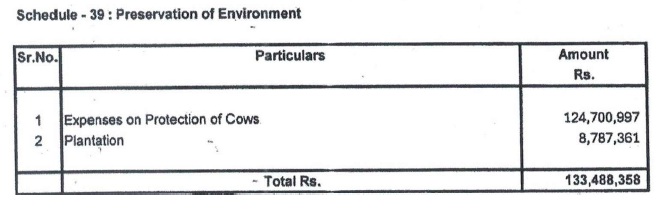
19.4. Govinda’s food outlets and accommodation: Ld. CIT(E) relied exclusively on data from ISKCON Juhu, Mumbai, merely one out of 270+ outlets, and ignored the assessee’s detailed nationwide data demonstrating that the thali price at Govinda’s outlets across the country ranges from Rs. 50 to Rs. 350 per plate, with the activity carried on at no profit-no loss or at a loss. The factual data in this regard is extracted below:
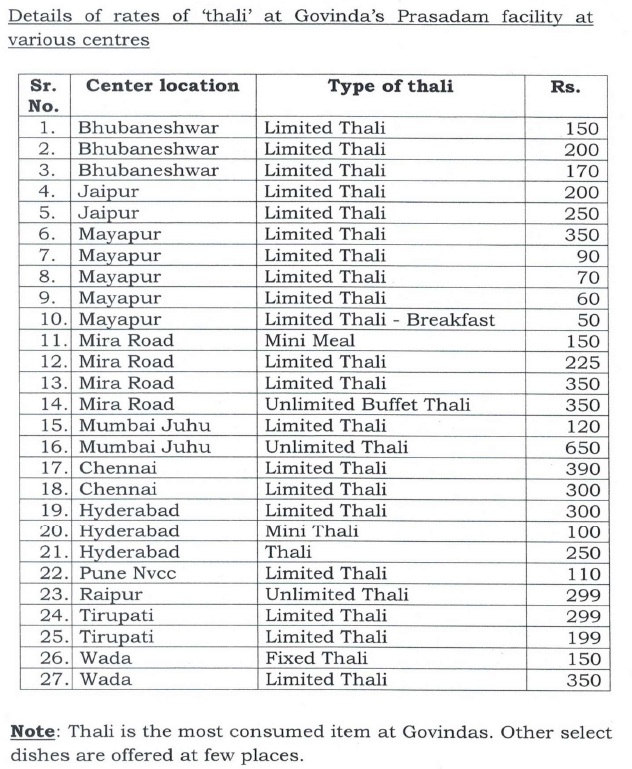
19.4.1. All these Govinda’s food outlets are housed within the ISKCON precincts/premises and are not separately located at a different geographical place to run like an independent restaurant. These cater only to those who visit the ISKCON premises and not otherwise. Selective reliance on one location while ignoring comprehensive national data furnished by the assessee is neither balanced nor bona fide. The financial data bears this out: gross receipts from food sales at Govinda’s during FY 2023-24 were Rs. 197.15 crore against direct expenditure (without overhead and administrative cost) of Rs. 178.88 crore. Same is extracted from the audited financial statement as under:
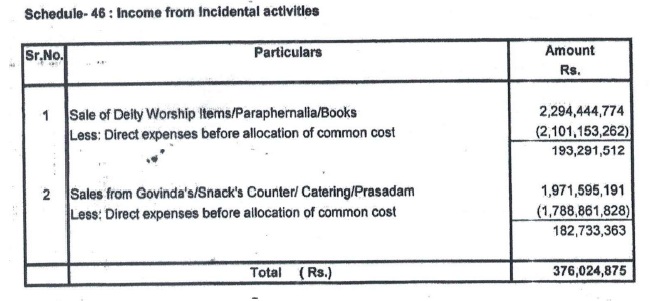
19.4.2. It is evident from serial no. 5 in schedule 45, for accommodation, gross receipts collection were Rs. 54.74 crore against direct expenditure of Rs. 53.54 crore in FY 2023-24. These figures demonstrate that even before allocation of common costs, the activities are carried on at or close to cost. Once common costs are factored in, there is no surplus. Schedule 45 extracted from the audited financial statement is reproduced below:
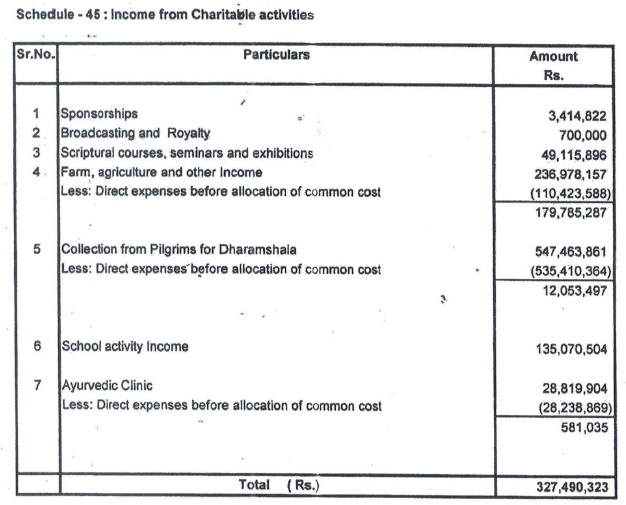
19.4.3. The accommodation maintained at more than 35 centres is invariably situated in the premises of the centres, with visitors having access to yoga programmes, educational programmes and other cultural events organised by the centre, making the accommodation an integral facilitator of ISKCON’s charitable programmes and not a commercial hotel service. Details of more than 35 centres where accommodation is maintained as against only one of Juhu, Mumbai on which reliance is placed by the ld. CIT(E) is tabulated below:
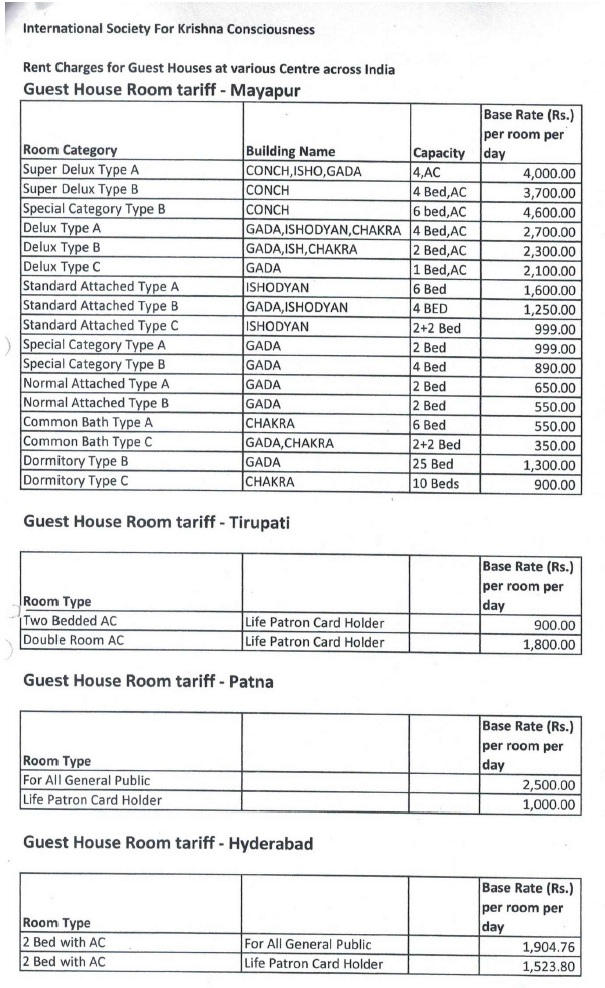
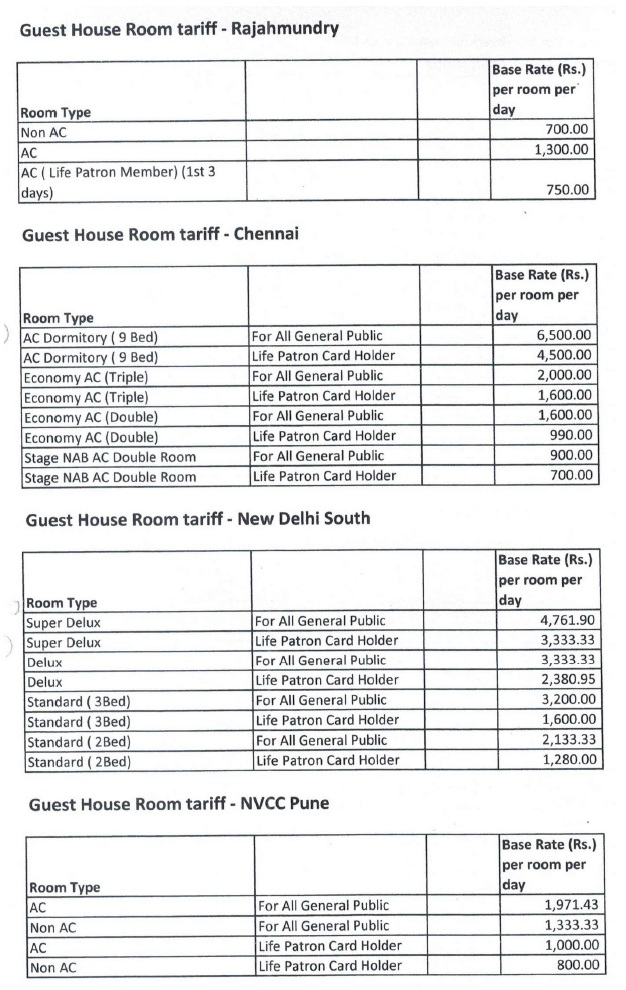
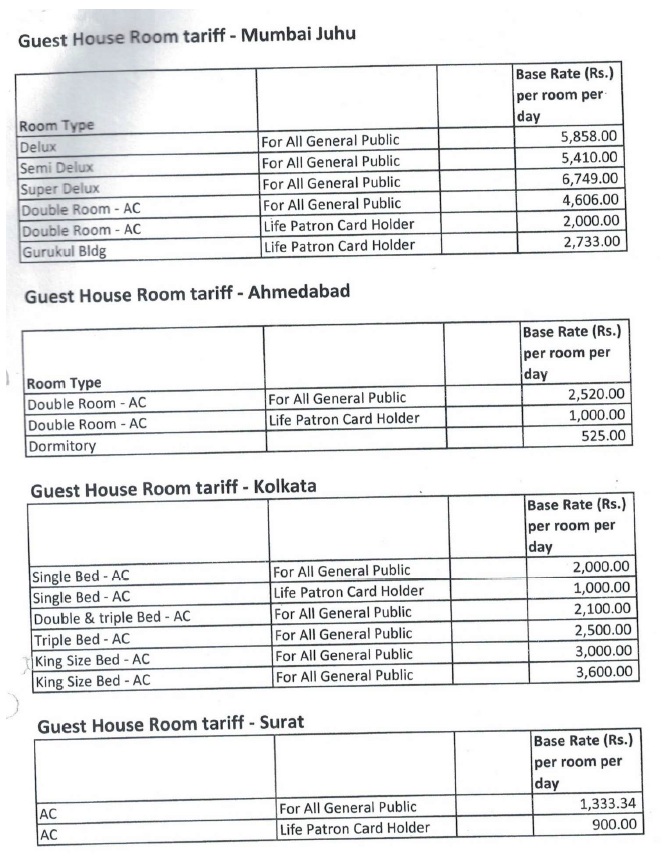
20. Even if the proviso to section 2(15) were applicable, which we hold it is not, for the reasons stated in paragraphs above, ld. CIT(E)’s computation of the 20% threshold is not sustainable for the following reasons:
20.1. Hon’ble Supreme Court in AUDA (supra) laid down the principle that the test for determining whether an activity constitutes “trade, commerce or business” requires an examination of whether the activity is undertaken at cost or at a nominal surplus in furtherance of charitable objects. The financial data tabulated in above paragraphs clearly demonstrates that ISKCON’s activities are priced at cost or at a very nominal margin before allocation of common costs, and at no-surplus or at a loss on full cost allocation.
20.2. Furthermore, ld. CIT(E)’s percentage computations, showing commercial receipts in the range of 43-47% of total receipts, are premised on a classification of all three income streams as “commercial” which classification is, for reasons set out above, fundamentally unsustainable. The actual computation of the 20% threshold, if carried out after (a) correctly classifying activities under the specific named limbs of section 2(15), (b) excluding activities that fall under those limbs from the denominator of the proviso test, and (c) applying the correct legal test from AUDA (supra) to the remaining activities, would yield a very different result from what the ld. CIT(E) has arrived at.
20.3. We accordingly hold that even on the alternative ground, i.e., assuming the proviso was applicable, ld. CIT(E)’s finding that commercial receipts exceed 20% of total receipts is not based on a correct application of the law to the facts available on record.
21. We now address the charge of “specified violation” under Explanation (g) to section 12AB(4). It is noted that Explanation (g) covers ‘furnishing of incorrect information or documents’ in the application for registration.
21.1. The factual position as emanating from the records is that assessee filed its application in Form 10AB on 30.09.2025 along with audited financial statements for the preceding three financial years, as evidenced by the Acknowledgement Receipt placed in the paper book at pages 63 and 64. The authority had complete access to the financial statements. The ld. CIT(E) drew his adverse conclusion upon these financial statements by extracting the financial data in para 4.9 of the impugned order. There was no suppression, no non-disclosure and no concealment.
21.2. Accounting presentation adopted by the assessee, where net surplus or deficit for certain activities is presented in the Income and Expenditure Account rather than gross receipts, is a recognised accounting practice, particularly where separate books of account are maintained for each activity as a matter of policy. This presentation does not amount to “incorrect information.” Incorrect information means information that is factually false or materially misleading. An accounting methodology that presents a net figure rather than a gross figure, where the underlying gross receipts and expenditure are available in the schedules forming part of the audited financial statements and other supporting details and paper books, and were indeed furnished, does not satisfy the threshold of “incorrect information” amounting to a “specified violation.” Relevant schedules from the audited financial statements are extracted above from where it is noted that gross receipts of each of such activities are duly disclosed while arriving at the net figures to be carried in to Income and Expenditure statement.
21.3. As noted above in the submissions made by the ld. Counsel for the assessee, coordinate Bench in the case of Pista Devi Education Society (supra) has in paras 11 to 13 thereof addressed a similar situation and held that the mere presentation of accounts in a particular format, without any element of wilful misrepresentation or deliberate concealment, does not rise to the level of a “specified violation” as defined under the Explanation to section 12AB(4). The bar for establishing a “specified violation” is a high one and is not met merely by pointing to a difference in accounting presentation when the underlying data is available and was in fact furnished.
21.4. We also note that ld. CIT(E), in para 6.1 of the impugned order, draws an adverse inference that assessee “deliberately” understated the receipts. Drawing an inference of deliberate wrongdoing is a serious matter that requires cogent material, not merely an accounting difference. Ld. CIT(E) has not placed any material on record to support a finding of deliberate misrepresentation. Assessee had furnished all its details in the paper books on record. The charge of “specified violation” and the adverse inference of deliberate understatement are therefore not sustainable.
22. On the question of violation of the principles of natural justice, we note with concern the sequence of events as recorded in the impugned order itself. Para 3 of the impugned order, after referring to the assessee’s reply dated 10.11.2025, records: “These activities are prima facie commercial in nature and being carried on for a consideration. The aggregate of receipts from such commercial activities exceeds twenty percent of total receipts; thereby attracting the applicability of proviso to section 2(15).” This conclusion, including the specific finding on the 20% threshold, was recorded before the show cause notice dated 21.03.2026 was even issued. The show cause notice was therefore issued not for the purpose of conducting an open inquiry but to clothe a pre-formed conclusion with the appearance of due process.
23. In the conspectus of the foregoing discussion dealing with factual matrix, provisions of the Act, judicial precedents and submissions made by both the parties, we record and summarize our conclusions as under:
| (i) | Ld. CIT(E) committed jurisdictional error in the impugned registration proceeding by examining application of income, quantum of receipts and activity-wise profitability, which are matters reserved for the ld. Assessing Officer at the stage of assessment under section 11. The proper scope of examination under section 12AB was limited to the objects of the assessee and the genuineness of its activities. |
| (ii) | Activities of the assessee trust fall under at least five of the six specific named limbs of section 2(15) of the Act, relief of the poor, education, yoga, medical relief and preservation of environment. The proviso to section 2(15) is, by the express terms of the statute, inapplicable to these named limbs and the rejection of the application on this ground is not sustainable. |
| (iii) | Ld. CIT(E)’s characterisation of specific income streams, Sponsorships, Broadcasting and Royalty and Farm, Agriculture and Other Income, as “commercial” is not supported by verifiable facts on record. The source and magnitude of income do not determine the charitable character of an institution. The decisive test is the dominant object and the application of income. ISKCON’s income is directed towards charitable objects. |
| (iv) | Selective reliance on data from ISKCON Juhu, Mumbai while ignoring comprehensive national data furnished by the assessee for 270+ outlets and 35+ accommodation centres render the finding in para 4.5 of the impugned order factually unsustainable. |
| (v) | The charge of “specified violation” under Explanation (g) to section 12AB(4) is not made out. Assessee furnished its audited financial statements and all supporting details at the time of filing. Accounting presentation on a net basis does not constitute “incorrect information” amounting to a “specified violation” in the absence of material establishing wilful misrepresentation, more particularly when the gross receipts are duly disclosed and reported in the relevant schedules forming part of the audited financial statements. |
| (vi) | The three challenged income streams by the ld. CIT(E) have been accepted in past scrutiny assessments. No cogent material has been placed on record by the Revenue to justify departure from this consistent position. The ratio of Radhasoami Satsang (supra) applies. |
23.1. Accordingly, in view of the above stated conclusions, impugned order dated 30.03.2026 passed by ld. CIT(E) rejecting assessee’s application for renewal of registration u/s 12AB is set aside. Ld. CIT(E) is directed to grant registration to the assessee u/s 12AB as prayed. Grounds raised by the assessee in this regard are allowed.
24. The second appeal is towards rejection of application seeking renewal under section 80G(5)(ii) which is consequent to rejection of application for renewal of application for registration under section 12AB which has been adjudicated upon by us in the above paragraphs. Since, order of ld. CIT(E) in this regard has been set aside and he directed to grant the registration in terms of our stated observations and findings, the application seeking renewal under section 80G(5)(ii) is also directed to be allowed. Ld. CIT(E) is accordingly directed to grant renewal of approval under section 80G as sought by the assessee. Grounds raised by the assessee in this regard are allowed.
25. In the result, both the appeals filed by the assessee are allowed.