ORDER
Keshav Dubey, Judicial Member.-This appeal at the instance of the assessee is directed against the order of the ld. CIT(A)/NFAC dated 23/01/2024 vide DIN & Order No. ITBA/NFAC/S/250/2023-24/1060031566 passed u/s 250 of the Income Tax Act, 1961 (in short “the Act”) for the assessment year 2018-19.
2. The assessee has raised the following grounds of appeal: –
| 1. |
|
The order passed by the ld. CIT(A), NFAC is erroneous, contrary to law and facts of the case. |
| 2. |
|
The ld. CIT(A) erred in upholding the order of the ld. AO imposing penalty u/s 270A of the Income Tax Act, 1961 |
| 3. |
|
The ld. CIT(A) erred in law and on facts in holding that the appellant company had under reported its income, despite the fact that the appellant had incurred losses during the relevant assessment year. |
| 4. |
|
The appellant craves to leave, add amend, alter and or modify any of the grounds of appeal before or at the time of hearing. |
| 5. |
|
For these and other grounds that may be urged before the Honourable Income Tax Appellate Tribunal, it is prayed that the penalty u/s 270A of the Income Tax Act, 1961 be deleted. |
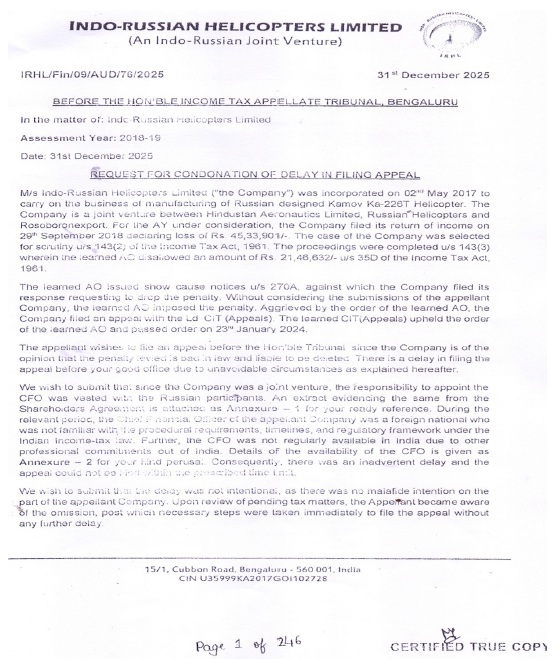
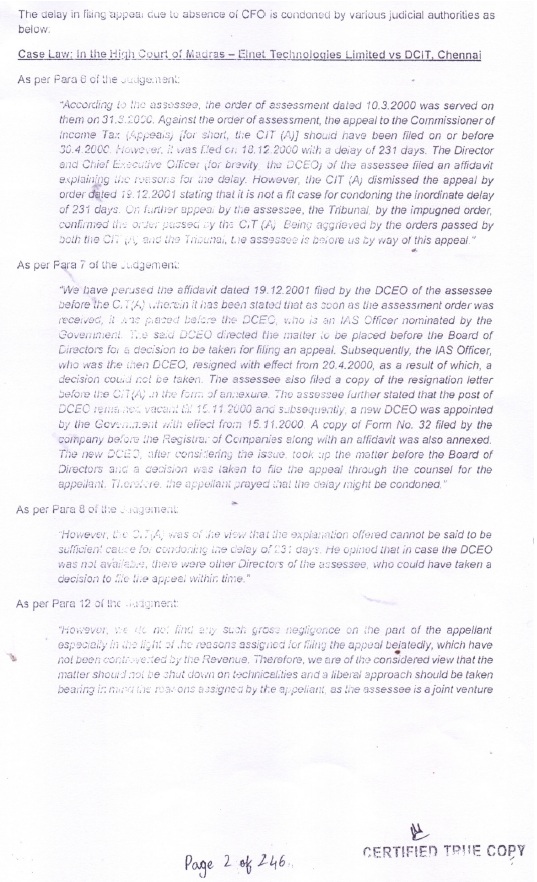
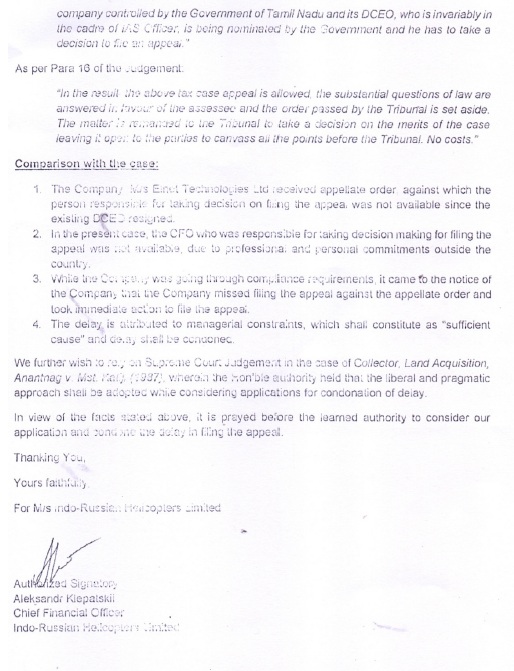
3. At the outset, as noted by the Registry, there is a delay of 642 days in filing the appeal before this Tribunal. The ld. A.R. of the assessee drew our attention on an application for condonation of delay dated 31/12/2025 stating the reasons/cause for such huge delay, which are reproduced below for ease of reference and record:
3.1 Having heard the ld. Counsel for the assessee as well as ld. D.R. it is perceived that the explanation offered in the condonation application is plausible and sufficient cause been shown by the assessee which prevented them from filing the appeal within the prescribed period u/s 253 of the Act and accordingly we inclined to condone the delay and admit the appeal for adjudication on merits.
4. The brief facts of the case are that the assessee is a company incorporated on 2.5.2017 to carry on the business of manufacturing of Russian design Kamov 226T Helicopter. The company is a joint venture between Hindustan Aeronautics Ltd., Russian Helicopters and Rosoboronexport. The assesse company filed its return of income for AY 2018-19 on 29.8.2018 by declaring total loss of Rs.45,33,901/-. The said return of income was processed and accordingly intimation u/s 143(1) of the Act was passed accepting the returned loss of Rs.45,33,901/-. Thereafter, the case of the assessee was selected for scrutiny under CASS and accordingly notices u/s 143(2) as well as 142(1) of the Act along with show cause notice were issued. The assessee furnished submissions on various dates through e-filing/ITBA portal. The reason for selection of the case was “Introduction of large capital/share capital in the year of incorporation”. During the course of assessment proceeding, the AO noticed that the assessee had claimed pre-incorporation expenditure of Rs.26,83,290/- and accordingly the assessee was requested to furnish complete details of pre-incorporation/pre-operative expenditure and justify its allowability as expenses. The AO observed that as per the provisions of section 35D of the Act, the assessee was eligible to claim deduction of only 1/5th of the pre-incorporation expenses in a year and the total expenses was to be claimed in 5 equal instalments in 5 years. However, the assessee claimed full expenses in a single year i.e. during financial year 2017-18 relevant for assessment year 2018-19 which is not allowable. Hence, an amount of Rs.5,36,658/- (1/5th of Rs.26,83,290/-) only to be allowed as deduction and remaining expenses of Rs.21,46,632/-(Rs.26,83,290/- – Rs.5,36,658/-) is liable to be disallowed and allowed to be carried forward for claiming deduction in subsequent four years. Accordingly, the draft assessment order proposing modification in the returned loss was prepared and sent to the assessee.
4.1 The assessee vide its reply dated 3.5.2021 submitted that company has incurred pre-incorporation expenses of Rs.26,83,290/-which has been inadvertently fully claimed in the return of income instead of 1/5th of such expenses over a period of 5 years. The assessee company agreed on the action of AO in allowing Rs.5,36,638/- for the AY 2018-19 and disallowing Rs.21,46,632/-which is in accordance with the provisions of section 35D of the Act. The assessee again reiterated that the claim of the entire expenditure was not intentional but inadvertent claim and accordingly prayed not to initiate penalty proceedings u/s 270A of the Act on the ground that income for the year is under reported. As the assessee agreed with the disallowance of Rs.21,46,632/- as per the provisions of section 35D of the Act, as proposed in the draft assessment order, accordingly, an amount of Rs.21,46,632/- was disallowed and added back to the income of the assessee for the year under consideration. The AO completed the assessment proceedings u/s 143(3) of the Act on 20.5.2021 on a total assessed loss of Rs.23,87,269/- against a returned loss of Rs.45,33,901/-. The AO before completion of the assessment proceedings also initiated the penalty proceedings u/s 270A of the Act for under reporting of income.
5. Thereafter, the AO on the very same day i.e. on 20.5.2021 issued show cause notice u/s 274 r.w.s. 270A of the Act asking the assessee to show cause as to why penalty order u/s 270A of the Act shall not be passed for under reporting of income amounting to Rs.21,46,632/-. During the course of penalty proceeding, the assessee company once again reiterated that assessee company has incurred pre-incorporation expenditure of Rs.26,83,290/- which has been inadvertently fully claimed in the return of income instead of 1/5th of such expenses over a period of 5 years. The assessee also submitted that the claim was not intentional but an inadvertent claim and accordingly prayed that the penalty proceeding u/s 270A of the Act may not be initiated. The AO however, did not accept the contention of the assessee by holding that the assessee during the course of assessment proceeding accepted the disallowances under the head “pre-incorporation expenses” as per provisions of section 35D of the Act and therefore, the under reported income to the tune of Rs.21,46,632/- as per section 270A of the Act for AY 2018-19 was imposed to the assessee company @ 50% of the amount of tax payable. Accordingly, the AO directed to pay an amount of Rs.3,31,655/- i.e. 50% of Rs.6,63,310/- by way of penalty u/s 270A of the Act for under reporting of income.
6. Aggrieved by the penalty order passed u/s 270A of the Act dated 16.3.2022, the assessee preferred an appeal before the ld. CIT(A)/NFAC.
7. The ld. CIT(A)/NFAC dismissed the appeal of the assessee by holding that the assessee did not furnish any concrete reasons or explanation in the submission as to why the AO’s action was unwarranted. In view of the same, the penalty imposed by the AO of Rs.3,31,655/- was upheld.
8. Again, aggrieved by the order of ld. CIT(A)/NFAC, the assessee has filed the present appeal before this Tribunal.
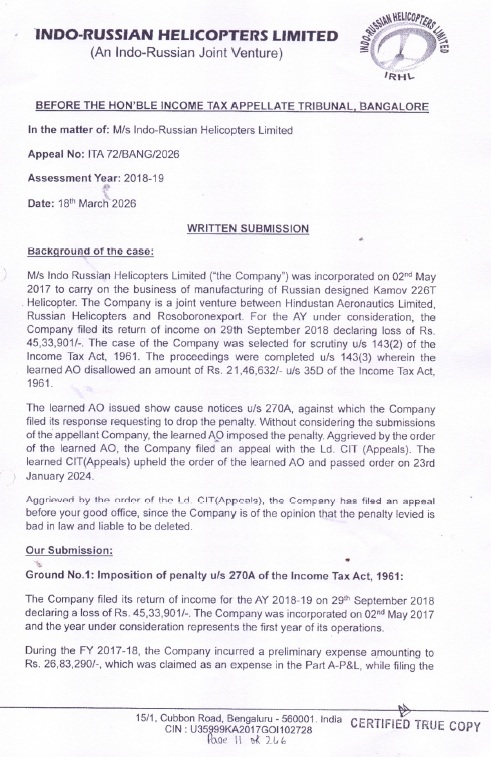
9. Before us, the ld. A.R. of the assessee vehemently submitted that assessee company had incurred pre-incorporation expenditure of Rs.26,83,290/- which has been inadvertently fully claimed in the return of income instead of 1/5th of such expenses over a period of 5 years. Further, ld. A.R. of the assessee submitted that during the course of assessment proceedings as well as penalty proceedings, the assessee had categorically agreed with the action of AO in allowing Rs.5,36,638/-for the AY 2018-19 and disallowing Rs.21,46,632/-, which is in accordance with the provisions of section 35D of the Act. The ld. A.R. further submitted that the entire claim of preincorporation expenditure in AY 2018-19 was not intentional but an inadvertent claim and accordingly prayed that the penalty may be deleted. Further, the assessee has also filed a written submission which are also reproduced below for ease of reference and convenience:
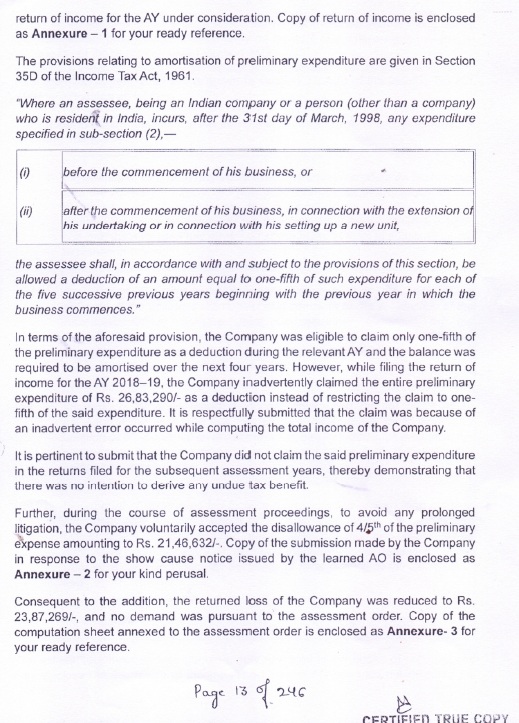
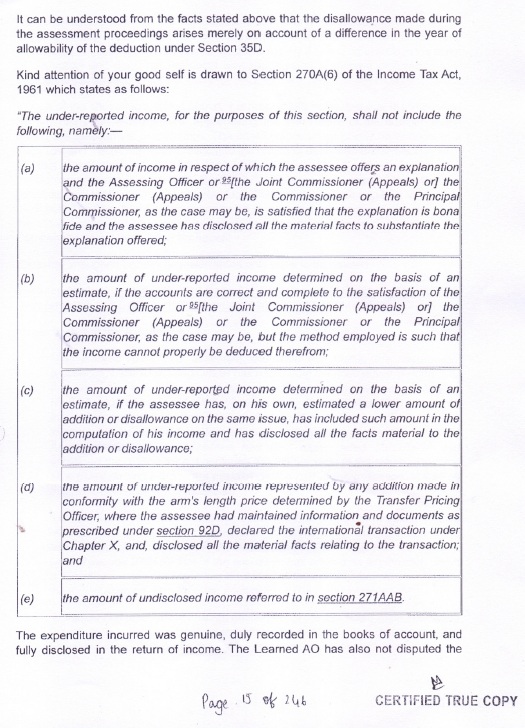
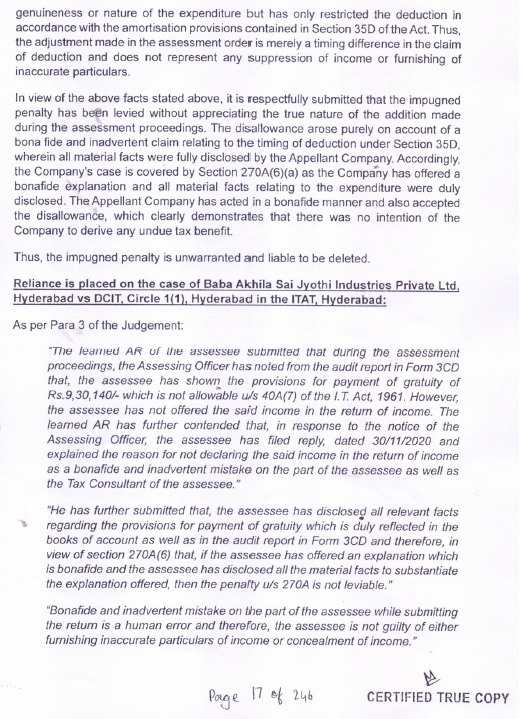

10. The ld. D.R. on the other hand supported the orders of the authorities below and vehemently submitted that the assessee company during the course of assessment proceedings admitted the action of AO in disallowing Rs.21,46,632/- in accordance with the provision u/s 35D of the Act and therefore, penalty is fully justifiable. Further, the ld. D.R. submitted that had the case not been selected for scrutiny, this fact would not have come to the light.
11. We have heard the rival submissions and perused the materials available on record. The AO had passed the assessment order for the AY 2018-19 after assessee agreed that only 1/5th of the pre-incorporation expenses was allowable and accordingly concluded the assessment proceedings on a total assessed loss of Rs.23,87,269/- against the returned loss of Rs.45,33,901/-. On going through the assessment order, we also observed that the AO had initiated the penalty proceedings on or before the completion of the assessment proceedings on the ground of under reporting of income.
11.1 It is an undisputed fact that the assessee had incurred preincorporation expenditure of Rs.26,83,290/-. The contention of the assessee is that the claim of entire amount of pre-incorporation expenditure in AY 2018-19 was not intentional but an inadvertent claim. We observed that during the course of assessment proceeding, the assessee vide reply dated 3.5.2021 suo-moto agreed that only 1/5th of pre-incorporation expenses was allowable and accordingly agreed with the disallowances of Rs.21,46,632/- as per the provisions of section 35D of the Act. We are of the considered opinion that the claim of the assessee was not intentional but an inadvertent claim also supports from the fact that the assessee in subsequent assessment years did not claim the said preliminary expenditure. This clearly demonstrate that there was no intention to deprive any legitimate dues of the government. We also take a note of the fact that during the course of assessment proceeding, the assessee company voluntarily accepted the inadvertent error and agreed for the disallowance of Rs.21,46,632/-. Thus, we are of the considered opinion that the explanation offered by the assessee that it was an inadvertent error and the claim was not intentional is bona fide and the assessee has disclosed all the material facts fully to substantiate the explanation offered within the meaning of section 270A (6)(a) of the Act.
11.2 For the purpose of evaluating the correctness of rival submissions addressed, we deem it apposite to extract section 270A of the Act herein below:
“270A. Penalty for under-reporting and misreporting of income.
(1) The Assessing Officer or the Commissioner (Appeals) or the Principal Commissioner or Commissioner may, during the course of any proceedings under this Act, direct that any person who has under-reported his income shall be liable to pay a penalty in addition to tax, if any, on the under-reported income.
(2) A person shall be considered to have under-reported his income, if-
(a) the income assessed is greater than the incone determined in the return processed under clause (a) of sub-section (1) of section 143;
(b) the income assessed is greater than the maximum amount not chargeable to tax, where no return of income has been furnished or where return has been furnished for the first time under section 148;
(c) the income reassessed is greater than the income assessed or reassessed immediately before such reassessment;
(d) the amount of deemed total income assessed or reassessed as per the provisions of section 115JB or section 115JC, as the case may be, is greater than the deemed total income determined in the return processed under clause (a) of subsection (1) of section l43;
(e) the amount of deemed total income assessed as per the provisions of section 115JB or section 115JC is greater than the maximum amount not chargeable to tax, where no return of income has been furnished or where return has been furnished for the first time under section 148;
(f) the amount of deemed total income reassessed as per the provisions of section 115JB or section 115JC, as the case may be, is greater than the deemed total income assessed or reassessed immediately before such reassessment;
(g) the income assessed or reassessed has the effect of reducing the loss or converting such loss into income.
(3) The amount of under-reported income shall be,-
(i) in a case where income has been assessed for the first time,-
(a) if return has been furnished, the difference between the amount of income assessed and the amount of income determined under clause (a) of sub-section (1) of section 143;
(b) in a case where no return of income has been furnished or where return has been furnished for the first time under section 148,-
(A) the amount of income assessed, in the case of a company, firm or local authority; and
(B) the difference between the amount of income assessed and the maximum amount not chargeable to tax, in a case not covered in item (A);
(ii) in any other case, the difference between the amount of income reassessed or recomputed and the amount of income assessed, reassessed or recomputed in a preceding order;
Provided that where under-reported income arises out of determination of deemed total Income in accordance with the provisions of section 115JB or section 115JC, the amount of total under-reported income shall be determined in accordance with the following formula-
(A- B) + (C- D)
where,
A = the total income assessed as per the provisions other than the provisions contained in section 115JB or section 115JC (herein called general provisions);
B= the total income that would have been chargeable had the total income assessed as per the general provisions been reduced by the amount of under-reported income;
C= the total income assessed as per the provisions contained in section 115JB or section 115JC;
D= the total income that would have been chargeable had the total income assessed as per the provisions contained in section l15JB or section 115JC been reduced by the amount of underreported income:
Provided further that where the amount of under-reported income on any issue is considered both under the provisions contained in section 115JB or section 115JC and under general provisions, such amount shall not be reduced from total income assessed while determining the amount under item D.
Explanation.- For the purposes of this section,-
(a) “preceding order” means an order immediately preceding the order during the course of which the penalty under sub-section (1) has been initiated;
(b) in a case where an assessment or reassessment has the effect of reducing the loss declared in the return or converting that loss into income, the amount of under-reported income shall be the difference between the loss claimed and the income or loss, as the case may be, assessed or reassessed.
(4) Subject to the provisions of sub-section (6), where the source of any receipt, deposit or investment in any assessment year is claimed to be an amount added to income or deducted while computing loss, as the case may be, in the assessment of such person in any year prior to the assessment year in which such receipt, deposit or investment appears (hereinafter referred to as “preceding year”) and no penalty was levied for such preceding year, then, the under-reported income shall include such amount as is sufficient to cover such receipt, deposit or investment.
(5) The amount referred to in sub-section (4) shall be deemed to be amount of income under- reported for the preceding year in the following order-
(a) the preceding year immediately before the year in which the receipt, deposit or investment appears, being the first preceding year; and
(b) where the amount added or deducted in the first preceding year is not sufficient to cover the receipt, deposit or investment, the year immediately preceding the first preceding year and so on.
(6) The under-reported income, for the purposes of this section, shall not include the following, namely:-
(a) the amount of income in respect of which the assessee offers an explanation and the Assessing Officer or the Commissioner (Appeals) or the Commissioner or the Principal Commissioner, as the case may be, is satisfied that the explanation is bona fide and the assessee has disclosed all the material facts to substantiate the explanation offered;
(b) the amount of under-reported income determined on the basis of an estimate, if the accounts are correct and complete to the satisfaction of the Assessing Officer or the Commissioner (Appeals) or the Commissioner or the Principal Commissioner, as the case may be, but the method employed is such that the income cannot properly be deduced therefrom;
(c) the amount of under-reported income determined on the basis of an estimate, if the assessee has, on his own, estimated lower amount of addition or disallowance on the same issue, has included such amount in the computation of his income and has disclosed all the facts material to the addition or disallowance;
(d) the amount of under-reported income represented by any addition made in conformity with the arm’s length price determined by the Transfer Pricing Officer, where the assessee had maintained information and documents as prescribed under section 92D, declared the international transaction under Chapter X, and, disclosed all the material facts relating to the transaction; and
(e) the amount of undisclosed income referred to in section 271AAB.
(7) The penalty referred to in sub-section (1) shall be a sum equal to fifty per cent of the amount of tax payable on under-reported income.
(8) Notwithstanding anything contained in sub-section (6) or sub-section (7), where under- reported income is in consequence of any misreporting thereof by any person, the penalty referred to in sub-section (1) shall be equal to two hndred per cent of the anount of tax payable on under-reported income.
(9) The cases of misreporting of income referred to in sub-section
(8) shall be the following, namely:-
(a)misrepresentation or suppression of facts;
(b) failure to record investments in the books of account;
(c) claim of expenditure not substantiated by any evidence;
(d) recording of any false entry in the books of account;
(e) failure to record any receipt in books of account having a bearing on total income; and
(f) failure to report any international transaction or any transaction deemed to be an international transaction or any specified domestic transaction, to which the provisions of Chapter X apply.
(10) The tax payable in respect of the under-reported income shall be-
(a) where no return of income has been furnished or where return has been furnished for the first time under section 148 and the income has been assessed for the first time, the amount of tax calculated on the under-reported income as increased by the maximum amount not chargeable to tax as if it were the total income;
(b) where the total income determined under clause (a) of subsection (1) of section 143 or assessed, reassessed or recomputed in a preceding order is a loss, the amount of tax calculated on the under-reported income as if it were the total income;
(c) in any other case, determined in accordance with the formula-(XY) where,
X= the amount of tax calculated on the under-reported income as increased by the total income determined under clause (a) of sub-section (1) of section 143 or total income assessed, reassessed or recomputed in a preceding order as if it were the total income; and
Y= the amount of tax calculated on the total income determined under clause (a) of sub- section (1) of section 143 or total income assessed, reassessed or recomputed in a preceding order.
(11) No addition or disallowance of an amount shall form the basis for imposition of penalty, if such addition or disallowance has formed the basis of imposition of penalty in the case of the person for the same or any other assessment year.
(12) The penalty referred to in sub-section (1) shall be imposed, by an order in writing, by the Assessing Officer, the Commissioner (Appeals), the Commissioner or the Principal Commissioner, as the case may be.”
11.3 On plain reading of the same, we are of the opinion that when a notice u/s 270A of the Act is issued, the following step ladder should be followed by the AO while levying penalty u/s 270A of the Act-
| 1. |
|
Underreporting – First the onus is on the AO to establish whether any of the contingency spoken of in clauses (a) to (g) of Section 27OA(2) in the case of the assessee are attracted or not. If Yes, under which clause (limb) the assessee has underreported the income? |
| 2. |
|
Now the onus shifted on the assessee to refute by establishing that the assessee falls within any of the clauses (a) to (e) of section 270A(6) of the Act & hence there is no underreporting of income & the proceedings end there. Section 270A(6) is a window given by the legislature to give a leave to the Assessee. |
| 3. |
|
If the assessee is not able to controvert the charge of under reporting, the under reporting gets confirmed. |
| 4. |
|
Once the charge of underreporting is confirmed, then the AO has to establish whether the underreporting is in consequence of any of the clauses (a) to (f) of Section 270A(9) of misreporting. If Yes, under which clause (limb) the assessee has misreported the income? |
11.4 In the present case, we are of the considered opinion that first the onus is on the AO to establish whether any of the contingency spoken of in clauses (a) to (g) of Section 27OA(2) in the case of the assessee are attracted or not. If yes, under which clause (limb) the assessee has underreported the income. In our opinion, the AO has not brought on record any specific charge of under reporting of income as to how the ingredient of sub-section (2) of section 270A of the Act is satisfied i.e. under which clause(limb) the assessee has under reported his income. In our considered opinion, the provision of section 270(6)(a) of the Act is applicable in the case of the assessee which states that the under reporting of income shall not include the amount of income in respect of which assessee offers an explanation and the AO is satisfied that the explanation is bona fide and the assessee has disclosed all the material facts to substantiate the explanation offered. We are of the considered opinion that the claim of the assessee was not intentional but an inadvertent claim also supports from the fact that the assessee in subsequent assessment years did not claim the said preliminary expenditure. This clearly demonstrate that there was no intention to deprive any legitimate dues of the government. We also take a note of the fact that during the course of assessment proceeding, the assessee company voluntarily accepted the inadvertent error and agreed for the disallowance of Rs.21,46,632/-. Thus, in our opinion the explanation offered by the assessee that it was an inadvertent error and the claim was not intentional is genuine one.
11.5 We are also of the opinion that the penalty by hereditary nature is always discretionary. The legislature has used the word “may” in Section 270A(1) of the Act which clearly says that it is discretionary on the part of the AO to levy penalty or not. In our opinion, the penalty is not at par with the tax and interest and therefore, penalty should not be levied in a light-hearted manner or in a routine-manner and not every additions/ disallowances are liable for penalty. The primary onus is on the revenue to prove that assessee falls under particular limb of the fault. The AO has to bring the case in the four corners of the sections in order to levy penalty, which in our opinion, the authorities below failed to do so. In view of the above & considering the fact that assessee during the course of assessment proceeding admitted that the entire pre-incorporation expenditure of Rs.26,83,290/- was inadvertently claimed in the return of income instead of 1/5th of such expenses over a period of 5 years and the claim was not intentional, we direct the AO to delete the entire penalty of Rs. 3,31,655/- levied under Section 270A of the Act.
12. In the result appeal filed by the assessee is allowed.