


Issue
-
Whether the release/reversal of an NPA provision transferred to the Profit & Loss account can be taxed under Section 41(1) as a remission or cessation of trading liability.
-
Whether deduction under Section 36(1)(viia) read with Rule 6ABA is to be computed on the total outstanding monthly rural advances including opening balances, and whether provisions created towards standard assets qualify for such deduction.
-
Whether penalty under Section 271(1)(c) can be levied on a disallowance under Section 36(1)(viia) arising due to statutory interpretation rather than concealment.
-
Whether overdue interest on NPAs credited to the P&L account is taxable on an accrual basis despite the uncertainty of realization.
Facts
-
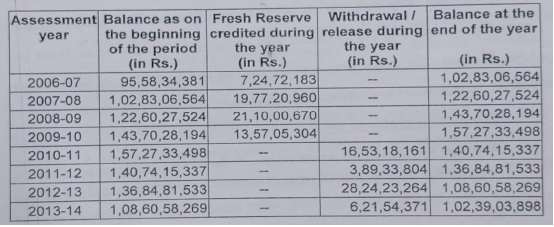
Reversal of NPA Provision: The assessee, a co-operative bank, determined NPAs as per RBI prudential norms and transferred excess year-end provisions to the P&L account as an NPA reserve release. The AO and CIT(A) taxed this release under Section 41(1).
-
Computation under Section 36(1)(viia): The assessee claimed a Section 36(1)(viia) deduction including provisions for standard assets. The AO restricted the deduction by calculating “aggregate average advances” using only incremental rural advances and held the allowable deduction was Nil.
-
Penalty under Section 271(1)(c): Penalty was levied on the assessee for claiming an incorrect deduction under Section 36(1)(viia) for AY 2008–09.
-
Overdue Interest on NPAs: The assessee credited overdue interest on NPAs to its P&L account but claimed a deduction citing non-realization. The AO taxed the interest on accrual under the mercantile system, which the CIT(A) deleted following the real income principle.
Decision
-
Section 41(1) Inapplicable [In favour of assessee]: The release of a provision for bad and doubtful debts cannot be taxed under Section 41(1) because a Section 36(1)(viia) deduction is a statutory notional computation rather than a written-off loss, expenditure, or trading liability.
-
Rule 6ABA & Provision Eligibility [Matter remanded]: Provisions created towards standard assets qualify for deduction under Section 36(1)(viia), and “aggregate average advances” under Rule 6ABA must be computed on total outstanding monthly advances including opening balances. The matter was remanded to the AO for de novo verification of net versus gross provision figures.
-
Penalty Set Aside [In favour of assessee]: Disallowances resulting from statutory interpretation or bona fide legal claims do not amount to concealing income or furnishing inaccurate particulars under Section 271(1)(c).
-
Overdue Interest Deletion Upheld [In favour of assessee]: Relying on binding High Court precedent in the assessee’s own case, overdue interest on NPAs is non-taxable on accrual under the real income principle.
Key Takeaways
-
Scope of Section 41(1): Reversals of bad debt provisions created under Section 36(1)(viia) do not trigger Section 41(1) taxability unless an actual write-off under Section 36(1)(vii) occurred earlier.
-
Calculation of Rural Advances: Under Rule 6ABA, the computation of aggregate average advances must take into account the entire outstanding advance at the end of each month, not just incremental advances made during the year.
-
Standard Assets Included: Provisions created against standard assets are eligible for statutory deduction benefits under Section 36(1)(viia).
-
Bona Fide Claims Excluded from Penalty: Making an unsustainable or debatable deduction claim based on statutory provisions does not automatically attract penalty for misreporting or concealment.
and Ms. Padmavathy S., Accountant Member
[Assessment years 2008-09, 2010-11, 2011-12, 2012-13 and 2013-14]
| Sl.No. | Issues for consideration | Assessment Year | ITA No. | Appeal filed by |
| 1. | Overdue Interest | 2010-11 | 1668/2017 | Department |
| 2011-12 | 1669/2017 | Department | ||
| 2. | NPA Reserve release |
2010-11
2011-12
2012-13
|
1559/2017
1560/2017
1561/2017
|
Assessee
Assessee
Assessee
|
| 3 | Enhancement Power of CIT(Appeals) | 2012-13 | 2873/2017 | Assessee |
| 4. | Penalty u/s 271(l)(c) on NPA Reserve (on enhancement) | 2012-13 | 2873/2017 | Assessee |
| 5. | Deduction u/s 36(l)(viia) |
2010-11
2011-12
2012-13
2013-14
|
1559/2017
1560/2017
1561/2017
2069/2018
|
Assessee
Assessee
Assessee
Department
|
| 6. | Penalty u/s 271(l)(c) on disallowance u/s 36(l)(viia) | 2008-09 | 748/2019 | Assessee |
“30. In all fairness to learned counsel for the revenue, the contention that Section 43D of the Act itself recognises taxability of such interest and that when a specific provision in the nature of section 43D of the 7-10-2020 15 Act has been made, and entities like the assessee are excluded from the purview thereof, the assessee cannot indirectly claim benefit which would amount to a benefit similar to that under section 43D of the Act, requires to be discussed. In this regard, it may be noted that the benefit claimed by the assessee is not under any provision of the Act. The assessee being bound by the RBI Guidelines which are issued under the provisions of the 1934 Act has not shown the interest on NPA as income. By virtue of the provisions of section 45Q of the 1934 Act, the provisions of Chapter IIIB thereof have an overriding effect over other laws. Therefore, notwithstanding the provisions of section 43D of the Act, since the provisions of section 45Q of the 1934 Act have an overriding effect vis-a-vis income recognition principles in the Companies Act, the Assessing Officer is bound to follow the RBI Directions so far as income recognition is concerned. The interest on principal loan amount which has been classified as NPA cannot be held to have “accrued” so as to tax them under the Act. The contention that the assessee cannot indirectly claim the benefit which would amount to a benefit similar to that under section 43D of the Act, therefore, does not merit acceptance.
31. The similar issue was considered in Shri Mahila Sewa Sahakari Bank Ltd.’s case (supra)in the case of Cooperative Banks by the Gujarat High Court where the issue was decided in favour of the assessee through a detailed judgment. Against the judgment of the Gujarat High Court, the Apex Court approving the said decision dismissed the C.A.No.8977 of 2017 filed by the revenue on 13-122017. It may further be noticed that the Parliament has amended section 43D of the Act by Finance Act, 2017 effective from 1-42018 whereby specifically including “a cooperative bank other than a primary agricultural credit society or a primary cooperative agricultural and rural development bank” in the said provision. ”
“28. The concept of reality of the income and the actuality of the situation are relevant factors which go to the making up of the accrual of income but once accrual takes place and income accrues, the same can not be defeated by any theory of real income. Reference may be made to Calcutta Co. Ltd. v. CIT [1959] 37 ITR 1 (SC).
29. Three decisions, two of the Madras High Court and one of the Punjab and Haryana High Court, which shall presently be noticed, were pressed into service on behalf of the assessee to suggest that the concept of real income can be so applied as to make, where the chances of realisation of accrued income are less, it non est.”
“11. After hearing learned counsel for the parties, we notice that the issue is squarely covered by the judgment in Pr. CIT v. Shri Mahila Sewa Sahakari Bank Ltd. [2017] 395 ITR 324(Gujarat), Pr. CIT v. Ludhiana Central Co-op. Bank Ltd. [2018] /[2019] 410 ITR 72(Punj. & Har.), CIT v. Deogiri Nagari Sahakari Bank Ltd. [2015] 379 ITR 24 (Bombay), CITv. Vasisth Chay Vyapar Ltd. [2010] 330 ITR 440 (Delhi).
12. In Shri Mahila Sewa Sahakari Bank Ltd. (supra) it was held that the Co-operative Banks were acting under the directives of the Reserve Bank of India with regard to prudential norms set out. And that the taxing interest on NPA cannot be justified on the real income theory. The decision in Shri Mahila Sewa Sahakari Bank Ltd. (supra) was subjected to challenge before the Supreme Court in Principal CIT v. Mahila Sahakari Bank Ltd. [Civil Appeal No. 8977/2017, by the Revenue, which was dismissed on 13-12-2017].
13. Similarly, the decision in Vasisth Chay Vyapar Ltd. (supra) wherein it was held “the assess being an NBFC was governed by the provisions of the RBI Act. In such a case, interest income could not be said to have accrued to the assessee having regard to the provisions of section 45Q of the RBI Act and Prudential Norms issued by the RBI in exercise of its statutory powers. As per these Norms, the ICDs had become 7-10-2020 3/3 NPA and on such NPA where the interest was not received and possibility of recovery was almost nil, interest could not be treated to have been accrued in favour of the assessee” was also upheld by Supreme Court in CIT v. Vasisth Chay Vyapar Ltd 12019] 410 ITR 244.
14. Recently a Division Bench of High Court of Bombay in Pr. CIT v. Solapur District Central Co-op. Bank Ltd. [2019] in seisin with the similar issue as crops up for consideration in present case, observed:— 5 Having heard the learned Counsel for the parties, we notice that the issue is squarely covered by the judgments of Gujarat High Court and Punjab & Haryana High Courts. The Gujarat High Court in case of Pr. CIT v. Shri Mahila Sewa Sahakari Bank Ltd. 395 ITR 324 had undertaken the detailed exercises to examine an identical situation. The Court held that, the Cooperative Banks were acting under the directives of the Reserve Bank of India with regard to the prudential norms set out. The Court was of the opinion that, taxing interest on NPA cannot be justified on the real income theory. The decision of the Gujarat High Court in Shri Mahila Sewa Sahakari Bank Ltd. (supra) was carried in Appeal by the Revenue to the Supreme Court and such appeal was dismissed. Later on, similar issue came up before Gujarat High Court in case of Pr. CIT v. Sarangpur Cooperative Bank Ltd. 406 ITR 302, the Court followed the earlier decision in case of Shri Mahila Sewa Sahakari Bank Ltd. (supra) and dismissed the Revenue’s appeal. Once again, the issue was carried to the Supreme Court by the Revenue. The Appeal was dismissed by an order dated 28th April, 2018. 6 Identical issue was also examined by the Punjab & Haryana High Court in case of Pr. CIT v. Ludhiana Central Coop. Bank Ltd. 410 ITR 72. The decision of the Gujarat High Court in Shri Mahila Sewa Sahakari Bank Ltd. (supra) was cited before the Court. The Court noted that appeal against such judgment of the High Court, was dismissed by the Supreme Court. The Court concluded as under: “Adverting to the factual matrix, it may be noticed that the Tribunal while relying upon the various pronouncements had decided the issue regarding taxability of interest on NPA in favour of the assessee as being taxable in the year of receipt. The Tribunal had upheld the deletion made by the CJT(A) on account of addition of Rs. 3,02,82,000 regarding interest accrued on NPA. No illegality or perversity could be demonstrated by learned counsel for the Revenue in the aforesaid findings recorded by the Tribunal.” 7 The issue is thus, covered by the decisions of two High Courts as noted above wherein identical situati6n came up for consideration. Against the judgment of the Gujarat High Court, the appeals have been dismissed by the Supreme Court. Thus, the Supreme Court can be seen to have approved me decision of the Gujarat High Court in case of Shri Mahila Sewa Sahakari Bank Ltd. (supra). We, therefore, do not see any reason to entertain these Appeals, since no question of law can be stated to have arisen.’
15. The issue in the case at hand is also not different as was in the case of Shri Mahila Sewa Sahakari Bank Ltd. (supra). The appellant-assessee acting under the directives of the Reserve Bank of India with regard to prudential norms set out, taxing interest on NPA, therefore, cannot be justified on the real income theory.
16. In view whereof, the substantial question of law is answered in favour of the appellant-assessee. The order passed by the Assessing Officer, Appellate Authority and Tribunal are set aside. The deduction as claimed for on the uncharged interest on NPA is allowed to the extent above.”
“4. In order to appreciate this contention, it is necessary to look into the said section as it stands today.
‘145. Method of accounting.—(1) Income chargeable under the head “Profits and gains of business or profession ” or Income from other sources” shall, subject to the provisions of sub-section (2), be computed in accordance with either cash or mercantile system of accounting regularly employed by the assessee.
(2) The Central Government may notify in the Official Gazette from time to time accounting standards to be followed by any class of assessees or in respect of any class of income.
(3) Where the Assessing Officer is not satisfied about the correctness or completeness of the accounts of the assessee, or where the method of accounting provided in sub-section (1) or accounting standards as notified, under sub-section (2), have not been regularly followed by the assessee the Assessing Officer may make an assessment in the manner provided in section 144.’
5. A reading of the aforesaid provision makes it very clear that section 145(1) is subject to the provisions of sub-section (2). Sub-section (2) provides that the Central Government may notify in the Official Gazette from time to time accounting standards to be followed by any class of assessees or in respect of any class of income. Therefore, it is clear the requirement of complying with cash or mercantile system of accounting is subject to the directions to be issued by the Central Government in the matter of accounting standards. After the amendment to section 145 the Board has issued accounting standards to be followed by way of a Notification No. SO 69(E), dated 25-11996. Clause (4) of the accounting standards reads as under:—
‘4. Accounting policies adopted by an assessee should be such so as to represent a true and fair view of the state of affairs of the business, profession or vocation in the financial statements prepared and presented on the basis of such accounting policies. For this purpose, the major considerations governing the selection and application of accounting policies are prudence, substance over form and materiality.’
6. Clause 6 defines ‘accrual’ for the purpose of paragraphs (1) to (5) in the said accounting standards. ‘Accrual’ refers to the assumption, that revenues and costs are accrued, that is, recognised as they are earned or incurred (and not as money is received or paid) and recorded in the financial statements of the periods to which they relate. Relying on this definition in the accounting standard, the revenue contends it is immaterial whether any revenue is actually received or not. If it is shown to accrued that is sufficient to charge the said income. In this context it is also necessary to take note of the guidelines dated 28-4-1995 issued by the National Housing Bank with reference to non-performing asset which is the subject-matter of these proceedings. It states the policy on income recognition to be objective should be based on record of recovery. Income from non-performing asset (NPA) may not be recognized merely on the basis of accrual. An asset becomes non-performing when it ceases to yield income. The income from NPAs, therefore, should be recognized only when it is actually received. NPA is an asset in respect of which interest has remained unpaid and has become ‘past due’. An amount is to be treated as ‘past due’ when it remains unpaid for 30 days beyond the due date. Interest on NPAs should not be booked as income if such interest has remained outstanding for more than six months on and from March 31, 1995. In fact this question arose for consideration before the Apex Court in the case of State Bank of Travancore v. CIT [1986] 158 ITR 102 where it has been held that, the concept of reality of the income and 7-10-2020 4/4 the actuality of the situation are relevant factors which go to the making up of accrual of income but once accrual takes place and income accrues, the same cannot be defeated by any theory of real income. The concept of real income cannot be so used as to make accrued income non-income simply because after the event of accrual, the assessee neither decides to treat it as a bad debt nor claims deduction under section 36(2) of the Act, but still enters the same with a diminished hope of recovery in the suspense account. Extension of the concept of real income to this field to negate accrual after the amount had become payable is contrary to the postulates of the Act.
7. Again the Apex Court in the case of UCO Bank v. CIT [1999] 237 ITR 889 held that, under the accounting practice, interest which is transferred to the suspense account and not brought to the profit and loss account of the company is not treated as income. The question whether in a given case such “accrual” of interest is doubtful or not, may also be problematic. If, therefore, the Board has considered it necessary to lay down a general test for deciding what is a doubtful debt, and directed that all Income-tax Officers should treat such amounts as not forming part of the income of the assessee until realized, this direction by way of a circular cannot be considered as travelling beyond the powers of the Board under section 119 of the Income-tax Act. Such a circular is binding under section 119. Such circulars are meant for ensuring proper administration of the statute and, they are designed to mitigate the rigours of the application of a particular provision of the statute in certain situations by applying a beneficial interpretation of the provision in question.
8. Therefore, it is clear, if an assessee adopts mercantile system of accounting and in his accounts he shows a particular income as accruing, whether that amount is really accrued or not is liable to bring the said income to tax. His accounts should reflect true and correct statement of affairs. Merely because the said amount accrued was not realised immediately cannot be a ground to avoid payment of tax. But, if in his account it is clearly stated though a particular income is due to him but it is not possible to recover the same, then it cannot said to have been accrued and the said amount cannot be brought to tax. In the Instant case we are concerned with a nonperforming asset. As the definition of non-performing asset shows an asset becomes non-performing when it ceases to yield income. Non-performing asset is an asset in respect of which interest has remained unpaid and has become past due. Once a particular asset is shown to be a non-performing asset, then the assumption is it is not yielding any revenue. When it is not yielding any revenue, the question of showing that revenue and paying tax would not arise. As is clear from the policy guidelines issued by the National Housing Bank, the income from non-performing asset should be recognised only when it is actually received. That is what, the Tribunal held in the instant case. Therefore, the contention of the revenue that in respect, of nonperforming assets even though it does not yield any income as the assessee has adopted a mercantile system of accounting, he has to pay tax on the revenue which has accrued notionally is without any basis. In that view of the matter, the second substantial question framed is answered against, the revenue and in favour of the assessee.
9. For the aforesaid reasons we do not see any merit in the appeal. Accordingly, the appeals is dismissed.”
“Whether the ITAT erred in law and on merits by deleting the additions of income made as interest earned/acquired on the loan advanced to M/s Shaw Wallace by considering the interest as doubtful and unrealisable?”
“15. We have considered the respective submissions in their proper perspective. Before we embark on the discussion on these arguments, it would be useful to extract the relevant provisions of the RBI Act and NBFCs Prudential Norms (Reserve Bank) Directions, 1998. Section 45Q of the RBI Act, which starts with non obstante clause, reads as under: —
“45Q. Chapter IIIB to override other laws.— The provisions of this Chapter shall have effect notwithstanding anything inconsistent therewith contained in any other law for the time being in force or any instrument having effect by virtue of any such law.”
16. It is not in dispute that on the application of the aforesaid provisions of the RBI and the directions, the ICD advanced to M/s Shaw Wallace by the assessee herein had become NPA. It is also not in dispute that the assessee company being NBFC is bound by the aforesaid provisions. Therefore, under the aforesaid provisions, it was mandatory on the part of the assessee not to recognize the interest on the ICD as income 7-11-2020 6/8 having regard to the recognized accounting principles. The accounting principles which the assessee is indubitably bound to follow are AS-9. Relevant portion of the said accounting stand reads as under:—
“9. Effect of Uncertainties on Revenue Recognition.—
9.1 Recognition of revenue requires that revenue is measurable and that at the time of sale or the rendering of the service it would not be unreasonable to expect ultimate collection.
9.2 Where the ability to assess the ultimate collection with reasonable certainty is lacking at the time of raising any claim, e.g., for escalation of price, export incentives, interest etc., revenue recognition is postponed to the extent of uncertainty involved. In such cases, it may be appropriate to recognize revenue only when it is reasonably certain that the ultimate collection will be made. Where there is no uncertainty as to ultimate collection, revenue is recognized at the time of sale or rendering of service even though payments are made by instalments.
9.3 When the uncertainty relating to collectability arises subsequent to the time of sale or the rendering of the service, it is more appropriate to make a separate provision to reflect the uncertainty rather than to adjust the amount of revenue originally recorded.
9.4 An essential criterion for the recognition of revenue is that the consideration receivable for the sale of goods, the rendering of services or from the use of others of enterprise resources is reasonably determinable. When such consideration is not determinable within reasonable limits, the recognition of revenue is postponed.
9.5 When recognition of revenue is postponed due to the effect of uncertainties, it is considered as revenue of the period in which it is properly recognized.”
17. In this scenario, we have to examine the strength in the submission of learned counsel for the Revenue that whether it can still be held that income in the form of interest though not received had still accrued to the assessee under the provisions of Income-tax Act and was, therefore, exigible to tax. Our answer is in the negative and we give the following reasons in support:—
First of all we would discuss the matter in the light of the provisions of Income-tax Act and to examine as to whether in the given circumstances, interest income has accrued to the assessee. It is stated at the cost of repetition that admitted position is that the assessee had not received any interest on the said ICD placed with Shaw Wallace since the assessment year 1996-97 as it had become NPAs in accordance with the prudential norms which was entered in the books of account as well. The assessee has further successfully demonstrated that even in the succeeding assessment years, no interest was received and the position remained the same until the assessment year 2006-07. Reason was adverse financial circumstances and the financial crunch faced by Shaw Wallace. So much so, it was facing winding up petitions which were filed by many creditors. These circumstances, led to an uncertainty insofar as recovery of interest was concerned, as a result of the aforesaid precarious financial position of Shaw Wallace. What to talk of interest, even the principal amount itself had become doubtful to recover. In this scenario it was legitimate move to infer that interest income thereupon has not “accrued”. We are in agreement with the submission of Mr. Vohra on this count, supported by various decisions of different High Courts including this court which has already been referred to above.
In the instant case, the assessee company being NBFC is governed by the provisions of RBI Act. In such a case, interest income cannot be said to have accrued to the assessee having regard to the provisions of section 45Q of the RBI and Prudential Norms issued by the RBI in exercise of its statutory powers. As per these norms, the ICD had become NPA and on such NPA where the interest was not received and possibility of recovery was almost nil, it could not be treated to have been accrued in favour of the assessee.
18. As noted above, Mr. Sabharwal, argued that the case of the assessee was to be dealt with for the purpose of taxability as per the provisions of the Act and not the RBI Act which was the accounting method that the assessee was supposed to follow. We have already held that even under the Income-tax Act, interest income had not accrued. Moreover, this submission of Mr. Sabharwal is based entirely on the judgment of the Supreme Court in the case of Southern Technologies Ltd. ‘s (supra). No doubt, in first blush, reading of the judgment gives an indication that the Court has held that RBI Act does not override 7-112020 7/8 the provisions of the Income-tax Act. However, when we examine the issue involved therein minutely and deeply in the context in which that had arisen and certain observations of the Apex Court contained in that very judgment, we find that the proposition advanced by Mr. Sabharwal may not be entirely correct. In the case before the Supreme Court, the assessee a NBFC debited Rs. 81,68,516 as provision against NPA in the profit and loss account, which was claimed as deduction in terms of section 36(1)(vii) of the Act. The Assessing Officer did not allow the deduction claimed as aforesaid on the ground that the provision of NPA was not in the nature of expenditure or loss but more in the nature of a reserve, and thus not deductible under section 36(1)(vii) of the Act. The Assessing Officer, however, did not bring to tax Rs. 20,34,605 as income (being income accrued under the mercantile system of accounting). The dispute before the Apex Court centered around deductibility of provision for NPA. After analyzing the provisions of the RBI Act, their Lordships of the Apex Court observed that insofar as the permissible deductions or exclusions under the Act are concerned, the same are admissible only if such deductions/exclusions satisfy the relevant conditions stipulated therefor under the Act. To that extent, it was observed that the Prudential Norms do not override the provisions of the Act. However, the Apex Court made a distinction with regard to “Income Recognition ” and held that income had to be recognized in terms of the Prudential Norms, even though the same deviated from mercantile system of accounting and/or section 45 of the Income-tax Act. It can be said, therefore, that the Apex Court approved the ‘real income’ theory which is engrained in the Prudential Norms for recognition of revenue by NBFC. The following passage from the judgment of the Apex Court would bring out the distinction noticed by the Apex Court between permissible deductions/exclusions, on the one hand, and income recognition on the other:—
“31. Before concluding on this point, we need to emphasise that the 1998 Directions has nothing to do with the accounting treatment or taxability of “income” under the Income-tax Act. The two, viz., Incometax Act and the 1998 Directions operate in different fields. As stated above, under the mercantile system of accounting, interest/hire charges income accrues with time. In such cases, interest is charged and debited to the account of the borrower as “income” is recognized under accrual system. However, it is not so recognized under the 1998 Directions and, therefore, in the matter of its Presentation under the said Directions, there would be an add back but not under the Income-tax Act necessarily. It is important to note that collectability is different from accrual. Hence, in each case, the assessee has to prove, as has happened in this case with regard to the sum of Rs. 20,34,605, that interest is not recognized or taken into account due to uncertainty in collection of the income. It is for the Assessing Officer to accept the claim of the assessee under the IT Act or not to accept it in which case there will be add back even under real income theory as explained hereinbelow.
38. The point to be noted is that the Income-tax Act is a tax on “real income”, i.e., the profits arrived at on commercial principles subject to the provisions of the Income-tax Act. Therefore, if by Explanation to section 36(1)(vii) a provision for doubtful debt is kept out of the ambit of the bad debt which is written off then, one has to take into account the said Explanation in computation of total income under the Incometax Act failing which one cannot ascertain the real profits. This is where the concept of “add back” comes in. In our view, a provision for NPA debited to Profit and Loss Account under the 1998 Directions is only a notional expense and, therefore, there would be add back to that extent in the computation of total income under the IT Act. 39. One of the contentions raised on behalf of NBFC before us was that in this case there is no scope for “add back” of the Provision against NPA to the taxable income of the assessee. We find no merit in this contention. Under the IT Act, the charge is on Profits and Gains, not on gross receipts (which, however, has Profits embedded in it). Therefore, subject to the requirements of the Income-tax Act, profits to be assessed under the Income-tax Act have got to be Real Profits which have to be computed on ordinary principles of commercial accounting. In other words, profits have got to be computed after deducting Losses/Expenses incurred for business, even though such losses/expenses may not be admissible under sections 30 to 43D of the Income-tax Act, unless such Losses/Expenses are expressly or by necessary implication disallowed by the Act. Therefore, even applying the theory of Real Income, a debit which is expressly disallowed by Explanation to section 36(1)(vii), if claimed, has got to be added back to the total income of the assessee because the said Act seeks to tax the “real income” which is income computed according to ordinary commercial principles but subject to the provisions of the Income-tax Act. Under section 36(1)(vii) read with the Explanation, a “write off” is a condition for allowance. If “real profit” is to be computed one needs to take into account the concept of “write off” in contradistinction to the “provision for doubtful debt”. 711-2020 8/8 40. Applicability of section 145.—At the outset, we may state that in essence RBI Directions 1998 are Prudential/provisioning Norms issued by RBI under Chapter IIIB of the RBI Act, 1934. These Norms deal essentially with Income Recognition. They force the NBFCs to disclose the amount of NPA in their financial accounts. They force the NBFCs to reflect “true and correct” profits. By virtue of section 45Q, an overriding effect is given to the Directions 1998 vis-a-vis “income recognition” principles in the Companies Act, 1956. These Directions constitute a code by itself. However, these Directions 1998 and the Income-tax Act operate in different areas. These Directions 1998 have nothing to do with computation of taxable income. These Directions cannot overrule the “permissible deductions” or “their exclusion” under the Income-tax Act. The inconsistency between these Directions and Companies Act is only in the matter of Income Recognition and presentation of Financial Statements. The Accounting Policies adopted by an NBFC cannot determine the taxable income. It is well settled that the Accounting Policies followed by a company can be changed unless the Assessing Officer comes to the conclusion that such change would result in understatement of profits. However, here is the case where the Assessing Officer has to follow the RBI Directions 1998 in view of section 45Q of the RBI Act. Hence, as far as Income Recognition is concerned, section 145 of the Incometax Act has no role to play in the present dispute.”
19. We have also noticed the other line of cases wherein the Supreme Court itself has held that when there is a provision in other enactment which contains a non obstante clause, that would override the provisions of Income-tax Act. Custodian appointed under the Special Court Act, 1992’s case (supra) is one such case apart from other cases of different High Courts. When the judgment of the Supreme Court in Southern Technologies Ltd.’s case (supra) is read in manner we have read, it becomes easy to reconcile the ratio of Southern Technologies Ltd. (supra) with Custodian appointed under the Special Court Act, 1992 (supra).
20. Thus viewed from any angle, the decision of the Tribunal appears to be correct in law. The question of law is thus decided against the revenue and in favour of the assessee. As a result, all these appeals are dismissed.””
(viia) in respect of any provision for bad and doubtful debts made by— (a) a scheduled bank [not being a bank incorporated by or under the laws of a country outside India] or a non-scheduled bank or a co-operative bank other than a primary agricultural credit society or a primary co-operative agricultural and rural development bank, an amount not exceeding eight and one-half per cent of the total income (computed before making any deduction under this clause and Chapter VIA) and an amount not exceeding ten per cent of the aggregate average advances made by the rural branches of such bank computed in the prescribed manner :
Provided that a scheduled bank or a non-scheduled bank referred to in this sub-clause shall, at its option, be allowed in any of the relevant assessment years, deduction in respect of any provision made by it for any assets classified by the Reserve Bank of India as doubtful assets or loss assets in accordance with the guidelines issued by it in this behalf, for an amount not exceeding five per cent of the amount of such assets shown in the books of account of the bank on the last day of the previous year:
Provided further that for the relevant assessment years commencing on or after the 1st day of April, 2003 and ending before the 1st day of April, 2005, the provisions of the first proviso shall have effect as if for the words “five per cent”, the words “ten per cent” had been substituted:
Provided also that a scheduled bank or a non-scheduled bank referred to in this subclause shall, at its option, be allowed a further deduction in excess of the limits specified in the foregoing provisions, for an amount not exceeding the income derived from redemption of securities in accordance with a scheme framed by the Central Government:
Provided also that no deduction shall be allowed under the third proviso unless such income has been disclosed in the return of income under the head “Profits and gains of business or profession.”
Explanation. —For the purposes of this sub-clause, “relevant assessment years” means the five consecutive assessment years commencing on or after the 1st day of April, 2000 and ending before the 1st day of April, 2005;
(b) a bank, being a bank incorporated by or under the laws of a country outside India, an amount not exceeding five per cent of the total income (computed before making any deduction under this clause and Chapter VI-A);
(c) a public financial institution or a State financial corporation or a State industrial investment corporation, an amount not exceeding five per cent of the total income (computed before making any deduction under this clause and Chapter VI-A) :
Provided that a public financial institution or a State financial corporation or a State industrial investment corporation referred to in this sub-clause shall, at its option, be allowed in any of the two consecutive assessment years commencing on or after the 1st day of April, 2003 and ending before the 1st day of April, 2005, deduction in respect of any provision made by it for any assets classified by the Reserve Bank of India as doubtful assets or loss assets in accordance with the guidelines issued by it in this behalf, of an amount not exceeding ten per cent of the amount of such assets shown in the books of account of such institution or corporation, as the case may be, on the last day of the previous year;
(d) a non-banking financial company, an amount not exceeding five per cent of the total income (computed before making any deduction under this clause and Chapter VI-A).
Explanation. —For the purposes of this clause, —
(i) “non-scheduled bank” means a banking company as defined in clause (c) of section 5 of the Banking Regulation Act, 1949 (10 of 1949), which is not a scheduled bank;
(ia) “rural branch” means a branch of a scheduled bank or a nonscheduled bank situated in a place which has a population of not more than ten thousand according to the last preceding census of which the relevant figures have been published before the first day of the previous year;
(ii) “scheduled bank” means the State Bank of India constituted under the State Bank of India Act, 1955 (23 of 1955), a subsidiary bank as defined in the State Bank of India (Subsidiary Banks) Act, 1959 (38 of 1959 ), a corresponding new bank constituted under section 3 of the Banking Companies (Acquisition and Transfer of Undertakings) Act, 1970 (5 of 1970), or under section 3 of the Banking Companies (Acquisition and Transfer of Undertakings) Act, 1980 (40 of 1980), or any other bank being a bank included in the Second Schedule to the Reserve Bank of India Act, 1934 (2 of 1934);
(iii) “public financial institution” shall have the meaning assigned to it in section 4A79 of the Companies Act, 1956 (1 of 1956);
(iv) “State financial corporation” means a financial corporation established under section 3 or section 3A or an institution notified under section 46 of the State Financial Corporations Act, 1951 (63 of 1951);
(v) “State industrial investment corporation” means a Government company within the meaning of section 61780 of the Companies Act, 1956 (1 of 1956), engaged in the business of providing longterm finance for industrial projects and eligible for deduction under clause (viii) of this sub-section;
(vi) “co-operative bank”, “primary agricultural credit society” and “primary co-operative agricultural and rural development bank” shall have the meanings respectively assigned to them in the Explanation to sub-section (4) of section 80P;
(vii) “non-banking financial company” shall have the meaning assigned to it in clause (f) of section 45-I of the Reserve Bank of India Act, 1934 (2 of 1934);
Modification in respect of deduction on provision for bad and doubtful debts made by the banks.
5.1 Under the existing provisions of clause (viia) of sub-section (1) of section 36 of the Income-tax Act inserted by the Finance Act, 1979, provision for bad and doubtful debts made by scheduled or a non-scheduled Indian bank is allowed as deduction within the prescribed limits. The limit prescribed is 10 per cent of the total income or 2 per cent of the aggregate average advances made by the rural branches of such banks, whichever is higher. It had been represented to the Government that the foreign banks were not entitled to any deduction under this provision and to that extent, they were being discriminated against. Further, it was felt that the existing ceiling in this regard, i.e., 10 per cent of the total income or 2 per cent of the aggregate average advances made by the rural branches of Indian banks, whichever is higher, should be modified. Accordingly, by the Amending Act, the deduction presently available under clause (viia) of sub-section (1) of section 36 of the Income-tax Act has been split into two separate provisions. One of these limits the deduction to an amount not exceeding 2 per cent of the aggregate average advances made to by rural branches of the banks concerned. It may be clarified that foreign banks do not have rural branches and hence this amendment will not be relevant in the case of the foreign banks. The other provisions secure that a further deduction shall be allowed in respect of the provision for bad and doubtful debts made by all banks, not just the banks incorporated in India, limited to 5 per cent of the total income (computed before making any deduction under this clause and Chapter VIA). This will imply that all scheduled or non-scheduled banks having rural branches would be allowed the deduction up to 2 per cent of the aggregate average advances made by such branches and a further deduction up to 5 per cent of their total income in respect of provision for bad and doubtful debts.
5. We have heard the learned counsel appearing for the parties and perused the material on record.
6. It is apparent from the material placed before us that the RBI guidelines prescribes the provision on standard assets from the year ended March 31, 2000 directing the banks to make a general provision of a minimum of 0.25% on standard assets.
7. In our opinion, the decision rendered by the Commissioner of Income Tax is unjustifiable for the reason that assessee is bound by the guidelines issued by the Reserve Bank of India. Any contrary view taken by the Income Tax Authorities would disentitle the assessee from claiming deduction under Section 36(1)(viia) of the Act. In view of non-furnishing of the material documents in support of the claim before the Tribunal, it was left with no other option except to confirm the order of the Commissioner of Income Tax (Appeals).
8. Having regard to the nature and circumstances, we deem it appropriate to remand the matter to the Tribunal setting aside the impugned order with liberty to the assessee to place on record the material documents in support of its case for deduction towards provision for bad debts made for standard assets of Rs.15,00,000/-relating to the assessment year 2011-12.
9. Accordingly, the appeal is allowed. The impugned order is setaside and the matter is remanded to the Tribunal for fresh consideration. All rights and contentions of the parties are kept open. The Tribunal shall pass appropriate orders after providing an opportunity of hearing to the assessee in accordance with law as expeditiously as possible.
“10.2 Similarly, the second issue relating to deduction of Rs.8.53 crores u/s 36(1)(viia) with regard to the provision for bad and doubtful debts, is covered by the decision in Principal Commissioner of Income Tax, Jalpaiguri v. Uttarbanga Kshetriya Gramin Bank [ (Calcutta), in favour of the assessee and the relevant passage of the same is usefully extracted below:
“6.Mr. Nizamuddin, learned advocate appeared on behalf of the Revenue and submitted the amended direction made by the Tribunal on the ITO has resulted in the assessee getting double deduction which is not permissible on computation made under Rule 6ABA. He submitted a double deduction in the manner thus obtained by the assessee has not been expressly provided. He relied on a judgment of the Supreme Court in the case of Escorts Ltd. v. Union of India reported in (1993) 199 ITR 43, on the following portion in the said judgment appearing in page 64 of the report.
“A double deduction cannot be a matter of inference, it must be provided for in clear and express language, regard being had to its unusual nature and its serious impact on the revenues of the State.”
7. Mr.Khaitan, learned senior Advocate appeared on behalf of the assessee and submitted that the computation to be made as prescribed by Rule 6ABA is for the purpose of fixing the limit of the deduction available under section 36(1)(viia). Clause (a) and (b) in Rule 6ABA cannot be given the restricted interpretation. The amount of advances as outstanding at the last day of each month would be a fluctuating figure depending on the outstanding as increased or reduced respectively by advances made and repayments received. The assessee might provide for bad and doubtful doubts but the deduction would only be allowed at the percentage of aggregate average advance, computation of which is prescribed by Rule 6ABA.
8. We find from the amended direction made by the Tribunal that such direction is in terms of Rule 6ABA. The ITO has made the computation of aggregate monthly advances taking loans and advances made during only the previous year relevant to assessment year 2009-10 as confirmed by CIT (A). The Tribunal amended such direction, in our view, correctly applying the rule.
9. For the reasons aforesaid we do not find the questions suggested to be substantial questions of law involved in the case. As such the application and appeal are dismissed. ”
11. This court has no disagreement with the legal proposition laid down in the aforesaid decisions. However, in the present case, though there was no double deduction, as alleged by the appellant / Revenue, there was no clear vision about the advances made by the rural and non-rural branches of the bank and the quantum of deduction was not properly determined by the assessing officer based on the materials furnished by the respondent / assessee. In this context, the relevant paragraphs of the assessment order dated 31.03.2006 passed by the assessing officer are quoted below:
“5.3 When the assessee was asked to clarify whether the advances which were considered to be bad and doubtful in earlier years and for which the provision was made so as to claim deduction under section 36(1)(viia) of the Act, have been recovered subsequently, it was stated that as the provision claimed was not with reference to any particular debt due to the assessee but on an overall basis, it is not possible to certify that the bad debts claimed as trading loss for deduction u/s 36(1)(viia) was recovered or not. It was also stated that the assessee would not be able to give age-wise details of outstanding advances for the branches more so for the rural branches with reference to which the deduction was claimed, so as to determine whether any advance of earlier year for which provision was made is still outstanding.
5.4. In other words, the assessee is not in a position to give details of the advances with reference to which the deduction of Rs.14.99 crores was allowed as per Annexure 2 as deduction under section 36(1)(viia) towards unknown and anticipated trading loss by virtue of mere provision made on ad-hoc basis for bad and doubtful debts and to confirm that these advances were still outstanding as at the end of the previous year relevant to this accounting year.”
“6.3.1. Therefore due to assessee’s inability to relate the provision to any particular advance of a branch, it cannot be said whether it is a provision for rural advance or for non-rural advance so as to examine the monetary limit prescribed under section 36(1)(viia) for allowing deduction thereunder. Then such provision is only reserve for bad debts and not provision for bad and doubtful debts. Though the provisions of section 36(1)(viia) may be understood as a beneficial provision to the assessee company to claim deduction even in respect of reserve created by it to meet certain anticipated loss or contingency due to default of its debtors whom the assessee may not be able to easily identify at the end of the previous year, yet the computation machinery for determining the deduction admissible in the matter of write off bad and doubtful debts of rural or non-rural advance u/s 36(1)(v) read with the proviso thereunder and section 36(2)(v) of the Act would fail.”
Thus, it is evident from the above extract that the quantum of deduction arrived at by the assessing officer was not based on the documents produced by the respondent / assessee. The CIT(A) as well as the Tribunal also, did not look into those aspect, while allowing the deduction claimed by the respondent / assessee. Therefore, this court is of the opinion that for that limited purpose, the matter has to be re-examined by the assessing officer and the same has also been agreed upon by the learned counsel appearing for both sides.
12. In such view of the matter, the order of the Tribunal, which is impugned herein, is set aside and the matter is remitted to the assessing officer for quantification of the deduction allowable to the respondent. The assessing officer shall complete the said exercise, after providing due opportunity to the respondent for submission of both oral and documentary evidence, if any, and pass appropriate orders, on merits and in accordance with law, within a period of three months from the date of receipt of a copy of this judgment.””
“9. We heard the rival submissions and perused the material on record. The issue in the present appeal relates to the levy of penalty u/s 271(1)(c) of the Act. The Assessing Officer disallowed the excess claim of deduction u/s 36(1)(viia) on the ground that the assessee had not created the requisite provision and levied penalty u/s 271(1)(c) by holding that the respondent-assessee is guilty of furnishing of inaccurate particulars of income. On perusal of the assessment order, it will clearly suggest that, it is a case of mere disallowance of excess claim for want of creation of requisite provision which, in our considered opinion, does not tantamount to furnishing inaccurate particulars of income, nor can it be said that it is false claim. Therefore, the ratio of decision of the Hon’ble Apex Court in the case of Reliance Petro Products Pvt. Ltd. (supra) is squarely applicable to the facts of the present case. Further, on mere perusal of the assessment order as well as the penalty order, we do not find any finding of the Assessing Officer as to how in what manner the assessee had furnished inaccurate particulars of income leading to the subject addition to the returned income. In the absence of this finding, the order of penalty cannot be sustained in the eyes of law as held by the following catena of decisions :-
| (i) | CIT v. Balbir Singh (2008) 304 ITR 125. |
| (ii) | National Textiles v. CIT (2001) 249 ITR 124. |
| (iii) | Nainu Mal Het Chand v. CIT (2007) 294 ITR 185. |
| (iv) | CIT v. Super Metal Re-Rollers Pvt. Ltd. (2004) 265 ITR 82. |
| (v) | Diwas Enterprise v. CIT (2000) 246 ITR 571 Delhi. |
| (vi) | CIT v. Shivnarayan Jamnalal & Co. , (1998) 232 ITR 311. |
| (vii) | CIT v. T. Abdul Majeed (1998) 232 ITR 50. |
10. Therefore, we do not find any fallacy and illegality in the order of the ld. CIT(A) deleting the penalty of Rs.59,00,884/- u/s 271(1)(c) of the Act. Thus, the issue raised in the grounds of appeal stands dismissed.”