


Reconciliation of BSNL Form 26AS gross receipts with net discount books warrants deleting business income addition.
Issue
Whether the Assessing Officer was justified in treating the gross amounts reflected in Form 26AS as taxable commission income without considering the trade discount allowed by BSNL, which was netted off in the assessee’s books of account.
Facts
-
Assessee Business: The assessee is a partnership firm operating as an authorized dealer for BSNL products, rendering mobile phone recharge services.
-
Scrutiny Selection: The assessee’s return of income for AY 2023-24 was selected for scrutiny assessment.
-
AO Addition: The AO noticed a discrepancy between the commission income credited in the profit and loss account and the gross amounts shown in Form 26AS from BSNL/India 1 ATM, treating the entire gross amount as taxable commission income.
-
Assessee’s Reconciliation: The assessee submitted a detailed reconciliation along with invoice-wise details showing that BSNL allowed trade discounts on recharge vouchers, which were netted off in its accounting records.
-
Factual Findings: Verification of invoices confirmed that the difference between Form 26AS gross figures and book income corresponded to the trade discount provided at the time of purchase.
Decision
-
Real Nature of Transaction: Held that the true character of a receipt must be determined based on the underlying transaction’s actual nature, rather than solely relying on descriptions in TDS statements or Form 26AS.
-
Absence of Disproving Evidence: Held that since the revenue provided no material to discredit the reconciliation statement or documentary evidence, treating the gross Form 26AS amount as commission income was unjustified.
-
Deletion of Addition: Held that the addition made by the Assessing Officer under business income was to be deleted, deciding the issue in favour of the assessee.
Key Takeaways
-
Form 26AS is Not Conclusive: Form 26AS entries do not automatically dictate taxable income; the actual agreement, invoices, and accounting entries override automated TDS statements.
-
Trade Discount vs. Commission: Net trade discounts allowed on product purchases cannot be mechanically recharacterized into gross taxable commission receipts.
-
Reconciliation Obligation: Maintaining and presenting detailed invoice-wise reconciliations effectively refutes arbitrary additions based on gross reporting discrepancies.
IN THE ITAT CHENNAI BENCH ‘C’
Sri Balaji Shopping World
v.
Income-tax Officer
George George K., Vice President
and Ms. Padmavathy S., Accountant Member
and Ms. Padmavathy S., Accountant Member
IT Appeal No. 1964 (CHNY) of 2026
[Assessment year 2023-24]
[Assessment year 2023-24]
AUGUST 5, 2026
M. Srinivasan, ACA and T.S. Lakshmivenkatraman, FCA for the Appellant. Christopher Vasanth, Sr. AR for the Respondent.
ORDER
Ms. Padmavathy S., Accountant Member. – This appeal by the assessee is against the order of the Commissioner of Income Tax (Appeals)/National Faceless Appeal Centre (NFAC), Delhi, (in short “CIT(A)”) passed u/s. 250 of the Income Tax Act, 1961 (in short “the Act”) dated 23.01.2026 for Assessment Year (AY) 2023-24.
2. The assessee is a partnership firm and is engaged in the business of rendering mobile phone recharge services for BSNL mobile operators and authorized dealer for BSNL products. The assessee is also entered into contract with India 1 Payments Ltd. which has obtained authorization from Reserve Bank of India for setting up white label automated teller machine in India. The assessee filed the belated return of income u/s. 139(4) of the Act on 31.12.2023 for declaring total income of Rs.5,28,530/-. The case was selected for scrutiny and the statutory notices were duly served on the assessee. The A.O noticed certain difference in the commission income as reflected in Form 26AS from BSNL/India 1 ATM and the commission income as reflected in the profit and loss account of the assessee. The assessee in response submitted the reconciliation statement and stated that the assessee has received a discount from BSNL which is netted of against the income declared by the assessee whereas Form-26AS contains the gross amount. The AO however did not accept the submissions of the assessee and held that:
“4. Conclusion drawn:
In view of the above facts of the case and discussion in foregoing paras the following conclusion is hereby drawn.
The explanation furnished by the assessee has been perused but not found satisfactory. As per 26AS, the assessee has received commission of Rs.60,90,096/- from BSNL of and contractual/commission receipts of Rs.15,48,731/- from Indian 1 ATM, aggregating to Rs.76,38,827/-. This fact is very clear from 26AS wherein the amount of Rs.60,90,096/- and Rs.15,48,731/- have been credited by the respective agencies after deduction of Tax at Source (TDS) u/s 194H and u/s 194C of the IT Act. This clearly indicates the nature of transactions entered into by the assessee with these agencies. There is no question of drawing any trading account as the assessee is working on the basis of commission for these agencies. Therefore, assessee’s claim in the Return of Income of deducing the income by way of drawing trading account is fallacy and as such not acceptable. Further, as per P & L Account, the assessee has claimed total expense of Rs. 16,97,358/-. After considering the whole of assessee’s claim of expenses, the net profit which comes to Rs.59,41,469/- [Rs.76,38,827/- Less Rs. 16,97,358/-] needs to be assessed in the case of the assessee for the FY-2022-23.
Further, as per assessee’s submission Commission reported in 26AS during March 2023 but billed in April 2024 in Books of Rs.1,33,914/- and Commission reported in 26AS during March 2022 but billed in April 2023 in Books of Rs.77,744/- and Commission Lower Reported during June 2022 in form 26AS As per 26AS Rs.86,511 but as per Invoice Rs.91,754/- which net effect is Rs.5,273/-, The assessee’s contention is found in order. Considering above, net effect is work out at (-) Rs.50,897/- [Rs.1,33,914/- less Rs.77,744/- less Rs.5,273/-).
After adjustment of above amount of Rs.50,897/-, the net profit comes to Rs.58,90,572/- [Rs.59,41,469/-less Rs.50,897/-] which needs to be assessed in the case of the assessee for the FY-2022-23.
In view of the above, the amount of Rs.58,90,572/- is hereby considered as profit under the head of income form business and profession. Further, the net profit is hereby considered at Rs.52,51,472/- after considering the salary to partner and interest to partner of Rs.6,39,100/-. Please note that assessee has already offered the net profit of Rs.4,42,510/-, hence, the balance amount of Rs.48,08,962/- is hereby added as profit under the head of income form business and profession.
In this case, the assesse is considered to have under reported the income as enumerated in the provision of Section 270A(2)(a) as the assessed income is more than the income processed uls 143(1)(a) of the Act. Therefore, the penalty u/s 270A of the Act, is needed to be initiated for under reporting of income. Further, in this case the under reporting of income is in consequence of misreporting thereof as per the provisions of Section 270A (8) of the IT Act. This is because, the assessee has misrepresented the facts of his case as enumerated in provisions of Section 270A(9)(a) of the IT Act. Therefore, penalty proceedings u/s. 270A of the Income Tax Act is hereby initiated for under reporting in consequence of misreporting of his income.”
3. Aggrieved, the assessee filed further appeal before the CIT(A). The CIT(A) confirmed the addition made by the AO by holding that:
7.2 The submissions made by the appellant, documentary evidence furnished by the appellant, impugned assessment order and material available on the record have been perused. The appellant has mainly averred that the Assessing Officer erred in treating the receipts from BSNL and India 1 Payments Ltd. as commission income solely on the basis of Form 26AS and failed to consider that a portion of the receipts represents trade discounts. However, on examination of the records, it is observed that the appellant has not furnished any conclusive evidence to demonstrate that the nature of receipts reflected in Form 26AS is incorrect. The submissions made are largely explanatory in nature and are not supported by independent or third-party corroborative evidence. The appellant has also not furnished any reconciliation statement to establish that the gross receipts reported by the deductors include the alleged discount component. In the absence of such supporting material, the contentions raised by the appellant remain unsubstantiated and cannot be accepted merely on the basis of claims made in the grounds.
7.3. The primary contention of the appellant is that the discount allowed by BSNL at the time of purchase of recharge coupons has been wrongly treated as commission and included in Form 26AS. In this regard, it is noted that the appellant has not furnished any schedule of commission income received from BSNL, clearly bifurcating commission receipts and alleged discount amounts. Further, no revised TDS certificates, confirmations from the deductor, or rectification of Form 26AS entries have been produced to demonstrate that the nature of receipts was wrongly classified by the deductor. The appellant has also not placed on record any correspondence addressed to BSNL seeking correction of the reporting in Form receipts reflected 26AS, nor any confirmation from BSNL stating that the therein are inclusive of the discount allowed.
7.3.1. While it is not in dispute that BSNL allows certain discounts to its dealers, the crucial issue is whether such discount amounts were included in the gross receipts subjected to TDS and reflected in Form 26AS. On this aspect, the appellant has failed to furnish any reliable evidence. Mere entries in the appellant’s books of account or internal adjustments cannot establish that the gross commission income reported by BSNL includes the discount component. In the absence of documentary confirmation from BSNL or any statutory correction in Form 26AS, the claim remains unverified. Therefore, the submissions of the appellant do not prove that the discount income forms part of the gross receipts reported as commission. Under these circumstances, no adverse inference can be drawn against the findings of the Assessing Officer, and the action of treating the receipts as commission income is found to be justified.
7.4. The appellant has placed reliance on the decision of the Hon’ble Supreme Court in Bharti Cellular Ltd. v. ACIT to contend that discounts allowed by telecom operators cannot be treated as commission income. On careful examination, it is observed that the facts of the said decision are clearly distinguishable from the facts of the present case. In Bharti Cellular Ltd., the issue before the Hon’ble Supreme Court was whether the telecom service provider was liable to deduct tax at source under section 194H on the margin earned by distributors. The Hon’ble Court held that the telecom operator neither paid nor credited any income to the distributors and that the distributors earned their margin independently from third-party customers, and therefore, the provisions of section 194H were not attracted. In the present case. however, the issue under consideration is not the liability of BSNL to deduct tax at source, but the taxability and nature of receipts in the hands of the appellant. Here, the receipts from BSNL are admittedly reflected in Form 26AS as commission income subjected to TDS, and the appellant has failed to produce any revised TDS certificates, confirmations from BSNL, or rectification of Form 26AS to establish that such classification is incorrect. Further, unlike the facts before the Hon’ble Supreme Court, the appellant has not demonstrated, through cogent evidence, that the discount allegedly allowed by BSNL was never included in the gross receipts reported by the deductor. In the absence of any confirmation from BSNL or documentary proof showing exclusion of discount from the reported receipts, the factual foundation necessary to apply the ratio of the said decision is not established. Therefore, the reliance placed on the decision of Bharti Cellular Ltd. is misplaced and does not assist the appellant in seeking deletion of the addition made by the Assessing Officer. In view of the above findings and the failure of the appellant to substantiate the nature of receipts or the existence of an independent trading activity.
7.5. With regard to the disallowance of trading loss claimed by the appellant, it is observed that the appellant has not furnished any valid details or evidence to substantiate the existence of an independent trading activity resulting in such loss. No separate records, quantitative details, or supporting documents have been produced to establish the conduct of retail recharge business distinct from the commission-based activity. Further, no reconciliation has been furnished between the commission business and the purported retail recharge business to demonstrate how the loss has arisen. In the absence of corroborating evidence to prove that the appellant has actually incurred the claimed loss, the Assessing Officer was justified in rejecting the same. Accordingly, the disallowance of trading loss is upheld.
7.6. In view of the foregoing discussion and considering the totality of facts and circumstances of the case, the addition made by the Assessing Officer is found to be justified. The appellant has failed to substantiate its contentions with credible and reliable evidence. Accordingly, the Grounds in Nos. 3 and 4 raised by the appellant are dismissed.”
4. The Ld. AR during the course of hearing drew our attention to the following reconciliation statements submitted before the lower authorities:
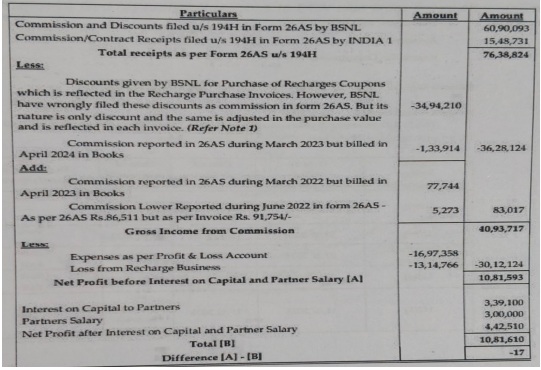
5. The Ld. AR also submitted that a detailed breakup for the commission income received from BSNL and submitted that the assessee has received discount from BSNL which has been netted of against the income of the assessee. The Ld. AR argued that the lower authorities have not considered the reconciliation statement by the assessee but has proceeded to make an addition stating that the assessee has not furnished any documentary evidences.
6. The Ld. Departmental Representative (DR), on the other hand, relied on the orders of the lower authorities.
7. We heard the rival submissions and perused the material available on record. The issue before us is whether the difference between the receipts reflected in Form 26AS and the commission income offered by the assessee represents trade discount earned by the assessee on purchase and sale of BSNL recharge vouchers or whether the entire amount reflected in Form 26AS is liable to be assessed as commission income. In this regard we notice that the assessee has furnished a detailed reconciliation statement explaining the receipts reflected in Form 26AS and the commission income credited in its books of account. The assessee has also produced invoice-wise details of recharge vouchers purchased from BSNL indicating the face value of the vouchers, the discounted purchase price and the corresponding margin retained by the assessee. On verification of the reconciliation and the supporting invoices, we find that the difference between the gross amount reported in Form 26AS and the commission income disclosed by the assessee substantially corresponds to the trade discount allowed by BSNL at the time of sale of recharge vouchers. It is well settled that the character of a receipt has to be determined having regard to the real nature of the underlying transaction and not merely on the basis of its description in the TDS statement or Form 26AS. Form 26AS is only a statement generated on the basis of reporting made by the deductor and cannot, by itself, conclusively determine the taxability or character of a receipt in the hands of the recipient. Therefore, the mere fact that BSNL has reported the gross amount in Form 26AS and deducted tax thereon cannot lead to the conclusion that the entire amount necessarily represents commission income in the hands of the assessee.
8. We further notice that the CIT(A) has rejected the assessee’s claim primarily on the ground that no revised TDS certificate, rectification of Form 26AS or confirmation from BSNL was produced. In our considered view, such reasoning cannot be sustained. Once the assessee has produced a reconciliation supported by invoice-wise details explaining the difference between the receipts reflected in Form 26AS and the income offered in the return, the claim cannot be rejected merely because the deductor has not revised its reporting. The taxability of a receipt has to be determined on the basis of the substantive evidence available on record and not solely on the manner in which the deductor has reported the transaction. We also find that the reconciliation furnished before us has not been controverted by the Revenue by bringing any material on record to demonstrate that the invoicewise details are incorrect or that the trade discount claimed by the assessee is fictitious. In the absence of any material to discredit the reconciliation and the documentary evidence produced, there is no justification for treating the entire receipts reflected in Form 26AS as commission income. In view of the above factual position, we are of the considered view that the authorities below were not justified in treating the trade discount earned by the assessee as commission income merely on the basis of Form 26AS. Accordingly, the addition made by the Assessing Officer and sustained by the CIT(A) is directed to be deleted. Accordingly, the grounds raised by the assessee are allowed.
9. In result, the appeal of the assessee is allowed.