ORDER
S. Rifaurrahman, Accountant Member. – These appeals are filed by the assessee against the order passed by the ld. Commissioner of Income-tax (Appeals)-30, New Delhi dated 15.09.2025for the Assessment Years 2016-17 and 2017-18.
2. Since the issues are common and the appeals are connected, hence the same are heard together and being disposed off by this common order. We take up the assessee’s appeal being ITA No.7276/Del/2025 for AY 2016-17 as lead case to adjudicate the issues under consideration.
3. At the time of herring, ld. AR of the assessee submitted that he is pressing only Ground No.4 which reads as under :-
“That the proceedings initiated u/s 153C of I.T. Act, 1961 on 22.12.2020 are barred by limitation on the basis of decision of Supreme Court in the case of CIT-III v. M/s. Calcutta Knitwears, Ludhiana 2014 (6) SCC 444 and CBDT Circular no.24/2015 DATED 31.12.2015.”
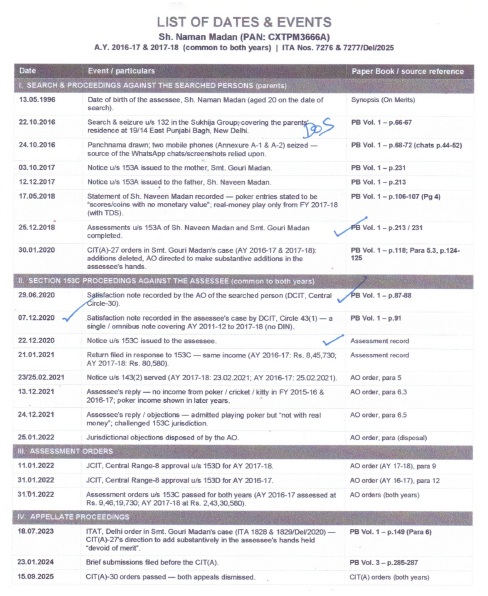
4. At the time of hearing, ld. AR submitted the facts and his submissions which are given below :-
| I. |
|
A single, consolidated satisfaction note under Section 153C of the Income-tax Act, 1961, without recording year-wise satisfaction of escapement of income, is invalid in law |
| (i) |
|
Fact of the appellant’s case – The assumption of jurisdiction under Section 153C is vitiated as the satisfaction note recorded on 07.12.2020 (PB Vol. 1 – Page No. 91) for A. Y. 2011-12 to A. Y. 201718 by then A.O. DCIT Circle 43(1), New Delhi is a single, omnibus note lacking any year-wise identification of incriminating material or escapement of income. It is settled law that satisfaction must demonstrate a clear nexus between seized material and determination of income for each assessment year. In absence thereof, the jurisdictional requirement remains unfulfilled, rendering the proceedings void ab initio. |
| (ii) |
|
Satisfaction of the searched persons recorded on 29.06.2020 (Page No. 87 to 88 of PB Vol. – 1) |
| (iii) |
|
Section 153C requires specific satisfaction that: – |
| • |
|
Seized material belongs to / pertains to / relates to the assessee; and |
| • |
|
Such material has a bearing on determination of total income for each relevant assessment year |
| • |
|
Therefore absence of year-wise linkage = absence of jurisdiction |
| (iv) |
|
Satisfaction is a jurisdictional requirement. Recording of satisfaction is not procedural, but foundational – If satisfaction is defective the entire proceedings collapse |
| (v) |
|
The AO must Examine seized material assessment year-wise and identify what income escaped, in which year and based on which document. A mechanical or omnibus note fails this test. Further incriminating material” must be relatable to each A. Y. – Proceedings u/s 153C are not meant for roving or fishing inquiries. Each year must be supported by specific incriminating material. |
| (vi) |
|
Judgements relied upon: – |
| i. |
|
Saksham Commodities Ltd. v. ITO 464 ITR 1 (Delhi) |
| ii. |
|
Karanataka High Court in the case of Dy. CIT v. Sunil Kumar Sharma 469 ITR 197 (Karnataka). (PB Vol. 3 – Page No. 379) |
| iii. |
|
ITAT Delhi in the case of SRS Panchratan Diamonds (P.) Ltd. v. DCIT [IT Appeal Nos. 218 & 219 (Del) of 2023, dated 14-11-2025] (PB Vol. 3 – Page No. 373 to 387) |
| iv. |
|
ITAT B Bench Pune in the case of Ramdas Chabaji Dhankude v. ACIT [IT Appeal No. 823 (PUN) of 2024, dated 23-3-2026] (PB Vol. III – Page No. 388 to 400) (refer PB Vol. 3 -Page No. 393 and 398) |
| II |
|
– Proceedings time barred – On the basis of decision of Supreme Court in the case of CIT -III v. Calcutta Knitwears [2014] 43 362 ITR 673 (SC)/[2014 (6) SCC 444] (PB Vol. No. III – Page No. 159 to 171) -Satisfaction note by A.O. of searched person was recorded belatedly i.e. after 24 months of the completion of assessment u/s 153A of the searched person |
| (i) |
|
In the case of appellant’s Father Mr. Naveen Madan and Mother Mrs. Gouri Madan, search took place on 22.10.2016 (Refer PB Vol. 1 -Page No. 66 to 67) (Panchnama PB Vol. I – Page No. 68 to 72) |
| (ii) |
|
Notice u/s 153A of I. T. Act 1961 in the case of the appellant’s Father Naveen Madan was issued on 12.12.2017 (PB Vol. 1 – Page No. 213) |
| (iii) |
|
Notice u/s 153A of I. T. Act 1961 in the case of the appellant’s mother Gouri Madan was issued on 03.10.2017 (PB Vol. 1 – Page No. 231) |
| (iv) |
|
Assessment in the case of Naveen Madan (PB Vol. I – Page No. 213) and Gouri Madan were made on 25.12.2018 (PB Vol. 1 – Page No. 231). |
| (v) |
|
CIT (Appeal) order passed on 30.01.2020 in the case of appellant’s mother Gouri Madan (PB Vol. 1 – Page No. 118). |
| (vi) |
|
Satisfaction note in the case of searched person recorded on 29.06.2020 (Page No. 87 to 88 of PB Vol. 1). |
| (vii) |
|
Satisfaction note in the case of appellant recorded on 07.12.2020 (PB Vol. 1 – Page No. 91) |
| (viii) |
|
Judgements relied upon: – |
| i. |
|
Supreme Court in the case of CIT-III v. M/s Calcutta Knitwears, Ludhiana(supra) (PB Vol. No. 3 – Page No. 159 to 171) |
| In Para 44 (PB Vol. No. 3 – Page No. 170) SC has observed that the satisfaction note could be prepared either of the following stages: – |
| (a) |
|
at the time of or along with the initiation of proceedings against the searched person under Section 158BC of the Act; |
| (b) |
|
along with the assessment proceedings under Section 158BC of the Act; and |
| (c) |
|
immediately after the assessment proceedings are completed under Section 158BC of the Act of the searched person |
| (ix) |
|
Satisfaction note was recorded/prepared on 07.12.2020 by the A.O. of the appellant which is: – |
| i. |
|
50 months after the search on mother Smt. Gouri Madan and father Sh. Naveen Madan i.e. searched person (Search on 22.10.2016). |
| ii. |
|
38 months after issue of notice u/s 153A to the mother of the assessee Smt. Gouri Madan on 03.10.2017 and 36month in the case of father Sh. Naveen Madan on 12.12.2017 i.e. searched person |
| iii. |
|
24 months after the completion of assessment u/s 153A of mother of the assessee of Smt. Gouri Madan and father Sh. Naveen Madan i.e. searched person on 25.12.2018 |
| Satisfaction note prepared is thus time barred keeping in view of the judgement of apex Court, which has to be followed as per CBDT Circular No. 24/2015 dated 31.12.2015 (PB Vol. 3 – Page No. 243 to 244) wherein it has been mentioned that the Provisions of Section 153C of I. T. Act 1961 are substantially similar/pari/meteria to the Section 153BD of I. T. Act 1961 and therefore the Supreme Court guidelines apply to proceedings u/s 153C of I. T. Act 1961 for the purpose of assessment of income of other than the searched person. This view has been accepted by the CBDT (PB Vol. 3 -Page No. 243). |
| (x) |
|
Further judgements relied upon: – |
| (a) |
|
Bombay High Court in the case of Clear Channel India (P.) Ltd. v. Dy. CIT (Bombay) dated 17.02.2026 (PB Vol. 3 – Page No. 368 to 372) – In this case the satisfaction note was recorded after 15 months of the search (Refer Page No. 368) |
| (b) |
|
Delhi High Court in the case of CIT v. Bharat Bhushan Jain [2016] 290 CTR 664/[2015] 370 ITR 695 (Delhi)/ITA No. 669/2009 dated 08.01.2015 (PB Vol. 3 – Page No. 233 to 242) – In this case the satisfaction note was recorded after 11.5 months of the completion of the assessment of searched person |
| (c) |
|
Gujarat High Court in the case of PCIT v. Pr. CIT v. Jitendra H. Modi HUF 403 ITR 110 (Gujarat) held that a period of Nine Months could not be termed as immediate (Page No. 368 of PB Vol. 3). |
| (d) |
|
Gujarat High Court in the case of Parag Rameshbhai Gathani v. ITO, International Taxation [2026] (Gujarat) wherein a delay of 22 months was held to inordinate (Page No. 356 of PB Vol. 3) – Affirmed by the Supreme Court in order dated 02.04.2026 in ITO, International taxation v. Parag Rameshbhai Gathani (SC)/Special Leave Petition (Civil) 12308/2026 @ Diary No(s). 16191/2026 (Page No. 402 of PB Vol. 3). |
| (e) |
|
ITAT Delhi in the case of ACIT v. Raj Kumar Jalan [IT Appeal No. IT (SS) A No. 28 (Del) of 2012, dated 8-7-2015] wherein period of above three years from date of completion of assessment of searched person cannot be considered as immediate or immediately proximate (Refer Para 13 to 16 at Page No. 249 of PB Vol. 3). |
5. Further, the ld. AR of the assessee submitted list of dates and events which are reproduced below :-
6. On the other hand, ld. DR of the Revenue heavily relied on the findings in the cases of Hon’ble Supreme Court in the case of
CIT v.
Jasjit Singh 458 ITR 437 (SC) and Hon’ble
Delhi High Court in the case of
PCIT v.
Ojjus Medicare (P.) Ltd. Ojjus and
Jasjit Singh and finally relied on the orders of lower authorities.
7. Considered the rival submissions and material placed on record. We observed that the search was conducted in the case of Smt. Gouri Madan and Sh. Naveen Madan on 22.10.2016, the searched persons and the relevant satisfaction note was prepared only on 07.12.2020, which is after 38 months of issue of notices in the above cases. It is also fact on record that the above satisfaction note was recorded after 24 months of completion of assessment u/s 153A in the above searched persons. The issue raised by the assessee before us is whether the above satisfaction note recorded is beyond jurisdiction or not. After considering the detailed submissions on this issue, we observed that the issue raised by the assessee under consideration is exactly similar to the facts in the case of Rajdeo Singh & Shishir v. DCIT [IT Appeal No. 8205 (DEL) of 2025, dated 29-4-2025] in which Accountant member is the author of the above decision. The relevant findings are given below:
9. Considered the rival submissions and material placed on record. The Ld. AR for the assessee have submitted before us that the assessment orders so framed u/s 153C of the Act dated 13.03.2024 are liable to be quashed. The relevant arguments so made by the Ld. AR for the assessee are summarized hereunder:
| (a) |
|
The Ld. AR submitted that the notices issued u/s 153C of the Act are time barred as the same have been issued after a delay of 15 months. The Ld. AR submitted that in the instant appeals before us, the notices u/s 153C of the Act have been issued on 12.12.2022 whereas the assessment u/s 153A of the Act in case of the person searched, namely, Sh. Ram Avtar Agarwal was framed on 28.09.2021, therefore, following the ratio of the judgement delivered by the Hon’ble Jurisdictional High Court of Delhi in the case of CIT v. Bharat Bhushan Jain (Delhi) after considering the law laid down by the Hon’ble Supreme Court of India in the case of CIT v. Calcutta Knitwears in Civil Appeal No. 3958 of 2014, there is an inordinate delay of 15 months in issuance of notices u/s 153C of the Act on 12.12.2022 and therefore, such notices are time barred. The observation and ratio of the judgement delivered by the Hon’ble Jurisdictional Delhi High Court in case of Bharat Bhushan Jain (supra) as relied is reproduced below: |
“6. Having regard to the intent of the Supreme Court in paragraph 44 of the Calcutta Knitwears (supra), where it was indicated that the Revenue has to be vigilant in issuing notice to the third party under section 158BD, immediately after the completion of assessment of the searched person, this court is of the opinion that a delay ranging between 10 months of one-and-half years cannot be considered contemporaneous to assessment proceedings. We are of the opinion that notices were not issued in conformity with the requirements of section 158BD, and were unduly delayed. The appeals of the Revenue, accordingly, fail and are dismissed.”
| (b) |
|
The Ld. AR for the assessee further submitted that if the original limitation for framing of assessment u/s 153A of the Act in case of the person searched, namely, Sh. Ram Avtar Agarwal is considered as prescribed under Second Proviso to Clause (b) to Sec. 153B of the Act (as the date of search was 16.05.2018), i.e., 18 months from the end of the financial year in which the last of the authorization for search was executed, i.e., 30.09.2020 then the delay in issuance of notices u/s 153C of the Act in case of Sh. Rajdeo Singh and Sh. Shishir, would have been more than two years & two months’ time, however, due to relaxations provided by the CBDT on account of COVID-19 Pandemic, that inordinate delay of more than two years & two months’ time fallen down to 15 months after exhausting the benefit of COVID-19 Pandemic relaxations as last extended vide CBDT’s Press Release dated 25th June, 2021 till 30.09.2021. |
| (c) |
|
The Ld. AR for the assessee further placed reliance on the decision of the ITAT, Hyderabad in the case of Shri Farooqi Gulam Samdani v. DCIT, Central Circle 1(3), Hyderabad in ITA No.814/Hyd/2025 for AY 2019-20 wherein vide order dated 24.12.2025, the ITAT had followed the principles laid down by the Hon’ble Jurisdictional High Court of Delhi in the case of Bharat Bhushan Jain (supra) and Hon’ble Supreme Court of India in the case of Calcutta Knitwears, held at Para 13 as under: |
“Since the Hon’ble Supreme Court and majority of Hon’ble High Courts have taken a view that notice issued u/s.153C of the Act after a period of 10 months to 1 1/2 year is barred by limitation and in our considered view by applying the above case laws in the present case, notice issued u/s.153C of the Act dated 16.12.2022 after a period of 22 months is not a valid notice and consequently the assessment order passed by the Assessing Officer u/s.153C of the Act dated 13.03.2024 is invalid, void ab initio and liable to be quashed. We order accordingly.”
The Ld. AR for the assessee pointed out that in the case of Shri Farooqi Gulam Samdani, even the date of framing of assessment u/s 153C of the Act and issuance of notice u/s 153C of the Act are almost similar and identical and thus, the notices so issued u/s 153C of the Act dated 12.12.2022 in case of the assessees, are also unambiguously time barred. Accordingly, the Ld. AR for the assessee prayed that the notices so issued u/s 153C of the Act are not valid and accordingly, the assessment orders so framed u/s 153C of the Act dated 13.03.2024 are liable to be quashed being void-ab-initio, invalid, bad in law.
……………………..
10. Having considered to the facts and the legal position involved in the matter coupled with the submissions made by both the parties, we are in complete agreement with the arguments so raised by the assessee and we find that the contentions of the Ld. DR are devoid of any merit. The contention of the Ld. DR that the grounds which have not been raised before the Ld. CIT(A) cannot be raised before the Hon’ble Tribunal has no legs to stand in the eyes of law as the law with regard to the admission of additional grounds is no longer res integra rather well-settled by the Hon’ble Supreme Court of India in the case of NTPC v. CIT (SC) and the said settled position of law has been unanimously followed by various judicial forums consistently. We are vested with the power to adjudicate any issue which goes to the root of the matter and it is bound to decide the issues raised before us as per the law. In the instant case, the additional ground so raised by the assessee that the notice u/s 153C of the Act is time barred goes to the root of the matter and keeping in view the facts, the said additional ground deserves to be admitted. Hence, admitted for adjudication.
11. We are of the view that the instant appeal before us are squarely covered by the ratio of the judgement delivered by the Hon’ble Jurisdictional High Court of Delhi in the case of Bharat Bhushan Jain (supra) since, there is an inordinate delay of about 15 months in issuance of notices u/s 153C of the Act on 12.12.2022 from the date of framing of assessment in the case of the person searched, namely, Mr. Ram Avtar Agarwal on 28.09.2021 and the said delay is not covered by the relaxations provided in the limitation period keeping in view the COVID-19 Pandemic as rightly argued by the Ld. AR for the assessee as mentioned at Paras 11(a) to 11(c) above that if the original limitation for framing of assessment u/s 153A of the Act in case of the person searched, namely, Sh. Ram Avtar Agarwal is considered as prescribed under Second Proviso to Clause (b) to Sec. 153B of the Act (as the date of search was 16.05.2018), i.e., 18 months from the end of the financial year in which the last of the authorization for search was executed, i.e., 30.09.2020 then the delay in issuance of notices u/s 153C of the Act in case of Sh. Rajdeo Singh and Sh. Shishir, would have been more than two years & two months’ time, however, due to relaxations provided by the CBDT on account of COVID-19 Pandemic, that inordinate delay of more than two years & two months’ time has fallen down to 15 months after exhausting the benefit of COVID-19 Pandemic relaxations as last extended vide CBDT’s Press Release dated 25th June, 2021 till 30.09.2021. Therefore, even after considering and allowing the benefit of COVID-19 Pandemic to the Revenue as pleaded by the Ld. DR, there is an inordinate delay of about 15 months in issuance of notices u/s 153C of the Act dated 12.12.2022 from the date of framing of assessment in case of person searched, namely, Mr. Ram Avtar Agarwal on 28.09.2021 and thus, we find merit in the arguments and submissions of the assessee.
12. In view of the above, we are bound by the binding judgement of the Hon’ble Jurisdictional High Court of Delhi in the case of Bharat Bhushan Jain (supra) keeping in view the principles of judicial discipline and accordingly, following the view taken by the Hon’ble Jurisdictional High Court of Delhi in the case of Bharat Bhushan Jain (supra), since in the instant two appeals before us in case of Sh. Rajdeo Singh in ITA No. 8205/DEL/2025 and in case of Sh. Shishir in ITA No. 156/DEL/2026, the notices so issued u/s. 153C of the Act both dated 12.12.2022 after a delay of 15 months are barred by limitation and consequently, the assessment orders passed by the Assessing Officer u/s 153C of the Act both dated 13.03.2024 are invalid, void ab initio and accordingly, are hereby quashed being non-est in the eyes of law and therefore, the additional ground so raised by the assessees are allowed.”
8. Respectfully following the above decision, we are inclined to decide the above issue in favour of the assessee. In the result, relevant grounds raised by the assessee are allowed. The other grounds and issues raised by the assessee are kept open.
9. The facts on the other appeal is also similar to the fact in ITA No. 7276/Del/2025, the findings are applicable mutatis mutandis, therefore, appeal filed by the assessee vide ITA No. 7277/Del/2025 is allowed.
10. In the result, both the appeals filed by the assessee are allowed.