


Interest paid to NHAI is exempt from TDS under Section 194A notification, negating default liability
Issue
-
Whether National Highways Authority of India (NHAI) qualifies as a corporation established by a Central Act under Notification No. 3489 dated 22.10.1970 issued under Section 194A(3)(iii)(f).
-
Whether an assessee paying interest on mobilization advances to NHAI is required to deduct tax at source (TDS) under Section 194A.
-
Whether the assessee can be treated as an assessee-in-default under Section 201(1) and charged interest under Section 201(1A) for non-deduction of tax on payments to NHAI.
Facts
-
The assessee, an infrastructure developer, executed a highway project covering a section of NH-31 in Bihar.
-
During the relevant financial year, the assessee paid interest to NHAI on mobilization advances received for the project.
-
The Assessing Officer (TDS Officer) held that the interest payment was subject to TDS under Section 194A.
-
The TDS Officer raised a tax demand under Section 201(1) treating the assessee as an assessee-in-default, along with consequential interest under Section 201(1A).
-
NHAI was established under Section 3 of the National Highways Authority of India Act, 1988, which is a Central Act passed by Parliament.
-
Central Government Notification No. 3489 dated 22.10.1970 issued under Section 194A(3)(iii)(f) exempts interest paid to corporations established by or under a Central Act from TDS obligations.
-
The Revenue sought to deny the exemption relying on conditions mentioned in CBDT Circular No. 18/2017.
Decision
-
The court held that NHAI is a corporation established under a Central Act (NHAI Act, 1988) and squarely falls within the ambit of Notification No. 3489 dated 22.10.1970. [Para 10]
-
The court held that since the statutory notification under Section 194A(3)(iii)(f) specifically covers NHAI, liability under Section 201(1) cannot be fastened on the assessee by invoking CBDT Circular No. 18/2017. [Para 14]
-
The court held that interest paid by the assessee to NHAI is exempt from TDS under Section 194A. [Para 15]
-
The court held that the assessee could not be treated as an assessee-in-default under Section 201(1), and the demand along with interest under Section 201(1A) was set aside. [Para 15]
Key Takeaways
-
Statutory Notification Overrides Circulars: Exemption granted via a statutory notification issued under Section 194A(3)(iii)(f) holds primary force and cannot be diluted or restricted by administrative circulars like CBDT Circular No. 18/2017.
-
NHAI Exemption from TDS: Payments of interest made to statutory bodies like NHAI established under a Central Act are covered under Notification No. 3489 and do not attract TDS under Section 194A.
-
No Default under Section 201: Where there is no statutory obligation to deduct tax at source at the time of payment, proceedings treating the payer as an “assessee-in-default” under Section 201(1) and levying interest under Section 201(1A) are legally unsustainable.
IN THE ITAT DELHI BENCH ‘B’
Welspun Aunta Simaria Project (P.) Ltd.
v.
DCIT
Raj Kumar Chauhan, Judicial Member
and S. Rifaur Rahman, Accountant Member
and S. Rifaur Rahman, Accountant Member
IT Appeal No. 6559 (Delhi) of 2025
[Assessment year 2019-20]
[Assessment year 2019-20]
OCTOBER 6, 2026
Rahul Sharda, Adv. for the Appellant. Rajesh Kumar Dhanesta, Sr. DR for the Respondent.
ORDER
Raj Kumar Chauhan, Judicial Member.- The appeal of the assessee is directed against the order dated 18.08.2025 of ld. CIT(A)/Addl./JCIT(A)-10, Mumbai passed u/s 250 of the Income-tax Act, 1961 (hereinafter referred to as ‘the Act’)arising out of the order dated 24.03.2025 passed u/s 201(1)/201(1A) of the Act wherein the assessee was treated as an assessee-in-default for nondeduction of tax at source on interest paid to the National Highways Authority of India (NHAI).
2. Brief facts as culled out from the orders of the authorities below are that the assessee is engaged in infrastructure development of Four/Six Laning of Aunta Simaria (Ganga Bridge with approach road) section of NH 31 from KM 197.900 to 206.050 (Design Chainage) and KM 204.741 to KM 209.945 (existing chainage) (total design length 8.150 KM) in State of Bihar. During the year under consideration, the assessee had paid interest of Rs.67,19,486/- to NHAI on mobilization advances. The Assessing Officer/TDS Officer held that the assessee was liable to deduct tax at source u/s 194A of the Act and accordingly raised a demand of Rs.6,71,948/- u/s 201(1) of the Act. Consequential interest of Rs.5,64,437/- was also charged u/s 201(1A) of the Act, resulting in total demand of Rs.12,36,385/-.
3. Aggrieved by the assessment order, the assessee preferred an appeal before the ld. CIT(A)who relying on CBDT Circular No. 18/2017 dated 29.05.2017, upheld the action of the AO and dismissed the appeal.
4. Aggrieved by the impugned order, the assessee is in appeal before us and has raised the following grounds of appeal:
“1. The Addl./Joint CIT(A) failed to appreciate that the appellant had not committed any default u/s 201(1)/201(1A), and hence, Addl./Joint CIT(A) erred in upholding the order of the AO holding the appellant as assessee-in-default for an amount of Rs.12,36,385/-. “
5. We have heard the ld. AR and the ld. DR. The ld. AR at the very outset submitted that the issue is squarely covered by the provisions of section 194A(3)(iii)(f) of the Act read with S.O./Notification No.3489 dated 22.10.1970. It was submitted that the said Notification specifically covers “any corporation established by a Central, State or Provincial Act”. It was further submitted that NHAI is a corporation established under section 3 of the National Highways Authority of India Act, 1988, which is a Central Act. Therefore, the payment of interest to NHAI falls within the statutory exception contained in section 194A(3)(iii)(f), and consequently no tax was deductible at source on such payment. The ld. AR further relied upon the decisions of the Hon’ble Allahabad High Court in CIT (TDS) v. Canara Bank [2016] 69 (Allahabad)/386 ITR 504, which was subsequently upheld by the Hon’ble Supreme Court in Commissioner of Income Tax (TDS), Kanpur v. Canara Bank (SC)/[2018] 406 ITR 161 (SC), and the decision of the co-ordinate Bench in Punjab National Bank v. ACIT (TDS), [2023] (Mumbai – Trib.).
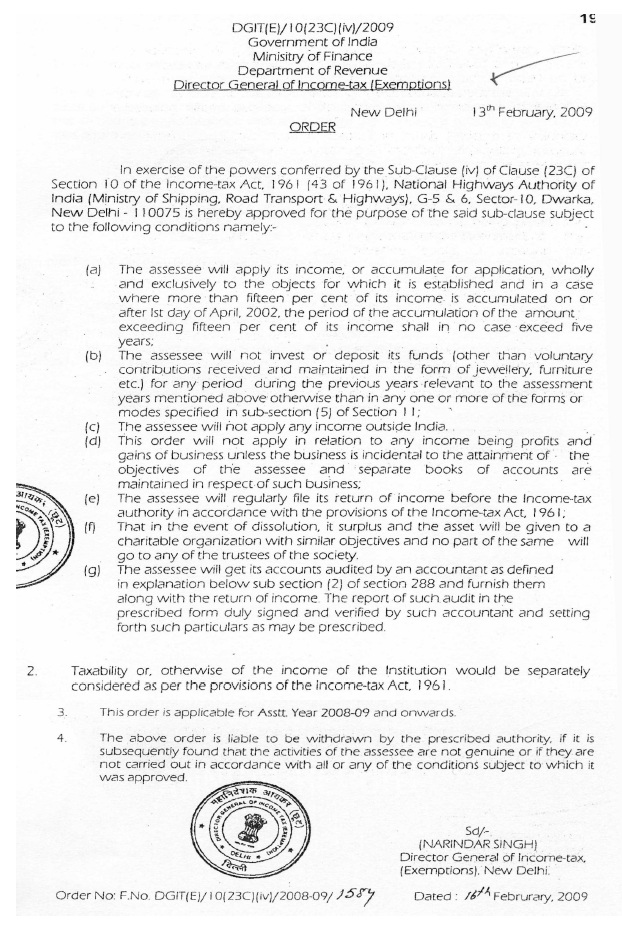
6. The ld. AR further relied upon the order dated 13.02.2009 of Director General of Income Tax (Exemptions) wherein the National Highways Authority of India has been approved for the purpose of exemption from Income-tax under sub-clause (iv) of clause (23C) of section 10 of the Act, extracted below as under:
7. The ld. AR has also filed written submissions in support of his above arguments, extracted below as under:
“4. The submission of the Appellant is that the Appellant was not required to deduct tax at source op the above payment to NHAI. The legal basis for the same is as follows:
1. Payment of interest to NHAI is covered in the exception contained in Section 194A(3)(iii)(f)
i. Sub-section (3) of Sec. 194A provides that the obligation to deduct tax at source u/s 194A(1) shall not apply to income credited or paid to such other institution which the Central Government may notify in this behalf.
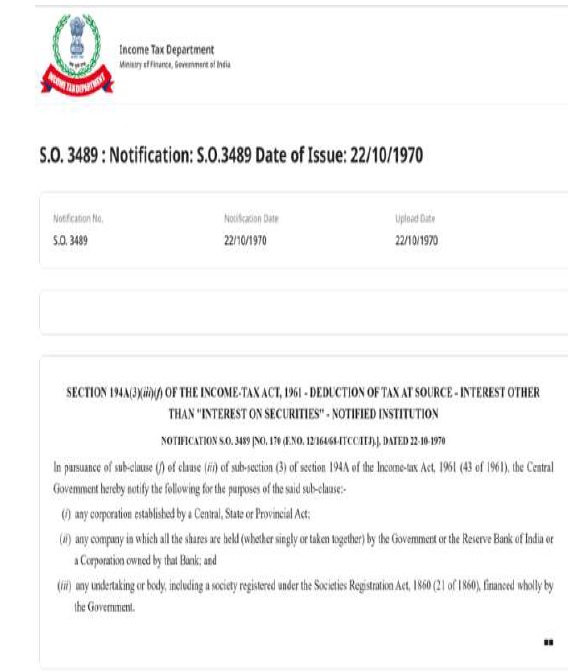
ii. For the purpose of sec. 194A(3)(iii)(f), the Govt., has issued S.O./Notification No. 3489 dated 22.10.1970 (pg. 26 of Assessee Paperbook). In the said Notification, the Government has notified “any corporation established by a Central, State or Provincial Act’.
iii. The CBDT has also issued Notification dated 16.05.2023 (pg. 27 of Assessee Paperbook) notifying institutions under section 194A(3)(iii)(f). The said Notification consolidates all such Standing Orders/ Notifications issued by the Govt., and also refers to the abovementioned Notification No. 3489 dated 22.10.1970 @ pg. 28 of Assessee Paperbook (second-last entry @ Pg- 29).
iv. NHAI is a corporation established under Section 3 of the National Highways Authority of India Act, 1988 (the “NHAI Act”) which is a Central Act vic. an act of the Parliament (Bare Act @ pg. 46 of Assessee Paperbook).
II. Even as per Section 196(10), no tax was required to be deducted at source as NHAI is “a corporation established by or under a Central Act”
i. Sec. 196(iii) provides that a person is not required to deduct tax at source from payments made to a corporation established by or under a Central Act.
ii. Since NHAI is a corporation established under section 3 of the NHAI Act as stated above, even sec. 196 exempted the Appellant from deducting tax on the payment to NHAI.
5. Therefore, the Appellant was not required by law to deduct tax at source on interest paid to NHAI.
Judgements relied on by the Appellant
6. The ratio of the following judgements is squarely applicable to the present case:
i. CIT v. Canara Bank [2016] 386 ITR 504 (All.) (HC) – Pg. 67of Assessee Paperbook New Okhla Industrial Development Authority (NOIDA) was a corporation established by a State Act and was therefore entitled to exemption of payment of tax at source under Section 194 A. This judgement also relies on S.O./ Notification No. 3489 dated 22.10.1970 relied on by the present Appellant (Para 20, 21, 41 & 42).
ii. The above judgement has been upheld by the Supreme Court in CIT v. Canara Bank Commissioner of Income Tax (TDS), Kanpur v. Canara Bank (SC)/[2018] 406 ITR 161 (SC) – Pg. 79 of Assessee Paperbook -Relevant paragraph #31
iii. Punjab National Bank v. ACIT (TDS) (Mum.) (Trib.) – Pg. 61 of Assessee Paperbook Mumbai Metropolitan Region Development Authority (MMRDA), established under the Mumbai Metropolitan Region Development Authority Act, 1974 falls under the exclusion provided under Section 194A(3) by virtue of S.O./ Notification No. 3489 dated 22.10.1970, and thus, it was held that the assessee could not be treated as an assessee-in-default for non-deduction of tax on payment of interest to MMRDA (Para 15 & 16).
Reliance on Circular No. 18/ 2017 by the Ld. DR is incorrect
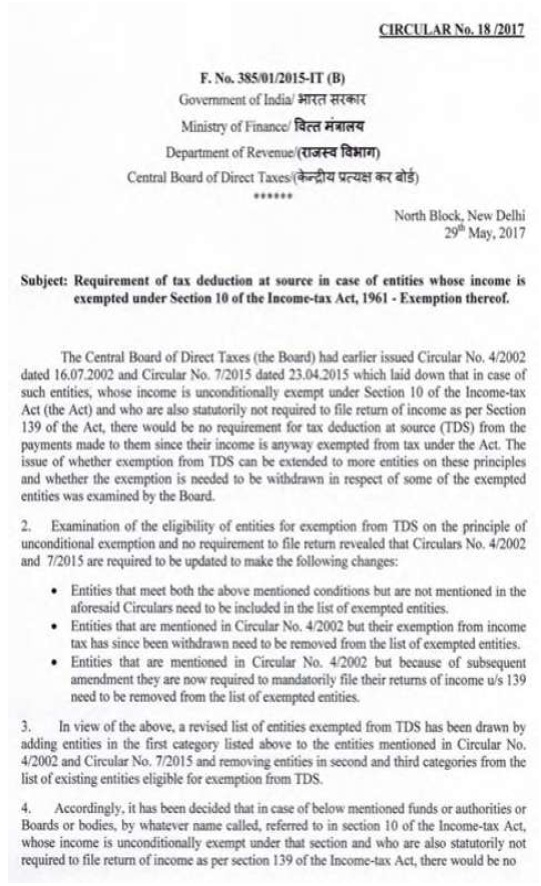
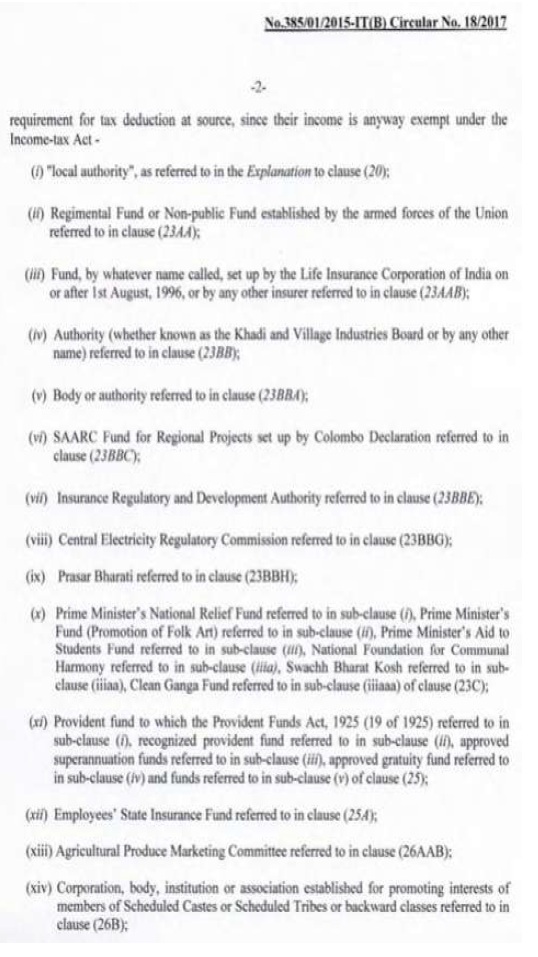
7. During the course of the hearing, the Ld. DR. placed reliance on the findings on the last page of CIT (A) order and more particularly on Circular No. 18/2017 dated 29.05.2017 (Pg. 23 of Assessee Paperbook) to contend that the exemption from the requirement to deduct tax at source is available only to entities whose income is unconditionally exempt under Section 10, and NHAI is not such an entity.
8. The submission of the Ld. DR is incorrect due to the following reasons:
i. The statutory provisions of section 194A(3)(iii)(f) and section 196 are unambiguous and Circular No. 18/2017 cannot be interpreted to impose additional conditions which even the statutory provisions do not impose;
ii. Circular No. 18/ 2017 deals only with all “entities whose income is exempted under section 10”. It cannot be interpreted to mean that unless an entity’s income is unconditionally exempt under Section 10, then payments made to it have to be mandatorily subjected to TDS notwithstanding other statutory provisions and Notifications;
iii. Circular No. 18/ 2017 only lays down an additional relaxation/ exemption from TDS provisions if the payee’s income is unconditionally exempt under Section 10. It ought to be read harmoniously with the statutory provisions and other Notifications;
iv. If the interpretation of the Ld. DR is accepted, then it would render S.O./Notification No. 3489 dated 22.10.1970 completely otiose. Hence, such an interpretation must be avoided;
v. The submission of the Ld. DR amounts to stating that a circular can override or restrict the unambiguous language of statutory provisions (sec. 196), which is contrary to the basic principles of interpretation.”
8. The ld. DR, on the other hand, relying upon the orders of the lower authorities and CBDT Circular No.18/2017 dated 29.05.2017, submitted that NHAI was not eligible for exemption from TDS and, therefore, the assessee was liable to deduct tax u/s 194A and was rightly treated as an assessee-in-default u/s 201(1) of the Act.
9. We have considered the rival submissions and perused the material available on record. The undisputed fact is that the assessee has paid interest of Rs.67,19,486/- to NHAI on mobilization advances. The controversy before us is whether the said payment was liable for deduction of tax at source u/s 194A of the Act and consequently whether the assessee could be treated as an assessee-in-default u/s 201(1) of the Act. However, section 194A(3) provides specific exceptions to the applicability of the said provision. Clause (iii)(f) of section 194A(3) reads as under:
“194A………….
(3) ……………
(iii) …………….
(f) such other institution, association or body 63 [or class of institutions, associations or bodies] which the Central Government may, for reasons to be recorded in writing, notify 64 in this behalf in the Official Gazette;”
10. In the present case, NHAI has been established under section 3 of the National Highways Authority of India Act, 1988, which is a Central Act enacted by Parliament. Therefore, NHAI falls within the description of a corporation established by a Central Act and consequently falls within the ambit of Notification No.3489 dated 22.10.1970. For the sake of brevity and ready reference, the said notification is reproduced as under:
11. We also find substantial force in the contention of the ld. AR that reliance placed by the authorities below upon CBDT Circular No.18/2017 dated 29.05.2017 is incorrect. For the sake of brevity and ready reference, the said circular is reproduced as under:
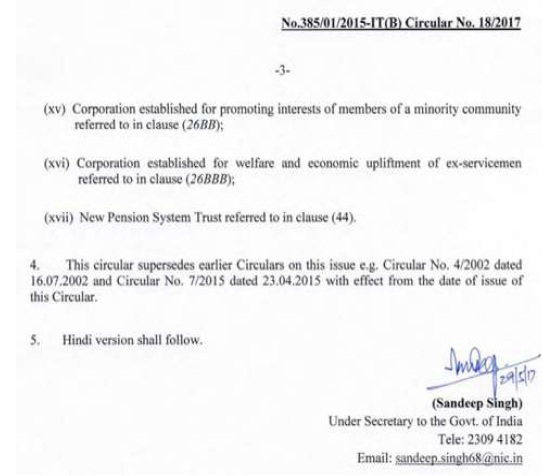
12. The Hon’ble Allahabad High Court in CIT v. Canara Bank (supra) had considered the applicability of Notification No.3489 dated 22.10.1970 in the context of a corporation established under a statutory enactment and held that the payment made to such corporation was outside the purview of the TDS obligation under section 194A. The said decision was subsequently affirmed by the Hon’ble Supreme Court. The coordinate Bench of the Tribunal in Punjab National Bank v. ACIT (TDS) (supra) has also followed the same principle in respect of a statutory authority established under an Act. Relevant portion of the order as contained in para 15 & 16, extracted below as under:
“15. As regards the deduction of tax at source under section 194-A of the Act on the interest paid by the assessee on delayed payment of additional premium, we find that section 194A(3)(iii)(f) of the Act reads as under:—
“(f) such other institution, association or body or class of institutions, associations or bodies which the Central Government may, for reasons to be recorded in writing, notify in this behalf in the Official Gazette:
Provided that no notification under this sub-clause shall be issued on or after the 1st day of April, 2020;”
16. We further find that in the exercise of the power conferred by the aforesaid provision, the Central Government vide Notification No. S. O.3489 dated 22/10/1970, inter-alia, notified any corporation established by a Central, State, or Provincial Act for the purpose of section 194A(3)(iii)(f) of the Act. Since MMRDA has been established under the Mumbai Metropolitan Region Development Authority Act, 1974, therefore we are of the considered view that the payment made to MMRDA will fall under the exclusion provided under sub-section (3) of section 194-A of the Act. Thus, the assessee cannot be held to be ‘assessee in default’ for non-deduction of tax on the payment of interest on delayed payment of additional premium. Accordingly, the demand raised by the AO under section 201(1) for nondeduction of tax under section 194-A of the Act and interest levied under section 201(1A) of the Act for the assessment year 2008-09 is deleted. As a result, the appeal by the assessee for the assessment year 2008-09 is allowed.”
13. With regard to the reliance of ld. DR as well as ld. CIT(A) in his order on Circular No. 18/2017 (supra), the ld. AR has made the following written submission stating that the said finding of the ld. CIT(A) and submissions of ld. DR are not correct for the following reasons:
| i. | The statutory provisions of section 194A(3)(iii)(f) and section 196 are unambiguous and Circular No. 18/2017 cannot be interpreted to impose additional conditions which even the statutory provisions do not impose; |
| ii. | Circular No. 18/ 2017 deals only with all “entities whose income is exempted under section 10”. It cannot be interpreted to mean that unless an entity’s income is unconditionally exempt under Section 10, then payments made to it have to be mandatorily subjected to TDS notwithstanding other statutory provisions and Notifications; |
| iii. | Circular No. 18/ 2017 only lays down an additional relaxation/ exemption from TDS provisions if the payee’s income is unconditionally exempt under Section 10. It ought to be read harmoniously with the statutory provisions and other Notifications; |
| iv. | If the interpretation of the Ld. DR is accepted, then it would render S.O./Notification No. 3489 dated 22.10.1970 completely otiose. Hence, such an interpretation must be avoided; |
| v. | The submission of the Ld. DR amounts to stating that a circular can override or restrict the unambiguous language of statutory provisions (sec. 196), which is contrary to the basic principles of interpretation.” |
14. We have considered the above rival submissions. In the given facts and circumstances while relying upon the coordinate bench of Mumbai Tribunal in case of Punjab National Bank v. ACIT (supra), we are of the considered opinion that the submissions made by the ld. AR with respect to nonapplication of Circular No. 18/2017 dated 29.05.2017 (supra) are cogent and forceful. We are in agreement with the ld. AR that in case the Circular No. 18/2017 dated 29.05.2017 (supra) is to be made applicable in the case of the applicant, then the notification No. 3489 dated 22.10.1970 would become completely redundant and such interpretation in our opinion is not legally permissible about the said notification and we are convinced that the arguments made on behalf of the Revenue by the ld. DR with respect to applicability of Circular No.18/2017 (supra) are not legally sustainable and accordingly rejected.
15. In our considered opinion, once NHAI falls within the specific category of corporations covered by Notification No.3489 dated 22.10.1970 issued under section 194A(3)(iii)(f), the assessee cannot be fastened with liability u/s 201(1) merely on the basis that NHAI may not satisfy the conditions referred to in CBDT Circular No.18/2017. Accordingly, we hold that the interest payment of Rs.67,19,486/- made by the assessee to NHAI was not liable for deduction of tax at source u/s 194A of the Act. Consequently, the assessee could not have been treated as an assessee-in-default u/s 201(1) of the Act. In view of the above finding, the demand of Rs.6,71,948/-raised u/s 201(1) is not sustainable and is directed to be deleted. Since the demand u/s 201(1) itself does not survive, the consequential interest charged u/s 201(1A) amounting to Rs.5,64,437/- also cannot survive and the same is accordingly directed to be deleted.
16. In the result, the appeal of the assessee is allowed.
■