


Building the future of global health, together

Building the future of global health, together
An estimated 4.6 billion people worldwide lack access to essential health services. While mobile and AI have tremendous potential to help bridge the gaps, the reality is that global digital health infrastructure is fragmented, which limits the potential of these technologies to improve health outcomes, especially in low-resource environments.
That’s why in 2023, Google Research collaborated with the World Health Organization (WHO) to launch Open Health Stack, a suite of open-source tools to help developers build next-gen digital health solutions. Today, we’re announcing the next step. Google is transferring the Open Health Stack code and assets to the Linux Foundation which will launch the Open Health Stack Software Foundation (OHS-SF), to provide a community-led home for the project.
Accelerating local, community-led innovation
The OHS-SF will provide a vendor-neutral, community-governed future for the essential building blocks for global digital health. Organizations who have expressed initial support alongside Google include the WHO, Anthropic, Microsoft, Endless Health, PATH and regional health networks in Asia and Africa. In addition, Google.org is providing a $3 million grant to support the long-term growth of the project.
The foundation is also introducing a program that will allow local startups, small businesses and developers from around the world to participate directly in its governance without financial barriers.
Building on global open standards
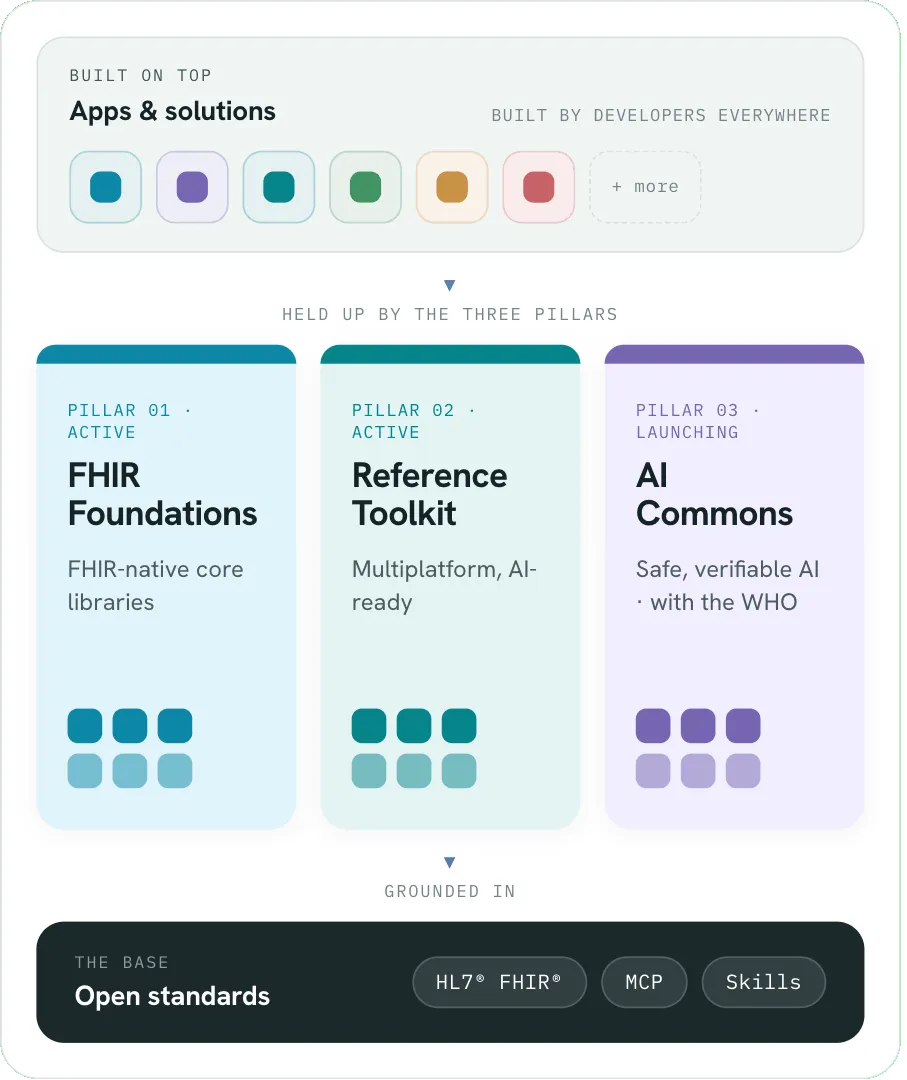
OHS-SF will give developers the building blocks to power AI-enabled digital health solutions to help close health equity gaps. The work is organized into three pillars: FHIR foundations which includes the original OHS libraries and extends these to make it easier to work with modern standards for healthcare data; a multi-platform toolkit for reducing time to deployment; and AI commons for collaborating on projects to advance safe, effective AI. Each pillar offers a different way for developers to engage, and all are grounded in global open standards for health and AI.
Supporting healthcare developers worldwide
Over the last three years, an incredible global ecosystem of technical partners — like Argusoft, Ona, IntelliSOFT, IPRD Solutions, KushiBaby, Living Goods and many more — have deployed OHS-powered solutions in countries across Sub-Saharan Africa, South Asia and Southeast Asia for a range of different use cases. Together with the broader ecosystem, we have hosted workshops to build capacity and stimulate local, standards-based innovation.
By transitioning the complete Open Health Stack to the global community under the Linux Foundation’s leadership, we are ensuring these critical building blocks are available to everyone and can act as the foundation for the next generation of health innovation.
🌐 Scalable Open-Source Architecture
- The Open Health Stack Software Foundation (OHS-SF): Originally a joint venture between Google Research and the WHO, the Open Health Stack code and assets have been transferred to the Linux Foundation. [1]
- Global Open Standards: This move creates a vendor-neutral home focused on FHIR data standards, multi-platform deployment kits, and open-source AI commons to bridge equity gaps in low-resource environments. [1]
- Financial Catalysts: Backed by a $3 million Google.org grant, the ecosystem allows localized startups and developers to contribute directly to global health architecture without entry barriers. [1]
🤝 Decoupling Donor Dependence
- The Global South Drives Priorities: Regional hubs and national institutions dictate where resources go, ensuring external funding strengthens, rather than dictates, local capacity. [6, 8]
- Strategic Alliances: The World Bank Group and the Global Fund launched a joint initiative to mobilize at least $2 billion to fortify primary healthcare across emerging economies, aligning investments strictly to country-led blueprints. [9]
🩺 System Resilience & Workforce Mobility
- Co-Created Digital Delivery: Platforms like Medtronic LABS’ SPICE demonstrate how open-source data helps community health workers track and treat non-communicable diseases from the ground up.
- Cross-Border Credentialing: Global forums like Health Without Borders are actively working to harmonize international credentials, standardizing health-professions training across borders to reduce strain on fragile systems. [10, 11, 12]
Read more
. Image interaction with GPT-Live
. Convert your Google Slides to videos in 7 additional languages
. Google boosting agroforestry efforts to help the atmosphere and farmer livelihoods.
. ChatGPT Work for Data Analytics Teams
. Announcing the 2026 cohort of Google for Startups Accelerator: India
. Google Marketing Live 2026: Delivering the Gemini advantage for Indian businesses
. Streamline identity lifecycle management in Google Workspace with new inbound SCIM support
. 3 ways this coffee shop is growing with Gemini
. ChatGPT Computer Use: Now faster with Live Picture-in-Picture
. Evolution: Official Trailer BBC Earth Science
. Google Workspace Weekly Recap – July 10, 2026
. Create shareable video clips in seconds with Video Remix in Google Photos.
.
for more refer Gemini website click here
for more refer Artificial Intelligence website click here