


Cash sales backed by stock, recorded in books, and verified by GST returns cannot be treated as unexplained money under Section 69A.
Issue
Whether cash found during a search can be treated as unexplained money under Section 69A and taxed under Section 115BBE when the sale of goods generating such cash is fully recorded in the books of account, backed by stock, and verified through GST returns and buyer confirmations.
Facts
-
A search was conducted on the lockers of two employees of the assessee-company, leading to the recovery of cash amounting to approximately Rs. 2.99 crores.
-
Both employees admitted during the search operations that the recovered cash belonged to the assessee-company.
-
The assessee explained that the cash represented sale proceeds from leftover construction material belonging to its project, which had been placed in the employees’ lockers for safekeeping.
-
The sales transactions were duly entered into the assessee’s books of account and reflected in its corresponding GST returns.
-
Copies of Income Tax Returns (ITRs) of the buyers and written confirmations from them validating the purchases were furnished to the tax authorities.
-
The Assessing Officer rejected the explanation, treated the entire cash amount as unexplained money under Section 69A, and applied the higher tax rate under Section 115BBE.
Decision
-
The Tribunal/Court held that the entire transaction of the sale of goods was backed by stock inventory and duly recorded in the books of account, which were accepted without raising any doubts.
-
Since the source of the cash was fully explained, verified through GST returns, and supported by buyer confirmations, the provisions of Section 69A could not be invoked.
-
Consequently, the addition made by the Assessing Officer under Section 69A read with Section 115BBE was deleted in favor of the assessee.
Key Takeaways
-
Duly Recorded Sales Exclude Section 69A: Cash receipts stemming from bona fide sales that are reflected in audited books of account and stock records cannot be classified as “unexplained money.”
-
GST & Buyer Verification Holds Evidentiary Weight: Aligning cash receipts with GST returns and providing third-party buyer confirmations along with their ITRs serves as robust evidence to discharge the burden of proof regarding the source of funds.
-
Inapplicability of Higher Tax Rates: Section 115BBE cannot be invoked arbitrarily if the primary invocation of Section 69A fails due to an adequately explained source of income.
and Manish Agarwal, Accountant Member
[Assessment year 2022-23]
| 1) | “Whether on the facts and circumstances of the case and in law, the Ld. CIT(A) has erred in law in accepting baseless invoices, internal ledger entries, and cash book records as adequate evidence of source of cash, without insisting on independent, third party corroboration such as weighment slips, transport documents, delivery records OR proof of physical movement of goods. |
| 2) | Whether on the facts and circumstances of the case and in law, the Ld. CIT(A) was justified in law in treating unverifiable, non substantiated replies to notices u/s 133(6) as sufficient corroboration to delete an addition made u/s 69A, despite the assessee s failure to produce the alleged buyers for examination. |
| 3) | Whether on the facts and circumstances of the case and in law, the Ld. CIT(A) has erred in law by accepting the assessee s claim of storing large amounts of cash in employees lockers as a commercial decision and ignoring the suspicious and abnormal conduct indicative of unaccounted income. |
| 4) | Whether on the facts and circumstances of the case and in law, the Ld. CIT(A) has internally recorded reduction in inventory, without external verification OR proof of sale, is sufficient compliance with the burden of proof cast upon the assessee under Section 69A. |
| 5) | Whether on the facts and circumstances of the case and in law, the Ld. CIT(A) has erred in deleting the addition u/s 69A is sustainable in law when the assessee could not establish a direct and cogent nexus between the alleged cash sales and the specific cash seized during the search operation. |
| 6) | Whether on the facts and circumstances of the case and in law, the Ld. CIT(A) was finding suffers from perversity for ignoring material facts, including the failure of the assessee to provide contemporaneous evidence and the suspicious manner in which Rs.2,99,98,000/ was found concealed in private lockers of employees. |
| 7) | Whether on the facts and circumstances of the case and in law, the Ld. CIT(A) has erred in law and on facts in failing to appreciate that the assessee could not establish the genuineness of the alleged buyers OR the transactions claimed to have been undertaken for disposal of leftover materials. The enquiries conducted under section 133(6) revealed that only two out of three alleged buyers responded, and all the buyers were found to be nonlocals, contrary to the assessee s own claim. The Ld. CIT(A) failed to consider that this contradiction materially affects the liability of the assessees explanation. |
| 8) | Whether on the facts and circumstances of the case and in law, the Ld. CIT(A) has further erred in ignoring that the assessee did not produce any supporting documentary evidence such as weighment slips, delivery challans, transportation bills, gate passes, e way bills, OR any digital footprints to substantiate the alleged movement OR sale of leftover materials. In the absence of such primary evidence, the AO rightly concluded that the narrative put forth by the assessee was fabricated OR an afterthought, and that the assessee had failed to discharge the burden of proof cast upon him under the Income tax Act |
| 9) | Whether on the facts and circumstances of the case and in law, the Ld. CIT(A) has failed to uphold the well-reasoned conclusion of the Assessing Officer that the assessees explanation regarding the source of cash found in the lockers was neither supported by facts nor corroborated by any material on record. The AO correctly held that the assessee could not establish any nexus between the alleged sale of leftover materials and the cash found, and therefore the amount was rightly treated as unexplained and unaccounted income |
| 10) | Whether on the facts and circumstances of the case and in law, the order of Ld. CIT(A) suffers from serious infirmities in law and fact by granting undue benefit to the assessee despite clear deficiencies, contradictions, and absence of evidence, and by disregarding the detailed findings of the AO, which were based on enquiry, verification, and logical reasoning. The addition made by the AO was justified and deserves to be sustained in full. |
| 11) | That the order of Ld. CIT(A)3, Noida being erroneous in law and facts be set aside and order of the A.O. be restored. That the above grounds are without prejudice to each other and appellant craves leave to add, alter OR amend any ground OR grounds on OR before the date of hearing of appeal.” |
| 6. | “In the light of the above submissions and documents filed by the AR during the course of appellate proceedings and findings of the AO in the assessment order, the various grounds of appeal are adjudicated as below: |
| 6.1 | Grounds of Appeal Nos. 1 to 3: In the said grounds of appeal, the appellant has challenged the addition made by the AO on account of unexplained cash found from the locker of the employees. During the course of appellate proceedings, the appellant has raised grounds of appeal challenging the addition of 22,99.98,000 – u/s 69A and levy of interest u/s 234B, inter alia on the grounds that: |
| 1. | The AO erred in treating cash seized from lockers as unexplained money. |
| 2. | The cash was duly sourced from the sale of leftover construction material during F.Y. 2021-22, which was duly recorded in the audited books. |
| 3. | Documentary evidences in the form of invoices, ledgers, cash book, and confirmations from buyers were filed and ignored by the AO. |
| 4. | AO failed to appreciate that buyers responded to notices u/s 133(6). |
The order of the AO has been perused along with the assessee’s submissions. The AO has stated that the invoices appear to be self-made and therefore cannot be relied upon. The mere fact that the seller has issued invoices is not by itself a ground to pronounce them ingenuine. If the seller’s invoices are supported by independent corroboration (ledgers, purchaser confirmations, charging of GST, cash receipt entries), they acquire probative value. In this case, the seller’s invoices are supported by (a) ledger accounts in the assessee’s books showing entries against the named purchasers; (b) the cash-book showing receipts matching the invoices; (c) charging of GST on the sale amount (showing that the assessee treated the transactions as taxable supplies); and (d) replies of buyers to notices u/s 133(6); mere labeling of invoices as “self-made” without demonstrating material discrepancies is an inadequate basis for rejecting the whole documentary chain.
The AO has further stated that the audited profit & loss account shows revenue of only 2,81,30,600, which is inconsistent with the assessee’s claim on cash receipts. As per appellant, the differences between amounts appearing as “turnover” in the profit & loss account and amounts appearing in a cash-book are because of GST inclusion & exclusion.
The AO has further stated that the lack of weighment slips/transport bills / email correspondence between the assessee and the purchasers casts doubt on the submissions of the appellant. The appellant explained that the material sold was leftover material stored at a site and sold to local buyers who came with their own conveyance and labour. As per appellant, this mode of trade often does not generate formal weighment slips; the buyer arranges transport and labour. The assessee furnished invoices, buyer confirmations and ledger entries showing the sales and receipts.
The AO further stated that the assessee could not explain the reason for keeping the cash in lockers of the employees. The appellant placed on record the VAT order and the recovery certificate (for a demand of 27,78,766) which explained the assessee’s fear of bank attachment. The appellant stated that the assessee’s action of safeguarding cash in a locked facility (board-sanctioned) therefore has a reasonable commercial explanation.
Further, perusal of the financial statements of the appellant shows that the assessee company had an opening stock of Rs. 12.90 crores at the beginning of the year which on account of sales made during the year was reduced to Rs. 10.39 crores at the year end. The cost of goods sold has been debited to the profit & loss account. The relevant page of the audited financial statement is reproduced below for ready reference wherein, the reduction in the inventory is clearly reflected:
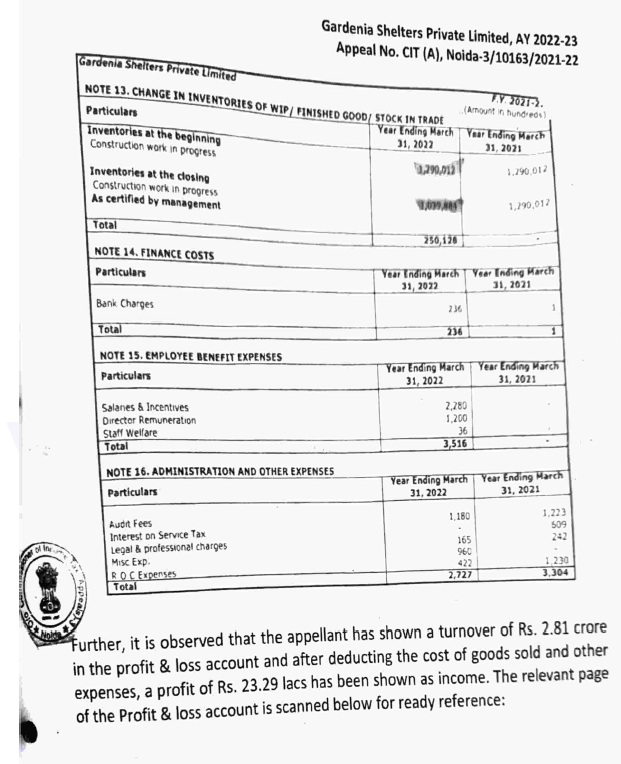
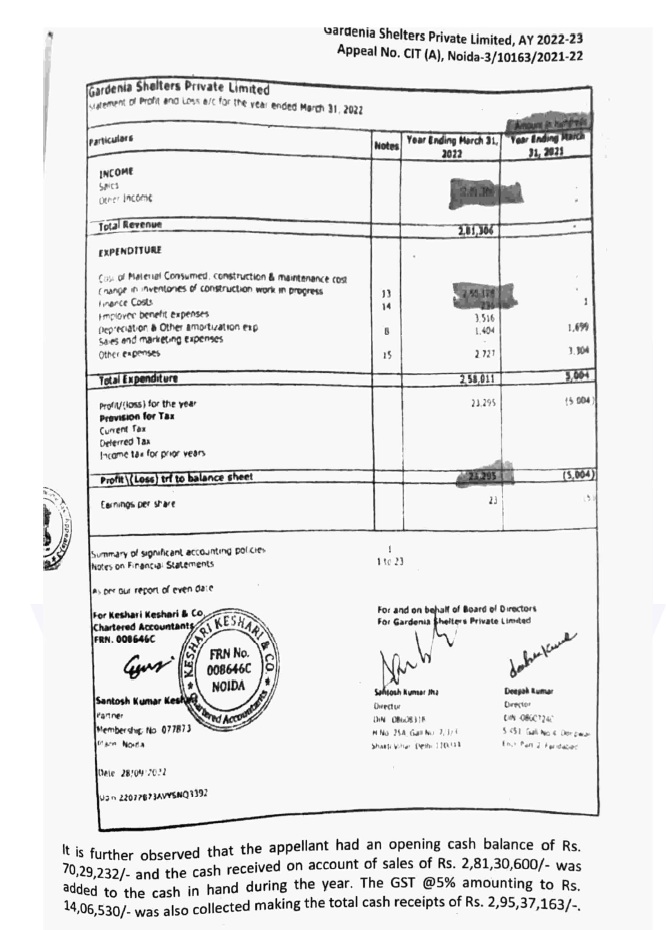
As per appellant, even after taking out the sum of Rs. 2,99,98,000/- seized by the department, the assessee is left with a cash balance of Rs. 60,68,985/-. The appellant has further stated that the balance is regularly maintained in the cashbook of the appellant and verifiable from the financial statement placed on record. It is further observed that the AO has referred to the enquiries conducted u/s 133(6) with the alleged buyers and as per AO, the information received has been placed on record. No adverse inference has been drawn by the AO on the basis of said enquiry u/s 133(6).
Finally, Section 69A operates where any sum of money, bullion, jewellery or other valuable article is found in the possession of the assessee and the assessee is unable to explain the source of such money or property. If the assessee fails to satisfactorily explain the source of the money, the AO may make an addition. Assessee has provided an explanation supported by contemporaneous records (invoices, ledgers, cash book), audited accounts showing cash in hand and the board resolution authorizing use of lockers of employees. The appellant with this evidence, has discharged its burden as required to show that the seized money has an accounted source and was reflected in books. AO’s failure to accept the explanation must be based on positive contradictions, or convincing evidence of bogus sale. The AO’s generalized statement that invoices are “selfmade” and that the turnover figure does not reconcile is not a sufficiently reasoned basis to discard the documentary chain when independent corroboration is available. Therefore, under the statutory test the assessee’s explanation is “satisfactory” and the conditions for making an addition under section 69A do not subsist. The assessee has produced a complete documentary trail connecting the seized cash to sales of leftover construction material:
| • | Sales invoices to three independent buyers. |
| • | Ledger accounts in the assessee’s books showing amounts realized from those buyers. |
| • | Cash-book entries and cash-book summary showing receipts and cash position for FY 2021-22 (opening cash + receipts explain the cash available). |
| • | The reduction in the value of the inventory showing the sale of stock. |
| • | The credit of the money received in the profit & loss account and debit of the cost of goods sold leading to profits shown as income. |
Accordingly, no infirmity is found in the assessee’s explanation that the seized cash of 2,99,98,000 was the proceeds of sale of leftover construction materials, recorded in its books (invoices, ledgers, cashbook), on which GST was collected, and that the cash was kept temporarily in lockers authorized by the board and the AO’s addition of 2,99,98,000 under section 69A is therefore unsustainable and is deleted. Hence, these grounds of appeal are allowed.
| 6.2 | Ground of Appeal No. 4 is regarding charging of interest u/s 2348 of the Income Tax Act, 1961 which is consequential in nature. The AO shall charge the interest as per law. |
| 6.3 | Ground of Appeal No. 5 has not been argued by the AR during the course of appellate proceedings.” |