


PBDIT Adopted as PLI for Heavy Fixed Asset Investments and Mandatory Loss Set-Off Upheld
Issue
-
Selection of Profit Level Indicator (PLI): Whether Profit Before Depreciation, Interest, and Tax (PBDIT) should be adopted as the most appropriate PLI under TNMM when an assessee’s net profit is significantly affected by high depreciation resulting from substantial investments in fixed assets.
-
Working Capital Adjustment: Whether the Transfer Pricing Officer (TPO) is bound to grant a working capital adjustment when claimed by the assessee during transfer pricing proceedings.
-
Set-Off of Brought Forward Losses & Depreciation: Whether the Assessing Officer (AO) is mandatorily required to allow set-off of verified brought forward business losses and unabsorbed depreciation while computing total taxable income.
Facts
-
Profile & Transactions: The assessee, a wholly-owned subsidiary of a Japanese company, is engaged in manufacturing and trading automotive components for Assessment Year 2021-22.
-
Heavy Fixed Asset Investment: During the relevant year, the assessee made substantial investments in fixed assets, leading to a significant increase in depreciation expenses that impacted its net profit margins.
-
TPO’s Rejection: Benchmarking its international transactions under TNMM, the assessee requested a depreciation adjustment on comparables or the adoption of PBDIT as the PLI, alongside a working capital adjustment. The TPO rejected these requests and proposed a transfer pricing adjustment, which was upheld by the DRP.
-
Non-Grant of Set-Off in Final Assessment: While passing the final assessment order incorporating the TP adjustment, the AO assessed total income without granting set-off for brought forward business losses and unabsorbed depreciation, without recording any reasons for the denial.
Decision
-
PBDIT as Most Appropriate PLI: In favour of Assessee. Since substantial fixed asset investments increased depreciation and skewed net profit comparisons, PBDIT should be adopted as the PLI to eliminate capacity/depreciation disparities. The TPO was directed to recompute the Arm’s Length Price (ALP) using PBDIT. [Para 9]
-
Working Capital Adjustment: In favour of Assessee. The TPO was directed to compute and allow the working capital adjustment to account for operational differences between the assessee and selected comparables. [Para 10.1]
-
Mandatory Set-Off of Brought Forward Losses: In favour of Assessee. Under Sections 70, 71, and 72 of the Income-tax Act, 1961, allowing set-off of brought forward business losses and unabsorbed depreciation is mandatory. The AO was directed to verify the records and grant the eligible set-off. [Para 11]
Key Takeaways
-
PBDIT Neutralizes Heavy Capital Outlay Impact: When an assessee undertakes major capital expansion leading to abnormally high depreciation compared to peers, adopting PBDIT/PBITDA as the PLI under TNMM prevents unfair transfer pricing adjustments caused by non-operational cost disparities.
-
Working Capital Adjustment is Statutory: Transfer pricing authorities cannot arbitrarily reject working capital adjustment claims if data for unadjusted differences in working capital positions is submitted.
-
Loss Set-Off is Non-Discretionary: Assessing Officers are statutorily obligated under Sections 70–72 to set off verified brought forward business losses and unabsorbed depreciation before finalizing total taxable income.
IN THE ITAT PUNE BENCH ‘C’
Nipro India Corporation (P.) Ltd.
v.
Deputy Commissioner of Income-tax
Vinay Bhamore, Judicial Member
and DR. DIPAK P. RIPOTE, Accountant Member
and DR. DIPAK P. RIPOTE, Accountant Member
IT Appeal No. 2723 (PUN) OF 2024
[Assessment year 2021-22]
[Assessment year 2021-22]
SEPTEMBER 9, 2026
Kishor B Phadke and Miheer Limaye for the Appellant. A.D. Kulkarni for the Respondent.
ORDER
Dr. Dipak P. Ripote, Accountant Member. – This is an appeal filed by the assessee Nipro India Corporation Pvt. Ltd. against assessment order passed u/s 143(3) r.w.s. 144C(13) r.w.s. 144B of the Income Tax Act, 1961 (the “Act”) for AY 2021-22 on 23.10.2024, emanating from Dispute Resolution Panel’s(DRP) order dated 25.09.2024, emanating from draft assessment order, passed u/s 144C(1) of the Act dated 20.12.2023.
2. The assessee has raised following grounds of appeal :
| “ | 1. General Ground |
| 1.1 | The learned DRP Panel-3, Mumbai (referred to as DRP Panel) and the learned DCIT, Satara Circle, Satara (referred to as AO) erred in law and on facts in making addition of Rs. 27,08,33,550 in the appellant’s total income and ignoring the returned loss of Rs. 4,33,01,391. |
| 2. | Issue no. 1 – Transfer Pricing adjustment to the Manufacturing business transactions |
| 2.1 | Main – Learned DRP Panel and learned AO / TPO erred in law and on facts in making TP addition of Rs. 27,08,33,550 in the appellant’s total income on the basis of median of arm’s length range (OP% to OC) of 8.21% and thereby rejecting appellant’s benchmarking. |
| 2.2 | PLI related- |
| 2.2.1 | Learned AO / TPO erred in law and on facts in committing arithmetical mistake in the altered PLI computation by not including “Export Incentive Income of Rs. 6,31,77,166” in the summation Operating Income and thereby calculating appellant’s altered PLI (OP% to OC) of -1.56% instead of 0.14%. As such, the alleged TP addition ought to have been Rs. 21,99,57,744 instead of Rs. 27,08,33,550. |
| 2.3 | Economic adjustment related- |
| 2.3.1 | Learned DRP Panel and learned AO / TPO erred in law and on facts in not considering the adjustment for capacity utilization on account of unabsorbed depreciation to the margins of external comparable companies as claimed by appellant. Thus, Learned DRP Panel and learned AO / TPO erred in law and on facts in rejecting appellant’s benchmarking based on PLI of 0.14% with the arm’s length range of -16.25% to -11.11% of external comparable companies. |
| 2.3.2 | Learned DRP Panel and learned AO / TPO erred in law and on facts in not considering COVID-19 adjustment in the impugned year to the appellant’s operating margin. |
| 2.3.3 | Learned DRP Panel and learned AO / TPO erred in law and on facts in not considering PBDIT (Profit before Depreciation, Interest and Tax) as PLI and comparing arm’s length range based on PBDIT of external comparable companies. Thus, learned DRP Panel and learned AO / TPO erred in law and on facts in rejecting appellant’s benchmarking based on PBDIT PLI of 28.29% with PBDIT based arm’s length range of 10.21% to 14.52% of external comparable companies. |
| 2.3.4 | Learned DRP Panel and learned AO / TPO erred in law and on facts in not considering working capital adjustment in the impugned year to the appellant’s operating margin. |
| 3. | Issue no. 2 – Corporate Taxation – Set-off of brought forward loss not given |
| 3.1 | Learned DRP Panel and learned AO / TPO erred in law and on facts in assessing appellant’s total income at Rs. 22,75,32,160 without granting set-off of brought forward business loss/unabsorbed depreciation. |
| 4. | The assessee craves leave to add / modify / delete all or any of the grounds of objection.” |
Basic Facts:
3. In this case, assessee filed return of income u/s 139(1) of the Act on 14.03.2022 for AY 2021-22 declaring total loss of Rs.4,33,01,391/-. Assessee’s case was selected for scrutiny. Accordingly, notice u/s 143(2) dated 28.06.2022 was issued by Assessing Officer (AO). Subsequently, various other notices were issued as mentioned in the assessment order. The AO noted that assessee had entered into international transactions with its Associated Enterprises (AEs). Hence, AO made a reference to Transfer Pricing Officer (TPO) after obtaining approval from PCIT.
3.1 The TPO issued notice u/s 92CA of the Act. Assessee filed details as called for by the TPO. The TPO has noted in the order that assessee had entered into following international transactions :
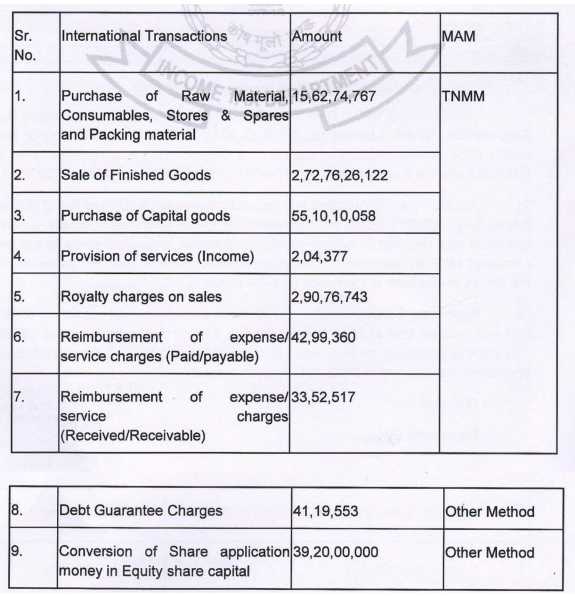
3.2 During the transfer pricing proceedings, the TPO noted that assessee had carried out depreciation adjustment on the comparables. The TPO rejected assessee’s claim for depreciation adjustment, the TPO also rejected assessee’s claim for adjustment on account of export incentive, insurance claim. The TPO also rejected assessee’s contention to consider PBDIT as profit level indicator. Finally, the TPO proposed an adjustment of Rs.33,85,84,469/- vide order u/s 92CA(3) dated 21.10.2023.
3.3 Then, the AO passed draft assessment order dated 20.12.2023. The assessee filed objections before Dispute Resolution Panel (DRP). The DRP upheld TPO’s adjustment vide order dated 25.09.2024 passed u/s 144C(5) of the Act. Then, the AO passed final assessment order on 23.10.2024 u/s 143(3) r.w.s. 144C(13) r.w.s. 144B of the Act.
3.4 Aggrieved by the final assessment order, the assessee filed an appeal before this Tribunal.
Submission of Ld. AR :
4. The Ld. AR filed paper book and written synopsis. Ld. AR vehemently submitted that during the year assessee had made substantial investment in fixed assets, therefore, the net profit has gone down. The Ld. AR submitted a chart to demonstrate that fixed assets of the comparable were substantially less as compare to assessee. The Ld. AR therefore submitted that in such scenario PBDIT is the most appropriate PLI. Ld. AR submitted that assessee had requested TPO to consider PBDIT as the PLI. The Ld. AR relied in the case of BA Continuum India (P.) Ltd. v. Asstt. CIT (Hyderabad – Trib.) and in the case of Aerzen Machines (India) (P.) Ltd. v. ACIT [2021] 127 (Ahmedabad – Trib.). The relevant paragraph of the written submission is reproduced here as under :
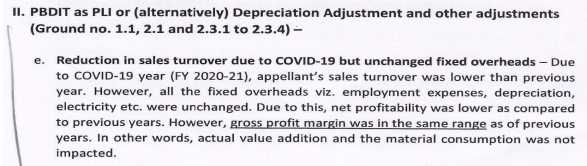
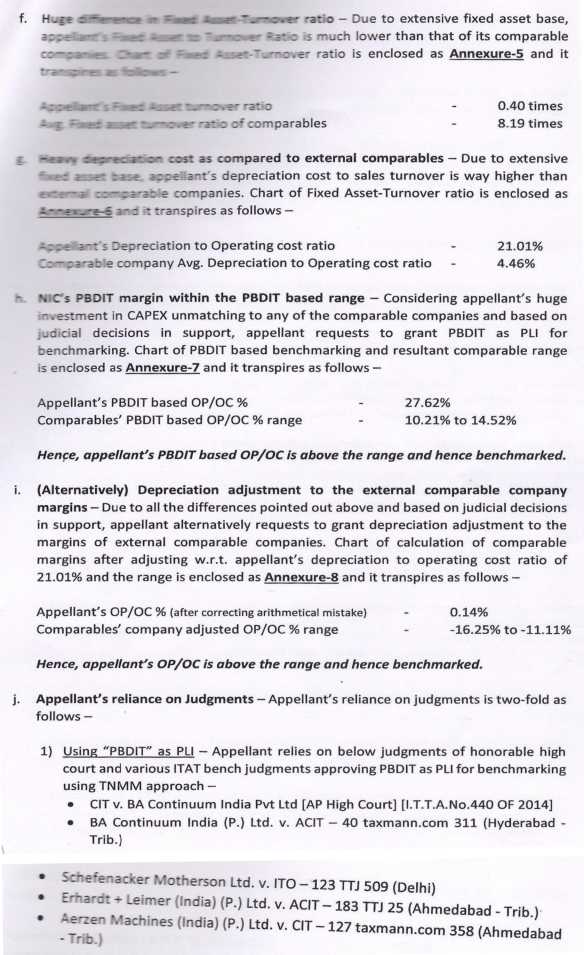
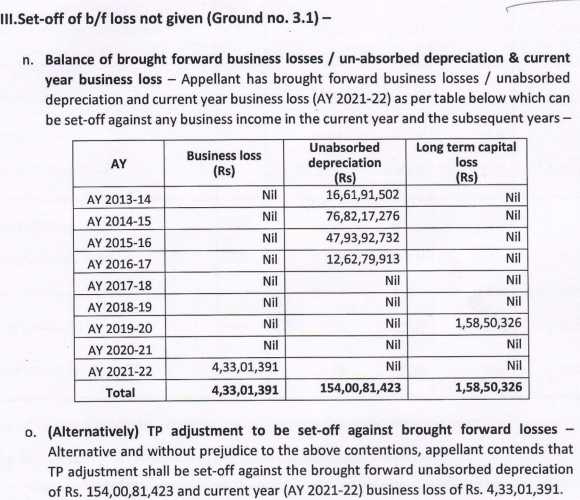
4.1 The Ld. AR submitted that assessee’s transactions are at Arm’s Length and no adjustment is required.
Submission of Ld. DR :
5. The Ld. DR relied on the order of AO/TPO and DRP.
Findings and Analysis :
6. We have heard both the parties and perused the records. The assessee is wholly owned subsidiary of Nipro Corporation, Japan.
6.1 We have already reproduced the international transactions of the assessee with its AEs. Assessee had used Transactional Net Margin Method (TNMM) as the most appropriate method to benchmark the international transactions. Assessee had calculated PLI at 1% and demonstrated that PLI of the comparables was in the range of -16.25% to -11.11%. The assessee had carried weighted average depreciation adjustment for the PLI of the comparables. The comparables and its PLI is as under :
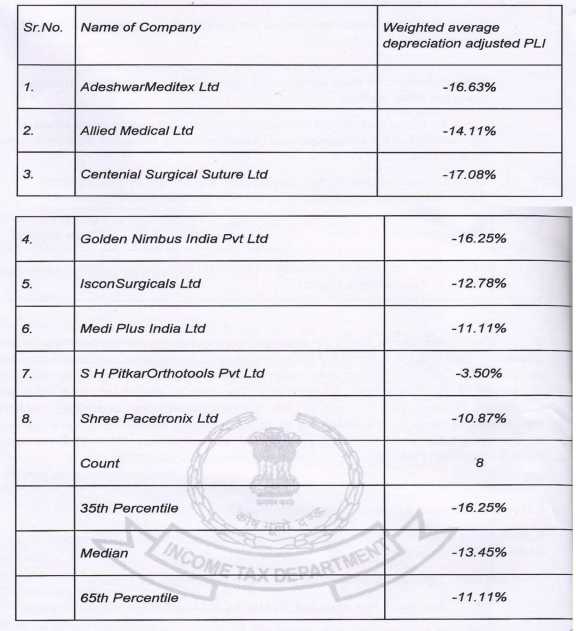
6.2 The TPO in his order has mentioned as under :
4.1 TPO Observations:
It is seen that assessee has carried out depreciation adjustment on the PLI of comparables.
It is also seen that assessee applies the SLM method while charging depreciation on the fixed assets while some of the comparable companies apply the WDV method.
It is to be noted that correct depreciation adjustment can be given when depreciation of the comparables is calculated using the same method as used by assessee.
Assessee has carried out the depreciation adjustment by assuming the depreciation of the comparables at a value same as that of assessee.
Such assumption is not supported by any facts and such wide assumption does not lead to a reliable and accurate benchmarking analysis.
Therefore, the same is being rejected as per sec. 92C(3).
4.2 Approach proposed by TPO:
Since a reliable depreciation adjustment cannot be calculated, the PLI of the comparables is considered as follows:
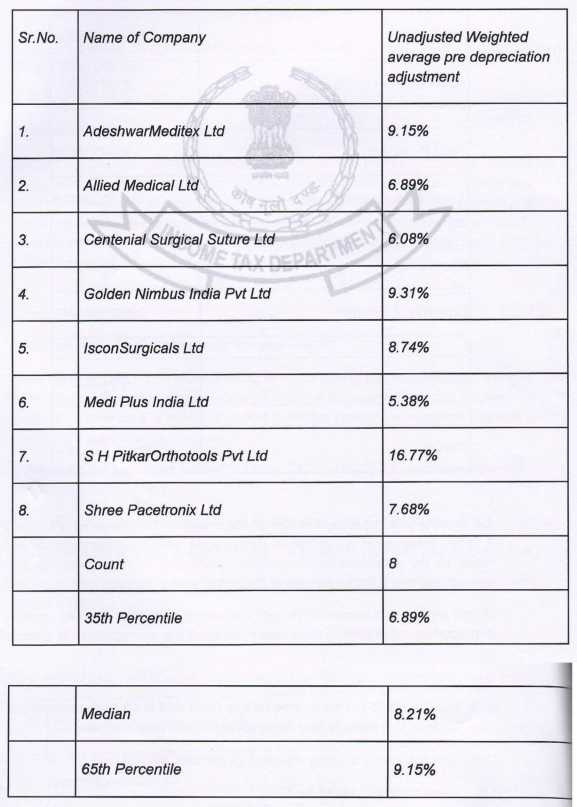
6.3 The TPO at page No. 13-14 recalculated the PLI of the assessee OP/OC at (-) 3.74%. The TPO worked out PLI of the assessee as under :
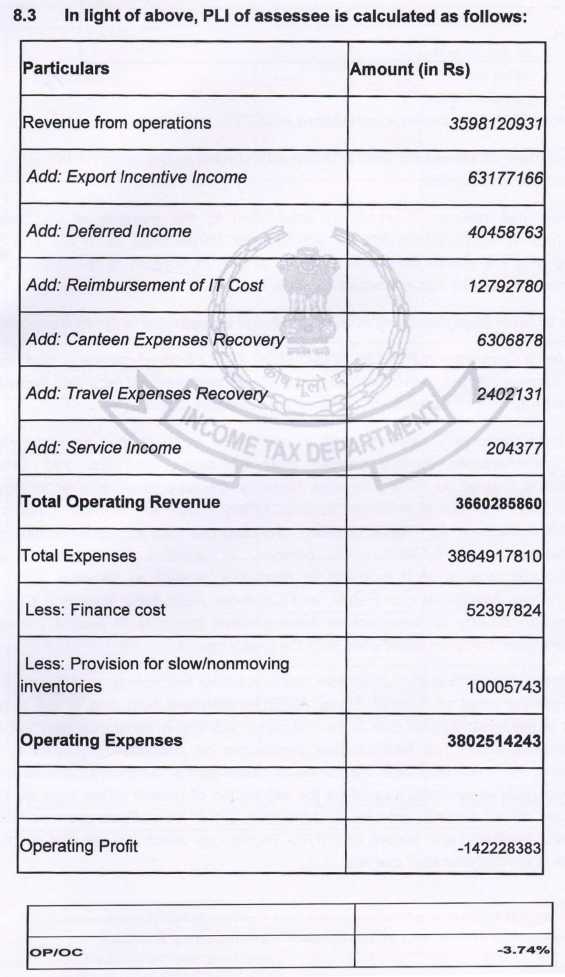
6.4 The TPO in the order u/s 92CA of the Act proposed an adjustment of Rs.33,85,84,469/-. The DRP confirmed the adjustment.
7. It is a fact that during the year assessee had made substantial investment in the fixed assets. The TPO in para 4.1 of the order has accepted that assessee had applied Straight Line Method (SLM) for depreciation on fixed assets. The TPO also admitted that correct depreciation adjustment can be given when depreciation of the comparables is calculated using the same method. The TPO in para 4.2 of the order accepted that reliable depreciation adjustment cannot be calculated to the PLI of the comparables.
7.1 Thus, the TPO accepts that correct depreciation is required to be made to the comparables, however, at the same time, the TPO admit that it cannot be made. It means, the TPO had accepted that PLI of the comparables is not comparable without adjustments.
7.2 In this case, assessee had demonstrated that fixed assets of the assessee are substantial high as compared to comparables. The relevant charts are as under :
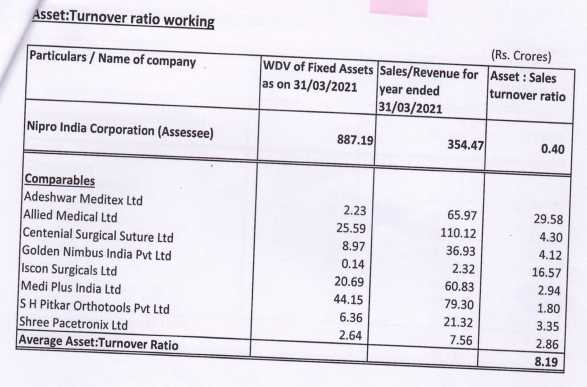
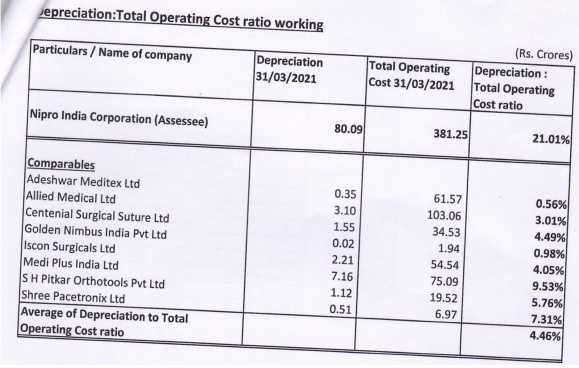
7.3 In transfer pricing study FAR of tested party is to be compared with comparables. FAR stands for Functions Assets Risk. Thus, Asset is the most important component in comparison in transfer pricing study. When Assets are substantially high appropriate adjustment is required. The assessee had demonstrated that its net profit was less only because of substantial depreciation. The chart filed by the assessee is as under :
| AY | Business Profile | Sales | GP | GP% to Sales | NP | NP% to Sales |
| 2017-18 | Mfg + Trading | 288.83 | 160.61 | 56% | 16.27 | 6% |
| 2018-19 | Mfg | 277.76 | 154.72 | 56% | 25.92 | 9% |
| 2019-20 | Mfg | 335.26 | 183.58 | 55% | 51.22 | 15% |
| 2020-21 | Mfg | 440.09 | 246.49 | 56% | 64.48 | 15% |
| 2021-22 | Mfg | 359.82 | 188.89 | 52% | 28.40 | 8% |
From the above chart, the Ld. AR submitted that GP% is within 52-56% whereas NP% has gone down only because of deprecation. Ld. DR has not disputed this fact. The chart explains that assessee’s net profit came down heavily because of depreciation.
8. In this context, we find ITAT in the case of BA Continuum India (P.) Ltd. (supra) in para 32 has held as under :
Quote, :32. We have heard both the parties and perused the material on record. In our opinion, the depreciation has impact on the profit margin of the assessee. Being so, depreciation adjustment is to be made. Accordingly, considering the various judicial precedents as cited by the AR, we direct the AO to use the PLI as PBDIT. Accordingly, the AO is directed to re-compute the ALP.” Unquote.
8.1 Similarly in the case of Aerzen Machines (India) (P.) Ltd. (supra) has held as under :
Quote, “8.6………In view of the above and in the interest of justice we hold that the AO should have taken the PBDIT as the profit level indicator while working out the arm length price with respect of the international transactions carried out by the assessee with its AE.” Unquote.
9. Therefore, as discussed above, assessee’s profit was affected due to large investment in fixed assets which increased depreciation. Assessee had pleaded that PBDIT is the most appropriate PLI. Ld. TPO rejected it stating that arithmetical mean irons out the difference. However, we have already reproduced the decisions of the ITAT which accepted assessee’s contention to consider the PBDIT as PLI. Accordingly, for all the reasons discussed above, respectfully following ITAT (supra), we direct the TPO to consider the PBDIT as the most appropriate PLI. Assessee had filed working of PLI of comparables based on PBDIT. Assessee had filed these documents before the TPO and DRP. We direct the TPO to consider PLI of the assessee and comparables taking PBDIT as PLI. In the result, the Ground Number 2.3.3 is allowed.
10. The other issue is providing working capital adjustment. Assessee claimed working capital adjustment before the TPO and DRP. The ITAT, Mumbai Bench in the case of Unilever Industries (P.) Ltd. v. Asstt. CIT (Mumbai – Trib.) held as under :
Quote, “8.12 Based on the above discussions, and respectfully following decision of coordinate Bench of this Tribunal in the case of Huawei Technologies India (P.) Ltd. (supra), we direct working capital adjustment to be computed and to allow as per actual, after considering exclusion/inclusion of comparable companies in the final set of comparables as discussed hereinabove.” Unquote.
10.1 Therefore, respectfully following ITAT, Mumbai, we also direct the TPO to allow working capital adjustment. Accordingly, Ground Number 2.3.4 is allowed.
11. It is observed that there was brought forward business losses and brought forward depreciation loss. The AO in the final assessment order had not considered the assessee’s brought forward business losses and brought forward depreciation loss. The AO has not given any reason for not allowing such brought forward losses. As per sections 70, 71 and 72 of the Income Tax Act, it is mandatory to allow set off of such losses. Accordingly, the AO to verify the brought forward business loss, brought forward depreciation loss and allow as per provisions of the Act. In the result, Ground Number 3.1 is allowed for statistical purpose.
12. Assessee had filed written letter withdrawing the Additional Ground challenging the validity of assessment order based on decision of Hon’ble Madras High Court in the case of CIT v. Roca Bathroom Products (P.) Ltd. 445 ITR 537 (Madras)/WA 1517 and 1519 Of 2021.
13. No other ground was pleaded before us. Accordingly, the appeal of the assessee is partly allowed for the statistical purpose.
14. In the result, the appeal of the assessee is partly allowed for the statistical purpose.