


Addition for suppressed sales is restricted to profit element, and cash disallowances require verification.
Issue
Whether the entire alleged suppressed sales turnover can be taxed as income instead of restricting it to the profit element, and whether disallowance under Section 40A(3) requires payment-wise verification.
Facts
-
Assessee’s Business & Return: The assessee-firm, engaged in the production, trading, and export of buffalo meat and by-products, declared an income of Rs. 7.95 crores for AY 2020-21.
-
Survey & Data Seizure: A survey under Section 133A led to the impounding of digital data (Excel sheets) from an employee, procurement in-charge, consultant, and accountant.
-
Addition for Suppressed Sales: The Assessing Officer (AO) treated alleged cash receipts of Rs. 5.01 crores as suppressed sales margin and added the entire amount to business income under Section 28, without disputing the corresponding purchases.
-
Disallowance under Section 40A(3): The AO initially flagged large cash transactions but accepted several exemptions (e.g., livestock purchases under Rule 6DD, government fees, advances). However, he disallowed Rs. 23.62 lakhs under Section 40A(3) for exceeding the daily monetary limit per person.
-
Assessee’s Defense on Cash Payments: The assessee asserted that the disallowed cash payments comprised distinct transactions paid to different persons or on different dates, each within the statutory threshold, which the CIT(A) failed to verify individually.
Decision
-
Suppressed Sales Restricted to Net Profit: The Revenue cannot tax the entire suppressed turnover as profit when purchases are undisputed. Only the embedded profit element can be taxed. Applying a 2% net profit rate to the Rs. 5.01 crore turnover, the addition was restricted to Rs. 10.02 lakhs.
-
Section 40A(3) Disallowance Remanded: The disallowance of Rs. 23.62 lakhs was remanded to the AO for limited verification of payment-wise and person-wise vouchers, supporting records, and applicable Rule 6DD exceptions.
Key Takeaways
-
Taxability of Suppressed Turnover: Suppressed turnover from an existing business cannot be taxed in full; only the reasonable profit element embedded in such turnover is liable to tax.
-
Undisputed Purchases Rule: When the Revenue accepts the underlying purchases, taxing the full sale value creates an inherent incongruity, making net profit estimation the appropriate legal approach.
-
Verification for Section 40A(3): Disallowance under Section 40A(3) cannot be sustained on generalized assumptions without carrying out a specific, transaction-by-transaction analysis of dates, payees, and monetary limits.
IN THE ITAT MUMBAI BENCH ‘E’
Al Quresh Exports
v.
Assistant Commissioner of Income-tax
Amit Shukla, Judicial Member
and Girish Agrawal, Accountant Member
and Girish Agrawal, Accountant Member
ITA No. 3662 (Mum) of 2026
[Assessment year 2020-21]
[Assessment year 2020-21]
AUGUST 19, 2026
Bhavik Chheda, Adv. and Rizwan Kotalwala, CA for the Appellant. Smt. Sujatha Iyyanger, Sr. DR for the Respondent.
ORDER
Amit Shukla, Judicial Member.- The aforesaid appeal has been filed by the assessee against the impugned order dated 24.02.2026 passed by the learned Commissioner of Income-tax (Appeals) [“CIT(A)”] in relation to the assessment order dated 10.06.2024 passed under section 143(3) read with section 147 of the Income-tax Act, 1961 (“the Act”) for the Assessment Year 2020-21. The assessee has raised various grounds challenging, inter alia, the validity of the reassessment proceedings, additions aggregating to Rs. 5,01,11,790 made by the Assessing Officer under section 28 on account of alleged suppressed/unaccounted sales and disallowance of Rs. 23,61,778 under section 40A(3). However, in so far as the additions on account of alleged suppressed sales are concerned, one of the principal alternative contentions urged before us is that even if, for the sake of argument, the amounts reflected in the impounded digital data are taken to represent sales or business receipts not recorded in the regular books of account, the entire amount of such sales cannot be treated as income of the assessee; at best, what can be brought to tax is the profit element embedded in such turnover, having regard to the nature of the assessee’s business and its demonstrated profit margins in the preceding and succeeding years.
2. The relevant facts are that the assessee is a partnership firm engaged in the business of production, trading and export of buffalo meat and various products and by-products derived from buffalo after slaughter. Apart from export of meat, the assessee also carries on local sales of meat, offals and other by-products such as horns, hooves and tallow. For the year under consideration, the assessee had filed its return of income declaring total income of Rs. 7,95,49,735. The case was originally selected for scrutiny and assessment under section 143(3) read with section 144B was completed on 22.09.2022 substantially accepting the returned income. Subsequently, a survey action under section 133A was carried out on 04.01.2023 at the premises of the assessee and its group entities. During the course of survey, various documents and digital data, including Excel sheets retrieved from the computers/desktops used by certain employees and consultants of the assessee, were found and impounded. On the basis of the information emanating from such material, proceedings for reassessment were initiated and, after following the procedure contemplated under section 148A, notice under section 148 was issued on 18.12.2023. Thereafter, reassessment proceedings culminated in the order dated 10.06.2024.
3. The principal basis for the impugned additions was the digital data comprising different Excel sheets retrieved from the computers/desktops of Shri Suleman, an employee of the assessee, Shri Irfan Sheri, who was stated to be looking after procurement, and Shri Imran Masuldar, Chartered Accountant/consultant looking after accounting work at the Solapur plant, besides an Excel attachment forming part of an email sent by the accountant at Solapur to the official accounts email address of the assessee. On analysis of these sheets, the Assessing Officer noticed entries recording receipts through banking channels as well as entries described as cash receipts. According to the Assessing Officer, while the bank receipts appearing in certain Excel sheets could be correlated with corresponding entries appearing in the regular books/party ledgers maintained by the assessee, the cash components appearing alongside such bank receipts were not reflected in the regular books. This correlation constituted the principal foundation for the Assessing Officer’s inference that the sheets represented actual business transactions and that the cash components reflected therein constituted sales receipts which had remained outside the regular books of account.
4. On the aforesaid premise, the Assessing Officer quantified the alleged suppressed sales under four separate heads. First, on the basis of Excel sheets relating to sale of offals, bone and fat from the Sangamner plant, alleged cash receipts aggregating to Rs. 2,94,32,100 were treated as suppressed sales. Secondly, from an Excel sheet captioned “Al-Shakir Foods final Sheet.xlsx”, which contained details of bank and cash receipts pertaining to transactions with Al-Shakir Foods, the Assessing Officer worked out alleged cash receipts of Rs.45,93,700 in relation to sale of offals from the Solapur plant. Thirdly, from the Excel sheet captioned “Copy of All Parties Payment details.xlsx”, containing details of receipts from various parties in relation to sale of horns, the Assessing Officer determined alleged unaccounted cash sales of Rs.25,11,630. Lastly, on the basis of the sheet captioned “Extranal Sale” forming part of “General File.xlsx”, cash receipts of Rs. 1,60,76,028 were initially noticed; however, after accepting that Rs.25,01,668 thereof overlapped with the cash sales considered under the other head, the balance amount of Rs. 1,35,74,360 was separately treated as suppressed sales. Thus, the aggregate amount brought to tax under section 28 on account of alleged sales outside the regular books was Rs.5,01,11,790, which can be summarised as under:-
4.1. Apart from the above, the Assessing Officer also made a separate disallowance of Rs. 23,61,778 under section 40A(3), thereby determining the total income at Rs. 13,20,23,303 as against the income originally assessed at Rs. 7,95,49,735.
5. During the course of assessment proceedings, the assessee had strongly disputed the inference sought to be drawn from the aforesaid digital material. Its case, broadly, was that the Excel sheets were neither authenticated nor approved business records of the assessee and had been prepared independently by employees/consultants as projections or working sheets for meetings, investors and business purposes. Affidavits of Shri Suleman and Shri Irfan were furnished explaining the circumstances in which such sheets had been prepared, and an affidavit of Shri Imran Masuldar was also filed stating that the workings available in his computer were in the nature of projections and presentations and did not represent actual cash receipts of the assessee. In relation to the transactions with the concerned parties, the assessee also relied upon regular ledger accounts, confirmations and, in certain cases, affidavits from the parties concerned. It was further contended that the procurementproduction-sales mapping and the quantitative movement of stock did not reveal availability of any additional quantity which could have been sold outside the books. In the case of Al-Shakir Foods, the assessee additionally relied upon the absence of corresponding invoices/e-way bills for the alleged additional sales and contended that the customer was situated outside Maharashtra and the movement of goods could not have taken place in the manner alleged without the corresponding statutory documentation.
6. The Assessing Officer, however, did not accept the aforesaid explanation. According to him, the nature and contents of the Excel sheets militated against the assessee’s plea that these were merely projections. He noticed that the sheets contained specific dates, quantities, rates and amounts and, in several instances, separately identified the mode of receipt as “Bank” and “Cash”. More importantly, while examining the transactions relating to Al-Shakir Foods and various parties purchasing horns, the Assessing Officer found that several bank receipts recorded in the impounded Excel sheets corresponded with the bank receipts appearing in the regular ledgers maintained by the assessee, whereas the cash receipts recorded in the same sheets did not find place in the books. He therefore inferred that once one part of the contemporaneously maintained data stood corroborated from the regular books, the cash component appearing therein could not be discarded merely by describing the sheets as projections. The affidavits filed by the employees, consultant and certain parties were also not accepted as sufficient to displace what, according to the Assessing Officer, was the contemporaneous documentary record.
7. There is, however, another significant facet of the assessment which assumes importance for the alternative contention raised before us. While rejecting the assessee’s explanation and treating the impugned receipts as suppressed sales, the Assessing Officer has not proceeded on the footing that the assessee had made any corresponding unaccounted purchases or that the goods allegedly sold outside the books had emanated from an independently unexplained source. On the contrary, while examining the assessee’s quantitative reconciliation and procurementproduction-sales mapping, the Assessing Officer has specifically observed that the purchases were not in dispute and that, according to him, the assessee had suppressed the rates at which the offals and other by-products were sold and thereby suppressed its total sales and profits. Similar reasoning has been adopted while dealing with the Solapur offal sales and horn sales, where the Assessing Officer compared the alleged actual sale rates appearing in the digital data with the rates reflected in the regular invoices and inferred that the assessee had shown a lower sale value/margin in its books. Thus, the substratum of the assessment, even according to the Assessing Officer, is essentially one of alleged suppression or under-recording of business receipts arising from the assessee’s existing business operations, resulting in corresponding suppression of the profit disclosed in the regular accounts.
8. The learned CIT(A), after considering the material and the submissions of the assessee, substantially concurred with the Assessing Officer. He held that the detailed nature of the entries, their segregation between bank and cash receipts and, more particularly, the matching of several bank entries with the regular books furnished sufficient corroboration to reject the explanation that the impounded sheets were merely projections. Accordingly, the additions of Rs. 2,94,32,100, Rs.45,93,700, Rs. 25,11,630 and Rs. 1,35,74,360, aggregating to Rs. 5,01,11,790, were confirmed as suppressed sales taxable as business income under section 28. The disallowance of Rs. 23,61,778 under section 40A(3) was also confirmed. It is against these findings that the assessee is in appeal before us.
9. Before us, learned counsel for the assessee, Shri Bhavik Chheda, submitted that the assessee continues to dispute the very inference that the impugned Excel sheets represent actual unaccounted cash sales. He reiterated that the sheets were retrieved from computers used by employees/consultants; that the persons concerned have affirmed on oath that these were projections/workings prepared for business meetings and other purposes; that confirmations and ledger accounts of the concerned parties were furnished; and that the quantitative reconciliation of procurement, production and sales does not reveal any excess quantity available for being sold outside the books. He further submitted that no corresponding unaccounted purchases, unexplained stock or other independent evidence representing deployment of unaccounted funds has been found during the survey. However, learned counsel submitted that quite apart from these objections, the addition as ultimately made by the Assessing Officer suffers from a more fundamental infirmity. According to him, even if the entire case of the Revenue regarding suppressed sales is accepted for the limited purpose of adjudicating the alternative ground, the sum of Rs. 5,01,11,790 represents, at the highest, additional turnover of the assessee ‘s existing business and cannot, by itself, represent its income. He submitted that the Assessing Officer has taxed the gross receipts as though the assessee had earned a profit of 100% thereon, notwithstanding his own finding that the purchases were not disputed and that the alleged suppression arose because the assessee had recorded lower sale rates/margins in its regular books.
10. Learned counsel further drew our attention to the statement of gross-profit and net-profit ratios of the assessee for Financial Years 2016-17 to 2021-22 placed in the paper book and submitted that the profitability of the assessee has remained consistently modest, having regard to the peculiar nature and volume of its business. According to the assessee, the average net-profit ratio for the aforesaid six-year period works out to approximately 1.5%. It was thus submitted that, without prejudice to the primary contention seeking deletion of the additions altogether, if the impugned receipts are ultimately regarded as suppressed turnover, the income attributable thereto ought to be estimated by applying the assessee’s own historical net-profit rate of 1.5%. The submission, therefore, is not that the alleged suppressed turnover should altogether escape taxation, but that what can legitimately be brought to tax is the income embedded in such turnover, and the most proximate benchmark for determining such income is the profit actually earned by the assessee in the same business over a representative period. The alternative plea to this effect has specifically been raised by the assessee and forms part of the written submissions filed pursuant to the directions of the Bench.
11. Learned DR, on the other hand, strongly relied upon the findings recorded by the Assessing Officer as well as the learned CIT(A). She submitted that the impounded Excel sheets cannot be brushed aside as mere projections when several bank receipts mentioned therein correspond precisely with the entries recorded in the regular books of account. According to her, the simultaneous recording of bank receipts and cash receipts in the same contemporaneous business records and the absence of the cash component from the regular books establish suppression of receipts. She further submitted that the assessee’s affidavits and subsequent explanations cannot dislodge the contemporaneous digital evidence found during survey and, therefore, the learned CIT(A) was justified in sustaining the additions. In so far as the alternative plea for application of a net-profit rate is concerned, the learned DR relied upon the orders of the authorities below and submitted that no interference with the additions was called for.
12. We have heard the rival submissions, perused the relevant material placed before us and carefully considered the reasoning given by the Assessing Officer as well as the learned CIT(A). In our view, for deciding the alternative ground urged by the assessee, it is not necessary to embark upon an elaborate examination of each individual Excel sheet or to return a conclusive finding upon every objection raised by the assessee regarding their authorship, evidentiary value or the affidavits subsequently furnished by the employees, consultant and customers. Even if we proceed, for the limited purpose of adjudicating this ground, on the premise adopted by the authorities below that the impugned amounts represent sales/business receipts which were not fully recorded in the regular books, a distinct and anterior question still survives, namely, whether the entire amount of such suppressed sales constitutes taxable business income or whether it is only the profit element embedded therein which can legitimately be brought to tax. The distinction is material because a receipt arising in the course of business does not, merely by reason of its non-recording in the regular books, shed its character as turnover and automatically assume the character of income in its entirety.
13. In examining this aspect, what is particularly significant is the very foundation on which the Assessing Officer has proceeded. While dealing with the Sangamner transactions, the Assessing Officer has categorically observed that the purchases are not in dispute and that his case is that the assessee suppressed the rates at which the offals were sold, thereby suppressing the total sales and reducing its profits. The same thread runs through the other additions. In the case of Al-Shakir Foods, the Assessing Officer has compared the alleged actual sale value with the amount reflected in the invoice and inferred that the assessee had accounted for sales at a substantially lower rate. Illustratively, he has referred to 8,329 kgs of offals for which the alleged actual value was Rs.26,96,200, whereas an invoice of Rs. 9,00,000 was recorded in the books, and has thereafter himself characterised the result as suppression of sales which had the effect of reducing the net profit offered to tax. Similarly, while dealing with horn sales, the Assessing Officer has illustrated a transaction where, according to him, 16,031 kgs of horns were sold at an actual rate of approximately Rs. 102 per kg whereas the invoice reflected approximately Rs.63 per kg. His inference again is one of lower recording of sale consideration/margin and not of acquisition of goods from any unexplained source.
14. These findings assume considerable relevance because the Revenue’s own case, as emerging from the assessment order, is not that the alleged suppressed turnover represents some independent activity carried on outside the disclosed business or that the corresponding goods were procured by making unexplained investment which remained outside the regular books. The goods are the very offals, horns and other by-products generated in the course of the assessee’s disclosed business operations. The allegation is essentially that while the quantities originated from the regular business stream, the full consideration realised on their sale was not reflected in the books. Once this is the factual premise, the gross sale consideration cannot ipso facto be equated with business income. A sale receipt ordinarily contains within it the recovery of the cost attributable to the goods as well as the profit arising from the transaction. Therefore, where the source and acquisition of the goods are embedded in the regular business and no separate unexplained investment in such goods is demonstrated, taxation of the entire sale proceeds would effectively proceed on an assumption that the assessee earned the whole of the turnover as profit. Such an assumption neither flows from the material relied upon by the Assessing Officer nor accords with the commercial character of the transaction.
15. In fact, the Assessing Officer himself, while dealing with the residual amount of Rs.1,35,74,360 reflected in the “Extranal Sale” sheet, has again recorded that purchases were not in dispute and that the assessee had shown lower profit margins on sales made to various parties, thereby reducing its net profit and consequently the income offered to tax. Thus, once the Revenue’s own analysis treats the impugned amounts as suppressed sales arising from the same trading/manufacturing activity and attributes the escapement of income to suppression of the sale margin, there is an inherent incongruity in thereafter bringing the entire sale value to tax as income under section 28. The consequence has to remain consistent with the premise: if what has escaped the books is turnover of the existing business, what has escaped assessment is the profit attributable to such turnover, unless there is separate material showing unexplained investment or expenditure warranting an independent addition under the applicable provisions of the Act.
15.1. This approach is also consonant with the principle recognised in Tribunal decisions that suppressed turnover cannot, without more, be treated as profit in its entirety and that the profit component requires reasonable estimation on the facts of the particular business. (ITAT [OBJ]) Equally, the rate of profit is not to be borrowed mechanically from another case; it must be founded upon the assessee’s own facts and available profitability material. (ITAT[OBJ])
16. We, therefore, accept the alternative contention of the assessee in principle and hold that the addition of Rs.5,01,11,790 cannot be sustained in its entirety merely because the corresponding receipts have been regarded as suppressed sales. What remains to be determined is the reasonable profit attributable to such turnover. For this purpose, in our view, the safest and most proximate guide would ordinarily be the assessee’s own demonstrated profitability from the same business over a representative period rather than an ad hoc percentage divorced from its actual business results. The assessee has placed before us its gross-profit and net-profit ratios for six financial years, i.e., Financial Years 2016-17 to 2021-22, and has specifically pleaded that the average net-profit rate emerging therefrom is approximately 1.5%.
17. Having held that it is only the profit element embedded in the alleged suppressed turnover which can appropriately be brought to tax, the next question is the rate at which such profit should reasonably be estimated. The assessee has placed on record a statement of its gross-profit and net-profit ratios as per the audited financial statements for Financial Years 2016-17 to 2021-22 and has pointed out that the average net-profit ratio over this six-year period is approximately 1.5%. This historical profitability undoubtedly furnishes the nearest and most objective starting point for estimation, since it represents the assessee’s own earning pattern in the same line of business over a reasonably representative period rather than a rate borrowed from an unrelated concern or adopted on an abstract basis. At the same time, an estimation of profit on turnover which, on the hypothesis accepted by the authorities below, remained outside the regular books cannot necessarily be made by mechanically transplanting the net-profit rate disclosed on the accounted turnover. The historical rate provides the foundation for estimation, but the peculiar character of the impugned transactions also requires to be factored into the exercise.
18. In this regard, certain features emerging from the assessment itself assume relevance. The impugned receipts, according to the Assessing Officer, were not merely omitted sales simpliciter, but in certain instances represented sale consideration allegedly realised over and above the amount reflected in the regular invoices. In the case of Al-Shakir Foods, the Assessing Officer has referred to a transaction involving 8,329 kgs of offals where, according to him, the actual value was Rs.26,96,200 whereas only Rs.9,00,000 was reflected in the invoice, with the balance consideration being realised outside the books. Likewise, in relation to horn sales, the Assessing Officer has referred to a transaction where the alleged actual rate was approximately Rs. 102 per kg as against approximately Rs. 63 per kg reflected through the invoice. These instances, if the Revenue’s factual premise is accepted for the limited purpose of estimation, indicate that the suppressed component represented incremental realisation from goods forming part of the assessee’s regular business stream. Such incremental turnover would not necessarily bear in the same proportion the entire common and establishment expenditure already absorbed in the accounted business. Thus, while there is no basis whatsoever to regard the whole or any substantial part of such turnover as profit, there is some justification for adopting a margin moderately higher than the average enterprise-level net-profit rate reflected in the regular accounts.
19. The exercise, however, must remain one of reasonable estimation and cannot become a vehicle for attribution of an artificial margin unsupported by the record. There is no material before us showing that the assessee’s business of selling offals, horns and other by-products ordinarily generated margins substantially exceeding those reflected in its audited results; nor has the Assessing Officer undertaken any exercise to determine the actual incremental expenditure saved or the precise profit earned on the alleged cash component. Therefore, an enhancement substantially beyond the historical profitability would itself become conjectural. Balancing the assessee’s six-year average net-profit rate of approximately 1.5% against the fact that the impugned turnover, on the Revenue’s own case, represents incremental receipts which remained outside the books and, in certain instances, arose from consideration allegedly realised over and above the invoiced amount, we are of the considered view that 2% of the suppressed turnover would represent a fair and reasonable estimate of the income embedded therein. The enhancement from the historical average of 1.5% to 2% sufficiently accommodates the peculiar character of the impugned transactions without attributing to them a profitability which the material on record does not support.
20. Accordingly, applying a net-profit rate of 2% to the alleged suppressed turnover of Rs. 5,01,11,790, the income attributable thereto works out to Rs. 10,02,236. We accordingly direct the Assessing Officer to restrict the addition under section 28 to Rs. 10,02,236 as against Rs. 5,01,11,790 made in the assessment order and sustained by the learned CIT(A). The balance addition is directed to be deleted. We make it clear that this conclusion has been reached on the alternative ground specifically urged by the assessee and, therefore, it is unnecessary for us to return any final finding on each of the assessee’s objections concerning the authorship, authenticity and evidentiary value of the individual Excel sheets or the affidavits and confirmations subsequently furnished. Even accepting the Revenue’s inference that the impugned amounts represent suppressed business turnover, the addition has to be confined to the income reasonably attributable thereto. The grounds relating to the individual additions of suppressed sales are accordingly disposed of in the aforesaid terms.
21. We now take up the separate disallowance of Rs. 23,61,778 under section 40A(3). The Assessing Officer, on examination of the Tally data, had initially identified cash transactions aggregating to a substantially larger amount under several heads. After considering the assessee’s explanation, he himself accepted that several of these transactions did not attract section 40A(3), inter alia, because they represented advances appearing in the balance sheet, purchases of livestock falling within Rule 6DD, ante-mortem examination fees paid to the Government authorities, payments not claimed as expenditure in the profit and loss account, transportation payments within the higher statutory threshold and certain payments to Government authorities. The controversy was ultimately confined to an aggregate amount of Rs.23,61,778 comprising the following items:
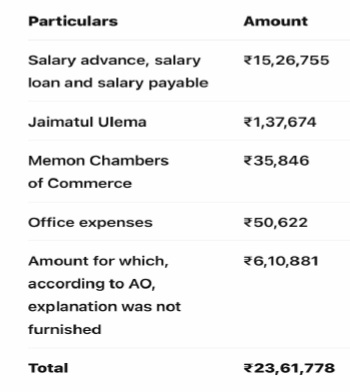
21.1. The Assessing Officer disallowed the aforesaid amount proceeding on the premise that these represented cash payments made to a person in a day in excess of the monetary threshold prescribed under section 40A(3).
22. Before us, learned counsel has submitted that the very factual premise underlying the disallowance is incorrect. Our attention has been drawn to the details and supporting documents placed in the paper book from page 51 onwards. It has been specifically contended that the salary advances/loans represent payments made to different employees and that no individual payment to an employee exceeded Rs. 10,000 in a day. Likewise, in respect of Jaimatul Ulema and Memon Chambers of Commerce, the case of the assessee is that the ledger amounts represent settlement of vouchers comprising several individual payments and that each underlying payment was below the prescribed limit. As regards office expenses, it has been explained that amounts were incurred by employees on different occasions in connection with travelling and other business requirements and were subsequently settled through the respective accounts; therefore, the aggregate amount appearing in the ledger cannot itself be regarded as a single payment to one person on one day. The assessee has specifically relied upon the supporting payment details before us and has alternatively requested that, if factual verification is considered necessary, the matter may be restored to the Assessing Officer for such limited purpose.
23. Section 40A(3), in its application to the year under consideration, operates where a payment or aggregate of payments made to a person in a day, otherwise than through the prescribed banking/electronic modes, exceeds the statutory monetary limit. Thus, the relevant enquiry is not whether the aggregate amount debited under a particular ledger head during the year exceeds Rs. 10,000, but whether the payment or aggregate of payments to the same person on the same day crossed the prescribed threshold. The Assessing Officer has, however, proceeded on the premise that the impugned amounts represented such payments, whereas the assessee has placed supporting details asserting that the underlying transactions comprised payments to different employees/persons or payments made on different dates, each remaining within the prescribed limit. This is essentially a matter capable of verification from the primary vouchers and payment-wise details. We also find that the learned CIT(A), while sustaining the disallowance, has not undertaken such payment-wise examination but has substantially proceeded on the reasoning adopted by the Assessing Officer.
24. In these circumstances, we do not consider it appropriate either to sustain the entire disallowance merely on the basis of the aggregate ledger figures or to delete it without verification of the underlying payments. We, therefore, restore this limited issue to the file of the Assessing Officer with a direction to examine the payment-wise/person-wise details, vouchers and other supporting records furnished by the assessee. If, upon such verification, it is found that an individual payment or aggregate of payments to the same person on the same day did not exceed the monetary limit prescribed under section 40A(3), no disallowance shall be made merely because the aggregate debit under the relevant ledger account during the year exceeded the prescribed amount. Likewise, wherever the assessee claims that a payment falls within any of the exceptions contained in Rule 6DD, the same shall be examined on the basis of the relevant supporting material. The Assessing Officer shall confine himself to this limited verification and shall afford reasonable opportunity to the assessee to furnish the necessary payment-wise details and supporting evidence. This ground is, accordingly, allowed for statistical purposes.
25. Before concluding, we may observe that the determination made herein rests upon the peculiar factual matrix emerging from the assessment order itself. The Assessing Officer’s case is that the impugned receipts arose from sales of offals, horns and other by-products forming part of the assessee’s existing business operations; the corresponding purchases have not been disputed; and the alleged escapement arose because the entire sale consideration/margin was not reflected in the regular books. Once that premise is accepted, the entire suppressed turnover cannot be transmuted into taxable profit. What can legitimately enter the computation is the profit embedded therein. This approach is consistent with the recognised distinction between suppressed turnover and the income component contained in such turnover. At the same time, estimation of that profit must account for the circumstances of the unrecorded transactions; where general and establishment expenditure is already absorbed in the regular business, the incremental turnover may reasonably yield a somewhat higher margin than the enterprise-level net profit, though any enhancement must remain supported by the factual record. In the present case, therefore, taking the assessee’s six-year average net-profit rate of approximately 1.5% as the objective starting point and making a modest adjustment for the peculiar character of the impugned receipts, we have considered 2% to represent a fair and reasonable estimate. The addition of Rs. 5,01,11,790 is consequently restricted to Rs. 10,02,236. The separate disallowance under section 40A(3) stands restored for the limited verification directed above.
26. In the result, the appeal of the assessee is partly allowed for statistical purposes.
Order pronounced in the open Court on 19th August, 2026.