ORDER
Manish Agarwal, Accountant Member.- These are five appeals filed by the Revenue and the Assessee against the common order of Learned Commissioner of Income Tax (Appeals)-3, Noida (“Ld. CIT(A)”) arising out of the assessment orders passed for Assessment Years 2020-21, 2021-22 & 2022-23 respectively.
2. The captioned Appeals filed by the Assessee and the Revenue are tabulated as under:
| s. No. |
Appeal Nos. |
Asstt. Year |
CIT(A)’s Order dated |
Assessment Order dated |
Assessment Order passed u/s |
| 1 |
IT(TP)A No.272/Del/2026 [Revenue’s appeal] |
2020-21 |
19.02.2026 |
22.05.2024 |
143(3) r.w.s 144C(3) of the IT Act. |
| 2. |
IT(TP)A No.259/Del/2026 [Assessee’s appeal] |
2020-21 |
19.02.2026 |
22.05.2024 |
-Do- |
| 3. |
ITA No.5367/Del/2026 [Revenue’s appeal] |
2021-22 |
24.03.2026 |
20.02.2025 |
-Do- |
| 4. |
IT(TP)A No.260/Del/2026 [Assessee’s appeal] |
2021-22 |
-Do- |
-Do- |
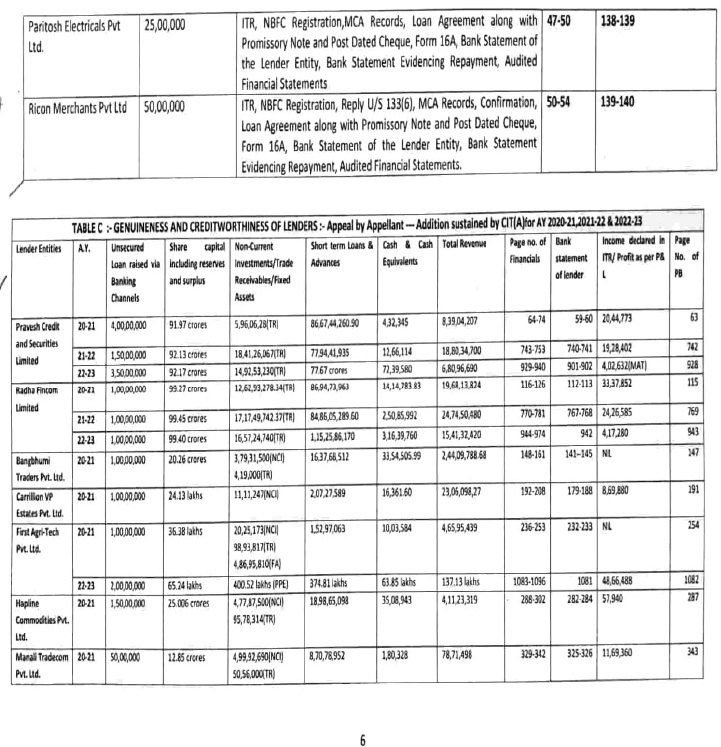
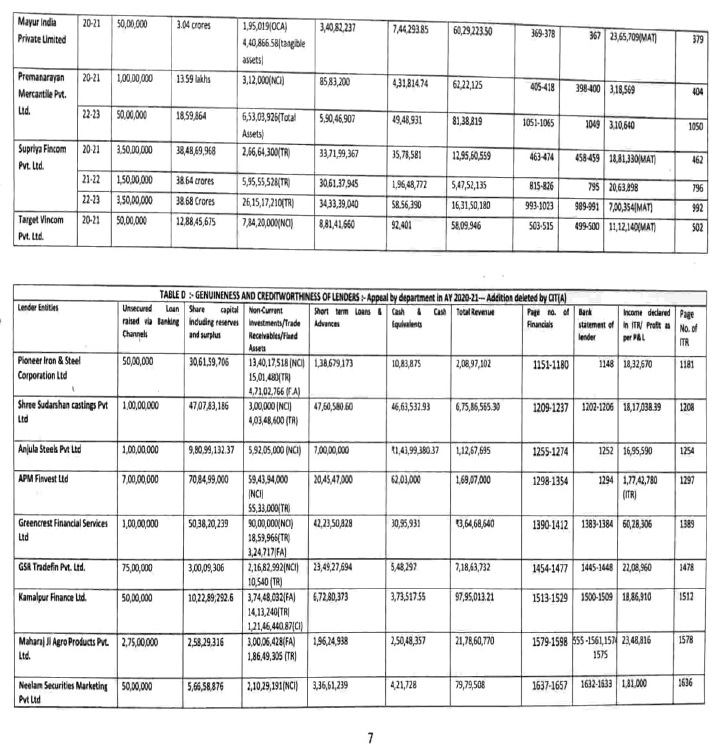
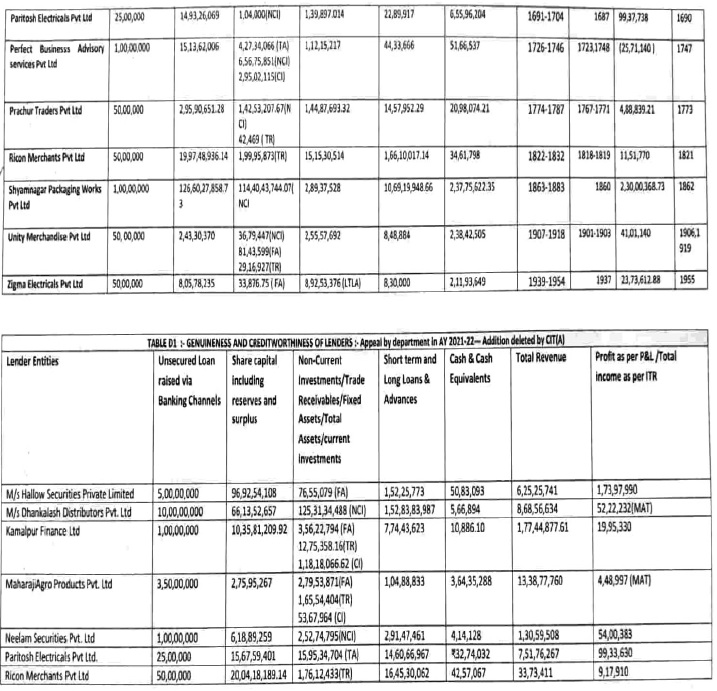
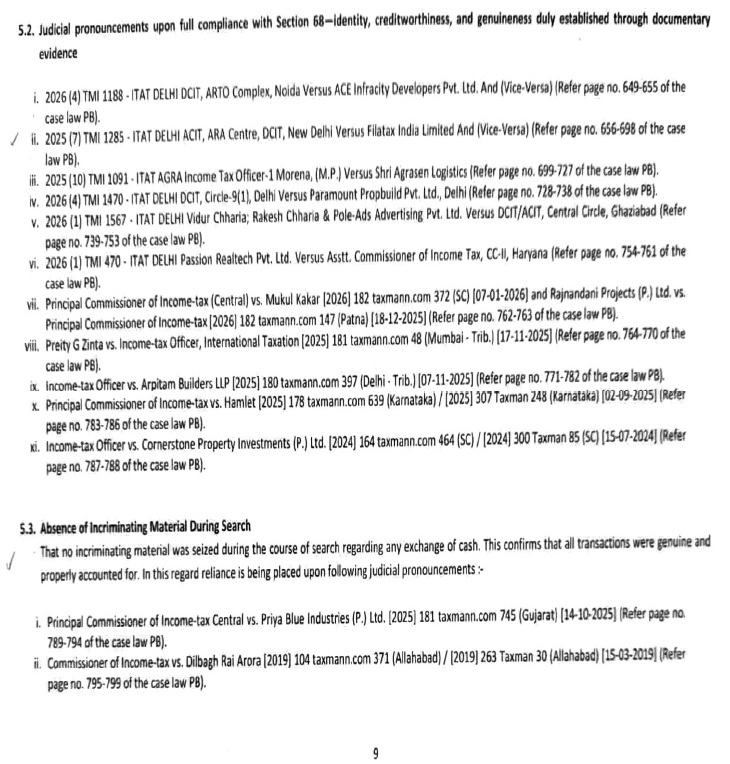
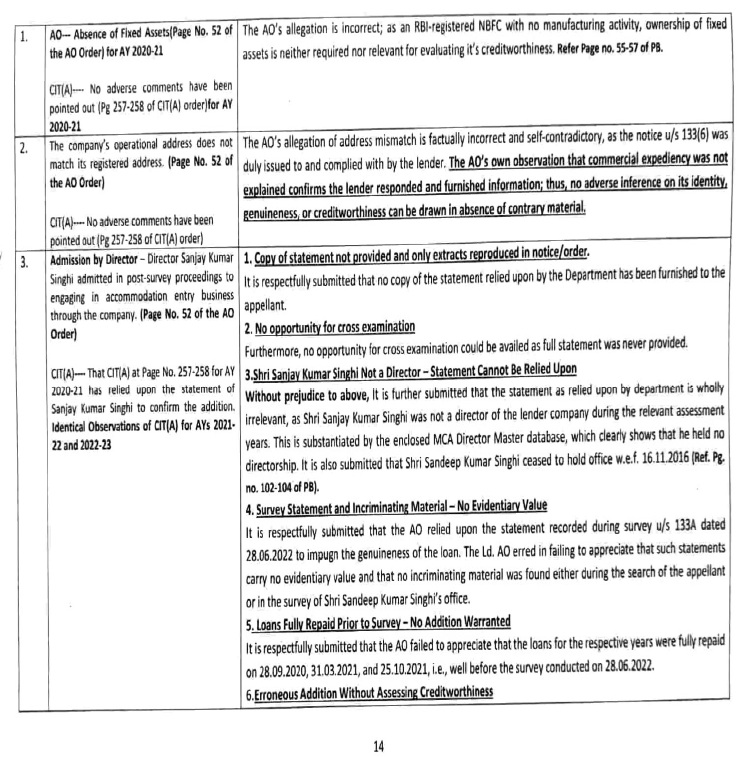
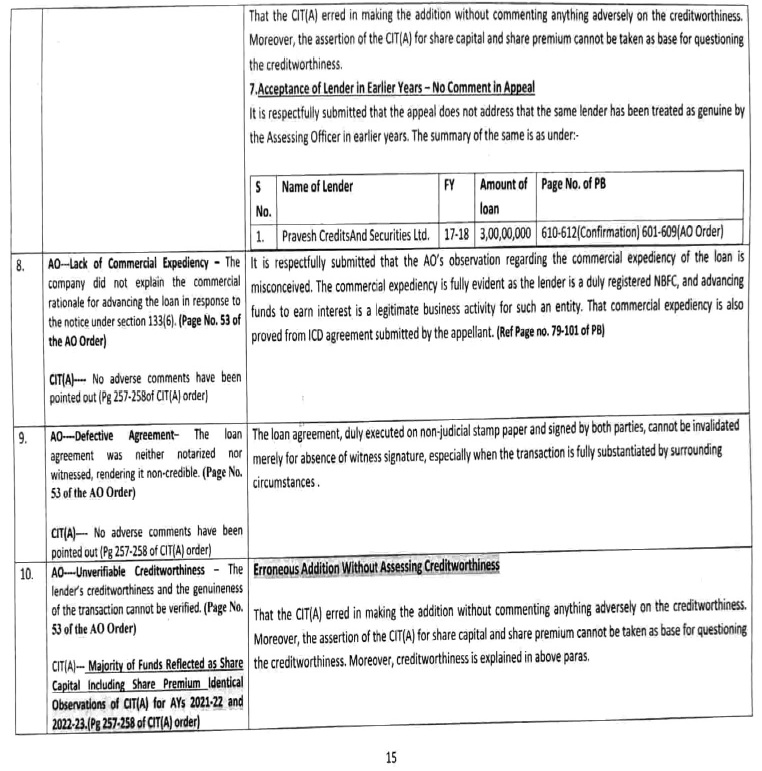
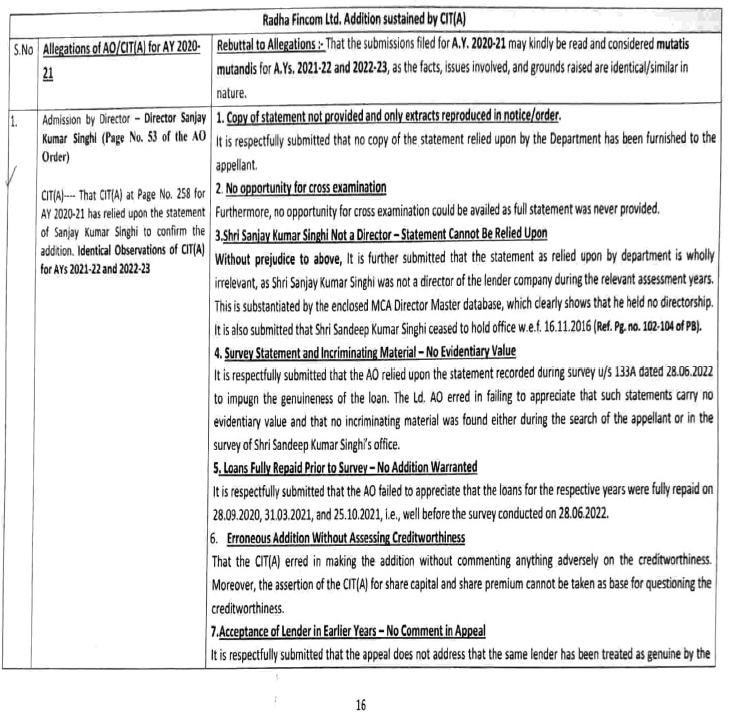
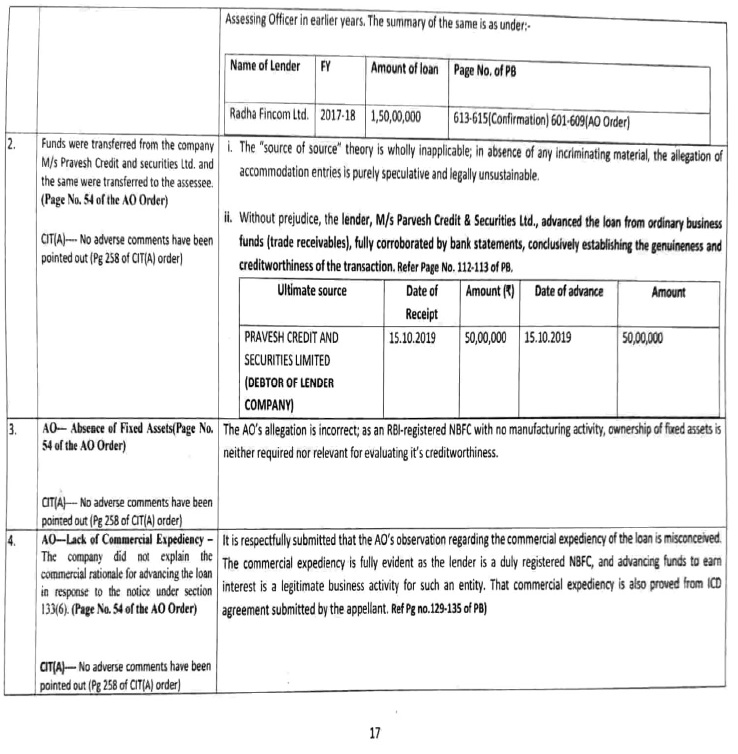
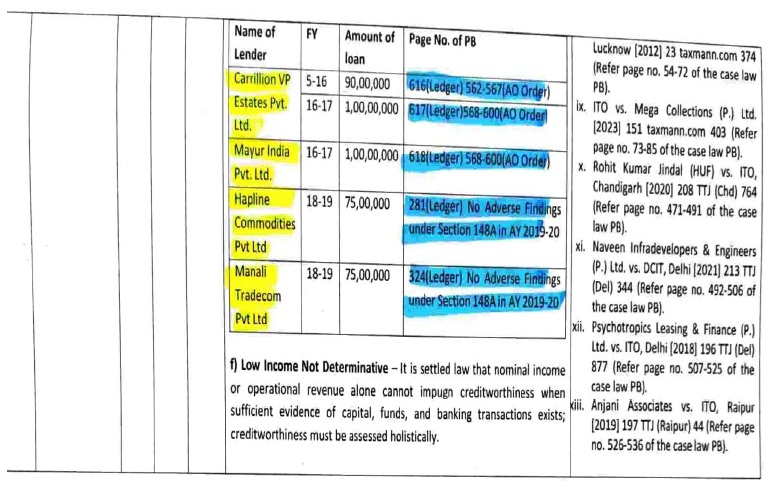
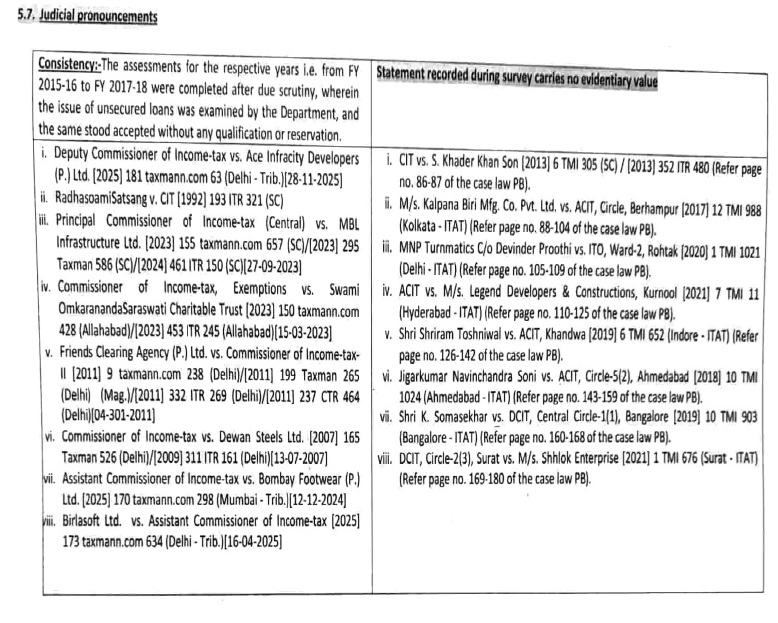
-Do- |
| 5. |
IT(TP)A No.280/Del/2026 [Assessee’s appeal] |
2022-23 |
21.04.2026 |
22.05.2025 |
-Do- |
3. Before us, both the parties have stated that most of the issues involved in all these appeals are common, therefore, they are taken together and decided by a common order.
4. First we take appeal of the assessee in IT(TP) No. 259/Del/2026 of the assessee and IT(TP)A No. 272/Del/2026 of the Revenue for Assessment Year 2020-21.
IT(TP) No.259/Del/2026 [Assessee’s appeal] & IT(TP)A No.272/Del/2026 [Revenue’s appeal] [Assessment Year 2020-21]
5. Brief facts of the case are that the return of income was filed on 03.02.2021, declaring total income of INR 1,01,55,90,800/- which includes income from business or profession of INR 1,10,78,12,302/-and income from other sources of INR 3,57,99,249/-. The assessee claimed deduction u/s 80G of the Act of INR 8,30,500/- and deduction u/s 80IB of INR 12,71,90,249/-.
6. The business profile of the assessee as stated by the AO in the assessment order for AY 2020-21 is as under:-
Business Profile:
7. The Assessee is a flexible packaging solution provider serving varied sectors spanning FMCG, Consumer Product Goods, Pharmaceuticals, Building Materials, and Automobile etc. The company provides packaging for a wide variety of products such as snack foods, candy and confectionery, sugar, rice & other cereals, beverages, tea & coffee, dessert mixes, noodles, wheat flour, soaps and detergents, shampoos & conditioners, vegetable oil, spices, marinates & pastes, cheese & dairy products, frozen food, sea food, meat, anti-fog, pet food, pharmaceuticals, contraceptives, garden fertilizers and plant nutrients, motor oil and lubricants, automotive and engineering components etc. Since COVID-19 pandemic, it has also been manufacturing consumer-facing products like N-95 masks and sanitizers. The assessee has its headquartered in Noida and has manufacturing facilities for packaging films in India, UAE, Mexico, Poland, Egypt, USA, Russia, Hungary & Nigeria. It has installed new packaging films plant coming up in Dharwad in South India. In India, its plants are located in Noida & Jammu for packaging products and allied businesses & in Sanand for aseptic liquid packaging. Its clients include global entities like P&G, PepsiCo, CocaCola, Nestle, Mondelez, L’Oreal, Britannia, Haldiram, Amul, Kimberly Clark, Reckitt, Dabur, ITC, Perfetti, GSK, Agrotech Foods, Mars Wrigley, Amcor, Mondi, UPM Raflatac etc. The assessee company manufactures and markets flexible packaging products such as biaxially oriented polyethylene terephthalate (BOPET) films, biaxially oriented polypropylene (BOPP) films, cast polypropylene (CPP) films, and metalized films. It also develops packaging allied and printing machines including extrusion coating, aseptic liquid filling machines, and lamination machines.
8. Besides above, the assessee also has a cylinder business, which carries out the manufacturing of elastomers and sleeves; rotogravure printing cylinders; Flexo-polymer plates and metallic dies. It offers packaging solutions for motor oil and lubricants, automotive and engineering, dairy, pharmaceuticals, textile, fertilizers and plant, confectionery, consumer goods, and food and beverage sectors.
9. The case of the assessee was selected for scrutiny under CASS and since assessee has carried out specified domestic transactions and well as international transactions with its AE’s, the matter was referred for determination of the Arm’s Length Price (“ALP”) of international and domestic specified transactions to the TPO. The TPO in terms of the order passed u/s 92CA(3) dated 16.02.2022 has made following two adjustments:-
| (i) |
|
Interest on delayed receivables from AE’s of INR 33,04,951; and |
| (ii) |
|
Corporate guarantee fee of INR 6,78,72,478/-. |
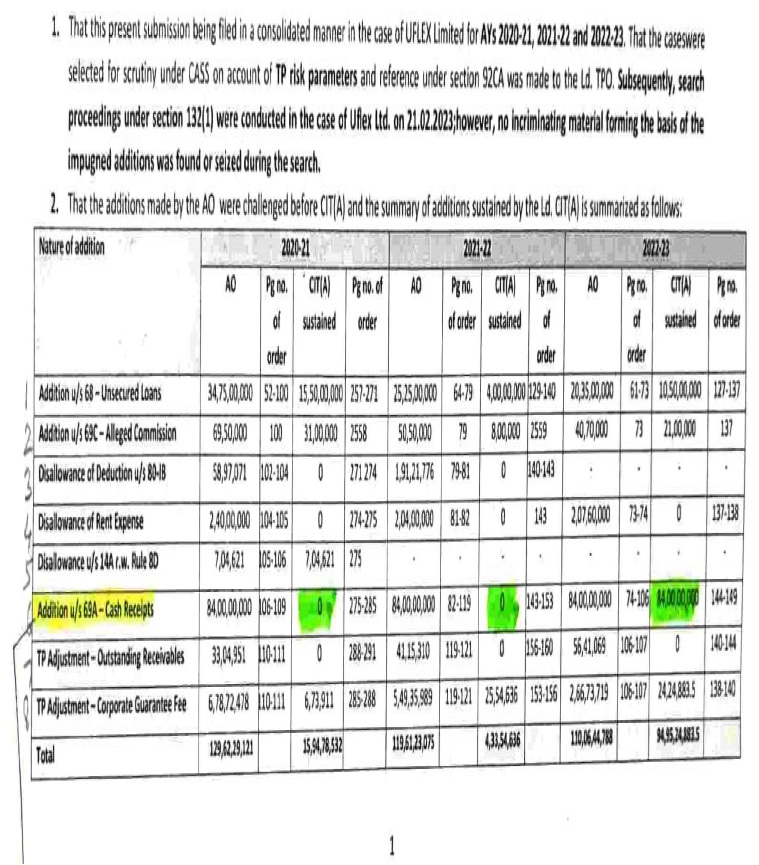
10. Thereafter, the AO passed the draft assessment order on 26.03.2024 wherein the AO has incorporated the adjustments made by the TPO. A search and seizure action u/s 132 of the act was carried out at the business premises of the assessee, its business associates, group companies and residence of their directors were also covered. The AO considered the material found and seized during the course of search and after considering all the facts, in terms of paras 8.11 & 8.12 of the order has concluded that assessee has received unsecured loans of INR 74.00 crores from 38 lender parties out of which unsecured loans received from 27 parties amounting to INR 34.75 crores were treated as unexplained credit since the assessee has failed to prove the creditworthiness and genuineness of the transactions and business expediency and accordingly, addition was made u/s 68 of the Act. In first appeal, ld. CIT(A) confirmed the loans taken from 11 parties amounting to INR 15.50 crores and deleted the remaining loans taken from 16 lender parties of INR 19.25 crores. Further, an addition of INR 69.50 Lakhs was made on account of alleged commission paid for obtaining such unsecured loans treated as bogus and held the same as unexplained expenditure u/s 69C of the Act. The AO also disallowed a sum of INR 58,97,071/- out of deduction claimed u/s 80IB of the Act related to income from scrap sales and other miscellaneous non-operative and other income such as insurance claim, balances written off etc. by holding the same as not derived from eligible industrial undertaking. The AO further disallowed rent charges paid to the spouse of the Chairman of the assessee company amounting to INR 2.40 crores. The AO further made the addition u/s 14A of the Act of INR 7,04,621/-. The AO in para 12 of the order, observed that during the course of search simultaneously carried out in the case of Montage Enterprises P. Ltd. (MEPL), a group company, statement of one Shri Manoj Kandpal, AGM (Accounts & Finance) of MEPL were recorded u/s 132(4) of the Act wherein he has stated that the cash was collected from unrecorded sales made by MEPL as found noted in various diaries/notepads seized during the search and out of such cash, a sum of Rs. 7.00 crores were delivered to the head office i.e. the assessee company on monthly basis. This fact was stated in reply to question No.36 as reproduced in page 109 of the assessment order. Accordingly, the AO held the assessee company as beneficial owner of such cash and made the addition of INR 84.00 crores u/s 69A of the Act. Thereafter, total income of the assessee company was assessed at INR 2,31,18,19,921/- by making total addition of INR 1,29,62,29,121/-.
11. Aggrieved by the said order, the assessee preferred an appeal before ld. CIT(A) wherein assessee has submitted various documents including additional evidences on which the remand report was obtained from the AO. The ld. CIT(A) after considering the submissions and the facts of the case and the Remand Report submitted by the AO, has confirmed the addition of INR 15,94,78,532/- and deleted the remaining additions made by the AO.
12. The necessary chart of the additions made by the AO and deleted by ld. CIT(A) is tabulated as under:
| S.No. |
Particulars |
AY 2020-21 |
| Addition By AO |
Sustained by CIT(A) |
Deleted by CIT(A) |
| 1. |
Addition u/ s 68 Unexplained unsecured loans |
34,75,00,000 |
15,50,00,000 |
19,25,00,000 |
| 2. |
Addition u/s 69C — Estimated commission |
69,50,000 |
31,00,000 |
38,50,000 |
| 3. |
Disallowance of deduction u/s 80-IB |
58,97,071 |
NIL |
58,97,071 |
| 4. |
Disallowance of rent expense |
2,40,00,000 |
NIL |
2,40,00,000 |
| 5. |
Disallowance u/s 14A r.w.r. 8D |
7,04,621 |
7,04,621 |
NIL |
| 6. |
Addition of unexplained cash receipts u/s 69A |
84,00,00,000 |
NIL |
84,00,00,000 |
| 7. |
Enhancement on account of Arm’s Length Price determined by TPO on Corporate Guarantee Commission |
6,78,72,478 |
6,73,911 |
6,71,98,567 |
| 8. |
Enhancement on account of Arm’s Length Price determined by TPO on Interest on receivables |
33,04,951 |
NIL |
33,04,951 |
13. Against the order of ld. CIT(A), both the parties are in appeal before the Tribunal by taking following Grounds of appeal:-
IT(TP) No.259/Del/2026 [Assessee’s appeal] [Assessment Year 2020-21]
| 1. |
|
“That the Ld. CIT(A) has erred, both on facts and in law, in upholding the assessment framed under Section 143(3) r.w.s. 144C(3), despite the fact that, pursuant to the search conducted on 21.02.2023, the proceedings were required to be initiated under Section 148, with approval under Section 148B; thus, the assessment framed under an incorrect statutory provision is invalid and liable to be quashed. |
| 2. |
|
That the Ld. CIT(A) has erred, both on facts and in law, in sustaining the quantum addition aggregating to 16,33,28,532/, comprising of Rs.15,50,00,000/- on account of unsecured loans under Section 68, estimated commission of Rs.69,50000/- under Section 69C of the Income Tax Act, 1961 (‘Act’), Rs.7,04,621/-under Section 14A, and 6,73,911/- under Section 92CA(3) towards corporate guarantee commission, without properly appreciating the facts and documents on record. |
| 3. |
|
That the Ld. CIT(A) erred in not appreciating that the impugned assessment is bad in law, as the approval in the draft assessment order and the final assessment order were identical, with no fresh approval obtained from the higher authorities for passing the final assessment order. |
| 4. |
|
That the Ld. CIT(A) erred in confirming the AO’s action of not providing the Foreign Tax Credit of 2,69,565/-, despite the corresponding income being included in the return of income for the year under consideration. The CIT(A) incorrectly stated that no addition had been made by the AO in the assessment order, overlooking the fact that the credit was not reflected in the computation of tax liabilities. |
| 5. |
|
That the Ld. CIT(A) erred in confirming the AO’s action of not providing the adjustment of *9,18,34,804/- made in the book profit under section 115JB, as per the computation of Income. |
| The CIT(A) incorrectly stated that no addition had been made by the AO in the assessment order, overlooking the fact that the adjustment as claimed in the return of income was not provided in the computation sheet to determine the demand. |
| 6. |
|
That the Ld. CIT(A) has erred, both on facts and in law, in sustaining the addition of Rs.15,50,00,000/- under Section 68 on account of unsecured loans received from Bhangbhumi Traders Pvt. Ltd. (1,00,00,000), Carillion VP Estates Pvt. Ltd. (1,00,00,000), First Agri Tech Pvt. Ltd. (Rs.1,00,00,000), Hapline Commodities Pvt. Ltd. (Rs. 1,50,00,000), Manali Tradecom Pvt. Ltd. (Rs.50,00,000), Mayur India Pvt. Ltd. (Rs.50,00,000), Premnarayan Mercantile Pvt. Ltd. (*1,00,00,000), Target Vincom Pvt. Ltd. (*50,00,000), Pravesh Credit and Securities Ltd. (Rs.4,00,00,000), Radha Fincom Ltd. (1,00,00,000), and Supriya Fincom Pvt. Ltd. (3,50,00,000), on the alleged ground of lack of creditworthiness. That the CIT(A) failed to appreciate that the appellant has duly discharged the onus u/s 68 by submitting necessary documents. |
| 7. |
|
That the Ld. CIT(A) erred, both on facts and in law, in sustaining the addition under Section 68 in respect of alleged credits from Pravesh Credit and Securities Ltd. (Rs.4,00,00,000), Radha Fincom Ltd. (1,00,00,000), and Supriya Fincom Pvt. Ltd. (Rs.3,50,00,000), by solely relying on uncorroborated statements of third parties who were not directors during the year under consideration. That the CIT(A) erred in relying on such statements, ignoring the fact that statements recorded during a survey have no evidentiary value, thereby rendering the addition unsustainable in law. |
| 8. |
|
That the Ld. CIT(A) has erred in disregarding the fact that the loans in question had been accepted by the AO in earlier assessments and failed to demonstrate how the creditworthiness of the same lenders was affected in the year under consideration. |
| 9. |
|
That the Ld. CIT(A) erred in confirming the addition of some lenders, ignoring the fact that the loans have been repaid in subsequent years. That CIT(A) failed to appreciate that the addition under Section 68 cannot be made where the repayment has been made. |
| 10. |
|
That the Ld. CIT(A) erred in not adjudicating the ground regarding the estimated commission amounting to 69,50,000/-under Section 69C of the ‘Act’. |
| 11. |
|
That the Ld. CIT(A) has erred, both on facts and in law, in sustaining the disallowance of *7,04,621/-under Section 14A, ignoring the fact that no addition can be made where the AO has not recorded his satisfaction after examining the books of account. |
| 12. |
|
That the Ld. CIT(A) erred in sustaining the addition of 6,73,911/- towards corporate guarantee fees by adopting the fees rate of 0.50% instead of 0.40% benchmarked by the appellant, ignoring that the same was at arm’s length, rendering the adjustment unsustainable. |
| 13. |
|
That the Appellant craves leave to add, amend, alter or withdraw any of the grounds of appeal at or before the time of hearing.” |
IT(TP)A No.272/Del/2026 [Revenue’s appeal] [Assessment Year 2020-21]
| 1. |
|
“Whether on the facts and in the circumstances of the case and in law, the CIT APPEAL has erred in deleting the addition of Rs. 19,25,00,000 out of the total addition made under section 68 of the Income Tax Act, 1961 in respect of unsecured loans 1 received from various Kolkata based entities, ignoring the detailed findings recorded by the Assessing Officer establishing that the said entities were paper companies and accommodation entry providers lacking genuine creditworthiness and financial capacity, and that the transactions lacked commercial substance. |
| 2. |
|
Whether on the facts and in the circumstances of the case and in law, the CIT APPEAL has erred in holding that the assessee had discharged the onus cast upon it under section 68 merely on the basis of documentary evidence such as PAN, confirmations, Income tax returns and bank statements, without appreciating that such documents, in the presence of adverse investigation findings and surrounding circumstances, are not sufficient to establish the identity, creditworthiness and genuineness of the lenders. |
| 3. |
|
Whether on the facts and in the circumstances of the case and in law, the CIT APPEAL has erred in deleting the addition of Rs. 84,00,00,000 made under section 69A of the Income tax Act, 1961 on account of unexplained cash, without properly appreciating the statements recorded during the course of search proceedings and the material gathered during investigation, which indicated the existence of unaccounted cash transactions linked with the assessee. |
| 4. |
|
Whether on the facts and in the circumstances of the case and in law, the CIT APPEAL has erred in deleting the transfer pricing adjustment of Rs. 33,04,951 made on account of interest on delayed receivables from associated enterprises, without appreciating that outstanding receivables from associated enterprises constitute a separate international transaction requiring independent benchmarking under the provisions of Chapter X of the Income Tax Act, 1961. |
| 5. |
|
Whether on the facts and in the circumstances of the case and in law, the CIT APPEAL has erred in restricting the arms length rate of corporate guarantee commission to 0.5 percent as against 2.10 percent determined by the Transfer Pricing Officer, thereby deleting a substantial portion of the adjustment without conducting a detailed comparability analysis OR adequately considering the benchmarking study carried out by the TPO. |
| 6. |
|
Whether on the facts and in the circumstances of the case and in law, the CIT APPEAL has erred in deleting the disallowance of Rs. 2,40,00,000 made by the Assessing Officer on account of rent paid for a farmhouse guest house, without adequately verifying the extent of actual business utilization of the premises during the relevant previous year and without appreciating that the assessee had failed to establish that the said expenditure was incurred wholly and exclusively for the purposes of business.* |
| 7. |
|
Whether on the facts and in the circumstances of the case and in law, the CIT APPEAL has erred in allowing deduction under section 80 IB in respect of receipts such as insurance claim, remission write back of liabilities, scrap sales, purchase discounts and other miscellaneous income, without adequately examining whether such receipts could be regarded as profits derived from the eligible industrial undertaking within the meaning of section 80 IB of the Income Tax Act, 1961. |
| 8. |
|
Whether on the facts and in the circumstances of the case and in law, the order of the CIT APPEAL is erroneous both on facts and in law, and therefore the same deserves to be set aside and the order of the Assessing Officer restored. |
| 9. |
|
That the order of Ld. CIT Appeal 3, Noida being erroneous in law and facts be set aside and order of the A.O. be restored. |
| 10. |
|
That the above grounds are without prejudice to each other and appellant craves leave to add, alter OR amend any ground OR grounds on OR before the date of hearing of appeal.” |
14. Ground of appeal No.1 of the assessee is with respect to the framing of assessment u/s 143(3) r.w.s. 144C(3) of the Act, ignoring the fact that the case of the assessee was completed after search u/s 132 of the Act conducted on 21.02.2023 at its business premises and thus, the proceedings should have been initiated and concluded u/s 148 of the Act.
15. As observed above, a search and seizure operation was carried out on the assessee u/s 132 of the Act on 21.02.2023 alongwith search at the business premises of MEPL, a group concern. Prior to that, the return of income for the year under appeal was filed on 03.02.2021. The claim of the assessee was that the assessment for the year under appeal was completed u/s 143(3) of the Act however, when a search action was taken u/s 132 of the Act in the case of the assessee, therefore, in terms of Explanation 2 sub clause (i) to Section 148, the assessment proceedings should have been initiated u/s 148 of the Act and thus the order passed u/s 143(3) of the Act was invalid. For this reliance is placed on the judgement of the coordinate bench in the case of Montage Enterprises (P.) Ltd. v. DCIT/ACIT (Delhi – Trib.) in ITA No. 5458/Del/2025 dt. 29.12.2025 who followed the judgement of Co-ordinate Bench of Chandigarh Tribunal in the case of Homelife Buildcon (P.) Ltd. v. Dy. CIT (Chandigarh – Trib.) and further relied on the judgement in the case of Jamna Das Nikkamal Jain Saraf Pvt. Ltd. v. DCIT [IT Appeal No. 403 (Chd.) of 2025, dated 04.11.2025]. He prayed accordingly.
16. On the other hand, the ld. CIT DR submits that the return of income was filed u/s 139(1) on 23.02.2021 and scrutiny proceedings were already initiated by issue of notice u/s 143(2) on 29.06.2021 which were pending as on the date of search, thus the assessment order was rightly passed u/s 143(3) of the Act.
17. Heard both the parties and perused the material available on record. In the present case, a search and seizure operation us/s 132 of the Act was carried out on 21.02.2023 and prior to that notice u/s 143(2) of the Act for taking the case of the assessee for scrutiny assessment was issued on 29.06.2021. Claim of the assessee was that when search is conducted on or after 01.04.2021, assessment must be framed u/s 147/148 of the Act and not under Section 143(3) of the Income Tax Act. Before going further, it is necessary to refer Explantion-2 to section 148 of the Act, which reads as under:
Explanation 2- for the purpose of this section :
(i) A search is initiated under section 132 or books of accounts, other documents or any assets are requisitioned on or after 1st day of April 2021 in the case of the assessee or
(ii) a survey is conducted under section 133A, other than under subsection (2A) [***] of that section, on or after the 1st day of April, 2021, in the case of the assessee; or
(iii) the Assessing Officer is satisfied, with the prior approval of the Principal Commissioner or Commissioner, that any money, bullion, jewellery or other valuable article or thing, seized or requisitioned under section 132 or section 132A in case of any other person on or after the 1st day of April, 2021, belongs to the assessee; or
(iv) the Assessing Officer is satisfied, with the prior approval of Principal Commissioner or Commissioner, that any books of account or documents, seized or requisitioned under section 132 or section 132A in case of any other person on or after the 1 st day of April, 2021, pertains or pertain to, or any information contained therein, relate to, the assessee,
the Assessing Officer shall be deemed to have information which suggests that the income chargeable to tax has escaped assessment in the case of the assessee where the search is initiated or books of account, other documents or any assets are requisitioned or survey is conducted in the case of the assessee or money, bullion, jewellery or other valuable article or thing or books of account or documents are seized or requisitioned in case of any other person.
18. From the plain reading of the above explanation, it is conferred that the assessment ought to have been made under Section 148 of the Act where a search was conducted on or after 01.04.2021. Despite the search being conducted in the case of the assessee and the AO being fully aware of this fact, he had proceeded to conclude the assessment proceedings initiated by issued the notice u/s 143(2) on 29.06.2021. Thus, under these circumstances, proper course of action would be to drop the proceedings already initiated and proceeded to initiate the proceedings u/s 148 as outlined in Explanation 2(i) to section 148 of the Act as there was deemed escapement of income. Failure to comply the statutory procedure as provided under the Act constitutes a jurisdictional defect. The Hon’ble Apex Court in the case of Babu Varghessee v. Bar Council of Kerala (1999) 3 SCC 422 , wherein at paragraph 31 and 32, it is held as follows:
“31. It is the basic principal of law long settled that if the manner of doing a particular act is prescribed under any statute, the act must be done in that manner or not at all. The origin of this rule is traceable to the decision in Taylor v. Taylor (1875) 1.Ch.D 426 which was followed by Lord Roche in Nazir Ahmed v King Emperor who stated as under :-
“where a power is given to do certain thing in certain way, the thing must be done in that way or not at all. ”
32. This rule has since been approved by this court in Rao Shiv Bahadur Singh & Anr v. State of Vindhya Pradesh and again in Deep chand v. state of Rajasthan 1962, (1) SCR = “AIR” 1961 SC 1527. These cases were considered by a three Judge Bench of this court in state of Uttar Pradesh v. Singhara Singh & Others and the rule laid down in nazir Ahmed’s case (supra) was again upheld. This rule has since been applied to the exercise of jurisdiction by courts and also been recognized as statutory principal of administrative Law.
19. Therefore, the AO should have acted strictly in terms of the amended provisions of section 148 of the Act for the searches carried out on or after 01.04.2021. The coordinate bench of Delhi Tribunal in the case of MEPL (supra) held as under:
“Heard both the parties. Case files perused.
2. We notice at the outset that there arises the first and foremost issue of validity of the impugned section 143(3) assessment itself framed by the learned DCIT, Central Circle-II, Noida as per the assessee’s pleadings in its appeal ITA No.5458/Del/2025. A combined perusal of both these case files indicates that the assessee/appellant is engaged in the business of manufacturing and sale of flexible packaging material etc. It has filed its return for the impugned assessment year 2022-23 on 29.10.2022, declaring loss of Rs.64,53,88,702/-. And the same was taken for scrutiny. The learned departmental authorities thereafter carried out section 132 search action as well as section 133A survey in its case on 21.02.2023. There is further no dispute that the learned Assessing Officer then proceeded to frame the impugned assessment on 30th March, 2024 in its case inter alia making various disallowances/additions etc., involving varying sums, which stand partly upheld in the CIT(A)’s lower appellate discussion.
3. It is in this factual backdrop that the assessee seeks to raise it’s precise question challenging validity of the impugned assessment for the sole reason that the same ought to have been framed under section 148 with approval under section 148B of the Act in light of Homelife Buildcon (P.) Ltd. v. DCIT, (Chandigarh – Trib.) as relied in Jamna Das Nikkamal Jain Saraf Pvt. Ltd. v. DCIT (ITA No. 403/Chd./2025) decided on 04.11.2025, adjudicating the very issue against the department as under:
“11.4 In conclusion, it was submitted that since the year under appeal formed part of the three assessment years immediately preceding the year in which search was conducted, the assessment ought to have been framed under section 148 with approval u/s 148B. The framing of the assessment u/s 143(3) and approval taken only for the purposes of section 143(3) was thus asserted to be fundamentally defective, non-compliant with statutory mandate, and consequently void ab initio. On these grounds, following the ratio in Homelife Buildcon Pvt. Ltd., it was prayed that the impugned assessment be quashed.
12. The Ld. CIT-DR Shri Manav Bansal opposed the contention, stating that the return for A.Y. 2022-23 was filed prior to the date of search, and validly selected for scrutiny under CASS. The AO was competent to complete the assessment u/s 143(3).
12.1 He contended that section 148B applies only to “reassessment” and not to “regular assessments.” The AO’s approval from Addl. CIT, being in line with the CBDT Instruction No. 7/2022 dated 15.07.2022, fulfils the supervisory requirement. The DR also submitted that Homelife Buildcon is distinguishable, as the AO therein relied on third-party search data, whereas the present case is based on assessee’s own seized material.
13. We have carefully considered the rival submissions and perused the record. It is undisputed that search u/s 132 was conducted on 24.11.2022, relevant to A.Y. 2023-24. Thus, A.Y. 2022- 23 is one of the three preceding years under Explanation 2(iv) to section 148. The Explanation reads that if a search is initiated, “the Assessing Officer shall be deemed to have information suggesting escapement of income for the three assessment years immediately preceding the assessment year relevant to the previous year in which the search is initiated.”
13.1 Therefore, the only permissible statutory course was to issue notice u/s 148 and obtain prior approval u/s 148B before passing assessment order.
13.2 As the Assessing Officer completed the assessment under section 143(3) of the Act without issuing the notice under section 148 of the Act. Therefore, the question before us is whether the assessment proceedings initiated under section 143(3) of the Act can be validly continued and completed after a search under section 132 has been conducted in the case of the same assessee, without following the procedure prescribed under section 148 (Explanation 2) of the Act.
13.3 In our considered opinion, the answer lies in the scheme of the Act itself. Section 143 provides the general framework for regular assessment, whereas sections 147-148 (post-2021 regime) deal with reassessment based on information suggesting escapement of income, including that unearthed during a search.
13.4 A plain reading of section 143(2) shows that such notice can be issued only when a return of income is furnished under section 139 or in response to a notice under section 142(1). It empowers the Assessing Officer to scrutinize that return if he considers that income has been understated or tax underpaid. However, when a search under section 132 takes place and materials are found indicating possible escapement of income, the statute envisages a different route for carrying out assessment or reassessment under section 147 read with section 148, which is the special mechanism for bringing to tax the income discovered in consequence of a search.
13.5 Although section 148 (inserted w.e.f. 01.04.2021) does not begin with a non-obstante clause similar to the erstwhile section 153A, its context and Explanation 2 make it clear that where a search is initiated, the jurisdiction thereafter must flow through this special channel, subject to prior satisfaction and approval of the Principal Commissioner or Commissioner. The legislative intent is to ensure that when a search is carried out, the assessment is framed under the specific provisions meant for such cases and not under the general provision of section 143(3). Further we may mention that no notice under section 143(2) could have been issued after 3 months from the end of the financial year in which the return is furnished. In the present case the original return of income was filled on 4/11/2022 for the assessment year 202223 and 143 (2) was issued on 21/6/2023 , therefore also the assessment was framed under 143(3) of the Act is not sustainable. In other words the time required for issuing the notice under 143(2) had already expired, and the revenue can not be allowed to issue issue 143(2) on 21.6.2023 after the search was carried out and notice had been issued on 21.6.2023 and assessment was framed under 143(3) of the Act. The relevant portion of section 143(3) reads as under:-
143(2) Where a return has been furnished under section 139, or in response to a notice under sub-section (1) of section 142, the Assessing Officer or the prescribed income-tax authority, as the case may be, if considers it necessary or expedient to ensure that the assessee has not understated the income or has not computed excessive loss or has not under-paid the tax in any manner, shall serve on the assessee a notice requiring him, on a date to be specified therein, either to attend the office of the Assessing Officer or to produce any evidence on which the assessee may rely in support of the return:
Provided that no notice under this sub-section shall be issued after the expiry of three months from the end of the financial year in which the return is furnished.
13.6 This position finds substantial support from the ratio of various decisions of Hon’ble High Court and Hon’ble Supreme Court.
The Courts unanimously held that once a search has been conducted and proceedings are triggered under section 153A, the Assessing Officer cannot continue parallel proceedings under section 143(3) or section 147 for the same assessment year, because the entire assessment for that year stands merged in the search assessment. The Courts emphasized that the existence of a special procedure for assessment consequent to a search is a complete code in itself; therefore, ordinary assessments abate and cannot coexist with the search-based assessment.
13.7 Drawing this analogy to the current regime, it is evident that when a search takes place and information is unearthed suggesting escapement of income, the Assessing Officer must act under section 148 (which now performs the role formerly assigned to section 153A) rather than continuing with a pending section 143(3) proceeding. The legislative intent remains the same — to prevent multiplicity of proceedings and ensure that only one comprehensive order is passed, factoring in both the pre-search and post search materials.
13.8 The rationale is further reinforced by the well-settled principle of generalia specialibus non derogant — the special provision overrides the general. Section 148 (as a special provision triggered by search information) must prevail over section 143 (the general provision for regular scrutiny). Allowing the Assessing Officer to continue and conclude proceedings under section 143(3) after a search would defeat this legislative scheme and render the safeguards, such as prior approval of the Principal Commissioner, redundant.
13.9 Accordingly, we hold that once a search is initiated under section 132 and material is found relating to the assessee, the pending assessment under section 143(3) cannot validly continue, as the time for issuing the 143(2) in response to original return of income had already expired, therefore the Assessing Officer must necessarily proceed in accordance with the special provisions contained in section 148 of the Act.”
4. Learned CIT(DR) representing the Revenue vehemently supports the impugned assessment that the Assessing Officer had rightly finalized the same under the normal provision once the entire issue was pending before him as on the date of search.
5. We have given our thoughtful consideration to the assessee’s and the Revenue’s foregoing vehement submissions. We find merit in the assessee’s legal ground herein once the impugned search had taken place in its case, no normal assessment under section 143(3) of the Act could have been framed in light of the tribunal’s foregoing twin decisions going against the department. We thus adopt the above extracted reason mutatis mutandis to quash the impugned assessment framed by the learned Assessing Officer on 30th March, 2024 in very terms.”
20. In view of above discussion, and by respectfully following the judgements of Co-ordinate Benches of the Tribunal as referred herein above, we are of the considered view that the assessment for the year before us must completed u/s 148 of the Act and not u/s 143(3) of the Act and thus, the order so passed is invalid order and is quashed.
21. Though we have allowed the legal ground of appeal taken by the assessee and quashed the assessment order however, in the interest of justice, the other grounds of appeal taken on the merits of the additions by both the parties are decided as under:
22. Ground of appeal No.2 raised by the assessee is general in nature, requires no separate adjudication.
23. Ground of appeal No.3 of the assessee is not pressed hence, dismissed.
24. Ground of appeal No.4 of the assessee is against the denial of foreign tax credit of INR 2,69,565/- to the assessee.
25. Heard the contentions of both the parties at length and perused the material on record. Claim of the assessee was that out of total foreign tax credit of INR 1,03,99,055/-, the AO has allowed the credit to the extent of INR 1,01,29,490/- and has not allowed the credit of INR 2,69,565/- though the corresponding income was fully incorporated in the computation of total income and subject to the tax as per India Tax Law thus, it is double taxation.
26. Considering the overall facts and submission of both the parties made before us, and upon perusing the material available on records, we direct the AO to examine whether income related to such short foreign tax credit was offered for tax in the year under appeal and if the claim of the assessee is found correct, necessary credit of foreign tax be allowed. With these directions, Ground of appeal No.4 of the assessee is allowed for statistical purposes.
27. In respect of Ground of appeal No.5 of the assessee, no effective submission was made by the assessee. As per this Ground of appeal, assessee has challenged the adjustment made in the book profit.
28. As per the assessee, the AO has not provided the details of adjustment of INR 9,18,34,804/- made in the book profit, therefore, AO is directed to provide the necessary working details to the assessee so that the necessary action could be taken at the end of the assessee. With these directions, Ground of appeal No.5 of the assessee is allowed for statistical purposes.
29. The Assessee in Grounds of appeal Nos. 6 to 9 has challenged the addition sustained by ld. CIT(A) whereas the revenue in Grounds of appeal Nos. 1 & 2 has challenged the first appellate order on the amount of addition deleted by ld. CIT(A).
30. Brief facts leading to this issue are that the assessee has received unsecured loans from 38 different lender parties totaling to INR 74.00 crores out of which loans taken from 27 lender parties amounting to INR 34.75 crores were held as unexplained credits u/s 68 of the Act. The AO has made detailed discussion of the inquiries conducted in respect of these loan creditors from pages 53 to 101 of the assessment order wherein the AO has made observations with respect to the statements recorded of the Directors of some lender companies during the course of survey where they have stated that the respective company was engaged in providing accommodation entries. The AO further referred notices issued u/s 133(6) of the Act. The AO after considering the replies filed by the assessee, was not satisfied about the genuineness of the loan transactions and creditworthiness of the total 27 lender and made the addition of INR 34.75 crores u/s 68 of the Act. The ld. CIT(A) confirmed the addition of the loans taken from 11 lenders of INR 15.50 crores and for the remaining loans of INR 19.25 crores taken from 16 lender parties, ld. CIT(A) after satisfying with the submissions and evidences produced has deleted the addition.
31. Before us, first and foremost arguments of the assessee was that no incriminating material was found and seized with respect to the loan taken during the year under appeal therefore, without referring to any incriminating material, no addition could be made in the order passed u/s 143(3) consequent to search carried out u/s 132 of the Act.
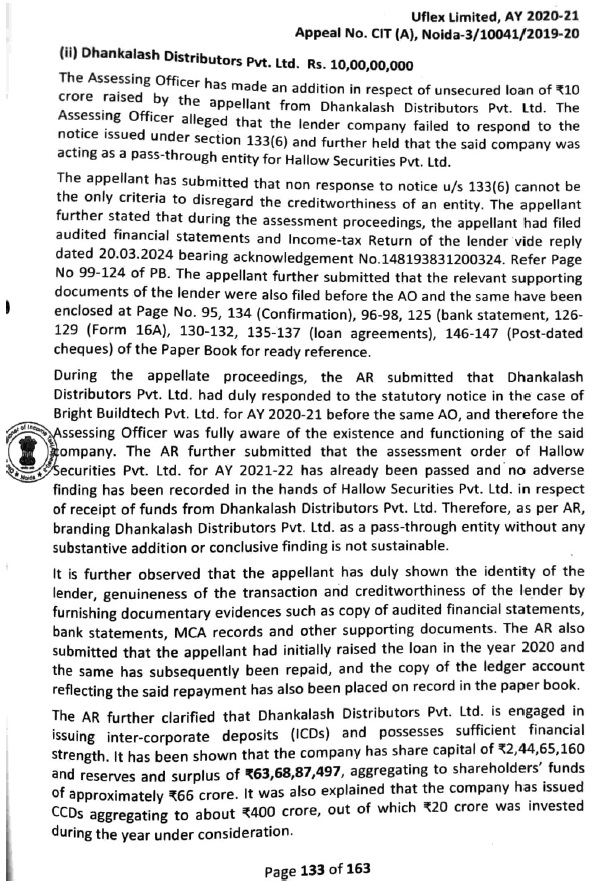
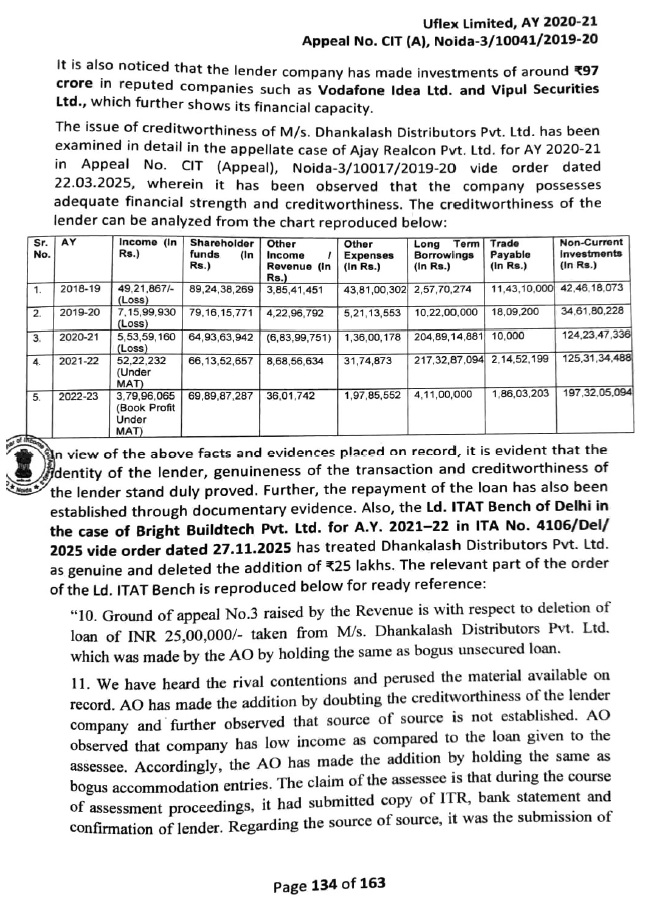
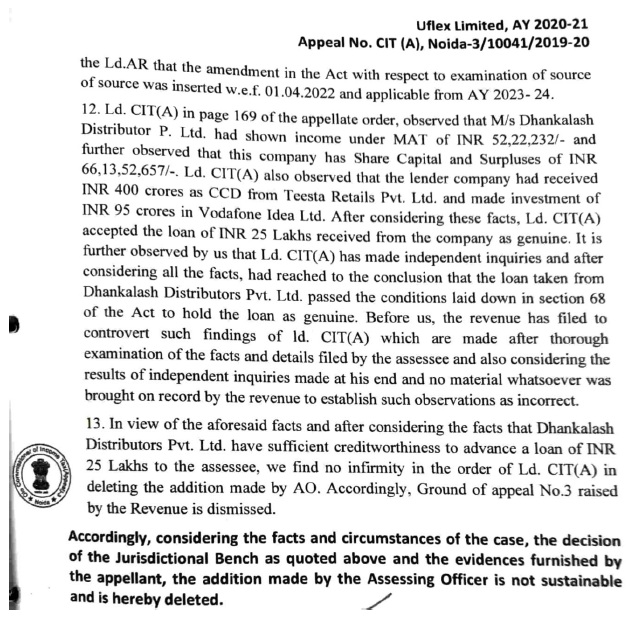
32. Regarding the allegation that the lenders have not replied in response to notice issued u/s 133(6) of the Act, the assessee has filed a chart reproduced at page 12 & 13 of the written submissions, stating that they had filed the replies and further filed the confirmations therefore, no addition was required to be made. Ld. AR further submits that from most of the parties, loans were also taken in preceding assessment years where assessments were completed u/s 143(3) and the issue of unsecured loans were examined and no doubts were raised with respect to the genuineness of the transactions and creditworthiness of the parties. He, therefore, submits that entire addition made on account of the loans deserves to be deleted including the additions sustained by ld. CIT(A). The detailed submissions made by the assessee containing various charts as well the item-wise submissions and the judicial pronouncements relied upon are reproduced as under:-
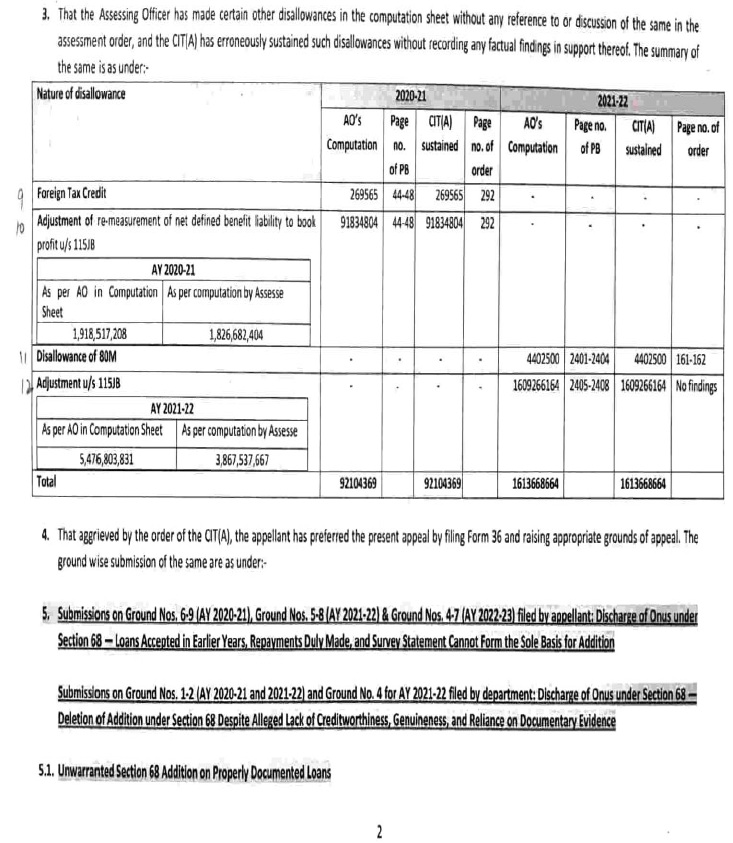
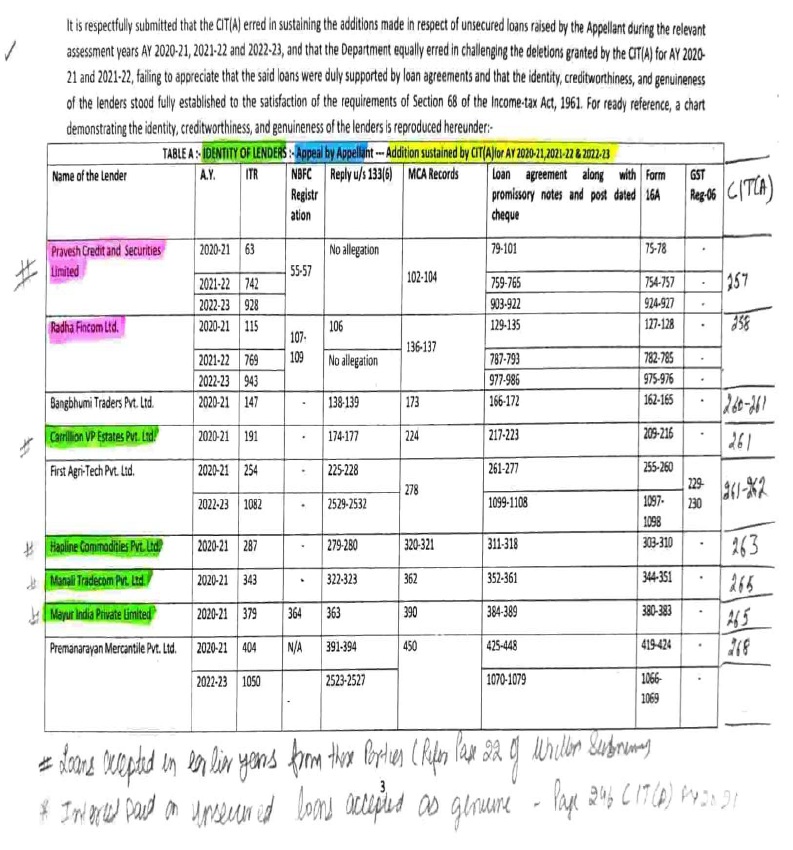
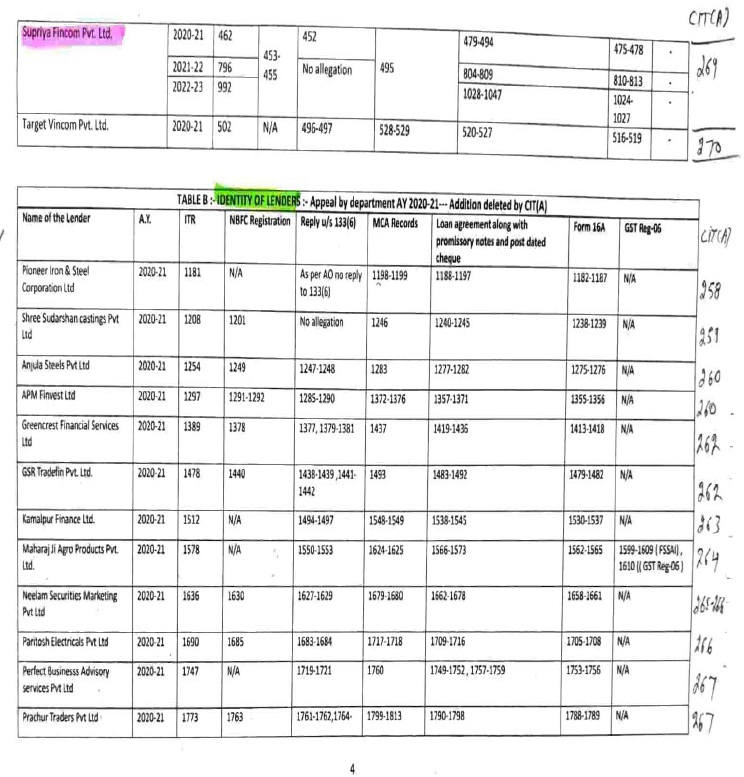
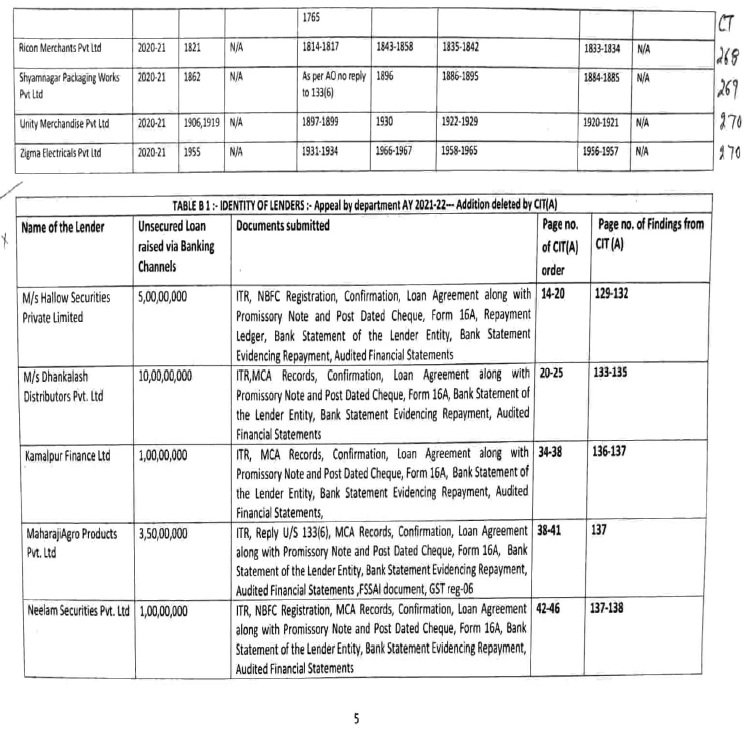
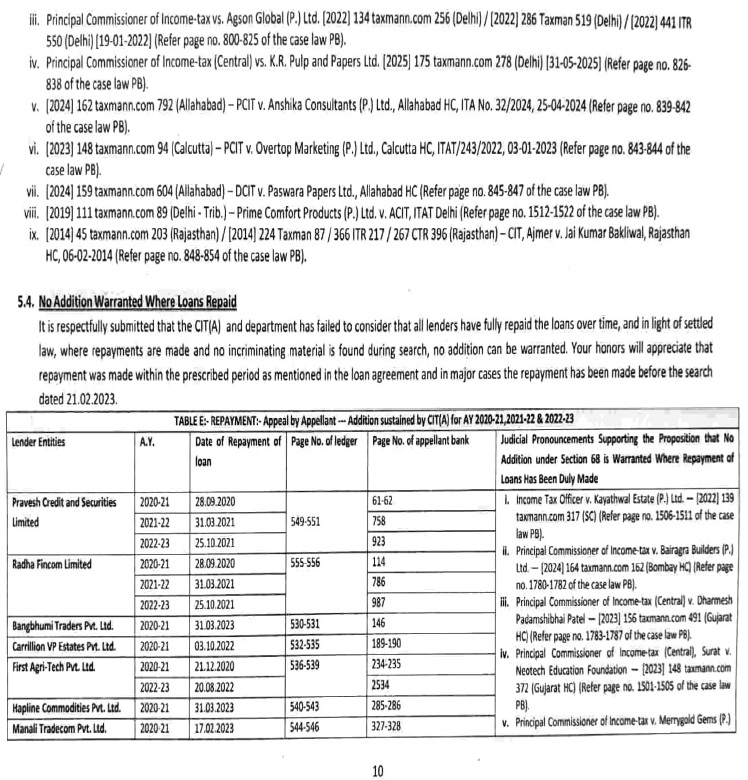
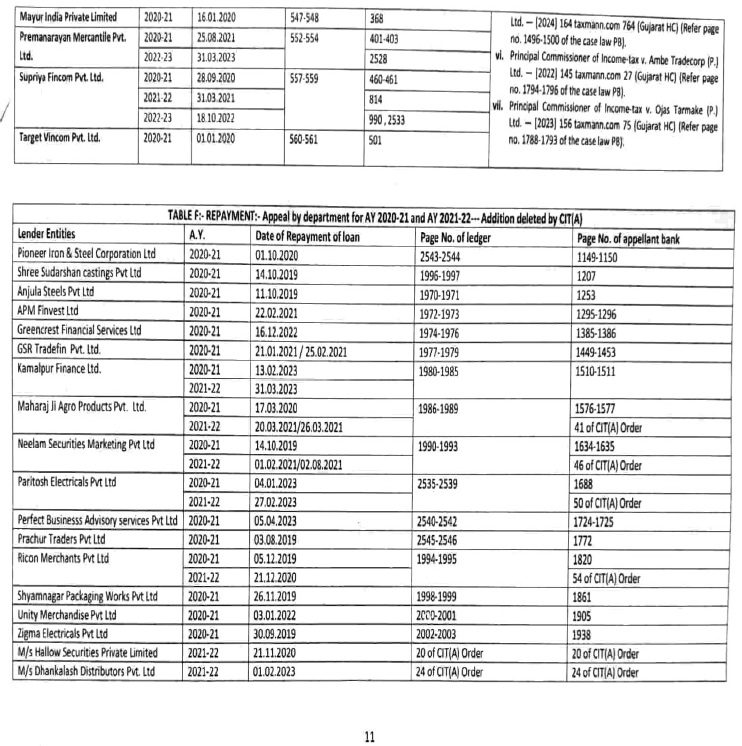
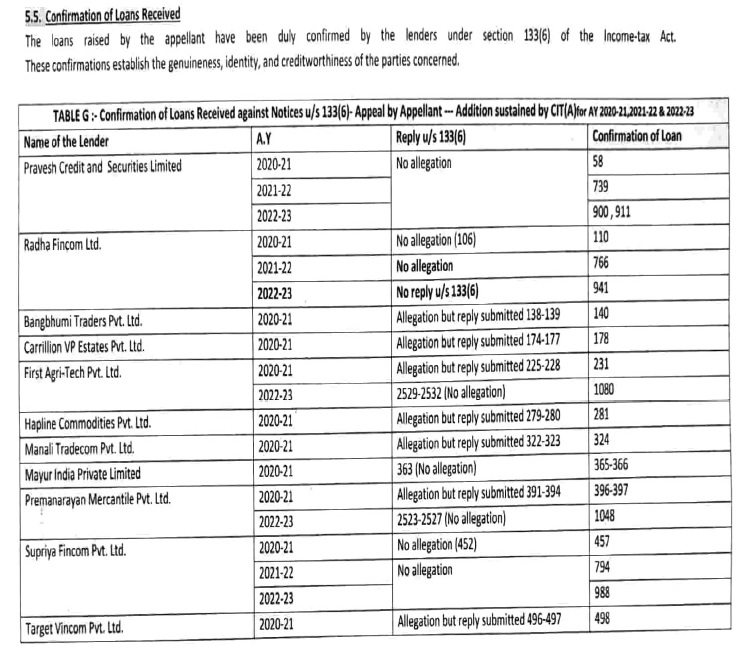
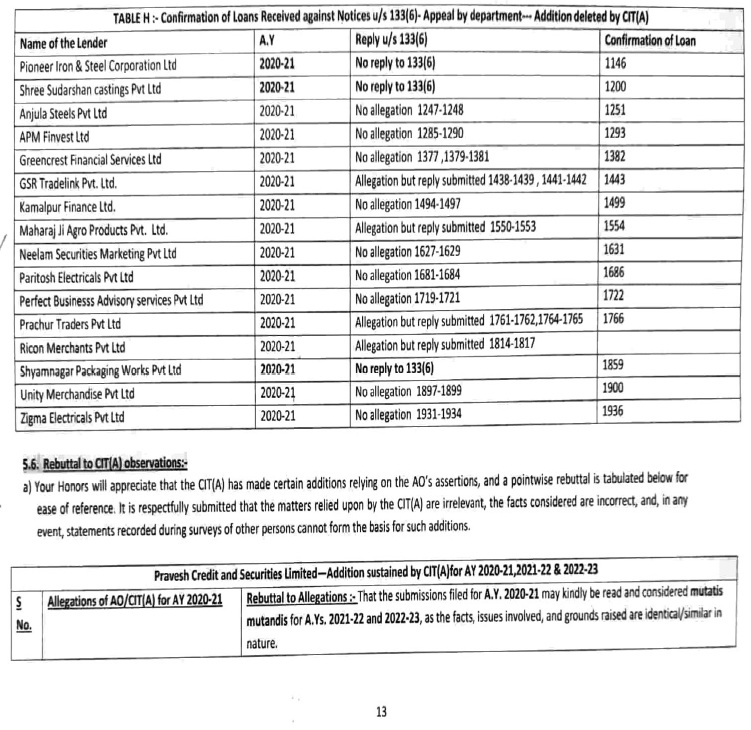
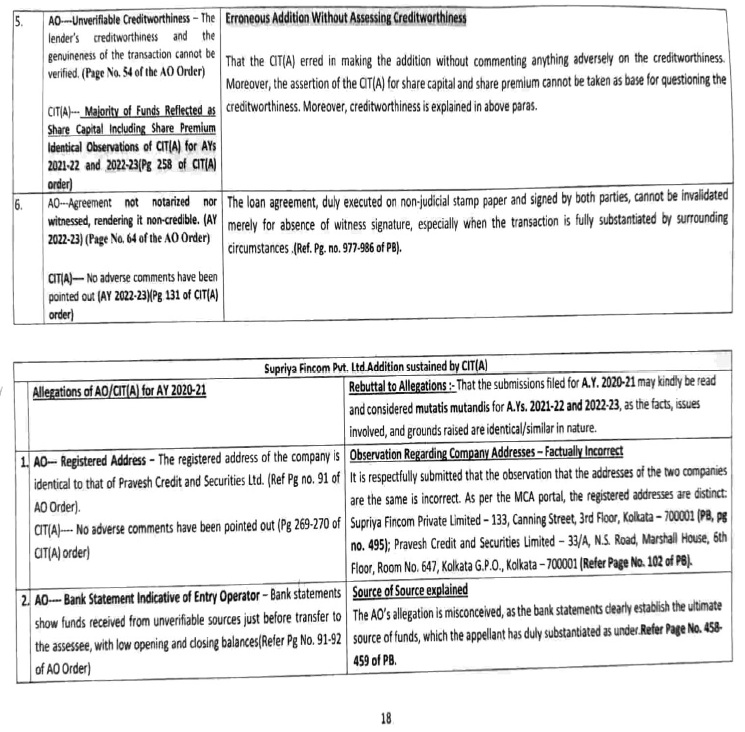
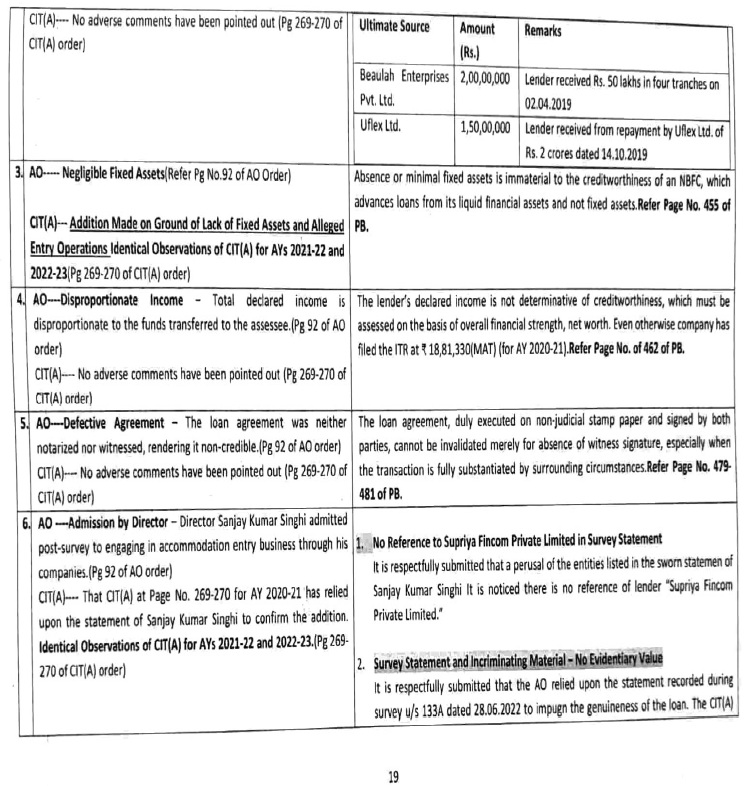
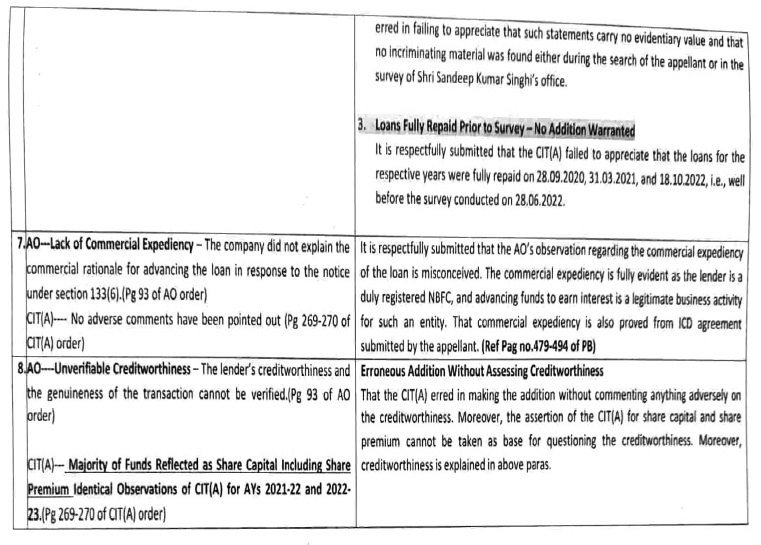
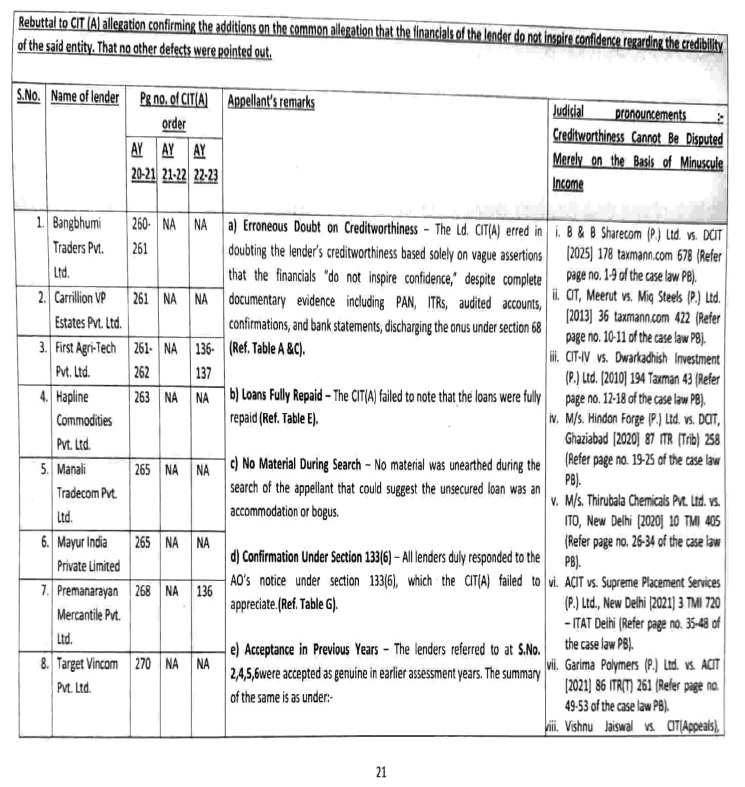
33. Ld.AR stated that the assessee has discharged the burden casted upon it of proving the identity and creditworthiness of the lenders and further established the genuineness of transactions and therefore, in absence of any incriminating material found / seized as a result of search from the business premises of the assessee company or during the course of survey carried out at the business premises of some of the lenders companies which established the loans taken by the assessee was not genuine, no additions could be made u/s 68 of the Act. Ld. AR further submits that since all the loans were repaid and therefore, the main allegation of the revenue that they are the accommodation entries itself demolished considering the fact that if assessee had taken accommodation entries, there was no reason to repay the same within the year itself or in subsequent years. The accommodation entries are in the nature of the credits which have been taken by providing cash of the same amount to the respective lenders with the understanding that such entry would not be squared off or returned or even if it has to be squared off, the same will happen after an long period and not within few months or short period of one year. Therefore, the ld. AR submits that all the unsecured loans taken by the assessee are genuine loans and the additions made by AO without providing an opportunity to cross-examine the directors whose statements were relied upon by the AO for treating the loans as accommodation entries and further without providing their complete statements and the material based on which lower authorities have reached to the conclusion that the loans of accommodation entries could not be utilized against the assessee. Ld.AR submits that an opportunity of cross-examination of such witnesses of the revenue should be allowed to the assessee which has not been allowed by the AO despite of the fact that the assessee has filed complete details. Further, in the statements relied upon of Shri Sandeep Singh in respect to the loans taken from M/s. Radha Fincom Ltd. and Parvesh Credit and Securities Ltd., Shri Sandeep Singhi clearly stated that he was not the Director of the said company during the period when the loans were taken by the assessee and therefore, such statements has no relevance and cannot be relied upon. Ld. AR further submits that in case where the AO observed that notice was issued u/s 133(6) of the Act and was returned unserved however, all the relevant details of such parties were duly filed containing bank statements, financial statements etc. to establish their present whereabouts. However, without making any further inquiries solely based on the fact that notices issued u/s 133(6) of the Act were returned unserved, the AO alleged that these parties were not in existence and the loans taken by the assessee are mere accommodation entries and made the addition. Under these circumstances, ld.AR humbly prayed that the entire addition made by the AO and sustained by ld. CIT(A) be deleted.
34. On the other hand, ld. CIT DR for the Revenue vehemently supported the orders of the lower authorities and submits that the AO has made every possible inquiry in order to examine the genuineness of the transactions and creditworthiness of the lenders. He placed reliance on the chart given by the AO at pages 53 to 101 of the assessment order wherein AO discussed each and every loan creditor and further referred the outcome of the inquiries conducted by issuing summons u/s 133(6) of the Act or by examining their financial statements stated to have been filed by the assessee. Ld. CIT DR for the Revenue drew our attention to the observations of AO wherein AO stated that he has not only examined their financials and further observed that they do not have the capacity to advance loan or there was no commercial expediency in advancements of loans to the assessee company. Ld. CIT DR further submits that the assessee argued that loans were repaid however, for the purpose of examination of loans u/s 68 of the Act what is to be seen is the creditworthiness of the lender at the time of granting loan and nothing to do with the repayment of the loan. Nowhere in the Act, it is provided that if the loan taken is repaid, no addition could be made u/s 68 of the Act. He therefore, prayed that the additions made by AO, be restored. With respect to the deletion made by ld. CIT(A), he supported the orders of AO and submits that ld. CIT(A) has wrongly deleted the additions by placing reliance on the material which has already examined by the AO for holding the said loan creditor as accommodation entries. He, therefore, requested that the addition to such extent be confirmed.
35. On merits of the additions, ld.AR submits that during the course of assessment proceedings as well as appellate proceedings, assessee has duly established the fact that all the loans taken were duly supported by the loan agreements, identity and creditworthiness of the lenders and genuineness of the transactions was fully established as provided u/s 68 of the Act. In support, the ld. AR drew our attention of the chart submitted in the written submissions filed containing details of documents filed and the inquiries conducted by the AO and the replies filed. Ld.AR submits that in order to establish the identity of the creditors, assessee has filed the NBFCs registration (wherever applicable), copy of the MCA records, loan agreements alongwith promissory notes and post-dated cheques, form 16A issued and GST registration (wherever application). All these documents were filed before the lower authorities and are placed in the Paper Books filed before us. Regarding the genuineness of the transactions and creditworthiness of the lenders, ld. AR drew our attention to the chart given in page 6 & 7 of the written submissions containing the financials of each and every lender company and further referred their bank statements, ITRs so as to establish that the funds were available in their bank accounts when the funds were transferred to the assessee company and all the lenders had sufficient net worth to advance the loans to the assessee company. It is further submitted that the loans were raised through banking channel therefore, genuineness cannot be doubted. Ld.AR submits that loans were repaid in the year under appeal or during subsequent period and necessary details have already been filed with respect to such repayment and therefore, no addition should be made by holding that the loans has taken accommodation entries of unsecured loans.
36. Heard the contentions of both the parties at length and perused the material on record. The facts leading to this issue as described by ld. CIT(A) in its order are as under:-
4. “As per the AO, the assessment proceedings for Assessment Year 2020-21 were completed under section 143(3) read with section 144C(3) of the Income-tax Act, 1961, since the assessee did not file any objections before the Dispute Resolution Panel against the Draft Assessment Order dated 26.03.2024, and therefore the draft order became final and binding under the provisions of law. The AO stated that the case of the assessee was initially selected for scrutiny through Computer Assisted Scrutiny Selection (CASS) on account of transfer pricing risk parameters, and accordingly a reference was made to the Transfer Pricing Officer under section 92CA of the Act, whose findings were taken on record during the assessment proceedings. The AO mentioned that subsequently a search and seizure operation under section 132(1) of the Act was conducted on 21.02.2023 in the cases of Uflex Group concerns, including the assessee company, during which, as per AO, several incriminating materials, statements and evidences were gathered.
As per the AO, the assessee had filed its return of income declaring total income of 101.55 crore, which included business income and income from other sources, after claiming deductions under Chapter VIA, including a deduction under section 80-1B (Jammu Unit), and the correctness of these claims was examined in the light of search findings and post-search investigations.
The AO stated that during the search and post-search enquiries, it was noticed that the assessee had accepted unsecured loans amounting to 74 crore from as many as 38 entities, most of which were based in Kolkata, and these entities were prima facie found to be paper companies having no real business activities or financial strength.
The AO mentioned that it was revealed that the lender companies did not have adequate income, assets, employees, or genuine business operations, and their financial statements mainly reflected paper transactions such as interest income or routing of funds, thereby raising serious doubts about their creditworthiness.
As per the AO, as per page no. 33 of the assessment order, notices under section 142(1) were issued to the assessee calling for complete details regarding the unsecured loans, including loan agreements, bank statements, income-tax returns of lenders, purpose of loans and evidence of business expediency, however the assessee failed to furnish complete and satisfactory replies despite being granted multiple opportunities.
The AO stated that independent third-party enquiries were also conducted by issuing notices under section 133(6) of the Act to the lender entities, seeking confirmation of transactions, financial details, bank statements and proof of business activities, but in many cases, as per AO, either no replies were received or the replies were incomplete and non-substantive.
The AO mentioned that several notices sent to the lenders were returned unserved by the postal authorities with remarks such as “no such company”, “address not found” or “left without instructions”, which clearly established that these entities were non-existent at their registered addresses and were merely paper companies.
As per the AO, statements recorded under oath during other search and survey proceedings of entry operators such as Shri Ashish Begwani, Shri Vikas Kumar Agrawal, Shri Ramesh Poddar and Shri Sandeep Kumar Singhi show that they were engaged in the business of providing accommodation entries in the form of bogus unsecured loans in exchange for cash and commission.
The AO stated that these entry operators specifically admitted that funds routed through shell companies were used to provide unsecured loans to beneficiaries, including group concerns of the assessee, and that the so-called loans were nothing but a method to convert unaccounted cash into accounted money.
The AO mentioned that it was further established that certain lender entities such as Radha Fincom Limited and Pravesh Credit and Securities Limited were directly controlled by entry operators who had confessed to providing accommodation entries, and therefore the loans received from such entities were clearly bogus.
As per the AO, the assessee was confronted with the findings gathered during investigation through show cause notices, but the replies filed by the assessee were found to be general in nature, unsupported by credible documentary evidence, and failed to rebut the strong material brought on record by the department.
The AO stated that the assessee could not establish the three essential ingredients required under section 68 of the Act, namely the identity of the creditors, their creditworthiness, and the genuineness of the transactions, and merely filing basic documents without proving the real source of funds was held to be insufficient.
The AO mentioned that the conduct of the assessee in accepting large unsecured loans from dubious Kolkata-based entities, despite being a reputed and financially strong company capable of obtaining finance from recognized institutions, further strengthened the inference that the transactions were not genuine.
As per the AO, considering the totality of facts, including search findings, sworn statements of entry operators, failure of lenders to respond, non-existence of companies at registered addresses, and inadequate explanations offered by the assessee, the unsecured loans amounting to Rs. 34.75 crores received during the year were treated as unexplained cash credits under section 68 of the Act and were added to the income of the assessee. Further, as per AO, as usual practice, a commission @1-2% was paid on booking these accommodation entries in the form of unsecured loans. Therefore, as per AO, the expenses incurred by the assessee to make commission payment was estimated @2% which amounts to Rs. 69.50 lacs which were covered within the ambit of Section 69C of the Act as unexplained expenses and also added the same to the total income of the assessee.”
37. Before going further, we first refer to the provision of section 68 of the Act.
Cash credits.
68. Where any sum is found credited in the books of an assessee maintained for any previous year, and the assessee offers no explanation about the nature and source thereof or the explanation offered by him is not, in the opinion of the Assessing Officer, satisfactory, the sum so credited may be charged to income-tax as the income of the assessee of that previous year :
Provided that where the sum so credited consists of loan or borrowing or any such amount, by whatever name called, any explanation offered by such assessee shall be deemed to be not satisfactory, unless,—
(a) the person in whose name such credit is recorded in the books of such assessee also offers an explanation about the nature and source of such sum so credited; and
(b) such explanation in the opinion of the Assessing Officer aforesaid has been found to be satisfactory:
Provided further that where the assessee is a company (not being a company in which the public are substantially interested), and the sum so credited consists of share application money, share capital, share premium or any such amount by whatever name called, any explanation offered by such assessee-company shall be deemed to be not satisfactory, unless—
(a) the person, being a resident in whose name such credit is recorded in the books of such company also offers an explanation about the nature and source of such sum so credited; and
(b) such explanation in the opinion of the Assessing Officer aforesaid has been found to be satisfactory:
Provided also that nothing contained in the first proviso or second proviso shall apply if the person, in whose name the sum referred to therein is recorded, is a venture capital fund or a venture capital company as referred to in clause (23FB) of section 10.”
38. A bare reading of Section 68 suggests that there has to be credit of amounts in the books maintained by an assessee; such credit has to be of a sum during the previous year; and the assessee offer no explanation about the nature and source of such credit found in the books; or the explanation offered by the assessee in the opinion of the Assessing Officer is not satisfactory, it is only then the sum so credited may be charged to income-tax as the income of the assessee of that previous year. The expression “the assessee offer no explanation” means where the assessee offer no proper, reasonable and acceptable explanation as regards the sums found credited in the books maintained by the assessee. It is true that the opinion of the Assessing Officer for not accepting the explanation offered by the assessee as not satisfactory is required to be based on proper appreciation of material and other attending circumstances available on record. The opinion of the Assessing Officer is required to be formed objectively with reference to the material available on record. Application of mind is the sine qua non for forming the opinion.
39. As observed above, the AO has verified treated the unsecured loans taken in AY 2020-21 from 27 companies/lenders totaling to INR 34.75 crores out of which addition of INR 15.50 crores was sustained by ld. CIT(A) and balance was deleted. The claim of the assessee was that all the documentary evidences establishing the identity and the creditworthiness of the lenders and genuineness of the transactions were filed before the lower authorities. The lender companies are either the NBFCs having valid RBI license or are the corporate entities for which their MCA data were submitted alongwith their PAN, ITRs, Certificate of incorporation and audited financial statements. All the loans were received through banking channels and the lender companies have sufficient funds in their accounts as and when funds were transferred to the assessee which is evident from their bank accounts filed. It is further stated that the interest paid on such loan have not been doubted and the same was allowed as regular business expenditure. The assessee further claimed that in case of M/s Radha Fincom Ltd. and M/s Parvesh Credit and Securities Ltd., the AO placed heavy reliance on the statements of one Shri Sandeep Singhi who was Director of these companies in 2016 and not in the year under appeal and therefore, his statements cannot be made sole basis to hold that the loans taken from these two companies were accommodation entry. Moreover, no opportunity was provided to the assessee to crossexamine Shri Sandeep Singhi though he was the witness of the department and as stated above, his statements were made the basis for holding the loans taken from M/s Radha Fincom Ltd. and M/s Parvesh Credit and Securities Ltd. as accommodation entry. It was further claimed by the assessee that the notice issued u/s 133(6) of the Act were duly complied with by many of the lender companies. Once the transactions were carried out through banking channel and all the plausible evidences were filed thus, without bringing on record the contrary material nor linking the loans taken with the incriminating material, if any, found and seized during the course of search, it cannot be said that the lenders were not in existence or loan taken from them are mere accommodation entries.
40. With respect to the commercial expediency, claim of the assessee is that for the purpose of section 68 of the Act, three basic conditions are to be satisfied i.e. identity, creditworthiness and genuineness of the transactions and it has nothing with do with the commercial expediency. It is the assessee who has to decide as to when and how much funds are required for smooth running of business and therefore, Revenue cannot direct any assessee to borrow funds irrespective of the requirements of business or otherwise.
41. With this background, we proceed to first consider those lenders, loans taken from whom were treated as accommodation entries and additions made by the AO were sustained by ld. CIT(A) in all the three assessment years.
M/s. Radha Fincom Ltd. and Parvesh Credit and Securities Ltd.
42. The allegations of the AO were that this company has no fixed assets and address given is not matched with the registered office address. The reply filed in response to notice issued u/s 133(6) of the Act, the commercial expediency for advancement of the loan to the assessee was not explained and the loan agreement submitted was neither notarized nor having signature of witnesses. Further its Director, Shri Sanjay Singhi in the statements recorded during post survey proceedings admitted that this company was involved in providing accommodation entries. Therefore, AO was of the opinion that neither the creditworthiness of the lender is proved nor genuineness of the transactions is found verifiable. Ld. CIT(A) confirmed the addition by observing that though the company is having share capital and Reserves of INR 90.00 crores and having profits of INR 20.00 Lakhs on the gross revenue of INR 83.35 crores however, it appears that its entire funds are in the shape of premium and further when its Director had admitted the fact that the company was involved in providing accommodation entries therefore, he confirmed the additions of INR 4.00 crores towards loan taken from the said company. Similarly, in the case of M/s. Radha Fincom Limited from whom loan of INR 1.00 crores was received, the addition was sustained by making similar observations by the ld. CIT(A).
43. It is observed that to prove the identity of both the companies, assessee has filed their ITRs & NBFC registration Certificate issued by RBI which are placed at pages 55 to 57, 63, 115, 107 to 109 of the Paper Book. Further, both the lender companies had filed replies in response to notice issued u/s 133(6) of the Act. The assessee also filed copy of the MCA records, loans Agreements and Form No.16A for both the companies. From the perusal of the financial statements, it is observed that M/s. Parvesh Credit & Securities Ltd. has Share Capital including Reserves and Surplus of INR 91.97 crores and having total turnover of INR 8.39 crores and not of INR 83.85 crores as observed by ld. CIT(A). The assessee has further demonstrated from the copy of their bank statements that sufficient funds were available with them to advance loans to the assessee. It is further observed that loans taken were repaid in subsequent Assessment years and the date of repayment were incidentally be fallen much prior to the date of survey in their own cases and search in the case of the assessee. Further, confirmations were filed and reliance was placed solely on the statements of Director, Shri Sandeep Singhi that the company was engaged in providing accommodation entries. The assessee filed the necessary evidences placed at page 102 to 104 in support of the claim that Shri Sanjay Singhi was ceased to hold the office of the Director w.e.f. 16.11.2016 whereas the loans were received from both the lender companies in FY 2019-20 i.e. after the expiry of 03 years from the date of cessation of Shri Sandeep Singhi from the post of Director. It is further observed that despite of the repeated requests, no opportunity for cross-examination was provided to the assessee nor complete statements of Shri Sandeep Singhi were supplied to the assessee company.
44. When the source was proved of loans received from both the companies, and once the assessee has discharged the burden casted upon it of proving the identity, creditworthiness of the lenders by filing their assessment particulars, MCA data etc. and their financial statements were filed, it cannot be held that the loans taken were not genuine. Moreover, it is also a matter of fact that loans were repaid before the survey carried out in their cases by the Department. The statements relied upon was of the persons who was having no authority to make any comment on behalf of the lender companies as he was not connected in any manner when the funds were advanced to the assessee thus such statements cannot be relied upon, more particularly, as observed above, when such statements have not been supplied to the assessee nor any opportunity to cross-examine was allowed though the person was the witnesses of the department and such statements were made the sole basis for alleging the loans taken as accommodation entries. Considering the entirety of the facts and further keeping in mind that loans have been repaid, we find no reason to hold the loans taken as accommodation entries, in absence of any contrary material, accordingly, the addition made towards the loans taken from these two companies are deleted.
45. The Ld. CIT(A) has further sustained the loans taken form the following lender companies:
| Name of Lender Company |
Amount (INR) |
| Bangbhumi Traders Pvt. Ltd. |
1,00,00,000 |
| Carrillion VP Estates Pvt. Ltd. |
1,00,00,000 |
| First Agri-Tech Pvt. Ltd. |
1,00,00,000 |
| Hapline Commodities Pvt. Ltd. |
1,50,00,000 |
| Manali Tradecom Pvt.Ltd. |
50,00,000 |
| Mayur India Pvt. Ltd. |
50,00,000 |
| Premanarayan Mercantile Pvt. Ltd. |
1,00,00,000 |
| Supriya Fincom Pvt. Ltd. |
3,50,00,000 |
| Target Vincom Pvt. Ltd. |
50,00,000 |
46. With respect to all these companies, assessee has filed every plausible evidence / details to establish the identity comprising of its ITRs, MCA records, loans Agreements, Form No.16A, to prove the genuineness of the transactions, bank statements of the assessee as well as of the lender companies and to establish the creditworthiness, their financial records were submitted. All these evidences so filed are placed in Paper Book and is tabulated by the assessee in its written submissions which is reproduced herein above.
47. Further from the perusal of Table (c) reproduced herein above, it is observed that all the companies having sufficient net worth to advance the loans to the assessee and most of the companies have filed replies in response to the notices issued u/s 133(6) of the Act. It is further observed that in none of the case, contrary statements of any person were available nor their names were ever appearing in the so-called statements of any of the entry operators available with the department. It is also a matter of fact that the loans taken have been repaid prior to the commencement of search in the case of the assessee. The additions were sustained by ld. CIT(A) for the reason that the commercial expediency has not been established. As observed above, as per section 68 of the Act, assessee has to prove the identity and creditworthiness of the lenders and genuineness of the transactions. Section 68 of the Act does not cast any burden upon the assessee to prove the commercial expediency of loan transaction. It is settled law that the commercial expediency has to be judged by the parties to the transactions and the AO cannot walk into the shoe of businessman to examine the commercial expediency of loan transactions. It rests upon the lender entity to examine the purpose for which the funds were utilized so as to ensure that loan funds would be applied in the manner, it remained safe and be repaid as per agreed terms.
48. It is also relevant to state that the “source of source” could not be questioned in the instant year as the amendment was made in section 68 enabling the AO to examine the “source of source” of the unsecured loan w.e.f. 01.04.2022 and applicable from AY 2023-24 and onwards.
49. Once the assessee has successfully discharged the burden casted upon it of proving the identity and creditworthiness of lender parties by filing their all relevant details and the allegations made by the AO were rebutted, the loans taken in the regular course of business duly supported by the necessary loan agreements and were repaid cannot be doubted. It is also observed that the AO has already allowed the interest paid on such loans as genuine. Under these circumstances we find no error in the order of ld. CIT(A) in deleting the additions made towards the loans taken from these companies.
50. Now coming to the Revenue’s appeal for deletion of the additions of INR 19.75 crores made out of the unsecured loans taken from following companies made by the AO by holding that the assessee has failed to establish the creditworthiness of the lenders and genuineness of transactions and further has not proved the Commercial expediency however, the same were deleted by ld. CIT(A). These companies are tabulated as under:-
| Name of Lender Company |
Amount (INR) |
| Pioneer Iron & Steel Corporation Ltd. |
50,00,000 |
| Shree Sudarshan Casting Pvt. Ltd. |
1,00,00,000 |
| Anjula Steels Pvt. Ltd. |
1,00,00,000 |
| APM Finvest Ltd. |
7,00,00,000 |
| Greencresh Financial Services Ltd. |
1,00,00,000 |
| GSR Tradefin Pvt. Ltd. |
75,00,000 |
| Kamalpur Finance Ltd. |
50,00,000 |
| Maharaj Ji Agro Products Pvt. Ltd. |
2,75,00,000 |
| Neelam Securities Marketing Pvt. Ltd. |
50,00,000 |
| Paritosh Electricals Pvt. Ltd. |
25,00,000 |
| Perfect Business Advisory Services Pvt. Ltd. |
1,00,00,000 |
| Prachur Traders Pvt. Ltd. |
50,00,000 |
| Ricon Traders Pvt. Ltd. |
50,00,000 |
| Shyamnagar Packaging Works Pvt. Ltd. |
1,00,00,000 |
| Unity Merchandise Pvt. Ltd. |
50,00,000 |
| Zigma Electricals Pvt. Ltd. |
50,00,000 |
51. From the perusal of the order of ld. CIT(A), it is observed that ld. CIT(A) has deleted the additions appreciating the fact that these companies are not appearing in any of the statements of entry operator relied upon by the AO. Further, they all have submitted replies in response to the notices issued u/s 133(6) of the Act which are placed in the Paper Book. From the perusal of Table D reproduced herein above forming part of the written submission, it is observed that all these companies are having sufficient net worth to advance loans to the assessee which facts has been discussed elaborately by ld. CIT(A). All these companies are having regular business activities and positive income was declared in their ITRs filed. The loans were repaid during the year or in subsequent AYs but prior to the survey/search carried out by the Revenue. It is further observed that no incriminating material was found and seize, suggesting any cash payment against the loans so taken. Once the assessee has discharged the burden casted upon it u/s 68 of the Act of proving the identity and creditworthiness of the lenders and genuineness of the transactions is also established, we find no infirmity in the order of ld. CIT(A). For the sake of convenience, the observations made by ld. CIT(A) while deleting the additions loans of INR 7.00 crores taken from these companies is reproduced herein below:-
“The submissions of the appellant reveals that the said entity is not named in any of the statements of the entry operators relied upon by the AO in the assessment order. The AO has also not made any specific allegation in his observations in the assessment order with respect to naming of the said company in the statements of the entry operators. The AO has made specific observations about receipt of reply to notice u/s 133(6) but has stated that the commercial expediency of the loan has not been explained. The AO has stated that there are rapid credits debits from the bank account of the lender company and there is some operational revenue of Rs. 1.69 crores. The AO has further stated that the ITR of the said entity has been filed at Rs. 1.77 crores. Moreover, the ITR, confirmation, bank account statement, loan agreement, audited balance sheet have been filed before the AO in support of the genuineness and creditworthiness of the transaction. Apart from this, the lender has share capital of Rs. 4.32 crores, the lender has reserves & surplus of Rs. 6.65 crores. Further, the lender has short term borrowings of Rs. 10.45 crores, non-current investment of Rs. 59.43 crores, revenue from operations of Rs. 1.69 crores and various expenses under different heads claimed in the profit & loss account. It is further seen that the said loan has already been repaid during the year under consideration. It is further observed that to establish the creditworthiness and genuineness of the transactions, it is imperative that the audited financials of the lender are properly examined and observations regarding low returned income/rapid credits & debits/ value of fixed assets cannot be the sole basis of disregarding the creditworthiness of the lender. In absence of any adverse evidence with respect to identity, credibility and genuineness of the said lender and detailed observations regarding the sound financials of the lender as already discussed above, the addition made by the AO is deleted.”
52. Likewise in the case of Maharaj Ji Agro Products Pvt. Ltd. from whom unsecured loan of INR 2.75 crore was received, while deleting the addition, the ld. CIT(A) has made following observations:-
“The submissions of the appellant reveals that the said entity is not named in any of the statements of the entry operators relied upon by the AO in the assessment order. The AO has also not made any specific allegation in his observations in the assessment order with respect to naming of the said company in the statements of the entry operators. The AO has made specific observations about receipt of reply to notice u/s 133(6) but has stated that the commercial expediency of the loan has not been explained. The AO has further stated that notice u/s 133(6) could not be delivered to the said entity which is in-contradiction to the above observations of the AO at page 75 of the assessment order. The appellant has also submitted that the lender had filed reply in physical form in response to notice u/s 133(6) dated 26.02.2024. The copy of the reply has also been filed during the appeal proceedings. The AO has stated that the lender has shown income of Rs. 12.44 lacs. Moreover, the ITR, confirmation, bank account statement, loan agreement, audited balance sheet have been filed before the AO in support of the genuineness and creditworthiness of the transaction. Apart from this, the lender has shareholder’s funds of Rs. 2.58 crores, long term liabilities of Rs. 1.88 crores, short term borrowings of Rs. 3.74 crores, outstanding creditors of Rs. 1.03 crores, tangible assets of Rs. 3 crores, inventories of Rs. 1.03 crores, trade receivables of Rs. 1.86 crores, revenue from operations exceeding Rs. 21 crores and various expenses under different heads claimed in the profit & loss account. It is further seen that the said loan has already been repaid in the near future. It is further observed that non-notarization of agreement cannot be considered as a condition which requires prior satisfaction of rigors of Section 68. It is further observed that to establish the creditworthiness and genuineness of the transactions, it is imperative that the audited financials of the lender are properly examined and observations regarding low returned income/rapid credits & debits/value of fixed assets cannot be the sole basis of disregarding the creditworthiness of the lender. In absence of any adverse evidence with respect to identity, credibility and genuineness of the said lender and detailed observations regarding the sound financials of the lender as already discussed above, the addition made by the AO is deleted.”
53. Similarly in the case of Shree Sudarshan Castings Pvt Ltd. from whom loan of INR 1.00 crores was taken, ld. CIT(A) has made the following observations while deleting the additions:-
“The submissions of the appellant reveals that the said entity is not named in any of the statements of the entry operators relied upon by the AO in the assessment order. The AO has also not made any specific allegation in his observations in the assessment order with respect to naming of the said company in the statements of the entry operators. It is further observed that the appellant has submitted that reply to the notice u/s 133(6) was duly submitted on e-portal of the AO by the said lender and copy of the reply has also been submitted as filed before the AO. It is further seen that the AO in the assessment order on page 57 has stated that commercial expediency has not been explained by the company in its reply in response to notice u/s 133(6) and on the same page, the AO has stated that the notice issued u/s 133(6) was returned undelivered making the observations of the AO as self-contradictory. Further, the observation of the AO that the directors of the company did not file ITR for the year under consideration is inconsequential as the credibility of the lender entity is under question and not the directors of the said entity. The AO has stated that the said entity has declared Rs. 17.23 lacs as income and the fixed assets are of very meager value. Perusal of the financials of the said entity reveals that a sum of Rs. 1 crore has been received from the said concern. Moreover, the ITR, confirmation, bank account statement, loan agreement, audited balance sheet have been filed before the AO in support of the genuineness and creditworthiness of the transaction. Apart from this, the lender has share capital of Rs. 7.02 crores, the lender has reserves & surplus of Rs. 40.05 crores. Further, the lender has inventories of Rs. 7.56 crores and trade receivables amounting to Rs. 4.03 crores. The entity has revenue from operations of Rs. 6.73 crores, purchases of Rs. 3.53 crores and various expenses under different heads claimed in the profit & loss account. Moreover, the said entity has other current liabilities of Rs. 19.38 crores. It is further seen that the said loan has already been repaid during the year under consideration. It is further observed that to establish the creditworthiness and genuineness of the transactions, it is imperative that the audited financials of the lender are properly examined and observations regarding low returned income/rapid credits & debits/value of fixed assets cannot be the sole basis of disregarding the creditworthiness of the lender. In absence of any adverse evidence with respect to identity, credibility and genuineness of the said lender and detailed observations regarding the sound financials of the lender as already discussed above, the addition made by the AO is deleted.”
54. After considering the entire discussion, as made herein above, the details filed by the assessee can be summarized as under:
A . To prove the Identity of the Lender companies: Assessee has filed the following documents
| • |
|
Copy of Permanent Account Number (PAN) of each lender company; |
| • |
|
NBFC certificate of the lender companies wherever applicable; |
| • |
|
Company Master Data as available on the Ministry of Corporate Affairs (MCA) portal. |
| • |
|
Copy of their PAN card and ITR acknowledgements |
| • |
|
Copy of GST registration wherever available; |
B . To prove the Genuineness of the Transactions, following documents were submitted:
| • |
|
Bank statements showing the receipt of loan amounts through normal banking channels; |
| • |
|
Copies of the loan agreements and promissory notes wherever available; |
| • |
|
Signed confirmations of account from each lender; |
| • |
|
Details and evidence of repayments, where applicable; |
| • |
|
Ledger accounts of lenders maintained in the books of the assessee; |
| • |
|
Interest payment records with TDS deduction, including Form 26AS. |
C. To prove the Creditworthiness of the Lender companies, following documents were filed:
| • |
|
Audited financial statements of all the lender companies for the relevant financial years; |
| • |
|
Acknowledged copies of Income Tax Returns of the lender companies; |
| • |
|
Bank statements reflecting adequate balances prior to the transfer of funds. |
55. By filing all the relevant details of the loan creditors before the AO as listed above, assessee has discharged the onus lies upon it. It is also a matter of fact that the AO has failed to point out any defects in the same and made general observations more particularly harped upon the justification for commercial expediency. Therefore, there is nothing left on the part of the assessee to prove further. It is also a matter of fact that in many cases notices issued u/s 133(6) of the Act were duly replied as could be seen from the chart reproduced herein above.
56. Hon’ble Supreme Court of India in case of
CIT v.
Lovely Exports (P.) Ltd. [2008] 216 CTR 195 (SC) held:
“2. Can the amount of share money be regarded as undisclosed income under section 68 of IT Act, 1961?. We find no merit in this Special Leave Petition for the simple reason that if the share application money is received by the assessee company from alleged bogus shareholders, whose names are given to the AO, then the Department is free to proceed to reopen their individual assessments in accordance with law. Hence, we find no infirmity with the impugned judgment.”
57. The Hon’ble Allahabad High Court in the case of Pr. CIT v. Anshika Consultants (P.) Ltd. (Allahabad) held as under:-
“INCOME TAX : Where assessee had received unsecured interest bearing loans from three corporate entities and had furnished necessary acknowledgement of return, balance sheet, profit and loss account, etc., to prove identity, creditworthiness and genuineness of transaction of unsecured loan taken by it, addition under section 68 was not warranted.”
58. Similarly in the case of Dy. CIT v. Paswara Papers Ltd. (Allahabad) , the Hon’ble Court has held as under:
“INCOME TAX : Where assessee received loan from various creditors who sold their old jewellery and gave loan to assessee out of sale consideration, since assessee had disclosed name of jewellers to whom jewellery was sold and also established mode of payment through banking channel, and moreover existence of deposits made to assessee by creditors was not in dispute, impugned addition under section 68 with respect to loan could not be sustained.”
59. The Hon’ble Jurisdictional High Court in the case of CIT v. Kamdhenu Steel & Alloys Ltd. [2014] 361 ITR 220 (Delhi) has held as under:
28. “The contention of the assessee has been found to be convincing by the Tribunal and the learned Tribunal has allowed the appeal thereby deleting the addition. The Revenue is in appeal before us. The entire case of the Revenue based on the plea that as per the report, the investing companies were not found at the given addresses and on this basis, argument is raised that the companies are non-existing and the transactions were bogus and not genuine. Here, the case of the Revenue is even weaker than the cases discussed above. It is not even the case that the Directorate of Income Tax (Investigation) has found Mr. Mahesh Garg in such racket of floating bogus companies. We state at the cost of repetition that after the assessee had furnished the evidence, initial onus had been discharged and it was for the AO to make further necessary inquiries which are completely missing.
29. We are, thus, of the view that no question of law much less substantial question of law arises. This appeal is dismissed.”
60. The SLP filed by the revenue against the aforesaid of hon’ble Delhi High Court was dismissed by the Hon’ble Supreme Court in SLP (CC) no. 15640 of 2012.
61. The Hon’ble Jurisdictional High Court in the case of
Pr. CIT v.
Laxman Industrial Resources Ltd. [2017] 397 ITR 106 (
Delhi) has held as under:
“This Court notices that the assessee had provided several documents that could have showed light into whether truly the transactions were genuine. It was not a case where the share applicants are merely provided confirmation letters. They had provided their particulars, PAN details, assessment particulars, mode of payment for share application money, i.e. through banks, bank statements, cheque numbers in question, copies of minutes of resolutions authorizing the applications, copies of balance sheets, profit and loss accounts for the year under consideration and even bank statements showing the source of payments made by the companies to the assessee as well as their master debt with ROC particulars. The AO strangely failed to conduct any scrutiny of documents and rested content by placing reliance merely on a report of the Investigation Wing. This reveals spectacular disregard to an AO’s duties in the remand proceedings which the Revenue seeks to inflict upon the assessee in this case. No substantial question of law arises. The appeal is dismissed.”
62. On the issue of discharging the onus, the Hon’ble
Delhi High Court in the case of
Mod Creations (P.) Ltd. v.
ITO [2011] [2013] 354 ITR 282 (
Delhi) , held as under:
“It will have to be kept in mind that Section 68 of the I.T. Act only sets up a presumption against the Assessee whenever unexplained credits are found in the books of accounts of the Assessee. It cannot but be gainsaid that the presumption is rebuttable. In refuting the presumption raised, the initial burden is on the Assessee. This burden, which is placed on the Assessee, shifts as soon as the Assessee establishes the authenticity of transactions as executed between the Assessee and its creditors. It is no part of the Assessee’s burden to prove either the genuineness of the transactions executed between the creditors and the sub-creditors nor is it the burden of the Assessee to prove the creditworthiness of the sub-creditors.”
63. It was further observed by the Hon’ble Court as under:
14. “With this material on record in our view as far as the Assessee was concerned, it had discharged initial onus placed on it. In the event the revenue still had a doubt with regard to the genuineness of the transactions in issue, or as regards the creditworthiness of the creditors, it would have had to discharge the onus which had shifted on to it. A bald assertion by the ASSESSING OFFICER that the credits were a circular route adopted by the Assessee to plough back its own undisclosed income into its accounts, can be of no avail. The revenue was required to prove this allegation. An allegation by itself which is based on assumption will not pass muster in law. The revenue would be required to bridge the gap between the suspicions and proof in order to bring home this allegation. The ITAT, in our view, without adverting to the aforementioned principle laid stress on the fact that despite opportunities, the Assessee and/or the creditors had not proved the genuineness of the transaction. Based on this the ITAT construed the intentions of the Assessee as being mala Ride. In our view the ITAT ought to have analyzed the material rather than be burdened by the fact that some of the creditors had chosen not to make a personal appearance before the A.O. If the A.0. had any doubt about the material placed on record, which was largely bank statements or the creditors and their income tax returns, it could gather the necessary information from the sources to which the said information was attributable to. No such exercise had been conducted by the A.O. In any event what both the A.O. and the ITAT lost track of was that it was dealing with the assessment of the company, i.e., the recipient of the loan and not that its directors and shareholders or that of the sub-creditors. If it had any doubts with regard to their credit worthiness, the revenue could always bring it to tax in the hands of the creditors and/or sub-creditors. [See CIT v. Divine Leasing & Finance Etd (20092-229-178.268 (Delhi) and CIT v. Lovely Exports (P.) Ltd. 2006) 215 CTR 495 (SC).*”
64. The Hon’ble Delhi High Court in the case of CIT v. Vrindavan Farms Pvt. Ltd. etc. in ITA. No.71 of 2015 dated 12th August, 2015 held as under :
“The sole basis for the Revenue to doubt their creditworthiness was the low income as reflected in their return of income. lt was observed by the ITAT that the Assessing Officer had not undertaken any investigation of the veracity of the documents submitted by the assessee, the departmental appeal was dismissed by the Hon’ble High court.”
65. The Hon’ble Delhi High Court in the case of Pr. CIT v. Agson Global (P.) Ltd. 441 ITR 550 (Delhi) while allowing the appeal in favour of the assessee deleting the additions made u/s 68 of the Act has held as under :
“Section 68 of the Income-tax Act, 1961 – Cash credits (Share capital money) – Assessment years 2012-13 to 2017-18 – Assessee-company received share capital and share premium money from several investors – Assessing Officer made addition in respect of same on account of unaccounted income under section 68 on basis of recorded statement of managing director of assessee-company – Whether since assessee placed sufficient documentary evidence to establish that money which assessee had paid to investors was routed back to it in form of share capital/share premium and identity, creditworthiness and genuineness of investors was proved, there was no justification to make addition under section 68 – Held, yes [Paras 11.4, 11.5 and 14.4] [In favour of assessee]”
66. As observed above, all the loans taken were repaid in the year under appeal or in subsequent years and much prior to the search carried out in the case of assessee or survey in the case of lender companies and relevant copies of the ledger accounts evidencing the repayment are placed in the paper book and reference of the same is made in the chart reproduced herein above. It is a matter of record that no adverse inference was drawn by the revenue in the year of payment and thus question of getting accommodation entries in the guise of loan does not survive. The Hon’ble Gujarat High Court in the case of
Pr. CIT v.
Ojas Tarmake (P.) Ltd. [2023] (Gujarat) has observed as under:
“Where appellant showed unsecured loans received during relevant assessment year and AO made addition on ground that appellant failed to discharge onus of liability as laid down under section 68, since amount of loan received by appellant was returned to loan party during year itself and all transactions were carried out through banking channels, impugned addition was to be deleted.”
67. The Hon’ble Jurisdictional High Court in the case of Pr. CIT v. Jagmag Builders [IT Appeal No. 325 of 2024] has held as under:
2. “The issue itself pertains to additions under Sections 68 and 37 of the Income Tax Act, 1961 [‘Act’] which were made by the Assessing Officer [‘AO’] on account of unexplained unsecured loans and disallowance of interest expenses. We note that the Tribunal while affirming the conclusions which were arrived at by Commissioner of Income Tax (Appeals) has observed as follows:-
“6. From the evidences furnished by the assessee before the departmental authorities, it is established that the entire loan, which is subject matter of addition, as unexplained cash credit has been repaid either in the year under consideration or subsequent assessment years. The entire transaction relating to availing of and repayment of loan has been done through banking channel. All details relating to loan availed and repayments made have been furnished before the departmental authorities, the details of which have been produced at pages 24 to 29 of the order of learned First Appellate Authority. It is also a fact on record that assessee has furnished all supporting evidences not only to prove the identity of the lenders but even creditworthiness as well as genuineness of the transaction by furnishing their bank statements, income-tax return copy, confirmations etc. Thus, it is evident, assessee has discharged its onus of proving the identity and creditworthiness of the creditors as well as genuineness of the loan transactions. Therefore, in our considered opinion, learned First Appellate Authority was justified in deleting the addition of Rs.2,67,05,959 made under Section 68 of the Act. Since, the addition made under Section 68 of the Act has been deleted, as a natural corollary, the disallowance of interest paid on such loan also has to be deleted. Accordingly, we do so. Grounds are dismissed.”
68. Another major fact which has not been doubted by the AO is the interest payments made on the loans alleged as unexplained credits which was accepted as genuine expenditure. Once it is alleged that the principal loan is a bogus accommodation entry, the payment of interest on such loans should not be allowed as genuine expenditure. In the instant case, the AO has not only allowed the interest payment but also accepted the fact of TDS made on such interest payment as genuine and accepted the income declared by the assessee after claiming such interest as expenditure. This dual approach leads to belief that the AO has proceeded with preconceived notion of making addition of the loans as bogus without applying his mind to overall facts of the case and the relevant details submitted by the assessee.
69. In view of the above, in our considered opinion no addition could be made when the assessee has duly discharged the onus lied upon it of establishing the identity and creditworthiness of the lenders and genuineness of the loan transactions through every plausible evidence like confirmations of the lender companies, their Financial Statements, their Income tax records such as their ITR’s and PAN, bank statements and further evidences of repayment in subsequent years and RBI license etc. which were never revoked. Thus in view of above discussion and by respectfully following the judicial pronouncements as referred herein above of the hon’ble Supreme court and various high courts including the jurisdictional high court, the entire addition of INR 34.75 crores made by the AO towards unsecured loans treating the same as unexplained credit u/s 68 of the Act is hereby, deleted. Accordingly, the Grounds of appeal Nos. 6 to 9 raised by the assessee are allowed and Ground of appeal Nos. 1 & 2 raised by the Revenue are dismissed.
70. Ground of appeal No.10 of the assessee is with respect to the deletion of addition of INR 69.50 Lakhs made u/s 69C of the Act being alleged commission paid for obtaining the accommodation entries of unsecured loans held as unexplained which according to the assessee was not adjudicated by the ld. CIT(A).
71. Heard the contentions of both the parties at length and perused the material on record. The addition was made by holding that the assessee had paid commission @ 2% on the accommodation entries of unsecured loans of INR 34.75 crores for which separate addition u/s 68 of the Act was made by the AO. Since we have already, deleted the additions made u/s 68 of the Act towards unsecured loans, therefore, there is no question of any such payment of commission. Accordingly, we hereby, delete the addition. Ground of appeal No.10 raised by the assessee is hereby, allowed.
72. Ground of appeal No.11 raised by the assessee is with respect to the confirmation of addition of INR 7,04,621/- made u/s 14A of the Act r.w.s. 8D of the Rules.
73. Heard the contentions of both the parties at length and perused the material on record. The AO by observing that assessee is having exempt income to the tune of INR 62,12,900/- in the shape of dividend and no disallowance was made u/s 14A of the Act, has computed the disallowance by invoking Rule 8D(2)(ii) of the Income Tax Rules, 1962 (‘the Rules’) and computed the disallowance at INR 7,04,621/- being 1% of the average value of the investments. It was the claim of assessee that AO has not recorded the satisfaction as required u/s 14A(2) of the Act. Further reliance is placed on the judgement of Co-ordinate Bench in its own case for preceding AY 2016-17, where addition made u/s 14A was deleted as no satisfaction was recorded before making the addition. Further, the assessee claimed that it is having interest free funds of INR 2,25,959 Lakhs and the average investment made was of INR 70.40 crores therefore, it could be safely presumed that the investment was made out of the interest free funds available with the assessee. It is observed that ld. CIT(A) while confirming the addition, has observed that the AO has recorded the satisfaction and further, the disallowance has been made under sub-clause (2) of Rule 8D of the Rules and no further disallowance out of the interest payment was made.
74. Before us, the assessee has failed to controvert the findings given by ld. CIT(A) and merely relied upon the orders of the preceding AYs where no satisfaction was recorded. However, as observed above, in the instant case, satisfaction was recorded in the assessment order before invoking the provision of section 14A and therefore, we find no error in the order of ld. CIT(A) in confirming the addition made. Accordingly, Ground of appeal No.11 of the assessee is dismissed.
75. Ground of appeal No.12 of the assessee and Ground of appeal No.5 of the Revenue are with respect to the transfer pricing adjustment made by TPO on account of corporate guarantee fee of INR 6,78,72,478/- which is reduced by ld. CIT(A) to INR 6,73,911/-by reducing fee rate from 2.10% applied by the TPO to 0.50% by ld. CIT(A).
76. Briefly stated facts are that the appellant has extended corporate guarantee in favour of financial institutions on behalf of its AEs namely Flex Africa, Flex Egypt & Flex USA to avail credit facilities from foreign banks. The assessee has charged guarantee commission @ 0.40% on such corporate guarantee. It was the claim of the assessee that corporate guarantee issued by parent company cannot be equated with the bank guarantee provided by the commercial bank where the regulatory requirement involves capital, independent credit etc. The assessee further claimed that in the case of Flex Egypt & Flex USA, no fresh guarantee was given during the year under appeal and the guarantee was extended in preceding years and guarantee commission @ 0.40% was charged which stood accepted by AO/TPO and adjustment was made. As there was no change in the circumstances, the commission charged @0.40% by the assessee on such guarantee deserves to be upheld as a principal of consistency. With respect to the fresh guarantee given for fresh finances taken by its AE Flex Africa, it had benchmarked the guarantee commission by adopting “interest saving approach” according to which total benefit derived by AE on account of explicit support and credit enhancement provided by the parent company was computed and a substantial portion thereof i.e. 50% of such benefit which comes to 0.40% in the instant case was attributed as guarantee commission. The claim of the assessee was that ld. CIT(A) has deleted the addition made on account of corporate guarantee given to Flex Egypt and Flex USA however, ld. CIT(A) has reduced the guarantee commission @ 0.50% on the guarantee extended to Flex Africa without any basis whereas the assessee has adopted interest saving approach.
77. Ld.AR for the assessee thus submits that assessee has already charged corporate guarantee commission @ 0.40% and therefore, action of ld. CIT(A) in restricting the same to 0.50% deserves to be deleted. For this, reliance is placed on various judgements which are stated in the written submissions.
78. On the other hand, ld. CIT DR for the Revenue vehemently supported the order of AO and submits that AO/TPO has rightly enhance the corporate guarantee commission to 2.10% as against 0.40% charged by the assessee for which no basis/ working was provided and therefore, requested for the confirmation of the order of AO/TPO on this issue.
79. Heard the contentions of both the parties at length and perused the material on record. This issue is elaborately discussed by ld. CIT(A) from pages 285 onwards where ld. CIT(A) has relied upon the judgement of Hon’ble Supreme Court in the case of CIT (LTU) v. Glenmark Pharmaceuticals Ltd. (SC) in 2018 (12) TMI 608 (SC) and observed that approach taken by TPO for benchmarking the transaction is not correct where TPO has taken SBI rate. It is further observed that ld. CIT(A) has deleted the adjustment made in respect of corporate guarantee provided to two AE’s namely, Flex Egypt and Flex USA by holding that in preceding assessment years when the guarantee was given, commission was charged @ 0.40% which was accepted in the order passed u/s 143(3) and since there was no change in the circumstances, no adjustment is required to be made. For this, ld. CIT(A) has referred proviso to Rule 10D(4) which provides that were international transactions continued for more than one year and if there was no significant change in the nature or terms of international transactions, fresh documentation is not mandated. Thus, we find no error in the order of ld. CIT(A) in deleting the adjustment made towards corporate guarantee provided to Flex Egypt and Flex USA.
80. Regarding fresh guarantee extended during the year under consideration to Flex Africa, ld. CIT(A) has confirmed the rate of 0.50% for the corporate guarantee given. From the order of ld. CIT(A), it is observed that the application @ 0.50% on corporate guarantee is based on the judgment of Co-ordinate Bench of Chennai in the case of
Asstt. CIT v.
Bahwan Cybertek (P.) Ltd. [2025] (Chennai –
Trib.) and the decision of Kolkata Tribunal in the case of
Asstt. CIT v.
Electrosteel Castings Ltd. [IT Appeal No. 2303 & 2304 (Kol) of 2019, dated 17.05.2022] and further in the case of
Dy. CIT v.
Ashok Leyland Ltd. (Chennai –
Trib.) .
81. Considering the overall facts and circumstances of the case and further keeping in mind that in respect to the corporate guarantee extended to other Two AE’s namely, Flex USA and Flex Egypt, commission charged @ 0.40% was accepted by the Revenue in preceding assessment years and also in the year before us, we have held the same as reasonable, therefore, solely for the reason that in some judicial pronouncements, corporate guarantee commission @ 0.50% was held as reasonable, the same cannot be applied in the case of assessee without any basis. There is no thumb rule to follow the rate adopted in various judicial pronouncements which depends upon the facts of each individual case. In the instant case, as observed above, assessee has adopted “interest saving approach” where 50% of the total benefit derived by AE towards the explicit support provided by the assessee which was worked out at 0.40% and was attributed as guarantee commission by the assessee itself. Further the revenue has failed to bring any material before us, to controvert the approach adopted by the assessee. Thus, in our considered opinion, corporate guarantee commission charged @ 0.40% by the assessee from its AE is fair and reasonable and accordingly, the addition so sustained by ld. CIT(A) by applying rate of 0.50% as against 0.40% taken by the assessee is hereby deleted. Ground of appeal No. 12 of the assessee is allowed and ground of appeal No. 12 raised of the Revenue is dismissed.
82. In the result, appeal of the assessee is partly allowed.
83. Coming to the remaining Grounds of appeal of the Revenue.
84. Now we take Ground of appeal No.3 of the Revenue where Revenue has challenged the action of ld. CIT(A) in deleting the addition of INR 84.00 crores made on account of cash received from MEPL.
85. Brief facts leading to this issue are that search was simultaneously carried out in the case of MEPL Wherein statements u/s 132(4) of the Act of its employees were recorded including the statements of Shri Manoj Kandpal. In the said statements he has stated that cash of INR 84.00 crores (monthly INR 7.00 crores) was given to Shri Arvind Gupta, Director of MEPL who handed over the said cash to Shri Rajiv Jain, CFO of assessee at its head office i.e. of the assessee company. Based on these statements, the AO concluded that the assessee was the beneficial owner of the cash so received in its head office and addition of Rs. 84.00 crores was made u/s 69A of the Act. The said addition was deleted by ld. CIT(A) by observing that no incriminating material was seized relating to the year under appeal of cash sales by MEPL, thus no addition could be made for the alleged cash being handed over to the assessee at its head office.
86. Before us, ld. CIT DR vehemently supported the order of AO and submits that during the course of search carried out at the premises of MEPL, various note pads were found and seized which were marked as Annexure D-1 to D-39 containing details of unaccounted cash sales made by MEPL to various parties. Ld. CIT DR submits that in the statements recorded of Shri Manoj Kandpal, he categorically stated that cash of INR 7.00 crores was given to the assessee on monthly basis. Since MEPL is one of the group company and cash was given by it to the assessee company who enjoyed the said cash and thus become the beneficial owner of such cash. Ld. CIT DR further submits that this cash was not found recorded in the books of the assessee. As per ld. CIT DR, assessee has sold the goods to the MEPL and therefore, cash so received was against unrecorded /under billing sales made by the assessee and therefore, the AO has rightly made the addition in the hands of the assessee company as its undisclosed income and requested to restore the addition deleted by ld. CIT(A).
87. On the other hand, ld. AR vehemently supported the order of ld. CIT(A) and submits that no incriminating material whatsoever, was found/seized from the possession of the assessee company or from MEPL indicating receipt /payment of any such cash as has been stated by Shri Manoj Kandpal in his statement recorded. Ld. AR further submits that Diary seized marked as Annexure D-1 to D-39 relied upon for alleging the cash sales by MEPL, contained the entries for FY 2022-23 and no entry whatsoever was found noted pertaining to the year under appeal and therefore, extrapolating the said statement for the year under appeal is incorrect. Ld. AR further submits that besides the solitary statement of Shri Manoj Kandpal, there was no corroborative material/evidence was ever brought on record to support the allegation as against which assessee has filed affidavit of Shri Arvind Gupta, Director of MEPL denied the receipt of any such cash and further referred statements of various employees of assessee and MEPL wherein they all had denied of making payment/receipt of any such cash. He further submits that assessee has requested to cross-examine Shri Manoj Kandpal however, no such opportunity was provided. Ld. AR further submits that statements of Shri Rajiv Jain to whom Shri Arvind Gupta handed over the cash were also recorded where in reply to Question No.54, he categorically denied of receiving any such cash from MEPL. Ld. AR further submits that Shri Ashok Chaturvedi, Director of the assessee company and Shri Rajesh Bhatia, CEO of the appellant group also denied of receipt of any such cash from MEPL. As per ld.AR, when there was constant denial by the Senior Officials of the appellant company, not providing the opportunity to cross-examine of only witness of the Revenue whose statements were heavily relied upon by the Revenue, is a serious violation of principal of natural justice and thus under these circumstances, no addition could be made u/s 69A of the Act. Ld. AR finally submitted that the ld. CIT(A) appreciated these facts and then, deleted the addition which order deserves to be sustained.
88. Heard the contentions of both the parties at length and perused the material available on record. It is observed that sole basis for making addition is the statement given by one Shri Manoj Kandpal who was the employee of MEPL in whose case search was carried out simultaneously. During the course of search in the case of MEPL, some loose papers and diaries were found and seized which were marked as Annexure D-1 to D-39. As per the AO, these diaries contained unaccounted cash sales made by MEPL In his statement, Shri Manoj Kandpal stated that out of the cash collection recorded in the said diaries, a sum of INR 7.00 crores was given by him to Shri Arvind Gupta, director of MEPL who has handed over the said cash to Shri Rajiv Jain of the assessee company. Accordingly, AO was of the opinion that this monthly cash of INR 7.00 crores was received by the assessee company from MEPL and thus is unexplained money sources of which is out of undisclosed sales. Therefore, addition was made u/s 69A of the Act as unexplained money. Ld. CIT(A) after considering the facts, the arguments of the parties and the statements of various employees of the assessee as well as of MEPL and the issue of cross-examination and by placing reliance on various judicial pronouncements has deleted the addition made, by making following observations:-
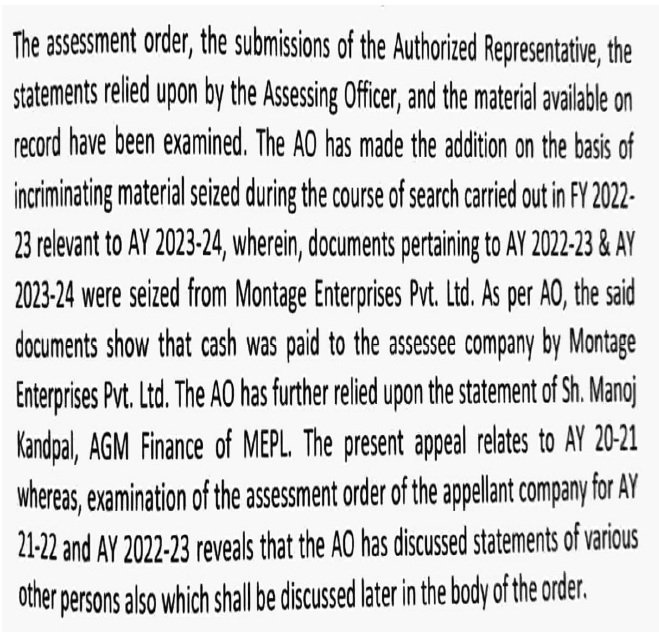
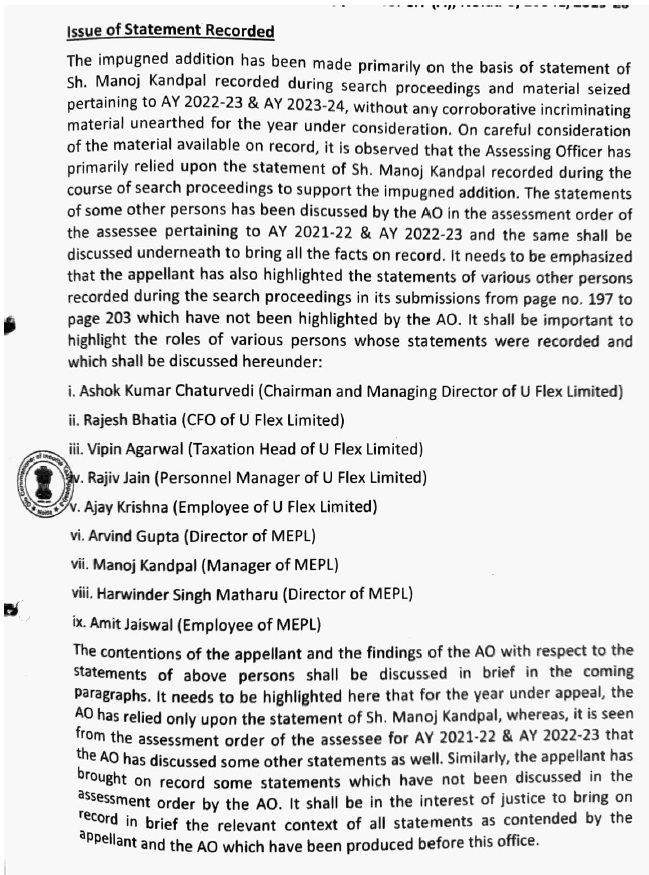
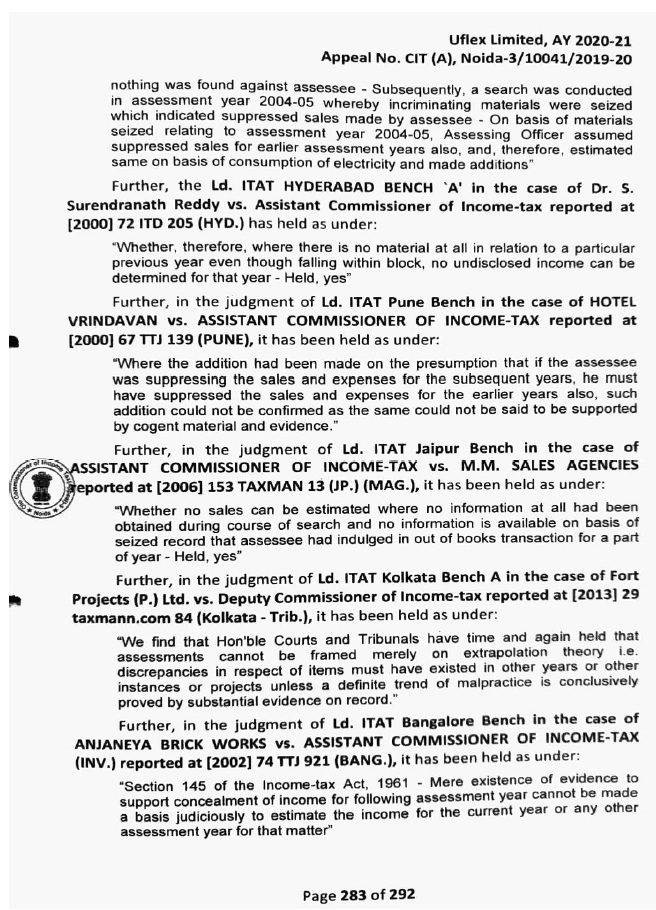
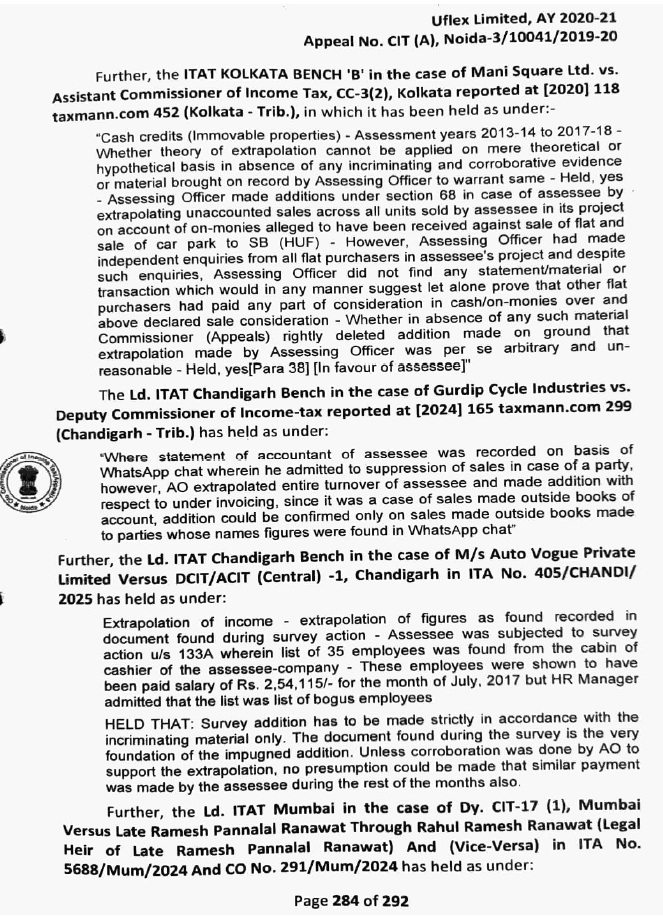
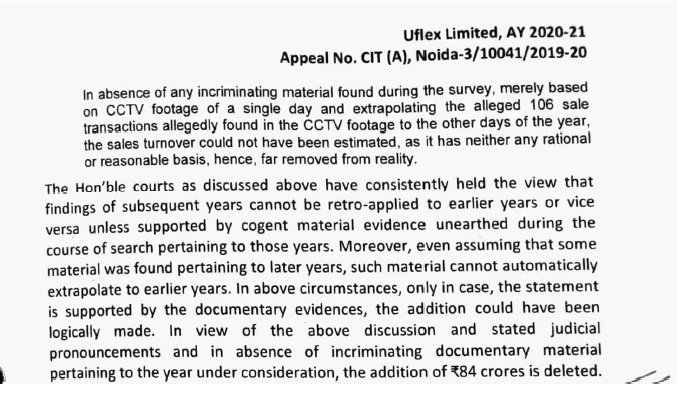
89. On careful consideration of the facts and on perusal of the order of ld. CIT(A), it is observed that ld. CIT(A) has held that no opportunity of cross examination was allowed to the assessee and except Shri Manoj Kandpal, none of the other employee of the assessee or MEPL had ever admitted receiving of any cash from MEPL. Further, the documents found and seized during the course of search at the business premises of MEPL conducted simultaneously, certain diaries were found and seized which were marked as Annexure D-1 to D-39. The said diaries contained entries pertaining to FY 2022-23 and it is an admitted fact that no entry was found noted in any of the diary relating to the year under appeal. The hon’ble Apex Court in the case of Pr. CIT v. Abhisar Buildwell (P.) Ltd. (SC) in Civil Appeal No. 6580 of 2021 dated 24.04.2023 has laid down the scope of assessment u/s. 153A r.w.s 153C and held the pre-condition of making an addition during assessment proceedings u/s 153A/153C for a particular year is the existence of seized material/incriminating material in that year. ld. CIT(A) by following the order of Abhisar Buildwell Pvt.Ltd. (supra) of Hon’ble Apex court has held that no addition could be made in the year under appeal without having any incriminating material.
90. It is further observed that despite of repeated requests, the AO has denied the opportunity of cross examination of the witness of the department Shri Manoj Kandpal whose statements are heavily relied upon for making the additions. The Co-ordinate Bench of Delhi Tribunal in the case of Veena Gupta v. ACIT in ITA No.5662/Del/2018, has followed the judgement of Hon’ble Supreme Court in the case of Andaman Timber Industries v. CCE (SC) and held that by not providing the opportunities of cross examining the prime witness of the Revenue, no addition could be made. The relevant extract of the order as contained in para 11 to 15 are reproduced as under:
| 11. |
|
“We have perused submissions advanced by both sides in light of records placed before. We also refer to all judicial precedents relied upon by both sides. |
| 12. |
|
It is observed that both Assessing Officer as well as Ld. CIT(A) is relying upon statement recorded by Investigation Department of Sh. Amit Dalmia and Sh. Narendra Kumar Jain. It is based upon their statements, that test of human probabilities has been applied to facts of present case by authorities below. Further, it cannot be ignored that assessee was not granted opportunity to cross examine Sh. Amit Dalmia and Sh. Narendra Kumar Jain. Even after assessee asking for opportunity to cross examine these persons, before First Appellate Authority, same was not granted. Assessee has contested truthfulness of statements given by Sh. Amit Dalmia and Sh. Narendra Kumar Jain before us. |
| 12.1 |
|
It is pertinent to note that assessee, vide letter dated 21/12/16 had asked Ld. AO to provide material based upon which various allegations have been levied by Ld. AO. These factors from para 20 of assessment order, wherein assessee raised objections, one of which is opportunity to cross examine, in case of any evidence used against assessee. |
| 12.3 |
|
To our surprise, Ld. AO without providing any material evidence, report on which he was relying and not granting an opportunity to cross examine the persons on whose statement he arrived at certain presuppositions, made addition in the hands of assessee. This is evident from para 22 of assessment order. |
| 13. |
|
Before Ld. CIT (A) assessee once again raised plea of crossexamination granted to assessee and materials not based upon which the submissions have been made has not been provided for examination. Even then opportunity was not granted to assessee, though Ld. CIT (A) had coterminous powers as that of Ld. AO. |
| 14. |
|
In our view this amounts to gross violation of principles of natural Justice. We draw our support from the decision of Hon’ble Supreme Court in the case of Andaman Timber Industries versus CCE reported in (2015) 52 GST 355/314 ELT 641/[2016] 38 GSTR 117 (SC) , wherein Hon’ble court observed as under: |
“According to us, not allowing the assessee to cross-examine the witnesses by the Adjudicating Authority though the statements of those witnesses were made the basis of the impugned order is a serious flaw which makes the order nullity inasmuch as it amounted to violation of principles of natural justice because of which the assessee was adversely affected. It is to be borne in mind that the order of the Commissioner was based upon the statements given by the aforesaid two witnesses. Even when the assessee disputed the correctness of the statements and wanted to cross-examine, the Adjudicating Authority did not grant this opportunity to the assessee. It would be pertinent to note that in the impugned order passed by the Adjudicating Authority he has specifically mentioned that such an opportunity was sought by the assessee. However, no such opportunity was granted and the aforesaid plea is not even dealt with by the Adjudicating Authority.”
| 15. |
|
We, accordingly, respectfully following decision of Hon’ble Supreme Court in the case of Andaman Timber Industries versus CCE (supra) allow appeal of assessee on legal ground raised in Ground 2(c), and quash and set-aside the assessment order so passed.” |
91. Similar view was expressed by the Hon’ble Apex Court in the case of
CIT v.
Odeon Builders (P.) Ltd. [2019] 418 ITR 315 (SC) . The relevant observations are reproduced as under:
“However, on going through the judgments of the CIT, ITAT and the High Court, we find that on merits a disallowance of Rs.19,39,60,866/- was based solely on third party information, which was not subjected to any further scrutiny. Thus, the ld. CIT(A) allowed the appeal of the assessee stating:
“Thus, the entire disallowance in this case is based on third party information gathered by the Investigation Wing of the Department, which have not been independently subjected to further verification by the AO who has not provided the copy of such statements to the appellant, thus denying opportunity of cross examination to the appellant, who has prima facie discharged the initial burden of substantiating the purchases through various documentation including purchase bills, transportation bills, confirmed copy of accounts and the fact of payment through cheques, & VAT Registration of the sellers & their Income Tax Return. In view of the above discussion in totality, the purchases made by the appellant from M/s Padmesh Realtors Pvt. Ltd. is found to be acceptable and the consequent disallowance resulting in addition to income made for Rs.19,39,60,866/-, is directed to be deleted.”
4. The ITAT by its judgment dated 16th May, 2014 relied on the self-same reasoning and dismissed the appeal of the revenue. Likewise, the High Court by the impugned judgment dated 5th July, 2017, affirmed the judgments of the CIT and ITAT as concurrent factual findings, which have not been shown to be perverse and, therefore, dismissed the appeal stating that no substantial question of law arises from the impugned order of the ITAT.
5. In these circumstances, the Review Petitions are dismissed.”
92. Thus, not providing the opportunity of cross examination of the person whose statements are relied upon for making the additions is not acceptable in the facts of the case. The entire case of the revenue hinges upon the presumption that the cash was received by the assessee from MEPL. However, this presumption or suspicion how strong it may appear to be true but needs to be corroborated by some evidence to establish a link. It is quite a trite law that suspicion howsoever strong may be but cannot be the basis of addition except for some material evidence on record. The theory of ‘preponderance of probability’ is applied to weigh the evidences of either side and draw a conclusion in favour of a party which has more favourable factors in his side. The conclusions must be drawn on the basis of certain admitted facts and materials and not on the basis of presumption of facts that might go against assessee. Once nothing has been proved against the assessee with aid of any direct material especially when various rounds of investigation have been carried out, then nothing can be implicated against the assessee. Except relying upon the statements of Shri Manoj Kandpal, the AO has made no enquiries to support the allegation of cash received by the assessee. It is also a matter of fact that no material whatsoever, was found/seized as a result from the possession of the assessee or from MEPL indicating any such cash payment to the assessee in the year under appeal. Thus, before making the allegation of receipts of such cash, burden was on the AO to bring on record material to support the allegation by making independent enquiries and investigation which has not been done in the instant case. It is a settled law that documentary evidences will always carry more weight than the oral statements, particularly when such oral statements were proved to be incorrect by filing documentary evidences. Thereafter burden is shifted upon the AO to prove the documentary evidence to be untrue/ bogus/ non genuine which in the instant case, the AO has miserably failed to do so.
93. The Hon’ble Delhi High Court in the case of CIT v. Fair Finvest Ltd. [2013] 357 ITR 146 (Delhi) has held as under:
“6. This Court has considered the submissions of the parties. In this case the discussion by the CIT(Appeals) would reveal that the assessee has filed documents including certified copies issued by the Registrar of Companies in relation to the share application, affidavits of the Directors, Form 2 filed with the ROC by such applicants confirmations by the applicant for company’s shares, certificates by auditors etc. Unfortunately, the assessing officer chose to base himself merely on the general inference to be drawn from the reading of the investigation report and the statement of Mr. Mahesh Garg. To elevate the inference which can be drawn on the basis of reading of such material into judicial conclusions would be improper, more so when the assessee produced material. The least that the assessing officer ought to have done was to enquire into the matter by, if necessary, invoking his powers under Section 131 summoning the share applicants or directors. No effort was made in that regard. In the absence of any such finding that the material disclosed was untrustworthy or lacked credibility the assessing officer merely concluded on the basis of enquiry report, which collected certain facts and the statements of Mr. Mahesh Garg that the income sought to be added fell within the description of Section 68.”
94. The Hon’ble Delhi High court in the case of PCIT (Central)-3 v. Anand Kumar Jain (HUF) [IT Appeal No. 23 of 2021, dated 12.02.2021] has held as under:
“8. Next, we find that, the assessment has been framed under section 153A, consequent to the search action. The scope and ambit of section 153A is well defined. This court, in CIT v. Kabul Chawla,1 concerning the scope of assessment under Section 153A, has laid out and summarized the legal position after taking into account the earlier decisions of this court as well as the decisions of other High Courts and Tribunals. In the said case, it was held that the existence of incriminating material found during the course of the search is a sine qua non for making additions pursuant to a search and seizure operation. In the event no incriminating material is found during search, no addition could be made in respect of the assessments that had become final. Revenue’s case is hinged on the statement of Mr. Jindal, which according to them is the incriminating material discovered during the search action. This statement certainly has the evidentiary value and relevance as contemplated under the explanation to section 132(4) of the Act. However, this statement cannot, on a standalone basis, without reference to any other material discovered during search and seizure operations, empower the AO to frame the block assessment. This court in Principal Commissioner of Income Tax, Delhi v. Best Infrastructure (India) P. Ltd.,2 has inter-alia held that.:
“38. Fifthly, statements recorded under Section 132(4) of the Act do not by themselves constitute incriminating material as has been explained by this Court in Harjeev Aggarwal.3”
10. Now, coming to the aspect viz the invocation of section 153A on the basis of the statement recorded in search action against a third person. We may note that the AO has used this statement on oath recorded in the course of search conducted in the case of a third party (i.e., search of Pradeep Kumar Jindal) for making the additions in the hands of the assessee. As per the mandate of Section 153C, if this statement was to be construed as an incriminating material belonging to or pertaining to a person other than person searched (as referred to in Section 153A), then the only legal recourse available to the department was to proceed in terms of Section 153C of the Act by handing over the same to the AO who has jurisdiction over such person. Here, the assessment has been framed under section 153A on the basis of alleged incriminating material (being the statement recorded under 132(4) of the Act). As noted above, the Assessee had no opportunity to cross-examine the said witness, but that apart, the mandatory procedure under section 153C has not been followed. On this count alone, we find no perversity in the view taken by the ITAT. Therefore, we do not find any substantial question of law that requires our consideration. “
95. In the case of CIT v. Smt. S.Jayalakshmi Ammal [2017] 390 ITR 189 (Madras) the Hon’ble High Court has held that mere statement is not enough to make addition, the relevant observations are as under:
“…While adverting to the above, we are of the considered view that, for deciding any issue, against the assessee, the Authorities under the Income Tax Act, 1961 have to consider, as to whether there is any corroborative material evidence. If there is no corroborating documentary evidence, then statement recorded under Section 132(4) of the Income Tax Act, 1961, alone should not be the basis, for arriving at any adverse decision against the assessee. If the authorities under the Income Tax Act, 1961, have to be conferred with the power, to be exercised, solely on the basis of a statement, then it may lead to an arbitrary exercise of such power. An order of assessment entails civil consequences. Therefore, under judicial review, courts have to exercise due care and caution that no man is condemned, due to erroneous or arbitrary exercise of authority conferred….”
“…If the assessee makes a statement under Section 132(4) of the Act, and if there are any incriminating documents found in his possession, then the case is different. On the contra, if mere statement made under Section 132(4) of the Act, without any corroborative material, has to be given credence, than it would lead to disastrous results. Considering the nature of the order of assessment, in the instant case characterized as undisclosed and on the facts and circumstances of the case, we are of the view that mere statement without there being any corroborative evidence should not be treated as conclusive evidence against the maker of the statement…”
96. Before us, Revenue has failed to controvert the arguments of the assessee and findings given by ld. CIT(A) while deleting the additions, by placing on record any contrary material which could suggest that during the year under appeal, assessee had received cash of INR 84.00 crores from MEPL nor any evidence of unaccounted sale or under billing was found/seized as a result of search. Thus in view of above discussion and by respectfully following the judicial pronouncements as referred herein above of the hon’ble Supreme court and various high courts including the jurisdictional high court, we find no error in the order of ld. CIT(A) in deleting the additions so made. Accordingly, Ground of appeal No.3 raised by the Revenue is dismissed.
97. Ground of appeal No.4 of the Revenue is with respect to the deletion of transfer pricing adjustment on account of delayed payment of receivables of INR 33,04,951/-.
98. Heard the contentions of both the parties and perused the material available on record. The TPO has made the adjustment on account of notional interest by holding trade receivable as interest free loan to its AE’s. As per the ld. CIT DR, once the payment was delayed, AO/TPO has rightly made adjustment. On the contrary, it was the claim of the assessee that international transactions carried out are in the normal course of business and most of the receivables were released within the agreed credit terms and the minor delay occurred were due to Covid-19 Pandemic. The assessee further claimed that the sales have been made to AEs at a higher price so as to adjust the component and delayed payment if any. Once higher margins was taken on the sales made to AE’s, as per the assessee, there was no requirement for making any adjustment on account of outstanding receivables. Reliance is placed on the judgment of Hon’ble Jurisdictional High court in the case of Pr. CIT v. Kusum Health Care Pvt. Ltd. (Delhi)/[2017] 398 ITR 66 (Delhi) in [2017] (4) TMI 1254 (Delhi).
99. After carefully examined the facts, it is observed that the assessee has not made any adjustment on account of delayed payment whereas TPO has made the adjustment of INR 33,04,951/-by applying interest rate of 6.02% by taking LIBOR + 300 basis points for foreign exchange fluctuation. The AO computed the interest for the delayed period between the invoices date and date of receipt of payment. Ld. CIT(A) appreciated the fact that assessee has already factored the cost incurred on delayed payment by charging high margin which was included in the sales price of the material sold to its AE’s as compared to the sale price charged from non-AEs. The assessee has demonstrated that it had claimed 30% high rates from the AE’s as compared to sales made to non-AE thus, delayed payment has already been considered in the sale price charged. Ld. CIT(A) further observed that no adjustment was made on this account in preceding assessment years where the assessments were completed u/s 143(3) of the Act. The observations of ld. CIT(A) while deleting the additions made are as under:-
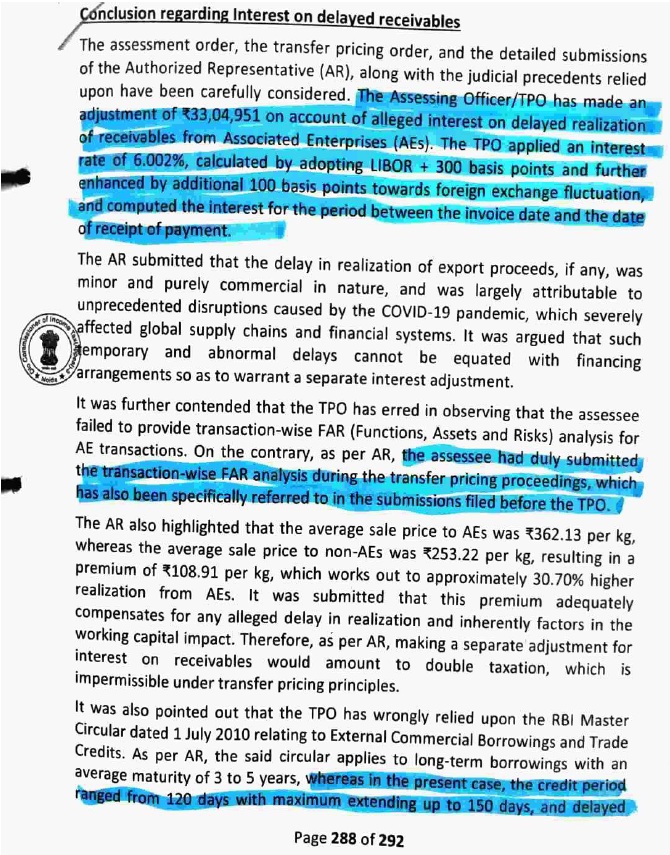
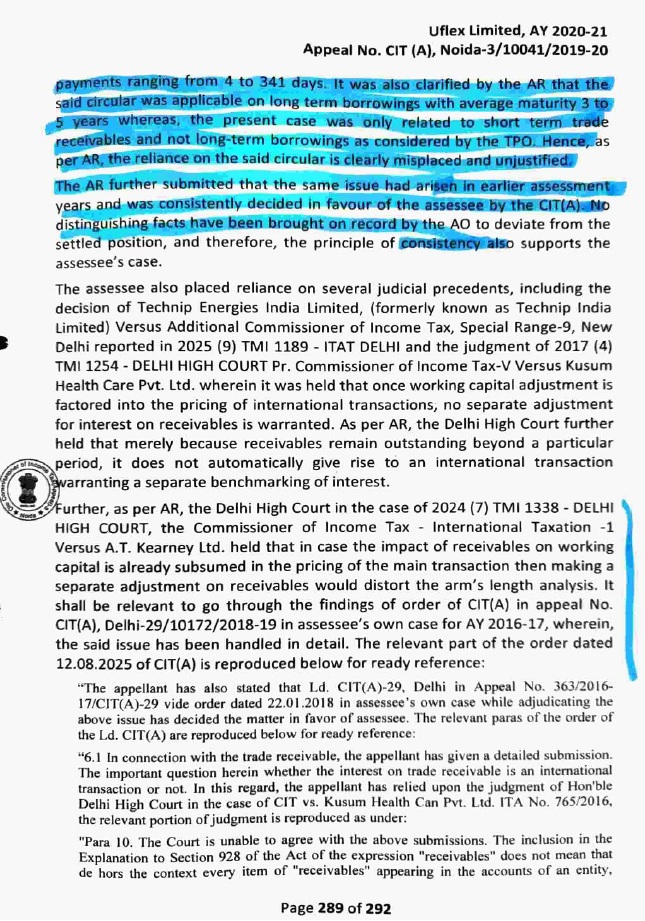
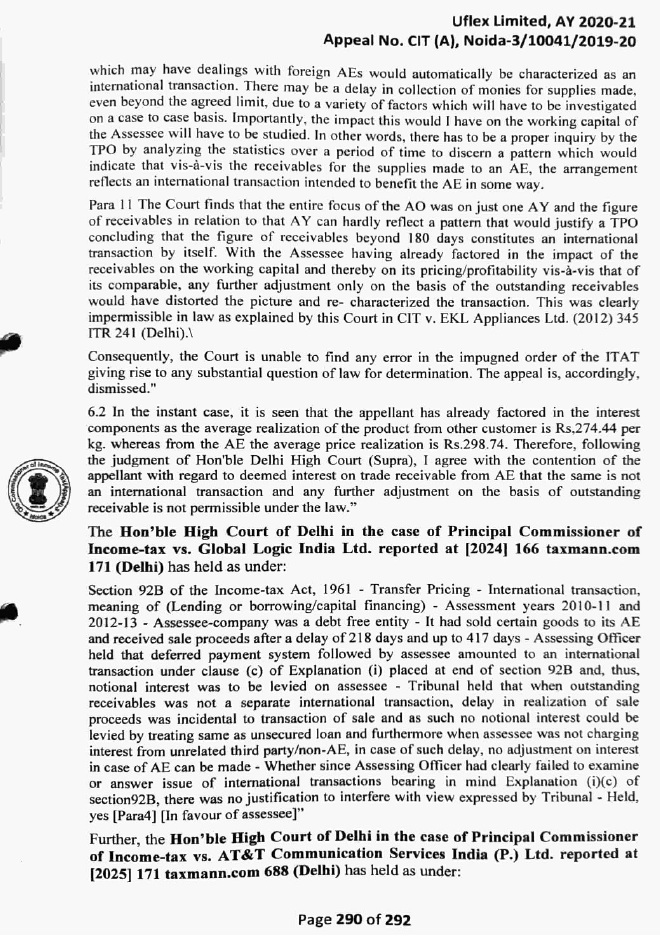
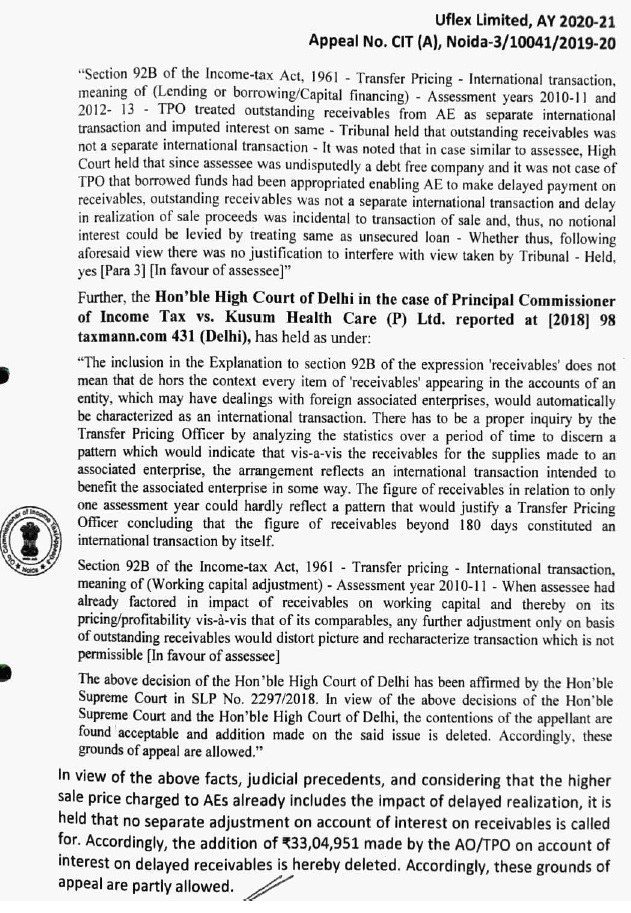
100. As observed above, the hon’ble Delhi High Court in the case of Kusum Health Care Pvt. Ltd. (supra) has held that once working capital adjustment is factored into the price of international transactions, no separate adjustment on receivables is warranted. In the instant case, assessee has been able to demonstrate that it had already charged margin of more than 30% from its AE’s as against the sales made to non-AE’s thus, has already factored the working capital adjustment on account of delayed payment of receivables. This being so, we find no error in the order of ld. CIT(A) in deleting the adjustment made on account of delayed payment of receivables. Accordingly, Ground No.4 raised by the Revenue is dismissed.
101. Ground of appeal No.6 of the Revenue is with respect to the deletion of addition of INR 2.40 crores made towards rent paid on farm house taken by the assessee and used as its guest house.
102. Brief facts leading to this ground of appeal are that disallowance of INR 2.40 crores was made by the AO being rent paid to Smt. Rashmi Chaturvedi, wife of the Chairman of the assessee company, Shri Ashok Chaturvedi. The AO observed that this house was utilized for the purpose of personal residence cum office of the Chairman and has no relationship with the business of the assessee company and therefore, rent paid is not for the purpose of business and he made the disallowance which was deleted by ld. CIT(A).
103. Before us, ld. CIT DR for the Revenue vehemently supported the order of AO and submits that the assessee has failed to establish that the said property was taken by the assessee company for the purpose of business and was utilized by the Chairman of the assessee company for his personal use, therefore, the AO has rightly made the disallowance of the rent paid to Smt. Rashmi Chaturvedi and he prayed accordingly.
104. On the other hand, ld.AR for the assessee vehemently supported the order of ld. CIT(A) and submits that the assessee has taken the farm house owned by the spouse of the Chairman on lease of 20 years and filed the broad resolution and the Lease Agreement. The property was taken on rent under commercial expediency and for the purpose of business and small part of the house was used for the residence of the chairman and remaining part was used as guest house of the company. Ld.AR further submits that in the hands of Chairman, value of perquisite attributable to such residential house has already been brought to tax as part of salary income which fact remained uncontroverted. Ld. AR further stated that rental income was duly disclosed by the recipient i.e. Smt. Rashmi Chaturvedi. In the last, it was submitted by ld.AR that rent payment on the same property was made in AYs 2013-14 to 2018-19 where this payment was not doubted by the AO, thus, as a principal of consistency, it should be allowed as claimed.
105. Heard the contentions of both the parties at length and perused the material on record. The claim of the assessee was that major portion of the house was used for guest house where foreign clients used to stay and official meetings are conducted with them. A small portion of the house was used for the residence of the Chairman which consists of 02 bed rooms and kitchen which were separately identified and perquisite value of the same has duly been taxed in the hands of Shri Ashok Chaturvedi, chairman of the assessee company. Ld. CIT(A) after considering these facts, has deleted the addition by making following observations:-
(c) Disallowance of rental expenses in respect of Farm House
As per AR, the Assessing Officer, at page no. 104 of the assessment order, has made a disallowance of Rs.2.40 crores on account of rent paid for a farm house taken on lease from Smt. Rashmi Chaturvedi, who is the spouse of Shri Ashok Chaturvedi, Chairman of the company. The AR submitted that the farmhouse
[12:44, 20/08/2026] AMIT KUMAR: was taken on lease by the appellant company and was primarily used as a camp office for business purposes. It was explained by the AR that only a limited portion of the farm house was used as residential accommodation by the Chairman, while the major portion was utilized for official purposes such as business meetings and hosting of clients. It was further submitted by the AR that the portion used for residential purposes, comprising only two bedrooms and a kitchen, was separately identified, and the perquisite value of the same was duly taxed in the hands of Shri Ashok Chaturvedi. As per AR, the Chairman was paid salary and house rent allowance amounting to 72 lakhs, and the corresponding residential use had already been offered to tax as part of his salary income. Thus, as per AR, there was no revenue loss to the Department. The AR also pointed out that the appellant is a large multinational company with a consolidated turnover of approximately 7,685 crores, operating across various locations in India, outside India and having subsidiaries in several foreign countries. As per AR, considering the scale and nature of business, frequent visits of foreign customers, business associates, and high-net-worth dignitaries are inevitable. As per AR, the farmhouse is regularly used for hosting such foreign clients and for conducting official business meetings. It was further submitted by the AR that the same issue had been examined by the Assessing Officer in earlier years. Additionally, as per AR, the transaction was also scrutinized under domestic transfer pricing provisions by the TPO for assessment years 2013-14 to 2018-19. In all those years, no adverse inference was drawn, and no disallowance was made. As per AR, there being no change in facts or circumstances during the year under consideration, the AR pleaded that the principle of consistency should be followed. The AR also relied upon the lease agreement entered into with Smt. Rashmi Chaturvedi, copies of which were duly furnished before the AO. It was clarified that the rental income was duly offered to tax in the hands of Smt. Rashmi Chaturvedi. The AR contended that the disallowance was made merely on surmises and without appreciating the business necessity and supporting evidences such as board resolutions and past acceptance by the Department. Accordingly, it was prayed that the disallowance of \2.40 crores be deleted.”
106. Before us, Revenue has failed to controvert the findings given in order of ld. CIT(A) that partial uses of the property by the Chairman for his residential house has already been suffered taxes as perquisite and the Revenue has not denied the use of the remaining part of the house as guest house purposes where the same was used for stay of foreign clients and conducting the business meetings.
107. Considering the overall facts and circumstances of the case, we find no error in the order of ld. CIT(A) in deleting the disallowances made by AO. Accordingly, Ground of appeal No.6 raised by the Revenue is dismissed.
108. Ground of appeal No.7 raised by the Revenue is with respect to the disallowance of deduction claimed u/s 80IB of the Act on other receipts such as insurance claim, remission, write back of liabilities, scrap sales, purchase discounts and other miscellaneous income.
109. Heard the contentions of both the parties at length and perused the material on record. The allegation of the AO was that the assessee has claimed deduction u/s 80IB of the Act @ 30% on the profits of the eligible unit situated at Jammu identified as “Unit-3”. The AO has not disputed the eligible unit however, disallowed the claim to the extent of INR 58,97,071/- being 30% of the other receipts which according to AO, were not earned from the eligible unit. The claim of the assessee was that other receipts comprising of insurance claim, remission write back of liabilities, scrap sales, purchase discounts and other incidental receipts which are directly related to manufacturing activity and therefore, are eligible for the deduction u/s 80IB of the Act. It is observed that deduction u/s 80IB was claimed since Unit-3 had started commercial production and income generated was offered for tax. The AO had made the disallowance by making similar allegation with respect to other income and the Co-ordinate Bench of Delhi Tribunal has allowed the same vide its order for AY 2011-12 and such order has been accepted by the Revenue. Thereafter, the deduction claimed on such other income was never doubted. Thus, following the principal of consistency, deduction as claimed should be allowed. Ld. CIT(A) has appreciated these facts and deleted this disallowance by making following observations:-
(b) Disallowance of Deduction under Section 80-IB
“The appellant claimed deduction of 12,71,90,249/- under section 80-IB in respect of profits earned by Jammu Unit-3, an eligible industrial undertaking, which earned total profits of 42,39,67,495/-. The deduction was computed at the statutory rate of 30% and was duly supported by Form 10CCB in accordance with Rule 18BBB. The Assessing Officer has not disputed the eligibility of the unit, the correctness of the audited books of account, or the computation of profits. As per AR, the sole dispute raised by the Assessing Officer relates to the treatment of certain components classified under the head “other income,” which were erroneously held to be ineligible for deduction under section 80-IB.
The Assessing Officer disallowed a sum of 58,97,071/-, being 30% of certain receipts, on the ground that such income was not “derived from” the eligible business. As per AR, this finding is legally unsustainable, as the Assessing Officer failed to appreciate the true nature and source of the receipts. As per AR, the interest income amounting to 43,84,434/- was voluntarily excluded by the appellant from the eligible profits and was offered to tax under the head “Income from Other Sources.” As per AR, despite this, the Assessing Officer again treated the same amount as ineligible while computing the disallowance, resulting in an impermissible double disallowance.
The remaining components of “other income,” excluding interest income, comprise scrap sales, purchase discounts, insurance claims, write-back of liabilities, remission of customs duty, and other incidental receipts. As per AR, all these receipts arise directly from and are intrinsically linked to the manufacturing operations of the eligible unit. As per AR, scrap sales represent proceeds from byproducts generated during the manufacturing process and are taxable as business income under section 28. As per AR, scrap cannot exist independently of manufacturing activity and has consistently been held to be eligible for deduction under section 80-IB in the appellant’s own case in earlier years, including Assessment Year 2011-12, as confirmed by the Hon’ble ITAT, with no reversal by any higher forum.
As per AR, purchase discounts arise in the normal course of procurement of raw materials and effectively reduce the cost of inputs. Such discounts are embedded in the manufacturing cost structure and do not constitute independent income. As per AR, merely because these receipts are presented separately in the accounts does not alter their character as business income. As per AR, identical receipts were allowed in earlier assessment years, including Assessment Year 2013-14, and the principle of consistency requires the same treatment to be followed in the year under consideration.
As per AR, insurance claims received on account of damage to raw materials represent compensation for business losses incurred in the ordinary course of manufacturing operations. As per AR, such receipts substitute trading losses and are taxable as business income under section 28 or section 41(1). As per AR, the direct nexus between the insurance claim and the manufacturing activity is undisputed, and the levy of GST on such receipts further reinforces their business character. As per AR, these receipts have also been allowed as eligible for deduction in earlier years and confirmed by the Ld. ITAT.
As per AR, the write-back of liabilities amounting to 1,20,465/-pertains to liabilities originally incurred for the import of raw materials. As per AR, such write-back signifies the cessation of a business liability and is deemed to be business income undersection 41(1) of the Act. As per AR, the Hon’ble Delhi High Court in CIT-III v. Shri Vardhman Overseas Ltd. (2011) has categorically held that such write-backs constitute business income. As per AR, these receipts directly impact the cost of inputs and profitability of the eligible undertaking and therefore satisfy the “derived from” test undersection 80-IB.
As per AR, the remission of customs duty and insurance claim aggregating to 3,03,872/-represent receipts that either reduce the cost of imported raw materials or compensate business losses. As per AR, both are revenue receipts arising directly from manufacturing operations and form an integral part of business profits. As per AR, the Assessing Officer’s attempt to segregate these receipts and deny deduction is contrary to the settled legal position and the object of section 80-IB, which is to promote industrial activity.
It is submitted by the AR that the expression “derived from” used in section 80-IB requires a direct nexus between the receipt and the eligible business. As per AR, all the aforesaid receipts arise solely because the manufacturing activity exists and are commercially inseparable from the business of the eligible undertaking. As per AR, the narrow interpretation adopted by the Assessing Officer defeats the legislative intent and ignores binding judicial precedents as well as consistency followed in the appellant’s own case.”
110. As observed above, the claim of the assessee was consistently been allowed by the Revenue and never disputed in the orders passed u/s 143(3) of the Act. The assessee has placed reliance on the following judgments with respect to the other income on which disallowance has been made:-
| SI. No. |
Component |
Judgement Relied upon |
| 1. |
Scrap Sales |
(i). CIT v. Sadhu Forging Ltd. 336 ITR 444 (Delhi) (Refer page no. 1294-1298 of the case law PB).
ii. High Court of Delhi, CIT v. Dabur India Ltd. (Delhi) [12-03-2024] (Refer page no. 1430- 1434 of the case law PB).
iii. CIT v. Jikar A Saiyed (Gujarat) (Refer page no. 1299-1301 of the case law PB).
iv. Pr. CIT v. Reckitt Benckiser Healthcare India Ltd. 451 ITR 403 (Gujarat)
v. CIT (C) v. Flakes-N-Flavourz New Delhi (Delhi), New Delhi (Refer page no. 1315-1319 of the case law PB).
vi. Dy. CIT v. Reckit Benkiser Healthcare India P. Ltd. (Ahmedabad – Trib.) [16-07- 2025] (Refer page no. 1302-1310 of the case law PB).
vii. 2024 (11) TMI 818 – ITAT MUMBAI Hindustan Unilever Ltd. v. Deputy Commissioner of Income-tax (Mumbai – Trib.), Mumbai and vice versa (Refer page no. 1320-1337 of the case law PB). |
| 2. |
Other Mise. Income (Discount on Purchase of Raw Materials) |
viii. High Court of Gujarat, CIT v. Metrochem Industries Ltd. [2016] 389 ITR 181 (Gujarat) [19-07-2016] (Refer page no. 1338-1353 of the case law PB).
ix. High Court of Punjab and Haryana, CIT v. Metalman Auto (P.) Ltd. 336 ITR 434 (Punjab & Haryana) [11-02-2011] (Refer page no. 1354-1359 of the case law PB).
|
| 3. |
Insurance claim on Damage of Raw material |
x. CIT v. Meghalaya Steels Ltd. 383 ITR 217 (SC) (Refer page no. 1360-1373 of the case law PB).
xi. CIT v. Sportking India Ltd. /[2010] 324 ITR 283 (Delhi) [19-08-2009) (Refer page no. 1311-1314 of the case law PB).
xii. CIT v. Needle Industries (India) Ltd. 245 ITR 556 (Madras)(Refer page no. 1426-1429 of the case law PB).
xiii. CIT v. Khemka Container (P.) Ltd. 275 ITR 559 (Punjab & Haryana) (Refer page no. 1374-1375 of the case law PB).
xiv. CIT v. Shree Rama Multi Tech Ltd. (Gujarat) (Mag.) (28-01-2013] (Refer page no. 1376-1378 of the case law PB).
|
| 4. |
Writeback of Liability (Import of Raw Materials) |
xv. Gujarat Industries Power Co. Ltd. v. Dy. CIT (Ahmedabad – Trib.) [28-07- 2023]- where it is held that Section 80-IA of the Income-tax Act, 1961 Deductions – Profit and gains from infrastructure undertakings (Sundry creditors) Assessment years 2009-10 to 2012-13 – Assessee-company was engaged in business of generation and sale of power Whether income arising on account of writing back balances of sundry creditors having direct nexus with income derived from business of industrial undertaking was eligible for deduction under section 80-IA Held, yes [Para 18] [In favour of assessee) (Refer page no. 1379-1388 of the case law PB). |
| 5. |
Other Misc. NonOperating Income (Remission of Custom duty and Insurance claim) |
xvi. CIT v. Dharam Pal Prem Chand Ltd. 317 ITR 353 ( Delhi) [27-11-2008] (Refer page no. 1389- 1396 of the case law PB). xvii. CIT v. Eltek SGS (P.) Ltd. 300 ITR 6 (Delhi) [19-02-2008] (Refer page no. 1397-1401 of the case law PB).
xviii. Asstt. CIT v. Poddar Associates [2009] 319 ITR 419 (Karnataka) (Refer page no. 1402-1404 of the case law PB). xix. Suzlon Energy Ltd. v. Dy. CIT 57 SOT 54 (Ahmedabad – Trib.)(URO) [21-09-2012) (Refer page no. 1405-1425 of the case law PB). |
111. Considering the facts that the other income was generated from the regular manufacturing activity of and Revenue has failed to bring on record any material to hold that such income was not derived from the eligible undertaking therefore, we find no reason to interfere in the order of ld. CIT(A) allowing deduction u/s 80IB on such other income who has followed the orders of the coordinate bench in assessee’s own case in the first year of the claim of deduction u/s 80IB of the Act. Accordingly, Ground of appeal No.7 raised by the Revenue is dismissed.
112. Ground of appeal Nos.8 to 10 raised by the Revenue are general in nature hence, not adjudicated.
113. In the result, appeal of the assessee is partly allowed and appeal of the Revenue is dismissed for AY 2020-21.
114. Now we take appeals of the assessee IT(TP)A No.260/Del/2026 and appeal of the Revenue in ITA No.5367/Del/2026 for Assessment Year 2021-22.
IT(TP) No.260/Del/2026 [Assessee’s appeal] & ITA No.5367/Del/2026 [Revenue’s appeal] [Assessment Year 2021-22]
115. The Additions made by the AO and deleted /sustained by ld. CIT(A) are tabulated as under:
| S.No. |
Particulars |
AY 2021-22 |
| Addition By AO |
Sustained by CIT(A) |
Deleted by CIT(A) |
| 1. |
Addition u/s 68 Unexplained unsecured loans |
25,25,00,000 |
4,00,00,000 |
21,25,00,000 |
| 2. |
Addition u/s 69C — Estimated commission |
50,50,000 |
8,00,000 |
42,50,000 |
| 3. |
Disallowance of deduction u/s 80-IB |
1,91,21,776 |
8,00,000 |
1,83,21,776 |
| 4. |
Disallowance of rent expense |
2,04,00,000 |
NIL |
2,04,00,000 |
| 5. |
Addition of unexplained cash receipts u/s 69A |
84,00,00,000 |
NIL |
84,00,00,000 |
| 6. |
Enhancement on account of Arm’s Length Price determined by TPO on Corporate Guarantee Commission |
41,15,310 |
NIL |
41,15,310 |
| 7. |
Enhancement on account of Arm’s Length Price determined by TPO on Interest on receivables |
5,49,35,989 |
25,54,636 |
5,23,81,353 |
116. In Ground of appeal No.1, the assessee has challenged the order passed u/s 143(3) r.w.s.144B of the Act since there was a search carried out in the case of the assessee after 01.04.2021 thus in terms of the amended provisions, the proceedings should have been completed u/s 148 of the Act as provided in Explanation 2(i) to section 148 of the Act.
117. Heard the contentions of both the parties at length and perused the material on record. At the outset, it is observed that this issue has been considered and decided by us in afore-mentioned paras while disposing the Gound of appeal No. 1 of the assessee in ITA No.259/Del/2026 for AY 2020-21. Before us, both the parties are fairly admitted that facts are identical in the present case also. Thus, by respectfully following the observations as made in ITA No.259/Del/2026 for AY 2020-21 which are Mutatis Mutandis applicable to the facts of present case also we held that the order passed u/s 143(3) r.w.s. 144B of the Act is invalids and thus quashed. The Ground of appeal No.1 raised by the assessee is allowed.
118. Though we have allowed the legal ground taken by the assessee and quashed the assessment order passed u/s 143(3) dt. 20.02.2025 however, in the interest of justice, the other grounds of appeal taken on the merits of the additions made/ deleted are decided as under:
119. Ground of appeal Nos. 2 to 8 of the assessee are with respect to the confirmation of the additions of INR 4.00 crores on account of unsecured loans treating the same as unexplained credit u/s 68 of the Act out of total addition of INR 25.25 crores made by the AO. The Revenue is also in appeal against the deletion of the addition of INR 21.25 crores in Ground of appeal No.1 & 2.
120. During the year under appeal, the assessee has taken total unsecured loans of INR 65.00 crores from 24 parties out of which the loans taken from 10 parties, totaling to INR 25.25 crores were alleged as unexplained credit and addition was made u/s 68 of the Act and further addition of INR 50.50 Lakhs was made u/s 69C as alleged commission paid on such accommodation entries of unsecured loans.
121. In first appeal, ld. CIT(A) has confirmed the addition to the extent of INR 04.00 crores of the loans taken from three lender companies namely, Pravesh Credit & Securities Ltd. of INR 1.50 crores; Radha Fincom Ltd. of INR 1.00 crore; and Supriya Fincom Ltd. of INR 1.50 crores and remaining addition of INR 20.25 crores of the loans taken from 07 different lender companies were deleted.
122. Aggrieved by the said order, both the parties are in appeal before the Tribunal. It is observed that additions sustained by ld. CIT(A) of the loans taken from three lender companies are common in AY 2020-21 where after considering the entirety of the facts, the addition sustained by the ld. CIT(A) stood deleted by us herein above while deciding the appeal of the assessee in IT(TP)A No. 259/Del/2026 for AY 2020-21 by holding that the loans taken from these parties are genuine loans. The observations made in IT(TP)A No.259/Del/2026 for AY 2020-21 are Mutatis Mutandis applicable to the facts of the present case therefore, by following the said observations, we delete the addition of INR 4.00 crores made u/s 68 and sustained by ld. CIT(A).
123. Now coming to the additions deleted by ld. CIT(A) with respect to the 07 lender companies out of which loans taken from 05 lender companies tabulated as below are common in AY 2020-21:-
| [i] |
Kamalpur Finance Ltd. |
INR 1.00 crore |
| [ii] |
Maharaj Ji Agro Products Pvt. Ltd. |
INR 3.5 crores |
| [iii] |
Neelam Securities Marketing Pvt Ltd |
INR 1.00 crore |
| [iv] |
Paritosh Electricals Pvt Ltd |
INR 25.00 Lakhs |
| [v] |
Ricon Merchants Pvt Ltd |
INR 50.00 Lakhs |
124. The unsecured loans were taken also from above companies in immediately preceding AY 2020-21 wherein loans taken from these companies were held as unexplained credit by the AO. The same were deleted by ld. CIT(A) and while deciding the appeal of the Revenue in IT(TP)A No. 272/Del/2026 for AY 2020-21, we have confirmed the order of ld. CIT(A) treating the loans taken from these parties are genuine as the assessee has been able to establish the identity, creditworthiness and genuineness of the transactions. The observations made by us in IT(TP)A No. 272/Del/2026 are Mutatis Mutandis applicable to the facts of the present case therefore, by following the same observations, we confirm the order of ld. CIT(A) deleting the additions to the extent of INR 6.25 crores of the loans taken from the aforesaid 05 lender companies.
125. Remaining loans of INR 15.00 crores taken from two companies namely M/s Hallow Securities Private Limited of INR 5.00 crore sand M/s Dhankalash Distributors Pvt. Ltd of INR 10.00 crores which were deleted by ld. CIT(A). Loans taken from these companies are decided as under:-
126. Before us, ld. CIT DR for the Revenue vehemently supported the orders of the AO and submits that the AO has observed that the company M/s Hallow Securities Private Limited was identified as a shell company and its whereabout and other particulars have been discussed at length by the AO in para 8.12 to 8.18 wherein a reference was made to the statements of its Directors and further observed that the registered office is not available at the given address and other particulars were also discussed. Ld. CIT DR drew our attention to the assessment order para 8.1.4 which is the survey report given by the Assessing Unit wherein it is observed that no actual business was carried out by this company. Ld. CIT DR further referred the statement of Shri Ashish Begwani wherein he specifically admitted that the accommodation entries of loans were provided to Uflex Ltd. owned by Shri Ashok Chaturvedi and accordingly, ld. CIT DR requested for the confirmation of the loan taken from Hallow Securities as the same was established as bogus accommodation entries.
127. With respect to the loan taken from M/s Dhankalash Distributors Pvt. Ltd, ld. CIT DR submits that the company has not responded to the notice issued u/s 133(6) of the Act. As per the AO, the information received that it was a Kolkata based company who had provided accommodation entries to M/s Hallow Securities Private Limited. Further ld. CIT DR for the Revenue submits that there were direct evidences found suggesting that M/s Dhankalash Distributors Pvt. Ltd. was used as a conduit to route the funds of M/s Hallow Securities Private Limited to camouflage the accommodation entries and therefore, requested for the confirmation of the same.
128. On the other hand, ld.AR for the assessee vehemently supported the order of ld. CIT(A) and submits that in the case of the Allure Developer Pvt. Ltd., the Co-ordinate Delhi Bench of Tribunal has confirmed the order of ld. CIT(A) where after making inquiries from SFIO, it was concluded that no inquiry/investigation was pending against the M/s. Hallow Securities Pvt. Ltd. and it was a genuine NBFC. It was further observed by the Co-ordinate bench that M/s Hallow Securities Private Limited has received funds of INR 195.00 crores from a company Teesta Retails which is a NBFC of Reliance Group. Ld. CIT(A) after considering these facts, deleted the addition made towards the loans taken from both the companies i.e. M/s Hallow Securities Private Limited and M/s Dhankalash Distributors Pvt. Ltd. It was further submitted by ld.AR that the Coordinate Bench in the case of Dy. CIT v. Bright Buildtech Pvt.Ltd. [IT Appeal No.4106 (Del) of 2025] has held the loan taken from M/s Dhankalash Distributors Pvt. Ltd. as genuine. Ld.AR thus, submits that ld. CIT(A) has rightly deleted the additions which orders be upheld.
129. Heard the contentions of both the parties at length and perused the material on record. The ld. CIT(A) while deleting the addition, has made following observations:-
130. It is observed that assessee has filed all the relevant details and in the case of both the companies, the Co-ordinate Bench of Delhi Tribunal in the case of Allure Developers Ltd. (supra) and in Bright Buildtech Pvt. Ltd (supra) has already held the loans taken from these companies as genuine. Further in the case of loan taken from M/s Hallow Securities Private Limited, Co-ordinate Bench has referred some inquiries conducted from SFIO according to which no investigation was pending against this company. Moreover, the source in the hands of M/s Hallow Securities Private Limited were found to be from genuine sources and it is not the year where the “source of source” are required to be explained.
131. It is also a matter of fact that by making similar allegations, loans taken from various parties including certain parties from whom loans were taken in this year also, additions were made u/s 68 of the Act in immediately preceding assessment year i.e. in AY 2020-21 where the additions so made stood deleted by us, while deciding the appeal of the assessee herein above, in IT(TP)A No. 259/Del/2026 and of the revenue in IT(TP)A No. 272/Del/2026 which observations are Mutatis Mutandis applicable to the facts of the present case. Accordingly, by following the same, we hereby deleted the total additions made of INR 25.25 crores u/s 68 of the Act which includes the additions sustained by the ld. CIT(A). Accordingly, Grounds of appeal Nos. 2 to 8 of the assessee are allowed and Grounds of appeal Nos.1 & 2 of the Revenue are dismissed.
132. Ground of appeal No.9 of the assessee is with respect to the confirmation of addition of INR 50.50 Lakhs made u/s 69C of the Act by alleging the said as commission paid on the alleged accommodation entries on unsecured loans.
133. Heard the contentions of both the parties at length and perused the material on record. At the outset, it is observed that this issue has been considered and decided by us in afore-mentioned paras while disposing the appeal of the assessee in ITA No.259/Del/2026 for AY 2020-21. Before us, both the parties are fairly admitted that facts are identical in the present case also. Thus, by respectfully following the observations as made in ITA No.259/Del/2026 for AY 2020-21 which are Mutatis Mutandis applicable to the facts of present case also therefore, Ground of appeal No.9 raised by the assessee is allowed.
134. Ground of appeal No.10 is with respect to the confirmation of addition of INR 25,54,636/- towards corporate guarantee commission by applying 0.50 % as against 0.40 % benchmarked by the assessee.
135. Heard the contentions of both the parties at length and perused the material on record. Addition of similar nature by making identical observations were made in immediately preceding assessment year i.e. in AY 2020-21 wherein the AO has made the adjustment on account of corporate guarantee commission by applying 2.10% rate which has been reduced by 0.50% by ld. CIT(A) in respect to corporate guarantee given for Flex Africa and deleted the corporate guarantee commission given for Flex Egypt & Flex USA. Similarly, in the year under appeal, AO/TPO made adjustment of INR 5,49,35,989/- by benchmarking the transaction by taking 1.50% rate of fee as against 0.40% benchmarked by the assessee. Ld. CIT(A) had deleted the adjustment made with respect to the corporate guarantee given to Flex Egypt and Flex USA however, sustained the addition of INR 25,54,663/- computed @ 0.50% on the corporate guarantee given to Flex Africa.
136. Before us, both the parties have fairly admitted that facts are identical with the facts of immediately preceding assessment year thus, by respectfully following our observations made in IT(TP)A No. 259/Del/2026 in assessee’s appeal and in Revenue’s appeal in IT(TP)A No. 272/Del/2026, wherein we have held that the transaction benchmarked by the assessee by taking 0.40% rate is fair and reasonable accordingly, deleted the adjustment made and upheld by ld. CIT(A). Such observations are followed Mutatis Mutandis in the present case also. Accordingly, the adjustment so sustained of INR 25,54,636/- is hereby, deleted. Ground of appeal No.10 of the assessee is thus, allowed.
137. Ground of appeal No.11 is with respect to the adjustment of INR 1,60,92,66,164/- made by the AO in the book profit u/s 115JB of the Act.
138. Heard the contentions of both the parties at length and perused the material on record. It is observed that AO has not provided computation sheet based on which adjustment was made in the book profit therefore, AO is directed to provide the same to the assessee so as to enable the assessee to take the necessary action in this matter.
139. Now coming to remaining grounds of in Revenue appeal in ITA No.5367/Del/2026 for Assessment Year 2021-22.
140. Ground of appeal Nos.3 & 4 raised by the Revenue is with respect to the deletion of addition of INR 84.00 crores made on account of unexplained cash credit u/s 69A of the Act.
141. Heard the contentions of both the parties at length and perused the material on record. At the outset, both the parties have fairly admitted that the issue under appeal is identical with the issue involved in AY 2020-21 in revenue’s appeal in IT(TP)A No. 272/Del/2026 wherein we have confirmed the order of ld. CIT(A) deleting the addition made by the AO and the observations made therein are Mutatis Mutandis applicable to the facts of the present case. Thus, by following the said observations, we confirm the order of ld. CIT(A) deleting of addition of INR 84.00 crores on account of alleged cash received from M/s. Montage Enterprises Pvt. Ltd. Accordingly, Ground of appeal No.3 & 4 raised by the Revenue are dismissed.
142. Ground of appeal No.5 raised by the Revenue is with respect to the deletion of addition on account of transfer pricing adjustment of INR 41,15,310/- made towards interest on delayed payment on outstanding receivables against AEs and Ground of appeal No.6 raised by the Revenue is with respect to the restriction of ALP of Corporate Guarantee commission to 0.50% as against 1.50% determined by TPO.
143. Heard the contentions of both the parties at length and perused the material on record. At the outset, it is observed that both the issues have been decided by us in afore-mentioned paras while disposing the appeal of the assessee in IT(TP)A No. 259/Del/2026 and of the Revenue in IT(TP)A No. 272/Del/2026 for AY 2020-21. Before us, both the parties fairly admitted that facts are identical in the present appeals also. Thus, by following the observations as made in IT(TP)A Nos. 259 & 272/Del/2026 for AY 2020-21 which are Mutatis Mutandis applicable in the present case also, the additions so made by AO are deleted. Accordingly, Grounds of appeal No.5 & 6 raised by the Revenue are dismissed.
144. Ground of appeal No.7 raised by the Revenue is with respect to the deletion of addition of INR 2.04 crores made on account of rent paid of the farm house owned by the spouse of the chairman of the assessee by alleging the same was used for business purposes.
145. Heard the contentions of both the parties at length and perused the material on record. At the outset, it is observed that this issue has been considered and decided by us in afore-mentioned paras while disposing the appeal of the Revenue in ITA No.272/Del/2026 for AY 2020-21. This fact is fairly admitted by both the parties. Thus, by following the observations as made in ITA No.272/Del/2026 for AY 2020-21 which are Mutatis Mutandis applicable to the facts of present case also, the order of ld. CIT(A) deleting the disallowance is hereby confirmed. Accordingly, Ground of appeal No.7 raised by the Revenue are dismissed.
146. Ground of appeal No.8 raised by the Revenue is with respect to the deduction u/s 80IB of the Act on account of insurance claims, remission or write back of liabilities, scrap sales, purchase discounts and other miscellaneous receipts.
147. Heard the contentions of both the parties at length and perused the material on record. At the outset, it is observed that this issue has been considered and decided by us in afore-mentioned paras while disposing the appeal of the Revenue in ITA No.272/Del/2026 for AY 2020-21. This fact is fairly admitted by both the parties. Thus, by following the observations as made in ITA No.272/Del/2026 for AY 2020-21 which are Mutatis Mutandis applicable to the facts of present case also, the order of ld. CIT(A) deleting the disallowance is hereby confirmed. Accordingly, Ground of appeal No.8 raised by the Revenue are dismissed.
148. Ground of appeal Nos. 9 & 10 raised by the Revenue are general in nature hence, not adjudicated.
149. In the result appeal of the assessee in IT(TP)A 260/Del/2026 is allowed and appeal of the revenue in ITA No. 5367/Del/2026 is dismissed.
150. Now we take assessee’s appeal in ITA No.280/Del/2026 for Assessment Year 2022-23.
IT(TP)A No.280/Del/2026 [Assessment Year 2022-23] [Assessee’s appeal]
151. The Additions made by the AO and deleted /sustained by ld. CIT(A) are tabulated as under:
| S.No. |
Particulars |
AY 2022-23 |
| Addition By AO |
Sustained by CIT(A) |
Deleted by CIT(A) |
| 1. |
Addition u/s 68 Unexplained unsecured loans |
20,35,00,000 |
10,50,00,000 |
9,85,00,000 |
| 2. |
Addition u/s 69C — Estimated commission |
40,70,000 |
21,00,000 |
19,70,000 |
| 3. |
Disallowance of deduction u/s 80-IB |
NIL |
NIL |
NIL |
| 4. |
Disallowance of rent expense |
2,07,60,000 |
NIL |
2,07,60,000 |
| 5. |
Addition of unexplained cash receipts u/s 69A |
84,00,00,000 |
84,00,00,000 |
NIL |
| 6. |
Enhancement on account of Arm’s Length Price determined by TPO on Corporate Guarantee Commission |
56,41,069 |
NIL |
56,41,069 |
| 7. |
Enhancement on account of Arm’s Length Price determined by TPO on Interest on receivables |
2,66,73,719 |
24,24,883.50 |
2,42,48,835.50 |
152. In Ground of appeal No.1, the assessee has challenged the order passed u/s 143(3) r.w.s.144B of the Act since there was a search carried out in the case of the assessee after 01.04.2021 thus in terms of the amended provisions, the proceedings should have been completed u/s 148 of the Act as provided in Explanation 2(i) to section 148 of the Act.
153. Heard the contentions of both the parties at length and perused the material on record. At the outset, it is observed that this issue has been considered and decided by us in afore-mentioned paras while disposing the Ground of appeal No. 1 of the assessee in ITA No.259/Del/2026 for AY 2020-21. Before us, both the parties are fairly admitted that facts are identical in the present case also. Thus, by respectfully following the observations as made in ITA No.259/Del/2026 for AY 2020-21 which are Mutatis Mutandis applicable to the facts of present case also we held that the order passed u/s 143(3) r.w.s. 144B of the Act is invalids and thus quashed. The Ground of appeal No.1 raised by the assessee is allowed.
154. Though we have allowed the legal ground taken by the assessee and quashed the assessment order passed u/s 143(3) dt. 22.05.2025 however, in the interest of justice, the other grounds of appeal taken on the merits of the additions made/ deleted are decided as under:
155. Grounds of appeal Nos. 2 to 7 raised by the assessee which are related to the confirmations of addition of INR 10.50 crores made u/s 68 of the Act on account of loan taken from Pravesh Credit and Securities Ltd. of INR 3.50 crores; Radha Fincom Ltd. of INR 1.00 crore; Supriya Fincom Ltd. of INR 3.50 crores; Premnarayan Mercantile Pvt.Ltd. of INR 50.00 Lakhs and First Agri-Tech Pvt. Ltd. of INR 2,00 crores.
156. Heard the contentions of both the parties at length and perused the material on record. Before us, both the parties have fairly admitted that additions of identical nature on account of loan taken from these parties were made in AYrs 2020-21 & 2021-22 wherein while deciding the appeal of both the parties for AY 2020-21 in ITA No. 259/Del/2026 [Assessee’s appeal] and in ITA No.272/Del/2026 [Revenue’s appeal], detailed discussion on the facts and argument made by both the parties were considered and after considering the same, additions sustained by ld. CIT(A) were deleted and further action of ld. CIT(A) in deleting the addition with respect to the loans taken was also confirmed, resulting into the deletion of the entire additions made by the AO. Thus, by respectfully following the observations as made in captioned appeals for AY 2020-21 which are Mutatis Mutandis applicable to the facts of the present case therefore, Grounds of appeal Nos. 1 to 7 raised by the assessee are allowed.
157. Ground of appeal No.8 raised by the assessee is with respect to the confirmation of addition of INR 21.00 Lakhs made u/s 69C on account of alleged commission paid for obtaining the accommodation entries of unsecured loans.
158. Heard the contentions of both the parties at length and perused the material on record. At the outset, it is observed that this issue has been considered and decided by us in afore-mentioned paras while disposing the appeal of the assessee in ITA No.259/Del/2026 for AY 2020-21. Before us, both the parties have fairly admitted that facts are identical in the present case also. Thus, by respectfully following the observations as made in ITA No.259/Del/2026 for AY 2020-21 which are Mutatis Mutandis applicable the Ground of appeal No.8 raised by the assessee is allowed.
159. Ground of appeal No.9 raised by the assessee is with respect to the confirmation of addition of INR 24,24,883.50 towards transfer pricing adjustment on corporate guarantee commission by adopting 0.50% instead of 0.40% benchmarked by the assessee.
160. Heard the contentions of both the parties at length and perused the material on record. At the outset, it is observed that this issue has been considered and decided by us herein above, while disposing the appeal of the assessee in ITA No.259/Del/2026 for AY 2020-21. Before us, both the parties have fairly admitted that facts are identical in the present case also. Thus, by respectfully following the observations as made in ITA No.259/Del/2026 for AY 2020-21 which are Mutatis Mutandis applicable, the addition sustained by ld. CIT(A) of INR 24,24,883.50 is hereby, deleted. Accordingly, Ground of appeal No.9 raised by the assessee is allowed.
161. Ground of appeal Nos. 10, 11 & 12 raised by the assessee are with respect to the confirmation of addition of INR 84.00 crores based on the material found during the course of search on the third party i.e. MEPL.
162. In Ground of appeal No.10, the assessee has challenged the additions made in the order passed u/s 143(3) without initiating the proceedings u/s 148 with respect to the documents found from the possession of third party and without following proper procedure as provided in Clause (iv) of Explanation (2) to section 148 of the Act. In Grounds of appeal Nos. 11 & 12 assessee has challenged the additions on merits.
163. Brief facts of the case are leading to this issue are that a search and seizure action u/s 132 was carried out in the case of Montage Enterprises on 21.02.2023. During the course of search, certain incriminating material in the shape of diaries marked as Annexure D-1 to D-39 was found and seized. The AO based on the entries found noted in the said diaries and further relying upon the statement of one Shri Manoj Kandpal, an employee of MEPL, alleged that the assessee company has received cash of INR 84.00 crores (INR 7.00 crores monthly) and made the addition for the same by treating the same as undisclosed income of the assessee. IN first appeal the same was confirmed by ld. CIT(A).
164. Before us, it is submitted by the ld. AR that the impugned addition was made in the order passed u/s 143(3) of the Act though the material relied upon was found from the possession from the third party and further search u/s 132 of the Act was also carried out in its own case on 21.02.2023 therefore, no addition could be made for the documents found from the possession of third person during the course of search in the case of such other party without following the procedure as provided in section 148 Explanation (2) clause (iv) of the Act.
165. Ld.AR thus, submits that addition made to be deleted. In this regard, reliance is placed on the judgment of Co-ordinate Bench of Chandigarh “A” Bench in the case of Homelife Buildcon (P.) Ltd. v. DCIT (Chandigarh-Trib.) dated 17.07.2025 wherein Co-ordinate Bench has held that after 01.04.2021 if the documents found and seized from the possession of third person and considered as belonged to or pertained to the assessee, due procedure as provided u/s 148 Explanation (2) should be followed wherein the approval from Competent Authority has to be taken which is the prerequisite and mandatory. He thus, prayed that in the instant case additions made on the basis of entries alleged as found noted during the search in the case of MEPL without following the due procedure deserves to be deleted.
166. On the other hand, Ld. CIT DR for the Revenue supported the orders of lower authorities and submits that once the assessment proceedings were initiated by issue of notice u/s 143(2) of the Act, the AO can make the addition for the information available before him which was gathered in the course of search in the case of third party and therefore requested to confirm the additions so made.
167. Ld. CIT DR further placed reliance on the provision of section 292C of the Act which makes clear that presumption is that seized documents belong to the assessee and contents of the documents are true and correct and therefore, he requested for confirmation of the order of lower authorities.
168. Heard the contentions of both the parties and perused the material available on record. Undisputedly, the order for the year under appeal was passed u/s 143(3) of the Act and while disposing the Ground of appeal No. 1 of the assessee, we have already held that the action of the AO in completing the assessment proceedings us/s 143(3) as invalid.
169. Coming to the issue whether any addition can be made in the order passed u/s 143(3) based on some material found during the course of search conducted after 01.04.2021 in the case of third party, the answer is provided in sub clause (iv) of Explanation 2 of section 148 as existed at the relevant year. The Explanation (2) to section 148 as amended by Finance Act, 2021 is reproduced as under:-
“Explanation 2.-For the purposes of this section, where,-
(i) a search is initiated under section 132 or books of account, other documents or any assets are requisitioned under section 132A, on or after the 1st day of April, 2021, in the case of the assessee; or
(ii) a survey is conducted under section 133A, other than under subsection (2A) or sub-section (5) of that section, on or after the 1st day of April, 2021, in the case of the assessee; or
(iii) the Assessing Officer is satisfied, with the prior approval of the Principal Commissioner or Commissioner, that any money, bullion, jewellery or other valuable article or thing, seized or requisitioned under section 132 or section 132A in case of any other person on or after the Ist day of April, 2021, belongs to the assessee; or
(iv) the Assessing Officer is satisfied, with the prior approval of Principal Commission Commissioner, that any books of account or documents, seized or requisitioned under section 132 or section 132A in case of any other person on or after the Ist day of April, 2021, pertains or pertain to, or any information contained therein, relate to, the assessee, the Assessing Officer shall be deemed to have information which suggests that the income chargeable to tax has escaped assessment in the case of the assessee for the “three assessment years” immediately preceding the assessment year relevant to the previous year in which the search is initiated or books of account, other documents or any assets are requisitioned or survey is conducted in the case of the assessee or money, bullion, jewellery or other valuable article or thing or books of account or documents are seized or requisitioned in case of any other person.”
170. From the above, it is clear that if any addition is to be made after recording the satisfaction that the documents found and seized during the course of search in the case of third pertained to assessee and some income has escaped assessment. Therefore, the action of the AO in ignoring the Explanation-2(iv) of Section 148 and not recording the satisfaction on the material found from the possession of third person and without taking approval of the Prescribed Authority of such satisfaction is bad in law. The Co-ordinate Bench of Chandigarh Tribunal in the case of Homelife Buildcon (P.) Ltd. (supra) has observed as under:-
20. “We have gone through the additional ground of appeal as taken before us and also the assessment order, order of the CIT(A), written brief synopsis of the assessee on the issue of additional ground of appeal and also the arguments of the Ld. CIT DR. The facts are not in dispute viz-a-viz the facts that the search was conducted on the assessee on 16.11.2021 and also the fact that separate search was conducted on Sh. Ajay Prabhakar (Deed Writer) and Sh. Ravi Kapoor (Broker in real estate) and distinct and different Panchanama was drawn in their respective names in their cases. In so far as, the first issue regarding the passing of order u/s 143(3) instead, of framing the assessment u/s 147 is concerned, we find that after the search was conducted on 16.11.2021, the case was centralized on 11.03.2022 and the return of Income was filed by the assessee for Asstt. Year 2021-22 as per the extended time available on 5th of March 2022 and, thus, it is a case where the notice u/s 143(2) was issued after centralization of case and a sufficient time had passed from the date of search i.e. 16.11.2021 to the date of issue of notice u/s 143(2), dated 17th of June 2022 and the Assessing Officer was well aware of the information and material including, the material found and seized from the third parties namely Sh. Ajay Prabhakar and Sh. Ravi Kapoor and further to that, we have carefully gone through explanation -2 to section 147 as amended by Finance Act 2021 as ‘cited supra’, which clearly lays down the mandatory procedure to be followed in search assessment and which apparently has not been followed in the present case.
21. The core question before the Bench is whether, in the facts and circumstances of the case, the assessment ought to have been framed under section 143(3) or under section 147 of the Income-tax Act, 1961. From the plain reading of the statutory provisions and in light of Explanation 2 to section 148, it becomes abundantly clear that the legislature has widened the scope of reassessment, particularly through the Finance Act, 2021, which introduced significant changes to the reassessment regime. These amendments explicitly include instances involving third-party search material and make it incumbent upon the Assessing Officer (AO) to follow the procedure under section 148, including obtaining prior approval from the Principal Commissioner of Income Tax (PCIT).
23. In the present case, the AO proceeded to frame the assessment under section 143(3) despite relying heavily on material found during searches conducted on third parties. The AO, instead of complying with the jurisdictional preconditions laid down under the reassessment provisions, proceeded without recording the mandatory satisfaction and without obtaining prior sanction from the competent authority. This conduct not only, violates the express mandate of law, but also renders the assessment a jurisdictional error. The AO has, in fact, gone a step further by bypassing the legal safeguards embedded in section 147, thereby vitiating the assessment proceedings ab initio.
24. Furthermore, a plain reading of the Finance Act, 2021 and the Explanatory Memorandum to the Finance Bill clearly indicates that the legislative intent was to bring all searches conducted on 20 or after 1st April 2021 within the ambit of the new reassessment regime under section 147 of the Income-tax Act, 1961. This new regime was introduced through significant amendments to section 147 and section 148, along with the insertion of Explanations 1 and 2, and the concept of “information suggesting escapement of income” was explicitly defined. From the reading of Explanation 2 to Section 147, it is evident that in cases where a search is initiated on or after 1st April 2021, the Assessing Officer shall be deemed to have information, which suggests that income chargeable to tax has escaped assessment for three assessment years immediately preceding the assessment year relevant to the previous year, in which, the search is initiated, provided that books of account, documents, assets, bullion, jewellery, or other valuable articles are seized or requisitioned in the course of the search. This deeming provision is not limited only to the person searched, but also extends to “other persons”, provided that due procedure under the law-specifically, the recording of satisfaction that such seized material belongs to the assessee and obtaining prior approval from the PCIT-is followed.
25. In the present case, where the AO has admittedly relied upon material seized during searches conducted on other persons, i.e., Sh. Ravi Kapoor and Sh. Ajay Kumar Prabhakar, it was mandatory for the AO to invoke the provisions of section 147 and not to bypass the statutory framework by proceeding under section 143(3). Granting such unfettered powers to the AO to rely on third-party material without adhering to the safeguards under section 147 would defeat the very purpose of the amendment and open the floodgates to arbitrary assessments.
26. The relevant extract Memorandum explaining the finance bill is reproduced as under:-
‘(ii) Assessments or reassessments or in re-computation in cases where search is initiated under section 132 or requisition is made under 132A, after 31st March 2021, shall be under the new procedure.
(VI) Further, in search, survey or requisition cases initiated or made or conducted, on or after 1st April, 2021, it shall be deemed that the Assessing officer has information which suggests that the income chargeable to tax has escaped assessment in the case of the assessee for the three assessment years immediately preceding the assessment year relevant to the previous year, in which, the search is initiated or requisition is made or any material is seized or requisitioned or survey is conducted.”
27. The notice issued under section 143(2) was also produced by the AR. Upon perusal of the said notice, it is evident that the assessment under section 143(3) was initiated solely for the purpose of verifying the return of income filed by the assessee. In such circumstances, the importing and reliance upon material seized from third-party searches, namely, those conducted on Sh. Ajay Kumar Prabhakar and Sh. Ravi Kapoor, goes beyond the jurisdiction conferred under section 143(3). Particularly, where the applicable law— Explanation 2 to section 148 (as amended by the Finance Act, 2021) mandates prior approval from the Principal Commissioner of Income Tax (PCIT) before initiating reassessment proceedings on the basis of such material, the failure to comply with that requirement renders the assessment legally untenable.
28. In the present case, the AO did not issue a notice under section 148, nor did he follow the due process of law under the new reassessment framework, including recording of satisfaction and obtaining prior sanction from the PCIT. Therefore, the assessment framed under section 143(3), because of being based on third-party material without adhering to statutory safeguards, is bad in law. The AO was only empowered to verify the return of income and restrict his scope of inquiry accordingly; he was not permitted to expand the assessment by importing and relying upon third-party seized material without following the mandatory procedure laid down under the law.
29. Furthermore, there exists a mandatory statutory requirement that in all cases involving search-related assessments falling within the assessment year, immediately preceding the year of the search, the prior approval of the Joint Commissioner is required under section 148B of the Income-tax Act, 1961. In the present case, the Assessing Officer (AO) has proceeded without obtaining such approval, which is a clear violation of the procedural safeguards envisaged under the law and, as such, vitiates the assessment proceedings. In the present case, approval has been granted for assessment framed u/s 143(3) only.
The relevant provision of section 148B reads as under:
Prior approval for assessment, reassessment or recompilation in certain case.
148B. No order of assessment or reassessment or recompilation under this Act shall be passed by an Assessing Officer below the rank of Joint Commissioner, in respect of an assessment year to which clause (i) or clause (ii) or clause (iii) or clause (iv) of Explanation 2 to section 148 apply except with the prior approval of the Additional Commissioner or Additional Director or Joint Commissioner or Joint Director.
30. A comparison of the requirement of approval under section 153D and section 148B is drawn, from which it is evident that approval under section 153D was earlier required only in cases where assessments were completed under section 153A/153C and also for search year. However, under the amended provisions, approval under section 148B is now required in all cases where proceedings are initiated pursuant to a search, requisition, or survey, or where asset/material/documents found during such search pertain to or relate to another person. In such cases, the Assessing Officer must take the approval under section 148B from the specified higher authority.
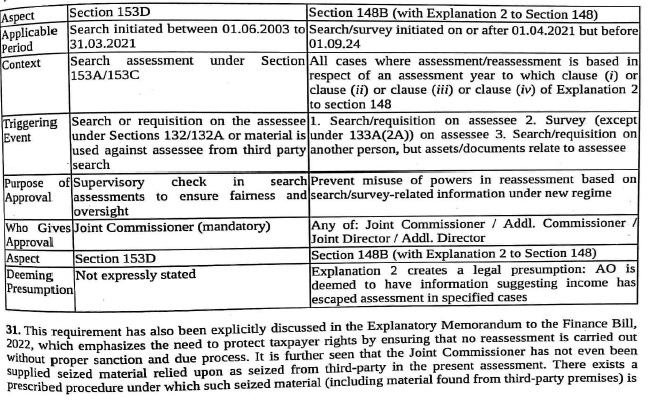
31. This requirement has also been explicitly discussed in the Explanatory Memorandum to the Finance Bill, 2022, which emphasizes the need to protect taxpayer rights by ensuring that no reassessment is carried out without proper sanction and due process. It is further seen that the Joint Commissioner has not even been supplied seized material relied upon as seized from third party in the present assessment. There exists a prescribed procedure under which such seized material (including material found from third-party premises) is to be forwarded to the approving authority at least 30 days in advance of granting approval. This procedural safeguard is crucial to prevent arbitrary and unregulated use of third-party material.
32. In the present case, there is no evidence to demonstrate that the prescribed procedure was followed, or that the Joint Commissioner was apprised of the seized material by forwarding copies of the documents found from the third party prior to framing the assessment. The complete failure to comply with the mandatory _provisions of section 148B renders the reassessment not only. procedurally defective but also without jurisdiction.
33. Even we find while framing the assessment under section 143(3), the Assessing Officer (AO) has, on the last page of the assessment order, referred to an approval obtained from the supervisory authority. However, a bare perusal of this approval 25 shows that it was obtained in reference to F. No. 299/36/2020/1DAR/INV3(3)/577 dated 15.07.2022, i.e., in accordance with the CBDT Circular dated 15th July 2022, and not under the mandatory provisions of section 148B of the Income tax Act, 1961. At the outset, it is important to note that the approval so obtained does not mention or consider any of the seized materials sourced from the third-party. searches conducted on Sh. Ajay Kumar Prabhakar and Sh. Ravi Kapoor, despite the AO having heavily. relied on those materials in framing the additions. The approval merely states that the appraisal report was considered, without any reference to the original documents seized or to the statutory procedure outlined under section 148B. It is pertinent to refer to the Manual of Office Procedure in February 2003, which lays down a mandatory protocol: that in all search cases, especially where material pertains to persons other than the one searched, such material is to be forwarded in original to the approving authority, and a draft order is required to be submitted for approval at least 30 days in advance. In the present case, the approval letter was issued by the DCIT only on 22nd August 2023, which clearly contravenes this procedural requirement. This procedural lapse is further compounded by the judgment of the Hon’ble Supreme Court in Serajuddin and Co. case, (SC) wherein it was held that in search cases, strict adherence to the approval protocol as laid down in the departmental Manual of Office Procedure in February 2003 and law is essential to uphold the validity of the assessment.
34. Thus, from the above, it is quite evident from the approval granted by the Addl.CIT(Central), there is no mention or consideration of the seized material sourced from the third party, namely Sh. Ajay Prabhakar and Sh. Ravi Kapoor, though, we find that in the assessment order and in the order of CIT(A), both the authorities have heavily relied upon on such seized material and it only states that the appraisal report have been considered without any reference to any original documents seized for statutory procedure outlined u/s 148. Thus, in view of above, the assessment as framed by Assessing Officer vide order dated 24.08.2023 is quashed.”
171. As observed above, in the instant case, the AO has not followed the procedure as provided in clause (iv) of Explanation 2 to section 148 of the Act and made the additions based on the entries alleged as found noted in the material seized from the possession of third person. Since no action of initiation of re-assessment proceedings was taken before making the additions and therefore, we are in agreement with the view taken by the Chandigarh bench of tribunal in the case of Homelife Buildcon (P.) Ltd. (supra) and accordingly, held that no addition could be made on the basis of the documents found and seized form the possession of third person without following procedure as prescribed in sub clause (iv) of Explanation 2 to section 148 and without obtaining mandatory approval from the prescribed authority to use such material against the assessee.
172. In view of above discussion, we delete the addition made on account of the entries found recorded in the documents found and seized from the possession of third person. Ground of appeal No.10 raised by the assessee is thus, allowed.
173. Coming to the Grounds of appeal Nos.11 & 12 of the Assessee wherein the assessee has challenged the additions of INR 84.00 crores on merits. At the outset it is observed that additions of similar nature were also made in AY 2020-21 and 2021-22 where the same were deleted by the ld. CIT(A) by holding that no incriminating material was found / seized pertaining to those years. However, for the year under appeal, ld. CIT(A) has confirmed the addition by observing that the material found and seized from the possession of MEPL contained name of the assessee.
174. While deciding this issue in AY 2020-21 in ITA No. 272//Del/2026, we have made detailed observations on the merits of the additions also and held that the additions was made solely on the basis of statements of one of the employee of MEPL which were rebutted by the assessee by filing every possible and credible evidences and thus in the absence of any link with the assessee of the material so found, no additions could be made, more particularly when no such money was found from the possession of the assessee as a result of search for which the provisions of section 69A could be invoked. Such observations are Mutatis Mutandis applicable to the fact of present appeal thus by respectfully following the same, even on merits, the additions made u/s 69A of the Act is hereby deleted.
175. In the result, appeal of the assessee is allowed.
176. In the final result, captioned three appeals of the assessee in IT(TP)A No.259/Del/2026 [Assessment Year 2020-21]; IT(TP)A No.260/Del/2026 [Assessment Year 2021-22]; & IT(TP)A No.280/Del/2026 [Assessment Year 2022-23] and both captioned appeals of the Revenue in IT(TP)A No.272/Del/2026 [Assessment Year 2020-21] and ITA No.5367/Del/2026 [Assessment Year 202122] are dismissed.
Order pronounced in the open Court on 21.08.2026.