


Operation Blue Skies: Reducing aviation climate impact with AI

Operation Blue Skies: Reducing aviation climate impact with AI
Google partnering with the UK Government and aviation leaders to use AI to help airlines avoid contrails over the North Atlantic, reducing aviation’s climate impact at airspace scale.
When you look up at a clear sky and see thin white lines trailing behind airplanes, you’re looking at condensation trails, or “contrails.” These are clouds created when water vapor condenses around soot particles in jet exhaust. While they may seem harmless, these warming contrails account for roughly one third of aviation’s total climate impact. Today, Google announcing a new step in our efforts to help the industry avoid contrails.
Since publishing our initial research on ways AI can help mitigate contrail warming, we’ve partnered across the aviation industry, working alongside airlines such as American Airlines, air navigation service providers like EUROCONTROL’s MUAC, and Flight Planning Software providers including FlightKeys, to demonstrate that avoiding warming contrails is both scientifically validated and operationally practical. Our AI-powered forecasts have enabled flight crews and air traffic controllers to make targeted adjustments that avoid contrail-sensitive regions while remaining within normal flight operations.
Now, google taking the next major step: expanding beyond individual airline trials to coordinated contrail mitigation across an entire flight corridor. Google launching Operation Blue Skies — the world’s first state-backed trial to avoid contrails at the scale of an entire oceanic airspace.
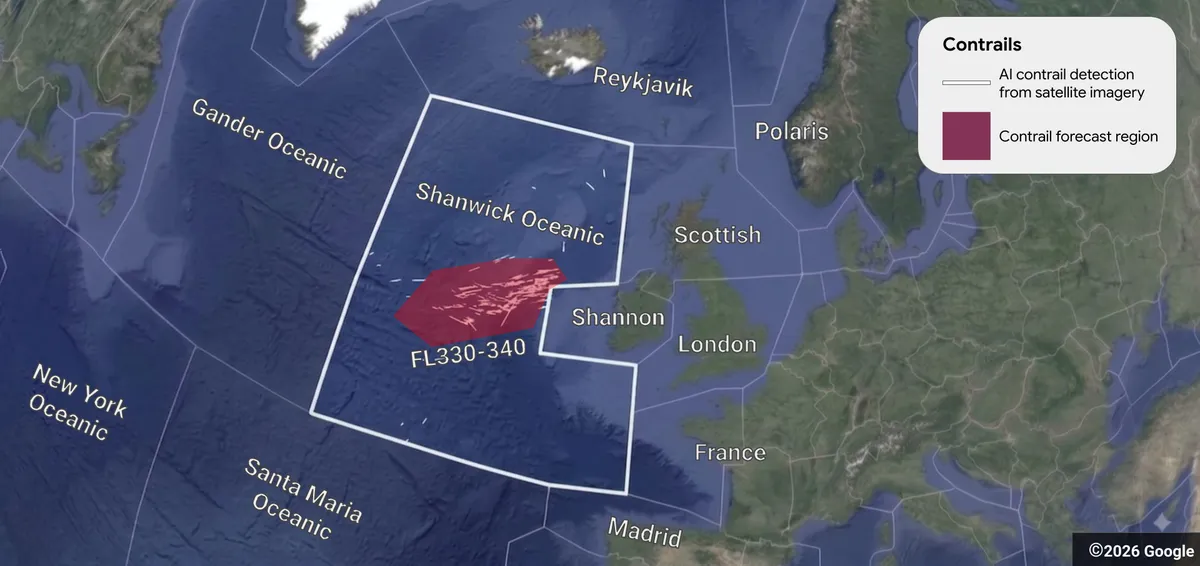
Operation Blue Skies will operate within the eastern half of the North Atlantic corridor, Shanwick airspace, which accounts for approximately 5% of global contrail warming. 1 The 30 month program consists of two operational trials, each lasting approximately four months. Around 10,000 flights, originating from hundreds of cities, will pass through Shanwick airspace during trial hours each year and a small percentage of these flights that would otherwise pass through contrail-sensitive airspace will be slightly deviated, preventing them from forming strongly warming contrails.
A landmark consortium for global impact
Achieving airspace-scale contrail avoidance requires close collaboration across science, technology, and air traffic management. Operation Blue Skies brings together a world-leading UK consortium with the expertise to turn cutting-edge research into operational reality:
- Google UK: Developing AI models to predict and avoid warming contrails, while using machine learning and satellite imaging to track and verify our impact.
- NATS (the UK’s leading air navigation service provider): Trial airspace operations, air traffic control coordination, safety assessment and air traffic controller training.
- Contrails.org: Leading forecast assessments, designing trial parameters, and supporting data analysis.
- Imperial College London & University of Cambridge: Evaluating trial outcomes and providing independent verification of climate impact.
- Met Office: Developing a new UK contrail forecast capability and ensuring meteorological accuracy throughout the trial.
Operation Blue Skies programme is co-funded by its industry partners and the Department for Transport (DfT) through the ATI Programme, a partnership between the Aerospace Technology Institute (ATI), the Department for Business, Innovation, Science and Trade (BIST) and Innovate UK. To ensure public funding directly advances sovereign scientific capabilities, 100% of the government grant funding is allocated directly to academic, non-profit, and aviation partners.
Google UK is participating on a pro-bono basis, contributing £1.4 million in-kind through AI research expertise, engineering time, and high-performance computing infrastructure to advance open climate science.
A blueprint for the future of flight
Contrails are one of the most urgent yet solvable climate challenges facing aviation today. Research suggests that avoiding contrails could be one of the most cost-effective ways to reduce aviation’s climate impact. 2 Addressing this challenge requires new approaches that combine scientific insight, advanced technology, and operational innovation. Operation Blue Skies aims to demonstrate that solving the challenge of contrails is operationally practical, providing a validated blueprint for how our airspaces can be managed to drastically reduce aviation’s climate impact.
If you’re part of the aviation industry and interested in advancing contrail mitigation through collaboration or participation, we’d love to hear from you. Please contact our team to learn more about opportunities to get involved.
The Problem: Planet-Warming Contrails
Key Elements of the Initiative
- The Airspace: The trial is centered in the Shanwick oceanic airspace (covering the eastern half of the North Atlantic corridor), which drives approximately 5% of global contrail warming. [1, 5]
- The AI Technology: Google’s AI-powered forecasts predict highly sensitive atmospheric zones where strongly warming contrails are likely to form. [1, 6]
- Minor Path Adjustments: Instead of major rerouting, air traffic controllers will issue small altitude changes—typically around 2,000 feet above or below the planned flight level. [6]
- The Fuel Penalty Debate: Changing altitude can cause a minor increase in fuel burn (around 100kg per affected aircraft). However, technical experts note that “the CO2 penalty is in the order of less than 1%, compared to the contrail cost,” making it an incredibly cost-effective climate win [EME Outlook Magazine]. [7, 8]
Operational Timeline & Coalition
- Trial Windows: The 4-month testing windows will run during the winters of 2026–2027 and 2027–2028.
- Scale: Roughly 10,000 flights passing through the airspace will be evaluated, with only a small percentage requiring actual flight path modifications. [5, 6]
| Consortium Partner | Core Role in Operation Blue Skies |
|---|---|
| Provides AI models, processing data, and predictive contrail-sensitive forecasting. | |
| UK Department for Transport & ATI | Backs the project with state funding to explore cleaner aviation pathways. |
| NATS & Contrails.org | Manages live operations and air traffic control channels in Shanwick airspace. |
| The Met Office | Delivers foundational meteorological data and localized weather tracking. |
| University of Cambridge & Imperial College London | Evaluates trial outcomes and provides independent scientific verification of climate impacts. |
Read more
. Xiaomi IFA 2026 Launch Event
. Bring your spreadsheet data to life with Sheets canvas
. Automate Drive, Gmail, and Google Chat actions with new steps in Workspace Studio
. Custom instructions for Gemini in Workspace now available in more apps
. Turn Google Docs, PDFs, and Word files into video summaries in Google Vids
. Use your voice to get more done in Gmail, Docs, and Keep
. First impressions of GPT-6 Astra from developers
. Introducing Gemini 3.7 Flash
. Reassessment proceedings initiated after
. The latest updates to Google Translate
for more refer Gemini website click here
for more refer Artificial Intelligence website click here