


Reassessment Completed Without Mandatory Section 143(2) Notice Is Without Jurisdiction and Void
Issue
Whether a reassessment completed under Section 147 read with Sections 144 and 144B is valid and sustainable when the Assessing Officer fails to issue a mandatory notice under Section 143(2) after the assessee specifically adopts an earlier filed return as the return furnished in response to a subsequent Section 148 notice.
Facts
-
The assessee filed their original return of income for Assessment Year 2013-14 on 18-10-2013, claiming long-term capital gains as exempt under Section 10(38).
-
Pursuant to the substituted reassessment regime following the Supreme Court judgment in Ashish Agarwal, reassessment proceedings were initiated, and a fresh notice under Section 148 was issued on 31-07-2022.
-
In response to an earlier notice under Section 148 issued under the erstwhile provisions, the assessee had already filed a return on 29-05-2021.
-
On 01-03-2023, the assessee made a formal communication requesting the Assessing Officer to treat the return filed on 29-05-2021 as the return furnished in response to the subsequent Section 148 notice dated 31-07-2022.
-
The Assessing Officer denied the Section 10(38) exemption, added the entire sale consideration as taxable income, and completed the reassessment under Section 147 read with Sections 144 and 144B on 09-05-2023.
-
The Assessing Officer completed the scrutiny assessment and made additions without issuing any notice under Section 143(2).
Decision
-
Adoption of Return: In favor of Assessee. Once the assessee specifically adopted the return filed earlier (on 29-05-2021) as the return furnished in response to the subsequent Section 148 notice, the Assessing Officer was legally required to issue a notice under Section 143(2) before scrutinizing the return and making additions.
-
Jurisdictional Requirement: In favor of Assessee. The requirement to issue a notice under Section 143(2) is not an empty procedural formality; it goes to the root of the Assessing Officer’s assumption of jurisdiction to make a scrutiny assessment.
-
Inapplicability of Finance Act, 2023 Amendment: In favor of Assessee. The third proviso to Section 148 (inserted by the Finance Act, 2023 w.e.f. 01-04-2023)—which states that a return furnished beyond the allowed period shall not be deemed to be a return under Section 139—did not apply because the assessee had already made a specific, valid request on 01-03-2023 to treat the previously filed return as the response.
-
Invalidity of Assessment: In favor of Assessee. The reassessment completed by the Assessing Officer without issuing the mandatory notice under Section 143(2) was without jurisdiction and could not be sustained.
Key Takeaways
-
Mandatory Nature of Section 143(2): Issuing a notice under Section 143(2) is a mandatory jurisdictional prerequisite before proceeding with a scrutiny assessment or reassessment; omitting it vitiates the entire proceeding.
-
Adoption of Prior Returns: When an assessee explicitly requests that an already-filed return be treated as the response to a newly issued Section 148 notice, that return stands validly adopted for the reassessment proceedings.
-
Procedural Safeguards Protect Taxpayers: Courts continue to strictly enforce statutory procedural safeguards, ruling that failures to follow foundational assessment steps cannot be brushed aside as mere procedural irregularities.
IN THE ITAT HYDERABAD BENCH ‘SMC’
Pankaj Kumar Baheti
v.
Income-tax Officer
VIJAY PAL RAO, Vice President
and MADHUSUDAN SAWDIA, Accountant Member
and MADHUSUDAN SAWDIA, Accountant Member
IT Appeal No. 1564 (Hyd) OF 2026
[Assessment year 2013-14]
[Assessment year 2013-14]
SEPTEMBER 16, 2026
Siddharth Toshnival, Adv. for the Appellant. B. Laxmi Kanth, Sr. AR for the Respondent.
ORDER
Madhusudan Sawdia, Accountant Member.-This appeal is filed by Shri Pankaj Kumar Baheti (“the assessee), feeling aggrieved by the order passed by the Learned Commissioner of Income Tax (Appeals), National Faceless Appeal Centre (NFAC), Delhi (“Ld. CIT(A)”) dated 20.03.2026 for the A.Y.2013-14.
2. The assessee has raised the following grounds of appeal:
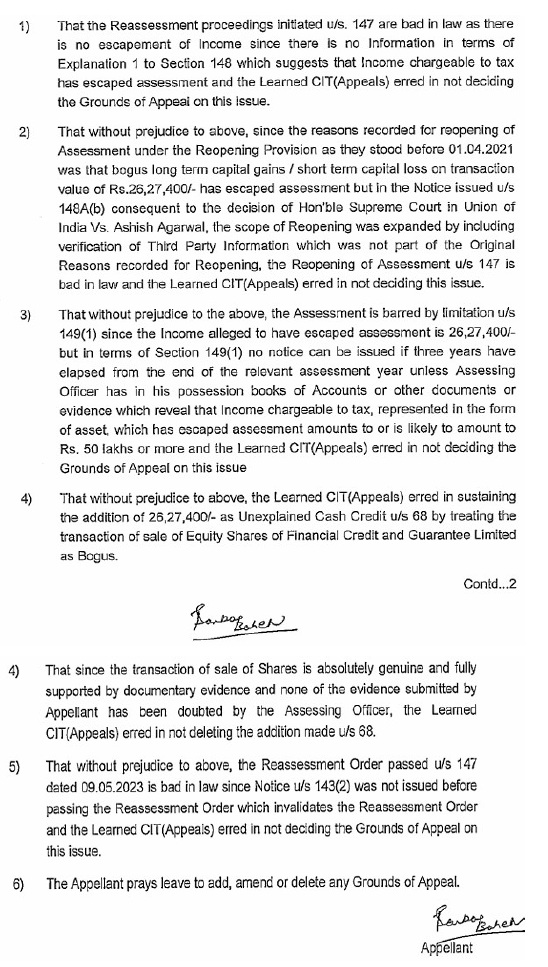
3. The brief facts of the case are that the assessee is an individual who had filed his return of income for the assessment year 2013-14 on 18.10.2013, declaring a total income of Rs. 11,38,610/-. The Assessing Officer observed that during the year under consideration, the assessee had sold shares amounting to Rs. 26,27,400/- and had claimed the resultant long-term capital gain as exempt under section 10(38) of the Income-tax Act, 1961 (“the Act”). Accordingly, reassessment proceedings were initiated in the case of the assessee and notice under section 148 of the Act was issued on 31.07.2022 after following the procedure pursuant to the judgment of the Hon’ble Supreme Court in the case of Union of India v. Ashish Agarwal 444 ITR 1 (SC), dated 04.05.2022. After considering the submissions of the assessee, the Assessing Officer denied the exemption claimed under section 10(38) of the Act in respect of the long-term capital gain arising from the sale of shares and added the entire sale consideration of Rs. 26,27,400/- to the income of the assessee. Accordingly, the Assessing Officer completed the assessment under section 147 read with sections 144 and 144B of the Act vide order dated 09.05.2023, assessing the total income of the assessee at Rs. 37,66,010/-.
4. Aggrieved by the assessment order, the assessee preferred an appeal before the Ld. CIT(A), who confirmed the addition made by the Assessing Officer and dismissed the appeal of the assessee.
5. Aggrieved by the order of the Ld. CIT(A), the assessee is in appeal before the Tribunal. The Learned Authorized Representative (“Ld. AR”) submitted that the ground no. 5 raised by the assessee involves a legal issue challenging the validity of the reassessment order on the ground that the Assessing Officer completed the reassessment without issuing the mandatory notice under section 143(2) of the Act. In this regard, the Ld. AR submitted that the assessee had specifically intimated the Assessing Officer vide reply dated 01.03.2023, placed at page no. 40 of the paper book, that the return of income filed by him on 29.05.2021 in response to the notice issued under section 148 under the erstwhile provisions of the Act may be treated as the return of income filed in response to the subsequent notice issued under section 148 under the amended provisions of the Act. Despite such specific intimation, the Assessing Officer proceeded to complete the reassessment without issuing any notice under section 143(2) of the Act. The Ld. AR, therefore, submitted that issuance of notice under section 143(2) of the Act being a mandatory jurisdictional requirement, the assessment framed without issuance of such notice is invalid and liable to be quashed.
6. Per contra, the Learned Departmental Representative (“Ld. DR”) submitted that the assessee had not filed any fresh return of income in response to the notice issued under section 148 under the amended provisions of the Act. According to the Ld. DR, a mere request made by the assessee that the return filed earlier in response to the notice issued under the erstwhile provisions may be treated as the return in response to the subsequent notice under section 148 cannot be equated with the filing of a return pursuant to the subsequent notice. The Ld. DR further submitted, in the alternative, that even if the assessee’s communication dated 01.03.2023 is considered as a request to treat the earlier return as the return filed in response to the subsequent notice under section 148 of the Act, the same was beyond the period prescribed in the notice dated 31.07.2022. Inviting our attention to the third proviso to section 148 of the Act, the Ld. DR submitted that a return furnished beyond the period allowed for furnishing the return shall not be deemed to be a return under section 139 of the Act. Therefore, according to the Ld. DR, once the return cannot be regarded as a return under section 139 of the Act, there was no requirement for the Assessing Officer to issue a notice under section 143(2) of the Act. Accordingly, the Ld. DR prayed that the legal ground raised by the assessee be dismissed.
7. We have heard the rival submissions and perused the material available on record. We have also gone through the relevant statutory provisions and the material placed in the paper book. There is no dispute before us that the Assessing Officer has completed the reassessment without issuing any notice under section 143(2) of the Act. The principal controversy is whether, in the facts of the present case, the assessee can be regarded as having furnished a return in response to the notice issued under section 148 of the Act dated 31.07.2022 so as to attract the mandatory requirement of issuance of notice under section 143(2) of the Act. It is an admitted position that the assessee had already filed a return of income on 29.05.2021 in response to the earlier notice issued under section 148 under the erstwhile provisions of the Act. Pursuant to the judgment of the Hon’ble Supreme Court in Ashish Agarwal (supra), the proceedings were thereafter continued under the substituted reassessment regime and a fresh notice under section 148 was issued on 31.07.2022. In this regard, we have gone through the submission of the assessee, dated 01.03.2023 placed at page no. 40 of the paper book, which is to the following effect:
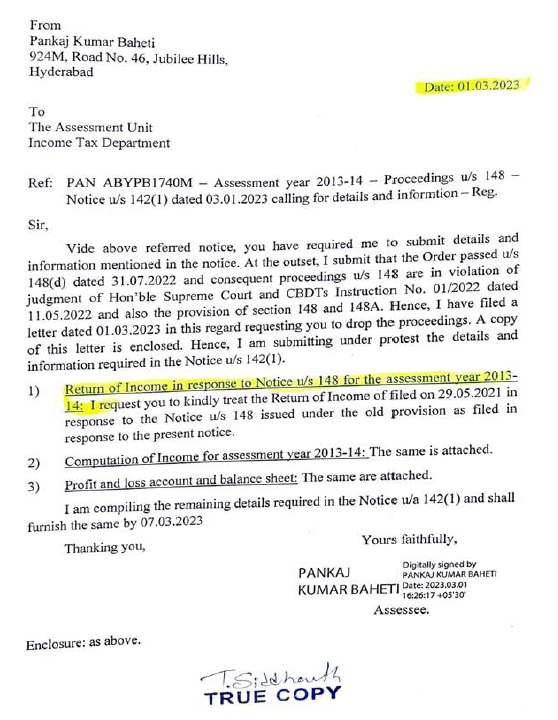
8. On perusal of the above, we find that the assessee, vide its communication dated 01.03.2023, specifically requested the Assessing Officer to treat the return already filed on 29.05.2021 as the return filed in compliance with the subsequent notice under section 148 of the Act. It is pertinent that under section 148 of the Act, as it then stood, the provisions of the Act were to apply to a return furnished pursuant thereto, so far as may be, as if such return were a return required to be furnished under section 139 of the Act. In our considered view, the objection of the Ld. DR that such communication cannot amount to furnishing a return in response to the subsequent notice under section 148 of the Act cannot be accepted in the peculiar facts of the present case. Once a return of income for the very same assessment year was already available with the Assessing Officer and the assessee specifically and unequivocally communicated that such return should be treated as the return furnished in response to the subsequent notice under section 148 of the Act, there was no requirement in law for the assessee to mechanically upload an identical return once again merely for the purpose of completing a procedural formality. The substance of the assessee’s communication was clear and unambiguous, namely, that the return already furnished should constitute its return in response to the subsequent notice. Once such request was made and the Assessing Officer proceeded with the reassessment on that basis, the return already on record was required to be treated as the return furnished in response to the subsequent notice under section 148 of the Act. Consequently, if the Assessing Officer intended to scrutinize such return and make additions to the income returned therein, compliance with the mandatory requirement of section 143(2) of the Act was necessary.
9. We also do not find merit in the alternative contention of the Ld. DR based upon the third proviso to section 148, which is to the following effect:
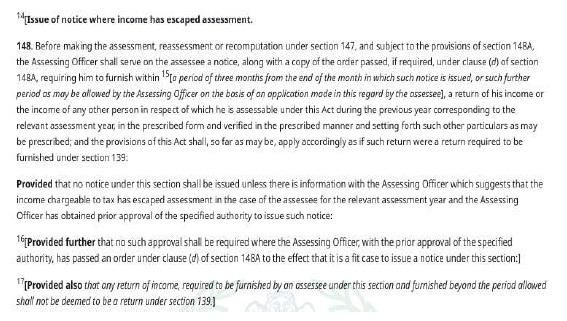
10. On perusal of the above, it is evident that the third proviso providing that a return furnished beyond the period allowed shall not be deemed to be a return under section 139 of the Act, was introduced by the Finance Act, 2023 with effect from 01.04.2023. In the present case, the assessee had already made the specific request on 01.03.2023 to treat the return earlier filed on 29.05.2021 as the return furnished in response to the subsequent notice under section 148 of the Act. Thus, on the date on which the assessee made the said request, the third proviso relied upon by the Revenue was not on the statute book. Therefore, a substantive consequence introduced by the Finance Act, 2023 with effect from 01.04.2023, namely, that a return furnished beyond the permitted period would not be deemed to be a return under section 139 of the Act, cannot be invoked to retrospectively alter the legal character of the assessee’s return/request made on 01.03.2023. We are, therefore, unable to accept the contention of the Ld. DR that, by virtue of the subsequently inserted third proviso to section 148 of the Act, the return of the assessee should be treated as a non est return and consequently no notice under section 143(2) of the Act was required to be issued. Once the return filed earlier by the assessee was specifically adopted by him as the return in response to the subsequent notice under section 148 of the Act, the Assessing Officer, before proceeding to scrutinize the return and make additions thereto, was required to issue notice under section 143(2) of the Act. The requirement of issuance of such notice is not an empty procedural formality but goes to the assumption of jurisdiction to make a scrutiny assessment. Admittedly, no notice under section 143(2) of the Act was issued in the present case.
11. In view of the foregoing discussion, we hold that the reassessment completed by the Assessing Officer without issuance of the mandatory notice under section 143(2) of the Act is without jurisdiction and, therefore, cannot be sustained. Accordingly, the assessment order passed under section 147 read with sections 144 and 144B of the Act dated 09.05.2023 is hereby quashed. Consequently, ground no. 5 raised by the assessee is allowed.
12. Since we have quashed the reassessment itself on the aforesaid jurisdictional ground, the other grounds raised by the assessee challenging the addition on merits have become academic and, therefore, do not require separate adjudication.
13. In the result, the appeal filed by the assessee is allowed.