


Ad Ad Hoc Disallowance of Purchases and Business Expenses Is Unsustainable Without Independent Verification or Defect in Books
Issue
Whether the Assessing Officer is justified in making an ad hoc disallowance of 50% of purchases under Section 69C and ad hoc disallowances of labor/salary and business expenses under Section 37(1), without conducting independent inquiries, issuing notices under Section 133(6), or rejecting the books of account, particularly when Form GSTR-2A and supporting particulars were furnished.
Facts
-
Background: The assessee, an individual working as a Government contractor, filed an income tax return that was selected for scrutiny.
-
Unexplained Expenditure Addition (Issue I): The Assessing Officer (AO) treated 50% of total purchases as unexplained expenditure under Section 69C due to non-compliance with initial notices.
-
Ad Hoc Expense Disallowances (Issue II): The AO also made ad hoc disallowances against the assessee’s claimed labor/salary and office/business expenses.
-
Remand Proceedings: On appeal, the assessee submitted additional evidence—including Form GSTR-2A, ledger accounts, and supporting expense particulars—which was forwarded to the AO for a remand report.
-
AO’s Failure to Verify: In the remand report, the AO dismissed Form GSTR-2A as insufficient evidence without conducting any independent verification, issuing notices under Section 133(6) to suppliers, pointing out specific defects in the books, or proving any expenditure to be fictitious or non-business-related.
-
Financial Consistency: The Revenue accepted the assessee’s contract receipts without rejecting the books of account, and the declared gross profit (GP) and net profit (NP) ratios remained consistent with preceding years.
Decision
-
Issue I (Unexplained Purchases u/s 69C): Held in favor of the assessee. Form GSTR-2A serves as significant corroborative evidence for purchases and cannot be brushed aside without proper verification. An ad hoc 50% disallowance is legally untenable when contract receipts are accepted, books of account are not rejected, and profit ratios align with historical trends.
-
Issue II (Ad Hoc Expense Disallowance u/s 37(1)): Held in favor of the assessee. Ad hoc disallowances of labor, salary, and business expenses are completely unsustainable when the AO fails to identify specific defects in the books or produce material evidence disproving the genuineness of the claims.
Key Takeaways
-
GSTR-2A as Valid Corroborative Evidence: Form GSTR-2A constitutes credible documentary proof of purchases that tax authorities cannot summarily reject without undertaking independent verification or issuing third-party summons under Section 133(6).
-
Impermissibility of Ad Hoc Additions: Disallowances under Section 69C or Section 37(1) cannot be made on arbitrary percentages or pure conjecture without establishing that the underlying transactions are fictitious.
-
Integrity of Unrejected Books: If the Revenue accepts an assessee’s gross receipts and books of account, and the profit margins are consistent with past years, it cannot selectively disallow underlying expenses without demonstrating explicit defects.
-
Burden of Proof in Remand: During remand proceedings, the Assessing Officer bears the responsibility of conducting proper inquiries rather than issuing blanket rejections of additional evidence.
IN THE ITAT CHENNAI BENCH ‘C’
Deputy Commissioner Income Tax
v.
Gunasekaran
George George K., Vice President
and Ms. Padmavathy S., Accountant Member
and Ms. Padmavathy S., Accountant Member
IT Appeal No. 467 (CHNY.) of 2026
[Assessment year 2022-23]
[Assessment year 2022-23]
JULY 21, 2026
Alagappan V., Adv. for the Appellant. Ms. Nayani Swapna, CIT for the Respondent.
ORDER
Padmavathy S., Accountant Member. – This appeal by the Revenue is against the order of the Commissioner of Income Tax (Appeals)/National Faceless Appeal Centre (NFAC), Delhi, (in short “CIT(A)”) passed u/s. 250 of the Income Tax Act, 1961 (in short “the Act”) dated 12.11.2025 for Assessment Year (AY) 2022-23. The grounds of appeal raised by the Revenue are as under:
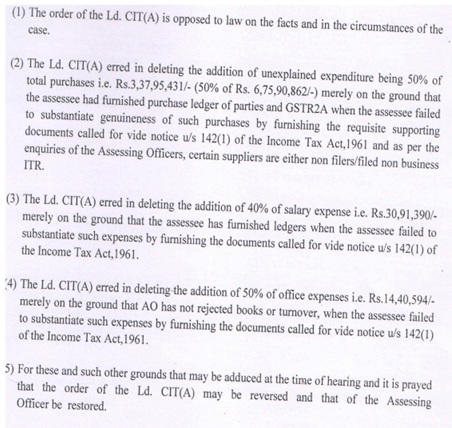
2. The assessee is an individual and is a Government contractor engaged in the business of construction and supply and installation of venial sticker, radium sticker and erection of boards on roads painting of traffic signal etc. The assessee filed the return of income for AY 2023-24 on 22.12.2022 declaring total income of Rs.29,03,780/-. The case was selected for scrutiny and the statutory notices were duly served on the assessee. The A.O issued various notices calling on the assessee to furnish details pertaining to the expenses claimed towards purchases, salary and office expenses. Since the assessee did not respond to the notices, the A.O treated 50% of the purchases and expenses as unexplained to make an addition u/s. 69C of the Act. Aggrieved, the Revenue filed further appeal before the CIT(A). Before the CIT(A), the assessee submitted various details and the CIT(A) called for a remand report from the A.O. The CIT(A) after considering the remand report and the details furnished by the assessee deleted the addition made by the A.O by holding that:
9.3.1 During the appellate proceedings, the appellant submitted that he had already provided supporting documentary evidences for purchases vide reply dated 24-03- 2024 before the Assessing Officer, however the said reply was not considered while passing the final assessment order on 25-03-2024. He stated that the original time given for reply to Show Cause Notice was only 3 days (i.e. 10-03-2024 to 13-03- 2024). However, he managed to submit the reply on 24-03-2024, before the passing of the assessment order and hence his submissions ought to have been considered at the time of finalising the assessment order. Additionally, before the FAA, he also furnished copy of Form GSTR-2A and stated that from the date GST has been introduced, all suppliers are required to inform the GST Department, what they have supplied, when they have supplied, with invoice number and purchase value through GSTR1. The GST Department will prepare Form GSTR-2A summarizing all purchases made by a particular assessee using the data submitted by all the suppliers through GSTR-1. There can be no better evidence for purchases than GSTR-2A. Out of the total purchase of Rs. 6,75,94,921/-, the appellant stated that he had made purchase amounting to Rs. 6,11,94,271/- from GST Registered suppliers. The other purchases of Rs. 64,00,650/- are from unregistered/non-filers of GST. These purchases are related to sand, bricks and blue metal. These are normally purchased from unregistered suppliers (in the civil construction business). But without these materials, civil construction works cannot be completed. As stated in the facts, the appellant has received payments from his customers only after completion of work and measurement and acceptance by the officers of the Government Departments.
9.3.2 The form GSTR-2A, being in the nature of additional evidence, was forwarded to the JAO for his comments. The JAO has remarked in the remand reports that the appellant has filed a GSTR 2A statement now but from that it is not clear whether they were all related to the appellant, whether due payments were made through banking channels, duly reflected in the books of account, supported by bills etc., The appellant has also not given any explanation alongwith that. The appellant failed to provide the details with credible supporting evidence before the AO also. Except the general claims that there were purchases from registered suppliers as per GST and other purchases from unregistered / non-filers has not produced any supporting evidence either before the AO or the appellate authority. Hence in the absence of corroborative material evidence the GSTR form alone cannot be taken as a conclusive evidence to prove the claim of purchases. In his rejoinder to the remand reports, the appellant has contended that the Form GSTR-2A data has been furnished as evidence in support of the purchases, which serves as a credible and verifiable proof of such transactions. The AO could have easily verified the authenti city of this information through the GST Department, since all suppliers are required to report details of their outward supplies in their GSTR-1 returns. Based on this information, the GST system automatically generates Form GSTR-2A for the recipient, summarizing all purchases reported by the suppliers. The GSTR-2A data only shows the purchase made by a particular person from the Registered Suppliers. It cannot contain any other person’s purchase details. This document, derived directly from the statutory filings of the suppliers it serves as strong evidences of genuine purchases. Therefore, disregarding the GSTR-2A data and dismissing its evidentiary value on the ground that it does not explain or substantiate the purchases is contrary to the principles of fair assessment.
9.3.3 Upon careful examination of the assessment order, the remand reports and the submissions made by the appellant, I am of the considered view that the contentions of the appellant are tenable. It is not the case that during the assessment proceedings, the Assessing Officer had carried out in-depth verification of the purchase parties by issuing notices u/s 133(6) of the Act and had found them to be bogus or non-existent. Nor was there any specific information with the Assessing Officer from the Investigation Wing or other enforcement agencies with regard to any purchase party being bogus or non-existent. Further, it has been observed from CPC 2.0 portal that the appellant had indeed submitted reply before the A.O on 24-03- 2024 along with 27 enclosures. These documents included purchase details such as name of purchase parties, GST no and PAN, complete purchase ledger account and ledger accounts of major sundry creditors. These evidences were further corroborated by the submission of Form GSTR-2A before the FAA. It is pertinent to mention that Form GSTR-2A is a system-generated Statement of Inward Supplies for a recipient wherein all the invoices uploaded by supplier in their Form GSTR-1 /5/1A are collated. It is basically a complete record of all the invoices received from various suppliers in a given tax period. It is a readonly document and no changes can be made or invoices added to Form GSTR-2A.It is noted that neither did the Assessing Officer verify the submissions made before him by the appellant vide reply dated 24- 032024, nor the JAO made any independent verification of the invoice-wise and party-wise purchase details contained in the Form GSTR-2A. The JAO has summarily dismissed the Form GSTR-2A as having no evidentiary value, without objectively examining the details furnished by the appellant. Furthermore, from the perusal of the turnover, gross profit and net profit details for the last 5 years, it is seen that there is not much variation in the net profit declared over the years. The average gross profit for the Assessment Years 2017-18 to 2021-22 comes to 6.34% whereas appellant has declared the gross profit at 7.14% during the year under consideration. The average net profit for the Assessment Years 2017-18 to 2021-22 comes to 3.27% whereas appellant has declared the net profit at 3.28% during the year under consideration. Thus, the Assessing Officer has accepted the book results, however, he has arbitrarily disallowed 50% of purchases for the year without carrying out any independent verification at his end. In view of the above facts, there appears to be no valid ground to disallow in an ad hoc manner 50 % of the purchases made by the appellant during the year.
9.4.1 Upon careful examination of the assessment order and the submissions made by the appellant, I am of the considered view that the contentions of the appellant are tenable. It is evident from the CPC 2.0 portal that the appellant had furnished before the Assessing Officer the complete ledger account of the impugned expenses containing a detailed date-wise narration for each of the entries , name of the payee and voucher numbers. Given the voluminous nature of the transactions, verification of the sample invoices on a test-check basis could have been done by the Assessing Officer. It was incumbent upon the Assessing Officer to verify the same and point out specific defects/ discrepancies/ mismatch in the documents furnished by the appellant. However, no such exercise has been carried out by the Assessing Officer. Further, if he doubted the authenticity of the above transactions, the Assessing Officer ought to have conducted separate enquiries with the respective parties to verify the genuineness of the above transactions. However, no such exercise has been carried out by the Assessing Officer. The only reason for making an ad-hoc disallowance of 40% of the above expenses was that documentary evidences have not been submitted by the appellant. It is not even the Assessing Officer’s case that the impugned expenses are fictitious or bogus in nature, or that these were specifically prohibited under section 37 of the IT Act. It is trite law that ad hoc disallowances are not permitted and unless specific adverse material is brought on the record, the Assessing Officer is not allowed to make disallowances/ additions merely on conjectures and on subjective basis. In this case, the Assessing Officer has not provided any reasonable or sound basis for accepting 60% of the above expenses, while randomly disallowing 40% of the same. Therefore, it is inferred that the Assessing Officer arbitrarily chose to disallow 40% of impugned expenses without attributing any particular reason for the same.
9.4.2 Thus, in the light of the above facts and discussion, the ad hoc disallowance of 40% of the salary expenses amounting to Rs.30,91,390/- is directed to be deleted. Hence, this ground is allowed.
9.5. Through Ground no.6, the appellant has contested against making an ad-hoc addition of Rs.14,40,594/- 50% of office expenses. It is seen from the assessment order that the Assessing Officer disallowed an amount of Rs.14,40,594/- being 50% of office expenses amounting to Rs. 28,81,188/-claimed in the trading account, for which no documentary evidence proving their genuineness were submitted during the assessment proceedings.During the appellate proceedings, the appellant has stated that he has reported total office expenses of Rs. 28,81,188/-, which constitutes just 3% of the total turnover of Rs. 7,47,04,376/-.Some of the expenses were paid through Bank and remaining were paid in cash. Given that 3% is nominal size for these expenses, it is clear they were necessary for generating sales, without making those payments, business operations wouldn’t have been possible, and profits wouldn’t have accrued. Since the Assessing Officer has neither rejected the books of account nor challenged the turnover, any disallowance of these expenses must rely on tangible evidence that these expenses were not incurred exclusively for business purposes. Accordingly, an arbitrary 50%disallowance of these expenses as lacking proper evidences would be legally incorrect.
9.5.1 Upon careful examination of the assessment order and the submissions made by the appellant, I am of the considered view that the contentions of the appellant are tenable. It is evident from the CPC 2.0 portal that the appellant had furnished before the Assessing Officer the complete ledger accounts of the impugned expenses. Given the voluminous nature of the transactions, verification of the sample invoices on a testcheck basis could have been done by the Assessing Officer. It was incumbent upon the Assessing Officer to verify the same and point out specific defects/ discrepancies/ mismatch in the documents furnished by the appellant. However, no such exercise has been carried out by the Assessing Officer. Further, if he doubted the authenticity of the above transactions, the Assessing Officer ought to have conducted separate enquiries with the respective parties to verify the genuineness of the above transactions. However, no such exercise has been carried out by the Assessing Officer. The only reason for making an ad-hoc disallowance of 50 % of the above expenses was that documentary evidences have not been submitted by the appellant. It is not even the Assessing Officer’s case that the impugned expenses are fictitious or bogus in nature, or that these were specifically prohibited under section 37 of the IT Act. It is trite law that ad hoc disallowances are not permitted and unless specific adverse material is brought on the record, the Assessing Officer is not allowed to make disallowances/ additions merely on conjectures and on subjective basis. In this case, the Assessing Officer has not provided any reasonable or sound basis for accepting 50% of the above expenses, while randomly disallowing 50 % of the same. Therefore, it is inferred that the Assessing Officer arbitrarily chose to disallow 50 % of impugned expenses without attributing any particular reason for the same.”
3. The Ld. Departmental Representative (DR), on the other hand, submitted that the CIT(A) has merely relied on the GST return to conclude that the purchases of the assessee are genuine, whereas the A.O has made the impugned disallowance for the reason that the assessee has not produced evidences with regard to the receipt of materials such as transport bills etc. The Ld. DR further submitted that unless the movement of goods are substantiated the claim of the assessee towards the purchases cannot be accepted and accordingly supported the disallowance made by the A.O. The Ld. DR with regard to the disallowance made towards salary and other expenses submitted that the details submitted by the assessee during remand proceedings were not sufficient and the explanations provided are vague. Accordingly, the ld. DR submitted that the A.O while rightly made the disallowance towards the salary and other expenses.
4. The Ld. Authorized Representative (AR) of the assessee, on the other hand, submitted that the CIT(A) while deleting the disallowance towards purchases has placed reliance on GSTR-2A which is uploaded by the vendors and which is not controlled by the assessee. The Ld. AR further submitted that for generation of GSTR-2A the various details including transport bills had to be furnished by the vendors towards outward supply in their GSTR-1. The ld. AR therefore submitted that the CIT(A) has correctly placed reliance on the said return and has deleted the disallowance. With regard to the disallowance towards salary and other expenses, the Ld. AR submitted that due to volume of transactions involved in the line of business, the assessee is engaged in the entire vouchers and supporting evidences could not be submitted basis which the A.O has made the disallowance. The Ld. AR also submitted that the A.O has not questioned the genuineness of the transactions and has not rejected the books of accounts before making the disallowance. The Ld. AR also submitted that the accounts of the assessee are subject to audit and making an adhoc disallowance merely for the reason that the assessee has not submitted the entire bills and vouchers pertaining to the impugned payments cannot be sustained. Accordingly, the Ld. AR supported the order of the CIT(A).
Disallowance of purchases
5. We have considered the rival submissions and perused the material available on record. We notice that during the appellate proceedings, the assessee furnished additional evidences including party-wise purchase details, purchase ledger, GST particulars and Form GSTR-2A, which were forwarded to the Assessing Officer for examination in the remand proceedings. We further notice that in the remand report, however, the A.O. has merely stated that Form GSTR-2A by itself is not sufficient evidence, without carrying out any independent verification of the purchases or the suppliers. We also notice that the A.O. neither examined the invoice-wise details reflected in Form GSTR-2A nor verified the transactions from the suppliers, books of account or banking channels. Further no notices were issued under section 133(6) of the Act to suppliers and no material was brought on record to establish that any of the suppliers were non-existent or that the purchases were fictitious.
6. It is relevant to mention here that Form GSTR-2A is not a document generated by the assessee but is a system-generated, read-only statement of inward supplies made available on the common GST portal. Form GSTR-2A is auto-populated from the outward supplies declared by the respective suppliers in their statutory GST returns, principally Form GSTR-1, and contains invoice-wise particulars such as the supplier’s GSTIN, invoice number, invoice date, taxable value and tax charged. Accordingly in our considered view there is no infirmity in the findings of the CIT(A) that Form GSTR-2A constitutes a significant corroborative piece of evidence regarding the existence of the underlying purchase transactions and that the same cannot be brushed aside without conducting any verification of the information reflected therein. We further note that the books of account have not been rejected, the contract receipts have been accepted and the declared gross profit and net profit are broadly consistent with those disclosed in the earlier years. In these circumstances, an ad hoc disallowance of 50% of the purchases, without any cogent material establishing that the expenditure was either bogus or non-genuine, is not tenable. Even during the proceedings before us, the ld DR did not bring any new material on record in this regard. We, therefore, see no reason to interfere with the finding of the ld. CIT(A) that the A.O. failed to dislodge the evidences produced by the assessee even after the remand proceedings and consequently find no reason to interfere with the order of the CIT(A) deleting the addition.
Disallowance of Labour Charges and Other Business Expenses
7. We have considered the rival submissions and perused the material available on record. We find no infirmity in the order of the ld. CIT(A) deleting the ad hoc disallowance of labour charges and other business expenses. It is an admitted position that during the appellate proceedings the assessee furnished the relevant ledger accounts and supporting particulars, which were forwarded to the Assessing Officer for verification in the remand proceedings. However, neither during the assessment proceedings nor in the remand proceedings did the Assessing Officer point out any specific defect in the books of account or identify any particular expenditure as fictitious, excessive or not incurred wholly and exclusively for the purposes of business. Further no independent enquiry was conducted with the payees or other concerned parties, nor was any material brought on record to discredit the genuineness of the expenditure claimed by the assessee. The remand report merely reiterates the observations made in the assessment order without rebutting the evidences furnished by the assessee or recording any adverse findings based on verification. In these circumstances, the disallowances have been made purely on an ad hoc basis without any supporting material. It is well settled that no disallowance can be sustained merely on suspicion, conjectures or surmises in the absence of any cogent evidence demonstrating that the expenditure is not genuine or is not allowable under the Act. Since the Revenue, despite having the benefit of remand proceedings, failed to substantiate the basis for the impugned disallowances, we concur with the finding of the ld. CIT(A) that the ad hoc disallowances are unsustainable. Accordingly, we find no reason to interfere with the order of the ld. CIT(A) deleting the disallowance of labour charges and other business expenses.
8. In result, the appeal of the Revenue is dismissed.