


Irrecoverable VAT/CST Refunds and Valid Debt Write-Offs Are Allowable Deductions Under Income-Tax Act
Issue
Whether write-offs of irrecoverable VAT/CST refunds and trade debts with proper accounting entries constitute allowable deductions under Sections 28/37(1) or 36(1)(vii), and whether Section 14A interest disallowance applies when own interest-free funds exceed investments.
Facts
-
Issue I (Write-off of VAT/CST Refund): For AY 2009-10, the assessee, a textile manufacturing and trading company, claimed a deduction for writing off a VAT/CST refund that became irrecoverable due to sales returns and procedural delays. The AO disallowed it as a bad debt under Section 36(1)(vii).
-
Issue II (Bad Debts Written Off – AY 2009-10): The assessee claimed a deduction for bad debts written off regarding outstanding dues from parties ‘BB’ and ‘BP’ due to quality defects and unrecovered balances. The AO disallowed the claim because the underlying sales pertained to AY 2008-09 rather than AY 2009-10.
-
Issue III (Bad Debts Written Off – AY 2010-11): The assessee claimed a bad debt deduction for write-offs relating to sales returned by party ‘BB’. The AO disallowed the claim on the premise that the sales were not offered to tax in earlier years.
-
Issue IV (Section 14A Disallowance): For AY 2010-11, the assessee earned dividend income from investments in shares and mutual funds. The AO applied Rule 8D to make interest and administrative expense disallowances under Section 14A. The CIT(A) deleted the interest disallowance under Rule 8D(2)(ii) because the assessee’s own interest-free funds exceeded the investments, but upheld the administrative expense disallowance under Rule 8D(2)(iii) in the absence of separate accounts.
Decision
-
Issue I (VAT/CST Refund Write-off): Held in favor of the assessee. The loss of the VAT/CST refund was directly related to business operations and incurred in the ordinary course of business. Hence, it is allowable as a business loss under Section 28 / Section 37(1).
-
Issue II (Bad Debts Write-off for Past Sales): Held in favor of the assessee. Since the assessee furnished ledger accounts, book entries, and explanations showing that the underlying sales were offered to tax in prior years and subsequently written off as irrecoverable, the deduction is allowable under Section 36(1)(vii).
-
Issue III (Bad Debts on Returned Sales): Held in favor of the assessee. The record established that the sales were previously offered to tax in the computation of income and subsequently written off due to sales returns; the addition was deleted.
-
Issue IV (Section 14A & Rule 8D Disallowance): Held partly in favor of the assessee. The CIT(A)’s order was upheld: interest expense disallowance was rightly deleted due to sufficiency of own funds, while administrative expense disallowance under Rule 8D was justified due to lack of separate accounts.
Key Takeaways
-
Business Loss vs. Bad Debt: An irrecoverable government refund (such as VAT/CST) tied to normal business transactions is deductible as a business loss under Section 28 or Section 37(1), even if it fails to strictly qualify as a trade debt under Section 36(1)(vii).
-
Prior-Year Sales Eligibility for Bad Debts: Bad debts written off under Section 36(1)(vii) do not need to originate from sales made in the current assessment year, provided the income was offered to tax in a previous year and actual write-off entries are made in the books of account.
-
Write-Off for Sales Returns: Uncollectible amounts arising from sales returns or quality defects qualify for bad debt deduction under Section 36(1)(vii) once written off, provided the original sales were part of income computations.
-
Presumption of Own Funds Under Section 14A: Where an assessee possesses interest-free funds exceeding its tax-exempt investments, it is presumed that own funds were utilized, negating interest disallowances under Rule 8D(2)(ii).
-
Administrative Disallowance under Section 14A: In the absence of separate accounts segregating expenses for earning exempt income, tax authorities can invoke Rule 8D to quantify indirect administrative disallowances.
IN THE ITAT MUMBAI BENCH ‘B’
Bayer Bioscience (P.) Ltd.
v.
Assistant Commissioner of Income-tax (OSD) – 10
SAKTIJIT DEY, Vice President
and Prabhash Shankar, Accountant Member
and Prabhash Shankar, Accountant Member
IT Appeal Nos. 555 & 556 (MUM) OF 2025
[Assessment years 2009-10 and 2010-11]
[Assessment years 2009-10 and 2010-11]
JULY 2, 2026
Rahul Hakani, AR for the Appellant. Swapnil Choudhari, Sr.DR. for the Respondent.
ORDER
Prabhash Shankar, Accountant Member.- The captioned appeals emanating from the appellate orders dated 06.03.2020 and 13.03.2020 are preferred by the assessee against the orders passed by the Learned Commissioner of Income-tax (Appeals) [hereinafter referred to as “CIT(A)”] pertaining to the assessment orders passed u/s. 143(3) of the Income-tax Act, 1961 [hereinafter referred to as “Act”] dated 05.03.2013 and 31.01.2014 respectively for the Assessment Years [A.Y.] 2009-10 and 2010-11.We take appeal for the AY 2009-10 first as below.
2. It was noticed that the appeal is delayed by 918 days. The assessee filed an application for condonation of the delay admitting the same after excluding the covid period of 807 days as per the decision of the Supreme Court in Cognizance for Extension of Limitation, In re 441 ITR 722 (SC)/ suo motuW.P. (C) No. 3 of 2020 dated 10th January 2022. It is also submitted that the appellate order was not received by the assessee at its physical address or on its email-id mentioned in the return of income AY 2019-20 i.e. padmashri.joshi@bayer.com. Further, it was also not received on email-id mentioned on the income tax portal i.e. padmashri.joshi@bayer.com. The assessee had filed physical appeal before the CIT(A) wherein e-mail ID was not required to be mentioned in the said Form 35.The CIT(A) order dated 06th March 2020 was uploaded on the Income Tax Portal on 04th May 2020. However, due to the covid-19 pandemic and nationwide lockdown imposed on that account and the resultant disruption, the assessee could not take note of the order and was under the impression that the matter was still pending with him for passing the order. The delay in filing the present appeal was thus, attributable to genuine circumstances beyond the control of the assessee and was occasioned by bona fide and sufficient cause and unintentional. It is submitted that the expression ‘sufficient cause’ must receive a liberal construction so as to advance substantial justice and generally delays in preferring the appeals are required to be condoned in interest of justice. A litigation does not stand to benefit by resorting to delay, therefore a justice oriented approach is required by courts. The assessee further submitted that refusing to condone delay can result in a meritorious matter being thrown out at the very threshold and cause of justice being defeated. It was requested to consider the facts of the case and condone the delay days, more so when the assessee has a good case on merits.
3. On careful consideration of the submissions of the assessee,we are of the view that the delay does not appear to be intentional but due to unavoidable and sufficient cause. In this connection, reliance could be placed on the landmark decision of hon’ble Supreme Court which inter alia held in Collector, Land Acquisition v. Mst. Katiji [1987] 167 ITR 471 (SC) that “ordinarily, a litigant does not stand to benefit by lodging an appeal late.Refusing to condone delay can result in a meritorious matter being thrown out at the very threshold and cause of justice being defeated.Any appeal or any application, other than an application under any of the provisions of Order XXI of the Code of Civil Procedure, 1908, may be admitted after the prescribed period if the appellant or the applicant satisfies the court that he had sufficient cause for not preferring the appeal or making the application within such period. A litigant does not stand to benefit by resorting to delay. In fact, he runs serious risk.” We find therefore, condone the delayand proceed to adjudicate the appeal on merits.
4. ITA No. 555/MUM/2O25(AY 2009-10)
The grounds of appeal are as under:
“1. Ground No. 1: Denial of deduction for sales tax expenses of INR 19,35,518 under section 36(1)(vii) or section 37(1) of the IT Act.
1.1 On facts of the case and in law, Learned CIT(A) haserred in upholding the disallowance made by the Learned Assessing Officer (“Ld. AO”) for the sales tax expense of an amount of INR 19,35,518 claimed by the Appellant on the grounds that the said amount cannot be claimed a deduction w/s 36(1(vii) or section 37(1) of the IT Act.
1.2 Without prejudice to the above, if the above expenses are not allowed as deduction under section 36(1)(vii) or section 37(1), then the said expenses should be allowed as deduction under section 28 of the IT Act.
Ground No. 2: Disallowance of bad debts amounting to INR 5.51,63,396 in respect of sales made to Baver Brazil (i.e. INR 3,38,48,776) and Bayer Philippines (i.e. INR 2,13,14,620).
2.1 On facts of the case and in law, Learned CIT(A) has erred in upholding the disallowance made by the Ld. AO toward bad debts expenses of INR 5,51,63,396 claimed by the Appellant under section 36(1)(vii) of the IT Act in respect to sales made to its related parties, namely, Bayer Brazil and Bayer Philippines.
2.2 Without prejudice to the above, if the above expenses are not allowed as deduction under section 36(1)(vii), then the said expenses should be allowed as deduction under section 28 or section 37 of the IT Act, being loss incurred to the Appellant which is directly relatable to its business”
5. Briefly stated facts are that the return of income was filed declaring total income at Rs. 31,84,23,429/-. The assessee company is engaged in the business of production and sale of hybrid and patent seeds. Ground no.1 pertains to the denial of deduction in respect of sales tax expenses of Rs. 19,35,518/- claimed under section 36(1)(vii) or section 37(1) of the Act. The assessee had claimed write off of non-claimable VAT/CST expensesas follows:
| Particulars | Amount (Rs) |
| CST Payable | 313464 |
| Local Sales Tax | 1296582 |
| CST Refund | 325769 |
| Total | 1935815 |
The AO observed that the assessee did not explain the reasonsfor claiming the same as Bad debts. As the claim of write off was not allowable under section 36(1)(vii) of the Act, Rs. 19,35,815/- was disallowed by him and added back to the income of the assessee.
6. Before the ld.CIT(A),the assessee contended that as per law, it was required to collect and deposit VAT/ CST on sale of its products. At the time of sale, invoices were raised on customers after charging these taxes as applicable on the products. These taxes so collected was deposited with the State governments in accordance with the provisions of VAT/ CST Act. At the time of sales return, when credit notes were issued to customers, theywere paid back the amount with tax which was collected at the time of sale. Since the entire tax collected from the customers at the time of sale was deposited with the Government by the assessee, it was entitled to claim a refund of the VAT/CST repaid to customers at the time of sales return. It was submitted that such a refund could be claimed only within the time limit as specified in the VAT laws of the State where the sale was made. It was stated that the assessee had claimed refund of tax repaid at the time of sales return amounting to Rs 9,07,712/- and Rs 2,46,767/- pertaining to FYs 1998-99 and 2004-05 respectively, but since the time limit for claiming refund had lapsed, the claim for refund of above taxes was rejected by the State Sales tax department. Accordingly, the irrecoverable claim aggregating to Rs 19,35,815/- was written off by it. It was contended that the tax amount had already been repaid to the customers, but had become irrecoverable from the Government, thus the assessee had incurred loss to the extent of tax repaid in the ordinary course of business. Therefore, the write off of such receivables could be regarded as revenue loss incurred in ordinary course of business, incidental to the business and as such it is allowable expenditure. The AR placed reliance on the ruling of Hon’ble ITAT, Mumbai in the case of Asstt. CIT v. Claridges Investments & Finances (P.) Ltd. [2007] 18 SOT 390 (Mumbai)/ITA No 3475/Mumbai/2006) and Mahesh J Patel v. ACIT ([2007] 109 ITD 35 (Mumbai) in support of the claim that bonafide business loss of revenue nature is to be allowed as business loss even if, the provisions relating to deduction of Bad debt do not apply. The AR also contended that if the claim for sales tax written off does not fall within the scope of section 36(1)(vii) of the Act, it should be allowed deduction for the said write off under section 37(1) of the Act, since such expenditure was inextricably linked with the sales made by the assessee in earlier years and hence, expended wholly and exclusively for the purposes of the business. In support of his claim the AR placed reliance on the ruling of the Hon’ble Delhi High Court in the case of Mohan Meakin Ltd v. CIT [2011] [2012] 348 ITR 109 (Delhi)/59 DTR 401 (Del).
7. The ld. CIT(A) observed that VAT/CST claimed is a component of sales return and hence, had never been a part of sales and as such its income. The claim of refund which was not received by the assessee from the Sales Tax Department did not qualify as bad debts allowable u/s 36(1)(iii) of the Act, hence, the addition made by the AO was confirmed. Regarding the alternative claim of deduction u/s 37 of the Act, the ld.CIT(A) observed that the assessee grossly erred in stating that the refund claim by it from the Sales Tax Department was sales tax expenses. The amount of Rs 19,35,815/- which it claimed from the Sales Tax Department and was rejected by them could not be termed as expense. The assessee could not alternatively claim it as business expense u/s 37(1) of the Act.
8. Before us, the ld.AR has submitted that the lower authorities were not justified in rejecting a bonafide claim of the assessee. It is argued that the amount written off is directly related to the day to day business activity carried on by the assessee and is eligible for deduction u/s 37 of the Act or in the alternative u/s 28 of the Act, if not u/s 36(1)(vii) of the Act. He drew attention to the detailed submissions made in this regard before the ld.CIT(A) explaining the reasons for such a claim. The cited decisions were found inapplicable by the ld.CIT(A) without giving any specific reason. The ld.DR on the other hand, relied on the orders of the lower authorities.
9. We have carefully considered the above facts. The AO disallowed the claim with the reasoning that the impugned sum was not a Bad Debt allowable u/s 36(1)(vii) of the Act while the alternative plea of the assessee for allowing it as a trading /revenue loss was rejected by the appellate authority. It was claimed that such write off was directly related to the business activity of the assessee and was incurred in the ordinary course of its business,being incidental to it and is therefore, allowable u/s 37(1)/28 of the Act. However, the ld.CIT(A) disallowed the claim on the ground that such write off could not be considered as an expense. We find that there is no dispute that the amount written off is inextricably linked to the business activity carried on by the assessee which arose on account of sales return from certain parties. Although, the assessee refunded the taxes collected from the customers to them,it could not claim refund thereof from the Sales Tax Department in stipulated time.
There is no denying the fact that the assessee was otherwise entitled to such refund which it lost due to procedural delay. Consequently, the amount was required to be written off in the books of account. Therefore, such a loss hasa proximate nexus with the business activity and arose in the ordinarycourse of its business.
10. We find that Hon’ble Delhi High Court in the case of Mohan Meakin Ltd. (supra), has held that non-recovery of trade advances amounted to business loss and were to be allowed as deduction under Section 28(i) read with section 37(1) of the Act Business loss/deduction Also the decision of Hon’ble Bombay High Court in the case of Harshad J. Choksi v. CIT [2012] 349 ITR 250 (Bombay) also supports the claim of the assessee. The question raised before the Hon’ble High Court and the decision rendered thereon is reproduced below:-
“Questions:
| • | Whether if an amount is held to be not deductible as a bad debt in view of noncompliance of the condition precedent as provided under section 36(2), could the same be considered as an allowable business loss? • Whether, therefore, the amount of Rs. 44.98 lakhs could be considered as an allowable business loss? |
Held: • Section 28 imposes a charge on the profits or gains of business or profession. The expression ‘Profits and gains of business or profession’ is to be understood in its ordinary commercial meaning and the same does not mean total receipts. What has to brought to tax is the net amount earned by carrying on a profession or a business which necessarily requires deducting expenses and losses incurred in carrying on business or profession. The Supreme Court in the case of Badridas Daga v. CIT [1958] 34 ITR 10 has held that in assessing the amount of profits and gains liable to tax, one must necessarily have regard to the accepted commercial practice that deduction of such expenses and losses is to be allowed, if it arises in carrying on business and is incidental to it. [Para 10]
| • | On the basis of the aforesaid decision, it can be concluded that even if the deduction is not allowable as bad debts, the Tribunal ought to have considered the assessee’s claim for deduction as business loss. This is particularly so, as there is no bar in claiming a loss as a business loss, if the same is incidental to carrying on of a business. The fact that condition of bad debts were not satisfied by the assessee would not prevent him from claiming deduction as a business loss incurred in the course of carrying on business as share broker. [Para 11] |
| • | Therefore, the amount of Rs. 44.98 lakhs, which was held to be not deductible as bad debts in view of the provisions of section 36(2), could be considered as an allowable business loss. [Para 13].” |
10.1 In view of the above discussion and relying on the decisions cited (supra), we are of the considered opinion that the claim of the assessee has to be allowed as business loss u/s 28/37(1) of the Act. The lower authorities were not justified in rejecting such a valid claim. Accordingly, we set aside the appellate order and direct the AO to allow the deduction claimed, thus allowing the ground of appeal.
11 . Ground no. 2 pertains to the disallowance of Bad debts amounting to Rs. 5,51,63,396/- in respect of sales made to Baver Brazil (i.e. Rs. 3,38,48,776/-) and Bayer Philippines (i.e.Rs.2,13,14,620/-).In the alternative,it was claimed without prejudice to the above, that the AO ought to have given relief in AY2008-09, while holding that the expense (Bad debt) of Rs. 3,38,48,776/- pertained to AY 2008-09.
12 . In respect of the claim of Bad debts disallowed of Rs. 5,70,99,211/-the AO observed that the assessee had claimed bad debts of Rs. 6,84,59,740/-during the previous year. Further, out of this Rs. 551,63,396/-, the part representing debts from Bayer Brazil was Rs. 3,38,48,776/- and Bayer Philippines was Rs. 213,14,620/-. In response to the query in this regard, certain details were filed. The AO stated that the assessee provided names of parties only without details of date of sale and year of accounting of income.In respect of the amount relating to Bayer Brazil of Rs. 3,38,48,776/-, the assessee was required to file sale bill, ledger account and reasons to write off the debt which were not filed thoughit was explained that the assessee company had sold seeds to the above parties during the financial year 200708. However, the same were rejected on account of quality issues. The Brazil Ministry had issued directions to destroy the whole quantity imported and therefore the goods were not returned and same were destroyed in Brazil. In support of above claim, the assessee filed relevant copies of credit and debit notes etc. The order of destruction by Brazilian authority was dated 26/11/2007 while the assessee had written off the balance in previous year 2008-09 on 20/07/2009. Thus, the expense was of the previous year 2007-08 and did not relate to the relevant previous year. The assessee company had made provision for sales return. Thus, there was a provision for sales return and sales was nullified by the entry. Besides, the debt of export sale could not be written off without the approval of Reserve Bank of India. Thus, the claim of write off bad debts in name of group company was not tenable and was disallowed. In respect of Bad Debts written off of Bayer Philippines of Rs. 2,13,14,620/-,he observed that the assessee failed to file the sale bills and ledger account of the party in support of its claim. In absence of bill, ledger, other correspondence, evidences etc and in absence of communication / approval from Reserve bank of India, the claim of assessee to write off debt as bad in name of Group Company could not be allowed. The assessee company had not provided the order of the Government Authorities of Philippines for the destruction of the seeds or any relating supporting documents. As a result of the above facts and discussion Rs. 2,13,14,620/- wasadded back to the total income.
13 .According to the ld.CIT(A), the AR filed detailed written submission along with copy of purchase order, sales invoice, bill of lading & shipping, Phytosanitary certificate, import permit, sales return invoice, etc., before him. From the facts of the case, it was noticed that the assessee had exported 385.60 metric ton of Hybrid rice seed to Bayer Brazil in August 2007 (AY 2008-09) and 86.48 metric ton Arize Bigante hybrid rice seed and 3.52 metric ton Arice H64 rice seed to Bayer Philippines. In Brazil when the Brazilian Ministry of Agriculture tested the goods at the port, they were found to be infected by Xanthomonas Oryzae. Similarly, the rice exported to Philippines did not meet the internal quality standards of the Philippines Government, since the average germination of seeds exported was below 85%. Accordingly, the Brazilian and Philippines Government returned the goods to India. During the year under the appeal, the assessee had written off bad debts aggregating to Rs. 5,51,63,396/- (pertaining to sales made in AY 2008-09) in respect of Bayer Brazil (Rs 3,38,48,776/-) and Bayer Philippines (Rs. 2,13,14,620/-) respectively and claimed deduction of the said amounts. It was submitted before him that the said sales were treated as income and offered to tax in the year of sale and that therewas no dispute with respect to the original sales being offered to tax. It is further contended that all the necessary documentary evidences to evidence the sale of goods and sale return, ledger explaining the sales made and amounts written off for Bayer Brazil and Bayer Philippine were furnished before the AO during the course of assessment proceedings. The AR further contended that based on the fundamental accounting principle of conservatism, the assessee created a provision for sales return in AY 2008-09, in connection with sales made to Bayer Brazil and Bayer Philippines during the year, when the rejection of goods was communicated and recoverability of the said amount became unlikely. The provision for sales return account was credited and the Profit and Loss account was debited. However, the amount which was provided as sales return was re-grouped/re-classified in the financials under ‘provision for bad debts’ in A Y 2009-10. Subsequently, the assessee claimed deduction for the A Y 2009-10.
13.1 The ld.CIT(A) observed that the accounting entries were passed when the seeds were returned to the assessee in A Yr 2008-09 was crediting the provisions of sales return and net sales were taken to the income side of the profit and loss account. Hence, in the profit and loss account only net sales were credited, i.e. the sales pertaining to goods which had been returned was never taken in to the P&L A/c as income. The goods returned were entered in the provision for sales return account. While filing the Income Tax return for A Y 2008-09, the assessee in the computation of income had added back provision of sales return. In the next year, i.e. the instant year of appeal A Y 2009-10, the appellant had reclassified the provision of sales return as provision of doubtful debts and claimed that the provision of doubtful debts had been adjusted with the provision of sales return. He further stated that in the first instance there was no amount which was owed to the assessee by Bayer Brazil or Bayer Philippines, as per its books of accounts. It had simply added back the provision of sales return in its computation of income filed along with his ITR and stated that it had been included in its income. Hence, the bad debts claimed to have been incurred on account of sales return could not be accepted and the disallowance made by the AO on account of bad debts written off was sustained.
13.2 The alternative claim for deduction u/s 37 of the Act, the ld.CIT(A) concluded that as per the P&L Account of A Y 2008-09, the provision for sales return had been debited. It led to the determination of the correct profit for AY 2008-09. In A Y 2009-10, such sales return did not occur and hence, there was no question of allowing debit to determine profit for A Y 2009-10. Goods Returned was an event of the AY 2008-09 and was duly taken into consideration in the books of accounts in that year. As to the appellant’s contention that it had added the same to the computation of income in A Y 2008-09 and so it should be allowed to debit the same from computation of income for A Y 2009-10 was not acceptable.
14. Before us, the ld.AR has reiterated the same contentions as made before the lower authorities. It is further submitted that in this case, due to sales return on account of rejections of the goods, there was no debt claim per se for the asseseee. There was no possibility of recovering the said amount and it was an actual loss for it in the form of sales return which ought to be allowed u/s 36(1)(vii) of the Act as the assessee fulfills all the requite conditions laid therein. It is further stated that from 01.04.1989,there is no requirement in the act to establish that the debt has actually become bad. Reliance is also placed in this regard on the decision of hon’ble Supreme Court in the case of TRF Ltd v. CIT 323 ITR 397 (SC) which has been followed consistently by courts of law. The ld.DR relied on the orders of lower authorities.
15. We have carefully considered all the relevant facts of the case and find sufficient merits in the contentions of the ld.AR. It is undisputed that the impugned amount was written off on account of salesreturn by the customers who found the goods sub standard. The assesssee has evidently satisfied all the requisite conditions u/ 36(1)(vii) r.w. section 36(2) of the Act. In view of the amended provisions of section, mere write off in the books of account is sufficient to make a claim for deduction. The lower authorities did not allow the claim merely on the ground that the impugned sum did not pertain to the sale of AY 2009-10 but to AY 2008-09. The assessee had explained the nature of bad debts written off i.e. the amounts due from different concerns against the outstanding dues and also certain payments not being received on account of quality defects. The party-wise ledger accounts of the parties for the respective years to which the said purchases related were filed. The case of the assessee was that complete details were filed before the lower authorities who failed to consider the same and has summarily rejected the claim of assessee. In the entirety of the above said facts and circumstances, where the assessee has filed relevant details by furnishing the details and explanation for writing off, the outstanding statement and proofs of the entries made in the books of account in the respective previous years to which sales to the said parties were reflected and once the amount had not been recovered and had been written off in the books of account of the assessee, then the same is to be allowed as deduction under section 36(1)(vii) r.w.s. 36(2) of the Act. Therefore, the orders of the CIT(A) and the AO on this issue are to be set-aside and the grounds raised by the assessee should be allowed in view of the Hon’ble Supreme Court’s judgement in the case of TRF Ltd. (supra). Thus, the ground raised by the assessee is allowed.
16. In the result, the captioned appeal is allowed.
17. ITA No. 556/MUM/2O25(A.Y. 2010-11)
“Ground No. 1: Disallowance of bad debts amounting to INR 1,32,96,314 in respect of sales made to Bayer Brazil in AY 2008-09.
1.1. On facts of the case and in law, Learned CIT(A) has erred in upholding the disallowance made by the Ld. AO toward bad debts expenses of INR 1,32,96,314 claimed by the Appellant under section 36(1)(vii) of the IT Act in respect to sales made to its related party, namely, Bayer Brazil.
1.2. Without prejudice to the above, if the above expenses are not allowed as deduction under section 36(1)(vii), then the said expenses should be allowed as deduction under section 28 or section 37 of the IT Act, being loss incurred to the Appellant which is directly relatable to its business.
Ground No. 2: Disallowance of expense of an amount of INR 82,508 incurred in earning exempt income as per provisions of section 14A of IT Act r.w.rule 8D(2)(iii) of the Income-tax Rules, 1962
2.1. On facts of the case and in law, Learned CIT(A) has erred in upholding the disallowance made by the Ld. AO of an amount of INR 82,508 as expenses incurred towards earning exempt income computed as per section 14A of the IT Act r.w. Rule 8D(2)(iii) of the Income-tax Rules, 1962 (‘IT Rules”).
2.2. On facts of the case and in law, the learned CIT(A) has erred in not appreciating the fact that no further expenses other than that suo motu disallowed are relatable to exempt income and accordingly, no further disallowance is warranted in the instant case under section 14A of the Act.
2.3. Without prejudice to the above, the Learned CIT(A) has failed to appreciate the fact that the Learned AO has erred in considering taxable investment in the calculation of total investment u/s 14A r.w.r. 8D(2)(ii) &(iii) without appreciating the fact that disallowance u/s 14A r.w.r. 8D is warranted only on investments which generate exempt income.”
18. Ground no.1, pertains to the write off of Bad Debts in respect of Bayer-Brazil of Rs.1,32,96,314/-.The facts are identical as dealt with in the appeal for AY 2009-10(supra).The amount represented the write off of the amount receivable from Bayer Brazil pursuant to sale made in Financial Year 2007-08. The assessee explained that the company has sold seeds to the above party during the financial year 2007-08. However, the same were rejected on account of quality issues. The assessee claimed that this amount was an allowable deduction u/s. 36(i)(vii) read with section 36(2) of the Act which was rejected.
19. According to the ld.CIT(A), the AR filed a detailed written submission contending that said sales was treated as income and offered to tax in the year of sale and there is no dispute with respect to the original sales being offered to tax. It was further contended that all the necessary documentary evidence to evidence the sale of goods and sale return, ledger explaining the sales made and amounts written off for Bayer Brazil were furnished before the AO.The AR further contended that based on the fundamental accounting principle of conservatism, the appellant created a provision for sales return in AY 200809, in connection with sales made to Bayer Brazil during the year, when the rejection of goods was communicated and recoverability of the said amount became unlikely. The provision for sales return account was credited and the Profit and Loss account was debited. However, the amount which was provided as sales return was re-grouped/ re-classified in the financials under ‘provision for bad debts’ in A Y 2009-10 and was disallowed in the ROI filed for A Y 2008-09. Subsequently, an amount of Rs 5,51,63,396/- was written off as bad debts in books of accounts in A Y 2009-10 and balance amount of Rs 1,32,96,314/- was written off and claimed in the year under consideration i.e. AY 2010-11.The ld.CIT(A) rejected the contentions upholding the action of the AO.
20. Before us,the ld.AR has reiterated the same contentions as made before the lower authorities.It is claimed that the impugned sum was already offered for taxation as per the computation of income filled with the return.The amount had to be written off as the sales were returned by the concerned parties.It is submitted that the ratio laid down in the case of TRF Ltd(supra) is directly applicable to the facts of the case. Our decision rendered in appeal for the AY 2009-10 in para 15 above applies mutatis mutandis. Therefore, relying on the decision of the Apex Court in the case of TRF Ltd(supra) we set aside the appellate order and direct the AO to delete the impugned addition, thus allowing the grounds of appeal.
21. Ground no.2 pertains to the disallowance u/s 14A of the Act.The AO on perusal of the balance sheet and the other details furnished, noticed that the assessee had made huge investments of Rs. 3,30,03,432/-in the shares of IDFC Mutual Fund Daily Dividend Plan, income from which shall not form part of total income. The dividend income earned which is shown exempt was Rs. 91,60,000/-.In response to the query regarding proposed application of section 14A r.w.Rule 8D,it was submitted before him that submitted that no expenses incurred for earning dividend income. However, the investing activities of the companies were managed by the Treasury department whose proportionate administrative cost was Rs. 68,376/- which was reasonable and appropriate. Further, the interest on borrowed funds for earning exempt income amounted to Rs. 710/-. Accordingly the assessee made total disallowance of Rs. 69,086/- stating that no further disallowance was warranted u/s. 14A of the Act. The AO further observed that the Balance sheet of the assessee represented mix of borrowed as well as own funds. The assessee had not proved one to one nexus where the borrowed funds has been utilized whether in share investment, working capital, or exempt income earning investments. Hence, the application of such interest bearing funds towards making investments for earning of exempt income could not be ruled out. The investments had been made by the assessee, income from which shall not form part of total income. The said activities were not without any efforts or incurring of expenditure. The funds of the business being mixed, it is a valid inference that the funds utilized are a mix of own as well as borrowed funds. He placed reliance on Godrej Boyce & Mfg. Co. Ltd. v. ACIT, the Hon’ble Bombay High Court had upheld the constitutional validity of Rule 8D.Since the interest cost debited to the P&L. a/c was not incurred in relation to any particular income, , the AO worked out the disallowance as below u/s 14A was computed as per Rule 8D :
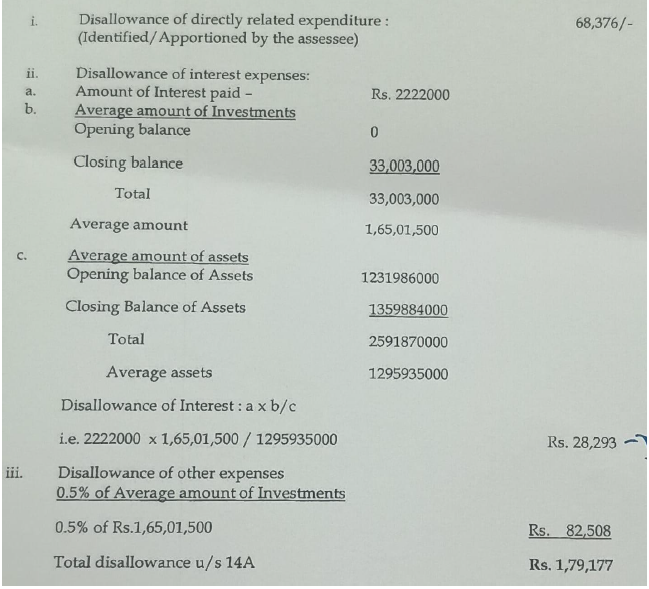
Since the assessee had already disallowed an amount of Rs. 69,086/-, the remaining balance of Rs. 1,10,091/- was added to the total income.
22. In the subsequent appeal, the asseessee contested the disallowance claiming that no disallowance was called for in respect of interest expenses, as it had not invested any borrowed funds in mutual funds which earned exempt income and once the assessee had proved the availability of own funds in excess of value of investments, then the question of disallowance of interest expenses under Rule 8D(ii) did not arise. As regard the findings of the AO that the assessee had common/mix funds for earning taxable and tax free income the AR contended that the assessee had not utilized any borrowed funds for the purpose of investments to earn exempt income and that the appellant has suo-motto disallowed proportionate interest pertaining to general borrowings. The AR further contended that mere commonality of funds by itself cannot be any ground for disregarding the claim made by the appellant and that when there are interest free and interest bearing funds available with the assessee, then one has to proceed on the basis that investments were made out of noninterest bearing funds in accordance with the law laid down by the Hon’ble Bombay High Court in the case of CIT v. Reliance Utilities & Power Ltd. The AR further contended that out of total interest cost of Rs 22,22,184/- debited to P&L A/c, only interest of Rs 72,872/- pertained to general borrowing and the balance interest of Rs 21,49,312/-was towards specific purposes and not towards any general borrowing. Accordingly, it was submitted that wherever the expenses incurred had not relationship with the income not includible in the total income, there could not be any occasion to invoke the provision for making the disallowance u/s 14A of the Act. It was further submitted that assesseehad sufficient own funds as on March 2010 in the form of share capital, General Reserve, Profit & loss account to deploy for the purpose of investment in the units of mutual funds. Its own funds exceeded the investment made in earning exempt income. The AR contended that net increase position of Reserve & Surplus is a substantial evidence of the availability of free surplus funds to invest in mutual fund.Theld.CIT(A) directed to delete the disallowance of interest expenses calculated under Rule 8D(2) (ii) of the IT Rules.
22.1 As far as disallowance of direct expenses is concerned, he noticed that the assessee had itself calculated expenses incurred in relation to such income and disallowed Rs 82,508/- and in the absence of separate books of accounts it was difficult to ascertain exact amount of expenditure incurred for earning exempt income. Under these circumstances, the only way to quantify disallowance was by invoking rule 8D(2)(iii) of Income Tax Rules, 1962.It was held that AO was right in invoking rule 8D(ii) to quantify disallowance in respect of expenses in relation to exempt income.
23. On careful consideration of the facts and in the light of the provisions of section 14A r.w. Rule 8D,we find no infirmity in the conclusion drawn by the ld.CIT(A).The appellate order is therefore, upheld and the grounds in this regard are dismissed.
24. In the result, the appeal filed by the assessee is partly allowed.
25. In final summing up, ITA No.555/Mum/2025 is allowed while ITA No.556/Mum/2025 is partly allowed.