


Cash Payments to Intermediary for Agricultural Produce Disallowed Under Section 40A(3) Lacking Direct Cultivator Status
Issue Whether cash payments exceeding prescribed limits routed through an intermediary/agent for procuring agricultural produce qualify for exception under Rule 6DD(e) as direct payments to cultivators, and whether alternative relief under Rule 6DD(k) for agency arrangements requires factual verification of the terms of agency.
Facts
-
Nature of Business: The assessee is engaged in the wholesale trade of agricultural produce as well as storage and warehousing operations for Assessment Year 2021-22.
-
Cash Payments & Intermediary: The assessee made cash payments exceeding statutory limits for procuring agricultural produce, routing the funds through an intermediary/alleged agent rather than paying the farmers directly.
-
AO’s Disallowance: The Assessing Officer (AO) proposed a disallowance of these cash payments under Section 40A(3) of the Income-tax Act, 1961.
-
Assessee’s Exemption Claims:
-
The assessee claimed protection under Rule 6DD(e), asserting that the cash payments were ultimately disbursed for purchasing agricultural produce from farmers.
-
Alternatively, the assessee invoked Rule 6DD(k), contending that the cash payments were made to an agent who was required to pay cash for goods on the assessee’s behalf.
-
Decision
-
Rule 6DD(e) Exemption: Decided in favour of revenue. Held that Rule 6DD(e) specifically requires direct payment to the cultivator, grower, or producer; routing cash through an intermediary does not satisfy this exception even if the intermediary later disburses funds to farmers [Para 8].
-
Rule 6DD(k) Agency Exception: Matter remanded. Held that applicability of Rule 6DD(k) depends on establishing a genuine agency relationship where the agent is required to make cash payments on behalf of the principal, necessitating remand to the AO for factual verification of the agency terms [Para 10].
Key Takeaways
-
Strict Construction of Rule 6DD(e): Protection under Rule 6DD(e) applies exclusively to direct transactions with cultivators, growers, or producers of agricultural produce. Cash paid to brokers, middleman, or intermediaries fails this test.
-
Burden to Prove Agency under Rule 6DD(k): To claim exception for cash payments to an agent, the assessee must demonstrate a legally binding agency arrangement requiring the agent to make cash payments for goods on their behalf.
-
Intermediary Disbursals Irrelevant for Rule 6DD(e): Sub-disbursal of cash by a third party to actual farmers after receiving payment from the buyer does not convert the original buyer-intermediary transaction into a direct payment to a grower.
IN THE ITAT JAIPUR BENCH ‘SMC’
Rekha Agarwal
v.
Income-tax Officer
T. R. Senthil Kumar, Judicial Member
and Om Prakash Kant, Accountant Member
and Om Prakash Kant, Accountant Member
IT Appeal No. 844 (JPR) of 2025
[Assessment year 2021-22]
[Assessment year 2021-22]
OCTOBER 21, 2026
Anoop Bhatia, CA and Apeksha Kalra, Adv. for the Appellant. Mrs. Aarti Rawat, Addl. CIT for the Respondent.
ORDER
Om Prakash Kant, Accountant Member. – This appeal by the assessee is directed against order dated 29.04.2025, passed by the Addl./Joint Commissioner of Income Tax, Appeal-5 Delhi (hereinafter referred to as “Ld. CIT(A)”) for assessment year 2021-22, raising following grounds:-
| 1. | On the Facts and Circumstances of the case and in the law the Ld. CIT(A) has grossly erred in upholding the disallowance of 1 Rs. 19,13,684/- under section 40A(3) of the Income Tax Act, 1961. Such addition is incorrect and against the law hence deserves to be quashed. |
| 2. | On the facts and circumstances of the case and in law the Id. CIT(A) has furthered erred in neglecting the provision of Rule 6DD of Income Tax Rules, 1962 while completing the assessment proceedings against the assessee. Therefore, such order passed in complete ignorance to the Rules is invalid, illogical and against the principal of natural justice, hence deserves to be rolled back. |
| 3. | That the assessee has a right to add/ alter/modify/ delete any or all the grounds at any time before the hearing. |
2. The dispute concerns the disallowance of ₹19,13,684 under section 40A(3) of the Income-tax Act, 1961 (“the Act”), in respect of cash payments allegedly made through Shri Pradeep Kumar for the purchase of agricultural produce from farmers. The assessee has also sought admission of additional evidence under Rule 29 of the Income-tax (Appellate Tribunal) Rules, 1963, comprising affidavits of certain farmers supporting the claim that Shri Pradeep Kumar acted as the assessee’s agent.
3. Briefly stated facts of the case are that assessee is an individual was engaged in the wholesale business of a agricultural products such as Bajra, Barley and chana and also in the business of the storage and warehousing services in name of propriety concern M/s R.K. Warehouse. The assessee filed a return of income for the year under consideration on 16.12.2021 declaring total income of Rs. 1,50,000/-.
4. The return of income was processed by the Centralized Processing Centre(CPC) under Section 143(1) of the Income Tax Act, 1961 (in short the Act) on 11.08.2022, wherein, adjustments was made invoking sub-clause (a) of clause (iv) of Section 143(1) on the ground of disallowance of expenditure incurred in the audit report but not considered while computing the total income in the return. The CPC made adjustment on the basis of tax audit report comprising of (i) disallowance of Rs. 19,13,684/- under Section 40A(3) and (ii) Rs. 45,000/- under Section 40(a)(ia) as proposed by the tax auditor in the tax audit report.
5. Aggrieved the assessee preferred appeal before the Ld. CIT(A). The Ld. CIT(A) though allowed relief in support of Rs. 45,000/- made under Section 40(a)(ia) but upheld the adjustment of Rs. 19,13,684/- in relation to Section 40A(3)., holding that the exception under Rule 6DD(e) was unavailable since the payments had been made to an intermediary rather than directly to the cultivators or producers. The relevant finding of the Ld. CIT(A) is reproduced as under:-
6.1 The appellant, an individual engaged in the wholesale business of agricultural produce such as bajra, barley, chana, and also in the business of storage and warehousing services through her proprietorship concern M/s RK Warehouse, filed her return of income for the Assessment Year 2021-22 on 16.12.2021, declaring a total income of Rs. 1,50,000/-. The return was duly verified and filed electronically.
Subsequently, the return was processed under section 143(1) of the Income Tax Act, 1961 In the intimation issued under section 143(1) on 11.08.2022, following two adjustments were made:
(i) disallowance of Rs. 19,13,684/ – under section 40A(3) and
(ii) disallowance of Rs. 45,000/- under section 40(a)(ia).
Consequently, the total income was assessed at Rs. 21,08,680/- and a demand of Rs.5,80,390/- was raised. Aggrieved with the said intimation, the appellant preferred an appeal before this forum.
The appellant challenged the additions made by CPC on multiple grounds, mainly contending that the disallowances were made without providing an opportunity of being heard, that the payments in cash fell within the permissible exceptions under Rule 6DD, and that no default was committed warranting disallowance under section 40(a)(ia) of the Act.
During the course of appellate proceedings, the appellant explained that the disallowance of Rs. 19,13,684/- under section 40A(3) arose due to cash payments made to one Mr. Pradeep Kumar, who acted as an agent for purchasing agricultural produce from farmers. It was contended that although the payments were made in cash exceeding the permissible limit of Rs. 10,000/- per day per person, the payments were ultimately meant for farmers, and hence fell within the exception
provided under Rule 6DD(e) of the Income Tax Rules, 1962. An affidavit of Mr. Pradeep Kumar and a list of farmers were also furnished in support. INCOME OTMEN
In this regard, it is apt to mention here that as per the provisions of section 40A(3) of the Act, where an assessee incurs any expenditure and payment or aggregate of payments made to a person in a day otherwise than by an account payee cheque, bank draft, or prescribed electronic mode exceeds Rs. 10,000/-, no deduction shall be allowed in respect of such expenditure. The intention behind this provision is to curb cash transactions and promote transparency in business dealings.
However, Rule 6DD of the Income Tax Rules provides specific circumstances where such disallowance shall not apply. Rule 6DD(e) provides exemption for payments made to the cultivator, grower, or producer of agricultural produce.
In the present case, it is evident from the submissions and documents furnished that the cash payments were made to Mr. Pradeep Kumar, who acted as an intermediary and not as a cultivator or producer. The exemption under Rule 6DD(e) is strictly applicable only where the payments are made directly to the farmer, cultivator, or producer. Payment made to an agent or intermediary cannot claim the protection under Rule 6DD(e). Thus, the case of the appellant does not fall within the ambit of the exceptions provided under Rule 6DD.
Further, the Hon’ble Apex Court in various judgments has emphasized strict interpretation of exemptions in fiscal statutes. Since the appellant did not make direct payment to farmers but through an agent, the conditions of Rule 6DD(e) are not fulfilled, and therefore, the disallowance made under section 40A(3) amounting to Rs. 19,13,684/- is legally justified. This ground of appeal is dismissed.
6. Before us, the learned counsel submitted that the payments were made to Shri Pradeep Kumar, who had acted as an agent in procuring agricultural produce from farmers and had, in turn, distributed the amounts to them. It was contended that the payments were covered by Rule 6DD(e) of the Income-tax Rules, 1962. Alternatively, the assessee invoked clause (k) of the said Rule, which provides an exception for payments made to an agent who is required to make cash payments for goods or services on behalf of the assessee. In support of this alternative plea, the assessee furnished additional evidence, including affidavits of certain farmers as follows:
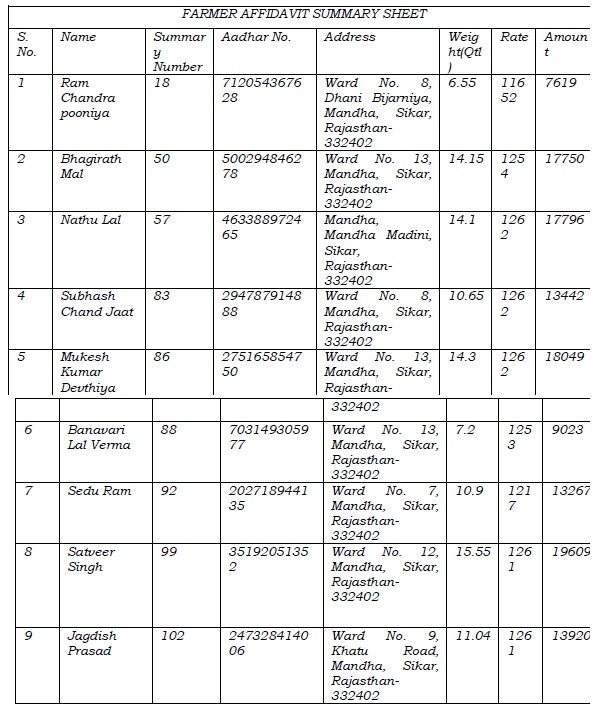
7. The learned Departmental Representative submitted that the nature of the relationship between the assessee and Shri Pradeep Kumar, including the alleged agency arrangement and the commission amount, if any, paid to him, required verification by the Assessing Officer.
8. We have heard the rival submissions and perused the material available on record. The contention that Rule 6DD(e) extends to payments made indirectly to cultivators through an agent cannot be accepted. The clause specifically contemplates payment for the purchase of the specified produce to the cultivator, grower or producer. The mere assertion that an intermediary subsequently disbursed the money to the farmers does not, by itself, bring the payment within this exception. The claim under Rule 6DD(e) is, accordingly, rejected.
9. The alternative claim under Rule 6DD(k), however, stands on a distinct footing. The applicability of this clause depends upon whether Shri Pradeep Kumar was, in fact, the assessee’s agent and was required to make cash payments for goods on her behalf. The additional evidence furnished by the assessee, including the farmers’ affidavits, requires examination along with the relevant books of account, the alleged agency arrangement and other supporting material. These aspects have not been verified by the Assessing Officer. In the interests of justice, the alternative claim requires fresh examination.
10. Accordingly, we set aside the impugned order to the extent of the disputed disallowance and restore the issue to the file of the Assessing Officer for the limited purpose of examining the assessee’s claim under Rule 6DD(k), after considering the additional evidence admitted by the Tribunal and such other relevant material as may be furnished. The Assessing Officer shall verify the genuineness and terms of the alleged agency arrangement, the nature of the payments and whether the conditions prescribed under the said clause are satisfied. The assessee shall be afforded a reasonable opportunity of being heard. Our observations on Rule 6DD(e) shall govern the rejection of that specific plea; the alternative claim under Rule 6DD(k) shall be decided independently in accordance with law.
11