


-
The assessee is a banking company maintaining its accounts in compliance with the Banking Regulation Act, and the correctness of these accounts was not disputed.
-
The assessee earned income exempt from tax and asserted that no expenditure was incurred or claimed towards earning such exempt income.
-
The Assessing Officer noted that the assessee possessed sufficient/adequate surplus funds available in its hands.
-
Despite the availability of surplus funds, the Income Tax Appellate Tribunal directed the Assessing Officer to apply Section 14A read with Rule 8D to compute a proportionate disallowance of expenditure related to the exempt income.
-
The court held that given the Assessing Officer’s finding that the assessee had sufficient/adequate surplus funds, there was no justification for making any disallowance under Section 14A.
-
It was decided that under such circumstances, it was not open to the Revenue Department to estimate or attribute expenditure to the earning of exempt income.
-
Consequently, the impugned order of the Tribunal was set aside in favor of the assessee.
-
Presumption of Interest-Free Funds Usage: If an assessee possesses non-interest-bearing surplus funds exceeding the investments yielding exempt income, a legal presumption arises that the investments were made out of those interest-free surplus funds.
-
Restriction on Estimation: The Revenue cannot mechanically apply Section 14A read with Rule 8D to estimate disallowances when adequate self-owned/surplus funds are demonstrated.
-
Prerequisite of Satisfactory Findings: Assessing Officers cannot make ad-hoc or rule-based proportionate disallowances without disproving the availability and deployment of an assessee’s sufficient interest-free surplus funds.
Whether on the facts and in the circumstances of the case, the Income Tax Appellate Tribunal was right in holding that the deduction u/s 80M should be worked out applying Rule 80D read with Section 14A without appreciating that it was not applicable for the dividend income for the Assessment Year under consideration, instead of upholding the Assessing Officer’s action in working out the expenditure to be deducted on the basis of the Supreme Court’s decision in 200 ITR 478?
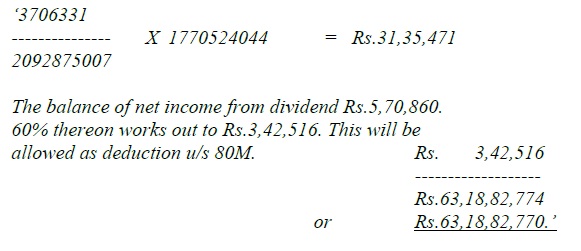
12.3 . I have carefully considered the submissions thus made by the appellant. This issue too has been discussed at length in the appellate order for the assessment year 199091. It has been held in the said order that the stand taken by the Assessing Officer that deduction u/s 80M could be allowed only in respect of the net dividend is correct. In the case of Distributors (Baroda) P. Ltd. v. Union of India and others, 155 ITR 120, the Hon’ble Supreme Court had categorically held that the deduction required to be allowed under the provisions of section 80M(1) had to be calculated with reference to the amount of dividend computed in accordance with the provisions of the Act and forming part of the gross total income, and not with reference to the full amount of dividends received by an assessee. Therefore, there is no scope for any debate that deduction u/s 80M will have to be computed only with reference to net dividends and not the gross. The appellant’s argument that in the case of Commissioner of Income-tax v. Union General Trust Ltd. 200 ITR 488, only managerial expenses had been held to be netted from the gross dividends is not correct. The only issue before the Hon’ble Court in the above case was whether any portion of the managerial expenses could be attributed to dividends and accordingly could be deducted from the gross dividends in order to arrive at the net dividends. The court did not have any occasion to look into the other expenses. It was only in this context that the Hon’ble Court had ruled on the deductibility of managerial expenses alone.
12.4 . In view of the foregoing, I would hold that the Assessing Officer was perfectly justified in considering disallowance of expenses with reference to the dividends claimed for deduction u/s 80M. However, the moot question is how much of the expenses could be said to have been incurred by the appellant for earning the dividends. Only such expenditure as could be related to the dividends on the ground of having been wholly and exclusively laid out could be disallowed u/s 57(iii). Earlier on, while dealing with the subject of proportionate disallowance of expenses relatable to interest on tax-free securities, it has been seen that the appellant had substantial interest-free funds at its disposal and, therefore, no part of the interest-bearing borrowals could be said to have been used for making investments in shares. In the circumstances, no financial expenditures could be attributed to the dividends claimed u/s 80M. Coming to the managerial expenses, I find merit in the appellant’s submission that as the dividend warrants involved were negligible in number and the vouchers transacted were also very few, the managerial expenses attributable would also be negligible. However, as the appellant itself has offered the attributable expenses to be taken at 2% of the dividends, which offer must be regarded as reasonable, the attributable expenses are hereby directed to be taken at 2% of the dividends. The Assessing Officer shall recompute the deduction admissible to the appellant u/s 80M accordingly.
It was claimed that the exempted investment held in shares and MF as on 31/03/1996 was Rs.20.86 Cr, from out of total investments of Rs.407 Crores which constitute 5.12% of total investments. The bank was having own funds by way of equity capital of Rs.89 crores and demand deposit of Rs.272 crores. Therefore, equity and demand deposits was more than the investment in exempted investments. Hence, no disallowance is warranted on proportionate expenses on earning exempted income as held by Hon’ble Supreme Court verdicts in South Indian Bank case Supra and requested to delete the addition made. Out of the total disallowance of Rs.22,23,799/-, already an amount of Rs.21,79,323/- was given relief in the giving effect order. Hence, the balance of Rs.44,476/- is to be allowed. ‘
’18. Substantial question arising in TCA.Nos.293, 294 & 295 of 2010 (AY 1996-97, 1997-98, 1998-99) and admitted on 16.08.2010:
Whether on the facts and in the circumstances of the case, the Income Tax Appellate Tribunal was right in not dealing with the disallowance of a sum of [as follows] as proportionate expenditure related to tax-free bonds deleted by the Commissioner of Income Tax (Appeals)?
A.Y. 1996-97 :Rs.2,24,38,091/-
A.Y. 1997-98 :Rs.3,35,46,751/-
A.Y. 1998-99 :Rs.7,38,81,028/-
19. As both parties agree that this question is to be answered in favour of the assessee in light of the judgment in South Indian Bank Ltd6, this question is answered in favour of the assessee.’